Nobel Prize goes unnoticed

You might think that an organisation which is at least partly British being awarded the Nobel Peace Prize would be news in the UK. If it had been for Chemistry or Medicine or Literature it would certainly have made the headlines on the BBC and at least in the more serious of our newspapers. But I can’t recall hearing anything about the 2017 Nobel Peace Prize. Nor for that matter about the achievement which gained it for ICAN, the United Nations global nuclear ban treaty, already signed by 122 nations.


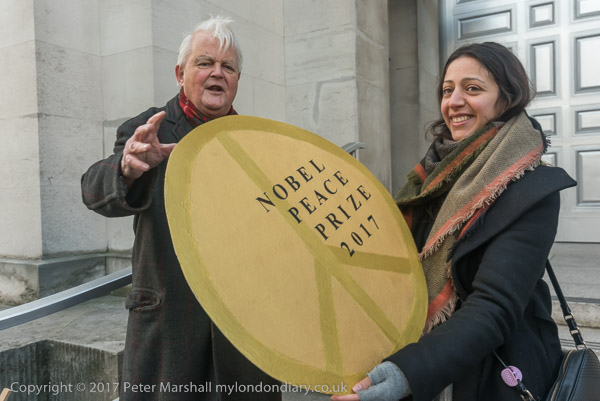
Bruce Kent presents a rather large Nobel Prize to ICAN

ICAN, the International Campaign to Abolish Nuclear Weapons, has been as effectively blanked by UK media as if it was covered by a government ‘D notice’. First introduced in 1912, D-Notices were official requests to news editors not to publish or broadcast items on specified subjects for reasons of national security. They still exist, though in the 1990s they became DA-Notices and are now DSMA-notices (Defence and Security Media Advisory Notices) and come under five headings. It’s just possible that this Nobel Prize might be covered by an advisory note under DSMA-Notice 02: Nuclear and Non-Nuclear Weapon Systems and Equipment but rather more likely that it simply reflects an establishment prejudice against the UK organisations involved. And in any case, D-Notices are only advisory, and when it suits them newspapers and even the BBC have ignored them.

For some of our newspapers and their billionaire owners anyone not entirely gung-ho about nuking Russia even if it might mean the end of the world as we know it is some kind of commie sandal-wearing jesus-loving hippie freak. And probably gay to boot.


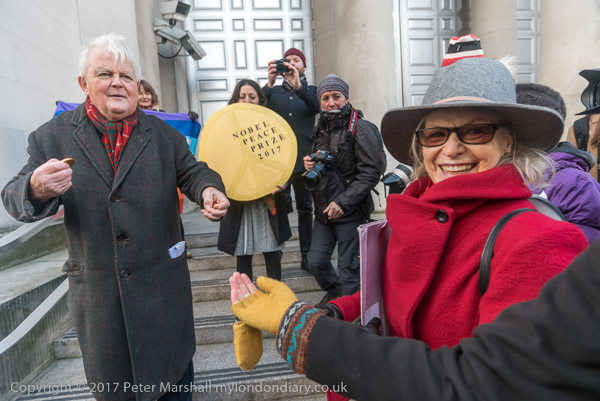
And hands out smaller chocolate ones to the rest of those present

Among those UK organisations which are a part of ICA are CND, which has campaigend since the 1950s for the UK to unilaterally give up its nuclear capability, Medact, a UK charity of health professionals working on issues related to economic justice, ecological health, human rights, and peace, and WILPF, the Women’s International League for Peace and Freedom.

Fifty years ago, when CND was something of a mass movement, the UK government attempted to counter its arguments for unilateral nuclear disarmament by saying that of course they were against nuclear weapons too, but that they wanted not a unilateral disarmament that would leave Britain at the mercy of the remaining nuclear powers, but a multilateral treaty involving the world giving up nuclear weapons. But now the UN has come up with this, our government – and the other nuclear powers – will have nothing to do with it. Not only have the UK refused to sign it, they refused to take any part in the negotiations that led to it.

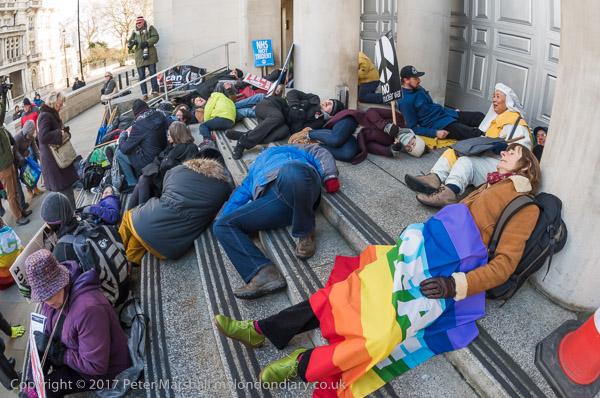
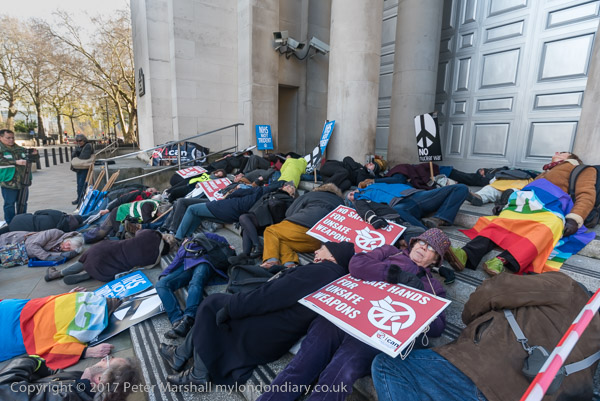
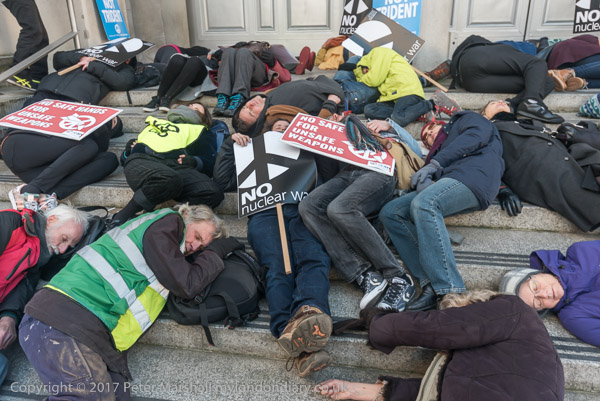
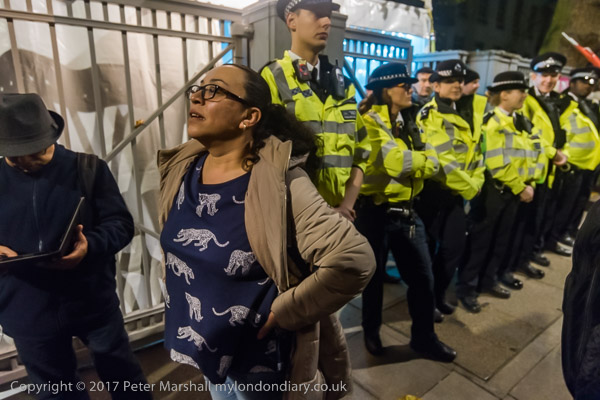
Given the lack of acclaim for the award in the media, CND and the others decided to hold their own mini-awards ceremony on the steps of the Defence Minsitry, along with a die-in, and called on the UK to abandon Trident and sign the nuclear disarmament treaty.

As the die-in approached, I decided to change from the 28-200mm to the 16mm fisheye so that when people started to get down on the ground I had two wide-angle options, with the 18-35mm on the other camera. I didn’t want to actually get in the area with those taking part, because I find it extremely annoying when other photographers do this, standing up in the middle of everyone who is on the floor and getting in everyone else’s pictures, but decided I could run up the side of the steps at the edge of those in the die-in.  Mostly too I would be behind a pillar and largely hidden from those photographers who had stayed at the bottom of the steps.

I was fortunate that one of the protesters there had wrapped herself in a peace flag, as you can see from the picture at the top of this post. Unusually for me this is an uncorrected fisheye image. I think because the steps themselves are not particularly curved the curvature of the elements around the edges of the picture is less disturbing. In any case, when you work with the camera not level, converting to cylindrical perspective gives steeply converging (or diverging) verticals which often is not a good to see. If the effect is only slight then that too can be corrected, but then you start to crop the picture, losing some of its wide impact.

When I’d taken a few pictures there, I came down to get a view across in a diagonal, which helped to give an impression of a fairly large number of people. From the bottom of the steps the numbers looked rather thinner, and I changed back to the longer lens to concentrate on details rather than the whole scene.

ICAN Nobel Peace Prize Die-In

______________________________________________________

There are no adverts on this site and it receives no sponsorship, and I like to keep it that way. But it does take a considerable amount of my time and thought, and if you enjoy reading it, a small donation – perhaps the cost of a beer – would be appreciated.

My London Diary : London Photos : Hull : River Lea/Lee Valley : London’s Industrial Heritage

All photographs on this and my other sites, unless otherwise stated, are taken by and copyright of Peter Marshall, and are available for reproduction or can be bought as prints.

To order prints or reproduce images

________________________________________________________

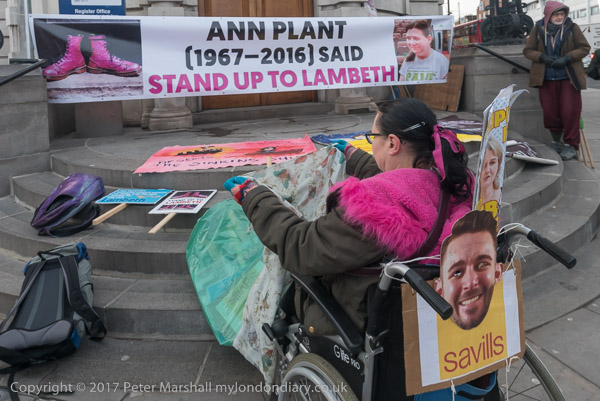
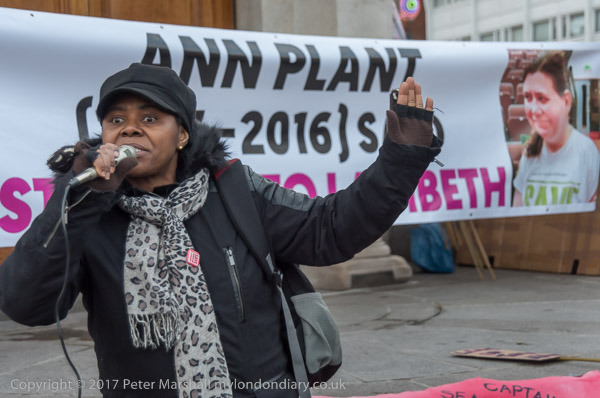
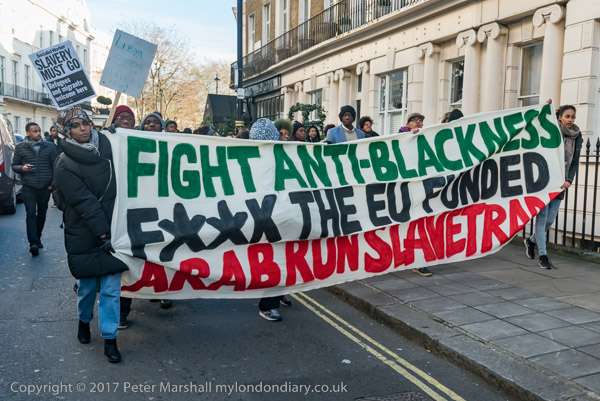
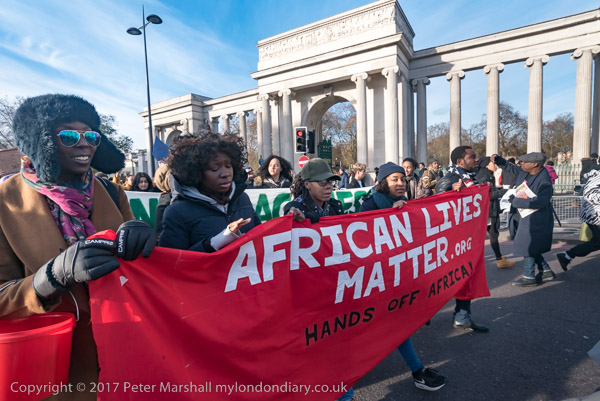
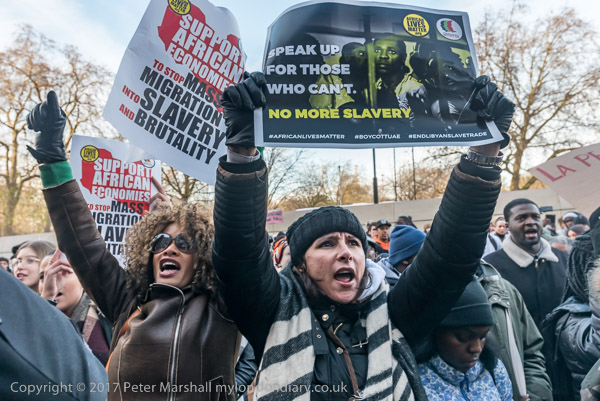
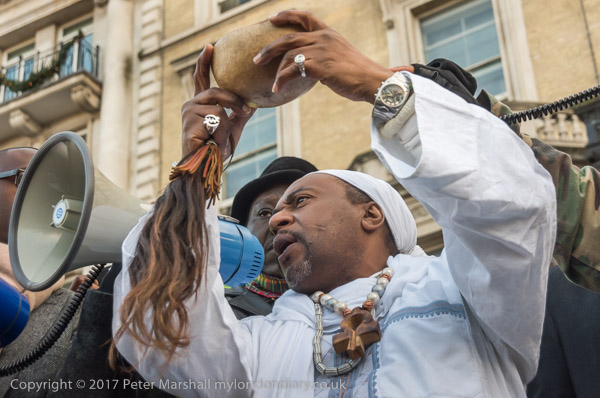
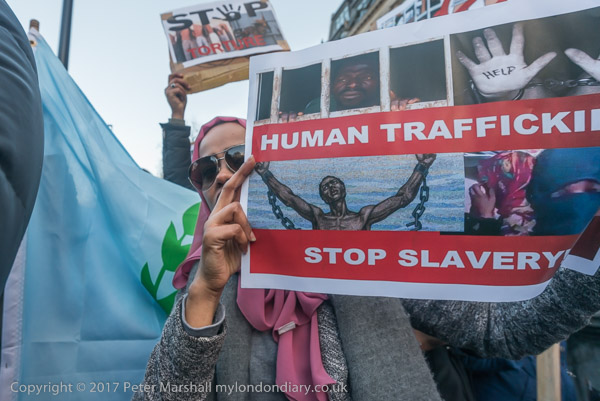
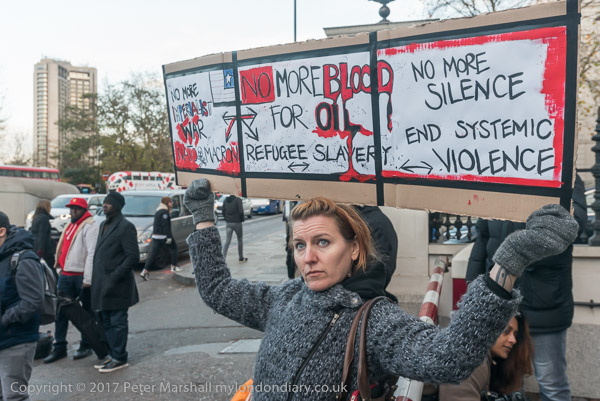
Slavery in Libya

It comes as a shock to learn that slave auctions still take place, and that Black Africans are still being bought and sold. One of so many things we like to think of as no longer taking place in the modern world, but which are still going on.

Slavery was found inconsistent with common law here in the UK in 1772 and trading in slaves made illegal in the British Empire in 1807, though another act was needed to officially abolish slavery throughout the British Empire in 1833, and it continued in some parts for another few years. The world’s first international human rights society, the British and Foreign Anti-Slavery Society, was formed here in 1839 (and continues now as Anti-Slavery International. But slavery has continued around the world, and even in the UK the National Crime Agency says there may be “tens of thousands” of victims of modern slavery and trafficking now.

Slavery has a long history in Libya into modern times, but has changed following the overthrow of Gaddafi by NATO-led forces, since when the country has been in disorder. Both Black Libyans and migrants on their way to Europe through Libya have been targeted, including those taken back to Libya while making the Mediterranean crossing and put into camps. Captured by people smugglers or militias they are often tortured to try and extract money from their families, and may be sold as slaves.

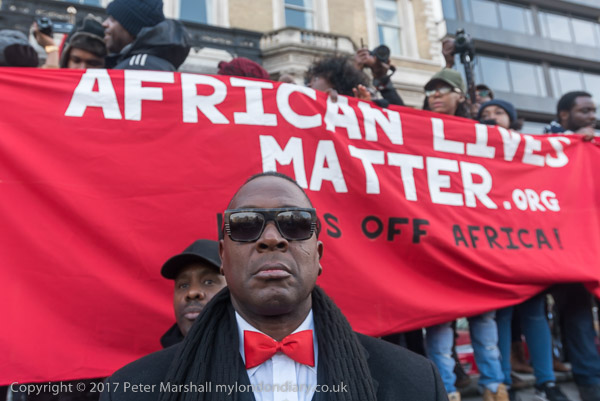
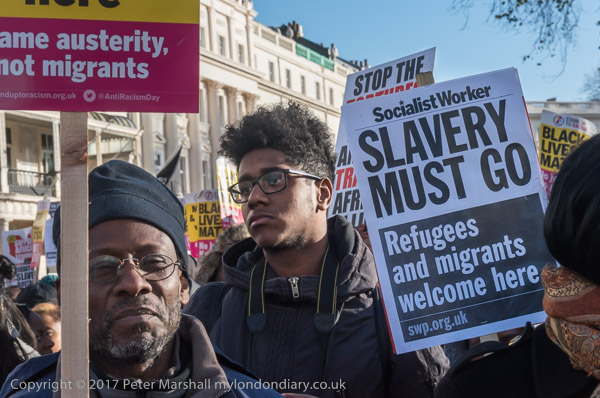
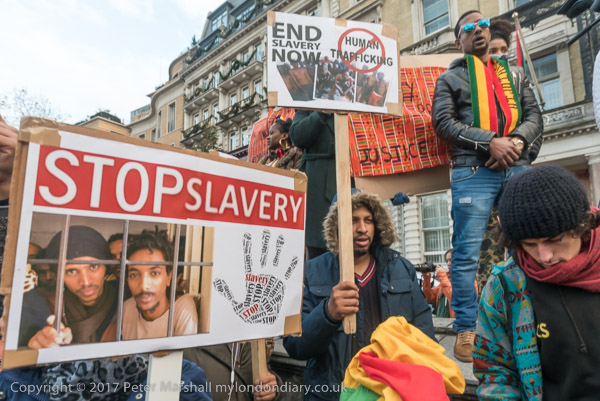
Reports about the slave auctions had leaked out and led to complaints by some African governments, but it was the leaking of videos of the auctions that led to large-scale protests in France and to hundreds of people at this protest outside the Libyan embassy in London.

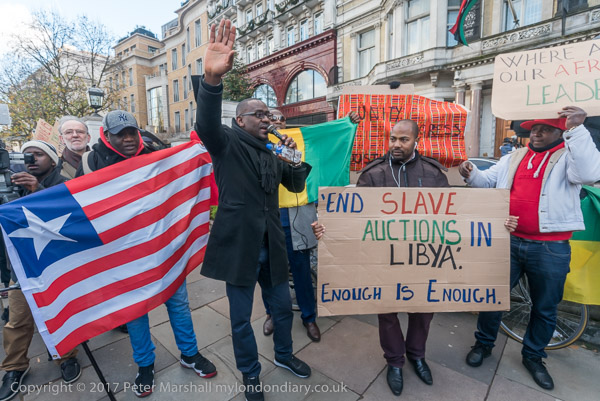
The narrow pavement of Knightsbridge outside the Libyan Embassy soon became very full, spilling out onto the road, which was almost blocked by the time I left. Many of those at the protest were Black, and some carried flags of African nations.

Although there have been reports about the terrible conditions in the Libyan camps and the slave auctions for some months, little has appeared in the Western press, and many see the Western intervention to remove Gaddafi as part of a wider continuing neo-colonialist attempt to control Africa’s natural resources. They complain the west and those it has put into power in Libya are engaged in a process of de-Africanisation and elimination of Black Libyans and that the slave auctions are a logical extension.

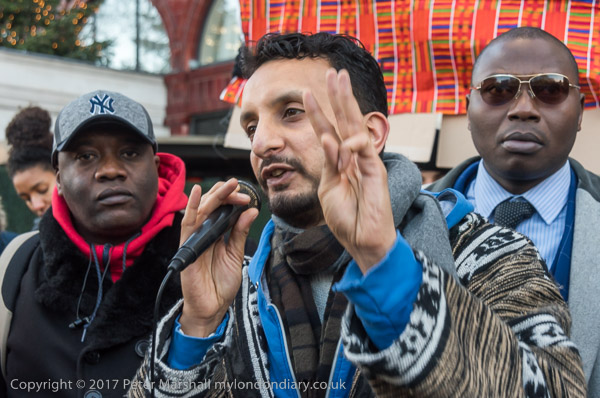
Although I was able to photograph those at the centre of the protest, the crowding made it difficult to move around as the numbers at the event grew, and many of my pictures show the same small number of people, particularly those who had brought national flags and who spoke at the event.

More at: End Slave Auctions in Libya
______________________________________________________

There are no adverts on this site and it receives no sponsorship, and I like to keep it that way. But it does take a considerable amount of my time and thought, and if you enjoy reading it, a small donation – perhaps the cost of a beer – would be appreciated.

My London Diary : London Photos : Hull : River Lea/Lee Valley : London’s Industrial Heritage

All photographs on this and my other sites, unless otherwise stated, are taken by and copyright of Peter Marshall, and are available for reproduction or can be bought as prints.

To order prints or reproduce images

________________________________________________________

London University Workers Protest

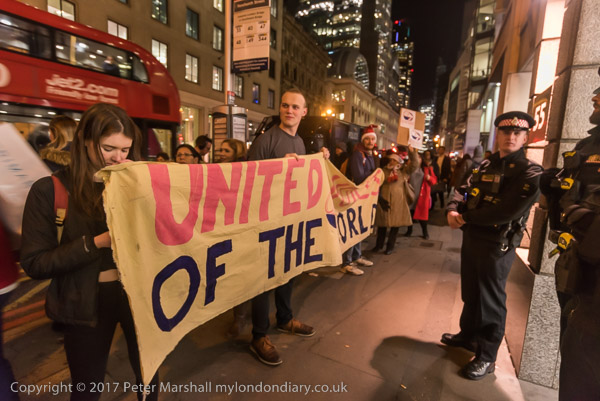
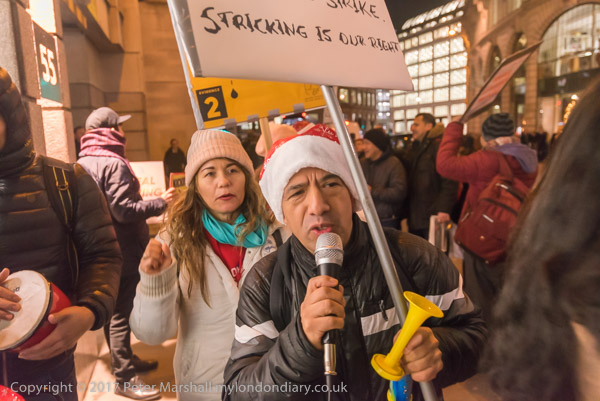
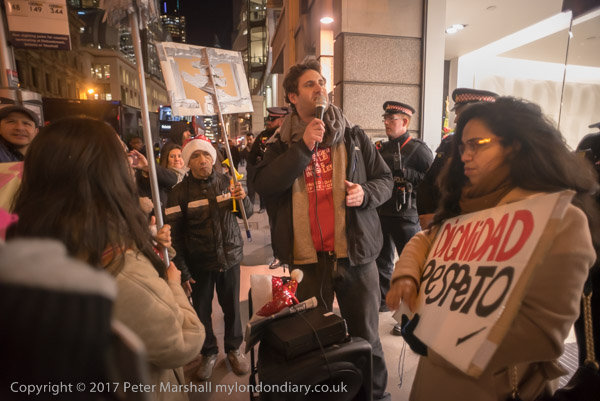
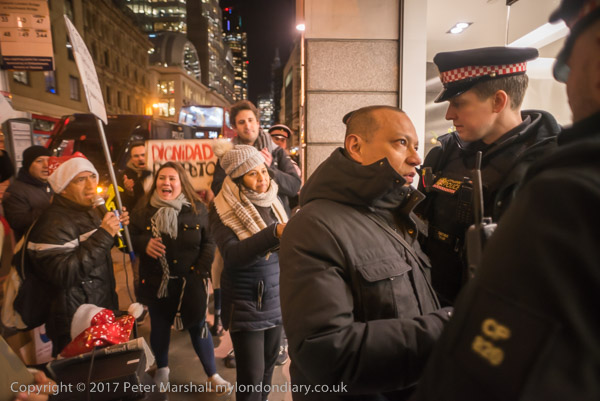
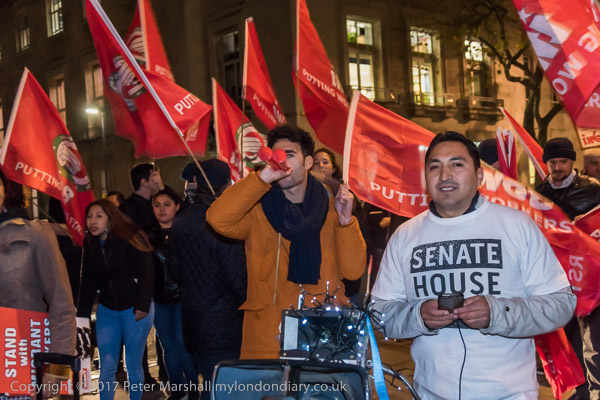
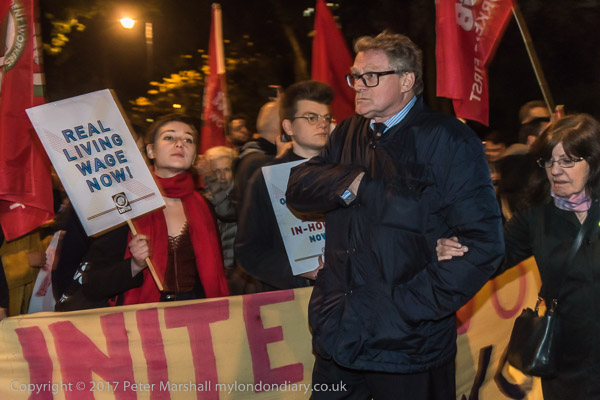
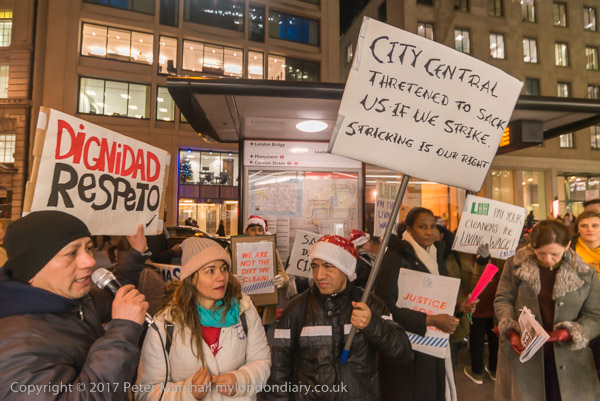
Workers at the University of London protest outside Senate House while University of London Chancellor Princess Anne was visiting on Foundation Day, calling for all workers in the university to be directly employed by the university. People attending the event had to walk past a noisy crowd, though Princess Anne was sneaked in through another entrance.
They call on the university to play fair by the workers whose services are vital in keeping the university working rather than abandon them to the poor conditions and bad management of companies who get contracts as the lowest bidders. They underpay and overwork staff, often fail to supply proper equipment and materials to do the job, and bullying the staff who are generally employed on the statutory minimum legal conditions, far inferior to those offered by any responsible employer, often on zero hours contracts. Staff doing similar jobs directly employed by the university get much better treatment with proper contracts and far superior conditions of service.

The university sets the contracts and could insist on proper conditions and pay, but generally seems to disclaim any responsibility for these staff, though as a result of the continued campaign has stated it is considering direct employment for some of these workers. But both London university and Cordant who employ the security staff refuse to recognise the IWGB or have proper talks with them.
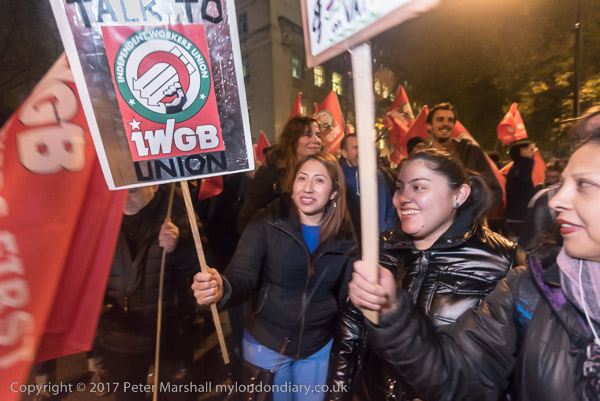
Security workers belonging to the IWGB (Independent Workers Union of Great Britain) were on the latest of a series of one-day strikes, and at the end of the working day their picket was joined by supporters for a noisy protest. People attending the event had to walk past some noisy protesters on their way in, though there was no attempt to stop them.

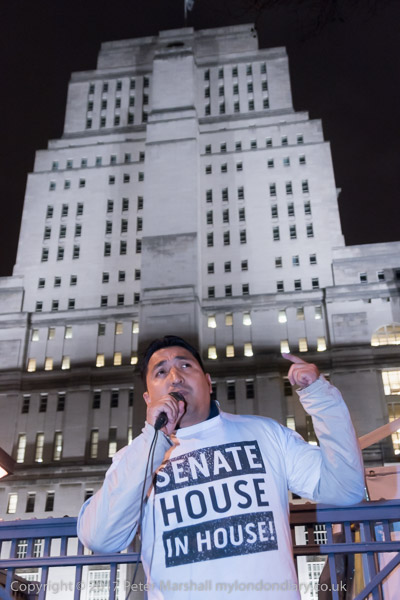
The pavement outside the main gates to Senate House is poorly lit and except for a small area close to the gates I needed to add some light for most pictures. Because there was quite a lot of movement I used flash rather than the LED light source.

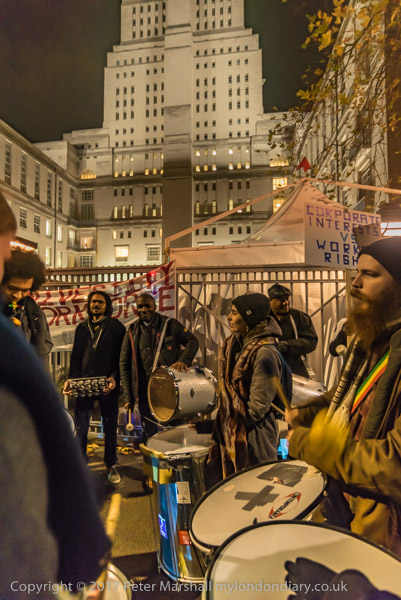
There were some large differences in colour temperature between the street lighting, the floodlighting on Senate House, the temporary lighting around the security entrance and my flash, with the occasional flashing blue from a police car adding to the palette.

For some pictures I’ve used Lightroom to selectively change the colour of parts of the images, making local adjustments to temperature and tone, though others I’ve left as they were made. The picture of IWGB President Henry Chango Lopez speaking in front of a floodlit Senate House above needs correction to give a more natural skin tone. Deep yellow sodium street lights and police blue lights are too monochromatic to allow correction.

IWGB protest London Uni outsourcing
______________________________________________________

There are no adverts on this site and it receives no sponsorship, and I like to keep it that way. But it does take a considerable amount of my time and thought, and if you enjoy reading it, a small donation – perhaps the cost of a beer – would be appreciated.

My London Diary : London Photos : Hull : River Lea/Lee Valley : London’s Industrial Heritage

All photographs on this and my other sites, unless otherwise stated, are taken by and copyright of Peter Marshall, and are available for reproduction or can be bought as prints.

To order prints or reproduce images

________________________________________________________

Islington in the Dark

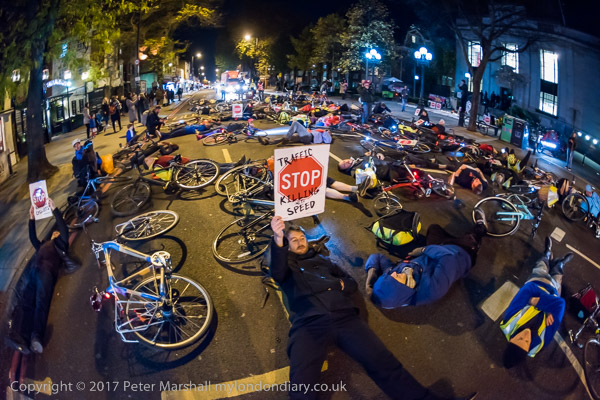
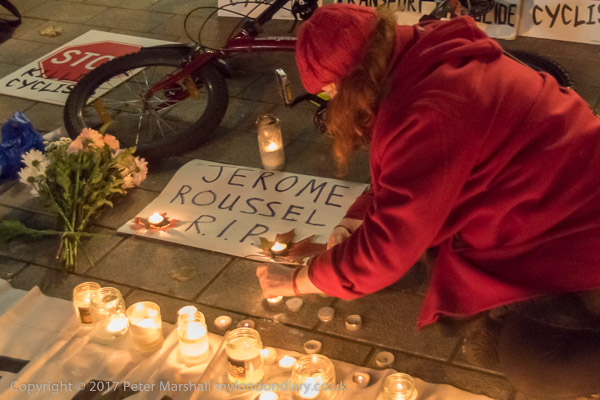
Another cyclist dies, killed on a main road on his way to work when a van drove into him on a mandatory cycle lane.  Roads like the Pentonville Rd need protected cycle paths, and Islington has not built a single protected cycle route in over 20 years.

Vigil for Islington cyclist killed by HGV

It really is time to get moving on better facilities for cyclists, which would not only stop deaths like this, but also encourage more people to get on their bikes for some healthy exercise, at the same time helping to reduce London’s terrible levels of air pollution and reduce congestion.  Everybody wins from getting more people to cycle safely on our roads – even those black cab drivers who lobby against it.

And of course long past time when vehicles designed with highly restricted driver vision were allowed to be built and to drive on our roads. Better mirrors and, where necessary built-in CCTV, would prevent these deaths.  It wouldn’t be difficult to improve vehicle design and not very expensive to make them safe.

But we continue to suffer from years of a failure to invest properly in facilities for cyclists – and we all suffer, whether pedestrians, cyclists or motorists. Stop Killing Cyclists are doing a great job in bringing the issues to greater attention through events such as these, and through the detailed studies that they and others associated with them make to lobby the London Mayor, Transport for London and others.

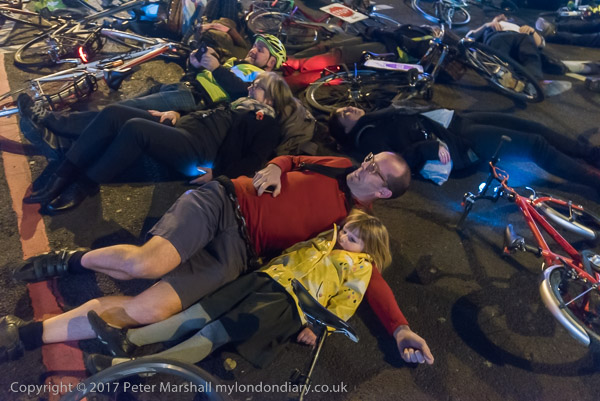
As usual there were a series of speeches followed by a die-in, with police holding up traffic to allow this short protest to take place. Police do seem to have developed a greater appreciation of the problems faced by cyclists now that a number of them patrol on push bikes.

I’d like to see our driving tests have a cycling proficiency test as a prerequisite – with those medically certified as unable to ride a bicycle or tricycle being allowed to qualify in some kind of virtual reality.  Back many years when I rode in France, driver behaviour towards cyclists seemed so much better, perhaps because many more French drivers had cycling experience.  Not only might it improve attitudes towards cyclists, but I think would be a safer and cheaper way of learning how to use our roads sensibly. But this is probably one of those common sense ideas that is totally impracticable.

The protest took place outside Islington Town Hall, not far from where the death occurred.  I don’t think it is sensible to call any of these deaths accidents when there are so many reasons why they happen.

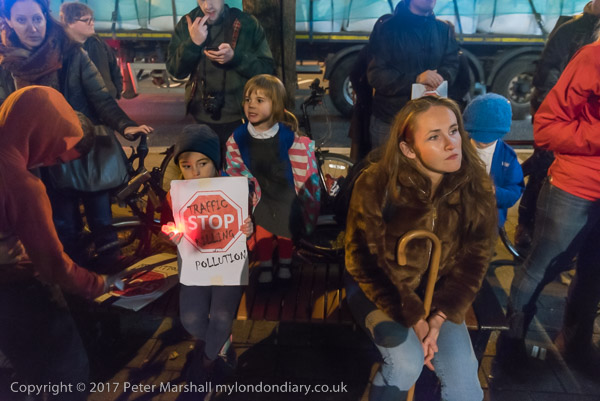
It’s surprising how dark it can be just a few yards from a major road in London. I struggled with light levels  as you can see in the pictures. For some I used the LED light, but most relied on whatever ambient there was, with just a couple where flash seemed the only possibility. Particularly when photographing candle-lit vigils like this it’s important to try and retain the feeling of the lighting, but candles seldom really give quite enough light, especially if there is any movement.

Candle flames are also pretty bright in themselves, and an exposure which retains detail in them often is just too underexposed over most of the frame. The D750 and D810 do a pretty good job, but it isn’t always possible or entirely predictable, and the preview on the camera back doesn’t work quite well enough to let you know which highlights can be recovered in Lightroom.

Colour temperature is also a problem, and I should have remembered to use the amber filter on the LED, which is roughly daylight balanced, to bring it closer to the candles. It doesn’t matter too much what white balance you set the camera to when working in RAW files, as this can be adjusted later. I think I had the D810 set on Auto WB and the D750 on ‘Tungsten’  and can see no real difference in the adjusted images.

Vigil for Islington cyclist killed by HGV

____________________________________________

On my way back to the station I stopped to talk with a friend outside the squatted bank and was invited in and took a few pictures.

Groups like this are important both in bringing attention to homelessness when we have so many empty buildings, and also providing at least short term shelter to a few of the homeless. It would make sense to change laws on empty properties to persuade their owners bring them back into use, or allow councils to compulsory purchase them.

ORAL Squat empty NatWest Bank

______________________________________________________

There are no adverts on this site and it receives no sponsorship, and I like to keep it that way. But it does take a considerable amount of my time and thought, and if you enjoy reading it, a small donation – perhaps the cost of a beer – would be appreciated.

My London Diary : London Photos : Hull : River Lea/Lee Valley : London’s Industrial Heritage

All photographs on this and my other sites, unless otherwise stated, are taken by and copyright of Peter Marshall, and are available for reproduction or can be bought as prints.

To order prints or reproduce images

________________________________________________________

Class War Return to the Ripper

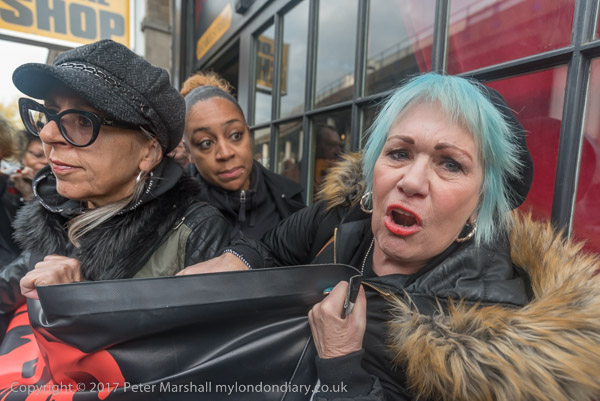
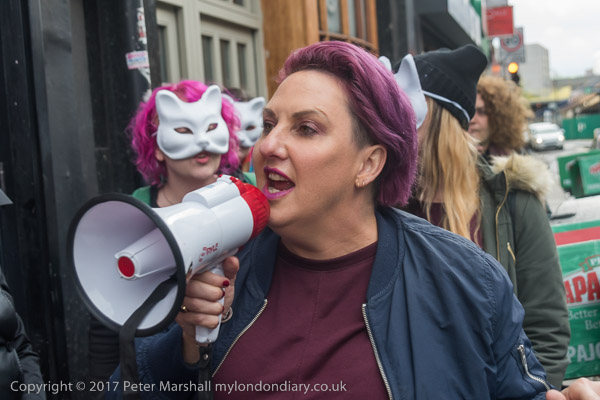
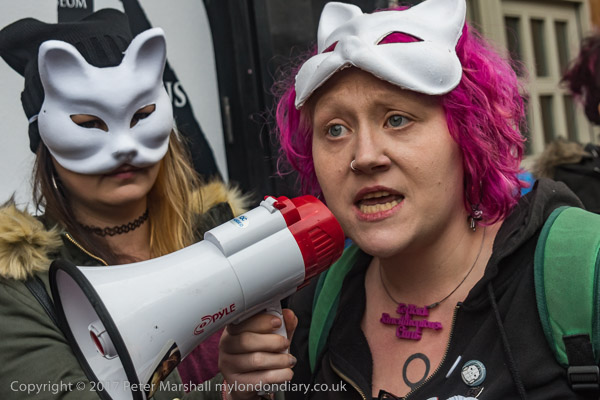
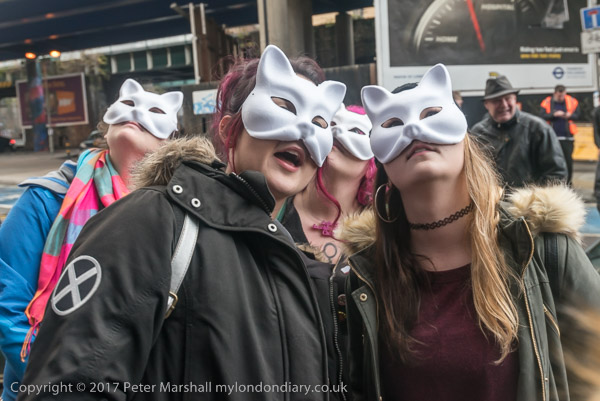
Class War and London 4th Wave Feminists protested again outside the Jack the Ripper tourist attraction in East London, calling for it to close. They say the so-called ‘museum’ exploits violence against women, making money from images of sexually mutilated women, and encourages attitudes that lead to violent sexual assaults.

One of the women taking part in the protest had recently called the police after finding a 17-year old woman collapsed at her doorstop who had been raped several times on the streets.  Tower Hamlets council has found the shop in breach of planning applications over its shutters and signage but has failed to enforce its decisions.

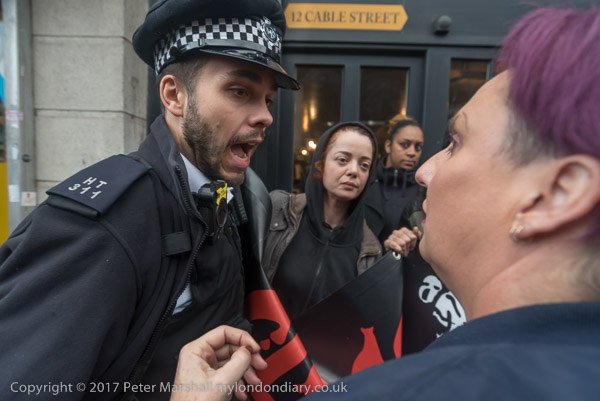
It was a difficult protest to photograph because the pavement outside the shop is narrow and a car was parked in front restricting access. Police were trying to keep a clear way through past the shop, and, together with the two female security staff specially brought in by the shop, trying to make it easy for customers to enter and leave the premises.

As can be seen from the picture at the top of the post, there was a considerable amount of pushing by the security staff at times, and also some angry reactions from a few customers. Considering it was a Saturday afternoon there seemed to be very few of them, and I think some stopped and listened to the protest and turned away. Most tried to avoid the eyes of protesters as police and security took them in or out.

There were several short speeches about the reason for the protest, the failure of the local authority, the lives of the victims and the attacks on women which still take place in this area as everywhere else. Violence against women is a problem across the world, and the protesters pointed out to the police that they were failing in their duty to protect women from it while coming to protect tourist attractions which promote and allow people to come and take a prurient, unhealthy interest in it.

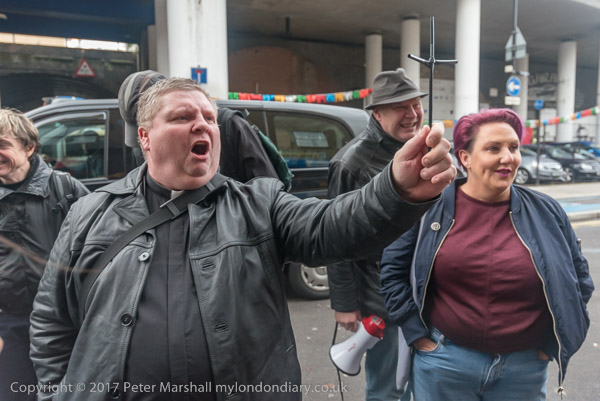
There were some heated arguments with the police, and Patrick, playing the part of ‘Father Brannigan’ continued to call out the demons with the aid of a rather makeshift cross.

After an hour or so of protest, the group retired to a nearby pub, and I was about to leave when the police raided the place, coming in to arrest a trans-gender woman alleged to have assaulted an anti-trans activist during a protest at Hyde Park in September.  She has pleaded not guilty and her trial opens shortly.

I was obstructed by a member of the bar staff who showed me her warrant card as a special constable while attempting to follow the police as they left and she later tried to stop me taking pictures on the pavement outside. I’m pleased to say that the police officer in charge told her to stop, telling her that I was quite entitled to photograph what was happening.  I decided at the time I would not post these pictures until after the case had ended or been dropped.

More pictures at: Class War back at the Ripper

______________________________________________________

There are no adverts on this site and it receives no sponsorship, and I like to keep it that way. But it does take a considerable amount of my time and thought, and if you enjoy reading it, a small donation – perhaps the cost of a beer – would be appreciated.

My London Diary : London Photos : Hull : River Lea/Lee Valley : London’s Industrial Heritage

All photographs on this and my other sites, unless otherwise stated, are taken by and copyright of Peter Marshall, and are available for reproduction or can be bought as prints.

To order prints or reproduce images

________________________________________________________

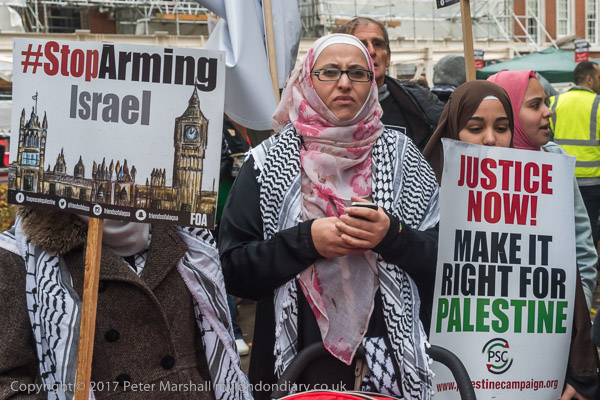
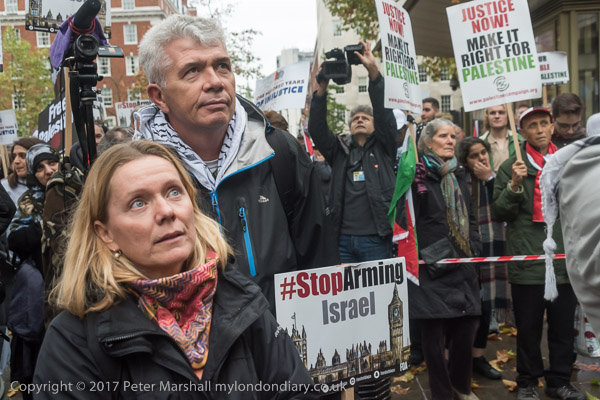
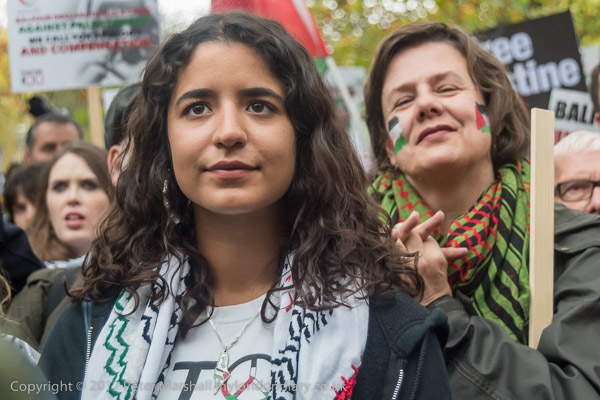
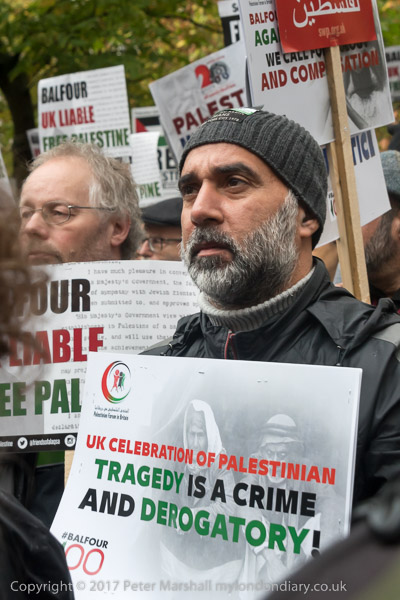
Justice for Palestine

A protest took place during the celebrations to mark the 100th anniversary of the Balfour declaration, a letter written on November 2nd, 1917 and signed by the
United Kingdom’s Foreign Secretary Arthur Balfour to Lord Rothschild, a leader of the British Jewish community, for transmission to the Zionist Federation of Great Britain and Ireland:

“His Majesty’s Government view with favour the establishment in Palestine of a national home for the Jewish people, and will use their best endeavours to facilitate the achievement of this object, it being clearly understood that nothing shall be done which may prejudice the civil and religious rights of existing non-Jewish communities in Palestine, or the rights and political status enjoyed by Jews in any other country”.

The protest which marched from a rally outside the US Embassy, then still in Grosvenor Square, was to point out that although the state of Israel had been established, the second half of the declaration had sadly never been taken seriously, and both the civil and religious rights of existing non-Jewish communities in Palestine have virtually entirely neglected.

Equal Rights & Justice for Palestine

Back when I first became aware of politics in the 1950s, attending Labour and Cooperative party youth events (mainly for the girls and the free cigarettes) I think we all regarded Israel in a very positive light, a country which was providing a new home for many survivors of the holocaust and had shaken off the colonial yoke. Several people I knew went to work on a kibbutz, which were seen as the forerunners of a new society, a socialist utopia “dedicated to mutual aid and social justice; a socioeconomic system based on the principle of joint ownership of property, equality and cooperation of production, consumption and education; the fulfillment of the idea “from each according to his ability, to each according to his needs“.

Things have changed since then. Both in Israel and here, and now almost all of those on the left, both Jewish and non-Jews feel the need to support the rights of Palestinians against the actions of the Israeli state. That in no way implies we are being anti-Semitic, though does mean we will be accused of being so.

I was born shortly before the state of Israel and still remember people talking about  terrorists, who then were mainly Israeli,  with the Irgun led by Menachem Begin, notable for blowing up the King David Hotel in Jerusalem killing 91 people of various nationalities, with one of their members also dying. There was also Haganah, but it was the Stern Gang who made the greatest impression on us kids, probably because of their name. Dissolved in 1948-9 they are often said to be the last terrorist group to proudly describe themselves as “terrorists”. To many of us they seemed heroes.

We now know rather more about their exploits following the release of various classified documents over the years, some of which are discussed in an article on Haaretz last December (though you may need to subscribe to read it.) One of the favoured devices of both Irgun and the Stern Gang was the sending of letter bombs, one of which Sir Anthony Eden carried around all day in his briefcase but, fortunately for him, was retrieved by security before he opened it. Other targets included Winston Churchill, and most other senior British politicians and cabinet members including Prime Minister Clement Attlee, Foreign Secretary Ernest Bevin and Chancellor of the Exchequer Stafford, Cripps.

Stern also attempted to blow up Dover House, the headquarters of the Colonial Office in Whitehall, London, managing to successfully plant a powerful bomb with 10 sticks of explosives.  Had it gone off there might have been an even larger death toll than at the King David Hotel, but the fuse was incorrectly fitted and it failed to explode.

The Stern Gang got its name from Avraham (“Yair”) Stern, its founder in 1940, though it was officially named Lehi. In 1941, as the Jerusalem Post controversially reminded its readers, Stern “with the Final Solution already under way in all but name, sought out German cooperation in the setting up here of a Jewish state on a national and totalitarian basis.” It twice offered the Nazis an alliance to oppose British rule in Palestine in exchange for the release of Jews from Nazi hands. The Germans turned them down.

Stern continued after Stern’s death under the leadership of Yitzhak Shamir, who around 40 years later became Prime Minister of Israel, to move closer to Stalinist Russia, a move which lost them many followers. (See Wikipedia and The Los Angeles Times archive.)

History is history – and the sources of this history are incontrovertible. It isn’t because what Ken Livingstone said was false that got him attacked, but because it was at least largely true.  I cite this history not to be thrown out of the Labour Party – I don’t belong – but simply to expand a little on my own very mixed feelings about the state of Israel and the Balfour declaration.  But whatever you think about Israel, it seems blindingly obvious that today Palestinians are being treated abysmally by the Israeli state and its army, and that the international community should be actively trying to improve their situation.

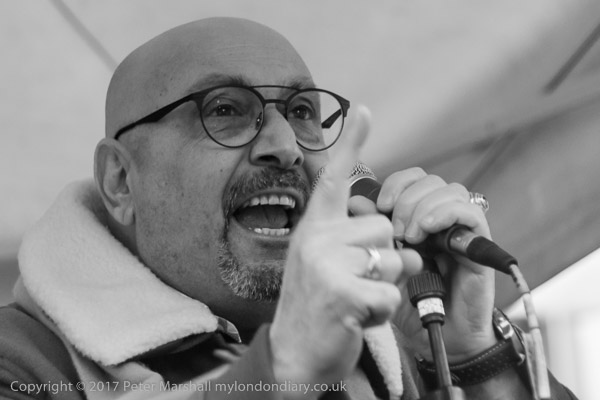
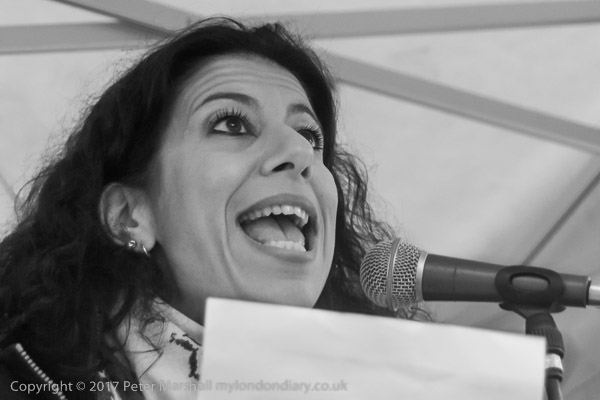
My problems at the embassy rally were rather different. The weather with the odd bit of rain didn’t help, but the real problem was red light. Most of the light falling on the speakers was coming through the red roof under which they were speaking, producing a red cast on their faces that seemed beyond correction.

I should perhaps have used flash, but it would still have been a problem, and though I could perhaps have turned up the flash to overwhelm the red light, the results would have had a  brutal flattening.  So I stuck with the red, hoping I would be able to make it acceptable in post-processing, by tinting the faces with some blue and green.

This did help a bit, but was time-consuming and doesn’t quite work as shadow and highlight areas were more or less affected by the red. In the end I gave up and as you see converted them to black and white.

I don’t like doing this. I take things now almost exclusively in colour and work for colour, and things taken in colour and converted seldom look quite right to me. It often annoys me greatly when others convert their digital images to black and white, thinking it somehow makes them look more ‘authentic’ or more documentary. Though of course if they really think in black and white I wouldn’t notice.

Equal Rights & Justice for Palestine
________________________________________________________

There are no adverts on this site and it receives no sponsorship, and I like to keep it that way. But it does take a considerable amount of my time and thought, and if you enjoy reading it, a small donation – perhaps the cost of a beer – would be appreciated.

My London Diary : London Photos : Hull : River Lea/Lee Valley : London’s Industrial Heritage

All photographs on this and my other sites, unless otherwise stated, are taken by and copyright of Peter Marshall, and are available for reproduction or can be bought as prints.

To order prints or reproduce images

________________________________________________________

Homage to Catalonia

Another Spanish Civil War appears now to be taking place, though fortunately at the moment rather less bloody than the last, though the repercussions of that and the repressive Franco regime are still at least in part behind the current unrest.

Without that history, the referendum in Catalonia would have not have stirred up the same problems. It might have been rather more like the Scottish vote here in the UK, raising some fairly bitter arguments and probably being won by dint of promises made by the government which turned out to be largely fairy stories.

In the end I suppose I’m not a great supporter of independence, whether for Scotland, Catalonia or for that matter the UK. Rather than proliferating countries I think we should be setting up more clearly federal structures, recognising our interdependence, devolving much more to regional authorities at every level of government, from country or even continent down to street level, setting up a truly participatory and democratic system. It’s clearly the solution for Syria too, with Rojava an inspiring model.

Spain seems to be sitting on top of a pressure cooker, managing to hold the lid down for the moment, but things inside are building up and it can’t be long until they explode, unless something fairly dramatic is done to ease the pressure.

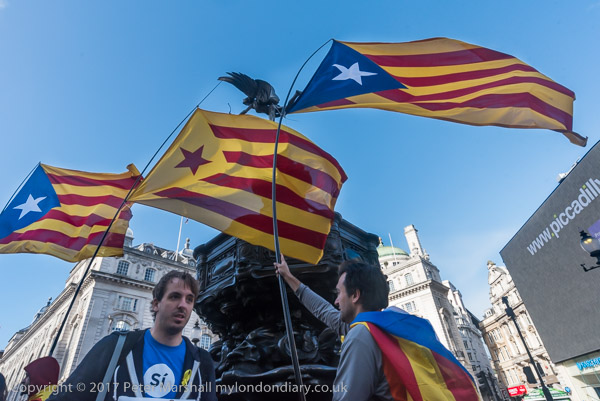
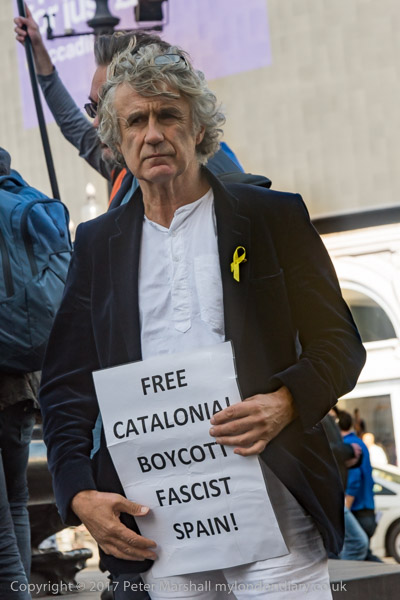
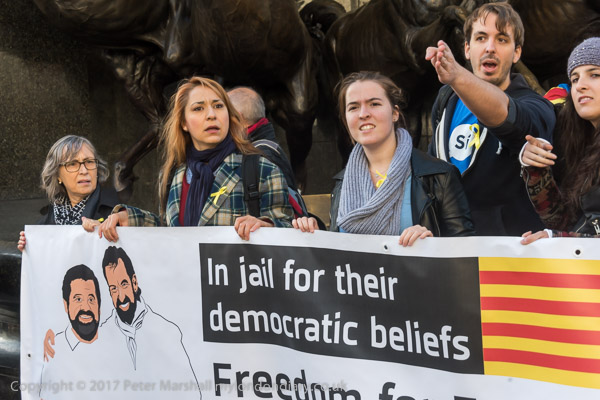
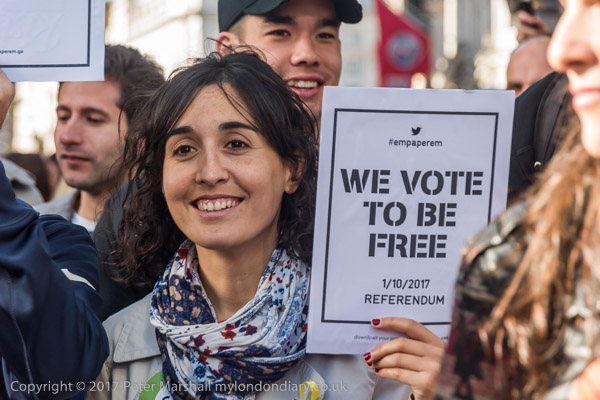
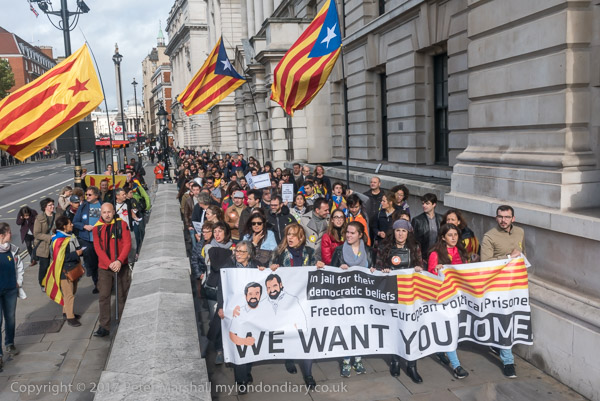
There was a lot of anger and energy on display at this event where several hundred, mainly Spanish and many Catalan came together to wave flags and show their support for the Catalonian people, demanding the immediate release of Catalonians imprisoned for their political views and calling on the UK government to condemn the police violence against civilians who wanted to register their vote in the Catalan referendum.

It’s always the problem of how your pictures show what the event is about, both the issues and the feeling. Words – on banners, posters, placards – and actions, and particularly gestures and expressions are mainly what we have to tell the story.

March in Solidarity with Catalonia
______________________________________________________

There are no adverts on this site and it receives no sponsorship, and I like to keep it that way. But it does take a considerable amount of my time and thought, and if you enjoy reading it, a small donation – perhaps the cost of a beer – would be appreciated.

My London Diary : London Photos : Hull : River Lea/Lee Valley : London’s Industrial Heritage

All photographs on this and my other sites, unless otherwise stated, are taken by and copyright of Peter Marshall, and are available for reproduction or can be bought as prints.

To order prints or reproduce images

________________________________________________________

London 1978 – The Crescent Cafe

Since the start of the year I’ve been making the occasional post of my pictures from the 1970s with some comments on my Facebook Page – though not quite as regularly as I did with my Hull photos for Hull2017, where I kept up daily posts for the whole of Hull’s year as UK City of Culture. I’m still posting the occasional set of images and comments to the Hull site, and all of the London pictures are on my more recent London Photographs site, which was put on hold for Hull’s year in the limelight.

A few of the pictures of London I have shared here earlier, but most are new, and where either pictures or comments have a particular photographic interest I’ll share them here too. The photographs will link if clicked to the London site where they appear a little larger. This is today’s image and comment:


Crescent Cafe, Crouch End Hill, Hornsey, Haringey, 1978
16r26: cafe, Haringey,

I didn’t go in the Crescent Cafe (they spelt it without an accent) but had it been open I might well have been tempted to hand over 7p for a cup of Tea, or even 17p on a Bacon Roll, though its unlikely I would have been hungry enough to deal with Egg + Bacon + Sausage + Toms, nor have been able to spare the 56p to pay for it. It seems nothing now, but money was  very tight for me then though that 7p would only be around 38p allowing for inflation, so still a bargain.

It was however probably the highly detailed menu on the blackboard that attracted my attention, along with the shiny aluminium of the urn and teapot. I’m not sure why it was closed. Perhaps it was a Saturday or Sunday, or, as it was taken in August, perhaps the owners were taking their annual holiday, but the place was clearly still normally in business.

I can’t remember either what had taken me to north London, but I suspect I may have been carrying a large orange box of Agfa Record Rapid, following a visit to “the Brovira Boys of Muswell Hill“, Peter Goldfield and Martin Reed, who imported this holy grail of photographic paper into the UK, and published in 1978 ‘The Goldfinger Craftbook For Creative Photography‘, now rather dated but available on-line. Later I got to know Peter, and wrote a short piece on my >Re:PHOTO blog when he died in 2009. Martin Reed went on to continue the work they started at Silverprint, for many years from 1984 in Southwark and still in business, though without Martin, in Poole and by mail order.

Record Rapid died so far as photographers were concerned around 1988, when Agfa were forced to re-formulate it without cadmium for health and safety reasons. Cadmium compounds are highly poisonous, and are still used in artists’ pigments, but while they are fixed on the surface of paintings, and thus safe unless artists licked their brushes, a considerable proportion ran off into the drains when photographic paper was processed, and their use was banned in most countries. Papers containing cadmium salts continued to be made in other countries for a few years but none achieved the properties of the old Record Rapid, and probably the closest approach to it now involves using some inkjet papers.

Peter Goldfield
The Goldfinger Craftbook For Creative Photography
Silverprint
_____________________________________________________

There are no adverts on this site and it receives no sponsorship, and I like to keep it that way. But it does take a considerable amount of my time and thought, and if you enjoy reading it, a small donation – perhaps the cost of a beer – would be appreciated.

My London Diary : London Photos : Hull : River Lea/Lee Valley : London’s Industrial Heritage

All photographs on this and my other sites, unless otherwise stated, are taken by and copyright of Peter Marshall, and are available for reproduction or can be bought as prints.

To order prints or reproduce images

________________________________________________________

Another Cyclist Dies

Stop Killing Cyclists were at Kensington & Chelsea Town Hall to hold a vigil and protest for the latest cyclist to be killed by a heavy goods vehicle on London roads. The woman was knocked from her bike at the junction at the north end of Chelsea Bridge, where 36 recorded accidents took place last year, but no improvements have been made.

Kensington & Chelsea Council have resolutely opposed schemes for safer cycling in London and have built not a single metre of protected cycle lane in the borough, despite being one of the richest boroughs in London – they even gave wealthier residents some of their council tax back. The 36 year-old woman who was killed at Chelsea Bridge was the second cyclist killed by a HGV in the borough this year.

They are also of course the council responsible for making the Grenfell fire almost inevitable – and ensuring that when it took place so many of those in the tower would die, by cutting costs and deliberately modifying the building and surroundings to increase risk as well as frustrating proper safety inspections. It’s hard not to come to the conclusion that the wealthy councillors consider cyclists – and the residents of social housing – as some kind of inferior beings whose lives don’t much matter.

Usually Stop Killing Cyclists hold their vigils and die-ins on the road where cyclists are killed, blocking traffic for the duration of the die-in. Today was different, perhaps to emphasize that this was an accident largely down to the obstructive policy of Kensington & Chelsea Council towards providing safe cylcing infrastructure. The event took place on the large courtyard of the council offices, which are tucked away out of sight a few yards from the busy Kensington High St.

Fortunately the die-in happened fairly early in the event, while there was still a considerable amount of natural light at the end of a bright day, and my pictures of this are clear and the colour good. As at other die-ins, using the 16mm fish-eye enabled me to get a good overall impression. Even at full aperture the corners are almost pin sharp (they are softened slightly in the conversion to cylindrical perspective) and at f2.8 I was able to expose for 1/125 at ISO 2,200. It is a lens where there is relatively little point in stopping down – though for landscapes in good light I’d perhaps work at f5.6 – and depth of field is pretty incredible wide open.

Later it did get very dark in the courtyard, and I was working at ISO 6400 again with lenses at full aperture, though with the 28.0-200.0 mm this is only f3.5-5.6 depending on the focal length. The 18-35mm is only slightly faster at f3.5-4.5.

After the previous week’s problems with wandering fingers I kept a close eye on the aperture and shutter speed. This was a much easier event from that point of view with plenty of time and no rushing. But light was a problem, not mainly because there was so little of it, but because what there was was almost entirely a bright orange. It’s easy enough to vary the colour of the cast (and often hard to avoid) but impossible to remove it.

Cyclists Kensington Vigil & Die In

Continue reading Another Cyclist Dies

Stopping London Traffic Pollution

Every Saturday evening in my youth the BBC Home Service broadcast the radio programme ‘In Town Tonight’, introduced by the music of the Knightsbridge March by Eric Coates and traffic noise, halted by a loud shout ‘Stop!’ and the radio announcer’s voice “Once more we stop the mighty roar of London’s traffic …” It carried on, even becoming a TV show for a few years, an early chat show with celebrities and the odd and occasionally interesting rather random outside broadcast segment, most famously on a night spent in the waxworks Chamber of Horrors by Brian Johnston.

Memories of this and the comfortable fug as our family sat around the radio and a coal fire in our cramped living room came back to me as ‘Stop Killing Londoners‘ again stopped that mighty roar, if a little less dramatically, first at Oxford Circus, by stepping out with banners when the traffic was halted at the lights, in the sixth of their brief protests to highlight the thousands of premature deaths each year caused by air pollution in the city, largely by oxides of nitrogen and minute particulates from traffic. Official figures put the number of such deaths at very close to 10,000 deaths a year, and of course many more suffer greatly from illnesses caused or exacerbated by the polluted air, well above the legal limits for most pollutants.

Actions such as this are intended to force action from London’s Mayor and from TfL, who the protesters see as moving far too slowly and failing to confront those with vested interests, including London’s black cab drivers who are responsible for a surprisingly large amount both of the pollution and also the opposition to measures that tackle it, including the cycle superhighways. And until there is much greater public awareness of the problem, it is hard for the politicians to take more decisive action.

I’d met with the group on Oxford St around 6 pm, and as a photographer it was frustrating to see the light fading rapidly as we approached sunset and we were still waiting for more to arrive and the action to begin. It really was quite dark, and I wasn’t too well prepared for it. I’m always very surprised by the low light levels in parts of busy streets even in the very centre of London.

Flash generally isn’t a good option in wide open spaces for overall lighting, as it falls off with the square of the distance, but it does enable you to pick out people and banners closest to the camera, as in the picture above. But I didn’t want it to remove the shadows from the main lighting which was coming from the headlights of the vehicles stopped well behind those holding the banner.  In some of the other pictures this is a little more obvious.

The effect of the light fall-off with distance from the flash becomes more of a problem when the main  subject is at an angle so that some parts of it are much closer to the camera and flash than others. I often try to lessen the problem by twisting the flash head to the side. The flash doesn’t  really cover the very wide angle of the 18mm used for the above picture, and by angling it away from the centre, in this case towards the left of the picture, puts the closer figure into the area where the light is falling off.  But still considerable burning of the closer part of the image and dodging of the further areas is called for in Lightroom.

It isn’t easy to remember to shift the flash head in the heat of the moment – and with these short protests I’m always very much aware that I do only have a very short time, and often – as on this occasion, rush around taking pictures and getting things wrong.  It’s easy to turn the flash head to the left for one picture and then forget to put it back when it really should be head on.

But my main problem in the heat of the moment was, as usual, my straying fingers.  Quite how I managed to turn the control dial and change the shutter speed from the 1/250th selected to stop motion as the protesters moved into position through 1/500th, 1/1000th, 1/2000th and even to 1/4000th before I finally noticed I had a problem is hard to fathom.  Though the problem was far less noticeable on the camera back then when I was later looking at them larger on the computer.  The above image was made on the D750 at 1/2500s, f/3.5, ISO 6,400 and is at least 4 stops under-exposed, probably rather more.

The grainy image and odd, low saturation colour actually result in a certain gritty attraction, though not one that I was aiming for – and certainly one that required rather more processing in Lightroom than I like or usually allow. At extreme underexposure the darker areas of images acquire an odd purplish colour which needs careful tinting to eliminate. Quite a few images were impossible to salvage from the gloom, and I only had time to take a few pictures as by the time I realised my error the protest was drawing to an end.

The difference in image quality is pretty dramatic, even viewed in these small web images, and I tried to retake a few of the earlier pictures, but time was very short. I did have plenty of time to reflect on my mistakes as I walked down Regent Street with the protesters to Piccadilly Circus, and here I managed to keep my errant fingers a little better under control, at least for the first part of the protest.

Although it was later, it helped too that Piccadilly Circus is generally rather better lit – here the bright lights of London are generally something of a reality. But, as you will see if you look at the images, by the end of the protest there, my fingers had wandered yet again, making me wonder if amputation is the only answer…

Stop Killing Londoners with traffic fumes

Continue reading Stopping London Traffic Pollution