Dan Heller on Model Releases

One writer about the business of photography I’ve mentioned previously is Dan Heller, and I’m pleased to hear about his new book, A Digital Photographer’s Guide to Model Releases coming out shortly. (And no, there is nothing that applies specifically to digital photographs in the book – just that we are all digital photographers now – or at least that’s where the publishers see the market.)
I only have one problem with Heller (style apart), which is that like many Americans he writes almost entirely with the USA in mind. But if you are an American photographer I think this is a book that should probably be on your shopping list.

I wouldn’t mention the book except for the fact that Heller provides a very generous guide on-line guide to model releases, and for most of us outside the US this will suffice. It’s a subject I’ve written about myself, but certainly not at such length and depth, although having read his piece there is nothing significant I’d want to change in my previous efforts.

Perhaps the best piece of advice in the whole piece is his “rule of thumb“, borrowed from the American military, “shoot first and ask questions later.” Although he discusses the issues from a legal point of view, his pragmatism is a strong point. You don’t need a release to take pictures, but only for fairly specific areas of usage.

Heller does look at many of the legal traps with sensible warnings about the many legal grey areas. He also appropriately mentions related problems of copyright and trademarks – with links to his feature on them.

Almost all photographers will find much to reassure them in this feature; for example he makes clear that in general exhibitions of your work, including images on a web site, even if for sale, do not require model releases, and you can always sell prints of people without a release (though with the famous there may be copyright or trademark issues.)

Heller rightly says that model releases (and the same is true of property releases) will make your pictures of people much more saleable – even for usages where a release is unnecessary. But although as he makes clear it is the responsibility of the publisher to ascertain whether a release is needed, this is something that some publishers are now attempting to push onto photographers.

Read the small print of any contract carefully and if you find any clauses that state that you indemnify the publisher against the costs of legal action arising from the use of your work, take legal advice or cross them through before signing, adding the words “as amended” with your signature. You may of course lose work this way, and at times it is impossible to avoid some liability – but as the practical risks are so low it may even be covered by your insurance. A greater risk in the small print is of course the increasing tendency to “rights grab” by publishers, and there is also advice on this on the pages at the NUJ Freelance Fees Guide. Unfortunately much stock is now handled through site on-line submission forms which preclude the use of the NUJ Delivery Notes (available to members) which include their standard photographers’ terms and conditions.

Heller does have a very interesting discussion of a problem of this nature, related to a picture of a trademarked building, the Hearst Castle, in his page on copyrights and trademarks. Again its a page well worth reading, full of good advice and pragmatism. You’ll be reassured to find, for example that you very seldom need worry about photographing logos and that you need almost never bother about building releases.

Of course there is still a gap between the actual situation and the demands of many stock agencies, particularly on-line agencies, and also commercial clients. So, if it is easy, cheap and possible to get a model release (or a property release) it makes business sense to do so, although I’ve only bothered once in the last year.

Media Attacks on Muslims

Sometimes it’s hard to make interesting images of important events. Often things just aren’t that interesting. Press photographers, at least in the UK tend to ‘set up’ a picture, but its something I always try to avoid. We don’t seem to have the clear distinction between news and features that is always made in the USA, where the kind of things that many British newspaper photographers do as a matter of course would soon get them fired.

But at least it is rather more difficult for photographers to completely fabricate stories. Or to ask other people to make up stories and phone them in to you. One of the more appalling stories to hit the UK political blogs recently is a leaked email apparently from Diana Appleyard of the Daily Mail offering £100 to anyone who wanted to phone her with “anonymous horror stories of people who have employed Eastern European staff.” I don’t know how many responded to her call, but it seems a golden opportunity for spreading nasty racist slurs – and for the Daily Mail to stoke the prejudices of its readership.

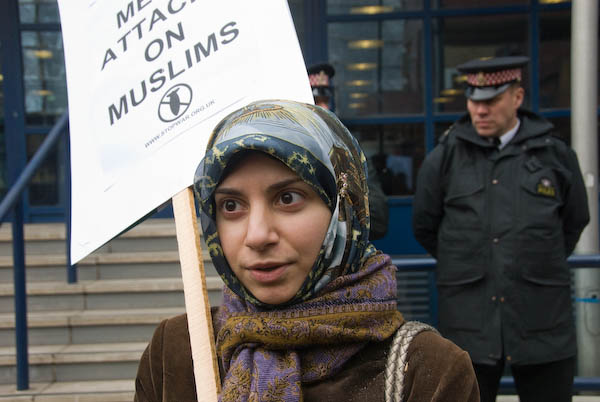
But it was the Daily Express where in 2004 NUJ members objected to the pressure being put on them to write articles denigrating gypsies, who ran the headline: “CHRISTMAS IS BANNED: IT OFFENDS MUSLIMS” (our Muslim relatives send us Christmas Cards – and expect to get them,) and much more designed to stir up and encourage anti-Islamic prejudice. And on Thursday, around 20 people picketed the Express offices on Lower Thames Street with placards asking for an end to media attacks on Muslims.


My framing cropped the placard that said “Stop Media Attacks on Muslims” but otherwise I think it was the best picture I took.

You can read more about it, and see a few of the pictures I took at the event on My London Diary, where I hope you will notice some changes to the site. It took a lot of fiddling to get the new design to work in Internet Explorer 6, which just doesn’t do some things right. It isn’t really possible to get it to work properly, and the site is best viewed in more up-to-date browsers such as Firefox, where the improved navigation really seems to help.

Back to thinking about photographing events that lack the kind of visual interest that photographers would like. I think photographers have got to sometimes admit that a particular event was not that visually interesting, and be prepared to turn in pictures that show it as it was. Setting up pictures is putting a foot on a slippery slope and we owe it to those who see our pictures not to mislead them.

For Collectors

I’ve never been a collector of photographs although I do have a very large collection, mainly of my own work, but with a few fine pictures by other photographers, including one or two vintage prints worth fairly serious sums. But I’ve always felt that the kind of photography that interests me most was largely produced for publication in magazines and books, and that these are the things that anyone with a deep interest in the medium should collect.

Of course there are photographs that are made to be seen as objects and that suffer greatly from reproduction; the gum bichromate that usually hangs in my front room would be one example, although even framing it behind glass as I have really kills the tactile nature of the image. It’s replacement for this year, a finely printed large format 2008 calendar* with pictures from the 2005 FotoArt Festival in Bielsko-Biala can hang without protection (and also has the bonus for me that the August image is my picture taken on the riverside at Greenwich, and it feels good to be in such respected company as Pilar Albajar & Antonio Altarriba, Gunars Binde, Stefan Bremer, Shadi Ghadirian, Eikoh Hosoe, Peter Korniss, Joachim Ladefoged, Sarah Saudek, Antanas Sutkus, Lars Tunbjork and Ami Vitale.)


Greenwich, February 1982. (C) Peter Marshall
A couple of my favourite photographs on display are from gravure portfolios published years ago in an American photographic magazine. I’ve seen the originals of both, one a pigment print, and the other an albumen print, and the gravures are both better prints, though costing several thousands of pounds less. On my bookshelves are thousands of superbly printed images (along with rather more where the printing is indifferent or worse) including many colour images which are keeping considerably better than most of the high-priced vintage prints I see displayed by dealers at the shows.

Some books are of course also extremely valuable collectors items now, and the two volumes by Martin Parr and Gerry Badger on photo books have certainly helped to create a market for some of the more obscure (and sometimes deservedly so) titles around. With notable exceptions it isn’t the most interesting works that become the most collectable, but probably those that were either produced in very short runs or that failed to attract much sales at the time.

I do have a few signed copies of books, but I’d never dream of paying extra for one, although a simple signature by the artist adds significantly to the price. But except for those photographers I’ve known personally I really don’t see any point. Obviously I’m not a collector.

A couple of recent events brought these thoughts to the top of my mind. One was finding a link to an article by Paul Messier on the AIPAD site, ‘Preservation of Photographs: Handling, Storage, Display, Conservation & Retention.’ This is a short piece by one of the authorities on the subject, but probably won’t tell most photographers anything they don’t already know. My own older work is stored in conditions almost guaranteed to cause rapid deterioration – some in my loft, glacial in winter and baking in summer, and all suffering from the occasional high humidity of the damp low-lying Thames valley. Which perhaps explains my own conviction – currently heretical among conservators – that the best chances for survival of my own work are digital.

Recently as a member of the London Photographers’ Gallery I got an invitation to a ‘Collecting Photography Course‘ they are running next month. It looks an interesting programme of half a dozen events including the VIP reception for the Deutsche Borse award with champagne and canapés, as well as talks by some very knowledgeable people and visits to the V&A, Michael Hoppen Gallery and Merill Lynch. At £400 it’s a little above my budget, but if you have excess thousands or millions sitting in your Swiss bank account ready to invest in buying photography, well worth the price.

*Collectors – serious offers are invited for my two spare copies of this highly collectable 58cm x 58cm calendar!

Stream of Consciousness

One of the more frustrating things for a writer is the problem of getting your thoughts down on paper. Particularly because most ideas seem to come when you are least prepared to record them. Sometimes when I do jump out of bed in the middle of the night, after answering nature’s call I feel a need to grab a sheet of paper and a pencil and put down some of the thoughts that have been running through my head. The previous post, Captioning Dreams, came from just six words scribbled in this way – and fortunately for once I could read my writing.

Often things come to me when lying in bed, trying to get to sleep, and in my mind arrange themselves with a precision and clarity that just isn’t there when I wake and try to put them on paper. When I was working as a teacher, all my best ideas and plans for lessons came as I was cycling to college, often about the lesson I was to deliver on my arrival – but try telling that to OFSTED! (Of course their paper world only briefly intersects with real life on those rare occasions when the inspector sits in your class.)

For photographers like me, whose photography is to some extent a record of their lives and experiences (rather than those who construct things to photograph) the ideal camera would record our mental images – what we see inside our heads – rather than what a lens images on some light sensitive medium. Perhaps some kind of head-set that taps into our brain waves and from them reconstructs the image so it can be saved in a digital format.

At the moment, this is just a thought experiment, without any technological means to implement it, though perhaps one day it will enter the realm of the feasible, though in some ways I rather hope not, as it is all too easy to imagine the possibilities for surveillance and control that such technology could provide. But it does perhaps represent the ultimate goal of many photographers, a kind of seamless transfer of a situation that they perceive as significant into a photographic record.

When thinking about street photography and how to improve our work, we think about equipment that is responsive and becomes intuitive, and about ways that we can remove the barrier to recognising and recording. I imagine we all start by beginning to see the photographic opportunities we have missed because we were too slow to see and react to them.

There are of course specific cameras and techniques that aid us. The Leica and similar cameras were small, simple and enabled you to feel that they became a part of you. One of the pieces of advice given by Henri Cartier-Bresson was that the photographer should become so familiar with the camera that the settings for taking a picture could be made by touch alone. On a Leica you can certainly set both aperture and distance in this way, although shutter speed is trickier – but then most of us probably changed it rather less often. On my M8 it’s actually taped on auto, but simply because I got fed up with it getting knocked onto inappropriate settings.

Working with a fixed focal length also simplified matters. You soon got to know more or less exactly where the frame edges would fall, or where you needed to stand to get the picture you wanted for your favourite 28 or 35mm or 50mm lens. Looking through the viewfinder was largely a matter of a quick check that you were pointing the lens in exactly the right direction, and something that could, if necessary, be dispensed with.

Using wide angle lenses also helps, increasing the depth of field for a given aperture and distance. Most of us relied on setting a zone of focus and always shooting from roughly the same distance – in my case usually centred on 1.8 metres.

Such techniques reduced taking a photograph to the essentials of identifying the opportunity and pressing the shutter release at the right time. The simple mechanism also meant there was little or no delay between the press and the taking of the picture.

What remained was our reaction time, the time for us to process the input and then decide to press. Working on that is tricky, and sometimes it brings up things that we might not always want to acknowledge. To be a street photographer you have to be on the street with your finger on a knife-edge, ready to react at any stimulus – and your negatives tell you what stimulates you. I found that I shared much of the same obsession that Gary Winogrand, the acknowledged master of the art, made deliberately manifest in his controversial ‘Women are Beautiful

[Don’t miss the two Winogrand links above – the first is a great description of a workshop with him, which really does give an insight into his working methods. The second has a few pictures from the book.]

Digital photography has supplied us with an equivalent of Jack Kerouac’s endless roll of paper compared to the very limited and discrete nature of film, but perhaps Virginia Woolf offers a better model for the photographer?

———————————————-

[This, although perhaps not obviously so, is the second in a few pieces I promised to write about ‘candid photography’ in Candid on Candids. More later I hope.]

Captioning Dreams

One of the consequences of age (along with diabetes, exacerbated by too many mugs of coffee staring at the computer screen) is that most nights I wake up around 4.30 am (yes, Alex*, AM does mean in the morning.) Fortunately after a short visit to the bathroom I normally fall quickly back to sleep. But this morning, I had a little shock as I woke, struggling as often out of a dream. I realised that my dream had been a kind of dream about a dream, in which I had been captioning each of its images for my pages at Alamy.

As contributors to Alamy will already know, each image submitted needs extensive key-wording, caption and description information, and it is a time-consuming process to add these, made more tedious as the system doesn’t match up well with the more standard IPTC meta-data. Yesterday I spent around 6 hours working on a batch of images submitted last month, so it’s hardly surprising that it was still at the top of my sleeping mind.

I’m not sure that my images will in any case sell from Alamy, as probably they are the wrong kind of subject matter for its customers, and those wanting my work are more likely to look elsewhere – perhaps in specialist libraries such as Photofusion, where I also have work. Or better still; come directly to me having found what they want in the 25,000 or so images on My London Diary. I do get plenty of requests to use images from there, but too few from anyone who can afford to pay.

The simplest approach to keywording would be to make use of a controlled vocabulary, and there are hierarchical lists available for import into applications such as Adobe Lightroom, for example, the Controlled Vocabulary Keyword Catalog or CVKC. I’m not sure that their listing would be particularly appropriate to my rather limited field of work, and until the libraries I work with adopt it, I don’t think it makes much sense for me to pay the modest dollar cost but much more significant time input to make use of it. However the site does have one of the best pages of advice on captioning images I’ve come across, of course starting from the basic “Who, What, Where, When, Why and How?” but with some other very useful tips.

But, as my dream showed, things can take over our lives. I’ve met many people who have said to me that they never take photographs, as they feel it makes them into observers and they would rather take a full part in what they are doing. It’s a view I have some sympathy with, but then there are plenty of events I’d rather observe than take part in.

But there are other occasions where photography is an important part of how I take part in things. It’s also important to me in preserving my own memory and sense of what happened. In the 1960s I threw myself into various things, and was too busy to take photographs. Now I find that it’s true that if you remember what happened you weren’t really there – largely because these were exciting times and too much was happening rather than substance abuse. All I have are occasional glimpses – being in a dressing room with the great master of the tenor sax, Ben Webster, came back to me a few weeks back (my job was to get him on stage able to stand, largely accomplished by drinking my share of the whisky he would otherwise have got through on his own. If he could stand he could play. And did, beautifully. I’ve never really liked whisky since.)

It wasn’t that I didn’t have an interest in photography. But in those years you either had to be extremely rich or devote hours of your time to the darkroom to be a photographer. I was penniless and already trying to fit more than 24 hours into every day. It didn’t help that my camera was still suffering from a rusty shutter after being dropped in the lake at Versailles, making speeds above an eighth of a second problematic and those below default to B. All in all I have little photographic record of those times to jog memory, one of my great regrets.

*Alex ten Napel, a fine Dutch photographer I met in Bielsko-Biala, Poland, left checking his travel arrangements home rather late. In the car when we were going to dinner to celebrate the end of the event, late on the night before we all left, he asked me “does AM mean morning?” And found he was booked to leave in a few hours on the 4.30am train. His portraits of swimmers, taken standing with them in the pool, were one of several highlights for me of the Foto Art Festival there.

Ash Wednesday

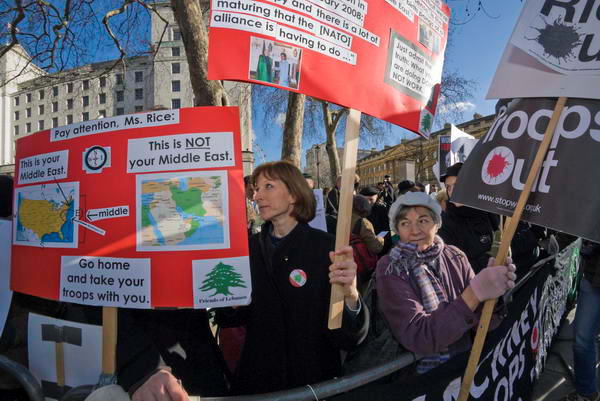
Ash Wednesday is of course a much more serious day, the start of Lent, and a time for sack-cloth and ashes, which I did get to photograph, although my photographic day started with a couple of hundred people opposite Downing Street as a reception committee for ‘war criminal’ Condoleezza Rice. Unfortunately she came in to visit Gordon Brown by the back door and so missed our welcome – and a much-needed Geography lesson from the Friends of Lebanon:

The Middle East

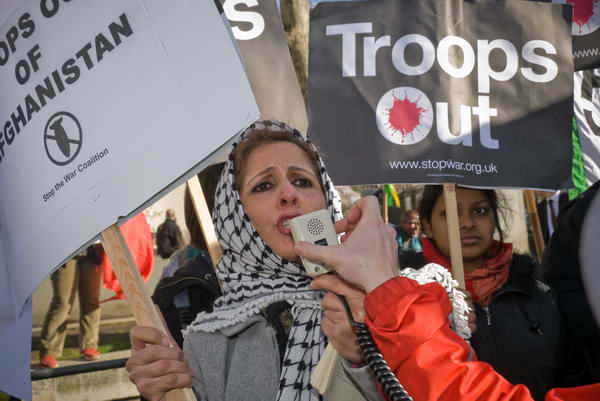
I felt sorry for the guys inside the stockade opposite the famous door, cooped up for hours with nothing to photograph, perhaps because it was too noisy for Condi to emerge in case her delicate ears might hear the shouted advice from the road opposite. It really was much more fun outside, and the picture opportunities were also much better. I’m sure this would have made a better picture for the paper than another boring shot of a politician:

By 3pm we had all had enough and went away – but they were still waiting and hoping. I hope they did finally get to take something, although a quick look through the papers the next day certainly failed to find anything of interest.
More pictures.

Meanwhile the Ministry of Defence was getting more and more barriers and a policeman every few metres around its periphery, as if a huge and violent demonstration was imminent. Others were gathering across the road.

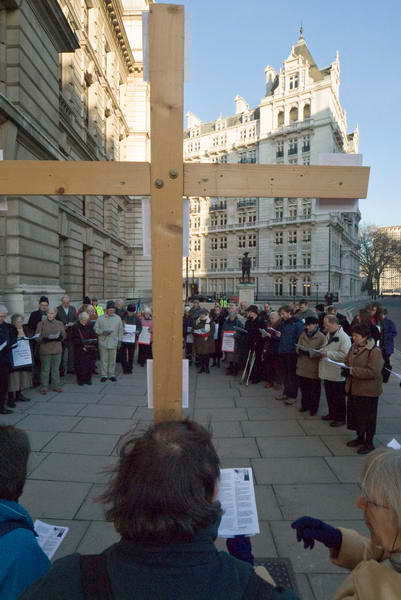
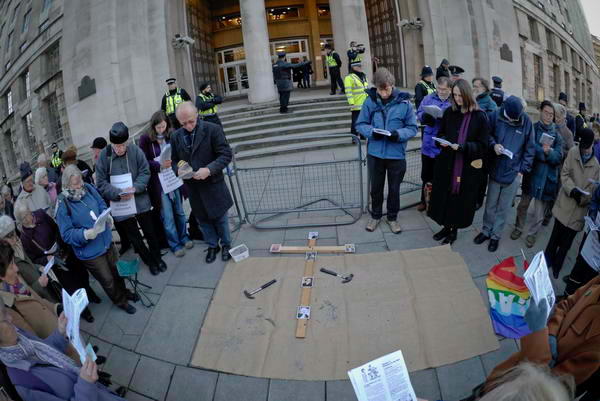
I walked past them and into Embankment Gardens, where a small circle of around 50 people was holding an Ash Wednesday service. This was the combined forces of Pax Christi, along with Catholic Peace Action and Christian CND. One man held a simple wooden cross on which were small photographs, I think of modern Christian martyrs, another a megaphone. The only other weapons – and ones that had seemingly struck fear into the hearts of the Metropolitan Police were ash and charcoal (and later I was also to see a hammer, some nails and sack-cloth.)

This was a Lenten Witness for Peace, an Ash Wednesday Liturgy of Repentence and Resistance to Nuclear War. The vast police presence was because a small number of those taking part were prepared for an act of civil disobedience, writing on the walls of buildings using charcoal. In fact all of those taking part were almost certainly in breach of the SOCPA legislation as the organisers “have never sought permission from the police to engage in the act of prayer and resistance which has taken place here every year since 1982.”

The ashes and charcoal were blessed with holy water and then those present took part in an act of penitence, symbolised by the marking of each of them with a cross of ashes on the forehead. After some further prayers there was a procession to ‘Station 1′, the pavement outside the Old War Office, where the service continued.

This was fittingly a situation begging for a ‘Hail Mary‘ shot, holding my camera above my head at the fullest height I could get, cursing Nikon for their cheapskate omission of a viewfinder curtain from the D200 (actually they give you a small rectangle of black plastic which you lose in ten seconds and isn’t exactly convenient) which means you have to hold one thumb over the viewfinder to get correct exposure while doing so. They did build one into the D2X, but over a thousand pounds and a large weight penalty is a lot to pay for this fairly essential but cheap for Nikon to implement feature. My first attempt (above) was possibly the best.

As this section of the event ended, one of those taking part pulled me to one side to tell me to watch out for people trying to write on the building, and so distracted me from actually taking a photograph of it happening (and I’d already changed lenses and added the flash for that very eventuality.) Of course he meant well, and I was able to photograph the police holding the guy and the unfinished message. Later I saw a woman writing on another wall, and ran, but was too far away to get to her before a policeman had stopped her and was telling her off.


A fisheye used in ‘Hail Mary’ mode to give an overall view. More curses on Nikon.

Outside the Ministry of Defence itself, a large sheet of sackcloth was used to cover the pavement and the cross laid on it. A set of theses for the modern church was read and each of them nailed to the cross while the congregation continuously repeated their chant of a short ‘Litany of the Martyrs.’

Unfortunately I think my curses must have upset Nikon, because halfway through the event my D200 stopped working. I think it had crashed, always a possibility with computers (and modern cameras are computers.) I tried the standard treatment of removing the battery for a few second, and it came back to life, though just to make sure I also changed the battery as it was below 30% left.

Somehow in doing all this, the camera went from the RAW setting I always used and on to basic quality JPEG, and I didn’t notice until I got home, and got rather a nasty surprise on viewing my work. Using my normal LightRoom import settings on jpegs always gives very contrasty poor quality images (they work best using the Linear . Once I had realised the problem I was able to get surprisingly decent results, but the lighting had been extremely tricky and I really missed the flexibility of RAW.

More pictures on My London Diary.

Candid on Candids?

Bus, Peckham 1991 (C) Peter Marshall
Bus in Peckham, 1991 (C) Peter Marshall

A day or two ago someone asked on an on-line photography forum if anyone knew of a book on the subject of candid photography they could recommend, mentioning one publication they had already been given as a present. (I haven’t read it, but what looks to me a rather posed portrait on the cover didn’t inspire confidence.

My immediate response was to wonder what there was to write a book about, which perhaps wasn’t the most helpful of comments, although perhaps appropriate. On further thought what I would recommend is Ralph Hattersley’s ‘Beginner’s Guide to Photographing People‘, published in 1975, though it came out in the UK, published by Robert Hale Ltd, in 1979. (ISBN 0709174039)

It’s a work that I admire for starting with a discussion of the ethical basis of portraiture, and with a listing of some of the wrong and the right reasons for taking pictures of people, in a chapter on taking candid portraits. Later in the book there are chapters on how to make staged candid pictures and how to photograph strangers in the street – and that also starts with an examination of your motives.

Hattersley also does a pretty thorough job of the technical stuff, including lighting. Of course its a book written for photographers using film, but really digital hasn’t changed things that much, although some cameras at least provide new opportunities for shooting with the camera away from your eye.

The very term ‘candid photography’ has a dated feel to it. I immediately think of the 1930s ‘Mass Observation’ project and the splendid images of Humphrey Spender on the streets and in the pubs of ‘Worktown.’ If you have any doubts about the validity of working in this way, take a look at the way the Bolton Museums now give the work a proud place on their web site. As they write, “He used what was at the time cutting-edge technology in the form of an unobtrusive 35mm Leica camera.” In some respects the early screw Leica that he used was a better instrument than the later M cameras for this kind of work – where you don’t change lenses. It was smaller and less obtrusive, and I think the shutter was perhaps even quieter. Certainly much quieter than that on the latest digital Leica M8, and even the promised (and expensive) replacement will still be rather more noticeable.

Bolton’s weather also helped Spender, since he spent most of his time there wearing a mackintosh, keeping the camera hidden under this except when he was actually taking a picture. As they note, “He recalled that the occasional Boltonian would react angrily if they discovered him taking a photograph.” There was a feeling of being spied on – rather more rational then than under the Panopticon of security cameras that now track us through much of our lives. Spender himself they suggest “disliked the intrusiveness of his work” and the stress of documentary was one reason why he turned away from photography to painting and stage design.

I think photographers always have a responsibility to their subject, and especially so when you photograph people without their permission. I often take pictures I would not use, perhaps because I’ve caught a moment when they look distinctly peculiar (something some other photographers sometimes seem to strive for.) Or when photographing a flamenco dancer recently, the picture that caught the fleeting fraction of a second where her rapidly swirling skirt revealed rather more than intended. I perhaps see it as my job to try and see the picture as the people in in might see it years later in a book or museum rather than an immediate reaction.

One of the great projects of candid photography was made by Walker Evans, travelling on the New York City subway trains, often accompanied by his assistant Helen Levitt. Starting in 1938 he photographed using a Leica hidden under his coat, its lens poking out, making around 600 photographs. He had conceived the project with the help of his collaborator, writer James Agee – they were working together on the even more famous ‘Let Us Now Praise Famous Men‘, published in 1941 – and Agee in 1940 wrote a preface to the subway work. Although the pictures were finished in 1941, it was not until twenty-five years later in 1966 that ‘Many Are Called’ was published to accompany a show of the images from it at the Museum of Modern Art in New York.

While at the time the pictures might have been seen as an intrusion into privacy, the passing of time gives us – and any of the subjects – a different perspective. The work was published again in 2004 by the Yale University Press and the Metropolitan Museum of Art mark the 100th anniversary of the subway system, with new texts and also greatly improved reproduction of the images, thanks to new digital scans.

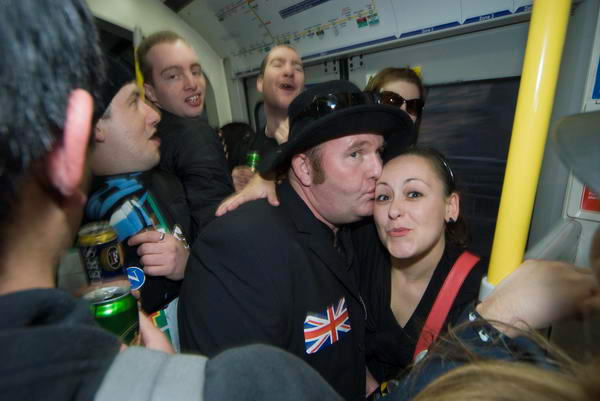
I was reminded only briefly of this work on Saturday, as I crammed into an underground carriage full of Kiwis out with a few thousand others for their Waitangi Day Circle Line Pub Crawl. This image, taken with a 12mm lens on a Nikon D200 may in some respects qualify as candid, but was certainly not made without the knowledge and willing consent of those shown.

New Zealanders celebrate Waitangi Day on the Circle Line Pub Crawl
(C) Peter Marshall, 2008

More pictures as usual on My London Diary. More about candid photography in other posts shortly – including Stream of Consciousness.

What makes a good portrait?

I often find Jörg Colberg‘s Conscientious blog (see sidebar) annoying, too often clogged up with short and undiscriminating links to photographers, but among these are some interesting pieces that make me continue to check it out.

One of these is What makes a great portrait, where he and Miguel Garcia-Guzman of Exposure Compensation, another blog I’d add to my Sage feed if I could work out how, wrote to zillions of photographers, fine art and commercial, bloggers, curators, editors, and gallerists and asked them the question “What makes a good portrait?”, asking them to provide an example and their comments.

They both print the 20 or so replies that they got – which do include a few great portraits, notably by Ingres and Sander, along with a few others that are frankly dross and some between those extremes. One of the pictures is that beautiful image of a young woman, Edouard Boubat’s muse Lella, taken in Brittany in 1947. This can be seen with some of his other images of her on the Sexuality in the Arts blog. It is certainly the best image of the set, but I’m not sure it is the best portrait of her.

Tim Hetherington wins World Press Photo Prize

Congratulations to UK photographer Tim Hetherington, whose colour image of an American soldier resting in a bunker in Afghanistan has won the 2007 World Press Photo Prize. It is a picture that captures, as jury chair Gary Knight of VII notes “”the exhaustion of a man – and the exhaustion of a nation.”

On his web site, he says “I’m currently in New York recuperating after an accident in Afghanistan.” He was in the country on assignment for ‘Vanity Fair‘, where there is also a slide show of 15 of his portraits of soldiers and another of 15 images from the Korengal Valley – the winning image is the final picture of this. There is also a video discussion between Hetherington and Sebastian Junger, the writer of the feature.

You can also see it and all the other winners on the World Press Photo 2008 pages, which will be occupying me for some time.

PGDB Shortlist: Esko Mannikko

It was seeing the work of Elina Brotherus which won her the 2000 Finnish Photography Prize that first prompted me to take a deeper look at Finnish photography, and to write a feature about it at the start of 2001. Before then I think most of us had thought of Arno Rafael Minkkinen as the only Finnish photographer. Esko Männikkö was not among the almost 30 photographers I mentioned in my feature, nor did I feel it necessary to add him when I revised it a few years later.

This isn’t an opinion that the work on show at the Photographers’ Gallery would cause me to revise. There is something deeply wrong when the most interesting thing I could think of to write about is the frames (and these are not very interesting) and the fact they are hung without space between them, apparently his ‘trademark.’ Though not it seems in Berlin.

But I have actually changed my mind rather about him as a photographer, not because of the pictures on show, but for the book ‘Mexas‘ (1999) included in the corridor display at No. 5. This must qualify for some kind of award for the worst colour repro in recent years, looking like a comic book version of poor inkjet printing. More like the kind of thing we got in the 1950s than modern publishing. For $75 I expect more, although Photo-Eye, where you can see a few pages from it, thinks differently, writing “The printing, done in Finland, is lush.” But despite this I found the work impressive.

At least one of the pictures from this book is in the show, ‘Simon, Batesville’ and on the wall – like the other works – is impeccably printed there. In fact the most positive thoughts I had about his work on the wall was about the quality of the printing, particularly in the still life works.

Batesville, Texas, near the border with Mexico is the location for many of the pictures in ‘Mexas’ and in particular some very impressive panoramas (as Gary Michael Dault remarks in one of the two introductory essays, “The panoramic works are the key“.) My advice is not to waste too much time looking at his stuff on the wall, but to take a good slow meander through the pictures in this book.