Arranged Images and Bossy Photographers

I don’t believe in the elaborate setting up of images of events. As a photojournalist I want to record and comment on what is happening, not to produce staged images.

Of course I’m not naive enough to think that me being there and taking pictures has no effect on the situation. Even were I to act like Cartier-Bresson, hiding his Leica and pouncing on his prey without warning – though in practice he didn’t always work like this either. Flies on the wall don’t take pictures, and even they get swatted at times. Like it or not, we are part of the action.

Actually I do rather like it most of the time. Like getting up close and rather personal, often deliberately using flash fill more to draw the subject’s attention than to alter the lighting, though it usually does that as well. And I do like to shoot several pictures, working through slight variations of my idea before I’m satisfied that if it works I’ve got it working. Of course many ideas still fail, but it’s seldom from want of trying.

So yes, I interact with people and they respond to me, but still in general they choose their responses, not me. Very occasionally I may ask someone to look at me, but usually I’m happy with their choice whether to look at me or away. Yesterday I did ask a couple of people to move placards so I could see things they were masking, occasionally I’ve tidied a branch or some grass out of a foreground, or removed some litter, but generally I don’t interfere with the subject.

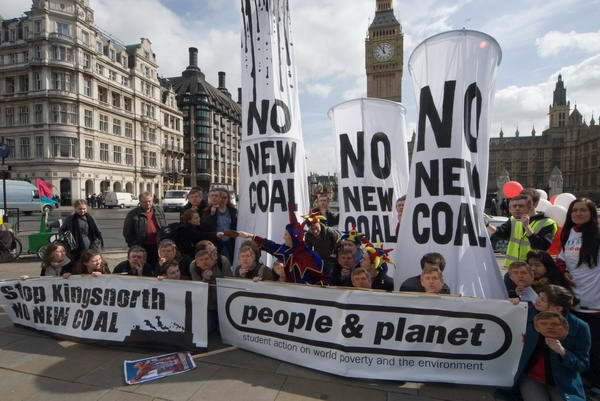
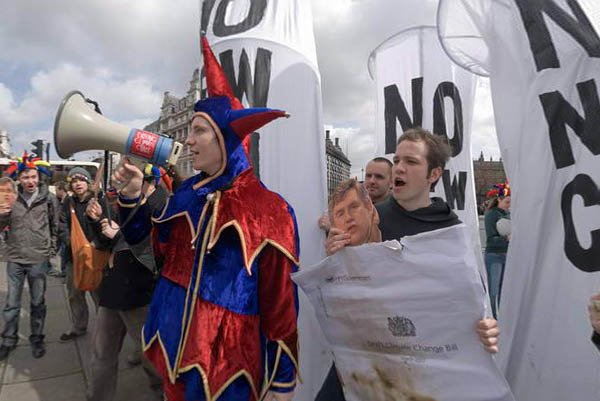
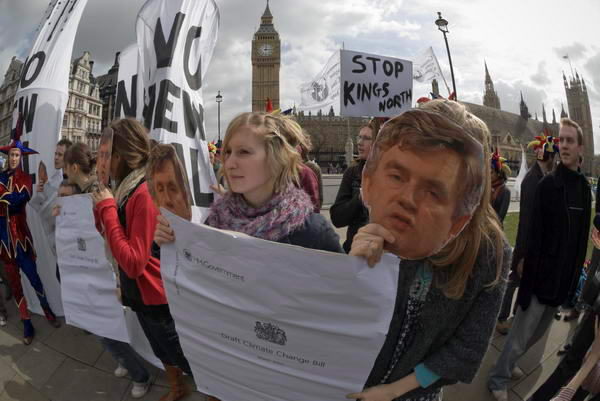
At yesterdays Fossil Fuel’s Day demonstration in Parliament Square I watched with some annoyance as one photographer spent around 15 minutes rearranging the cooling towers, demonstrators and banner to produce a rather dull composition in front of Big Ben. Like the other photographers present I was annoyed because it stopped us getting on with taking pictures, and turned what was just getting interesting into a boringly formal situation.

KIngsnorth Demo in Parliament Sq

It’s something that often happens with photographers at events, who want to organise things for their own particular view of what a picture of the event should look like. Local press photographers are usually the worst offenders.

Then there are some press photographers who always want other photographers to stand further away so they can take shots with a longer lens. I use a 200mm quite often, but seldom to take things I could take with a 28mm. You can get too close to things – and sometimes circumstances force us to. At times I’ve been pushed into actual physical contact with the people I’m photographing, which makes it hard even with an extreme wide lens. But in general, Capa’s dictum “If your pictures aren’t good enough, you’re not close enough” is a good one.

KIngsnorth Demo in Parliament Sq
Later we were able to get back to taking pictures

Back to yesterday, none of us like being bossed around, whether when being posed and having pictures or if you are taking pictures. It was behaviour that showed a lack of respect for the subject and for the other photographers present, and also that undermines photography as a medium of record. It makes it PR photography rather than reporting.

Kingsnorth Demo in Parliament Sq

This is one area where journalistic practice in the UK is poor compared to that in the USA. Photographers working for the press here do things as a matter of course that would be firing matters there, failing to observe the clear boundary that they insist on between news and features.

It did mean that I – and others, including the person who had spent ten minutes arranging things and getting in anyone else’s way – didn’t get as good pictures as we might otherwise have done of the centrepiece of the protest – which was a shame.

More about the event and more pictures of course on My London Diary.

Photographers by the Yard

Along with 20 other photographers (dozens according to the NUJ site, but I made it exactly 1.67 dozens) I went along to New Scotland Yard this afternoon to photograph the one person protest by Jeremy Dear, NUJ General Secretary, to highlight the failure of law enforcement officers to protect media freedom.

If you are a regular reader of My London Diary and this blog you will know I often have reason to complain about the way some police officers impede the work of photographers covering protests on the streets. Sometimes its a matter of individual officers deciding that we shouldn’t be photographing particular events – as in the case of the officer who stood in my way while a young man was being stopped and searched in Whitehall, and when I attempted to move into a position that gave me a clear view while in no way interfering with the work of the police ordered me back. At other times its a failure by the officer in charge to realise that we need reasonably close access to events to photograph them adequately. Sometimes we are even denied access on spurious grounds of road safety – when police officers are standing further out in the road than photographers would.

There are agreed guidelines, but too often police simply ignore them. At times officers have even denied that my NUJ Press Card is a valid press card, and have treated me as a protester rather than a reporter, refusing for example to allow me to leave a protest when I have finished taking pictures.

In particular the SOCPA legislation which has made many demonstrations around Parliament illegal has soured relations between police and press – as well as those between police and protesters. So its good news to hear that the relevant aspects of this law are to be reviewed, although we may fear that a SOCPA Mark 2 will be no less inimical to the rights of citizens to protest.

SOCPA provided a limited right for one person demonstrations, which although they had to give notice, the police are not entitled to ban, although they can impose restrictions. So Jeremy had duly applied, filled in the forms and answered various questions about his demonstration (the police were apparently very exercised about the actual wording of his placard) and been granted permission, and photographer Marc Vallée had talked, texted, e-mailed and contacted through Facebook and other on-line sites with photographers to persuade them to come and photograph the event at New Scotland Yard, bribing us with the offer of a free drink to celebrate the out of court settlement his lawyers recently agreed with the Met for his injury during the ‘Sack Parliament’ demo in October 2006.

It was a fairly daunting group of photographers to be working with, including a few well-known names and as always we all wanted to take a better picture than the pack. There wasn’t really a lot to work with – just Jeremy with a placard, New Scotland Yard as a background, and of course the other photographers, so it was something of a challenge.
NUJ photo protest

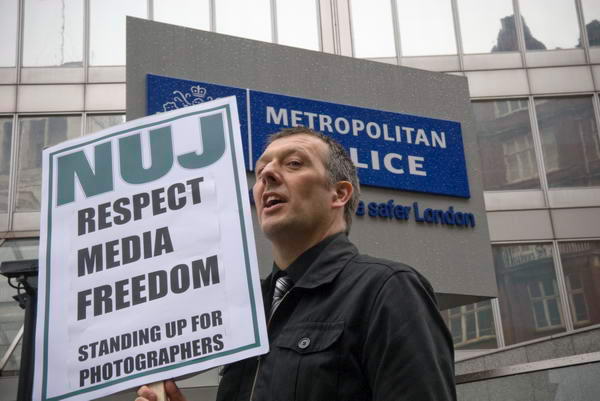
I started with a straightforward picture of Jeremy with the placard and the New Scotland Yard (or Met Police) sign behind him. Not a bad snap, but nothing special.

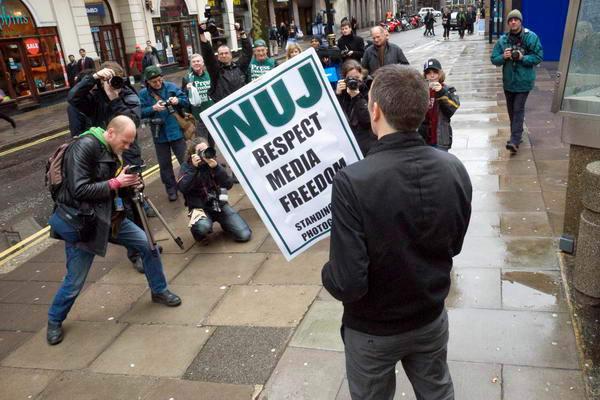
But obviously it would be more interesting to have both him and the photographers. I tried a ‘Hail Mary‘ from behind with the 18(27)mm wide-angle end of the 18-200; perhaps a bit too prosaic, and of course you can’t see his face, nor the whole of the placard.
NUJ PHotographers protest

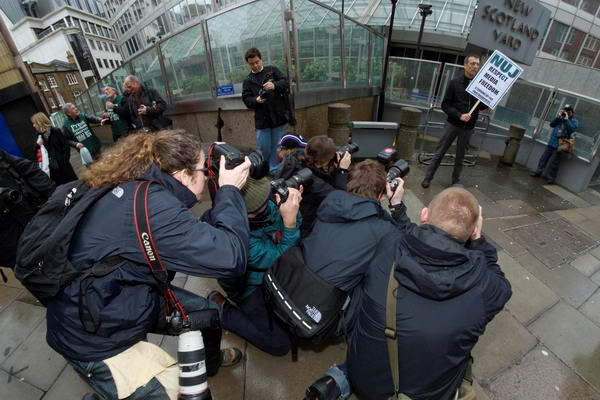
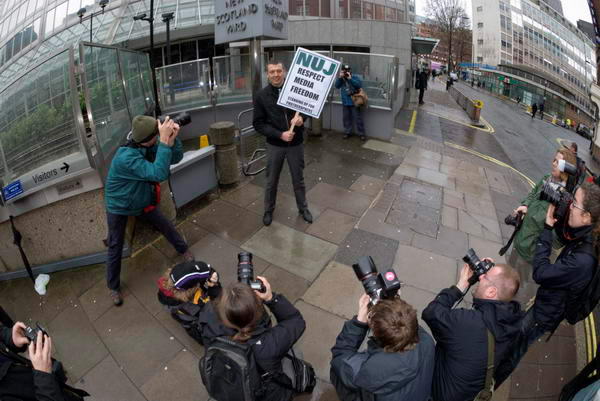
Unfortunately for once the police were simply ignoring us and standing some distance away. I tried a few shots including them, but the placard was just too small, so I came back to photograph the pack from close in using an extreme wide-angle.
NUJ Photographers protest

Several rather similar shots to choose of which I thing this is the best.

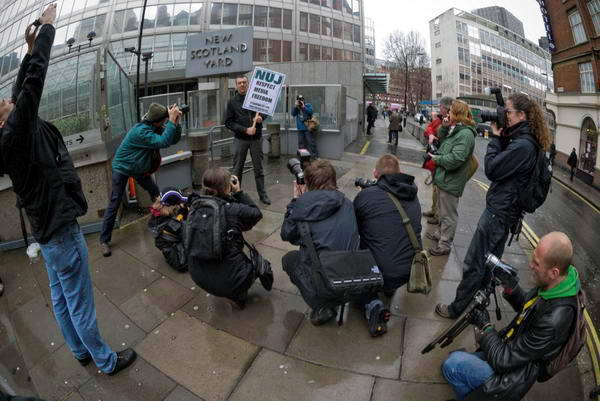
Taking a higher viewpoint gives a different view, but shows a line of photographers rather than a pack
NUJ Photographers protest
and coming down lower perhaps provides a more interesting shot.
Moving in close to Jeremy, still working with a very wide lens I could show him, the poster (though a rather oblique view) and the line of cameras pointing at him.
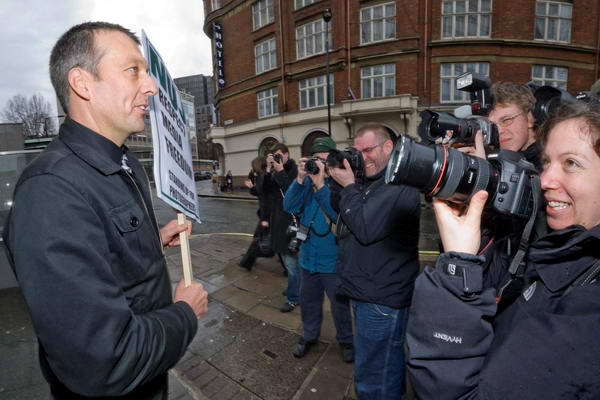
NUJ Photographers protest

Jeremy then moved to hand in a letter to New Scotland Yard, but they refused to take it. I moved fast to be in the right place and shot from close with the 12-24mm, getting a couple of shots that aren’t bad.
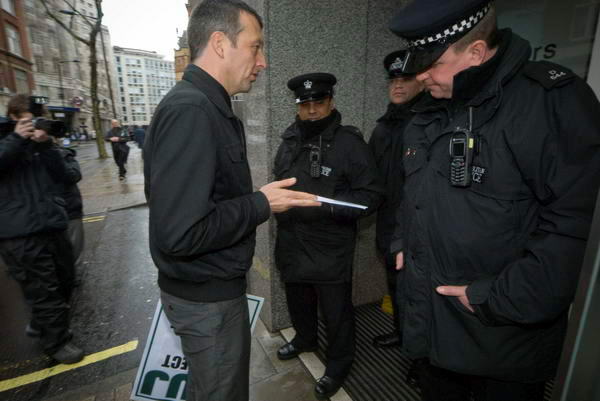
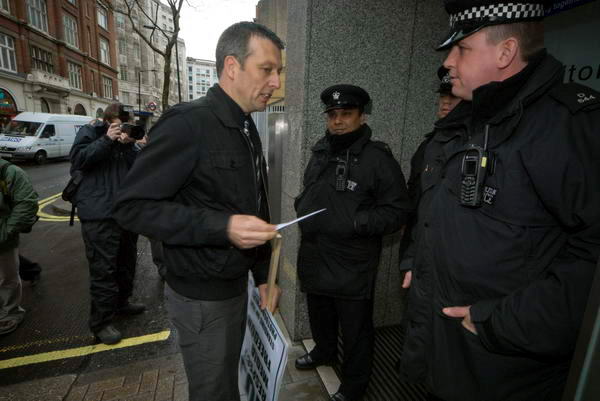
NUJ Photographers protest

Finally we moved to the corner of the building where the windows were showing the infamous posters, including the anti-photographer poster:

THOUSANDS OF PEOPLE TAKE PHOTOS EVERY DAY. WHAT IF ONE OF THEM SEEMS ODD?

Again my starting point was a simple image of Jeremy with placard in front of this.
NUJ Photographers protest

Then I shot the pack facing him, but couldn’t include the poster in this.
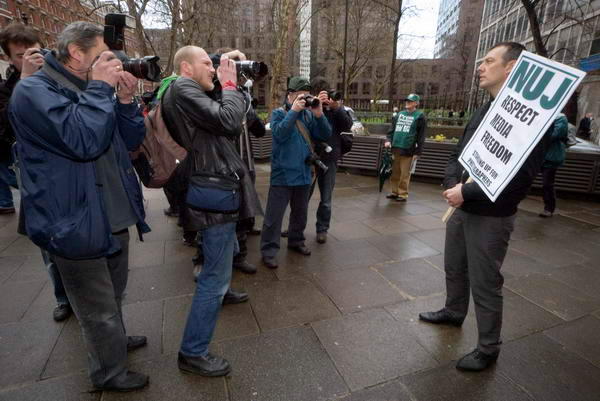
NUJ Photographers protest
Shooting over their heads provides an image including the poster, but not I think a very strong one.
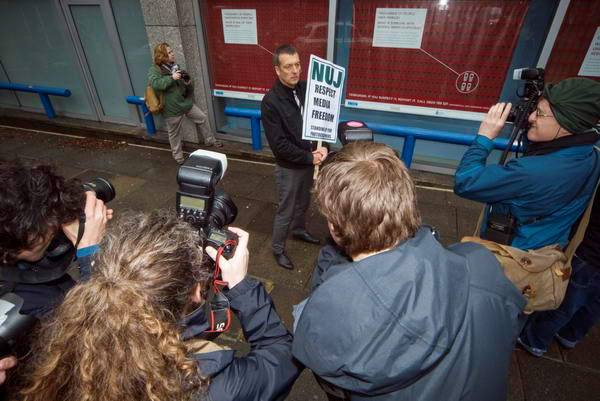
NUJ Photographers protest

David Hoffman has produced one of many parodies of this poster available on the web – and you can buy his as T-shirts, mugs etc. He decided to photograph himself in front of it, and I caught him doing so, with tongue out
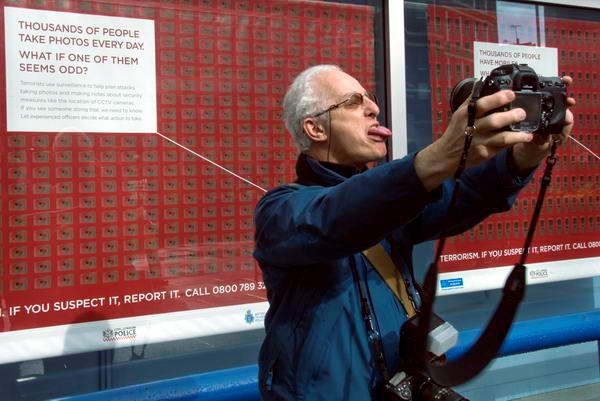
and looking rather more normal
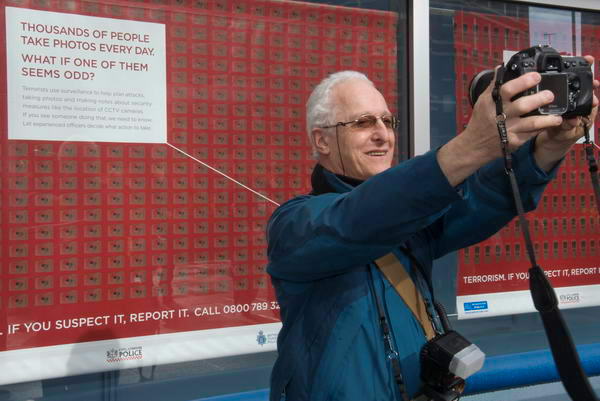
David Hoffman

Finally came a few pictures of photographers standing in front of the poster and looking odd. If I post these here they might never speak to me again, so I’ll tuck them away in case I ever need them for blackmail.

Peter Marshall
More Camera Porn

One of the problems I seem to be getting more and more is a failure of autofocus on my Nikon D200. In the old days of course we all focussed manually, but this is actually a lot harder with modern cameras and lenses. We used to shoot mainly with fast (or fast-ish) primes – my standard SLR kit included a 28mm f2.8, 50mm f1.8, 105mm f2.8 and 200mm f4, but nowadays that whole set is usually replaced by a 18-200mm f/3.5-5.6 which goes a bit further as well as filling all the gaps (and weighs about the same.) Larger apertures means brighter focussing screen images – and a more decisive ‘snap’ in and out of focus. And of course the smaller sensor – and thus smaller focussing screen also dims the image.

Factor in too my age and dimming eyesight, along with rather poor manual focus rings on modern autofocus lenses and manual focus for me now tends to be for emergencies only when I’m working with a DSLR. Generally I rely on autofocus, but one of my problems is perhaps that the D200 seems to have so many options. I have to admit that I’ve only intentionally used a few of them – perhaps some of the others would be more suitable.

There is a nice switch on the front left of the camera, at the bottom of the lens box, which has 3 nice, straightforward settings, labelled C, S, and M for continuous, single and manual. The only problem I have with this is that it’s too easy for us compulsive button-fiddlers to move it to the wrong setting – particularly manual, and its then possible, especially in poor light, to take lots of out-of-focus pictures before you notice.

Then on the back is another less scrutable 4 position lever, with icons that could mean anything. The only one I really understand is square braces inside square braces, which stands for ‘Single Area AF’ and means the camera focusses using the focus area you tell it to (and is indicated in the viewfinder.) It was perhaps not the best choice for the chaos outside the Chinese embassy, as the manual indicates it best suits static compositions where the subject stays in the selected focus area.

Perhaps I would have been better off with ‘Dynamic Area AF’ which can use focus information from other focus areas, but doesn’t indicate it is doing so, or with ‘Group Dynamic AF’ or even ‘Dynamic Area AF with closest subject priority’, but unfortunately I didn’t have the manual with me to weigh up the options (page 54) though it would certainly have let me identify the icons (I’d find say S, D, G, C much easier to remember.)

Of course, once you’ve assimilated all that there are a number of custom functions related to all this – a1 to a10 – and given a few hours I might sort out the best combination taking everything into account. It would actually have been a lot easier just to get out the Leica and get on with the job, perhaps with that nice fast 35mm f1.4!

Actually I’m beginning to think that perhaps the D200 (or lens) may be in need of some kind of service, as well as casting my eyes more and more over the reviews of the D300. There’s a good one fairly recently appeared by Thom Hogan , one of the few reviewers on the web whose opinions I take seriously (one of the best-known others is really just a clown and believes that there isn’t a lot of point in shooting RAW – well perhaps there isn’t for the sort of pictures he likes to post.) Of course Digital Photography Review is pretty hot for the technical kind of stuff (so far as they go) and they’ve also recently reviewed the D300, but Hogan is a photographer who takes reviewing very seriously – even to the extent of taking cameras to bits. (One other guy worth reading is Sean Reid, but his site is a subscription site, and costs $32.95 per year – and well worth it if you have an interest in the gear he reviews.)

Hogan also writes extensive e-books on cameras, though I can’t tell you what they are like – when I was writing for what was then one of the most popular photography sites on the web I did write asking for a review copy of one, but never even got a reply! So I reviewed a couple of those from another author instead. But I suspect Hogan’s might be better.

One of the other things I didn’t write about when I was the guide to ‘About Photography‘ was so-called ‘glamour photography‘, although the reasons there were different, and one thing I don’t miss are the regular and frequent e-mails I used to get from several people in that sordid business telling me they were God’s greatest gift to photography and that I should be featuring them on my site. Frankly, it’s boring formulaic crap, and the slicker it is, the more boring.

Today I was reminded just how sordid it can be by a mention on ‘Conscientious‘ of a blog with a posting entitled How To Photograph Nude Women, For Free. I won’t give the link given there on this site, as I can’t think of any reason to recommend this to any photographer, but if you know any young women who might be thinking of becoming a model, I’d suggest they read it and beware. It really is the kind of thing that gives photography a bad name, and even makes the actual porno industry look respectable.

WARS from Magnum

There are an awful lot of photo-blogs around. I don’t have many links on the ‘blogroll’ of this site, mainly because I wanted to keep it simple and only link to sites where I often find interesting features. One of those carefully selected links just has to be Magnum‘s blog, and yesterday this announced a new set of four essays on its companion site, Magnum in Motion,”WARS – A series of four essays revolving around a common topic,” also to be published on ‘Slate.’

In 2006 Magnum in Motion interviewed Philip Jones Griffiths, almost beyond argument the greatest photographer of the Vietnam War, and at the start of his piece he makes the comment “Photographers are either mud people or sand people. I’m a mud person.” This was his response to people who asked him why he hadn’t covered the desert wars of recent years. More seriously he feels that photographers need to get the kind of perspective that comes from a detailed knowledge of the country and what was happening – as he set out to do in Vietnam. In his piece he gives an insight into what he set out do in his coverage of the war there, and his pictures give a real feeling about the country and the war, including the Americans fighting there, who he sees also as victims of the war.

[In Jones Griffith’s Magnum in Motion podcast, “Point and Shoot“, he talks about guns and his experiences, and attitudes to war, and it’s also worth listening to – you’ll find it – along with 35 others of interest on their podcast page. But the images are shown much more strongly in the ‘War’ presentation.]

Jones Griffith’s flip response on sand and mug acts as the starting point for presentations by three of the leading younger photographers who have covered recent conflicts. As Christopher Anderson points out, the younger generation of war photographers got sand wars rather than mud, whether they liked it or not. Paolo Pellegrin ‘s stark black and white images from Lebanon are perhaps more often from a ruined cityscape of rubble than either sand or mud.

Thomas Dworzak in Chechyna and Iraq has seen both, but the difference is more in the situation than the geology. In Chechnya he could usually go along with the rebels whatever they were doing – if he was brave enough , and he obviously was – but in Iraq “as a Westerner, there is no more access to the insurgent’s side” and he can only work with the Americans, photographing what they do in the country. He comments on the freedom he is given to take pictures – and that those things ‘off-limits’ are largely the kind of boring ‘high security’ places and briefings he has no interest in photographing. He became a photographer to show the injustice and inhumanity of war, and his pictures continue to do so, even if he may sometimes feel that what he is doing is in some sense “a middle-class, Western, boy’s game” as he can leave the war and go home to enjoy a very different world.

Stop the Wars

Saturday’s anti-war demonstration in London was a large one, with estimates of 50,000 by the organisers. It took roughly 40 minutes to pass me going over Westminster Bridge, and by the time I’d photographed the final protesters opposite Westminster station I had to run the hundred yards or so to catch up with the head of the event going round Parliament Square. They had arrived there by walking a roughly 2km circuit, coming back across the Thames over Lambeth Bridge and up Millbank.

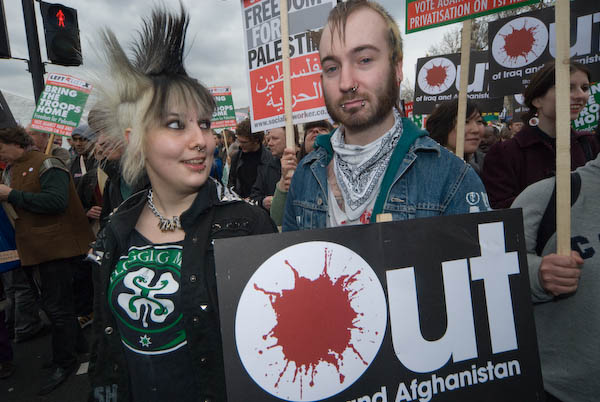
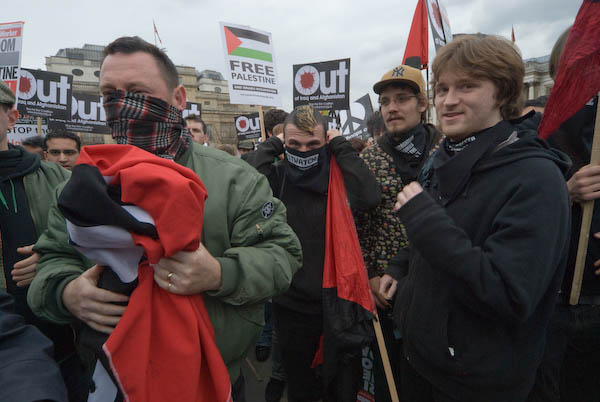
It was remarkable too for the range of different people and groups supporting it, many adding their own causes to the general aims of getting our troops back from wars in Afghanistan and Iraq, not going to war with Iran and ending the Israeli seige of Gaza.

I tried to reflect the whole range in my pictures, though I’m sure I missed some. And although thankfully the police did largely leave the conduct of the demonstration to the march organisers, the event did show the continuing fascination of FIT teams with the anarchist fringe, which only serves to encourage them. The only real clash, when four were arrested on what seems a very dubious pretext, predictably came when I was taking a break from the event as little seemed to be happening.

Although I’ve written a little on My London Diary about the event, mostly I’ve just put up pictures, roughly in chronological order, that cover the event. It was a big event, so I took a lot of pictures and there are rather a lot on line, perhaps about one in ten of what I took.

Thinking again about Winogrand, he liked to keep his work for a couple of years before he looked at it and selected the pictures that worked. Although nothing on My London Diary is in the same league, my serious edit will also be in a few years time. For the moment the site is really more like my digital version of contact sheets, as the name suggests a diary of how I saw things in London.

Narrative and Photography

ere’s another quote from the Garry Winogrand TV programme I mentioned recently (and if you haven’t watched it yet, I’m sure you will find it of interest.)

There isn’t a photograph in the world that has any narrative ability, any of them, they do not tell stories; they show you what something looks like… to a camera.”

Garry was of course right, but also wrong. Right from the point of view of making a photograph (almost certainly all he was interested in.) As he goes on to say “the thing has to be complete in the frame … it’s a picture problem, it’s part of what makes things interesting. A piece of time and space is well described, but not what is happening.”

But when we view all or most photographs we see them in a narrative manner. We supply a narrative context. And although that narrative may not be true to the time and space from which the photographer wrenched his moment, it does bear some relation to it. Although the photograph doesn’t determine the narrative, there has to be some kind of consonance between the image and it.

One of photography’s most famous images is of a man leaping from a plank in the Place de l’Europe in Paris, behind The Gare St Lazare in 1932. It’s ‘decisive moment‘ is because of our narrative completion with the splash of failed pride, although the picture itself is complete in a Winograndian sense in its frame (one of Henri Cartier-Bresson‘s few cropped frames.)

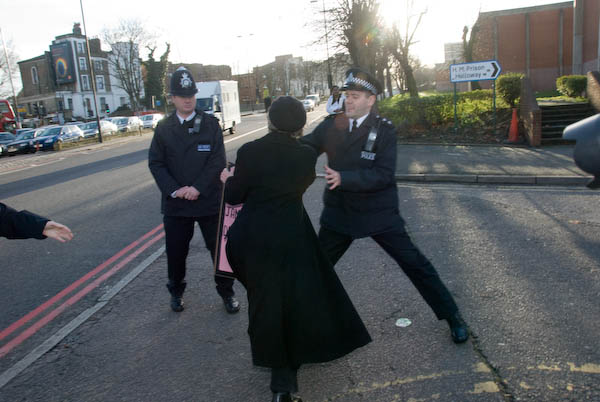
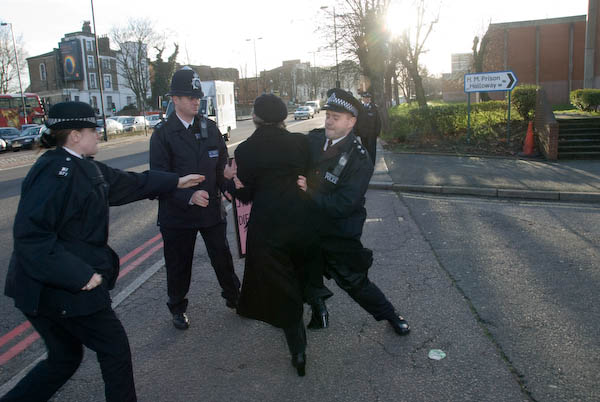
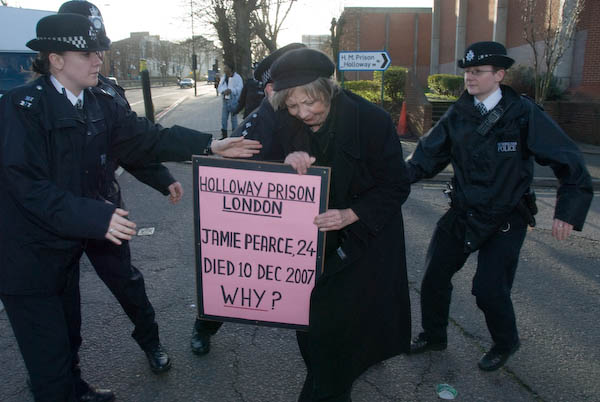
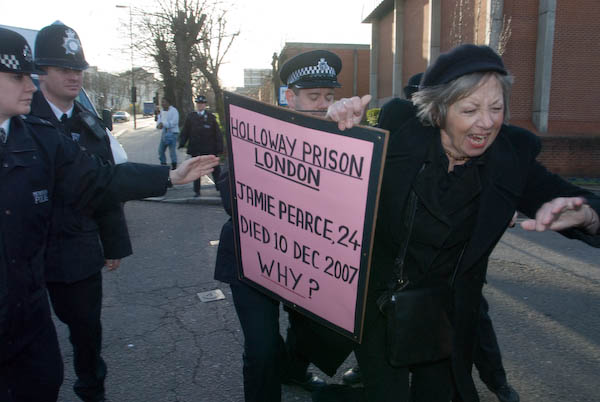
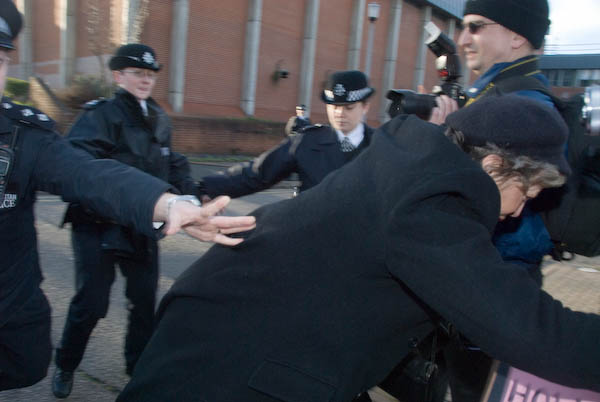
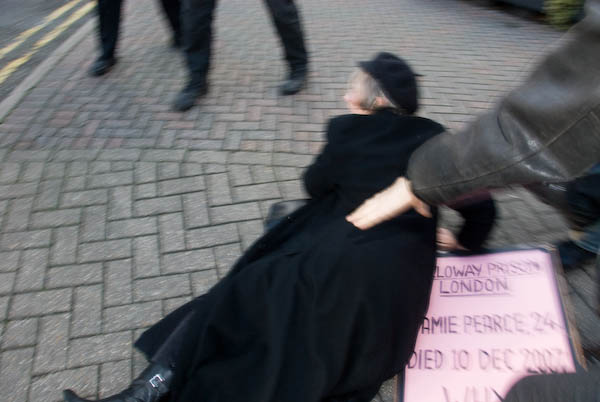
The set of pictures I took outside Holloway prison on Jan 16 have no claims to photographic fame, though they are perhaps a good illustration of being in the right place at the right time (and almost getting the exposure right.) Taken individually they could be anchored to a narrative in various ways, but as a sequence they tell more of a story.

Pauline Campbell’s daughter died in Styal prison in 2003. Sarah’s death led to her campaigning around the country on behalf of women who have died in prison – now more than 40 deaths since Sarah. After nearly four years of her campaigning the Home Office “finally admitted responsibility for the death of my daughter Sarah Campbell, including liability for breach of Sarah’s human rights under the European Convention on Human Rights.”

In January Pauline organised a protest to mark the death the previous month in Holloway of Jamie Pearce (later she found the prison authorities had spelt her name incorrectly – she was Jaime Pearce.) As a part of this she attempted to stop vans arriving at the prison with prisoners and talk to the drivers, and police were determined to prevent this picketing.

I took 6 frames of one incident as it happened and several afterwards which were related. Because of the sunlight coming more or less directly toward the camera (giving flare in some images) I was shooting using flash, and there was a variable delay between shots as the flash recharged. (Longer than usual as my SB800 had died and I was using the SB80DX, which is slower to recycle and less smart with the D200.) One of the minor advantages of digital is that is does record timings of pictures in the EXIF data, particularly pertinent in this case as I rename images on import to Lightroom including a sequential number – and in this case these are not in the correct order.

On Indymedia I published six, and they were also used in a centre page spread in ‘The News Line’, together with another picture from the event and my ‘Indymedia’ report. ‘The Big Issue (North)’ used a single image. Here they all are, although the times are all an hour out, as my camera was set incorrectly – it actually happened at around 15.34:

Image 1
Frame 1. 14.34.28 Pauline sees the van approaching and tries to run through the police line…

Image 2
Frame 2. 14.34.28 … but is intercepted by the senior officer…

Image 3
Frame 3. 14.34.30 … who starts to push her back, while a woman officer holds out a hand in front of her.

Image 4
Frame 4. 14.24.31 Pauline falls towards my right

Image 5
Frame 5. 14.34.31 … while I move round to show the hand pushing her…

Image 6
Frame 6. 14.34.33 … and she has landed on the pavement.

There should have been more than six images, but I was pushed me out of the way by police between the 5th and 6th images. I took a frame of her being helped on the ground, but wasn’t allowed tot really get where I needed to be, then I saw the officer who had pushed here, apparently reacting to what he had done, taking two pictures before he noticed and turned away.

Image 8
Frame 8. 14.34.42

Image 9
Frame 9: 14.34.42

No one picture really tells the story, though some suggest more than others. Taken together they are fairly convincing, in particular I think Frame 3, which shows that only one officer was pushing her – and another holds out her hand to try to stop her falling, and Frame 5 where I’ve moved round pretty fast to show the hand in the middle of her back.

The best picture – the most dramatic frame – is 4, shows Pauline from the front falling towards the camera, but clearly it doesn’t tell the whole story.

Déjà Vu?

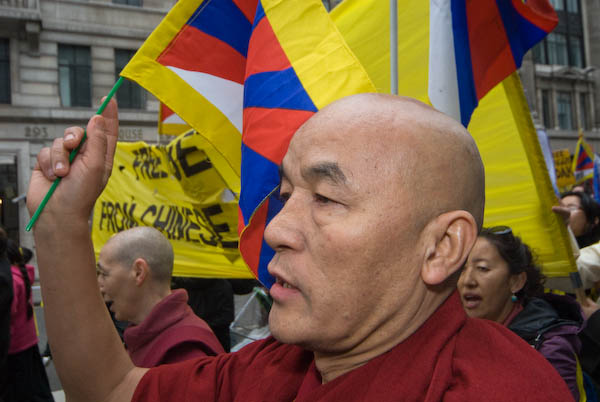
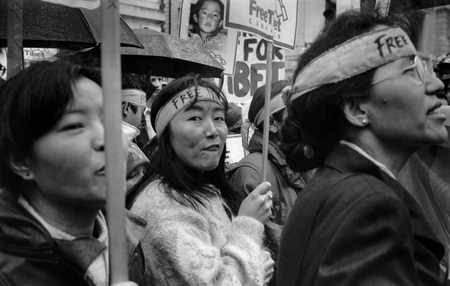
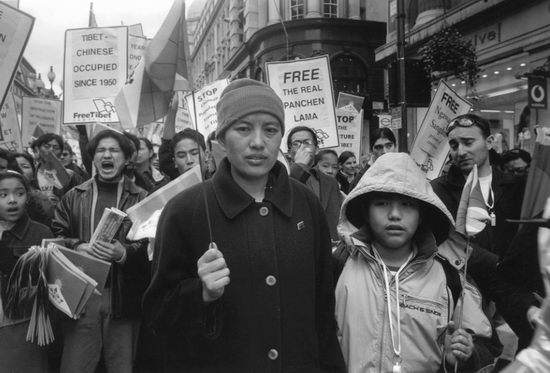
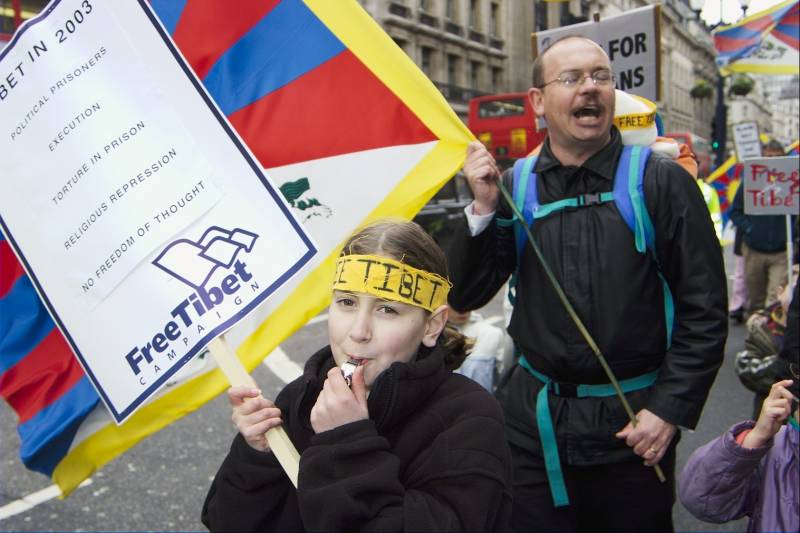
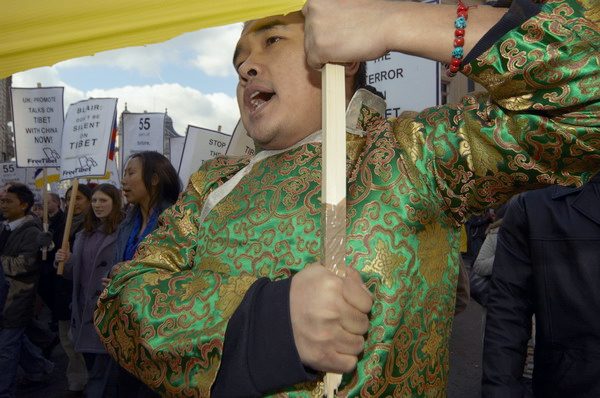
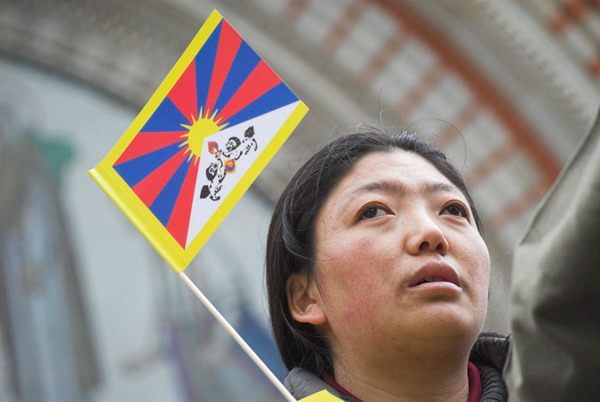
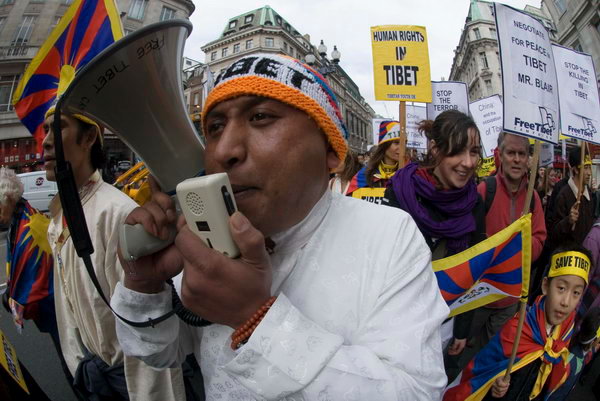
Saturday morning started for me opposite the Chinese Embassy, where supporters of a free Tibet were demonstrating on the 49th anniversary of the Tibetan uprising. I haven’t photographed there all of those 49 years, but it sometimes begins to feel a little like it, and this and the ensuing march through the West End certainly felt like watching a yet another repeat. All over again!


more 2008 pictures

Photographically it brought to mind two people, both in their different ways important teachers, although for me only at second-hand.

Alexey Brodovitch was art director of Harper’s Bazaar from 1938 to 1958, and among the photographers he nurtured there were Irving Penn, Richard Avedon and Hiro, while his classes in New York (and New Haven) drew Diane Arbus and Tony Ray Jones and a whole generation of New York based photographers. One of the many whose work you may not know well, but has a great web site with work from 60 years of photography is George S Zimbel.

Brodivitch used to insist to photographers “Surprise me!” and told them that if they looked into the viewfinder and saw something they had seen before not to take the picture.

The other person who came to mind was Garry Winogrand (and it was Zimbel who turned Winogrand on to photography), whose work has always interested me greatly. Again I never met him, though I’ve used film of him in teaching (and a piece in The Online Photographer last summer included links to a TV video on him from 1982 and the recollections of O C Garza who studied with him at the University of Texas in the mid 70’s – both well worth looking at.)

In the video, one of several comments by Winogrand is “You don’t learn anything from repeating what you know … in effect … so I keep trying to make it uncertain

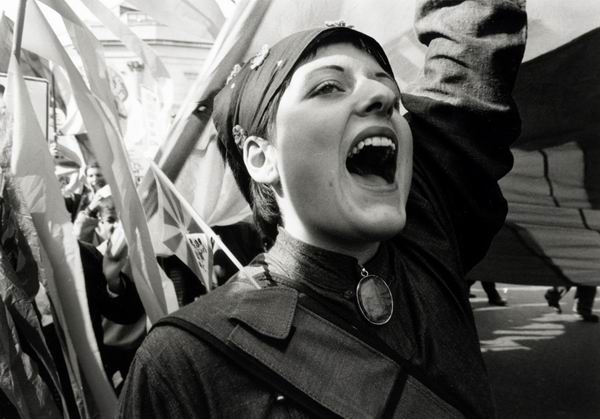
Saturday with ‘Free Tibet‘, too many things seemed familiar and I had problems with making things uncertain as I struggled with what Winogrand described as “the battle of form versus content.” But too many of my images were merely safe – and as he also said, “Most everything I do doesn’t quite make it. Hopefully you’re risking failing every time you make a frame.” Perhaps as usual I wasn’t risking enough.

You can see more of my pictures from 2008 on My London Diary, as well as some from previous years:

Free Tibet: 2000

Free Tibet 2001


Free Tibet 2002


more 2002 pictures

Free Tibet 2003

more 2003 pictures

Free Tibet 2005

more 2005 pictures

Free Tibet 2006

more 2006 pictures

Free Tibet 2007

more 2007 pictures

Looks like I had a year off in 2004!

Peter Marshall 
Phillip Jones Griffiths Interview

Although I have to say thanks to Jörg Colberg of Conscientious for alerting me to the Aperture interview with Philip Jones Griffiths, I find his comment on the piece pretty trivial and a little unpleasant. Whatever Jones Griffiths may say about photography doesn’t make his pictures one tiny bit less great. He would remain one of the greatest photojournalists of the 2oth century – and as well as the slide show in the Aperture Interview you can see more of his work on Magnum, including Vietnam Inc.

Colberg finds him “narrow-minded and outright disappointing (apart from intellectually lacking)”. Looking at what he writes and what Jones Griffiths says, I think that largely means that they come at photography from different perspectives. If Colberg can’t work out what Jones Griffiths was saying – and his comments suggest he didn’t – its a failure on his part .

For me – as I think with Jones Griffiths (certainly my favourite Welsh photographer) – the power of photography as a distinctive medium comes from its curious relation with reality, something that has been explored at great length but not always much light by many. For me it certainly isn’t something limited to photojournalism – and is even more important in much documentary photography, and also in much photography that comes under the rather vague category of fine art. But there are certainly works which although produced with the help of a camera don’t seem to me to be a part of the photographic tradition and that I don’t feel it appropriate to think of as photographs, although I may still appreciate them as art.

PDN 30 – My Top 5

The PDN’s annual choice of 30 “New and Emerging Photographers to Watch” is always of interest, and earlier years have certainly picked some fine photographers who have become well-known at least among other photographers – as well as quite a few we’ve yet to see more from.

Most of the photographers included – 25 out of the 32 (two of the choices are photographers who work as a pair) are 30 =/- 4 years old, and a majority live New York City and Brooklyn, with half a dozen others residing elsewhere in the US, mainly in California.

You could take that as representing the way that photographic talent is spread around the world, but probably only if you are a New Yorker. More likely it tells you that there is more interest in photography in NY than anywhere else on the globe, and that if you want to get noticed, NY is the place to be. And of course that PDN is based in NY.

Of course you don’t have to be American to live in NY, and one of the 30 (or 32) was born in Chorleywood, a northern fringe London suburb. Andreas Lazlo Konrath‘s father was a Hungarian architect, mother an English ballet dancer, so he became a skateboarder and played in a punk band, turning to photography after his elder brother gave him a Larry Clark book for his 18th. After writing off his knee in the way of skateboarders he turned to punk and punk photography, living in the East End and getting a fine art degree from London Guildhall. Now he’s taking portraits in New York.

Ed Ou stands out partly because he’s only 21 and lives in Israel, although he’s Canadian. At 21 his history is phenomenal. Working for Reuters, AP and Sipa in Africa, the Middle East, Asia. It helps that he speaks Mandarin, Arabic, French and some Hebrew too. Some very impressive images too.

Espen Rasmuissen is Norwegian, based in Oslo, where he is a picture editor for the biggest newspaper as well as a photographer. Represented by Panos, he has done a lot of work with Medecins Sans Frontieres. Perhaps more emerged than emerging, as his powerful images have won both World Press Photo and POYi awards.

Mikhael Subotzky is another photographer perhaps already too well-known to be considered emergin, with images by this South African already in the collections of MoMA as well as SA museums, several awards already in his bag and exhibitions around the world. I wrote quite a long time ago about his amazing stitched 360 degree panoramic images from South African prisons, although these are only a small aspect of his work.

Munem Wasif is from Bangladesh. Born 1983, he studied at the South Asian Institute of Photography and is now a staff photograph at DrikNEWS. Drik, set up in 1989, aimed to show the views of photographers and writers from the developing world, presenting images from that showed the majority world “not as fodder for disaster reporting, but as a vibrant source of human energy and a challenge to an exploitative global economic system.” It has become a very impressive organisation, known around the world, not least for its organisation of the Chobi Mela international photography festivals in Bangladesh. The 2008 festival is on the theme of ‘Freedom‘ and submissions can be made by post or on-line until 31 May 2008.

I’m not sure why my top five from the PDN30 are all of photographers whose background is far from the typical. Only one living in New York, and that an English photographer. Certainly there are others whose work interests me – Donald Weber, Brian Sokol, Dustin Snipes in particular – but on checking I find that none of them live in New York either. It must mean something, if only that I’m not a New Yorker.

Deutsche Borse Winner

I was a little shocked but not really surprised to find that the winner of this year’s Deutsche Borse Photography Prize is Esko Männikkö. He certainly didn’t come in my own top two choices of the four on the shortlist. Is he really the photographer of the four “who has made the greatest contribution to photography over the previous year?”

I’ve previously posted my thoughts on the 4 contestants. You can read them at:

John Davies
Jacob Holdt
Esko Männikkö
Fazal Sheikh

Prizes like this are of course a lottery, decided on the whim of a particular jury, and another group of equally eminent jurors would likely have reached a different decision. It isn’t really possible to come to an objective decision over something like this when the four bodies of work are so different.  If like me you have a strong conviction that documentary is the real centre of photography, then Männikkö’s work for this show was unlikely to get your vote.

So congratulations to Männikkö and commiserations to the other three contestants who the pin missed. Although it’s a great honour to have been short-listed, the disparity between the award made to the winner and the others seems, as always, greatly unfair.

This is only one of several important prizes awarded recently, which I’ll look at it a later post.