Wide Angle on Global Day Of Action For Darfur

I do like working with wide angle lenses, as anyone who has ever looked at My London Diary will have noticed.  Most times when I go out to take pictures I start off with a wide-range zoom on the camera, either a Sigma 18-25mm or the Nikon 18-200mm. The Nikon adds that extra length, has VR (I keep it switched on all the time, but don’t feel it does a great deal) but is quite a bit heavier and bulkier and mists up badly in dampish conditions. Image quality is very similar – both need software correction for chromatic aberration and distortion for critical use.  The Sigma feels better made, has a much better lens hood – the Nikon hood often falls off at inconvenient moments. Annoyingly the Sigma zooms in the wrong direction, but that’s the only real problem I have with it.

These lenses are both very flexible, allow you to work from a little distance or get in reasonably close. But when things are going well, there is usually a time when I feel I need to take off my jacket and get stuck in with a real wide angle, such as the Sigma 12-24.  And sometimes when I want to get really close and personal, the 10.5mm Nikon semi-fisheye. The curvy perspective can be a problem with the fisheye, but often when I use it I’m already thinking how I can sort things out a little in software afterwards.

The Darfur Day of Action marked five years of conflict there, and I needed the wide-angles for the two Darfur events I photographed in April and September 2007 as well.
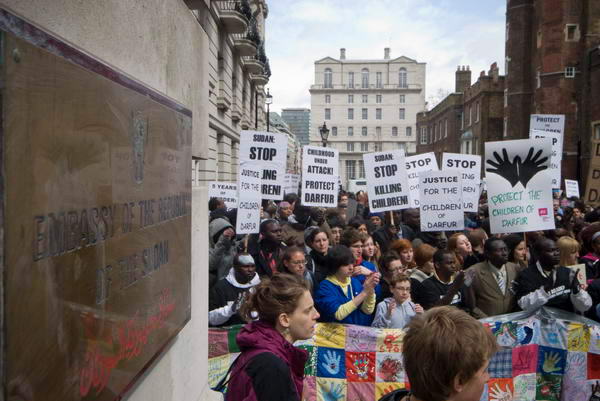
Sudanese Embassy
This shot, with the 12-24mm, manages to show that the demonstration is taking place at the Sudanese Embassy. A little work with Photoshop would help to bring this out – but this is a simple development of the RAW file. Probably I could have improved it a little while I was taking the image, but I had to stand on top of a wall with a rather long drop down to cellar level in front of me, the kind of situation that always leads me into a bad case of the shakes. I’ve just no head at all for heights – I blame it on my father taking me up with him on roofs where he was working when he had to look after me when I was a very small child.

But the wide angle has let me put together the brass plate and the demonstrators, and the perspective on it brings in the eye to the demonstration. I’d have preferred it to be wider to show more of the demonstration which stretched roughly twice as far across the street.  Although this was only at 24mm, it is tolerably sharp from the Y of Embassy to infinity, depth of field being a great advantage (usually) in wide angle shots – this one at f13.

Shortly before I’d poked the 10.5mm into the Embassy letter box, with this effect:
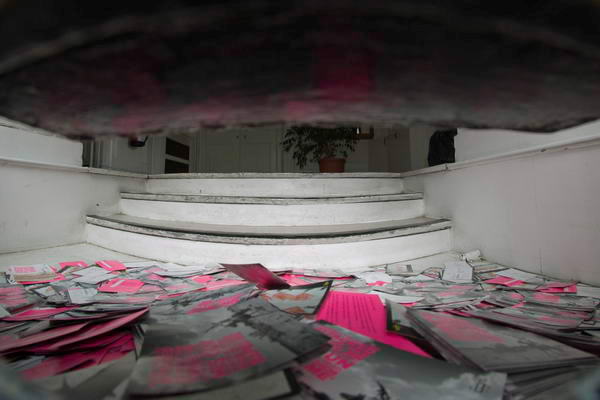
fisheye-ITfilter

Earlier I’d photographed people putting postcards through the door, and here they are in a pile on the floor inside., almost covering the area in front of the steps. Here I’ve used the Image Trends  Fisheye-Hemi 2 filter, followed by a slight crop. I couldn’t quite get the lens as far into the letterbox as I would have liked, but I think it still gives a decent effect.  The closest cards are really very close to the lens, and even the vast depth of field of the fisheye doesn’t quite cover.

The filter makes vertical lines straight, but leaves horizontals such as the steps with the curve that you see.  It is easy to remap to rectilinear perspective, but that seldom works unless quite severely cropped. The horizontal angle of view of roughly 140 degrees just results to too distorted a stretched effect towards the edges, and much of the image is lost when the remapped image is cropped to rectangular. You also get a drastic loss of quality at the edges and corners where there are simply not enough pixels to give a good result.

You can also try remapping fisheye images with the Panorama Tools plugin (particularly using the PSphere projection) or RectFish although this latter is perhaps better for circular fisheye images. Another alternative – and a great way to deal with distortion in all normal lenses, is PTLens.

The Darfur Protest pictures include a number taken with an ultra wide or semi-fisheye lens – as well as those taken with longer focal lengths. These things are useful tools, but can’t do everything you might need to do.
Protest and Publicity

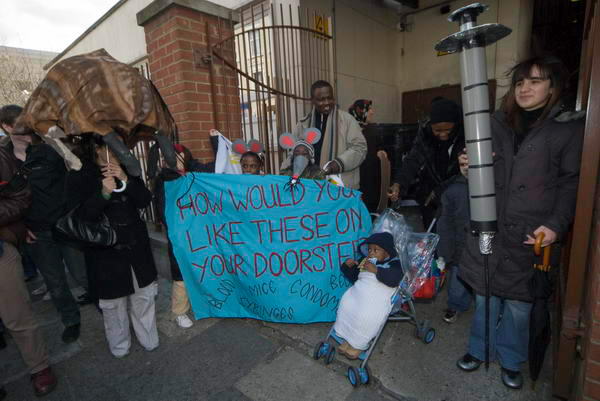
On Saturday morning, April 12, I arrived at a hostel in Stoke Newington from where residents, together with supporters of the London Coalition Against Poverty, were intending to march to Hackney council offices to highlight the appalling conditions they lived under and shame the council into taking action rather than simply making promises.

As I arrived, another photographer, photographing for a local paper advised me I needed to talk to the organiser of the event. She told me that it might be a problem if pictures of some of the women involved were to appear in the press, as some had been rehoused after suffering violence from their partners and that photographs might reveal their location and expose them to further attacks. Since one of the issues the protest was about was the lack of security at the hostel, with no locks on the outside gate and easily broken doors to the flats themselves, this seemed a real problem.

Of course, publicity was important to the case the residents was making. So they wanted publicity – and pictures. There was a dilemma here, and one which I don’t really think sensible that I should have been faced with. This was a protest in public, walking through busy streets in a major shopping area full of people with cameras – and I later saw many holding up their phones as the march past.

If there are ever real concerns about people being recognised in public protests, the solution is obvious; they should cover their faces (and any other recognisable features.) Many people in demonstrations of course do, for various reasons and in various ways. In this particular event, masks depicting mice, rats and bed bugs would all have been appropriate, and added to the impact of the march, although simple scarves or balaclavas would have done the job.

PHoto call
Photo call outside the hostel gate before the march. The umbrella is a bed bug.

There were some ‘mice’ present, and they were difficult to keep out of the camera. I tried hard to make sure everyone in my pictures was happy to be photographed, because the last thing I want to do is to cause any problems to people who are already in difficult circumstances. Nobody I asked had any problems with having their picture taken, so perhaps all those whose position was sensitive stayed at home.

Story and more pictures on My London Diary

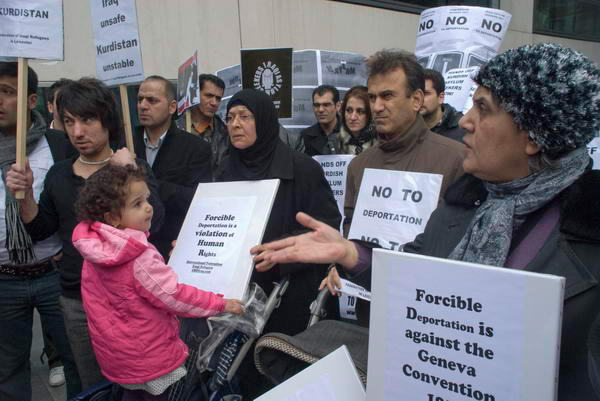
Protest Against Forcible Deportation to Iraq

Kurds protest

Friday was a gloomy day for me, although the weather was typical April sunshine and showers. I’d decided to cover a demonstration by Iraqi Kurds about the forcible deportation of their fellow asylum-seekers back to Iraq. It takes a considerable and shameful leap of the imagination for our government to consider that anywhere in Iraq is a safe place to return those who have previously fled in fear of their lives. Even though the Kurdish area may be safer for most than the rest of the country, among those who have been returned were people who came from elsewhere in the country, as well as some who feared retribution for their previous support of Saddam and their Christian religion.

Our policy on returning people who have failed to gain permission to remain is shameful, but the way it is implemented is even more so. Dawn raids, violence, dumping people at inappropriate destinations without support or resources and so on. All done to appease the racist elements of our popular press (and apparently assisted by racist attitudes in parts of our civil service that deal with immigration, along with inappropriate government-set targets that reduce people to numbers.)

Even those papers that might support human rights – even for immigrants – generally fail to regard such stories as news. The plane-full of Kurds dumped in Iraq at the end of March was reported only in the Guardian among the commercial newspapers, and no mention of Friday’s demonstration appeared anywhere – other than perhaps in the odd blog, and of course my own report on Indymedia.

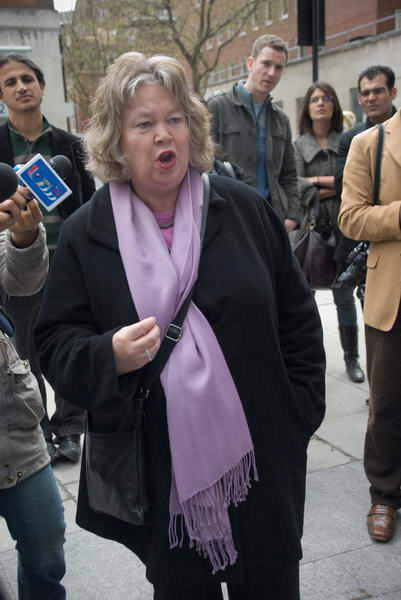
Jean Lambert

It wasn’t a particularly exciting event. There was no riot, no arrests. It was a relatively small protest, with most of the speeches not in English. One exception was Jean Lambert, Green MEP for London, the only British politician to take an interest, and I admire her for it, but have to apologise for detaining her for a few seconds as she was about to leave. After I’d taken a couple of pictures and thanked her, many of those taking part in the demonstration came up to her and wanted to have their pictures taken with her, so she was still at the event 5 minutes later when the heavens opened and we all got rather wet.

More about this and more pictures on My London Diary.

I suspect rain was also behind another reason for me feeling gloomy on Friday, when I finally had to admit that my 18-200mm VR lens really wasn’t working well enough and took it in for service. For some months it’s been getting harder and harder to get auto-focus at shorter focal lengths – and I’ve often found myself having to zoom out to focus before zooming back to take a picture – and sometimes missing a picture by doing so.

The long zoom range comes with a quite impressive extension to the length of the lens, and this basically seems to pump moisture into the lens even from the slightest of London drizzle, often resulting in condensation on inner elements. It’s a very handy lens in dry weather, but one I’ve come to leave at home when the forecast is bad. But on a few occasions recently its been impossible to avoid it getting a little damp, and I suspect this will result in a very expensive bill for repair.

Its great to be able to read the news that commercial media doesn’t bother with on Indymedia, but it has several flaws, especially for the professional. Not least that it doesn’t pay – nor does this blog or My London Diary.

Reasons to Celebrate: Bilal and Bert

It’s always good to be able to celebrate things connected with photography, and today I’ve received a couple of pieces of good news.

Firstly, the US military have said they will release AP photographer Bilal Hussein today, two years and a few days after his arrest. As the e-mail from the Free Bilal committee stated, “It seems the nightmare will soon be over. Let’s just wait to see the photos and the video of our dear colleague truly free to celebrate.

Secondly a small cause for celebration in London SE1, where a public vote by more than 5000 local residents has recognised Bert Hardy (1913-95) as worthy of a blue plaque at his birthplace in Webber St, just a short walk from one of my favourite photographic suppliers, Silverprint.

Hardy is best known for his warmly human pictures of people, many of which from the period around the 1939-45 war appeared in Picture Post, and your can see over 20 from around the Elephant in 1948.

Hardy, who got a job at a nearby photo-processing plant on leaving school aged 14, was one of the first British photographers to work professionally with a Leica, starting by using it to photograph cycling events.

Editor Tom Hopkinson recruited him to work for ‘Picture Post‘, and his war pictures so impressed him that Hardy became the first photographer to get a byline in the magazine.

Hardy’s great asset for Picture Post was his ability to go anywhere and get on with the people he had to photograph, whatever their social background. He really was interested in people and his photographs show this.

He was called up and sent as a photographer to cover the armies advancing across Europe after the invasion, photographing the Rhine crossing and many other events. He was among the first allied soldiers to enter the concentration camps and photograph there.

After leaving Picture Post he did some advertising work and set up a photographic printing business, Grove Hardy Ltd, in Burrows Mews, Southwark.

You can now find many of his images on the web, as well as several pirate copies (not in the links below) of the short text I wrote about him some years ago!

James Hyman Gallery
Getty Images
Google Images

Bilal Hussein Cleared, Still Held by US in Iraq

Free Bilal icon

The good news from the Free Bilal Committee is that an Iraqi court has dismissed the terrorism charges against Associated Press photographer Bilal Hussein and ordered his immediate release.

But at the moment he is still held by the US Military, almost 2 years since they first detained him on April 12, 2006. It is not clear yet whether they will release him or not – they claim that a UN mandate, valid until the end of the year, allows them to hold anyone they think is a security risk whatever the courts say.

A further allegation, which appears to have no substance, has been made against Hussein over an incident in which he and two other journalists were taken at gunpoint by insurgents to see the body of a kidnapped Italian journalist.

Bilal Hussein’s case is, as the Free Bilal Hussein web site puts it, “a serious affront to the press as a whole, as well as to democratic traditions.” He was one of the AP team in Iraq to be awarded the 2005 Pulitzer prize for Breaking News Photography “for its stunning series of photographs of bloody yearlong combat inside Iraqi cities.”

Almost 2500 journalists, photographers and writers from around the world have signed the petition for his release, along with over 750 working in fields outside of journalism. Many of us have also written in print or on-line about his case and added the graphic at the top of this post which links to the petition site.

Portraits and Paps

If one thing is certain it is that the inquest verdict on the deaths of Di and Dodi will not end the conspiracy theories surrounding what actually happened leading up to their deaths in Paris in the early morning of 31st August 1997.

Its also clear that the blame attached to the paparazzi that “the speed and manner of driving of the following vehicles“, in the views of the majority of nine jurors “caused or contributed to” the crash will do nothing to improve the image of photography.

Of course it is the very same public that deplore the way the paps acted on that evening who also fuel the apparently insatiable appetite for the celebrity snaps that more or less fill our popular press, spawning a ridiculous number of magazines and web sites and are becoming more and more common in what we used to think of as the serious press.

Blaming the paps is an irrelevance. They are the driven not the drivers in this situation. I don’t know why other jurors dissented from the majority verdict, but I hope it might be because they take a similar view to me.

Assuming you aren’t royalty but just an ‘ordinary’ celebrity and want to avoid the attention of paps, it isn’t too hard. Try – as at least one person has done – buying a number of sets of the same fairly normal clothing – and having same look each time you go out. Make yourself reasonably available to press photographers, dress and behave sensibly in public. Be polite to photographers and don’t assault them or employ others to do so, but don’t be too cooperative. Look at them and give them a nice smile (which they will soon come to hate) and just shake your head when they ask you to do silly things.

But of course most of those taking part in the circus thrive on it; celebs get the photographers they deserve, which is perhaps why the pages I flick through rapidly on the free sheets or see people sitting beside me on the bus or in the tube reading are full of such ordinary and banal images of them.

Last week I went to the National Portrait Gallery in London, largely to see a show of pictures of brilliant 18th century women, the original ‘Bluestockings‘. There were some good portraits, though of course none were photographs (and the set of modern photographs connected to the show failed to interest me) as well as some very interesting books and other artefacts, but while there I did wander around the other rooms of pictures. The work on show changes from time to time, but there are usually a few good photographic portraits on show as well as rather more paintings that hold my attention.

The show ‘Born 1947 – Camera Press at 60‘, which closes on 20 April 2008, celebrates 60 years of the UK’s largest independent photographic agency with specially commissioned portraits of celebreties who are also 60, along with some of founder Tom Blau‘s informal protraits from the 1940s to the 1960s.

Blau (1912-1984), was a Jewish Hungarian reporter and photographer who was born and brough up in Berlin, leaving Nazi Germany in 1935 to come to London. Here he worked as a freelance photo researcher and in 1938 was employed to help set up an international photo library, Pictorial Press, was owned by three Hollywood producers. In 1947, after having become a British citizen, Blau put up £2000 to found his own agency, Camera Press. His grand-daughter, Emma Blau, (b1975,) currently has one picture on display in Room 39 of the NPG, although my favourite image in that room is Angus McBean’s 1950 print of Audrey Hepburn.

Images and the Press

Thursday this week at the Old Lecture Theatre, Westminster University in Regent St, London, at 7pm, Media Workers Against the War are hosting a debate ‘Iraq 5 years on – How the media sells war and why” with Dahr Jamail, Iraqi independent journalist and author of “Beyond the Green Zone“, the Guardian‘s Nick Davies, author of “Flat Earth News“, Kim Sengupta, defence and diplomatic correspondent of the Independent and Lindsey German, national convenor of the Stop the War Coalition.

The venue is 2 minutes walk north of Oxford Circus and tickets can be bought on line – £5, £3(concessions.)

In their mailing, MWAW give a number of links to the ‘iconic’ image of the toppling of Saddam’s statue in Baghdad, the most memorable image from the Iraq invasion until we saw those pictures taken by soldiers of prisoners at Abu Ghraib, showing clearing how this event was staged for and misrepresented by the media. One of the best of the links is an interview with eye-witness Neville Watson on Australian TV, together with footage of the scene in a You-tube video.

For a rather different story about photographing the news, read the Reuters blog, in which their senior Bangkok photographer Adrees Latif describes how he took the pictures of the killing of Japanese video journalist Kenjii Nagai which have just won Latif the 2008 Pulitzer Prize for Breaking News Photography.

Latif’s story gives a real description of the problems of covering such protests. You can see a larger version of his winning picture on the Pulitzer site. Also on the same site is the series of nineteen colour images, an intimate chronicle of a family coping with a parent’s terminal illness, which gained Preston Gannaway of the Concord Monitor her Pulitzer for Feature Photography.

‘Bangladesh 1971’ at Autograph

I was surprised not to see more people at the press view of ‘Bangladesh 1971‘ yesterday, at Autograph ABP‘s superb new premises that opened last year in Rivington Place in London’s now-trendy Shoreditch.

Women preparing for battle prior to the crackdown of 25th March 1971
Photographer: Rashid Talukder, courtesy of Drik and Autograph ABP

Produced in partnership with Shahidul Alam and the Drik Picture Library (I was disappointed not to meet Shahidul, having corresponded with him over the years, and read his newsletters, but he was held up getting his visa for Croatia) this is in several ways an important show, and one that curators Mark Sealy of Autograph and Shahidul Alam can be proud of.

The show in the superb ground-floor gallery is of photographs, taken mainly by Bangladeshi photographers, of the events that led to independence for Bangladesh. One of the bitterest and bloodiest conflicts ever, many of the details are not widely known and still contested, and one of the aims of the curators was simply to provide a true account through photographs.

As they state, “For Bangladesh, ravaged by the war and subsequent political turmoil, it has been a difficult task to reconstruct its own history. It is only during the last few years that this important Bangladeshi photographic history has begun to emerge.” After showing here it is hoped that this exhibition will return to Bangladesh and become a part of a museum collection there. Although it is a show with considerable photographic interest, it is also one where the historical background is vital for fuller appreciation.

In an attempt to impose its will on the country the Pakistan army implemented the systematic killing of Bengali members of military forces, intellectuals and students, along with any other able-boded men they came across. Estimates of the number killed range from 200,000 to three millions (although an official Pakistan government investigation somehow arrived at a figure of only 26,000.) Similarly, estimates of the number of women raped during the atrocities cover range between 3000 and 400,000.

Over two million refugees fled from the army atrocities over the border to India. I also watched the film ‘Bangladesh 1971‘, part of the associated ‘Bangladesh 1971 Film Season‘ at nearby Rich Mix Cultural Centre, which includes powerful scenes from film made during the liberation struggle. We see refugees stepping through deep mud on their journey and of an old, near blind woman making her way by putting down a bamboo staff flat on the ground every few steps to find a route.

The 60 minute film, produced by a group at the Rainbow Film Society in Bethnal Green, describes the events in a clear time line, with footage of some of the key scenes also covered by the still photographs – and I think one or two of the featured photographers may be seen in it.

This show is politically important, and not just for Bangladesh, or the British Bangladeshi community- many of whom live in neighbouring Tower Hamlets – but also is very much relates to the British history of involvement in India since the days of ‘John Company‘, founded in 1600 “for the honour of the nation, the wealth of the peoples” of England, leading to over 300 years of colonial exploitation (in some respects little changed by independence in 1947.) The partition of India at independence was an unsatisfactory (and also extremely bloody) solution, and one which underlies the events of 1971.

US support of Pakistan, both through military aid and at the UN, also had disastrous consequences, and it would be good to see this show put on in the America. President Nixon even urged the Chinese (who also armed and supported Pakistan) to mobilise its forces on the Indian border, as well as sending the nuclear-powered aircraft carrier the USS Enterprise to the Bay of Bengal. Such support encouraged Pakistan to launch a ‘pre-emptive’ attack on India, and it was the failure of this followed by the rapid intervention of Indian forces against the Pakistan army in Bangladesh that brought the war for independence there to a speedy victory.

If I’ve spent too long on history and politics, it is because this show is in several respects an importantly political one (and if I have a criticism it would be that the exhibition needs to have more background material on display, including a time-line of the main events.)

But it is also an powerful show in terms of the actual photography – and also one that relates to the politics of photography. These are pictures taken by photographers from Bangladesh, several of whom deserve to be far more widely known. Although some of the images are important simply for what they show and in other respects are typical or even rather poor press images, there are also some outstanding pictures here. There are several very fine photographers among the dozen or so included here (and at least one excellent anonymous image) but the work of Rashid Talukder (b1939, India) and Abdul Hamid Raihan is outstanding.

Two Boys
Two boys stand among rocket bombs left by Pakistani army at the picnic corner in Jessore, Bangladesh. 11/12/1971
Photographer: Abdul Hamid Raihan, Courtesy of Drik and Autograph ABP

One picture by Raihan which stays in my mind is of a man standing in the ruins that were once his house. You can see it, along with another 32 of his pictures at Majority World, a “collaboration between The Drik Picture Library of Bangladesh and kijijiVision in the UK to champion the cause of indigenous photographers from the developing world and the global South.”

Talukder’s work is also striking, and in many cases not for the squeamish, with a startling picture of the discarded head of an intellectual along with bricks in a puddle, or the public bayoneting of a collaborator by guerillas. He also has a fine images of more peaceful events, including the release of a dove by Bangabandhu in 1973. Again you can see more of his work – over 90 images – on Majority World.

Drik, set up in 1989 by a small group including Shahidul Alam, its name the Sanskit for ‘vision,’ has pioneered the representation of photographers from the majority world, seeing it “vibrant source of human energy and a challenge to an exploitative global economic system.” It has very much challenged “western media hegemony“, promoting work from the majority world, running education programmes and setting up the first Asian photography festival, Chobi Mela.

The show – and the work of Drik – also raise questions about the future. We live in a rapidly changing world, one where India is fast becoming a leading power in the world economy, and also one where Bangladesh itself is under considerable threat from rising sea levels as a result of global warming.

The exhibition opens April 4 and runs until May 31, 2008. It is hoped it may also show elsewhere in the UK.

April 1

Photo Safety Identity Checking Observation (PSICO) in EPUK’s April 1 post is great stuff – worth a look if you’ve not already seen it.

Met Police to relax London photography restrictions in pilot scheme is the headline, and the feature gives some pretty full details of the pilot scheme for tagging photographers – including the cost of licences and a map of the area covered. And of course, “There will nevertheless be full consultation with the NUJ and other interested parties once the scheme is up and running.”

Of course you can read several true stories related to police and photography on the web, including my own piece on Jeremy Dear’s one-person protest at New Scotland Yard last week.

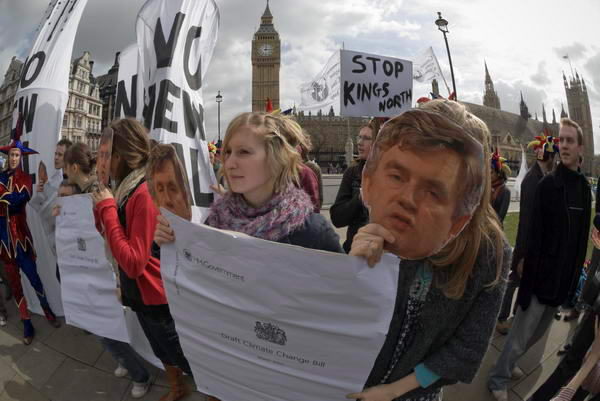
Kingsnorth - Parliament Sq
‘No New Coal’ read the cooling towers in Parliament Square

I was too busy to read the April Fool post on 1 April, being out taking pictures of protests in London on ‘Fossil Fools Day’ against the Kingsnorth coal-fired power station and opencast mining in Merthyr Tydfil.

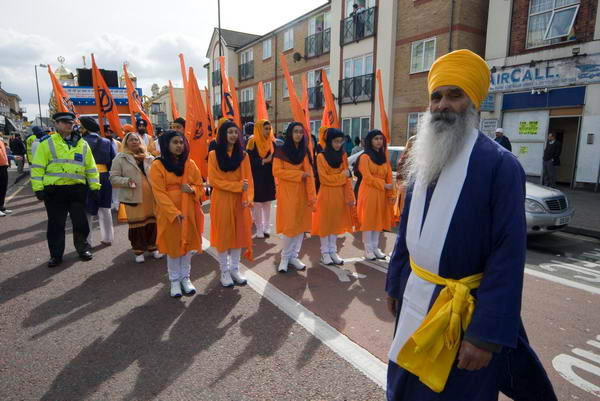
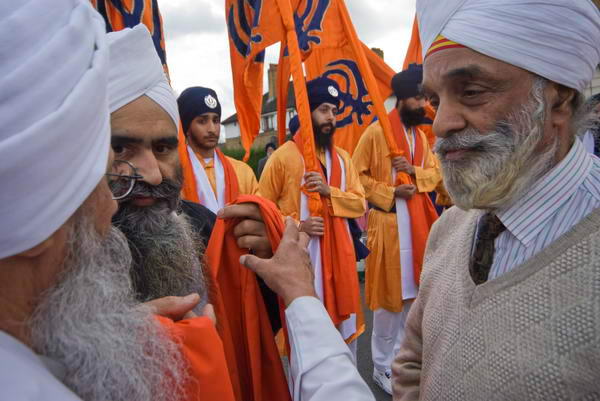
Vaisakhi

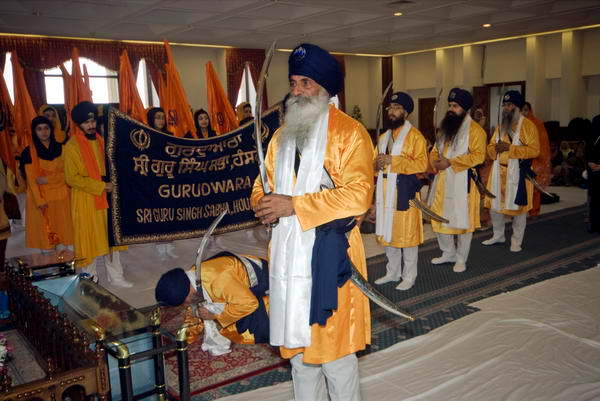
One of the really great things about being a photographer is that it gets you places you wouldn’t otherwise go. So on Sunday I walked into the Gurdwara in the town I grew up up, and was welcomed as a guest and helped to photograph virtually everything that went on.

Hounslow Gurdwara
Rather different from when I used to walk along here to the pub at lunchtimes.

Sikhs are of course very generous people, and non-Sikhs are I think always welcomed. But the reception I got contrasted rather with the Catholic cathedral I’d entered earlier in the week to be greeted by notices stating ‘no photography‘ (and I’ve been escorted out of an Anglican cathedral for attempting to take pictures of an event there.)

Of course you have to behave with a certain sensitivity and follow the normal practice of removing your shoes and covering your head, and not to get in the way of the activities, but as with the Sikh wedding I photographed last year, you could otherwise photograph as you liked.

I was fortunate to meet when I arrived another photographer I knew who had also arrived to take pictures and already knew some of the people at the Gurdwara.

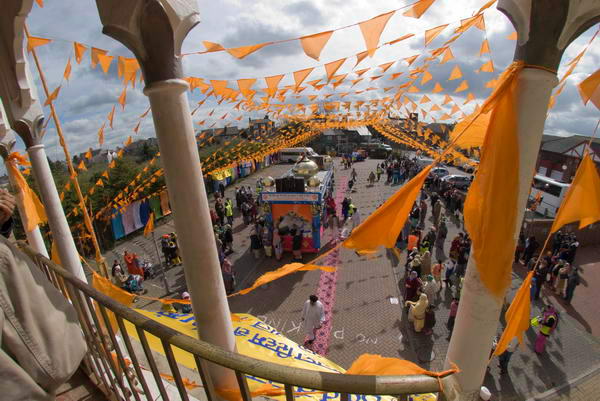
Vaisakhi Hounslow

I’ve previously photographed Vaisakhi processions on half a dozen or so occassions in other places, including a few times in Southall, in Slough and at East Ham, so I had a good idea what to expect, although each of these places observes things with some differences. But this was the first time I’d photographed the events inside the Gurdwara before the procession around the town.

Bell Road

I stayed with the procession for several hours as it made its way around the town, which I’ve visited only infrequently since my father moved away in the early 1970s. It was a fascinating day, and like the other similar processions I’ve photographed, extremely interesting. One real bonus is the free food available at various points along the route, though it hurts to have to turn down all the delicious sweets on offer.

Ouside the other Gurdwar in Martindale Road

You can also see pictures from some of the Vaisakhi processions I’ve photographed in previous years on My London Diary. There are processions in various towns over the next few weekends.