New York in London

There is of course a sense in which a show like ‘The New York School‘, currently at the Michael Hoppen Gallery in London’s Chelsea, is bound to disappoint, and it is one that is heightened by the hype in the listings which describe it as “An overview of a period of intense photographic creativity from the Big Apple featuring the likes of Diane Arbus, Robert Frank and William Klein” (BJP)

It certainly isn’t an overview. Michael Hoppen is a commercial gallery and the contents of their show is determined by what can be found currently on the market and so offered for sale – only a couple of the works were without prices. It would be impossible to mount a real overview without the collaboration of various museums and collectors in lending work, and would require a considerably larger space. London saw a much better overview as the first half of the major Barbican show ‘American Images‘ in 1985 – and that just isn’t the kind of thing a commercial gallery can hope to match.

We can perhaps take “the likes of Diane Arbus, Robert Frank and William Klein” simply as sloppy journalism, in that the very point about these photographers was that they stood out as each having a particular view. There is a decent print of one of Klein’s better pictures in the show, but Frank and Arbus are poorly served by the couple of examples on offer, at least one of which should clearly have gone direct into the darkroom waste bin.

I went to the gallery not expecting a great deal, and in that respect I wasn’t really disappointed. There were however at least a couple of prints that interested, even moved me, including a fine photogravure of four men from the mid 1950s by Roy DeCarava (surprisingly not included in his fine volume ‘the sound I saw‘ although his second picture in the show, to me less interesting image of dancers is – and I think looks better in the book.) Unfortunately the lighting in the gallery gave maddening reflections – if you want to see the richly stygian ‘Four Men‘ at its best you should take a large black card along with you. I could only really make out two of them in the show.

One of a few Leon Levinstein pictures also caught my attention, although it perhaps lacked the kind of shock of his best work it did have a little of his characteristic directness.

Overall, by the time I’d been round the show – which does include some other pictures, particularly by Weegee and Louis Faurer, of at least some interest – I was beginning to think a more accurate title might have been ‘New York on a Bad Day’. Most of the photographers in it are deservedly well-known, but not on the basis of what was on show here. (I’ve never quite understood why people rate Ted Croner (1922–2005), an early Brodovitch student who he sent to photograph the city at night, and certainly what I saw here didn’t help.)

But as an overview, it simply omitted so many photographers whose work seems so central to the creative ferment stirred up by the New York Photo League and by Brodovitch in the period around and after the war. It was also perhaps rather defocussed by the inclusion of work from the city by two visiting British photographers, David Bailey and Neil Libbert.

Perhaps the good prints from the ‘New York School’ are all elsewhere, in galleries on on people’s walls, or, hideous thought, stashed in vaults by ‘investors’. Fortunately we are talking photography, and it is often best seen in books. One of the best overviews of what this show purports is still the catalogue of the Barbican show, ‘American Images‘ still readily available secondhand at a very reasonable price (ranging from 74p from one US bookseller, up to £65 elsewhere.)
Dumbo Brooklyn?

I didn’t get to New York for the New York Photo Festival , although rather a lot of others seem to have done. Held in Dumbo, Brooklyn and billed by its organisers as “the future of contemporary photography” the event on May 14-18 attracted many visitors, though not all were entirely complimentary about what they found.

You can view some videos about it on PDN Online and read a rather short note in the New York Times. The future would appear to be dominated by curators rather than photographers, with Kathy Ryan of the NY Times, Martin Parr of Magnum, Lesley A Martin of Aperture and Tim Barber of Vice curating the four major shows.

But to get a real feeling of what it was like from someone who was in the thick of it, take a look at photographer Andrew Hetherington’s ‘Whats the Jackanory‘ blog reports from New York, perhaps starting with ‘Lets Get the Party Started‘ on May 9 and then going on to the You know it’s a really good photo festival: 1 and following the ‘newer post’ link at the bottom to read the rest. He was also one of the contributors to Foto8’s coverage of the event, and you can read more there from him and other contributors.

In case anyone is still wondering, Dumbo is Down Under the Manhattan Bridge Overpass.

Anyone for Morris?

I’m never quite sure that I want to photograph Morris Dancing. Partly I think because it seems to be such a popular subject with amateur photographers – the kind of event that gets listed under ‘photo opportunities‘ in the amateur magazines. Fortunately I don’t think these have got onto May Queens yet. But it does seem to be a general rule that whenever something is listed whether on a press release or elsewhere as a ‘photo-op’ it is almost certain to be boring. You, along with 27 other photographers are presented with someone else’s idea (almost always a word person’s idea) of what would make a good photograph, typically some posed group, and its always hard work – if not impossible – to make a different and more interesting picture.

Of course Morris isn’t like that, but it does come with lots of wacky coloured clothes, stripy waistcoats, flowery hats and knee-bells that make it ‘photogenic‘ – another of my least favourite words, committed as I am to the proposition that it’s photographers who make photographs. Photogenic just means more clichés to struggle against, and all too often my doggy paddle can’t breast the stream.

Not that I’m against Morris at all. It’s a great tradition and guys like Cecil Sharp and the others who recorded and resuscitated its dying embers at the turn of the nineteenth century did a great job. If I didn’t have a life and two left feet I’d happily join up and spend more time with them studying real ale. I’m even on record as saying that the stupidest, most arrogant and wrong-headed decision the English Arts Council ever made was not to fund Morris Dancers; “Over my dead body” on of its more illustrious leaders was reported to have said in a rare pause from shovelling money into the bottomless pit of London’s Royal Opera House.

sword and wheel
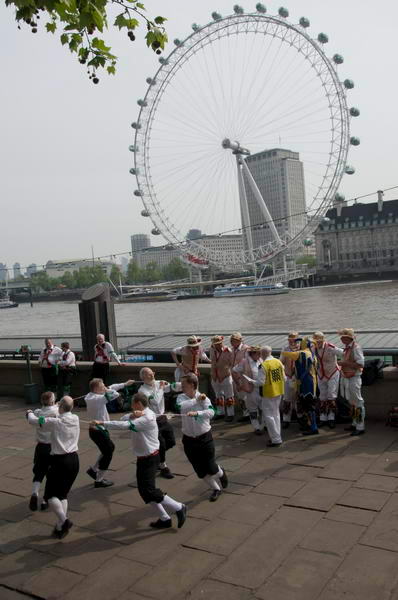
Sword dancers at Embankment Steps, Westminster, London

The Westminster Day of Dance is rather a splendid event, organised by the “world famous Westminster Morris Men” who dress in tabards with a portcullis motif which makes me think of council employees (perhaps why I seem to have edited them completely out of the pictures I’ve put on line) though they do have a rather fine unicorn.

There were four locations where groups of dancers were putting in an early morning session before coming together in Trafalgar Square, and I decided that the River Thames would make for a more interesting London background, so started off at Embankment steps, with the view across the river, including the London Eye – see above. Shortly before the session ended I rushed down to Victoria Gardens, where I hoped that the Houses of Parliament and Rodin’s Burghers of Calais might form suitable backgrounds, though I didn’t really get either to work.

After a brief and pointless journey on the tube to photograph another event (on arrival I found it wasn’t starting until three hours after the time I’d found on the web) I went to see the Morris Men (and I think they were all men, although there are women Morris Dancers, following in the footsteps of the suffragette Esperance Working Girls Club of 1906) in Trafalgar Square, where they were competing rather successfully for the attention of tourists with Falun Dafa, celebrating its 16th anniversary and protesters against the slaughter of seals. The dancing continued at various sites around Westminster after lunch, but by then I was with the May Queens in rural suburbia.

There is a tendency for us to look back and see the interest in and revival of folk traditions – including both Morris and the May Queens around the end of the Victorian era as a conservative movement in political terms. There were actually strong links with the radical movements of the day both in the arts – the Arts and Craft movement – and in politics, including both socialism and the emancipation of women.

London May Queen

I’ve had an exhausting few days, partly from working in what for us in England has been some unusually hot weather but also because I’ve been out photographing rather a lot. People who aren’t photographers (even some who take a lot of photographs) think that photography is an easy number but – at least the way I do it – it can actually be physically and mentally draining.

My camera bag isn’t particularly heavy, typically around 15 or 16 lbs on my left shoulder, and I can stand around for hours without getting tired (though if I forget and pick it up on my right I start to feel pain in minutes.) But covering a procession or demonstration involves a lot of running around, much of it going backwards, as well as stretching, crouching and leaning to get the camera into the right place, often rather tricky as the subject is often moving too.

Mentally I think it’s rather like taking an exam when new questions keep getting fired at you and you have to respond instantly with answers. As well as the purely visual problems you are also working with people and situations. I’m not complaining – I do it because I find it exhilarating, but can also be very tiring.

Of course the subjects I choose to cover are relatively soft ones, unlike those of some other photographers. Despite some of the lurid stories of gun crime that appear in newspapers there is essentially little or no risk of “kinetic activity” when photographing in London, and the worst physical dangers I usually face are those of road traffic. And being able to get on a train and go home at the end of the day does make life so much easier.

Coney Hall
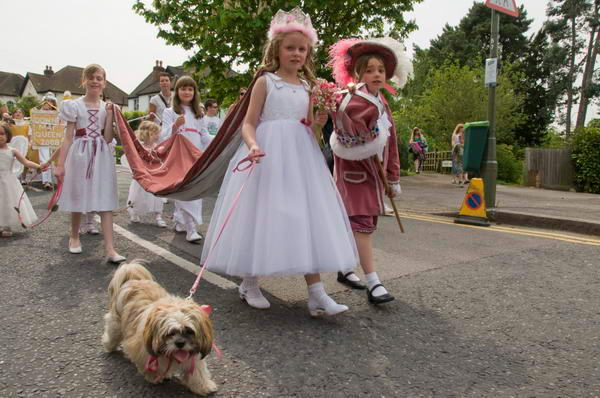
The Coney Hall May Queen and her dog in the procession

But despite the fact that the Merrie England and London May Queen Festival is a delightful and interesting event, I was still pretty tired by the end of it, and it was great to be able to relax and have a couple of beers before going home and downloading the images on to my computer. It’s also good not to have to work to tight deadlines, although I had to get everything transferred and backed up so that I could go out and take more pictures the following day.

Sutton May Queen
Sutton May Queen

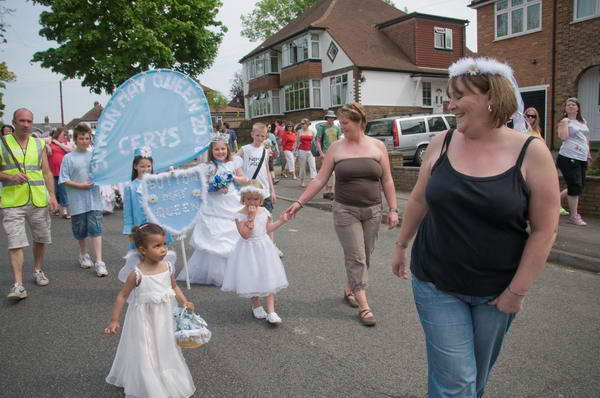
The festival was held as always at Hayes Common, on the leafy suburban south-east fringe of London (and the pollen count was undoubtedly high as my itching eyes and sneezing testified.) I’d been invited to take pictures by the mother of the 96th London May Queen, though I would quite likely have been there in any case as I’ve been working on a project on the subject of May queens, hopefully for a museum show and book, since 2005. Given the problems that there can be now in photographing children, getting to know and be trusted by people has been vital.

You can read much more about the actual event, and see more pictures than you need on My London Diary, where there are also pictures from various previous May Queen events.

Who needs Oscars?

I have to admit to a certain feeling of ennui about the increasing number of awards for photography, especially so those that attempt to introduce something of the ridiculous commercial razzmatazz of the Oscars.

So I didn’t have very high hopes when I heard about the Sony World Photography Awards, especially when I learn they were to be held in Cannes. And although the Honorary Board members did include photographers Bruce Davidson, Elliot Erwitt, Martine Franck, Susan Mieselas and Martin Parr of Magnum, along with Nan Goldin, Mary-Ellen Mark, Rankin and Tom Stoddart. There are also some very well-known names in the other Academy members, along with a number of others whose photographic credentials are perhaps less credible. It was also a team lacking in international terms; far too many are from the UK and US, with only two from Asia, one from Africa and none from South America.

This week’s British Journal of Photography (some stories need a subscription to read online) has two interesting features on photographic competitions. One is about the SWPA (not to be confused with the WPA, which for all of us with an interest in photography is the Works Progress Administration), written by Su Steward (BJP editor Simon Bainbridge was one of the Academy, so perhaps she had to be even more careful than usual in what she wrote.) She gives an interesting view of the event and some of the problems, as well as commenting on the judging and winners, although the article has its own teething problem with a wrongly captioned image.

I did find it surprising, that after quoting the comment made over a Cannes Film Festival lunch that apparently kick-started the SWPA, claiming that there wasn’t “an Oscars for Photography” she failed to mention the “Lucies,” set up for that very purpose in 2003, when Henri Cartier-Bresson received the first Lifetime Acheivement Award. On the Lucie Award web site the front page quotes for Douglas Kirkland “The Movie Industry has its Oscars and the Photography Community has its Lucies.”

The 2007 Lucie Awards were:
Elliot Erwitt – Lifetime Achievement,
Kenro Izu – Humanitarian Award,
Ralph Gibson – Achievement in Fine Art,
Eugene Richards – Achievement in Documentary,
Philip Jones Griffiths – Achievement in Photojournalism,
Lord Snowdon – Achievement in Portraiture,
Deborah Turbeville – Achievement in Fashion,
Howard Zieff – Achievement in Advertising,
Heinz Kluetmeier – Achievement in Sports,
and the 2008 Awards will go to Richard Misrach, Josef Koudelka, Sara Terry: The Aftermath Project, John Iacono, Susan Meiselas, Visa Pour L’Image Festival, Herman Leonard and Erwin Olaf – with more details on the web site May 15.
I never attended the Lucie awards ceremony – despite being invited – partly because it didn’t seem my kind of event, but it surely deserves a mention in this context.


(C) 2007, Peter Marshall. Giacomo meets Max Kandhola

You can find more about the WPA event on its website – or buy the BJP. I’d just like to mention one of the winners, Giacomo Brunelli, who showed me his superb work at Rhubarb Rhubarb in Birmingham last year and I wrote about it for this blog, with a couple of examples, as well as introducing him to Luminous Lint.

Also in the BJP is an article first published on-line at Foto8 by two of the judges at the World Press Photo contest, ‘Unconcerned but not indifferent‘ by Adam Broomberg and Oliver Chapman. They lift the lid off the proceedings there and also question the role of photojournalism, particularly as “photographs rarely break the news these days” or at least those that do are largely the products of ‘citizen journalism’, the blurred impressions from the mobile phones of those caught up in the affair. (When I wrote a guide to the photographs of 9/11 – first on-line on 9/12 it received hundreds of thousands of hits – I commented on the immediacy of such coverage, highlighting some of the more powerful examples.)

The BJP adds a little to the debate by publishing a reply by this year’s World Press Photo of the Year winner, Tim Hetherington, who argues that photojournalism remains as relevant today as it ever was.

I’ve been meaning to write for some time about the re-launched “all-new” biannual Foto8 magazine. 180 pages of essential reading for anyone with the slightest interest in photojournalism. If you are reading this are aren’t already a subscriber you almost certainly should be.

Orphan Works

The US at at it again with an Orphan Works Bill, or two to be precise. You can read a thorough examination of what this means for photographers in Why the Orphan Works Act is Uncle Sam’s thieves’ charter by Tony Sleep on EPUK.

Basically this seeks to upturn the Berne Convention on copyright and make your photographs an open house for theives – unless you have paid for them to be entered in private registers certified by the US Copyright Office.

In particular any work on the Internet will be at danger, and if this is passed into law I think the only protection we will have will be to overprint every image we put on the web with a large visible copyright notice. I’ve always been against this approach as I think it severely damages the value of putting images on-line.

It is hard to see the rest of the world accepting this US usurpation of intellectual property and we may expect to see some retaliatory action if either of these bills becomes an act – as it seems likely to do with the end of term coming up for President Bush.

It’s also worth reading ‘A Wolf in Sheeps Clothing‘ on Photo Business News which makes clearer some of the problems. What is surprising is the support for the proposal from the ASMP, in a feature that contains the astonishing statement “In a nutshell, we see little financial harm to creators from the non-profit and non-fiction uses of orphaned images.” In other words they think we don’t – or shouldn’t – make money from “Uses in works of non-fiction, such as books, articles or documentary films or videos” and “Uses by non-profit educational institutions, libraries, museums or archives“, while they want to alter the bill to make sure that commercial users can’t use it as a “free pass to profit from infringements.”

For many of us this seems to imply we should be happy to give away a large chunk of our income. The APA (Advertising Photographers of America) seems rather more clued up when it comments “If left unchanged, this legislation has the potential to destroy the businesses and livelihoods of thousands of photographers, other visual artists, as well as the collateral small businesses that serve the industry, and are dependent on, creators.” It is also worth looking at the Stock Artists Alliance site – they too are also calling for major changes in the bill.

If you want to take action – whether you are a US citizen or not – the Illustrators Partnership page has some useful suggestions.

Of course there is a real problem with s0-called ‘Orphan Works’ although its perhaps not surprising that the Canadian approach – which instead talks about ‘Unlocatable Copyright Owners’ offers a solution far more favourable to creators. Simply, if you wish to use a copyright work and can satisfy the Canadian Copyright board you have made reasonable efforts to locate the copyright owner, they will grant you a licence and pay a fee to a collective copyright society. These fees can be claimed by the copyright owner up to 5 years after the end of the licence, but otherwise would be distributed to members in a similar way to the fees we can now receive for the photocopying of our work.

This system allows users to make use of such works for reasonable fees – but not free of charge, and also passes on fees to creators. There is a balance about it totally missing from the US proposals. I hope that other countries will take up similar proposals – and also take suitable retaliatory action against the US if they pass an Orphan Works act that effectively gets rid of copyright protection for works not registered in the US

Street a State of Mind?

I think I’ve more or less got over being a street photographer, though I work most of the time on the street, if anything I do think of myself as a ‘post-street’ photographer. Been there, done that, eventually got bored.


Hatton Garden

Of course I’m not being entirely serious. What I’m really bored with is people who think of themselves as somehow radical because they are ‘street photographers’ and are wandering around producing very third rate images. As Mitch Alland puts it in his
An Approach to Street Photography on the Online Photographer site:

without a purpose, street photography can be meaningless, particularly if the pictures don’t have any graphic distinction: how many times have you seen on the internet humdrum photos of street people, of old men sitting on benches, that say nothing either socially or graphically?

Amen. Recently in Britain we’ve seen far too many people claiming to have invented the wheel and making it far too square for my taste.

As Alland goes on to say, “even photographers that have no experience in street photography can do it when they have a purpose and a reason for doing it” and also talks a little about the kinds of techniques he find useful. I was particularly interested in his description of how he works when using the small-sensor Ricoh GR Digital II, using the LCD to roughly establish the edges of the frame but looking at the subject when pressing the shutter.

The discussion that followed the posting also brings out some interesting points, but rather than pursue that here, I thought I’d just post a fairly random selection of pictures. Some might be street.


Notting Hill Market


Weston-super-Mare 1


Weston-super-Mare 2


Oxford Street


Manor Park


Soho


Brixton


Edgware Road


Peckham

I don’t know if everyone would think of all of these as street photography, and I don’t greatly care. They were all scenes that interested me in some way at the time I made the picture.  None were set up, all taken in an intuitive manner, “on the run“, with a brief glimpse at the viewfinder – or, in a couple of cases just relying on my experience of what a 28mm lens would show.

Miley who?

Thanks to David Schonauer at American Photo for an almost totally incomprehensible link to an amusing video clip about some photographs by that most mis-spelt of photographers, Annie Leibovitz . I’m pretty good at the typos myself, and names are one thing a spell-checker isn’t a lot of help on – even if I can be bothered to sue (sorry, I mean use) one. For Leibovitz, mine gives various helpful suggestions including Bovinely.

Once, having written and published several features and posts about Leibovitz, I received a very irate e-mail from a reader, complaining I had spelt the photographer’s name wrongly. I did a quick search on all the features and found that my correspondent was right – I had got it wrong on I think 2 out of 20 or 30 occasions I’d used it. But it gave me great satisfaction when I replied to be able to point out – of course very politely – that she had herself used an incorrect spelling in her complaint to me.

The non-story that prompted the clip is about some mildly ordinary images of a 15 year old I’ve never heard of, Miley Cyrus, who apparently appears in some American TV series called Hannah Montana, trying rather unsuccessfully in my adult male opinion to look sexy. The picture which show large areas of her back and right arm, neither in my opinion the most erotic of areas, was taken for and published by Vanity Fair. Personally I would have been inclined to put them on the spike, but I guess having committed huge expense to stylists, hairdressers, assistants and a celebrity photographer you really have to use the stuff.

Once the tabloids had held up their hands in inaccurate shock horror at these “topless” images, the Vanity Fair server was brought to its knees by America clicking to view. Hard to understand why, since around 50% of the population share similar similar characteristics, and many of them in rather greater abundance. It isn’t exactly hard to find nudity on the internet, and perhaps I’ve been lucky, but most of that I’ve come across has been less clichéd than this image. For a particularly po-faced commentary on it you can rely on Murdoch’s London The Times, with
Shame on you Annie Leibovitz, Carter – and Miley Cyrus’s parents. His New York Post was at least accurate in describing the pictures as “near nude,” which, as Schonauer writes, “is a Rupert Murdoch way of saying ‘not nude’.”

A while back I wrote about Leibovitz’s portrait of Mrs Windsor (or Saxe-Coburg-Gotha as the family were once known, before a German connection became less fashionable) suggesting that the affair was perhaps a publicity stunt. This too, and I suppose by writing this I’m colluding in the whole sorry sordid business. But the clip by Stephen Colbert did make me laugh.

Steichen Portraits – National Portrait Gallery

Americans visiting London sometimes express surprise at coming across the National Portrait Gallery close to Trafalgar Square, so perhaps I should make it entirely clear that the show of portraits by Edward Steichen (1879-1973) is not at that venue, but in the National Portrait Gallery, part of the Smithsonian Institution in Washington, DC. Fortunately some 21 of the portraits are in a web gallery, and a good reminder of why, as the site reminds us, in the 1920s Vanity Fair called him “the greatest of living portrait photographers” although this was perhaps coloured by the fact that he was being taken onto the staff as chief photographer for Condé Nast publications.

There are several very fine photographs among those on the web, including his well-known self-portrait as a young artist and his dramatic image of J P Morgan, both made in 1903, although perhaps the selection of later images misses some of his best. You can see a wider range of his work on Luminous Lint, or of course on Google Images, which includes one of my favourite portraits by him, of Greta Garbo, hands on head. It’s interesting to see it along with other images of the star on the Greta Garbo page (click on the images for larger versions.)

Here is something from my notes about the Morgan picture:

Use of the gum process, together with high contrast lighting led to a powerful effect. Morgan sits on a chair, facing the photographer squarely. Virtually all of his dark suit merges into the dark background, leaving his face with it’s piercing eyes staring intensely out. The lighting falling at an angle across his hand and on the arm of the chair produces a sunlight shape that can only be seen as a dagger in his grip, grasped and menacing. Also emerging from the dark background are Morgan’s white business collar and his watch chain – clearly symbolising the industrial process by which human labour was combined and synchronised to the clock.

The show ‘Edward Steichen : Lives in Photography‘ opens at the Palazzo Magnani, Reggio Emilia, Italy today, until June 8, and then travels on for a showing in Madrid. A collaboration between the Foundation for the Exhibition of Photography and the Swiss Musée de l’Elysée, curated by William Ewing and Todd Brandow, it has already been shown in Paris and Lausanne, but surprisingly there is no British showing planned for this major show with over 250 original prints and considerable supporting material.

Or rather it isn’t surprising, just a reflection of a continuing lack of real recognition for photography in the UK.

April Biofool

Last week’s ‘April Biofools demonstration opposite Downing St looked a promising event to photograph, but I ended up finding it rather disappointing. At least one photographer wisely decided not to hang around and went home after taking just a few pictures.

The issue is of course a serious one. Using biofuels looked green enough to attract the support of the EU – and so we got the Renewable Transport Fuel Obligation (RTFO) – and it’s ratification was the reason for this demonstration. Biofuels were seen as a technical fix for carbon emissions, but unfortunately turn out in practice to be the kind of fix that creates more problems (and more carbon dioxide) than it solves.

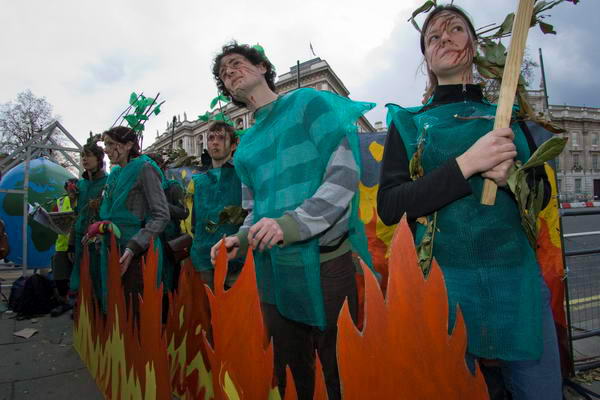
Buring down the forest

Commercial biofuel production means taking land out of food production, burning down forests and more. The organisers had gone to some trouble to show some of this in visual terms, with protesters from West Papua, one of the largest areas of rain forest under threat from biofuels, and others dressed up as trees being destroyed by some brightly painted flames.

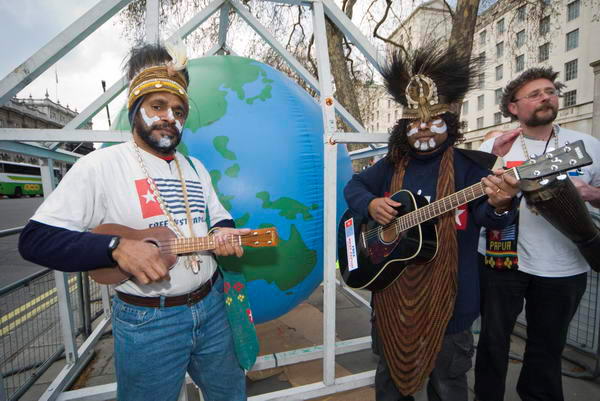
What the event really lacked was numbers, and perhaps this was because they had set up another session for the press at lunchtime. It did however allow me for the first time ever to make some real use of the Campaign Against Climate Change‘s greenhouse containing the Earth, which photographers have cursed at since it first appeared. One of many great ideas that just doesn’t really work visually (like those huge banners that you need a helicopter to photograph.)

West Papuan independence protesters

I wasn’t sure where West Papua was, and I was able to get those campaigning for its independence from Indonesia – who invaded it three months after it became independent from Dutch rule – to show me exactly where it was. For once I really made the earth move, turning the globe around to photograph them in front of their country on it.

Still not much of a picture though!