Collecting on the Cheap

I first came across Jen Bekman in 2003, when she started a small gallery in New York in 2003 and curated a show (the third at the gallery) ‘made in ny‘, a mixed show that included work by Mitch Epstein and other photographers along with street art and “works on paper” (also what most photos are printed on!) but what really brought her to my attention was the international photo competition, Hey, Hot Shot! which she started a couple of years later. This describes itself as “The best thing going for emerging photographers” and it is certainly worth considering an entry, though you have missed the latest of these now semi-annual events, which closed on June 17, and you can see the Hey, Hot Shot! 2008 – First Edition Winners on the blog along with pictures from some other entrants, and, until Aug 23 at the Jan Bekman Gallery in NY.

The two photographers who interest me most among the five winners are Kate Orne and Colleen Plumb, but all of the winners and those of the 20 or so ‘Honorable Mentions’ I’ve looked at have some fine work – this is a tough competition.

Entering Hey, Hot Shot! is also how photographers approach Bekman’s latest venture, 20X200 which is based on a simple formula:

large editions + low prices x the internet = art for everyone

Each week two new art works come on sale, one of them a photo, available in 3 sizes. The smallest size (on 8.5×11″ paper) is in an edition of 200 and sold for just $20, hence the site name (though mailing to the UK more than doubles the price), with a medium size print (17×22″ paper) at $200 – edition 20 – and a larger print (30×40″ paper) at $2000 in an edition of 2.

Some of the $20 editions – which go on sale online at 2pm EST on Tuesdays and Wednesdays (which I think makes it 7pm in the UK) – sell out in a few minutes, but others are slower sellers, and there were 20 of the $20 photos still available when I looked at the site, and a great choice of the more expensive editions – though $200 is still cheap looking at current market prices.

If you are interested, you can sign up for free on the 20X200 site and get advance notice of future editions. I think this is a great idea, although the delivery cost for those not in the USA makes it considerably less attractive.

You can of course buy low cost prints of some of the classic works of photography from the Science and Society Picture Library.  Their prints are not editioned and come from the Science Museum, National Railway Museum and the National Museum of Photography, Film & Television which includes the Royal Photographic Society Collection, one of the best collections of the first 100 years of photography in the world. Prices are extremely reasonable and print quality sometimes rather better than that of vintage prints. You can buy some really iconic photographic images- if you’ve always wanted a print of Alfred Stieglitz’s ‘The Steerage’ it’s yours for £7.50 at around the correct size.

LIbrary of Congress- Walker Evans
Walker Evans, Auto parts shop. Atlanta, Georgia. 1936
Library of Congress  (available as 20Mb Tiff)

Cheaper still is the Library of Congress. Its pictures are also available as prints at low cost, but you can also download some as high quality scans for free and make your own prints  – which can be better than the originals. Only a limited selection of the work is available as high quality TIFF files, but it does include a number of pictures by Walker Evans to name just one of my favourite photographers.

Climate Camp – Kingsnorth

Photographers – including my own union, the NUJ – have again complained about the media policy at this year’s climate camp which started today at Kingsnorth on the Isle of Grain in Kent, the proposed site of a new coal-fired power station.  Last year I decided I wasn’t prepared to work within the restrictions that the organisers had set, and only covered a little of the actions outside the camp on the final day.

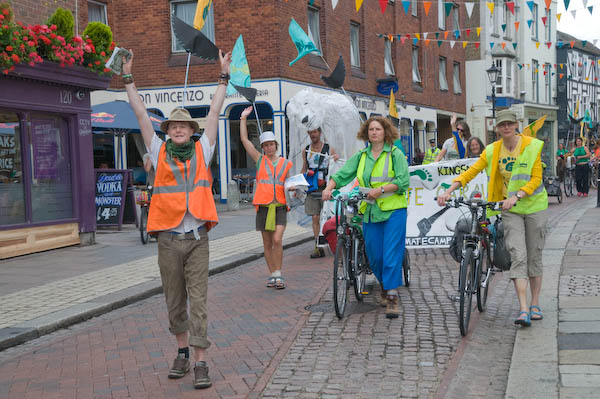
This year, my reasons for not covering the camp are simpler – I have to be in Scotland while it is taking place, but I was able to photograph the ‘No New Coal’ march from Rochester to the camp, or at least the rally in Rochester and the first couple of miles of the march.


Climate Caravan arrives in Rochester from Heathrow

Rochester is certainly a historic city (or an historic one) and I think we were perhaps making history there today in an action – along with those against a third runway at Heathrow that may come to be seen as a turning point for our government – and our planet. Unless we  move beyond green rhetoric to green action now, the opportunity to save the world may be missed.

There is no such thing as clean coal. If a new coal burning station is built at Kingsnorth this single plant will add more pollution than many whole countries currently produce.  The company and our government talk about carbon capture and storage, but Kingsnorth will not incorporate these (just be ‘ready’ for them.)  It is far from certain that these technologies will ever be developed and even less likely if so that they will be economic.

The nettle that we have to grasp is that of decreasing energy use. So far we have cut emissions simply by exporting the industries we used to have to other countries. We still actually use the products of the energy, but the pollution counts against the producing countries not us.


‘No New Coal’ march sets off from Rochester

Some things would be relatively easy to cut. We could travel less, and do more of it by less polluting methods – using rail or ship rather than air, possibly developing the use of slower but more fuel-efficient methods such as airships rather than aircraft.  Increasingly better on-line communications should be cutting down the need for travel to meetings, but in fact we seem to be travelling more despite using them.

Renewable methods of power generation would cut down emissions, although we also need to cut down the use of power and also of water.  A shift to more local methods of power generation rather than increasing reliance on large power stations could have a very useful effect.

But importantly people need to be persuaded that you can live better while using less energy and less resources.


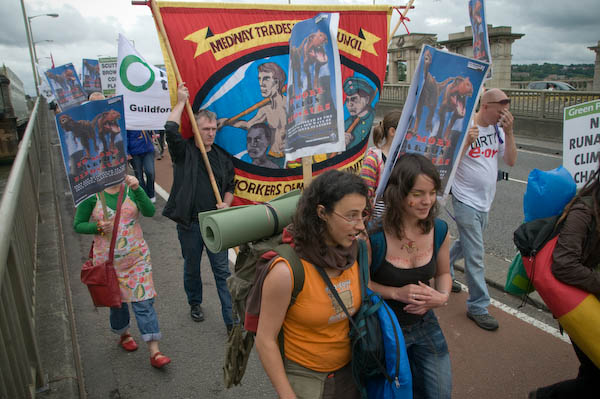
The ‘No New Coal’ march goes over the Medway towards Kingsnorth

So although I still have reservations about the media policy (and there is considerable interest from the media in the camp) I hope it will be successful. Because I’ll be away it will be rather longer than usual before more pictures appear on My London Diary.

City of Ambition – Ferit Kuyas and other shows

Yesterday I had a day of looking at pictures rather than taking them, though I couldn’t resist a few snaps later on – after too many glasses of red wine – as you can see here. Between a couple of meetings I fitted in visits to the Michael Hoppen Gallery in Chelsea and the Photographers’ Gallery near Leicester Square in an afternoon involving far too much sitting in hot buses in slow moving traffic and sweltering in the underground.

There were three shows at Michael Hoppen, but the only one I found of much interest was of work by Miroslav Tichy who I had written briefly about in 2005, around the time he won the ‘New Discovery Award’ at Arles (he first allowed his work to be shown in public in a show in Spain in 2004.) Tichy was obsessed by women, how they looked, stood, their gestures, and carried that obsession beyond normal limits, photographing through windows, the fences of swimming pools and on the streets, taking sometimes a hundred pictures a day with his handmade cameras.  Part of the charm that these pictures do possess is that they are so crudely made, but I think they are really objects that are talking points rather than photographs.  I certainly find the idea of paying 8 or 10,000 euros for one extremely curious. Yesterday was the last day of the show, but if you missed it I don’t think you missed a great deal. You can read the story on the web site (and elsewhere) and that’s what this is all about.

The Photographers’ Gallery has a show that clearly demonstrates how much better fashion photography used to be. I never thought I would walk around a show and decide that the most interesting picture was by Helmut Newton (there is a nice Irvin Penn and a quite a few others of interest.)  But frankly I don’t think any of the more current big names in the show stand up to the earlier competition and printing them big just makes them seem more vacuous.  Fashion in the Mirror continues until 14 Sept 2008.

Outside the gallery
It was cooler on the street outside Photofusion

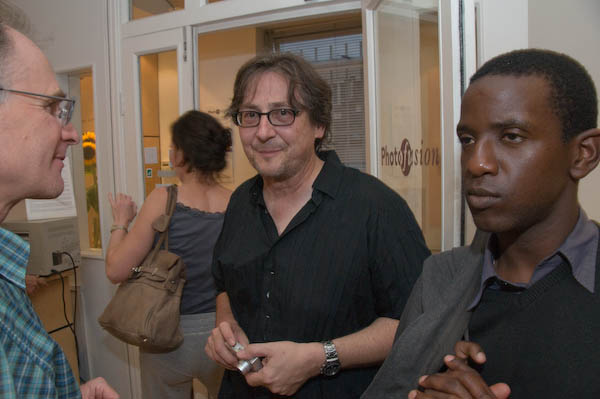
In several ways my most rewarding gallery visit was to Photofusion in Brixton, where Turkish-born Ferit Kuyas’s City of Ambition was having its private view.  The city in question is Chongqingin, China, whose 32 million inhabitants include the family of the photographer’s wife. The large colour prints made from his 4×5 images are mainly from the outskirts of the city, showing areas of rapid growth through the haze of pollution that appears to cover most of the country (and will possibly lead to the cancellation of the Olympic marathon in Beijing.)

Ferit Kuyas
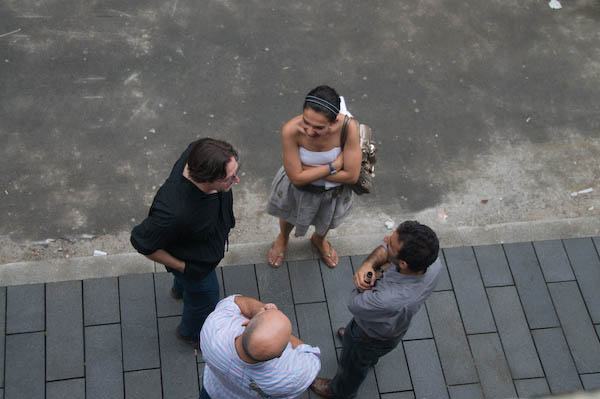
Ferit Kuyas (centre) at the opening

You can see some excellent images of his work from the project on his web site, along with some other projects worth looking at. ‘Agglosuisse‘ is a collection of colour images of “mediocre suburban spaces” that I really like, while the black and white images in ‘Archetypes‘ show more of his sense of design. You can also read more about him in a feature in the Hasselblad Masters Archive.

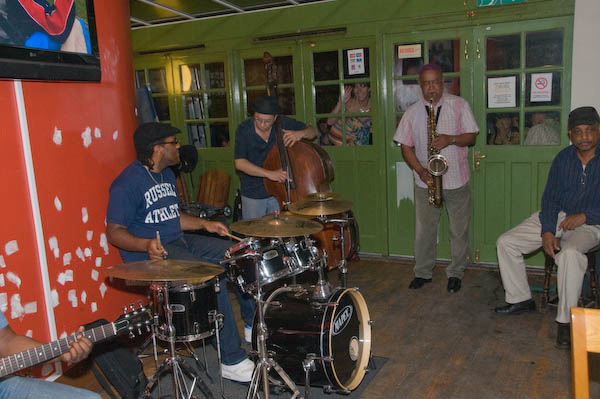
Down the pub
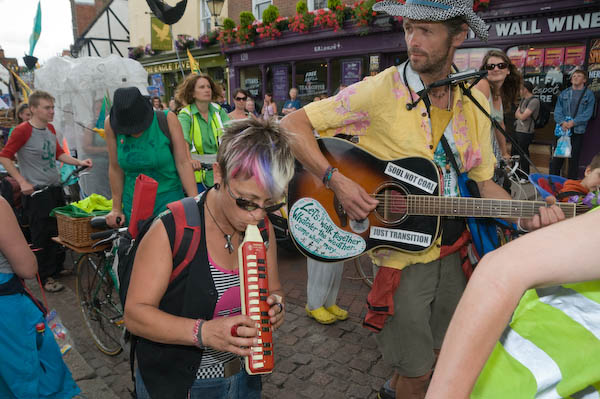
Brixton – band in pub

My evening finished at a pub a short walk away, before a rather long wait for the bus to take me to Clapham Junction for the train home.  It’s a pain that the Victoria line closes at 10.00pm – these works seem to be dragging on for ever.

Evans, Photography and Beaches

James R Mellor wrote the exhaustive biography of Walker Evans, a remarkable book (ISBN 046509077x) unfortunately not quite finished before Mellor’s death in 1997, and a book I recommend to all.  The final section of the final chapter that he completed is about the relationship between Evans and Frank and I think had he lived he would have explored more fully some of the questions this section raises.

In it, Mellor quotes (p553) from the wall label written by Evans for his nine pictures in a show containing work by him, Manuel Alvarez Bravo and August Sander presented by Edward Steichen at the Museum of Modern Art, New York, ‘Diogenes with a Camera III‘ in January 1956. (Other shows in this series of five from 1952-1961 included work by Edward Weston, Frederick Sommer, Harry Callahan, Eliot Porter, Gene Smith, Paul Strand, Shirley C Burden, Esther Bubley, Man Ray, Todd Webb, Tosh Matsumoto, Lucien Clergue, Yasuhiro Ishimoto…)

Diogenes was of course a seeker after truth who rejected social norms, lived on the streets in a barrel on a diet of onions and was the great cynic, debunking the values and institutions of his times. Certainly he was a very “minded” guy who made himself a “King of the Street” – and it was a few words with John Benton-Harris that set my mind wandering after a quotation from Walker Evans.

Tod Papageorge in his thought-provoking essay ‘Walker Evans and Robert Frank: An essay on Influence‘ written in 1981 (Yale University Art Gallery, ISBN 0894670158, text now available in The Missing Criticism series, which republishes out-of-print writing on photography) had earlier quoted this label in its entirety as a footnote on page 3:

“Valid photography, like humor, seems to be too serious a matter to talk about seriously. If, in a note, it can’t be defined weightily, what it is not can be stated with the utmost finality. It is not the image of Secretary Dulles descending from a plane. It is not cute cats, nor touchdowns, nor nudes; motherhood; arrangements of manufacturers’ products. Under no circumstances is it anything ever anywhere near a beach. In short it is not a lie – a cliché – somebody else’s idea. It is prime vision combined with quality of feeling, no less.”

(I was pleased I could still find my copy of Papageorge’s book – secondhand it now sells for around $2-400, and althoughit is good to see the text republished on the web,  without the images referred to by bracketed numbers throughout the text the reader has a certain amount of detective work to do. Mellor’s biography is a real bargain second-hand – unless you can find it locally you are likely to pay more for postage than the book – and there are many, many more pages to read.)

Perhaps “under no circumstances is it anything ever anywhere near a beach”  is worth bearing in mind for the holiday season (although of course it was aimed directly towards Edward Weston.)  When there are rather fewer (if any) posts from me over the coming few weeks at least you will know not to expect a deluge of beach images on my return.

Kings of the Street

John Benton-Harris looks at:

Henri Cartier-Bresson & Helen Levitt, ‘Side By Side
Laurence Miller Gallery,  20 West 57th Street, New York
(5 June to 14 August, 2008)

All things being equal (which they never are,) we who use photography to communicate should be encouraged to be courageous, minded and to speak from the heart, even while working to fill our pockets – as it once was in America. But the commercial world has become smaller, narrower, dumber, as well as much greedier, particularly in recent years.And as an American, who has resided here in England as long as I have, I pine the loss of more mature and optimistic times in a place where anything was possible as long as  we made the effort to work towards it.

And that’s the most honest declaration I can provide others with as to why I still return to New York once or twice yearly, but continuing  to speak frankly, it’s to protect and fan that flame that still is in me to stay alight and grow. And also because here in “Never Never Land”, the UK, there is no home-grown history of serious individual expression or mature leadership, that could spark such a light.   Here we merely continue to produce a glut of ambitious photographers, but not a surplus of talented ones. This will continue to be the case as long as  photography is controlled by a disconnected leadership at the very conservative centre of English life.

That is why New York – and  more particularly Paris today – are regarded jointly and deservedly as the ‘Home Offices’ of this medium. In fact the French have overtaken us Yanks in their celebration of visual expression, through and with photography. Through doing so much more to expand interest, understanding, opportunity and access, with its introduction of major city and regional festivals that are given over to this discipline.

Now you might be wondering what has all this to do with Henri Cartier-Bresson and Helen Levitt. Well they are the two significant talents that immediately come to mind signifying that personal commitment in these twin visual cultures on a personal level. And although very different people with very different outlooks, overviews, approach modes and subjects, none the less they were both committed to their personal understanding of excellence.

One travelled the world to catch views of people and life that concentrated more on defining his sense of timing, sensitivity, and eloquence. The other’s eye being a motherly one mostly watched over neighbourhood life, with a particular fondness for children at play and the elderly with time on their hands. And speaking of Time, they were both equally obsessed with shaping it, catching it, saving it, and presenting it, all together in ways that capture our attention, our appreciation, and our wonderment.

Helen and Hank (excuse the familiarity) are not just good friends, they are in their very different ways, life long influences; for one’s emotional warmth and sensitivity is as important as the other’s structuring and timing. Helen in her later years moved a little further out from her immediate neighbourhood and added additional information of another colour to her New York visual symphony that gained her an even larger and more appreciative audience. While Hank, hankering to be what he had already achieved, “An Artist” in his own right and place, took himself out from behind his camera. But quite apart from these late-life alterations, both still remain; put simply “Kings of the Street”.

In closing I feel no need to attempt to describe in words what is meant for eyes to digest, all I will say to those who know nothing of them, is that they are in for a very special treat. And for them that do, this presentation is chock full of premium works.

© John Benton-Harris – July 30th 2008

Selected Web Links

Lawrence Miller Gallery: Side By Side
Helen LevittNew York Streets  1938 to 1990s
Henri Cartier-Bresson: Magnum
Fondation Henri Cartier-Bresson

An Increasing List

I don’t know if it’s some kind of medical condition, perhaps a harbinger of oncoming senility, but I’m developing an increasing list.

Not an ever longer chronicle of those who, come the revolution will be lined up against the wall though my weekend stroll though the deepest home counties might well have prompted that.  Nor even a more and more lopsided walk due to the weight of my camera bag on my left shoulder – always my left shoulder as I collapse in pain after a just a few minutes with it on my right. It’s perhaps strange that with the coming of digital its weight has grown considerably from the more carefree past of film, when the heaviest item in the bag was a bottle of water or in winter a flask of coffee. Who would have thought all those electrons could be so heavy?

Somehow in the old days I seldom needed a flash unit or all those large spare batteries and (though I don’t often carry it) a notebook computer. Spare batteries back then were a couple about the size of a 20p piece that I changed every year on my birthday whether they needed it or no.

No, my problem is that none of my pictures are upright any more. Verticals ain’t vertical and rivers and oceans pour out from right or left frame. While a ‘dynamic composition’ may often be appropriate (as we very clearly learnt from Garry Winogrand) for demonstrations and street photography , it doesn’t always look too fine in landscapes and architecture.

One of the few possibly useful features found in the Nikon D3 lacked by the D300 is an ‘virtual horizon‘ or camera level that can be displayed at the right edge of the image in the viewfinder. Possibly it might solve my problem, but only at the expense of the camera’s weight crippling me over a long day’s work.  Of course the recently announced and lighter D700 has it too…

Incidentally, for a rather different set of pictures taken with the D700, take a look at Jim Reed’s gallery – Nikon lent him a pre-production camera early in April and he used it for a hundred days of chasing storms – there is rather scary image of him running towards a tornado holding it on the page where he writes about the camera giving it an excellent rating for durability and weather-resistance. Storm-chasing isn’t an area of photography I’ve ever felt drawn to, but I did find some impressive examples as well as a wealth of excellent advice on both techniques – such as how to photograph lightning – and also some very important safety information when I wrote a feature a few years ago.

What the D300 does have is the ability  (Custom setting d2) to project a rectangular grid on the viewfinder display. This is something I’ve avoided using, finding it too obtrusive as it flashes up in bright red when you autofocus. But now I’ve turned it on – and added it to ‘My Menu‘ so I can quickly turn it off when it gets really up my nose. It really is useful to be able to list just those things you want to access while shooting on that My Menu page so that they are there at the press of the menu button.

For years I walked around with a shift lens on the camera, getting things straight and even largely managing to avoid convergence when I wanted or needed to tilt the camera, though it’s main purpose was to allow me to stand in the right place and get the perspective I wanted. I don’t have one for the digital body, and my work has changed so I seldom miss it. With this lens, my favourite viewfinder screen in all my Olympus bodies (two OM4, OM2 and OM1) was a ruled one, finer and with a better thought-out layout than the Nikon version.  It also worked so well with other lenses that I very seldom bothered to change it. Funnily enough the Olympus one didn’t flash red and you could focus manually and precisely on the screen. Sometimes progress seems to go backwards.

Of course it’s easy enough to correct a list. In the darkroom we came to do it almost without thinking when needed, rotating the easel slightly to make the print straight. For digital it’s just as quick in Lightroom, pressing R to change to the crop/rotate screen, dragging the image as required, then D (or R) to return to develop mode.

If you use Photoshop (at least in version 7) it is a little slower still, but perhaps easier to get absolutely right. Change to the measure tool (it’s an alternative to the eye-dropper) and click to mark two ends of a line that should be either horizontal or vertical; then go to the image menu, choose Rotate Canvas, Arbitrary…, and click on OK. Then crop away all the extra background colour the rotate has added. You can just drag a marquee over the area you want to retain using the crop tool and double click, but I usually prefer to drag guides from the rulers (Ctrl R if they aren’t visible) to mark the 4 edges, then, when I’m happy these are in the correct place, use either the crop tool or the rectangular marquee (with ‘Snap to Guides‘ set in the View menu), finally using View, Clear guides. It is a bit fussier, but that way you know exactly what you are doing, and I find it  is rather easy not to get it quite right with the crop tool.

All this – even in Lightroom – does slow things down, and if like me you usually crop tightly in the viewfinder, presents a problem as the rotation results in a need for further cropping of the image.  So it’s better to get the tilt exactly how you want it in camera. Better still if you don’t need a gadget like the virtual horizon to do so.

Pigeons Post


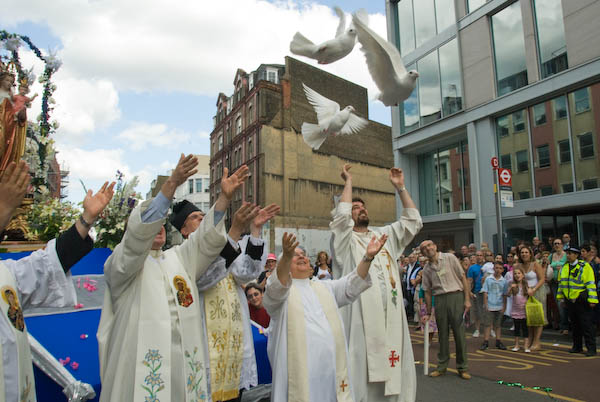
Detail from ‘Release of the Doves’ – see full image below

Pigeons were behind much of the dramatic increase in interest in photography in Britain as an expressive medium in the 1970s. It was the Coo Press, owned by Colin Osman, both a keen photographer and a photo historian, which provided the finance for ‘Creative Camera‘ magazine in the 1970s and the premises for the Creative Camera bookshop in Doughty St, where many of us made regular pilgrimage. (Osman had bought the magazine, then called Camera Owner and about to fold, for £1 in 1966) and the magazine, particularly with Peter Turner as editor and a great deal of advice – at least in the first place unsolicited and typically forthright – from Tony Ray Jones and some other photographers that edged at least a small section of British photography out of its comfortable and self-satisfied rut.

Behind me as I write is an almost complete set of that magazine, and on the shelves downstairs the annuals – including one with a set of three of my pictures, the first of my work published outside of the more strictly amateur magazines.


Town Meadow, Brentford, 1970s published in ‘Creative Camera Collection 5’.

(One of many paradoxes was that while those amateur magazines paid for photographs – at much the same rates as today – in Creative Camera you did it for love and prestige, as is still the case in some of the best photographic magazines, including Aperture.)

Camera Owner changed gradually into Creative Camera and continued to lose money, and it was the pigeon-fanciers who had probably never heard of it and certainly never read it who kept it afloat. Later, when Osman could no longer afford to subsidise his labour of love, the Arts Council took over the reins and drove the magazine into a cul-de-sac from which it only rarely ventured onto fertile ground. You can read the story in more detail (and doubtless more accuracy) on Roy Hammans’s Weeping Ash web site.

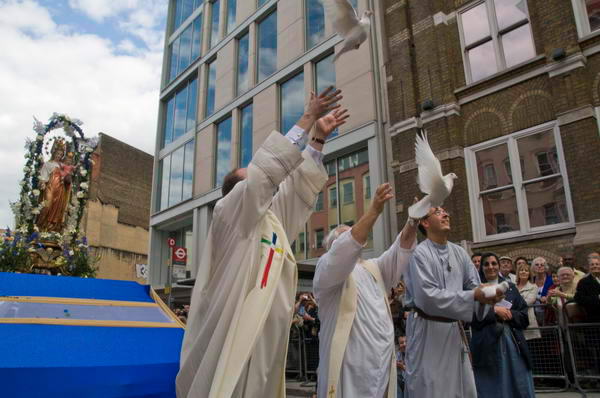
Once a year I photograph pigeons. Not for ‘Pigeon Breeders Gazette‘ or some other magazine, but as a part of the festival of Our Lady of Mount Carmel, the annual Italian festival in Clerkenwell, London (once known as ‘Little Italy’) where doves are released as a part of the event.

Last year I struck lucky as you can see from the detail – at roughly 50% full size at the top of this piece. Three pigeons took up a difficult to improve triangular formation as I pressed the shutter; it was superb choreography. I’d quickly moved into a good position for the picture as the clergy got ready to release the birds, but then it really was a matter of luck, as the pigeons generally head up into the air at great speed when released.

The full image below includes on the left hand edge ‘Our Lady’ looking down on the clergy and to their right some of the watching crowd (and I think the bus stop adds something, showing clearly it is London.


Release of the Doves, Procession in Honour of Our Lady of Mount Carmel, Clerkenwell, London, 2007. 

This year, however well I did I was never going to have the same luck, the doves were going to be something of an anticlimax, and so it proved. Either the pigeons were pesky or the priests who released them needed more training, for they failed to synchronise, and the birds only came together in the air a couple of hundred meters away.


The best of 3 frames taken in around 0.5 seconds before the birds disappeared

The release of the doves is a part of the procession which has evolved considerably over the years I’ve photographed the event, but still I think lacks something. As a considerably lapsed Congregationalist it’s perhaps surprising to have to point out that the missing element is liturgy, an appropriate and religious combination of words and actions, where the priests are in charge.

A countdown by an over-intrusive photographer (not me!) just doesn’t fit the occasion, which would be better served by a blessing with the release of the doves on the closing ‘Amen.’ It might just unite priests, doves, photographers and the crowds.

More pictures from the event on My London Diary – including more frames with the doves.

As always, pictures here, unless otherwise stated are (C) Peter Marshall and are available for use as high-res files

A Host of Pictures

There certainly were a host of pictures at the FOTO8 Summer Show 2008 in the Host Gallery in London’s Honduras St,  EC1Y 0TH (23 July- 31 August 2008), with 164 images on the walls of the gallery and the adjoining stairs. Although it is perhaps admirable to be so inclusive, (and I was told there was a much larger than expected entry from around the world), I think it would have been a much better show, and certainly rather easier to view with perhaps half that number of prints.


Honduras St gets quite full

A simple listing  with photographers names, sizes, media and prices was available at the gallery, but to fully appreciate the show you need a copy of the catalogue which contains the captions for the prints and can be downloaded as an illustrated pdf (4Mb) from the site. A rather smaller number of prints would have had the bonus of allowing captions to be included on the price list.

Most of the work was by photographers whose names were unfamiliar to me, although the three prints I personally singled out as possible choices for best of show were by photographers I know, including one I see regularly and another I’ve written about in the past. I won’t attempt to influence your efforts to find your own choice by naming them. Go along, look at the work and vote for your choice of best of show. Though I do think they have missed out in not calling it the Golden Daffodil Award.


The open bar was kept busy

Meeting another photographer from my generation (most of those present at the opening were considerably younger), I asked if she had anything in the show, and she told me that she didn’t have a great interest in  competitions and hadn’t entered. I feel much the same, although in my case a general lack of organisation had also contributed to my not sending anything in. I have after all been a subscriber to FOTO8 magazine since it began, and did feel that perhaps I should support this initiative. But then I had other things to do.  (If any of you reading this don’t get the magazine, do take a look at a recent issue – now better than ever.)

Competitions, particularly those based around single images (though a few photographers had two or three) do encourage and reward a particular type of photography, and much of what we were presented could be seen as a celebration of the exotic – unusual places, people and events – in a kind of colour supplement view of life.  When my students used (rather often) to complain about having “nothing to photograph” and if only they could go to China or New York or Bosnia or wherever the last set of pictures they had seen in a magazine had been taken I used to remind them of something I think said by Alfred Steiglitz, to the effect that he had found his best photographs within 50 yards of his front gate. Though of course his family back yard at Lake George was also extremely extensive.

Or perhaps I might show them the work of Helen Levitt or Ruth Orkin (New York yes, but working on their not very unusual doorsteps) or many other photographers whose subject has been everyday life, not treated as the exotica so often on display in this show, but working with the warp and weft of everyday life and creating something with a little magic, some small epiphany. Of course you also see it in the best photojournalism, often working with much more dramatic events (and it is important that these should be photographed too.)


Pizza appeared and quickly disappeared

It’s work like this that, for me at least, is at the heart of photography, and perhaps the only game worth playing is trying to bring out the significance of the ordinary. There is work in this show that moved me in this way, perhaps even 20 or 30 pictures that I might want to live with and hang on my wall, but much of the rest, after I had stood looking at the image for perhaps thirty seconds on the gallery wall I didn’t really feel I wanted to look at it much longer or need to see it again. Plenty of novelty perhaps, but it isn’t easy to produce photographs you can live with. But 20 good prints is a good show, and one well worth a detour. Buses 55 and 243 stop handily and Old Street tube is a short walk away.

The show also prompted me to think about photographic printing, print sizes and pricing.

Pricing
Also on the show page at the Foto8 web site is a useful guide intended for the selected photographers about the pricing of their pictures, which others might also like to download for some sensible general advice on the subject. However I think there were perhaps rather too many who might have been given further advice on the subject.

Setting prices is always a problem. But I think many of these works are unlikely to find buyers at the kind of prices involved, unless the photographers have particularly rich and generous friends and relatives to support them as sometimes happens (mine are all poor and expect prints for nothing.) It would be nice to be proved wrong and to find that there are people willing to pay perhaps £500 or £750 or more for a work by a relatively unknown photographer.

Print sizes
As a very minor quibble, while I’m not in favour of uniformity in general, I think the gallery might have converted all sizes to centimetres rather than have some in metric and others imperial.

What I do find interesting is looking at the small images in the downloaded catalogue and comparing them with the works on show, which range from original small Polaroid prints to five-footers. One of the conclusions I drew from looking at the show was that printing large can be and usually is a mistake!

That all the pictures I found of most interest were a moderate size (mainly 16×20″ or 20×24″) in part reflects my interests stated above, but I did actually feel some of these were a little too large and might have been better at say 10×15″ or even smaller. But then I think photography is at its best as an intimate medium, perhaps in a book (although having spent more on my Eizo screen than the computer that serves it, I’m coming very much to appreciate the advantages of a high resolution rock-steady display screen for viewing my own work and other pictures available at suitable resolution – and certainly looking forward to a new generation of very much higher resolution screens in the future.)

Some works do need scale, but I’m not sure these were the ones actually printed big for this show – and there were a few small images that might have looked rather better at floor to ceiling size. What we are I think seeing in photography at the moment is size largely as a marketing device rather than an artistic one, relating more to the display space than the image. It’s an approach that has a great deal of sense. While large prints may – and I think did – look rather out of place on the crowded wall at HOST, the more normal photographic sizes would be lost on the vast white spaces of the corporate atrium.

Print Quality
Some of the best prints on the wall were inkjet prints, both black and white and colour. With prints for which no information on the print process (or an ambiguous term) it was seldom possible to decide whether they were inkjet or chemically processed.

Inkjet as a medium has certainly come of age (it did so a few years ago for colour, but black and white has now more or less caught up too), although this show also demonstrates that some of its users have still some way to go. Looking through the small digital thumbs in the catalogue there are clearly a dozen or two images on the wall where the print fails to do the work justice.

It isn’t too hard to set up a properly calibrated digital workflow that will produce excellent print quality on desktop printers such as the Epson R2400 – and, using appropriate paper and inks the results are likely to be more long-lasting than C-types or other chemical colour processes. But if you don’t have proper colour management or use unsuitable materials – such as Epson’s misleadingly named ‘Archival Matte’ then problems will arise.

Of course, back in the days when more of us went into the dark to print our own colour there were often some sorry examples of C-types on some exhibition walls – and of course many expensive lab prints from the 1970s and 80s boom in ‘New Color’ are now distinctly past their best.

Giclée

One thing I did find amusing is the number of different ways photographers choose to tell us (or, more often to disguise the fact) that their work is an inkjet print. Among the variations in this show (apparently produced on a device lacking an e acute)  are:  Giclee, archival Giclee, HP Professional, archival pigment, Giclee printed on Art photo paper, Giclee print on archival matt paper, Giclee art paper print, digital Giclee print (I wonder briefly about analogue Giclees, and how they might be made, but given its slang usage it’s best not pursue this train of thought far) while others give us the make of the printer,  the paper, the day of the week and the name of their cat who sat next to their printer (well, almost.) I was pleased to see a few that simply said ‘inkjet print’ or ‘archival inkjet print.’ Giclee (or even giclée) is a term than should have long since been dead and buried.


Someone still working in an office round the corner as I went home

Up and Down: Seesaw Summer 2008

It’s in the nature of Seesaws that they go up and down, and I have to say there is work in the summer 2008 edition of this on-line magazine that excites and work that depresses me.What depresses me is perhaps not so much a reflection on the photographers concerned, but more on the photographic education some of these photographers have recently suffered. That they occasionally manage to rise above it is a tribute to their talent.

Last year in Birmingham a number of us looking at portfolios were driven almost to breaking point over so many portfolios of work in which students had gone back to their childhood homes and explored their memories (or some such similar idea) producing images that may have had interest for them but frankly were worse than boring for the viewer. But although Betsie Genou‘s Les Moguichets is an example of this genre, I actually found the variation in the subject matter and her feeling for lighting and colour made this a series of pictures I clicked through several times and ended wanting to see more. And there are more at her own web site.

Rian Dundon’s black and white work on the Chinese born since the planned birth policy limited families to a single child is also well worth a look. After getting his BFA in 2003, he worked in China from 2005-8, and on his web site you can see more of his photography from China, the US and Europe as well as his writing about China.

The third set of pictures I found of interest was Latvia:Terminus Riga, a very personal and visual investigation of the city with some intriguing images. You can also see more of Iveta Vaivode‘s work on the Latvijas fotogrāfijas Gada balvas galerija 2007 site, including both fashion and five very wintry images in “Dārziņi” (at the bottom of the page.)

Teaching photographers is never easy, at least once you get beyond the basics (though many photography courses in this country have never quite managed to teach these – where I taught it used to be a constant refrain from students who came back to visit us after a year on a higher level course: “Thank God you taught us how to… , because nobody does here.”) What is difficult is encouraging people to see things in their own way and not to be afraid of actually looking both at the motif and their own photographs and seeing where the visual might lead them, rather than working from neatly expressed and constricting ideas or reworking themes that are currently fashionable.

Perhaps there are some hopeful signs in some of the work here that I’ve not mentioned, some glimpses of individual talents that may escape the academic straight-jacket that photography tied itself into from the late 70s. There are certainly some pictures I like among the portfolios, although I think there is rather more interesting work in the Seesaw archives.

Also in this issue Seesaw is a reprint of an interview with Ryan McGinley which more or less tells us exactly the same as every other interview or feature on him (including one I wrote a few years back) and its main claim to fame is that it was made on his 30th birthday. I wrote not long ago about OjodePez, the Madrid-based on-line magazine for which Seesaw editor Aaron Schumann guest-edited issue 13 on ‘This Land Was Made for You and Me‘, including work by McGinley. Schumann contributes three found images of a bare-breasted Tahitian dancer to this issue, found in Winchester (UK) in 2008. I can see no particular reason for finding these images and even less to publish them.

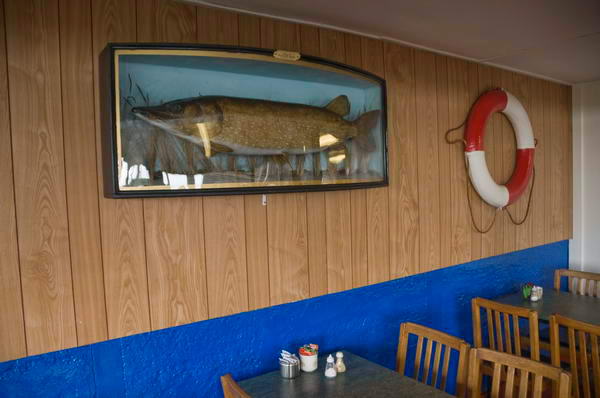
Dundon is one of the contributors to the fascinating collection – kind of a photographic version of fishing stories, where it is always the biggest fishes that got away – made by Will Steacy, ‘The Photographs Not Taken‘ with an essay on social conventions in China, ‘Drunk in Fujian‘. Here’s a completely gratuitous fish that didn’t get away, a 27lb pike caught in Hornsea Mere in 1907.


The Cafe at Hornsea Mere. (C) Peter Marshall, 2008

It’s a free country (at least in New York)

New rules from the New York Mayor’s Office of Film, Theatre and Broadcasting (MOFTB) about photographing on the streets of that city will I think be welcomed by photographers who work there. They make it clear that you don’t need a permit unless you want to use extensive equipment or vehicles or want to block a significant part of a street for your work.

If you only use a hand-held camera (still or video) – even if it is on a tripod, you don’t need a permit, as it makes clear: “Standing on a street, walkway of a bridge, sidewalk, or other pedestrian passageway while using a hand-held device and not otherwise asserting exclusive use of City property is not an activity that requires a permit.” Tripods can still land you in trouble if you block road lanes or use them on narrow pavements, but do not in themselves need a permit – they too are generally regarded as “hand-held equipment.”

Similarly it states ” the filming of a parade, rally, protest or demonstration does not require a permit” and you don’t need a permit if you are a press photographer with a NYPD pass.

To photograph in city parks and inside public buildings will still require authorisation from those in charge of them and permits will continue to be required for the certain activities “including but not limited to animals, firearms (actual or simulated), special effects, pyrotechnics, police uniforms, police vehicles” etc.

The new rules came only after several rounds of public consultation and seem a useful clarification of the right to photograph on public streets (and the activities that, largely reasonably, require a permit.)

Although we have a similar freedom to photograph in public places in the UK without need of permits, it might perhaps be nice to have a similar statement clarifying this in our country and in our major cities in particular, where increasing photographers are finding their right to photograph while on the public street without permission challenged, particularly by the growing armies of heritage wardens, community support officers, security employees and others who police our streets.

One site worth looking at for UK photographers is UK Photographers Rights
by Linda Macpherson LL.B, Dip.L.P., LL.M, a lecturer in law at Heriot Watt University, and I’m glad to read from one of the comments that she is working on a revised version of her “short UK guide to the main legal restrictions on the right to take photographs and the right to publish photographs that have been taken” which you can download there.
The comments on the page, and in particular Linda’s replies to them make some interesting reading, although they are occasionally debatable (as are so many things in law.)

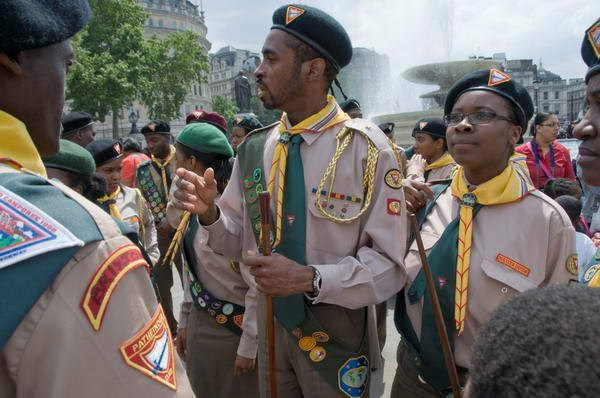
Trafalgar Square - without a licence
Trafalgar Square – without written permission to photograph
(Seventh Day Adventist Youth march against gun & knife crime)

One particular instance concerns the by-laws which apply to Trafalgar Square which thousands of photographers – myself included – regularly break which require written permission for “photographs or any other recordings of visual images for the purpose of or in connection with a business, trade, profession or employment or any activity carried on by a person or body of persons, whether corporate or unincorporate“.

This is exactly the kind of nonsense that the New York MOFTB rules clarify and largely dispense with – making clear exactly what kind of photographic activity needs a licence, and provides a very good example of why would benefit from a similar document in London.