Perpignan Winners

You will probably have heard the names of the winners of this year’s Visa d’Or at Perpignan. More interesting for me was Philip Blenkinsop, awarded the Visa d’Or News for his coverage of the coverage of the earthquake in China, not least because of the rather unusual presentation. Pouring rain meant that the awards ceremony was abandoned, and left everyone wondering what was going to happen. Festival director Jean-Francois Leroy combed the town, award in hand searching for Blenkinsop, called him out of a restaurant and made the presentation in the street outside in the centre of a surging crowd of photographers.

You can watch the event without getting wet in a video on the PDNPulse web site (you’ll have to sit through an ad to do so.)

As you can read in the Digital Journalist, Blenkinsop chucked in a job as a photographer for an Australian newspaper in 1989 at the age of 21 finding it too shallow, sold his car to buy a Leica, some lenses and a one-way ticket to Bangkok, determined to point his camera at what was real and become a photojournalist.

At first he struggled, as few people wanted to publish pictures as raw as his, but in 1993 he was awarded the Felix H Mann Prize and 3rd place in World Press Photo for his work on the suppression of the pro-democracy movement in Thailand. In 1997 he joined Agence VU (and is now with the Amsterdam-based Agency NOOR, launched at last year’s Visa Pour l’Image.) He has deservedly picked up a tremendous series of awards including two earlier Visa d’Or – the 2003 Visa d’Or Magazine for his coverage of the ‘Secret War In Laos’ and the 2005 Visa d’Or News for his work on the tsunami.

At least Brent Stirton won his Visa d’Or Features for his pictures of the slaughter of gorillas in the Congo and not the (uncredited) images he took of of Angelina Jolie and Brad Pitt’s twin babes (which apparently made Getty $14 million.) You can also watch a video of him on PDN. Stirton, a senior staff photographer for Getty Images is another highly awarded photographer, but somehow his work sometimes makes me feel a little uncomfortable, perhaps too highly coloured and polished. Sometimes it strikes me as too much technique and perhaps not enough feeling.
Milk and Jim Barron

I got a couple of identical e-mails the other day, and the first one that I found rather startled me, as it was addressed not to me, but to a good friend of mine who died six years ago, Jim Barron.

He had a long career in photography, starting with a parrot on his shoulder taking beach snaps and then using flash powder as a scientific photographer in the Civil Service, ending up as head of one of its photographic departments, but also finding time to work occasionally on the side for newspapers etc. Three portraits by him, two of Larry Adler and one of Sir Arthur Bliss, are in the National Portrait Gallery collection. He was also well known as a collector of photographica, and his collection included one of the wooden cameras that Bill Brandt had used for those wide-angle nudes. He lent cameras and acted as a photographic consultant on several films and TV programmes.

I got to know Jim shortly after he retired, when he turned up at a meeting of a small group of photographers that I was part of, and we and most of the others continued to meet regularly to show and discuss our latest work until weeks before his death – in later years at his home in Richmond.

At the time, Jim was taking pictures using a 4×5″ camera, very much in the mould of Edward (or perhaps more Brett) Weston.  He’d walk from his home, perhaps up into Richmond Park, his camera and tripod in a shopping trolley.  Technically they were fine, but I and others tried to tell him that there were other things in photography that were perhaps of more interest.

At the time most of what I was showing was ‘street photography’ and we had long discussions about my pictures and also about some of the great street photographers whose work interested me. I remember going with him to an exhibition of the work of Gary Winogrand, going round it with him and arguing over the pictures.

Perhaps what finally persuaded him to have a go at street photography was not my example – or Winogrand’s work – but a workshop we both went to with Thomas Joshua Cooper, who told Jim rather more directly what I had been trying to say about his large-format work and encouraged him to try something new.

From then on, until shortly before he died, Jim salked the streets of the West end in his wooly hat, lurking with his Leica and usually a 24mm lens.  Ten years ago I wrote a short piece about him for the magazine of London Independent Photography, which by then we had both joined:

Most days it seems, you can find Jim in London. Several times this year I’ve been hurrying to the Photographers’ Gallery or across Soho or down Bond St and in the distance have seen a familiar figure with his Leica and hat.

I haven’t always had time to stop and talk, or even to go over and greet him, as I usually seem to be rushing to a late appointment. Sometimes I’ve realised he is at work waiting patiently for the moment to happen and not wanted to disturb him.

Though officially retired, Jim seems to be working harder than ever. After a day’s work on the street he goes home to spend the evening in the darkroom printing.

Every LIP meeting sees Jim with a new box of pictures for our delight, with perhaps another 30 or 40 or more 20×16 prints.


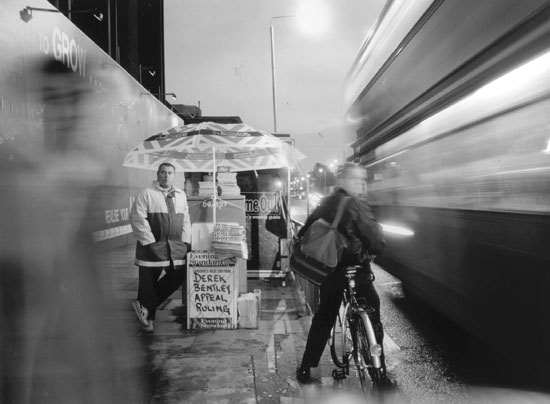
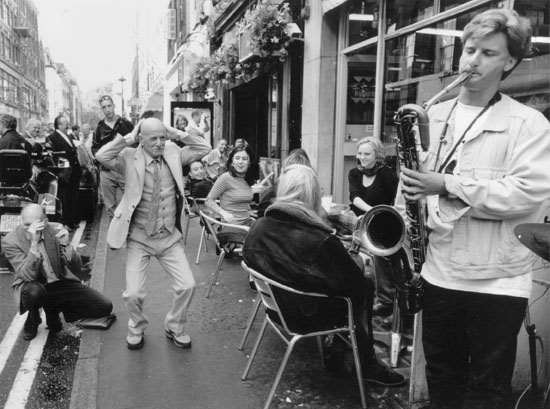
This print won second prize in a competition organised by the Evening Standard and Canon and was one of five or six prizewinners displayed in the Victoria & Albert Museum.

Despite this success, Jim was robbed as this picture was clearly in a league of its own compared with the other winners.

Another superb example of his street photography, this picture made a fine poster for the Soho Jazz festival. It is hard to imagine how anything or anybody in this peculiar theatre of the street could have been better placed – a moment so precisely caught that could not have been better drafted or choreographed.

I soon realised why I’d got an e-mail for Jim Barron. Both he and I had entered for a competition called ‘M.I.L.K’ in 1999, and as he didn’t do computers, he had got me to send in his entry for him. Now almost ten years on there is a second version of this competition, entitled ‘Fresh M.I.L.K.’ It describes itself as:

“A $125,000 international competition to find photographs that capture spontaneous and humorous moments shared between friends, families and lovers.

We are inviting both professional and gifted amateur photographers from around the world to submit their images now. 150 images will be chosen as finalists and the overall winner, chosen by Magnum photographer Elliott Erwitt, will receive $50,000.

This is a chance to have your photograph become part of a world-renowned collection and be published in a prestigious international book.”

For details go to the Fresh M.I.L.K web site. Entry is free and you can submit up to five entries of five pictures each – online submission only. The small print looks pretty reasonable – as you would expect with Erwitt lending his name to it – and the prizes aare certainly worthwhile. We have until 31 Dec 2008 to enter, and the winners will be announced on or before 31 March 2009.

Major A.Villiers Gardening Club

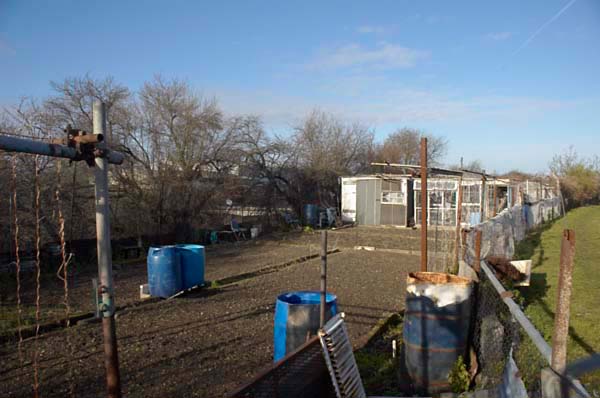
I first photographed what we now call the ‘Olympic area‘ in the early 1980s. Then it seemed rather like the back of beyond, a long-neglected backwater of London, which appealed greatly to my imagination.

The pictures I remember well are largely those on one of my least-finished web sites,  ‘The Lea Valley‘ which looks at London’s Second River – The River Lea (or Lee.)  It’s probably 20 years since I went back and looked at the contact sheets for the pictures I made there rather than just the relatively few that made it to a portfolio.

In the past couple of days I’ve been doing just that, and it’s interesting to see how looking at the pictures takes me back and reminds me of things that were previously submerged in the hidden depths of memory as well as some lost completely. I don’t think I’ve found any great work I missed but there are certainly things that stir my interest.

One that I’d forgotten taking was of these gates on Waterden Road:

Gardening Club gates
Waterden Rd, Hackney Wick, 1983 (from a quick scan on my flatbed)

which isn’t a startling composition, but the text on the notice caught my eye. It may be a little small to see clearly, so here it is larger:

Gardening Club gates

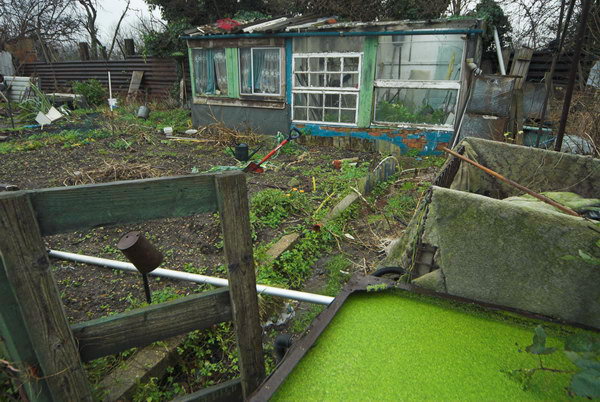
Twenty years later not far away, close to Bully Point nature reserve, I took another picture of allotments started by Major Villiers:

and a couple of years further on I played a very small part in the big campaign to keep the Manor Gardens Allotments  as a green centre-piece for the Olympics. As we all know was unsuccessful (their great campaign running up against a total failure of imagination by our Olympic organisers) and they are now in Leyton, struggling to grow crops on damaged land.

My River Lea web site does have quite a lot of work from the area,  including a few of those black and white images from the 1980s, but the vast majority of work on it is taken since 2002 – for example pictures of the Stratford area – such as this:

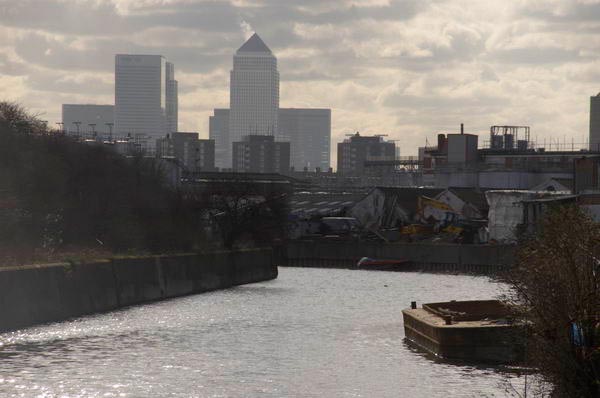
The site however covers much more than the Olympic area, with pictures that start at the source in Leagrave, near Luton, and go to both Bow Creek where the river enters the Thames and also to the Limehouse Dock entrance, which offered an alternative route to the Thames.

Perhaps one day I will find the time to put more work on that site. Of course it is so much easier to put digital images on line, although there are many on My London Diary that I’ve not yet got around to also putting on the site – most can be found from the site index, though I’ve not quite kept that up to date either.  But it’s even more time-consuming to work with those old pictures from the 80s and 90s on film. In 2005 when I started the River Lea site I wrote “1990s (to follow)” and they are still to follow three years later.

Israelis find firing at journalist ‘reasonable’ and ‘sound’

Reuters cameraman Fadel Shana, age 24, filmed an Israeli tank in Gaza on April 16, recording the flash from its muzzle, around a mile away, of the shell that killed him and several civilian bystanders.  He had been working in Gaza for Reuters for three years and two years ago was wounded when an Israeli aircraft fired a missile at a marked press vehicle in which he was travelling.

IN his blog the Deputy Director of the Committee to Protect Journalists, Robert Mahoney, reports that the Israel Defence Forces’ (IDF) confidential inquiry into the killing has concluded that the decision to fire a shell at an unarmed and clearly identified TV crew, acting in a perfectly normal manner for reporters was “reasonable” and “sound.”

It’s a decision that appears to fly in the face of the rules of war, which oblige soldiers to do everything feasible to verify that targets are military and makes the deliberate or reckless targeting of civilians – including the press – a war crime.

Human Rights Watch report that the shell was a flechette shell, which explodes before impact releasing hundreds of dart-like projectiles in the air with the intent to kill people in a wide area around its target. Human rights groups have repeatedly urged Israel not to use these weapons in Gaza because they indiscriminately kill civilians around the actual target – as was the case in this event.  (There is a yellow flash on the video which may be this explosion)

Eyewitnesses report that there was no fighting in the vicinity at the time of the incident and that the Reuters truck, clearly marked ‘TV’ and ‘Press’ had actually driven close to the tank twice earlier in the day. Those observing in the tank had clearly seen that something was being set up on a tripod, and Mohaney claims there were 4 soldiers – the tank commander and observer in both the firing and spotting tanks – with state of the art equipment that would have enabled them to view the scene clearly. They should thus have also been able to see the blue ‘press’ body armour and the clear ‘Press’ and ‘TV’ signs on the vehicle. It is hard to escape the conclusion that either they didn’t bother to  consider the possibility of innocent civilian activity (press or otherwise) before opening fire, or else deliberately targeted the press.

Reporters take great risks working in conflict zones, and far too many are killed or injured, even when they are not deliberately targeted. As you can read on the CPJ site, so far there are 24 confirmed journalist deaths in 2008, along with another 15 as yet unconfirmed  and one missing.

Visa pour l’Image

Another of the big annual festivals I’ve never been to is Visa pour l’Image at Perpignan, which accurately describes itself as the “International Festival of Photojournalism“. Held every year in the south of France since 1989, it’s been going for 20 years and has established itself as the most important event of the year for many photojournalists, with many of the big names as well as those who would like to be more famous attending during the professional week – this year from 1-7 Sept.

There are around a thousand photographers and others in the business listed (you can download it from the site)  as being there, and something around 30 exhibitions, among them one arranged by the friends and family of Alexandra Boulat, who died tragically last October, only 45.

Those attending were also saddened to hear of the death of one of France’s greatest photojournalists, Françoise Demulder, after a long illness; photographing for Gamma, she was the first woman to win the World Press Photo of the Year in 1976.

In the evenings at Perpignan there are screenings of images covering the events of the year and various meetings and events. Freelance photographers also get a chance to show their portfolios.

The Visa d’Or awards are presented at Perpignan, for news, feature reporting and the daily press, as well as a special best young reporter award. Four four nominees are selected by an international panel for each award, and a different panel meets during the event to select the winner. The Canon Female Photojournalist Award and the CARE International Award for Humanitarian Reporting are also made there.

The nominees were announced some time ago. For the Features award, made on Friday night they are:

  • Carlos Spottorno / Getty Images : Xinjiang, China’s Far West
  • Alfred Yaghobzadeh / Sipa Press for the Figaro Magazine : Religious Minorities in Iran
  • Brent Stirton / Reportage by Getty Images for Newsweek and National Geographic Magazine : Virunga National Park, Eastern Democratic Republic of Congo, July 2007
  • Agnès Dherbeys / VIImentor program : Temple of Dooms, Wat Prah Bat Nam Phu, Thailand;

and for the News category to be awarded Saturday:

  • Yasuyoshi Chiba / AFP : Kenya
  • Philip Blenkinsop / NOOR : China Earthquake
  • John Moore / Getty Images : Assassination of Benazir Bhutto
  • Anthony Suau / Bill Charles : Mexico/US border fence

You can read reports from the festival on several sites, including Foto8 and PopPhoto, although others who have promised to cover it – such as the  Digital Journalist – have yet to make a post from Perpignan as I write.  But I’m sure they will find a hot spot soon!

Byzantine Photographs

Thanks to a post on Indymedia I got to read the story posted on ‘Byzantine Blog‘, Deceiving the World with Pictures posted on Aug 12,  which cast some doubt on some pictures from  Georgia by Reuters photographers David Mdzinarishvili and Gleb Garanich, suggesting they were staged.

According to blog comments, Reuters has now re-captioned some of these pictures and allegedly removed others but you can view a set ‘Crisis in Georgia‘ which includes pictures by Mdzinarishvili and Garanich, including three from the two sets those the blog labels as fake, and you can find others from the scenes by a search on the Reuters site.

The evidence on ‘Byzantine Blog’ certainly raises doubts, and though at first I thought they had discovered something, having seen more of the pictures I’m fairly convinced the pictures are genuine.  Take a look and see what you think. It’s also worth looking at the comments and the pair of pictures it mentions on another site.  You can also see the story and read more comments (for, against and mainly pro and anti-soviet rants) on Russia Inside Out.

In real life things are as simple and straightforward as many of the comments suggest, and in the chaos following an air raid almost anything may happen.

Work on the Reuters site that shows Mdzinarishvili and Garanich as phtoographers doing a great job working under what must be difficult circumstances, I’d certainly be inclined to give both the benefit of the doubt – even if I had any.

Photos are of course staged all the time for various reasons, but it is important that those that have been staged are not represented as news. I’m sure Reuters would agree wholeheartedly, and when they were made aware of the actions of Adnan Hajj with Photoshop, he was quickly fired.

A lengthy post with the title ‘The Reuters Photo Scandal’ looks at these and other images from Lebanon on Zombietime, a San Francisco based site that perhaps requires reading with salt shaker to hand and that I would not recommend exploring too fully.  But some of the examples it gives are interesting and leave little doubt that photographers are sometimes manipulated by being offered good picture opportunities, and that in other cases they have set out to deliberately manufacture news.

Notting Hill – I went home early on purpose

There are two kinds of photographers when it comes to covering violent or potentially violent events, those like to keep safe and those who seem to hunt out trouble. I found out which I was pretty definitively on May Day in 2000, when I was in the middle of a surging crowd in Whitehall and a few yards away people started smashing the windows of that well-known fast food shop.

May 1, 2000
A woman shouts at demonstrators from behind a police line

My immediate thought wasn’t to rush and push my way through the packed bodies to get pictures, but to think whether I wanted to take pictures that might incriminate those involved. And I pointed  my lens away and photographed instead some of the reactions to the event, including those of the police who after giving the demonstrators time to trash the place decided to move in, incidentally with a an entirely gratuitous violent assault by one officer on a photographer standing close to me – unfortunately my picture of the event too blurred to provide any evidence.

May1, 2000
Police charge – but I missed a picture of a photographer close to me being hit by a baton

Looking back, it was the wrong decision, and certainly when the police charged I should have followed them rather than deciding it was time to go home rather than risk being detained by the police for several hours. Now I think I would react differently – and certainly now being an union member with a press card and an emergency support number helps a little. But I’m still a cautious (or sometimes rather timid) kind of guy.

So although I’ve been to Notting Hill Carnival for around 20 years I’ve never photographed any violence there. For me it’s a great event with hundreds of thousands of people enjoying themselves, while the press coverage this year gave almost as much attention to the 40 youths who had a minor rampage and threw bottles at the police on Ladbroke Grove as to the three-quarters of a million who danced along there earlier. (In the coverage from Sky on at the Times it is hard to see any rioters at all, though the streets are full of police.)

By 5pm I’d been photographing carnival for five hours and felt it was enough. All my pictures are about carnival and not about a violent few, and deliberately so, and I certainly left with a feeling that things might get at least rather lively later. I missed the violence because as always I went home long before it started as darkness fell.

Ladbroke Grove
On Ladbroke Grove where the incidents occurred several hours  later

One of my friends was still there later taking pictures (probably including some of those that made the papers), but I prefer the film coverage, at least for the actual scenes it shows from the street, where the viewer can get a better idea of the extent of the problem and make their own judgements.  Still photography can sometimes catch a moment that has a particular intensity or that somehow represents a situation or an event, but if anyone did that here I’ve yet to see it.  And even with cameras like the Nikon D3, video still seems to have an advantage in very low light, perhaps because sharpness is far less important in moving images.

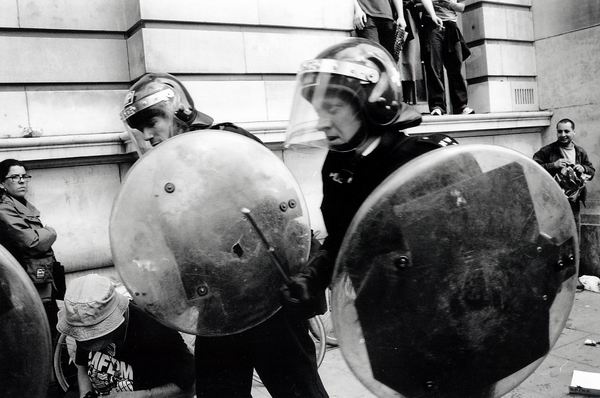
One thing I find surprising is the apparent slowness of the police to respond to the youths, who they say were making trouble for two hours. There were after all reported to be 40 youths and 11,000 police, including a number with riot shields and the full gear – including, according to my photographer friend, tazers which were used on some of the youths, although this gets no mention in the press coverage I’ve seen.

There was a sickening predictability to the coverage of the event by some of our newspapers. Ridiculous comparisons made to the Notting Hill riots of 1958 when white racist thugs threw petrol bombs into the homes of black families, or the 1976 battle when the 3000 police on duty decided to close down carnival and were repulsed by those taking part.  (Thanks to the web you can now access material published in 1976 by the Times  (see Times Archive box at left, some way down the page, the BBC and others.)

Others used the small disturbances as a pretext to call for an end (or at least an emasculation) of carnival, something the police and some administrators have long wanted – with calls in 1976 by the then Commissioner of the Met, Sir Robert Mark,called for the event to be held in a stadium. Although carnival over the years I’ve been going has become in some ways more restrained and ordered, it is still a long way from that kind of sanitised display, with crowds behind barriers rather than taking part.

You can see my pictures of the carnival from Notting Hill on My London Diary.

Microsoft Fudges up my Fonts

I’ve long advised people to use browsers other than Internet Explorer. In the old days Netscape did a better job, while for some while it’s been Mozilla Firefox that has been setting the standards.  So until a few days ago I hadn’t bothered to upgrade the copy of IE that I only use for testing web pages from IE6 to IE7.

But people – or most of them – had told me that IE7 was better, and then various sources began to warn that IE6 might be a security risk, and in any case I decided I really ought to be testing my sites on the browser that most people use, which is now IE7 (of course I also test on Firefox.)

Well, the good news is that my computer still works after the upgrade.  But the bad news is that IE7 still doesn’t work properly, and, at least on my computer,  that it managed to mess up my fonts.

With Firefox, the index for my monthly pages  is fixed in position when you scroll down the items on the page. IE7 still ignores the style=”position:fixed;” that achieves this, and I still have to use various unnecessary invisible images to fix some of it’s problems with layout.

But even worse, I found it rendered the text on my pages fuzzy and hard to read, whereas in Firefox they are clear and sharp. IE6 hadn’t looked quite as good, but the difference was small.

Normally I don’t mention computer stuff here, but this is something that messes up virtually everything I put on the web, and will also effect you if you have a web site, so I think it’s important to let everyone know the reason and the solution.

The problem is that IE7 by default uses something Microsoft calls ‘ClearType’. For some people, especially users with very cheap and nasty screens, this is probably a good thing. But most photographers especially will have pretty decent screens and it is likely to actually make your fonts look worse.

So the first thing I tried was simply to switch it off in IE7. Tools menu, Internet Options, Advanced and you will find it under Multimedia.  Clear the box, ok things and it should make it better (you may need to exit and restart IE7 – its the kind of thing Microsoft like.)

Doing that I still wasn’t happy with the fonts – they just certainly a lot better, but still noticeably worse than Firefox, with some odd weak areas in letter shapes.

Clear type has been around since XP came out, but many of us have never felt the need to use it. I went to Microsoft to find out more about it, and took advantage of their ‘Clear Type Tuner’ to alter its settings.  The instructions told me how to turn ClearType on for my display (Right click onthe desktop…  Properties, Appearance, Effects and click in the box to use a screen font smoothing method, then choose ClearType – I found my previous setting was Standard.)  Then I could use their tuner to select the best effect.

Of course I also had to switch on using ClearType in IE7 and then it gave almost as good a display of screen fonts as Firefox.  The only thing left was to go back to the desktop and reset the screen font smoothing method to Standard, as even with the tuned ClearType my desktop was rather less readable than before.

Rather a performance, and one that would have been unnecessary if those arrogant b’s in Seattle hadn’t decided to mess up my computer in the first place.

So, if you are finding my fonts here or on My London Diary hard to read, then you probably either need to install Firefox or sort out your ClearType settings. Or you could just need to see an optician.

iona- bokeh

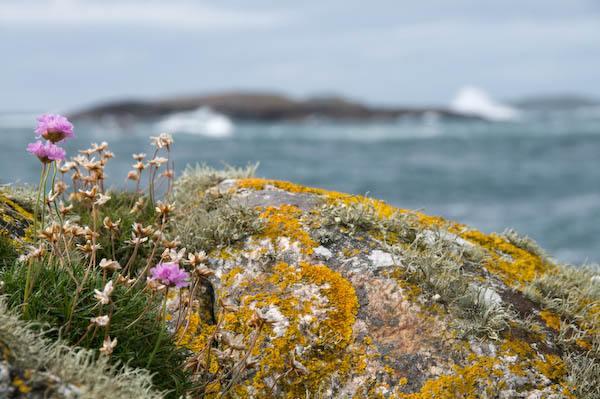
Back to photography, I’ve just updated My London Diary with the rest of my pictures from Scotland, including work from Glasgow, Iona and Staffa. The picture above is from Iona and illustrates something I don’t much like about the Nikon 18-200VR lens I wrote about recently. I find it’s rendering of out of focus areas (sometimes referred to as ‘bokeh‘) just slightly unpleasant. Yet another reason for using wide-angle settings where you can get everything in focus!

Busman’s Holiday?

What do you do about taking pictures when you take a holiday? Many, particularly amateurs, see their holidays as one of the main opportunities for taking pictures (and when long ago I used to belong to camera clubs I would groan, usually inwardly, to see yet another picture of Windermere or Switzerland flash up on the screen or appear on the wall.)


Iona: Another holiday snap!

But as someone whose life revolves around photography, if I take a holiday I want to at least distance myself slightly from the normal round and relate at least a little more normally with the people I’m on holiday with. Much as I enjoy and am involved with it, making decent and meaningful pictures is hard work, demanding a high level of concentration, and I am often pretty mentally exhausted at the end of a busy day. Once in a while I feel I need a rest.

So there are times – days, possibly even weeks (though I can’t remember one) where I don’t take any pictures at all. But on holiday I often come across things I’d like to at least record in some way by taking a few snaps – and sometimes rather more. My companions almost certainly still think I’m obsessed with photography (and they are probably right) but it is a matter of degree. Time after time in the last couple of weeks when I was away on holiday I didn’t go down the street, didn’t cross the road, didn’t go and talk to the person I would have approached had I been photographing seriously.


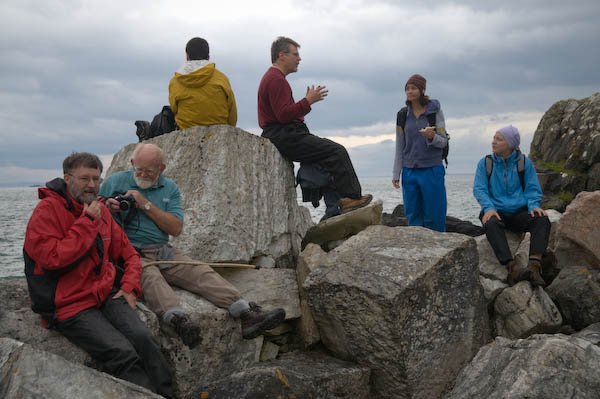
Some companions on a pilgrimage on Iona relax at the marble quarry.

Often when I’ve travelled for reasons other than to work as a photographer I’ve travelled light, often taking only a simple compact camera. Generally I’ve come across situations where I’ve regretted not having a better camera for various reasons, and digital has added to that dilemma. With film, the quality of the results from a 35mm compact with a good lens was identical to that from an large and expensive SLR (or sometimes with wide angles, even better) while the same just isn’t the case with digital.

I’d hoped that the Leica M8 would present me with an reasonably compact solution – if at considerable expense. With a fast f1.4 lens it was certainly fun to use, particularly at night in Paris, but in general it’s been a disappointment, though if I could afford them, some new lenses might help. But over the past few years I’ve become so used to using zooms that it’s a hardship to be without one.

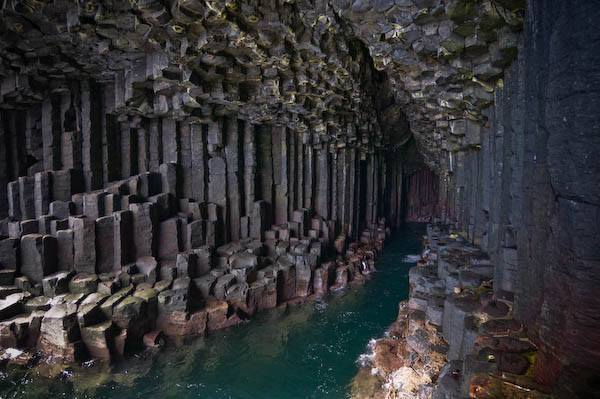
Staffa - Fingals Cave
Fingal’s cave, Staffa – one place where a real wide-angle helped

So this summer I travelled with the Nikon D300, but with a considerably cut-down kit. Even so, 2 lenses (the moderately large 18-200mm VR and the miniscule 10.5mm semi-fisheye) and an SB800 flash although a very flexible outfit isn’t exactly light and compact, and at times the gear did get a little in the way. Next time I’d certainly opt for a smaller lens, perhaps an 18-50mm, which would also enable me to rely on the camera’s own flash.

Of course what I’d really like would be a compact digital with no shutter lag, a large sensor and a a zoom lens with something like 24-85 equivalent.  It doesn’t seem an impossible specification, but nothing yet approaches it. In fact it might even replace my Nikon for work.

I’ll doubtless put more of my holiday pictures on line shortly, both from Glasgow and Iona.  A few of them show that I was occasionally able to think as well as press the shutter.

Kelvingrove


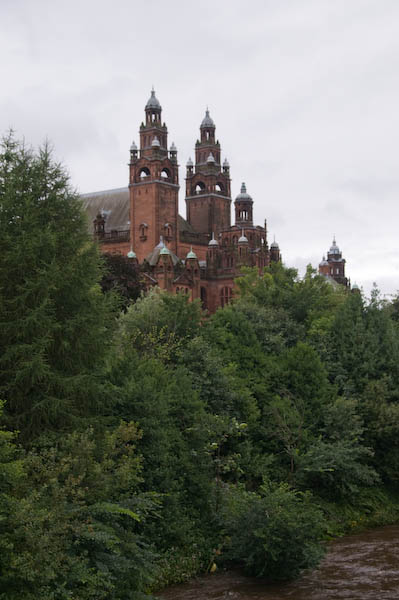
River Kelvin and Kelvingrove Art Gallery

Glasgow’s Kelvingrove Art Gallery. is a gallery I can whole-hardheartedly recommend with a fine collection of paintings and other objects.

My companions and I differed in our opinions of the ‘Glasgow Boys‘, whose contribution to art in the 1880s and 90s deserves to be better known, but the gallery has a superb collection of French painting, although unfortunately too many works were absent on loan, some in Edinburgh for a joint show, ‘Impressionism & Scotland‘ which comes to Glasgow later in the year. I don’t like these big collected shows – much better I think to see the works a few at a time, but having paid your £8 you feel obliged to slog round all hundred and something of them.

The gallery (entry is free)  also has a fine display of work by C R Mackintosh and friends  – rather more authentic than in most tea-rooms and certainly than the ‘Rennie Mackintosh’ hotel I was staying in. (Like W H F Talbot, Mackintosh seems almost always saddled in the popular mind with his middle name.)  It also made clear how much his work relied on that of sisters  Frances and Margaret Macdonald, which I found more interesting than his. Good though buildings such as the ‘School of Art’ are, I find a little Mackintosh goes a very long way.

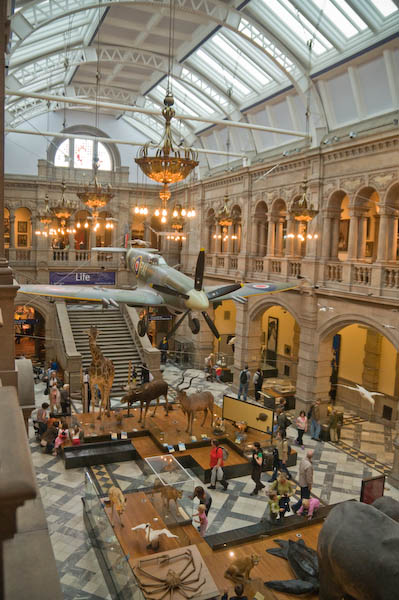
It’s also a great place for kids, and there were a lot enjoying it while we were there on a wet August morning. What other museum can boast both a Spitfire and a giraffe?

(Also showing at the Kelvingrove Art Gallery were photographs by  one of its most illustrious photographer sons, Harry Benson – which I write about separately.)