Should Magnum do fashion?

Alec Soth continues his campaign to turn the Magnum blog into a true ‘Web 2.0’ site interacting with its users rather than simply feeding them with some of Magnum’s truly fabulous eye-candy by posing the question ” Should Magnum do fashion?”

Of course Magnum photographers have done fashion in the past, and most particularly (as he points out) Magnum have  produced their Fashion Magazine series, with issues shot by a single photographer – previous issues have been by Martin Parr, Bruce Gilden and Soth himself.

The latest – just released – Magnum Fashion Magazine, shot by Lise Sarfati raises the issues more starkly for several reasons. Firstly because of her whole approach to documentary which has dealt more intensely with the people she has photographed than the other photographers, but most importantly because she has made use of those same people as models in her fashion pictures and shot in many of the same locations.

Of course there are those who argue that Magnum lost its true documentary heart some years ago, particularly with the inclusion of Martin Parr, whose approach caused some apoplexy among some more traditional documentary photographers at the time (and I think smoke was seen rising from at least one of my heroes.)

Until now it was always possible for those who had some sympathy with this view to apologise for Magnum and say that even if some of the work lacked the old spirit, at least Magnum was still supporting the serious work of photographers such as Lise Sarfati…

Had we looked at these pictures simply on the web or gallery wall would we have simply seen them as an extension of her earlier work? After all they are marked on Magnum as “Not for use in advertising or retail calendars“, so are they really so different from her other work?

Seen as a whole, I think they are, and I think they cheapen her work. Although taken individually most would fit into her approach, as a set of over 70 images the fashion fiction seems to me to take over, spreading a certain sameness and repetition.  I don’t know if it is the presence of stylists, the expectations of the “models” themselves or the pressure on the photographer to produce in a limited time-scale, but there seems to be a lack of intensity as well as a certain unwelcome gloss in these images.

I also wonder about the relationship between the documentary photographer and the people she is photographing, not just in this case but in general.  For me certainly, I’ve always felt that what I do is justified by the story that I tell; sometimes it may be of direct benefit to those who work with me,  or promote their cause or in some way enlarge people’s understanding or appreciation of the world.  Somehow I can’t fit selling frocks into that relationship.

So should Magnum do fashion? Well, Magnum photographers need to make a living and fashion is one of the safer and better paid ways to do that, so I’ve no problem with them doing a little on the side.  Even do a few weddings if they really have to. But I’d rather Magnum itself didn’t confuse it with their real work.

On Criticism

Another recent post from Jörg Colberg on Conscientious that caught my eye was Being critical vs. being negative.

In it he mentions the “dearth of critical discussions of photography online” and that many people he is in touch with would like to see more, going on to make clear the distinction between being critical and being negative, and then suggesting that most people (and in particular I think he means most bloggers) are not critical because they fear it will be misunderstood as being negative, and that they feel this will be bad for their careers.

As someone who has been writing critically about photography on-line since 1999, my first thought was “what career?”  When I started writing for ‘About.com‘  I was expected to be critical. I was asked to write because I had ideas about photography and could express them, (although by the time we parted company in 2007 corporate policy had changed.) But now here on >Re:Photo and elsewhere I can do my own (but unpaid) thing.

Of course this isn’t the only blog which does feature critical writing about photography – and Colberg himself occasionally does his bit on Conscientious.

I don’t always write about every show I attend or web site I visit. Sometimes I don’t feel I have much to say, and if I feel the work is very bad it would be hard to write without seeming negative. Essentially I think the job of the critic is to provide some insight that will encourage or enrich photographers and the audience.  And, hopefully also to stimulate some kind of dialogue about the work. If I can’t think of anythi

And Colberg thinks critical discussion would be a positive thing. So I wanted to contribute to one by making a comment on his blog. I looked for the comment box on the page – and to my surprise there wasn’t one.

You can comment on >Re:PHOTO, although to prevent abuse you need to be a member (joining is free and instant) and logged in, and all comments are moderated before they appear on the site. There is a page – see list at top right – on how to make comments for anyone who can’t see how to do it.

I don’t get many comments here, but I do welcome them.

Editing Your Work

After a few days away and rather longer being tied up with putting a show on the wall I’ve today got back to catching up with some of my e-mail and reading some of the blogs I like to take a regular look at, including Jörg Colberg‘s Conscientious, which often comes up with some interesting leads. One of these that he mentioned a few days back was about Editing Pictures. Unlike me, Colberg often says little or nothing about the sites he links to, and his only comment on the article on Simon Robert‘s Blog was that it was a “must-read post.”

So I read it, and found it to be a very useful but hardly surprising account of how Roberts went about editing the pictures for his book ‘Motherland‘. Basically its probably not a lot different from the way many others work. He starts by having all of his films contact printed.

Nowadays I tend to do that instead on the Epson V750 Pro, which lets me scan my negatives in their filing sheets, carefully laid on top of the glass without a holder. It takes a complete 120 film in the filing sheet from the several different formats I use or either 5 strips of 6 35mm negs, 7 strips of 5 35mm negs or 7 strips of 3 XPan negs at a time.

Fine for the XPan, as its a whole film, but a problem for normal 36 exposure films which I have already filed, usually with 6 strips of 6 negs and a short end with 1 or 2 frames. However scan times are so short with the V750 that it is easy to make a second scan with the remaining strips – it only takes a few seconds to re-unite the two in Photoshop.

I find it better to make my first selection on screen – and its something I’ve become very used to with working from digital. 35mm printed contacts are a little on the small side, even though the high-quality loupe I use gives a superb view. If you work with film, it really is worth spending money on a really good loupe, though I made do for years with a cheaper Nikon one that isn’t bad…

Scanning at 360 dpi gives a jpeg file (at good quality) of around 2,000Kb for each contact sheet and is probably the minimum resolution worth considering. Each 35mm frame is then around 540×360 pixels and thus nominally around postcard size at 1:1 on the screen.

For Roberts, working away from base, the ability to see physical contact sheets while he was carrying out the work was of course pretty vital. He shot just over 5000 6×7 frames on the project in a year – a relatively small number of images compared to those of us who work with 35mm or digital, and both the small number and larger size certainly make editing easier.

From the contact sheets he made a selection of 500 images to scan and print, making up a book with 12 images per page. He doesn’t indicate the size of the book shown in the post, but if it was A3 landscape, then these images were around 4×3 inches. Roberts scanned all 500 for this on an Imacon, which seems to me overkill – the V750 could do the job perfectly adequately and a great deal faster.  If you are work on medium format and scan as contact sheets you can simply ‘cut’ the images out from these and paste them into a new document to print out.  For 35mm you would need to make your contacts at 600 dpi or higher, as then printing at 200 dpi would give images around 4.5 x 3 inches. (The optimum dpi for printing on most printers is probably 250-360dpi, but 200 dpi does a very decent job.)

500 pictures – 1 in 10 of his take – was still far too many for a book, and the challenge was to get them down, in his case to 153, for publication. (Looking at his book, which I think I wrote about briefly at the time it was published, I would actually have preferred a tighter edit, and considerably more text.)

There are two very important points that he makes on the real editing process that takes place at this point. Firstly that it is something that needs time; rather than making final choices immediately you need to go back time after time and let your thoughts about the images mature. Personally I prefer to leave work for years rather than months or weeks to give time for my initial enthusiasms, often more tied up with the event of making the image rather than the image itself, to evaporate and be replaced by a more clear-headed appreciation of the work.

It’s also true that many photographers are poor editors of their own work, too emotionally attached to it to think objectively. And some photographers are simply poor editors; the two occupations call for differering if overlapping skills. Roberts was fortunate to be able to call on the services of others, and in particular his publisher, Chris Boot.

The feature also contains some interesting quotes from a couple of books, one in which a number of well-known photographers give a sentence or two about their approach to editing and a slightly longer quote about editing and Gene Smith from ‘On being a photographer‘ – in which Magnum photographer David Hurn talked to Bill Jay.

I wrote about their views on Smith some years ago. They concentrate on his Pittsburgh work, produced in part during the short period he was a member of Magnum. It was in many ways a difficult project, not least for Smith when all his cameras and negatives were stolen. The burglars were caught after the cameras were sold as one contained a film on which they had photographed each other, but the negatives were never recovered and Smith had to re-shoot.  In some ways the project was doomed from the start, Smith had aimed to create an in-depth project, but Magnum and writer Stefan Lorant wanted a quick shoot with around a hundred pictures to decorate Lorant’s text. What they saw as a week or two of shooting eventually ended up as several years of Smith’s work, completed with the aid of a grant after he had left Magnum. But here’s the comment I wrote back in January 2000:

David Hurn and Bill Jay dismiss the idea that Smith was a good editor of his work, suggesting that all his best work was edited by Life staffers. It’s at best a curious argument, not least because Smith generally edited his work considerably before letting the staffers near, and the overwhelming evidence appears to be that they were limited to trimming and shoe-horning his ideas into the magazine format. At its best it was a painful and high-energy dialectic that did deliver. Hurn & Jay’s prime evidence is the stilted prose of the Pittsburgh article, which, according to other sources, was not by Smith, but written to a deadline by two Magnum staff at a time Smith was largely beyond lucid thought.

Which perhaps leads to a third point about editing.  It’s best done on a clear head and not under the influence of whiskey and Benzedrine or whatever your particular poison. A glass of wine may help me, but not a bottle.

But ‘Dream Street‘ was hardly as Hurn and Jay suggest “a failure“, except that is for the finances of Magnum, which Smith almost single-handedly brought to ruin (and he left owing money he was never able to repay.)  Some consider it Smith’s finest work, but perhaps Magnum was never able to forget that debt.

Orphans Act- your images up for Grabs?

Although the US Senate passed the Shawn Bentley Orphan Works Act of 2008 a few days ago, hotlined through a back door while most Senators eyes were fixed on the attempts to save the US economy,  there is still actually quite a road to travel before it becomes law, even in the USA, where it still has to pass the House.  And given that it basically alters the whole situation over copyright and intellectual property it isn’t beyond imagination that it could lead to considerable problems between America and the rest of the world, even though its perhaps more likely that many other countries will quickly slip through similar legislation.

Although most photographers are opposed to the ideas behind the US concepts of ‘orphan works’ in this and other bills, there are many others who would welcome the opportunity they offer for free-loading at our expense. These include the education industry, and Internet and media giants. At an earlier stage, Google were licking their lips over the prospect of using a million ‘orphan images‘, although probably even the weak safeguards of Shawn Bentley would queer their proposed piracy. It’s perhaps interesting to see the discussion of orphan works on non-photographic sites such as Public Knowledge.

As PDN comments,  Shawn Bentley does give some further ideas about what might be considered a ‘diligent search‘ and thus what steps we should do to protect our own work. Which of course include making sure our images contain the proper metadata – particularly IPTC copyright and creator data, and considering the use of registries such as PLUS – though it remains to be seen how usable and affordable such systems will be, particularly for low-earning freelances and semi-pro photographers.

Using Lightroom or similar software you can set up templates that add basic metadata to your images as you upload them from card to computer, including in the IPTC copyright section a copyright message, coypright status, rights usage terms and a web address for a page giving copyright information. In my case this part of the preset looks like this:

Rt Click, View image to see larger

although I’m not sure that these are exactly what are intended for these fields.

Part of any ‘diligent search‘ must surely be to look for image metadata, and I hope one  beneficial aspect of orphan works legislation (which I’m sure we will eventually get) will be to create a greater awareness of the existence of metadata and include the ability to read it into all viewing software.

Another positive result may well be an increased insistence on the proper attribution of published work, though I’m less sure that publishers will bother to do this. It really is something that photographers and their organisations should campaign more about.

I’ve always resisted putting visible watermarks on my images, but its perhaps time to rethink this, or at least to include them in an added image border. Again, software such as Lightroom enables you to automatically add a visible watermark.

Big agencies have for some years used image tracking services such as PicScout to locate unauthorised image use on the web, although these are perhaps too expensive for most freelances.  You can try out the Tin Eye beta from Idée – the easiest way to use it is to install the browser plug in and then right-click on your image on a web page and let it search. But so far its image data base seems too small to find any of mine – even where I know they are in use legitimately on other pages.

You will also need to be very careful about using image sharing services, both to look at what rights you are giving away, and also to see if your metadata is retained when the images are shown on the pages.

National No More Fur March

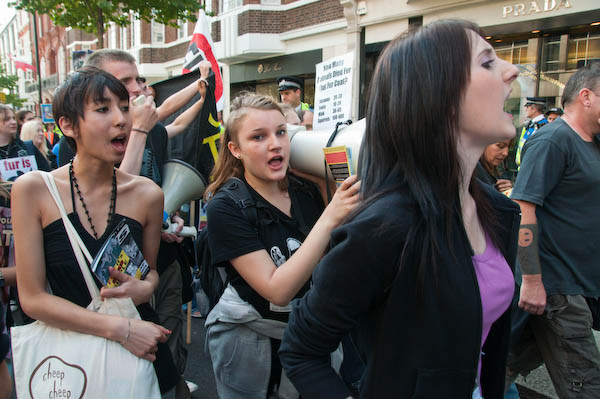
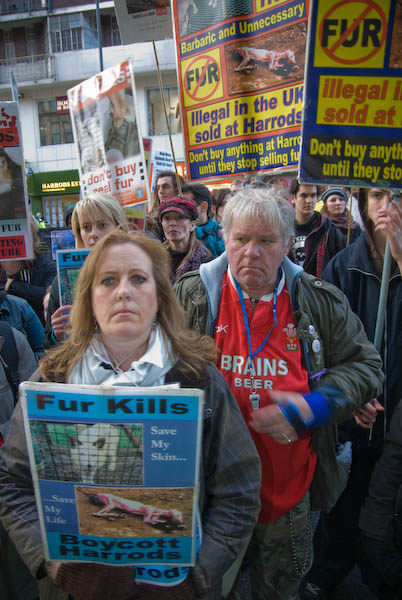
Last December around 2-300 people marched from Belgrave Square in London to Harrods passing many designer shops that sell fur-trimmed garments on the way and voicing their opposition to this cruel, inhumane trade which involves the deliberate and callous ill-treatment of animals. Some of the same people were there for another march on Saturday, but in general it seemed a more middle class and polite affair, with rather more people present, nearer to 500.

Rt Click, View image to see larger
Anti-fur marchers outside Prada, Sept 2008

Looking at this crowd, the organiser’s plea for them to be sensible and not to try anything silly with half the Metropolitan Police watching them (and one of the many vehicles I noticed was from the City of London force) seemed superfluous, while in December there had appeared to be rather more chance of something happening.

Policing did seem to be excessive, with officers all along both sides of the procession and more in front of virtually every clothes shop the march passed – certainly all those that sell fur.  I got pushed in the back by police on several occasions as I stood on the curb to photograph the marchers and was pulled back rather firmly as I walked onto the pavement.  Showing my press card I was told “It makes no difference.” I argued but got nowhere, so simply walked a few yards further up the road (actually towards a fur shop) where the police seemed to have no problem about me going off the road.

For once the FIT team seemed busy photographing demonstrators and I didn’t once notice them photographing me or the other photographers present.  Of course I could just have missed it, but usually they like to make sure people notice they are being watched.

In December, outside Harrods, I’d shot from inside the march:

December 2007 Harrods
Anti-fur March outside Harrods, Dec 2007

So this time I’d decided to try from the other side of the fence there:

Rt Click, View image to see larger
Anti-fur March outside Harrods, Sept 2008

Harrods is a particular target as the only department store in the country to still be selling furs. As the placard points out we have a peculiar situation here that while fur-farming was banned here, the law failed to ban the import of fur farmed in other countries – under much more cruel conditions than those were allowed before the ban here.

Photomonth 2008 now on line

You can now find out more about Photomonth 2008, the East London Photography festival, from the web site which is finally on line. This has now grown into the country’s largest photography festival, with over 100 events included.

Larger image - Rt click, view image
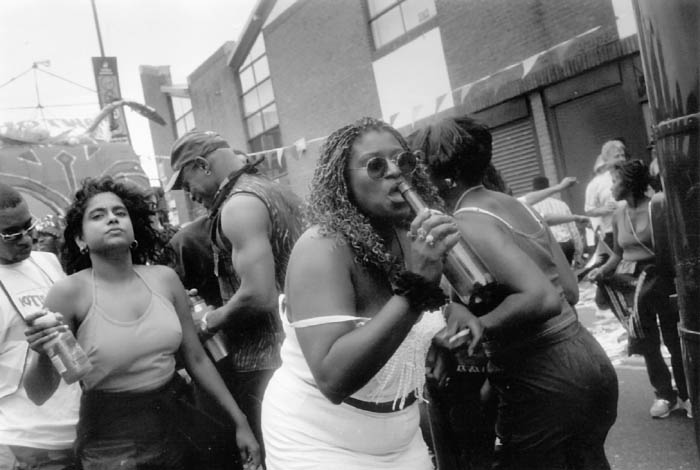
Notting Hill, 1998.  Peter Marshall

One of them is of course English Carnival, on show* at the Shoreditch Gallery at the Juggler in Hoxton Market until 30 Oct – and this is positively the last time I’ll mention that you are all welcome to the opening tomorrow, Thursday 2 Oct, 6.30-8.30!  Some people in the past have found the Juggler hard to find (go up Pitfield St  from Old St, take the first on the right a few yards up, then Hoxton Market is another 50 yards or so on your left – or use put N1 6HG into Streetmap – how hard is that?)

It’s a shame that this is also the date of the Photomonth launch event – and several other openings I’ve had invitations too. Sometimes openings are too much like London buses.

Rt Click, View image to see larger
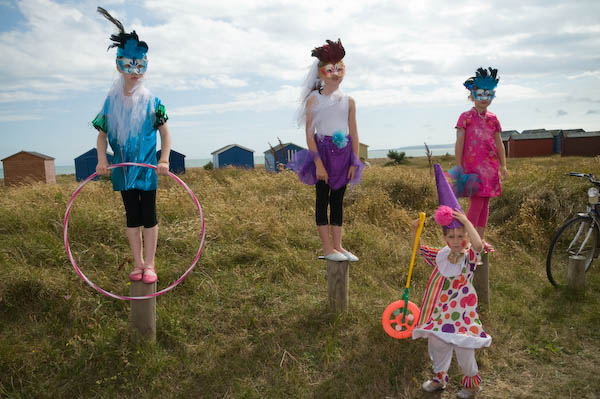
Hayling Island Carnival, 2008. Peter Marshall

Unfortunate too that our later “English Carnival”  show at the Barbican Library was arranged too late to be in the Photomonth programme, although it’s in the right area during the right time, from 3-29 Dec, 2008. More about that later – I’ll probably show a different group of work from the pictures at the Juggler.

*PS – Thanks to BJP

I’m delighted to find the show is listed today by the British Journal of Photography in their ‘On Show’ feature in print and on-line at number 2 in their pick of “Five to visit…”

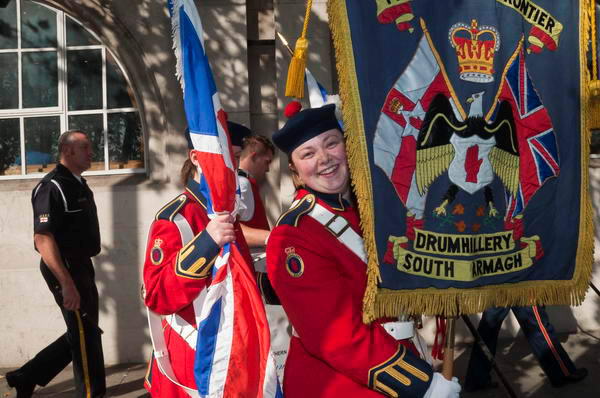
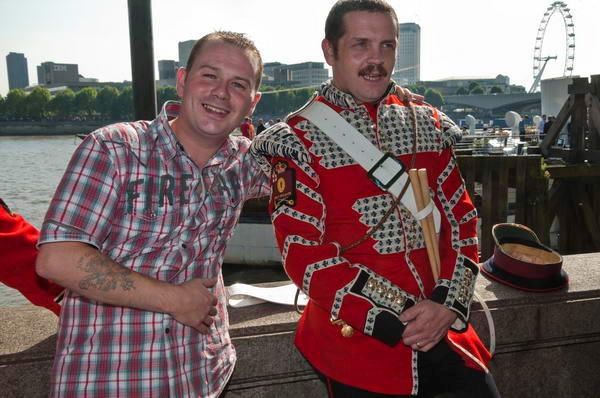
Ulster Practices in London

I was born and brought up a Protestant, although my own parents were considerably more open-minded than some and probably regarded Catholics  as misguided rather than as the evil followers of the Antichrist; they even knew and talked to some, though sensibly kept quiet about this.

It wasn’t in Northern Ireland, and my parents had chosen not to worship at the church where  the rest of my father’s family went, occasionally visited by and spiritually if not physically in the see of the The Rt Honourable The Rev’d Ian Paisley.

Later in my seven years in Manchester I often attended a Presbyterian church, eventually learning to cut through the preacher’s powerfully Northern Irish accent to find his views were considered and moderate.  Because of this background more than most English I feel a understanding of groups such as the Apprentice Boys of Derry, even though I don’t share their views.

Protestant marches in Ulster are a way of displaying tribal loyalty and showing a cultural defiance, a clear display both of cultural difference and of superiority. Often they have acted as a catalyst for violence between the communities, stirring up hatred that has lead to killings and maimings by both ‘Catholic’ and ‘Protestant’ terror groups.

In London, they are just celebrating a culture and I can’t imagine anyone on our streets feeling in the least intimidated or upset by their marches.  They are,  as one man put it to me – “having a fine day out and enjoying ourselves.”  But this very large man wearing dark glasses did rather spoil the effect by attempting to prevent me taking pictures and to intimidate me, pushing me backwards through the crowd and telling me very firmly to leave the area.

I don’t have a problem with people marching in my city, but I do object to being threatened and intimidated on its streets. This man attempted to justify his  unacceptable behaviour by saying that someone had told him that I was a photographer who worked for a left-wing newspaper. Unfortunately it’s untrue (I could do with the money, though left-wing publications seldom have any.) But even if I were, it would be no excuse for his attitude and his assault.

I asked him who had told him this nonsense, but he wouldn’t say – probably it was a story he had made up. The only people I recognised at the event apart from other photographers (including one who does work for a left-wing publication) were several police officers including the FIT team who have photographed me on so many occasions – although I didn’t see them doing so at this event. Unfortunately none were in the immediate area when the incident took place, and in any case I preferred to keep on working rather than stop to make a complaint.

Most of those I met were happy to talk and to be photographed, but the incident did leave a nasty taste in my mouth. If the Apprentice Boys want to get a better press in London they really need to take the lunatic fringe responsible for this kind of behaviour in hand.

More pictures on My London Diary

Seeing RED

You’ve probably heard of the RED ONE video camera if you have any interest at all in making movies. It’s a revolutionary modular camera that can shoot 4096 pixel wide (4K) video at up to 30 frames per second in 12 bit RAW. Two new models, one with a larger image size and one smaller are due next year; the 5K EPIC will make shooting movies on film a thing of the past (already studios are turning to RED ONE.) SCARLET – a 3K camera – promises to be significantly more affordable.

Last month, RED camera’s Jim Jannard posted a comment about a new camera, a “DSMC (Digital Still & Motion Camera)” to compete – or rather revolutionise – the DSLR market. Given the example of RED ONE, it will be worth waiting for – and expect to wait until around 2010 (Jannard’s post says “late 2009“.) It is likely to offer higher resolution, faster image writes, better compression codecs than existing high-end DSLRs as well as significantly under-cutting the prices of the top-level models. It is also likely to be a modular system – even to the extent of allowing sensor upgrades. So far there are 39 forum pages of comments (and a wish list page with more)  if you have a day or two spare to read them; Jannard says he won’t make detailed comments until Jan 1, 2009. And there is a wish list and

For some rather more concise but detailed speculation, take a look at Wired, where they set out their wish list for the camera. One of the nicest thoughts they have is that one manifestation of it might be a camera that would “‘out-Leica’ Leica“, giving us “a digital rangefinder camera that actually works.” I do hope so.

Leica are not quite standing still, although their  official Photokina 2008 product announcements on the Leica User Forum  (you will need to register to see the details there, but doubtless they will soon be available everywhere else) don’t fill me with great excitement. Certainly they don’t live up to some of the rumours that were around.

The Leica M8.2 has the new shutter and hard cover glass previously announced as an upgrade for the M8, along with a snapshot mode, quick override settings and a more robust finish. Nothing of great significance – and certainly nothing that will make the camera live up to it’s pedigree.

The snapshot mode usefully includes auto ISO speed, which can also be used on other settings. Leica seem also to have responded to photographer’s complaint over insufficient detent on the main switch (we get fed up of finding we have the camera on self-timer by mistake) and also claim improved bright line frames. Although their accuracy was a feature of some earlier cameras, on the original M8 only the 35mm outline seems to give acceptable accuracy.

Apart from these minor camera improvements there are some new lenses. The 21mm and 24mm f1.4 lenses seem interesting although are likely to be unaffordable when they become available in December 2008. Doubtless they will be superb performers, although I find the statement that “in the 21 mm lens, distortion is only -2,3%, and only -2.2% for the 24 mm lens, and is therefore hardly visible” rather debatable.

Personally I’d find a 21mm f2.8 with a considerably smaller size and cost very much more interesting. What Leica have still to realise is that with digital it’s better to go for a lower noise sensor than to bother  with very wide apertures – and they also have a new Noctilux 50mm f0.95 to prove they’ve yet to get the point.

The 24mm f3.8, equivalent to 32mm on a full-frame camera, is described by Leica as being “moderate cost.” I suspect that means only around a thousand pounds, but I could be seriously underestimating.

So, rather than wait for Leica to bring out the M9 (or even the M11, given how far they have to go) , I think we are now crossing our fingers for the RED M.

Minneapolis

This morning I’ve been following a little trail that actually started from and item on PDNPulse which they had picked up from the Minnesota Indpendent .

The MI story listed 42 members of the news media who were arrested or detained during the policing of the protests outside the Republican National Convention (RNC) there, and two further names had already been added in comments on their story when I visited the site.

It’s hard to know how many of them were photographers (or videographers) because in many cases only the name of the organisation they were working for is given, but certainly more than the 11 listed by PDN are described as such in the MI story – and the two extra names are also photographers. But all 44 were media workers – and most if not all will have had ID to make that clear.

And of course in these days it’s a fair bet that most of them were carrying and using cameras – like Seth Rowe mentioned below – even if they are not called  ‘photographers.’

Vlad Teichberg of the NY new media art group ‘Glass Bead Collective‘ and two colleagues were detained by Minneapolis police and searched; police confiscated their cameras, computers and notes for several days (perhaps surprisingly for a new media group they even had a camera with film in it, and  apparently the police examined this in daylight but couldn’t see the pictures) but was released without charge.

In a short video clip on MI, Teichberg makes the point that there are just so many cameras around now that we have passed the point where police can actually stop videos of them behaving badly appearing on sites like You-tube, and that their only sensible response now is to keep within the law. It’s a point the police have yet to grasp.

On the Minneapolis Sun, Seth Rowe, community editor of the St. Louis Park Sun-Sailor writes about how he talked to the police chief about the situation and then went there determined to follow police instructions – and found himself arrested for doing just that. He gives a lengthy eye-witness report of his treatment, which suggests that many of the arrests were made simply to boost the pay of the officers concerned.

Another account worth reading comes from AP photographer Matt Rourke and was posted on the MinnPost web site along with the last picture he took before his arrest. Rather curiously the police allowed him to hand his camera over to a colleague when he was arrested.

The story also mentions – though rather unsympathetically – some of the other media workers arrested, with links to a couple of popular videos of their arrests which you may have already seen. If not they are also worth a look.

Press Freedom Under Attack

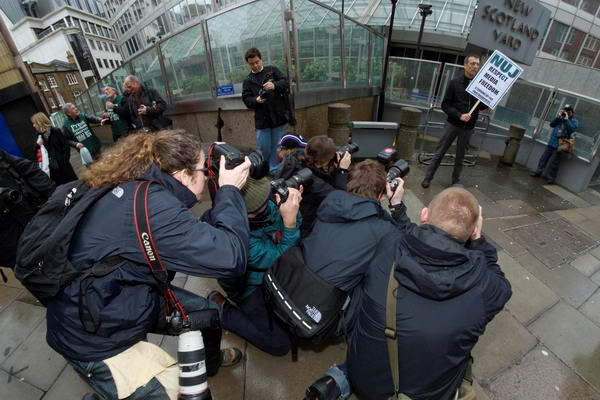
I’ve written a number of times about the increasing harassment that I and other photographers who document protest have been getting from the police over recent years. It’s  got so bad that NUJ General Secretary Jeremy Dear held a one-man protest outside New Scotland Yard this March, photographed by around 20 of us.

Jeremy Dear at New Scotland Yard

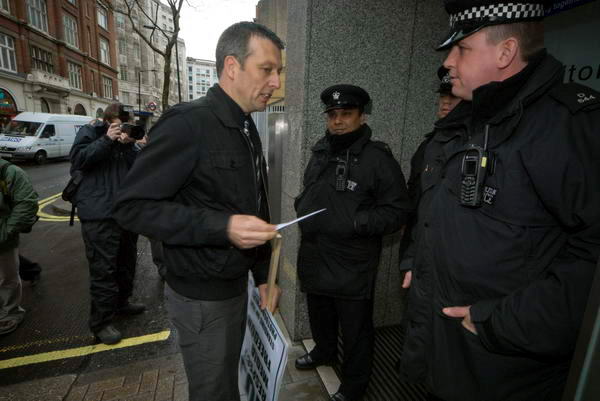
At least on that occasion the police didn’t bother us, although they did refuse to accept a letter from Jeremy Dear at New Scotland Yard, refusing him access to deliver it – he was told to put a stamp on it and post it.

This is a police station - you can't come in!
This is a police station – you can’t come in!

Other recent posts have looked at the repeated searching of photographers covering the Climate Camp (Police States – Hoo and Beijing) and the Smash Edo demonstration in Brighton.  A more general piece looked at the deliberate use of ‘Photography as Intimidation‘  by the police both against the press but also against demonstrators and also – praised by Home Secretary Jackie Smith – against those who police have identified as “persistent offenders” on some problem estates.

Those of us who believe in law in order and order in law feel that persistent offenders should be brought before the courts with proper evidence rather than suffer summary victimisation by  police officers.

At the Trade Union Congress in Brighton, Jeremy Dear moved a motion which called for a rethink of government policies that put journalists at risk of imprisonment just for doing their job which was adopted unanimously. His speech was brief but cited various examples of harassment of journalists, and in it he mentioned a video giving more details. You can read some of his speech and see that video on the NUJ site.


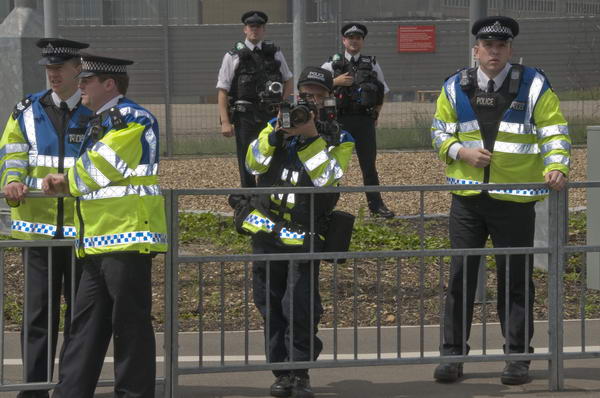
More pictures of me – as at every demo –  this time from a distance

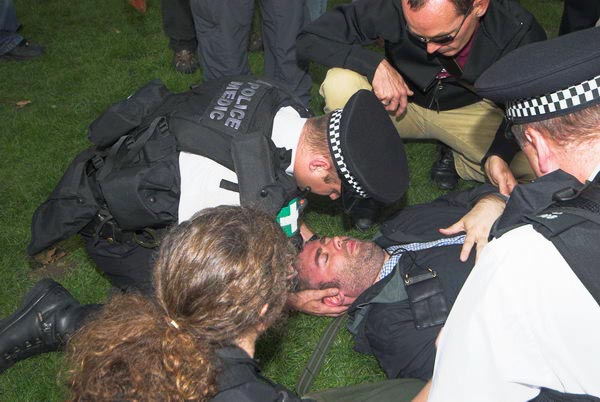
The video, Press Freedom: Collateral Damage, is filmed , written and directed by Jason Parkinson, who I first met when he was held inside a police cordon at  the Colnbrook Detention Centre with police refusing to accept his NUJ card as genuine (it happened to me too at the tank auction at Excel last year- see Bad Press?) The producer of the film was Marc Vallée, who I wrote about when he accepted an out of court settlement earlier this year for a police assault that put him in hospital at the ‘Smash Parliament‘ demo in Parliament Square in 2006. Others involved in making the 9 minute video were Jeremy Dear as Executive Producer, Roy Mincoff for Legal and additional footage by Rikki Blue.

Police Medics treat Marc Vallee

I was taking pictures at most of the events covered by the film (and you will find them on My London Diary as well as often on Indymedia and in picture libraries), and there are fleeting glimpses of me at several points in the film but fortunately no more.

All of us suffer the kind of harassment you see and hear about, although it’s fair to add that there are other officers who apologise to us for the way we are treated by others and  for the orders they have to carry out. And at times some are helpful. One once told me he had been given an official warning for being too friendly to me. So perhaps I shouldn’t mention it.

Although relations between individuals can sometimes be good, we do seem to be increasingly faced with an official policy of restriction and harassment, of trying to prevent us from reporting what is happening.  Jeremy was absolutely right when he called it “a co-ordinated and systematic abuse of media freedom“, and equally right to set it in a wider context of the use by an intolerant government of “blunt instruments” of the Terrorism Act, SOCPA and other restrictions on the personal liberty of all citizens. As he said towards the close of his speech,  “The price is too high. Less liberty does not imply greater security. It never has.