Another Worrying ‘Terrorism’ Story

Popular newspapers in the UK have all covered the story of a 15 year old schoolboy using his mobile phone to photograph Wimbledon station was stopped and searched by three police community support officers. They claimed to be doing so under Section 44 of the Terrorism Act, although they do not appear to have had the supervision of a constable that this requires, nor is it clear that the authorisation was in force that would enable it to be done.

But, apart from being an abuse of law, what the PCSOs did was simply incredibly stupid.  But also part of a concerted anti-photographer culture being promoted by police and Home Office through poster campaigns and press releases.

Marc Vallée’s blog has a number of posts related to this and has recently posted Terror Law and Photography about Clause 75 of the new Counter-Terrorism Bill 2008, which will create a new offence which may well cover photographing or publishing a photograph of any policeman (or members of the armed forces or intelligence services), with draconian sentences.
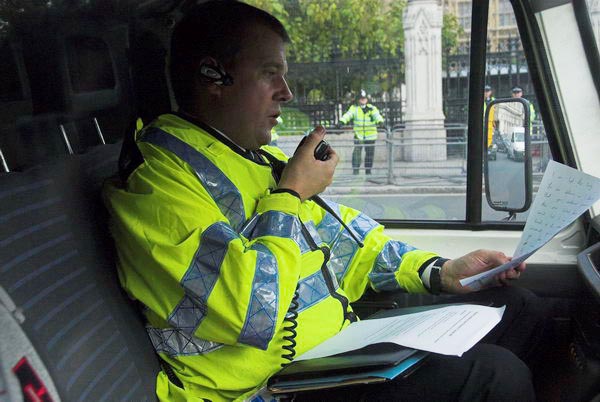
The Bill does include the statement:
It is a defence for a person charged with an offence under this section to prove that they had a reasonable excuse for their action,  although I’m not at all sure what the courts might consider a reasonable excuse.
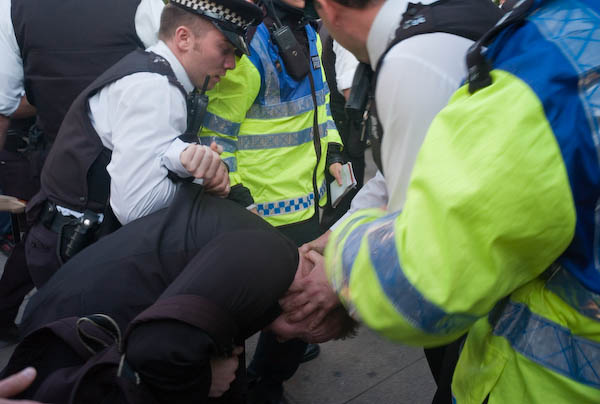

Could pictures like these put me in jail?

Marc’s post also mentions that the Home Office is about to post new operational guidance to police about using their stop and search powers, and quotes the draft as clarifying that the police have no powers to stop people taking photographs in authorised areas under Section 44, but if they “reasonably suspect that photographs are being taken as part of hostile terrorist reconnaissance” they may search the person and possibly make an arrest, when they can seize cameras, films and cards as evidence (though they must not destroy or delete images.)

The Wimbledon schoolboy is yet another example of how the police (and PCSOs)  misuse existing law. Giving them further powers can only make things worse.  The future of photography on our streets looks increasingly bleak.
Thinking of Paris

I’m getting down to thinking about Paris, where I will be next week for Paris Photo.  I’ll be one of 40,000 or so visitors to the rather stygian cellars below the city of light looking at the work of over thousands of photographers from around the world on the stands of 120 galleries, publishers and magazines from around 20 countries – just one of a thousand accredited journalists from 50 countries there. For as long as I can stand it before rushing up for air and perhaps a beer before diving down for more.


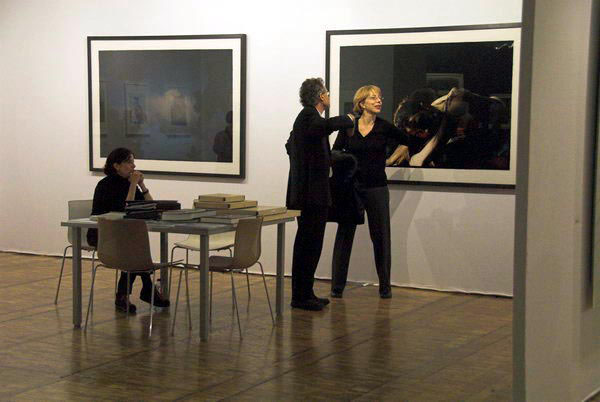
A quiet moment in Paris Photo in 2006

This is the largest and  most important trade show of the photography year for dealers and collectors, and a great opportunity to see work, even if so much is just the kind of large-scale expensive corporate wall-decoration that supports most of the gallery world these days.  Among that kind of stuff I’d be happy never to see again there will be plenty of really great work.

In particular I’m looking forward to seeing a great range of work from Japanese photographers, from1848 to the present day, including quite a few new names so far as I’m concerned. Of course there will be plenty of familiar work, including people such as Shoji Ueda, Ihei Kimura, Masahisa Fukase, Eikoh Hosoe, Shomei Tomastu, Hiroshi Sugimoto, Nobuyoshi Araki and Daido Moriyama, most of whom I’ve previously written about, but also much new to be seen.


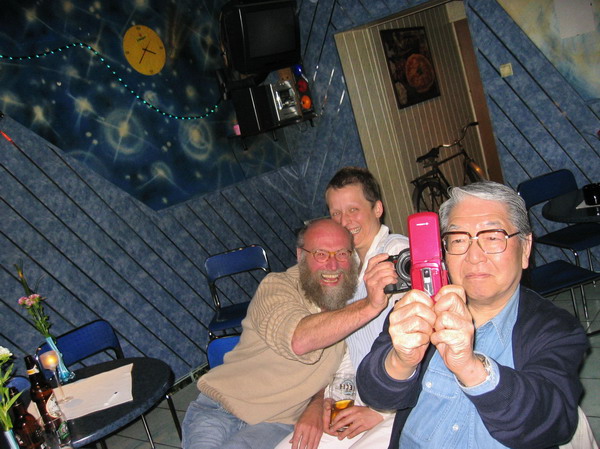
Eikoh Hosoe photographs me on a pink camera phone – one Japanese image I’m fairly sure won’t be at Paris Photo! But you can see more from this series here.

One of the best ways to get an idea of the range of work on show is to take a look at Lens Culture, always worth reading on photography and one of the partners of Paris Photo, which has a preview selection of more than 200 photographers from the show.

As well as the pictures, Paris Photo is also a good place to meet people and I’m looking forward to meeting some old friends and making new ones there. You can see my pictures from my visit there last year on ‘My London Diary‘.


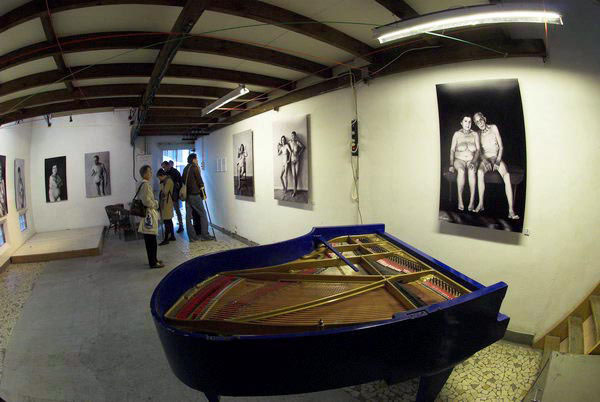
A show in the ‘Off’ in 2006 by leading Chilean photographer Paz Errazuriz was one of the most interesting in Paris that year

But even if Paris Photo was not taking place, it would still be worth visiting Paris this month, for the great Mois de la Photo which takes place in November every even-numbered year. The web site is (as yet) only in French, but the listing of exhibitions and events you can download makes sense so long as you know (or look up) the days of the week in French.  There are around 90 exhibitions taking place with some in almost every district of Paris, and on top of this there is also a lively ‘fringe’, the Mois de la Photo-OFF, with a further 101 exhibitions (again the site is in French, but the listings are easy to follow and you can download an illustrated pdf of the shows.)

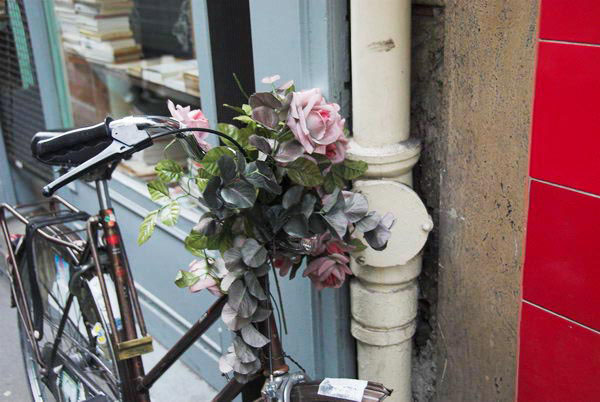
And of course there is the city of Paris itself – always worth a visit. The picture above is from those I took in 1973 – more here.

And in 2006, when I went to Paris Photo I also took a few pictures:


More pictures from 2006 from Paris (and Stains, a Paris suburb.)

Justice for Asbestos Victims

Some events (even when you are at the right place at the right time) are difficult to photograph because visually they are not very exiting of different. It doesn’t help when the issues involved are complex so that it is not easy to decide on a point of view to take.

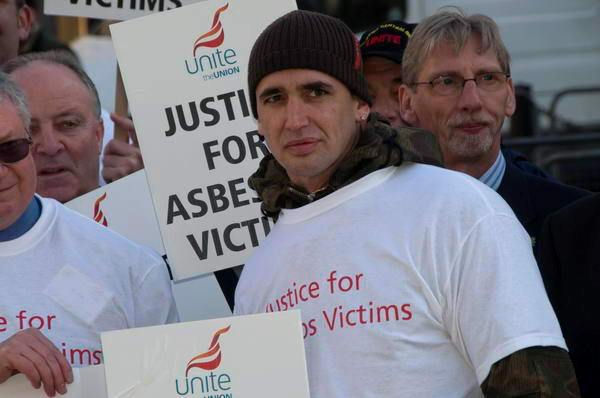
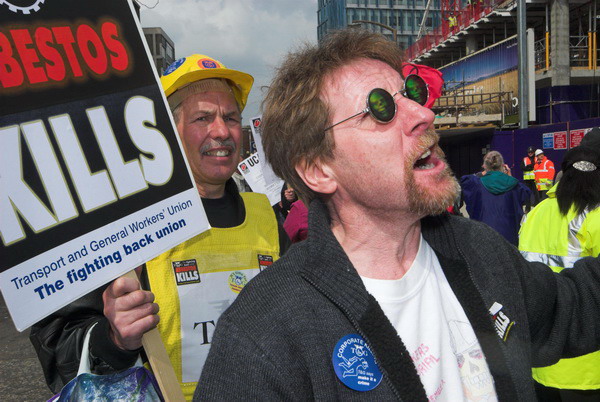
The ‘Justice for Asbestos Victims‘ rally was organised by trade unions representing people who had worked with asbestos.  As we all know, asbestos is dangerous stuff, exposure to it killing many workers, and it is also clear that many employers have been negligent and failed to take reasonable precautions to prevent people working for them being exposed to its dangers.

The demonstration was over a decision by the Law Lords that compensation should not be awarded for pleural plaques,  a form of irreversible lung damage caused by exposure to asbestos, because in themselves these do not normally materially affect people’s physical health.  People with them are however likely to develop more serious, often fatal conditions – for which damages are awarded. I think the employers should be liable for their negligence in exposing workers and that the pleural plaques provide clear evidence that this has occurred.

Rt Click, View image to see larger

Several other photographers present were working for the unions concerned who would probably be happy  with some fairly tedious group pictures showing workers and MPs and a few banners – and they proceeded to set these up.  It all helps to make a living, but I wanted to find something more, and don’t really think I managed it.  The picture I took at the International Workers Memorial Day march in April 2006 was considerably stronger – but then its message was clearer too.

Rt Click, View image to see larger
Asbestos kills

Wacky UK?

I spent the last weekend away from home, staying at a friend’s house in the north-east, where we had gone to celebrate his 90th birthday with a surprise party – with more friends coming from London and Sheffield for the event. Despite the misgivings of one of his neighbours – “What are you trying to do, kill him?” she asked –  it went off well;  we had after all known him for at least twice as long as her.

But being away from home, and in weather so poor I didn’t feel like going out anywhere with a camera left me plenty of time to read the papers, and in the Guardian Weekend Magazine I found a feature on ‘Martin Parr‘s Britain’, with 12 pages mainly of pictures from a lengthy project by him for the paper covering 10 English cities.

Parr was a photographer I admired greatly in the 1970s, although I’ve found some of his later work not entirely to my taste. He’s made a enviable reputation for himself, as well as a not so small fortune from his photography, but does sometimes seem to be cruising on that reputation rather than producing work of any consequence.  And although there were a few pictures I admired in the feature, as a whole it left me thinking that far from  (in the Guardian’s words) capturing “the essence of Britain’s cities” what we had was a few assorted glimpses of the wacky extremes of British (mainly English) eccentricity rather than any serious attempt to tackle the ostensible subject. It did really seem to be a good example of taking the easy way out, and I thought about writing a serious blog post about the work.

Perhaps fortunately I don’t need to, because Simon Roberts has done a very good job already. Although my thoughts would differ in detail, his UNDERWHELMED BY PARR raises some of the same thoughts that I had, mainly in quotations from letters on the Guardian web site, where you can see rather more of his project than appeared in Saturday’s magazine in a slide show called Pies, parties and pink drinks. Despite the joky title, this is a considerably better edit than that which appeared in the magazine.

Roberts of course has a certain competitive interest in the subject, having this year been engaged in his project ‘We English‘, supported by the National Media Museum, Arts Council England and The John Kobal Foundation, which he describes as ” a photographic journal of life in England in 2008“. At the moment if you click on the ‘GALLERY’ link at the top of this page it leads only to a picture of him with a page of biographical information. Perhaps when this emerges as the promised book and exhibition of 36×48” landscape prints in Autumn 2009, Martin Parr can be tempted to review it.  Having so far only seen the two pictures in a Foto 8 feature I might well find Parr’s work of greater interest.

Banking on Photography

This is very much the year of China, so it came as no great surprise to see the winner of the Pix Pictet 2008 was Canadian photographer Benoit Aquin for a series of images, The Chinese ‘Dust Bowl’. The 10 images on the front page of the web site are perhaps a little too small to really judge the images, which are inkjet prints varying from 34×52 cm to 86x132cm  (13×20″ to 34×52″ for those of us who still inhabit an imperial universe.) As in the pictures of Ferit Kuyas who I wrote about earlier in the year and others, China is seen through a dim haze of pollution.

Aquin’s series of pictures would probably not have been my first choice, but certainly would have featured in my top two or three not least for taking the theme of water in the context of sustainability seriously;  it seemed at best peripheral to some other entries.

Those short-listed were Edward Burtynksky, Jesus Abad Colorado, Thomas Joshua Cooper, Sebastian Copeland, Christian Cravo, Lynn Davis, Reza Deghati, Susan Derges, Malcolm Hutcheson, Chris Jordan, Carl De Keyzer, David Maisel, Mary Mattingly, Robert Polidori, Roman Signer, Jules Spinatsch and Munem Wasif.

In another announcement made at the awards ceremony, Munem Wasif was selected for the commission to document WaterAid’s Chittagong Hill Tracts Project in Bangladesh which is supported by Pictet & Cie. If you don’t already know Wasif’s work, his web site is certainly worth a look. He would also certainly have made my top three for the prize.

The prize entries also reflected another big story, Hurricane Katrina, although by now this seems rather passée, although I suspect either of these photographers might have got the award had this been the Prix Pictet 2006, but this year is the first of these competitions. Although I think Aquin’s work was more interesting, I do wonder how this and some other current high-profile work from China will seem to us when the Beijing games are a distant memory, and wonder whether some things are better left to World Press Photo.

You can see more of the pictures entered, along with a commentary by the head of the Prix Pictet jury, Francis Hodgson (a man who thinks stroboscopic lights are  high technology!) on a few selected photographers from those shown on the BBC web site. His comments about the broadest range of photography being invited to take part, even amateurs, is perhaps disingenuous; as my previous post on the Prix Pictet notes, this is a contest that no one can enter, the 18 short-listed photographers being selected by judges from names put forward by 49 leading experts.

I had hoped to get the opportunity to see the works at a preview in London, but this was cancelled at the last minute, probably because bankers were rather busy with other matters. Unfortunately I was too busy to take up my invitation to the opening of the show in Paris last week, where Kofi Annan awarded the £50,000 prize, and the show of short-listed works at the Palais de Tokyo closes on 8 November 2008, a couple of days before I arrive in Paris.

Rt Click, View image to see larger
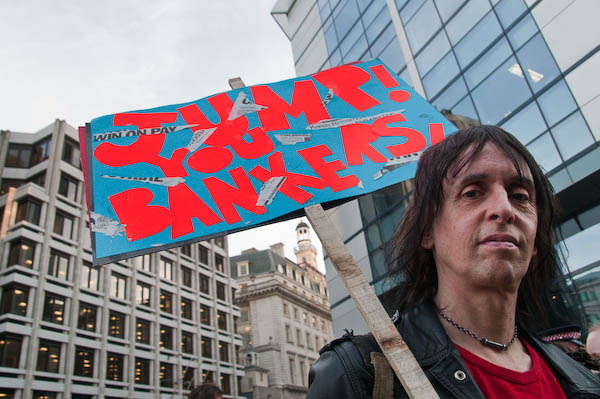
‘Jump You Bankers’

Justice for Deaths in Custody

Rt Click, View image to see larger
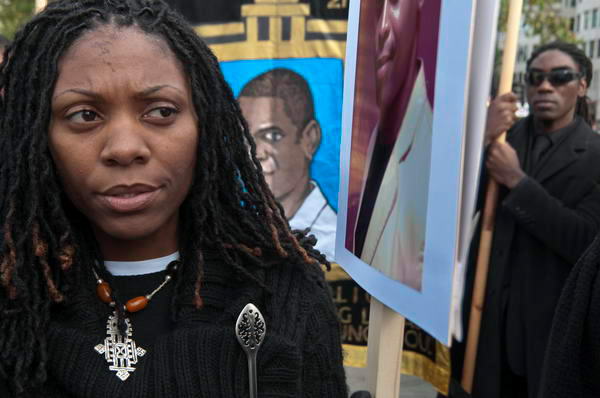
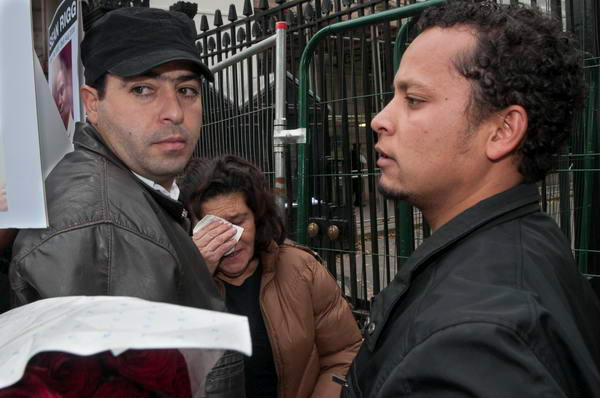
Family and friends call for justice for Sean Rigg, who died in Brixton Police Station this August

Being in police custody or prison should really be the safest possible of situations, but unfortunately as the over 2500 names on the list carried in Saturday’s demonstration by the United Families and Friends of those who have died in custody shows this isn’t the case.  It isn’t even easy to get the figures and the names, and even this long list covering the years since 1969 is far from complete.  Last year there were 182 known deaths – and at that rate the list would be three times as long.

The police, the prisons, secure psychiatric units, immigration detention centres all have a duty of care for the people in them, but it a duty in which they too often fail.  Some of those 182 will be people known to be likely to commit suicide who were not adequately supervised, others those who were restrained in a manner that caused their death.

One of the names on the long list was a young Brazilian man who took a bus to Stockwell station and walked through the barriers and down the escalator. He didn’t know that his perfectly innocent and ordinary movements were being followed by a surveillance team, even though they were very close to him as he entered the station.

While I was writing my post about this year’s United Families and Friends march, I watched the CCTV footage from the station on that morning, showing nothing untoward until about a a minute after he made his way to the platform, when three armed men jumped over the barriers and rushed down.

Someone had blundered, with the result that these men were sent to gun down an innocent man. The Met’s response was to try to cover up in various ways for the mistake, and even at the inquest they are still clearly doing so.  The order that was given was clearly a gross error which should have led to the immediate dismissal and almost certainly criminal charges against the senior officer concerned, but it also highlights a ‘shoot to kill’ policy that I think has no place in a civilised society. It remains to be seen what the inquest will determine.

When Maria Otonia de Menezes came to lay flowers at the gates of Downing St, I was there with others photographing and filming. Earlier, along with other photographers I’d been asked to give the family a little space as they were finding it difficult, and I’d immediately stopped taking pictures and turned away to photograph other things, although some others took no notice of the request. But when it came to the actual pacing of the bouquets and photographs my job was to show the grief and anger of the de Menezes family and others whose sons, brothers, fathers had died to the best of my ability.  At times I found it hard to keep taking pictures, but that after all was what I was there for, and I owed it to these people to do it as well as I could.

Rt Click, View image to see larger

More pictures and text about the demonstration on My London Diary

Guy in Hospital

Not an early Nov 5th story, but a kind of follow-up to my recent post Police attack Photographers where I mentioned that a photographer was attacked by a police dog.

On photographer Marc Vallee’s blog, in the post Guy Smallman in Afghanistan, you can read about another incident in which the same photographer was injured. I’m not quite sure why, but the words that Oscar Wilde put into Lady Bracknell’s mouth about losing parents came into my mind.  Guy certainly has suffered misfortune, but I think it is more a matter of working in dangerous places rather than carelessness.  And being rather cautious, as I tend to be (unkind people might call it timid) is seldom the best way to get good pictures. (You can see more of the Swiss incident in which he was injured on PigBrother.)

Elsewhere on Marc’s blog you can read a lot more about the problems that photographers have with police harassment. On Tuesday he was in the committee room when NUJ Gen Secretary was giving evidence to the Joint Committee on Human Rights and he gives this link to the long video of some of the proceedings. As he says, parts of it make interesting viewing, though there is a lot best fast-forwarded.

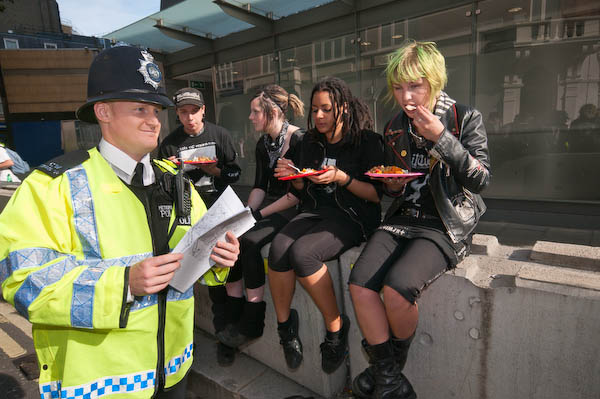
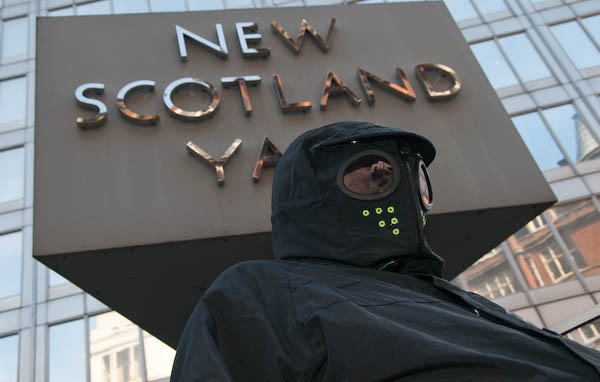
Here in London, the police appear to have been easing off recently, especially over the SOCPA restrictions on demonstration.  On October 11, ‘People in Common‘ and others, including FitWatch, staged a Freedom not fear 2008 event outside New Scotland Yard, although a smiling officer handed out the usual maps and warning, it seemed clear that while reminding people of the law they had no real intention of enforcing it.

Rt Click, View image to see larger in Firefox
A warning that eating in the SOCPA  zone could be an offence

But perhaps the strangest thing about the demonstration was the little person I photographed trapped inside the hood of a large black suit

Rt Click, View image to see larger in Firefox
See the detail view below:
detail

More about that demonstration – and more pictures on My London Diary.

Cheney & Iraqi Oil at Shell UK

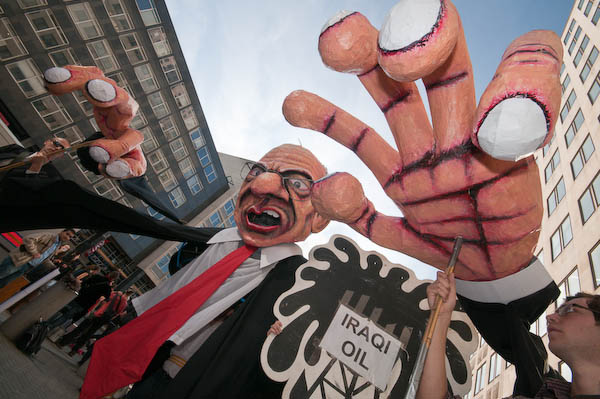
It’s good when someone actually comes up with a visual idea for a demonstration that you can photograph; too often you really get things that would only look good from a helicopter. Actually it’s usually better if people don’t try to be too clever, but give us something a little out of the ordinary in the way of masks or makeup or costumes or props that we can play around with and find a different way to photograph.

Firefox: Rt click and 'View Image' to see it larger
Dick Cheney, Iraqi Oil and the Shell Centre (right)

So although a giant Dick Chaney was a nice idea, and he was very well produced, and we all had some fun photographing him, I have a feeling that every other photographer there will have produced a picture more or less like mine. But perhaps not quite.

100 Days to stop Bush & Cheney’s Iraq Oil Grab! was of course a protest about a very serious issue, basically the pay-off US and UK forces were sent to Iraq to bring home. Forget WMD, Iraq was about another three letters, OIL, and Cheney with his friends at Shell and BP are now getting down to wrapping it up and bringing the swag home.

It’s a simple plan. A nationalised oil industry belonging to the Iraqi people (even if much of the proceeds went into palaces for the president) does nothing for multinational oil companies. So you invade, topple Saddam, put a puppet government in his place and send them your “oil experts” to draft natural resources laws that hand out the oil to your friends. 

I photographed the demonstration outside Shell’s UK Offices in Waterloo, before it set off for the BP offices and then the US Embassy at Grosvenor Square. There is some opposition to the proposed handover in the Iraqi Parliament – and rather more among the Iraqi people. If the give-away goes ahead I think we can forecast further trouble in the Middle East after US forces finally pull out.

Northeastern Pennsylvania – Urban Landscapes

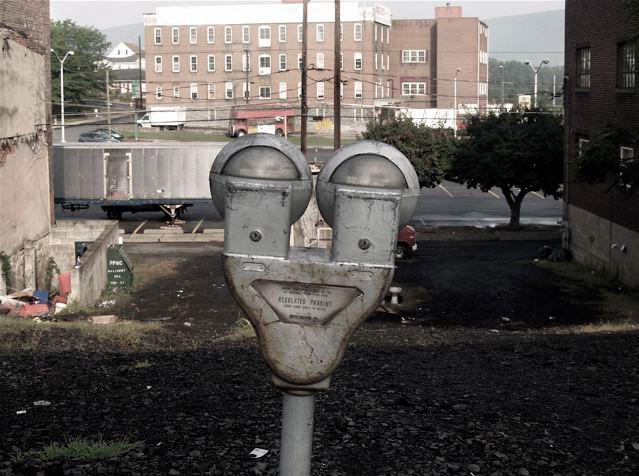
Philip A Dente writes that in his pictures of towns in Northeastern Pennsylvania he tries to “to demonstrate the feeling of a continual loss of the past through the disruptions of the present.”

Rt Click, View image to see larger
Pittston (C) 2008, Philip A Dente

Visually we see this in many images where we see through gaps or past obstructions giving a layering of planes and also in the softish light and muted colours that appeal to him. The pictures are his account of “an exciting journey …. in the context of vision and emotions.”

Philip is the latest photographer to be added to the Urban Landscape web site I run with Mike Seaborne, the full international eleven now being:

John DaviesPhilip A Dente , Lorena EndaraBee Flowers, Nicola Hulett,   Peter Marshall, Paul Anthony Melhado  Neal OshimaPaul RaphaelsonMike Seaborne and Luca Tommasi.

Although I feel it’s a strong team, new players are always welcome, but sometimes it takes us rather a long time to come to a decision.  One key problem is always to decide whether a particular body of work fits our concept of ‘urban landscape‘. It isn’t just a matter of pictures taken of cities or areas of cities -whether pretty or gritty, and there seem to be quite a few groups now on Flickr and elsewhere dedicated to one or other of these.

Nor is it straightforward architectural images. Last year in Brasilia I talked about this distinction – and you can read my thoughts in the excessively literally titled post
Architecture and Urban Landscape photography

You can also of course read  the page from which that post quotes on the urban landscapes site where there are some more picture examples, which also has a page of advice for contributors. As well as showing urban landscape projects we would also be interested in essays related to the area – but do read the advice before contacting us.

Of course as well as appropriateness, quality of work is also important and an even more subjective area, and not one that is easy to write about.  It’s something that perhaps comes across more obviously not in individual images but in a body of work, and is more about the visual thinking that this demonstrates than the technical aspects of making and presenting work or the ability to write a polished academic statement  (indeed many of the better photographers suffer from dyslexia.)

Mike Seaborne and I are the initial selectors of work, but if we have any doubts or are unable to agree, then we seek the advice of whichever of the others with work  already on the site seems most appropriate.

Light on the Lucie

For several years I received an free invitation to attend the annual Lucie Awards, US-based photography awards based on the Oscars and almost as ludicrous and self-congratulatory. I never went, mainly because a Travelcard can’t get you to New York. And as I wrote last year, Who Needs Oscars?

This year the sixth Lucie awards were presented on October 20, with the top award, for Lifetime Achievement going to the Italian photographer Gianni Berengo Gardin.

Gardin, born in 1930, started taking pictures in 1954 and has been awarded most of the major photography prizes, published around 200 books of photographs, had around 200 shows around the world (including at Arles and in Paris, New York…)  He has pictures in museums around the world, his work has been in leading books and shows but is almost totally unknown in the UK.  He’s a photographer very much in the mould of Henri Cartier-Bresson or Willy Ronis, but who remained working in that mode into the 2000s.

Y0u can read more about him at PhotoCentral (more pictures)  and at Photostream there is “half a review” of his 2005 retrospective book and half a discussion of why he is not better known here.