Catherine Cameron

Another Paris  show I didn’t want to miss, also outside of the Mois and the Photo-Off, was by Catherine Cameron. Here Photographies was showing at Galerie Plume on the rue de Monmorency in the 3e, from 10 Oct to 29 Nov, and the gallery was open until 19h. Earlier in the year she also showed work in China, Poland, Argentina and the US.

You can see her work on her web site, but although this has an idea that lifts it above the ordinary, with a nicely designed slide-show in the pages of a book, it doesn’t actually do a very good job of showing her pictures.  The images are just too small, the shadows too blocked and the work has a coarseness out of keeping with the delicacy of her images.  You can see her work shown better at Lensculture but it is still no substitute for the real thing.

There are photographers whose work can look better on screen than as prints, but Cameron’s work is very much linked to the craft of photography. She shoots on medium format film and still makes her prints on photographic paper in the darkroom (though this is not to say that craft skills can not be equally applied when working with digital capture and inkjet printing – and increasingly it is clear that they can.)  Whatever the photographic means, the photographer needs to master them and produce work that leaves you not thinking about the means but entirely caught up in what has been created, and I stood entranced before several of these works.

Catherine comes from Norway, where together with her partner  Øyvind Hjelmen  she arranges photographic workshops on the island of Stord, on the west coast.  Among those who have taught there are Keith Carter (2005), Anders Petersen (2006) and Michael Ackerman (2007/2008). It was good to meet (and photograph) Catherine and Øyvind again at the Lensculture party in Paris earlier in the week.

This was our last visit of the day to a photography show – the end of what had been a very long day, and we needed to find something to eat before we collapsed. There were after all lots of shows to see tomorrow…

Photographies Récentes: Gilles Perrin

This was one show I didn’t want to miss in Paris, even though it wasn’t a part of the Mois or the PHoto-Off,  and like a number of others organised by photographers, its opening hours were fairly restricted, although the bonus of such things is that often this is because the photographers themselves will be invigilating there.

I’d already checked with his partner Nicole that she and Gilles would be present on Friday afternoon, and I knew that Linda would both be interested in the work and the issues it raises and would welcome an opportunity to talk to Gilles about it.

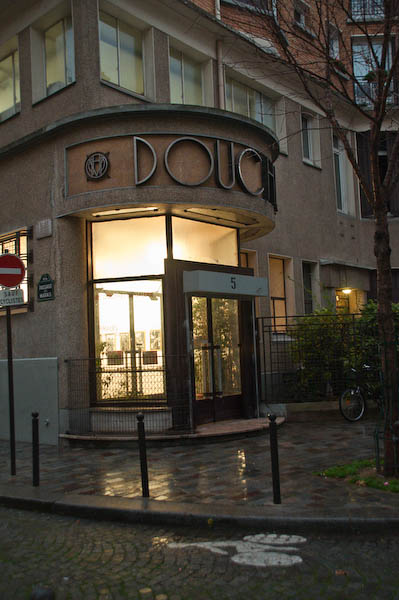
Photographies Récentes was showing from 18 Oct -28 Nov on Fridays and Saturdays in the Batiment des Douches in rue Legouvé in the 10e, close to the canal,  and a short Metro ride and walk from the previous show we  had visited at the Cité des trois fushias. Other than me getting the map up the wrong way and making a short sally in exactly 180 degrees the wrong direction (easily done at night and when street signs are nowhere to be seen) there were no problems in finding the location,  and we walked in to be greeted by Nicole and Gilles.


Le
Batiment des Douches, rue Legouvé

I first met Gilles Perrin and his partner Nicole Ewenczyk when they came to show me work at Rhubarb-Rhubarb in Birmingham and I was very impressed by the quality of Gilles’s large format black and white images and the dignity of those sitting for him. I wrote about his work fairly recently on here on  >Re:Photo and so I won’t say much here. Most of the prints were similar to those I’d seen before, but they had one that was printed as a very large wall hanging, and it really made it come to life dramatically. Nicole says it was printed by one of the best printers in Paris, and it certainly looked great.

We spent some time talking about the work and the people shown in the pictures and their way of life, as well as the logistical and political problems involved in photographing them.  I found it hard to follow the conversation – which was in French – in detail, but most of the things I’d talked about before with them. But at least it gave me time to stand their and enjoy the pleasure of looking at a fine print.

Before we knew it, it was time for the exhibition to close at 18h, and, with a quick look at another show upstairs (which wasn’t my kind of photography at all) we hurried away to view yet another show.

Cité des trois fushias

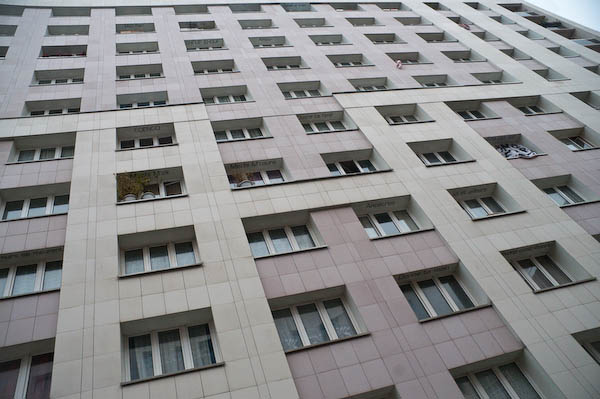
We had to hurry away from the bar Floréal because there were several other things I wanted to see and it was getting late. Our next call was not far away at the Cité des trois fushias, blocks of modern ten-storey flats around a large courtyard.


Cité des trois fushias

The first problem was getting in through the security gate from the street to the courtyard, solved in the normal way of waiting until someone came out! We then wandered around inside, vaguely hoping to see some notice telling us about this Photo-Off event, but these were too small and insignificant for us to see. Finally one of the group concerned, Colectif Tribuydom, who were setting up a film for later, saw us wandering around  and took pity on us. He phoned a friend to get the security code and took us over to the block on the east side of the court and let us in.

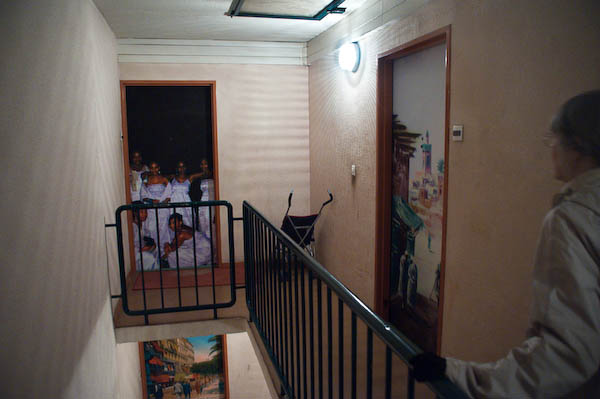
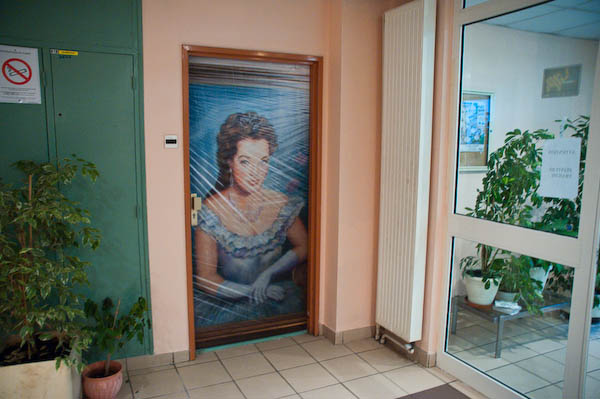
Here we found, in the lobby and on selected doors off the stairway all the way up to the 10th floor were images, largely photographic in some way, meant to relate to the inhabitants, the cite and the quarter.

Slowly we climbed our way up the stairs, stopping to look at the various doors, and to photograph all or most of them in some way. It was a long way to the top of the block, and by the time we got half way we realised it would have been more sensible to take the lift up and walk down!

I’m not sure that it was really worth the effort – and perhaps something that is more for the people who live there than outsiders – but it was certainly one of the more unusual experiences of the Photo-Off, and a reminder of what a broad church photography is. I’ll put a few more pictures from the show in the Paris supplement to My London Diary shortly

North Circular Views: Benoît Grimbert & Me

Benoît Grimbert
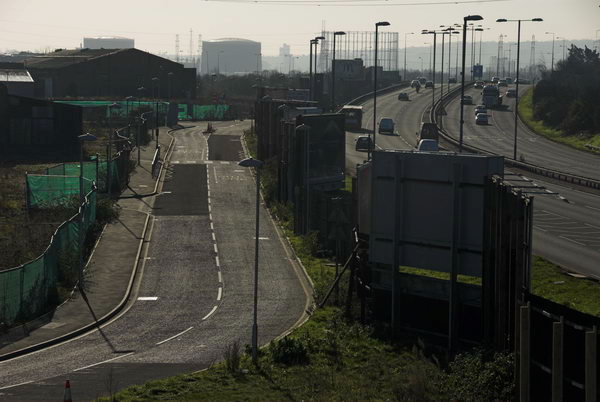
A406 North Circular Road
École nationale supérieure d’architecture de Paris Malaquais
1 rue Jacques Callot, Paris
Nov 10 – Nov 29, 2008

A couple of hundred yards down a road on the Left Bank, lined with galleries and antique shops, we came to the North Circular Road.

Not of course the actual North Circular, which runs from Kew Bridge to the Woolwich Ferry through suburban London, but a Mois de la Photo show by Benoît Grimbert at l‘Ecole Nationale Supérieure d’Architecture Paris-Malaquais.

You can see a slightly extended version of the 20 pictures on show there on his  web site.

Benoit Grimbert (b1969) lives in Paris but travelled to London on several occasions to take a series of pictures along the length of the A406 North Circular Road. Unlike London’s South Circular which is almost entirely conceptual, the North Circular has a physical existence – and I’ve walked along most of its accessible parts (there are some elevated motorway style sections where I think pedestrians are not encouraged and possibly prohibited.)

So I was not just looking at a show of photographs, but a set of photographs of something I also know from my own photographs, several of which could be cropped to give virtually identical views.

If I went back to take pictures of the A406, I would work with a panoramic camera (and I have taken some pictures of it with one) as more suited to the idea of flow of traffic.  Grimbert works to a square format and seems to be very much a man wedded to his tripod and spirit levelt, all restrictions that I think oppose the central concept of the work being about movement, traffic and flow. It ends up being very much a static view, one that concerns itself largely with the structures of various types which surround the road rather than the road itself or the kind of concepts which, according the text, it is concerned with.

The mismatch between technique and concept doesn’t in one sense particularly concern me. This is after all a show of photographs and it isn’t unusual (certainly in these days) for perfectly good pictures to be accompanied by a completely irrelevant sheet of academic jargon. But here I think the work was sometimes  indecisively trapped between the visual and the conceptual (and the text from the show would certainly be a candidate for Pseuds Corner, except that I think that would be a concept the French may be unable to appreciate.)

Perhaps the problem I have with his work is that I know the North Circular. The following day I came across some of his pictures of Normandy – which you can also see on his web site –  in a projection at the École nationale supérieure d’architecture de Paris La Villette. I found those more interesting than the A406, but perhaps if I was from Normandy I would have my reservations?

Actually I think not. I’ve cycled around Normandy and do know it at least slightly – and the same is true of another of the projects on his web site, Lisieux. Here the work is essentially about structures and their relationships to each other and his chosen techniques fit well with the subject and Grimbert’s intentions.

Grimbert presumably works with a medium format camera using 120 film  and the prints are clear and detailed, though not especially so. (He claims that his colour prints are “tirage manuels argentiques” but there was no sign of the lack of bleach-fixing that this appears to suggest – perhaps the French doesn’t mean what it appears to – these seemed to me to be perfectly normal colour coupler prints.)


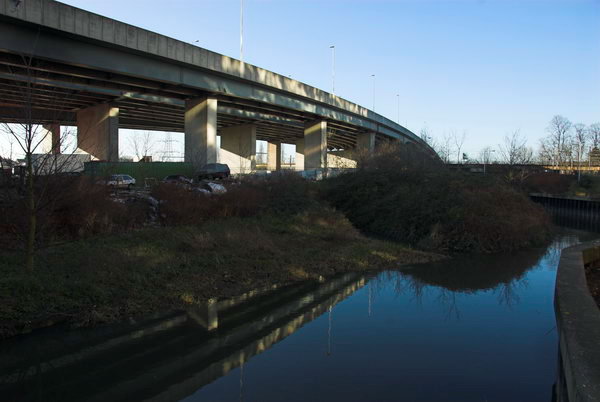
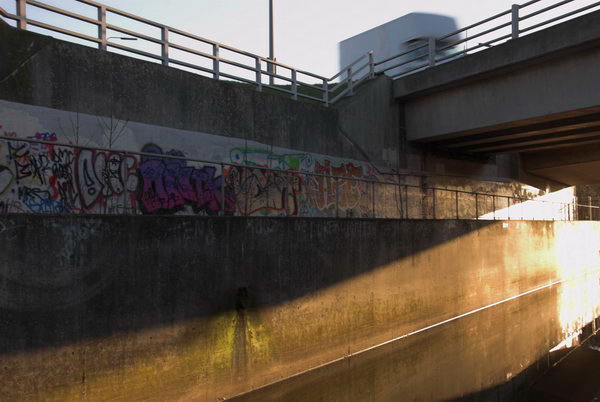
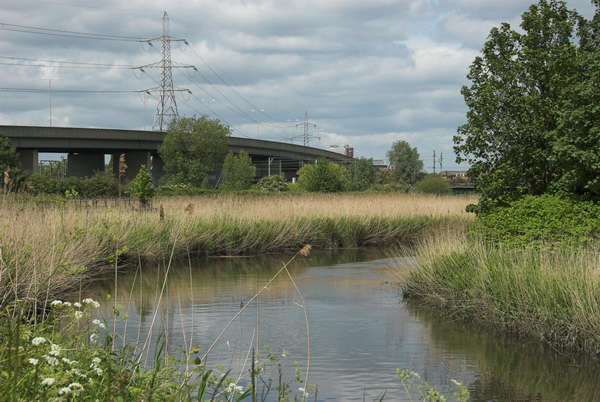
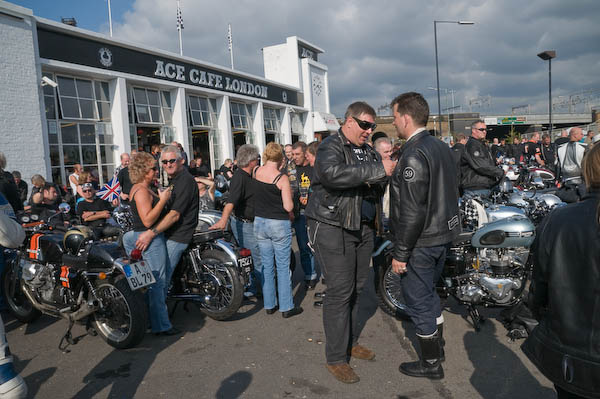
Peter Marshall Here are a few assorted digital images I’ve taken in the past couple of years on the North Circular – taken as parts of different projects. One day I’ll get around to developing and scanning the panoramic images that I also made on some of these visits!


Late evening in winter at Ilford.
There is a picture by Grimbert from almost exactly this point, but in rather different lighting.

(C) 2008, Peter Marshall
River Roding and North Circular,  Redbridge

(C) 2008, Peter Marshall
River Roding and North Circular, Barking

(C) 2008, Peter Marshall
Ace Cafe, the most famous site on the old North Circular, Stonebridge Park

(C) 2008, Peter Marshall
North Circular at Barking, looking South

Hitler at the 1948 London Olympics. And Jesus

Just a couple of the photo requests that even Getty Images couldn’t supply from its huge archive. The film Photograph Of Jesus by Laurie Hill, made in association with the Getty Images ‘Short & Sweet Film Challenge’ , on YouTube includes some other fine examples of requests made by picture researchers and also shows you the inside of the seriously large archive.  And it does also supply those impossible images…

Belgian Architectural Photography in Paris

L’alibi documentaire, on show at the Centre Wallonie-Bruxelles opposite the Pompidou Centre in Paris until Feb 1, 2009 is a show of Belgian architectural photography and related imagery.  It has three strands, the first showing vintage architectural work, the second contemporary architectural photography and the third ‘photographic’ imagery of imaginary buildings.

Architecture is of course an area where the ability to create images of buildings that do not exist has long been important. Every project proposal needs its artists representations of how it will look, and now these are more readily (and believably) produced using computer-generated methods, which can mimic photographs to the last pixel. At least some of the images in this section of the show are more genuinely photographic, produced by merging photographic images using Photoshop or similar software, and produced solely as art.

Early work is represented by Edmond Fierlants (1819-1869), an apprentice in Paris to the pioneering Hippolyte Bayard and one of the founders of the Société française de photographie in 1854. He returned to his native Belgium in 1858, and was commissioned by the state to photograph architecture in Anvers (better known to us as Antwerp), Brussels and Louvain (Leuven.) For the last two years of his life he devoted himself to portraiture in his Brussels studio.

Of more interest to me was the work from the modernist period, particularly that of Willy Kessels (1898-1974) one of the great architectural photographers of the 1930s. The show was certainly worth a visit just to see his work. Other photographers from the 20th century were Marcel Lefrancq (1916-1974) and Gilbert de Keyser (1925-2001) whose architectural details are also interesting.


Willy Kessels: Houses. Photomontage for the Book ‘atmosphere Brussels’, 1932
Credit: Museum of Photography in Charleroi, Inv. MPC 97/83

Although the contemporary architectural photography was uniformly of a high standard, I found little to particularly inspire me. Perhaps the most interesting piece was a grid of 35 images by Marie-Francoise Plissart showing the successive stages of demolition of the Tour Martini in 2001.  Gilbert Fastenaekens‘s side walls of buildings were too bland even for my taste, and the images of Marc Wendelski too severely geometrical to really appeal – I longed to have some lines at odd angles to relieve the horizontal and vertical. I quite liked the dusk images of internally lit building by Marie-Noëlle Dailly, which had a strange lighting quality which made them seem rather less real than some of the fictive images in the third section of work.


Marie-Noëlle Dailly

The final section of invented images included some pictures that seemed more real than the actual architectural photography, but quite a few of them left me wondering why anyone had bothered to produce them. For me the work of Simon Boudvin (click on the minute artists name at top left, then select ‘already made‘) and Filip Dujardin stood out in this section, both for the actual quality of the work and the wit their work embodies. I also enjoyed the ‘Villa Malaparte’ by Martin Vierin, but this needs to be seen projected – a pity it isn’t on YouTube!.

Photographers in Uniform?

Photojournalists in the USA, covering news on “federal highways” are now covered by a law that requires them – along with anyone else working on the highways – to wear high visibility ANSI 107-2004 class II vests. The US National Newspaper Association sells suitable items with the word PRESS on the back in large letters for $15.

Now well I wouldn’t want to go that far when covering most events, since our police in the UK seem unable to distinguish between press photographers and demonstrators, perhaps we should make their job easier? Although, given that the Met Forward Intelligence Teams (FIT) have taken certainly hundreds if not thousands of pictures of me over the past few years I would have thought they should recognise me by now.

At more sensitive events I often work with a press card clearly visible, alhtough I don’t like to do so, because most of what I do – even there – falls within what should be part of the freedom of expression available to all citizens. I worked for years without a card when most of my income came from teaching, and if for some reason I was no longer eligible for a card it wouldn’t stop me working now – although it would make a few things impossible and would increase my chances of arrest.

Legislation in recent years has meant there is no such thing as an “innocent bystander“. If you are in a particular area and have been issued a SOCPA warning to leave and stay you are guilty of an offence, even if you take no active part in what is happening. I’ve objected and shown my press card when given such orders only to be told by police it makes no difference, but I think they are simply wrong. If I didn’t have a card I would be considerably more likely to leave rather than continue to take pictures.

Usually I carry my card in a holder inside a trouser pocket, in a holder on a cord around my belt, making it very simple to find when I need to show it and attaching it securely to my person (long ago I handed a card to a police officer and never saw it again.) In Summer I often wear a holder that fits on my belt that I can drop the card into – still in its holder – to wear it visibly, but easily take it out for people to look at.

But in colder weather I wear a jacket on top of the belt, and the only way I’ve found to carry the card visibly is in a holder that goes round my neck. Often I have at least one camera around there too, and things can get tangled, which is a nuisance. Cords around the neck also can be used to strangle, which can be a danger in tense situations. So usually the card stays in my pocket on its cord. I’m sure there must be a better solution to make it securely visible.

Not that having a press card is always of much help. At various events police refuse to treat journalists any different from demonstrators, and at times I’ve been told that the UK Press Card I have (a police approved scheme) “isn’t a real press card.”

Of course, the US item, published at the end of last month, reminded me of this year’s great April Fool hoax on EPUK, which provided a great solution for some of these problems – and fooled many – including a Guardian writer!

Zombies in Ramillies Street

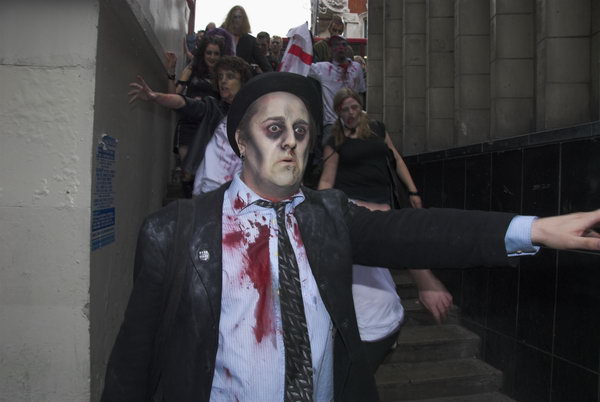
Ghouls, zombies and the undead staggered and lunged along Ramillies Street on my previous visit, sprawling on the roadway of this small street down a short flight of steps from Oxford Street, often referred to – as Photographers’ Gallery director Brett Rogers informed us – as “Piss Alley.”


Coming down the steps into Ramillies St

But that was Halloween a couple for years ago, and tonight things in the pristine white space of the temporary home of England’s “flagship photography gallery” were a little quieter, although I was perhaps more apprehensive.


Brett Rogers welcomes us to the gallery

Rogers welcomed us to the new space –  opposite the former home of Keith Johnson Photographic, and like its predecessor on the edges of Soho, but this time at its north rather than east – and waxed enthusiastic about the possibilities it presented for a new building to replace the current temporary conversion. Dublin based architects  O’Donnell +  Tuomey then told us about their early years in London and their plans for a new building, constrained by the small footprint of the site, rising vertically around a lift and stairway, organically (or at least metaphorically) like the branches from the trunk of a mighty oak. (You can read more here – and see a computer graphic view of the new building by clicking on the thumbnail.)


John Tuomey talks about the building as Sheila O’Donnell looks on.

Their presentation was excellent, but I found the futures suggested for the gallery outlined by Rogers rather more chilling, and my doubts were heightened by the work that had been selected for the inaugural showings in this new space.

Like many of those I talked to, I felt that this was a real occasion that should have celebrated English (or British) photography, but it was one that was sadly missed.

I’m old enough to remember Picture Post and its place in lifting the spirits in an age of austerity and rationing, even though in my childhood my family were too poor to buy it. We saw copies at neighbours and friends, read it waiting for a haircut at the barbers, and sometimes people passed on issues when they had read them. Later of course I saw many of its best pictures republished in books, and got to know the work of many of its better photographers, writing features about several of them, including Thurston Hopkins, Grace Robertson, Bert Hardy and Bill Brandt.

It takes great curatorial expertise to mine this rich resource and produce such as turgid, mind-numbing show as was presented on the ground floor of the gallery. All photographers of course have their off-days but on this evidence Picture Post photographers spent most of them – or at least their off-nights – in Soho. But from the evidence we see here it would be difficult to regard Hopkins or Slim Hewitt as anything more than reasonably competent hacks.  And Tim Gidal and Kurt Hutton fare little if any better, and we can see that Ken Russell was well-advised to turn to making films.

As the major show for this major British event I would have hoped for a major show by a well-known British (or British-based) photographer – perhaps one of that long list neglected by the gallery over the years (and there were at least half a dozen of them present at the opening) or one of the great historical figures in photography in this country – such as Bill Brandt or Raymond Moore.

Instead we got Katy Grannan, a USAmerican photographer bron in 1969 who studied with Gregory Crewdson, Philip-Lorca diCorcia and Tod Papageorge at Yale (one of the more disappointing highlights mentioned by Rogers was the Deutsche Börse Photography Prize 2009, where Papageorge is a contender with his rather bland images of Central Park, shown at Michael Hoppen  in Chelsea earlier this year – but I couldn’t bring myself to review it, as the most interesing thing was that one image was shown upside down – though Taryn Simon is also on the short list for her Photographers’ Gallery Show – one of their best in recent years, but it is hardly a heavyweight list) graduating with an MFA in 1999.

Grannan had her first gallery shows in 1998, and in 2004 she showed work at Arles, exhibited in the Whitney Biennial and won the 2004 Baum Fellowship Award for Emerging American Photographers. In 2005 she got an Aperture award for emerging photographers, and theypublished her ‘Model Americans.

Grannan is a photographer whose work I’ve previously written about appreciatively in the past, but I think this show, “The Westerns” does little to enhance her reputation. Large images, empty in every sense, at times vapid, with a few little digs in various directions including an unbelievably bad Edward Weston pastiche. You can read an interesting interview on her earlier work at The Guardian by Melissa Denes.

In that earlier work, published in Model Americans in 2005, she photographed people in their homes and other locations,  she worked mainly with strangers (starting to advertise for models in local papers in 1998), coming together for the short time needed for her to arrange them (and sometimes the surroundings) as a stage set on which to photograhp them with her 4×5 camera.   The Westerns is the result of a more lengthy collaboration with three people, including two middle-aged transsexuals, and I don’t feel she has managed to sustain the same level of interest and creativity.  It might even have been a more interesting work had the three people concerned been more conventional in their life-styles; their somewhat exotic nature makes for too easy a cliche.

Grannan is a photographer for whom size matters, and most of these prints seem to me to be oversize. Her work often appeals far more strongly to me on the web or magazine page than as these large wall prints.

Of course there were a good things on show – including Vanessa Winship’s charming portraits (one of the few stars of this year’s Arles, her pictures are also on show in the Royal Festival Hall as a part of the 2008 World Press Photo.) And on the top floor in the Print Sales area, Picture Post came to the rescue with Bert Hardy‘s delightful evocation of a British summer in his Box Brownie view of two young women perched on the promenade rail at Blackpool. It was an image that stood out glowing from what largely seemed to be an ocean of fashionable mediocrity.

I’d gone to the event in an optimistic mood; I’d thought that perhaps the move to a new building represented the possibility for a new start, a new emphasis on photography. Unfortunately the auguries seem bad, and despite the new premises, the gallery seems destined to remain mired in the same old rut.


At the opening – not much depth of field on the 35mm at  f1.4!

As someone who has been a member for around 30 years I find it deeply disappointing that if you want to see photography and a vibrant photographic culture you need to look elsewhere, whether to smaller London galleries such as HOST or by taking a trip to Paris.  (see Paris and London: MEP & PG)

Jacques Vauclair

Jacques Vauclair (1926-99) started working in photography at Studio Harcourt in 1946. Set up to meet the needs of the press in 1934, the studio had developed into a leading portrait studio with a fairly distinctive film-style lighting and posing.  It’s “trademark style” continues in use to the present day by the studio, still offering its services.  To me it recalls the worst of Hollywood photography of the era in which it is founded.

You can find the site easily on Google, by typing in ‘Studio Harcourt’. As well as some pictures it contains one of the most restrictive ‘Legal Notices’ I’ve seen on the web which probably means I’m not even allowed to tell you about it or hint at its existence and certainly can’t link to it. Google are big enough to ignore such things – as they do.

Like much film lighting of the period, it was done to make people look as if they were in a film, very much in the spotlight.  To my eyes, used to a more realist approach it seems impossibly stagey and false, incredibly dated.  Light should generally be sympathetic and help to describe the subject, not overpower it, and certainly not to the extent that the actual subject becomes almost immaterial.

Vauclair, to his credit, didn’t quite seem to fit Harcourt, though it was ten years before he left to set up Studio Vauclair, next to the famous Olympia concert hall. For the next five years or so he was the photographer to be photographed by in Paris, particularly for actors, actresses, singers (even then they didn’t call female singers singesses) and the young unknowns who became a part of the French ‘New Wave’ cinema.

Although many of the stars he photographed may be better known in France, even I’ve head of some of them, including figures such as Charles Trenet, Charles Aznavour,  Jacques Brel and Georges Brassens, Jean Marais, Catherine Deneuve and Jean-Pierre Léaud.

Looking through the large cellar gallery of  Le Centre IRIS, its walls covered with images – or the book that accompanies the show – its hard not to be impressed by the sheer volume. There are some interesting portraits, particularly of the singers, but too many are let down by either the lighting of the printing I think many were modern prints from his negatives) or both.  Frankly there were quite a few images on show that had a student brought them out of the darkroom to show me I would have made a few suggestions and sent them back to try and do better. But then perhaps I don’t understand his version of that trademark style.

For Vauclair, the time was the most beautiful years of his life, and it was his luck to mix with the greatest artists of this unique era.  It gave him great professional and personal satisfaction. But eventually gave up professional photography to pursue a second very successful career as a songwriter. His work in this show is valuable as a fine record of the period and milieu in which he worked and the way he lit and took pictures is also very much of its time.   But I do hope there are no photographers out there today who think it a style worth emulation.

Street Pictures and Lin Delpierre

Increasingly in England it is getting more problematic to take photographs on the street, with increasing suspicion from both police and public. And of course the police advertising campaign suggesting anyone with a camera was a terrorist suspect and should be reported to them didn’t help any.

Our right in the UK to take photographs in public places has recently been affirmed again by the government. But at the same time they also seem to be one of the parties busily eroding it, with new legislation, and guidance to the police. Judges (and one judge in particular) seem also to have recently tipped the balance in favouring rights to privacy (at least of celebrities) in public places over the rights of photographers and the public at large.

Our right to photograph is also diminished by the increasing privatisation of public spaces. More and more areas of cities to which the public have access are becoming privately owned. Quite large areas of the City of London which appear to most users as public streets which now actually private property, and so too are vast areas such as Canary Wharf. Many of London’s parks are also in private hands – of the Crown. Although you may often get away with taking pictures, you can also, as I’ve found on several occasions, be stopped from doing so.

Even some areas remaining in public hands, such as Trafalgar Square, are covered by by-laws which restrict photography, and although their intention was usually to get commercial photographers to pay for their use of locations, other photographers are at times stopped.

In France, the law relating to photographing people in public seems to be fairly similar to that in the UK. If you can read French, the FreeLens site is a  useful source of information on the various laws that restrict the activities of photojournalists in France – and they also produce a useful booklet you can download,   “Photographe Presse Mode D’Emploi“, essential reading for freelances (pigistes) working there.

This makes clear that people have no rights to their image under the code of Civil Law, but they do have a right of privacy, which has been the subject of interpretation by the courts. As in the UK, in general you can publish pictures of people in public in the press without needing their permission. However it is important to treat the subject suitably and to caption pictures accurately.

Similar rules apply to property that is on public view – so long as it does not amount to a breach of privacy, pictures can be published without the need for authorisation.  However for commercial use, if people or property are an important part of an image, you may have a problem, although it would be necessary for those wishing to make a claim against you to establish an actual cause for complaint.

A difference from the law – if not practice – in the UK is that journalists may photograph freely in the Metro and at railway stations, although videoing or filming needs permission.

French law also forbids publishing recognisable pictures of police doing their duty, except during demonstrations. One of the latest UK laws, the Counter-Terrorism Act, 2008 which received royal assent recently means that photographing a police officer here might also result in a lengthy jail sentence.

The position of artists is perhaps less clear than that of journalists. Certainly in the past there has been considerably more important placed on the rights of individuals over their appearance in France than in the UK or USA.

Which brings me (at last!) on to the the work of Lin Delpierre (b 1962) on show in rue Quincampoix in Paris at the Galerie Cour Carree in November.

Passantes‘ shows women walking by the photographer on the streets (the web site has series showing women from Bombay, Buenos Aires and Peking taken on medium format as well as groups of men on the street in Calcutta taken with 5×4  and other work.) As the text makes clear, Delpierre has travelled the world to photograph women in cities, including Rome, Moscow and Barcelona – as well as Paris.

The pictures are taken without permission and apparently often without the knowledge of the women involved, although some seem to be reacting to the presence of the photographer – either by staring or looking away.

Taken with a square format camera, Delpierre normally frames the figures fairly centrally, from perhaps 5 feet ot sometimes a little further away, working perhaps from waist level or slightly higher and seldom if ever showing them below knee level – but with quite a bit a space in the image above their heads. Mostly the subjects are young, and mostly they are at least fairly attractive.

I was in part reminded of Gary Winogrand’s most controversial book ‘Women Are Beautiful‘, although Delpierre’s work doesn’t show the same preoccupation – most of his subjects lack the sexuality that attracted Winogrand, so obviously in the grip of a mammary obsession.

The medium format also cuts down depth of field, and in some images this amounts to almost a dislocation of the subject from background, almost a cardboard cut-out effect,  exaggerated on the web site by over-sharpening. At times he seems to catch women as they step into pools of light, and while on the web this gives the appearance of added flash, the lighting on the works on show appeared more natural.

One report I read about the show suggested that Delpierre’s work  was original in that he worked at a close distance. Hardly so, since many street photographers have prowled for ages with their lenses pre-focussed at a similar distance – including me. Some of us have often mixed black and white with colour also, as he does in his triptychs.

I have to admit to liking Winogrand’s work, although (or because?) it sometimes makes me feel as if I am standing on the street and giving a wolf-whistle at the girls who go by. Not that this was ever the kind of behaviour I indulged in (though I had friends who did.) His pictures have a directness and an openness whereas in fornt of some of Delpierre’s I feel more of a voyeur. This perhaps reflects a different sensibility between the French and English.

I asked if the photographer thought photographing on the street in this way had any problems, and the answer was that there were none – it was a way of working that had a long pedigree in photography and there were no legal or moral issues involved.

To an extent I agree. These are people in public, and their actions are visible to any of us who share their space. Showing them in a photograph doesn’t really alter things, but the act of taking the photograph may. Many women may well feel they are being harassed by the photographer – and were they to see their photograph being exhibited might well feel aggrieved.

I would have been happier if I could have seen a real reason – perhaps documentary – for these images on the street. They reminded me a little of a fascinating series of men and women walking along Sutton High Street around 1930, published in Photographers’ London 1839-45. Nothing seems to be known about the photographer or his reason for making the images, but they are now a fascinating record of their times.

Delpierre’s women, particularly in their clothing, do indicated geographical differences (and the season and weather) but although they were technically fine, I wasn’t too sure I was really able to see the same kind of interest in them, and I don’t think it was the photographer’s intention. But perhaps in 75 years time they too will look different.