Emma Livingston in PDN’s top 30

I’ve often dissed the annual PDN top 30 as being geographically restricted – a very New York view of photography – although they do get nominations from people outside the city boundary, even from outside the USA,  of photographers from around the world.  Their 30, selected from 300 nominations is bound to include a number of the most promising photographers around, and has turned up some great names in past years, along with some others who have deservedly never been heard of since.

This year only about half of the photographers were born in the US, although quite a few of the others now live and work there.  None of them was born in the UK, and I think the only British photographer is Emma Livingston, who I met in Paris last year – she was born there but currently lives in Argentina. She  was working in a London gallery in 2003  when she decided to concentrate on photography.

You can see this year’s choice of “New and Emerging Photographes to Watch”  here, and it’s worth wading through, looking at the portfolios, interviews and also photographers web sites. I’ll perhaps write more on some of them later.

Leica: A Small advance Advance for the M8

It’s good to know that Leica can sometimes change their mind and listen to customers, rather than keep on telling us that they know best. One of many complaints Leica M8 users have had is about shutter noise – and the M series was once legendary for its quietness. Many of us who sometimes like to work discretely were distinctly disappointed by the M8, which has a shutter that is intrusive in anything other than pretty noisy areas – and usually noticeable in street photography.

There was an expensive shutter upgrade to the M8-2 shutter on offer; it is a little quieter, but the depressed state of both my finances and the pound made the expense a step too far. You can listen to both the shutter sounds on the Leica site and decide if it really would have been worth the small fortune demanded

Another new feature of the M8-2 was the ability to separate the shutter firing from the re-cocking,  a ‘discreet’ mode that delayed the re-cocking while the shutter release was held down.  Leica decided not to make this available for M8 users, presumably hoping we would rush out and buy the M8-2! But instead users just went on complaining and eventually Leica have relented and made this facility available in updated firmware, available for download from today. It’s a small and very welcome step.

This still leaves one major and I think unnecessary inconvenience in using the camera for many of us (I could probably put up with what appears to be less accurate framing than the film models.) Leica’s range of wide-angle lenses, while excellent, are extremely expensive. Like many Leica users I’ve made extensive use of Voigtlander lenses, made by Cosina, which in some cases are around a tenth of the price and most of which give excellent results.

The M8 (and M8-2) has an inbuilt problem with its IR sensitivity due to the decision to use a very thin IR blocking filter. I first came across this photographing Muslim women in black burkhas and finding they came out in different shades of brown and purple. I wasn’t amused and it took hours of work in Photoshop to produce a usable file.

Leica – rather late in the day – admitted the problem and came out with a solution, supplying IR/UV blocking filters for the front of the lenses, but while this solved the colour issue, it introduced a new problem. Light from the corners of the frame goes through the filter more obliquely, thus taking a longer path through the filter and resulting in what they correctly describe as “annoying colour casts in the frame corners.” It is only noticeable when using lenses of 35mm (a standard lens on these 1.3x cameras) and below, and increases as you go to lower focal lengths.

Again Leica had its solution, detecting the focal length from coded dots on the back of the lens and allowing you to automatically apply a firmware correction in camera as the pictures are taken. Apparently it works fine with Leica coded lenses but leaves users of older non-coded Leica lenses and non-Leica lenses out in the cold. Leica will – at a price – add coding to some Leica lenses.

Those of us with lenses without coding can find independent engineers who will add coded read rings to some lenses or can try the do-it-yourself solution with a ‘Sharpie’ felt tip pen (tricky to do and although it can work, it soon wears off.)

More successful is removing the colour cast with the excellent and free Cornerfix software (for Mac and PC – the latest version 1.0.0.0 was updated January 5, 2009.) It works well, but it does add another level of processing and if you take more than a few images adds a level of time and hassle to your workflow you could do without.

While it would not be reasonable to expect Leica to come up with solutions for every lens you could possibly put on the camera, it would be a very usable solution if they allowed you to manually select from the Leica lenses covered by their coding (and thus by the firmware) so the camera would then apply a reasonably close correction.

Instead they simply recommend using coded lenses. A set that covers the same focal lengths and apertures as my existing Leica, Minolta and Voigtlander wide angles would – at current street prices – set me back around £8000.

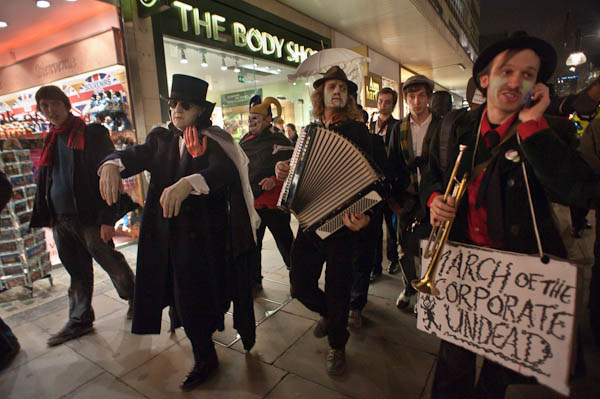
Full-frame and the March of the Corporate Undead

I still don’t believe that in the longer term we need 36s24mm sensors and the rather large and clunky DSLRs that these entail, but for the moment at least, cameras like the Nikon D700 do offer considerable advantages when working in low light, and I had a good opportunity to exploit this on Tuesday.

© 2009 Peter Marshall.
The Body Shop, Oxford St

It isn’t hard to take pictures at night with digital cameras, but available light action shots such as this, even lit by the relatively bright lights of Oxford St are beyond DX format cameras such as the Nikon D2oo – on which I was also shooting, but with flash.

Interestingly, my tiny Panasonic camcorder, with its minuscule sensor, also did pretty well under these light conditions.  Of course the image format is smaller, but it does make me wonder whether we are getting as much as we should from DSLRs.

I liked the idea of the troupe of zombies staggering past ‘The Body Shop‘ in their March of the Corporate Undead, but without half a dozen flash heads and a team of assistants, there just wasn’t enough light to get a usable result with the D200.  Above ISO1600 it really struggles.  This picture was taken at ISO 2000, 1/80 f3.5 and would have been a little better if I’d used ISO 3200 and stopped down for a little more depth of field, as the lettering and figure at the extreme right is just slightly out of focus.

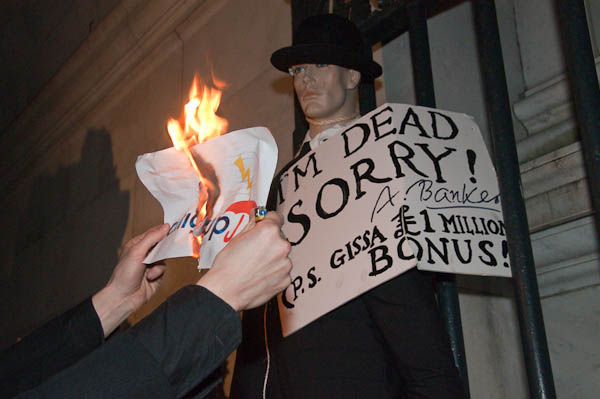
Some of the action, particularly the hanging of the dead banker at Tyburn (Marble Arch) was a little too dark even for ISO 3200 and flash became essential. When  one of the protesters set fire to sheet of paper and threatened to burn the dead bankerI was a little worried the flash might blot out the flames, but the results were fine.

© 2009 Peter Marshall.

Although I put in the stuff about speeds and apertures, most of the time when working I simply leave it to the camera and flash, which have all these automatic things that generally handle the technical stuff better than me. Of course you do sometimes have to give them a hand, often by dialling in a little exposure compensation, or altering the shutter speed or aperture and letting the camera’s smart program setting make the necessary compensation.

One thing I find handy at times when I shooting – particularly at the start of each event – is to take an exposure reading from a typical subject and then make appropriate settings for the camera’s manual, shutter priority and aperture priority modes.  It helps if you do decide you need to switch to manual not to have to spend 20 seconds twidding the shutter speed dial from when you last used it for a long time exposure. It helps even more when (as I often do) you press the wrong button and change mode when you meant to dial in a little exposure compensation.

This pancake day event got a little publicity – even in the Evening Standard, and some fairly silly comments by one blogger about it possibly scaring children. Who would get my vote for twit of the week, if there hadn’t been an even greater idiot at the event who kept on standing in front of photographers and getting in the picture. And yes, of course, he was holding a compact camera.

London 2012 & Rose-Red Empire

 London 2012


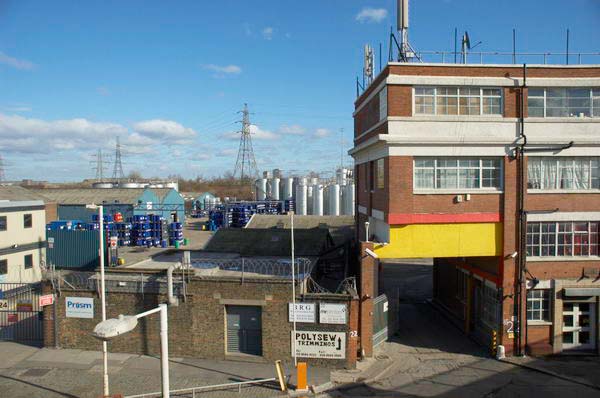
In 2005, this was the view from the Greenway where it crossed over Marshgate Lane; now it looks like this:

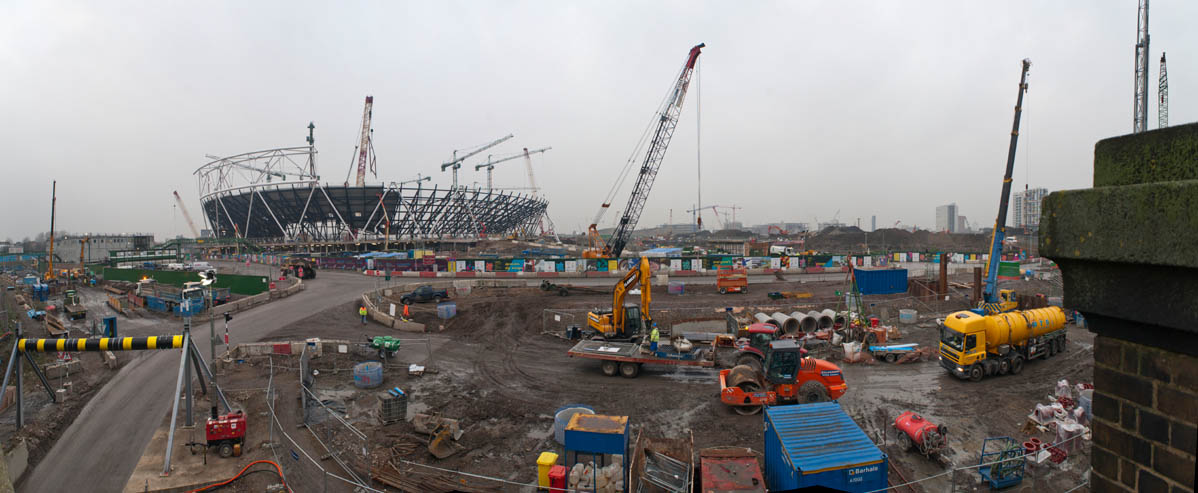
with the Olympic stadium taking shape amid a complete re-creation of the landscape. You can see many more of my pictures of the area covered and surrounding the Olympic site from the 1980s to 2005 on my Lea Valley site,  and more current work in My London Diary, for which I try to add a roughly monthly progress report.

I’ve photographed various panoramas around the area over the years, working with several swing lens cameras (and the relatively cheap Ukrainian Horizon 202 is probably my favourite – when the first one wore out after around 10 years I immediately ordered another) and later also with the considerably more expensive Hassleblad XPan equipped with a 30mm lens. This gave close to the maximum angle of view that makes sense as a rectilinear perspective – any wider and the edge-stretching becomes silly.  Swing lens cameras get over this problem, but their cylindrical projection adds another of its own that makes them tricky to work with, giving curvature in all non-vertical lines except for that along the exact centre of the image(where usually you try to place the horizon.)

Now I most often use a normal DSLR, taking several exposures and joining them with PTGui, which allows a choice of projections, including rectilinear and cylindrical but also others. The latest version (8.1.2)  has added more possiblities, including ‘Vedutismo‘ which I used for the above panorama (see a larger version)  which keeps all lines that pass through the centre of the image straight.  There is also a modified version of the cylindrical projection, ‘Mercator’, (added in version 7.0) which is also of interest.

You can see February’s London 2012 site pictures here.

Rose-Red Empire

On Saturday I went to see the show ‘Rose-Red Empire‘ at Danielle Arnaud contemporary art in Kennington, which accompanied the launch of Iain Sinclair’s latest book on Hackney (it continues until 15 March – see website.) Show and book include material on the impact of the Olympics on Hackney,  and a film by Emily Richardson brought back memories of the Manor Gardens Allotments as well as the Bow Back Rivers.  The show does include some photographic work, as well as paintings and other media, but the photography in general disappointed. Perhaps the best was in ‘The Book of the Brook’  by Iain Sinclair, produced as a unique single copy with his own photos tipped in, along with other material, simple honest and un-pretentious records of his observations on walks around the largely hidden parth of Hackney Brook.

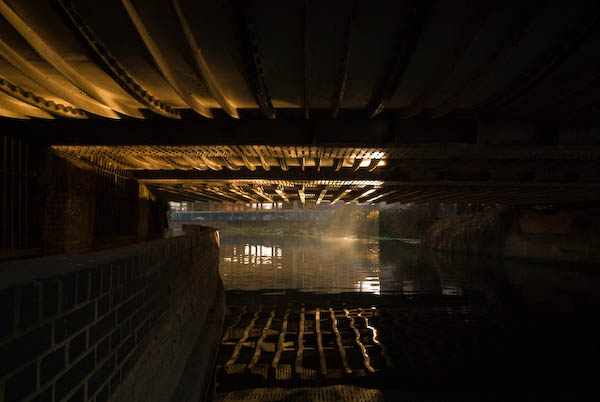
Here’s a picture that I think Sinclair might appreciate:

© 2007 Peter Marshall
Northern Outfall Sewer and Lea Navigation
.

and I made it without a kayak.

Worshipful Company of Poulters Pancake Race

It’s a shame that the Pancake Race is unlikely to feature in the London 2012 Olympics, because it’s perhaps the one sport in which Britain still leads the world, and we seem to have plenty of talent in training. I had decided to give pancakes a little of a rest this year (and I’ve never been a great fan of eating the things) but couldn’t resist a couple of pancake-related events, the first of which was the Shrove Tuesday Pancake Race organised by the Worshipful Company of Poulters, and held – with the permission of the Chief Commoner, in the Guildhall Yard.

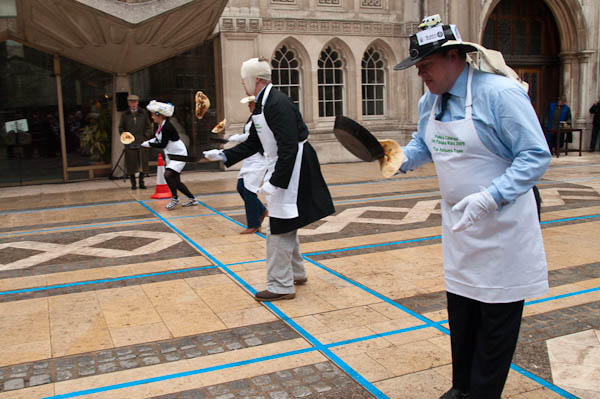
This is a highly organised event with a large number of timekeepers and other officials, who ensure that the rules are kept and time penalties are levied for those who toss their pancakes outside the prescribed zone or fail to toss them at all, and for ladies whose dress is above the knee.

This is a charity event, run in support of the Lord Mayor’s Charities, but despite a great deal of fairly reserved fun, the truly competitive nature of the city emerges in these inter-livery races. Although the rules are old-fashioned – in the masters race those taking part wear their badges and robes and skirts or dresses are required for the ladies race, the times are impressive.

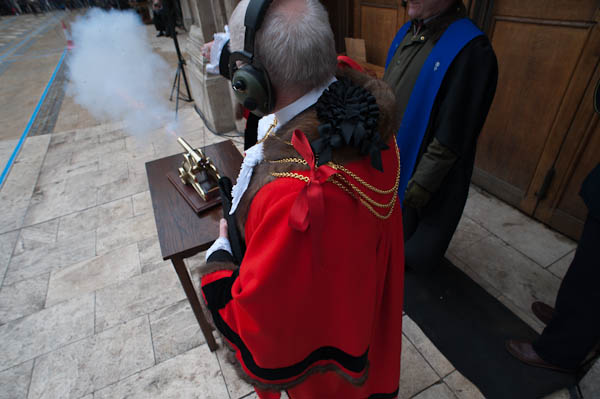
Photographically there are plenty of moments to catch, but two gave me  a special satisfaction, though I don’t think they are the best pictures I took. The races are started using a small cannon, and I just caught the right moment when the event was started, with a flame and smoke coming from the barrel. I could have done with ear-protectors too!

Another slightly unusual moment came during one of the races. Each heat had 4 people taking part, and halfway down the course they had to stop and toss their pancake, before running to the end turning round and doing the same on the way back.  In one race the four were more evenly matched than most and arrived in the tossing zone together and I got a picture with 4 pancakes.  The man closest to me had been the first to toss, and has just failed to catch his pancake cleanly – he managed to grab it with his left hand in the next frame that I took (not on line.)

So although it may not be a great photograph, it is a bit like hitting a jackpot on a fruit machine, where all the dials have ended up on a pancake!

The guilds are a part of our ancient traditions, but this race is only in its fifth year, and I’ve photographed three of these and put the pictures on My London Diary (and as I was taking pictures, someone said “you’re the man with the web site”.)  As well as this year’s pictures, you can also see those from 2008 and 2007.

Suau and more

On the World Press Photo site you can see and hear jury chair MaryAnne Golon talking about the winning photo by Anthony Suau (and I also learnt that she at least pronounces his name An-thony with a “th” rather than in the normal British English fashion, and his second name as “swore”, so I shall have to learn to stop thinking of him as Antony Sow.)  She doesn’t talk about the way the figure with a gun is so clearly shown and dramatically in front of a white wall between two doorways, or that curious head he thrusts forwards behind the arm and gun makes him appear almost a cartoon figure projected on the scene, or how the simplicity of the upper half of the image and the chaos in the lower, but she does make some points about the image.

It’s well worth seeing the picture in the context of Suau’s essay on the site which got him a second prize for stories in the Daily Life section. Overall I think this is perhaps the most interesting story on the site, and one reason for this is the diversity of the ideas in this Time essay covering the crisis in the US economy (of course also something the rest of the world can thank America for.)

You can see his work Beyond the Fall on his web site and also on Time, (at least I think you can, though I’ve not managed to get beyond the opening sequence), with a work from a number of projects at Photoshelter and also on the Bill Charles site.

Elsewhere there is perhaps less of interest than in some years and there are a number of pictures and stories I find it hard to understand either why they are there or why they deserved their rather peculiar treatments by the photographers concerned. Sometimes competitions like this place too high a value on novelty without perhaps considering whether an artsy effect is anything more than that. But there is – as always – a considerable amount of work worth looking at.

Among work that particular caught my eye was the work by Davide Monteleone (Italy, Contrasto) taken in Abkhazia in September-October that won him first prize for General News stories, Polish photographer Tomasz Gudzowaty‘s Child jockey, Mongolia (3rd prize sports singles in Sport Features), and a story on where homeless people sleep in São Paulo, Brazil by Carlos Cazalis (Mexico, Corbis) which gained first prize in Contemporary Issues.

Interestingly the 3rd prize in Spot News stories went to Wojciech Grzedzinski, (Poland, Napo Images for Dziennik) for a set of images from the conflict in Georgia which included images of the same two men that became the subject of controversy on the Internet over photographs by Gleb Garanich and David Mdzinarishvili of Reuters which I covered in my post Byzantine Photographs last August. Although I found that the pictures showed no evidence that would make me in any way doubt their veracity, despite the comments of conspiracy theory obsessed bloggers, it does go to suggest that the world which is covered by news photography is perhaps a rather smaller place than we might hope.

Photo Forum, Futures & World Press Photo

Yesterday evening I was standing in a packed Photoforum meeting in central London with other photographers listening to two photographers talking about and showing their work. Ray Tang of Rex Features presented some of his stories on sex trafficking and drugs in Eastern Europe, and Carl de Souza showed us what it was like to cover the Olympics for a major agency (AFP) – if I remember correctly he was one of over 70 photographers they had covering the event – as well as the month or so he took off in China after that event.

De Souza had a fast-moving slide show of his work with some very graphic images, particularly from the various cycling events which was one major area he was assigned to. It was a shame that through some technical mis-match his whole presentation was shown with the images at a noticeably incorrect aspect ratio which made his horizontal images almost square and turned verticals into upright pillar-box slits.

One of the more amazing of many facts and figures was that AFP had pictures from the 100m final on the wire in just over a minute after the end of the event – from memory 1 minute 14 seconds. These first pictures came from a remote camera linked by fibre cable to the AFP editing suite where they were selected and dropped into waiting templates with captions etc for immediate transmission.

After the end of the Olympics de Souza got AFP to change his ticket home to give him a month in China and set off on his own to travel around one of the outlying provinces. He had to pay his own expenses, but with hotels at 20p a night and an enormous hospitality from the people he met this wasn’t a great problem, but he had to find his way and make himself understood purely by sign language and pointing at symbols in a guide book, as absolutely no English was spoken.

One question that came up was whether he had sold any of this work from China, and he told us that we were the first people except his family and friends to see it – and were asked if we had any ideas on how it could be market or published.

Most of the discussion over Tang’s work was about his paying for the drugs used by one of his subjects to set up a photographic session. As well as raising moral issues around drugs, some suggested it was an interference with the subject that was unacceptable in a documentary project. But there were also some useful practical questions about how you get to find and work with people on sensitive issues such as prostitution and the victims of sex trafficking. Tang used the Internet to make contacts with local people, mainly students who he employed cheaply on a daily basis to find people and places, make phone calls and go round with him, as well as working with various NGOs involved with the problems.

As with De Souza’s pictures of China, this work by Tang was self-financed and little has been sold. Both work for agencies and get a living from what the agencies want, but also spend a considerable amount of time and money on personal work.

I thought while listening to this about a piece that Simon Norfolk wrote in December for World Press Photo (and it was a big day for them yesterday when the results of the 2008 contest were announced – you can now see all the winning pictures including the winning image black and white image by Anthony Suau, which I think may be less controversial than some other recent winners.)

Norfolk’s piece comes in the on-line magazine from WPP, Enter, and in a section called ‘ask the experts‘ under marketing, which I think is intended to give advice to people coming in to photography. It’s worth reading in full (and isn’t very long) but early on in the piece he writes “I gave up trying to make a living from editorial a few years ago…

Magazine commissions still get him to places – as they took de Souza to China – and he then stays on and makes work that he can sell as fine art prints. Or used to be able to sell – since much of that market was fuelled by those obscene bonuses that gave bankers more money than they knew what to do with.

Norfolk sees hard times ahead and suggests photographers learn other trades to keep them going: “soon we’ll all be amateur photographers with real-money making jobs on the side..”

Actually this isn’t a new thing. Many of those great names that fill the history books were never able to make a living from photography. And on a much humbler personal note, I took a serious look at the business in the 1970s and decided (despite the encouragement of some whose opinions I respected)  that I couldn’t afford to be a full-time photographer – unless I was prepared to do weddings. My situation is different now mainly because I need less money to live – just as well as fees are now plummeting back to those 1970 levels.

This is War & The Subject of War

A Dear John letter by John Benton-Harris to a colleague about:

“This is War” & “The Subject of War”

at the Barbican Art Gallery (16 October –  25 January 2009)

Dear John,

It was nice running into you at the Barbican, and good to see that you are keeping well. It was also good that the Barbican has retained something of my improved thinking on exhibition design and traffic flow in that very peculiar and difficult space. For as you I am sure have noticed, this gallery resembles something more akin to the dining room of the TITANIC, then any appropriate space for hanging art. It was also swell to socialize with some of the artists who make up the gallery’s hanging crew. I must tell you however that I was very disappointed with both the upstairs presentation – Robert Capa’s “This is War” (AKA – Endre Erno Friedmann) and a much smaller presentation by his non-notable girlfriend Gerda Taro (also previously named – Gerda Pohorylle). Anyway, looking around this presentation, I would be forgiven for thinking that these small, toneless, grubby un-spotted prints came out of that same long lost valise, which housed those negatives. It may have been sufficient to represent Gerda’s contribution to photography, but not Robert’s, for this staging reveals more of the weaknesses of his seeing then its strengths. So if I were forced to come to a decision about Robert’s ability based on this presentation of his work, he would fail spiritually, emotionally and intellectually. And about any question of him being an artist, he would fail there as well. 

I realize these are harsh words, but looking at these repetitive rows of small, shapeless and thoughtless moments (although beautifully over matted, framed, lit, and presented) this poor limited selection tells me he was only physically present. And that, in my book, denies him the title of the “greatest anything”, for greatness is a privilege reserved for those who consistently find themselves in the right place at the right time, just for starters. These images for the most part have no real clear readable central drama, and no edge concern either, and both are required to make a message taut, to maximize viewer response, and to clarify one’s intent, to go beyond showing that one was merely present. The majority of these out-takes from time suggest that most likely he was holding the camera away from his eye and possibly even above his head, while running. The bottom line, from this credible reading of them is that Robert failed to adhere to his first principal of seeing, which is, in his own words – “If your pictures aren’t good enough, you’re not close enough”.

This selection of weak, loose and wanting moments, taken from wherever Robert was, rather then from where he should have been, along with their tortuous repetition and unimaginative juxtapositionings further diminished by slow shutter speeds which resulted in camera shake. All taken together tells us looking at what we got away from the written blurb, that Robert was simply a very nervous adventurer, with poor technical skills, there for the buzz – and didn’t even have the sense to keep his bit of skirt out of harm’s way.   

So in order to reassure myself about him and his dedication, I needed to revisit my library to remind myself afresh that there was more to him then met my eye at the Barbican. Although there were those few classic historical moments in this poor portrait, such as “Death of A Loyalist Soldier – 1936” and “D-Day Normandy Beachhead -1944”,  their shock was considerably lessened, indeed almost lost, among so  many “SO WHAT” images, denying us his humanity or his reason for being a man at war.

This show also attempted to prove that Gerda Taro was Capa’s equal, or possible his superior, simply because her two rooms worth of shaky out-of-focus snaps that filled her viewfinder slightly better than those of Robert’s on display. Hence Gerda’s importance to photography (as seen by the Barbican and possibly ICP – the New York International Center of Photography – originator of this show) has more to do positive discrimination and a feminist agenda then it does with any sighted humanism or commitment to minded seeing.

I do hate it when market forces and distortions of this or any other kind, work to devalue this history. It’s simply much too high a price to pay for her inclusion.

Returning to that Omaha Beach image of a soldier seeking protection behind tank traps from the onslaught of bullets and mortars ricocheting and exploding all around him in on that Normandy shoreline, littered with the floating dead, in the cold early morning light of the 6th of June 1944. This D-Day image was the image that started my modest print collection, back in 1961 although I had to part with it when hard times struck 33 years later. On a more pertinent and optimistic note, my print of this moment was given extended significance by it’s new custodian – Steven Spielberg, and it’s influence on him helped to create the opening sequences to his film “Saving Private Ryan”, so giving the world a greater dramatized reflection of the events of that horrific morning. To my mind, this was a price worth paying for my personal loss of this historic moment.  

The title of this show was lifted from Davis Douglas Duncan’s Korean book, of the same name, published in the early 1950’s. And unlike this show this was a presentation about several things, firstly one man’s dedication to fallen colleagues, secondly about a clearly defined subject and chapter structure, delivered in three parts (1) The Hill, (2) The City and (3) Retreat Hell. As such it had a planned and executed focus, unlike this show, which was plainly based on the contents of a long lost suitcase. So let’s not delude ourselves, into thinking this Barbican offering was about WAR or Robert Capa, it’s simply a cheap, off the peg merchandising opportunity of a known name.

If the Barbican truly wanted to show us war, they would have commissioned someone with the knowledge, commitment and overall sensitivity they lack, so the public could experience the best by those that described its horrors. Someone who would know it needed to include people like – Bernard, Brady, Brandt, Burrows, Capa, Cartier-Bresson, Doisneau, Duncan, Eisenstaedt, Engel, Fenton, Frith, Gardner, Jones-Griffiths, Jackson, Nicholls, Mc Cullin, Robertson, Rodger, Sander, Smith and Steichen.  And if they wanted to do a show about Capa, almost any other published or exhibited view of Robert would have given us a more complete, accurate and complementary view of this man who successfully invented himself.

Now moving on briefly to the downstairs show “The Subject of War”, it was immediately better in several ways. To start with new advances in camera technology make it almost impossible to take an un-sharp image, unless it’s ones intent, as today’s new advances in camera technology have given us light, easy to use, cameras with fast zoom lenses and anti shake devices to reach out and get closer to the subject, without getting closer to the action. We also have the ability to alter our ASA (ISO) up and down, and from shot to shot, to guarantee the sharpness and the depth of field needed to tailor a moment to ones intent. This show amply illustrates that so much can now be done in the camera (and or one’s lap-top)

So we can produce, or more correctly have others produce for us (as with Capa and these photographers), clearer grit free moments that are more complete and compelling to the eye, emotionally, aesthetically  and technically, while now also possibly eliminating what isn’t wanted. And all of this technical excellence is present in abundance in this larger gallery space, which also has the added genuflections to current gallery installation thinking. In the case of this presentation this included introducing video screens, positioned (bumper to bumper) to tell two separate stories simultaneously, neither of which were digestible, and both seemingly influenced by morning soap-opera TV. One enormously large wall at the back the gallery has the appearance of a chequer-board, viewed from above, with a multitude of large images running down and across it, without giving us clue as to how to decipher its message.

However, at the opening the staircase between both these offerings seemed to offer me some momentary sanctuary from the past that valued the presence of a camera, more then the mind of the person behind it, and from the now, that seems to value the originality of the observer, more then the content of the message. Maybe I’m being super-sensitive hear, but I kind of feel the designers of this poor donation to photographic understanding also felt that the base of this staircase was an ideal place to offer alcoholic refreshment, for it served as a kind of  “Oasis Point” in this desert of  deprived expression.

John Benton-Harris

This review is also published on John Benton-Harris’s own blog, The Photo Pundit
Law makes an Ass of itself?

Robert Kabakoff is an actor who has appeared in a couple of films, but now is more famous as a photographer. Cycling through Central Park in New York last April he saw a woman getting a bit of sun on her nether regions, “laying on her stomach with her skirt pulled up over her butt” and felt this would make an amusing picture.

So he jumped off his bike and took a snap with his phone from around 15 feet. One of the woman’s friends noticed him and the woman complained to a cop. Kabakoff was handcuffed and taken in a police car to the station, where he was charged with “unlawful surveillance” and spent the night in jail – it was 18 hours before he was released.

Perhaps because Kabakoff is a graduate of the John Jay College of Criminal Justice he had the sense to sue the City, and he settled out of court for $8,000 which paid for him to have a month in Paris.

Most of the details above come from a report on the NY Daily News web site, but rather more interesting to us is the commentary by Carolyn E Wright on her Photo Attorney blog, where she makes clear exactly what that offence means.   It does outlaw surreptitious photography of people “dressing or undressing or the sexual or other intimate parts of such person” but only when that person has a reasonable expectation of privacy. Clearly this cannot apply in a public open space such as Central Park.

But I wouldn’t want to encourage people to follow Kabakoff’s example. It may be legal (at least in the UK), but I think it is also rather likely to cause offence – as it did. Of course there are times when there is a real public interest in taking pictures that cause offence, but this clearly doesn’t seem to me to be one of them.

I also found the story mentioned on the War On Photography site, which has previously awarded the New York City Police Department one of its
Honorary Order of Lenin Awards.
This site is also the first place I’ve found with a link which works in the UK to the Colbert Report programme on the ‘Amtrak Photo Incident.’  It’s a rather heavy-handed American comedy report on an incident in which a member of the NPPA found himself arrested for taking pictures on a railway station – and what was he doing? Taking pictures to enter in the photo competition run by the railway company, Amtrak. He still intends to enter the competition.

Boycott the fruits of apartheid

 © 2009 Peter Marshall.
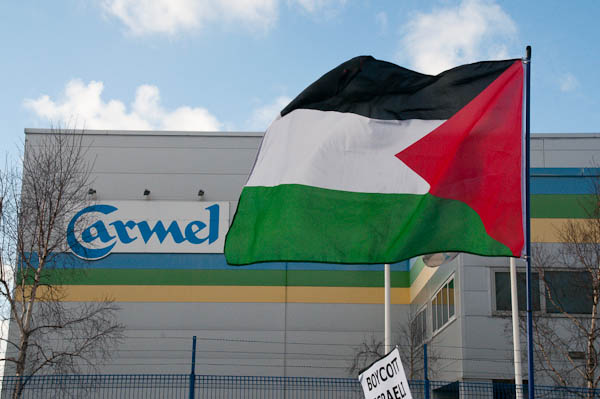
No Israeli flag now flies at Carmel Agrexco

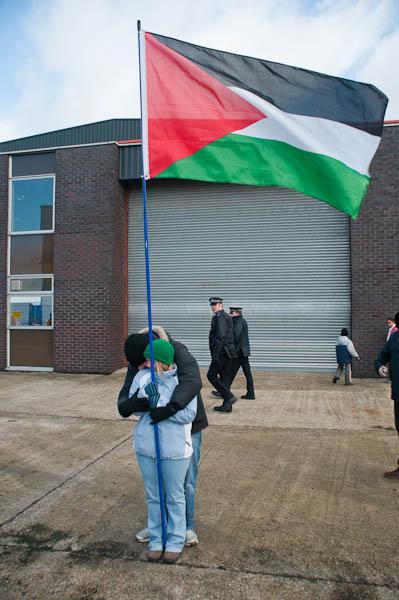
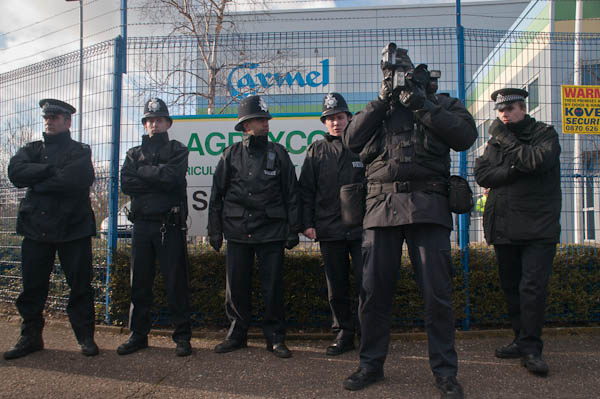
There was no sign of the Israeli flag which used to fly proudly outside the Carmel Agrexco warehouse in Hayes, Middlesex, and the Union Jack on the adjoining flagpole was tattered and skewered on its pole. When I arrived the gates were closed and guarded by around 20 police, with perhaps another 50 or more in reserve in vans parked around the industrial estate.  As well as normal police vans, these included a couple of old vans that looked like they had been rescued from the knackers yard and cheaply fitted with a notice saying Metropolitan Police in the front windscreen, so perhaps police resources were rather stretched. Later I saw even more police vans at other points around this industrial estate a couple of miles north of Heathrow.

© 2009 Peter Marshall.
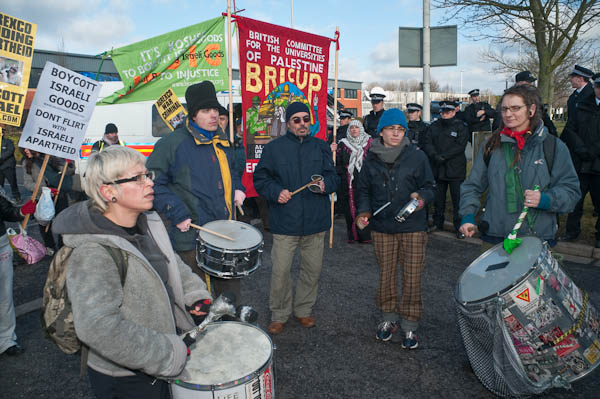
The demonstration was led around the estate by the samba band

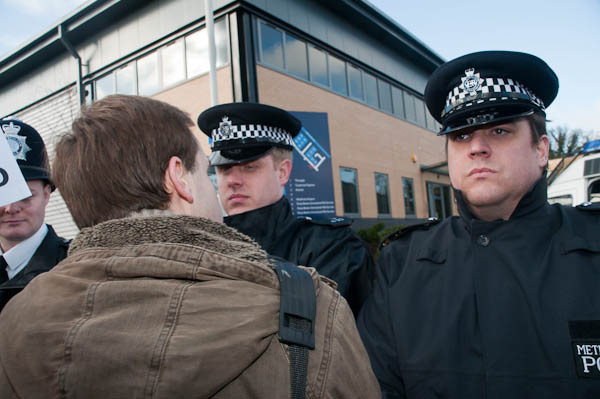
Roughly the same number of demonstrators eventually arrived, looking considerably more cheerful than the police who appeared to be feeling the cold. Once the samba band got there the protesters went off with them for a walk around the block, attempting to visit another company on the estate involved in the export of Israeli and Palestinian flowers. Police formed a solid line across the road and refused to let the marchers past, pushing back those who tried but refusing to say why there were not allowed to continue. Eventually an Inspector introduced himself and read a statement (he afterwards confirmed this was under the Public Order Act 1986) confining the demonstration to the block containing Carmel Agrexco, and after a few arguments the marchers moved on.

© 2009 Peter Marshall.
Police stop demonstrators but refuse to answer questions

At this point one man was stopped and searched, but no arrests were made. The FIT photographer was hard at work throughout the event, but generally the police were well-behaved and made an effort to engage the protesters and photographers in polite conversation throughout the roughly three hours I was there.

© 2009 Peter Marshall.
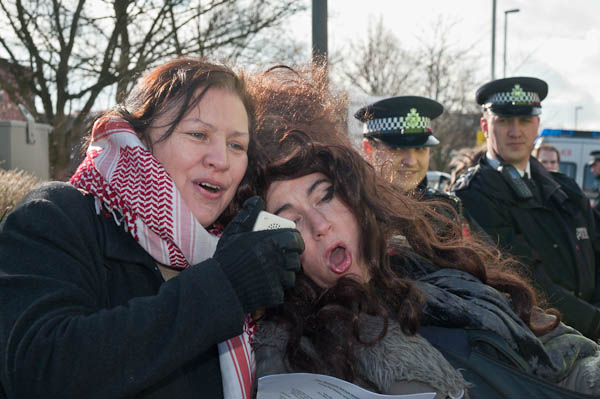
‘Amy’ and friend end their performance of The Boycott Agrexco Song

At several places the march stopped to sing songs, with ‘Amy Whitehouse’ whose wig was surely too tidy to fool anyone and another singer with a strong voice, both of whom had the advantage of knowing the tunes. The Boycott Israel Song (tune Bye Bye Love) reminded us not to buy Israeli goods including dates, Jaffa fruit, Israeli wine – and anything with a bar code starting 729. (Although some Israeli produce has this barcode, there are others, so always read read all the small print.)

A new Boycott Agrexco Song (none of us knew the tune, Jesus wants me for a Sunbeam, but then few at the demonstration will have attended Sunday School – and we didn’t sing it at mine) was more specific, reminding us of the house demolitions and checkpoints that force Gaza farmers to sell their produce dirt cheap to Israeli companies who illegally export them as Israeli produce, and of the stealing of water from Palestine to irrigate Israeli fruit. It ended on a seasonal note:

“Don’t buy your flowers from Agrexco
To give your valentine
Boycott the fruits of apartheid,
And help free Palestine”

Agrexco is Israel’s largest exporter of agricultural produce and much of it goes to EU countries including the UK. Its main UK depot is in Hayes because this is close to Heathrow – where much of the produce is flown in to this country.

© 2009 Peter Marshall.
This was described as a Valentine demonstration

Movement of food by air is a considerable an unnecessary drain on the planet’s resources and contributes to global warming. So Carmel Agrexco was naturally a target for demonstrators during the Heathrow Climate cap in August 2007.  As in other protests no prosecutions resulted despite there being considerable damage reported.

© 2009 Peter Marshall
There were other photographers present – including this one.
From 16 Feb I might be arrested for taking pictures like this
.

Protesters claim that Carmel Agrexco is in violation of international law in exporting produce – mainly carnations, strawberries and cherry tomatoes – from Gaza, as well as from Israeli settlements inside the Green Line and in the West Bank.

More pictures on My London Diary.