More on Pirkle: Plagiarism & Truth

The question of what is and isn’t plagiarism has been aired considerably in recent months, particularly over the use made by Shepard Fairey in his posters of Obama.  There’s also a link to Pirkle Jones, whose recent death was the subject of my previous post.

As Mark Vallen  pointed out in his article Obey Plagiarist Shepard Fairey in December 2007, Fairey took an image of an anonymous Black Panther from Jones and RuthMarion Baruch‘s 1960 essay on the Black Panthers, degraded it both tonally and by the addition of a couple of inappropriate graphics and made it into ‘his’ street poster. As Vallen puts it:

Pirkle Jones gave us a compassionate image that served the cause of African-American dignity and liberation, while Fairey gave us a stolen and regurgitated image stripped of all historical meaning and refashioned to serve only one purpose – the advancement of Fairey’s career.

For Jones, taking a photograph was a political act (and we often forget that his mentor Ansel Adams was very much involved in a part of the environmental movement – as well as his more clearly political work on the wartime internment of Japanese-Americans at Manzanar.)

Funnily enough, the first time I recall meeting the unforgettable name of Pirkle Jones was in an essay by a student in which she pointed out a remarkable similarity between one of his images and an earlier picture by another photographer – I think Lewis Hine – showing a worker weilding a hammer. I think this was however not plagiarism but simply two photographers coming to a very similar solution when faced by the same subject matter. It’s something that happens fairly regularly in photography.

Pirkle Jones and Ruth-Marion Baruch’s work also became controversial in another way in 1964, when they exhibited a joint project on the sad decline of the northern Californian town of Walnut Grove. As you can read on Howie’s Home Page, things appear to have been not quite what they seemed.

In fact the truth about Walnut Grove is more complex than this article suggests. You can find out more about it on various web sites including Wikipedia,  a history page from the local Chamber of Commerce and various sites giving local statistics such as City-data. It is interesting to see that the population there now is more or less exactly the same as it was in 1961, though of course its composition may well be very different.  Another article on Jones and Baruch describes it as “a small, racially diverse community that was displaced by a freeway.”

The site about the film of his life, Seven Decades Photographed, as well as the pictures of Walnut Grove linked above, also has pictures on the other pages, for example the ‘Press’ page has pictures of the Black Panthers. There is also a trailer for the film, but since this is a 712Mb Quicktime file very few will have the bandwidth to download it!
Whirling Dervishes

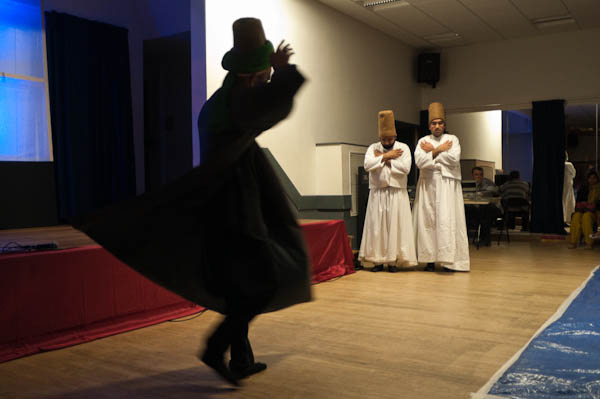
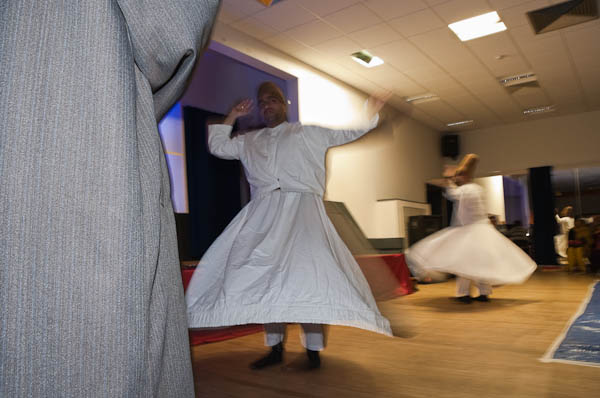
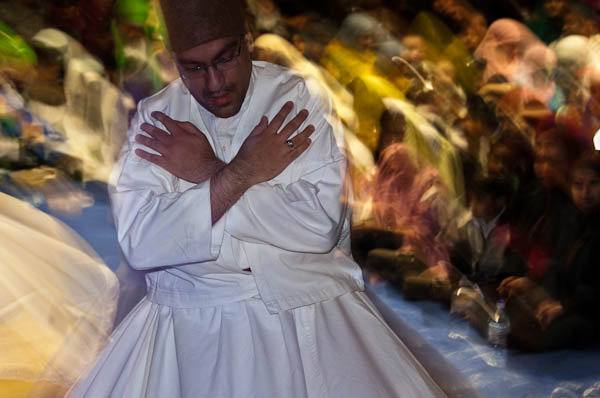
There were three of them, performing in in a dimly lit hall in a leisure centre in Tooting, at the Eid Milad-Un-Nabi celebrations of the birthday of the Prophet Muhammad organised by the Sunni Muslim Association, and I really couldn’t quite work out how to photograph them.

Working with flash seemed a good idea, since even with the D700 giving pretty good results at ISO 3200,  it was hard to get both enough depth of field and a sensible shutter speed, but even more of a problem was that the lighting in which they were performing was extremely uneven.  Using the flash, I also wanted to get some ambient exposure to avoid very dark backgrounds and also give some feeling of movement to the figures.

© 2009 Peter Marshall.

My decision in the heat of the moment was that 1/8 would probably give me enough blur and I set that as my slowest speed with flash. I set an ISO of 1250 as the18-200 zoom I was using only covered the smaller DX area and quality was more important, set the flash into TTL FP mode, the camera on P and then forgot about it, concentrating on getting pictures.

© 2009 Peter Marshall

I was also using the D300 with a 20mm wide open at f2.8 with no flash, which gave slightly underexposed results at around 1/60 ISO 1600. There were far fewer usable images from this, though I did get one with a fairly dramatic silhouette.

© 2009 Peter Marshall

You can see more pictures of the Whirling Dervishes as usual on My London Diary, where you can also read something about the deeply religious significance of their performance.  But they were only a small part of the event I photographed, and although they had particularly attracted me to the event, as usual it was the people rather than the performers that I think more interesting in the pictures that I took.

Prague Poet Remembered

I’ve long been a fan of Josef Sudek – and my copy of the first edition of the monograph on him published in the West in 1978, two years after his death, edited by Sonja Bullaty shows considerable signs of use.  Bullaty, a photographer who shared some of his lyrical approach, had been held in Nazi concentration camps (including Auschwitz)  before managing to escape from a death march and return to Prague as the war was ending.  There she found none of her family had survived. She became Sudek’s apprentice until she was able to leave for New York in 1947.

Sudek’s images in the book were finely printed in gravure, and have a quality that often very much echoes the originals. His work very much showed a different sensibility and an alternative photographic printmaking syntax to the bravura zone-based silver prints of American photographers such as Ansel Adams or the glossy bromides of photojournalism. Complex, sometimes brooding, and always with feeling, whether on matte silver or pigment his prints had an interest in surface and depth. It was work in a different register to the prevailing US hegemony.

Later I bought a few more books of his work, and around 1980 organised a small gallery display of Czech photography that included at least one of his prints along with these. I’ve had another gravure of one of his images hanging on my front room wall for many years. And of course I wrote about the man and his work for About Photography.

So I was pleased to see a mention on The Online Photographer  (though I think to call him “one of the fathers of 20th-century photography in the Czech nation” belittles a man who was truly one of the greats of  20th century photography full stop) directing me to a note marking the anniversary of his birth on March 17, 1896 at the Disability Studies site of Temple University.

Sudek fought in Italy in the First World War, losing his right arm, and it was this very disability that brought him into photography, as he was given a camera while convalescing from the amputation, and his disability pension allowed him to study photography. The site also links to an extensive gallery of his work and you can also see some at Iphoto Central  and Luminous Lint.

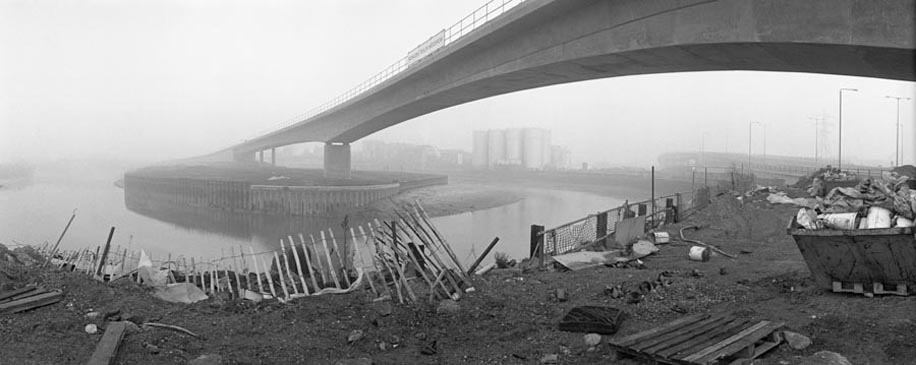
One aspect of his work that I developed a particular interest in was his use of panoramic photography – something indeed that led me to buy and use a number of panoramic cameras. The internet doesn’t lend itself too well to the  format and not many of his (or mine) appear to be on line.

DLR at Bow Creek, © 1992 Peter Marshall
Definitely not Sudek, but one of my panoramas – some others are on the Urban Landscape web site.
Right Click in sensible browsers and select ‘View image’ to see the picture larger.

One site that has a few (it is poorly written – scroll far to the right to find images) compares some of Sudek’s Praha Panoramaticka images with 1992 images at the same locations by  Peter Sramek. Although it is sometimes interesting to see the differences time has made, Sudek’s work has a quality that sets it at a quite different level to the later work.

London St Patrick’s Day Parade

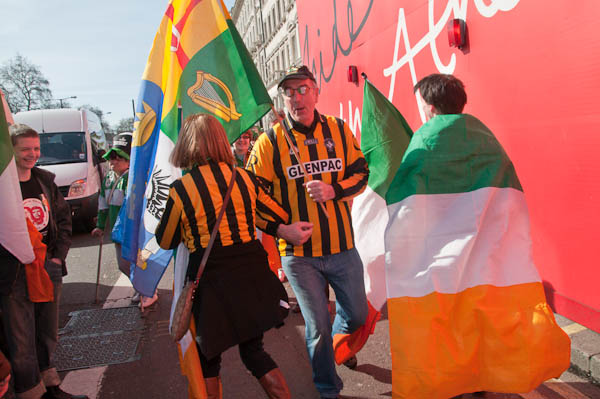
Sunday’s St Patrick’s Day parade in London formed up on Piccadilly, which was a problem for photographers, with lowish sun streaming into our lenses much of the time. Things were a lot easier for us when they used Park Lane around the corner.  So although everyone else was probably enjoying the bright sun, we were cursing it.

I wasn’t helped by not having a lens hood for my 20mm on the D700, although frankly most wide-angle lens hoods are hardly worth the trouble. As usual I made use of my hand, holding it in the right place by looking through the viewfinder until I can just see it – and then at least in theory moving it just out of picture. In practice it’s more efficient than the Nikon lenshood, but it also means I have to crop the occasional image where my fingers intrude along the top of the picture!

© 2009 Peter Marshall.

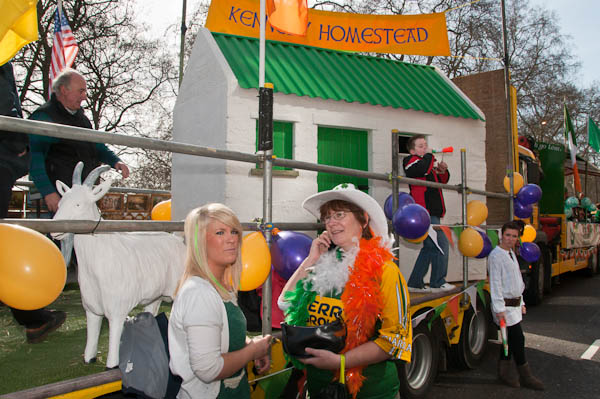
Kennedy Homestead‘ above is a good example – the sun was only just out of picture and my hand was just visible along the top of the picture; fortunately I could also crop a corresponding area at the right and still keep the normal aspect ratio.

I’m not quite a cropping fundamentalist à la H C-B (and it’s always worth remembering that perhaps his best known picture, the leaping man in the Place de l’Europe which featured in most of his obituaries, was quite seriously cropped) but like him I do believe in composing in the viewfinder rather than after the event.

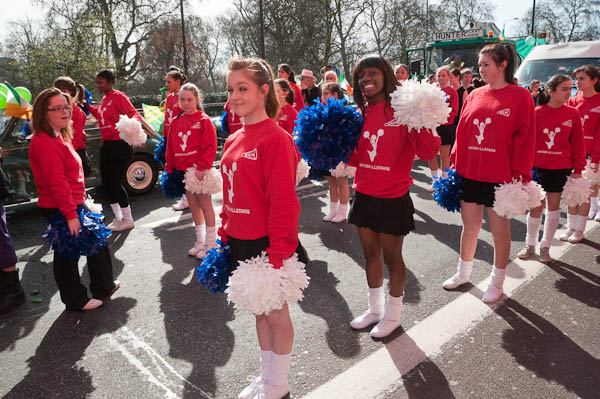
The second problem with bright sun is of course lighting contrast. Fortunately using fill-flash can help with this, along with a little dodging and burning in Lightroom. I’m not quite sure what the US-style cheerleaders were doing at this Irish event, though doubtless some of them had Irish ancestors, and it isn’t anything more than an adequate picture, but it is one that I would have found impossible just a few years ago.

© 2009 Peter Marshall.

Modern flash systems and high sync speeds make fill flash simple to handle. I couldn’t have done this with my old Olympus OM system. The shutter speed here was 1/320s (at f11, ISO 400) and I had my usual -2/3 stop setting on the flash along with +2/3 on the camera exposure. Really I didn’t have to think about it at all, other than to check I had the flash switched on and take a quick look at the image and histogram after taking the picture.

It did need a bit of work in Lightroom, bringing the sky area and some highlights down and opening up some of the shadow areas.  The kind of control that in the old days one could do in black and white, but was very tricky with colour – I remember a number of times getting messages back from the lab that  what I wanted just wasn’t possible in those good old days.

© 2009 Peter Marshall.
Another that would not have worked without fill

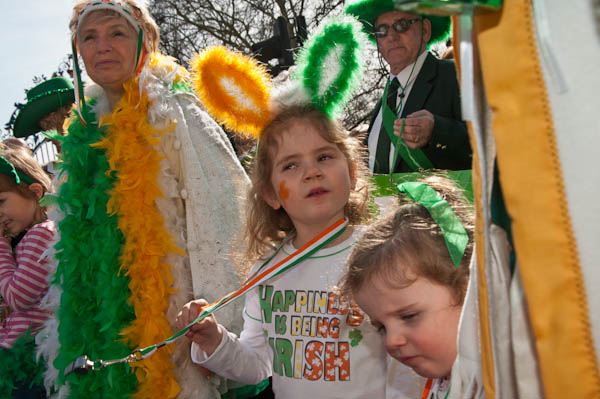
The St Patrick’s day parade was one of the big events started in London by Ken Livingstone, and one that he always seemed to enjoy. Although many of the supporters of Boris Johnson moaned about Ken wasting money on such events, I’m pleased to see that they are continuing under the new management – and Boris was there himself at the front of Sunday’s march. So far as I’m aware he doesn’t claim any Irish ancestors and for once he didn’t put his foot in anything.

© 2009 Peter Marshall.
Fill again essential

You can see more pictures from the parade- including several different St Patricks –  on My London Diary.

Portraits? And One Law For All

Someone asked me yesterday evening if I took portraits. I found it a difficult question, though I do often take pictures of people. And some I think aren’t bad. But I rarely if ever have the luxury of being able to work with someone – at least for more than a few seconds, or to direct them or light them carefully in the way that traditional portrait photographers might.

It is of course a matter of choice. Although I can appreciate – for example – the portraits by great masters of the art such as Bill Brandt, the kind of deliberate and planned approach in much of his best work just isn’t my style. Most people probably know the story of the oil lamp in a picture taken for ‘Picture Post’ of a sea-captain in Liverpool; when the editor commented how fortunate he was to have found the man had such a lamp in his room, Brandt replied that he had taken it with him from London for the picture. And when he arranged to meet Frances  Bacon at a particular time in the early evening on Primrose Hill, there seems little doubt that the picture he made – one of his finest – was already more or less present in his mind.

Then there are the more formal portraitists who I don’t find particularly of interest – except for some rare moments. People such as Karsh,  Arnold Newman and others, whose work I can admire for its technical competence but with a few exceptions leaves me cold. Somehow I don’t think photography is really suited to this kind of formal portraiture, which suffers greatly from inviting itself to be compared with portrait painting.

Photography is much more concerned with capturing the fleeting moment, the look or gesture that perhaps gives an insight into the person.  Of course there are great photographs of people that do this, and even some taken on large-format cameras. Paul Strand was one of the masters of this, in so many of his images.  You can read an interesting description of his taking a portrait of Katie Morag Morrison in South Uist by John Morrison on the Scotland site, and her picture is one of the 32 by Strand on the Fine Art Photography Masters site (she is the 27th picture in the album for the impatient – but why deny yourself the pleasure of looking through the others before and after. ) Others have decribed the experience of standing in front of his camera a little differently,  as a long process in which Strand more or less seemed to ignore them, simply waiting for the moment when he felt they were ready, composed (or as some put it, bored – but they don’t look bored in the images.)

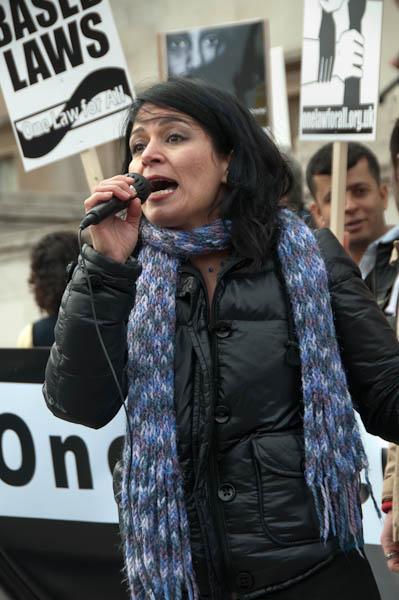
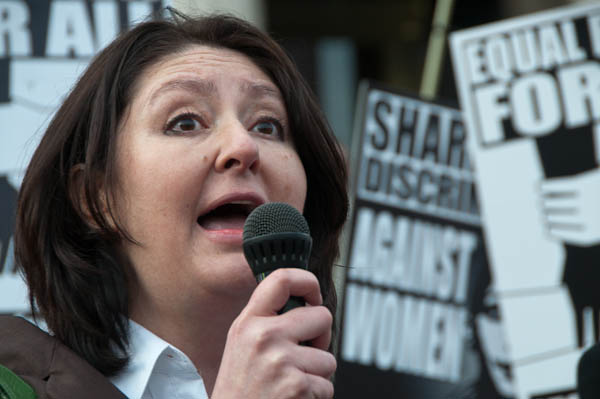
At the ‘One Law For All’ rally at Trafalgar Square on Saturday, against any introduction of Sharia law into the UK, the speakers were far from bored. It was an event where relatively little else was happening, and I was concentrating on them, photographing and trying to catch moments when expression or body-language seemed to speak to me.

© 2009 Peter Marshall

The placards for the event provided some lively and relevant background. For once I worked without any flash fill, using fairly long focal lengths to give some differential focus. Here are a couple of the results – and there are a few more (evenincluding some of men, although it was an International Women’s Day event) on My London Diary, where you can also read more about the event.

© 2009 Peter Marshall.

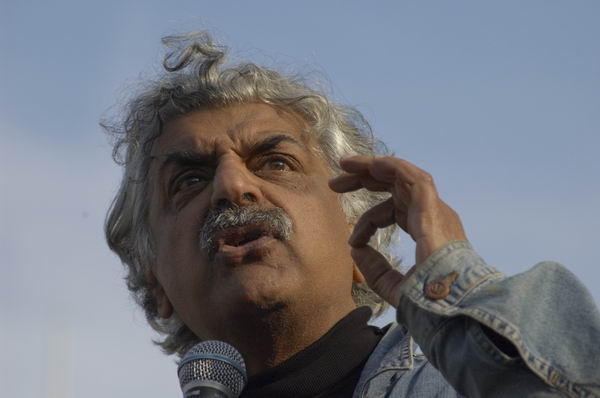
And sometimes I take one that isn’t bad – like this picture of Tariq Ali in Trafalgar Square a few years ago:

© 2005 Peter Marshall

Copyright infringement & Visible Watermarking

I know several photographers who won’t put their work on the web at all because they are worried about people stealing their pictures.  Of course with over 25,000 images on the web I do get some of mine used without permission, but it isn’t something I get too worked up about.

I don’t like getting ripped off,  but I don’t think I lose a lot of revenue – if anything the opposite. Probably most of the sites on the web where my work has been used without permission are the kind of sites that Alamy would sell a licence to for a couple of dollars or I would allow free use if they asked me and provided attribution and a linkback to one of my sites. Personal sites of people with an interest in photography or in some of the causes I also support.

Of course if I find my work on a commercial site things are different. I follow what many photographers I know advise and send the company concerned a polite letter pointing out the detail of their copyright infringement,  accompanied by an invoice for the usage – at double the price I would normally have charged.

According to a recent post on the BJP blog, quoting John Toner (who I was sitting a few feet from in the London Freelance Branch NUJ meeting last night,) “only 74% of photographers who pursued payment for copyright infringements received fair compensation” but this still seems a fairly good figure. Of course the actual proportion of infringements successfully pursued could be rather lower.  It is a tricky business pursuing debts through the courts – even for small claims – and winning your case doesn’t unfortunately guarantee you will ever get the money.

The figure comes from a report by the British Photographic Council which is covered in more detail on the EPUK web site (and can be downloaded from a link there in full) , which reported that almost three quarters of the photographers they surveyed were aware of infringements of their copyright (not all on-line) and that the average photographer was aware of 26 such infringements.

One response to image theft is to watermark images, either visibly or invisibly.  Invisible watermarking really only makes sense if you can afford the services of one of the companies that will crawl the web looking for use, and will have no effect on use off-line.  Although the pictures we put on the web are small – perhaps 600×400 pixels, these still suffice for reasonable size reproductions in newspapers, perhaps up to five inches wide at suitable quality. I’ve actually seen one of mine used as an A2 poster; it wasn’t pretty in photographic terms but it did the job.

Visible watermarking makes more sense for those of us without deep pockets. But I hate those sites – such as Magnum – where it can make some pictures almost impossible to see, let alone appreciate. One useful compromise is to add a border to the picture and add your copyright information on that rather than across the actual image.

I thought about that again last week, following a link from the Photo Attorney to Jim Goldstein’s site and one in a useful series of features about watermarking – and this one also deals with how to find copyright infringement of your work.  Although it’s perfectly possible for people to crop or eliminate watermarks from your files, most infringers don’t bother – they either don’t know about copyright laws, or think their usage is covered by “fair use” (and it may be – see the Photo Attorney site on the US position on this) or they don’t think anyone will notice.

Goldstein asks people who contact him for pictures where they saw his work. As he writes, it is  “the way I find some of the most surprising cases of not just infringement, but marketing.” The visible watermark turns infringement into a marketing too, but of course, once you know it is happening then you can decide whether it is worth sending an invoice or making a complaint.

Lightroom copright example
Lightroom 2.3 added this watermark automatically when the output option was checked

Lightroom, at least in the latest versions, does quite a nice neat job of putting your information from the ‘Copyright’ metadata field just inside your picture, though I can’t find any way to customise this at the moment. What I’d really like is to add a small border on the lower edge of the image with it in. But at the moment I can’t decide whether this is something I want to use.

Million Women in Oxford St

Most Saturdays there seem to be about a million women shopping in Oxford St, and quite a few men too, worshipping at the altar of consumption. It’s a place I try to avoid, especially if I’m trying to get anywhere in a hurry, with crowded pavements and buses largely stationary.  Unless, like my friend Paul Baldesare, you want to document such things. Its something I’ve tried in the past but don’t think I have the stamina to attempt now.

© 2009 Peter Marshall
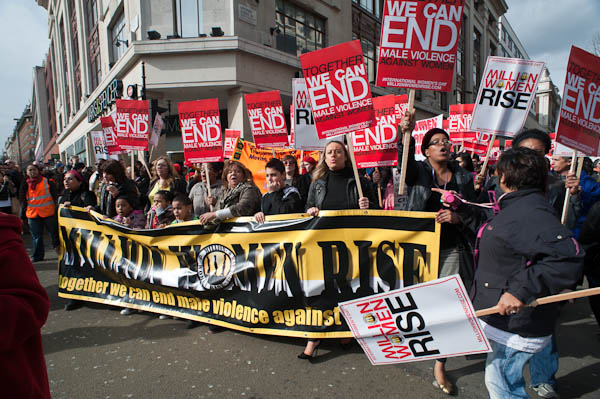
The front of the march turns on to Oxford St

But Saturday it was different, with women marching in the ‘Million Women Rise‘ march from their assembly point in Portman Square turning onto Oxford St at the corner of Selfridges and continuing along it to Oxford Circus before turning down Regent St on its way past Piccadilly Circus to a rally at Waterloo Place.

This was intended to be (but was not quite entirely) an all-woman march, and although most of the couple of thousand or so taking part seemed happy to be photographed even by a male photographer, once the march was in progress we were asked to keep off the roadway while doing so. Which I did (although plenty of others did not) and was a little annoyed to then be harassed by one over-zealous steward for standing too close to the edge of the pavement. It was however an isolated incident.  But as a photographer who very much prefers to work close to people this restriction very much affected my work, and I was taking much more with longer focal lengths than usual.

The  march takes place at this time to mark International Women’s Day (the actual day is March 8th) and its theme – on the banner above – is “together we can end violence against women.” One of the more popular chants was  “However we dress, wherever we go, yes means yes, no means no!

© 2009 Peter Marshall
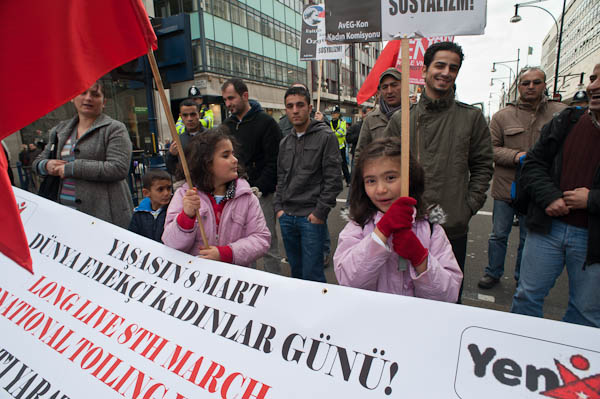
A few men marched in solidarity with the women and children at the rear of the march

This year, the global theme of International Women’s Day was a similar but significantly different message:  “Women and men united to end violence against women and girls“, which perhaps explains why one of the groups taking part – marching behind the women-only march’ with largely Turkish placards – also contained men.

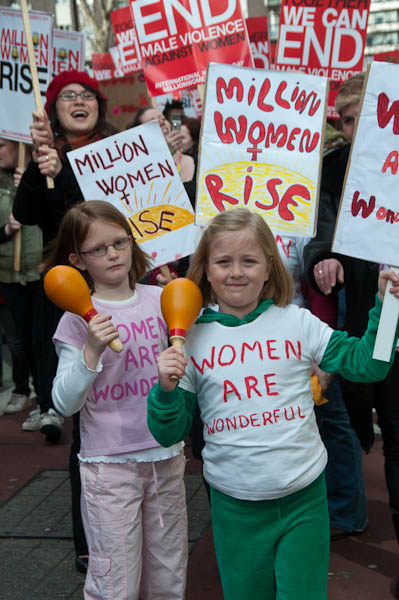
But of course I was much more interested in the women and the statement that they were making, because, as some of the marchers maintained, “Women are Wonderful”.

© 2009 Peter Marshall

By the time I reached Oxford Circus I was exhausted and left the women to continue their protest, while I sloped off to my favourite pub and a very welcome pint of bitter. Fortunately Paul, who had been busily photographing consumption, was ready for a pint too, so I didn’t have to drink on my own. You can see some of his work – from suburbia rather than from Oxford St – in our Another London on-line show which also has work by Mike Seaborne.  Of course an updated version of this show is still available for galleries.

More of my pictures of the women on the Million Women Rise 2009 march on My London Diary, where there are also pictures from last year’s rather larger Million Women Rise march.

Police Evidence Incriminates Police

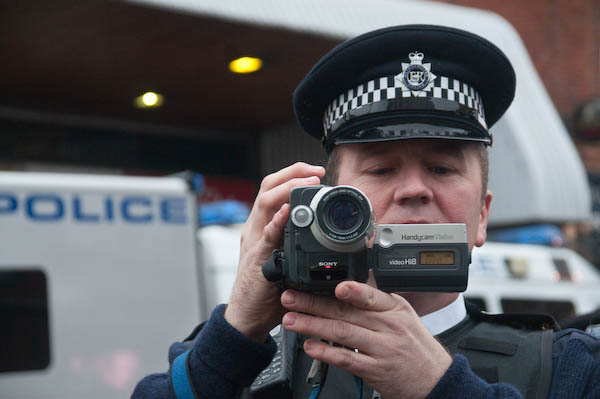
For some years now, photographers – myself included – having been complaining about the high level of surveillance by police of us while we are doing our job at demonstrations. I’ve been videoed and photographed at almost every such event I’ve attended, often in a way that I think can only be intended as deliberate harassment. There must be thousands of images of me now on the police files, along with hours of video footage.

© 2008 Peter Marshall

Yet all that time I’ve been behaving perfectly legally, following the instructions of police even when I’ve thought them unreasonable.  The police have always denied that they paid special attention to journalists, but today on the Guardian Online site you can see a video which includes footage (video and sound commentary)  from a police unit covering the Climate Camp at Kingsnorth which clearly shows how they targetted press photographers and videographers covering the event as well as the campaigners.

The Guardian report is by Paul Lewis, Marc Vallée and John Domokos, and Marc is one of the photographers targetted, along with videographer Jason N Parkinson.  I was filmed and photographed by police on the Sunday when protesters marched from Rochester to Kingsnorth, although the surveillance then was considerably more low-key, but missed the rest of the week as I had to be in Glasgow, otherwise I would have been there too.  As well as Marc and Jason, several other photographers I regularly work alongside also appear in the clip.

It’s long been very clear that the police target journalists who cover protest – despite their protestations of denial. Now we have it clearly in their own words and images from an operational level.

Paranoia – or Standard Operating Procedures?

I’ve been thinking for a while about whether to make this post. Having at least to some extent learnt my trade as a journalist I only like to post either about things I know from direct, first-hand experience, or that I can at least in some way verify sources. In this case I have to start with the warning that I haven’t been able to do so in any way; although I’ve found the story mentioned in several different places, none of them does more than to refer back to the original anonymous blog posting, made in August last year.

About all I can tell you about the author of this chilling story is that according to the blog he is a young Asian man with an interest in replica arms who lives somewhere in south London with his parents, not far from Wimbledon station.

And one who claims to have been arrested by police in central London at gunpoint for taking photos, later being told by the officer who apprehended him he was lucky that he hadn’t been executed on the spot.  His is a story you need to read.

On his blog,  HM Ministry of Paranoia (HM MoP),  he tells how he was arrested while walking through tourist London with a Nikon D300 and a tube map for “Suspicion of a Section 58 – Possessing information likely to be of use to terrorists.

Section 58 of the Terrorism Act 2000 states:
(1) A person commits an offence if—
(a) he collects or makes a record of information of a kind likely to be useful to a person committing or preparing an act of terrorism, or
(b) he possesses a document or record containing information of that kind.
(2) In this section “record” includes a photographic or electronic record.

It is a defence to this charge to show a “reasonable excuse” for possessing possessing or making the record, though there has been considerable dispute about what this means. You can read more about this in yesterday’s report in The Times Online of yesterday’s judgement in the House of Lords on the case of Regina v G and J., two men charged under this section of the act whose cases have resulted in appeals, eventually to the Law Lords, whose judgement I find hard to follow. Probably it is because of this case that the story on HMMoP, originally posted in August 2008, has emerged again.

On HM MoP, just before he was finally released uncharged, the man was told by the armed officer who had arrested him “Had you not have been soo compliant, I would have shot you, and you would have died“.  He writes ‘I asked him what did I do wrong, he said “Look, lets face it, suicide bombers are Asian. If I had a choice between you and him (pointing to a white colleage), id shoot you every time”. ‘(sic)

The story illustrates graphically the gulf between the laws that are debated in Parliament (where civil liberties are at least given lip-service) and the way in which they are interpreted on the ground by police.  Although we may suspect that the way the police carry them out is perhaps rather closer to the kind ideas that the bully-boys in New Labour’s back rooms would like (have you watched the preview clip of Armando Iannucci’s In the Loop?)

As I said at the start I don’t know anything more about this case than appears on the pages of HM MoP, and it would be fair to record that in its pages one policeman – the Insepector at Wimbledon Police Station where the man went to hand in his replica guns as ordered to do by the Special Branch officers – did his job properly.  But is it just my paranoia that leads me to wonder just why the last post on the HM MoP was made on October 10, 2008 and to wonder why this man is no longer blogging?

And of course, you’ll know why if >Re:PHOTO should suddenly stop posting or disappear from the web or even stop in the middle of

You can’t photograph Sewer Gratings

The latest silly story about photographers being arrested is about Stephen Clarke, arrested in Manchester for allegedly taking photographs of sewer gratings. Watch the video here.

The police also took a DNA sample and it is not on the police database, despite a ruling that such action is illegal at the European Court of Human Rights. Once the police have your sample, getting off the database is not easy.

© 2009 Peter Marshall.

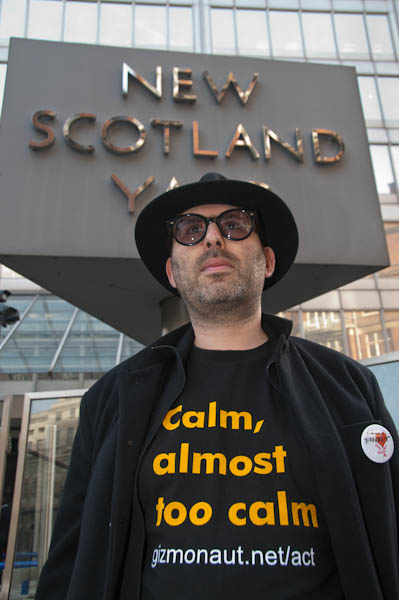
One man – perhaps the only one – who has managed it is David Mery, arrested in July 2005, three weeks after the London bombing – and six days after the shooting of Jean Charles de Menezes – while entering  Southwark tube station on 28 July for being “calm on arrival, almost too calm” and having a largish rucksack and a strong French accent. You can read about his struggle, eventually successful – to have his DNA record removed from the database on his web site.