Good Friday

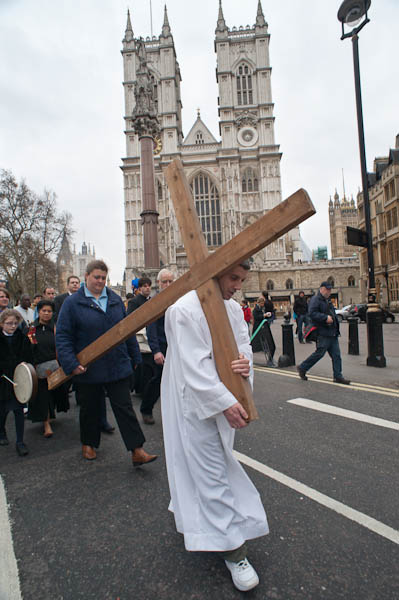
Christians in the UK sometimes seem not to keen to be photographed when they do, but the various Good Friday ‘Processions of Witness‘ are an exception. Of course I have been made welcome at many other events – as you can see from ‘My London Diary‘.
© 2009 Peter Marshall.

One of the largest of such events takes place in the centre of Westminster, along Victoria Street, involving Methodist Central Hall, Westminster Cathedral and Westminster Abbey. There are always quite a few photographers taking pictures during the services outside the first two churches and the procession between them, but photography is not allowed when the procession goes in to Westminster Abbey.

I started by photographing a service in the concourse of Waterloo Station, where around a hundred people from North Lambeth had ended their two processions around the area. Photography ‘for personal use’ is generally allowed in railway stations, so long as you don’t “take photographs of security related equipment such as CCTV cameras.”
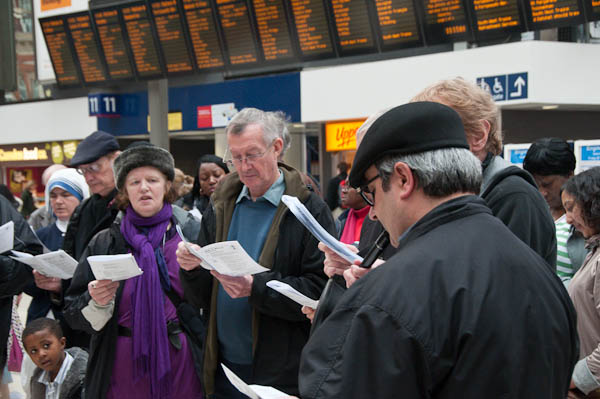
© 2009 Peter Marshall.

It would of course be almost impossible not to coincidentally include CCTV cameras in most general shots of stations, and in practice it is unlikely to be a problem unless you appear to be concentrating on such things.  It seems unlikely that even so you would be committing an offence, but people have been stopped and questioned for doing so.

It didn’t actually occur to the Secretary of State for Transport that photographing CCTV cameras was a problem worth mentioning; in a written answer in Jan 2007, Tom Harris said that the Department “would not normally expect operators to object to photography at stations unless it was being carried on in such a way as to pose an unacceptable risk to the photographer or others.”

Commercial photography at stations does of course require a licence, and if you want to use equipment such as tripods and lights you will need one. But so long as you stick to hand-holding and available light (flash is also allowed except on platforms) and don’t annoy people you are unlikely to have problems.  I’m an editorial photographer not a commercial photographer; but as usual when working (except at highly policed demonstrations) I keep my press card in my pocket.
© 2009 Peter Marshall.

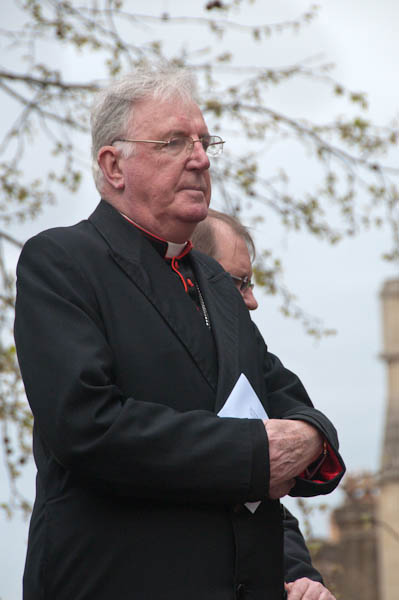
The ‘Crucifixion on Victoria Street‘ has a much higher profile, with the Lord Mayor of Westminster, Councillor Louise Hyams and the Archbishop of Westminster in attendance along with lots of other clergy. As Cardinal Cormac Murphy O’Connor’s retirement has been announced this is the last of these events he will attend.

More on My London Diary.
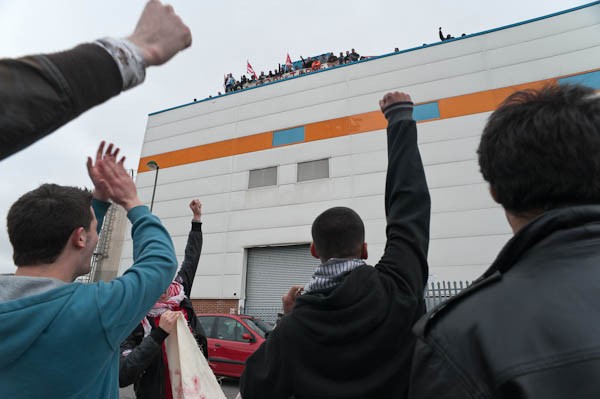
Visteon Occupation Ends

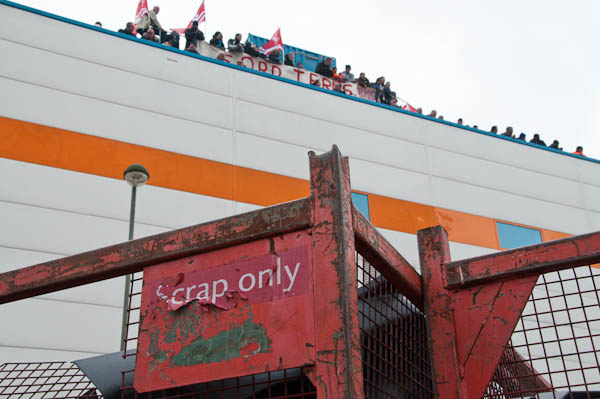
The factory occupation by workers sacked at a few minutes notice by the administrators for Visteon ended on Thursday, and I was there to photograph as they came out of the building.

They were obeying a court order which had named their convenor, Kevin Nolan and demanded that they vacate the premises by noon.  Their action and the publicity it gave had certainly lent urgency to the talks between union officials and the bosses of both Visteon and The Ford Motor Company about a proper settlement for the men, and hopes are still high for some kind of acceptable settlement.

Covering an event like this isn’t just a matter of being there and taking pictures, you need to think about how to show the story and find the pictures to do so. I don’t as a matter of principle set up pictures, but that doesn’t mean I don’t try to use a little intelligence.

How do you show the support by students for the workers?

© 2009 Peter Marshall.

Your thoughts about the company’s position?

© 2009 Peter Marshall.

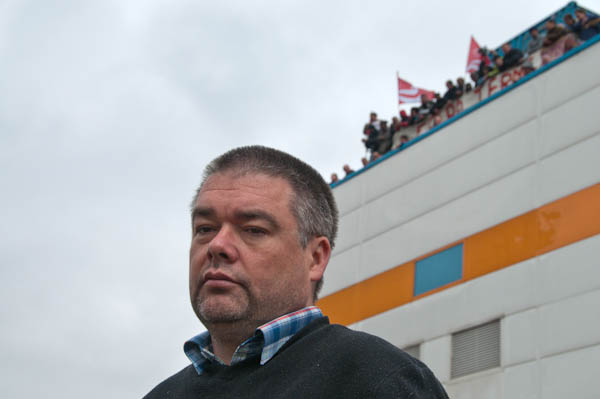
The man leading the action?

© 2009 Peter Marshall.
Convenor Kevin Donal and the occupying workers

Admittedly this picture was to an extent posed – I was standing there as another photographer talked to him and asked if I could take his picture – but that was all.

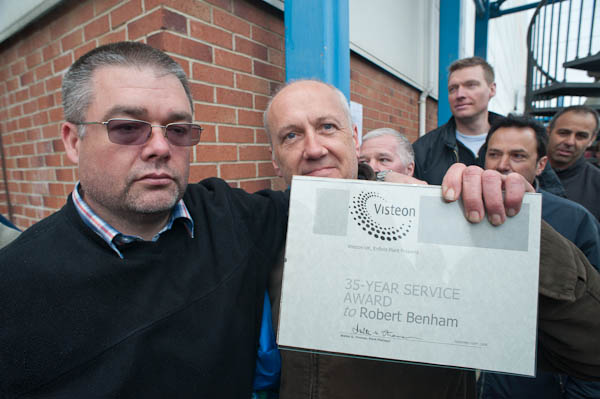
Then there were key moments as the workers came out, as for example when one was holding the certificate for 35 years of good service (over 25 of which were as a direct employee of The Ford Motor Company before they set up Visteon as a part of their enterprise.)

© 2009 Peter Marshall.

What doesn’t show in pictures like this last one is that I was only one of perhaps 20 press photographers and videographers all trying to get pictures, and at moments like this, all trying to get more or less the same picture.  To be successful you need to have thought in advance and got in the right place – and it sometimes takes a little bit of assertive behaviour to stay there, though most photographers do try to avoid getting in the way of others.

On My London Diary you can see more of how I tried to tell the story through my pictures. One of the great things about putting work on the web is that I can do it at some length, while it’s very unusual to get more than a single picture in print.

The action at Visteon isn’t over yet. Although they have come out of the factory, the sacked workers are still picketing the two gates of the plant in an effort to prevent the removal and sale of the valuable machinery on site and to get the ‘Ford Terms’ they were promised when they were transferred to Visteon.

Great Advice, Fine Eyes

Seen on the 100 Eyes blog, a post Great Advice for Photographers, written by Dawoud Bey and originally published on his own blog, What’s Going On.

It’s worth looking at and reading, even if much of it is things we already know (Bey originally posted it as ‘Advice to a Young Artist‘)  and some of it at least we have already taken to heart and put into practice. I’ve also given and written similar advice myself many times over the years, but it’s still good to see it pulled together so well.

Bey’s second point is ‘Put in 10,000 hours’, which may not appeal to those hoping for instant success, but hard work is needed to develop your ideas and to keep on growing. But five years of full-time work (less if, like many artists you are a workaholic) is a good basis for success, though not of course a guarantee.

Another sentence that stood out for me in the piece was this:

Your work should be something that you would be doing regardless of whether the larger market ever responds or not. Making art has to be your own particular obsession.

But what I think comes out time and again in the piece is the importance of working in a community, and taking a part in that community, sharing your work with other people and also sharing your ideas. It’s something that applies not just to the ’emerging artists’ Bey is writing for, but also to the author himself.

When I started in photography, there was very little advice available, and most of us floundered, while a few, often through just happening to meet the right people at the right time, made great strides.

If you’ve not yet seen 100 Eyes, the ‘beta issue’ of a “new web publication aimed at bringing compelling photography to the web” founded by Andy Levin a former Contributing Photographer at Life Magazine who lives in New Orleans, do take a look.  Most if not all of the work in this issue is from photographers in his area, and I particularly liked the grittily abused HP5 of Kevin Dotson, not least because the soundtrack to his slide-show is for once both appropriate to the subject matter and also one of my favourites, Petite Fleur by the incomparable soprano of the great Sidney Bechet. And I’m pleased that we get the full track, although the pictures begin a reprise before it ends.

Hounslow revisited

© 2009 Peter Marshall.

Forty-three years ago I stood more or less exactly on this same spot working on a mildly novel process to produce the dye for the blue-rinse vital to the elderly ladies of Tory persuasion, along with running tests on Kipper Brown, the kind of chemical nightmare that put me off those fish for many years (and according to Wikipedia, is banned in the European Union – except for the UK – Australia, Austria, Canada, United States, Finland, Japan, Ireland, Sweden, Switzerland, New Zealand, and Norway.)

Among the workers on the factory floor were quite a few Sikhs, and in the packing department in particular they could be found stained every colour under the sun depending on which particular product they were handling. I don’t know if it was Health and Safety laws or simple economics that led to the closing of the factory – I returned rapidly to twentieth century chemistry elsewhere, though there had been a certain fascination in handling dyestuff samples in bottles signed personally by Sir William Henry Perkin, the founder of the modern chemical industry with his synthesis of mauveine, the first synthetic dyestuff, in a crude laboratory at his home Cable Street in 1856 when he was only 18 – though our samples were from his later works at Greenford on the sometimes curiously coloured Grand Union Canal.

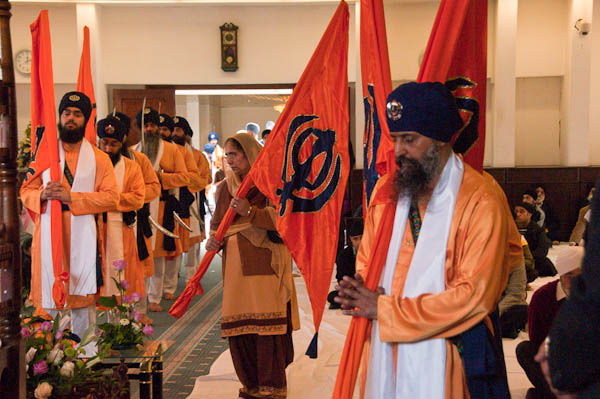
For whatever reason, the dyestuffs factory is long gone, and in its place is the Sri Guru Singh Sabha Gurdwara, and I was there to photograph their Vaisakhi celebrations.  I walked in, took off my shoes, put on a saffron rumāl (headscarf – something extra for my camera bag at this time of year) and went to the Gurdwara office and told them I would like to take photographs in the Gurdwara. Of course, they said, that’s fine. You can photograph anything you like, anywhere. If only everywhere was like that.

And it was true, I could, and everyone seemed to like being photographed. You can see the results on My London Diary in Vaisakhi in Hounslow.

It was hard to refuse all the food I was offered and by the time I’d finished taking pictures I was rather full, and I hate to think what my blood sugar was, although I did refuse most of the sweets.  Working with the SB80DX was a little tricky too, and not all the flash exposures were exactly what I expected. The last time I was without an i-TTL flash unit I managed to work out a fairly reliable method to do it, and I really should have revised from my Using Your Existing Flash with a Nikon before leaving home!

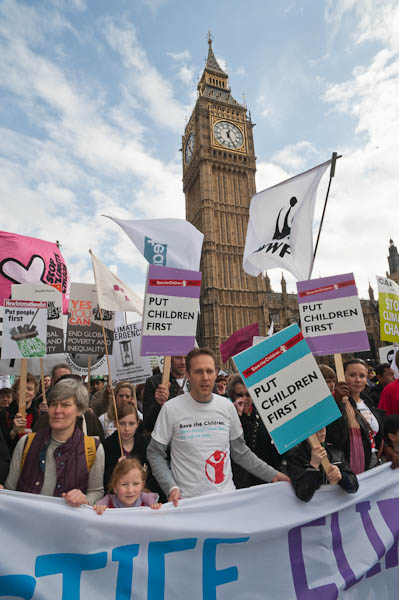
Jobs Justice Climate: Put People First

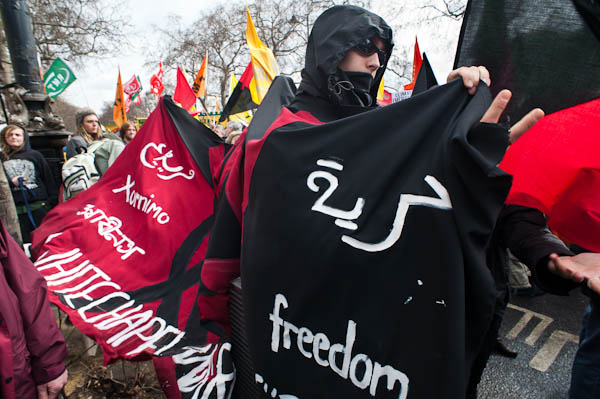
The G20 meeting in London’s docklands this Thursday brought protesters out in force on to the streets of London on Saturday, as well as prognostications of violence and doom for April 1 and 2 from the authorities and some of the gutter press. But the first major event, backed by over 150 groups and attended by around 50,000 people turned out to be entirely peaceful, if rather chaotic.

© 2009 Peter Marshall.

Police led the front of the march at a brisk walking pace, although I managed to sneak in and slow it down a little while I took pictures as it passed the Houses of Parliament, but the groups behind had problems in keeping up, with a number of large gaps developing – so the front of the march reached Hyde Park around two hours before the tail. The major hold-up was apparently caused by a police over-reaction when a few anarchists staged a sit-down.

© 2009 Peter Marshall

The march was enlivened by a little theatre or various kinds, but almost everyone was on their best behaviour except for a curious incident at Speakers Corner where the alternative end of march rally was being held. People who were there report that a mysterious figure in black dumped some tightly wrapped packages and moved quickly away. When some of the demonstrators investigated these and found them to contain catapults, they kicked them into a fenced off area away from the protest.  Before long, a police officer who seemed to know exactly what he was looking for came and found them.

© 2009 Peter Marshall
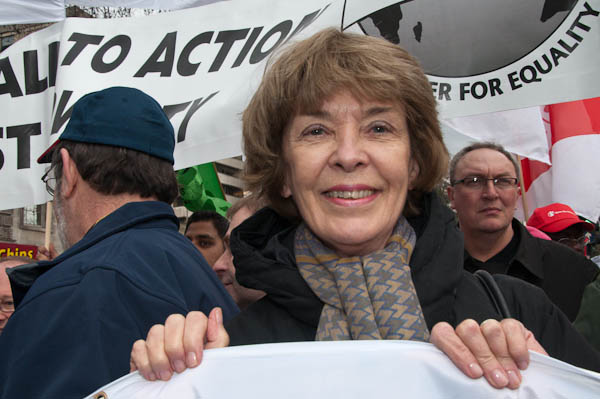
Susan George, whose books include ‘How the Other Half Dies‘ (1976)

You can see quite a few of my pictures of the event on My London Diary, though I’ve not yet had time to complete all the captions, though there is a little more about the event there.

Fontcuberta interview on Lens Culture

Although I’ve known the work of conceptual artist Joan Fontcuberta for years, it was only in 2007 that I met him in person, when he was showing Landscapes without Memory at the FotoArtFestival in Bielsko-Biala where I was speaking.

Although I wasn’t impressed by the work that he was showing –  computer generated landscapes that seemed to me of no photographic interest and not essentially different from the ray-traced images that I had seen many others – including my own sons – produce in the past, he gave a superb presentation particularly about two of his projects which it seems to me achieve an exceedingly rare successful combination of the photographic and conceptual.

Most impressive for me was his collaboration with Pere Formiguera – Dr Ameisenhaufen’s Fauna and I was also very impressed by the Sputnik Project.

On Lens Culture you can see a selection of his images, including some from these projects (and some of those I find of less interest) and also listen to a 20 minute audio interview made by Jim Casper with Fontcuberta in late 2005 in Paris. It repeats much of what I heard him say in Poland, but if you’ve not hear him talk about his work is well worth a listen. (You will need to make sure your browser allows the site to pop up a window to listen to it.)

Vintage?

I’ve written on various occasions over the years, here and elsewhere, about the cult of the vintage print.  As a photographer I find it ridiculous that people might regard the prints that I made thirty years ago more valuable than the far superior prints that I might make from those same negatives now.

We all of course get older, and some may get wiser, and certainly for many of us our ideas change, hopefully gaining in depth and insight. While those old prints we made back then simply degrade, our ideas mature and we can add to the work when we make new prints.  Valuing the older prints seldom makes sense.

Of course there may sometimes be aesthetic reasons for preferring the older work. In the immediate post-war period, Bill Brandt printed his work in an intense and moody fashion, at times because he was working for the block maker rather than the wall, knowing that a lower contrast and perhaps rather dull image was more suitable. He was working for the printed page rather than the print.

Later, as he aged, he turned to making much more contrasty prints, sometimes with very little in the mid-tone area. It was an age where the fashion was for high contrast high impact photography, particularly on the magazine page (though its arguable whether Brandt was a follower or helped to create this trend.)

Personally I loved the earlier dark and brooding versions of many of his pictures, far preferring those – for example in the first edition of his ‘Literary Britain’ to the later prints (yes, I do mean I prefer the book reproduction to the photographic prints.)  The first edition is also in most respects preferable to the later publication – though each has its merits and I have both.

But my preference is nothing to do with one being older than the other – vintage as opposed to later. It’s all about the actual quality of the work, and it is a fairly rare occasion where the early work is better. I’ve often been shocked by the poor quality of some high-priced ‘vintage prints’ on dealers stands at shows like Paris Photo – often prints made as proofs or press prints or even apparently rescued from the photographer’s rubbish bin.

Usually later prints are better prints, not least because of the availability of more sophisticated printing methods. For many photographs – and a good example would be the work of Tony Ray Jones – the ability to produce high quality scans and to print from these rather than direct from the negatives has produced superior results, not least by allowing far more precision in the dodging and burning required to get the most out of the images.

And ten years ago we were bemoaning the demise of so many classic high-quality black and white photographic papers, not least the famed Cadmium-rich Agfa Record Rapid, which after its reformulation on health and safety grounds never had quite the same appeal. But now we have papers and inks that can match or outdo virtually everything that was available in the ‘golden age’ of silver printing.

I own several Tony Ray-Jones prints.  One is something relatively rare, an exhibition print made by Ray-Jones  himself (he hated printing and wasn’t good at it, though this is an acceptable attempt), the rest are modern inkjet prints. And they are better prints despite only costing a few pounds.

It was a piece I read a week or so ago by Mike Johnston on The Online Photographer that prompted me to write again about this subject.  He finishes it with his thoughts on the subject that the should be only two things that matter about a photographic print; firstly whether it was made or approved by the photographer and secondly that it is a good print.I think I’d reduce that to one.

AIG fails again

Stephen Mallon, a New York industrial photographer took some remarkable pictures of the recovery of the US Airways Flight 1549 from the Hudson River for the crane company that lifted it out of the water. It was a great opportunity and he got full co-operation from everyone involved and took 5000 images, which his client was happy to allow him to publish non-commercially on his blog or anywhere else.

On The Online Photographer you can read as I did a story with many long comments about the letter he received from one of the largest rercent business failures, AIG, who apparently have used some of the massive support they are getting from the US taxpayers to get their lawyers to write a letter forcing Mallon to take the pictures off-line.

You can see some posts about this by Mallon on his web site, and the hole were they were is currently filled by a short notice about their removal. Elsewhere on the web you can see many sites with comments about this fine set of pictures, and at the moment there are still some of them on line so you can see it was indeed a pretty remarkable set of work.

On Eric Lunsford‘s blog there are two large images, one of the actual plane body being lifted. This is also on Stellazine, Stella Kramer‘s blog. It’s worth reading what she says, both about this as an attack on free speech and on the pictures themselves: “Stephen Mallon’s photos are a thing of beauty, and show not only the fragility of such large machines, but the truly heroic work done by those who pulled it out of the icy Hudson.” She is after all a Pulitzer Prize-winning photo editor who has worked with publications including The New York Times, Newsweek, Sports Illustrated and People magazine.

Doobybrain has another six images, and on PDN, who have also covered the story, you can still see the picture they published as their picture of the day in February. I suspect that the lawyers might well try to get some of these removed also, so don’t wait too long before looking at them. I think all of these sites are based in the USA, and it might be good to see as many of his pictures as possible posted on sites in other countries.

It isn’t at all clear what AIG are trying to do, and why they are using their immense legal clout to try and hide this fine work. But I think all of us involved in photography need to speak up and oppose them.

Bohemian Musings

One photo blog I don’t think I’ve come across before is ‘Thoughts of a Bohmenian‘ which describes itself as ‘Another Photo Industry blog‘. What led me there was a Twitter post by the writer of a blog I do occasionally read, ‘A Photo Editor‘.

In case you are wondering about the title, Paul Melcher‘s title for his blog came from hearing the comment about photography “This business has too many Surveyors and not enough Bohemians” and deciding to do his bit to redress the balance.He certainly has a nice turn of phrase (if his speed-spelling isn’t up to scratch) in his post  ‘Please, save photography

Like me he saw the pictures on Magnum  in Motion shot from TV by Alex Majoli and was apalled that Getty Images were rewarding him with a $20,000 grant, but I didn’t think to say “Henri Cartier Bresson must be having a tsunami in his grave as I can assure you, that was NOT the reason he created Magnum. Not for that kind of nombrilistic, uber self-absorded, hyper refflective intello photography.”

Photographing a TV isn’t of course a new thing. Last November I rested my feet during a tiring walk around Paris in front of a screen for another Magnum photographers work, Harry Gruyaert’s TV Shots, on show in the Passage du Desir gallery space, and found myself thinking “that I would have found it much more interesting if Gruyeart had gone out and taken his camera with him” rather than sitting home and wasting colour film on a malfunctioning TV.

One photographer who did it back in the ’70s to some effect was Paul Trevor, who while working with ‘Exit‘ on their great documentary project, Survival Programmes, turned around and photographed the very different world that came to him through the TV as ‘A Love Story‘.

And of course, Gruyaert and Majoli do both go out and take pictures. Don’t waste time on Peace TV but do watch Requiem in Samba, also on the Magnum site.

Melcher’s comments came after reading about the ‘Save Photography‘ campaign organised by the French photographic organisations the Union des Photographes Créateurs, FreeLens and the SAIF ( Socièté des auteurs des arts visuels et de l’image fixe.) Their concerns are largely about the falling rates, microstock, orphaned images and so on, as well as some specifically French worries about the legal status of photographs, and as he comments, in typical French style they don’t suggest any solutions but just ask the government to do something about it.

So Melcher’s suggestion is that they should doing something about the quality of photography and get down to saving photography not just by asking the French government to do something but to stop people promoting what he calls “salon photography.”

Paul Graham wins

I wrote my thoughts about the four contestants for the Deutsche Börse photography prize at the London Photographers’ Gallery when the show opened.  You can read them here.

I’ve seen it again since then. But I wouldn’t want to change a word.

Here’s a recent interview with Paul Graham on PDN in  which he says some sensible things, particularly about digital and film still having all the important challenges in photography the same, as well as about documentary – with a nice little quote from Walker Evans.

As he said, it was about time the prize went to a UK photographer – even to one who has moved to New York.