NY Times Photo Blog

I have a certain regard for the NY Times – and after all it paid my bills for a few years recently when I worked for one of the companies it owned. It’s certainly one of the papers I look to as a paper of record and have often linked to, example when I wanted to know more out about Boris’s Turkish great-grandad. They obviously have an excellent photo-editor, and some of the features they’ve commissioned about photography and photographers have  certainly been of interest.

So it’s not surprising that their photojournalism blog, LENS, introduced on May 15, has some decent work on show. Just a shame that the unusual design makes it so difficult to find it.  Blogs – and browsers – are just not made to scroll sideways.

Of course you can – as many do for this blog – rely on a RSS feed to let you know what is there, but LENS is a fairly active place, and the feed only displays the last ten posts – three or four days.

LENS isn’t perhaps a very good choice of name either. Too generic, this site doesn’t at the moment get on the top page of ten when I google it.  >Re:PHOTO or Re-Photo brings this site up as No 1 as it should be!

And perhaps too many of us will be wondering who Len was anyway or if it’s a site for wearers of small glass discs on the eye or that town in France or…  But I am pleased to see that Lens Culture still came above it in my Google search.

One post worth a look (there are others) is  by Ozier Muhammad, “58, a staff photographer for The Times, has been photographing Harlem since he moved to New York in 1980.”  Its perhaps unfortunate that this work is only present as a slide show, making it difficult to pick out individual images and meaning that those who haven’t got 3 minutes 40 second may miss some of the better work. It’s a nice slide show, but I’d like also to be able to the thumbnails and jump to the work I want to see, or at least to click through the pictures at my own pace.

Incidentally should anyone be wondering why this site is called >Re:PHOTO you can read a little more about it and me on the About >Re:PHOTO page

Pericles Antoniou – Case Dismissed

Police failed to offer evidence against Greek photographer Pericles Antoniou when the case against him for taking photographs on the tube came up at Westminster magistrates yesterday (18 May) and so the case was dismissed.

Good news for Mr Antoniou – and the Greek Embassy report he is to be compensated for his legal and travel expenses, which is a start. But it would be good to see some investigation of the activities of the Transport Police – in particular over the claim that he was refused the right to see a lawyer, as well as some compensation for what appears to be wrongful arrest and holding overnight.

The Transport Police, according to the report in The Register,  deny this claim, but then they also deny that they failed to submit evidence to the court. It is possible that whatever evidence they did supply was judged by the magistrate to be insufficient – or perhaps just irrelevant. I’m not a lawyer, but it would seem to me that the section of the law under whichMr Antoniou’s  was charged simply does not cover what he was doing – see my earlier post Greek Tourist Arrested for Photography on Tube for the text of the Act.

The Register article also brings up London Underground’s policy on photography on their property.  They want to make money from photographers by insisting on a licence for any professional photography on underground trains and stations. In practice you need – as always – a licence for film crews to work or for commercial shoots, but as it says on the TfL site:

Do I need permission to film or take photographs on the tube?If you are just passing through, you shouldn’t have a problem taking personal snaps, souvenir shots etc, although you must NOT use flash or lights on any of our platforms.

However, if you want to spend more than 10-15 minutes at any one station videoing or taking photos, or if they are for professional use, you MUST have a permit.

Perhaps now they really should add a footnote that if you are Greek you can expect to get a day in jail. And TfL should really amend the advice given in their ‘Guide to Filming’, which they say “should tell you everything you need to know about filming or taking photos on the Tube” but states:

Any individual or film production company wanting to film or take photographs on the Tube must seek prior permission from the London Underground (LU) Film Office.

You can also read more about the photography policy in the staff manual, quoted on the ‘Banditry‘ blog:

10.1 Passengers can take photographs with small cameras for private purposes, provided
* flashlights and/or tripods are not used
* No obstruction or inconvenience is caused to staff and/or passengers.

10.2 Representatives of the media, press or photographic agencies and film companies, and other persons taking photographs for commercial purposes must first get permission from the Press Officer.

It is perhaps unfortunate that the case did not come before the court, as it would have been useful to get a clear decision against the use of the Public Order Act in this way. I hope that the Greek Embassy will pursue the details of the arrest and that the Transport Police will conduct an enquiry and take suitable disciplinary action against the officers concerned, but I’m not holding my breath.

Greek Tourist Arrested for Photography on Tube

Pericles Antoniou was a tourist from Athens on holiday in London with his wife and 14 year old son, and the first I heard about his him was on the British Journal of Photography web site. Antoniou is a keen photographer and started taking some pictures on the tube around 11.30am on Thursday 17 April, 2009. A woman complained after he took pictures of her young daughter, and he apologised to her, showed her the pictures and deleted them as a courtesy to her.

At the next station, the father of the girl called the police, who arrested Antoniou, locking him up and keeping him in a cell in solitary overnight. They did not allow him to communicate with his family or anyone, and he does not appear to have been given any access to a solicitor. On Friday morning he was brought to the magistrates court, and accused under the Public Order Act 1986 of public harassment that might have caused fear and stress to the people around him.

The relevant section of the Act appears to be section 5:

(1) A person is guilty of an offence if he:

(a) uses threatening, abusive or insulting words or behaviour, or disorderly behaviour, or
(b) displays any writing, sign or other visible representation which is threatening, abusive or insulting,

within the hearing or sight of a person likely to be caused harassment, alarm or distress thereby.

And one of the statutory defences is:

(3) The conduct was reasonable.

And certainly I would hold that taking photographs is a reasonable act.  An offence under this section would carry a maximum fine of £1000.

Antoniou pleaded not guilty, and the case was adjourned. The police have kept his camera.

As he says in his letter to the Greek Ambassador (as translated on Facebook where a support group has been set up) :

It is inconceivable for one to think, in the country where Bill Brandt, Martin Parr, Killip were born and their works are based on street photography, that I had to be humiliated and accused of taking photos (!!!) while being in the Metro – subway. It is noted that in the National Portrait Gallery there is a photo exhibition currently which is about photos taken of people in streets!!!” (sic)

Mr Antoniou appears to me to have been wrongfully arrested and to have been denied his legal rights by the police, and unless the  case is thrown out when he appears in court again on May 18 it would set a very worrying precedent threatening the whole future of photography in public in the UK.

I’d also hope that he will be able to make a considerable claim against the police for wrongful arrest.

30

30 – photographic show at the Shoreditch Town Hall, London, open 10-6 until 2 May 2009, is a show by 30 photography students from the University of Westminster, where ‘producing a photographic show’ was a module on their course.

You can see some of their names with an example  of their work on the 30 blog,  and if you are anywhere within distance I think it’s a show worth seeing, both for the impressive range of work on display, but also for the location itself.

Where else can you see a film of a bride and groom projected above a urinal, images made to fit in a room with the floor half dug up and a large brown earthenware pipe and much much more, and some of the pictures simply pinned up on decaying walls are well worth a look.  This was an exhibition I really enjoyed visiting, which is more than you can say for many at more prestigious venues. It has a liveliness that makes the current offering at the Photographers’ Gallery I visited the previous day seem extremely sad.

It’s good also to see a student show with such a wide range of work, rather than some that seem to be largely a series of clones of a particular tutor or small group of tutors.  There is certainly a lot of talent here, though perhaps a little depressing to reflect that with the current state of the market for photography nearly all of them will end up doing other things for a living. Of course that isn’t necessarily a bad thing and I’m sure that photography will continue to enrich the lives of many of them – and of others who will continue to enjoy their work.

Don’t put off going to see this – it ends this Saturday. Here are a few of the pictures I took of the location and the work on display.

© 2009 Peter Marshall.

© 2009 Peter Marshall.

© 2009 Peter Marshall.

© 2009 Peter Marshall.

© 2009 Peter Marshall.

© 2009 Peter Marshall.

© 2009 Peter Marshall.

© 2009 Peter Marshall.

© 2009 Peter Marshall.

Where was St George?

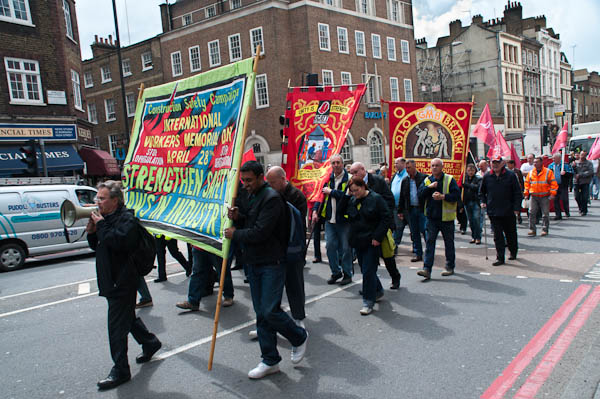
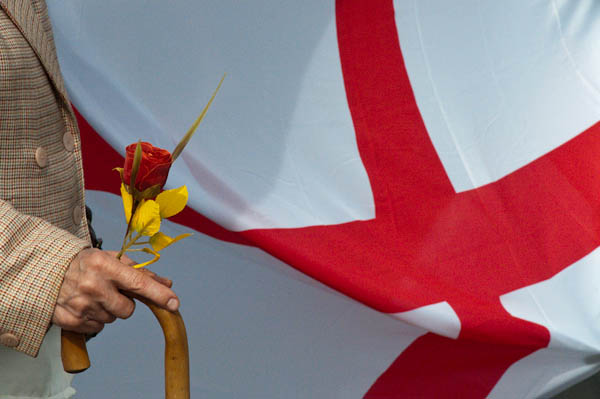
I spent much of the day on April 23 looking for St George around the centre of London, and was largely disappointed. Celebration of our patron saint’s day still seems to be pretty low key, and I found a handful of members of the English Democratic Party in Trafalgar Square trying to drum up support for a national holiday every April 23. At least this year – unlike last – they were allowed to visit our National Gallery in the square, which was also putting on some related events. Apparently last year they were refused entry for wearing the national flag.

© 2009 Peter Marshall.
Looking for St George’s Day in Trafalgar Square – more pictures

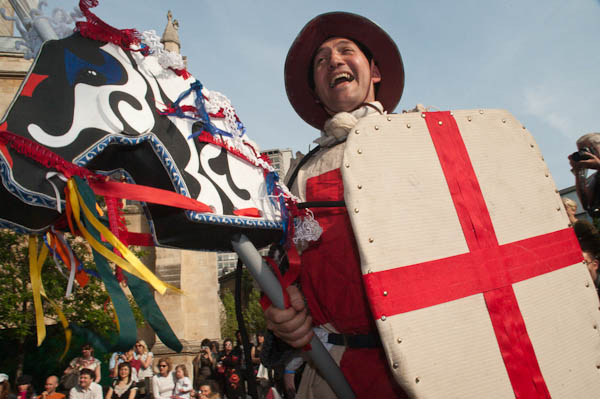
Others were in the square expecting something to happen, but without success, though when I returned later things were a little livelier. Meanwhile I knew that the theatre group, The Lions part, were giving some performances during the afternoon in Southwark and I went to take some pictures of St George and the others there.

© 2009 Peter Marshall.
The Lions part: St George (& the Dragon – more pictures)

There were other things going on that I missed, some on purpose. Boris took a trip to the City for some cheap publicity, and Southwark Cathedral and St Georges Church were also marking the day with events.

© 2009 Peter Marshall.
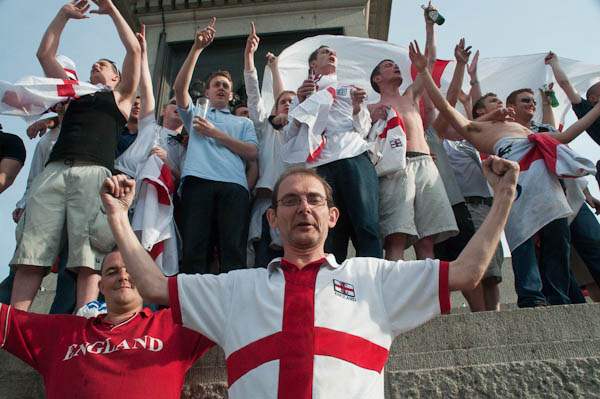
England Supporters – More pictures

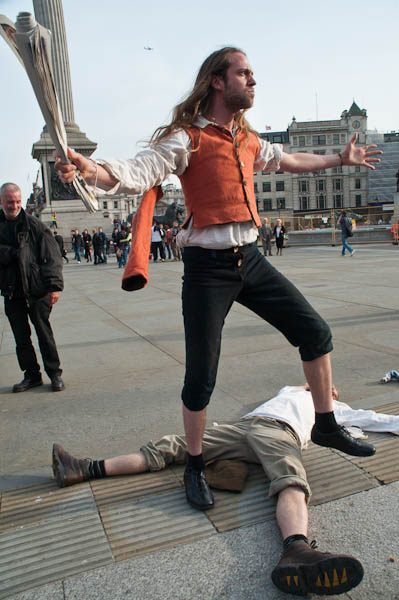
I went back to Trafalgar Square on my way to the Photographers’ Gallery, and found around 25 young people having a noisy time on the plinth below Nelson, and then another theatre group who had come out from their show in the National Gallery decided to put one on in the square also – with a little more audience participation than they are used to.

© 2009 Peter Marshall.
St George is defeated by the Turkish Knight, while ‘Lucozade Man’ looks on. More pictures

The latest show at the Photographers’ Gallery didn’t detain me long, though as always I read the texts and looked at the pictures and other objects. As before the most interesting work was on around the edges, in the print room (including a couple of nice prints by Thurston Hopkins – which reminded me very much of my own games on the streets in the 1950s) as well as work by Guy Tillim I’ve mentioned before.  Although I appreciate a wide range of work across all the genres, the PG doesn’t seem to be showing much of quality outside the odd bit of photojournalism these days.

In the main show, the work of Gerhard Richter stood out rather more than head and shoulders above the rest (perhaps from the ankles up?) , though I don’t think the small photographs which he has over-painted actually have a great deal to do with photography or being a photographer – and there are some rather more interesting examples on the web site.

One of those admiring Hopkins work with me was  Shimelis Desta, formerly the court photographer to the Ethiopian Emperor Haile Selassie, some of whose work was shown in the Photographers Gallery in 2007. You can see a CNN film about how he managed to get this work out of the country on YouTube. He tells me that he has more interesting images than those that were chosen by the curators for that show, so I hope that one day we will see more of his work.

Slough Vaisakhi

The Gurdwara Sri Guru Singh Sabha in the north of Slough is around ten miles – an easy bike ride – from my home, though I always do an extra half mile or so. Slough isn’t a place a visit too frequently, and something about it means I always get lost, despite knowing exactly where I want to go.  Somehow, as usual, I end up in the middle of town on the wrong side of a wide road with a fence down the middle, and have to divert and cycle through a subway.

Fortunately I’d left home early, and arrived in plenty of time, well before much had started to happen. Photography often involves rather a lot of hanging around and waiting, because it isn’t much good arriving with your camera after things have happened – and the only time I’d come to Slough to photograph the Vaisakhi celebrations before I had been just a little late.

Being there early did give me the opportunity to go inside the Gurdwara and take a look around, and as well as taking a few pictures get to know my way around and talk to people.

© 2009 Peter Marshall.
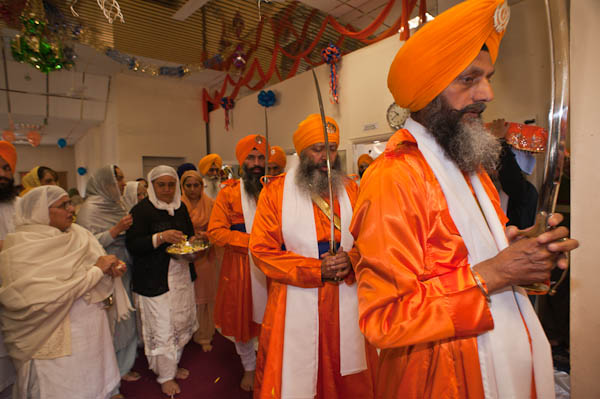
The Panj Piyare process from the prayer hall, swords raised

© 2009 Peter Marshall
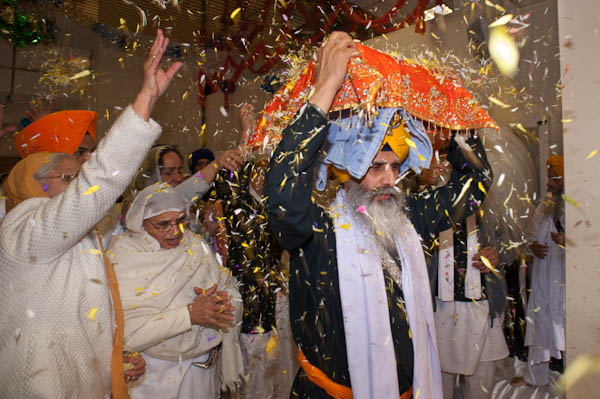
Women throw flower petals at the Guru Granth Sahib

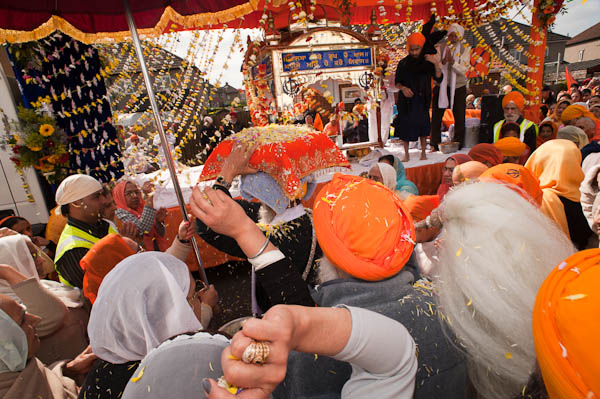
I was at the top of the stairs when the procession came out of the prayer hall and made its way down and out to the crowds waiting below; all the time women were throwing flower petals over the Guru Granth Sahib and I joined them to take pictures from their viewpoint as the scriputres were carried to the waiting float.

© 2009 Peter Marshall.

Most of the pictures inside were taken with a 20mm lens on the Nikon D700, and this enabled me to work in rather crowded conditions. The 20mm is a nice compact lens too, and although in some ways I’d prefer a wide zoom, I’m getting to like working with a fixed lens again.

This was the first real set of pictures I’ve taken with the Nissin Di622 flash, and I was impressed. It just worked, and seemed to keep up rather better with my fairly rapid shooting than the SB800 generally does.  I simply put it on the hot shoe, flipped out the diffuser to cover the wide angle and shot in ‘P’ mode, moving from indoor exposures of 1/60 at f5.6 to outdoors at 1/250 at f18 (at ISO 400.)

I’d tried shooting inside with available light earlier, and at ISO 2000 could work at around f4 and 1/100, but the colour was poor with the fluorescent lighting. On the stairs light levels were higher with a large window adding daylight, but the mixed lighting seemed an added problem. So flash seemed the obvious choice, although I felt a little obtrusive using it. But my previous experience photographing at other Vaisakhi celebrations and a Sikh wedding was that this was unlikely to present a problem to those I was photographing. And I did really want it for those petals.

More pictures from the event – many of those outdoors taken with a Sigma 18-125mm on the D300 – on My London Diary. The Sigma – which I’ve had for a few years – seems more robust than the Nikon 18-200mm, and has similar image quality – very usable rather than really superb. It lacks the VR of the Nikon lens, but I seldom seem to see much benefit from this in practice – and certainly not on sunny days. I have less focus problems with the Sigma, and its one fault is that the zoom ring works in the wrong direction.

Working with two bodies again does make life easier in most ways – though I wish they were lighter and came with straps that could never get entangled!

Stop Police Brutality

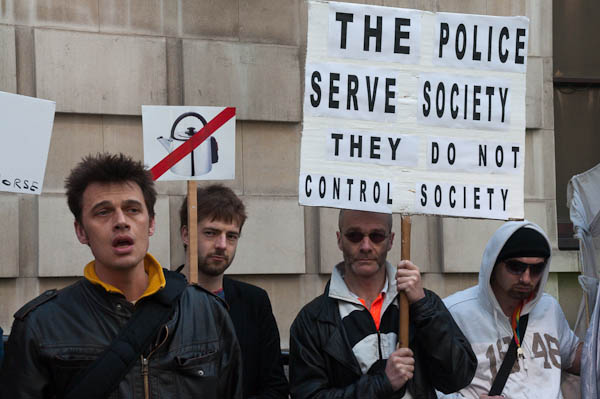
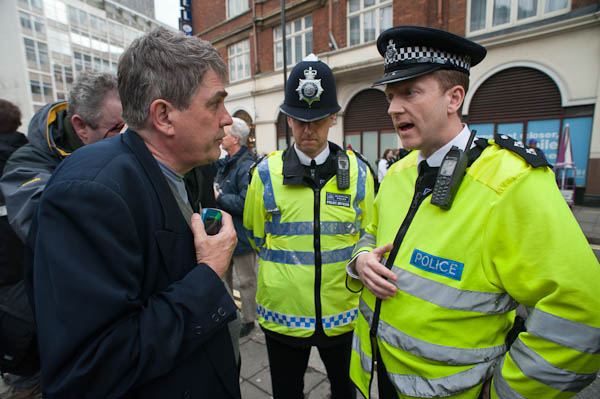
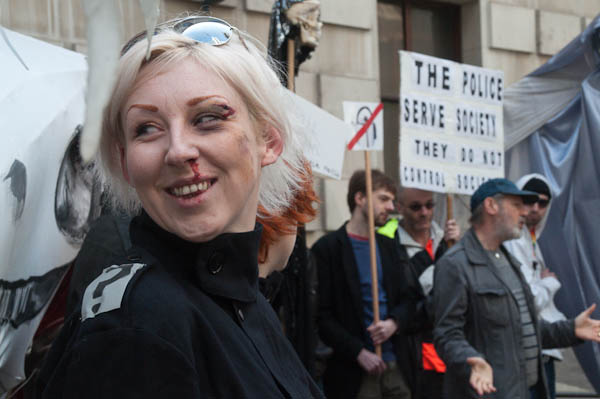
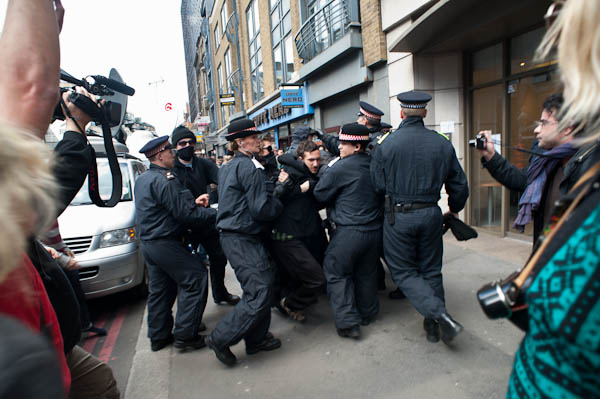
Last week I photographed two demonstrations against the police treatment of demonstrators, particularly at the April 1 demonstrations in the City of London, but also more generally.

There does seem to be a growing realisation that the police over the last few years have changed the emphasis in their policing of protests. The setting up of the para-military Tactical Support Group, trained and equipped for street combat, and the increasing use of surveillance techniques, including CCTV and the intentionally confrontational use of photography by the Forward Intelligence Teams have led to a raising of the temperature of inevitable friction between police and protesters. A temperature that “kettling” then increases to further heights until things too often boil over.

Increasing the police appear to see this as a battle, and come prepared, mentally and physically for a fight. The TSG in particular tend to stand like a group of thugs, bouncing on the balls of their feet, rubbing fists in palms, itching for a fight. It isn’t how I want police to be. As a placard on Saturday reminded us “The police serve society – they do not control society“. That’s how it should be, but increasingly not how it is.

© 2009 Peter Marshall.

Of course a part of the problem is legislation. Poorly thought out knee-jerk reactions to terrorism which have done little if anything to increase our security but have led to hundreds of highly publicised raids and arrests, but very few charges – and even many of those clearly unfounded, and thrown out by courts.

Police campaigns to increase paranoia – particularly against photographers – haven’t helped. Nor has the campaign they have mounted against the press, which was very evident on April 1, with injuries to a number of my colleagues. They also threatened many journalists with arrest to try to clear them away at Bank, apparently because they didn’t want witnesses to the use of police dogs on the protesters.

© 2009 Peter Marshall

One piece of legislation that has led to more friction than any other is SOCPA, where late additions were made to an act dealing with serious organised crime with the intention of outlawing the protest in Parliament Square by Brian Haw. The act failed to stop his protest but made it an offence to protest in a wide area of Westminster without getting police permission in advance.  Its main effect has been a vast increase in the number of demonstrations – both legal and illegal – many directed at the act itself, with a few unfortunate individuals being targeted for often rather dubious prosecutions.

At the protest outside New Scotland Yard on Wednesday evening, police pointed out to the organisers that their protest on the wide expanse of pavement outside the building was illegal, and asked them to move to the other side of the street where it would be legal.  The very narrow pavement there made such a move impractical, and unsurprisingly when the matter was put to the demonstrators they were unanimous in deciding to stay put.

City of London Police were rather more relaxed at the demonstration outside their Wood St headquarters on Saturday morning, attended by three of the large ‘Four Horseman of the Apocalypse‘  puppets from the April 1 carnival at Bank and the remains of the fourth destroyed there. Some of the protesters also showed signs of the attacks by police on demonstrators there and on the even more peaceful Climate Camp in Bishopsgate.

© 2009 Peter Marshall

More pictures and details of events at New Scotland Yard and City of London Police HQ on My London Diary.

G20 Bank Videos

More and more videos are coming onto the web giving a fuller view of the protests in the City of London on April 1, and in particular of the way the police handled the demonstrations.

The Guardian was of course the first to feature the assault on IanTomlinson just before his fatal heart attack, and among the other highlights there is a short clip by Jason Parkinson,  showing police carrying out a baton charge on press photographers. Another clip by Jason records police threatening press photographers under Section 14 of the Public Order Act, telling them to leave the scene and stop taking pictures – or be arrested (they later issued an apology for this.) Others worth viewing include Rikki Blue‘s footage of riot police attacking peaceful demonstrators at the Climate Camp in Bishopsgate.

If what happened at Bank and in Bishopsgate can be called riots, on the evidence of the videos the rioters are mainly the police, although you can clearly see a few minor incidents involving demonstrators in the videos. The breaking of windows at the RBS was an isolated ocurrence, which involved few people and was soon abandoned. On Jason Parkinson’s blog you can see a good impression of rather more of a riot at in Strasbourg where the NATO summit was taking place on April 4. This is serious stuff, where the photographer’s kit needs to include helmet, gas mask and body armour.

Here in London things are usually more sedate, and only the police get kitted up with riot gear, (which always seems to alter the way they behave)  although photographers may well need to rethink after April 1. Another video of the events by Ollie Wainwright on Vimeo includes footage of David Hoffman, a veteran photographer perhaps best known for his pictures of the Poll Tax Riots, being attacked by a policeman using a riot shield to beat him in the face. There is a lengthy slideshow of his pictures of the day on his web site.

Hoffman bets that no other photographer used a senior citizen bus pass to get the the event, and he may be right, but only because I chose to walk from the station as I was early and to take the underground when I left early to go to the peaceful march in the West End.  The pictures that I took before I left give a good impression of the kind of peaceful demonstrations that the organisers of both the G20 Meltdown and the Climate Camp had planned and were taking place before the police intervened.

© 2009 Peter Marshall.

There were perhaps 5-10,000 peaceful demonstrators in the City and probably less than a couple of hundred who had come with the intention of making real trouble. Sensible policing would  have isolated the troublemakers rather than attacking everyone indiscriminately.

Photoshop – Several Steps Too Far?

A day or two ago I came across a link to a feature on the Danish Press photography site, Pressefotografforbundet, which was an English translation of an earlier post about the Danish Pictures of the Year competition. Klavs Bo Christensen who had sent in pictures on a story he shot in Haiti had been asked by the judges to submit his RAW files for the images concerned, and they had then decided to disqualify his work.

The competition rules state that pictures entered:

must be a truthful representation of whatever happened in front of the camera during exposure. You may post-process the images electronically in accordance with good practice. That is cropping, burning, dodging, converting to black and white as well as normal exposure and color correction, which preserves the image’s original expression.”

Having seen the work – which is on the site –  I’m surprised that it’s disqualification has aroused any controversy. It clearly – at least to my eyes – goes far beyond what I would consider “a truthful representation” and takes the work more in to the province of illustration rather than of photography.  Had I been one of the judges I would have turned it down as inappropriate without feeling the need to examine the RAW files.

RAW files are not of course image files, and need suitable processing. In the article this is done as a comparison to the submitted images using the default setting of Adobe Camera Raw, and clearly a little more is needed on all three images shown. Unless I’m in a tearing hurry, I seldom accept the default ‘Autotone‘ result from Lightroom. As I used to in the darkroom, I’ll often do a little dodging and burning, and with the digital file I’ll usually also take advantage of the ease with which you can open up the shadows a little.  The default settings often compress the highlights rather more than I like, and again I’ll correct this. And the auto setting normally fails to produce either high key or low key images and should I have been aiming at these effects, a more drastic tonal rearrangement is called for.

I may not get it right, but my aim is always to produce images that look photographic, where the viewer essentially isn’t aware of the process but in a sense feels they are looking through the picture to what is depicted, retaining the essence of the photograph as some kind of a trace of the original scene. For me the photograph is very much a ‘window’, although I always felt that Szarkowski was totally wrong to suggest that it could not at the same time be a powerful ‘mirror.’

Of course it has always been possible to use photography in different ways, for example to give a negative of the scene, or to solarize or posterize the image. But such graphic effects are designed very much to distance the photographically produced images from the original photographic expression, what we might call an experimental approach rather than the realist approach that is central to photojournalism and documentary work.

So I’m 100% behind the judges. This work, with its extremes of saturation and local contrast should never have been entered for the competition. There have been some images in other competitions – even World Press Photo – that I’ve thought perhaps have gone a little beyond the acceptable, but these are more extreme.

I’m not saying that they are bad pictures, but that the treatment is unsuitable for the purpose. If pushed I would say that two of the three shown clearly don’t work very well, and although the default conversions from RAW do still need a little tweaking, clearly there is a better photograph that could have been made from them than the pictures the photographer sent in. With the third, the bottom image on the page with a yellow chair and a blue concrete beam, this graphic treatment is rather more successful. It is also rather harder to tell from the default processed RAW file exactly what a more photographic approach could have achieved from this file.

These pictures were taken up yesterday on The Online Photographer, where there is quite a lot of discussion both of yesterday’s post and a follow-up today.

As Mike Johnston says there “If you like the wretched excess of the overhyped, overcooked style, go for it—it’s your hobby; you own it. They’re your pictures.”  And there are certainly plenty of people on Flickr who do seem to like it. It makes me cringe, and it certainly isn’t appropriate for photojournalism.

Stop Sri Lanka’s Genocide of Tamils

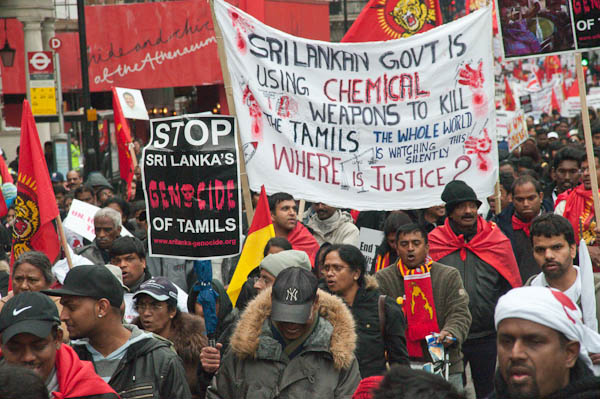
The British Tamils Forum organised another massive protest march in London on April 11th, marching from Temple to a rally in Hyde Park. The march began around 1.30 pm, and  by the time I left around 4.15pm stretched most of the way from Westminster to Hyde Park.
© 2009 Peter Marshall.

When even the police give an estimate of numbers as 100,000 you can be sure it is a very big march, and as the crowds were generally pretty solidly packed there seems little reason to question the independent estimates of around 150-200,000 people.

The vast majority of them were Tamils, with probably only a few hundred white faces. There didn’t seem to be a great deal of media interest, and I saw no photographers from major newspapers or news agencies and no cameras from major UK TV stations. It was such a large event that I could have missed them, but usually at the start of marches there is a crowd  of media in front, while on Saturday there was just me, three other photographers, none of whom get regular work for the mass media and a Tamil with a video camera.

However it was reported by some, including the BBC where three very short paragraphs and an indifferent photo accompany a longer piece on the two Tamil hunger strikers in Parliament Square.

It was quite a contrast with the Bethnal Green march on the death of Ian Tomlinson earlier in the day, a small event where there were almost as many media as marchers, with all the major agencies, papers, channels and most of the freelances I know putting in an appearance.
© 2009 Peter Marshall.
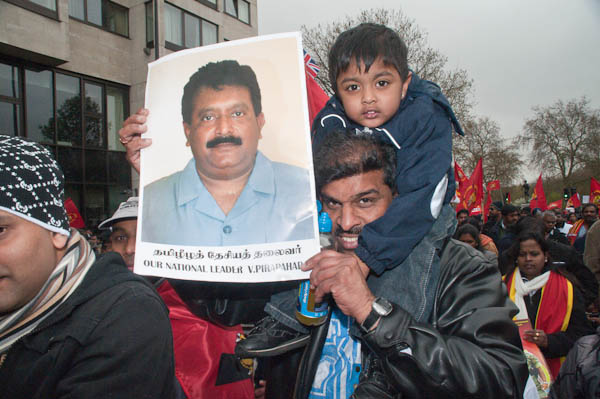
Photo of Velupillai Pirapaharan, founder and leader of the LTTE

The Tamil march was also very much a family event – at one time I found myself facing a row of around 20 push chairs, and they were many children carrying placards and being carried on shoulders, as well as crowds of young people and students, and adults of all ages, including some who looked old enough to be my mother or father.

They were united in their opposition to the killing of Tamils in Sri Lanka, but also the vast majority of those marching in some way expressed their support for the LTTE, the Liberation Tigers of Tamil Eelam. A few carried actual tigers, fortunately only large toys, but many wore the colours or carried flags or portraits of the founder and leader of the Tamil Tigers, Velupillai Pirapaharan (sometimes spelt spelt Prabhakaran.)

In the UK, the LTTE has been a proscribed organisation under the Terrorism Act 2000 since 2000. This makes it a terrorist offence for a person to support the group or wear clothing which arouses the “reasonable suspicion that he is a member or supporter of a proscribed organisation.” Police sensibly made no attempt to arrest all 200,000 marchers on Saturday despite their clear breach of the Act.
© 2009 Peter Marshall.
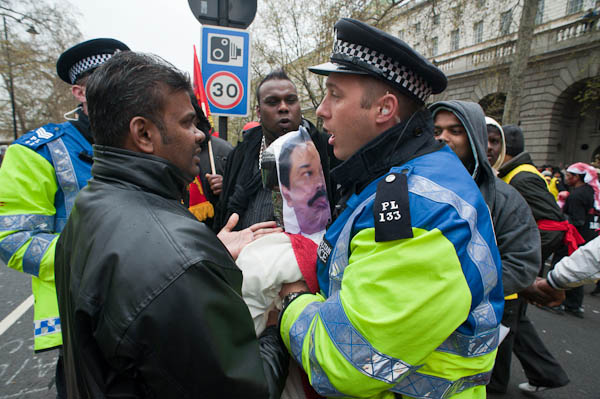
Police object to a dummy with the President’s face

Although enthusiastic, the Tamils had no intention of causing serious trouble in London and only three arrests were reported. I saw only one small incident, where police prevented marchers from carrying a dummy with a photograph which of Sri Lanka’s President Mahinda Rajapaksa as its face. Once this photograph was removed they allowed them to continue.
© 2009 Peter Marshall.
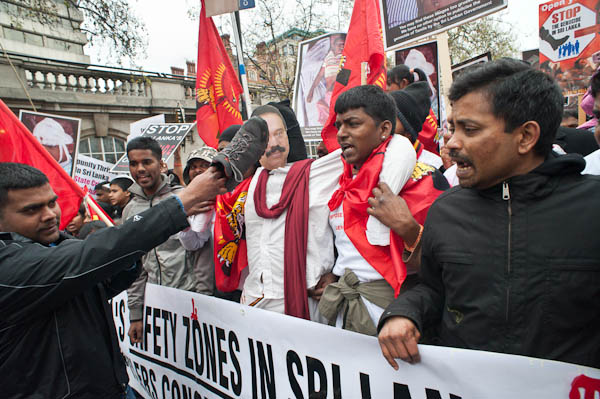
But her’s another getting shoe’d

Britain has a long history of lack of care for the Tamils in Sri Lanka, going back to colonial days. When we gave Ceylon independence in 1948 we neglected to take any precautions to safeguard their interests. Within a very short time many had been disenfranchised and deported as “Indian Origin” Tamils, whose ancestors had been brought to the country by the British in the middle of the previous century. Since then there has been a continued programme of repression, religious discrimination and marginalisation of Tamils, with Sri Lanka being established as a Buddhist republic in 1972. The LTTE was founded in 1976, and for some years until 2006 large parts of the Tamil areas of the country came under their civil administration.

At least a part of the LTTE success for many years came from the extreme and desperate measures that they have used, including assassinations and suicide bombings. Both sides in the conflict have committed numerous atrocities against civilians. Various international attempts to broker peace over the years came to an end in 2006, since when the Sri Lankan army has been engaged in a full-scale assault on the Tamil areas and the LTTE seem now very close to final defeat as an organised military force, although they are expected to re-emerge as a guerilla group.

At the moment the Sri Lankan government’s policy appears to be aimed at the complete annihilation of the LTTE and much of the Tamil population. Others are being resettled in transit camps and then ‘welfare villages’ which may seem rather more like prison camps than normal life.  At the moment it seems unlikely that there will be any effective intervention by outside powers to prevent the genocide of the Sri Lankan Tamils; David Miliband did phone to ask the Sri Lankan government not to return to a full-out assault following their two-day cease-fire,but his plea seems unlikely to be taken seriously. The situation is desperate and although marches like this should call attention to it, the mass media hardly seem to find it newsworthy. We appear to be approaching a truly scandalous climax to years largely of scandalous indifference.

It takes only a few seconds to send an e-mail letter to the UN High Commissioner for Human Rights about the Tamil crisis and there is also a petition form which can be downloaded on the Tamil Writers Guild,  for filling in and faxing to your MP or Gordon Brown.
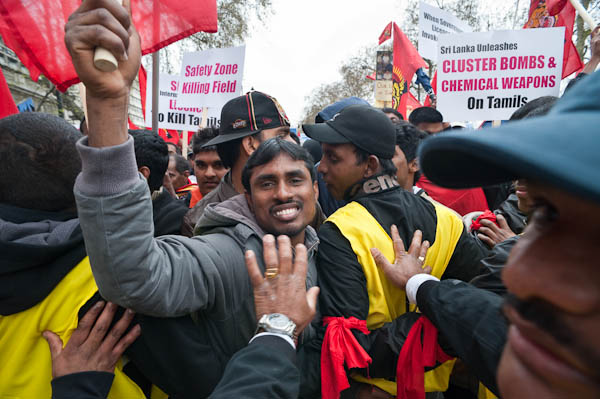
© 2009 Peter Marshall.