Capa Again

Do we care if that picture of a falling soldier really does or doesn’t show the actual moment when a Republican fighter died for his cause?  Whether it was taken during actual fighting, or during a training exercise, or when a soldier acting out an attack for the camera got into the sight of a distant sniper? What does seem clear if you look at the surviving images by Capa is that neither Phillip Knightly or Richard Whelan (link above)  provided a believable solution to the enigma (see in particular comments #7 and #10 on the piece.)

The story seems to be one that will never come to an end – and you can read about the latest instalment in a feature, Wrong place, wrong man? Fresh doubts on Capa’s famed war photo, published in the Observer last Sunday. There is an audio slide show which takes a look at some of the evidence. Although I’d need to see rather  more before making any judgement; in particular it’s a shame that the José Manuel Susperregui, whose book Sombras de la Fotografía gives the evidence, apparently didn’t take a rather better photograph, preferably in black and white and with suitable lighting, than the one shown.

Capa’s picture was I think captioned and published in his absence by Vu magazine in September 1936, and it may well have come as rather a shock to him when he first saw it on the magazine page, although the caption there was almost certainly deliberately vague, and it was Life the following year who made it into the legend of the Falling Soldier. He was – as his writings show  – a great story-teller, and whatever the real story behind this image it would have been very hard to resist that provided in first publication.

Photojournalism is very much about telling stories, about giving our view of events, of finding ways to express what we feel about what we see; CCTV seldom provides great news images.  The power and fascination of our medium is very much tied up in the relationship between reality and the image and also between our experience and how we relate it in images. Susan Sontag, quoted at the end of the audio clip, really oversimplifies to the point of irrelevance. (But that’s ‘On Photography‘ for you.)

But images, particularly ones as iconic as ‘Falling Soldier’ have their own lives.  Although when made it was news, it soon became something else, a symbol, detached from the actual events (whatever they were) of its creation.

So while it was of vital import at the time the picture was made – and the public was almost certainly mislead at least to some extent – it is now frankly of academic interest.  And of course this is a book by an academic, if one that seems rather more  interesting than most such productions.
Your Best Shot

Thanks to Jim Casper of Lensculture for pointing me (via Twitter)  towards the Guardian Series My Best Shot, which I hadn’t looked at since November.  It’s a series that is interesting for both the selection of image and also what the photographers have to say about them – and sometimes that’s very little.  And among some splendid work there are also some that make me think “well if that’s your best I’d hate to see the worst” and others where I think “you CANNOT be serious!” and think of many many more they have taken that are so much better.

But then if anyone asked me what my best picture was, I’d probably be stuck for an answer.  And whatever I said this week, probably by next week I would have changed my mind.  And I rather hope I still have my best picture to look forward to.

Of course some of those selections are little more than a marketing exercise for the photographer’s next book or show and I very seriously doubt if the photographer felt they were their “best shot.” And perhaps such a thing doesn’t really exist in any case, though their have been a few photographers perhaps unfortunate enough to be known only for one single image – though sometimes so iconic that it must be in its way satisfying.

But mostly the pictures chosen – even if sometimes rather randomly are interesting, and so are some of the stories and the details the photographers give about themselves. So if like me, you’d forgotten about it, why not take a look. And if you come across something there you think is ridiculous – or particularly interesting –  do share it with others in a comment.

Street Photography, Iran Style

Although I’m rather a fan of Paolo Pellegrin and have previously written about his work several times, perhaps the most interesting thing about his latest set of street portraits ‘The Changing Face of Iran‘ is that it exists at all.

The pictures and accompanying text perhaps say more about the problems of working in the country as a foreigner than anything else: “Accompanied by an official ‘minder’ from the ministry of information and armed with a government permit to take street photos, Pellegrin approached mullahs, shopkeepers, beggars and young hip-hop kids, and most readily agreed to be photographed.”

I don’t find the resulting pictures of much interest, and I hope that Pellegrin found other things to photograph in Iran as well.  But it must be difficult to take pictures there. His Magnum colleague Thomas Dworzak, another photographer whose work I admire, visited in November and with a few exceptions his work on this occasion also fails to inspire me.

Today’s election there reminds us that these are interesting times in Iran, but I have a suspicion that the more interesting pictures may not emerge for some years – and will have been taken by Iranian photographers we have never before heard of, rather than visiting firemen.

Whither or Wither Street Photography?

The recent case of Wood v Commissioner of Police for the Metropolis is discussed in an article by solicitor Nigel Hanson of Foot Anstey solicitors that I think makes interesting reading for photographers.

Essentially the court decided that the use of photography by the police to harass people involved in demonstrations – something I’ve written about on many occasions in the past few years- was a contravention of the right to privacy under Art. 8(1) of the European Convention on Human Rights (ECHR).

But perhaps importantly for street photographers,

Lord Justice Laws said it was clear individuals still have no right to prevent another person politely merely taking their photograph in public.

He said: “It is no surprise that the mere taking of someone’s photograph in a public street has been consistently held to be no interference with privacy. The snapping of the shutter of itself breaches no rights, unless something more is added. Accordingly I conclude that the bare act of taking the pictures, by whoever done, is not of itself capable of engaging Article 8(1) unless there are aggravating circumstances.”

So it would appear that we can go on taking pictures – so long as we do so in a discrete manner, although this does not necessarily mean that we are free to either retain them or publish them.

The police lost the case in part becuase the way that they took pictures was intrusive – I’ve long argued it more to be more a deliberate harrassment than any attempt at providing evidence – but also because they were unable to convince the court of any real public interest to justify their action.

But the judgement seems to imply that if you work – like Cartier-Bresson – in a candid fashion, the ECHR would not affect you, but possibly walking right up to your subjects and blasting them with flash would clearly be an intrusion, as would a persistent following of people or workiing with a pack of photographers.

This all seems pretty sensible to me. Long ago I decided that most people would rather be photographed without their knowledge than have strangers approach them and ask if they can take photographs. There are times when I do both of these things, but  generally working without permission is more likely to produce interesting pictures. I always agree if strangers ask if they may photograph me (it seems only fair as I’m a photographer), but frankly I’m happier if they just get on and do it without asking me – so long as they don’t disturb me too much. Probably I’m rather more likely to notice if they do so, but like most of the public I prefer to ignore it.

But what the judgement also made clear (if I interpret Mr Hanson correctly) was that to retain and publish pictures taken without permission there has to be a valid argument that it is in the public interest.

I’m not quite sure what this might mean legally, but I have my own views on what the moral position is, at least so far as my own work is concerned.

The first question I always ask is to try and put myself in the position of the persons in my picture – would I find the way that I have portrayed them objectionable? It’s too easy to catch moments when people look ridiculous or show something they would not want to show.

Secondly, and more difficult,  does the picture have something worth saying about who we are and how we live – the human condition. This perhaps sounds more pretentious than I mean it to be, but what I’m not interested in are pictures that simply show how clever the photographer is (something I find only too common in much street photography),  and what I hope to produce are pictures that have something to say about life. I think that this is something that we can clearly see, for example, in at least most of the pictures of Cartier-Bresson, and something that a court might also be persuaded was in the public interest.

I hope I’m not being too optimistic, but despite the fact that the judgement found that the particular photography being carried out was outside the law, it seems to me that as photographers we can take something positive from it.

Agustí Centelles (1909-85)

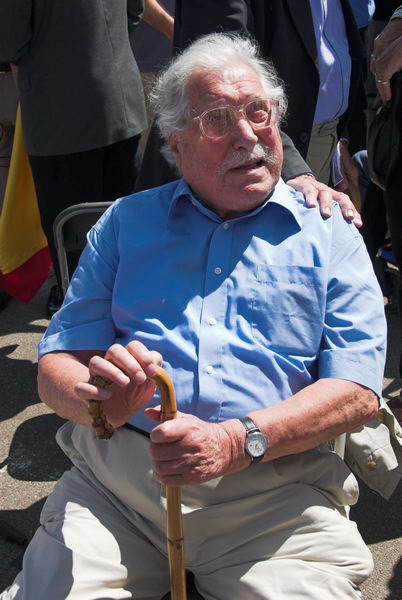
This morning I listened to the Today programme as I washed up the breakfast things and heard an interview with Sam Lesser, one of the seven remaining Britons who went to Spain with the International Brigade, all of whom have now been made Spanish citizens and given Spanish passports.

Sam Lesser © 2006, Peter Marshall
Sam Lesser in 2006

But of course as well as those thousands of brave individual who went to Spain to fight for freedom, there were many Spaniards also fighting.

And when we think of the photographs of the Spanish Civil War, probably we immediately think of Robert Capa – and in particular his ‘Falling Soldier‘ picture.

But of course there were also Spanish photographers. Or in the case of   Agustí Centelles (1909-85), Catalan photographers.  A photojournalist in Barcelona, he became an official photographer for the Republican government, and even managed to continue using his Leica when interned in the Bram refugee camp in France in 1939.

When he fled to France in February 1939 he took several thousand negatives with him. Later, when France was occupied by the Germans, he decided to return in secret to Spain, but left his negatives hidden in a house in France, as his pictures could have incriminated many Spaniards and led to their persecution by Franco. It was only 40 years later, after the fall of Franco that he could return and reclaim his work.

An exhibition of his work from 1936-9, “Agustí Centelles: journal d’une guerre et d’un exil, Espagne–France 1936-1939” opened at the Jeu de Paume (Hotel de Sully site) in Paris yesterday and continues until 13 Sept 2009. You can read more about it in French on their site, and also in English on Art Knowledge News. There is also an extensive collection of his work on line at VEGAP – I’ve not yet looked at all 336, but what I have seen is enough to convince me that  we should be thinking of him as the major photographer of the Spanish Civil War.

Too often we think of events that happen abroad – particularly in the majority world – only in terms of the photographs made by photographers from the  Western agencies who travel there – almost as if photographs that don’t come from Magnum or VII  or Getty or Reuters somehow aren’t real.  Agencies such as Drik should have changed the way we see the South by now.

New Topographics Revived – No UK Show

In 1975, I was one of many youngish photographers to be excited and to an extent influenced by the work shown in an exhibition at George Eastman House curated by William Jenkins called “New Topographics: Photographs of a Man-Altered Landscape.” Not that I went to Rochester, but I read the reports in the US magazines, looked at books and catalogues, and at pictures which did come over to exhibitions here, and even went and did a workshop with one of the photographers included, Lewis Balz. (The full listing of those included: Robert Adams, Lewis Baltz, Bernd and Hilla Becher, Joe Deal, Frank Gohlke, Nicholas Nixon, John Schott, Stephen Shore, and Henry Wessel Jr.)

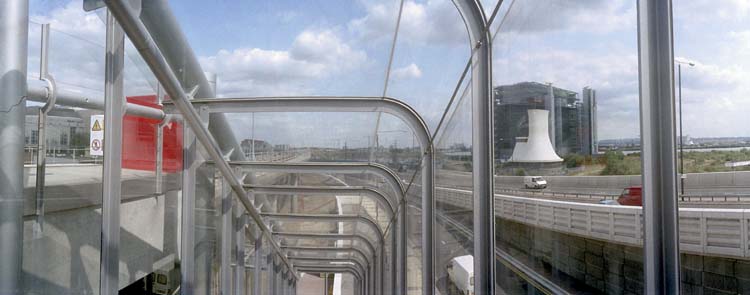
I think you can see a certain influence in some of the work I’ve done since then, particularly on the urban landscape, a genre central to the show.  Without it I don’t think I would have set up the Urban Landscape web site, or produced many of the images on it – such as this of the DLR at Blackwall:

Blackwall © 1984 Peter Marshall
DLR Blackwall, 1994, Peter Marshall

The NPR article on the show, with a slide show of a dozen images that is worth viewing at full screen – for once you really do get larger images, not just fuzzier ones, is surely quite wrong to state that the paradigm shift this show produced “was imperceptible at the time.”  To photographers such as myself it was as imperceptible as a thunderbolt.

The reason for the feature is that a new version of this show, new version of this seminal exhibition, organized by  George Eastman House with the Center for Creative Photography at the University of Arizona opens at GEH on Saturday, June 13 and runs until Sunday, September 27, 2009. As well as 100 works from the 1975 show, it also has “some 30 prints and books by other relevant artists to provide additional historical and contemporary context.”

After Rochester the show will travel to eight international venues.

  • Los Angeles County Museum of Art (Oct. 25, 2009–Jan. 3, 2010);
  • Center for Creative Photography (Feb. 19–May 16, 2010);
  • San Francisco Museum of Modern Art (July 17–Oct. 3, 2010);
  • Landesgalerie Linz, Austria (Nov. 10, 2010–Jan. 9, 2011),
  • Photographische Sammlung Stiftung Kultur, Cologne (Jan. 27–April 3, 2011);
  • Jeu de Paume, Paris (April 11–June 12, 2011);
  • Nederlands Fotomuseum Rotterdam, the Netherlands (July 2–Sept. 11, 2011);
  • Bilbao Fine Arts Museum, Bilbao (November 2011–January 2012).

Like me you may well be devastated but hardly surprised that no venue in the UK is on this list. After all it is a major photography show, so you can’t expect the Photographers’ Gallery or the Hayward or the Barbican to take much interest.

Gaia

Here’s a site I think is worth a look both for the photography on it and the idea behind it.
Gaia Photos mission is to “increase awareness about the challenges we are facing together on this planet and to promote understanding across all borders, physical or otherwise, of this world we share“, and to “promote quality and diversity in documentary photography.”

They are also looking for photographers around the world, and if you are “an active and professional freelance photographer or photojournalist” with “a ‘track record’ of working for publications or other media organisations“and particularly if you live in a country where they don’t yet have photographers (when I looked there was only one for the whole of Africa but already a couple for the UK) this could possibly be a place worth putting your work.

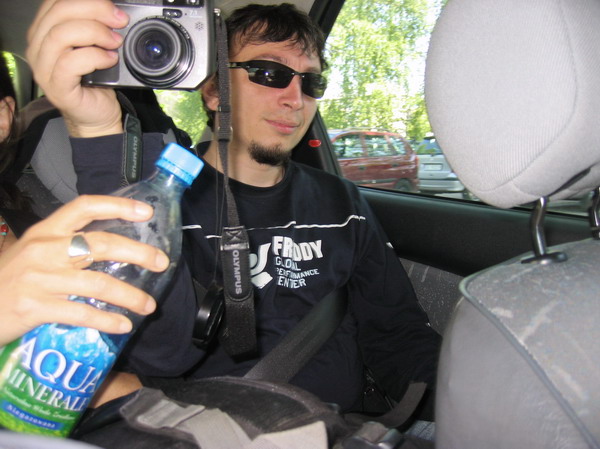
The site certainly has some interesting stories already posted on it, and looking through the names there I find a few I recognise, including Bevis Fusha from Albania who I met in Poland in 2005, and whose recent Facebook post led me to the site.

© 2005 Peter Marshall
Bevis photographing me in Poland at the end of an exhausting festival

You can see much more of his work on his own web site.

But That’s My Picture!

Most photographers who put pictures on the web – or publish them in magazines – are likely to have the experience of opening a web site and finding to their surprise that one (or more) of their pictures is being used without their permission.

It’s a problem I’ve written about in the past and doubtless will return to. The first thing to do is perhaps to make sure it really is your picture – especially if it’s a picture of a popular place or event other people may well have had the same idea as you and produced a very similar image.

If it was taken from the web, it’s quite likely still to contain the metadata that you always include – such as your copyright message and contact details (and if you are not including these you should be.)  If it was scanned from a magazine it won’t have your metadata, and of course some software discards much or all of it from web images.

Once you are sure it is your picture that has been used, you need to consider whether the use could be legal. If you sell images through an agency or picture library, the person using it may have a licence for the use they are making, and in some countries, particularly the USA, the concept of ‘fair use’ may give people rather more licence to use work without permission than in the UK.  Probably the main area where such as use would normally be accepted here is in reviews of exhibitions and publications, where normally selected images are made available by galleries and publishers.

Photo Attorney Carolyn E. Wright, LLC, in her post Help! I’ve Been Infringed! provides excellent advice from a US perspective on the various options for dealing with this, starting with doing nothing at all and ending with going ballistic – or rather File a Copyright Infringement Lawsuit.

Although much of it applies in other countries, in the UK photographers are perhaps less greedy than in the US – or rather the law allows them to be. She warns against sending invoices at three times the normal rate for any unauthorised use – apparently fairly usual in the US – on thegrounds that you may otherwise get considerably more. Most photographers here are happy to settle for double, and invoice on that basis.

You’ll also need to decide whether filing with the US Copyright Office is worth the cost and they hassle involved. While she recommends it strongly, for those of us not based in the US I think it is considerably more debatable.

Can Anyone Apply for an NUJ Card who has a Camera ?

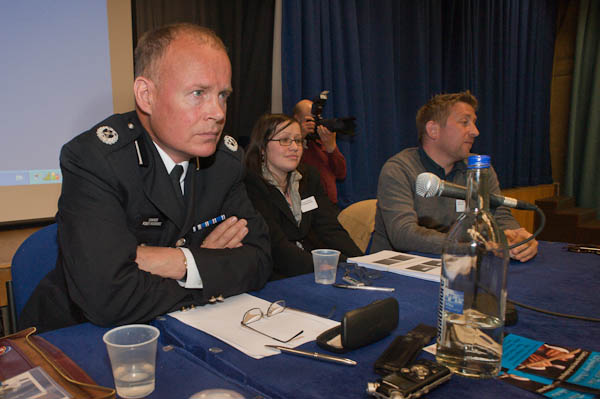
Oh no, Commander Broadhurst, no, no, NO, NO!

© 2009 Peter Marshall.

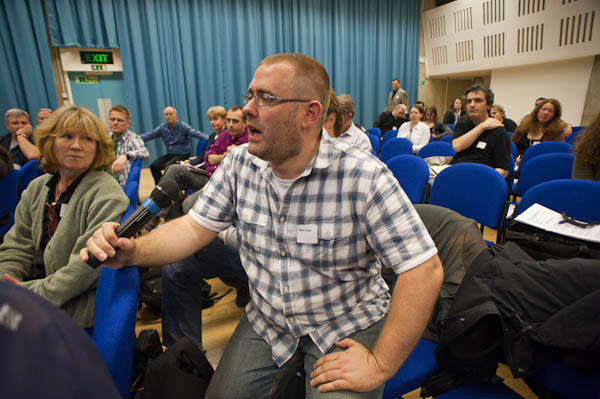
Some advice for any high-ranking police officer. If you come to a conference of 200 press photographers, don’t say things like “I don’t know whether, or what vetting system there is for holding an NUJ card, can anybody apply for an NUJ card who has a camera?” And it isn’t really sensible to talk about a  “phalanx of cameras” getting in the way of police either or make too much of expressing support for the actions of front line officers to people who have been assaulted by them. When someone gets up and describes how an officer in riot gear shouted at him “I don’t care if you’re press” and then broke the arm holding up a press card with a baton blow, or how another photographer wearing a protective helmet was hit so badly that he suffered from concussion for two days, that isn’t helpful.

The card we use is not an NUJ card, but a UK Press Card, issued by the NUJ and other bodies on behalf of the UK Press Card Authority and states “The Association of Chief Police Officers of England, Wales and Northern Ireland and the Association of Chief Police Officers in Scotland recognise the holder of this card as a bone fide newsgatherer.” But apparently neither the man in charge of public order for the Metropolitan Police nor the officers on the front line do.

It isn’t easy to get a press card from the NUJ – you have to provide evidence that you work in public places and so have a need for the card, and that 50% or more of your income comes from journalism for NUJ membership.

Two hundred of us there all tried to tell him – and he had to abandon his presentation to the NUJ ‘Photography Matters‘ conference at that point and sit and listen and try to respond to complaint after complaint about police behaviour.

© 2009 Peter Marshall
Press photographers were told to leave or be put in the cells…

Notable among these was the use of the Public Order Act to compel a group of around 20 press photographers to leave the Royal Exchange area on May 2.  An officer came up to them as they were standing behind a police cordon, and addressing them starting with the words “Ladies and Gentlemen of the press…” informed them that unless they left the area for half an hour they would spend the rest of the day in a police cell. Why? Because the police were about to set police dogs loose on the demonstrators.

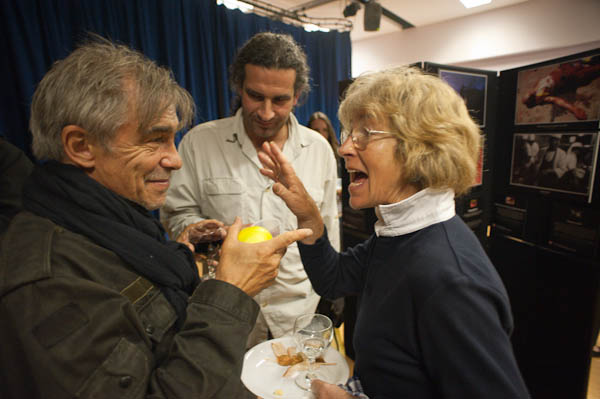
This wasn’t the only session of the conference, and others,  if less important were more informative or entertaining. Penny Tweedie presented a retrospective view of her career, starting from when the NUJ stopped her getting a staff job in Fleet Street because she was a woman and couldn’t possibly cope with being the only photographer present on a night shift if anything stressful happened. You can read a little more about the other sessions that I was able to attend on My London Diary, where there are also more pictures from the day. All were taken with a 20mm lens (one is severely cropped) as when I put my hand in the bag for a longer lens I found it wasn’t there. It was an early start for me and in my rush to get the train I’d not packed it. It’s a nice lens, but some shots would be easier with something a little longer.

© 2009 Peter Marshall.

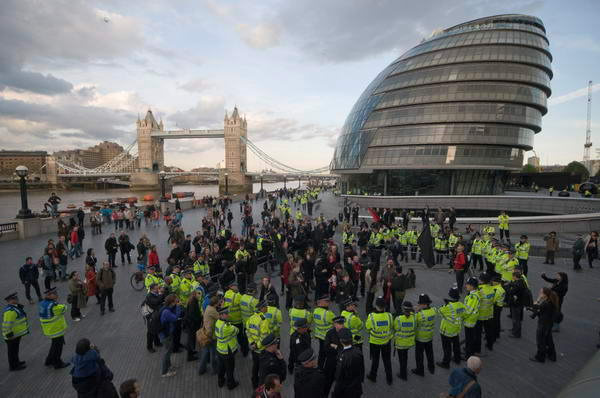
During the lunch break we all had an opportunity to look at the 2009 Photography Matters exhibition, with 50 pictures from 35 photographers – and I was very pleased that two of my pictures made the show, including a rather nice picture made with the 12mm Sigma (on the D300 – so 18mm equivalent) of a ring of police around a few demonstrators at City Hall on the night the London mayoral election was announced.

© 2008 Peter Marshall

I took this picture with a policeman pushing my shoulder, telling me I had to leave the area. It was hard to see any particular reason for this, but I knew there was no point in arguing – and that to do so could lead to my arrest. Fortunately I managed to hang on long enough to change the lens and get the image.