Swan Uppers and Downers

Although traditionally the Swan Uppers started their journey up the Thames at the City of London, in recent times they have missed out the tidal river, starting just a few miles upstream of Teddington at Sunbury lock. In recent years I’ve joined them on my bicycle at Shepperton or Chertsey, cycling with them along the towpath to lunch at Staines (which they took, appropriately, at the Swan Inn) and then in the afternoon going on with them to Windsor.

This year, the Uppers have deserted that stretch of the river altogether and start their journey at Eton College boathouse. I might have considered joining them there, but for the fact that it is going to be a royal affair, with the Queen expected to join the event at Boveney Lock.

I’m not in favour of the monarchy – it’s a shame we’ve still got one. I find the continuing interest in the press on the royals depressing, and have no wish to add or encourage it in any way.  Even if I did want to take pictures, royal events are bad news for photographers not in the exclusive clique of the royal rota with very limited opportunities and heavy security. So Monday is a day I’d choose to avoid.
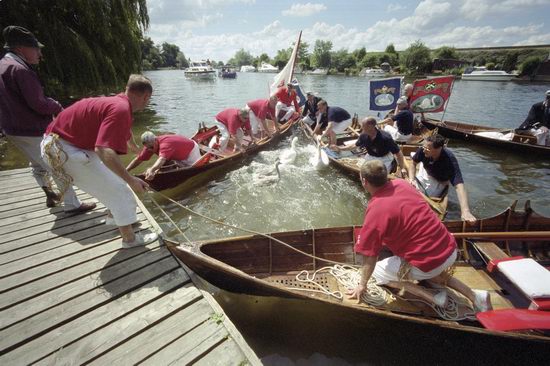
© 2001 Peter Marshall

Back in 2001 I was still using film, and the best pictures I made were panoramic format using the Hasselblad XPan with a 30mm wide-angle, though the picture above was I think made with the Konica Hexar – I think of it as the Leica M9, though the build quality wasn’t quite there, but it had autowind and rather better metering than the M series. You can see more pictures – including a few of those pans on My London Diary, as well as those from 2004, 2005, 2006, 2007 and 2008.
© 2008 Peter Marshall

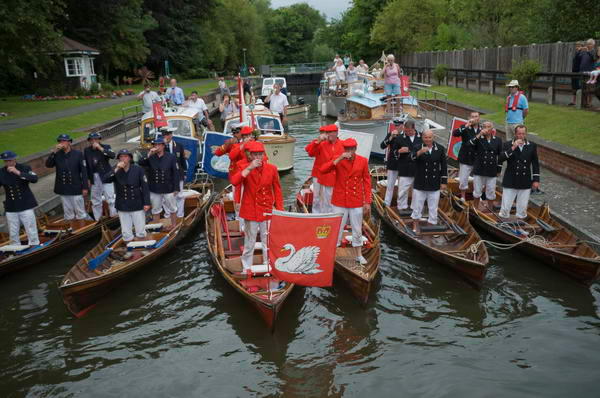
Of course Swan Upping was always a royal event – the guys in the red jackets making the loyal toast in Romney Lock are the Queen’s Swan Uppers, but she didn’t come down from the castle to the lock.

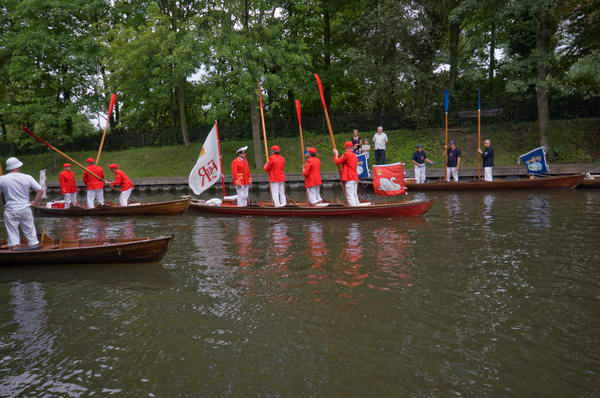
I didn’t bother to photograph this part of the event until 2007, when there was a real fear that swan upping might be coming to an end. Photographing the loyal toast is pretty simple, as all the boats are in the lock and pretty static. Much harder is the salute between the crews at the end of the day which used to take place a few hundred yards downstream, where the river banks are lined by trees and bushes. It’s also spread across the width of the river, with the Dyers two boats close to one bank and the Vintners on the other. They come to a halt and stand up holding oars vertical, giving the two boats containing the Queen’s men a cheer as they pass through the middle, also standing with their oars raised, and returning the salute.
© 2008 Peter Marshall

This is about the best of a rather poor crop of my attempts to photograph it.  I had hoped I might do better this year, and was disappointed to learn of the changed schedule.
London Photographers Branch

Yesterday there was a meeting attended by just over 30  photographers with an overwhelming vote (26 for, 1 against, 1 abstention) for the formation of a London Photographers Branch (LPB) of the NUJ. Of course forming a new union branch is a matter for the National Executive Committee to decide, but yesterday’s meeting certainly makes it more likely.

Debate at the meeting was almost entirely about the geographical nature of the proposed branch, which for several reasons, most particularly the union’s constitution, seemed irrelevant and at times more about particular photographer’s emotional issues than the substance of the matter.  A motion proposing it be proposed as a ‘national’ branch was reject by a roughly 2:1 majority.

Photographers (and videographers) do face different problems working on the streets to other journalists, and these have been particularly acute for those working in London both because it it the focus of so much protest but also because of the particular responses of the Met.

The NUJ was formed in an earlier age, essentially based around the ‘chapel’ or workplace organisation. There are also branches set up on a geographical basis – such as the unions largest branch, the London Freelance Branch (LFB), to which many of those at the meeting currently belong.

Most photographers are freelance, with fewer staff and agency positions every year, and they share many of their problems with other freelances – so being a part of the LFB makes sense. The LFB has tried its best to recognise and cater for the special problems photographers face – photographers form a large percentage of its membership and committee – but I think many photographers feel it is unsatisfactory.

Membership of the proposed LPB would be open to all photographers who work in London wherever they live – and would certainly include many based in London who spend much of their time working elsewhere around the world. It would both freelance, agency and also staff photographers, (you can belong both to a chapel and a branch, but only one branch) thus uniting photographers in all modes of employment.

Photography isn’t just an issue for photographers. At a time when more and more journalists are being handed cameras and told to take photographs, does it make sense to separate ourselves from our fellow union members in a separate branch?  Only I think because the NUJ doesn’t appear to allow any other way forward.

For some years the NUJ has repeatedly turned down the need for a photography organiser to work for the particular interests of photographers – and I would expect the LPB to continue the pressure on this. Photographers based wherever the union has chapels or branches need to see their special needs recognised throughout the union.

These are of course hard times for photographers – and also for other journalists, both with changing technology and economic conditions. Times when we need the union more than ever, and the support of our colleagues.

At the end of the meeting a freelance working for the Guardian/Observer brought up the issue of the rights grab they intend to impose on contributors. In April the management made a decision to stop paying fees for any re-use of images. Guardian freelances refused the new terms and are being supported by staff in the Guardian chapel, but so far the management has refused to talk.

The Guardian’s action strikes at the very core of photographers copyright and rights management, although it isn’t something that solely affects photographers. Of course if we let the Guardian get away with it, then others will surely follow their lead.

Black Friday – Still Catching Up

Last Friday was Black Friday here. Literally in that around 10am when I was getting down to work on my computer, the screen suddenly went black and the system started to reboot.  My hope were raised as Windows loaded again, but dashed a few seconds later when I got the message “Windows has recovered from a serious fault” and then everything went black again – and this time the computer didn’t reboot.

I used to work a lot with computers and have often fixed other peoples, but this had me beat. I couldn’t persuade the system to boot from a CD, and nothing looked obviously wrong when I opened up the box, though it was very dusty!

I unplugged the inessentials and tried again with no luck, and eventually I gave up, sulked for a bit, then called out a repair service. They told me an engineer could come in around 4 hours, though after4 hours they phoned to revise that to 6.  I’d hoped to go out and take pictures but instead found myself staying in for the call.

The good news was that he eventually got it going. The bad news that it took him an hour and a half at expensive rates, and that he couldn’t really identify the fault.  Removing the memory then replacing just one of the four memory modules brought it back to life, but it continued to work when all four were replaced, and all passed the memory tests on his diagnostic software.  Perhaps it was just a poor or corroded contact, possibly on the memory but perhaps somewhere else on the motherboard, disturbed by the pressure on removing and replacing memory. Perhaps a short circuit somewhere broken.

So I now am considerably poorer, have lost a day’s work on the computer and half a day’s photography and have a computer with a doubtful motherboard. It could well go again any time, though at least I can now do everything that worked for that engineer without having to pay anyone else!

If there is plus point it’s that it’s made me think more carefully about what I can do to save things if the system does go again. While waiting for the repairman I set up email on another computer, and checked that I had all my essential files backed up on an external hard disk (most of them were there.)  I also installed a copy of the free Raw Therapee v2.4 conversion software – it’s an old computer that isn’t powerful enough for Lightroom or recent versions of Capture One Pro, and none of the software already on it could read D300 or D700 files.

Raw Therapee does seem to produce decent results, but trying it out in case I needed to process the job I had booked in for the following day I was soon very aware why I use Lightroom. And very relieved that the computer was up and running when I needed it.

Firstly, workflow and in particular the much better design of the interface. Raw Therapee seems too much of a community effort, with everyone wanting their own particular bell or whistle included, rather than picking the best approach.

Then I’ve become entirely addicted to the various possibilities of Lightroom’s ‘Adjustment Brush’ – allowing local adjustment of exposure, brightness, contrast, saturation, clarity and colour – in any combination. Being able to define presets for particular purposes is extremely helpful – I’ve got one called ‘Remove Highlights’ and another called ‘Spotoff’ – which works well together with the supplied preset ‘Soften Skin’.

And finally the whole output side  is easier to use – and I’ve set up all the presets that I need for different purposes.

I haven’t quite managed to catch up with what I missed, and haven’t quite decided what to do about the computer. The serviceman suggested it was probably time to think about a new one as it’s hardly worth replacing motherboards these days and systems are now so cheap. But it seems so wasteful.

And of course I’ve been checking my backups, although I lost none of the files on my hard disk – except for the anti-virus that was corrupted and had to be removed and re-installed. But today I’ve been busy writing out more of my images on to DVD.

DVD may not be good for long term storage, but there is something satisfying about a box full of disks that you can take out and put into almost any computer. Of course I also have the files on removable hard disks, the latest a 1 Tb Toshiba USB 2.0 model that cost me under £70 (now £75) and will store around 80,000 NEF RAW files. I’m happier with belt and braces.

Although digital photography has many advantages – and I often mention some of them – it has made us entirely reliant on computers. If you’ve not thought about what would happen if your computer suddenly stopped working, now would be a good time to do so.

Pride 2009 – and nearly a fall

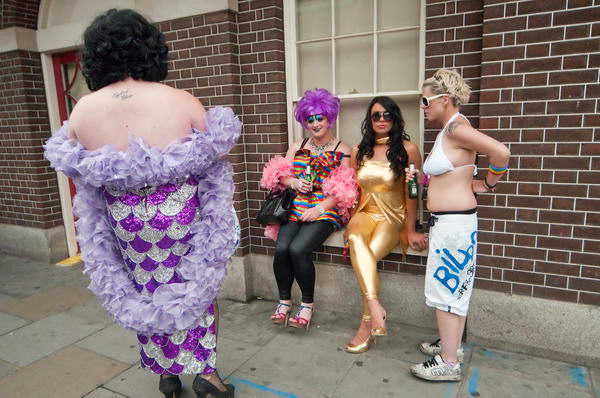
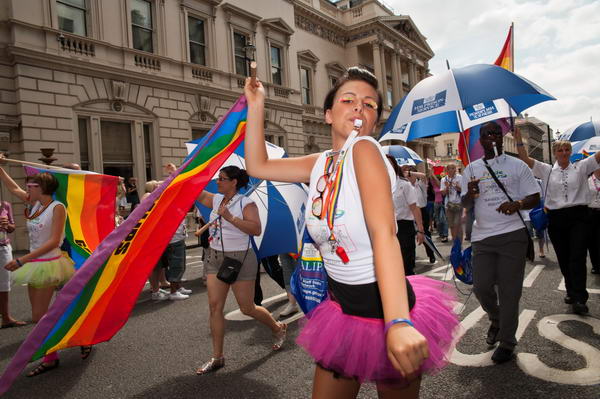
I failed to photograph the only slogan I saw at Pride that made me laugh or at least smile; one of those times when you see something and for some reason don’t photograph it, intending to do so later. But later seldom happens.

So I didn’t get a picture. But it doesn’t really need a picture – and probably why I didn’t photograph it was that it didn’t make a good picture. “ASEXUALS don’t give a F**K” amused  me, but not visually.

© 2009 Peter Marshall.
HM Prison Service: “Banged to Rights”

Fortunately quite a lot did visually appeal, and I took rather a lot of pictures, and despite a few technical problems quite a lot of them came out. Enough certainly to make editing a real pain.

It had been a good night on Friday, and I probably still wasn’t fit to drive a camera – fortunately they can’t breathalyse you for it. For some reason I left the D300 on a high ISO setting for an hour or so while taking pictures, though fortunately I managed to set the D700 to something sensible. Working with two bodies, I had a Sigma 12-24 (equiv 18-36mm) – just back from repair – on the D300 and another Sigma, the 24-70 HSM on the D700. So for that time the wide-angle shots were taken at silly settings like ISO 3200.

© 2009 Peter Marshall
For mysterious reasons this was taken at ISO 2500

The results were noticeably more noisy than I’d like. With the D300, I’m fairly happy working at ISO 1600 if I have to, but try to avoid anything faster. For the first time in a year or so I found the noise reduction built into Lightroom wasn’t enough and had to turn to specialist noise reduction software.

There are I think several programs worth considering to reduce noise, and when I used to seriously review software I was given free licences for all of them. But two years ago I moved to a new PC, and could no longer get them to work. Fortunately that old PC still works, and I switched it on for the first time this year to process these images.

The 3 programs that I recommended after my tests – and still recommend – are Imagenomic Noiseware Pro, Neat Image Pro and Noise Ninja, all capable of excellent results. For these pictures I actually used Noiseware, but either of the others would have given similar results.  You can actually download a free ‘Noiseware Community Edition’ for non-commercial use, which gives similar results although a few options are disabled. Its main limitation – at least if you only want to work with jpegs – seems to be that it is a standalone programme rather than a Photoshop plugin.

I sent a disk of mixed files taken at normal and high ISO to a library the day after Pride (I’d already e-mailed a few) and viewing them on my 21″ screen at 15″ wide the difference in quality is only noticeable on close inspection. At 1:1 it’s a little more obvious, but not greatly so. There is just a slight difference in colour quality that I think you can see even in the web files – more pictures on My London Diary – but frankly it’s still so much better than we would have thought possible just a few years ago.

Last year I wrote very little about Pride, but of course did take pictures I did give some links to some work from earlier years.

Police and Photographers

One of my colleagues, Marc Vallée, has a piece in the Guardian today, The Met’s attack on photographers which examines the advice issued today by the Metropolitan police service (MPS) to the public and the media on photography in public places.

© 2008 Peter Marshall
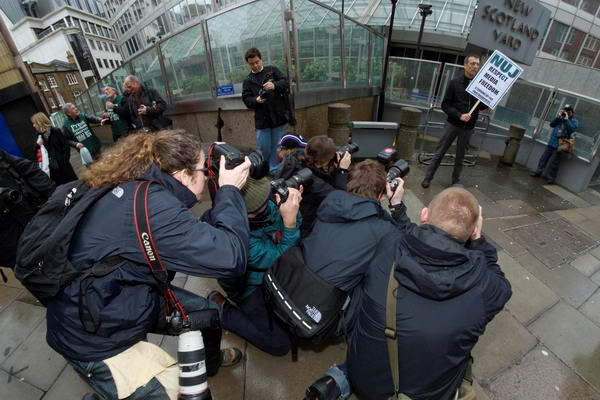
Protest by NUJ General Secretary Jeremy Dear and photographers at New Scotland Yard, March 2008

It raises a number of important questions about such advice, and in particular of how sections 44 and 43 of the Terrorism Act 2000 apply to “protected journalistic material” where it is not at all clear that the police have the legal power to “view digital images contained in mobile telephones or cameras” that the advice claims.

The advice given by the MPS is that section 76 of the Counter Terrorism Act 2008 (referrred to by the MPS as 58a of the 2000 Act)  which makes it an offence to photograph police where a reasonable suspicion can be demonstrated that the information was of a kind likely to be useful to a person committing or preparing an act of terrorism should not be used to “arrest people photographing police officers in the course of normal policing activities, including protest.”

Which would be good news, except that there are, as Marc mentions,  at least two well-authenticated cases where it has been so used, including one  by a photographer I know who was covering the attempted eviction of a London squat – with absolutely no terrorist connections.

As Marc says “Professional photographers such as myself view it as part of an ongoing campaign to create a hostile environment for photography in the public sphere.” It’s something I first wrote about on ‘My London Diary’ almost five years ago – here is my exact text from October 2004 – all then in lower case. I’ve picked out the key parts in bold:

on the friday, critical mass were out on their bikes, together with rising tide and other environmental protestors. on a ‘london underwater 2050 tour of the g8 climate criminals‘. starting under waterloo bridge, they went on tour, visiting the london offices of several climate change villains, including petrol giants exxon mobil and bp and the canadian government, ending up outside the national portrait gallery, site of the annual bp-sponsored portrait award.
more pictures

it was a generally good-natured event, with an international samba band. from the top of a tourist bus an american voice asked the bill what was on. as he floundered to reply, the woman i was talking to suggested “hey it’s a fluffy takeover!”

most of the police were good-natured and cooperative throughout, but there were some ineffectual attempts to block the path of the demonstrators. by standing in the road the police blocked traffic, while the demonstrators simply walked around them.

worrying was the deliberate police use of photography as intimidation, with the police photographer going out of his way to confront demonstrators, aided by two other officers.

i worry because i think it is an attempt to attack civil liberties, but also because such behaviour makes all photographers suspect. i can only work effectively if i gain the trust and cooperation of those whose pictures i take. perhaps it helps that photography is one of the activities that also arouses suspicion and intimidation by the police.

as i walked away at the end of the demonstration, this team ran 50 yards down the road and caught up with me, one calling”excuse me, sir” and tapping on my shoulder. i turned to face him, and found myself looking into the lens of the police photographer, who took my picture as his colleague started to question me about who i was taking pictures for. it seemed clear and deliberate harassment, intended to intimidate a photographer acting entirely lawfully, photographing on the public highway.

This was the first time I was aware of being deliberately targeted by the police because I was a photographer, but it was the first of many times – and if we seriously believe that the police are now destroying all those images that they have collected over the years, there will be several thousands of pictures of me being deleted from hard disks and databases.

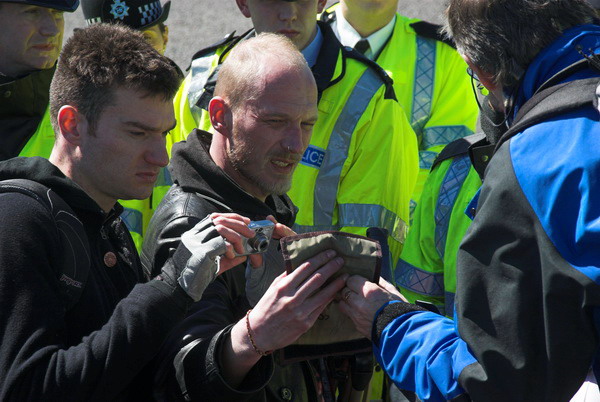
Another key moment for me came in April 2006, outside Harmondsworth Immigration Detention Centre, where I watched from a raised bank as a group of demonstrators were kettled by the police and a colleague showed his Press card. Officers told him that they didn’t believe it was a real press card, and he called to the 3 photographers watching from the bank to show ours to confirm.

© 2006 Peter Marshall

Fortunately one of the other photographers rushed to do so, as I’d noticed as I came out that day that mine had expired at the end of the previous month!

Since then I’ve also been told by officers that my now current press card isn’t a real press card, though more often they tell me they just don’t care if I’m press.

What is particularly regrettable about the MPS statement is that it fails to refer to the published guidelines for MPS staff and photographers that were agreed between the Met and the BPPA, CIoJ and the NUJ and later approved by ACPO, although some aspects of this are summarised.

One key paragraph is missing:

Members of the media have a duty to report from the scene of many of the incidents we have to deal with.  We should actively help them carry out their responsibilities provided they do no interfere with ours.

Orbs, Bad Weather & Summer Nights

Last night I was at a London Bloggers Meetup and one of the other bloggers present asked me if I would take a look at some photographs she had posted on her ‘Shaman UK‘ site of ‘orbs’ and tell her what I thought about how they might be caused.

What I found was one image of orbs – a rather nice example  – and a number showing illuminated blurs well outside the orb zone – perhaps insects or even small birds. Orbs are actually circles of confusion, out of focus images of the lens iris caused by light reflected from small particles too close to be brought to a focus.

The orb image – with the two cats – still contains its Exif data, and it’s interesting to see that it was taken on a Nikon D40X using flash at 1/60, f3.5 (full aperture)  with a focal length of 18mm (27mm equiv.)  This is interesting, since ‘orb’ pictures are much more common with small sensor cameras; also unusual is the blog author’s comment, about some other images, that she was  “actually seeing the orbs through the view-finder prior to pressing the shutter. ”

You can read a considerably amount about orbs, and the Orb Zone Theory of how they are produced –  and how to make them – on the ASSAP site  (Association for the Scientific Study of Anomalous Phenomena) which also has an interesting feature Paranormal photos and analysing them. The book also gives some advice should you want to produce your own ‘orb’ images (though my own advice would probably be to consult a doctor.)

Looking at the pictures showing flash reflections from objects in the air reminded me of Martin Parr‘s 1982 book, “Bad Weather” and I wandered to the shelf where I thought I might find it, but it wasn’t there.  I hope I still have it somewhere around the house, partly because I still think it (his first book) is probably also his most interesting, but also because it now sells for silly prices. There used to be a gallery of images from the book on the Magnum site, but it is no longer there, and a search (enter ‘bad weather Parr’)  now only brings up ten pictures from the book (plus one unrelated colour picture.)  You can also (with difficulty and persistence) find the book on Parr’s own web site.  Clicking twice at the bottom right corner of the cover image then allows you to look ata pair of images from the book which have a similar effect to those here, his flash illuminating the falling flakes in the right hand picture (click again for a few more images from the book.)

The image on the left of the pair I think shows a similar effect with rain drops, which are all apparently moving upwards, as a result of the flash at the start of the exposure followed by a tailing off effect as they continue to fall.  It’s like photographing other moving objects with a slow shutter speed, to get a light trail behind the object you need to use rear-curtain flash – probably not an option on the camera Parr was using, but I’m sure he would in any case prefer the odder effect given in his picture.

Parr of course deliberately went out in bad weather, while ‘Shaman UK‘ chose more pleasant times and at least on one occasion a location close to the Tom Cobley pub. As she says “spending time on warm evenings, in a beautiful location, with good company, human and animal, while photographing Nature, was wonderful and also fun.”

Summer Nights” is another of my favourite photography books, by Robert Adams, and the V&A have a nice little piece on it with a dozen images, mainly taken around twilight (click on them for larger versions.) There are possibly some among those of his pictures on the Fraenkel Gallery site, but that – like Parr’s – is another though very different text-book example of how not to write a web site, and I gave up before finding out.

Nearby Café & Family Pictures

Nearby Café

A D Coleman opened his Nearby Café  web site along with a regular web newsletter, C: the Speed of Light in 1995, the same year as I put my first site, ‘Family Pictures‘ on line.  I’ve always enjoyed reading Coleman’s writing about photography, although of course I haven’t always agreed with everything that he says, but he is one of very few people to write intelligently about our medium. So I’ve made a habit of dropping in to the site occasionally to see if there is anything new on line.

“On the Front Burner” as a part of that site to producing a blog – written like this one using WordPress. It’s called Photocritic International, a title to which he has a better claim than most, and its one I’ll be following regularly. In fact there are at least two posts he’s already made that I want to write about when I have a little more time.

Family Pictures

Linda (C) 1976, Peter Marshall

My own first site –  Family Pictures – still looks almost exactly the same as it did in 1995, though minor changes have been made as browsers and html have evolved to keep it more or less in its original state, and then it was hosted on a free site in the USA. The scans, re-made early in 1996, slightly larger than the originals, look primitive by today’s standards with an odd dotty sparkle on most of them, possibly because they were from prints made on a Pearl photographic paper.

Linda, Richard & Sam (C) 1976, Peter Marshall

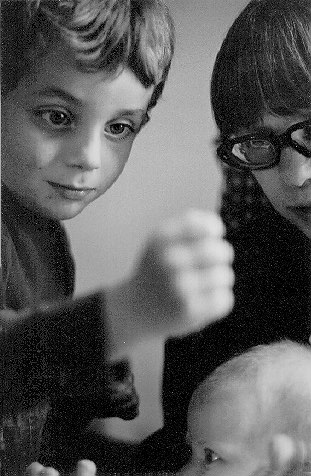
The pictures were already old work when I put them on line, taken between 1976 and 1982, and one of them shows a baby of six months or so who helped me work out how to write the site and put it on line in 1995. He now writes web sites as a part of his work.

One day I’ll perhaps go back and look at the work again – there are some pictures I know I should have included – and perhaps one or two I’d want to leave out, and I wince when I look at these scans. But for me it’s a little reminder of how much things have changed over the years, both personally and with the web – and how it has changed my own life.

Honduras Coup – London Protest

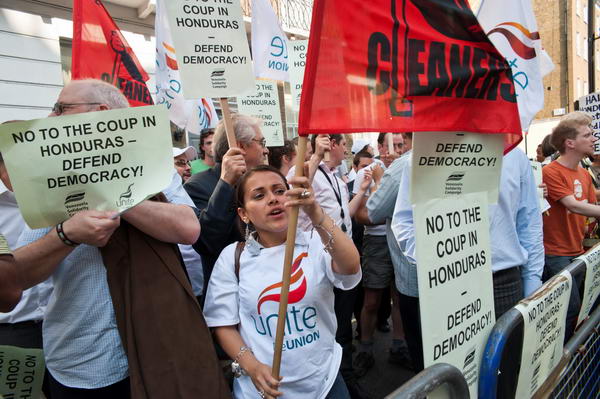
I rushed out shortly after writing about how a series of staged images had won Paris Match’s student photography contest to photograph an “emergency picket” opposite the Honduras Embassy in London against the recent coup and expulsion from the country of President Mel (Manuel Zelaya.)

When I arrived at the scene, a few minutes after the protest had been meant to start (thanks to the Bakerloo line coming to a complete standstill after a train failure at Baker St)  there were perhaps 50 people standing around, mainly in small groups talking to each other. A few did have placards, but you could hardly call it a demonstration. There was one other photographer there, someone I’ve known for a few years, whose work appears regularly in the left press, and occasionally more widely, and we too talked briefly, before I went off to say hi to a few of the demonstrators I recognised and take one or two pictures.

Five minutes later we were still waiting for something to happen, and the other photographer said to me “This is no use” (or rather words to that effect) “let’s get these guys organised” and shouted for the protesters to all come to our end of the pen and start doing something.  And despite my principles I did a little encouraging too and soon we had at least a slightly more interesting event to photograph.

© 2009 Peter Marshall.

But I suppose you could call it “faked” or “staged”, although once they were started off, they did exactly what they had come to do, demonstrating their opposition and making a noise about it. And probably they would eventually have got round to doing something very similar in time without the intervention.

I didn’t take any great pictures – you can see some of the others and read more about the protest on My London Diary. Three of the 15 pictures there were taken before the photographers got the event started.

Hoax Upsets Match

Probably most  will have read about the “student hoax” that won Paris Match’s annual contest for student photojournalism, a set of black and white images on how students at the French university of Strasbourg were making ends meet – if you’ve not seen the pictures, they are on the Paris Match site.

Students are shown searching through boxes left on the street after markets for food, staying in overcrowded rooms where they take turns to sleep on the floor, having to work as prostitutes, working long hours at low paid jobs, having to travel long distances from cheap lodgings…

At the prize ceremony, the two winners, Guillaume Chauvin and Rémi Hubert, from the Strasbourg School of Decorative Arts, read out a statement that the pictures were faked, made as an artistic gesture to point out the voyeurism and gullibility of the press. The Independent quotes them telling Le Monde, “We pushed the clichés to the limit. We thought the whole thing was so hackneyed that it could never win … We wanted to call into question the inner-workings of the attitude of the kind of media which portrays human distress with complacency and voyeurism.”

They were given the 5,000 Euros at the award ceremony, but the cheque was later stopped, although they claim not to have broken any of the competition rules in their work.  The rules will presumably be rewritten for next year!

Although the pictures are described as “entirely faked” this is arguable. Obviously they were pictures taken with the cooperation of the people involved, but the techniques and the level of direction are perhaps little different from those in many more legitimate photojournalistic projects.

Photographic history is of course full of such things – for example in the work of one of our greatest photographers, Bill Brandt, where so many of his deservedly well-known scenes of London in the thirties were acted to his direction by family, friends and servants.

It’s really the stories that were faked for the Match entry, or at least partly faked. Student poverty is a real issue, but the particular students shown were presumably not feeling its pinch in the way the captions to the images describe. The young lady in miniskirt and boots viewed from behind on a hotel or hostel corridor may well not be “Emma, 23 ans, Master de Philosphie” and may never have said “Pour pouvoir étudier le jour, je me sers de mon cul la nuit… ” But such things are happening and it is a picture that could well have appeared in the press entirely legitimately with the small text “posed by model” hidden at one corner.

I suppose the main thing I think about this work is that it represents a waste of time and effort. There is a problem of student poverty, and students such as Chauvin and Hubert have a privileged position to see it and document it in a truthful and serious work of reportage. To tell it without the clichés, without being hackneyed, though I’m not sure voyeurism is ever absent from photography.

Had they chosen to do so, their work would probably not have won the Paris Match prize, probably not even have been of interest to the magazines or to newspapers. The real problem lies in a culture that depends on prizes and values the voyeurism about distress these students were questioning.

You can see also see some of the other work entered for the competition on the Paris Match site, where the work by Chauvin and Hubert is not identified as the winning entry.  You can also watch a video of last year’s award ceremony, but not this!

1200 Naked Cyclists

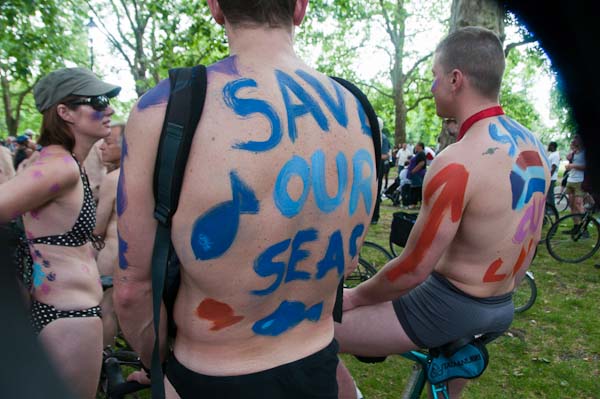
The World Naked Bike Ride is in several ways an interesting event, and certainly causes quite a stir as it goes through London, Passing as it does through major tourist traps including Piccadilly Circus, Trafalgar Square, Parliament Square and Oxford St, guarantees it a huge audience, and almost all of those seem to be holding cameras and camera phones.

Most of those taking part also seem to be taking photos – often even when cycling around, which can be rather tricky, but certainly at the numerous pauses on the 10km route. There’s even a Flickr pool for images, with around 700 online when I looked, mainly taken by riders.

The World Naked Bike Ride is a high profile public event in a very public place – and nobody can have any expectation of privacy.  Everyone taking part knows they will be photographed and most seem pretty happy about it.  Many smiled and waved as I took their pictures (including some who know me, but many more who don’t) and a few quite clearly tried to attract my attention.

– – –

Perhaps the most surprising aspect of the whole ride was the notice that one cyclist chose to carry on his bicycle:

© 2009 Peter Marshall.

It reads:’This photo was taken without permission.’ Well of course, as no permission was needed  – either to take it or to publish it as news, nor was it feasible to ask for permission at the time.  And so far as the law is concerned, as I mentioned recently,  wityh regard to the European Convention on Human Rights, “It is no surprise that the mere taking of someone’s photograph in a public street has been consistently held to be no interference with privacy.

What is even more ridiculous is that the gentleman in the picture – actually a crop of around 1/8 of the full image – is actually apparently taking pictures himself, in circumstances where it would clearly be impossible for him to have the permission of all those who are in his pictures.

– – –

It’s perhaps a pity the the WNBR seems overall a little  confused as to what it is about, and certainly those watching find it hard to understand. I’ve written in earlier years that it it would be better to have more clarity, and in particular to make it much more clearly an environmental rather than a naturist event.  It would be good to see everyone taking part carrying a relevant message on their bike or person.

© 2009 Peter Marshall.

And yet again I have to ask why can’t Nikon make a decent lens hood, with a bayonet fitting that isn’t easily knocked out of place?  I didn’t take many pictures before I noticed, but one is too many. I’ve just bought another Sigma lens, the new 24-70 mm f2.8, for use with the full-frame D700, and the lens hood – like that on other Sigma lenses – is so much firmer and more firmly fixed. Most days when I’m out using the Nikon 18-200 I’ll have to pick it up at least once from the ground after it’s been knocked off the lens.

More on the new Sigma 24-70 mm f2.8, when I’ve used it in anger a few times. But it certainly impresses in feeling solid and well built. As you might expect it isn’t a light lens, but shorter and lighter than the major competition (not that I could use the Canon in any case.)

Canon  83.2mm x 123.5mm, 950g
Nikon 83 x 133 mm, 900g
Sigma 88.6mm X 94.7mm, 790g

Most modern lenses can of course perform at the highest level, giving results that will satisfy practical photographic needs. Mostly any differences only become noticeable when photographing test charts!

More pictures from the World Naked Bike Ride in London on My London Diary, where there is the obvious warning – don’t click on the link if pictures of naked men and women might offend you.