Some Good News for Photographers?

One piece of what I think it good news for photographers, particularly those who post images on line, was reported a few days back by PDN Pulse under the headline Twitter Photographer Asks Sky News to Pay Up, though the good news came in a later Twitter update.

Joe Neale only found out from friends that Sky News had used a picture he had posted on Twitter using Twitpic about a shooting at Waterloo Station without asking him.  PDN links to a fuller account on Online Journalism Blog, which gives all the details, including that Neale sent Sky an invoice for £300 plus 5% per week for the time the image remains on the Sky site.

Sky didn’t contest that the image was copyright – perhaps because fortunately Twitpic’s terms on this are crystal clear:

By uploading your photos to Twitpic you give Twitpic permission to use or distribute your photos on Twitpic.com or affiliated sites

All images uploaded are copyright © their respective owners

and the update on 19th August from Neale, reported on both sites, was that Sky had agreed to pay up.

A second piece of possibly good news reported by Marc Vallée on the Guardian web site last Friday (and by others elsewhere) is that the UK Government Home Office have sent out a circular 012 / 2009 Photography and Counter-Terrorism legislation to the Association of Chief Police Officers in Scotland, HM Inspector of Constabulary and the Association of Chief Police Officers (England, Wales and Northern Ireland) clarifying that anti-terrorism legislation should not be used to stop people taking photographs in public places – even where these are covered by an authorisation under Section 44 of the Terrorism Act (such as London!)

It makes clear that police should not specifically target photographers, that they should only use the power to stop and search when they reasonably suspect someone to be a terrorist – not just because they are taking photographs.

Perhaps the weakest part of the advice is on the use of Section 58a which relates to gathering information (for example by taking pictures) of “persons who are or have been at the front line of counter-terrorism operations, namely the police, the armed forces and members of the security and intelligence agencies.”

It does point out that officers must have reasonable suspicion that the information is likely to be useful to a person committing or preparing an act of terrorism – such as might be gathering information about the person’s house, car, routes to work and other movements, but this still seems rather vague and far too open to interpretation.

I’m also unhappy about  the comment it makes about the statutory defence of reasonable excuse:

Important:Legitimate journalistic activity (such as covering a demonstration for a newspaper) is likely to constitute such an excuse. Similarly an innocent tourist or other sight-seer taking a photograph of a police officer is likely to have a reasonable excuse.

So far as journalists are concerned this appears to give police the impression that freelances are somehow less legitimate than photographers actually working for a newspaper. I also also see the phrase “eliciting, publishing or communicating” as covering a much wider range of legitimate practice – including citizen journalism and blogging.

Whether or not the circular will lead to changes on the ground is also a matter of question. When a leading police commander who has been in charge of many public order situations can show such a woeful ignorance about the UK Press Card as we saw at the NUJ Photographers Conference earlier this year – see Can Anyone Apply for an NUJ Card who has a Camera ? – I don’t hold out great hopes.
East Surrey Volcano

As someone who taught photography for 30 years, largely to 16-18 year old female students (though there were males and many considerably older including a number in their seventies rather than seventeen) I feel very strongly in support of Simon Burgess, the lecturer at East Surrey College who faces a disciplinary hearing for suggesting one of his students looks at the photography of Del LaGrace Volcano.

I didn’t write about it earlier as I understood that those involved wanted to keep it private in the hope that the issue might be resolved.But since it has been aired in the BJP and everywhere else there seems no point in refraining comment any longer.

According to Brendan Montague on  the-sauce.org, the disciplinary hearing which was to have been on Monday has been postponed, and Burgess has further been charged with gross misconduct “for speaking to the media – despite his refusal to take calls from journalists.” Which I imagine is just the kind of thing that those involved wanted to avoid.

The context in which Burgess suggested a student look at this work isn’t entirely clear, with some reports stating that it was as a part of “gender and sexuality component to a HND photography course” and others suggesting that the student concerned was doing a project on gender and sexuality. Whichever was the case, the suggestion seems entirely sensible and apposite – it would be hard to find photography which was more relevant to such a study.

But if the course does actually contain a component on gender and sexuality, it is very hard to understand why the college managers should feel there is any basis at all for proceeding against a lecturer for teaching it. If there is any culpability it lies with the college managers for approving the existence of this module, for resourcing it with materials such as the Love Bites collection and for allowing a student who appears to lack the emotional maturity to  work with such material to register for the course.  Clearly it would seem that Burgess is being made a scapegoat for their deficiencies.

Of course if it was a project chosen by the student concerned – who apparently was the source of the complaint – the action by Burgess in suggesting the work was simply pertinent advice a a useful resource in the area. It is hard to understand why a student who had elected to make a study in the area should then make a complaint – unless as a result of external pressure. It would seem to be a case where management should be supporting the tutor rather than attempting to discipline him.

I hope that the matter will soon reach a satisfactory conclusion with the charges against the lecturer being dropped, but one of the reasons why I left teaching was the kind of new management that has come into education in the past few years.

– – – – –

I was fortunate never to face similar charges during my career, largely because of a supportive head of department, but there were occasional problems. Even at my interview for the post at a sixth form college in 1980, the Principal was obviously very keen to clarify exactly what kind of pictures I was taking, and obviously very relieved to find there was no nudity involved.

It isn’t possible to teach the history of photography properly without paying a sensible degree of attention to the nude and issues of gender and sexuality are bound to arise.  With students in their late teens, gender issues are very much at the forefront of many of their lives, and some of my students chose to explore them through their photographs. At least one student’s work for an end of year public show, involving apparently nude models in chains got censored by management as not representing the image of the college they wanted to portray, but I was never criticised for allowing or encouraging students to investigate such issues.

Of course there are issues about showing possibly controversial material to students, and I think teachers need to be clear about the reasons for using particular images. Some of my students were from home backgrounds where any nudity was quite unacceptable, while at least one came from a family of nudists.

When I worked on the web, writing a web site about photography I used to get occasional complaints about material that I had written about or linked to, for example in features on Nan Golding, Jo Spence, Robert Mapplethorpe and Joel-Peter Witkin as well as in historical surveys of nude photography. Some were from educators, regretting the fact that because of such material on my site they could not recommend it to their students. At least once I sent a sympathetic reply expressing regret that the conditions under which they worked were so repressive that they were unable to teach the subject fully.

Of course I had no interest in putting pornography on the site. Although it might have boosted site visitors and thus my remuneration, it might also have got the the sack!  But the main reason I avoided it – and in particular that peculiarly seedy corner of so-called “glamour photography” was that in general I find it tedious.  Or in the case of “glamour”, gratuitously offensive.

To Flash or Not to Flash…

That is often the question for photographers.  And last Thursday evening I wasn’t sure whether to shoot with flash or without. But in the end I turned on the SB800, set it to my usual-2/3 stop and got on with it.

It was pretty dim light, but the D700 can cope with that, giving fine results even at ISO 3200 if you get the exposure right. It was also raining, and  and that can certainly be a problem with flash in several ways. More equipment to keep wiping dry, but you can get also odd effects from the flash illuminating rain drops. There were half a dozen other photographers taking pictures and none were using flash – I seemed to be the odd one out. It didn’t worry me – I’m rather used to that, but I was a little surprised.

I’ve just checked up on the EXIF data in the files – always a better bet than my memory – and find I was shooting at ISO 1250 most of the time. The pictures with flash were at 1/60 f8, while a few without were at 1/160 f4.5, which are more or less equivalent apertures. Both were made with a -1 stop exposure adjustment as otherwise the sky was excessively burnt out when it was in frame.

I was using iTTL balanced fill-flash which automatically adjusts the flash to give a balance with the ambient lighting. The 1/60 speed with flash appears to be a result of using P mode and setting the custom setting e2 for the slowest flash sync speed to the default value (1/60.)  With flash, I like the effect of a little shake on the ambient part of the exposure – which at 1/60 you certainly get if the subject makes a gesture.

For the non-flash exposures I’d chosen a minimum shutter speed of 1/160 as I was working with a 24-70mm lens, and although I could work at 1/125 or even 1/60, the faster speed more or less eliminates the chance of camera shake. With the high ISO and a fast f2.8 lens there is seldom a need to use slow shutter speeds in any case. The lens, a fairly new Sigma HSM f2.8 24-70mm, is sharp enough wide open for most purposes, but stopping down to around f4 does sharpen it a little. You only need to stop down further if you need the depth of field.

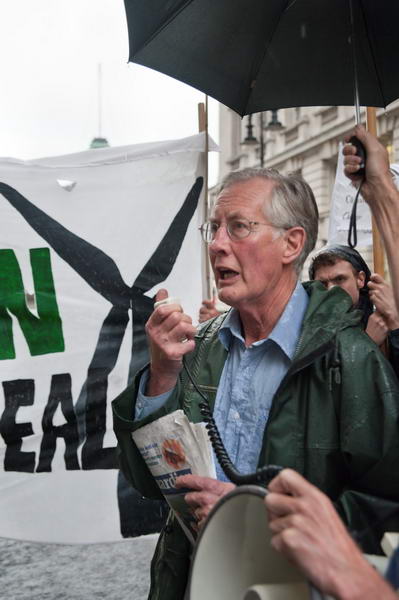
Of course I didn’t spend a long time working things out, just took a test frame with and without flash and then decided I’d use flash. Later, while I was photographing Michael Meacher MP  more or less head on, his glasses were giving some annoying reflections, so I turned the flash off for a few frames.

© 2009 Peter Marshall
Michael Meacher MP calls for action to save Vestas jobs – No flash

But then I moved around to one side and took a frame without flash before remembering to turn it back on. The result isn’t bad – though it took quite a lot of work in Lightroom to get it like this.

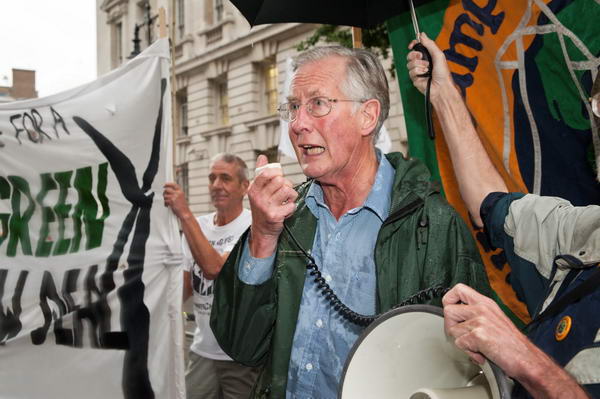
Below is an picture taken using the flash, which was rather easier to sort out in Lightroom, although I’ve perhaps dramatised it a little too much.

© 2009 Peter Marshall.
Michael Meacher MP calls for action to save Vestas jobs – With flash

As well as added flash, this image also has added water, a drop on the very large filter on the front of this lens which gives a slight smearing to the letters on the banner. You can also see the greater depth of field in the foreground hand – Phil Thornhill of the Campaign Against Climate Change holding the  megaphone – both were taken with focal length of 40mm. It’s perhaps a matter of taste which is better, though I prefer the flash version.

Of course what is important is what Meacher and the other speakers were talking about – supporting the Vestas workers in their fight for jobs. You can see more pictures – almost all taken using flash  – and read more about the event on My London Diary.

Milton Rogovin Speaks

You can hear one of my favourite photographers (and I’ve written about him on various occasions) Milton Rogovin talking briefly in the Lens blog on the New York Times about his attitude to photographing people.

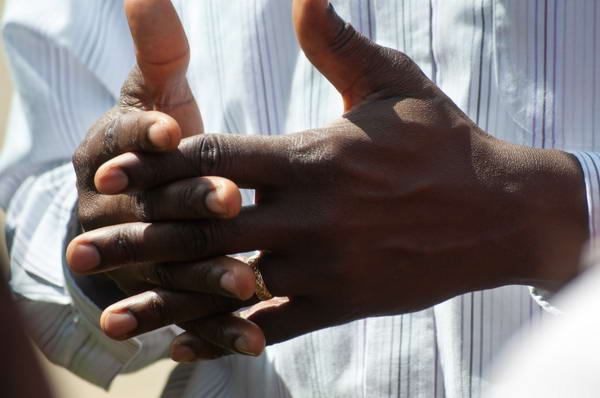
It also links to a feature about him in the paper, with photographs of Rogovin, his house (exterior and interior) taken by  Fred R. Conrad for The New York Times, although I don’t really see the point of 5 photographs of Rogovin’s files as he looks through pictures, some showing his hands, but all with his images seen at an angle.  One rather better image of the man showing his hands and the work might have been worthwhile, but really it would have been far better simply to have shown more images of some of his fine work.

You can read some of my own earlier pieces on Rogovin on this site:, in particular two different posts not too cleverly titled identically Milton Rogovin and Milton Rogovin. The second link is to a longer biographical article.

I don’t follow Rogovin’s prescription on photographing people, but like him very much regard it as a mutual or cooperative endeavour. Sometimes I use flash simply to make sure people are aware I’m photographing them, but I don’t think it is the only acceptable way to take pictures. Hard to believe so if you are also a fan of Henri Cartier-Bresson. But even when I photograph people without their knowledge, respect for them is still vital for me.

Maisie’s Night – The Ian Parry Scholarship 2009

© 2009 Peter Marshall.

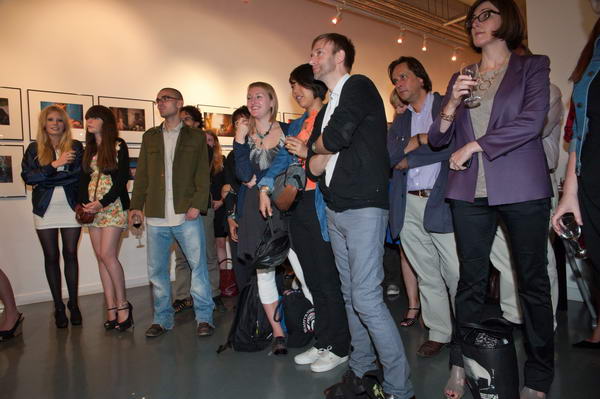
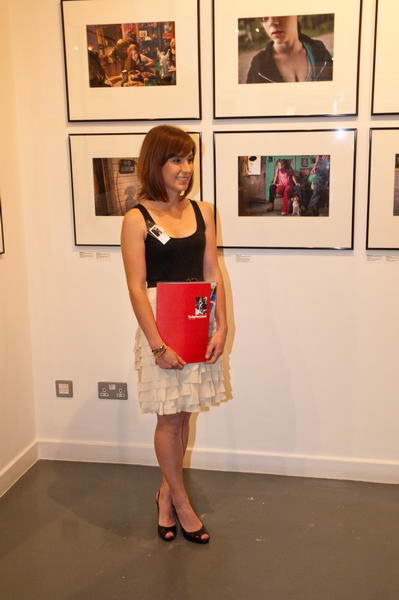
I’ve written in several previous years about the Ian Parry Scholarship award, particularly when I was writing virtually from New York but actually from Staines for About.com, not least because I wanted to remind our friends in the USA that there is photographic life outside their borders. But this is the first year that I’ve attended the awards ceremony – and the large party that accompanied it in the gallery and on the street outside.

Ian Parry was a 24 year old photojournalist shot while working for the Sunday Times covering the Romanian revolution in 1989, and family and friends set up an annual scholarship in his memory open to those attending a full-time photography course or under the age of 24.

As the exhibition at the Getty Images Gallery in Eastcastle St (near Oxford Circus) in London for the next week (so don’t delay in going to see it) shows, it attracts a high standard of work from around the world – including many from the USA.

Even more important than the prize is the prestige and exposure that the award attracts, with the exhibition and publication of work by the finalists in the Sunday Times magazine (2 Aug 2009 issue), a place on the final list of nominees for the World Press Photo Joop Swart Masterclass and this year, an international assignment for one of the finalists from Save The Children.

The value of the award can be seen in the careers of those who have been awarded it in previous years. Last year’s winner was Vicente Jaime Villafranca and on his web site you can see some of his fine black and white work on the Gangs of BASECO.

© 2009 Peter Marshall.

Maisie Crow is currently working as an intern for The Boston Globe and is a graduate student in the School of Visual Communication at Ohio University. Previously she studied Spanish at the Universidad de Veritas  in Costa Rica and Spanish and Art History in Seville before a BJ in Photojournalism at the University of Texas and further studies at the Salt Institute of Documentary Studies, and also worked as a freelance from 2006-8.

Her winning project on Autumn, a 17 year old Ohian girl growing up in a poor and dysfunctional family environment contains some powerful and intimate images – a selection of six were in the BJP feature on the award  (BJP 22/07/2009 p10). One of the captions which sets the scene reads “Autumn sits between a relative’s legs. She alleges he tried to rape her when she was 13 years old but says her parents do not believe her.”

Surprising the 12-page Sunday Times feature uses only one of her pictures, tightly cropped on the front cover. It is a highly charged scene with Autumn being attacked by her boyfriend, pushed down over the kitchen sink (the caption notes that within half an hour they had kissed and made up) printed much more harshly than the original and gaining drama at the expense of sensitivity.

© 2009 Peter Marshall.

Ed Ou’s Highly Commended work on the horrible deformities suffered by people living in the area of Kazakhstan where the Soviet Union carried out over 450 nuclear tests is extremely strong, and hard to view. Too much so for the Sunday Times, who use only a picture of a nurse cradling a small child; the BJP too shies away from publishing the more horrific of these powerful images from ‘Under a nuclear cloud’. Ou doesn’t dwell unduly on these aspects but they are an important part of the story, as you can see in the images on his web site (rather slow to load – but it does eventually appear.)

Some of the other work is better served in publication than on the gallery wall. The two pictures of Dennis, a sufferer from dementia and Ruby his wife, married for 61 years and now forced apart in the Sunday Times are far stronger than the sentimental portrait of the couple on the gallery wall, and made me want to see more of this project by Dan Giannopoulos.

Similarly, the two pictures by Giuseppe Moccia of an American teenager suffering from Down’s syndrome on the wall failed to grab my interest, but the Sunday Times has a far stronger image.  Other photographers whose work seemed more interesting in publication included Alinka Echeverria with images of veterans of the Cuban revolution and Masud Alam Liton’s project Bangladesh: Requiem For Freedom (he has a blog – Liton Photo) and a second set of images from the same country by Mohammad Rashed Kibria.

© 2009 Peter Marshall.

Of course the magazine page (or now the web page) is where this work really belongs, rather than the gallery wall and its perhaps not surprising that some at least works better there. The black and white work in particular seemed better suited to print than frame, perhaps reflecting the difficulties in making good black and white inkjet prints, but occasionally also the hanging. Ruben Joachim‘s Afghan child clinging to her father so intense on the printed page was lost in reflections and weaker contrast on the wall.

It is perhaps more a sign of the times rather than a reflection on the quality of the work that all of the winning and commended work this year was in colour. Personally I would have made some different choices, although the work of Crow and Ou did I think stand out among the rest.

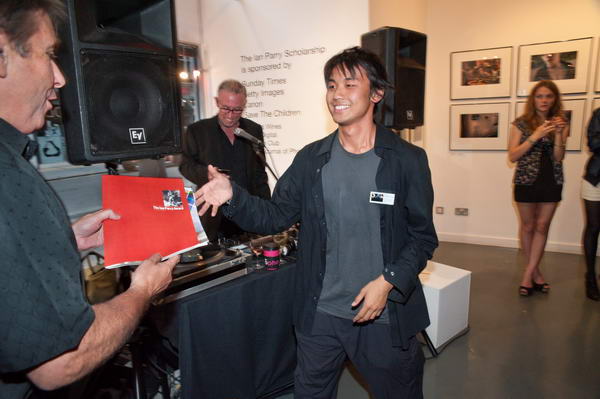
We were sorry to hear that Don McCullin was unable to attend, but Tom Stoddart was there to hand over the awards to the winners. This is one of the more interesting of photographic awards, and deservedly gets sponsorship from the Sunday Times, Getty Images, Canon and Save The Children, as well as Touch Digital, Frontline Club, British Journal of Photography and, last but certainly not least, Eminent Wines.

© 2009 Peter Marshall.

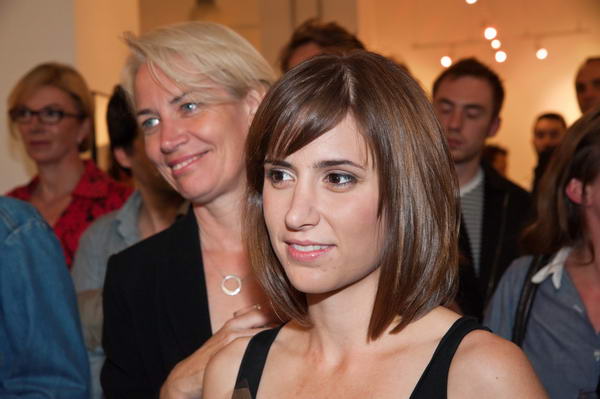
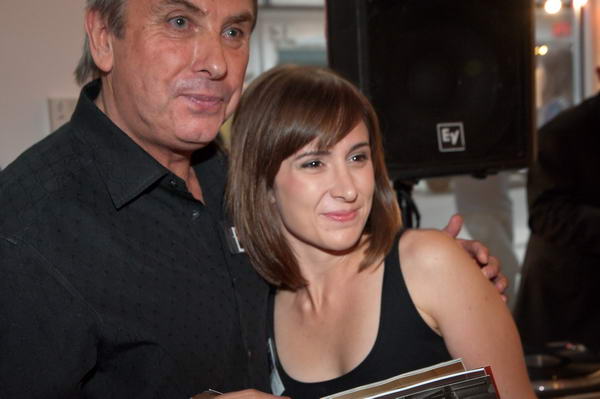
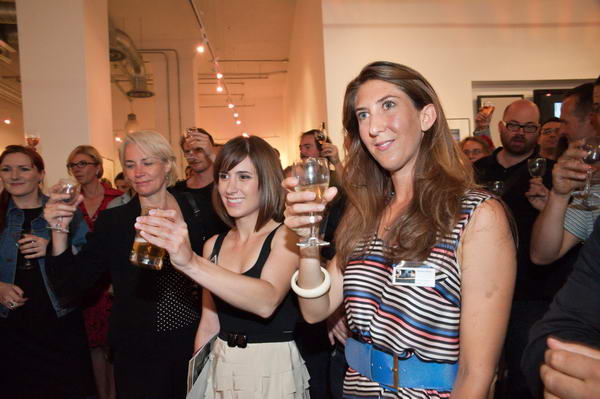
Since I was there, I took some pictures – though using a Nikon D700 with Nikon SB800 flash and a Sigma 24-70 f2.8 HSM lens (sorry Canon!) Given all that excellent wine it is a powerful testimony to Nikon’s intelligent electronics that everything came out.  The gallery was crowded for the opening, and the food and drink was still flowing freely when I left around 10 pm to scurry back to Staines.

© 2009 Peter Marshall.

I’ll put a few more pictures from the opening on My London Diary shortly.

Carnaval del Pueblo

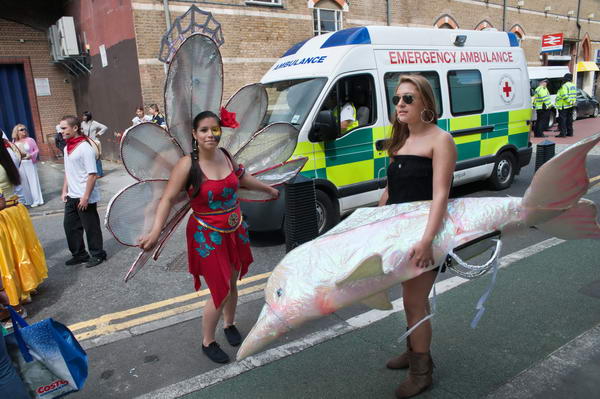
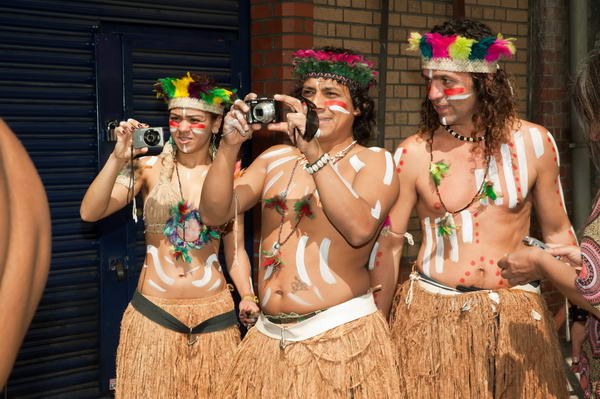
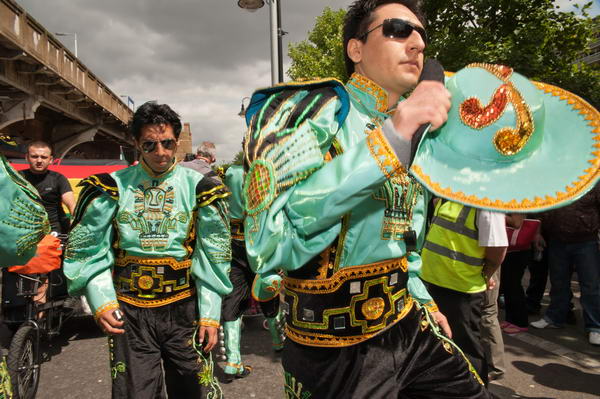
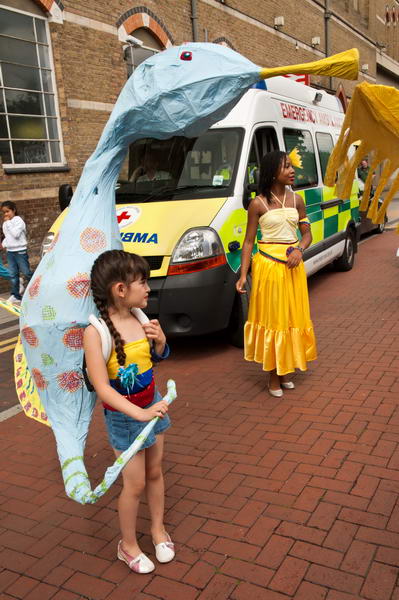
There are those who turn up their noses at South London and apparently taxi drivers who refuse to go there late at night – though that’s not a problem I’ve ever had since I virtually never use taxis.    But south of the river has many charms and I’ve photographed many parts of it, as well as events such as the Carnaval del Pueblo,  described as “the largest Latin American out-door festival in Europe” which began with the support of Southwark Council in 1999.

© 2009 Peter Marshall.

I’m not sure if the first time I photographed the parade which forms a part of it was in 2004, but certainly this was the first set of pictures from it I put on My London Diary (about halfway down a long page) and in some respects I think it was rather easier then than last Sunday.  The big difference is simply the number of photographers. Since 2004 we’ve seen an enormous growth in the ownership of digital cameras, and in particular of amateurs getting digital SLRs capable of professional results.

© 2009 Peter Marshall.

And once people have got digital cameras, of course they want to go out and use them, and what better opportunity than a festival such as this. Not only are there more photographers, but while film had a restraining influence on the number of pictures that people took – many amateurs might well have thought 36 exposures more than enough for a single event, and for the more serious of us perhaps half a dozen cassettes would have seemed fairly extravagant given the likely return – with digital the marginal cost of an exposure is essentially zero.

Don’t get me wrong. I’m not saying that digital photography is cheap – my annual accounts would immediately prove me wrong. Just that taking more pictures doesn’t add to the costs. It adds a little in the cost of storage – but a one terabyte external hard disk costing around £70 will hold perhaps 80,000 of my RAW images  – under 1p per image. And probably more importantly it each adds a few seconds to the time I take to go through a set of images and select the relatively small proportion that I will take further. But once you’ve got the gear, then photography becomes more or less free.

The event has also gained a higher profile and the festival in particular has grown, although the procession – despite some lottery funding – doesn’t seem to be much different. Perhaps it does now have a little less of a ‘grass-roots’ feel to it than it did in the early years, but this doesn’t yet appear as an event that seems to have been commercialised and organised out of existence like some others. It is still an event where anyone can turn up and take pictures, and I think probably the kind of thing that is listed as a ‘photo-opportunity’ in Amateur Magazines. Hence the swarm of photographers, and the problems that brings for both other photographers and those taking part in the event.

© 2009 Peter Marshall.

In general working with a crowd of amateurs is harder than working with pros, who tend to be rather more aware of what they are doing and less likely to walk in front of other photographers etc. And I’m sure that my way of photographing things – using my feet to get in what I think is the right place to take pictures whenever I can – infuriates many of those who like to stand well back and press the button from a distance.

© 2009 Peter Marshall.

Of course these other guys have just the same rights to be there and take pictures as I do, and I wouldn’t want that generally restricted, though there are times when I think a press card should get you places that others can’t go. But perhaps I might find other things to do another year.

More about the event and more pictures on My London Diary.

Repent!

Although I’ve photographed a lot of religious events I still sometimes find them a problem. It has nothing to do with the actual beliefs held by the people I’m photographing, but more about feeling that I am intruding on something private.

It’s something I seem to feel more strongly with Christians, and also it is only with Christians that I’ve had people object to being photographed.   So while I can go into a Gurdwara and be told “photograph anything you like“, in some churches I’ve been told I can only take pictures when the worship is over.

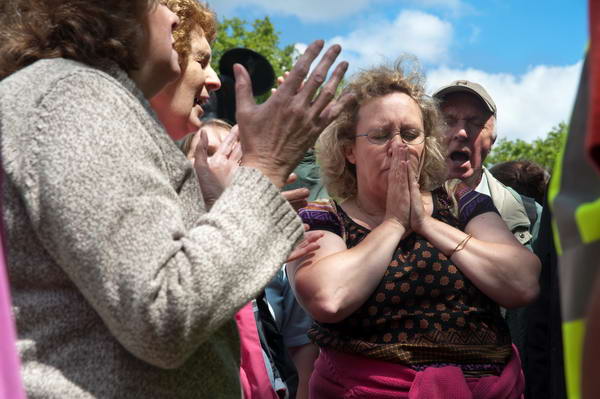
So on Saturday I wasn’t quite sure what reaction I would get when I went to photograph the March of Repentance, but in fact I was made welcome by the stewards running the event.  Even so, I felt the need to work with somewhat more reserve than normal when photographing the groups of people praying – they didn’t object, but I just felt a little uncomfortable at times, and ended up taking considerably more at longer focal lengths than normal for me.

© 2009 Peter Marshall.

This was with the 24-70mm at its long end, and I took two versions, one focussed on the closer hand and the second with the woman at right sharp. Both actually work quite well, though I prefer this, with the woman slightly unsharp.

Of course, where longer lenses really come into their own is for pictures like this:

© 2009 Peter Marshall.

Using the D300 with the Sigma 70-210 gives a an effective 105-315mm, and this was taken from just outside a small ring of people praying, with an equivalent focal length of 270mm.

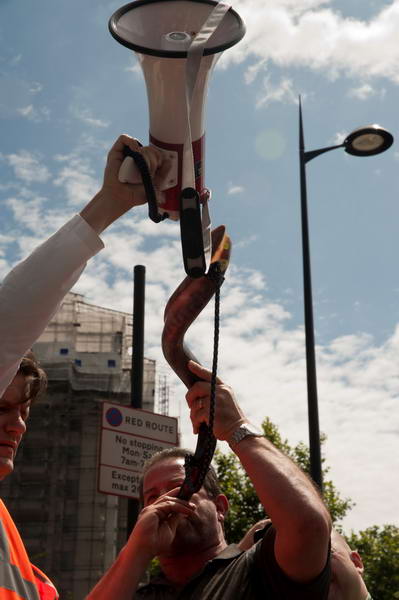
As always at events, you need to try and think what is going to happen, as well as concentrating on what is actually happening and thinking how to solve the visual problems involved. The guy standing at the front of the march holding a ram’s horn was obviously at some point going to blow it, so I made sure to be there when he did. What I hadn’t expected was that instead of just sounding the Shofar, he was going to blow it into a megaphone. It’s perhaps something that sounds better in USA-speak when that electrical device is called a bullhorn.

© 2009 Peter Marshall

It isn’t the greatest picture I’ve ever taken (and I think I could do a little dodging and burning to improve it ) but I think it records a key moment, and I was surprised I was the only photographer among several there to be in a suitable position to take it.

More about the event and more pictures on My London Diary.

Photo-Op Impossible

I’m not a fan of ‘photo-ops’, arranged scenes set up for the press to take photos. Of course in a sense almost all the events and protests I photograph are arranged, and often very much with the possibility of press coverage in mind, though sometimes – for example too often with Stop the War events – you find the stewards do their best to frustrate photographers trying to get good pictures. So much so that I remember one time where we all sat down with our cameras on the tarmac in front of a march going down Park Lane.

But photo-ops are well meaning attempts to present what the organisers think will make a good picture.  Usually the problem is that they are just boring, and also many of us like to have a little more chaos and show things how they are.  Of course some of the press photographers are very much to blame – they like having things made easy for them.

There are photographers working for newspapers who like to set everything up. My heart sinks when one such decides to take charge of an event and to “set things up so we can get some good pictures” and procedes to get in the way of all of us and produce some massive cliche.  Of course sometimes you can still continue to take pictures, ignoring their concept and perhaps concentrating on smaller parts of the subject. He may want a wooden image of all 27 bishops present but you can still photograph the one who  is telling his neighbour a risque joke – and the reaction it causes – even bishops don’t respond too well to herding.

Another hate of mine is “Lets all move back boys, and we can all get a good picture”, usually coming from someone who saw a picture opportunity too late to get there. Or perhaps just can’t be bothered to change to a wide-angle lens. It’s always said when if anything I’d like to get in closer. You can be too close to people when photographing them – and when the only possible lens to use is a fisheye you probably are, though I do like my full-frame (on the D300) fisheye.

Yesterday,  a demonstration outside the Ministry of Energy & Climate Change  (from both title and policies its hard to tell whether they are for or against it) came one of those almost impossible to photograph ideas, with protesters getting down on the roadway to try to spell out the words

SAVE
VESTAS

with their bodies. It was a scene that demanded to be photographed from around 100 ft above, and my feet were firmly on earth.

[Vestas Blades UK  are the only UK manufacturers of wind turbine blades whose owners want to move production to the USA to take advantage of government funding available there – no connection with matches or curries.]

They made quite a wide target, and even with a 12mm ultrawide on the D300 I had to stand well back to get the whole message in.  Although it was obviously hopeless I took a few frames, though with a less wide lens to minimise distortion.

© 2009 Peter Marshall.

Then I switched to the 10.5mm fisheye and moved in close to the people on the ground. With its 180 degree diagonal view (and 147 degrees horizontal) getting everyone in wasn’t a problem. I got as high as I possibly could by a ‘Hail Mary’, holding the camera at arms length above my head and pointing it down towards them. It still wasn’t high enough, but the best I could do. I could perhaps have gone in a little closer, but I knew that I might need plenty of subject matter around the central scene for the later work.

© 2009 Peter Marshall.

Then at home it was time for Photoshop, and some perspective correction and cropping and more. I spent far too long trying out various approaches that gave results like this.

© 2009 Peter Marshall.

Not a great result, but I think the best I could do in the situation.

More about the actual event on My London Diary shortly.

Wikimedia, Gage and Orphan Works

Whenever two or three photographers are gathered together issues of copyright are seldom far away, and increasingly they hit the news too.

Almost all the pictures on this site are by me. When I wrote and blogged for a commercial site (About.com) for eight years I was required to have explicit written consent for any images used other than those that were unequivocally in the public domain, and its a policy that I’ve stuck to pretty rigidly here. After all, I don’t like others taking my images in vain.

The strength of the Internet is very much in how it links sites together, and takes users on some fascinating journeys. If I want readers to see an image by another photographer, I’d generally prefer to take them to that photographers website, where as well as the image I refer them to they may find other things to interest them. A good link is much more than an image.

Wikimedia and the NPG

Three things about copyright have come to my attention recently. The first hit the national news when the English National Portrait Gallery (NPG) threatened Wikipedia over the uses of images from its collection.

The pictures in the collection are clearly out of copyright, being paintings of considerable age. The dispute is over whether the NPG can claim copyright in its reproductions of these images.

Despite the fact that it takes skill and considerable expense to make accurate photographic reproductios of paintings, it would seem to me to be something that was clearly and deliberately outside the traditional definition of copyright. This clearly stated that it must involve articles of artistic intent rather than those that were a matter of mechanical reproduction.

So far as I’m aware, British courts have never been asked to rule on this specific matter, and although at least one leading UK copyright lawyer has given his opinion that such works are copyright, I’ve heard others express a differing view. In the US, the case of Bridgeman v. Corel gave a clear decision that such works were in the public domain, but still many museums continue to claim copyright.

Phineas Gage

A similar case exists over the privately owned daguerreotype of Phineas P Gage 1823-1860 in the Wilgus collection. I can’t get too worked up over it  –  it isn’t a great example of the daguerreotype art although Gage is mildly interesting – an early victim of an industrial accident, he was a railway builder who had his head pierced through by an iron rod he was using to pack gunpowder which exploded prematurely. Although the rod went in his left cheek and out through the top of his head, he survived for a further 11 years. The photo shows him holding the large rod and with a missing eye.

The dispute here was largely that the image was originally placed on the web site with a visible watermark across Gage. Following a rather furious Internet spat, the owners have re-posted it with the watermark across the case – possibly more interesting than the actual portrait!

Private Ownership and Public Institutions

Both these cases are essentially not so much about copyright as about the business interests of the owners of the original in supplying high res images for reproduction. Owners of public domain images are in general under no obligation to put them on the web and have every right to charge a fee for supplying files, and to impose a suitable licence on their use.

A note on the Gage page states: “High resolution photographs without a watermark are available for reproduction. Contact us for information on usage fees. For several years we have had an informal business supplying images in our collection to publishers, film, and television producers for a modest fee. We often grant permission for educational and non-profit usage, asking only for a credit line and, perhaps, a copy of the publication if it interests us.” I find it hard to find fault with this.

For the National Portrait Gallery, the situation is I think different. It is a publicly funded body, and it’s my and others taxes that have paid for these images and indeed for their reproduction. The pictures belong to us and it is a central part of the NPG’s remit to make them available as widely as possible. Hard to see a better way to meet its obligations than by allowing Google to use them.

The NPG appears to have a poor reputation over its attitude to reproduction of works in the collection. In the comments on the  Wikimedia blog you can read this from someone working for a UK publisher:
I’d just like to say that the National Portrait Gallery is one of the worst offenders in the world in its digital practices. The terms and conditions (quite apart from the cost) associated with getting permission to use one of their images – itself a pretty offensive idea, I know – are so bad that you can’t really afford to do business with them.

This is particularly bad because the NPG often holds the only good image of a historical figure. I’m publishing the only book in some decades about a minor 18th-century writer, for instance, whom the NPG owns the only contemporary painting of. It’s the obvious choice for a cover image. But we can’t afford the money or the legal obstacles, so it’s not on our cover. Instead we’re using an obscure etching of a sketch made towards the exact same painting.

If I had to name one museum or gallery in the UK as the chief villain in this all-too-common story, the NPG would be the one.”

It does seem likely that a compromise will be reached in this case also; an NPG spokeswoman is reported by the BBC to have been said that they would be willing to supply medium resolution images of its public domain works to Wikipedia.

Orphan Works

The third thing that I read a month or two ago was a post by Dan Heller on the “odds between the myth and reality of the OWA” (Orphan Works Act.)

What I think this makes clear is that the problem that photographers – or at least 99% of photographers – have is not the likely consequences of the OWA, but with US Copyright Law as it has been since 1976 (at least.) This essentially went against the terms of the Berne Copyright Convention in requiring registration of works at the US Copyright Office for effective copyright protection.

As Heller states, “99% of photographers don’t register their works. So, for them, the OWA is inconsequential.

He goes further to argue that for the 1% who do register the OWA is “a new sales opportunity, one that cannot be compared to any other: the searchable database might allow users to find your works.”

This post in May was Heller’s first in association with PicScout, a partnership that didn’t long survive the posting.  The PicScout bot, used by Getty Images, Corbis and others to discover unauthorised image usage, has aroused some strong feelings on the Internet, for example being described by William Faulkner  as “potentially criminal and certainly unethical.” Faulkner points out – among other things – that it’s behaviour is expressly forbidden in the terms of usage of Getty Images’ own web site.

Emergency Alternative Parliament

I’ve photographed demonstrations organised by the Campaign Against Climate Change for around ten years, at first of course on film and now on digital. Often they’ve had some nice visual touches that make life easy for photographers – one of the earlier occasions I remember involved a rather attractive female ‘tiger’ being pushed through London on a bed, which was fine until the wheels fell off!

© 2009 Peter Marshall.
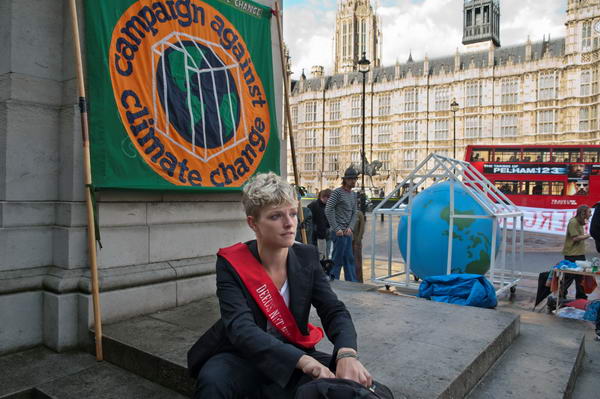
Tamsin, banner, greenhouse and Parliament. And a bus

But one thing that’s made life difficult for us in recent years is their trademark globe in a greenhouse. I’ve yet to find a sensible way to really use it in any photograph over the years, though it was less of a problem than usual.  It even sort of fits quite nicely into a few pictures, with the Houses of Parliament behind.

The demonstration was in Old Palace Yard, tucked in behind Westminster Abbey facing Parliament. It’s just a little frustrating that it’s almost impossible to see ‘Big Ben’ (or rather its clocktower)  from there, although I did manage to get the odd picture where it peeps around an edge.

© 2009 Peter Marshall.
Big Ben can just be glimpsed from Old Palace Yard

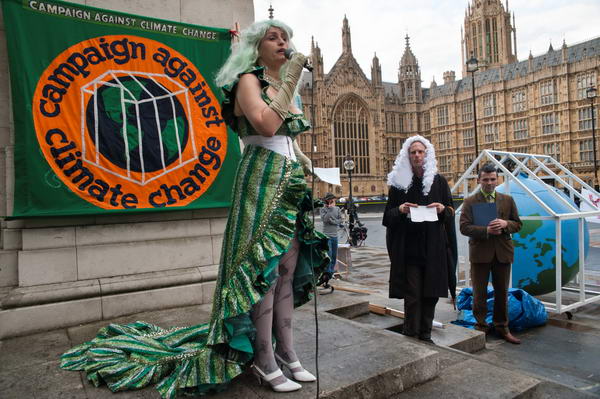
But at least there were a few things to add visual interest, not least the ‘Green Queen’ who looked suspiciously like a mermaid I’ve often photographed. Tamsin Omand with her ‘Deeds Not Words’ sash and the ‘Speaker’ also added a little, although considerably less once he lost his wig. It’s apparently the most daring constitutional change our current government has yet made.

© 2009 Peter Marshall.

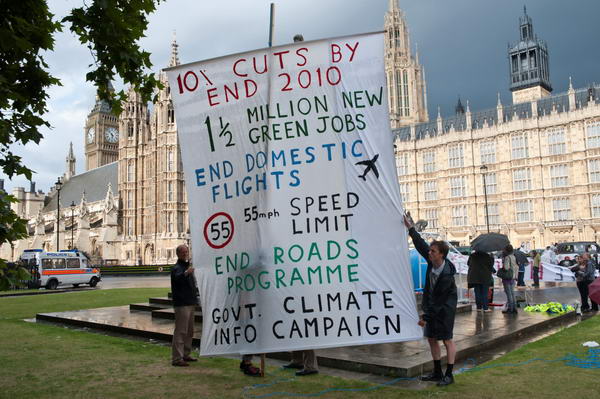
Of course people are interesting, but it has to be said some more so than others, and trying to produce varied images from a succession of speakers can be hard. Some give photographers a tough time, keeping their eyes closed or looking down. You can see what I made of them – and other pictures from the event on My London Diary, as well as something about the purpose of the event. The banner in the second picture has a pretty good précis!

The lighting was interesting at times, with sunshine and showers, though unfortunately no rainbow in the right place (or anywhere else.) The rain was a bit a a nuisance, but fortunately all three lenses I was using have lens hoods that help a little, and the occasional wipe with a microfibre cloth kept cameras and filter free of drops.