Photographers Flash-Mob

The response from the PM’s office to a recent petition on the restrictions on photography was of course bland in the extreme, but the petition itself was perhaps an over-reaction to a measure which perhaps clarified rather than intensified the existing  restrictions on photography. When the Counter-Terrorism Act 2008 came into effect I attended and recorded on the demonstration by photographers outside New Scotland Yard. Since then I’ve also mentioned the Home Office circular Photography and Counter-Terrorism Legislation which gave police  some generally welcome advice to police about how they should be using the legislation. A description of two sections of the legislation is in each case followed by something the circular designates as Important,  that they do “not prohibit the taking of photographs, film or digital images  … and members of the public and the press should not be prevented from doing so

It was perhaps a shame that in relation to Section 58 – the photography of police etc – the note concerning the statutory defence of reasonable excuse read:

Important:Legitimate journalistic activity (such as covering a demonstration for a newspaper) is likely to constitute such an excuse. Similarly an innocent tourist or other sight-seer taking a photograph of a police officer is likely to have a reasonable excuse.

Although of course the note should not be taken as excluding other activities from having reasonable excuse, it does seem unduly limited. The circular should have stressed more the need for their to be a reasonable presumption that the photographs would be “likely to be useful to a person committing or preparing an act of terrorism” and that it would not cover photography of police carrying out normal activities such as the policing of demonstrations, directing traffic or giving directions to tourists. Or even less normal activities such as beating up demonstrators and damaging property.

Most of the problems that we have with police on the street (and anyone who photographs on the street and claims to never have problems must surely be in police employ) have to do not with the law but with police who like to make their own laws or fail to know or respect the law. Certainly a few police do have it in for photographers,  but perhaps rather more fail to appreciate the problems that we face. And of course the police often have plenty of problems at some of the events that we photograph, even if some of them are of their own (or their superior officers) making. It can be instructive to read some of the blogs written by police.

But photographers are definitely finding the job harder, not just because of police, but also because more and more public areas are now controlled by security guards.  Increasingly parts of our cities that are spaces open to the public have been privatised, and if you raise a camera to your eye or erect a tripod you are likely to find your view blocked by a large man telling you that you cannot take pictures. And if you are on private land – such as that of Canary Wharf Estates – although it’s very much public, with underground and DLR stations, buses, shops and more where the public are free to pass and spend their money, you have no right to take photographs.

(Security guards do often appear to be trained to be hostile to photographers.  Over the years I’ve carried out an education programme, telling them what the law is and asking them to contact their supervisor to check, or to phone for the police.  But if the land you are standing on is private, you don’t have a leg to stand on, though I’m a fast worker and have often taken the picture I want before they get to me.)

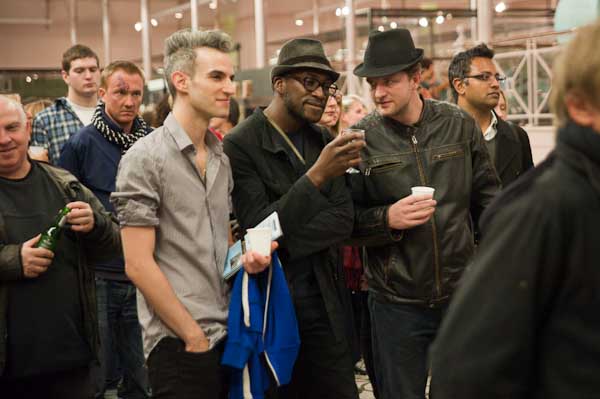
A couple of weeks ago, the I’m a Photographer not a Terrorist! campaign organised a flash-mob protest at Canary Wharf and around a hundred photographers including many of London’s better editorial photographers turned up on the dot of 3pm to defy the ban and take pictures. Security men watched from a distance but otherwise ignored the protest.
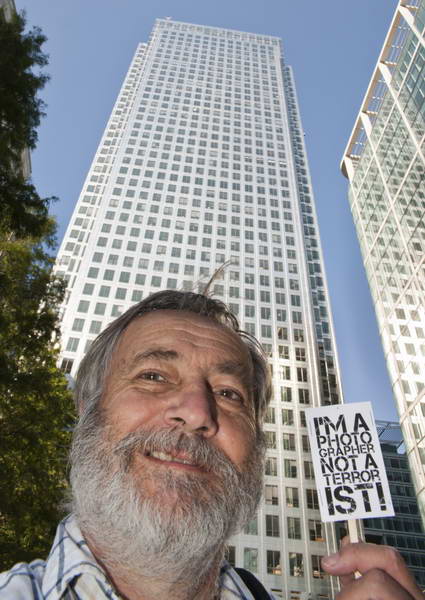
© 2009 Peter Marshall

So we photographed ourselves (above) and the other photographers, talked to a few members of the public about the issue and then went for a pint, before I went home to post the story to Indymedia and Demotix. You can read more about it and see pictures of some of the more attractive participants on My London Diary.
Spiritual America Meets Puritanical Britain?

In 1975 the perhaps aptly named Gary Gross, who had been taking pictures for Teri Shields, made a series of images of her 10 year old daughter. Teri had been managing her daughter Brooke’s career as a model more or less since her birth (she first appeared in an advert aged 11 months) and Gross had photographed for her regularly. This particular series of pictures was made for a project of his with Playboy Press, The Woman in the Child, which set out to explore the femininity of young girls, and Teri signed a comprehensive model release in return for a fee of $450.

It’s a set of images that has several times caused controversy. In 1981 Brooke tried to buy back the negatives from the photographer and then took a million dollar lawsuit against him. But the contract signed by her mother stood the test, even after a lengthy appeal. Her lawyers then tried to get the pictures banned as a violation of her privacy, but the court threw this out, probably taking into consideration what the StyleList blog describes as her “sordid history of being sexualized as a child. There was her portrayal of a 12-year-old prostitute in 1978’s “Pretty Baby,” the nude scenes of a 14-year-old Shields in “The Blue Lagoon,” and the notorious “What comes between me and my Calvins?” Calvin Klein ads a year later.”

In throwing out the case – which more or less ruined Gross, despite his victory – the court stated “these photographs are not sexually suggestive, provocative or pornographic, nor do they imply sexual promiscuity. They are pictures of a prepubescent girl posing innocently in her bath”, but it’s a verdict that many, apparently including the ‘Vice’ at the Metropolitan Police, disagree with.

Richard Prince is not one of my favourite photographers, largely because in my opinion he is not a photographer at all, but an artist who uses – and often abuses – photographers, failing in a number of cases either to give them proper attribution or a decent share of the loot. But in this case he appears in the end to have done the decent thing so far as Gross was concerned in getting his agreement for the use of one of these images in his piece ‘Spiritual America’, which appeared in what David Deitcher described in a 2004 feature in Artforum as “a now all-but-forgotten exhibition: works by Sarah Charlesworth, Louise Lawler, Cindy Sherman, Jeff Koons, Allan McCollum, and Richard Prince; opening on the evening of February 1, 1984, at a place called Spiritual America, 5 Rivington Street, on Manhattan’s Lower East Side.”

In his surprisingly readable and informative piece (neither truly native to Artforum) he reminds us that the title of the work is also a lift – from Alfred Stieglitz who gave the title in 1923 to an image of the rear flank of a gelded harness horse, an image and titling that impressed Prince greatly. You can also read about the image in a 1993 feature by Carol Squiers and Brian Wallis from Art in America, Is Richard Prince a Feminist (which includes an interview withPrince) which says that there was yet another legal controversy, this time over Prince’s plans to publish a limited edition of 1000 copies of ‘his’ image at $999, undercutting a planned 1000 copy edition of the picture by a poster company and Gross by a dollar a print. Apparently an acceptable settlement was reached.

According to the Guardian, Tate Modern had taken legal advice before deciding to put Prince’s version on display as a part of their Pop Life exhibition which opened on 1 Oct. But it opened without ‘SpiritualAmerica’  as the Met, having read about the forthcoming show in Scotland Yard’s copy of the Daily Mail, raided the gallery and persuaded them to remove the picture from the show. The catalogue in which it was listed has also been withdrawn. (The Daily Mail story has since been updated on-line to reflect the vice squad’s action.)

In writing this piece, I’ve been careful – for legal reasons – to not to link to sites which contain the full controversial image. If you want to see it, it has been published here many times in books and magazines and Google will enable you to find it in a couple of clicks, along with other images of Brooke taken by Gross, although the main site on which they were apparently housed is unobtainable, probably because of the intense demand fuelled by the story.  It does seem yet another occasion on which our law is making an ass of itself.

Paul Trevor – Photomonth2009 Opening

Last night Photomonth2009 was officially opened at the Museum of Childhood, part of the V&A Museum in Bethnal Green. It was an appropriate venue for several reasons. The V&A – at its South Kensington site – was one of the first museums to collect and buy photography, starting around 150 years ago,  and has one of the finest collections around which is accessible to visitors through their Print Room, as well as various exhibitions. It is a great experience to go there and handle vintage prints by great photographers such as Eugene Atget, Edward Weston and so many more there.


Festival director Maggie Pinhorn and Mick Williamson

The buildings that make up most of the Museum of Childhood were actually physically transported from South Ken into East London and opened in 1872, very much as a part of a mission to bring culture to the masses (a massive failure which you can read more about in Cathy Ross’s ‘The Romance of Bethnal Green‘ – the feature includes a few of the photos I supplied for the book.)

Photomonth, based in an East London which has now become the artistic centre of the capital,  is a rather more successful attempt, including a huge number of photographic shows and events as I mentioned previously.  It is very much the largest photographic event in this country, and I think the most important and most vital, though I’d like to see it even bigger and better as a London photo festival.

If you read my several postings last November on the events in Paris – the dealer trade show ‘Paris Photo‘, the ‘Mois de la Photo‘ and the ‘Photo-Off‘ fringe festival (see the >Re:PHOTO archive for November 2008 and  MyLondonDiary for the same month) I think you are likely to share my feelings that some of the most exciting things on show were in the fringe (and there were some on the fringe of the fringe too.)

While Paris becomes an inclusive festival by the presence of these different strands, Photomonth sets out to be so from the start – open to all photographers who want to participate, through major museums and arts centres, small galleries or any other spaces they can find to hang work. The Photomonth Photo-open at the Old Truman Brewery provides an even wider opportunity for taking part.

What is perhaps most important is that it is largely a photographers festival rather than a curators festival. Photography in this country suffered a near-fatal blow around 40  years ago when the Arts Council decided to concentrate funding on galleries and curators rather than on artists and photographers which almost halted the immature but developing photographic culture of this country in its tracks.


Paul Trevor

Photomonth opened with a photographer who first became known in those few years of opportunity in the 1970s, Paul Trevor, who I wrote about a little for last year’s Photomonth.  His show ‘Childhood‘ in the Museum of Childhood is a small selection of 20 pictures featuring children from the many thousands of pictures in his ‘Eastender Archive.’ Most were taken in the 1970s and 80s around where he was living in the Brick Lane area, and they include several of his justifiably best-known pictures, some of which I first saw in ‘Camerawork’ soon after they were taken. Although the printing is adequate in letting you see his images, it perhaps lacks the kind of depth and dimensionality his work really needs to be seen at its best.

Also on display at the V&A Museum of Childhood was a small series of large (3 times life-size and 105×134 cm)  head and shoulder profile views of one-year-old children by Bettina von Zwehl. The catalogue note says “With her distinctively precise and patient approach, von Zwehl creates images which challenge traditional expectations of how young children are portrayed” but I found them rather boring.  You can make up your own mind, at least from small reproductions of ‘Profiles Three, 2005’ on her web site The size on the web or on in the Photomonth catalogue, which you can pick up free at any of the participating venues, is really at least as much as I feel a need to see.

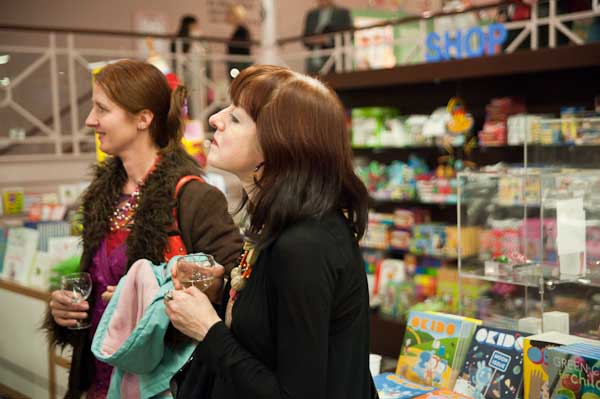
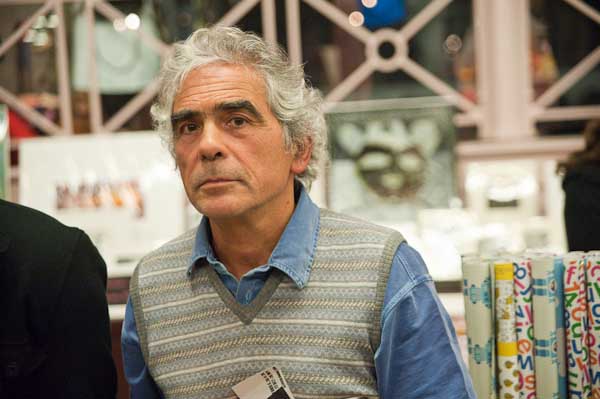
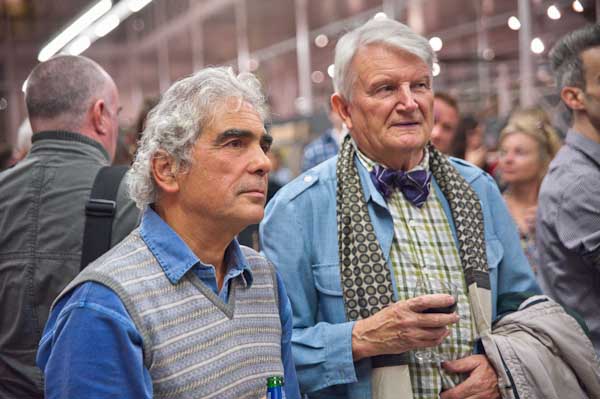
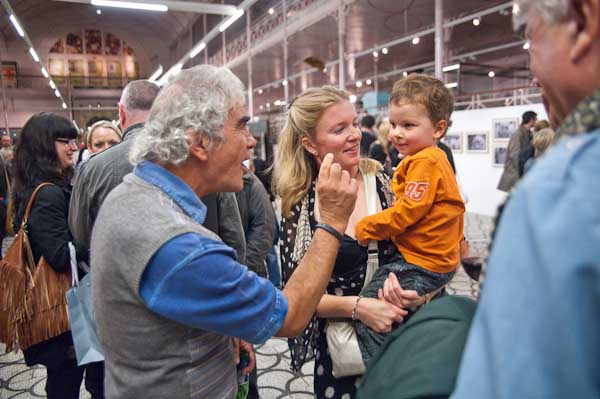
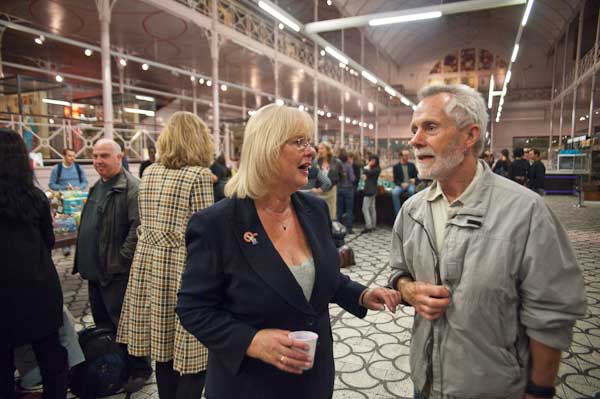
It was a well-attended opening, with many well-known photographers, including of course Paul Trevor. A temporary exhibition showcase of dolls very much attracted the attention of both Martin Parr (and myself.) Jenny Matthews is one of the festival patrons (I didn’t see the two others, Tom Hunter and Stephen Gill, but they may have been there.)  Far too many other photographers were there to name them all.

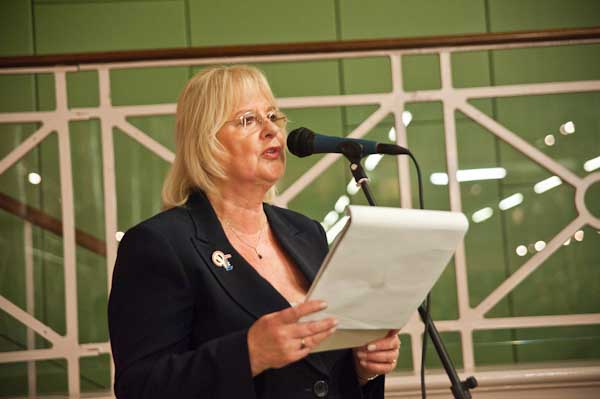
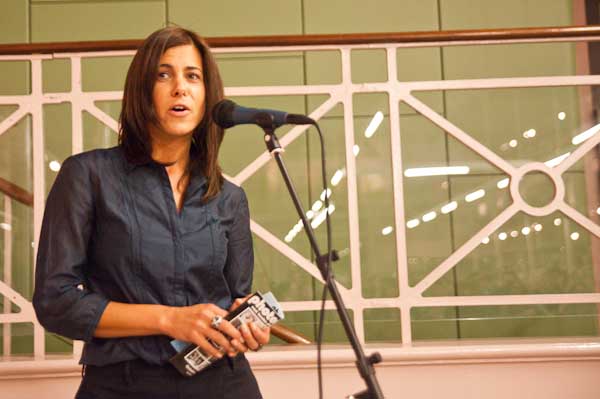
There were just three short speeches,  one welcoming us to the museum and a second by Festival Director, Maggie Pinhorn of Alternative Arts, who had the idea for the festival a few years ago and got it running with little or no support from the arts establishment. It’s still a festival that runs on a shoestring with the support of a few sponsors. The third and final speech was by someone from the World Photography Organisation which is sponsoring the new Youth Photography Award as a part of the festival.

Artists & Illustrators and a photographer

It may be just a small picture and a hundred or so words in total, but I think I’m the only photographer featured in the October issue of ‘Artists & Illustrators‘ magazine.

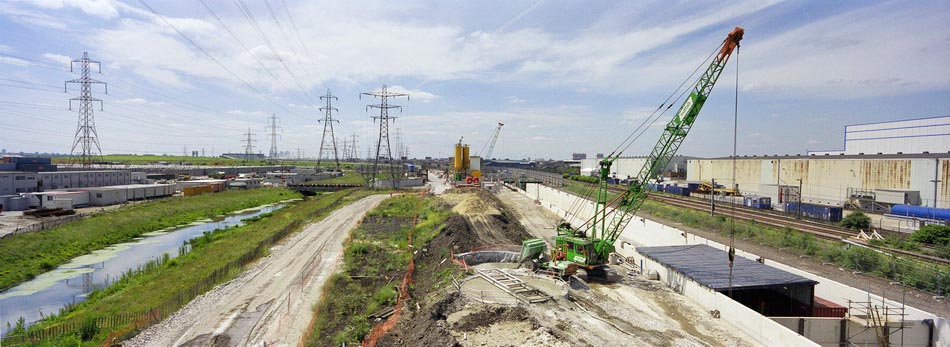
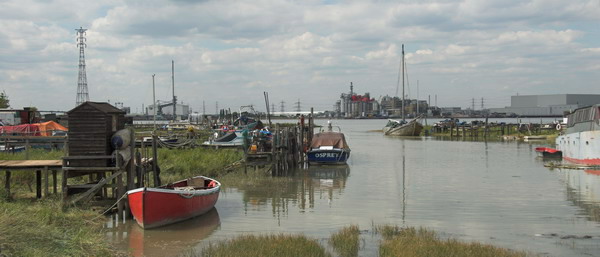
They asked me if I would send one of my photos of the Thames Gateway, “an industrial site rather than greenery” and 50 words on what attracts me to photograph the city, along with a portrait of myself.

© 2003 Peter Marshall
The Channel Tunnel Rail Link construction and Fenchurch St – Grays railway looking West, Dagenham. June 2003

The image I sent them of Dagenham did have some greenery, indeed it contains a Site of Special Scientific Interest in the ditch at the left (the Gores Brook) but also has an industrial quality and shows the Channel Tunnel Rail link under construction in 2003, as well as the railway line from Fenchurch Street to Grays.  If Boris hadn’t cancelled the DLR extension to Dagenham Dock last year (see London gets what it deserves. Unfortunately) that would have changed the view a little when it was built, and if common sense eventually prevails may still do so at some later date. Like quite a few from this series it was taken using the Hassleblad Xpan with the 30mm wide-angle lens using ISO 200 Fuji colour negative film.

I think I can now get similar results with digital, using the Sigma 12-24mm at around 18mm and cropping down to the same format, which results in about a 7.5 Mp image,  4256 pixels wide, which can give excellent prints up to around 20 inches wide, and certainly on the A3 or A3+  sheets on which I normally now print the Xpan files.  One made with a longer focal length hangs behind me and technically it’s hard to fault.

© 2006 Peter Marshall

You can see the Dagenham picture rather larger (though I think I made a slightly better scan for the magazine)  along with some others images in my Thames Gateway project on the Urban Landscapes site (it is of course in the ‘Essex’ section.) You might even be able to see Canary Wharf on the horizon.

And the 50 words I sent? Well, they didn’t really relate to this picture, but to my interest in the city in general, and it was really impossible to say all I wanted to say in such a limited space. But here they are:

Involvement in grass-roots planning campaigns in Moss Side in the 60’s led me to document urban realities and processes when I went into community photography in the next decade. My first major urban project was in Hull, where a similar vast clearance was under way. Since then London’s post-industrial landscape and new developments have provided plenty of material.

The magazine also mentions a couple of my web sites and my forthcoming show with Paul Baldesare, ‘Taken in London‘.

Capitolio – Christopher Anderson

Anyone who doubts the relevance of black and white in photography now that almost all of us shoot in digital colour should take a look at the selection of pictures on the New York Times ‘Lens’ blog by Magnum photographer Christopher Anderson from his new book on Venezuela,  Capitolio. You can see more of his fine work, both in black and white and colour, on the Magnum site.

The feature on ‘Lens’ by Simon Romero tells you more about the streets of Caracas, surely one of the more difficult places in the world to work, and also about the photographer, so I won’t write more here. Just don’t miss it.

However, as well as great work like this, I do see rather too much black and white photography that I look at and think that it was shot in colour and surely would have been better shown in colour. These days almost all photographers do start with colour – on digital compacts and phones – before taking up photography seriously,  and although may take courses that force them to do at least some work in black and white, few get the kind of experience with working with it that we used to back in the days before digital and when newspapers and many magazines were largely or entirely monochrome.

Green Fayre at Aylesbury

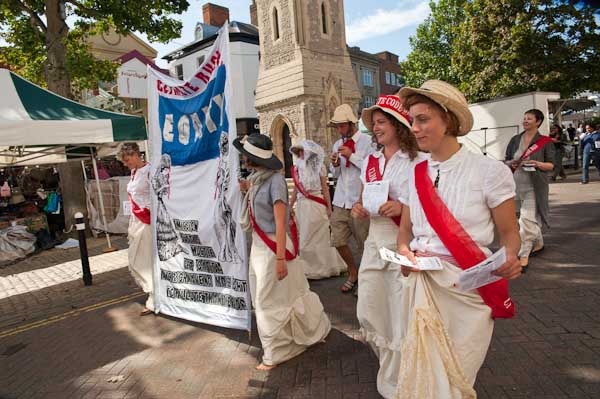
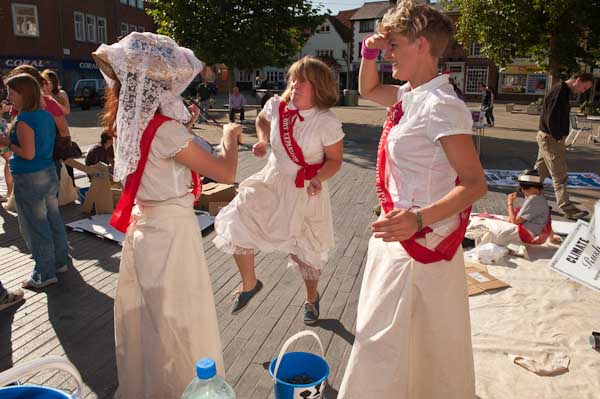
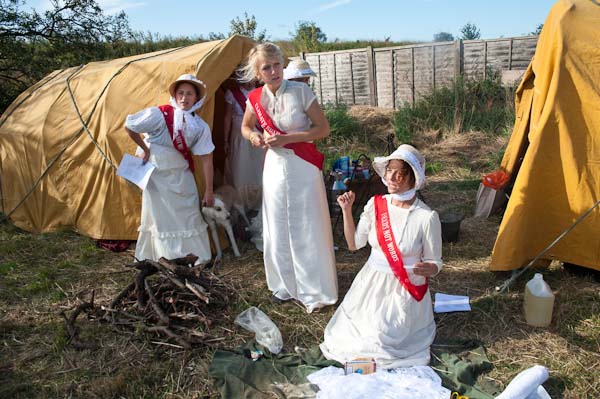
It was a lovely warm late summer afternoon in Aylesbury, quite idyllic and with the young women from the Climate Rush in their long white Edwardian-style dress and a TV personality and a Euro MP thrown in it should have been a good photo opportunity.

© 2009 Peter Marshall.

But somehow it didn’t work out quite as well as I’d hoped, although a few pictures aren’t bad, and they make quite a nice set of images of the event – perhaps with a suitable soundtrack. But no really interesting single images. Perhaps there wasn’t quite enough happening, the lowish sun was a bit too harsh and flare was a problem on quite a few images.

© 2009 Peter Marshall

Plenty of pictures that show the people, show the event, but lack the magic. Perhaps it was the spell of Aylesbury, which seems the kind of small town where not a lot happens (though the plums were nice.)  Or perhaps I was expecting too much.

© 2009 Peter Marshall.

The pictures aren’t bad, just somehow it was such a nice day and I expected more.

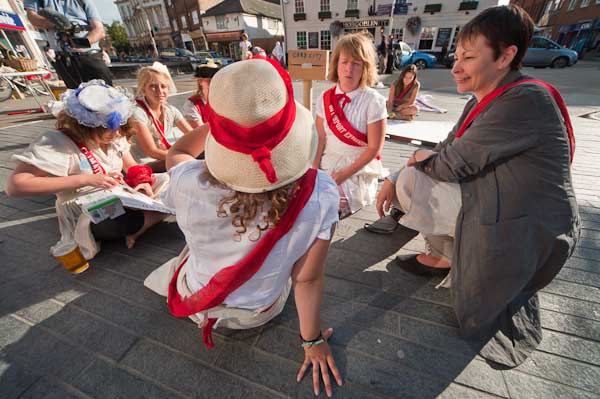
Most of the time I was using the 24-70mm Sigma, though the above picture with Caroline Lucas sitting with a group of the Climate Rushers was taken with the 12-24mm Sigma.  Really this is just a little too extreme for most things and something like a 16-35mm would be much more useful. Also having a bit of overlap in focal lengths between lenses would help to cut down on lens changes.

Lots of pictures on My London Diary .

Climate Rush on the Run

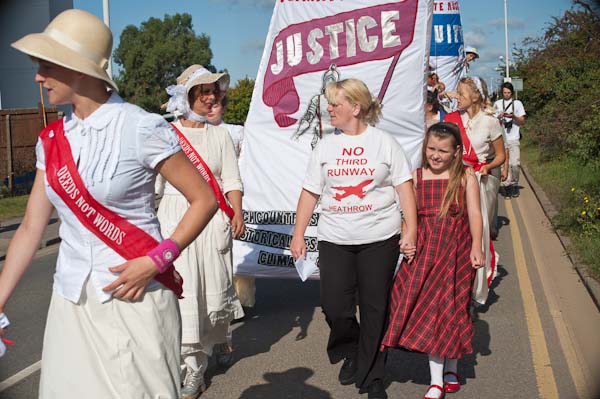
Friday was a beautiful day in London, sun and nice clouds in the sky, but with quite a breeze so it didn’t get hot. I got on my bike around 9 o’clock to cycle to Sipson to meet the Climate Rush who were camping on the Airplot there, for a “photo opportunity” at the start of their month long tour around the South West – which will take them around 250 miles on foot and horse and cart to Totnes, with many stops on the way to educate and campaign through the country.  The Rushers in their white suffragette-style long dresses and red sashes were to take a trip to the perimeter fence of London’s main airport along with local residents from NoTRAG, the action group opposed to expansion of Heathrow – and in particular a third runway that would mean demolishing their homes.

© 2009 Peter Marshall

As expected, there were several other photographers there, mainly from agencies and a couple people making videos, which is rather more than most small demonstrations attract.  The rushers – and Tamsin Omond in particular – have gained a little of the only thing most of the media are interested in now, celebrity. Although I tend to feel it’s unhealthy to pander to the press like this, it is effective, and certainly I find them more interesting to photograph than many demonstrators. It also helps that they want to be photographed – quite a change after some (fortunately not all) Climate Campers.

Sipson is pretty rural, and the Airplot, as well as its own small allotment –  raised beds of vegetables – has fruit trees around its edge, the remains of an orchard. Much of the site for Heathrow – the old Middlesex village of Heath Row – was covered with orchards, and the rest with fields of crops. Before the airport it had been one of the most productive agricultural areas of the country since cultivation began here, perhaps 5000 years ago. Add some horse, a couple of wagons, a wood fire with a kettle hanging from a hook above it, some rather ancient looking tents and young women in long white dresses and you have a scene that could come from the novels of Thomas Hardy.

© 2009 Peter Marshall
‘Deeds not Words’ and ‘No Third Runway ‘are clear but…

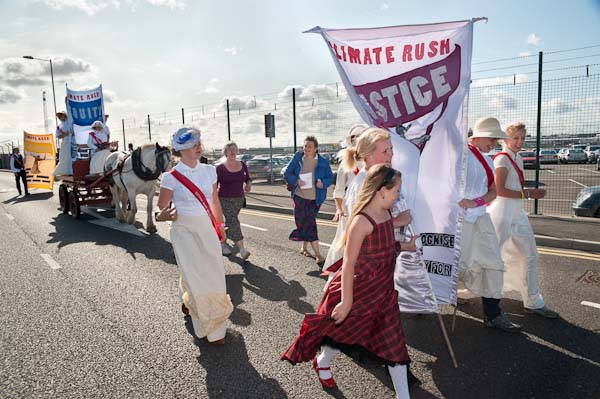
It wasn’t a huge group that set off down Sipson Road for the mile or so to Heathrow, and at first the pictures of the ‘caravan’ on its way were perhaps a little disappointing. What made the difference for me was the light once it turned west along the northern perimeter fence (by which time some helpful police were holding traffic back.)

My behaviour, moving in close to the protesters and using a fairly wide lens with  flash to balance the powerful back-lighting didn’t endear me to the couple of agency photographers.  Their fixed idea was to stand on the other side of the road with a long lens and try to get pictures with aircraft visible in the background. But we were really at the wrong place in the airport for that to work, and it was in any case a cliché that didn’t appeal to me.

© 2009 Peter Marshall.

If you can cope with the lighting, it does give the pictures rather more interest. I don’t think I could have done this on film, certainly transparency wouldn’t have held the range, and although colour neg might theoretically handle a longer scale than digital, I wouldn’t like to try it in practise. On digital it’s pretty easy. I shot RAW of course, and this was taken at the metered setting with no correction, using aperture priority (ISO 400, 1/800 f9.)  The Nikon D800 did its usual grand job at -2/3 stop to add a little to the closer figures. In Lightroom, parts of the sky needed considerable burning in and subduing of extreme highlights, and the figures also needed a little burning or dodging – it wasn’t the kind of picture I could have sat down and wired off immediately.

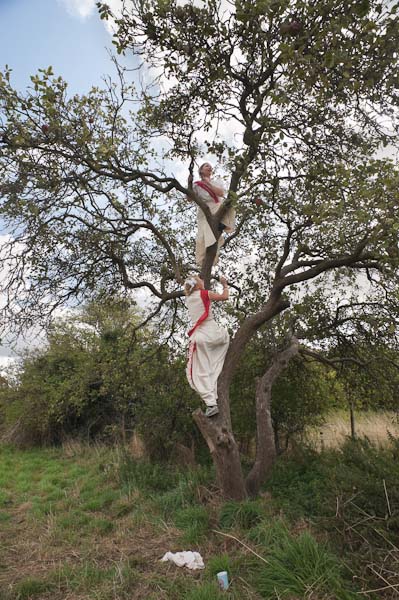
The agency guys had gone as soon as the procession left Heathrow, but I went back with the procession. You may not think that long white dresses are made for climbing trees.

© 2009 Peter Marshall.

The scrumping suffragettes were just a little disappointed, as these apples turned out to be cookers, though I’m sure they made some fine stewed apple for pudding later.

Many more pictures from the morning with the Climate Rush on My London Diary, as well as more about the Climate Rush on the Run tour.

Angry August

It seems to be the open season for physical attacks on photographers. Closest to home, freelances Marc Vallée and Jonathan Warren were attacked just outside the entrance to the Climate Camp on Sunday. A group of people from the camp had gone out to a Socialist Workers Party (SWP) stall outside the entrance and were arguing with the newspaper sellers there.

When the two photographers began to take pictures of the altercation, the climate campers turned on them, shouting aggressively that the photographers had not asked their permission to take photographs.

The bookstall was in a public place and on common land, and so was clearly a situation in which no permission was required to take pictures.  What the group from the Climate Camp were clearly doing was attempting to apply the camp’s ‘media policy‘ – its rules on photography – outside the camp.

The argument between one young man and Vallée continued, with the man insisting that he delete all pictures of him and the photographer refusing on principle to do so.  The man threatened to grab Vallée’s camera and smash it or delete the pictures himself. After a few minutes things appeared to have calmed down enough for the photographers to walk away, but as they did so the man lunged and tried to grab Vallée’s camera. Warren stepped in and shouted at him, and was kicked him violently in the stomach.

Following this, both photographers managed to back away and leave the scene without further blows. Both are photographers who invest considerable time and effort in covering and trying to get publicity for protests and movements such as the Climate Camp. As I know from my own experience, it isn’t an area which provides an easy or even a good living, and those of us who attempt it do so largely from a dedication to the various causes.

Although it happened outside the camp, there does seem to be a clear link with the media policy inside, one that I, like Vallée and Warren, find unacceptable, and I quoted both of them in a feature about it last week, Climate Camp Again.
As I wrote in another feature, “The policy appears to be driven by a few individuals with paranoid ideas about privacy and a totally irrational fear of being photographed. It really does not steal your soul!” Another photographer to write about it is Leon Neal, and the comments on his site are also worth reading. We can only hope that any future Climate Camp events will learn and try to adopt a more constructive approach to photographers and getting positive media coverage

The photographers decided not to go to the police and make a complaint, but instead wrote in an open letter to the Climate Camp “We ask the man who assaulted us to come forward and apologise and that the camp’s organisers unequivocally condemn his actions.” The NUJ has also backed their call for an apology. Presumably it should not be hard to identify him from the photographs they took.

Unless the camp can in some way deal with this incident and take action to prevent similar problems in future, it would seem to call into doubt their camp’s insistence on taking responsibility for its own policing and the agreement of the police to keep off site –  and more or less out of sight.

And on PDN last Friday, links to videos of three rather more serious attacks on journalists in the USA this month.

In Doylestown, Pennsylvania, the father of a woman who had just entered a guilty plea to faking her own abduction attacked several members of the press outside the court.   While an angry woman in Cocoa Beach, Florida attached 2 TV crews with a garden hoe, damaging a video camera while they were covering a story about teenage girls charged with dancing at a strip club. The final case was in  Norfolk, Virginia where a reporter and two photographers investigating a scam got into an argument with the the owners of an employment services company and both sides are suing for assault.

Let’s hope things quieten down in September.

Documenting the Climate Camp

Although the Climate Camp has always had problems with how to deal with photography and with the press – and things were a little better this year than in previous years – it has tried to create some proper documentation of its work through photography and film.

Although for various reasons I’ve not actually become a climate camper, I was invited to come and take part in this, although I was only able to do so for one day of the camp.

Members of the team were identified by wearing blue sashes and the camp handbook asked people both to tell them if they don’t want to be filmed and also if there is anything happening which should be documented. It says “These are highly trusted individuals accountable to the Camp as a whole, and we hope that campers feel cool and relaxed around them.”

Although wearing a sash did make it rather easier to work around the camp I still found a little hostility at times, and I wasn’t able to work as freely as normal. Much of my work relies on capturing a fleeting instant, and if I’m having to think whether I need to ask permission before I take the picture it means that I’ll miss the moment. You can see the pictures I did manage to make on My London Diary.
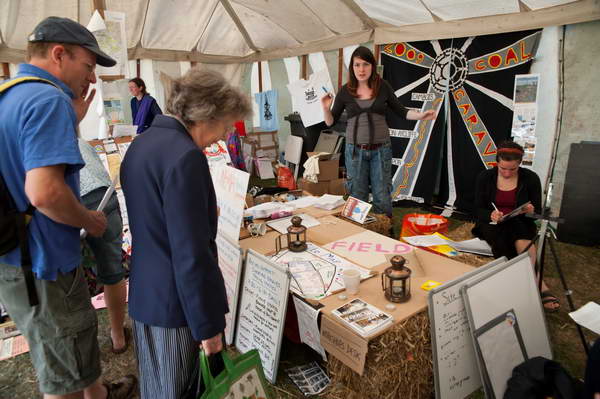
Of course there were photographers working inside the camp without permission, including several that I know who had simply come in with the rest of the public as visitors. I didn’t see anyone who had accepted the media guidelines and was wearing press badges and accompanied by minders.

© 2009 Peter Marshall.

What I was photographing was the normal daily life of the camp, hopefully giving some idea about how it works and what it was like to be there. I also spent a little time following (with her permission) one woman who had heard about the camp and had made a short trip across South London to come and see for herself.

© 2009 Peter Marshall

I think she was both confused and impressed by her first impressions of the camp, and so perhaps was I.

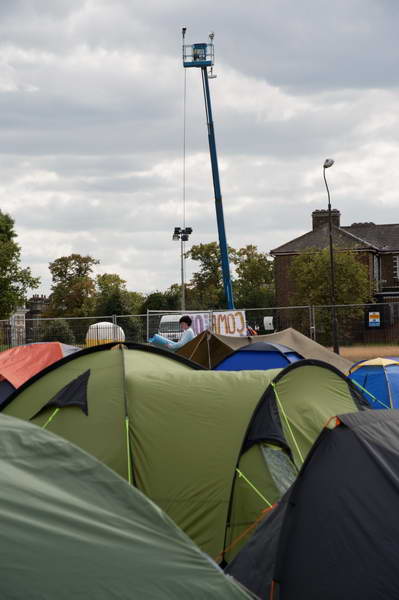
As I walked out of the camp and across the heath I noticed a small group of Climate Campers gathered at the fence below the police cherry picker with its video cameras trained on the camp day and night.  A small group of police was talking to them and they all dispersed as I drew near. I stopped and took a few pictures of the cameras, still rather distant on their high platform, then turned around and walked on a few yards to photograph the banners on the Climate Camp fence.

© 2009 Peter Marshall.
The cherry-picker and cameras from inside the Climate Camp

I became aware of a black man in his mid-twenties around twenty yards away from me. I turned down a path and he too turned down it, and again at the next meeting of paths.  I stopped to put my camera away in my camera bag. He stopped too. I took out a sandwich and stopped to eat it.  I’m a slow eater, but when I’d finished I turned my head and the guy was still there, writing in a notebook. I made my way down the hill and he continued to follow me.

Of course I was behaving suspiciously. After all, I’d been taking photographs.

Climate Camp Again

If  you are are in the right circles in the police, you will by now know exactly where tomorrow’s Climate Camp will be. If you are just an ordinary protester, you will will going to one of the published assembly points at noon tomorrow and will then – in time find out.

The police can’t be too up front about knowing, because it could risk compromising their sources. Tomorrow they will probably be making some kind of  pretence of being surprised, but you shouldn’t take that too seriously.

However, if you are a photographer, you are not very welcome in any case.

On Jonathan Warren’s blog you can read a nice piece that I think sums up what most photographers think about the Climate Camp’s attitude to the media.

It still seems rather like photographing in some Eastern European country at the height of the cold war, with a minder on your shoulder.

You will be accompanied by an assigned camper during that time, who will ensure that both campers and journalists are kept happy, and can ensure that consent is obtained from people being filmed and photographed. “

On his blog, Marc Vallée says:

“The camp is trying to write its own narrative – pretty much in the same way that New Scotland Yard is spinning its media strategy as fact. As Vidal wrote in 2007, “It’s an easy step from trying to manipulate the press to manipulate information.”

Two years ago I read what the campers said and decided there was no way I could cover the Heathrow camp under those conditions. Last year I photographed the march to the camp on the Sunday and then went up to Glasgow to do other things rather than waste my time. This year things are a little better, but I’m still not sure I want to attend the actual camp once it is up and running. Perhaps I’ll give it a try, though if they really enforce their media policy I can’t see many photographers with any self-respect lasting many minutes before being ejected.

Yet I’m someone who very much believes in all that the Climate Camp stands for.  Someone who sold their last car in the sixties, joined Friends of the Earth before it existed here, has never bough an airline ticket, gave talks and demonstrated on the environment before most people had heard of it and more.

In the end, for all of us as photographers, what matters is integrity. And that doesn’t rely on doing what other people tell us but on doing what we think is right.

There are sometimes legitimate reasons why organisations should control the nuisance of over-intrusive photographers – or just too many photographers wanting to take pictures at some events.  But I don’t find it acceptable to try to control when and how and what press photographers may photograph in the way that the Climate Camp does.

Most of the campers will have their own cameras – if only on their phones – and be taking pictures. Including of course all those undercover police who will be taking part this year as in previous years.  But it will be rather a shame if we have to rely on them and the FIT for a proper document of the event.

So if you don’t see good press coverage about the Climate Camp, or decent photographs, don’t blame us.  They’ve chosen not to allow it, or even to make it so we don’t feel it’s worth going.  In a comment, Warren says “At any other event being an accredited journalist affords you more access, not less.” I’d settle for the same.