Catching up – Afghanistan

I’ve had a busy couple of weeks and there are quite a few events I’ve photographed and not mentioned here, starting with the march calling for troops to be brought back from Afghanistan. Given the strength of public opinion in support of this it’s perhaps surprising that there weren’t more than the respectable 10,000 or so taking part, but perhaps it reflects the very different reasons some have for calling an end to this war which is seems we can only lose, and which is killing more and more British soldiers.

Certainly not everyone opposed to it would want to march with Stop the War, CND and the BMI who were the organisers of this march. We are also just seeing the start of mainstream politicians beginning to say what the left has been saying for a long time; I’m rather surprised that the liberal democrats haven’t already come out firmly against the war.

Photographically the main problem was the weather, a dull day, very dull at times, and with the occasional little burst of rain.  Fortunately the D700 is pretty well noise free at ISO 800, and that was fast enough to work at a decent shutter speed with apertures around f4-f5.6. Most of the time I was shooting on the Sigma 24-70 f2.8, and I like to avoid full aperture whenever I can; it’s usable, but definitely a little soft compared to f4. After that, stopping down is only really needed to get more depth of field, particularly at the longer end of the lens.

I took some pictures without flash, but some of them look a little colourless, almost drained. Flash does tend to add a little warmth and colour under lighting conditions such as this though I was generally keeping the amount pretty low.

Here’s a picture that shows this and that I like:
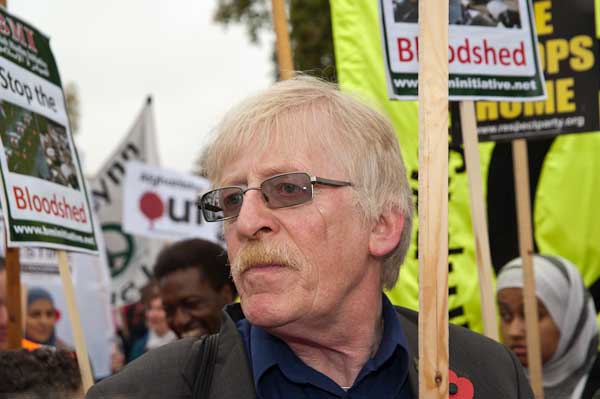
© 2009 Peter Marshall.
Peter Brierley who told Tony Blair “you have my son’s blood on your hands.”

The stewards were holding us a short distance back and there was a very tight scrum of press and others in the minutes before the march started. Quite a few pictures I took – even like this one at 1/250 – have camera shake because other photographers were pushing me from all sides. The len was at 65mm and aperture f8  and for some reason I was using spot metering – which is really better when you have plenty of time and can think what you are doing.  I was pleased to have two posters with the word’Bloodshed’ on them in shot.

I stood close to the start and watched most of the march go by, photographing close in and using the full range of the zoom. It’s an interesting exercise in thinking and working fast to try and frame compositions as people walk by and also enabled me to spot a few people and groups to photograph later.
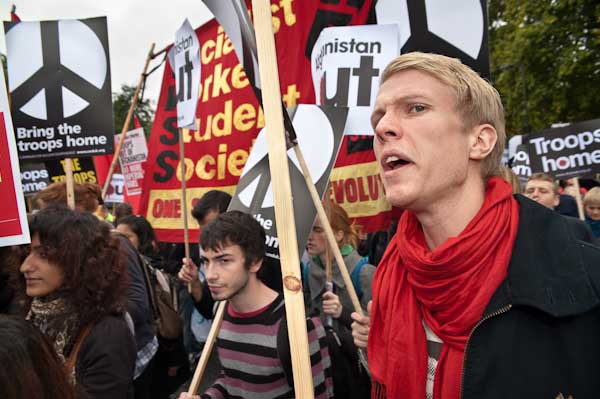
© 2009 Peter Marshall

This was one I liked, and again the flash livens it up a little (24mm, 1/250 f7.1) and enables me a lot more freedom when I come to develop the image in Lightroom – where I could choose to ‘burn in’ the figure at the right to the exact tone I want (perhaps just a little darker than above.)

Here’s one I took later on the march without flash, and although I think it’s a good image, I just can’t get the same kind of colour quality.
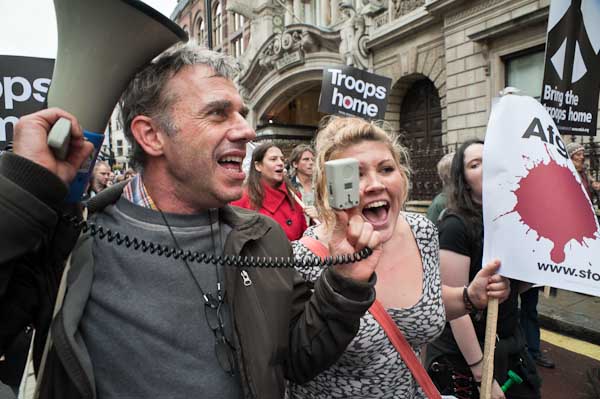
© 2009 Peter Marshall.

For once I walked the whole distance – which actually means I walked it several times, going back and forth taking pictures. And I took quite a few pictures of both audience and speakers in Trafalgar Square. But suddenly there was a disturbance at the back of the square, and several of us rushed out from the press area at the front of the plinth to cover it. Four Leeds supporters, in London for a match at Millwall had decided to heckle and insult the speakers, and the crowd had taken it badly, calling them racists and chasing them out. They were rescued and escorted by a largish group of police and it wasn’t easy to get clear pictures. As usual the answer was to think ahead and I was lucky when they stopped at exactly the right spot where I had chosen to stand on a ledge a couple of feet high and could look down on the scene.
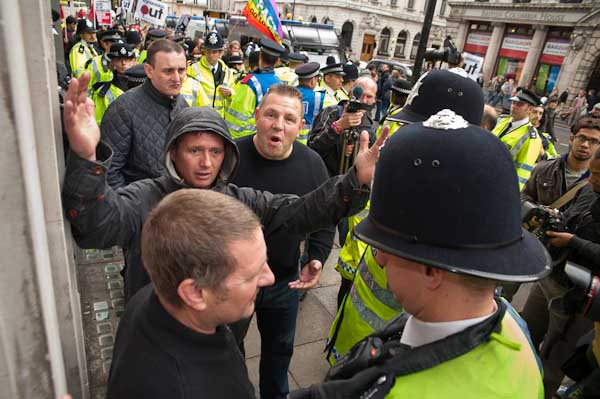
© 2009 Peter Marshall.

Overall I was for once quite please with my afternoon’s work. No major disasters and quite a few pretty decent pictures. You can make up your own mind about them on My London Diary.
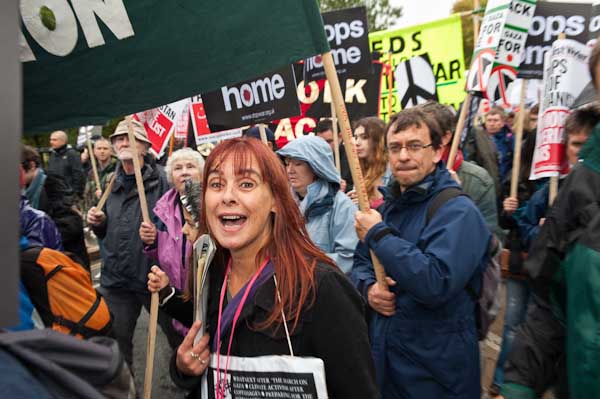
ICO Plans Attack Press Freedom

If the suggestions  – as reported in the  Amateur Photographer –  of the Information Commissioner’s Office (ICO) about a ‘Privacy Code for online use of photography‘ on the streets were to be adopted it would be the end of photography as we know it on the web. Their proposals seem to me ridiculous and unworkable – and my immediate reaction was to check the date of the article by Chris Cheesman. But to my surprise I found it was written on 27 Sept rather than April 1.

The proposal are frankly ridiculous in several respects, but particularly in the attack that they make on news reporting, with the suggestion that it would become necessary to blur many faces in images for publication in newspapers and also on websites – except for social networking and similar sites. The AP reports that while “background shots of passers-by will not normally breach the Data Protection Act, images of a small group of clearly identifiable people, sent for publication to a newspaper for example, may be considered an infringement.” So it becomes clear that this is not just a threat to what can be published on the web, but also to the freedom of the press as a whole.

The proposals according the AP report  “will not prevent someone taking photos in the street without the subject’s consent, provided that the images are for ‘personal use’ and the camera is not being used to harass people” but it will severely restrict what you can do with them. Stick them on Facebook or in your family album and you are fine, but publish them – even on Flickr – and it looks as if you may be damned.

© 2009 Peter Marshall.
Taking part in a demo on the street implies a willingness to be seen and photographed. More picture from ‘Bring the Troops home from Afghanistan

I mainly photograph public events and demonstrations, where those taking part know they will be under the gaze of cameras and thus implicitly grant permission to be recorded. At times I photograph the people who are standing on the street or in shop windows watching (and sometimes also photographing) events and it seems only a fair reciprocity that they too should expect to be watched and photographed.  And it is clearly important that in situations involving crime, potential crime or unrest that journalists – including citizen journalists – should where possible record both potential criminals and the activities of the police, and that news media – print, broadcast and web – have a public duty to publish such images. Whatever the feelings of those who appear in them, or indeed the Terrorism Act, unless the pictures would clearly be of aid to terrorists.

© 2009 Peter Marshall.
Reporting on the police is important for a free press. More pictures from this incident involving football supporters attempting to disrupt the Bring the Troops Home rally.

I actually follow my own test that differs significantly from that which the woman speaking for the ICO suggests. Rather than asking “whether the subjects would object to their picture being published in this way”, I think “whether a reasonable person photographed in this way would have a reasonable objection to having this particular picture published.”  It seems to me to be an important and fundamental difference, not least in that a “reasonable person” is also a reasoning person, while many of the objections that people have made about the use of their pictures have been purely on emotional grounds.

If someone walks down a street with a silly hat on, I don’t think they can reasonably object to a picture that shows them wearing a silly hat on the street, but if I have managed to catch them at a moment or from an angle that makes a perfectly normal hat look silly their objection might well be sustained. There is sometimes a fine line between being amusing and demeaning the person, but in general I think the distinction is clear.

Any test should probably also distinguish between people “in the public eye” who have chosen to live and profit from being public figures, and those in whom there is no genuine public interest. Although I usually chose to delete or not use images of – for example – politicians in which a momentary gesture makes them look silly, it would make the reporting of party conferences in particular rather boring if all were disallowed. And of course our current London mayor has made his political career on being seen as a buffoon (so perhaps we should not encourage him.)

So far as privacy is concerned, at present we have a fairly clear position –  “a reasonable expectation of privacy” – which offers a reasonable degree of protection to people while allowing publication of news etc. There seems little if any need for any further restriction. We also have the law of defamation that restricts the use that can be made of images of people, and although too it isn’t entirely satisfactory it largely does the job required in limiting the activities of publishers.

It is perhaps an interesting question whether a photograph in isolation is actually personal data. If I publish a picture of you without any accompanying text, only those who already know what you look like will be able to identify the picture as being of you. Without being incorporated into a structure with accompanying data the image to the wider public remains anonymous.

Photographs only truly become data when, for example, they are put into a police database and used to produce “spotter cards” for use by police at demonstrations, or when they are displayed on a right-wing hate web site along with names and other data with the intention of encouraging violence or other illegal acts against demonstrators and journalists (thanks to Marc Vallée for the anonymised link posted on Twitter.)

I’ve published literally thousands of pictures of children over the years, but I’ve always been careful not to give names except in very special circumstances. At times I’ve blurred name badges on them – (and some pictures of adults) – in order to preserve a certain anonymity. I’ve generally only named adults in pictures who are in some sense public figures – if at times in a very local and minor way. There might I think be some sense in restricting or at least reviewing the local paper practice of giving names and ages in picture captions, although local papers are becoming a thing of the past in any case.

Increasingly we are moving from still images to the use of video, and here the problems that the suggested regulations would produce seem more or less insuperable. Could we really have online newspapers without news pictures and online TV without news film from the UK? It does appear to be what the ICO proposals might produce.

Bert Hardy Talk

Years ago I remember going to hear Bert Hardy  talking about his own work at the Photographers’ Gallery. It was an entertaining evening, but a rather predictable one, as by that time he had a rather carefully worked out script that he followed almost word for word about his life and work on every occasion. It was good to go and see him and watch him perform, but there was little if anything new in the actual content.

The selection of pictures too was predictable. Not least because back in the “good old days“, the “golden years of photojournalism“, photographers worked for hire and the publication owned the pictures, which in the case of Picture Post, disappeared into the Hulton empire. Getty, not am organisation I usually have much praise for, deserve credit for having preserved material that might otherwise have been lost from the Hulton Archives.

And on November 10th, 2009,  Graham Harrison is giving a talk, The Unseen Bert Hardy, showing images recently rediscovered in that Picture Post collection at the Photographers’ Gallery, 16-18 Ramillies Street, London W1F 7LW,  at 7:00pm. The PG also has a nice little selection of his images for sale on line, although the thumbnails are a little misleading*. Harrison, whose Photo Histories site I’ve mentioned before and should visit more often (don’t go there unless you have a lot of time to spare!), was able to look through hundreds of original Picture Post contact sheets and find many Hardy pictures and stories that were never used.

There is a taste of what is in store in Doorstepping a city: how Bert Hardy captured life in Barcelona during the Franco dictatorship on Photo Histories. Spain was under the powerful thumb of Franco’s fascist dictatorship and times were tense as a general strike was taking place in Barcelona as Hardy arrived. Some of his pictures were published together with a story by James Cameron in ‘Barcelona: city in ferment‘ on April 15, 1951, but the others have just sat in the archive until now.

Although Hardy had got into photography with a Leica, in Spain he was using a square medium format camera, presumably a Rollei or Rolleiflex*. This gave the distinct advantage in tense situations of working with a camera held at waist-level with a quiet shutter. One disadvantage was its fixed standard lens, but this was an age where the publishing climate didn’t expect the kind of close intrusion and ‘big close ups’ we take for granted in the press today.  Much of the time he was on the street the camera was probably largely hidden in the folds of his coat. It must also have helped that people generally were much less aware of cameras and their possibilities than today, although some of his subjects have clearly realised they are being photographed, most seem to have remained unaware of the photographer.

Cameras then were simpler beasts, and although they lacked the automatic functions that we now take for granted (but curse when they let us down)  experienced photographers could set the aperture and shutter speed they would need without having to look at the camera (and without of course the help of a light meter.)

Focus with medium format might need some attention, but experienced photographers  became precise judges of distance, in more active kinds of work preferring to set focus by scale rather than relying on the much slower process of viewing the image on the viewing screen.  For many situations they would focus in advance on a particular distance – perhaps 10 ft – and then move or wait to be at exactly that distance when taking the picture.  (This is something street photographers still do, even with modern cameras that may have autofocus, though generally using closer distances and wider lenses with greater depth of field to give a zone of focus ; turning off autofocus – and autoexposure – cuts the lag between pressing the release and the picture being taken.)

Framing with the larger negative was also less of an issue, although some of the contacts on the slide show suggest that at times Hardy did it with great care. In general photographers were advised to leave plenty of space around the subject to allow for cropping that was almost always applied by editors both to fit images into the page layout but also as a way of showing they were doing their job (sometimes even when it meant ruining the pictures.)   Only two of his eight images printed in the Barcelona story are used in the square format they were taken, although that figure is probably higher than average and perhaps reflects the higher regard for images by Picture Post than most other publications.

* On the PG site, all the thumbnails are square but many of the images aren’t, having been taken on 35mm. Presumably apart from his Blackpool girls on the promenade rails, taken with a Box Brownie, the remaining square format images were largely made with a Rollei.

Quite incidentally in this set of pictures I notice the Spanish dancer in his 1954 image complete with leering British sailors in a Gibraltar bar is wearing pants under her swirling skirts, while I was embarrassed to find from some of the pictures that the flamenco dancer I photographed in London a few years ago wasn’t. Only slightly embarrassed, but I did choose not to publish the images that had revealed more to a fast shutter speed than was clearly apparent to the naked eye.

Worldbytes Defend the Freedom to Film

Worldwrite is a Hackney education charity which teaches youths how to make film, putting out the efforts made by 16-25 year olds on the web as an alternative news channel, Worldbytes.org, and increasingly they are running into the same problems many of us face when taking photographs on the street.

Under English law, photography and filming is allowed in public places. You don’t need to get anyone’s permission or a licence to film on the streets, but more and more some people are taking it into their hands to try and stop it happening. As Worldwrite say: “we are finding it increasingly difficult to film in public places in Hackney: security guards, community wardens and self-appointed ‘jobsworths’ are refusing us ‘permission’ to film on many of our streets.

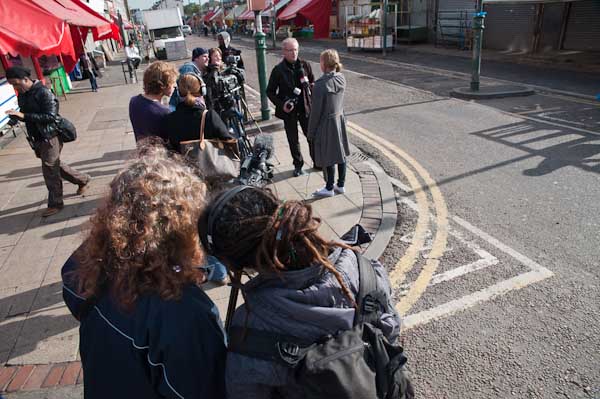
On Sunday 18 October, Worldbytes visited several of what they call ‘film-free places‘ in Hackney where their crews have run into difficulties and photographing to make a film about the problem, coming as a group to challenge these attempts to restrict our freedom, talking and interviewing people and handing out fliers explaining what they were doing and why.

© 2009 Peter Marshall.

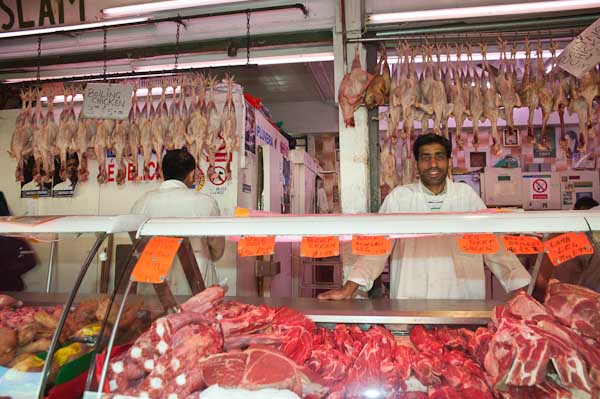
I met them at Ridley Road Market in Dalston, where I’ve photographed a few times over the years. Its one of London’s more interesting and multicultural markets, and there are always some interesting people on both sides of the stalls. I’ve had no problems there in the past, though there have been a few things I’ve decided it wouldn’t be wise to try and photograph. But Worldbytes crews have been told they can’t film there, not by the stall holders or other market users, but by employees of Hackney Council.

Worldbytes had issued an invitation for photographers and film-makers to go along and take pictures in support of their protest, and so I did. After talking to them, I decided to walk along the market and see if anyone working there objected to me taking pictures. Or indeed if council employees tried to stop me.

I took some general views without asking anyone for permission, but as usual, where I wanted to take pictures including stallholders or other people I asked if I might. Not because I need to, but out of politeness, and I shrugged my shoulders and moved on if they refused. Of course at times I photograph people who don’t want to be photographed, but this wasn’t appropriate here.

© 2009 Peter Marshall.

As I was using flash most of the time, it was clear that I was taking pictures and some people asked me to photograph them who I might otherwise have walked by. At one place I did stop to argue after having been refused – and eventually managed to get permission to take a picture; at another I got profuse apologies from an employee who was obviously sorry that the stall owner had decided not to cooperate with Worldbytes.

After around 20 minutes taking pictures I was asked if I would do an interview for the programme Worldbytes crews were making about the right to film, and although I much prefer to stay behind a camera I agreed. Though I do hope that my contribution is going to end up on the cutting room floor.

© 2009 Peter Marshall.

The council employees didn’t turn up to stop filming while I was there; probably Sunday is their day off. But it’s very hard to understand why Hackney Council should allow or instruct their employees in this way. They should know the law after all.

From what I was told it appears to be a case of misguided zeal around concerns about children and vulnerable adults, but the law is clear. As the Worldbytes flier put it:

There is in fact NO LAW against filming or taking photographs in public places and permission or a licence is NOT required for gathering news for news programmes in public spaces.

© 2009 Peter Marshall.

Contrary to what many people think – possibly including Hackney Council – you don’t need permission to photograph children, though now even being seen with a camera anywhere near them arouses suspicion. Cartier-Bresson wouldn’t now get away with his great image of a boy on a street corner proudly bringing home the bread and wine without being attacked by vigilantes or questioned by the authorities and getting on the sex-offender’s register. Of course there are good reasons to be very careful when approaching children, and often photographers will now want to have the permission of the responsible adults, but it isn’t an offence and should not cause any problems to take pictures of normal activities in public, for example of children accompanied by their parents shopping in a market.

Some areas of the market may be privately owned, as increasingly is the case with public places, even those where the public has more or less unrestricted access. Canary Wharf, where photographers held a protest against restrictions on photography last month, is an prime example, along with most shopping centres. In these privately owned places the owners can make their own rules, and usually ban photography, though amateurs and tourists may be tolerated.

But the problems photographers face in most public places are linked to the current paranoia over terrorism, which has been pandered to by parliament with panic-driven legislation and by the police with advertising posters that suggested that a camera is a terrorist weapon. But even parliaments misplaced zeal looks almost reasonable when you look at the way these laws have been misapplied by police and public employees.

Laws meant to deal with terrorists have been used against peaceful protesters, against innocent tourists and against photographers. The police did get a small rap across the knuckles from the Home Office in a recent circular which reminded them that they should only use the terrorist legislation where there is a reasonable suspicion of terrorism, and it is clearly time that councils and other employers attempted to teach reason to their staff as well.

The last thing that would-be terrorists are likely to do is to walk around their prospective target areas with large cameras and tripods, making themselves obvious. They are unlikely to take photographs at all, but should they choose to do so, their most likely tool is a camera phone and they will definitely not want to be seen as photographers. In most cases the visual information already readily available from on-line high-resolution satellite photography or Google’s Street View is likely to be of more use.

Photography and film are important media of visual expression, and the freedom to take pictures, especially about the society in which we live, is a vital part of the freedom of expression that makes our society a free society – and we all need to be vigilant to keep it free.

Edited versions of this post have appeared on Demotix and Indymedia. More pictures from Ridley Road on My London Diary.

Griffin BBC Protest

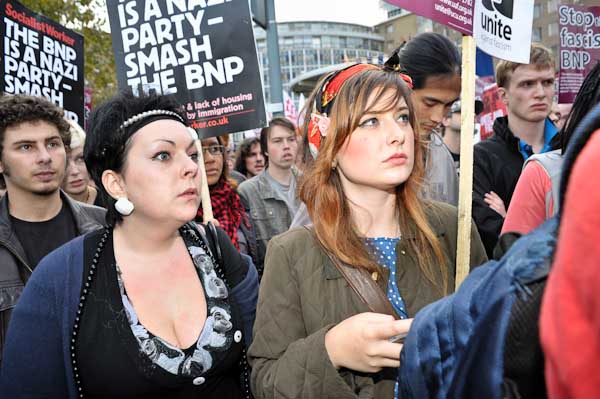
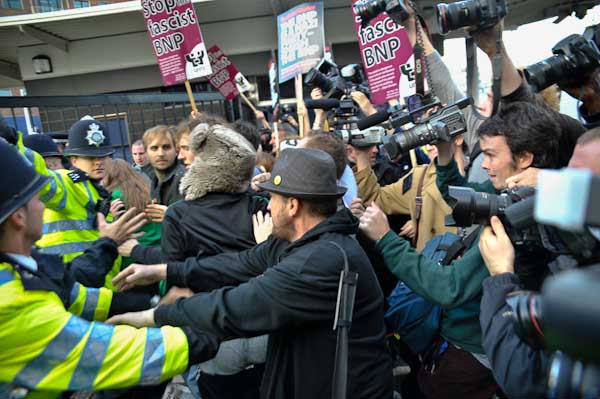
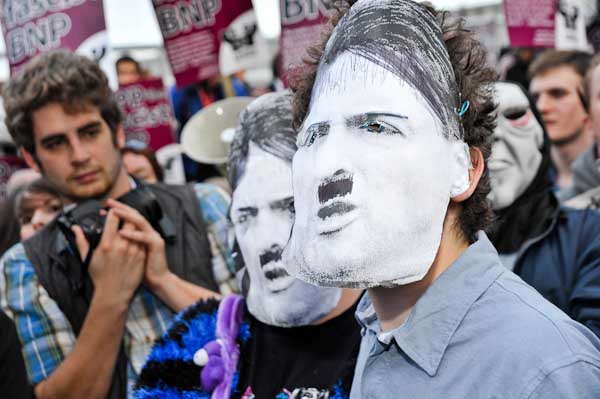
The BNP are a pretty nasty lot who I’ve photographed several times over the years but they weren’t around outside the BBC on Thursday night, just a thousand or two anti-fascists who are considerably more pleasant to be around and to photograph.

© 2009 Peter Marshall

But I did have problems taking pictures. The biggest was me, but also there were other photographers and videographers, as well as my camera and flash playing up.

This was a very high profile event taking place outside the largest media organisation in Britain, so it was hardly surprising that there were a great many photographers there, both professional and amateur – and more guys with video cameras than I could count.

© 2009 Peter Marshall

This isn’t a great picture but it gives you some idea. It was taken very shortly after a group of demonstrators had surged through the gates at the left, and the police had grouped too late to stop about 30 or so. I was actually up with them, but decided not to go onto the BBC site but moved to one side to photograph. I’m always wary of getting into situations where I might get trapped, but here there were several photographers who were on the other side of the gates who might have got better pictures.  Those in the picture here probably didn’t get a great deal, but they mightily outnumber the few demonstrators trapped between them and the police.

There were just so many people taking pictures it was hard to get a decent position – and when you did it was 100% sure that some guy with a large video camera would push in front of you. One of my friends – even though he takes video – was actually trampled on by a BBC crew, so I guess I was lucky.

Although I’d planned to get on site early, things kicked off just as I arrived, and I rushed into taking pictures. Somehow, without my noticing it, my camera had decided to reset itself to the default settings, which frankly are extremely odd.  You might think I should have noticed, but I didn’t, probably because I wasn’t wearing my glasses. I can’t get used to using a camera with glasses on, but without them I can’t read the LCD screen.

So I shot everything on JPEG rather than RAW, which was a real pain, especially since the lighting was pretty tricky. But I contrived to mess up even more, taking pictures for quite a while on too low ISO and so getting problems with camera shake and lack of depth of field. But the camera was also up to some tricks, giving occasional frames with exposure that was way out of line with what was needed for no apparent reason.

Since it was beginning to get dark, I slotted the flash into the hot shoe, but in the excitement of the moment forget to check it was still on its usual setting. It wasn’t, and before I realised I’d shot quite a few frames hideously over-exposed. It wasn’t immediately obvious on the viewing screen as often I’d shot several frames fairly rapidly and when I checked on the back of the camera saw only the last – where the flash hadn’t fully recharged and the exposure was more or less ok.

Once I realised the flash wasn’t doing what it should I put on my glasses and tried to sort it out.  Whatever I did it didn’t want to work normally, although eventually I managed to get more consistent exposures.

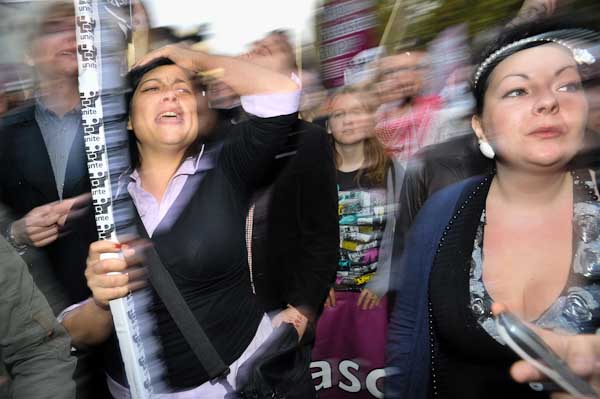
Of course sometimes things going wrong can produce interesting results. I was using flash with a shutter speed of 1/60 to combine with ambient light at ISO800 on pictures like this one:

© 2009 Peter Marshall

and when someone with a video camera barges into you the results can be quite interesting:

© 2009 Peter Marshall

There are around 50 pictures from the event on My London Diary, and a tighter edit of around 15 from these on Demotix, where the feature made the front page.

Getty, Yahoo, Flickr & Picscout

The title Might Picscout Ultimately Cause Yahoo to Acquire Getty? is probably enough to put most people off reading  Dan Heller‘s latest post on his Photography Business blog, but if you want to see what the future so far as buying and selling photography on the web is likely to be I’d suggest you struggle through it. What follows come from my own attempt to understand what he is suggesting – and doubtless to put my own spin on it. It also helps to read some of Heller’s other pieces he links to, and in particular his comments about  Picscout’s Index Registry Connection (IRC.)

I’m not sure that there is a lot of good news for those of us who try and make a living – or a part of one – selling stock images. Heller sees a future in which image use will be integrated into applications such as DTP software so that when someone putting a page together wants an image to use, the software will find suitable images on the web using image recognition technology, identify the ownership of the image and licensing fee (if any) required and carry out the appropriate payment transaction.

Of course all the companies involved in this process are going to want their cut – the software provider, the search company and the company providing the licensing data etc – as well as the site hosting the images, whether it is an on-line agency or a social networking site.

So, as others have also pointed out, with so many taking their cut, there is going to be less for the actual creator. Heller does however suggest there will be a silver lining in that the actual volume of sales should increase greatly, so in total we may do better.

Agencies he suggests will also change; they will need to work at getting good rankings in search engines (at present some are virtually invisible) and Heller also suggest they will need to give up their current policy of acting as editors and instead aim for volume content – the more the merrier, never mind the quality.

I’m not sure that this is the case. Some agencies at least have a reputation for quality that enables them to charge premium fees. Years ago I remember being rather shocked to find that some photographers working on the same project as me were getting paid exactly twice the rate I was, not because their pictures were better but because they were Magnum. There were two prices for the same job.

Whatever new system emerges I’m sure that such differences in licence fees will continue, and that quality control will be essential in maintaining them. When the putative buyer is presented with a page or two of thumbnails of similar images, it will perhaps be even more important that your image stands out to attract sales.

Virtually every photographer will be familiar with the experience of opening a paper or magazine and thinking “why on earth did they use that picture?” when you know you had a much better image. With a much more comprehensive search based on image-recognition, your picture might have a chance too.

As to Getty, Yahoo and Flickr I think perhaps the writing is on the wall for Getty. I certainly wouldn’t mourn its passing.

Three came along at once…

Sometimes demonstrations seem to be like London buses, and after you’ve waited ages, three come along at once.  It happened last Saturday, when as well as the three events in London I did get to – if rather briefly to two of them – there were also demonstrations I would have liked to cover in Swansea and Ratcliffe-on-Soar. But I’d decided I wasn’t up to the roughing-it that joining in with the Climate Swoop to photograph what was planned as a 24 hour action.

I’d actually visited Ratcliffe-on-Soar a few years ago – and it has been pretty popular with photographers, not for the tons of carbon dioxide it creates, but simply visually, and it did have its attractions.

But I think since I was there they’ve put up a rather better fence, and last weekend there were a thousand or two police getting in the way of the view. If you want to see some pictures from the demonstration, one of the better sets of images I’ve seen is by Fil Kaler, and there a quite a few videos that give some of the atmosphere from  – here’s a poetic one on Blip.TV and you can also see how a Climate Camp medic came to the aid of a policeman who had collapsed – and there are more videos on that site. Perhaps surprisingly, one of the fuller reports of the swoop was on CNN, just a pity they didn’t use any of the decent pictures that were available – but presumably they have a contract with Getty that means their pictures are dirt cheap or even at zero marginal cost.  Just a pity they aren’t rather better.  The three photographers I know personally who did go there all got considerably more interesting pictures.

Swansea too has its attractions, but it was a long way to go for what was expected to be a rather small demonstration by the right-wing EDL (or possibly WDL – Welsh Defence League) and rather more than three times as many in a counter demonstration by Unite Against Fascism. I’ve so far only found one picture of this protest on the web.

In London I had a busy day, starting with the Tamils, then rushing to Knightbridge for an anti-fur march before going back to Westminster for a demonstration against forced deportations of refugees back to the still terribly unsafe Baghdad. But each of those deserves its own post on the blog.

Don’t Screw Us

The AMSP (The American Society of Media Photographers, Inc)  has started a campaign on copyright with a web site ‘Don’t Screw Us‘  which has what they call a ‘Manifesto‘ with ten points in plain American vernacular about intellectual property rights and why it pays to use and pay a professional rather than steal work from the Internet. All good stuff.

There is also a link ‘Propaganda‘ which goes to a video on YouTube  set on a New York street where a photographer sets up an easel puts some pictures on it and just leaves it on the street.  Several people then come up, look at the pictures and then pick them up and carry them away. At which point the photographer comes and starts arguing with them about stealing his work.

I think it’s cleverly made down to the standards of YouTube, and does more or less come over as a fairly amateur report on a real event rather than (as I’m sure it was) a carefully conceived piece of film. But I’m not too sure it really makes its point – and certainly if you just leave stuff around on the street in NY you would surely expect it to disappear.

And of course even on the Internet it isn’t sensible to leave  your work entirely unprotected. On Saturday I was talking to a curator from a major museum and was shocked to find that they put images on the web without metadata – and that until very recently it was something they hadn’t even thought about.

I wondered exactly where people like this had been; its something I’ve written about many times over the past ten years, and only a few of my older images on line are without metadata. When I press the shutter release, my copyright message gets written into the file; when I import it to my computer using Lightroom, it gets associated with more metadata, including my contact details and another copyright message, written into every file I output. Pictures I add to these pages usually have a copyright message in the alternative text, and work I upload to other sites keeps its metadata too, and most pages also have a copyright message.

It may actually be down to me that they are thinking now having to think about metadata.  One photographer whose work they want to use has insisted that they must include it in any files they put on the web.  I know I’ve talked to him a number of times about the importance of having copyright metadata present in files that you put on the web, and he will have read some of the things I’ve written here and elsewhere about it. But of course it is the same advice he would get from any sensible and informed photographer.

It doesn’t make sense to just leave your work lying around – whether on the street on on the web.

My London Diary by the Sea

I didn’t go to Brighton clutching my bucket and spade, or even for the traditional dirty weekend – the hotels were in any case pretty much fully booked for the Labour Party conference, which explained my visit, though I had no intention of entering the boredom zone inside the conference centre itself. Coming from the western edge of London it didn’t make sense for me to travel on the specially chartered “Rage Train” from London Victoria, and I arrived an hour or two before this, avoiding the welcome by a large contingent of police at Brighton station when the demonstrators arrived, and strolled down to the conference centre and the pier with a Brighton-based photographer.

© 2009 Peter Marshall

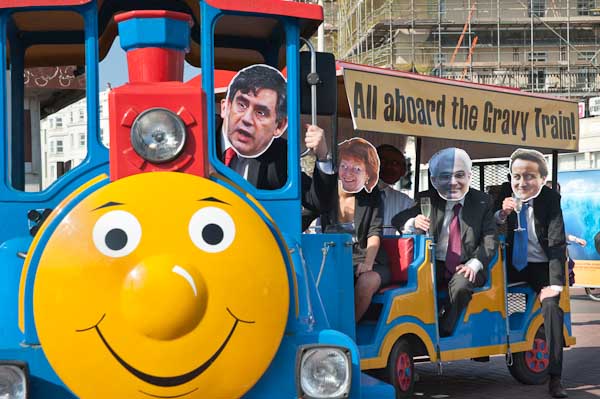
There we found another train, driven by Gordon Brown, but with David Cameron waiting his turn on the back seat. The ‘Westminster Gravy Train’ was provided by the ‘Vote for a Change’ campaign, calling for a referendum on electoral reform and a break with the “voting system that has left parliament unaccountable and unrepresentative.” There were other protests too, including a reminder that there is still unfinished business at Guantanamo Bay, with Shaker Aamer, whose family live in Battersea still detained and former Bournemouth resident Ahmed Belbacha  who is free to leave but has nowhere safe to go, permission not having been granted for him to return to the UK.

Meanwhile, protesters were gathering on the promenade for the main demonstration for ‘Jobs, Education, Peace‘ organised by six trade unions and several campaigning groups.  Protesting against job losses and unemployment – and arguing that instead of allowing industries like Vestas who make wind turbine blades to move production out of the UK the government should be taking a positive lead in creating green jobs; against cuts in education provision, especially those in deprived areas such as Tower Hamlets, and against essentially imperialist wars such as those in Iraq and Afghanistan.

© 2009 Peter Marshall

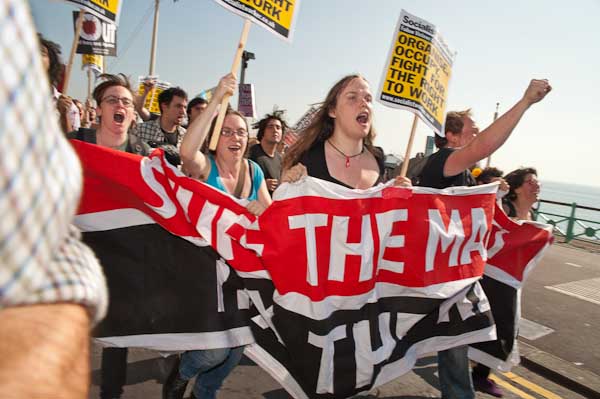
‘Stuff the Market, Tax the Rich’ was the uncompromising message of the banner carried by a large group of students among the several thousand demonstrators, intermittently halting to chant slogans and work up some energy before charging forwards into the gap of 50 or more yards they had allowed to develop, scattering the media who had gathered in front of them.

That’s my arm at the left of the picture above, running at some speed to keep ahead as I pointed the camera held in my other hand back towards the banner. The 24mm end of the 24-70mm was around the right focal length for the job on the full-frame D700, and the fill flash adds the necessary sharpness to the central figures, while a slight degree of blurring helps with the feeling of movement. It is only slight blurring because the flash synchronizes at 1/320th, rather different from just a few years ago when sync speeds of 1/60 were normal and 1/100 fast.

It was a nice sunny day, and working at ISO400 was plenty fast enough, with f14 eliminating any depth of field problems – the hairs on my arm are out of focus but then they are closer than the near end of the focus range – and better soft in any case. The sea and promenade railings are blurred slightly from the camera movement – and this helps the picture. As I now do most of the time, I was using the camera in P (program) mode (though I often use the dial under my thumb to increase or decrease shutter speed while keeping exposure constant) and the exposure was made using the 3D Matrix metering with no compensation. The camera was also set to autofocus in auto-area mode – in which it is supposed to recognise and choose faces to focus on. In other words I left the technical stuff to the camera – and it seems to have worked

Back in the old days, when I was working with manual cameras such as the Leica I would have only managed a single exposure, at most two, during this few seconds of rush; with the Konica which added autowind, perhaps three. In both cases I would have have been lucky to get anything at all from the pictures – though I did occasionally manage in similar situations.

I can’t say it’s easy or comfortable shooting back over your shoulder while running fairly fast, but modern technology does make it a lot more reliable!

More pictures and text (both stories were on the front page at Demotix)  on My London Diary:

Gordon on the Gravy Train etc

Jobs, Education, Peace March & Rally

Climate Chaos

I’m getting to know the Department of Energy and Climate Change pretty well, but two demonstrations outside there in a week was perhaps a little too much. The first on Monday evening was timed to try to influence the decision that Ed Miliband has to make on the building of a new coal-fired power station at Kingsnorth, following the end of a public consultation.

The decision, expected in the next couple of months, will give a clear indication of whether our government is serious about climate change or has bowed to the intense lobbying and financial clout of the energy industry. We don’t need Kingsnorth, and an alternative programme of investment in wind power has long term advantages as well as avoiding “climate-wrecking dirty coal power.” Nobody seriously believes that we will get 100% carbon capture and storage – or that it would in any case be a serious long term solution; all the technical solutions exist for wind power as a major power source for the UK (and for its export potential. Perhaps even more seriously, if the plant is built it is very hard to believe it would not be used even if, as seems likely, only marginal carbon removal proved economic.

Organising the demonstration were the Climate Chaos Coalition (CCC) representing virtually all the major environmentally concerned groups in the UK, including Friends of the Earth, Greenpeace and the Campaign Against Climate Change, as well as faith groups, aid agencies and many others – a total of over 100 organisations with a total membership of more than 11 million. There are probably few other organisations that unite the RSPB, the World Development Movement, Unison and Viva!

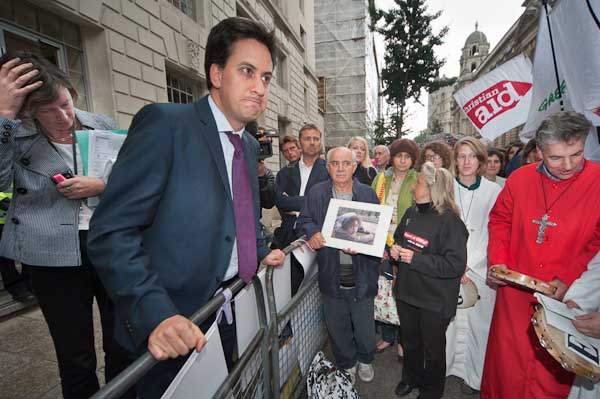
Christian Aid provided a choir in white surplices (and with one in a cardinal’s bright red)  and tambourines which livened the proceedings considerably but the big surprise was when Ed Miliband came out of the ministry to talk to the demonstration and answer some very aggressive questioning.   I took a few pictures from one side as he leaned over into the pen, shaking hands, but obviously the best place would be in front of him, in with the demonstrators. So I ran around to the back and made my way inside. It was a very crowded area, but I soon changed to a 12-24mm lens which let me work in the confined space.

© 2009 Peter Marshall
Ed bites his lip, his aide tears her hair

I was sorry I’d only brought a single body, as it was so crowded it was hard to change lenses, and I knew Miliband would not stay long and wanted to make the most of it so anyway didn’t want to waste more time with lens changes.  12mm is really too wide to be useful and I would have liked something a little longer than 24mm, perhaps something like a 17-35mm would have been ideal.  The 24-70mm just wasn’t wide enough most of the time.

Fortunately the other photographers present and the video guys didn’t follow my lead as there really wasn’t room for me let alone others there.  It was yet another story that made the front page on Demotix and I also put it on Indymedia,  but found no other takers. You can read the story and see rather more pictures on My London Diary.

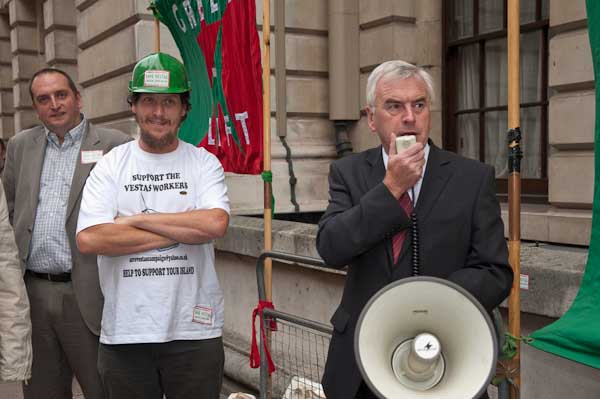
Thursday evening I was back more or less in the same place – the pen was on the opposite side of Whitehall Place for the  Vestas  ‘Day of Action for Jobs and the Planet’ demonstration there organised by the Campaign Against Climate Change, with speakers including John McDonnell, MP, Darren Johnson, Green Party spokesman on trade and industry and chair of the London Assembly, trade union organisers and Mark Flowers, one of the sacked Vestas workers.

© 2009 Peter Marshall
Darren Johnson, Mark Flowers and John McDonnell

The other acid test of the Government’s seriousness over climate change is of course their reaction to the closure of Vestas Blades. Unfortunately they have completely failed rather than take the opportunity of setting up a vital UK industry in the manufacture of wind turbines that could be important both in meeting our energy needs and investing in green technology with great future opportunities for export of both electricity and plant.

More on My London Diary.