On Yer Bike!

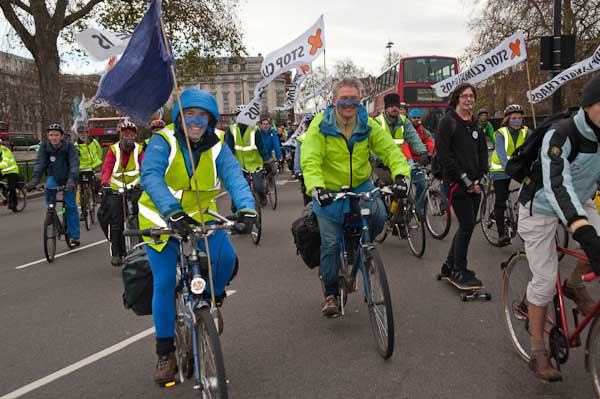
The Climate Emergency Bike Ride organised by the Campaign Against Climate Change last Saturday morning was pretty straightforward to photograph.  It can sometimes be useful to actually go on a bike when photographing bike rides, but it wasn’t convenient to do this on Saturday as I was going on to photograph other things where a bike would have been very much in the way.

Of course I could have left my bike somewhere locked up, but in London I normally like to use my folding bike, and these are very attractive to bike thieves because of their relatively high value and being so easy to transport away in a car boot or the back of a van. The big advantage of the folder for me is that it is so easy to put it onto a train – including the London Underground.
© 2009 Peter Marshall.
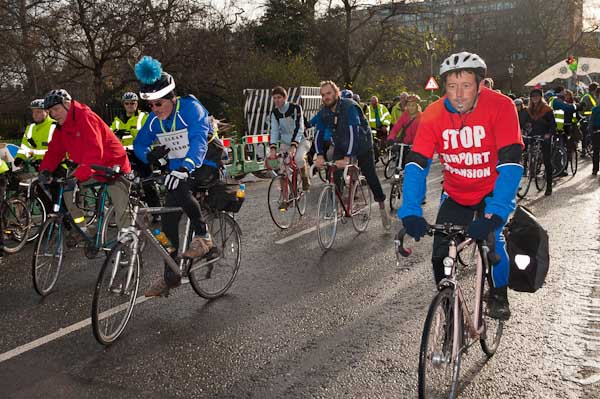
The start of the ride – sun right behind the riders

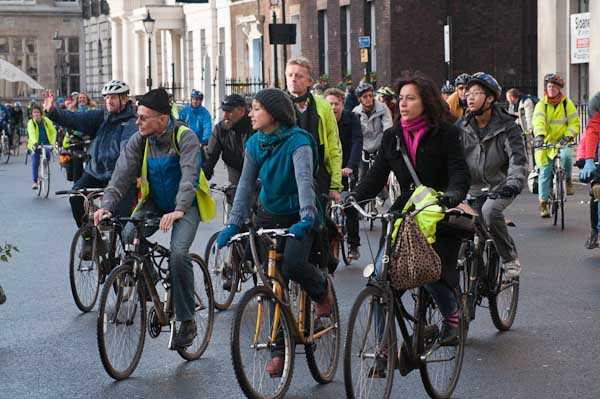
Anyway, I was without a bike, so an essential piece of research before the event was to find out the important places to be on the route and work out how I could get to these. Fortunately for this ride it turned out to be pretty simple – from the start at Lincolns Inn Fields I could go with the bikes the few hundred yards to Holborn Station, jump on a Piccadilly line train to Picadilly Circus and jog the quarter mile from there to the first stop outside BP’s Offices in St James’s Square in time for the ride to arrive.
© 2009 Peter Marshall.
I was waiting at St James’s Square when the ride arrived

Then it was only a few yards to the next call for the ride. From there I could make my way back to Piccadilly Circus and on to Marble Arch with plenty of time to spare for the bikes to arrive at the end of their demonstration.
© 2009 Peter Marshall
The end of the ride at Hyde Park

One thing I’ve learnt is to avoid trying to use buses when moving from one part of a demonstration to another. Marches or bike rides both tend to cause traffic chaos, and it can be extremely frustrating to be sitting on a bus in a traffic jam unable to get where you want to be.

Advance planning is also needed because some weekends the London Underground system has large parts shut down for engineering works,  so I check Underground (and bus) journeys on the Transport for London web site.  It isn’t infallible – last Saturday it was telling me I couldn’t use the train from home up to London which was actually running normally, and it isn’t unusual for it to suggest completely nonsensical routes. Particularly if I intend to photograph several events on the same day, the actual working out of the journeys between them can take an hour or two.

Everything worked out fine on Saturday, and I got to the right places on time, even managing to fit in a few more photos on the way.
© 2009 Peter Marshall.
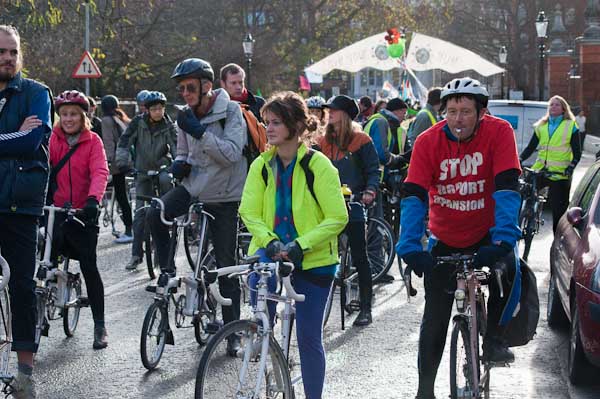
The sun was not far out of the frame for this image

The only real photographic problems were at the start of the ride in Lincolns Inn Fields where a low winter sun was shining from behind the riders. Even the fairly effective lens hood on my 55-200 zoom had to be augmented by a carefully held hand, while those on the wider zooms are pretty ineffectual at the best of times. But by working slightly from one side and keeping a careful eye in the viewfinder for flare I was able to get some decent pictures making use of the lighting – and of course using fill-flash to bring out some shadow detail.

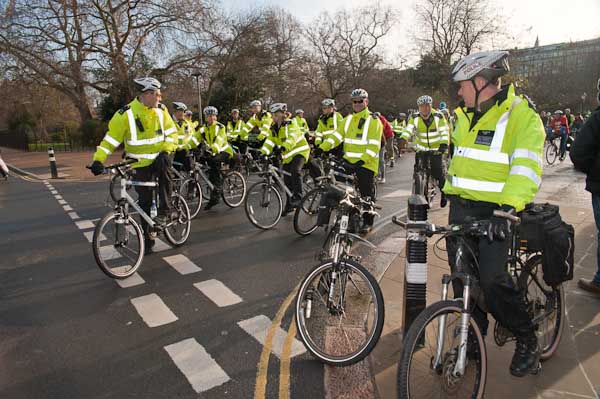
Using flash also creates problems, particularly because cyclists – like the police  – tend to have lots of bits of reflective clothing as well as other reflectors on their bikes. Often quite a little work is needed in Lightroom to tame these images, and that ‘magic’ highlight removal tool got a fair bit of exercise on images like these:
© 2009 Peter Marshall.

You can read more about the demonstration, part of a day of actions over Climate Change aimed at pressing the government to take effective action at the Copenhagen talks and in its policies here, on My London Diary, where there are also more pictures from the event.
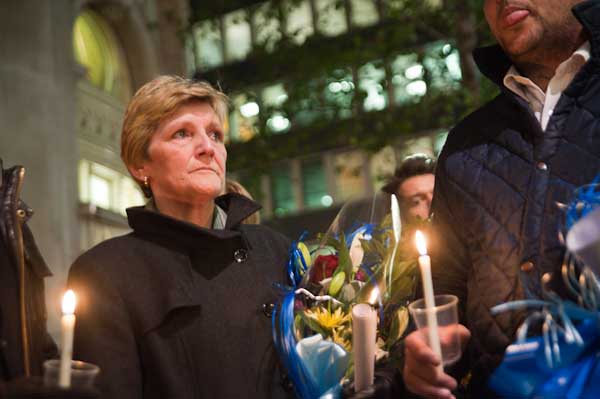
We Remember Ian Tomlinson

Last Wednesday, 1 December, was exactly 8 months since the death of Ian Tomlinson after a police assault at the G20 protests. The Ian Tomlinson Family Campaign wants a full investigation to find out what happened and to bring those responsible for his death to justice.

They decided to hold a public Candlelit vigil in Royal Exchange Buildings where he was assaulted and invited the press and others to attend. I’ve written a more detailed account of the event on My London Diary (and also on Demotix) so I won’t repeat the details here, where I want to look mainly at some of the problems in photographing such an event.

Firstly of course there were perhaps 30 other professional photographers there- including some from the national press and the picture agencies as well as other freelances, along with several TV crews and some other videographers. This made it fairly difficult – and at times impossible – to get into the positions for taking the best pictures (and also means that the chances of getting my pictures used in the news media is even lower than usual.)  Working in confined spaces with professional photographers generally isn’t too bad – everyone appreciates the problem and within reason people cooperate with each other (with a few exceptions.)

Working with digital has actually made it a little harder, with a growing tendency by some photographers – even when working with DSLRs when they can’t see the image – to hold their camera out in front at arms length to take pictures – and usually getting it into the frame of the rest of us.  They wouldn’t actually walk in front of us to take a picture, but somehow they seem to think it’s ok to shove a camera out there.

Working with videographers, particularly from the TV stations can also be rather difficult. They tend to like to set up on large tripods and take and stay in a good position, and sometimes feel they have a right to barge in front of stills photographers. Actually on this occasion they didn’t do so, but it still creates a barrier to movement in a way that still photographers don’t.

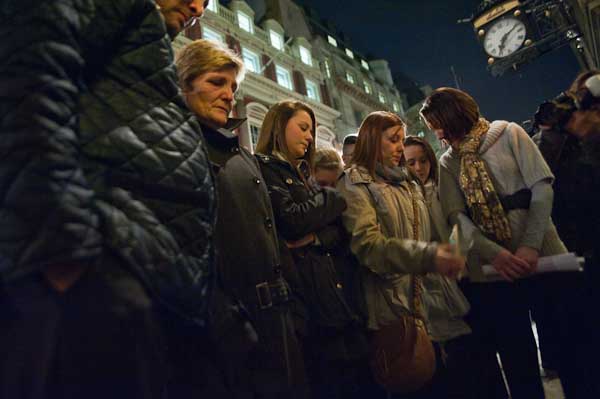
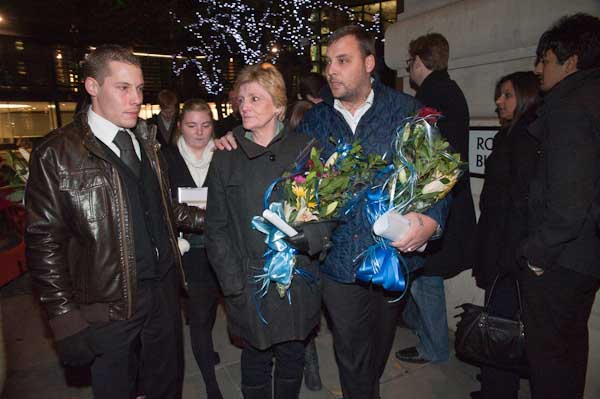
The light in Royal Exchange Buildings was fairly dim – it’s a pedestrian area and not particularly brightly lit.  I’d prefer not to use flash for a candlelit event, or at least only to use it sparingly to keep the effect of the candles. Using too much flash – as the the first picture – does create a very artificial effect an, with flash on camera particularly, does rather make people look like cardboard cutouts.

© 2009 Peter Marshall.
The Tomlinson Family arrive at the memorial event

This was taken at ISO2000, 1/60 f9, and flash is the main light source. The aperture ensures that I have sufficient depth of field to keep everyone sharp and even at f9 the ambient light does give some – if limited – background detail at 1/60s. I’d started taking pictures as they walked towards the event, moving backwards as they came; I hadn’t wanted to get in their way or stop them, but seconds after I started taking pictures I found myself with other photographers on both sides and behind me shooting over my should and I – and the family –  had to stop.

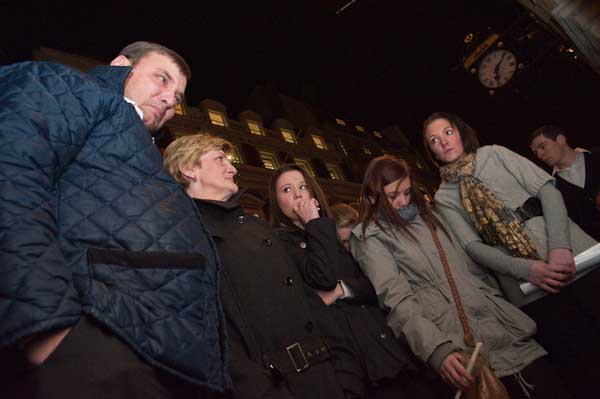
From there I managed to find a space crouching in front of the TV cameras and very close to the family. Having taken a few pictures with flash to make sure I had something sharp – if rather boring – I stared working by available light. Using the Sigma EX 24-70 f2.8, exposures were pretty variable, ranging from 1/20 to 1/60 at f2.8 to f3.5 at ISOs between 1000 and 3200.  Many frames were not sharp due to subject movement or camera shake, and the limited depth of field. The lens is just very slightly soft at f2.8 but good enough to use, particularly in difficult conditions.

© 2009 Peter Marshall
Mrs Julia Tomlinson

Flash is of course more intrusive, and although we had been invited to photograph the event and I wanted to produce pictures that might generate more publicity for the family campaign, I still found it hard at times to take pictures and wanted to do so with the minimum of intrusion. So when the family moved to the spot where Ian Tomlinson actually collapsed and died I needed flash to prevent blurring when they were laying flowers, but went back to available light to photograph them paying their respects after a short prayer from the minister present.

© 2009 Peter Marshall.

But after taking this I was not sure if it would have sufficient depth of field (looking at it now, although only Ian Tomlinson’s widow is really sharp, the image still works) and decided I had to take a similar picture using flash.

© 2009 Peter Marshall.

It is sharper, the colour is more accurate. Although probably I could process the raw file rather more carefully to get a better result, I think I prefer the atmosphere of the exposure using available light.

The story made the front page on Demotix, and I also published it on Indymedia, as well of course with a few more pictures on My London Diary.

More Police Paranoia

I think today is the first time I’ve read The Lone Voice blog, and it isn’t one I’ll be adding to my lists. It claims to be written by “FIDO The Dog”, a 43 year old Virgo male from Newport, Gwent who states he is “Fighting against the dhimmitude* and pc attitude that has taken over my country” and has an unfortunate fixation with Gordon Brown, Defence Secretary Bob Ainsworth and Alcohol Concern chief executive Don Shenker (about the last of which he does does have some sensible concerns.)

FIDO The Dog has made a number of posts about photographers being picked on by the police, and his post Yet more police abuse of photographers. features a couple of Welsh examples to add to the growing list of police overstepping their powers.

Yesterday Garry Chinchen was threatened with arrest for ‘breach of the peace’ when he stopped to photograph people on a jet-ski at the Glyn Neath Lakes water-sports centre from a lay-by on the A465. Despite the police apparently admitting that the pictures he had taken were perfectly lawful.

The Lone Voice also links to another incident I’ve read about before from last September, when a photographer from Motorcycle News had his camera seized (and returned after some argument) in a lay-by at Betws-y-Coed when he photographed a cop watching “a protest rally over North Wales Police’s heavy-handed treatment of law-abiding motorcyclists.”The MCN site has a picture of the event with audio of the argument between the photographer and the police officer.

There is another Welsh connection also, as The Lone Voice includes a link to a site that started life as started as an anti-racist football comic sold on the terraces of Cardiff City. But Urban 75, for some years now an excellent non-profit community site based in Brixton in south London, has a really useful feature Photographers Rights And The Law In The UKA brief guide for street photographers.

Of course in this campaign, The Lone Voice is certainly not alone. Yesterday, after Lord Carlile’s statement, the Photographer Not A Terrorist organisation was deluged with requests for media interviews,  and there were features on BBC programmes and elsewhere.  There is a rather nice story too on the BBC Viewfinder blog, written by Phil Coomes, picture editor and photographer for the BBC News website.

*the word dhimmitude comes from dhimmi, the protection awarded in Muslim states to non-Muslims under Sharia law which lays down both rights and responsibilities, but dhimmitude is a term largely confined to extreme right anti-Muslim campaigners in Europe who concentrate on the repressive and sometimes extreme aspects of this involving the persecution of Christians, and refers to attitudes of some liberal Europeans in accommodating Muslim ideas and practices.

The Future is Red?

Possibly.  We now know a little more about at least one promised Red camera, the Scarlet 2/3″,  (thanks to PDN – but here it is on RedUser) and although it may well be interesting at the moment to anyone shooting video (and the expected price of $4750 doesn’t seem too extreme considering) I don’t see it appealing to still photographers, though there is a picture of it up against a Nikon F3 – but for scale only.

Obviously we are seeing a convergence with pro still cameras now also including video modes. And we’ve seen a film (well to be honest I haven’t seen it – not my sort of thing) ‘The Fantastic Mr Fox’ shot using mainly Nikon DSLRs  as well as a Time front cover (and others) shot on a Red One (both reported recently on PDN.)

Reading the very confusing (at least to me) Red User forum I think we can expect the first Red offering targeted at still photographers around May/June next year.  It will be interesting to see how it compares.

Independent on Photography

Today’s ‘The Independent‘ front-pages the problems faced by photographers on the streets in the UK, and in particular in London.

It isn’t news to most of us that the police – and particularly the Met – are misusing their powers under anti-terrorism legislation. The Home Office even pointed it out to them in their circular 012/2009 as pointed out here last August.

What is news is that the latest criticism of their abuse of power comes from Lord Carlile Of Berriew QC, the government’s Independent Reviewer of Terrorism Legislation (a former Liberal Democrat MP he is also President of the Howard League for Penal Reform.)

Most of these abuses come from the inappropriate use of Section 44, which enables the police to designate areas as stop and search zones.  We aren’t even allowed to know where these zones are, and I had earlier assumed that the whole of London was covered by them, but the Independent article, by Mark Hughes and Jerome Taylor says that there are more than a hundred separate areas in London covered by them. It probably adds up to the same thing.  It also says that every train station in the UK is one, perhaps explaining why 96% of searches in a recent quarter were carried out by the Metropolitan Police or British Transport Police.

Most photographers have their own stories to tell, and there are a few mentioned in the feature, and more relate their experiences in the comments. Here’s one from pjjacques:

Stopped and searched for taking pictures of cyclists near Oxford Circus in June/July – police made me delete pictures – threatened me with arrest – kept me standing around for almost 30 minutes – very unresponsive to any questions I had.

Of course the police have absolutely no right under any law to ask photographers to delete pictures, but as a later comment suggests, it’s often best to accede to police demands – and if you don’t take any more pictures on the card you can always undelete them.

If you make a living from photography, you can get a limited amount of protection from joining the NUJ – as well as support when things go wrong. Many police are aware that they do need to be more careful with journalists event if – as often happens – they refuse to recognise your press card.  After all one of their bosses showed complete ignorance about them when he came to speak to the NUJ.

There is a related story on the Amateur Photographer site where freelance stills photographer Justin Leighton talks about the problems, saying “The Met Police and Police Community Support Officers (PCSOs) are a nightmare. They haven’t got a clue what they are doing.”

At the end of this piece are a whole long list of related links, including those to reports of a number of protests by photographers I’ve taken part in and written about here.  There are far too many of my own features that have dealt with the subject to list here, but here are some of photographers’ protests:

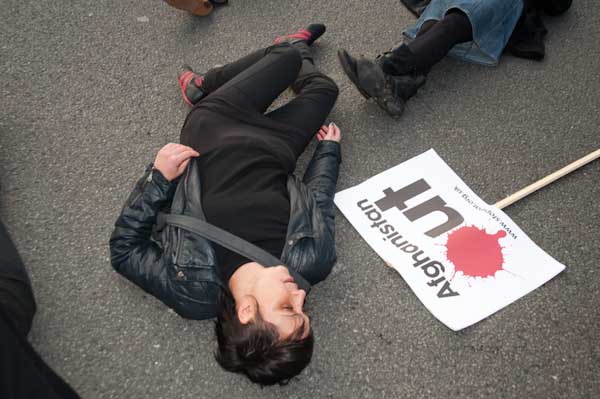
Die-in for Afghanistan

There were a lot of photographers in Parliament Square waiting for the student “Die-In” and I know that some were disappointed that the event was not more theatrical.  One said to me “I was expecting blood and bandages” and there were none of these.

It was in it’s way a nice demonstration, doing what it set out to do and flouting some of our over-restrictive laws that limit the freedom to protest. And although the police at the end did tell those taking part they had been breaking the law in protesting outside Downing St and in using megaphones, so far as I’m aware there were no arrests.

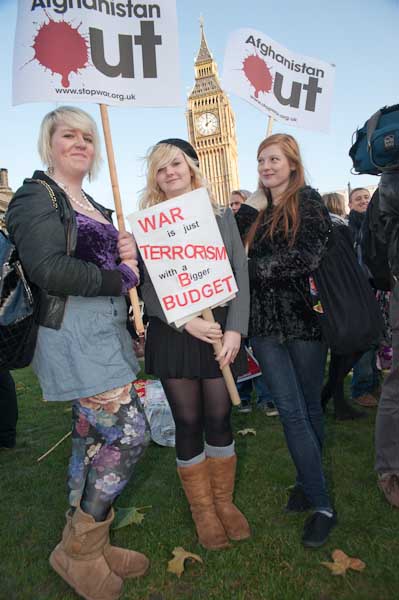
But how do you take interesting pictures of an event such as this? I think all of us look for something a little out of the ordinary, perhaps an interesting placard. But all except one young woman carried the same standard design – so of course she features rather a lot in my pictures, not least because I liked the little bit of humour in ‘Pick fruit not wars.‘  But rather annoyingly all the best pictures I took of her showed the other side that read ‘War is just Terrorism with a Bigger Budget.’

© 2009 Peter Marshall

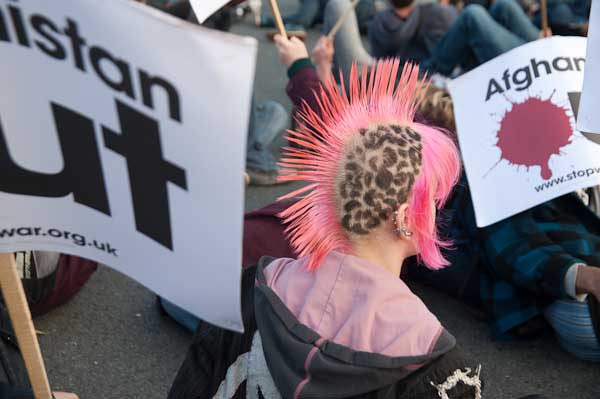
The punk girl with the pink spiky hair obviously felt very much under siege by photographers – and it probably didn’t help that some of her friends tried to shield her with placards. I tried not to be too obtrusive, but she did stand out and make some interest.

© 2009 Peter Marshall.

Often the police actions at demonstrations create a certain tension (and sometimes rather more) but on this occasion they simply stood back and watched most of the time.

Perhaps a very simple approach was the best:

© 2009 Peter Marshall

but it seemed every time I tired something like this other photographers or TV crews would walk into shot.

There are just some occasions where it’s hard to come up with really interesting pictures, though I think those I took – and you can see and read more on My London Diary – do tell the story of the event.

Internet Photo Criticism II

Great Photographers on the Internet, Part II which was posted on The Online Photographer on Saturday is another of those parodies of the kind of comments that get posted on internet photo-sharing sites, with photographers including Henri Cartier-Bresson, Frederic Sommer  getting the Flickr treatment.

If you missed it before (or even if you didn’t) Mike Johnston’s original Great Photographers on the Internet – where Bill Brandt and Garry Winogrand are among those getting some helpful advice – is also worth a look.

Terry King at Photofusion

Some thirty years ago I was sitting in a darkened hall in Richmond where an elderly man, a long-retired advertising photographer, was talking about the small, high contrast black and white prints which he had entered over the years for the Royal Photographic Society annual exhibition. What was unusual about these photographs by Steinbock was that they contained not a milligram of silver, but had been made on ordinary drawing paper using some black pigment, gum arabic and potassium dichromate.

It’s a story I’ve told before at rather greater length, on the occasion of Terry King’s 70th Birthday celebration, also attended by the man sitting on my left in that hall, Randall Webb, who was later co-authored  ‘Spirits of Salts:  A Working Guide to Old Photographic Processes’ with Martin Reed of Silverprint.

Although I’d heard of the gum bichromate process before – it was highly favoured around the start of the twentieth century among those involved in the ‘Photo-Secession’ and the pictorialist movement of the time, including Edward Steichen and Robert Demachy – and had seen prints made using it, this was the first time I’d heard and seen anyone actually telling how he made these prints.

Later, probably in the pub next door, the three of us decided we were all going to have a go at the process. Gum arabic wasn’t a problem as cooks used it and tubes of watercolour are readily available, but potassium dichromate was more of a problem. But not for me, as I was then teaching chemistry and knew that we had vast quantities of it in our chemical store, over-ordered by previous staff in the days when it was used in large quantities for cleaning glassware, and promised Terry a bottle.

For Terry it was the start of a new career in alternative processes – and you can see some of the results on his Hands on Pictures web site. Together we went on to explore more or less the whole range of alternative processes: salted paper, kallitype, Van Dyke, platinum, cyanotype, carbon and more.  For me it offered an interesting insight into the history of photography, but Terry found these processes the perfect expression for his own photographic work, and went on to research and produce his own variations – the “Rex” processes.

You can also see his work in a new book, ‘Beware the Oxymoron‘ which combines his photography with his poetry – and the preview gives you a good idea of both. I’ve enjoyed his poetry too over the years – particularly some of the limericks that he used to write every day on his short train journey in the days when he worked in a London office – and much more recently I spent an enjoyable evening at a Richmond pub where he and other poets performed their work.

Terry has also taught many others these processes, at colleges around the country (and abroad) and in courses at his Richmond studios. It was hardly a surprise to hear that his  Gum Bichromate Workshop on Jan 9, sponsored by Ilford Photo to coincide with Photofusion exhibition about the art of darkroom printing featuring Bill Rowlinson and Richard Nicholson booked up rapidly (though when I looked the web site reported there was one place left.) Of course if you can’t get on this, Terry does offer longer courses on his Hands on Pictures site.

As well as this course Ilford Photo have also sponsored an experimental print workshop with Branka Jukic on 23 Jan – places still left – as well as a fully booked course in December on black and white photographic printing with Nick Jones.

Bill Rowlinson – Printing Legend

When I was fairly new to practical photography, back in the 1970s, I came across a slim volume which, rather amazingly, was tucked away on a shelf in my local library. They didn’t have a large photographic section – I can only remember one other book, but, equally amazingly, that was Paul Strand‘s ‘Living Egypt.’

The very slim volume was an early edition of ‘The Print‘ by Ansel Adams, and very soon I was myself the proud owner of the latest 1968 edition of the same work, the bible for anyone wishing to become a master printer. Of course some things, even then were outdated and some materials that he mentioned not available in the UK, but although it covers the whole process of making photographic prints in great detail, it was always the principles that mattered.

From that book I taught myself to print, although other aids soon came along, and another vital step was a pilgrimage up Muswell Hill to the store above the pharmacy where Peter Goldfield had begun to import that holy grail of black and white printing papers, Agfa Record Rapid, and later with his partner Martin Reed, produced the Goldfinger craft book. Martin went on to found Silverprint, still in business selling fine photographic materials a few minutes walk from Waterloo station – and the Goldfinger book can still be download from the site as a pdf.

Darkrooms certainly had a magic, perhaps still have it, although we’ve seen some great losses – particularly when cadmium was taken out of many papers, making Record Rapid just another paper. Of course there were also advances, and in particular Ilford’s Multigrade papers giving a flexibility that almost persuaded me it was no longer vital to have two developer baths. And personally discovering that with sodium lighting carefully adjusted to avoid any fog that darkrooms didn’t need to be dark any more.

It wasn’t long before one or two people were asking me if I would print their work, and I briefly considered setting up as a photographic printer. But only very briefly, because although I enjoyed the challenge of printing my own work, I really did not wish to spend more of my life in the darkroom. And perhaps also because I knew there were people who did it so much better.

© 2009 Peter Marshall

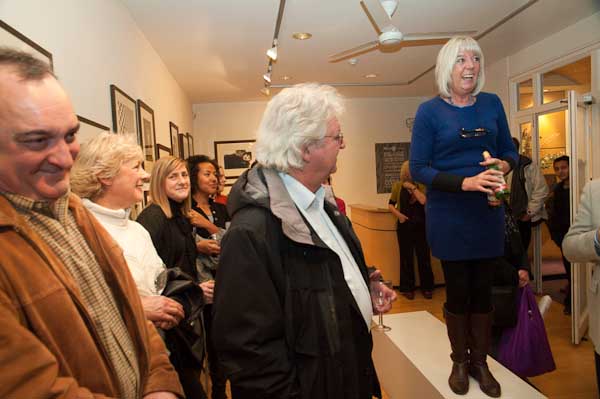
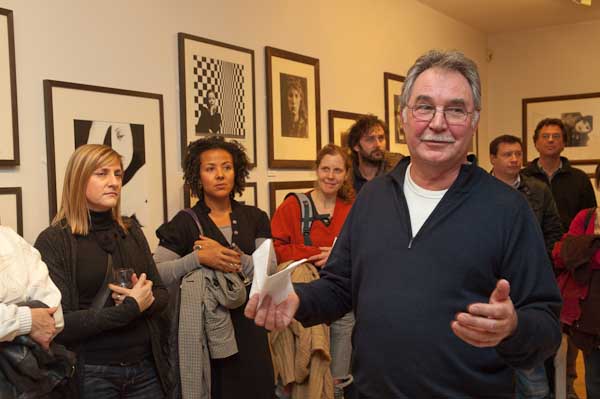
The current show at Photofusion – until 27 Jan 2010 – celebrates the art of arguably Britain’s finest photographic printer, Bill Rowlinson, who died in 2008, aged 78, leaving his collection of prints to Photofusion.

Many of us have worked late in the darkroom, making exposure after exposure trying to perfect the dodging and burning or the contrast of an area of a print, only to find once the prints are toned, washed and dried that the difference that seemed so critical in the safelight are hard if not impossible to discern in daylight, and I suspect that some of those in his collection may be ‘extras’ produced in this way, but certainly all those on show are excellent examples of the printer’s craft.

© 2009 Peter Marshall

It’s helped of course by the fact that he worked with many of the best photographers around, making his name in the 60s printing for Sarah Moon (who I was delighted to meet and talk to over a couple of days in Bielsko in 2007.)  Also in the show are several of his fine prints for Bill Brandt, as well as some works by Julia Margaret Cameron. Not that he was old enough to have actually worked with her (she died in 1879.) These prints will have been made from copy negatives of prints and were made for the Dimbola Trust which runs the museum in her house on the Isle of Wight (although I think from originals in another collection.)

There are also some intriguing pictures Rowlinson printed for the Kobal collection, along with work by other photographers including Barry Lategan, Jon Swannell, Clive Arrowsmith and Jimmy Wormser.

© 2009 Peter Marshall

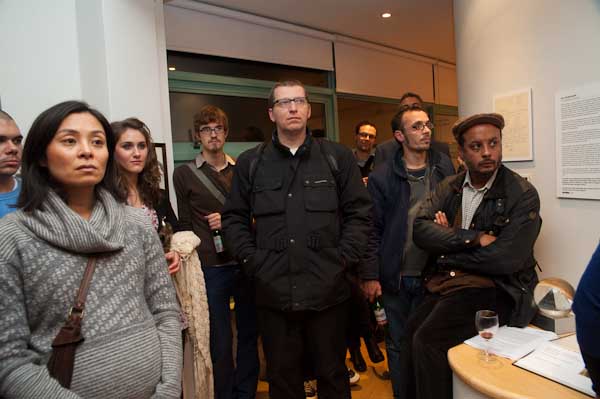
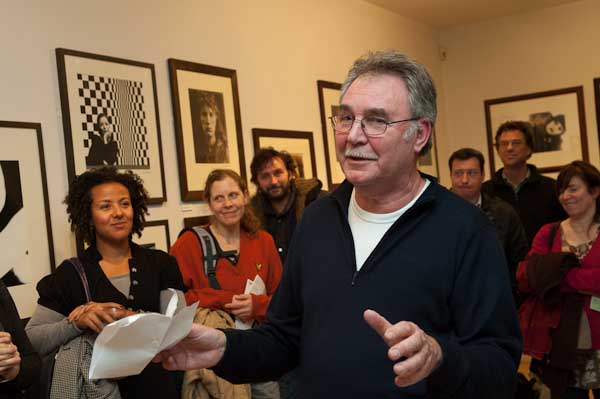
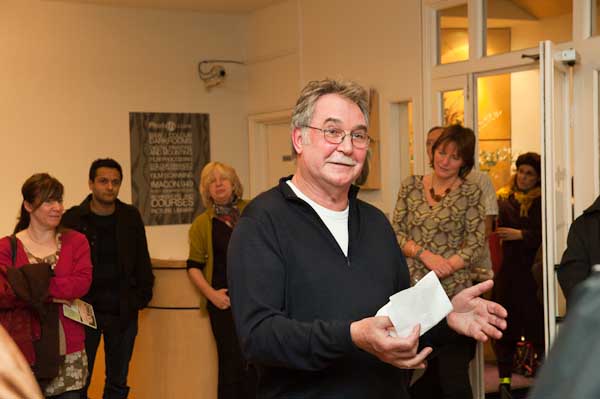
Of course, photography over the past ten years has largely moved to digital, and perhaps the age of the master printer is over. Quite a few of those remaining in London were at the opening last night, including Adrian Ensor, who spoke briefly about Bill Rowlinson at the opening and is appearing in a gallery talk there on 8 December together with Steven Brierley of Ilford and Richard Nicholson to talk further on Rowlinson’s work and “the evolution of photographic printing over the last 40 years.”  You can also hear Adrian Ensor talking with Bob Miller about his contacts with Rowlinson and some of his uncoventional techniques on the Silverprint site.

© 2009 Peter Marshall

Ilford did much to promote photographic printers in the old days, running their Ilford Printer of the Year award for around 25 years, starting in 1968. This was I think unique in that it  gave equal billing – and the same generous prize money – to the photographer and printer. Rowlinson won his first Ilford Printer of the Year Award in 1975.  Ilford – now Ilford Photo – formed from the ashes of the former Ilford imaging group by Harman Technology – exists to be “passionate about black and white” and is producing and promoting photography using black and white film and traditional darkroom techniques.

© 2009 Peter Marshall

A short visit to the working darkroom at Photofusion brought back memories, but its several years since I’ve ventured into my own darkroom to make a print. Perhaps one day I’ll go back again, but with every advance in inkjet printing I feel it’s less likely.

Papageorge on Foto 8

A very thick copy of Foto 8 magazine came through my door the other day, but I haven’t had time to read it properly yet. But it does include a number of interesting features, including two by photographers I’ve previously written about,  Michael Grieve and Edmund Clark. You can take a look at this twice a year publication online, but really you need to see the real thing – and the best way is to take out a subscription – and there is a special 50% offer on new and gift 2 Year Subscriptions until 16 December. It’s probably the best magazine in the world covering photojournalism.

Foto 8 also has a lot of content on-line in its blog, including an interesting interview in which Tod Papageorge talks to Mark Durden, in particular about Garry Winogrand and Susan Sontag. Here’s a quote:

It’s always been puzzling to me that capacious minds like Sontag’s … look at a photograph and see not a picture, but the literal world held in their palm. With that, they’re revealing themselves to be no more sophisticated than the proverbial tribesman who believes that a photograph made of him steals a piece of his soul.

You can see more of Papageorge’s photography at the Pace/McGill Gallery.

Papageorge has always impressed me more as a writer than as a photographer, and in particular for his 1981 book ‘Walker Evans and Robert Frank: An Essay on Influence‘.  The book is long out of print, but the text – without the pictures it refers to – is available on the web as the first of a series, The Missing Criticism on Eric Etheridge‘s ‘Mostly Photos‘ blog.

The second article in this series, also by Papageorge, is his 2002 essay ‘What We Bought‘ on the work published under that title by Robert Adams in 1995. Unfortunately by that date I’d stopped buying every new book by Adams, as this first edition now sells for around £400 (but I do have first editions of  the even more expensive  ‘Denver‘ and ‘The New West‘, though like most of my books my copies are well-thumbed.) But newer editions of these books are available – and you can buy ‘What We Bought’ in and edition published by Yale University Press (Papageorge became Director of Graduate Study in Photography at the Yale School of Art in 1979)  for £30 or less.