More on Haiti

Joerg Colberg at Conscientious has posted a couple of very  useful links, to More Perspectives on Haiti and Crisis Journalism by Matt Lutton on dvafoto and Staring at Death: Photographing Haition Pete Brook’s interesting Prison Photography site which has a very lengthy annotated list of links.

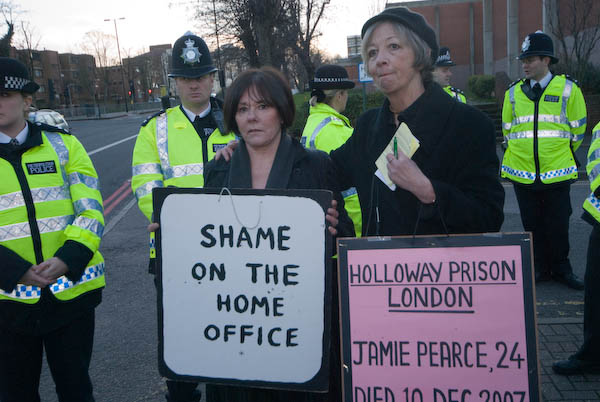
Although Brook, “a very amateur photographer” who has decided because of this to “stick to looking and commenting”  is based in Seattle, he writes “I have strong political views about prison reform, particularly in the United States, and increasingly moreso as regards Her Majesty’s Prison Service in the United Kingdom.

Me too.

© 2008 Peter Marshall
Gwen Calvert and Pauline Campbell in protest outside Holloway Prison, Jan 2008

You want to make money?

PDN Pulse has a feature on the top-selling microstock pictures of 2009 showing some of the examples.  It is more than depressing to look at them and think that this is how to make money at photography.

Or photography and bad Photoshop in some cases. One of the comments reads “hideous. I’d rather prize my teeth out with a butter knife than look at this garbage” and its hard not to agree.  But these guys are making a good living from it, while many if not most good photojournalists struggle to keep going at the moment.

But as I keep telling myself, I don’t do it for the money, though I do need some money to keep on doing it. Some things are worth doing, other things just aren’t. Whatever they pay.

On which subject, from Twitter this morning I found a link to Don’t Be Scared of the F-Word When Exploring New Business Models by London / New York based freelance commercial photographer Jonathan Worth on Black Star Rising, in which he argues that doing things for free can be worthwhile. It’s worth reading (sorry!)  and I’m very much in agreement that it is sometimes a good and even profitable idea. But just not in the vast majority of cases, when people just want to rip us off and the chances of our benefiting in any way are close to zero.

And yes, I do a lot of things for free, not least this blog and my posting of work on sites including My London Diary, the River Lea/ Lea Valley, London’s Industrial Heritage and the Urban Landscapes web sites.

Saturday in Tragalgar Square

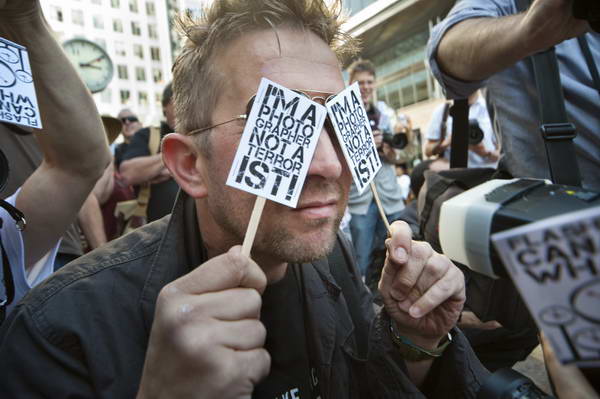
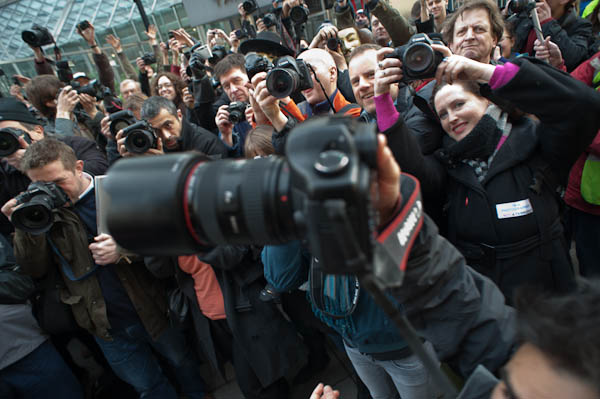
If you are a photographer – or simply someone who cares about our civil liberties, and can get to London on Saturday then I hope you will join us for the mass photo gathering in defence of street photography organised by I’m a Photographer, Not a Terrorist (PHNAT) at 12 noon.

© 2009 Peter Marshall.
I’m a photographer not a terrorist flash mob at Canary Wharf, Sept 2009

This is one of a series of protests by photographers against harassment by police while taking pictures, and in particular about the use of legislation aimed at preventing terrorism against people exercising their right to take photographs in public places.

Of course it isn’t just police. I think the latest silly incident involved a student taking pictures at Hounslow Central Tube station on a Sunday afternoon. I used to live just down the road, used it often (and probably took pictures there)  and can certify that no sane terrorist would ever bother to attack it.

The paranoia doesn’t just affect photographers of course. Eighteen months ago, just a hundred yards from where I live, a young student decided to hold a one-person peace protest, holding a placard “Stop training murderers” outside the building used by the Army Cadet Force (not as the paper says “an army base”.)

Eight police, including armed officers and dogs, swooped on his house to arrest him, while a helicopter hovered overhead. They arrested him under the Terrorism Act, took his books and computer and kept him in jail overnight. In the morning he was charged under the Public Order Act, and on the advice of the duty solicitor, accepted a police caution.

He has now realised how misguided this was (and that solicitor should be struck off) and is trying to have the caution rescinded.

© 2009 Peter Marshall
Photographers protest at New Scotland Yard, Feb 2009

It comes shortly after a ruling by the European Court of Human Rights that Section 44 stop and searches are illegal (the UK government has announced it intends to appeal.)

I’ll be there (and so too will Jess Hurd, back from Haiti and one of those involved in setting upPHNAT) and over 1400 people have signed up for the event already on Facebook.

I hope to see you there!

Rainy Day in London Town

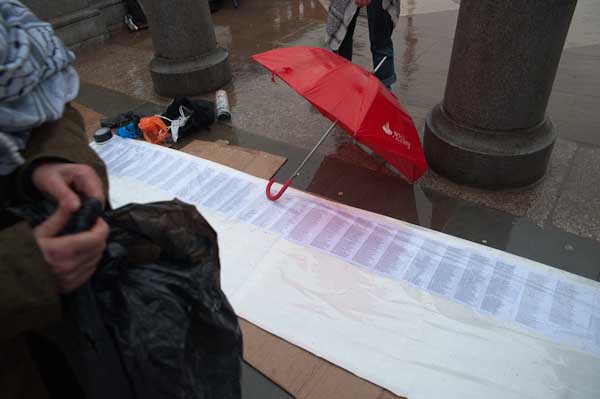
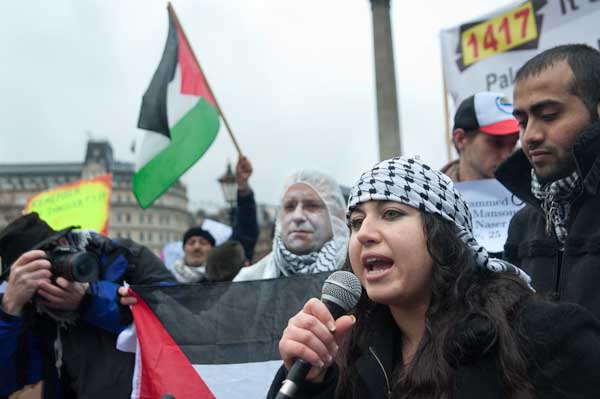
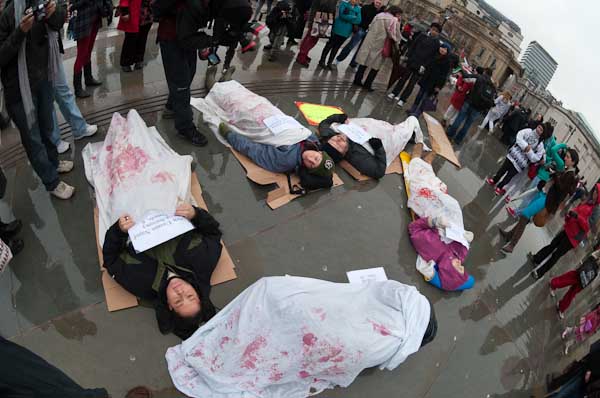
Yesterday was too wet for a die-in. The International Solidarity Movement had hoped to get 1417 people to lie down on the paving in Trafalgar Square as a graphic reminder of the 1417 men, women and children killed during ‘Operation Cast Lead‘, the 22 days of Israeli attacks on Gaza a year ago.

© 2010, Peter Marshall
All 1417 names on the list

The figure is disputed and comes from the Palestinian Centre for Human Rights, with the Israeli human rights organisation B’Tselem giving a slightly lower figure of 1387 and official Palestinian and Israeli sources differing rather more. But a great many certainly were killed, and the great majority of them – over a thousand – were non-combatants. Again the two more believable sources  give figures of 313 or 320 children in the overall figure. By contrast there were 13 Israeli deaths, including three soldiers killed by “friendly fire.”

(The figure of around 1400 is in one respect an underestimate, in that Palestinians are dying all through the year as a result of the Israeli blockade limiting their access to medical treatment; deaths due to this cause in the 22 days are not included in the estimates.)

Unfortunately due partly to the lousy weather with heavy rain rather fewer than expected turned up. Well under half of those who had signed up on Facebook as coming actually turned up to collect the names they had been allotted, though fortunately there were quite a few who for one reason or another hadn’t signed up.  But for whatever reason the event was still well over a thousand people short. Although it seemed quite a sizable crowd in a corner of the North Terrace, it was still perhaps only a fifth or less of the number who died in Gaza.

Not only was it too wet to lie down on the pavement, it was also really too wet for photography, at least as the event started. I was walking around holding up an umbrella with one hand and a camera with the other. An umbrella is a real pain, particularly in even slightly crowded situations for the way it limits your mobility. Photography, or at least this kind of photography, is all about getting into the right place to take pictures. Well at least that’s the sine qua non. “F8 and be there” is all very well (so long as you realise that being there sometimes needs almost millimetric precision) but you still need to release the shutter at the right time.

You need to learn how to get through small gaps in crowds fast, to slide into positions, to duck and weave to where you need to be, but really it’s impossible when you are holding an umbrella, and particularly so when everyone else is.

And then there’s the lack of a third hand to hold and use the cloth that you will need – even under an umbrella – to wipe the drops of rain off the filter. I use a microfibre cloth that isn’t bad, but really a genuine chamois leather is still better, though it costs several times as much. I went for the false economy and regret it every time it rains.


Fortunately the rain stopped for the speeches

I think almost all of the pictures were taken on program setting, though several times I used the “flexible program” facility, turning the handy thumb wheel to change the aperture or shutter speed.  I was also working on ‘”Auto ISO” with the camera ISO  set as ISO 800. The light was dim but changing,  giving some quite varied settings.  There were rather too many frames where the Sigma 24-70 was wide open at f2.8, and slightly higher lower ISO setting might have been better. The lens is usable wide open, but noticeably better at f4. I would welcome the ability to set a maximum lens aperture at which the ISO starts to increase when in Auto-ISO mode. With this lens for normal use I’d like it to start increasing ISO at f4 and only open up to f2.8 once the upper ISO limit had been reached.

© 2010, Peter Marshall
Anti-Zionist flag burning has become a ritual

I had thought wrongly that AutoISO worked with the set ISO as the minimum and was surprised to find some of the pictures I took had used a lower ISO – down as low as 320 in at least one case.  In fact the vast majority of images were taken at ISO 800, although according to the manual the lower limit when using AutoISO is always ISO 200.  But ISO 800 was a better base to work from under the light conditions, so I’m pleased it seems to do so, though mystified why it chose to use lower values for these particular frames rather than simply alter the aperture and shutter settings as it could have done.

© 2010, Peter Marshall
A few people did stage a die-in for the cameras at the end of the event

Incidentally Nikon did release a firmware update for the D700 recently, which I’ve downloaded and applied and recommend; if you have a D700 you should now be using Firmware Version 1.02.

Sudan Drums

Sudan was an area where British colonialism messed up in the nineteenth century with General Gordon being failed by the government and much more.  From 1899 to 1956 it was essentially a British colony, and for the last 30 or so years run as more or less as two different countries, a largely Muslim north and a largely Christian south.

Although the south and the north reached some kind of agreement in a peace settlement five years ago following two lengthy civil wars, fighting and civil rights abuses continue, particularly in Darfur in the west of the country. The peace settlement called for a referendum in the south to decide whether to remain in Sudan in January 2011, and the international Sudan365 campaign which was being launched on January 9, 2010 brings together groups working for peace and human rights in Sudan and a free and fair referendum in a year (actually now just under 365 days).

Photographically it was a fairly simple event to cover , with demonstrators in a pen on the pavement in Whitehall, although the police were occasionally being a little unhelpful and quite unnecessarily attempting to keep the pavement in front of the demonstration clear rather than routing passers-by through the wide empty gap behind it, and I was occasionally asked to move. They also refused to allow the organisers of the demonstration to have speakers there – and to my surprise they failed to insist on doing so, unlike several previous demonstrations I’ve photographed there.

© 2010, Peter Marshall
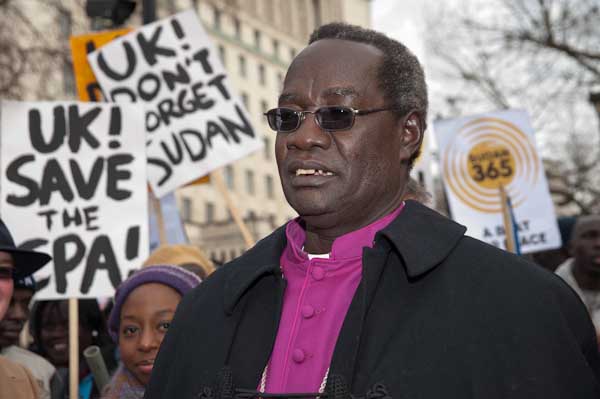
Archbishop Daniel Deng – difficult to get a good picture

The event had attracted some media attention, though mainly from broadcast media rather than print, and BBC radio 4 had interviewed the major speaker, the Sudanese Archbishop Daniel Deng earlier in the day (and did so again on Sunday morning.) Of course we all want peace, but his interviews- and the well-received address he gave at the protest – seemed to me politically lacking (as perhaps too is Sudan365.)  Perhaps not surprisingly he was feeling the cold in London, even with a red jumper under the purple.

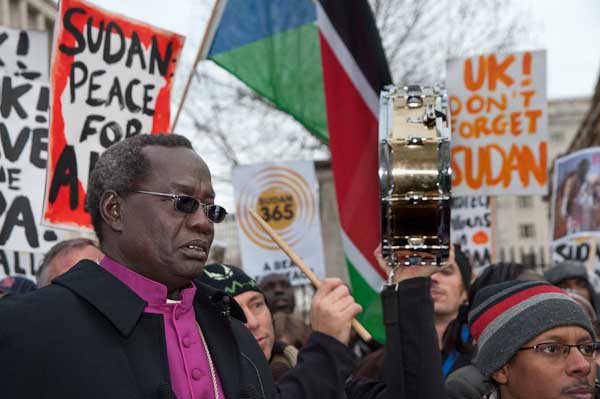
Since the protest was called ‘Drums for Peace‘ it would have been nice if he would have actually beat one at least for a few minutes with everyone else, but he could not be persuaded to do so, presumably feeling it wasn’t the kind of thing an archbishop should do. Apparently he is meeting Gordon Brown on Monday- and I hope the other party leaders too.

© 2010, Peter Marshall
The nearest I got to photographing him playing a drum

I did photograph him speaking, but he held the microphone close to his face all the time and spoke without any gestures or expression and so the pictures weren’t great.  A few of those when he was posing the the middle of the demonstration are a little better, but lack the kind of interest and dynamism shown by the demonstrators. And dark glasses are seldom a plus point when you are trying to make a portrait.

© 2010, Peter Marshall

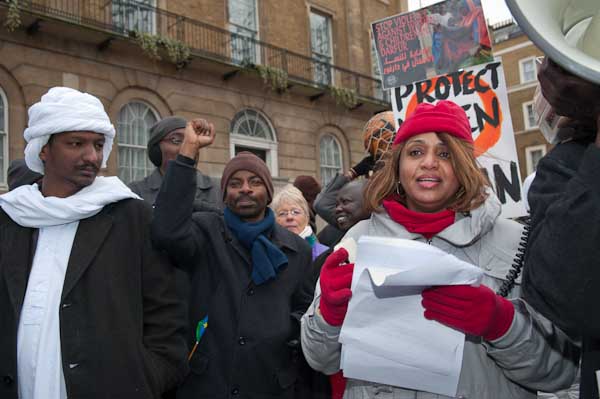
The second speaker was much more interesting to photograph, though again not easy, as there were only a few moments when she lifted her eyes from her typed pages. But there were some great faces in the crowd of demonstrators as you can see in the rest of my pictures from the event on My London Diary.

But by the time she had finished, I’d decided it was time for me to go also. Elsewhere on My London Diary you can see several other protests about Sudan I’ve photographed previously – all concerned with the continuing genocide in Darfur, in April 2007Sept 2007 , April 2008 and May 2008.

Doctorow on Copyright

I first read the speech by Cory DoctorowHow to Destroy the Book‘ before Christmas, but didn’t immediately mention it because although there was much in it that appealed to me I wanted to think about it a bit more.

Doctorow made the speech to a Canadian ‘National Reading Summit‘ in Toronto in the middle of November and the speech was printed by ‘The Varsity‘, a Toronto-based on-line student newspaper, a month later. If you haven’t read it, I suggest you should.

To put things simply, Doctorow stresses the centrality to our culture of being able to own and copy books and points out the threat posed both by mechanisms such as DRM licensing and the current attempts by the copyright industries (and in particular those from the US) through the the World Intellectual Property Organization and proposals to ‘update’ copyright laws in countries around the world.  (Our very own Peter Mandelson gets a special mention for his weekend in Corfu with David Geffen which persuaded him to to come back and rewrite our own copyright laws.)

Doctorow as a creator has certainly put his works where his mouth is, insisting on his work being published DRM free and making his books available as free downloads (and they really look good on screen.) For him, scattering his work, to use his image, as freely as the dandelion scatters its seeds, gives “a fecundity to your work that allows it to find its way into places that you never thought it would be found before.”

As he says, most people first come across the work of authors without buying it. They borrow books from libraries, from friends – or download material from the Internet. Far from threatening the sales of books, these same people go on to buy those that they really like – because they want to own them.

It works because the product for sale, the printed work, has a physical form that people want to own. An electronic book just isn’t the same (and I think most of us are by now simply annoyed by those clever book-look interfaces on web pages with pages that ‘turn’ rather than simply doing what a screen display can do better.)

But does it work for other media? Perhaps less so for some, although I’d still prefer to have those few movies I own on DVD in nice packages with a title on the spine and some interesting material in the box – something the industry has rather too often failed to provide.  Music too has failed to come up with anything to rival the LP cover in the post-vinyl age, though I still like to be able to run my eye along a row of CDs and choose the one I want, but perhaps I’m a dinosaur in this MP3 age.

And photography? I’ve certainly made much of my own work available in low resolution on the web – well over 50,000 images now on My London Diary and other web sites.  Although almost all of it carries a copyright message, I’ve never intended that this should prevent people copying it for their own personal use and for research/study. Occasionally people do ask for permission to print pictures or use them in their academic work or even to print them on a t-shirt, and I would never normally refuse such individual requests.

I also make it clear that my pictures are available for use without payment by “suitable non-profit organisations” but that payment is expected for any commercial use.  It isn’t a hard and fast division, though usually a reasonable test for me is whether the person asking to use pictures is actually getting paid for what they are doing. If the organisation can afford to pay them, it can afford to pay me for my work too.

By keeping my work copyright I can also try to prevent images being used by people in ways that I don’t want, for example by right-wing hate sites. Letters from a solicitor to the ISP concerned about copyright abuse have led to their removal, but unfortunately it is all too easy for these sites to move around to different hosts. Unfortunately Creative Commons licences – of any type – just don’t seem work in this way at all.

But as a photographer I also have something else to sell. Original prints and high res files for reproduction. And the Internet is a shop window for me, although the takings from it are not particularly high. I’m not sure I’m ever going to put high-res files onto the web without protection of some sort, though should I ever get round to publishing (almost certainly self-publishing) one of the books I’ve often started to produce I think it quite likely that I would make that available as a free PDF.

What I think is vital – and what Doctorow says – is that copyright, and in particular the international agreements on it, needs to take into account the interests of creators and users and not to be simply based on securing the profits of large corporate interests who are currently running the show in secret sessions of the Anti-Counterfeit Trade Agreement or at villas in Corfu.  People like Geffen would really like to keep copyright as their private beach!

A New Year

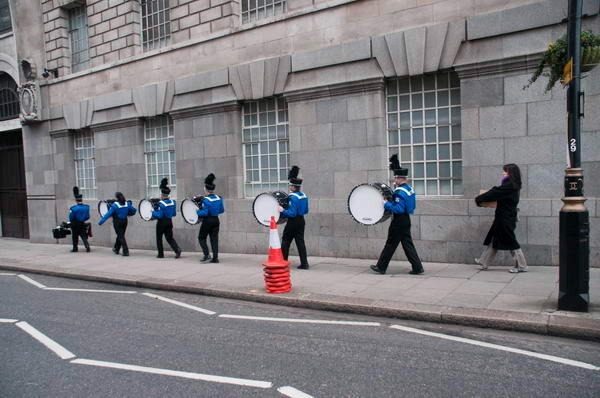
I decided to start the new year differently in 2010.  Almost every year this millennium I’ve made a start with the London Parade, a rather curious annual event that started almost 25 years ago, and at least in the early years that I photographed it was made up almost entirely of US teenagers either marching in uniformed bands or jumping up and down to music waving pom-poms. Here’s one I took in the previous century:

© 1999, Peter Marshall
London Parade, 1999

When I first photographed it, quite a while ago, it was called the Westminster Parade, involving only one of London’s three cities but it has since broadened to include not only the other two cities (the City of London and Southwark, south of the river) but also the Greater London boroughs, a number of which now have floats or groups in the parade, along with various other organisations from around the country.  But although 9/11, the London bombings have resulted in rather fewer US kids flying in, others have taken their place to give a more varied event.

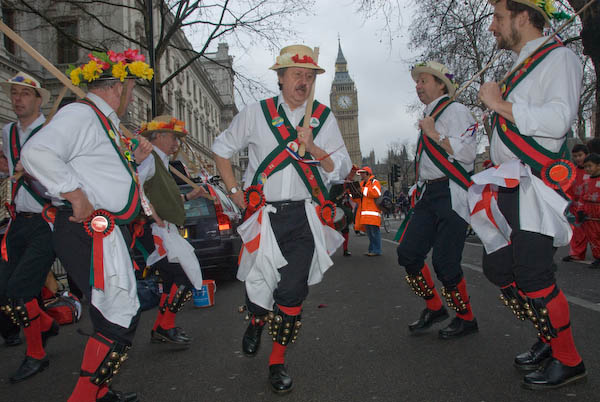
It’s also become increasingly controlled, and arranged more for the benefit of a worldwide TV audience than for those watching on the streets, and I’ve found it less interesting to photograph. One of the things that helped to retain some interest was that the parade assembled around Westminster, giving some nice backgrounds for pictures – such as these Morris Men from the London Borough of Harrow:

© 2008 Peter Marshall
Merrydowners Morris from the London Borough of Harrow, 2008

But this year the procession was to go around the route in the opposite direction – apparently the TV companies had pressed for the change as  they had decided it allowed them to show some of London’s landmarks better in their coverage. So rather than starting at Westminster it would be starting on Piccadilly.

Perhaps I’ll photograph it again another year, but once TV gets to call the tune I’m not sure it is worth bothering. I’ve felt that the last few years, though I’ve taken a few pictures I like, the only thing that has kept me going back is that it has become a little bit of a social occasion for some of my photographer friends, where we meet up and go to the pub as the last of the parade moves to the start line.  And I was sorry to miss that, though I imagine there will be a few opportunities later in 2010.

© 2009 Peter Marshall.
Westminster, 2009

My best wishes to all for 2010.  No long list of resolutions for me, but I’m going to try and do things a bit differently to 2009. Time for a change.

More from Paris

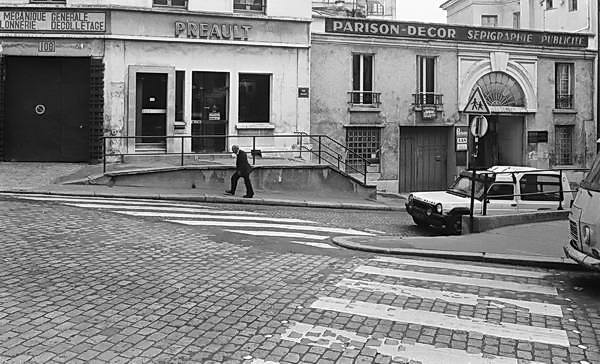
Paris 1984 © Peter Marshall

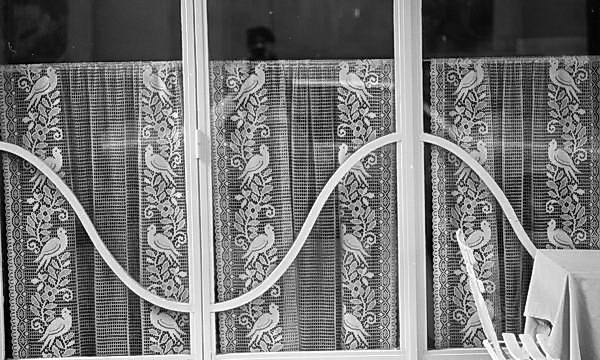
I’ve photographed this little crossing in the 10e – just along from the famous Hotel du Nord – many times and this is one of my favourite images. Last month when I stayed at home rather than going to Paris I got out some of those old negatives and scanned several hundred of them using the Epson V750.

The scans, despite what’s often said about flatbed scanners and 35mm film aren’t bad at all, and I could certainly make decent 10×8 prints from them, probably larger.  As a compromise I chose to scan at 2400 dpi. The scanner has a maximum optical 4800dpi, but at that resolution scan times get a little too long for volume production – roughly 4 times as long as with 2400. Of course I could have gone a little faster at a lower resolution, but given the time taken in removing and replacing the film from the filing sheets, putting them in the film holder, cleaning the negs and various glass surfaces  etc, the process as a whole wouldn’t be a lot faster.

Just for rough proofing of course you can scan  negatives still in their filing sheets – so long as you used the fairly clear transparent type, and its something I’ve done for making digital contact sheets. A normal full filing sheet doesn’t quite fit on the scanner bed, so you need to make two scans for each sheet – which I then usually join in Photoshop. Working at 600 dpi gives reasonably sized files where you can view individual images at roughly the size of an 8×10 print on screen, but aren’t too great for printing, though you can make postcard sized images.
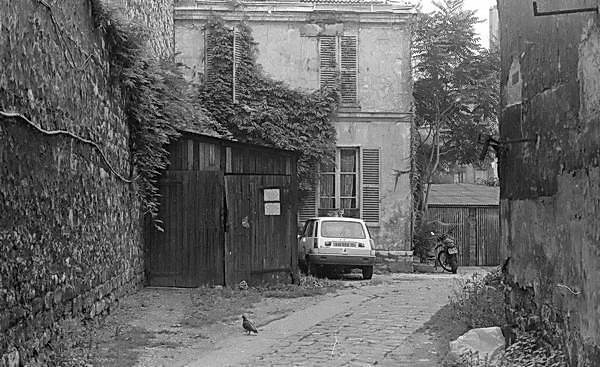
Paris 1984 © Peter Marshall
One of several ‘corners’ that Atget probably photographed

After a few experiments with the Epson software, I scanned the 35mm negs in 16 bit grayscale mode and saved them as TIF files. These are around 13Mb and roughly 3300×2050 pixels. I then made any basic corrections needed to the levels and/or curves as well as using the Polaroid dust removal filter and in a few cases a little bit of work with the clone tool, and saving them as 8bit gray scale jpeg files for use. Any I want to do much more work with I can start again with the TIF, archived on external storage. Although the files need some cleaning up if looked at 1:1, most are fine for use if reduced to web size, and I’ve now started to put some of them on line.
Paris 1984 © Peter Marshall
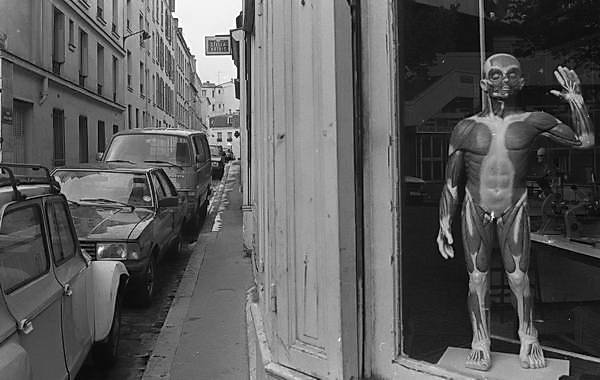
I think I took this a little straighter – and certainly printed it so

The main problem I’ve had with the scans is cropping. Although the Epson film holder can show more or less the whole negative, the automatic location of the images by Epson Scan seems to prefer a little cropping, especially with images where the edges of the negatives aren’t quite parallel to the edge of the film, which seems to be the case with quite a few of my negatives (I think it was a speciality of Leicas that it was easy to load the film slightly out, though working with M series cameras I never managed it quite as obvious as M Henri Cartier-Bresson occasionally did with the older models.
Paris 1984 © Peter Marshall

If I want to make new prints (and I hope some people may want to buy them) my first step would be to find the negatives and scan them at higher resolution in my dedicated film scanner, A Minolta Multiscan Pro. Especially when used with two devices made available by enthusiasts, this model produces some of the best possible film scans, as good and sometimes possibly better than drum scan.  Unfortunately the scanner is no longer available, but the idea of the Scanhancer, produced by Erik de Goederen from Holland, has been incorporated into some later scanner designs – though without acknowledgement. The other thing that improves the quality of the scans are some custom-designed and specially machined masks from another member of the user group, the MultiPro Xpander from Drazen Navratil in Zagreb. These hold the negs as flat as possible and the oversized 35mm mask allows the entire negative to be scanned. Altogether the Multipro group is a good example of how the Internet enables people from around the world to gain from each other’s ideas and experience.

Using the Epson V70 you can of course locate the negative edges more accurately manually, but it would slow down the whole process to a snail’s pace and isn’t really feasible when scanning several hundreds of negatives. I did recently get a mailing from Silverfast who claim that their latest software does the job better, but an upgrade to that supplied with the scanner was at a special offer price of 299 Euros, which I found not in the least attractive.  Of course I did install Silverfast when I bought the scanner, but soon decided I preferred to use the Epson software. Though some people do swear by Silverfast, I found myself more swearing at it.

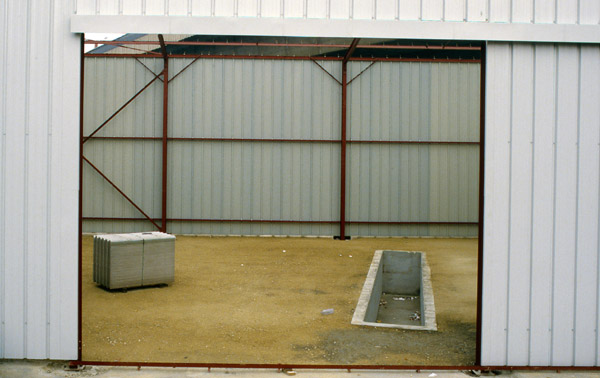
So far I’ve put the first set of 28 black and white pictures from my visit to Paris in 1984 onto the web, where you can already see 45 of my colour images from the same year:
Paris 1984 © Peter Marshall

as well as more black and white work from 1973.  More from Paris later.

While thinking about Paris, I can’t help but think of some of my friends there who I missed seeing in November, among them Jim and Millie Casper.  The LensCulture web site has been running since 2004 , establishing an enviable reputation in the world of photography, and attracting around three or four times as many visitors a day as this site.

I’ve often linked to audio interviews and other features on Lens Culture from this site, and I’m happy to give another link to the site, this time to a request for donations to keep Lens Culture going.  Like these pages, it carries no advertising – as the site says:

Since our inception in 2004, Lens Culture has been completely self-funded, without revenue from advertising or any other outside source. We prefer to keep Lens Culture “content-rich and clutter-free”, and your contribution today will help it stay that way.
Soth’s Top Ten

This is the time of the year when everyone who blogs (except me, and I’ve done it in the past) makes up their top 10 lists of something or other, and if few of the have the little bit of excitement we’ve seen in the UK in recent weeks over the Christmas number one in the pop charts (see The Day the Music was Resurrected if you’ve somehow managed to miss the story as it was presented in the Morning Star – rather more interestingly than in some other papers) they do sometimes have a little fascination. Most popular with photographers are lists of the year’s top ten photographic books, and there are quite a few of these around this year as always.

Alec Soth’s list on the Little Brown Mushroom Blog  interests me for several reasons. Of course he’s a photographer whose work I admire, but there are two particular books he lists that caught my eye. Both that are at least in part familiar.

Soth writes about Robert Adams‘s 1985 book Summer Nights, “I used to be embarrassed that the 1985 edition was one of my favorite photobooks.”  Well I’m not ashamed to say it has long been one of my favourites too, and the fact that the first edition is still available second-hand at under £20 reflects the fact it was popular as photographic books go – and I don’t entirely share Soth’s thoughts about the cover design.  Of course it isn’t the 1985 volume he is listing, but a new version of the book with extra images, Summer Nights, Walking, again published by Aperture.

I wrote quite a lengthy piece perhaps 8 years ago about a then largely forgotten body of work by Chauncey Hare, again published by Aperture, Interior America. Depending on where you buy this a copy can cost anything from around £65 to £650 (though the latter price is from a”rare book dealer”) which perhaps reflects the rather more difficult nature of his images of American domestic interiors, though I was hooked on his work as soon as I saw some images projected at a workshop by Lewis Balz.

A day or so after my feature went on line at About.com (where of course it has long disappeared) I got an e-mail from Hare, who I think was surprised that anyone remembered his work  and was bothering to write about it. By then pursuing a different career he was uncertain that he wanted to be written about, although after a few exchanges I managed to persuade him and got his permission to add a little material about his later life to my piece.

Again, Soth isn’t listing the 1978 classic, with its elegant and sober design by Marvin Israel and Kate Morgan, but a new volume from Steidl, Protest Photographs, which includes work form both Interior America and his 1984 This Was Corporate America along with other pictures. You can see 20 spreads from the book on the Steidl site, and as Soth says “I haven’t had time to wrap my head around this tome, but it only takes a quick glance to know that this book is a killer.

I’ve not had time to look at all the other books that he lists, though I’d familiar with several – including one I think I’m most unlikely to buy or review.

Leica X1

Although I’ve yet to touch or even see this camera for real, I’m beginning to feel an interest in it, despite the price tag (it is a Leica after all, so the main market will be the idle rich.)  But I spent quite a while reading – and reading between the lines as well – the lengthy full review of an almost-release version on Digital Photography Review. Their test camera came with the final development version of the firmware, and Leica told them the release version will have ‘bug fixes and performance improvements’.

DPR always give hardware a really good going over, and also realise that different people will have different needs and uses for cameras.  It’s an intelligent and thorough site, and gives readers much of of what they need to make an informed choice, even if sometimes they miss out things I think are important or fail to explore how users might tweak files. There are some things reviewers can’t really do and you only find out from working for several weeks or months with a camera.

The LX1 also comes with a full copy of Adobe Lightroom, which should be good news for those who don’t already own what I think is the best software around for digital photographers. Presumably for those of us who already own it, at least if we wait to purchase the camera after Lightroom 3 emerges (its full release is expected in April 2010, though you can download a free beta version) at least we will save the upgrade cost.

You can read the details on DPR, but what came into my mind as I read about this very limited camera with an APX-C sensor and a fixed 35mm equivalent lens was that it seemed to me to be an almost perfect digital replacement for one of my favourite film cameras, the Konica Hexar (aka Konica Hexar AF)  at least when equipped with the accessory viewfinder, although its a shame that the lens is only f2.8 rather than the fine Hexar f2. This was described as “the ideal stealth street camera” and within its limitations was both faster in use and better than any Leica. I bought one from the USA soon after it came out in 1993 – they were never easy to find here and at the time you could save around a hundred pounds by ordering from B&H in New York

Apart from the lens quality and speed, the great thing about the Hexar was shutter noise. In normal mode it was considerably quieter than any Leica, just a gentle click, inaudible on the street. But it also had a ‘quiet mode’ that more or less needed a stethoscope to detect it – often the only way I could tell I had taken a picture was by looking at the frame counter. I doubt if the LX1 will be quite as quiet, but DPR say it is very quiet.

I used the camera mainly on manual focus and exposure – when shutter lag was essentially zero. Again the LX1 may not be quite as fast (and its autofocus seems rather slow)  but I think it will be usable.

Thinking back to the Hexar, even the  price for the LX1  doesn’t seem too bad. From memory the Hexar cost me around £500 (which at the time was probably around 900$.)  Allowing for inflation that wouldprobably benearer £1000 now, 15 years later. But when comparing with a digital camera you need also to add in a certain amount for the price of film and processing – and having just been to a little pre-Christmas celebration with some of my neighbours I can quite decide what would be reasonable.  Lets assume I would take the equivalent of perhaps 5 films a week on the LX1 – about my average with the Hexar – and add on a couple of years work, making a total of 500 films.  The current cost including processing it myself is around £2.60 for the film and £0.90 for the processing chemistry, that would make a total of around £1750.

What I think is clear is that the LX1 is not a general purpose camera, but a tool for a very specific job. If its a job that you want to do – and it was once for me, and perhaps may be again – then I think it may be the right tool. The Leica X1 is now starting to look quite reasonably priced and I think I’ll start saving my pennies.

And if I do get one, the first thing I’ll do when I take it out of that so carefully (what a waste) designed box is to look for my black tape to put a piece over that red Leica flash on the front. Its the last thing anyone who is actually trying to work with the camera needs.