Iran Opposition

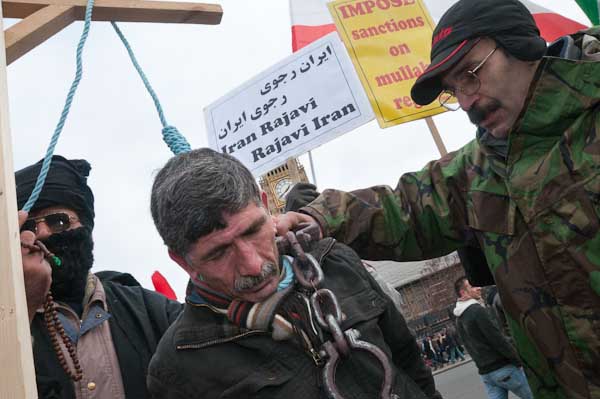
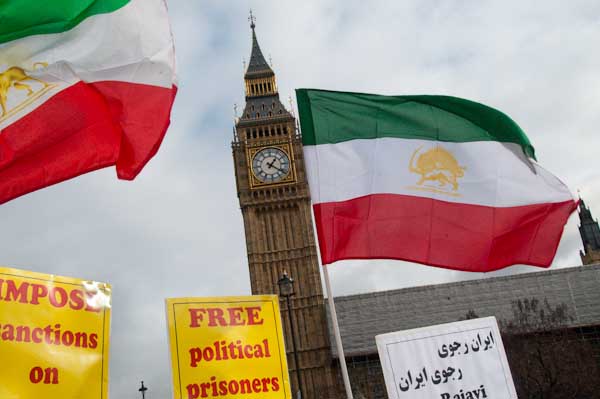
Last Saturday’s Iranian demonstration in Parliament Square was in several ways an easy event to photograph, not least since the organisers were very keen to have the press take pictures and had organised the event in a way that made it easy for us to work.

© 2010, Peter Marshall

Working in Parliament Square gives you a very obvious way of showing where you are in your pictures, with the gothic clock-tower of Big Ben instantly recognisable around the world. I’ve taken many images with it in over the years, sometimes having to perform some fairly extreme contortions to do so, but  here it was easy to satisfy my desire to include it in some images.

Most of the pictures were taken on a Nikon D300 with the Nikon 18-200mm lens, (27-300 equivalent) and it was a pleasure to be working with this again and not to have to change lenses to zoom in to a tight head shot. I really do prefer the D700, but lenses for that are rather more conservative in zoom range (and considerably more expensive.)  I was using the D700 for the more extreme wide-angle view, with the Sigma 12-24mm. Its a nice lens, and still going strong after six years of my normal abuse; though it did need a facelift when the front element got a few small craters in it – the element is too bulbous to allow you to protect it with a filter.

The 12-24 is a very useful lens on DX format – where it becomes equivalent to 18-36mm, but on full frame it is just a bit too extreme at the wide end. The distortion at 12mm is almost always a noticeable problem, and I really need to avoid the last few mm of focal length. So it’s useful zoom range is really only something like 16-24mm. I hope soon to replace this by Nikon’s latest 16-35/4 VR zoom – supposedly available here from Feb 19, though I don’t know yet when my dealer will get supplies.

Given the 1.5x factor with the DX format it really makes more sense to use this with longer lenses. If Sigma manage to sort out my 24-70mm that would become a 36-105 equivalent on the DX body, useful whenever I need it’s f2.8 aperture, but otherwise the 18-200 is just so versatile.

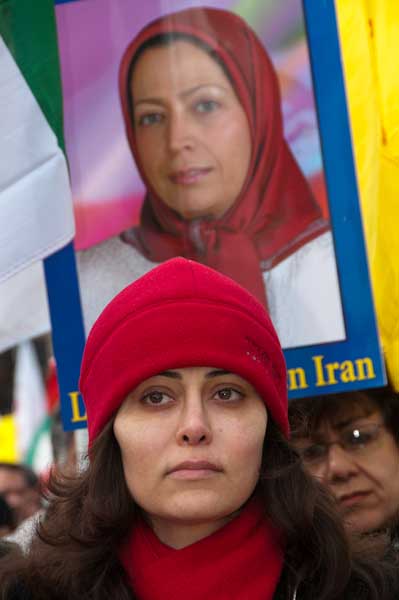
Back to the demo – as usual more about it and more pictures on My London Diary – in the end it’s people that make pictures interesting for me, and sometimes it’s just a matter of expression and fitting them in to the overall picture. But who could fail with this face?

© 2010, Peter Marshall

Although getting the right combination with the placard of Maryam Radjavi did take a little bit of doing – and this was probably about my twentieth attempt.

Here’s a slightly less obvious picture of Big Ben, along with some street theatre the protest organisers had laid on for the press.

© 2010, Peter Marshall

This was quite tricky to photograph, mainly because a dozen or more photographers and a couple of guys with video cameras were also trying to get the same picture. You have to learn to pick the right place, get there before the rest and stay there until you are sure you have your picture. Sometimes in situations like this the very wide angle of the 12-24 does come in handy, because if you move back with a longer lens someone is almost bound to jump in front of you.

Oily Olympics

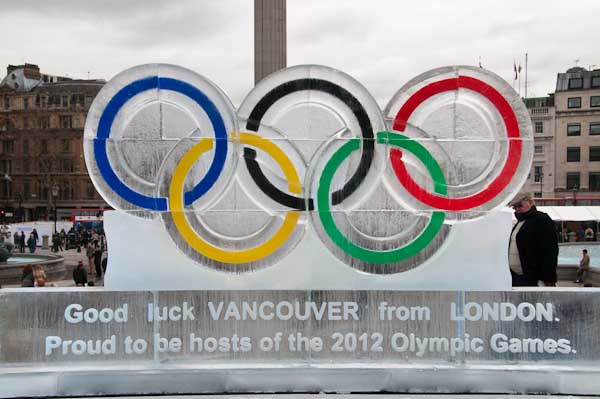
The start of the Vancouver 2010 Winter Olympics provided a great opportunity for protesters against the Canadian Tar Sands and they took it. Trafalgar Square was celebrating the event with a giant screen and an ice sculpture and I think they had hoped this would attract the crowds. Unfortunately it didn’t.

© 2010, Peter Marshall
It will soon all melt, just leaving a mess

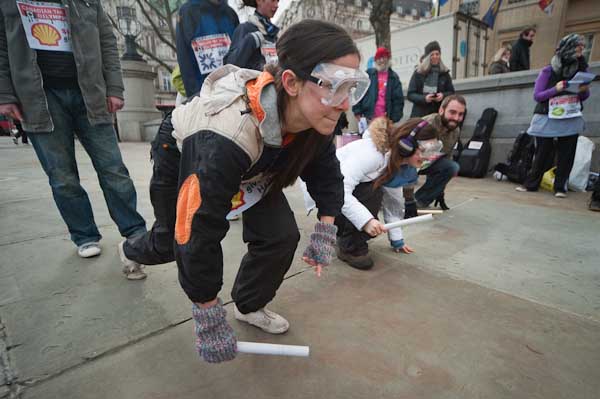
But at least the Canadian Tar Sands Oil-ympics provided an hour or so of interest, next to Canada House – and you can see the pictures I took of the events and the medal ceremony on My London Diary, along with a little more about why people are protesting against the tar sands – and the companies who hope to profit from this environmentally disastrous project.

 © 2010, Peter Marshall
‘Shell’ get off to a good start in the relay

Perhaps it was rather better as an idea than in the actual execution and I found it hard to produce pictures that really satisfied me. Perhaps it didn’t help that the 24-70mm I’ve mainly been working with recently was in for repair (again after a couple of weeks.)

One of the first things I photographed seriously was sports, though I soon got bored with it.

© Peter Marshall 1974

A couple of the canoeing images I took around 35 years ago now did quite well at the time. The only reason I took them was really that I’d just bought a new lens, one of the first of a new generation of zoom lenses, a Tamron 70-220mm Adaptall, introduced in 1973.

As well as the novelty of the zoom (really only common on movie and TV cameras before – I’d used one working in the educational TV studio where I really started learning practically about photography a few years earlier – these lenses also incorporated a rather clever idea that in theory enabled you to use the same lens on cameras with different mounts. The lens came with its own mount, and you then bayoneted a slim adaptor on to that suit the camera you were using. Lenses were rather simpler things then, and apart from actually holding the lens in place, the only other linkage that cameras provided was a mechanical one, indicating the lens maximum aperture and stopping it down to the taking aperture when you pressed the shutter release.

© Peter Marshall 1974

It wasn’t a really bad lens, but unlike now, there was still a considerable gap in optical quality between prime lenses and zooms such as this, and after a year or two I sold this lens second-hand and bought a couple of superb primes (a 105mm and 200mm) that actually together weighed slightly less than the zoom.  I think it was almost 20 years before I bought another zoom lens. Now I take perhaps 95% of my pictures on zooms.

More on Copyright

I’ve long been a fan of the Photo Attorney blog by US attorney Carolyn E. Wright, which recently celebrated five years on line – though if you have an old bookmark you should to update as it is now at a new address. (I think all the links I made to the old site still work.) She gives some great advice on legal matters for photographers, much of which is relevant to those of us outside the USA too.  Occasionally her site has been the first place where I’ve read about some of the problems photographers have had here in the UK too.

A week ago Wright made a great post on another blog I look at regularly, A Photo Editor, in an article Photographers- How To Deal With Infringements and one of the benefits of not mentioning it here immediately is that this has now attracted quite a number of interesting and informed comments.  Her piece has some useful advice on making use of the DMCA (the U.S. Digital Millennium Copyright Act, 1998) as well as the advice “If you created the photo in a country that is a signatory to the Berne Convention, you do not have to register in the U.S. to protect your copyright or to file an infringement lawsuit in the U.S. However, if you do, then you may be entitled to statutory damages and attorneys’ fees” which perhaps makes the situation clearer than some other sources (Though one of the comments asks the very good question why, since the US is a signatory, you need to register photos taken there. There’s signing and there’s signing!)

But her piece very clearly lays out a series of steps photographers can consider and take to try and recover fees for the use of their work. However much of this may soon be history so far as UK photographers are concerned, with the Digital Economy Bill now making its way through Parliament. As mentioned here before, this law is Mandelson’s baby part dictated to him in a Corfu villa by David Geffen and is expected to be passed within the next month or two and, as the Copyright Action web site puts it:

“It introduces orphan works usage rights, which – unless amended, which HMG says it will not – will allow the commercial use of any photograph whose author cannot be identified through a suitably negligent search. That is potentially about 90% of the photos on the internet.

“Copyright in photos is essentially going to cease to exist…”

On that site you can read and download a letter to post to your MP, preferably with your own comments, but otherwise as it stands (download links are in 3 formats at the bottom of the letter.) If you are a photographer or a lover of photography and a UK voter please consider doing so – and don’t leave it, do it now. I’m getting mine ready to send now.

Bow Creek By Bike

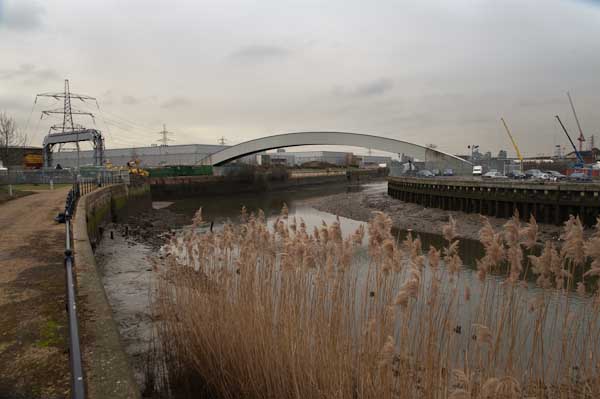
I was on my way to Stratford to be interviewed and decided on the way to visit the section of path by Bow Creek to the south of Bromley by Bow. This is an isolated section of path tidied up and opened some time ago that somehow I’ve never quite managed to go along before. If you are on foot it’s a bit of a pain, because having walked around 2/3 of a mile you come to a dead end and all you can do is turn round and walk back.

But it was a decent enough day for a bike ride, so I took the Brompton up to Waterloo on the train and down the escalator then hopped on it on Waterloo Rd. Cycling in central London is really rather easy compared to the suburbs where I live, because there the traffic tends to be moving around 30mph faster than me, whereas most of the time in London it’s going at the same speed or slower.

© 2010, Peter Marshall

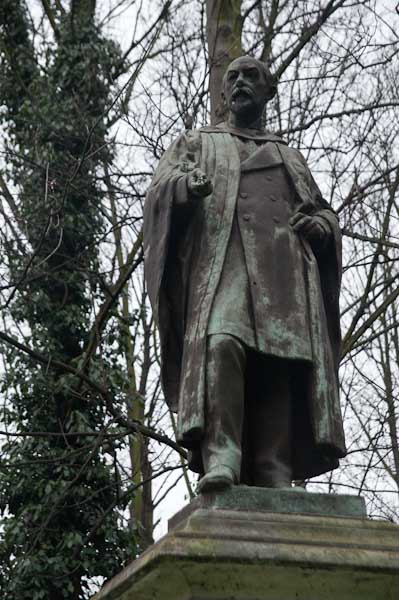
First I revisited The Gas Light and Coke Company’s War Memorial, which is close to the start of the footpath. I photographed it a few years ago, but since I was there thought I’d do so again. I rather admire the statue of the boss, Sir Corbet Woodall, one of the great figures in the gas industry whose attitude to his workers – who he made partners – was remarkably enlightened by today’s often primitive standards. He looks the part too, standing there with his spectacles in his hands. Although he died during the ‘Great War’ he was 75, so I don’t think his death was attributable to enemy action, but many of his employees did die fighting for their country, and their names are listed on the panels in the memorial.

The footpath is wide and has a good surface for cycling, and in the hour or so I was there taking pictures I saw only two people who had come down it for a walk. But it’s a pleasant detour if you are in the area.

© 2010, Peter Marshall
Near the end of the footpath

I was using the Sigma 24-70 and working mainly on manual settings with the lens well stopped down – mainly around f8, as I wanted to make some panoramas by stitching images. Since almost all the interest is along a fairly narrow strip there doesn’t seem to be much point in producing the kind of all-round views that would have acres of sky (and a lot of path) in them so I was making single-row panoramas, which it is fairly easy to do hand-held.  Thought it would have been slightly better to have used a good tripod – there were a couple of pans I tried that won’t stitch well enough for me.

I tried a few 360 degree panoramas, but apart from getting very long and thin, I usually find I lose interest somewhere. Probably the best pictures come from around the 100-120 degrees that I used to get in a single exposure on film with swing lens cameras like the Horizon.

You can see more pictures from the Gas War Memorial and the path on My London Diary – where I give some more information about the walk. I’ve also posted 3 of the panoramas I made on a special page. The top one is a bit less than 180 degrees and almost fits my screen if I browse maximised. The second is less ambitious and around the aspect ratio I normally prefer, though I don’t find this particular picture as interesting as the other two. And the third is a full 360 degrees. To see all of that at one time I need to press Ctrl and – together a couple of times to zoom out in Firefox. And contrary to the end, this is the picture I like best.

The Sincerest Form of Flattery

I’ve been thinking for a few days about the complaint made by New York City-based photographer Alex Brown aginst the Glasgow artists, Littlewhitehead (Craig Little and Blake Whitehead) who had based an installation on an image by him of a young boy in a Darth Vader mask sitting in a cheap restuarant.

You can see the photograph and a picture of the installation on PDNPulse, which also gives details of the story, though I think I first saw it somewhere else.

My immediate question are where do we stop? And frankly is it a good idea for photographers to raise such questions?

In this particular case much of the impact of both works relies on a heavily trade-marked and copyrighted plastic head dress warn by the child in the picture.  So perhaps Lucasfilm Ltd have a pretty good case for suing the arse off both of these guys?  Then for Alex Brown, perhaps we might ask whether he has a property release for the diner, and there looks like another copyright issue involved in that red shirt, which even has some photographic imagery…

Every time we take a picture, we are copying everything within the frame of our camera. And of course using our skills to organise it into some kind of statement – I don’t in any sense want to belittle the activity of photographers in general or Brown in particular by using the word copying. It’s at the basis of our medium.

And of course the installation is not just a simple transformation into 3D of Brown’s 2D work. There are obvious significant differences, but of course his work acted as an inspiration for the sculptors (though I think it an abuse of language to call it plagiarism.) Perhaps too we need to remember the dictum that is still at the base of our copyright laws “there is no copyright in ideas, only in their creative expression” even if some court decisions appear to contradict this.

It’s an area where photographers very much live in glasshouses, and if every artist or photographer who had inspired some of my pictures were to form a line outside my house it would stretch a very long way. And near the head of the queue would be guys like the two Henris (Matisse & Cartier-Bresson) and Walker Evans.

But back to the Darth Vader image; since Littlewhitehead were deliberately making use of a particular image, I would have assumed that they would have acknowledged it when exhibiting their work and in their documentation. And that they would have carried out sufficient research to include the name of the photographer (it wouldn’t have taken much at all.)

But really that’s all.  If I put an image of – for example – the Lloyd’s of London building on line, I don’t inform Richard Rogers, ask his permission or expect him to demand payment. Though I rather hope if he happens to see it he will like it. And if someone ever goes to the trouble of creating an installation based on one of my images, I’d feel flattered.

And my thanks to Charles Caleb Colton for the title to this piece!

Where Three Dreams Cross

Where Three Dreams Cross, continuing at the Whitechapel Art Gallery in London (Aldgate East or Aldgate tube) until 11 April 2010 is an important show although it perhaps does not live up to its subtitle, 150 Years of Photography from India, Pakistan and Bangladesh. It is worth going to see mainly because of the broad cross-section of contemporary work it displays from the sub-continent, but perhaps fails to deal adequately with the earlier history of photography there.

I say perhaps, because I don’t know in detail what history exists, though I feel sure there must be considerably more than this exhibition reveals. One indication that this is so is the very poor showing given to the work of India’s first great indigenous photographer, Lala Deen Dayal (1844-1905), whose work I wrote about at some length a few years ago. There are eight pictures by him on display in the ‘Street‘ section of the show, four of them interiors. None really fits this section of the show, and only one is a good example of his work.

Although my piece on Lala Deen Dayal is no longer on line, you can find more about this remarkable photographer on the Lala Deen Dayal web site. He gained international recognition with his work being exhibited in the photographic shows in London and Chicago as well as India, gaining over 25 gold medals between 1875 and 1905. The problem perhaps for the organisers of this show is that Deen Dayal was very much a photographer of the Raj, and honoured by the Nizam of Hyderabad who appointed him Court Photographer and gave him the title of ‘Raja’. In November 2006, one of his images appeared in an edition of 0.4 million on an Indian 500 Rupee stamp.

Deen Dayal was certainly the leading Indian portrait photographer of the nineteenth century, but unless I missed them (and it is large show in a gallery where the layout is always misleading to simple guys like me) this work was missing from that section of the show.

The work in the first gallery of the show deals with the two themes of ‘The Portrait‘ and ‘The Performance‘ with the historical material in the second containing considerably too much routine cinema publicity work.

Raghu Rai is I think still the only Indian photographer (born in what is now Pakistan in 1942) to have made it to Magnum, and his work certainly stood out in this show. You can also read about him on Global Adjustments.

Most of the nineteenth century work on display in the portrait section appeared to be studio portraits by unknown photographers, and much of it was pretty ordinary stuff. It’s hard too to believe that the first half of the twentieth century has so little to offer from India, and although there was some exciting material from the second half, most of it came from names that will already be well-known to many, though it was still welcome to see it being given greater exposure here.

Perhaps the  most intriguing work in this gallery was that of Umrao Singh Sher-Gil (1870-1954.) I actually find his work rather more interesting in itself than in the more widely known works based on them by his daughter Amrita Sher-Gil. Umrao Singh began taking photos in 1889 and continued for over 60 years, during which time he married a Hungarian opera singer in 1912 and was a political exile in Hungary for the next 9 years. The family returned to Europe for five years in 1929 so Amrita and her sister could study at the the Ecole des Beaux Arts in Paris. His best-known work is probably an extensive series of self-portraits.  Another member of this artistic dynasty also has work in the show, Vivan Sundaram, the nephew of Amrita Sher-Gil, whose work in ‘The Family‘ section consisted of montages of Umrao Singh’s pictures. I’d  rather have seen the original photographs on which these works were based.

The Family gallery also contained perhaps the most traditionally Indian of the works on show, large hand coloured rather symmetric tableaux that could almost have been embroidery. Here photography was being forced into a very non-photographic mould and retaining little of its inherent magic, although the results do have a certain charm.

The final gallery of the show contains work on the two themes ‘The Body Politic’ and ‘The Street‘, and although there was a great deal of fine work it was dominated by the large colour photographs of Raghubir Singh, (1942-99) arguably the greatest Indian photographer and photographer of India of the twentieth century and one of the first to work seriously with colour in the early 1970s.

But there is plenty more fine work, particularly some pictures by Rashid Talukder (you can see more of his fine pictures on the Majority World site.) Talukder’s powerful images of the liberation struggle in Bangladesh were the outstanding work in the Bangladesh 1971 show at Autograph in Shoreditch, and the co-curator of that show, Shahidul Alam, also has an interesting set of pictures (and a letter) ‘A struggle for Democracy 1967-70′ on view here. As well as being a fine photographer, Alam is the founder chair of Majority World, and also founded the Drik picture library, the South Asian Institute of Photography and much more.

Sunil Janah, born in 1918, photographed much of the history of India from around 1940 on, including the Independence movement and partition. You see his work and learn more about him on his Historical Photographs of India (and they truly are) which also contains a virtual version of his 2000 San Francisco show,  Inside India, 1940-1975. The site are rather dated and the reproduction of images is often not up to current standards.  You can also watch him talking about some of his work on YouTube. It was disappointing not to see more of his work here.

Apart from the work that I’ve mentioned, the strength of this exhibition lies in the survey of contemporary work it shows. It does exhibit a wide range of work, some from well-known artists (Saatchi has bought Pushpamala N‘s work for example) and others from photographers unknown here. I found it hard to find anything much peculiarly Indian in the best of this work, but there is certainly much of interest. But I think the best is probably the least known here. There really is too much worth looking at for me to list. Go and see it and make up your own mind.

Postscripts

  • The show is free for under 18s & Sundays 11am–1pm, otherwise £8.50/£6.50 concessions.  It was well attended but not crowded when I visited on a Saturday afternoon.
  • I’m still often asked if inkjet prints can match the quality of conventional silver or dye coupler prints. Reading the labels here, almost all the modern prints are inkjet of one kind or another, though some make a great effort to hide it, with such descriptions as “archival pigment print.”
London Photographers Branch

If you work as a photojournalist or editorial photographer in London for at least part of the time, I’d urge you to join the newly formed London Photographers’ Branch of the National Union of Journalists. I was at the inaugural meeting last night at the union headquarters although I kept my head pretty low, there were others who volunteered to join the committee, and I left feeling fairly confident that they had a wide range of experience between them and would do a good job.

Although the start of this group has been attended by a similar “reds under the beds” scare as marred lost year’s NUJ election for the editor of ‘The Journalist’, members at the meeting last night showed little appetite to continue this divisive bickering, though it is a shame that it has meant that a couple of the strongest advocates of a photographers’ branch in London have decided not to join the committee.

NUJ Left is an important and influential force in the union, and although I’ve never felt it necessary to join it, I do occasionally read the web site and have belonged to the Facebook group. It’s an open group that anyone in or employed by the union can join and its aims seem to me to be to promote the kind of active trade unionism that I’ve always felt was necessary for the union to be successful.

So it doesn’t worry me that some of the people on the committee (though not all) are in NUJ Left. I don’t think they have made any secret of it and we talk enough about politics when we meet on the job or in the pub for me to be aware of their views and for me to trust them to work through the branch for photographers and photographers rights.

To run an effective union branch you need activists willing to give up their time to work for the union. If there is some kind of association for activists in the union they are quite likely to belong to it.  So what’s the problem? And if anyone does think it is a problem, then surely the best response is to take a part in the running of the branch yourself.

You can find more details about joining the NUJ on their web site. If you work in the UK and make more than 50% of your income from photography/journalism it is in your interest to join the union and an appropriate branch.  If you are a photographer working in London and already an NUJ member, I understand that members can belong to both a chapel and a branch, but not to two branches and it tells you here how to transfer to the new branch (of course you will have missed the deadline for the meeting on the 26th – and one day the NUJ will update its web site.) The London Photographers Branch will shortly launch its own web site and branch meetings will be held monthly on the last Tuesday of each month at 6.00pm at Headland House. The next meeting is on Tuesday 23 Feb 2010, which I see is also Shrove Tuesday, so if I can get time off from tossing pancakes I’ll be there.

Photographers are only too aware of the growing problems we face, particularly over matters such as jobs, contracts, copyright and licences and new technology, relations with the police and more. Being a union member won’t solve all your problems but it does provide some very much needed advice and support.

Change We See?

The Labour Party has a Flickr pool entitled “Change we see”, which asks people to share photographs which show the government’s achievements since they came to power.

“Upload a photo of a local hospital we’ve rebuilt, a local Sure Start centre we’ve opened or a local school we’ve invested in and, together, we can show everyone the importance of the Change We See.”

Kate Day in The Daily Telegraph rather gleefully points out that people have been uploading images that were not quite what the party had hoped for, and in particular photographers have been uploading stop and search forms provided for them by the police when they tried to photograph buildings.

When I visited the site a few minutes ago it looked like this:

Flickr

And the third item in the lower row – the long pink form – is Grant Smith‘s Stop and Search form from the City of London Police.

The first item in the top row is a picture of heavily contaminated land on which the government has overruled a local council and given permission for new homes to be built. To the right of Grant’s stop and search is Mark Thomas’s ‘Stop and Search Card‘ and to the right of that, after the couple of ‘Rage Against New Labour‘ posters under ‘Waitrose Essentials’, a spoof of one of the Met’s anti-terrorist and anti-photography posters – the caption under it reads ‘My take on the Met’s misguided, paranoia-inducing “Seems Odd” campaign.’

Perhaps you have some pictures you could upload to the pool?

NOT Terrorists

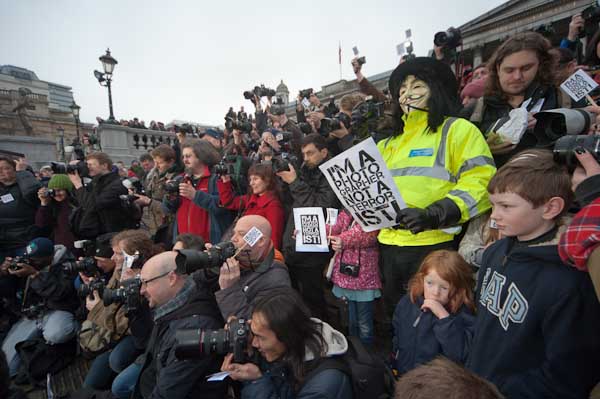
Trafalgar Square got pretty full of photographers at lunchtime last Saturday, and the event gained a useful amount of publicity, and I hope will have done a little to make it easier for people to use cameras on the street. We need to remember that the law is on our side even if some of the police are not, and to get that over to the general public.

© 2010, Peter Marshall
There were many more photographers on all sides of me

It wasn’t exactly by choice that I photographed the event entirely with a 12-24mm lens on the full-frame D700, though a wide angle was a good lens most of the time as things got pretty crowded. I did try to take a few pictures with an 18-200 on my D300 (27-300mm equivalent) but it took me rather a long time to realise I hadn’t put a card in the camera!  I always work with the camera on a setting that refuses to let you release the shutter without a card there, but Nikon in their near-infinite stupidity made the default for the Custom Setting that controls this not only to let you release the shutter without a card, but also to display the pictures you haven’t recorded on the back of the camera as usual.

A little while ago I had to perform a full reset on this camera, and I must have forgotten the need to alter this setting. The default does seem crazy to me, and the only possible reason I can think of is that it is for the convenience of dealers when demonstrating the camera before sale.  If so it seems a very curious priority for a company making tools for photographers to use.

© 2010, Peter Marshall
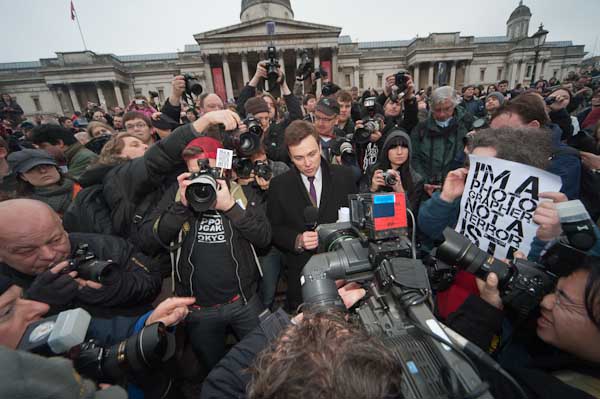
Should the BBC employ guys who have absolutely no idea of numbers?

At times it wasn’t easy taking photographs with so many photographers all trying to do the same thing, but mostly we managed without coming to blows. The only real example of unprofessional behaviour I came across came from BBC TV, whose reporter speaking to camera proved himself to be totally incapable of estimating the size of the crowd, reporting that there were 300 of us.  My own rough estimate was at least 1500, while other experienced journalists put it at 2-3000.

It’s often hard to be sure about numbers on demonstrations, but an error of this magnitude suggests an agenda rather than simply incompetence, and the numbers reported by the BBC are often on the very low side.

For events with fewer than around 500 people I have a simple approach – I count them. You can seldom get an exact count, but fairly close, though usually it will be an underestimate as some people leave early and others arrive late. For larger events it is a matter of estimation, though again I’ll often count a section of an event and then try to base an estimate on that.

Sometimes differences in numbers can be because people count at different times. The local paper reporter at the Harrow Mosque demonstration – whose figure was widely quoted by other news media – had clearly made his count fairly early on in the event, and numbers opposing the EDL had roughly doubled by the time I went  home.  But here there was no such excuse; it was either incompetence or the deliberate misleading of the public.

If I was shooting simply for the web, I wouldn’t have needed a longer lens than 24mm for this demonstration, but could simply crop pictures. After all I’m taking images 4256 pixels wide and web images on this blog have a maximum of 450 pixel width. (Most of them I use are actually 600 pixels wide but scaled down by the browser – and you should be able to see them at full size if you want – in Firefox, simply Right Click, select ‘View Image.’ Probably you can do something similar in other browsers, though perhaps the best advice would be download Firefox.

But virtually everything here (and on My London Diary) is essentially un-cropped, as I like to work with the frame that I can see in the camera.  The viewfinder doesn’t quite show the edges of the image and sometimes I’ll remove a thin sliver from two or four edges if it contains anything obtrusive, and I’m using a telephoto zoom designed for the DX format that I know vignettes a little at its shortest focal lengths when used on full-frame and work with a little crop in mind. But I only crop significantly on fairly rare occasions – as even Henri Cartier Bresson did, for example with his jumping man in the Place de l’Europe (though probably the other 49 in this set are not cropped.) In general I hold to the view that cropping encourages sloppy thinking when you are taking pictures, though the master expressed it more philosophically.

It was an event that reminded me once more of my age. The mother of one of the young photographers I photographed in the square was once one of my best students.

Paris Revisited 1984 – Set 2

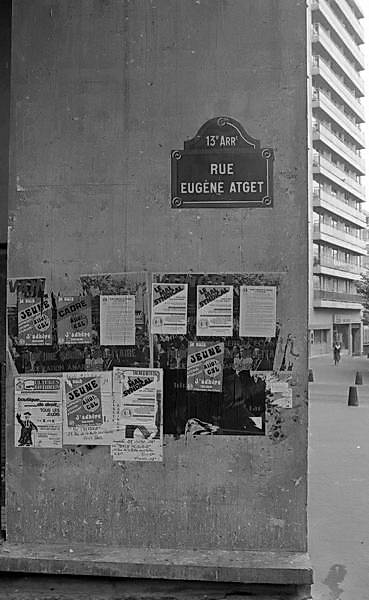
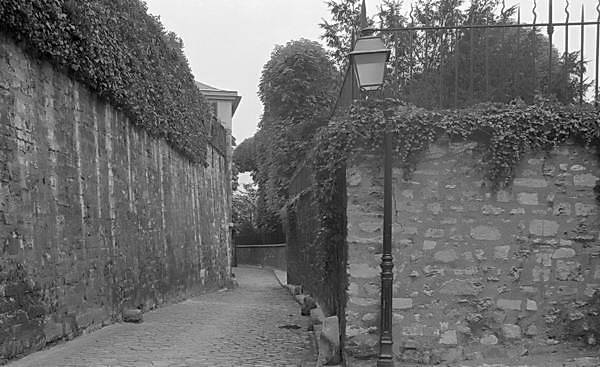
The  28 pictures that make up ‘Set 1’ of Paris Revisited included many of the favourite pictures that I took there in 1984, but there are also quite a few others that appeal to me, or that I found of particular interest for various reasons. It was good, for example, to find that Eugene Atget had a street named after him:

© 1984, Peter Marshall

though I’m fairly sure he would not have appreciated the architecture. Almost certainly the buildings that were demolished to make way for it were more to his taste – and probably among the many in the area that he photographed. This picture and the others in this post are in Paris Revisited – Set 2

One scene that was virtually unchanged since he photographed it was in rue Berton in the  16th arrondissement, and it is one of the few pictures where I consciously copied one of his works.

© 1984, Peter Marshall

Of course there are differences. One is in the aspect ratio – his pictures are much more square than the 1.5:1 of 35mm cameras. Using the V750 scanner with the supplied film holder and Epson software which auto-detects the frame actually crops the 35mm neg to higher aspect ratio of around 1.63:1 making the difference more pronounced.

© 1984, Peter Marshall

Most of these images from Paris were taken using an Olympus OM4 camera which had come out in 1983, and using the Olympus 35mm shift lens. This gave some of the control over perspective that is available using the rising and falling front and left-right movement available in many large format cameras, but lacked the tilt and swing of some of them.  The greater depth of field on the smaller format largely made this unnecessary so far as getting sufficient depth of field was concerned if  your aim was to achieve overall sharpness in a image.

It was quite a bulky lens compared with  the non-shift 35mm lens, partly because of the mechanism allowing the lens to shift around 10mm left or right and 12mm up and down between the lens and the camera.  But it is also larger to give a wider image circle at the film plane. A normal 35mm lens has to produce a sharp image across the diagonal of the format – around 43 mm. To allow the lens to move 10mm to left or right, the PC lens needs to have an image circle of around 61mm, which also allowed a maximum rise of 12mm and fall of 13mm. You could also combine smaller amounts of sideways and up and down movement – and the lens design ensured that these kept within that image circle.

The larger image circle meant that if you didn’t use the shifts you were working in the central area of the lens, and gave the lens a really excellent performance – and it remained pretty good even a maximum shift.

As with the movements on large format cameras, perhaps the most common and certainly the most obvious use is in photographing buildings. To avoid converging verticals you need to keep the camera level and not to tilt it, but to do this from ground level without a rising front, you have to move back so that the  base of the building is at the middle of the frame. With a rising front or a shift lens you can move in closer and eliminate all or most of the foreground.

Of course now that images are digital (or scanned) you can tilt the camera and then straighten up the image in Photoshop but this does involve some extrapolation and thus loss of quality in the result and is best kept to a minimum.

But the shift lens really introduces a different dimension to photographic composition, meaning you can to some extent separate perspective from viewpoint. Although text-books draw diagrams and show example photographs I think it really is something you can only really appreciate by working with it day in and day out.

There were some downsides the the lens. Firstly it was rather expensive,  even like mine when bought second-hand. But because of the sliding mechanism it was a purely manual lens without the automatic stopping down of the iris we usually take for granted. So when using it the first thing was to stand in the place you wanted to take the picture from, then point the camera and push the lens across or up or down as required to adjust the perspective.  As usual you would do this with the lens wide open, and it would stay wide open whatever aperture you set on the aperture ring. For metering and taking the picture you then held down a small button on the lens which stopped it down to the value set by the aperture ring, and when you had set the shutter speed (or viewed that chosen by the camera on an auto setting) you kept holding that button down while making the exposure.

It soon became second nature, particularly since for some years I probably took around 90% of my pictures  with this lens. So much so that even now I sometimes find myself trying to slide the lens on my Nikon across or feeling for that button to hold down when I’m taking pictures. And I’m sometimes more than a little disappointed to find that these lenses just won’t shift!

[Nikon do make PC lenses, including the wide angle 24mm f/3.5D ED PC-E Nikkor as well as a 45mm and 85mm, none of which I’d really find suitable for general photography. Unlike the Olympus lens they only shift in one dimension – you can have  rise/fall or, by rotating the lens by 90 degrees left/right but not a combination of both. They do however have a tilt, making them more versatile for specialised use.]

Apology

Attentive readers of this blog may have noticed that my previous post, Parc de St Cloud 1984 was about the same set of pictures as an earlier post with the same title, Parc de St Cloud 1984 but at least I wrote something a little different about them second time!