News, Freedom etc

BBC news this morning reported that a committee of MPs and peers, the joint committee  on human rights has asked that a review of all of our terrorism laws passed – often in great haste – since 9/11 should be “an urgent priority for the next Parliament.”

This jogged my memory about a video that EPUK pointed out in this weeks newsletter.  Born Under Punches ( Big Brother mix) is a video around 10 minutes long that puts images and clips from various sources along with text – including quotations from George Orwell, Stella Rimington, Thomas Jefferson, Robert Capa and others to the sound track of “Born Under Punches” by Talking Heads.

It includes some familiar pictures of familiar events – including the killing by police of Ian Tomlinson, a year ago next Thursday and various other events in London where police have clashed with protesters and photographers trying to report the events.
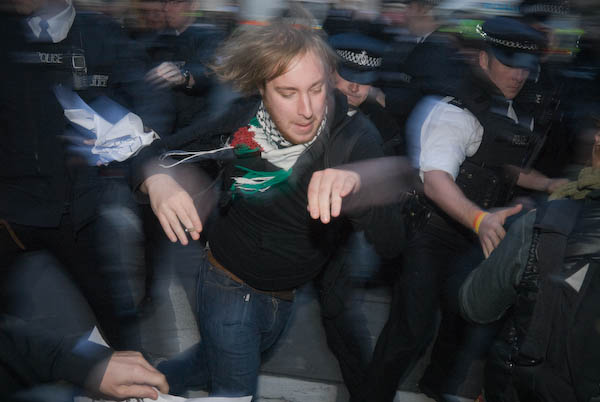
© 2008 Peter Marshall
Freedom to Protest demonstration at Downing St, Jan 2008

Robert Capa is best known for his advice that if your pictures are not good enough it’s because you are not close enough, usually interpreted simply in a physical sense in terms of feet and inches, but also I think meaning that you are not sufficiently involved. One of the books that included his work, lurking somewhere on my shelves, was ‘The Concerned Photographer‘ published in 1968, fourteen years after his death, edited by his brother Cornell Capa which also included the work of Werner Bischof, Chim (David Seymour), Andre Kertesz, Leonard Freed and Dan Weiner.

It is this need to get close to the action that often results in friction between photographers and police, and also means that photographers often get a much clearer view of what is happening at events than some other journalists, even many camera crews. While some independents with movie cameras get in there with the photographers – notably Jason N Parkinson, who appears in ‘Born Under Punches’ on both sides of the camera, the news organisations with larger cameras and often two or three people tend to stick to the sidelines and only move in for the more organised ‘photo ops’, sometimes pushing rather rudely in front of us still photographers to do so.

So when – as in the reports of last Saturday’s protest involving the EDL and the UDF – photographers tell a very different story to that put out by the BBC and some other news organisations, you can believe the photographers. They were there, as were some journalists, while the BBC are generally only thereabouts.  Photography isn’t just f8 and be there, but both a a sine qua non for photojournalists. Having heard BBC reports of events that I’ve covered in the past, I have no doubts that their reporting is often incomplete, sometimes incompetent and almost always biased.

The BBC does make some excellent programmes (and I often enjoy listening to them on the radio.)  I’ve always supported the idea of the BBC and I think it vital to our democracy that we have public service broadcasting and a truly independent news service. But years of covering protest in London have led me to the conclusion that the BBC no longer – if they ever did – provides this. Frankly programmes such as the ‘News Quiz’ and the ‘Now Show’ are often closer to the truth than the news broadcasts or the ‘Today’ programme.

Capa’s quote used in the video was a good one: “The truth is the best picture, the best propaganda.”
Crossfire

Yesterday, as I read on PDN Pulse,  an exhibition opened in Dhaka, Bangladesh with police barricading the doors of the Drik Agency where it was being shown.

The statement on Drik reads:

Drik Picture Library was forcibly closed down by the police today to prevent the launch of Pathshala, South Asian Media Academy, and the unveiling of a photography exhibition by photojournalist Dr Shahidul Alam, `Crossfire.’

From midday onwards, Drik was pressurised by RAB, police and Special Branch officials to close down the show on grounds that it does not have official permission, and later, on the grounds that it will create anarchy.

In its 20 years of existence, Drik has forged a unique position in the international cultural arena, which has earned Bangladesh a special place in the world of photography. The unfortunate event which was broadcast worldwide has tarnished the image of this democratically-elected government. We call upon the government to immediately remove the police encirclement, so that the exhibition can be opened for public viewing, and Bangladesh’s image as an independent democratic nation can be reinstated.

The show, with photographs by Drik’s founder Shahidul Alam and curated by Jorge Villacorte from Peru with research by Momena Jalil, Tanzim Wahab and Fariha Karim, was scheduled to be open to the public at the Drik Gallery until 31 March 2010 but currently can only be viewed on line due to the police action.

‘Crossfire’ gets its name from the statements issued by the RAB (Rapid Action Battalion) , a sinister black-clad group formed six years ago from members of Bangladesh Police, Bangladesh Army, Bangladesh Navy and Bangladesh Air Force which carries out extra-judicial killings and torture of people in custody. Set up in 2004 by Law Minister Moudud Ahmed, they have killed over 1000 people, whose bodies are then dumped in fairly random locations and a stock press release states that they were “killed in crossfire” between the police and criminals.  A new word, “crossfired” has been added to the vocabulary.

As Alam say, the facts of these murders by the RAB are already largely well known, and a court which tried to investigate them was recently dissolved by the Chief Justice immediately before the Government was to give evidence. The installation at Drik in his words aims to “to reach out at an emotional level. I aim to get under the skin. To walk those cold streets. To hear the cries, see terror in the eyes. To sit quietly with the family besides a cold corpse. But every photograph is based on in-depth research. On actual case studies. On verifiable facts.  A fragment of the story has been used to suggest the whole. A quiet metaphor for the screaming truth.”

The large format colour pictures show scenes where these killings occurred, and had to be taken in secret, often early in the morning – also a favourite time for the murders.  The existence of the show also had to be kept secret, and it was only announced on the 16 March, when Where Death Squads Struck in Bangladesh was published in the Lens blog of the New York Times with a slide show of the pictures.

On ShahidulNews you can read more about Crossfire, with a Google Map giving details of many of the killings and their locations, and a dark video, ‘RAB Night Walk‘.

Shahidul Alam is Bangladesh’s best known photographer and his work has often before been controversial.  Last November a show on Tibet at the gallery was closed down by the police following pressure from the Chinese government, and the web site was hacked and fake virus warnings put on it to deter people from viewing it. Thirteen years ago, as the Lens article relates,  Alam was set on in the street by a group of men who pulled him out of a rickshaw, stole his camera and computer and stabbed him 8 times – in what he describes as “a particularly unsubtle warning” about his opposition political activities.

Deutsche Börse Shame

I can’t say I was surprised to hear that this year’s prize was awarded to Sophie Ristelhueber, who as I mentioned when I wrote rather briefly about this year’s four finalists said of herself “Nowadays I am not even a photographer because I am a conceptual artist.” And she is right, she isn’t a photographer and was in the wrong competition in the wrong gallery.

Frankly it wasn’t a good year for the gallery, with none of the four finalists standing out, and even by Photographers’ Gallery standards it was an extremely boring show.  As usual the best work was on display in the print room, though even there it didn’t seem quite up to the usual standard.

It isn’t a situation I take any satisfaction in, rather one of considerable frustration because I know there is a lot of great photography out there. At least half a dozen photographers in the current show of Indian photography at the Whitechapel and another dozen whose work I’ve seen at other shows in London in the past year whose work I’ve found in some way exciting, and far more whose work I’ve come across on the web who have had shows in other cities across Europe.

What did interest me today was to read a Guardian feature, Has the Deutsche Börse turned into a conceptual art prize? by Sean O’Hagan which makes much the same kind of criticisms against the prize that I’ve made over the years, that the prize simply fails to reflect the “vitality, range or depth of contemporary photography from around the globe” and calling for “less theory and process and more exciting pictures.”

I wrote that the prize should have gone to the man who produced the scrapbooks that formed a part of Donovan Wylie‘s exhibition. Joanna Pitman in the Times suggested it should go to ‘Pete’ for his anti-cuisine meals photographed in loving close-up by Anna Fox.

This prize has simply become a piece of mutual curatorial back-scratching, with very little relevance to what is actually happening in photography – and rather a backwater so far as art more generally is concerned.

I’ve been a member of the Photographers’ Gallery for over 30 years, but now it has become something I’m almost ashamed to admit to other photographers and it isn’t just this prize that makes me feel that, but the whole programme there over recent years. As I’ve written before, it seems always to be apologising for photography rather than celebrating it. It really is time for the gallery either to start supporting photography or consider a change of name – and for the Art Council to rethink how it can support photography in Britain. There isn’t much point in funding a flagship if it is flying the wrong flag.

Bow Pans

Almost the only area where I still wish I was taking film is panoramic photography. Really because it is just so simple to taken with film and a panoramic camera – just compose and press the button.  Digital is more flexible and powerful but considerably more fuss, even for the kind of simple panoramas I prefer.

The 35mm panoramic film cameras I used had lenses around 26-30mm focal length which gives a decent vertical angle of view without usually encompassing huge areas of sky. The horizontal angle of view depended on how the camera worked, but with the swing lens versions was dictated by the angle the lens swung through, typically around 120 degrees.

So to get similar results with digital I want to use a lens with a similar vertical field, so either the same range of focal length or a slightly longer length used with the camera  in portrait format.  At or around the 30mm end I find I need a set of 3 exposures to stitch (perhaps 4  if I’m shooting portrait format)  while at the wider end, 2 frames will do.

One small complication is that I mainly shoot with zoom lenses, and if you are going to stitch images it is fairly important that the lens focal length remains constant. It really is only easy to be sure of this shooting at one or other end of the lens focal length range, although I suppose it would be possible to use masking tape to hold the lens at a fixed focal length.

Most zooms also alter focal length slightly as they focus, so at least in theory you need to hold the same focus throughout the series of exposures. This isn’t usually a problem as most panoramas can be taken with the lens focussed at infinity.

It’s also easier to get good stitching if all the pictures are taken at the same exposure – and under the same lighting conditions. The British climate is fickle and rather sneaky in this respect, rather too good at brightening up a little without telling you (or the reverse.)  Of course there is often considerable variation in lighting as you swing through that 120 degrees or so, and it’s something that film, with its gradual response to excessive highlights copes with rather better than digital, which has a pretty sharp cut-off on over-exposure.

Film wasn’t of course without its problems. You could (and I did) expose it wrongly and development had its hazards too. I’ve had film returned from a pro lab absolutely blank that I know was properly exposed and made countless errors over the years when processing my own which have resulted in damaged, uneven, dense or very thin negatives. But at least out there in the field it was simple.

© 2010, Peter Marshall

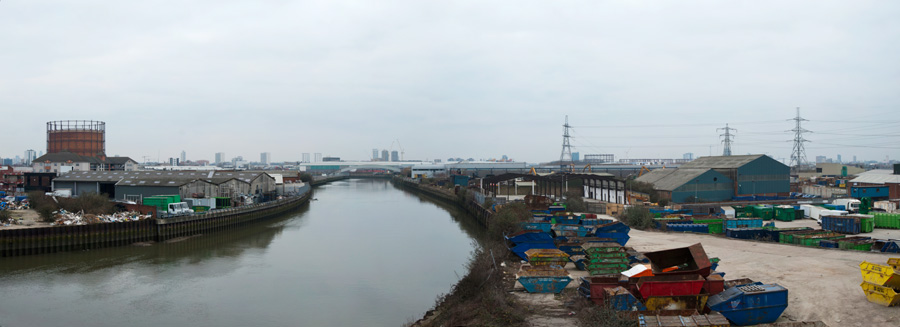
Anyway, here is a very small version of one of the results which I was reasonably pleased with. The file is actually twice the size it displays at on the blog,  and you can see it and the others at 900pixels wide on My London Diary.

The actual image I produced from PTGui, stitched from two 12Mp images (4288×2848 pixels each) is 8028×2917 pixels, an aspect ratio of 2.75:1,  and the horizontal angle of view is a little under 100 degrees.  It would print nicely at perhaps 30 inches wide if I had a sheet of suitable paper that large!

It uses a equirectangular projection which works well if – as here – the vertical angle isn’t too large, and gives a very natural effect. The image is too wide to look good in normal rectilinear perspective. One advantage of the equirectangular is that it more of less keeps the full width of the image, allowing me to retain the yellow skips at the extreme right of the image, which were for me a vital part of the composition.

Birth Matters

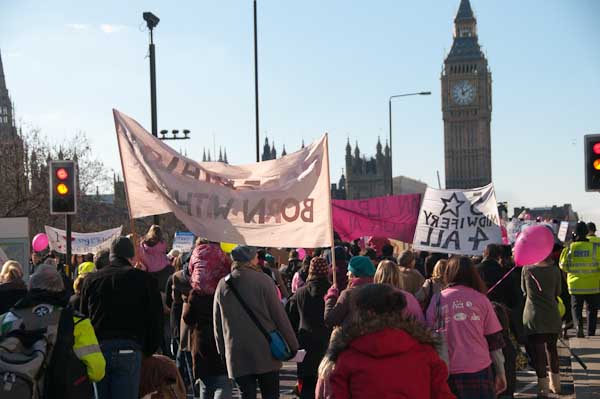
Talking to a doctor friend as I was working on the pictures that I took at the ‘Reclaiming Birth‘ march in London at the start of the week of International Women’s Day, he reminded me that one of the major aims of campaigners around this year’s events was to provide increased medical care for women while they gave birth, in order to cut down the number of women and children who die during childbirth. The call is for increasing medicalisation – and in  particular more doctors, more hospitals.

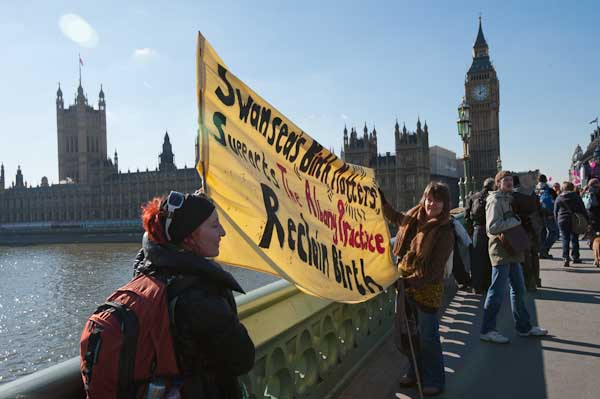
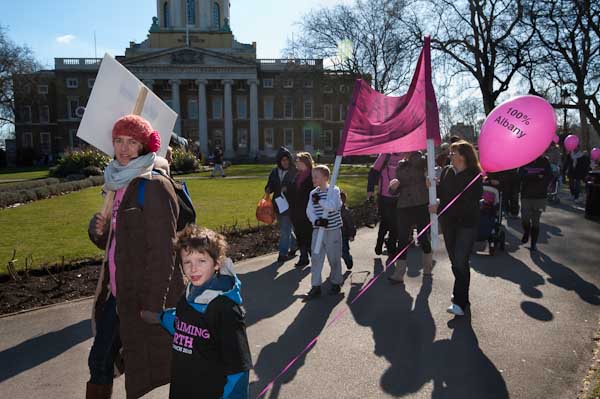
But here in the UK, the emphasis is rather different, because we have come to see the limits of the purely medical approach and campaigners are seeking to again give the women who are obviously at the centre of things a greater say in how they give birth and to centre the services provided around them, providing information, advice and support through the whole period of pregnancy, birth and baby care. Independent units such as the Albany Midwifery Practice based in Peckham, whose contract with Kings College Hospital was recently terminated, have provided models of best practice, achieving significantly better outcomes and highly satisfied mothers, many of whom were on the march, together with their children.

You can see the pictures and read more about the event  in Mums and Midwives Reclaim Birth  on My London Diary.

© 2010, Peter Marshall

Photographically the real problems were that almost everything about the march was the wrong way round. At the start of the march as people moved from Geraldine Mary Harmsworth park where they had gathered out on to the road the sun was shining strongly more or less directly into my lens as I tried to take pictures, and the same was true at the end of the march as it came up Whitehall for the rally. And when I photographed the march going over Westminster bridge with the Houses of Parliament in the background, all the marchers had their backs to me.

The sun, still low in the sky although we are approaching the Spring equinox, was a big problem. The lens hoods on wide-angle zooms are never very effective, and as usual I was doing the usual trick of trying to hold my left hand in the appropriate place to  cast a shadow on the lens. Tricky to do and impossible to avoid getting the odd frame with fingers in the top that need to be cropped out. Of course where possible I look for something in the scene that will act as a shade – perhaps a handy sign or even a placard or banner.

People walking towards you with the sun behind them will of course have their faces in shade, and you seldom have the luck to find a natural reflector that will put light into those shadows. The SB800, set to auto-fill at -2/3 or -1  stop is  a great help, though it risks over-exposure when subjects get close to the camera, and if I remember I’ll dial in a matching -2/3 stop to the ambient exposure set on the camera, which doesn’t seem to compensate itself for the extra light from the flash.

© 2010, Peter Marshall

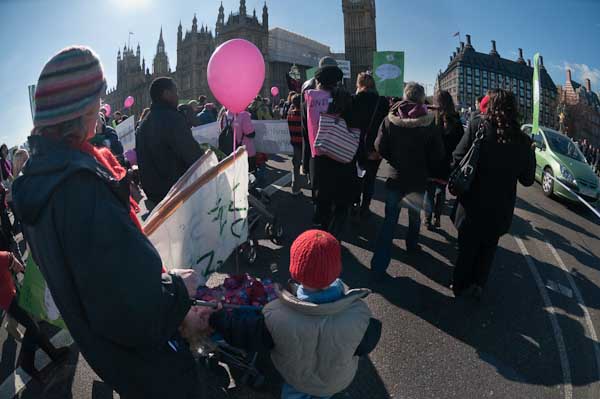
Seeing only people’s backs as they walk towards Westminster is a harder to fix. Occasionally I ask people to turn round  or look back over their shoulders, although I don’t really like posing them at all. Sometimes people decide themselves to pose and I’ll take advantage of this – as I did with the two women with their banner from Swansea.  But I also had another idea which was to make use of the more than 140 degree horizontal coverage of the 10.5mm full-frame fisheye.

© 2010, Peter Marshall

From exactly the right place above and slightly in front of someone’s head, this lens should make it possible to see their face (though from a rather odd angle ) and also the view in front of them. Although it should work in theory, in practice it is a little trickier to perform. My ideal camera position would have me floating horizontally face down in mid air above them around 2 metres or slightly more above the ground, but I couldn’t see an easy way to do this.

The approach I tried – not entirely successful – was to walk just a few inches behind the person I was trying to photograph and a few inches to one side, holding the camera up at arm’s length and slightly forward.  Since the 10.5mm is a digital format only lens, I had it on the D300 and one of the annoying small things missing from that body is an eyepiece blind. So while one hand is holding the camera to press the shutter, the other has to be on the camera back covering the eyepiece otherwise the light entering there will mess up the exposure reading and give severely underexposed results. (Had I thought a little more carefully I would have put the camera on to manual exposure, when this particular contortion would not have been needed.)

© 2010, Peter Marshall

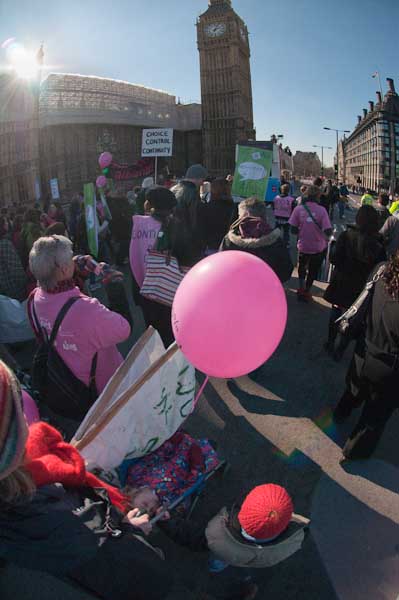
As you can see I couldn’t quite get the camera in the place I wanted – it isn’t far enough forward to show the woman’s face, although it does just manage the child in the push chair. I’d really need to mount the camera on a monopod and use a wireless release, and getting the orientation right would be extremely tricky.

I took quite a few frames (probably resulting in a rather worried woman) using both portrait and landscape orientation and the pictures are at least a little different. As often with a lens with such a wide angle of view the sun was also a little of a problem – and in this frame it was only just outside the picture where you can see the light area.  In the vertical version it is actually in the frame, which as you can guess made processing this image near impossible – and there is an interesting piece of colour on the pavement.

© 2010, Peter Marshall

Million Women Rise

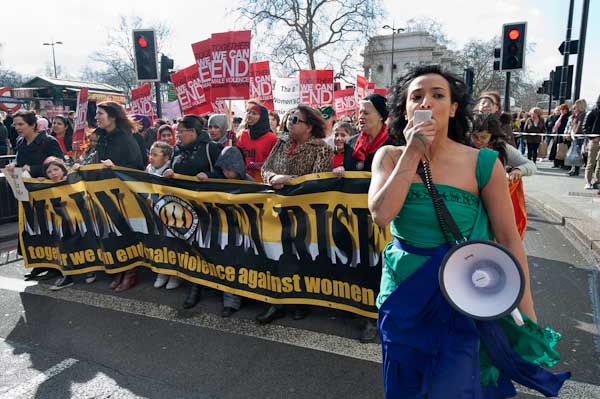
Photographing last Saturday’s ‘Million Women Rise‘ march in London would have been rather easier if I had shaved my beard off. The march was a ‘women only’ event, although I’m fairly certain that there were a few men marching in the thick of it with their partners.

© 2010, Peter Marshall

The previous day I’d told one of the women photographers I was working with about this event, and she was able to photograph it in the way I would normally work, getting into the right position and making contact with people as she took their pictures, while I was limited by having to stay on the sidelines – except at the head of the march.

Of course there were plenty of women on the march who wanted to be photographed, and some even rushed across to make sure I photographed them, or slowed to make space so I could read their banners, but too often I was further away than I would have liked, or could not get a proper line of sight.

© 2010, Peter Marshall

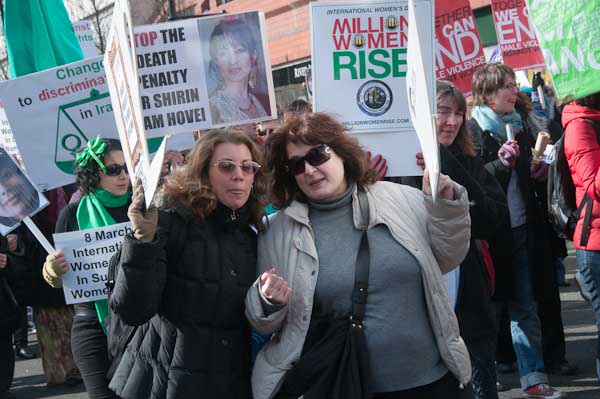
So these two women from the ‘Stripping The Illusion‘ campaign against lap dancing by Object  were carrying placards in the shape of teacups, protesting against the ridiculously named ‘Spearmint Rhino’ which they have given an “Award  for the biggest misuse of the word ‘Gentleman‘” (shown on the left hand placard) but I didn’t manage to show them well enough to use an image and thus mention them when I wrote about the event. Nor did I manage to get a picture of the woman behind them with her placard about Shirin Alam Holi, a 28 year old Kurdish political prisoner in a Tehran jail sentenced to death in January for “warring against God” by working with a Kurdistan opposition group. And I’m sure there was much more I missed, both in the march and by not attending the rally at its end.

Of course I did manage to take some pictures, even some I like, but so many times I wanted to get closer and couldn’t. Standing on the sidelines I sometimes felt rather more like a voyeur than I like, having to use a longer lens than usual.

© 2010, Peter Marshall

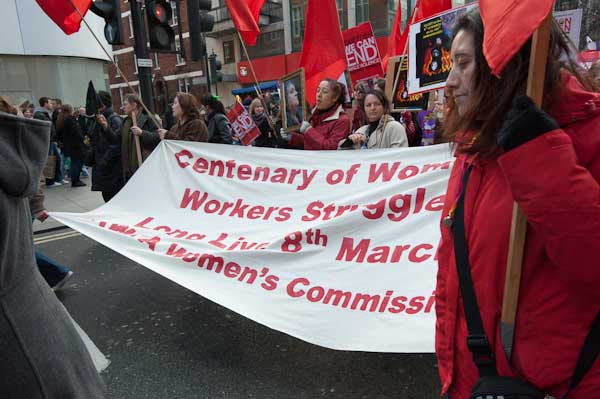
I did step a few inches into the road to take this picture, and just a few more inches to take the next frame which showed more of the text on the banner. Immediately one of the stewards was at my elbow, requesting politely that I show my support from the pavement and not from the road.

I’m not complaining because I feel hard done by. Rather just that I wasn’t able to support the event as fully as I would have liked, and as I have managed to do at other women’s events. You can see some of what I did manage to do on My London Diary.

Tibet Freedom

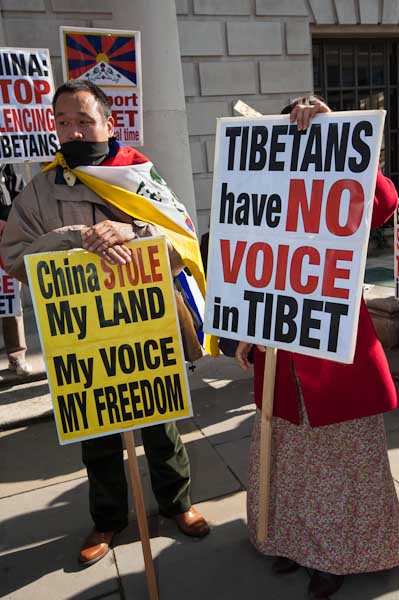
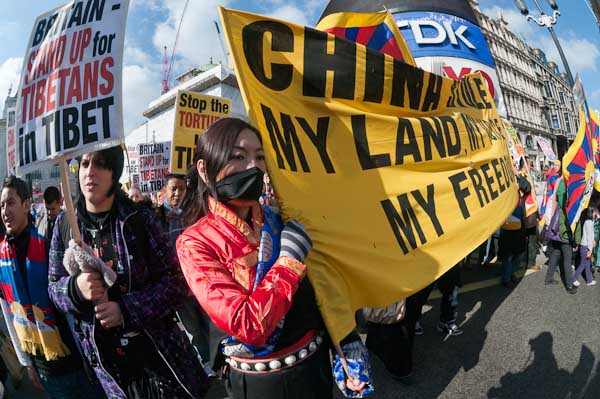
I always enjoy photographing the annual Tibet Freedom March, although of course I would prefer it to be an event celebrating the achievement of freedom rather than bemoaning its loss. Although the spirit of Tibet is kept alive, China’s rise as to become the major world power seems to make any  attempts to put pressure on it to ease conditions in Tibet likely to be ineffectual; but perhaps China will develop as a more democratic nation as it gains in wealth.

© 2010, Peter Marshall

Coming in a generally wintry month here, the colour it brings makes a welcome change, and I think most years recently the sun has been out. Certainly this year London felt a little warmer than it has for some months as we gathered outside RIBA, opposite the Chinese embassy.

RIBA of course houses one of the largest collections of architectural photographs anywhere- between 700,000 and 1.5 million pictures – and more than 40,000 – not all photographs –  are available on-line at RIBApix. That makes it almost as large an on-line collection as My London Diary, where you can see my pictures from this year’s Tibet Freedom March!

If you are  “an up-and-coming architectural photographer” then you could consider the opportunity of putting your work on RIBApix

But back to Tibet and the march.  As well as being very colourful (often rather too colourful for my taste, with those strong primaries of the Tibetan flag)  the march tends to be fairly densely packed and also full of  interest. It’s also relatively slow-moving.  Taken together these things provide an ideal situation for the kind of close wide-angle work work in crowds that appeals to me.

So it was a good day to work with the 16-35mm, and I took quite a few frames at the wider end. But I could go even wider, putting the 10.5mm fisheye on the D300.

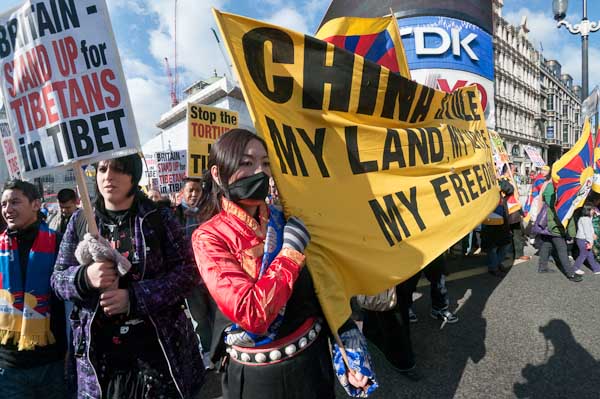
The 10.5mm is a full-frame fisheye, filling the whole sensor on the D300 and giving a diagonal field of view of 180 degrees (horizontally it is “only” a little over 140 degrees.) Its also a lens that lends itself to the use of various software tools to alter the perspective of the image. You can process the files to give a rectilinear panorama for example, though few subjects survive this treatment unscathed – rectilinear perspective seldom works above a roughly 100 degree angle of view.

So here is the march at Piccadilly Circus taken with the 10.5mm

© 2010, Peter Marshall

and its a picture I quite like, but a click in Photoshop applies the Image Trends IncFisheye-Hemi 2‘ filter to give a slightly different effect.

© 2010, Peter Marshall

It produces a result that I think is more ‘natural’ looking, in particular reducing the distortion of the figure at the extreme left of the picture and eliminating the curvature on the placard. Probably a little over 50% of the pictures I take with the 10.5mm look better treated to this realignment, though I’m not sure that Reuters or the World Press Photo would approve.

It hasn’t actually eliminated all curvature, and it actually looks less distorted than a rectilinear version would.  There are other alternatives to the Fisheye-Hemi plugin (some of which have the advantage of being free) but this is the one that most often works for me. It makes use of almost all the pixels in the image (losing a few in the corners) retaining the full width of the frame that I shot and almost all of the subject matter – the face that I placed at the left edge of the frame is still at the edge.

It works well in this case, particularly because I had the camera level when I took the picture, and so the lamp post and buildings at right of the frame become both straight and upright.

What is does lose is a little of the kind of outwards thrust and dynamic of the original image, where the woman in the centre really almost bursts out of the frame towards you. I was indeed very close to her when I took the picture; one of the problems of using this lens effectively is that you sometimes  have to really invade people’s personal space. In marches where they are moving forwards and you are walking backwards as you take your pictures it can be difficult to avoid collisions!

Flash at Holloway

Holloway Prison, the best-known women’s prison* in England, is not a fun place for anyone to be, either inside or outside, where it always seems somehow isolated and bleak even though it is in inner London. It’s next to a road junction which is part of a largish one-way system, and set a few yards back from the road behind some ill-kept grass and shrubs. Across the wide street of east-bound traffic is a defunct petrol station, and every time I’ve visited there has been an icy wind from the east blowing across the largely open space.

Thursday night it was cold, just a few degrees above freezing and the wind chill soon got into my bones. It’s a place with no shelter.

© 2010, Peter Marshall
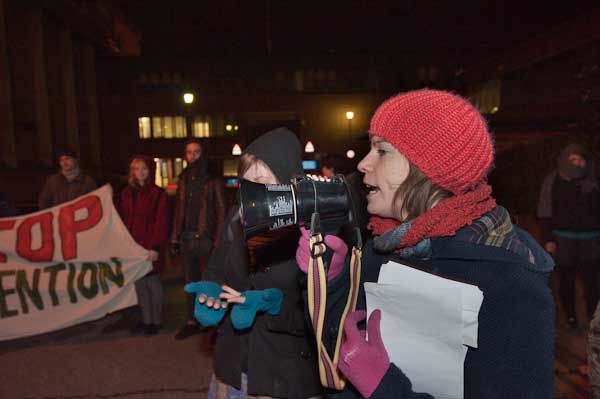
Virtually all the light for this picture came from a Nikon SB800 on camera

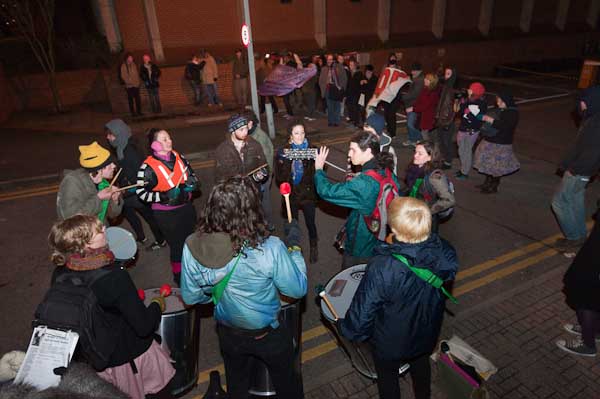
Outside the prison were a small group of demonstrators with banners. Inside were three women held without charge or trial (we do have a justice system in England, but it doesn’t seem to work for asylum seekers and migrants without proper documents) accused of being ring-leaders in a hunger strike still continuing three weeks later without them in the immigration detention centre (a prison in all but name, where people are routinely held without trial) at Yarl’s Wood.

By the time I left to catch a bus an hour later, the numbers had swollen to around 50 and included a samba band whose music did do a little to warm us up. But although I’d dressed for the weather I had really needed an extra layer for the steppes of Holloway.

More pictures and more about Yarl’s Wood and the hunger strikers in my piece Holloway Protest for Yarl’s Wood Women on My London Diary (also published elsewhere.)

Normal street lighting is enough to give some fill when working with flash at night if you take advantage of the high ISOs that are now perfectly usable. But the short driveway into the prison was only lit by a few low wattage bulbs which added nothing. Essentially direct flash was the only light source for photography.

This of course has its problems. It isn’t very interesting lighting being close to the lens and gives a harsh shadow because of its small size. And there is the inverse square law.

Traditionally photographers used flash brackets to take the flash further from the lens, or held the flash at arms length, but although these may make the lighting more interesting they also increase the shadow problem.

Social photographers often use weird and wonderful attachments on their flash to create a larger light source – I used to have my own favourite device made with an old translucent bottle, some aluminium foil, a couple of rubber bands and a little ingenious copying of other people’s ideas, which although it looked a touch Heath Robinson, did the job remarkably well, but these things are not too suitable for demonstrations and don’t help a lot when working a larger distances, partly because the light source still appears small, but also because they cut the light down too much.

The compromise favoured by many photojournalists was the Sto-Fen Omnibounce, a small translucent clip on diffuser, and most flash units now come with an inferior copy of this device. It actually has very little effect (a euphemistic way of saying sod all) on the light quality according to my own tests, but it does make you feel better and gives more even light with wide-angles. So I was annoyed to find that I had forgotten to put it in my camera bag. However it probably would not have made much difference to the pictures!

I do sometimes claim to have a special derogation from the inverse square law when people ask about some of my pictures, though I seldom explain this.

© 2010, Peter Marshall
Extreme differences in lighting needed a little Lightroom magic

The inverse square law if you are not familiar with it states that the light from a point source – and a camera flash is more or less that – falls off with with the square of the distance from the source. So if you imagine a picture with one person at 4 feet from the camera/flash and another at 8 feet, double the distance, the further person gets 1/4 (4=2squared) of the illumination. Its perhaps easier to think as a photographer that 2x the distance means 2 stops down and so on.

So if you expose for the close person, the distant guy is 2 stops under; and if you expose for the distant one, your near neigbour is at 2 stops over and likely to be pretty much burnt out white. It’s something that photographers like Winogrand and Friedlander used to great effect, but digital is less forgiving of overexposure than film and it is not in any case an effect that will generally endear you to editors.

You need either to get everyone at more or less the same distance from your camera, or expose very carefully to put the closest person just on the edge of burning out. If you do that, then you can burn the over-bright areas down in Lightroom (or Photoshop) and brighten the more distant dark parts. Virtually everything I took at Holloway needed something of this treatment. The results aren’t great but they are a lot better than they would otherwise have been.

While taking pictures I was asked by the reporter for a small local newspaper if I would supply them with pictures. He was apologetic when I enquired about rates and could only offer a by-line and I declined.  I think events like this are a good example of why photographers are still needed, even when everyone has a digital camera.  And if people need photographers they have to be prepared to pay for them.

* Holloway prison opened in 1852 as a mixed prison but became prison for women alone in 1902, just in time for the suffragettes.  It was demolished and completely rebuilt on the same site in the 1970s and early 80s as a rather depressive red brick block, but some reports at least on the Internet still use the pictures of the rather impressive Victorian ‘castle’ that would have been a much preferable backdrop to my pictures!

Film and Real Photography

I met and briefly talked with someone on Friday while photographing a demonstration by the English Defence League who was still using film. We didn’t talk for long, as we were busy taking pictures, just exchanged a few sentences, but this was for some reason something he felt I ought to know about him.

And I think that says a lot. You could talk to me all day and it probably wouldn’t occur to me to mention my cameras were digital unless you actually asked me. It didn’t particularly worry me or interest me, after all I was standing outside a pub in the middle of a crowd of people whose views on politics and social issues and almost everything had very little in common with mine and managing to talk to them, so one more oddball didn’t matter.  But you do have to be some kind of a fanatic to be photographing events like this on film these days.

Of course there are still a few minute niches were film still makes sense, mainly for the kind of things which have some kind of specialist technical need where there is not a large enough market to produce a digital equivalent or its cost is extortionate. A good example is for some panoramic work, where we don’t have the equivalent of cheap swing-lens cameras like the Horizon. For some subjects you can stitch digital images, but it is often simpler to use film. And I don’t yet own a digital camera that can produce the quality I get from a Hexar F in silent or virtually silent mode. Another place where film still has advantages is in the darkroom, for making enlarged negatives for platinum printing and other ‘alternative’ printing processes (rather a silly term as platinum was a hundred years ago a very mainstream process) although virtually everyone doing these now relies on digital techniques to print enlarged negatives on a inkjet printer.

Possibly too for those people who undertake lengthy projects in remote areas, away from mains electricity and camera repair facilities, simpler mechanical cameras using film might well make sense, though some people manage to keep digital cameras running under very difficult circumstances.

There is also a question of expense. Although film is more expensive to use, you can pick up film cameras, even very good ones, remarkably cheaply now. And for people who don’t have the money or credit to buy a decent digital, the best way to take pictures may be to use film, even though you know it will cost you more.

I’ve long been a fan of real ales, as of real bread and I do still own some vinyl, though it very seldom sees a turntable. But here there are real advantages (though I doubt if my hearing is still acute enough to appreciate them for the music,) while digital whips film in every way. You really do have to be some kind of crank to think otherwise. Not that I’ve anything against that – eccentricity is a great British tradition and good luck to him.

People talk about a ‘film look’ and its generally a matter of grain and poor colour reproduction – both of which you can simulate in Photoshop if you really must (and there are plug-ins that do it remarkably well.)

Of course some photographers do find digital hard to come to terms with. Many haven’t learnt how to shoot and process RAW images to get the most out of their cameras (and for much press work there simply isn’t time.)  Back in the old days specialist printers used to make a living from their skills in getting more out of film (and a few still survive) but we now seem to assume that all photographers can process their own digital work.

It isn’t of course true. Some haven’t much idea and simply accept what the camera gives them as the final word, whereas others take the possibility of digital manipulation too far. It’s something which has caused the organisers of this year’s World Press Photo some grief, and although I’d read various pieces on this before, my thanks to EPUK for providing the link to a post by Asim Rafiqui which goes into this case in more detail, pointing out all the manipulation they were apparently prepared to swallow while choking on the removal of a small and rather insignificant detail.

Like the photographer I talked to briefly, I used to enjoy working in the darkroom, where I’d dodge and burn (and occasionally crop my images slightly.) And later I’d take some pride in being able to use a spotting brush to clean up images. I horrified one museum curator by not only removing the dust specks from the sky but some of the pigeon droppings from the pavement of one image. As I said, “it isn’t a picture about pigeon shit.” Now I do similar things on a computer screen. Real photography involves using the appropriate equipment to get the best results you can – and for most things that means using digital at all stages of the process.

More about Friday when I get the time to put those images on My London Diary. For the moment you can see a small selection of them on Demotix.

Whittington March

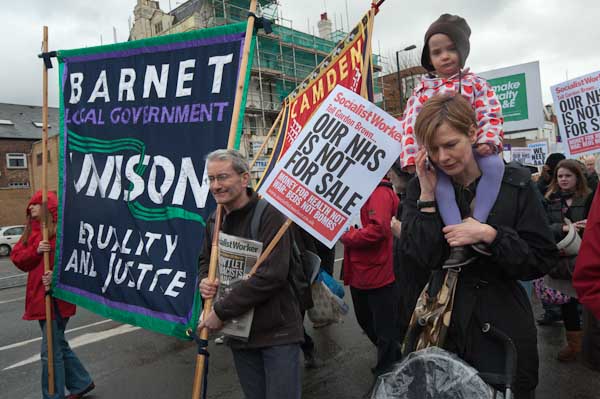
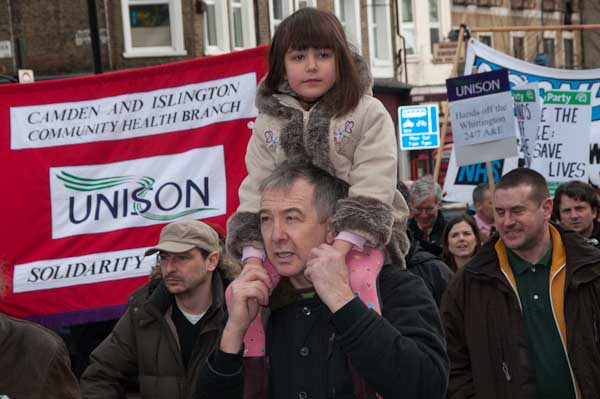
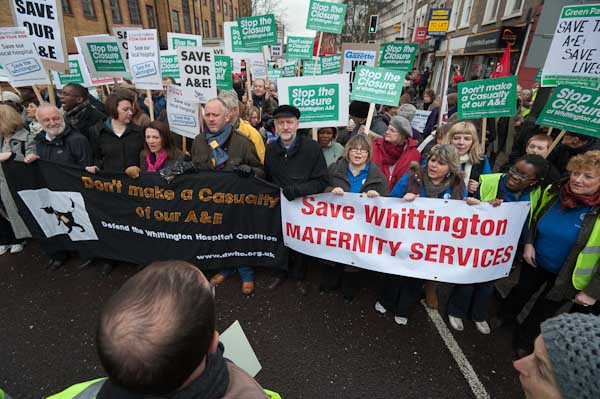
The demonstration on Saturday against the closure of the A&E and Maternity departments at the Whittington Hospital in north London was in some respects a typical march along a couple of miles of street with couple of thousand people. On My London Diary you can see the pictures I took as well as reading a little more about why people were marching.

© 2010, Peter Marshall

During the march most of the pictures were taken with the 16-35mm but sometimes I needed to work at a greater distance and the 18-200mm came in useful, often because it just wasn’t possible to get close enough to use the wider lens, but also to try and create a narrower background that included lots of placards and posters.

© 2010, Peter Marshall

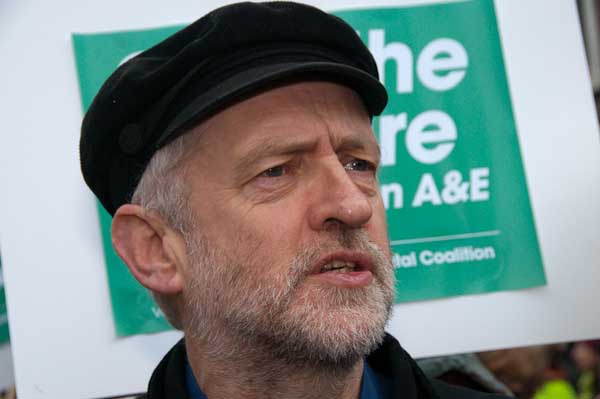
And there were times when I wanted to concentrate on just one person – particularly the speakers at the rally, but also sometimes people on the march.

© 2010, Peter Marshall
Jeremy Corbyn MP
© 2010, Peter Marshall
The start of the march

At one point on the march I had a rather disturbing encounter with one of the marchers, a man who seemed worried that I was taking pictures of people, and wanted to know why I was doing so. I think it was just another example of the kind of paranoia some people seem to have about photography.

When I’ve taken part in marches and protests, I done so because I want to put on record my support or opposition to a particular cause that is the point of the protest. Like most demonstrators I’ve welcomed any interest shown by others in the march and particularly people photographing or videoing the march, especially because it may need to greater publicity for the cause I’m demonstrating for.

Of course there are some protesters who intend to break the law and wish not to be recognised. But the way to do that is to wear a mask of some kind, not to try and evade cameras. These days you are in any case going to be recorded on CCTV – and it was interesting to see that the prosecutions in the Gaza demonstrations were based on CCTV evidence rather than the pictures of the many photographers at the demonstration (although the judge involved had also watched the coverage by Sky News.) Still photography, which simply captures an instant, seldom produces unequivocal evidence of an act in the same way as video and can often be extremely misleading.

This was however an entirely peaceful and lawful demonstration, so I find it hard to see any rational explanation for the attitude of suspicion which one man displayed. I suppose one madman in a couple of thousand is not too great a problem.

More pictures on My London Diary as noted above.