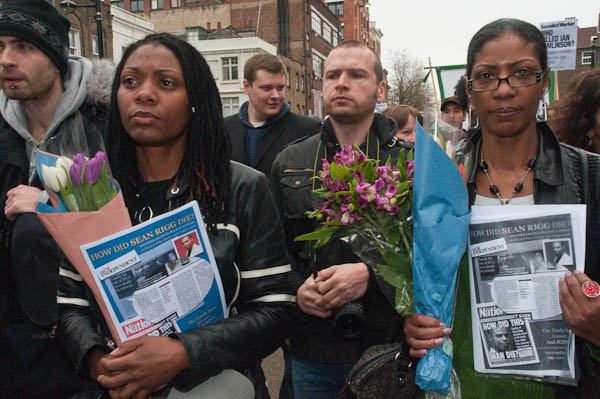
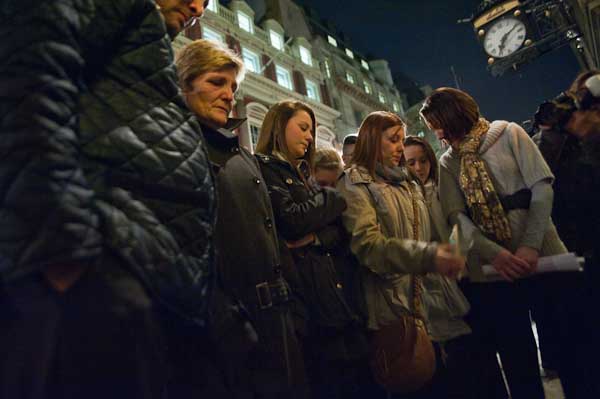
I Can Never Resist a Mermaid

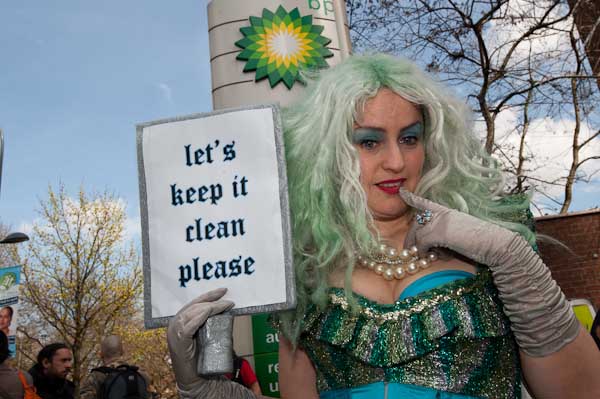
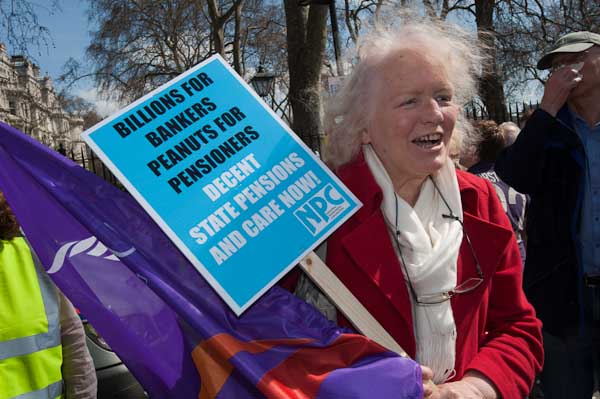
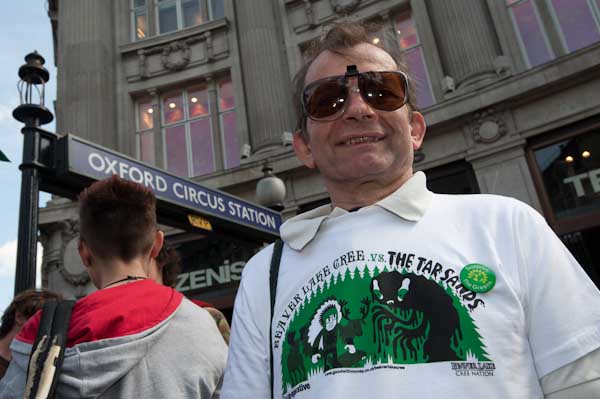
Sometimes you seem to wait an awfully long time for a demonstration and then two come along at once, and it happened again last Saturday. The National Pensioners Convention had organised a march to defend the welfare state, and lots of trade unionists were joining them,  meeting up at noon to start marching at 1pm to Trafalgar Square for a long rally with along list of speakers. And at that same time, 1pm,  the UK Tar Sands Network, Rising Tide and the Camp for Climate Action were meeting up at Oxford Circus to travel to an undisclosed destination for an action as a part of a ‘BP Fortnight of Shame leading up to their AGM on 15 April.

I thought about it and decided to make a quick visit to the Welfare State March and leave around when it was starting, close to Temple Station. A quick trip on the underground would then get me to Oxford Circus for the Tar Sands action, and if that didn’t look promising I could jump back on the tube and meet the pensioners back at Trafalgar Square. For once the two Underground lines I needed were both working at the weekend, something of a miracle in recent weeks, so it was possible.

© 2010, Peter Marshall
More about and pictures from the Defend the Welfare State March

I’d thought there would be a lot of photographers at the Welfare State event, not least because of the union support. Unions often actually commission photographers, but otherwise they may buy pictures from freelances for use in union magazines and they pay union rates. But also it was a large national event and that too might increase the chances of sale. The downside of course is that with more photographers there, the chance that they will use your picture rather than someone else’s decrease, and experience tells me that having a better picture is seldom a great deal of help.

I prefer to photograph events where there are fewer photographers even though this often means they are in some way less “newsworthy” partly because I think my pictures are more important simply because there are few others, and also because I won’t get in the way of other photographers and they won’t get in my way. Those of us who like to get close to the subject and work with wide-angle lenses are not always popular with the guys who like to stand further away with something longer.

© 2010, Peter Marshall

As I expected there were relatively few people around when I got to the Oxford Circus rendezvous, and fairly few photographers among them. Our destination turned out to be Shepherds Bush, just a little further from the centre of London than I’d hoped, and by the time I’d finished taking pictures there it seemed hardly worth going back to Trafalgar Square.

© 2010, Peter Marshall

There weren’t any speakers to photograph at Shepherd’s Bush, but there was an occupied garage, dancing and a mermaid, so I think it was almost certainly more fun.

More pictures and more about BP’s plans to take part in “the dirtiest and most desperate attempt yet to profit from – and prolong – humanity’s crippling addiction to oil” in My London Diary.

Hostile Reconnaissance

Yesterday I went to a public meeting organised by the London Photographer’s Branch of the NUJ about the systematic harassment of journalists, particularly  photographers, by the police.

Around seven years ago, many of us began to notice the increased us of photography by the police at demonstrations, and were disturbed by the way that it sometimes seemed to be used more as a way to harass protesters than for the stated purpose of gathering intelligence. We became even more disturbed when it became clear that photographers were clearly  being targeted and photographed time after time.

The first time I noticed it was when two officers came up to talk to me as I was photographing a demonstration outside the National Portrait Gallery. As I turned round to face them I met the flash of the photographer from the Met who had clearly been waiting for the moment.  It was the first of many such times. On one occasion in Parliament Square I stood for what seemed like several minutes with my camera in front of my face pointing it directly at a police photographer around 5 yards away who was pointing his camera with a telephoto lens directly at my face, clearly waiting for me to put the camera down so he could take yet more photographs of me, to add to the thousands already taken and doubtless on the database that the police still seem to deny having despite having been forced to admit its existence in court.

This is one area where we have now made some progress through protests and dialogue between the NUJ and others and the police and I haven’t noticed a police photographer taking my picture since we caught one out at the French embassy in July last year – and when challenged he vehemently denied having done so.

But that hasn’t stopped various unacceptable treatment. Not long ago a colleague was stopped and searched by police three times in half an hour covering a single demonstration, and others have also been searched while taking photographs where there was clearly no proper reason for the search. Advice from the Home Office has made it clear to police that they should have some real reason to suspect people are in some way connected to terrorism before using this as a pretext to carry out a search, but so far the police seem determined to ignore this advice.

All of us who photograph protest are I think worried, especially when we turn up and find we are the only journalist present (as in the case of that triple search.)  I don’t know what goes on when there are no journalists present, but having several of us around does seem to inhibit police irregularities. It’s no coincidence that when I was searched I was the only photographer present. We really shouldn’t be needing to rely on safety in numbers.

The government is currently attempting to appeal a European court ruling that the stop and search legislation is illegal, and it was good last night to hear film-maker Pennie Quinton whose appeal, supported by Liberty, achieved this decision.

You can read more about the rally on the London Photographers’ Branch web site, where you can download a full audio file of the evening. But the highlight came at the start where we watched Jason N Parkinson’s film Hostile Reconnaissance with examples of police misbehaviour towards photographers and highlights from the campaign by the NUJ, LPB and I’m a Photographer, Not a Terrorist! which is not available on the site.

Perhaps the most salient contribution to the evening came from Prof Keith Ewing, who suggested we campaign for a Press Freedom Bill on the lines of the Swedish Freedom of the Press Act, listing the twelve points he thought this should contain:

  1.    A right not to reveal sources.
  2.    A right not to be required to surrender images.
  3.    A right to attend public events and to move freely at these events.
  4.    A right to right to take photographs in a public place.
  5.    A right to photograph police officers and public officials exercising their duty.
  6.    A right not to be under surveillance by police or intelligence services.
  7.    A right to not have equipment confiscated.
  8.    A right not to have images erased or equipment deliberately damaged.
  9.    A right not to be subject to Stop & Search.
  10.    A right not to be restrained by injunction.
  11.    A right that police Forward Intelligence Teams only act with prior legal authority.
  12.    A right to meaningful accountability of police Forward Intelligence Teams.

And clearly the most depressing comment of the evening came in a contribution from the floor, when one photographer stated that he sometimes felt sorry for the police, as he had been to one or two demonstrations and felt it was hard for the police to distinguish between “proper” photographers and others who were there with press cards.

Suggesting that in any way the police should be able to decide who is or isn’t a “proper” journalist seems to me to be inviting a police state. We have a system of press cards that has been accepted by the police and is administered by various gatekeeper organisations who control it so only those who need a card and qualify for one should have them. The Association of Chief Police Officers have agreed the scheme and the only job of the police is to honour this agreement and recognise the needs of the press and wherever possible to make it possible for us to do our job.

Of course having a press card does not remove the requirement for citizens to obey the law (any more than wearing a police uniform should not.) I’ve been to more demonstrations than most, and can only recall one occasion where someone wearing a press card has behaved in a clearly unsuitable way. Several other photographers at the event, myself included, clearly told him that he could either be a journalist or a protester but if he wanted to protest he should put the card away.  I’ve not seen him at an event since.

Of course we all have rights, including the right to photograph in public, whether or not we have a press card, but those who are accepted by the industry as members – and increasingly that will also include bloggers and others writing for the web as well as print journalists – have a special responsibility. Most but not all of the points made by Ewing should apply to all, not just journalists.I think journalists might also think rather more about putting their own house in order and pressing for more accurate reporting of protests. I was shocked at the Trafalgar Square rally to find a fellow journalist standing up in front of a BBC TV camera and state there were “three hundred” people present, when if his cameraman had panned around the square he would have found several thousand.

It was the press too, that colluded with the police in building up an atmosphere of terror in the lead up to the G20 demonstrations in the City of London last April Fools Day, inventing lies and deliberately confusing street theatre and metaphor with insurrection. And the papers have already started this kind of nonsense for this May Day in London.

Section 43 Victory – But Orphan Works Won’t Go Away

Section 43 of the Digital Economy Bill, which would have made many of our photographs ‘orphan works’ and easy game for commercial publishers wanting a free ride on photographers backs got caught in the ‘wash up’ at the end of the current UK parliament. Conservative members led an attack on it and the whole section was deleted.

Photographers – including me – were delighted. I have over 50,000 photographs on the web, all potentially liable to be stolen and used had this section passed into law. And in the fairly unlikely event that I had caught any of the thieving publishers all I could hope for would be a probably derisory usage fee for that particular case.

So I was pleased I’d bothered to write to my Conservative MP, and that he had supported the cause, bringing it up with the shadow minister, who wrote me a letter in reply and spoke strongly against this section in the debate. I don’t kid myself that my action on its own had any bearing on the result, but it was the fact that many of us did the same that gave us the result.

The reply I got from my MP made it clear that he hadn’t considered the issue before he read my letter; so much legislation goes through parliament that most MPs don’t know much about most of it and there is really very little real scrutiny of many measures, indeed often virtually none unless outside people – like us – get stuck in.

Of course it doesn’t end here. There is actually a need for cultural institutions to be able to use material where the owner of the rights genuinely cannot be traced, and I think too that there does need to be legislation to deal with this and with the impact of the Web on disseminating material that often does lose it’s connection with the creator and copyright owner. But this needs to be done not by allowing a free for all overseen only very laxly by the Intellectual Property Office (who unfortunately don’t seem to understand IP)  but by some proper system which realises and protects the rights of creators especially where these have not been traced.

As a good starting point I think it should always be made more expensive for commercial users to make use of so-called ‘orphan works’ than those where the creator is known – fees for such material – collected and held by a suitable body – should be based on standard rates, such as those suggested by the NUJ, with a percentage added to meet the costs of the collecting body.

Perhaps the fees this body collects might be held for a period of several years by the body who would then pay over the standard rate fee if it was claimed. After that time it could go into fund that might in some way be generally distributed to creators in a similar way that DACS does for copyright licensing fees.

It would perhaps be more difficult to decide on the allocation of such fees among creators, which would to some extent be arbitrary. But I would propose as a necessary qualification for receiving a share to be membership of a relevant professional body – a trade union, professional agency or similar body. It may not be entirely fair, but I think it is important to support professional creative practice rather than all of those who put pictures on the web.

Also we need changes to the law to make it easier to identify the creators of images, in particular the proper recognition of moral rights. Attribution should become mandatory  for newspapers, magazines, removing the derogation they currently have. And the current law which apparently does make it an offence to remove ownership data (including metadata) should be strengthened and implemented, in the first case by prosecution of any companies producing software which does so automatically and withdrawing this from sale.

‘Orphan works’ should too be clearly attributed as such, and one of the responsibilities of the body collecting the fees for their use should be to display thumbnails, keywords and usage details of them on line in a searchable database, at least for the period of time that the fees may be claimed. Creators would then have only to look in a single place to see if their work was being used.

These are just some of my ideas, but its an area we need to look at carefully, to discuss and to come up with practical, workable and fair solutions. You can be sure there are commercial interests out there that will have their lobbyists pushing their own schemes on our next government.

Chocolate Box?

I was surprised to see on the cover of April’s British Journal of Photography (not yet updated on line) the text “Forget the chocolate box aesthetic and tune in to the new landscape photography with a message to tell“, because I thought that anyone with a serious interest in photography (rather than producing coffee table landscape books that sell rather well) had abandoned that kind of thing a few generations back. And in any case those few well-known guys who make a good living from schmaltz are hardly likely to throw their meal ticket away.

Is this I mused, a sign that BJP are now marketing themselves at the hopeless and helpless amateurs who are still immersed in the kind of pictorialism that went out of style with the rise of modernism now almost a hundred years ago? (Something I date in photography from the publication of Paul Strand’s work in the two final issues of Camera Work in 1916-7, though it took a while to spread from that point.)  Even Ansel Adams, arch-priest of large-format mountain worship, was seldom choc-box though perhaps more often pop-corn. And some of those later Edward Weston landscape’s were almost chillingly classical.

But turning to the article, it seems the “new landscape photography” they were referring to was really something very old by now, brought to public attention in 1975 by the ‘New Topographics‘ show and widely discussed here at the time by photographers with articles appearing in the US magazines that many of us read as well as ‘Creative Camera‘ and doubtless even the BJP.

I don’t find Eugenie Shinkle‘s article reflects the situation and the thinking among photographers, at least not those I knew at the time. The British landscape photographers most admired were people including P H Emerson, Paul Nash, John Piper, Edwin Smith and – rather different in his style – Bill Brandt, none of whom was in any way affected by Minor White and at least two who were certainly in part under the spell of Eugene Atget, perhaps a forerunner of the “neutral stance” of the New Topographics. To suggest that this was in any way “a moribund European landscape tradition” seems ridiculous.

Minor White was not particularly well-known at the time in the UK, and although parts of the USA were full to the gunwales of his disciples, I think had relatively little impact here. One reflection of this was the problem that I had in getting to see a copy of his “Mirrors, Manifestations and Messages“. The only copy that could be located in a library in the UK was in the British Library Lending collection itself and I had to sign away my soul to the devil before being allowed to take it home.

Raymond Moore certainly appreciated White’s work, along with that of others such as Callahan and Siskind, and made the pilgrimage their with his work – which was recognised, seized upon and shown in the USA.  I think he had a more profound and open vision than the better known Americans, particularly in his late work, and had he moved to the States would by now be considerably better known and respected.

I had the pleasure of going in a group with Moore and other photographers to the show ‘23 Photographers / 23 Directions’ at the Walker Art Gallery in 1978. The work which interested us all – Moore included – was largely that by Lee Friedlander, Lewis Baltz, William Eggleston, Steven Shore and Robert Adams (3 of them in the New Topographics show and the other two sharing some of what was described as their neutral stance) and we had very little time for some of the others (the Bechers were also in both shows, but perhaps we found their work less interesting.)  We had all seen the work of all these photographers in reproduction, but for some of us it was the first chance to see the actual prints.

A year or two later I had the experience of sitting at the feet of Lewis Baltz (absolutely literally if not entirely metaphorically) as he looked through the page proofs of his Park City. Along again with a group of photographers. Most interesting to me was the work he showed us by other contemporary American photographers working in both black and white and colour, most now well-known. Several were later in Sally Eauclaire’s New Color Photography (1981) and other books.

The New Topographics are now part of the tradition rather than news.  It’s still an interesting show, and one of several in that era that changed the face of photography.  But perhaps the article and the cover tease might more accurately have said “Show that shook up British photography thirty years ago.”

George S Zimbel v The New York Times

George Zimbel is a photographer who has already stamped his mark on the history of photography both through his own pictures – you can see his work on his web site – and also through his association with Garry Winogrand, which I’ve written about on several occasions, most recently here on >Re:PHOTO. When he was a student at Columbia, and already working as a freelance for PIX Inc and on other assignments, he teamed up with Winogrand in the “Midnight to Dawn” club making use of the university Camera Club darkroom.

Zimbel took on the NYT and won over an important question of photographer’s rights, the ownership of press prints supplied to newspapers. When in 2000 he saw one of his prints on sale through the NYT for $4,000 US, he was surprised, as he knew they did not own any of his work, as he had always worked for them as a freelance, selling only single reproduction rights.

He wrote to the paper, and while at first their legal team stated it was their property, after a while they  agreed to return it, while still claiming it was their property. He had supplied the print to the paper in 1960  for reproduction and they had failed to return it.

Even though they eventually returned this print, the counsel for The New York Times Company still claimed it was their property. I’m unclear on what legal basis that opinion was based, and it seems to me – as it did to Zimbel – to be a shameful and mean-spirited misuse of legal muscle to deprive freelances of their rights. You can read the full correspondence on his site.

Thanks to one of my favourite photographers, Ami Vitale, for posting about this on Facebook – and she got the story from Paul Melcher who has played an important role in technology for image licensing and other hi-tech aspects of photography on line.

Fair Trade Photography

Chris Barton, a photographer based  in Vancouver, Canada, the managing director of a professional photography portal who describes himself as a ‘Fair Trade Photography’ pioneer has put together a rather nice example on the dangers of using cheap stock photography rather than paying a photographer to make a unique image for your use. (thanks to EPUK for this.)

Microstock: why would a reputable company do this to themselves? gives a dozen example web pages using the same picture – and one of the comments points out he did a search using TinEye and found 86. Thanks also to Mr Barton for his “Entire Known World a Royalty-Free in Perpetuity All-You-Can-Eat License to link to this blog article. “

Radio 6

In a way it’s good news that I’m rather getting behind with writing about my own work here, and also in putting it on My London Diary.  Good because I often write about the problems that I’ve had or silly mistakes I’ve made, and there has perhaps been less than usual to write about, but also good because it means I’ve been busy.

Too busy in fact to put my recent work on My London Diary, though some of it at least has gone on to Demotix,  which gets it to a larger audience with the slight hope that it might sell.  Although I’ve always been determined not to let money determine my priorities, it does come in handy at times, and this is one time of year that I’m reminded about it, as today is the start of a new tax year.  I’m afraid the Chancellor can’t expect too much from me, and I for one won’t be at all worried about the coming in of a new 50% tax rate for high earners. Though as I’ve said before, “the poor pay taxes, the rich pay accountants.

© 2010, Peter Marshall

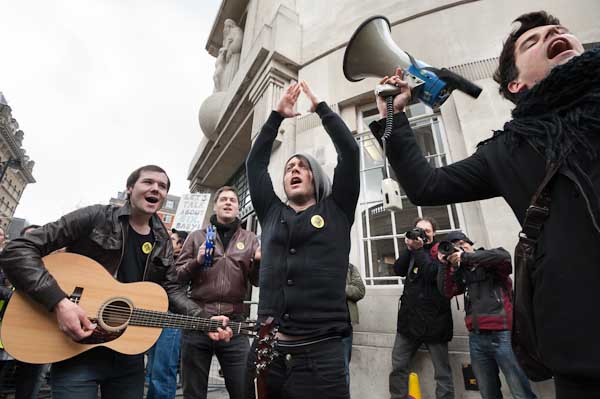
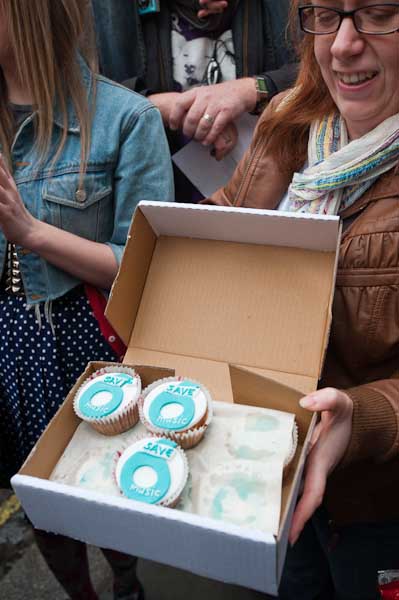
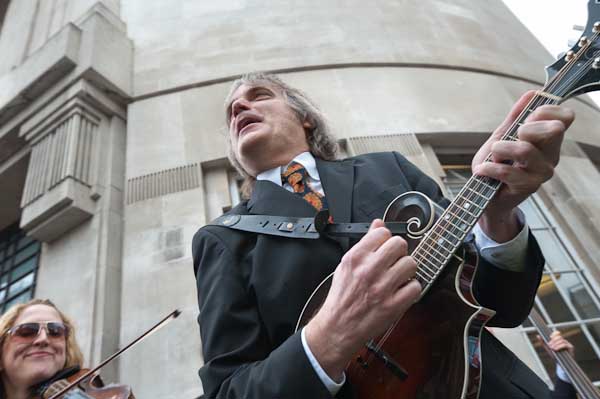
It’s over a week ago – last month even – that I was outside Broadcasting House in London to photograph a “protest party” against the closure of BBC 6 Music, a digital-only station that is hidden away somewhere hard to find on my DAB radio but can be listened to world-wide on the Internet.  It plays a rather wider range of music than the chart-orientated stations and has access to a huge BBC archive including the sessions by the late John Peel, who I sometimes used to listen to despite the music he played (it wasn’t  all bad.)  Six isn’t a station I listen to, but much more at the core of public service broadcasting than say Radio 1 or 2 (or BBC 1 TV)  which aim at exactly the same audience as most commercial broadcasters.

© 2010, Peter Marshall

Cutting it – as the BBC intend – doesn’t really seem to be a case of saving money. It actually costs less overall than one or two of the popular presenters elsewhere in the BBC (who would be no great loss) each earn. It’s a pin-prick in the budget, but along with the Asian Network fits untidily with the BBC’s marketing plans. Frankly they should sack the marketers, which would also save them more.

© 2010, Peter Marshall

You can see the pictures from the event and read more about it on my London Diary.

The only real problem in taking pictures was the rain, with several heavy showers. Another advantage of the new Nikon 16-35mm  (which this month’s British Journal of Photography expects to come out later this year – and I’ve been using for around 5 weeks) is that it is fairly well waterproofed.  Of course I have a UV filter on the front. With long lenses the lens hood offers useful rain protection, but on a wide-angle this is very limited, and you get in the habit of wiping the filter with a cloth very regularly and before virtually every shot. Even then you lose a few, though sometimes the drops fall on areas that don’t really affect the picture. The kind of diffused blur a raindrop gives isn’t a great problem on clouds for example.

After this outing, my two Nikons have now each acquired a small piece of black tape across the small lever that switches from matrix to centre-weighted to spot metering.  Although spot metering can be very useful (and I used to use it all the time with black and white film in the Olympus OM4, though it was a rather large spot) if you select it unknowingly it can give rather unpredictable results. With the Nikon D300 and D700 there are also some easily forgotten interactions with other areas of the camera and flash operation. Useful though spot metering can be, it isn’t something you ever want to use by accident.

I’m also finding it far too easy to change exposure mode by accident – and to forget to return it to my normal P setting when I’ve deliberately altered it for a particular series of shots, and can see no easy solution to this. It is surprising how long it can take me to realised in the viewfinder that I’m taking everything at 1/2000s or with the lens wide open.

Waiting around with a couple of other photographers at an event the other day, one of them admitted to almost always using his Nikon on ‘P’ setting (as I do) saying he told people that ‘P’ stood for ‘professional’, and ‘A’ for amateur. ‘M’ of course is for ‘mental’ and there were several suggestions for ‘S’, all slightly rude.  But with occasional use of the thumb-wheel over-ride, P (or rather then P*) really does provide the easiest and quickest way to get things right.

I’ve mentioned before my “cockpit drill” which – in theory at least – I carry out every time before taking pictures, usually on the way to an event. Checking the ISO, Quality and White Balance settings, thinking about any adjustments I might need to my basic custom settings, and then making sure that shutter speed in S mode, aperture in A mode and both in M mode are set to useful values (usually around 1/200 and f5.6 or f8 though if I know I may suddenly need a fast shutter speed or extreme depth of field I’ll set them for this)  so that if I want to switch to them in a hurry I don’t have to waste time fiddling around.  Setting sensible values also helps if you switch modes accidentally. Which I do.

Easter Morning Musing

This Good Friday I photographed the first Passion Play to be performed in Trafalgar Square for 45 years, and it was in many ways an interesting event.
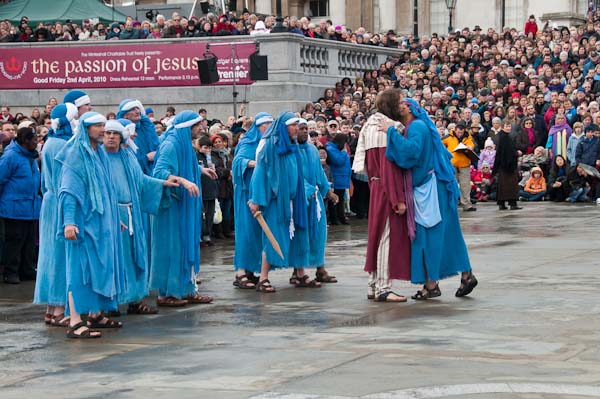
© 2010, Peter Marshall
Judas betrays Jesus with a kiss

It was also one that I’ve heard many rather silly things being said about. Some people have been heard making complaints that Christians aren’t allowed to tell their stories any more, that children don’t learn about Jesus in schools and that while Muslim or Sikh or Hindu festivals are encouraged by councils and celebrated in public places, Christians are not allowed to do the same.

It just is not true. There may be a few isolated cases where schools have decided not to celebrate Christmas in the traditional way, or where councils have banned Christmas greetings, but mostly they go on doing so. Christian groups who provide school assemblies may not get into every school, but the services they offer are still very much in demand and certainly not just in ‘faith’ schools, and there are plenty of public celebrations of Christianity, with pilgrimages, Good Friday walks of witness, and various other processions. In London we have several annual Orange parades and Catholic processions, the annual blessings of the river, the Jesus Army all taking to the streets and more.

There are probably more of these events now than there were twenty years ago. It is certainly true that many lack the colour and excitement (and numbers taking part) of festivals such as Vaisakhi, Milad un Nabi, Arbaeen or Diwali celebrations but you can hardly blame the other religions for that. It’s also true that as a photographer I generally find myself made rather more welcome at the events of other religions than at some Christian events I’ve attended.

I very much welcomed ‘The Passion of Jesus‘ as an attempt to put some spectacle into public Christian events, and was pleased I was able to photograph it. I did so alongside a couple of agency photographers, and it was perhaps an event that brought out the differences between the way you have to think to be successful at that job and the way I prefer to work.

Newspapers generally want a single picture of anything. Often they don’t seem too worried about exactly what it shows, although it helps to be visually dramatic and preferably very straightforwardly linked to the subject. Rather too often the pages are actually produced by the journalists with blank spaces to be filled by whatever the designer/art editor/picture editor happens to find at the agency where they have a bulk contract – so individual images come basically for free.

Photographs are generally seen as something that simply adds to the text, which is the basis of the story. Perhaps images are a necessary evil to brighten up the page and break up the text, but the approach is still almost entirely logo-centric, even in most sections of the tabloid press.

Agency photographers tend to think of events in terms of two or three very specific images. “Jesus on a donkey, a crown of thorns and Christ on the cross.”  Because they know that this will be what the papers will see and want.  There is also a market for some generic type of picture, such as “weather images” and at least one of the guys was praying for rain to get some good shots with lots of umbrellas in the background, though fortunately it stayed dry for the performance.
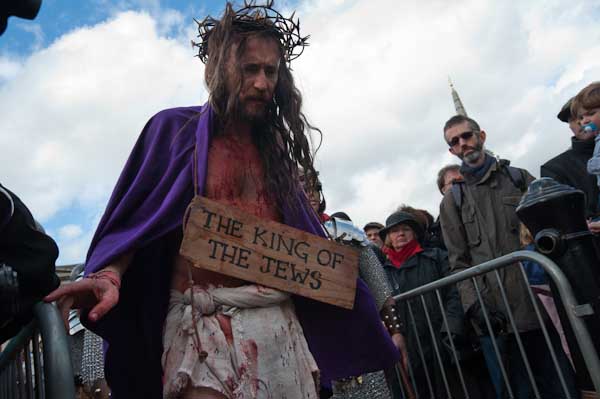
© 2010, Peter Marshall
The King of the Jews – Jesus wearing the crown of thorns

Photographing for the agencies is a specialist and skilled job, and I would not want to detract in any way from the professionalism and results people doing it produce – often taking pictures I would have very much liked to have made myself.  But while the kind of pictures they were seeking were things that I too wanted to photograph (and I got two out of the three on their list to my satisfaction) I don’t really see any story in terms of single pictures. I want to use pictures to tell the story – and of course good pictures do help in that.
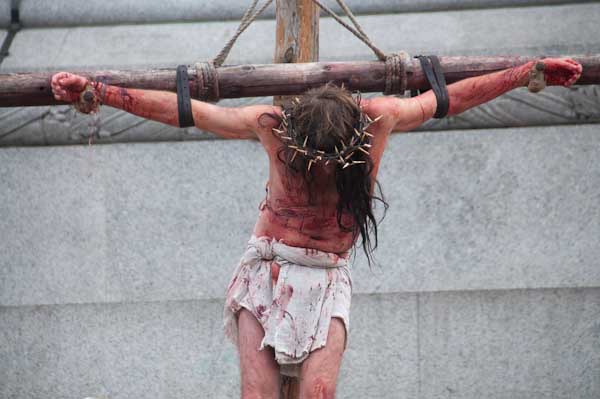
© 2010, Peter Marshall
Jesus wearing the crown of thorns hanging on the cross

I’m also not up with the working methods and technology to be an agency photographer. I’d certainly have to rethink my procedures and equipment to get pictures in on time. I seldom carry a computer when out taking pictures and like to carry out quite a bit of post-processing before uploading pictures. For me it’s often a rush job to get pictures out by the following day, let alone the few minutes which agencies now expect. (It can be seconds in the case of important events such as the Olympics, but photographers have a backup team to help there.)

I could probably learn to do it if I had to. It would mean buying a new notebook computer that was up to the job and carrying that around in a new, slightly larger bag. And shooting combined jpeg  plus RAW rather than RAW alone as I do now,  editing rapidly on the spot and letting images I know I could improve on being sent for publication with little or no post-processing.

It would also mean rushing away from events to file pictures. Both my colleagues from the agencies I think left after the crucifixion scene, as they had the pictures they needed. I didn’t, because I knew that the story hadn’t ended. In fact if that had been all there would be no story to photograph.

And stories, in pictures and in words are important to me. I’m happiest to see my pictures used with my text telling the story I want to tell. For some years I was fortunate enough to get paid for almost everything I wrote, but now mostly I publish for free and scrape a small income around the edges. Fortunately I don’t need a great deal to live on, so I can get by doing what I do.

Often when I’m taking pictures and mention My London Diary to people they tell me that they know the site and look at it. My own sites do get the stories out to a reasonable -but not huge – readership around the world, the kind of readership figures that some magazines would be happy with and that could generate some useful income if I put advertising on the site, but I prefer it without. Stories on Demotix get a lot of views too, especially if as mine often do they make the front page.
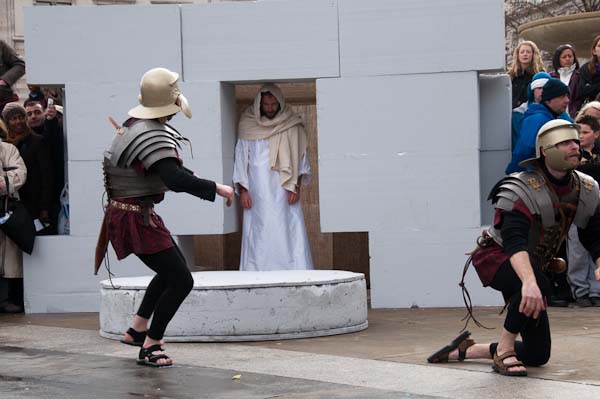
© 2010, Peter Marshall
Jesus emerges from the tomb, scaring the Roman soldiers on guard

The resurrection isn’t an easy story to tell either in a play or in photographs. Artists over the years have found the crucifixion a much more dramatic event to work with. But had death been the end of it, there would have been no Christian religion, nothing to remember two thousand years later, no history of millions of people over the years inspired and energised by whatever it was that happened.

It was something I thought about again this morning as I stood with around 20 or so others not too long after dawn outdoors in light rain facing the River Thames and celebrating Easter (I did take a couple of photographs, but they aren’t very interesting so I won’t post them.)

At its heart what happened after the crucifixion remains a mystery. The Gospel writers differ considerably about it, and perhaps it is impossible to represent with an actor playing the role of Jesus, whose presence is necessarily so physical. It was the part of the performance I was least impressed by, and also where I was least impressed by what I made of it in my pictures. But when I uploaded the text and pictures to go on line at Demotix, I knew this was the most important part to show. Death without resurrection is no story, whatever the papers think.
Anniversary of a Death

Today is exactly a year since a 47 year old newspaper seller, trapped by police in a “kettle” around the Bank area in the centre of the City of London while trying to make his way home from work, was assaulted by a police officer and collapsed and died a few yards away on the street from his injuries.

Most of us feel that if the assault had been carried out by anyone other than a police officer, the person concerned would by now be convicted and serving his sentence. Of course the police are in a different position to the rest of us, licensed to use reasonable force where necessary but in this and in many other cases, including the execution of Jean Charles de Menezes in a tube train at Stockwell Station and the almost 200 a year poorly investigated deaths in custody highlighted by the United Families and Friends campaign raise important concerns over their actions and accountability.

The situation in the UK is less extreme than that exposed to the world by the censored Crossfire exhibition in Bangladesh, and we do things more subtly in this country where essentially our class system, land inequality, constitution and laws date from the Norman conquest in 1066 – with of course many later amendments and adjustments.

I left Bank on April 1, 2009 before the situation became violent to photograph elsewhere and so only know about the events later through the published accounts and also personal conversations with many of those who were there, including several photographers who were also injured by police attacks.

© 2009 Peter Marshall.
Sisters of Sean Rigg, killed in Brixton Police station, march in memory of Ian Tomlinson, April 2009
I didn’t go to this morning’s anniversary laying of flowers by the family and others on the pavement where Ian Tomlinson died, partly because of pressure of work, but also because I thought it would be an event suffering from media overcrush, with photographers and videographers elbowing for limited room.  Although I usually manage to hold my own in such scrums (anticipation and getting there first fairly often is a great help, though not when some TV crews simply barge rudely in front of you) I seldom enjoy it and often, particularly with events such as this feel it is too much of an intrusion.

I felt that particularly strongly at the last event commemorating Ian Tomlinson and in particular about the laying of flowers by the family.  And I was as intrusive as most of the others, though I was appalled by the apparent lack of any sensitivity of one TV crew on the spot.

© 2009 Peter Marshall.
Ian Tomlinson’s widow and family members where he died in Cornhill, Dec 2009

I’m pleased that – for once – the mass media are taking an interest in the kind of issues that many of us have worked on for years and met with a blank wall from editors.  But that means there will be more than plenty of people there to take pictures. There are still many events of some importance that few of us cover.

So despite my sympathies for the Tomlinson family and interest in the issues around Mr Tomlinson’s killing I decided this was one event I would not make the journey to cover.

More on Crossfire

Last week I posted about the exhibition ‘Crossfire‘ at the Drik Gallery in Bangladesh which was barricaded by armed police and the public refused entry. Now on Shaidul News you can read
Drik: Photo power an illustrated article about this with pictures of the opening of the show in the road outside the gallery and a demonstration against the censorship by Satish Sharma which first appeared in Himal Magazine.

The original article in Himal Magazine is easier to read and there are more pictures in the slide-shows there. In it, Sharma discusses several cases of censorship and ask what it is about the photograph that invites censure and censorship.

Those in power fear the power of the photograph and seek to control it. It is a power that comes in part from its status as evidence, at least apparently a very direct stating of the facts, but perhaps even more from the way it can seize our emotions, more directly than writing.  The still photograph by crystallising a moment more directly than film.