How Many Ways

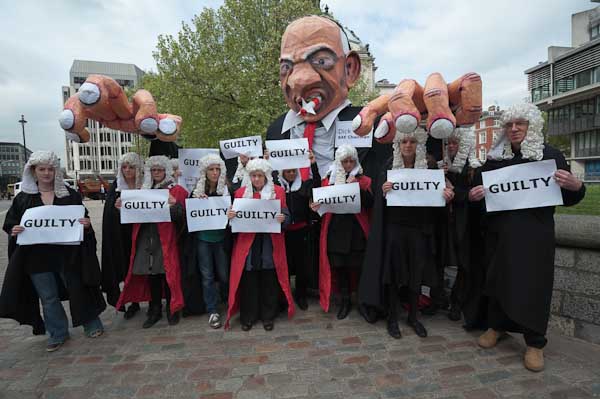
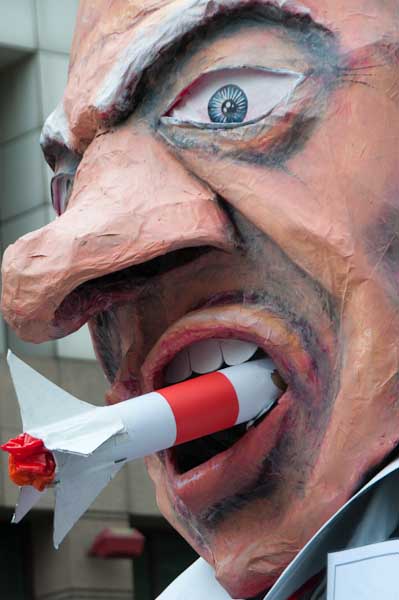
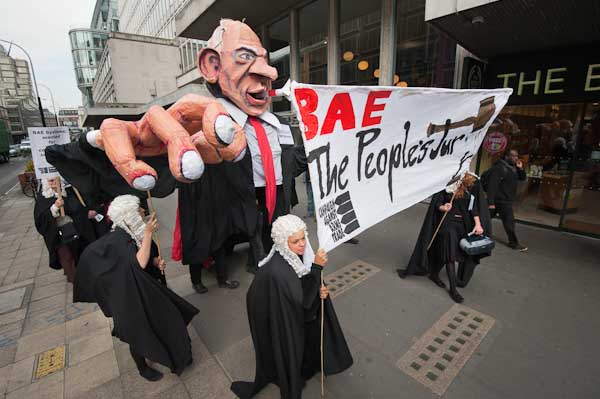
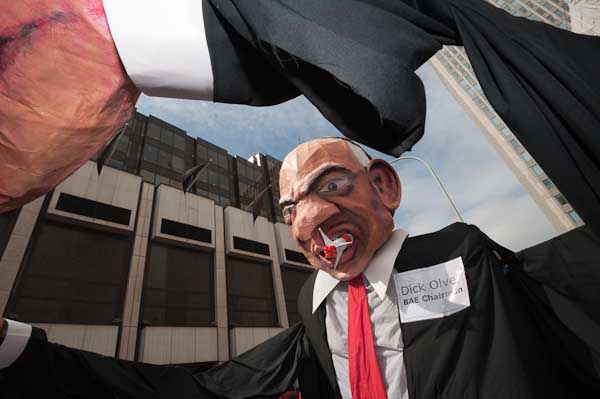
How many ways can you shoot basically the same thing is the kind of question that photographers often have to get to work on. And a couple of weeks ago it was the question I was asking myself as I walked down the road with a 12 foot high puppet of a man in a suit with a rocket in his mouth and a dozen judges.

The occasion was a protest by the Campaign Against the Arms Trade against arms manufacturer BAE Systems, who were having there AGM at the QE2 conference centre in Westminster, and the puppet represented the BAE Chairman.  As well as this activity outside the AGM, at least one CAAT activist was inside the meeting as a shareholder, asking questions about the activities of the company, which apparently didn’t get much of an answer from the chairman.

In a way you could almost sympathise with Mr Dick Olver; after all you can’t really say “my company is happy to take money from corrupt and tyrannical regimes around the world and is pleased that the UK government despite pretending to have an ethical policy is happy to assist us bringing in foreign money from almost anywhere for almost anything” which would probably be rather closer to the truth than what he felt he had to say.

© 2010, Peter Marshall

But my job was simply to produce some photographs of the event outside the meeting where Dick Olver’s effigy was being paraded along the street before, in true Alice in Wonderland fashion being found guilty and then having a trial.

© 2010, Peter Marshall

So I tried various angles, different focal length, close up and long shots, reflections and more. It was quite an unusual event in that there was plenty of time to play and very few photographers to get in my way (or me to get in theirs.)

© 2010, Peter Marshall

© 2010, Peter Marshall

And so on. You can see rather more variations on My London Diary, using focal lengths from a 10.5mmfisheye to 300mm telephoto.

Obviously some work better than others. One or two perhaps don’t really work at all, but most of them do the job.  So far I’ve not found an editor who thinks this is a story worth paying for and one of the benefits of putting work on sites like Demotix (or Indymedia) is that I get to choose which pictures get used (it just doesn’t pay the bills and you can see my choices there.

The Dunning-Kruger Effect

I read on Facebook today about the Dunning-Kruger Effect, named after Justin Kruger and David Dunning of Cornell University, although the idea behind it is rather older. The link pointed to a radio programme, the Science Show on ABC Radio National, where on 8 May, presenter Robyn Williams talked to Daniel Keogh about it, though I read the transcript there rather than listen to the programme. For most things when you want to think about the details its a better way to consume radio, as I’m finding with the current BBC Radio 4 series ‘A History of the World in 100 Objects‘, where both the transcript and there, even more importantly the images of the objects make it almost essential to follow the series on-line. The broadcasts themselves make good listening, more as entertainment, with the text and images being so much more informative.

The D-K effect is all about how people who know nothing about a subject are the most confident of their ability, or, as Keogh quotes Darwin ‘Ignorance more frequently begets confidence than knowledge’ and it’s something we are probably all pretty familiar with.

And Keogh rubs it in for photographers “If you’ve ever fancied yourself as a photographer, you might know just how this feels. It only takes a weekend workshop for you to suddenly realise that the poorly lit snaps of your cat in the backyard aren’t quite the masterpieces you’d once imagined.

I never felt I was a great cat photographer, but certainly recognise something it what he says, though I was fortunate at the first workshop I attended not only to have a few pictures among the dross that were more promising, but also to have a photographer running the workshop who recognised this and set me off in a more productive direction.

But it’s sometimes hard to convince people that they need to work at it, thanks to the D-K Effect, as I often found with students.  Those who did best were those who were prepared to listen and learn, and usually those who showed rather less confidence in their own abilities.

Except, as he points out, life often rewards the self-confident, even if this self-confidence has no basis in ability. Some of the ignorant incompetents manage to convince enough other people through their charm and charisma that they rise to the top and become in charge of things that they really know nothing about.  They become politicians or managers because of their ‘overconfident incompetence‘. The arts in general and photography in particular have more than their share of such people ‘fully controlled by the Dunning-Kruger effect‘ and it perhaps explains many things that are otherwise incomprehensible.

It is partly this kind of effect that has made it important to me throughout my time as a photographer to belong to formal or informal groups of photographers who have been able and willing to say what they thought about each others work. At times I’ve had things pulled to pieces (and performed a similar service for others) but it really helps. Of course sometimes I’ve gone away thinking that the others were wrong, or just didn’t understand what I was trying to do, but it’s always something that makes me think again, even if I sometimes end up with the same conclusion.

The show I’m part of that’s opening tonight in Croydon is not the greatest show the world has ever seen, but is something that comes in part out of that kind of critical process, by eight photographers who regularly meet and show each other their work in progress.  I like some of the work more than other pictures, but I think most of it is interesting to look at.

A Book At Last: 1989

Time after time over the past years I’ve been asked “Do you have a book of your pictures” and until now, the answer has always had to be negative, because the only books I’ve produced have been single copy ‘artists books’. One or two were made as ‘book dummies’ to try and sell the idea to a publisher, but although I might have had the occasional appreciative grunt (and even an offer to publish if I could come up with a large grant) I’ve never found anyone who felt it could be worthwhile as a commercial proposition.

Of course, as we all know, publishing on demand has changed that, and anyone can produce a book and make it available without a great initial outlay. In the past few years I’ve seen a number of such volumes produced by photographer friends, but certainly with black and white, always found the quality a little (sometimes more than a little) disappointing. Apart from a few specialised and very high price services the technology didn’t seem quite there.

But a few months ago I saw a book that changed my thinking about this, and decided me it was time to try it for myself. A few days ago I finally received a hardback and a softcover copy of my work ‘1989’, twenty photographs taken in north-east London in (would you believe) 1989 and first put together for the web with my own text in 2005-6. I’ve now had time to revise it and it is now on-line and on sale at Blurb.

You can actually still see the whole project on the web, and the book follows this fairly closely with a few minor revisions to the text I made (mainly typos) for its recent showing at the London International Film Festival.

I’m pretty pleased with the printing which is on Blurb’s recently introduced ‘premium’ lustre paper. I’d say print quality is adequate rather than excellent, and certainly better than many published books, but not of course at the standard of better (and often highly subsidised) publications using duotone, tritone or quadtone printing.

The hardback is a nicer volume, although the print quality in both is very similar as they both use the same premium paper and lustre finish.  It also comes with a dust-cover which includes a picture of me, which may put some off!  You do really need to have a different cover design for the two versions, and so far as I can see, with Blurb you can only get that by publishing hardback and softcover as two different books.

There are a few minor things where I wasn’t quite able to get Blurb’s Booksmart software to do exactly what I wanted. It does make the design easy – and allows you to produce your own customised page designs, as I did, but there are a few inflexible elements. You can submit your books as PDFs instead, but the software I have for this doesn’t give the required file type.

I’m still thinking about setting up my own “press”, buying a block of ISBNs and bringing out this volume under that imprint, together with around ten  other projects I have more or less ready, along with others I’m working on. And a couple of friends are also interested in becoming a part of this publishing process.

For that it might be worth buying a copy of Adobe Indesign, for which Blurb supply templates, but I’m not yet convinced that Blurb is the right answer for this yet, partly because it does add significantly to the cost of Blurb books to remove their logo and message and replace it with your own, but also because there is an unresolved problem which does not allow the normal placement of ISBN bar codes.

Even with the Blurb logo, the books are not cheap. This a 7 inch square publication with 20 pictures and short texts (around 50 pages in all) costs £10.95 for the softcover and £18.95 for the hardback and so is a little expensive and I don’t expect huge sales. (Prices have gone up since I wrote this – but the book is now available more cheaply as a PDF as well as a softback.)

As well as seeing the entire set of images on the web, you can also look through a part of the published book on the Blurb web site. And of course order it from there.

May Day

May Day seems rather a long time ago now, but its been a busy couple of weeks since then (we had an general election here among other things) and it took me quite a while to get around to sorting out my pictures from the various events to put onto My London Diary.

My London Diary is an archive of much my work over the last ten or so years, added to regularly, but it isn’t meant as an instant news site, more a reference. Getting pictures on it right away is not a priority, though it’s important to me to put them there in time. But first of all I want to get them on news sites and if possible into publications. Sites that I regularly put my work on close to the event include Demotix and Indymedia.

May Day started for me with a fairly relaxed journey to arrive at Clerkenwell Green for noon, when the annual trade union and socialist march to celebrate International Workers Day gathers to march through London to Trafalgar Square.

One of the many minor failures of our labour governments have been not to make May Day a public holiday. Jim Callaghan in 1978 gave us instead a bank holiday on the first Monday in May, which is really more of a nuisance than a cause for celebration.  Of course every few years coincides with May Day (as in 2000, 2006, and unless we get a changes before then, in 2017) and there are years such as this when May Day falls at the weekend. But most years when I was still in full-time employment, May Day was a normal working day for me.

May Day this year started bright and sunny, and Clerkenwell Green – long since covered by paving and asphalt with just a few trees to add a touch of green – was pretty full with hundreds of people in mainly red uniforms from the various communist parties, as well as many more variedly dressed trade unionists and socialists and a smallish group of anarchists in black.
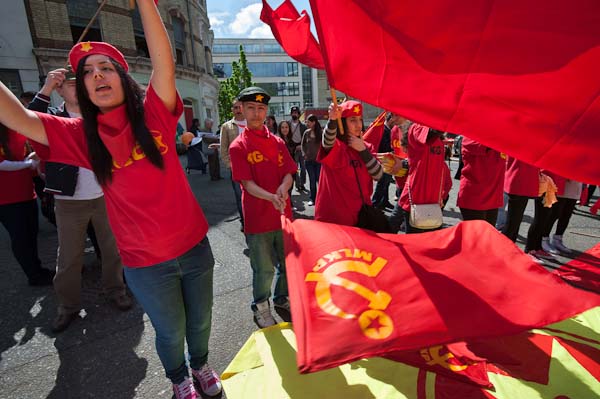

The Communist Youth Organisation (KGÖ) is the youth wing of the Turkish Marxist-Leninist Communist Party (MLKP)

The sun shines directly into most of the square, giving bright highlights and areas of deep shadow, so flash fill becomes essential for most pictures. Red isn’t my favourite colour photographically, although possibly digital copes a little better than film, but still it seems to lose detail far too readily and give large blocks of featureless colour, even though the highlights aren’t blocked. At least with digital images it’s fairly easy to do something about it, and “burning in” the over-bright reds usually solves or reduces the issues.

With the large areas of red (and yellow in some places) you do get a lot of red light as you can see in the faces in the picture above. But it’s part of the picture and usually adds to it.

Although photographically the problems are those I’ve coped with many times before, this May Day I faced another and fortunately less usual picture. When I had to visit my doctor a few years ago with a knee problem, one of the things he commented on was how flexible my knees were, and I think it’s something that comes from being a photographer. All of the time when I’m taking pictures I’m busy trying to get the camera in exactly the right position, flexing my knees, going just a little lower or higher and occasionally dropping down on them to the ground. Generally it must be pretty healthy exercise for the knees, though I do sometimes end up with a few bruises, and virtually every pair of trousers I own suffers from ‘photographers knee‘ with a  worn area halfway up both legs.

A short while after starting taking pictures at Clerkenwell I dropped down on my knees to photograph a group of kids, and there was a loud splitting sound. When I got up it was to find a split down the front of my trousers from close to my waist halfway down to my knees.

It was an embarrassing moment and for a while I was at a loss what to do about it. Fortunately I had a fairly respectable pair of boxer shorts on underneath, but I still felt rather naked.  I solved the problem by taking off the lightweight waterproof jacket I was wearing and tying the sleeves around my waist so that the jacket hung down my front to just above my knees and continued working.
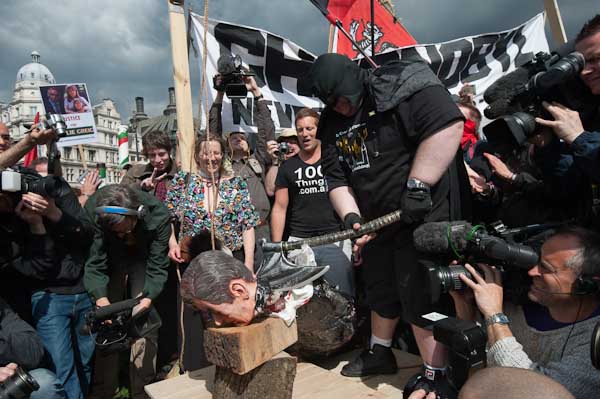

George Brown is beheaded

It’s the only day that I’ve spent photographing wearing a skirt, and it was a busy one, covering the march and then going on to a May Day election carnival in front of the Houses of Parliament where effigies of David Cameron and Nick Clegg were hung, George Brown beheaded and then disembowelled and Nick Griffin thrown to be torn to pieces by the London mob (all good clean fun) as well as dancing around the maypole and more.

Perhaps the most interesting thing about my state of dress was that nobody seemed to notice, even people who know me well enough to comment, at least until I pointed it out to them.  Of course there was quite a lot going on, including at one point a couple of naked male protesters in the trees next to the statue of Churchill.

I was busy photographing the maypole, where I’d almost got myself tied to the pole by the dancers, just ducking out under the ribbons as they closed in when I noticed a few people moving towards the corner of the square, where the Space-Hijackers ‘Spoil Your Ballot Bus’ had just appeared, and quickly joined a group of photographers taking pictures of it. But almost immediately I decided we weren’t in the right place, and ran round to the other side of the bus so I could get pictures with Big Ben behind it.
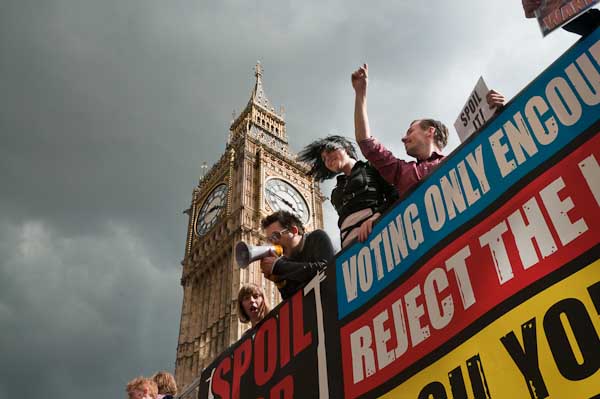
To my surprise the other photographers didn’t follow me.
© 2010, Peter Marshall

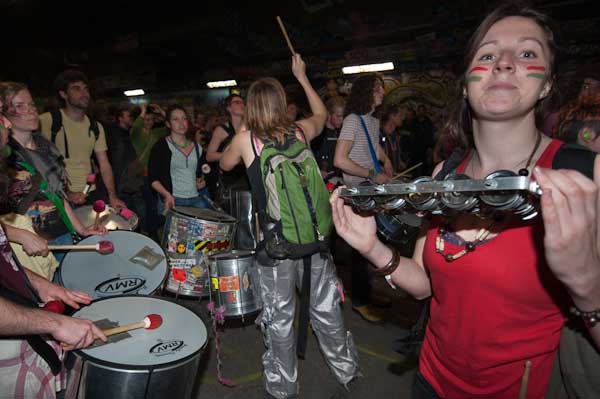
The sky was getting a very dark gray, almost black, and I was a little worried it might rain, as my waterproof jacket was already in use. Fortunately by the time I needed it I was already in the dry, in a street that runs underneath all of Waterloo station’s 22 platforms, photographing the start of the ‘Rave Against the Machine‘ there, and after I’d taken some pictures I could make my way to the station and take the train home. It was quite a relief to be able to change my trousers when I eventually got home.
An Invitation to Croydon

The short version of a post with this title might well be “You’re welcome to Croydon” but there is more too it (and that might be misconstrued.)

So I’ll spell it out. I’m taking part in a show of a small group of photographers that is taking place at the Croydon Clocktower. Here’s my version of the poster:

If you are within reach of Croydon, you are welcome to join us on Wednesday evening 19 May at 6.30pm for the opening. There isn’t a theme to the show, and I think some very different work from each of us. The show continues until July 12 and is open Monday to Saturday 9.30am – 5.30pm.

My six pictures are – like the one above – all about police and policing and I hope reflect my questions about who if anyone polices the police.

I’m not anti-police, but I do think we have to be very clear about their role in protecting democratic freedoms and over the past few years have perhaps been drifting rather dangerously towards a police state.

I’ve included one picture from Croydon, which for me revolves about an area a couple of millimetres square in the 24x36cm print, too small to see on line, so you will need to come to the gallery!

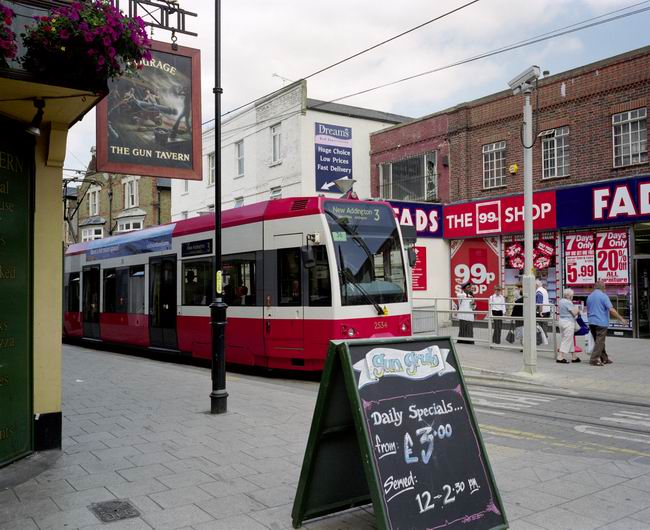
Croydon isn’t a bad place in some ways, and I’ve photographed quite a bit there over the years. One piece you can see on line looked at ‘Line 1’ of the new tramway system that opened there a few years ago. I think this is probably the nearest stop to the show:

© 2001 Peter Marshall

This was one of the relatively few times I’ve worked with medium format – taken on a Mamiya 7.

Olympic Panoramas

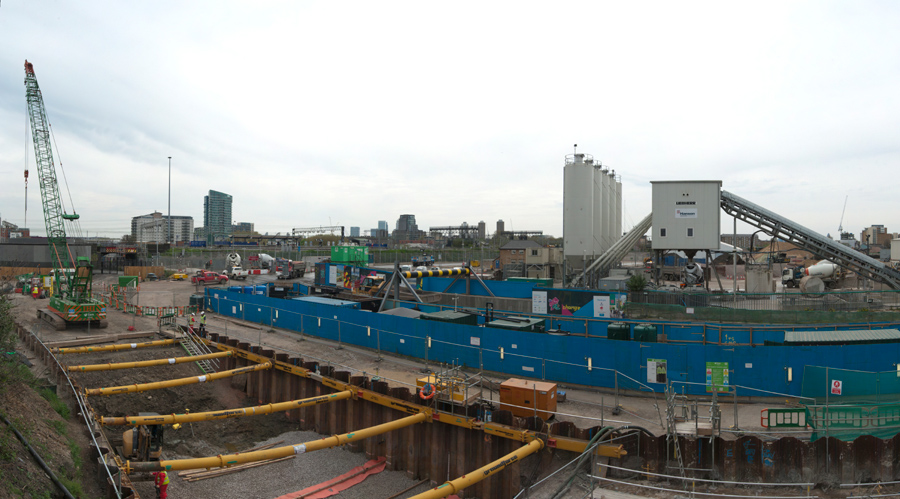
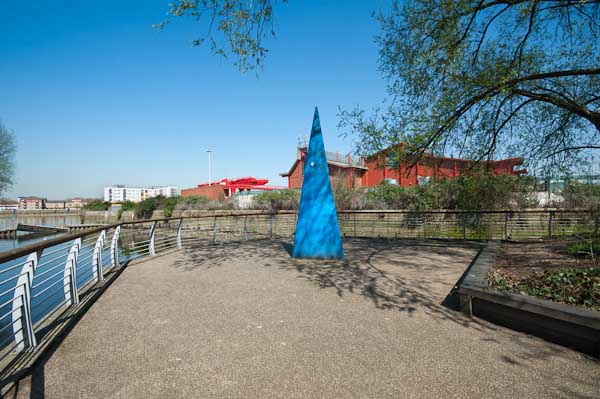
After photographing the ceremony for Workers Memorial Day in Stratford, I strolled back to the View Tube on the elevated Greenway above the Northern Outfall Sewer that goes through the centre of the site and took a few pictures to show the progress on the site, as I try to do at roughly monthly intervals.

I’d come out to cover the WMD event, and had not brought a couple of the things that help to make good panoramas, but it’s still generally possible.  I very seldom carry a tripod, but a monopod does a decent job and makes it much easier to take a series of pictures from the same place, but I’d left that at home.

Somewhere too, I have a short bar with a thread to screw onto the monopod, with a bolt that slides along a groove and lets you fix the camera at an offset from the centre tripod thread. Theoretically when rotating the camera to make a series of images for a panorama you should rotate the camera around the rear nodal point of the lens.  You can (at least theoretically) find this by trial and error. I start at a point  roughly the focal length in front of the film plane.  You get your assistant to hold an object such as a pencil in front of the lens so it lines up with a distance object, and then swing the camera around. If you are rotating the camera around that nodal point the two objects will stay lined up.

It’s best to do this before you go out to take pictures, and somehow make a mark or keep a record of the distance for use on location.  But since I hadn’t got it or the tripod I couldn’t do it anyway. But usually – if you avoid any close objects in the overlapped areas – you will get away without worrying about it.

Exposure is a little tricky, because as you swing the camera around the exposure reading will change – skies particularly get rather brighter near the sun on sunny days!  Overcast days make panoramas easier. You also need to avoid changeable lighting. Generally its best to set the camera to manual exposure and keep it constant through the series of pictures you want to join up.  On digital that means you need to start with test exposures with the camera pointing in the brightest direction and select the exposure which just avoids highlight clipping by inspecting the histogram.

The third thing I hadn’t brought was the fixed lens I like to make panoramas with. It is important not to change image scale when taking a series of exposures, and that is only too easy with most zooms. Its best to turn off autofocus too, and rely on manual focus, and the easiest way to do this is with a lens with a depth of field scale. Zoom lenses either don’t have these or they are useless.

I find the 20mm F2.8 Nikkor is a decent lens for panoramas. Used in landscape format (which is easier) it gives a decent vertical field of view on full frame. Prime lenses also generally have less distortion than zooms, which makes stitching frames easier. The DOF scale tells me that when set at 2m, everything from around 1m almost to infinity will be sharp at f5.6. Of course I don’t believe it, as DOF scales are always calculated for rather small prints, but stop down to f8 and things should be ok.

Anyway, these pans were made with the Nikon 16-35mm set to 24mm and typical exposures of  1/25 fll. All were handheld, and almost all worked pretty well.  Here I can only show them very small, and even on My London Diary they are only 900 pixels wide, while the originals are mainly 7-14,000 pixels wide.

© 2010, Peter Marshall
360 degrees on the Greenway. Original ca 14,000 pixels wide

Of course the lighting was a little changeable, which led to a few frames with clipped highlights, and in one set of images I’d moved the camera just too much from its original position – so the images almost but not quite join.

© 2010, Peter Marshall

Most were made with the camera in vertical (portrait) format, and were joined using PTGui and use the equirectangular projection.  The one above was made from three overlapping vertical images.

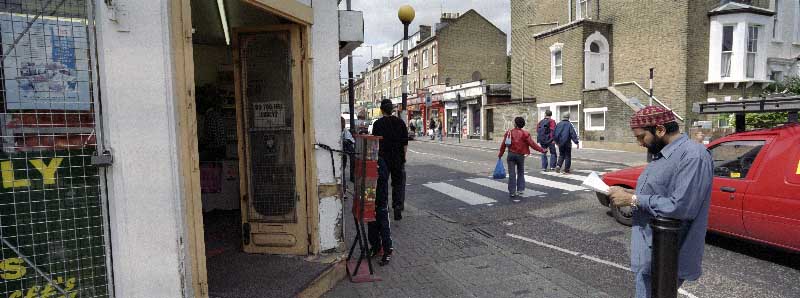
You can see seven more (including the one that doesn’t quite join up properly) as well as some single images I took on my walk – which took me along the Greenway, then through Three Mills to to the Limehouse Cut and Langdon Park DLR station on My London Diary.

Clear Blue Skies

Volcanic ash might have caused havoc to the world’s airlines and inconvenience to a many passengers – including several friends of mine and my son, who got an extra week’s stay in America with some more wild swimming.

But for those of us who live near Heathrow it was sheer bliss! We hadn’t realised here how much incessant background noise – day and night – the airport was responsible for, and it was almost like moving out to the country.  Nor how much our skies are normally populated by vapour trails. This morning as I performed my daily workout (not the most strenuous of activities, but good for the heart) I looked up at the sky and realised that every bit of cloud cover was man made, with con trails in virtually every direction speading out to give light and fairly diffuse clouds over perhaps a fifth of the sky.

Of course these trails eventually vaporize in the sun and later in the day we still sometimes get clear blue skies, but those few days when ash grounded the planes were something rather special. Despite being busy with other things I did find time to take advantage of them with a few pictures, in Finsbury Park and Wandsworth.

© 2010, Peter Marshall

The skies seemed a little deeper blue than normal, perhaps because of the ash. We had expected some rather special sunsets too, but I didn’t see any, though I’m not sure I would have photographed them in any case. File with cute cats so far as I’m concerned.

Actually I don’t much like clear blue skies either, better to have some clouds, but the do need to be real clouds. Con trails can be a nuisance, and its often hard to convince viewers that those marks in the sky are not scratches on the print and I have been known to retouch them out of pictures, especially when sending files to Alamy, otherwise their quality control may reject the images.

Alamy are also responsible for the elimination of countless birds from the sky too. Once you’ve had an image rejected for ‘dust’  that you know was seagulls, it’s easier to play safe and simply clone out those little dots.

You can see more blue skies on my pictures from Wandsworth and Finsbury Park on My London Diary, but I’ve taken better pictures of both places previously – with clouds.  Some of my acquaintances threw up their hands in horror when I told them I’d been photographing in Finsbury Park in 2003, expressing surprise that I had survived and not been mugged for the Hassleblad Xpan and other expensive gear I was carrying.

© 2002 Peter Marshall
Finsbury Park, 2002

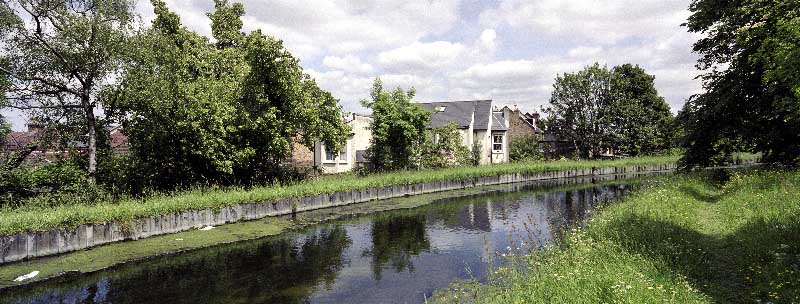
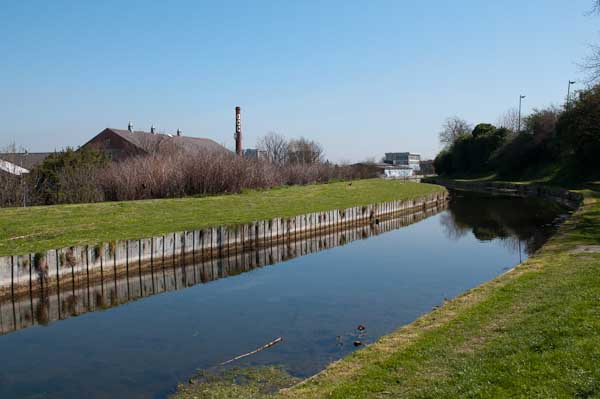
Not a great deal of cloud there, but here are two images taken a few hundred yards and 8 years apart on the New River that really show the difference.

© 2002 Peter Marshall

© 2010, Peter Marshall

Yes, I prefer clouds!

City of London Needs A Flash Flashmob

Security guards and police in the City of London have been at it again. Blatantly disregarding the official advice to police from the Home Office, they are continuing to misuse the powers under Section 44 of the Terrorism Act to harass photographers.

The NUJ Photographers Branch has Grant Smith’s account of what happened to him yesterday, 10th May, and clearly the police acted wrongly. They should have protected his right to photograph on the street but instead acted in an aggressive manner and forcibly searched him despite his cooperation with them. They also took away his mobile phone, although a later comment states it was later returned to him.

I think photographers need to educate both the City of London Police and security guards around the city, and a good way to do that would be a flash mob. My suggestion would be for it to start outside the police HQ in Wood St, and from their to go on a tour around every site in the city where we know of incidents of photographers being stopped. I’d like it to be a Flash flashmob, because firing a few hundred flashes would be a way of making sure we were noticed.

For maximum impact I think we should do it at lunchtime on a weekday when there are plenty of people in the City to see it – and perhaps some city workers who are also amateur photographers might be encouraged to join in.

Of course others may come up with better ideas – and I’ll be happy to join in with whatever is suggested.

Crow Country

The British Journal of Photography has a rather low opinion of it’s readers when it states “Few readers will have heard of – let along seen – Masahisha Fukase’s 1986 book, Karasu (Ravens), first printed by Sokyu-sha, a Japanese publisher based in Tokyo.”

Do I feel insulted or give myself a pat on the back as one of the chosen few?  No, but I do feel it rather more reflects the ignorance of the writers of the BJP about the wider aspects of photography which are too often demonstrated on its pages than anything about its readership, and for a publication hoping to establish itself as a monthly devoted to the medium is disappointing. Guys you need to up your game. In many respects the latest May issue is an improvement (and I’m pleased to see that it has lost the typographic fancies that made it literally hard for me to read.)

Although I don’t own ‘Karasu‘ I was among the thousands of us in London who flocked to the Serpentine Gallery in 1985-6 (and it was also shown in Oxford) for the show ‘Black Sun‘ which featured Fukase’s work along with that of three other great Japanese masters, Eokoh Hosoe, Shomei Tomatsu and Daido Moriyama and have the Aperture issue of the same name by Mark Holborn which served as a fine catalogue. It has 16 pages devoted to Fukase’s work, and in particular to the crows. Much more recently I remember seeing a whole wall of this work, I think at the V&A, and the former director there, Mark Haworth-Booth is among those listed in the acknoledgements to ‘Black Sun’.

More recently in 2008, Paris Photo had its thematic show on Japanese photography from 1848 to the present day and on this site I wrote “Of course there will be plenty of familiar work, including people such as Shoji Ueda, Ihei Kimura, Masahisa Fukase, Eikoh Hosoe, Shomei Tomastu, Hiroshi Sugimoto, Nobuyoshi Araki and Daido Moriyama” and there was.

Japanese photography, despite my particular interest in the work of people such as Eikoh Hosoe (who I was really delighted to meet in Poland in 2005) and Issei Suda, one of whose books I bought many years ago was an area I had only really just started to work seriously on in the ‘World Photography’ section of my ‘About Photography’ site when my contract was terminated.  A couple of years earlier I had published a piece ‘Early Photography in Japan’ which had dealt largely with the nineteenth century and was hoping to write more on the twentieth century, although I had written short notes about Fukase and the others.

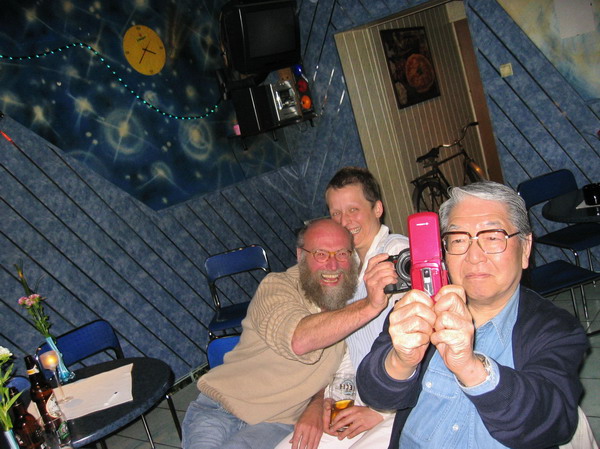
© 2005 Peter Marshall
Eikoh Hosoe photograhs me with a pink phone in Alacatraz

The BJP calls Karasu an obscure masterpiece” and expresses surprise it was chosen as the best photobook of the past 25 years in their critic’s poll and you may like see the list of the other works that these “five experts” (themselves somewhat randomly chosen) have selected.  Perhaps surprisingly, the one Japanese among them, Yoko Sawada, who was responsible for many of the issues of the influential Japanese photographic magazine déjà-vu in the first half of the 1990s, does not mention the book, picking works by five other Japanese photographers starting with Nobuyoshi Araki to whom 4 of the magazine’s 20 issues (including its last produced by Akihito Yasumi) were entirely devoted.

There are rather few books on the list I would have chosen, although I’m familiar with many of them. Those I own are Nan Goldin’s ‘Ballad of Sexual Dependency‘, Chris Killip’s In Flagrante and What We Bought: The New World by Robert Adams, although I do have other works by several of the photographers named.

I don’t really subscribe to the idea of “the best photobook“. Books to me are working tools, things I use, and if you have a job that needs a screwdriver even the best spanner is likely to be pretty useless. I’ve never felt a need – nor do I expect to –  for quite a few of the volumes listed by this very small selection of critics.

What I have read recently is ‘Crow Country‘ by Mark Crocker, described in the Independent as “A thoughtful and brilliantly executed celebration of countryside and the importance of nature in human affairs.” It contains no photographs, but is superb evocation of one man’s obsession with the the corvid family of birds – crows, rooks, jackdaws, ravens and more – and his attempts to find what lies behind their migrations, roosting and massing. It’s a work that perhaps might well be read alongside Fukase’s work.

November in Paris & Lensculture fotofest

I’m already looking forward to November in Paris, which really is the month of the photo, as well as a great time to enjoy walking around one of my favourite cities.

In 2008 I spent the best part of a week there and apart from Paris Photo, visited more than 40 other photo shows, writing about quite a few of them for >Re:PHOTO, as well as my reflections on the Maison Europeene de la Photographie (MEP) compared to our Photographers’ Gallery and attending the Cérémonies du 11 novembre. I think there are about 32 posts from that visit on the site in November 2008 and December 2008 (it took me a month to finish writing about the best of the exhibitions I saw) and also on My London Diary, a special Paris Supplement with my own pictures from the visit.

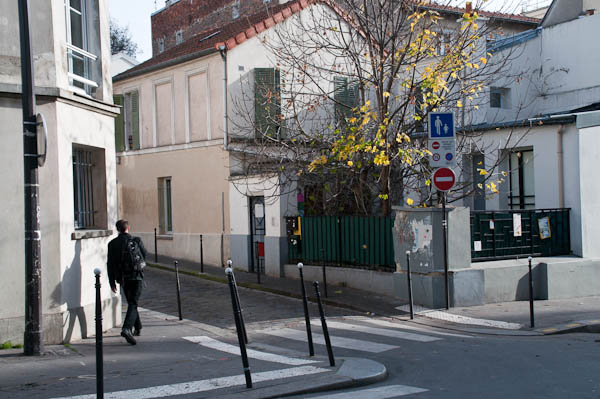
© 2008 Peter Marshall
A walk in the footsteps of Willy Ronis, 2008 Peter Marshall

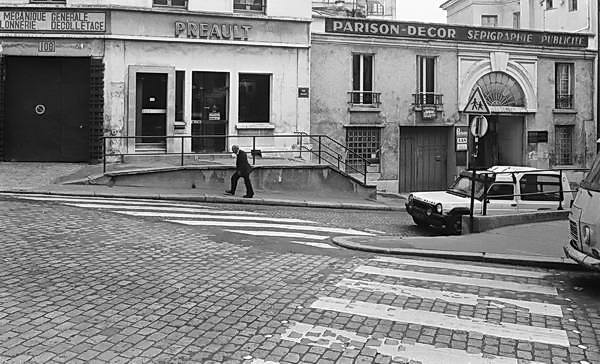
Two things reminded me about Paris in the last week. One was a request to supply a picture I took in 1984 which is on the front page of a part of my Paris site.

© 1984, Peter Marshall
Quai de Jemappes / Rue Bichat, 10e, Paris, 1984

And the second was the latest news from Lensculture, based in Paris, which as well as announcing the latest issue of this great online magazine, also gives details of the Lensculture fotofest Paris 2010, with international portfolio reviews and a meeting place for photographers to be held at Spéos Paris Photographic Institute in the 11th arrondissement from November 15-17 2010. This is the first large-scale event of the type – pioneered by FotoFest in Houston 20 years ago – to take place in Paris.  Birmingham of course got there some time ago with Rhubarb Rhubarb.

© 2007 Peter Marshall
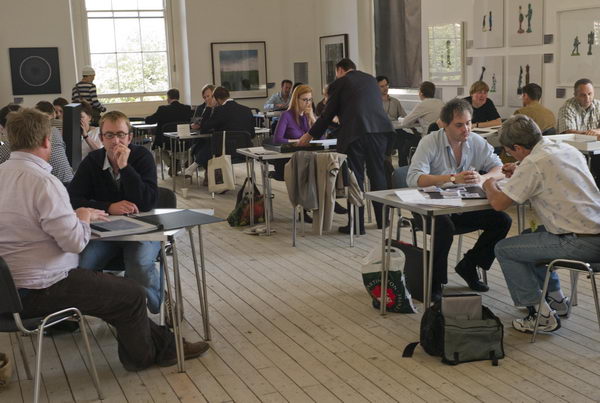
Reviews in progress at Rhubarb Rhubarb in Birmingham in 2007, where I was one of the reviewers

Lensculture has also joined up with VII Photo and now has features and recorded interviews with their photographers in an ‘Inside Photojournalism‘ series.

Something completely new to me in this issue of Lensculture is the work of Lithuanian photographer Mindaugas Kavaliauskas whose book on life in Kraziai, an historic village in north-western Lithuania, is reviewed by Zoë Fargher and you can see a set of of his 16 images from it on the site.