Anarchists & Underdogs

I read a post a week or two ago, pointed out to me by an anarchist friend, on the British Culture Archive web site, posted there last March, Anarchists & Underdogs | Images of Social & Political Graffiti in the UK and as well as sharing the link with you, thought there were also a few images I took in the 1980s of similar material.

It was one thing thinking that, but since I had no real idea of when I might have taken the pictures they were not that easy to track down. I’ve never really concentrated on taking pictures of graffiti, though in more recent times I have photographed some of the more colourful images on walls in Leake St underneath Waterloo Station, a route a sometimes detour through when I’ve just missed a train home and have 22 minutes to wait for the next, in Shoreditch, London’s graffiti capital, and elsewhere, not forgetting Hull’s great Bankside Gallery. But these are more murals than graffiti, and the earlier examples, both in the BCA article and here are simple text statements, usually of a political nature.

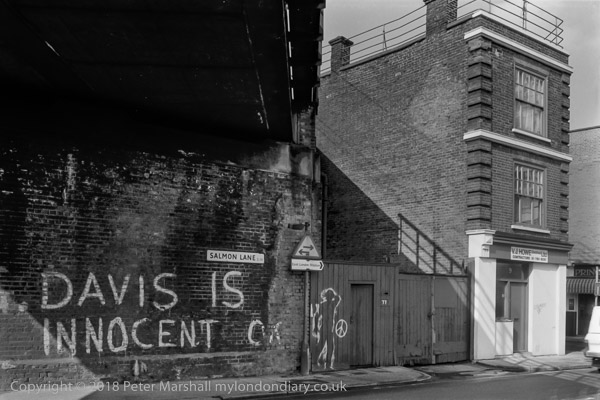
‘George Davis is innocent, OK’ appeared on walls across London, and is one I’ve written about before, though I can’t remember where. It was so common it hardly seemed worth using film on, unless there was a little more to it. Of course he was probably innocent of this one particular charge but otherwise a prime villain. Police had deliberately held back evidence that would have led to his acquital and the identification evidence was unsound and the huge campaign over his sentence led to early release in 1976 although the conviction was only finally quashed in 2011.

Many of us knew that such things happen – and I was later openly threatened with being “fitted up” by a police office back in the 1990s – but the George Davis case brought it out into the open in a way that hadn’t happened before. But what made me photograph this particular instance was the anti-nuclear figure with a CND symbol  next to it and the location. I didn’t even feel it necessary to include all of the G.

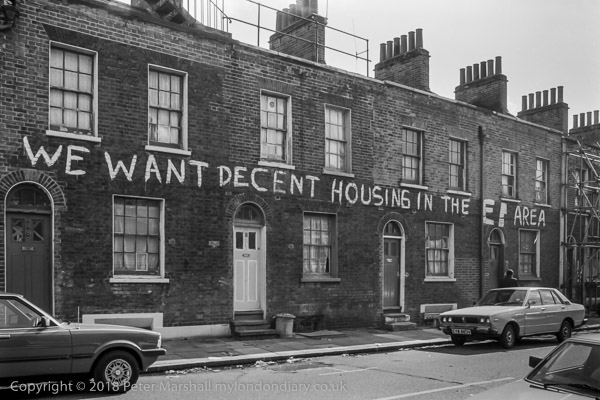
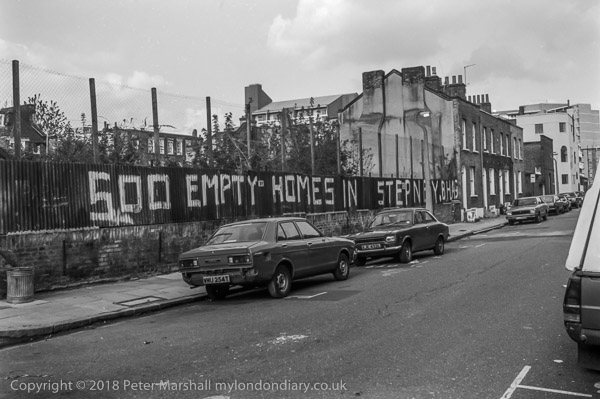
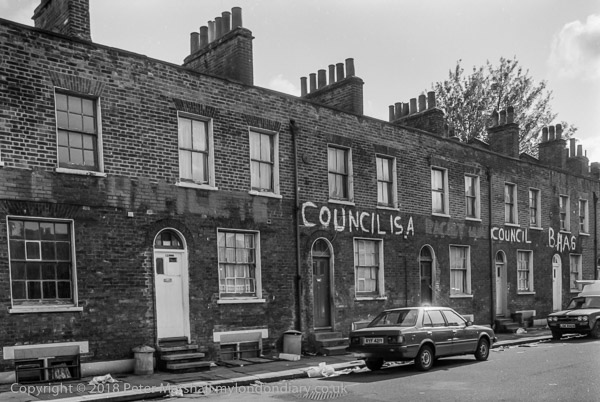
Housing was an issue back in the 1980s as it is now, with London Councils being accused of racism and social cleansing. Of course things have changed. Then the councils were building council housing – if not always doing so in a way that really met local needs, and clearing largely privately owned slums, often in very poor condition, though some were structually sound and could better have been refurbished. Now they are working with property developers to demolish council estates and build properties almost entirely beyound the means of the council tenants who are being displaced by the new developments and mainly for private sale at market prices, under the banner of ‘regeneration’. Tower Hamlets, traditionally Labour, came under Liberal/SDP control days before I took this picture by a majority of twoin a low (35%) turnout.

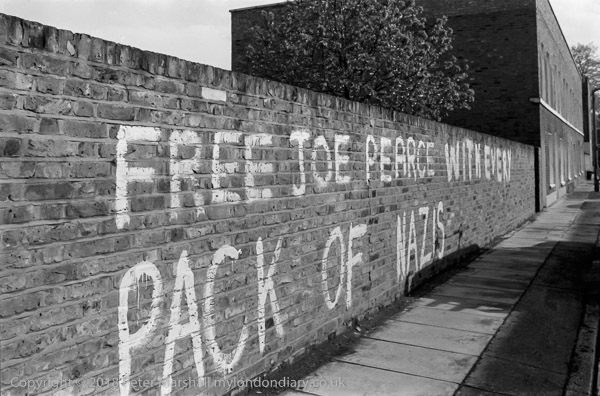
Joe Pearce was, together with Nick Griffin, one of the leading members of the Nazi National Front; together they took over the party in 1983, and reorganised it from a racist political movement into a racist gang based on young poor working class urban youth, particularly skinheads. Pearce had set up the NF paper ‘Bulldog‘ in 1977 when he was only 16 and in 1980 became editor of ‘Nationalism Today‘. He twice served prison sentences for offences in his wiriting under the 1976 Race Relations Act, in 1982 and 1985–1986. In 1989 he was conveted from Protestantism and membership of the Orange Order to become a Roman Catholicism and, according to Wikipedia, “now repudiates his former views, saying that his racism stemmed from hatred, and that his conversion has completely changed his outlook.”

I took all of these pictures in London’s East End in May 1986.
______________________________________________________

There are no adverts on this site and it receives no sponsorship, and I like to keep it that way. But it does take a considerable amount of my time and thought, and if you enjoy reading it, a small donation – perhaps the cost of a beer – would be appreciated.

My London Diary : London Photos : Hull : River Lea/Lee Valley : London’s Industrial Heritage

All photographs on this and my other sites, unless otherwise stated, are taken by and copyright of Peter Marshall, and are available for reproduction or can be bought as prints.

To order prints or reproduce images

________________________________________________________
AI Faces

Around twenty-five years ago my elder son passed his GCSE Art with a project, rather reluctantly endorsed by his art teacher, using ray tracing to produce drawings which he had generated on my computer, I think at the time still an Amstrad PC1512. I think we had to leave it running overnight for the best of them, and could only produce hard-copy by photographing the screen as we only had a black and white printer, but my memory of them is faint.

They weren’t particularly good drawings, though better than some entered for GCSE Art, and were certainly in no way photo-realistic. But both computer hardware and techniques have made great bounds since then, and the latest faces generated using AI and shown on PetaPixel in These Portraits Were Made by AI: None of These People Exist are entirely convincing.

The were produced by NVIDIA researchers Tero Karras, Samuli Laine and Timo Aila using generative adversarial networks (GAN), about which even they write “Yet the generators continue to operate as blackboxes, and despite recent efforts, the understanding of various aspects of the image synthesis process, e.g., the origin of stochastic features, is still lacking.” Having briefly scanned their publication, which contains the images shown on PetaPixel, my understanding is still definitely lacking, and, unless you are the kind of person who crunches tricky equations before breakfast it is unlikely to add much to your comprehension either.

I can’t even get this blog to reproduce the equations properly, but here’s one I just found:

lZ = E h 1  2 d G(slerp(z1, z2; t)), G(slerp(z1, z2; t + )) i

where z1, z2 ∼ P(z), t ∼ U(0, 1), G is the generator (i.e. g ◦f for style-based networks), and d(·, ·) evaluates the perceptual distance between the resulting images. Here slerp denotes the spherical interpolation operation [49] that is the most appropriate way of interpolating in our normalized input latent space…

So I guess that makes it all clear?

What I can see is the potential that this development has for fake news and for advertising images (and as another group of images from the paper illustrated entirely filling the few gaps in Facebook not already occupied by cat pictures.)

Doubtless it won’t be long before programs based on this a other similar research are common on our desktops (and even on our phones) and as well as producing non-people will be churning out images of real people doing things they never did in places they never visited.

I’m unsure too, about the copyright issues involved around these images, which rely on multiple real photographs for their generation, though I suspect those who run the software will claim the copyright.

Nor is it easy to predict the effect it will have on photographers, though it has the potential to replace much of the stock photography market, something that would not greatly worry me, though I think may greatly reduce employment in the area.

It may even increase the value of the ‘real’ photograph, an image whose integrity is vouched for by the credit line of the photographer – so long as we retain our integrity and our photographs have something to say.


Harlesden Protest Police Brutality

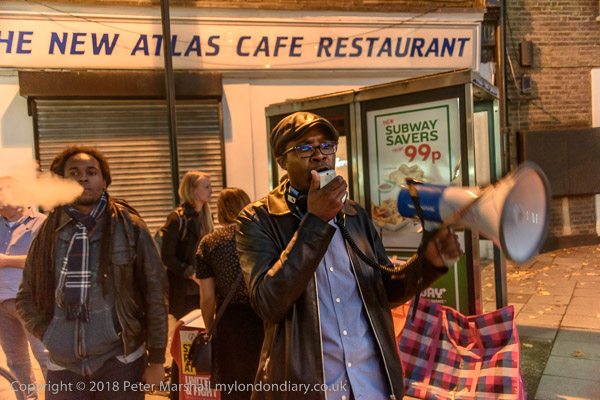
After an knife attack on a main street in Harlesden, a van load of police arrived and began questioning people on the street. Among them was a young black man who they had seen smoking cannabis and who, perhaps because of this was, was a little disturbed to be surrounded and questioned by police.


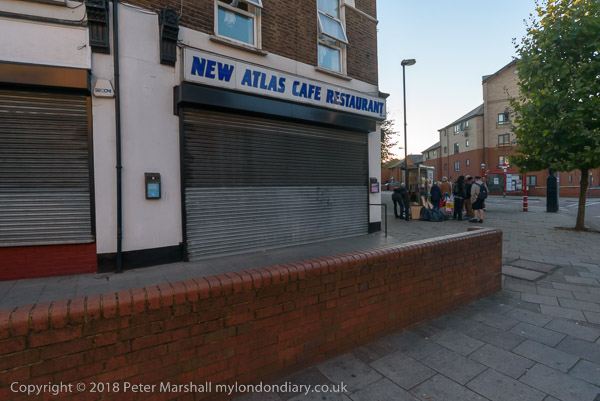
The scene of the police crime

What happened next was recorded on the phone of someone standing just a couple of yards away in a small crowd that had gathered around the group. They were protesting that the police were arresting him, and doing so with quite unnecessary force, with one officer viciously kicking him as others tried to handcuff him. And then, when he had been cuffed and was being held face-down on the pavement, clearly under control, another officer came up and sprayed him in the face from close range with CS gas.

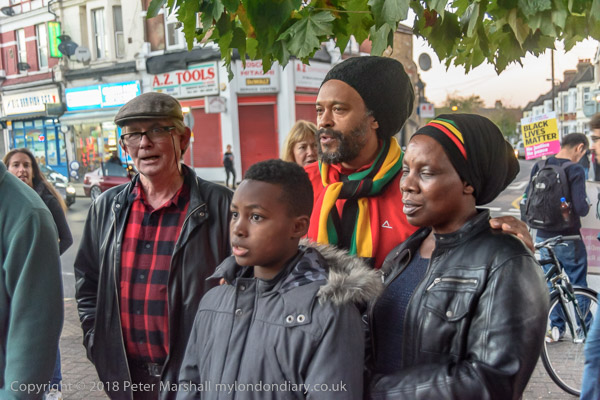
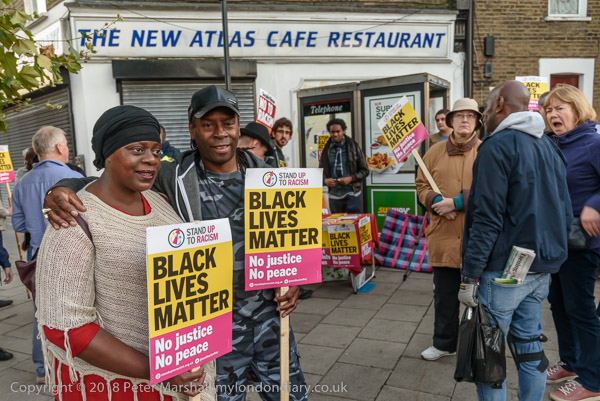
Although force is often needed in making arrests, particularly when suspects are not cooperative, this very clearly went far beyond what was necessary. Both the kicking and the use of CS gas were clearly intended to inflict pain rather than to assist in the arrrest. The video went viral, and North West London Stand Up To Racism called an emergency protest at the site of the arrest, seeing the incident as a clear case of racist policing.

The man arrested was shortly afterwards de-arrested, having clearly no link at all to the knifing the police were there to investigate – and which their attack on this unfortunate man made it much less likely that they would find any evidence.  Not only was it racist policing, it was also something that was counter-productive in the investigation of the crime and corrosive to police-community relations.

It was dusk as the protest began, and soon got darker, but I persisted in working by what ambient light there was. Quite a few pictures were ruined by subject movement but few if any by camera shake, so this was a situation where image stabilisation would not have helped, although faster lenses would have come in useful.

The arrested man’s mother spoke briefly at the protest but requested that we did not photograph her. Others were happy to be photographed, and some actually requested I take their pictures.

When people ask me not to photograph them, I generally assess both the situation and the public interest if any in taking their pictures before accepting their request. In this case I was happy to agree. Of course in general in the UK we have the right to photograph anyone in a public place like the street, and even in private places we can generally take pictures although publishing them might be an offence. But there are times when it isn’t appropriate to stick up for our rights, and where a little humanity makes more sense, and this was one.

Harlesden Protest Police Brutality

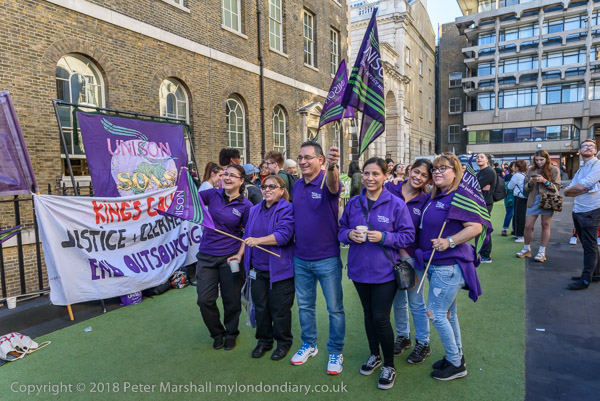
King’s brings cleaners in-house

Although I had to leave King’s College before the decision was announced, there was very much a feeling of celebration among the workers waiting in the area outside the building where the council meeting was taking place,  By the time I’d got my pictures ready to file there was an unofficial tweet of the decision, which was formally announced the following morning. I felt very pleased for the cleaners and also glad that I’d been able to support their campaign by attending and photographing a number of their protests.

People still keep telling me that “protests don’t work”. And its obviously true that some don’t. Our country still went to war in Iraq despite the largest ever protest against it (and one I was sorry to miss, having come out of hospital the previous day and still being unfit, though I had photographed various other protests against the war previously.)  But I’ve always felt that protest could have stopped us going to that war with better leadership of the movement. I do sometimes wonder if there were people in the pay of the intelligence services among them who deliberately let the moment slip. But many protests do acheive their aims, and others provoke and promote important debates and help to change public attitudes and political policies.

Some of the most succesful protests I’ve been involved with over the years have been by low paid workers, calling for better pay and conditions of service. Many of them have been organised by small grass-roots unions, but a few like at King’s College by more determined branches of a major union, in this case Unison. Although often they involve only small numbers of workers, for these people the gains can make huge differences to their lives, both in pay and in satisfaction with their jobs and in health and safety at work.

Some of these campaigns have had almost immediate success, with companies recognising the reasonable demands of the workers and, having been alerted to the Dickensian practices of contracting companies wanting to distance themselves and their reputations from these. Others have been long and hard fought, with Unison at SOAS fighting for over ten years to get workers brought into direct employment, though considerable gains were made on the way; the University of London central administration at Senate House is still dragging its feet. Universities seem less concerned about their reputations than many private firms, or perhaps they simply have more board members with entrenched views.

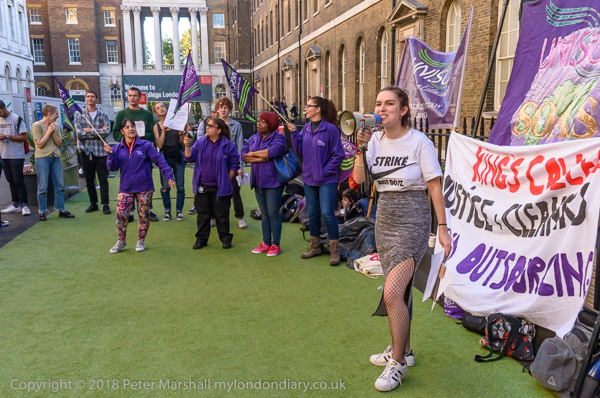
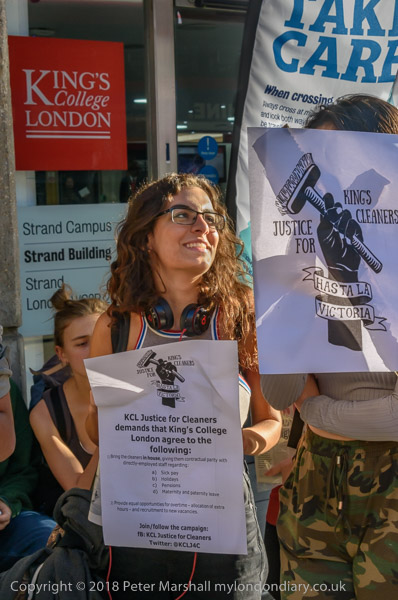
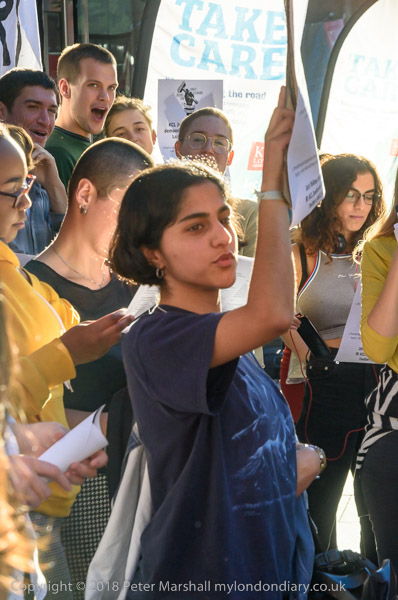
The event at King’s started on the pavement outside the college in the Strand, where students including the KCL Intersectional Feminist Society were running a lively protest.  The pavement gets very busy during the rush hour and police came to try and move the students who insisted on continuing the protest but did try to prevent the pavement being blocked. The police also eventually led away a man who had come to argue with the students; I could make no sense of what he was saying and was unsure whether he simply had mental health problems or was a fascist trying to provoke them as the students said.

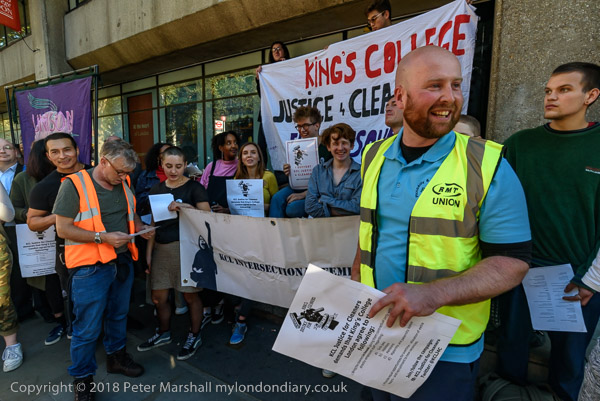
More welcome as visitors were two RMT members, who had been attending a strike meeting nearby, and stopped to express their support for the cleaners. The RMT has been active in supporting its own low paid workers and against management victimisatino of their trade union representatives – a major problem in many of the disputes by low-paid workers.

The students then decided to go inside King’s College to join the cleaners who were waiting outside the meeting. Those outside who were not members of the college, including myself, were signed in as guests to go through the security barriers and we joined the cleaners inside.

Apart from being pleased to see the cleaners, many of whom I knew from previous events, things also became rather easier photographically. There was far more space and it was easier to move around than on the crowded pavement – though the crowds perhaps made for more interesting images. But importantly the lighting was much easier to work with – though again less dramatic.

On the Strand, as this picture shows, the sun was low and shining directly along the street, giving deep shadows and often excessive flare.  Photographing into the sun gave more dramatic images, and it was sometimes possible to hide the sun behind banners or placards, but it made photography difficult. Taking pictures with my back to the sun was easier, but many of the pictures had both areas in  bright sun and those in deep shade.

Had I been making portraits I might have used fill flash, but with wide-angle images this isn’t really practicable, and I had to rely on processing to bring up the shadows and take down the highlights, often with some additional dodging and burning. For the backlit images local use of Lightroom’s ‘De-haze’ was essential. Lightroom continues to improve both in functionality and in ease of use, though I didn’t welcome the recent news that future versions would abandon support for Windows 7, still by far more usable than Windows 10.

Inside King’s, the height of Somerset House’s East wing (where the council meeting was taking place) and the low sun kept the area in shade. Less dramatic but much easier. I’m sure there is some kind of moral in this!

More at Kings College workers await council decision.

______________________________________________________

There are no adverts on this site and it receives no sponsorship, and I like to keep it that way. But it does take a considerable amount of my time and thought, and if you enjoy reading it, a small donation – perhaps the cost of a beer – would be appreciated.

My London Diary : London Photos : Hull : River Lea/Lee Valley : London’s Industrial Heritage

All photographs on this and my other sites, unless otherwise stated, are taken by and copyright of Peter Marshall, and are available for reproduction or can be bought as prints.

To order prints or reproduce images

________________________________________________________
Migrant Mother

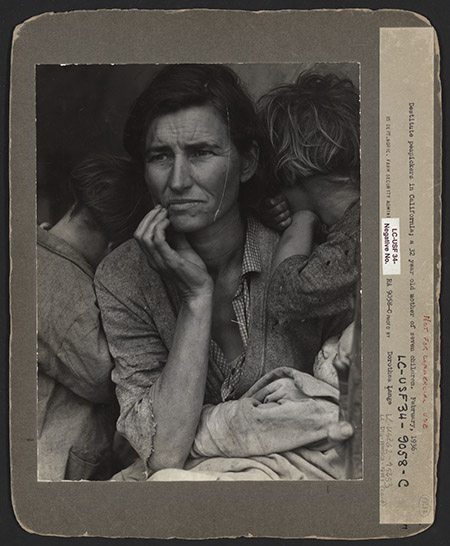
Had you asked me a few days ago I think I would have said that there was little more to say about Dorothea Lange‘s ‘Migrant Mother’ which has already had so much devoted to it, as one of photography’s truly iconic images. But there appears to be at least one significant fact I was not aware of in the new book from the Museum of Modern Art, written by Sarah Meister.

Perhaps not enough to make me want to read the book, but James Estrin, the co-editor of Lens, the New York Times photographic blog, has written a post on it, as always clear and concise, Unraveling the Mysteries of Dorothea Lange’s ‘Migrant Mother’.

As the image was one of a set taken for US federal Farm Security Administration, it is of course available at the Library of Congress, where you can download several versions of it and the others Lange made of Florence Owens Thompson and her children.

This is a smaller version of my favourite of this image, and probably the oldest. The current version of it, available for download as a large tiff if you want to make your own print, has slightly different scratches on it, and both versions would take considerable retouching to make a really good print. As the LoC page above states “This is an unretouched version of the image listed in #1. This version of the image shows a thumb in the immediate foreground on the right side.”

There is more about the retouching to remove the thumb in the book and Estrin’s post, which remind us that Roy Stryker, “Lange’s boss at the Farm Security Administration … thought it compromised the authenticity not just of the photo but also of his whole F.S.A. documentary project” although such practices were widespread at the time and “Ms. Lange considered the thumb to be such a glaring defect that she apparently didn’t have a second thought about removing it“, getting an assistant to retouch the image in 1939, some 3 years after she had made the image in February 1936 (according to the FSA, though possibly March.) Personally I’m with Mr Stryker on this.

Perhaps the most interesting issue raised in the book is that after Florence Owens Thompson came forward and identified herself in 1978, an Associated Press article revealed that she was not as had been assumed of European descent ‘but “a full-blooded Cherokee Indian” from Oklahoma‘, something that would certainly have caused the image to have been seen differently had it been known when it was widely published – and even now where considerable prejudice still exists against Native Americans.  Lange appears not to have provided the usual field notes and captions for this set of images, and to have known relatively little about her subjects.

Sarah Meister’s book is one of a series “One on One” on individual items in the collection of the New York Museum of Modern Art. Surely a prime candidate for such a series should be a book by A D Coleman on Robert Capa‘s iconic D-Day landing image, for which the material by Coleman and his collaborators has been published online in voluminous and convincing detail at Photocritic International in the Robert Capa D-Day Project. While I’m sure that this will one day emerge in book form, I think it is unlikely it will be published by MoMA.

Climate Reality

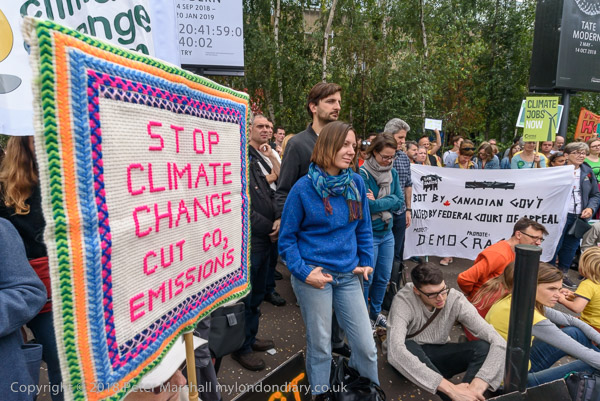
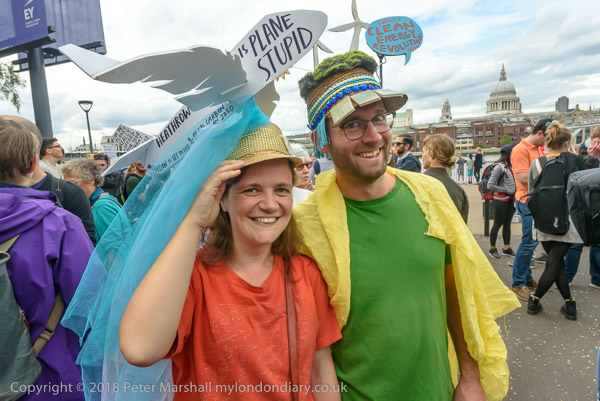
Together with several other photographers we spent some time looking for this protest – and met protesters who were also having the same problem, but finally we found it, not actually at Tate Modern where the Facebook event page had said, but hidden from there behind some greenery at the edge of the busy riverside path in front of the gallery. I think it had only just started, and certainly quite a few others arrived later than us, perhaps having had a similar problem to us. We’d actually walked close to it earlier on our way to the Tate, but it had been hidden on the edge of a larger crowd of tourists listening to some busking musicians.

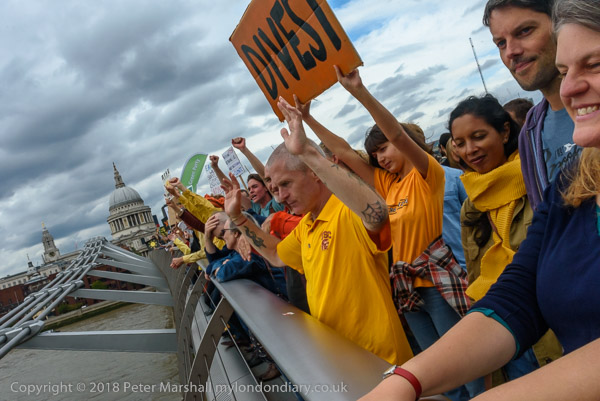
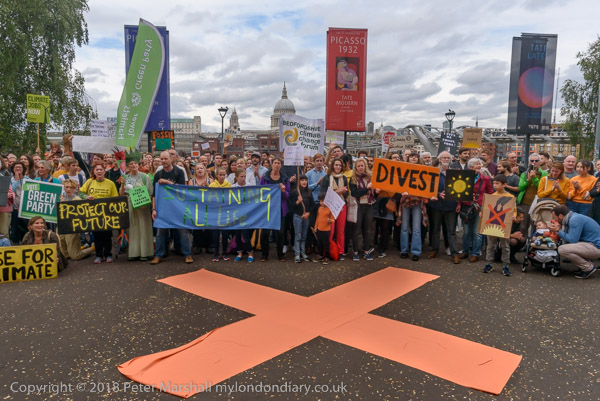
Like many protests it was rather a matter of preaching to the converted, and there were some good and worthy speakers, but perhaps a little lacking in popular appeal, but it was a part of a worldwide action, and seems to have been set up mainly to provide a photograph to send to the international web site. At the end of the rally those at the protest came out of the bushes to stand in front of Tate Modern and be photographed from a high balcony looking down at the crowd, who had been asked to wear yellow for the event.

I hope the photographer on the balcony got a decent picture, though I suspect it wasn’t too impressive.

Certainly it didn’t work that well from the ground, though I did my best, trying to show we were in London by including St Paul’s in the background, but getting the whole crowd in needed a very wide angle of view and this made the cathedral rather small; it was only a little better when I cut off a few at the edges. There was a similar problem when the crowd were asked to turn through 180 degrees for a picture with the  former power station behind them, with its high brick wall and tall chimney.

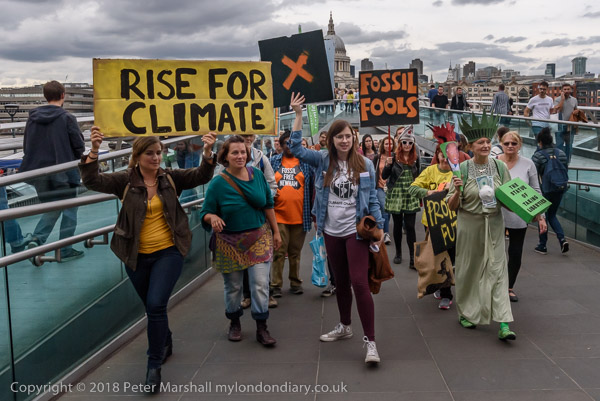
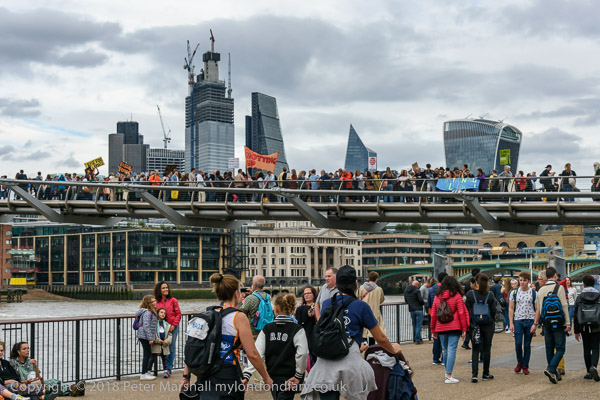
Of course I’d been using St Paul’s in the background while I was taking pictures of the protest and the speakers, but a longer lens had made it more visible, though of course not showing the size of the crowd – a few hundred people. By the time they were invited to walk up onto the Millennium footbridge I think quite a few had decided to leave. Probably the best viewpoint was as they came up the slope, but they did so in dribs and drabs. And once on the bridge it was difficult to photograph them protesting along it. I lent out with my camera, strap wrapped securely around my arm and tried a few pictures, but framing was tricky as I couldn’t see either viewfinder or rear screen. The frame at the top of this post was my best effort, and I was quite pleased with it.

I then rushed down to ground level and took some more photographs. Again there was the problem of either showing the whole group with a fairly wide view which made them rather small, or of using a longer focal length and showing just a small section of the protesters. As you can see from my other pictures on My London Diary at Worldwide Rise for Climate the latter approach was probably better than the wider view above.

There are no adverts on this site and it receives no sponsorship, and I like to keep it that way. But it does take a considerable amount of my time and thought, and if you enjoy reading it, a small donation – perhaps the cost of a beer – would be appreciated.

My London Diary : London Photos : Hull : River Lea/Lee Valley : London’s Industrial Heritage

All photographs on this and my other sites, unless otherwise stated, are taken by and copyright of Peter Marshall, and are available for reproduction or can be bought as prints.

To order prints or reproduce images

________________________________________________________
Marikana, Bangladesh, Bahrain, Brazil

Monday 13th August was a long day for protests in London, and one that reflected the global nature of London both as a financial capital and in its population now.

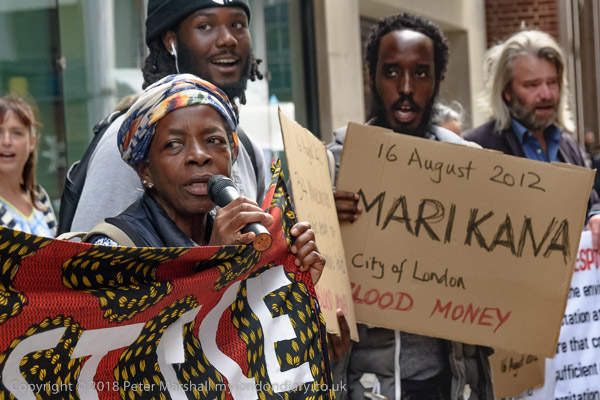
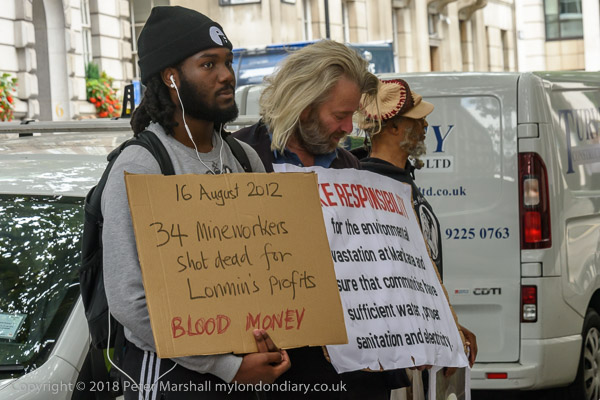
The first event I covered reflected the huge involvement of the City of London in the exploitation of mineral resources around the world, and with it the callous disregard both for the countries whose resources are being plundered and in particular the workers involved. The very buildings we walked around on our tour of investors, insurers and shareholders profiting from the violence against people and nature in Marikana were a reminder of the great wealth that was appropriated from our Empire and is still being made from countries around the world.

This was a story backed up by facts and figures in presentations at the brief stops the tour made as the tour stopped at Majedie, Schroders, Investec, Legal & General and BASF, the major customers for Marikana’s platinum.

The tour came three days before the 6th anniversary of the Marikana Massacre when 34 striking miners were shot dead by South African police at Lonmin’s platinum mine, for striking for better wages and living and working conditions. Those shot were trying to disperse and hide and many who survived are still in prison, and 19 were charged with murder. There has been no justice and no compensation for the victims’ families or for the injured mineworkers. One of the South African company directors implicated in ordering the police to take action is Cyril Ramaphosa, now President of South Africa.

From the city I went by bus on my way to Belgravia, taking a route that took me down Whitehall. Looking out of an upper-deck window I saw there was a protest taking place opposite Downing St, rang the bell and jumped off at the next stop.

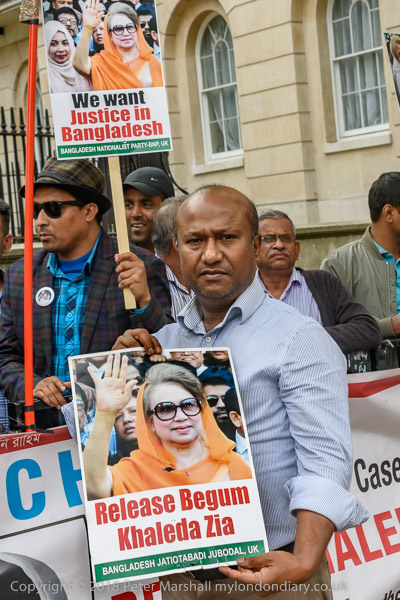
I’d photographed the Bangladeshi Nationalist Party UK at an earlier event also calling for the release of their party leader Begum Khaleda Zia, jailed in February for five years for embezzlement; her supporters claim the charge was politically motivated.

I took a few photographs, but couldn’t stop long as I was on my way elsewhere. Friends from Bangladesh have told me that both the BNP and their opponents now in power, the Awami League are both corrupt and neither represents the interests of the people of their country. There are some things on which I don’t know enough about to take sides.

Fortunately buses in London are usually frequent, and before long I saw the next on my route and made a run to the stop to catch it, getting to Belgrave Square only around ten minutes later than intended.

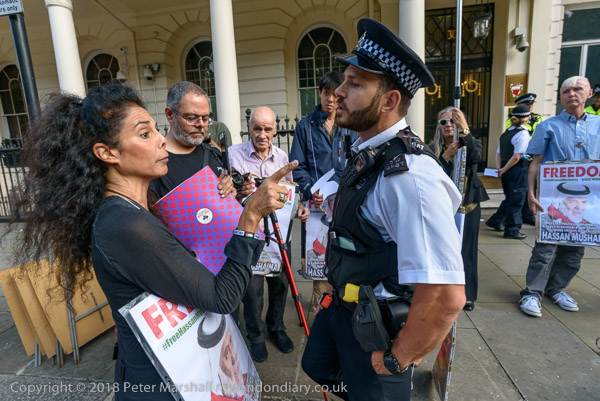
Belgrave Square was for a return visit to hunger striker Ali Mushaima, campaigning for his father imprisoned in Bahrain and camping on the pavement in front of the embassy. Early in the morning the previous day someone in the embassy had gone onto the ambassador’s balcony and thrown a bucket of an unknown liquid down on him while he was asleep.

The police had been called but do not appear to have taken the attack very seriously. While diplomats have immunity the attack is thought most likely to have been carried out by one of the bodyguards who are subject to the laws of this country, but the police appear to have declined to make appropriate investigations.

The campaigners from Inminds.com had returned to show their support in an emergency protest, along with a few friends of the hunger striker. Though the police had failed to properly investigate the attack, a small group came to harass the protesters, telling them they could not protest on the pavement outside the embassy, but had to move to the opposite side of the wide street.

There were arguments and threats of arrest, but the protesters who had previously protested in the same place with police on duty not objecting, refused to move and went ahead, performing a short piece of street theatre in which Theresa May sold arms to the Bahraini dictator which he used to shoot protesters, who were then chained up. Unlike in real life the International Criminal Court came to their rescue, released them and condemned the Bahraini regime for their crimes against humanity.

It was unrehearsed and something of a shambles, but pictures taken by Inminds were later made into an effective comic strip about the situation in Bahrain.

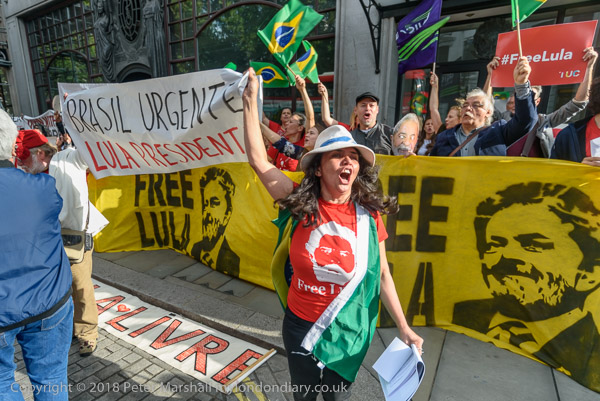
I rushed off and jumped on another bus to take me back to a protest outside the Brazilian embassy. I arrived shortly after it was due to start, but there were very few present and nothing much happening. Eventually more people arrived and the protest began, and I was able to take a few pictures before it was time to leave for home and some food.

The protest by the Workers’s Party (TP) was calling for the release of former President Lula so he could stand in the October elections. The TP say that the right wing who have seized power in Brazil have brought highly dubious charges against both Lula and Dilma Rousseff to prevent them winning in the elections.

By the time the event got going, the sun was low in the sky and shining almost horizontally into my lens making it impossible to work from some positions, and there were some excessive flare made unusable. It also created some very high contrast where there were areas of sun and shade in the same images. Fortunately working with RAW images does make it possible to do a fair amount of taming the contrast, so long as detail is retained in the highlights, but it does add to processing time. Some can be handled by overall changes but faces that are half in shade and half in sun sometimes need both ‘dodging’ in the dark areas and ‘burning’ in the light parts.

More on all four events on My London Diary:

Justice For Marikana – 6th Anniversary
Release Bangladeshi opposition leader
Attack on Bahrain Embassy hunger striker
Free Lula – Brazilians for Democracy & Justice

______________________________________________________

There are no adverts on this site and it receives no sponsorship, and I like to keep it that way. But it does take a considerable amount of my time and thought, and if you enjoy reading it, a small donation – perhaps the cost of a beer – would be appreciated.

My London Diary : London Photos : Hull : River Lea/Lee Valley : London’s Industrial Heritage

All photographs on this and my other sites, unless otherwise stated, are taken by and copyright of Peter Marshall, and are available for reproduction or can be bought as prints.

To order prints or reproduce images

________________________________________________________
Cleaners Protest in Pouring Rain

The Ministry of Justice at times appears to be titled in best Orwellian manner, and certainly so far as its low paid staff – such as the cleaners – are concerned it is very much a Ministry of Injustice. It’s  place I’ve attended a number of protests outside, about the treatment of refugees and asylum seekers, about prisons, about privatisation of probation services, aboujt the slashing of legal aid and more. Most recently I’ve been there a few times about the rock-bottom wages and lousy conditions of employment for the people who keep the place clean.

One major reason that our UK benefits system has become so complex, leading to the fiasco over the introduction of Universal Credit, is that we have become very much a low pay economy, at least for those at the lower end of employment. Partly this is because of the huge salaries and other payments given to the people at the top, but more it reflects the contempt the well-off largely feel for those at the bottom.

Universal Credit aims to drive people into work by cutting benefits; its proponents say that aims to make work pay, but unfortunately they have failed to make work pay enough to live on, particularly in London, where costs are high. It seems to me axiomatic that any full time job should pay as a minimum a real living wage. Paying benefits to people because their employer doesn’t pay them enough to live on  – as our system does is a subsidy for inefficient or unscrupulous employers (just as housing benefit is a subsidy for landlords.)  And of course there are many jobs that the state should pay for people to do, either directly or thorugh employers, but it should be deciding what these are and not leaving it to the whims and distortions of private companies.

Cleaners perform a vital role at the offices of the Ministry of Justice, as they do elsewhere, and should be paid at least enough to live on, which is the figure published annually as the London Living Wage. It seems to me a simple matter of justice, but that seems to be in short supply at the ministry.

The campaign here is one of a number being fought for low paid cleaners by the United Voices of the World trade union, which many employers refuse to recognise and try to avoid having to deal with. The large established trade unions – with a few notable local branch exceptions – have not been very succesful in recruiting low paid workers and dealing with their problems, particularly when many of these workers don’t have English as their first language. They often have cosy arrangements with large employers and are ‘recognised’ as representing low paid workers even when they have few if any members among them. Unsurprisingly they haven’t done much for those at the bottom.

Unions such as the UVW are ‘grass roots’ unions with few if any paid staff – and those who work for them generally do so on the London Living Wage they fight for on behalf of their members. They are small enough to have simple democratic structures where every member can have a say – and in their first language. They organise effective protests at workplaces, but also educational classes (particularly language classes) and social events, a few of which I’ve been invited to and have enjoyed.

The main problem in photographing the event was the weather. The  protest began in light rain, but it was soon pouring, and there was only very limited shelter. Some of the protesters were directly against the wall of the building, where an overhang gave some protection, while others stood in the rain under umbrellas.

I had an umbrella with me, but it isn’t easy to take pictures holding one – cameras really need both hands to operate. And sometimes I could stand with those under the underhang, but it wasn’t always the right place to be to take pictures.  Occasionally I could stand under one of the umbrellas various people were holding, but more often I was standing a little further away and they poured water down on me.

I was getting very wet, and so were the two cameras I was using. Both the Nikon D810 and the D750 have some weather protection, though the lenses are leaky.

I usually keep the D810 on a sling strap at my side, with the lens pointing down, and on the 28-200 I have a screw-in lens hood which offers some limited protection. It isn’t perfect, and vignettes slightly at the wide end when working full-frame, but it’s a great improvement on the plastic Nikon version, which used to fall off at the slightest provovacation. It was an odd size and I think no longer made. I managed to replace the first one I lost after long searching on the web, but it cost £20 and when that one disappeared I decided to go for a generic screw in one.

The D750 with a wide angle uses a more standard lens hood. Still falls off if looked at hard, but when I lose them it’s only a couple of quid for a Chinese replacement (actually slightly better than the genuine thing.) But any lens hood you can use on a 18-35mm isn’t too effective at keeping the rain off.  I have the D750 on a fairly short neck strap, and slip it inside my jacket when it rains, but this means leaving the zip down some way on the jacket – and I get a wet neck and chest.

In my hand when photographing in wet conditions I have a large microfibre cloth, to wipe cameras and lenses. As well as the filter on the front of the lens, its important to keep the tubes of the zoom lenses dry, or else water migrates from them into the lens and condenses as a mist on the elements. And doubtless also on the mechanical bits inside the lens, which I’m sure isn’t good for them.

When I’ve got the camera with the wide-angle in my hand I make a ball of the cloth and hold it in the front of the lens to protect it from rain drops – glass seems to have a strong magnetic effect on them – only removing it briefly to frame and expose each picture.

But for part of this event my job was made much easier, as one of the UVW members, seeing me getting rather wet, came and acted as my assistant, holding an umbrella over me and keeping the worst of the rain off. I was extremely grateful to her. Later the rain did stop and it was easier to work, and for Shadow Justice minister Richard Burgon to come and support the workers in his shirtsleeves. And by the end of the protest the cleaners and supporters were dancing in the street outside the ministry.

Three months later, the dispute is still ongoing, with the Minister of Justice refusing to meet with the UVW.  I’m sure there will be more protests soon.

Ministry of Justice cleaners protest

On the street

Although I take almost all of my pictures on the street I’ve never really though of myself as a street photographer, largely because I think of it as a meaningless category. If you disagree I think it is worth going back to what many think of as the ‘bible‘ of the putative genre, Bystander, and read through it carefully and critically looking at the examples. Of course there are plenty of photographs we can say are definitely not street photography, but nothing really emerges which amounts to a clear definition of a genre.

Yesterday I watched a couple of videos about street photography, both of which were mentioned on PetaPixel. For some reason the link to ‘Cheryl Dunn’s highly-regarded 2013 documentary Everybody Street‘ which is now on YouTube refused to display in the PetaPixel page in my browser, but a search on YouTube found it without problems and I was able to watch it full-screen in fairly high quality and I didn’t notice the ads.

It contains a number of photographers who have worked on the streets of New York speaking about their work, and shows them taking pictures and some of the pictures they have taken. Some are very well-known, while others less so, and their work covers a fairly wide range of practices. There is some attempt to give a historical perspective, with Max Kozloff talking about a number of other photographers from Alfred Stieglitz on.

One of the featured photographers, Rebecca Lepkoff, talks a little about the New York Photo League which brought her into photography, though it would have been good to have had a interviewer drawing her out more about this. She was one of the photographers I wrote about years ago in a series on the Photo League, but it would have been good for the film to have looked in a little more detail on some of the others, though few now survive. I think it is impossible to overstate the importance of this organisation in what later became known as ‘street photography.’

Some of the work shown and discussed in the film is quite clearly documentary photography,  and the rest seems to me too varied for the overall category of street photography to have any real use.

I think the film was about 80 minutes long, and it is certainly a very professional film, with some nice footage of New York, making me feel I should have gone there and lived and photographed on its streets, but there were times when I felt it dragged and I did skip forward a little at times. The making of the film was made possible by over $45,000 of crowdfunding but it looks as if it cost considerably more

The second film featured on PetaPixel was the curiously capitalised ‘Why you SHOULDN’T do STREET PHOTOGRAPHY‘ by UK photographer Jamie Windsor, which I have to say I found far more difficult to watch. Not because of what he said, which in part echoes things I’ve said and written in the past, but because of the production and personality of the presenter. He looks at the work of several photographers, particularly the late Hong Kong photographer Fan Ho, Nan Goldin and Martin Parr.

I wasn’t familiar with the work of Fan Ho, but by the time I’d seen a few pictures found it extremely repetitive, and failed to see that it represented in any real way the changing times of the city. If you like pretty, arty photos it may be for you.

Goldin of course did as he suggests live the life of the subjects she photographed, recording moments in the lives of her friends and their particular subculture, with her work something of a ‘family’ album.

I share some of Windsor’s misgivings about Martin Parr and his depictions of working class life. His approach was clearly rather more distant than that of – for example – the Picture Post photographers, and sometimes appears to be very much as he suggests reflecting he prejudices of a middle-class photographer, making judgements about those he photographs.

But not all those Picture Post photographers were Bert Hardy, who grew up a working class kid in the Borough and some who managed a much more empathetic approach came from rather more patrician backgrounds than Parr.

Despite Hardy’s working class background he appears to have had no problems relating to and empathising with people from all walks of life and all levels of society. The nature of Parr’s work came from his intention to be a social commentator rather than to engage with the people he was photographing.

Taking a photograph always implies a point of view. We shouldn’t pretend to “accurately represent a culture” whether or not we are part of it, and I’m not at all sure what that means. For me, empathy with the people I photograph is vital, and to that extent I agree with him.

Much of the uneasy interest I have in, for example, Martin Parr’s New Brighton pictures, comes from knowing that his is a rather snooty middle-class exploitatative view of the working class. It gives them the edge that makes them stand out, just as Bruce Gilden’s photographic street assaults do, though in Gilden’s case I find the approach soon gets to be rather boring, the pictures more about his antics rather than the subjects he photographs. I want photography to be about the world, not about photography.

And it is perhaps empathy that I find absent in Fan H0’s work, which uses people as tokens or ciphers, something which the presentation in this video emphasizes. They remind me of my least favourite of Cartier-Bresson’s work, what another photographer called the ‘waiters’, where the photographer had clearly identified a situation and then waited for a person to put themselves in just the right spot. It’s a side of ‘street photography’, particularly loved by amateurs, that I find just boring. But I wouldn’t want to proscribe it. By all means let a thousand Fan Ho’s bloom, just don’t expect me to spend much time looking at them.

Both for the people who do it and for the audience (if any) for it, photography can be many different things. It’s fine for Windsor to state what he thinks and to ask others also to think about their own practices, but not, as his title says, to try to impose a straitjacket on others.

On the train

I have mixed feelings about taking pictures thorugh the window on train journeys, though I do it quite often. While I enjoy just sitting and looking as the coutnryside flashes past, and we rush through towns and villages, our Intercity trains now go too fast, often passing through stations at speeds too fast to be able to read their names.

We can of course use our smartphones to tell us our location, though even they have problems keeping up, and its just a little disconcerting to often see on the map that we are in the middle of a field distant from any railway line.

Looking out of the window also seems to be a waste of time, when I could be reading a book or writing a post such as this, or even be reading Facebook or other web sites on my phone or notebook. But I do quite a lot of it, just feeling slightly guilty, and sometimes take a few pictures.

The great majority of them get deleted either on the spot or later,  with line-side posts and bushes having appeared in the fraction of a second between the decision to press the shutter and the actual exposure. Others because my split-second decision was simply wrong – you don’t get long to think at 145mph.  And then there are those spoilt by dirt on the window, though I try to find a clear patch. Or by reflections that are hardly noticeable when you make the exposure but glaringly obvious in the result.

It was much easier back in the old days, when trains went slower had windows you could open, and even lean out of (though there were notices to warn you of the danger of doing so.)

When I took pictures through train windows more seriously, I would travel with a cloth and, having picked my seat would often go outside and give the relevant window a much-needed clean.  Of course it was only really possible if you joined the train at the station it started from and sat on the platform side.

Reflections can be minimised too,  first by holding the front of the lens as close to the window as possible, and then by shielding around the lens. A rubber lens hood was useful for this, as it could be pressed up to the glass without transmitting the vibrations of the window to the camera – and if your cleaning cloth was a dark colour it could also be used to help.

I took hundreds of photographs – if not thousands – in this way through windows,though more often shops than trains, and was pleased to see that someone has come up now with ‘The Ultimate Lens Hood‘, a giant version of the rubber lens hood, though it perhaps looks too geeky for me to use it in public.

The journey from Doncaster to Hull flashed past too fast for me to take pictures,, except for one snatched of Alexandra Palace before we really picket up speed, though rather marred by the power lines across it,  but the service from Doncaster to Hull proceeds at a leisurely pace – and I think like my own local services rather slower than under British Rail as train operators have added a spare minute here and there to cut down the fines for late running – in the same way they now annoying quote the time of the train as anything up to 2 minutes after you can actually board it. The 12.00 is now really the 11.58 so far as passengers are concerned.

Somewhere in Lincolnshire the line goes along the edge of a large windfarm, and since we were jogging along at perhaps 30 or 40mph I was able to take a whole series of pictures, seven of which I’ve put on-line.  There was even time to think a little about composition, though of course I had no control over the running of the train. But I had time to look at what was coming up and thinking where the train would be, looking out of the window as well as at the camera screen.

Of course I didn’t get everything right. Rather more than I’ve shown were discarded, and even those that are on-line aren’t perfect. They’ve also had some tidying up in Lightroom, including some rotation, perspective correction and cropping, something that would have been tricky to get right in pre-digital days.

I took a few more at other places on the journey, and also read some of my book. Most of what I took were quickly deleted, but I’ve kept one from Goole and another as we were coming into Hull. I’ve photographed Goole’s famed ‘Salt and Pepper’ water towers before (and better) standing on the ground but the train does give you a different viewpoint.

And although the station in Hull is now just Hull, rather than Hull Paragon, the signal box outside carries a reminder of the past, as does the door into what was once the bedroom shared by my two sons next to where I’m typing this, still adorned by its bright orange-red sticker:

HULL

PARAGON


You can see another 6 pictures of the windfarm at On the way to Hull. And should you be sitting on a speeding train frustrated by not being able to read the station names, you can always take a burst of pictures as you go through  – one of the very few uses I’ve ever found for those extremely fast shutter speeds on my mirrorless cameras. When else is 1/4000 (or even faster) useful?

______________________________________________________
There are no adverts on this site and it receives no sponsorship, and I like to keep it that way. But it does take a considerable amount of my time and thought, and if you enjoy reading it, a small donation – perhaps the cost of a beer – would be appreciated.

My London Diary : London Photos : Hull : River Lea/Lee Valley : London’s Industrial Heritage

All photographs on this and my other sites, unless otherwise stated, are taken by and copyright of Peter Marshall, and are available for reproduction or can be bought as prints.

To order prints or reproduce images

________________________________________________________