PG Closure Enigma

The British Journal of Photography somewhat surprisingly announces as a scoop the news that London’s Photographer’s Gallery will be closing for a month from September 19.

I thought the closure had been long planned and remember going to a presentation by the architects who were overseeing the redevelopment last year. And when I got home after the opening of the current Sally Mann show on June 18th I wrote:

I was disappointed in various ways at the Photographer’s Gallery opening of a show of Sally Mann’s work yesterday evening, the last to take place in their current premises before they close for extensive rebuilding. But the show, The Family and the Land, which continues until 19 September 2010, is certainly worth at least a brief visit.

So I’m hardly surprised at the news!

But the feature on the Photographers Gallery is perhaps one of the few interesting items in the otherwise rather tedious September issue of BJP, and you can read it online.

It’s also hard to understand the headline that says  ‘Photographers’ Gallery to close down for a year, answers criticisms‘ as it seems to me that it rather signally fails to do so in the article. I’ve been a member of the gallery since soon after it was founded in the 1970s (except for a short period where they lost my membership details)  but find it hard to disagree with the criticisms that so many photographers have of it and its programmes. 

Quoted by the BJP are Magnum’s Chris Steele Perkins (the BJP gets him to expand on his June statement “I don’t hate The Photographers’ Gallery, I just think they’re shit”) and Brian Griffin, along with other figures in photography.

The Photographers’ Gallery is funded as if it was a major institution covering the whole of photography in the UK, its £852,693 grant being almost as much as the other photographic recipients – Photoworks, Impressions Gallery, Open Eye Gallery, Photofusion, Redeye Photography Network, Hereford Photography Festival, Four Corners Film and Pavilion put together. What we really need is something rather more like New York’s ICP or Paris’s MEP, rather than an organisation that seems to be pursuing just a particular niche which many of us feel is peripheral to photography.

You can read my thoughts about the differences between the PG and the MEP in a post from two years ago, Paris and London: MEP & PG, and more of my thoughts about the gallery in a post from the opening of the gallery at its new site,  Zombies in Ramillies Street.

I’ve always supported public funding for the arts in principle and still do, but I often find it hard to do so when in so many areas so little of the funding flows directly into supporting arts practice and so much into questionable institutions.

Perpignan Winners

Lens has a nice feature on the top award winners at this year’s Perpignan Festival, with some interesting photography from Frédéric Sautereau winner of The Visa d’or – Daily Press for his work for French newspaper La Croix, VII photographer Stephanie Sinclair, winner of the Visa d’or Feature award for work for National Geographic & The New York Times Magazine and Damon Winter of the New York Times, winner of the Visa d’or News award.

It was indeed a very good year for photographers associated with the New York Times, although Lens would probably have run a similar feature even if their paper had not been involved.

So far as I can see in the awards page, none of the three winners or the other six nominated photographers is British or has any connection with any UK newspaper or magazine.

There are some fine British photojournalists, but we perhaps lack the kind of photographic culture that incubates great photography; few newspapers or magazines that publish more than individual images or encourage thoughtful photographic endeavour. So perhaps the lack of British names  on the list isn’t too surprising.

Ian Tomlinson Eyewitness

On Foto8 you can read the story by Vu photographer Michael Greive of how on 1 April last year he photographed Ian Tomlinson in his dying minutes. His first picture of the incident shows Tomlinson sitting on the ground shortly after the fatal blow by PC Horwood in the pedestrian street behind the Royal Exchange; Tomlinson, seen from behind, looks up towards police who appear to be ignoring his pleas. After taking this frame, Grieve turned towards a group of police standing to the right to take another picture as a record of the whole scene, and at the back of this picture is the officer later identified as Horwood, two hands holding a club with his face partly covered.

A few minutes later, Greive saw the same victim, clearly in need of urgent medical attention. Police had prevented protesters – including a third year medical student –  and a news photographer from coming to his assistance; one of the protesters had called the ambulance service, but they asked to speak to the police and the request was ignored.

Grieve took further pictures as Tomlinson, finally attended by police medics, was dying. It was only several days later, when a friend told him that he could be seen taking a picture of Tomlinson on the film of the unprovoked assault by Horwood which a US investment manager had taken and later sent to The Guardian that the photographer realised exactly what he had witnessed.

Grieve was advised to contact the Tomlinson family’s solicitor with his evidence and was later interviewed by the IPCC who were investigating the case. He decided to cooperate fully with them, supplying high-res scans of his images, in the hope that these would help in ensuring a conviction. Among other things his pictures showed conclusively that PC Horwood was not  wearing his serial number.

In his feature, illustrated by a number of the pictures he took, Grieve records his disgust at the failure to prosecute Horwood.  It’s hard indeed to disagree with his final paragraph:

“But photography did not fail that day. It recorded evidence as best it could from professionals, amateurs, to the unauthored CCTV. All photographers acted with total professionalism, doing their job, and not, as the police may these days accuse us, acting like potential terrorists or paedophiles, or whatever they decide to pull out of the hat. It goes with out saying that the only individual who unleashed terror this particular day at G20 was wearing a police uniform with his face partially obscured and failing to wear his serial number. And though he may be reprimanded internally by the police force he has, in effect, got away with it. And we citizens have to fight our corner and watch our backs.”

As the farce of an investigation into this case and others has shown, the police are effectively above the law – particularly in dealing with protesters and with the working class and ethnic minorities. The law at every level is still very much a law for the rich and privileged.

My Own Day

I wasn’t around when Ian Tomlinson was killed, although I had been with the protesters as they made their way to Bank in the morning. By the time I’d followed a second group there the area was packed with people and it was impossible to move down past the Bank of England. As well as the protesters there were literally hundreds (if not thousands) of photographers and I decided my time might be better spent covering the other protests going on around London.

So I left the the demonstration at Bank a little after noon, going to photograph the Climate Camp as they arrived to set up camp in the middle of the street a quarter of a mile away in Bishopsgate. As I left, police had started to “kettle” the protesters, refusing to let them leave but were still allowing press to go out through their lines. Later I went to photograph the ‘Jobs Not Bombs‘ demonstration at the US Embassy and march to a rally Trafalgar Square – and police were by then refusing to let journalists back into the area around Bank. And by the time of the police violence against the Climate Campers I was back at home and in bed.

Earlier I’d seen a few minor incidents as police snatched some masked demonstrators apparently at random out of the crowds and stood among the TSG as some of them paced from foot to foot obviously itching for some action. They seemed to me more than eager for confrontation, and it was obvious that they were out to cause trouble and to have no interest in keeping the peace.

© 2009 Peter Marshall
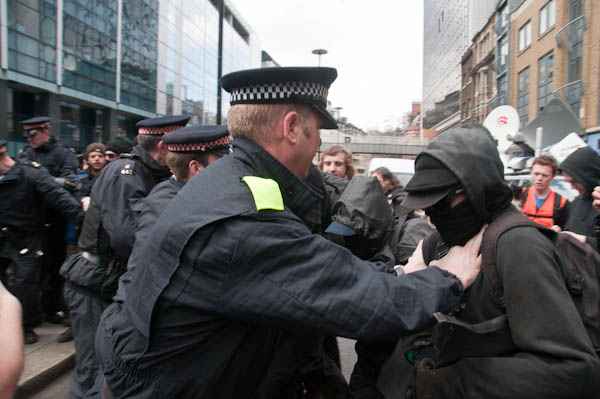
Police grab a masked protester at the Climate Camp

The murder of Ian Tomlinson (and despite the CPS decision it is difficult to describe it as anything but murder) didn’t surprise me, although I was shocked by it, as well as by a number of other non-fatal incidents recorded on other videos, including attacks on several journalists as well as protesters.

© 2009 Peter Marshall
Prof Chris Knight, one of the G20 Meltdown Organisers, and the officer responsible for the policing  at Bank meet at the start of the Ian Tomlinson Memorial March

Later I attended a number of protests against the killing, including a march in memory of Ian Tomlinson organised by the people who had organised the event at Bank, now working with the Tomlinson family. Later came a candlelit vigil with the family and, after the announcement of the failure to prosecute, a further demonstration outside the offices of the DPP.

© 2010, Peter Marshall

I think we haven’t heard the last of this case, either in the courts or on the streets. Perhaps it will even lead to action to curb police excesses by our parliament. But given the record that doesn’t seem too likely.

Metadata Mysteries

Photo-Attorney Carolyn E Wright has stirred up a metadata controversy again with Is Google Stripping Your Metadata? posted a couple of days ago. In it she links to a couple of posts from the Gunar blog, Google in the hot seat for stripping metadata in image search results (May 27, 2010) and What should Google do about media metadata? (June 3, 2010)

As I’m sure we are all aware, the vital part of metadata for photographers is the copyright information which shows our ownership of an image, as well as our contact information. Google for its image search feature produces thumbnails of images from web sites, and in making those fails to include such ownership information. As Gunar points out, industry guidance – such as the Metadata Manifesto from the Stock Artists Alliance – is that ownership metadata should never be removed, and the technical means to transfer it when creating derivative files are well-documented and relatively simple.

© 2010, Peter Marshall
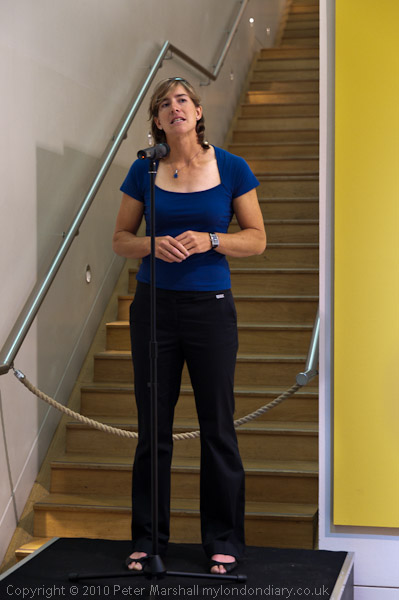
Katherine Grainger at the NPG. Thumbnail saved from Google search – no metadata.
© 2010, Peter Marshall

© 2010, Peter Marshall
Full size image found in Google seach – is saved from original location and so has full metadata.
© 2010, Peter Marshall

Gunar suggests that not only should Google always respect and transfer such information when it is present, but that it should also add the URL of the web page on which the picture is displayed. It’s data that Google obviously has and is currently in the link text on each image, along with the image URL. This would as stated be a very useful service, particularly for those older images put on line before we realised the importance of metadata and the threat of orphan works legislation.

As the post suggests, removal of metadata is illegal in the USA under the “copyright management information” (CMI) provision of the Digital Millennium Copyright Act, and according to leading copyright lawyers also in the UK. Perhaps it is about time that one of the leading photographers’ organisations in the US gave notice of an action against Google, who do rather seem to be dragging their feet over incorporating a few straightforward lines of code into their thumbnail production.

The same DMCA provision has also been dragged – perhaps rather less convincingly – into the dispute between Shepard Fairey and Associated Press over his use of an image of Barack Obama (news in the  BJP a week ago was the photographer Mannie Garcia has dropped his claim against AP) which is due to come to court in March 2011.

According to a post by Julian Sanchez on ars technica in March, AP are alleging that Fairey violated the DMCA copyright removal provision in making a copy of the work from which to produce his artwork. It isn’t clear what they mean by this, but Sanchez points out that “CMI embedded in a digital image as metadata, after all, will necessarily be omitted from a printed copy of the work.

Google are perhaps not the worst offenders of major online services. In April 2010, Jonathan Bailey reported on Plagiarism Today Flickr and Facebook STILL Strip EXIF Data. Flickr apparently now keeps it on the original uploaded files, but there is none on the other sizes that it generates. Of course most EXIF data isn’t a great loss, and what is important is particularly CMI data, most of which is IPTC data, but that probably goes the same way as EXIF.

Plagiarism Today also has some stock letters for making use of the DMCA to get content you own removed from web sites. It’s easy to do and there is useful guidance in DMCA Takedown 101, although I followed the perhaps more straightforward advice from Photo-Attorney Carolyn E Wright on NatureScapes. Unless you have some acceptable form of authenticated digital signature you will need to airmail or fax your signed take-down notice to the offending service provider’s DMCA agent.

It’s perhaps a symptom of the need to get more people to understand the need for metadata that almost all the web links I found when researching this article were about how to remove it rather than preservation.  Usually this was simply to reduce image size, although it was good to find the following in Yahoo! web developer’s Stoyan Stefanov’s Image Optimization, Part 3: Four Steps to File Size Reduction

“Important note on stripping meta information: do it only for images that you own, because when jpegtan strips all the meta, it also strips any copyright information contained in the image file.”

Also on my long trawl I came across a reminder that there can be privacy issues when EXIF data is included. If you are an illegal marijuana grower it probably isn’t a great idea to take pictures of your crop and upload them – even through an anonymous proxy – complete with EXIF geotags!

Jpegs From Lightroom

Two weeks ago, in the post Lightroom 3.2 RC I wrote “they haven’t tackled any of those things I find most annoying – like ‘Export’ giving lousy soft and over-large file size small jpegs.”

I met bahi a couple of months back at one of the monthly London meetings of Photo-Forum – well worth attending if you are in London on the 2nd Thursday of the month – it takes place in Jacobs Pro Lounge in the basement of their New Oxford St shop, from 6-8pm and afterwards we enjoy free food at a nearby pub paid for by a raffle during the meeting – the prizes are usually prints donated by the photographers who present work that evening.

Bahi is from Shoot Raw, an organisation that delivers support and training for photographers in digital photography, including Lightroom training and in a comment to that earlier piece  gives a useful link to Jeffrey Friedl’s analysis of file size vs quality for Lightroom JPEG export, and also asks me to go into more detail about the problem I mention.

When I read his comment I’d just been going through some of the pictures I took at Notting Hill yesterday and so decided to use the picture I’d just developed in Lightroom 3.2RC(on PC) as a fairly random example.

This is the full image – scaled down from the original D700 raw file taken at ISO 800 from 42656×2832 px to 600×399 px (and displayed here at 450x299px.)

© 2010, Peter Marshall

Not one of my greatest images!

First I tried using File Export to produce this file – here are the settings I used :

At 70% quality the file size for the 600-399px was 312kB.
At 30% quality the file size for the 600-399px was 254kB.

I tried to get File Export to produce a file using a file size limit of 150 and200Kb, but both times it reported it was unable to do so.

I selected the file and went to the web module in Lightroom, outputting a web site containing this file. I used the same 70% quality setting as before. The file produced was 118kB.

Here are some 300% details from the three Lightroom jpegs – as you can see, despite the huge file size differences the two 70% files are very similar.

© 2010, Peter Marshall
300% view of detail: File Export, Quality 30, 254 kB file

© 2010, Peter Marshall
300% view of detail: File Export, Quality 70, 312 kB file

© 2010, Peter Marshall
300% view of detail: Web Output, Quality 70, 118 kB file

[These files were created by viewing the files at 300% in ACDSee Pro, capturing with PrintScreen and pasting into Photoshop and cropping.]

70% is the setting I currently use for My London Diary, generally giving file sizes that are reasonable for broadband users – even on a page with a dozen pictures. Back in the old days of slow dial-up I used greater compression (and some special software that could actually use different compression levels on different areas of the same image) to trim file sizes to the bone, but this is no longer needed.  Before switching to Lightroom I had moved on to batch processing from full-size images with ACDSee Pro, which typically seemed to produce comparable quality with file sizes a little  smaller than Lightroom.  It isn’t possible to simply select an equivalent quality setting, but files slightly under 100kB from ACDSee seemed comparable to the Lightroom 70% file.

I’ve not investigated this Lightroom problem in great detail, butI get the impression it gives the largest files from those images I’ve worked on most with the tools such as the adjustment brush.

Friedl in his piece at the link given above points out that despite having quality settings labelled 0-100 actually only implements 13 quality levels  – just like Photoshop. I think you also get those same 13 quality levels if you use the checkbox to limit file size, but the file sizes can be different. Using quality 92 (or rather 85-92) on the above image gave a file size of 3748 kB, while limiting the file size to 5000 kB produced a visually identical file of 3550 kB.

Long, long ago when I produced jpegs using a DOS command line program I there were at least two parameters which had to be specified. One was a 1-100 setting for the quality of the match required between cells which would be replaced by the same cell, and the second was some kind of smoothing function. I don’t know that we need that kind of control, but perhaps we could be offered a little more than we have at present.

Obama Poster Controvery Continues

In Fairey or Not? I took a look at the controversy over the use by artist Shepard Fairey’s who clearly based a poster of Obama on a photograph by AP photographer, Manny Garcia, using the work without permission or payment.

I’ve quite a few times been paid by artists who wished to base their works on my pictures, so I have some personal interest in the practice continuing. Recently Dan Heller has posted a lengthy reply on his Photography Business blog to  law professor Peter Friedman’s article Ruling Imagination: Law and Creativity which asserts that Fairey had copied nothing that could be copyrightable. Both pieces are worth reading.

There are many aspects where copyright law – in the UK as well as the US – lacks clarity both as to its intention as well as its application.

Do We Need Property Releases?

Thanks once more to Photo Attorney Carolyn E. Wright fora very interesting post on her blog pointing me in the direction of A House’s Right of Publicity, posted on Wednesday on the Property, intangible blog about Robinson v HSBC Bank USA, a case in which Mr Robinson sued because a pictures of his house had been used in a flyer distributed with the San Francisco Chronicle advertising the bank’s “Premier Mortgage.”

Robinson’s lawyers put up seven different cases under US and Californian law as to why this usage was a breach of his rights, and all were thrown out. A comment on the fotoLibra blog, comes down against the decision, on the grounds that it was “discourteous in the extreme not to request permission of the owner.” Well perhaps so, but that doesn’t make it illegal.

FotoLibra also challenges the policy of the UK National Trust, who as many of us know have for some years been attempting to impose a ban on the photography of their properties other than “strictly for private use”  – and have managed to get many photographs of these buildings removed from image libraries, including pictures taken from outside of their property.

Many have questioned the legality of their position, as well as the morality of banning photography of buildings which are owned by them on behalf of us, the nation. But although like fotoLibra we might “defend the right of people to photograph what they will, and sell those photographs if they can, if they are to be used in an educational, illustrative, informative or editorial function” we would also like them feel that, on our behalf the National Trust should both have to give consent and also receive payment for images of our property being used to promote commercial gain.

So the US decision is good in some respects but bad in others. What would be good is a clear ruling that distinguishes editorial and related usages from commercial use.

Recently in the UK, press photographers have been told by police and PCSOs that they need a permit to photograph in Royal Parks in London, which include Victoria Tower Gdns next to the Houses of Parliament.  Here I was approached and informed of this by a PCSO on Sat 24 July. The alleged need for a licence laughably also includes Parliament Square where I have taken literally thousands of images this year alone.

The first time I heard of this happening was a couple of days earlier, where a demonstration had been taking place outside Buckingham Palace against the invitation to a BNP MP to attend one of the Queen’s garden parties. Obviously police had been dredging around to find some pretext to try and prevent reporting and someone had come up with this.

The distinction between commercial and editorial photography has long been understood and it is one we need to continue to insist on.

So do we need property* releases? In general for commercial use we do (despite the US case) and for non-commercial use the answer continues to be no. So far as the National Trust is concerned I think it is clearly no so long as we are on public land when we make the photograph, but perhaps less clear once we have gone on to National Trust property. Although the National Trust acquires property on behalf of the nation, often in lieu of tax payments that would have gone into the national exchequer, by some legal sleight of hand (which certainly should be illegal) it isn’t ours. And it probably won’t be long before it is completely privatised and then taken over by some Spanish-owned company.

[*Readers are reminded that property doesn’t just mean bricks and mortar but refers to anything that someone owns. So unless you own everything that appears in one of your photographs it probably needs a property release.]

Voja Mitrovic

Printers are seldom celebrated and it was good to read a two part piece, Voja Mitrovic, Printer to the Greats by photographer Peter Turnley, himself once a printer. Mitrovic, born in 1937,  has printed the work of many great photographers, including Henri Cartier-Bresson and  Josef Koudelka . He arrived in Paris from Yugoslavia in 1964,  and worked from 1966 until his retirement at the start of 1997 at the world-renowned Paris photographic laboratory Picto created by Pierre Gassmann in 1950.

Turnley worked closely with Mitrovic, both as a printer (and he reveals it was only with his help that Turnley got a job as a printer at Picto) and when Mitrovic printed his photography, and his closeness to the printer makes this a compelling article.

As he points out, although we may not know Mitrovic’s name, we have all seen many of his prints, both in many exhibitions but for so many books. In the feature there is an incredible list of the photographers he has printed for.

Many photographers prefer to print their own work, and I’ll write about this more in another post. But for many others the collaboration with a skilled printer has been a vital if seldom acknowledged part of the success.

Uncle Earl’s Photos

I thought I had said my last word about the pictures that made the headlines when it was claimed they were long lost works by Ansel Adams when I wrote Lost Ansel Adams? in which I made clear that whatever the authorship of these images, I felt they were of no value, going perhaps a little further by writing “I’d really like to see some kind of mechanism for losing much of Mr Adams’s work rather than anyone coming up with more.”

What seemed absolutely clear from the images on the web was that whoever had made them they were not a product of the mature photographer who produced a number of truly outstanding images. I found it hard to believe that had he made them he would not have destroyed at least some of them, and more than unlikely that he would, as alleged have shown them to others during his teaching.  It was also clear that none of those supporting the claim had any real competence in the matter.

But I revisited the scene after reading A D Coleman’s comments in his Cowflop from the Adams Herd (1) largely because of some of the points that he made about the idea of ‘original prints’ with a post Coleman on Adams or Not in which I tried to look at whether there was any way we could reclaim the term and give in some true meaning in a photographic context.

But now I’d recommend you go back to Coleman’s  Photocritic International, scroll down to the bottom of the page and start reading each of his contributions in turn just for the sheer pleasure of seeing a critical sledge-hammer applied with immense control and precision to a rather small and mouldy nut. It kept me up for an hour later than I intended last night reading through it.

Coleman has not yet finished his series, and there is more to come, and I think it possible that there could be some clumsily litigious comeback against him from the by now aggrieved parties, though given his apparently meticulous evidence-based approach I see little chance of any success.

Of course the whole story has little to do with photography, but a great deal about the curious distortions that the art market has imposed on much of the institutional basis that now underpins our medium. It perhaps would not matter much if it was confined to the world of dealers, but it also now very much determines the agendas in the museum and academic sectors.

Personally, I’m going to get on with making pictures and with showing them on the web and elsewhere when and where I can, producing moderately priced books through Blurb and perhaps in other ways, and selling them for reasonable prices as prints or licensing them for use at costs that reflect both my needs and my customer’s ability to pay rather than the kind of bulk-buy rates available from the image superstores.

Perhaps finally on this topic (though who knows what may ensue) Eric Felten has an interesting piece in the Wall St Journal, Ansel Adams And the Art World Name Game which concludes with the thought:

we might want to be more open-minded when we encounter art of dubious provenance, allowing ourselves to judge and appreciate works for their quality rather than their attribution. Who knows, maybe Uncle Earl was an artist with something to say.

Although I very much regret that Uncle Earl isn’t around too enjoy his moment of posthumous fame and gallery showing, I’m afraid it is only too clear that he was not.

Photo Paris

© 2010, Peter Marshall

I still get a great buzz from seeing my work in print*, and although once again it’s “only in Blurb” I still felt that same thrill as I ripped open the packet containing my latest publication, Photo Paris.

Although it’s a new book – I finished and uploaded it earlier this month but only made it public today when I’d checked my first ‘proof’ copy – in some ways it’s also rather old. I took the pictures  in 1988, twenty two years ago, and shortly afterwards assembled a number of the enprints from the visit there into a single copy of a book, made from cartridge paper sheets cut to page size and bound together using an office report binding system that punches a row of rectangular holes along one edge for a plastic ‘comb’ binder.  To make it look more like a proper book, I laser printed a cover to go around and hide the binder.  It’s still there on my bookshelves and over the years I’ve often taken it down to look through.

© 2010, Peter Marshall

Although it looks rather amateur and is now showing signs of wear, it has one advantage over the new Blurb-printed edition, in the the pictures are genuine photographs.  But they were machine-produced prints with no dodging or burning and the colour is sometimes not quite how I think it should be. Although the printed work just lacks the kind of quality of a photographic print, at least I was able to work on the scans to get the pictures looking how I wanted them.  The print quality from Blurb is adequate though not spectacular, and I think the premium paper which I specified makes slightly less difference with colour than with black and white.

This is an extended volume – which has more than twice as many images as the original version – now 67 in the actual ‘Photo Paris‘ series, along with the view from the window of the flat I stayed in and the usual portrait of me.

© 2010, Peter Marshall

Rather than working from the original, I made contact prints of all the negatives from the project using my Epson V750. Most of the negatives were already in transparent filing sheets and it was relatively quick and easy to simply put them on the scanner in these, although some I had to transfer to new sheets to do so. From these ‘contacts’, scanned at 1200 dpi so I could enlarge individual frames for a good look, I discovered a number of images I’d overlooked at the time, in some cases because the en-prints were rather poor.

I then scanned around a hundred images at 4800 dpi on a negative scanner – the Minolta Multi Pro, no longer made but still one of the best negative scanners around when equipped with third party ‘Scanhancer‘ diffuser and Xpander negative carrier. This was around 20 hours of work, with probably around the same time in Photoshop needed to get the scans into decent shape. Of course I didn’t need files that big for the book, but I’m also working for a show of some of these pictures in a couple of months, and if you are making scans it generally makes sense to scan at the highest optical resolution of the scanner in case you need a larger file later.

Scanning negatives doesn’t entirely take up your time for all those hours – it takes some time for each actual scan when you can occupy yourself doing other things. As I write this I’m actually scanning another book/exhibition project – Blurb is seriously habit-forming! But using Photoshop or some other software is too processor intensive and seriously slows down the scanner on my computer.

© 2010, Peter Marshall

Computers are good for many things, but at this point I still find it best to go to physical prints. The next step was to make a set of small prints of these scans to continue with the selection and editing process. Although Photoshop can print out multiple images on each sheet of paper, I find it easier to use QImage for this job.

Our dining table is fortunately large enough to lay out all one hundred of the prints, and to start working out a sequence for the book and discarding any images that I didn’t want to use. Some photographers like to get other people to work on their books at this stage, but for me its a vital part of the creative process that I want to keep 100% under my control.

I think a photo book needs to have both some kind of structural idea, a start and a finish and a view about how you get from one to the other and the various themes that run through the work, and also be alive to and work with the graphic elements in the pictures.  If, as in this case you use pictures on facing pages you have to be particularly careful in selecting images that will work together, not least because although you design a book to be read from start to finish, many people will read it simply by turning to random spreads.

© 2010, Peter Marshall

Looking through the book now, I think I made a pretty good stab at it, though perhaps there are one or two images I might have ordered differently, and one or two I might have left out. But had I done so I’m sure I’d now be thinking the reverse. I was surprised in making a new selection from the contacts how good my editing had been before – every single image from the original 25 is in the new book.

You can see around a quarter of the book on the preview on the Blurb site, although I’ve selected pages with some of my favourite pictures rather than just the default first 15 pages.  As always with Blurb, at £16.45 it seems just a bit expensive, and adding the postage makes it rather silly – though not so bad if you buy several books at once.

I’ll be showing a few pictures from the book in a show with two other photographers at ‘The Shoreditch Gallery‘ in the Juggler in Hoxton Market in October, and hope to bring some copies for a book signing at the opening at a slightly cheaper price – and of course if you come and buy one you don’t have to pay postage. More details on the show and an invite to the opening later. The show is a part of the East London Photomonth 2010, and the website for this is also coming soon!

* but I still require money for any commercial publication!