Against Racism, Homophobia & Islamophobia

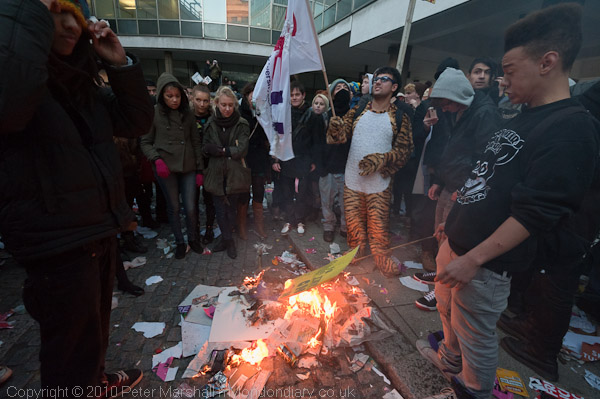
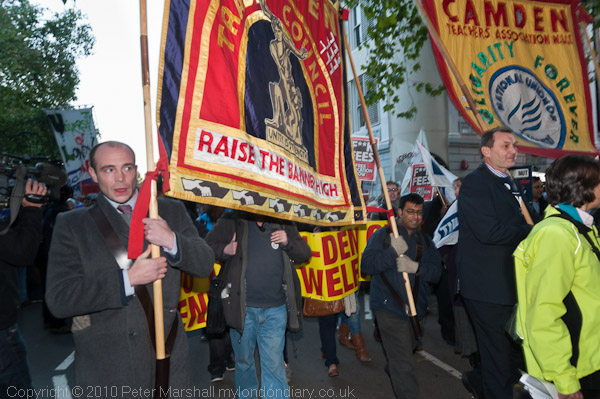
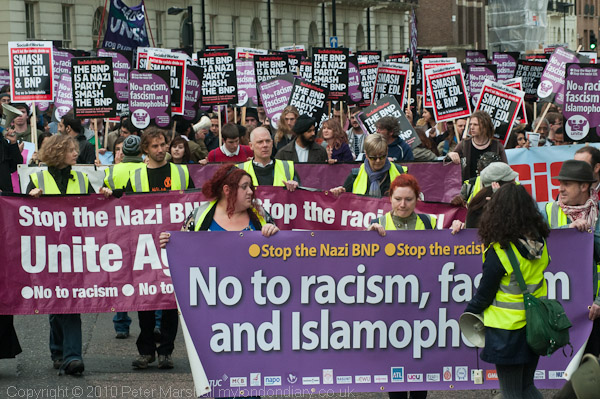
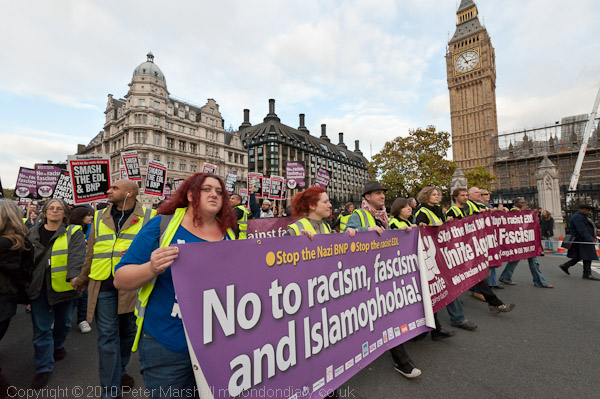
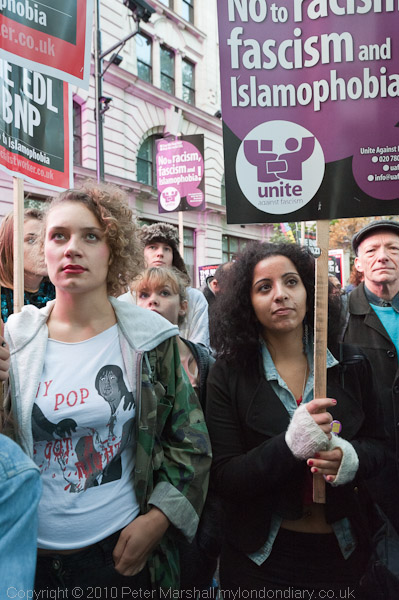
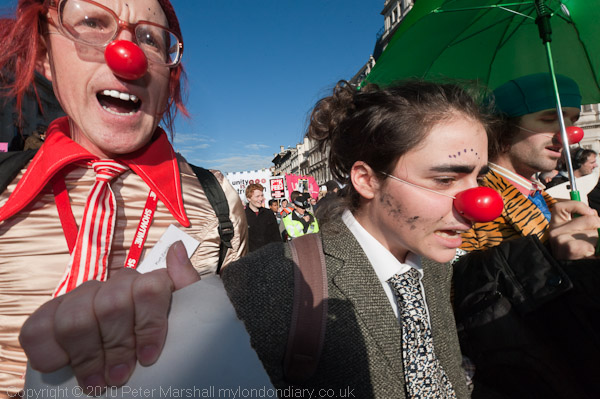
The NO to Racism, Fascism and Islamophobia march on Nov 6 was a decent size and had rather more of a carnival air than most since it was organised by Love Music Hate Racism (LMHR) as well as being organised by Unite Against Fascism (UAF). That did mean we got a DJ playing some very loud music, and when I found at one point I wanted to be right in front of the rather large speakers next to the lorry they were using I wished I had brought some ear plugs. It isn’t that I don’t like music, but when it reaches the kind of decibel level where all your internal organs vibrate it’s a bit too much. It used to amuse me when I saw the guys at Notting Hill Carnival photographing with ear-muffs on, but it makes more sense to me now.
© 2010, Peter Marshall

Both the UAF and LMHR are widely regarded as being closely linked to the Socialist Workers Party (SWP)  although both draw support from a wider range of people – and get funding from bodies such as the TUC which the SWP itself would not.  Many left-wing activists are SWP members and without the effort they put into organising things we would have far fewer demonstrations and they would be considerably smaller. Many of the more active members of Stop The War are also from the SWP.  I don’t suggest anything sinister here, it is simply a matter of fact and generally strongly evidenced by the number of people offering SWP petition forms and publications at demonstrations.

But it is bad news for photographers, as these organisations all share a style of stewarding that makes our job difficult. There is an obsession with control which seems to be central to the SWP mentality (and one reason why I’ll never join them.) Usually it is just a matter of keeping photographers away from the front of marches by surrounding the march with stewards who link arms to create an empty area in front of the banner, making it impossible to get within a reasonable working distance to the front of the march, or indeed to get good pictures of the front of a march from a longer view.

At one Stop The War march the photographers got so annoyed that we staged a sit-down in front of the march on Park Lane until we were allowed a few minutes access.  But it goes further and I’ve several times been assaulted by stewards at such events – although others have been more cooperative and have apologised for the  behaviour of others. During one march from the US embassy I was fortunate to escape serious injury when pushed violently backwards.  It’s not surprising that we sometimes amuse ourselves by making up other meanings for the initials SWP – such as ‘Sod Working Photographers‘.

There was some of that aggressive and obstructive behaviour at this event. One of my colleagues was assaulted and most of us were at times rather frustrated trying to get the pictures we needed. It just isn’t necessary and it certainly is counter-productive. Much larger demonstrations manage without stewards who think they are storm-troopers, and it is obviously in both the protesters and photographers interest to get the best pictures possible.

A little chaos really does work fine and it seldom gets out of hand, as photographers tend to regulate themselves though there are a few who don’t play the game – mainly those with big video cameras, like the guy who several times swung his round rapidly and hit me the other day. And there are those sad individuals who like to try and organise everything and everybody who deserve to be dealt with drastically by the stewards. But most of the time we get along OK, and if they stewards would just stand back and  let us get on with it unless a real problem arose we’d get better pictures without compromising the march in any way.

Fortunately I don’t often spend a lot of time at the front of marches where these things happen. Certainly on this one there didn’t seem to be any ‘celebrities’ who might occasionally need a little protection from a crush of photographers, and almost all the people I found interesting were further back in the march where I could wander around as I liked.  There the atmosphere was much friendlier.
© 2010, Peter Marshall

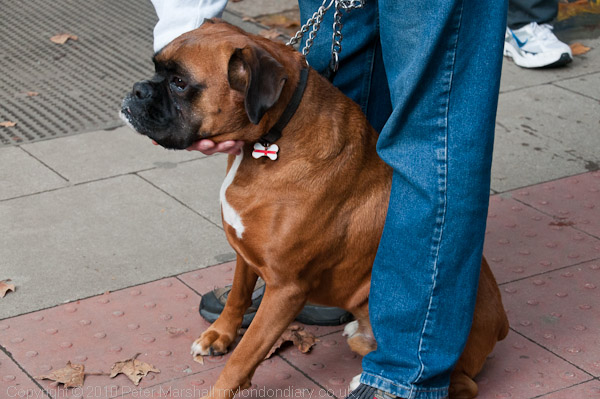
There had been some anticipation that there might be some trouble from members of the English Defence League during the march, but they had the sense to stay away. When we saw this dog, sitting with its owner watching the march go by, most of us probably drew the conclusion both from the St George flag and the appearance of the dog owner that this could have been one of them, but when one of my colleagues asked him he told us he had no sympathy for people who behaved like they do although he was proud to be English. It was a lesson about being careful not to jump to conclusions based on people’s appearance.
© 2010, Peter Marshall
For once the weather was good and I remembered to make reasonably sensible settings on my two cameras, and everything worked as it should. It does happen sometimes.

But by the time we got to Millbank, the light was beginning to fade and it was getting harder to work, and even at ISO 3200 people dancing just moved too much to be always sharp, so after another round of speeches I decided it was time to go home. There was actually another problem, which you can see in a few of the pictures on My London Diary  with light from a large TV screen, mainly filled with purple creating a rather unhealthy effect.
© 2010, Peter Marshall

But by then I was ready to go home anyway.
Millbank & Misrepresentation

 © 2010, Peter Marshall

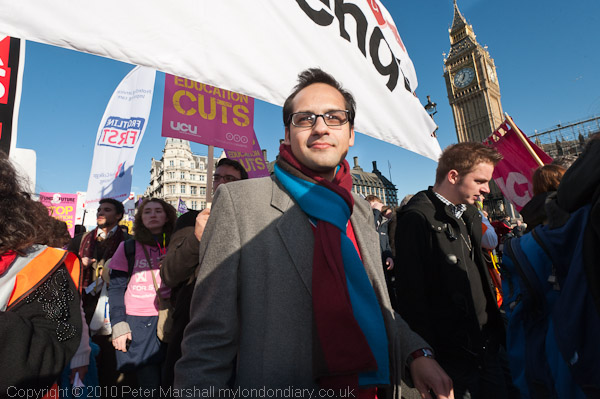
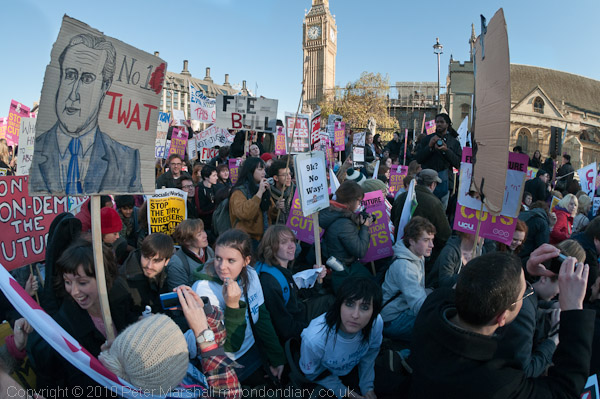
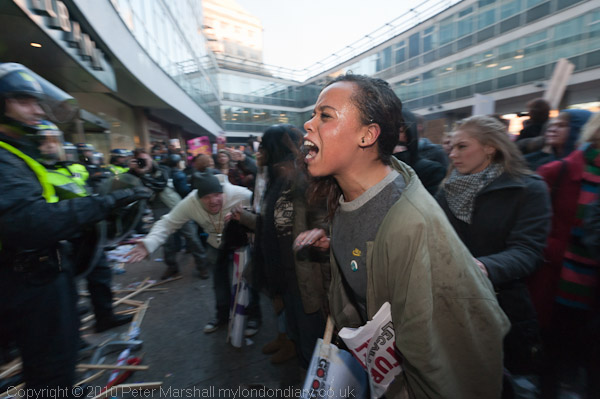
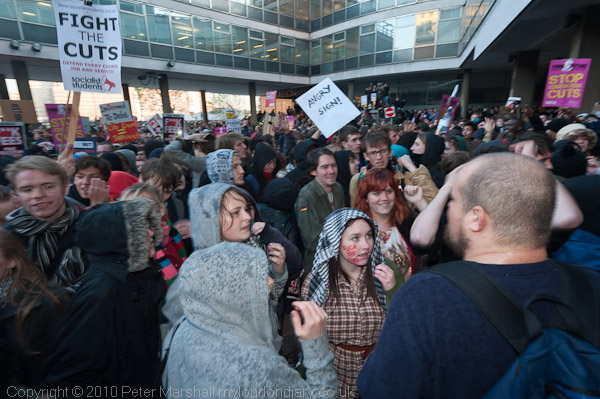
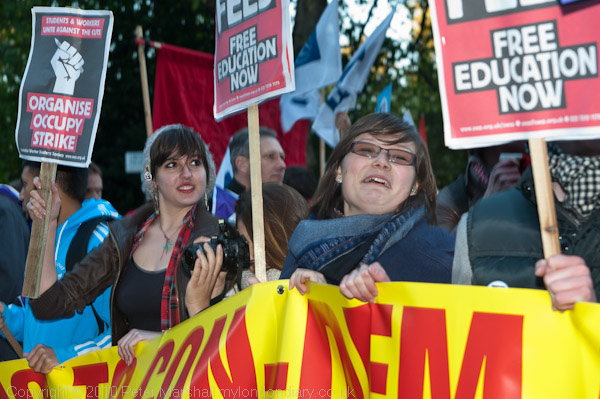
I’ve just posted my pictures from last Wednesday’s higher education march on My London Diary. The pictures I took tell a very different story from that which filled the news broadcasts and papers on Wednesday evening and throughout the next day or two. But of course most of those who pontificate about it weren’t there, and even those of us who were could only get a partial view. But I’ve talked to a number of others, read eyewitness accounts, watched the videos and seen the photographs taken by others as well.

© 2010, Peter Marshall
NUS President Aaron Porter passes Big Ben

The account I just uploaded to my web site – and this story here – both differ in some respects from what I wrote for Demotix on Wednesday night, because of what I’ve heard since from others who were there, but it was clear on the day that many published accounts were frankly sensationalism rather than based on fact. Even today the BBC continues to talk about the ‘storming’ of the building which just isn’t what happened. They are simply telling a lie on behalf of the political establishment and the government.

It wasn’t just the Met who got it wrong for the student protest on Wednesday; the journalists and photographers in particular did as well, which is why the editors and politicians got quite such an easy ride in making up their lies about what happened.

As the march came down Whitehall and we stopped to photograph it going through Parliament Square we’d talked about the possibility of trouble. And although one of the best-known anarchists had earlier told me “There’ll be plenty for you to photograph” I didn’t take the hint, or at least failed to understand it, though I doubt if he knew the details of what would happen.

© 2010, Peter Marshall
Sit-down in Parliament Square

I’d thought that the glass-fronted Millbank offices outside which I photographed in May had only been taken over by the Conservatives as their temporary election HQ, and didn’t realise they were still there six months later. Had I known that – and if I was the officer in charge of the policing I would have known it – I might have followed the front of the march down just in case rather than keep on taking pictures in Parliament Square. But probably not, as there had been little indication that there was likely to be anything special to photograph. Certainly there had been no organised bloc that looked like causing trouble – though many obviously angry students – and I’d seen few of those that I’ve photographed at previous events who might be expected to cause trouble. Several photographers commented to me that it didn’t look likely that things would take off.

So I was a little surprised when I heard (thanks to a tweet read by one of the students I was photographing) what was going on. I’d stayed on in Parliament Square as I thought there would be a few things of interest there (and there were) while quite a few of the other photographers had continued down towards Tate Britain, outside which the rally was being held.

But few if any of them were actually there when the first group of students walked into the offices and occupied them – more or less non-violently. There are some people taking pictures on the short and fairly amateur video I’ve seen, but I didn’t recognise any of them as professionals. Rather more of the press were there when the police made their second big mistake, which was to try and forcibly remove the protesters when they had too few officers to do the job sensibly.

The photographers who were there at that point tell me that there was a great deal of indiscriminate violence by the police, much of it against protesters offering no resistance – and some photographers also have the bruises from the batons and riot shields to prove it. The said the effect of this attack was to enrage many of those who until then had been onlookers and produce an angry mob, which was the start the real battle that took place, with the breaking of windows and a fair amount of indiscriminate violence, in a second wave of occupation.  Had the police reacted more calmly and sensibly, waiting until they had the resources to properly protect the building there might have been only minimal damage.

© 2010, Peter Marshall

By the time I heard about what was going on it hardly seemed worth rushing to get there  – I thought I would have missed everything. So I continued taking pictures for quite a while around Parliament, and then decided to make my way home by a route that took me along Millbank.

I ignored the NUS/UCU stewards who where by this time turning away protesters coming down Millbank at the Lambeth Bridge roundabout, telling people that the protest was all over and walked down towards the Millbank Tower. As I arrived a group of riot police got out of several vans and ran past me and into the crowded area; I tried to follow them but soon found my way blocked by a crowd of onlookers, so I went back and round into the courtyard which was slightly less packed with people, some standing around a couple of small fires.

© 2010, Peter Marshall
Not a riot!

Over their heads I could see a line of riot police facing the crowd with a small gap between. I pushed through the crowd and eventually got to the front and found myself with a number of other photographers, most of whom I knew, taking pictures.

By that time there wasn’t a great deal happening, and the police were adopting a low-key policy, at least outside the building, forming a line to prevent any further ingress. A few people in the crowd were still throwing the occasional piece of card or stick towards the police, and a number fell short on the photographers and crowd, and a number of those at the front occasionally shouted at the police. Generally it was almost good-natured – more a game than any serious attack by this time. The police certainly weren’t in any great danger and though a few looked a little stressed, many seemed to be quite enjoying it.

© 2010, Peter Marshall

A couple of fire-extinguishers were let off from the crowd, as well as from the roof and I got rather wet, and then covered with powder. Neither healthy for cameras. I wasn’t there when an empty extinguisher was thrown down from the roof, but on the video it’s clear that it caused an immediate angry chant from the crowd below as a stupidly irresponsible act. Someone – and and given the way it was lobbed it could have have been a protester rather than police – could easily have been killed,  was just luck that it missed everyone.

There didn’t seem to be a great deal of point in staying – there were hordes of photographers and videographers there and any pictures I got would be unlikely to add much to the coverage or even get used. Unlike some of the other photographers there I refuse to carry a helmet or hard hat, and this was a situation where I would have been happier with one on. So having taken a few pictures I left and walked across Vauxhall Bridge for a train home.

More detail about the event and more pictures on My London Diary.

Pictet ‘Growth’ Shortlist

You can see the shortlist for the valuable Prix Pictet which was announced today in Paris, where a preview of the work will open at the Galerie Les Filles du Calvaire on Sunday – and I hope to drop in and see it when I’m in Paris next week. The prizewinner won’t be announced until March, so there is plenty of time to place your bets.

In alphabetical order,a the runners are Christian Als, Edward Burtynsky, Stéphane Couturier, Mitch Epstein, Chris Jordan, Yeondoo Jung, Vera Lutter, Nyaba Leon Ouedraogo, Taryn Simon, Thomas Struth, Guy Tillim and Michael Wolf, and you can see their work that is in for the prize on the Pictet web site.

What is unusual for a photographic prize these days is that there are some pretty decent pictures among the lot, and seven or eight photographers whose work I might well have chosen myself. There are a couple I find ‘arty’ in a sense that would have been fresh in the 1930s, but now I just find pretentious garbage, and a couple that do things that I’ve seen rather better done by others (and in one case seems hardly worth doing), but it is good to see so much good photography up for a prize like this – though it remains to be seen what will win.

I probably shouldn’t condemn any of them to oblivion by naming them as my favourite for the prize, and in any case I think it should receive rather though more than my quick first impression. Particularly because it isn’t just a matter of a single image, but really of a set of pictures, and that does need more consideration. But Mitch Epstein has long been one of my favourite contemporary photographers, Guy Tillim’s work I always find of interest and the show by Taryn Simon was one of the best in recent years at the Photographers’ Gallery. The only work that really appeals that was new to me was by Nyaba Ouedraogo. So probably those four are now the outsiders in the race!

I hope I’ve more or less got everything sorted for my Paris trip now, and certainly I’ll be writing about it here. Unfortunately I’ve been having some problems with getting my notebook to connect to the Internet, so I may not be able to post until I return home and there may be a few days without posts on the blog. In any case I tend to be too busy and get too tired (and sometimes emotional)  to comment while I’m there.

Not Cricket

Last night I visited the holy of holy for many, the inner sanctum of the world of cricket, the Long Room at Lords. Even for someone with so little interest in the game as me it was an interesting experience, and there in a glass case was a small terracotta urn along with some larger and shinier trophies.

As the name suggests it is a fairly long room, and did look quite large when we were some of the first to arrive – our rush hour bus had taken rather less time than the Transport for London web site’s rather pessimistic forecast. But it felt fairly crowded when the other 290 or so had arrived. It’s a pleasant enough space, and but for the fact it was dark would have given us a good view of the pitch with its unlikely looking stretched out lollipop media centre by Future Systems at the opposite end. But for lovers of cricket, this is the spiritual home of the game and the MCC, the Marylebone Cricket Club, “the guardian of both the Laws and the Spirit of Cricket.

It’s also more surprisingly a part of the London 2012 Olympics, despite cricket not being an Olympic sport (presumably because countries such as America and France have never managed to understand the rules.) Instead they are shooting out the archery here.

We were there not for cricket but for the launch of a book written by a friend about “the first garden suburb“, the villas, many still standing, built a hundred years before the Garden Suburb movement on the extensive Eyre brothers estate of St John’s Wood – where the world’s most famous cricket ground was built on the site of a pond. Mireille Galinou‘s ‘Cottages and Villas – The Birth of the Garden Suburb‘, published by Yale University Press (ISBN: 0300167261) and based on several years of her work on the Eyre archive looks a fascinating and superbly illustrated study of the building of the area and the people who came to live there.

The MCC moved to St John’s Wood – their third ground – in 1814, and the new pavilion we were in was built in 1826 after the previous one burnt down  Many of those who attending the launch were local residents, members of the St John’s Wood Society, founded to promote and conserve their unique area (I don’t think they included any of the pop stars and Russian oligarchs who now live there but keep themselves to themselves in their deeply dug basements behind high gates and security cameras) and the books were selling like hot cakes – I saw one man leave carrying four of them.

Fortunately I hadn’t gone there to take photographs (I commiserated with the man who had), as when I took my camera out of my bag, I found it was completely dead. I’d  brought it mainly to take a few pictures at a party we were going to later, and unusually hadn’t bothered to take a spare battery. I always keep one in my proper camera bag, but I’d only taken the D700 with the 24-70mm and 20mm along with a few books and other things I needed in a small shoulder bag.

I’d charged the battery when I came in on Saturday, as I always do, and had only used it since for a handful of test shots, so it should have been good for the usual thousand or more pictures the D700 can normally clock up on a fully charged battery.

It remains a mystery to me how it came to be fully run down. Sometimes I’ve found that I’ve left a camera switched on when I’ve put it in my bag and it has produced a series of rather noisy but otherwise blank files, but when I checked the card after I got home there were no blank files.

So now I’m left wondering whether there has been some kind of electrical fault in the camera, though it seems to be working fine, or perhaps the battery is faulty. I’ve recharged it and put it back in the camera, and the battery check reports it as good.

But the moral of all this is clear, a message I’ve told others many times, and a practice I always used to follow until the incredible capacity of recent cameras had made me rather slack. ALWAYS CARRY A SPARE BATTERY.

So no pictures of mine showing the Long Room, which is perhaps just as well, because I think almost any mental image you may have of it is probably more impressive than the reality  – a nice enough room of its age (and recently splendidly refurbished along with the rest of the pavillion at a cost of £8 million), but with a rather dull collection of portraits of cricketers (some of whom were surely more impressive on their cigarette cards) and early but largely unexciting paintings of people with oddly shaped cricket bats.

© 2005 Peter Marshall.
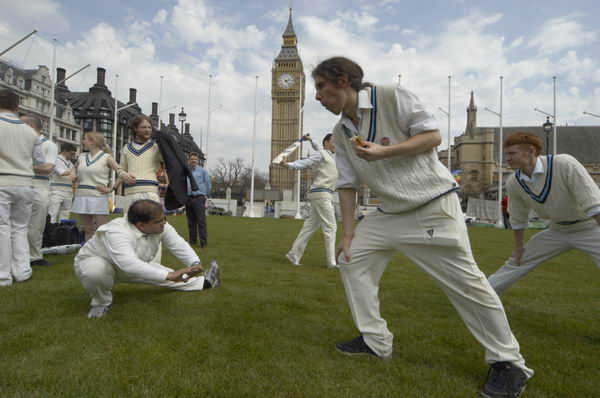
Spacehijackers team warm up waiting for the MPs who didn’t turn up

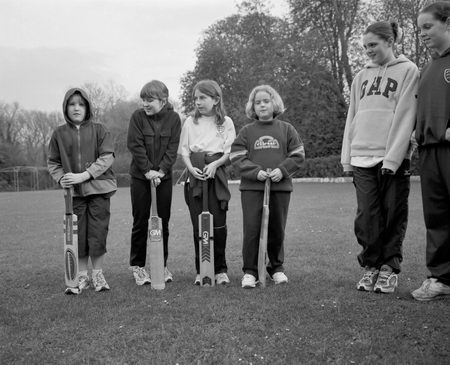
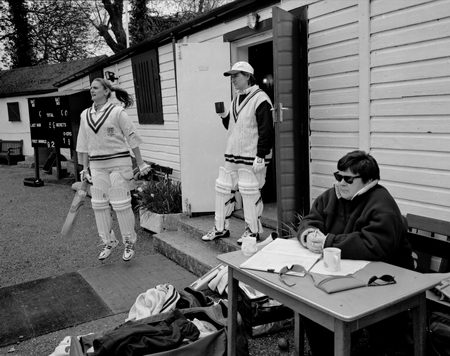
But of course I have photographed cricket. Not just a couple of games by the Space Hijackers – as here when they challenged our members of parliament (who if they noticed had the sense not to turn up) to a game on Parliament Square, but the real thing a few years earlier when I got a commission from my local council and the Arts Council to photograph one of the leading ladies teams in the country and in particular their younger members.

© 2001 Peter Marshall.
Juniors at the start of a training session at Sheppertone Ladies CC

The most interesting action was almost always off the pitch, and during matches of course I had to keep outside the boundary line, but photographing during practice sessions I was at times in some very silly fielding positions with a camera.

© 2001 Peter Marshall.
Batters wait their turn next to the scorer at Shepperton Ladies CC

It was a nice project and I enjoyed being with the people there. It is one of very few projects where I’ve worked with medium format, though I also used 36mm, particularly at some of the matches where at times a 200mm with a 2x converter was still a little on the short side for capturing action.

Halloween

I’m not a fan of Halloween, which seems just another sad synthetic commercial opportunity. There is something very unpleasant about the whole ‘trick or treat’ idea, a kind of demand with menaces (and one which sometimes gets out of hand.)

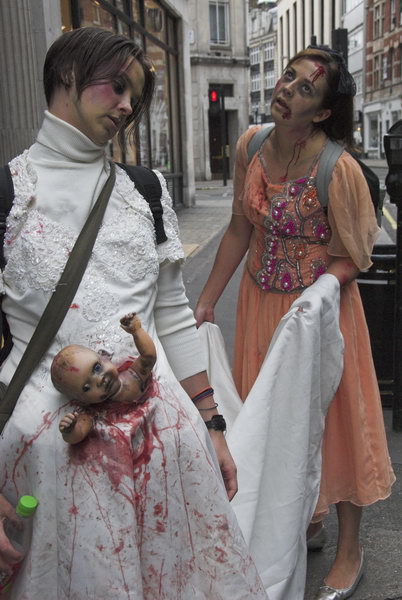
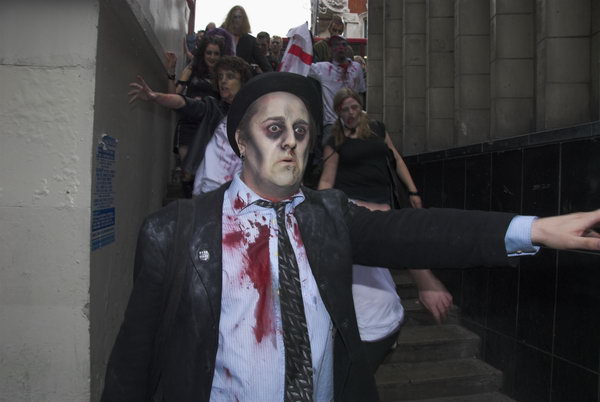
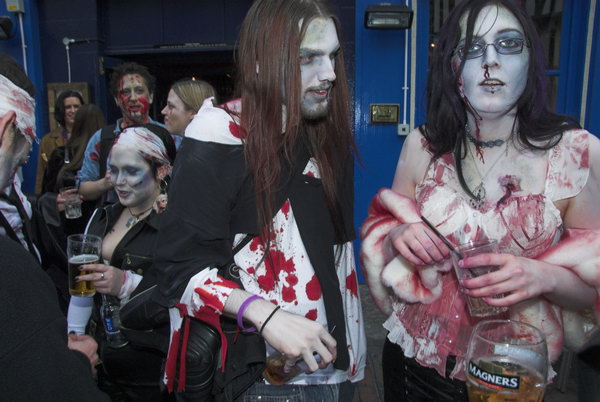
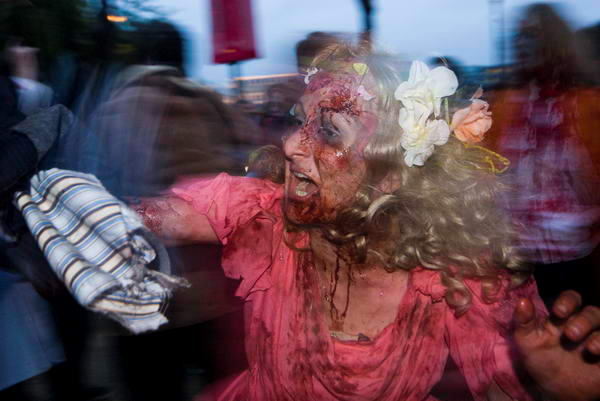
Not that I’m against people having fun, and I do rather like the sight of zombies invading our streets, generally simply out to have a good time and a bit of a party.  These and more formal Day of the Dead celebrations perhaps owe more to All Saints Day and All Souls Day than to Halloween which comes before them, although now they have been drawn into a single commercial exploitation.

In 2006, (somewhere well down this page) I met up with some very fine zombies, including the two ladies below for a tour around Oxford St.

© 2006 Peter Marshall.

Starting from the very spooky Ben Crouch Tavern (now sadly converted to a pub I find rather plastic and unpleasant) we toured a shopping centre on Oxford Street and walked past the hard-core shoppers before slithering down the steps to Ramillies St (which later became the home of the Photographers’ Gallery),

© 2006 Peter Marshall.

and on to another pub at the top of Carnaby St.

© 2006 Peter Marshall.

On that occasion the pub ‘Crawl of the Dead‘ had started in late afternoon, and although the light was failing there was still enough to work with even by the time I left them.

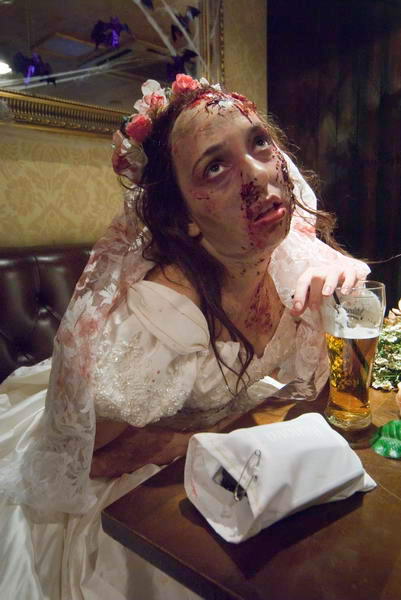
The following year, in the City of London, the Crawl of the Dead started later, which was probably better for zombies but not for photographers, though I was able to take some pictures before the start in ‘Ye Olde London’, a rather dimly lit pub with some appropriate decoration.

© 2007 Peter Marshall.

but by the time we got to staggering on the streets things were a little trickier.

© 2007 Peter Marshall.

It certainly didn’t help that my SB800 flash decided to pack up – in need of a rather expensive flash tube replacement – and I was left only with the built in flash on the camera, really only suitable as a fill, and not usable with big lenses which cast a shadow in the image area.

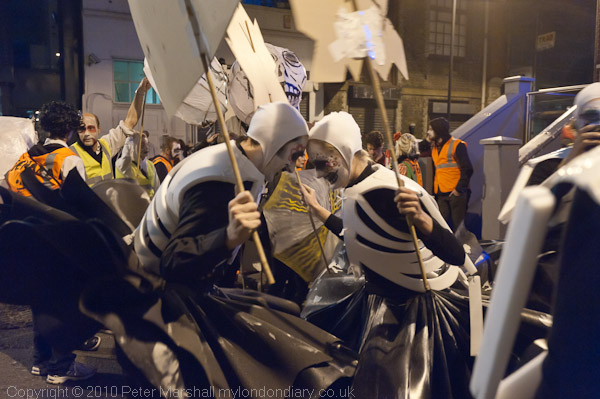
This year it was fully dark when the ‘Dance of the Dead’ street parade from Hoxton Square to Dalston was gathering, and the rather dim street lighting had the very orange colour of sodium lamps.

© 2010, Peter Marshall

So although there was just enough light in some of the brighter areas to take pictures at ISO3200 and get some reasonably sharp,  it isn’t possible to get good colour, even when shooting RAW, as the light is essentially monochromatic orange and sadly lacking in other colours.  The image above, taken at 1/20 f4 was about the best I could get.

Using the SB800 mounted on the D700 camera did produce some better results, but the orange light was still a problem. You can’t light up the whole world with a single flash, so I normally use flash at high ISO when I can to pick up enough ambient exposure to add some background detail. Because of the poor colour of that ambient and to get better quality in the flash lit areas, I compromised on using ISO1000. With the flash I was working at 1/60 f7.1 to get a bit more depth of field and avoid movement blur where the ambient was stronger.  I think that was equivalent to around 4 stops underexposure for the ambient, but I didn’t make a precise calculation.  Looking at the results on the computer now, I can see that the flash, despite being set at -2/3 stop was actually overexposing slightly, though seldom enough to burn out the highlights completely.

© 2010, Peter Marshall

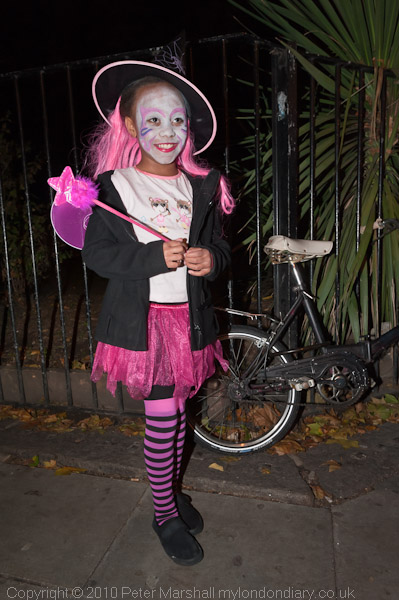
My favourite image from the event was also the simplest, a young girl waiting for the event to start. I photographed her first with her mother standing watching the preparations, then got down on my knees to make this image, in which her witches hat becomes a kind of purple halo.

There are some other pictures that I quite like – and you can see a largish set on My London Diary – but none that really lived up to my expectations, as it was a very tricky, fussy and at times fast-moving event. Perhaps if I’d followed the parade further I would have found some better lighting, and the dance at the end might well have been fun, but I’d been on my feet and taking pictures for over 7 hours and was feeling rather tired, and when I saw a bus approaching I rushed across the road to jump on it and start my journey home. Perhaps next year I’ll do better.

Lost Steps Again

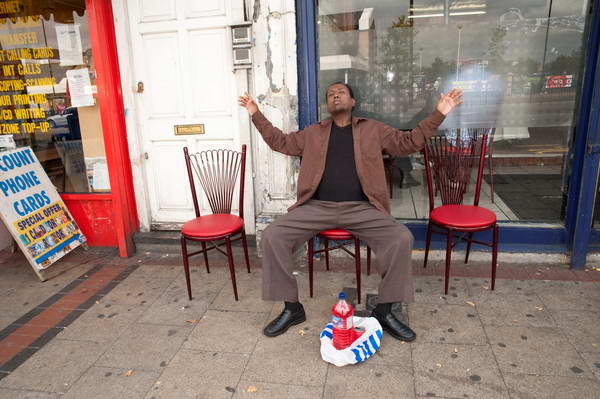
If you missed my broadcast in the Lost Steps series on ResonanceFM last month, you can now listen to it any time you like on the Lost Steps web site  – or even download it from there as a podcast. And there have been a couple more programmes since mine, one about London Hauntings and the latest  with Nigel of Bermondsey and Vanessa Wolf-Hoyle from London Dreamtime which has a couple of film clips of the Old Kent Road, one from the 1970s. I photographed it at some length in the early 1980s, one of the last projects on which I used transparency film and I’ve been there occasionally since – one of my sons lived there for a year. The last time I walked a few yards along it with a camera several people asked me to take their pictures – this guy was the first:

© 2009 Peter Marshall
August 2009 – Old Kent Road

I don’t much like hearing recordings of myself, though on the programme I do sound rather more like I think I do than on some other recordings. And apart from a couple of silly slips I more or less seem to make sense. Its often hard to gather thoughts when being interviewed, and interviewer Malcolm Hopkins had only told me what his first question would be – there really was no other preparation. Actually that one was really the hardest to answer.

It’s always interesting to see what others think of you (and sometimes – like this – reasonably flattering except for the photograph.)  I was interested to see the selection of pictures and comments by producer Nick Hamilton, with three very different photographs. My favourite of them is one only labelled there Ilford High Road, June 2002:

© 2002 Peter Marshall.

This is of course part of how East London celebrated the Queen’s Golden Jubilee (I went on from there to photograph a rather livelier street party in Mile End.)  But what strikes me particularly about this image is the rather poor colour reproduction, rather typical of images shot on film.  Of course I could probably make a better scan, but digital has so much improved colour, and made it so much easier to get good colour in the images in My London Diary– though I still occasionally manage to mess it up a little when I’m in a hurry.

At the street party I had terrible problems with flare. There is a little on this image but there might have been some water  on the lens as it was raining when I took this picture. Later it was dry and probably I’d managed to leave a fingerprint on the filter. Dirty lenses are of course still a problem with digital, but there is at least some chance to spot it in the results while you are still taking pictures.

Incidentally I’m still using a Lens Pen to clean my lenses when I’m out working – the ones I have are actually called Hama Lenspens – they cost me around £6 from 7Dayshop and last for around 6 months to a year. Very easy to carry and do the job well, though apparently there are some cheaper imitations that should be avoided. I also have a lens cloth and some cheap cleaning fluid to use if things get very messy.

Some years ago I appeared a few times on an American Internet radio programme, talking over a phone line rather than in a well-equipped studio, and every time we started getting into a conversation, one of the two presenters would interrupt with an ad for Lens Pens – and they used to give them away to people who phoned in, though I never got one!  But despite that I still recommend and use them. Lost Steps was considerably more professional, despite being non-commercial, or perhaps rather because it is non-commercial.

Nick has also used a quote from the first Blurb book I produced, 1989,  ‘real’ images and fictional text relating to walking around North East London.  Here’s a part of it:

It’s Sunday morning and on the newsagent’s board the News Of The World promises us it will “UNLOCK THE SECRETS OF SUPERSEX” just like last week and the next week, but still they remain secret.

I go in and unlock the secret of a Mars bar instead.”

(you can see the whole page here.)

Unfortunately now I have to watch my sugar levels as well, and I can no longer indulge in Mars Bars!

Blurb Pop-Up London

I’m not exactly sure what a Blurb Pop-Up is, but we are getting one in London shortly, when Blurb launches its first-ever U.K. pop-up store on Wednesday, November 3. They say “It will be buzzing through November 14 with free workshops, guest speakers, and special events.” It’s at 22 Newman St,  a couple of hundred yards to the north of Oxford St and 5 minutes walk from Tottenham Court Rd tube.  See comment – now closer to Oxford St tube.

The events are listed on the web page, with links to click to RSVP if you want to attend, and everything is free. If you look through the programme you will find that I’m down to give a presentation on my Blurb book, ‘Before the Olympics‘ on Sunday 7th Nov at 13.00-14.00, but there are some highlights too!

© 1989, Peter Marshall
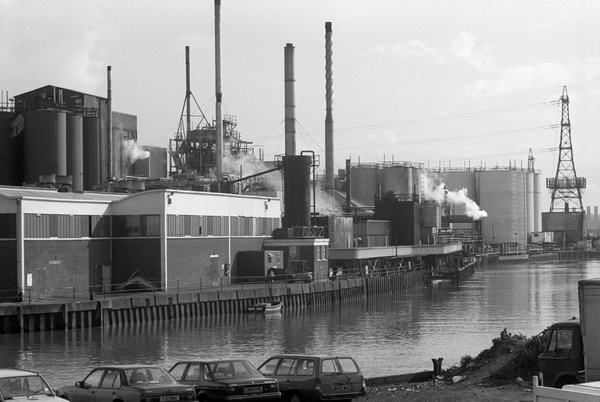
Pura Foods, Bow Creek in 1989. Now demolished.  © 1989, Peter Marshall

Later that day I’ll also be there to take part in the Self-Publishing Debate with guest panelist Bruno Ceschel of ‘Self Publish, Be Happy‘ at 3pm.

Although the main part of my presentation will be about ‘Before the Olympics‘ which gained an ‘Editor’s Pick’ on Blurb, I’ll also be talking about my two other Blurb books and a little about my plans for forthcoming publications, as well as my comments on Blurb and the whole idea of self-publishing and answering any questions people have. I hope it will be an interesting session so if you are in London and free around Sunday lunchtime you can book a free place on the web page.

Cuts And Chaos

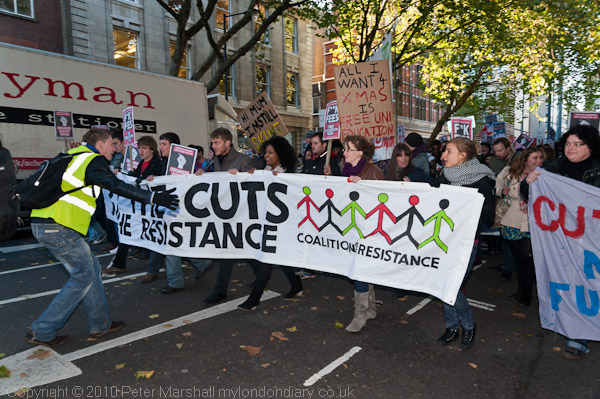
We in the UK are in for a hard winter as following Wednesday’s Comprehensive Spending Review the cuts in public services begin to make themselves felt. Although we were expecting the Con-Dem coalition to make the most of the political opportunity to greatly reduce the public sector and the welfare state while blaming it all on the previous New Labour government, hearing the actual news still came as a shock, and there will doubtless be many more shocks as the planned spending cuts are introduced.

© 2010, Peter Marshall
The start of the student march

So far the official trade union movement response has been relatively quiet and low key – they are planning a national demonstration for early next year, many are calling for earlier and more decisive actions.

The demonstration at Downing St was called by ‘The Coalition of Resistance’ which describes itself as ” a broad united national campaign against cuts and privatisation in our workplaces, community and welfare services, based on general agreement with the Founding Statement” which appeared in the Guardian in August 2010, signed by Tony Benn and 73 other people including MPs, union leaders, writers and others. It is now supported by “thousands of individual supporters, together with national unions, union branches, anti-cuts campaigns, student, pensioner, unemployed, youth and other organisations” and is still growing.

It’s hard to get a large group of people to a demonstration on a Wednesday evening. Around 300 students set off from Malet St in the late afternoon and joined roughly twice that number of trade unionists and others waiting for them at Lincoln’s Inn Fields. Doubtless others met them at Downing St, making this a significantly sized  event, but rather smaller than the 20,000 who marched in Edinburgh at the weekend.

It was a busy day for me – earlier I’d been listening to Jesse Jackson and lobbying my MP and afterwards I was giving a speech at the opening of our contribution to the East London Photomonth 2010 at the Shoreditch Gallery. I’d decided I couldn’t carry around my normal large camera bag all day, so was working with just a single camera – the Nikon D700 – along with my lightweight but slow 55-200mm Sigma and the SB800 flash.

Of course 24mm is quite wide, but I did find I was missing the even wider 16-35mm, particularly when working in the crowd. And having only a single camera meant I took very few pictures with the longer telephoto. I’ve rather got out of the habit of changing lenses when working.

Malet Street, where the student march gathered is pretty gloomy most of the time, with trees and tall buildings cutting down the  light, and by 4pm it was beginning to look like dusk. For some unaccountable reason I decided to leave the camera set to ISO 640 when the sensible thing to do would have been to use ISO1600 or even 3200.

© 2010, Peter Marshall
Behind a banner in Lincoln’s Inn Fields

By the time I finished working at Lincoln’s Inn Fields it was really beginning to get dark. I took a few pictures without flash – at f2.8 which is a pretty useful aperture, but most were with the flash giving an aperture of f6.3 – in the earlier pictures the flash was a fill, but later on it was the main light source with fill coming from the ambient light. I still find the combination of two slightly complex electronic systems impossible to really understand, but mostly with a little fiddling on the flash setting it at different levels I manage to get the results I want.

© 2010, Peter Marshall
The march departs for Downing St

I had to leave as the march left for Downing St, and then needed to work out how to get to Shoreditch when the march was stopping the bus I normally take!

More pictures and text on My London Dairy.

Photographers Social

Long ago, back in the days of film, every year around this time I used to lock away the colour stock and go out with only black and white in my cameras, as I knew otherwise I would waste far too much recording the changing colours of leaves. Had I got round to it I would have got around to printing a t-shirt for photographers with the message “Get over it – leaves turn brown in Autumn!”

© 2010, Peter Marshall
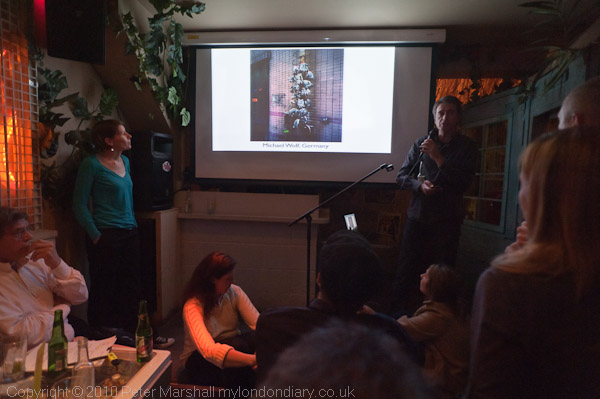
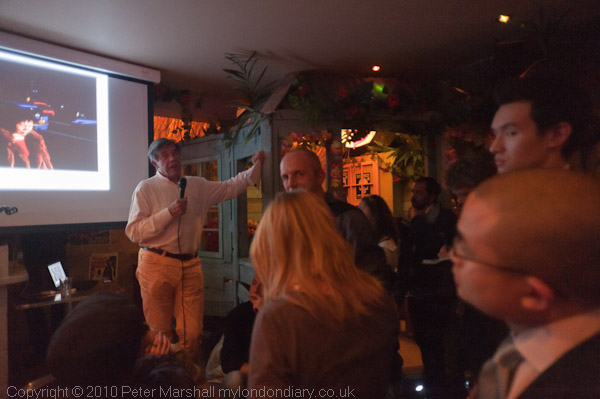
Stephen McLaren talking and showing photographs at the Social at Barrio Central – and as this picture suggests it was dark and crowded there. 20mm f2.8 Nikon D700

I felt something related to this as I watched Stephen McLaren‘s presentation of images by some of the photographers features in the book ‘Street Photography Now!‘ at the first Photographers Gallery/BJP Social evening at Barrio Central in Poland St this evening, though rather than Autumn colours my thoughts were about pictures mainly about and created by strong shadows and unusual lighting conditions.

Of course light is one of the basic tools of the photographer – where would we be without it –  but at least for me the aim isn’t to make pictures about it but to use it to illuminate (in every respect) the subject.

It would be wrong and impossible to propose a complete ban on taking such pictures. Books such as Trent Parke‘s ‘Dream Life‘ show how powerful they can be. But since Trent and rather many others have pretty well ploughed that furrow out perhaps we might turn to other fields?

Stephen McLaren showed some interesting work (and I very much liked his own picture which made use of the low angle sun on a nearby street despite the comments above – from his series Coupling) with at least one image from each of the photographers concerned that gained my admiration, which isn’t a bad average, but I was left wondering if some perhaps showed too much striving after what might be called ‘Flickr approval‘ and that perhaps the hardest thing to learn as a photographer is the power of understatement. And to repeat one of my old refrains, that photography isn’t about making pictures.

I also found it disturbing that the images appeared to be projected on screen at the wrong aspect ratio changing images in a normal format into near-panoramics (I think actually from 1.5:1 to about 1.7:1 – it is a problem with some screen resolutions.*) There was too a problem with the colour, with some images at least being greatly over-saturated. I would have hoped that two of our major photographic institutions could have coped rather better with screen resolutions and colour management and hope it’s an issue they address for further occasions. Surely we should treat photographers’ work with much greater respect.

On the train home I was entertained to hear a lengthy report by a photography student on the evening, and at least he had gathered the main point from lawyer Rupert Grey (of photography specialists Swan Turton), that on the street you can legally photograph anything you like.

© 2010, Peter Marshall
Rupert Grey talking at the Social at Barrio Central

Perhaps the only thing that he said that was new to me was his opinion that the police probably never have the right to demand to view your images; I’d been fairly clear about this so far as journalists are concerned, but he went further to apply this to anyone taking photographs.

Most of us also know that the police have no right to delete images or demand that you do so, although in a number of cases – and he mentioned that of Martin Parr – police have insisted that photographers do so. In practice of course it isn’t a great problem, as so far the police haven’t realised that deleting files from your card doesn’t actually remove them. So long as you don’t take any more pictures on that card afterwards, it is a simple matter to recover them.

There were a few things – particularly in response to questions – that he perhaps might have been clearer about, at times because he failed to make clear the distinction between taking a photograph and publishing it. Working in public places you never need permission or model releases to take a picture, although sometimes it may be sensible to get a release or polite to ask. But many of the best pictures come from situations where neither is possible. But what he failed to explore was the increasing threat to photographers that the legal interpretation of the individual’s right to privacy – even in the absence of UK law – is already having on court judgements in this country.

Using a picture without a model release becomes a problem in contexts where that use might be defamatory. So, for example, using a picture of a person on the street to illustrate an article on drug addicts would be ill-advised unless the picture or other evidence clearly showed that person to be a drug addict. There is so far as I am aware no legal requirement for a model release to use any photograph in an advert (or in any other way), but it is a normal commercial requirement as it should remove the possibility of legal action. Contrary to popular opinion not all adverts or commercial work needs photographs to have a model releases – the last picture I came close to selling  in that field was considered to be quite acceptable despite the presence of a recognisable person but no model release – but it is certainly normal practice to require one.

Grey also made it clear that there were no restrictions on photographing children – unless the images you produce are indecent. This can perhaps sometimes be a problem for street photographers in hot weather, when there may well for example be naked children running through fountains, playing in pools or running along beaches. To you or me, pictures of them might be perfectly innocent, but police and courts might take different view. And this is again an area where the privacy rights under European law are increasingly coming in to play – and at least one judge has made it clear in a judgement that the balance that has to be maintained between freedom of expression and privacy would be biased more towards privacy for minors.

I’ve heard Grey speak on various occasions before and he is obviously an expert in the field, but while it is good to know what the law is, we know that what police and others such as PCSOs, security staff and council employees try to enforce may be very much different – as examples such as the incident involving Parr demonstrate.

Perhaps the most useful and most sound piece of advice Grey gave about such situations was that photographers should be polite. I’d take that a little further and suggest that while where necessary insisting on our rights we should do so without unnecessary confrontation and where possible cooperate with the police and others. So I’m always happy to talk to any member of the public – whether in uniform or not – about what I’m doing, and where I think it appropriate to produce evidence of identity.


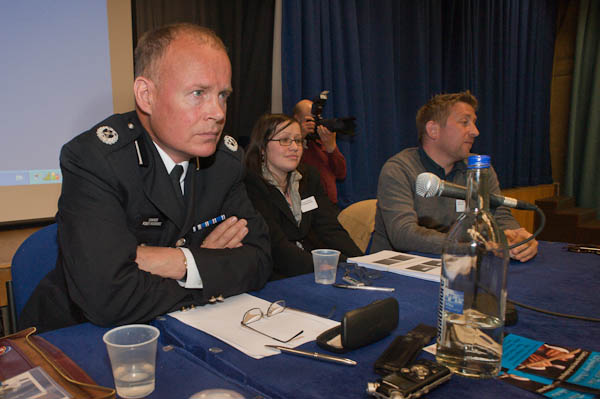
Commander Broadhurst at the NUJ photographers conference in May 2009 listens to photographers accounts of police violence.

Perhaps the most amusing part of his talk related to his conversation with Commander Broadhurst of the Met and a representative of ACPO. While it was good to hear of changes in their thinking about photographers, the suggestion from Broadhurst that police on the streets would all know about this seems laughable. http://re-photo.co.uk/?p=660 It was Broadhurst who said at an NUJ photographers’ conference in May 2009 “can anybody apply for an NUJ card who has a camera?” shocking all present by his  total ignorance and lack of understanding of the UK Press Card scheme (more about this occasion here.)

So while there may well have been some changes, I think we can be pretty sure that most of the police on the street will know as much about these as they have about previous statements which gave essentially similar advice such as that sent by Assistant Commissioner John Yates to all MPS officers and staff last December.

I think there have been some indications of a better attitude towards photographers by police at demonstrations in London at least since their disastrous public performance at Bank in April 2009, and I welcome this, and hope that Broadhurst’s extreme optimism is well-founded. But I’m far from sure that this has as yet had any impression so far as the more general interactions between photographers and ‘officials’ of all types on the street away from protests.

Although the ‘Photographers Social’ seems a great idea, in practice it was too crowded, too hot and too uncomfortable, and the area was really not well suited to such a large event. Like quite a few others I left as soon as the two presentations were over for the comfortable bar (and real beer at rather lower prices) a few yards away.  Perhaps the BJP/PG might investigate other venues in the area.

*Display Aspect Ratios

You should check any screen (or projector) by finding the screen resolution in pixels and comparing the ratio between width and height with the actual width and height of the image. Most displays allow you to run them at  different resolutions, some or all of which may be unsuitable, but LED screens are best used at their native resolution, in the case of my monitor 1680 dots x 1050 lines.

So I’m writing this on a 1680×1050 pixel screen with an image display 454x 283mm, ratios of 1.6:1 and 1.604:1 – essentially identical.

Projector or monitor displays that give markedly different ratios for these two things are unsuitable for photographers.

Jesse Jackson & Christian Aid

When I go to most of the political events that feature on My London Diary I’m going as a photographer rather than to take part in them. If you read what I write it is of course usually fairly clear whether I support them, or what reservations and disagreements I have. But last Wednesday morning it was a little different, as I was actually going to lobby my MP about action over trade justice in an event organised by Christian Aid.

For many years my wife has organised local events for this charity, including the annual house to house collection carried out by members of local churches. It’s a charity that I admire for its work with local groups of all kinds (certainly not all church connected) in the majority world, really tackling problems at the most basic level through working with cooperatives and other small organisations, as well as its relief work in disasters, where its local connections can enable it to be far more effective than some other aid organisations.

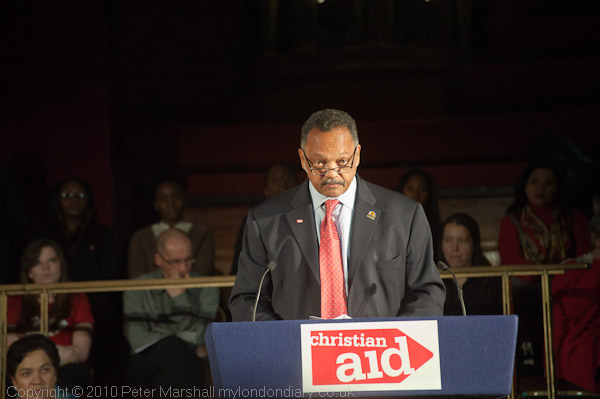
© 2010, Peter Marshall

So rather than attending as ‘press’ and going up  into the gallery, I went into the hall along with the crowds and was seated by a steward in the centre of the hall rather towards the back. I hadn’t actually intended to take photographs during the meeting, just to listen to the speeches, and I settled down in my seat, waiting for the event to begin.

But then I thought I had a decent view of the front of the stage and although the hall was fairly dim there was some spotlighting there, and I took out the D700 and fitted my Sigma 55-200 lens.  It wasn’t ideal – at 200mm the maximum aperture was f5.6 and really I could have done with another couple of stops. Exposures varied from around 1/50th to 1/250th working at ISO2000, and even at the slower speed some were sharp. Unlike most lenses I now use, this one doesn’t have image stabilisation, which might have helped, although some of the wasted frames were caused by the subject moving.

I stayed sitting in my seat to increase stability and also because I didn’t want to cause more annoyance to those seated around me. I also hoped that the tops of heads in some pictures would give a greater feeling of actually being there.

Jesse Jackson, the star of the show, spoke without gestures, just occasionally glancing up from the text he was reading with a penetrating glance over his glasses direct at the audience and in particular me in the middle of it – which I caught on several frames, including the one above. The message was in his words and not in his performance. Others, and Jackson himself when not speaking, as you can see in the pictures on My London Diary, were at times more demonstrative.

But as a set of pictures these are of course limited by the same viewpoint throughout, though there are some changes in framing.

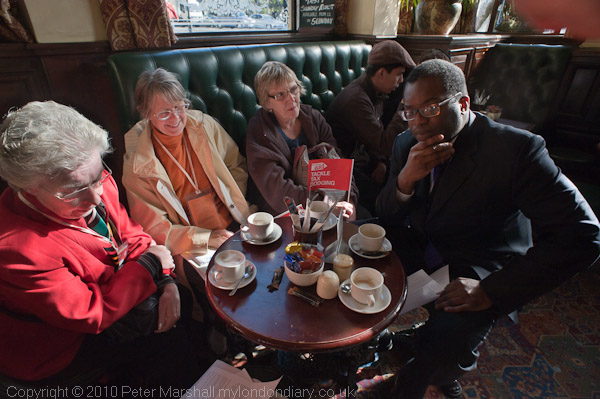
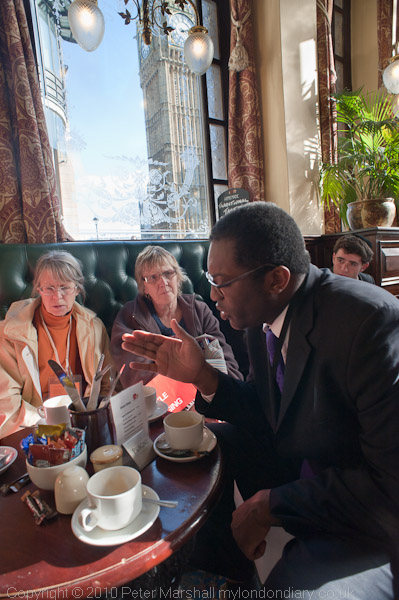
Later, when actually lobbying my MP – we had coffee with him in a pub – I had more freedom, although I was also trying to take part in the discussion and really you can’t do two things at once. These pictures were taken with the 20mm f2.8 and the main problem was excessive contrast, with direct sunlight streaking in on one of those taking part and the dark skin of our MP in deep shade.

It was a situation I would have written off when working with film, even with colour neg – and perhaps used for graphic effect in black and white. But with a lot of work in Lightroom I managed to get usable results. I also had to give extra exposure to the Christian Aid logo and the blue background of the lectern, which was excessively prominent in the pictures, and was I think lit rather more strongly than the speakers.

© 2010, Peter Marshall

though getting Big Ben visible through the window was pretty tricky:

© 2010, Peter Marshall

Of course, using flash fill would have simplified things, but it would also have altered the whole atmosphere of our meeting, which I didn’t want to do. As we left of course I did take a few more boring shots outside to send to the local newspaper, who tend not to like any more interesting pictures.

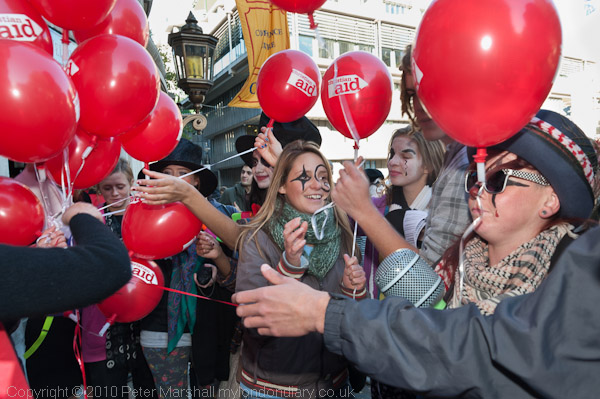
Finally I photographed some of the younger Christian Aid supporters who were parading around the Westminster area.

© 2010, Peter Marshall

More on  My London Diary.