Lens TAAB

Those among you who like to use manual focus (or have no other choice) may well be users of Leica cameras and have lenses that incorporate a focus tab. On my first Leica, a second-hand M2, the only lens I had for the first year was a ‘collapsible’ 50mm f2.8 Elmar, an excellent lens that would largely disappear inside the body when twisted and pushed in, so the camera and lens would slip inside a largish pocket.

There was a small downside, in that it was possible to fail to get the lens completely pulled out and locked when you wanted to take a picture, resulting in a very out of focus image. Sometimes you only found out when – perhaps weeks later – the film was developed.

But another feature of that – and I think other old Leica lenses – was the focus tab, which stuck out from the lens. On that Elmar it was metal, and on its end was a small button which acted as a lock. To move the focus from the infinity position you had to press this in as you pushed the tab around. Being Leica designed and engineered it worked smoothly and ergonomically.

By the time I’d saved a month’s wages for my second lens, a Leica Canada 35mm f1.4 Summilux, the tab was plastic and there was no lock, though it had gained a better shape that fitted your finger. The great thing about both these tabs was that they removed the need to look at the camera when focussing. Cartier-Bresson style we learnt to adjust focus by the tab before raising the viewfinder to the eye to frame and expose.

Various people like me who miss the convenience of the tab have found ways to add them to other lenses. As well as focus by feel, they also give focus by finger tip; possible without but usually on lenses without a tab we use the less convenient finger and thumb to focus.

Some people have previously made various tab devices available for sale, and the Steer from Leica goodies is designed for “fast and big glass such as the Noctilux, the 75 Summilux and the 90 Summicron“.

But a new product (currently you can pre-order on the web site) from TAAB does look like a better solution. TAAB is a flexible neoprene ring that incorporates a tab and can be stretched over the focus ring to grip and provide a tab. Three sizes will fit most lenses. A recent design tweak has slimmed the rings down by 1mm, removed the logo and tapered the tab into a more ergonomic finger-fitting form compared to the prototypes shown in on-line images.

Mostly I’ve moved to using auto-focus, with Fuji-X or Nikon cameras and lenses. But perhaps I might get a TAAB to use on one of the Fuji lenses – perhaps the 18mm – to work with on the street, where manual focus is often the best way to go, as auto-focus too often finds the background rather than the subjects.

Thanks to PetaPixel for an article that let me know about TAAB.

2015 PDN Photo Annual

There is plenty of good photography in the winning work in the 2015 PDN Photo Annual, though there are some of the various categories that interest me less than others. They include quite a few that have me thinking ‘how slick’ rather than really appreciating, and rather too much ‘so-whattery’, but it’s easy to skip on to the more worthwhile.

As well as the well-known names, there are also quite a few new to me. If you are short of time, I’d recommend going to the Student section first. Much of the other good work you may already have seen, and this also seems to me the most consistently interesting group of work. And perhaps surprisingly given my lack of interest in most sports photography, the Sports section here (which I almost didn’t bother with) is one of the more interesting.

I think the PDN Gallery might be more useful if it featured rather fewer photographers – if you worked your way through all the work here and went on to follow the links to the websites you could spend a few weeks on this site. It perhaps isn’t as obvious as it might be that the ‘Next’ button at bottom right of the screen is a very good way to go through all the photographers in order, showing you the first of their images – and you can then either view more or quickly jump to the next person.

Five Year Growth

Someone asked me yesterday if the only thing I photographed was protests. It was a genuine query, because she had seen me working at every protest she had attended in recent months, but my answer was “not quite”. But I went on to say that there were just so many protests at the moment that they had more or less forced everything else out of my diary – and out of My London Diary.  I used to cover a rather wider range of events.

It’s perhaps partly the election coming on, though I don’t really see a huge decrease in the activity of protesters after May 7, whichever party or parties form our new government. The policies that are behind what seems to be a growing resentment and militancy were many of them begun by Labour although the screw has certainly been tightened by the Conservative-LibDem coalition government. To mix a metaphor, Labour might release a little of the pressure, but it still looks to me as if growing inequality is stoking up a boiler on its way to bursting point.

Other photographers occasionally ask me how I find out about all the protests I cover, but really it isn’t a problem. My problem is more about choosing which of the many going on to decide to attend. Yesterday there were half a dozen things in various parts of London I knew about (and some I only heard about after the event) but I only got to one. And the pressure of work is such that I’ve been getting over-tired, not getting enough sleep and finding that I have to stop work after a few hours -at times I begin to feel my age.

It’s been a few days longer than usual since my last post here, mainly because I’ve been out working every day, and its likely to happen again. Today I’m able to sit here writing this because I didn’t manage to finish yesterday’s work at the computer, simply falling asleep as I tried to write, eventually dragging myself off to bed. So this morning I had work to finish and also still needed to rest. Otherwise there were a couple of protests in the centre of London and another following on from yesterday’s protests in Brixton I might be photographing. But I need a day off. Perhaps when I’ve finished writing this I’ll go for a quiet walk, taking as usual a camera with me, but probably not making and photographs.


X-Pro1, 10-24mm, 20mm

Sometimes I still do manage to photograph things that are really a day off from protests, and there was one such at the end of Febraury, when I went to a party to celebrate five years of Grow Heathrow. I’d first visited the site very briefly shortly after it had opened, just a short walk from an extremely small plot of land I had become a “beneficial owner” of at Heathrow Airplot in Sipson as a part of the campaign against a ‘third runway’ for Heathrow, and had returned for a couple more visits over the years.  Every time I went I thought it would be my last visit, with court cases and evictions always looming, and it was something of a surprise to find they were still there and active after 5 years.


X-T1, 10-20, 10mm

I’d thought a little about taking photographs, and decided it would be an ideal occasion to use the Fuji cameras, taking with me both the Fuji X-T1 and X-Pro1 bodies. I had four lenses, the 10-24mm and 18-55mm zooms, the 18mm f2 and the Samyang 8mm fisheye, though I didn’t use this. I’d taken the 18mm in case I had to work in low light, though it only has a one stop advantage over the 18-55 zoom at the same focal length. It’s also a nicely light and compact lens which is handy to have on a body hung around my neck when travelling, and my favourite focal length, but in the end I only made a few images with it. Eleven out of just over four hundred. Most used was the 18-55mm (266) with just over half as many (142) on the 10-24mm.


X-Pro1, 18-55mm, 55mm

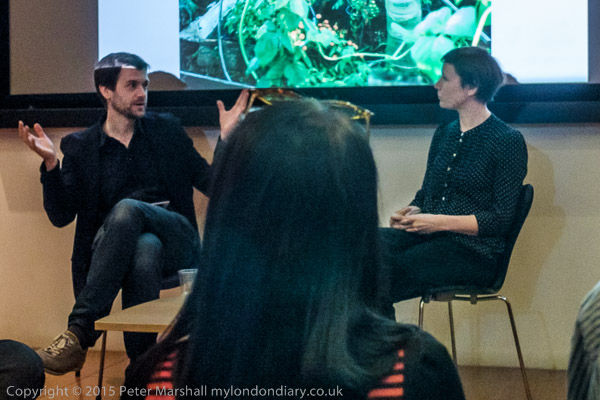
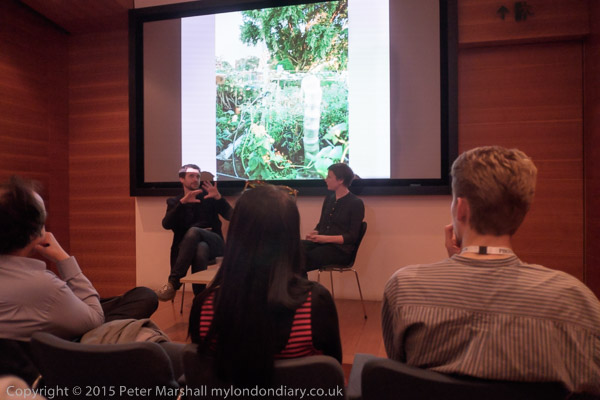
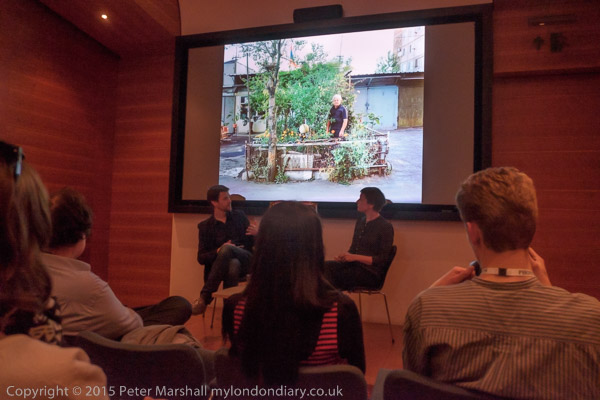
I like the optical viewfinder of the X-Pro1, but ended up taking more pictures with it using the electronic viewfinder and the 10-24 zoom, and wishing that I had two X-T1 bodies. One thing I did miss was a longer lens than the 18-55mm, particularly when photographing the panellists at a discussion where I could not move in closer. I’ve rather got used to using the 18-105mm on the Nikon, and if I ever decide to use the Fujis seriously would certainly buy something longer, perhaps the 18-135mm.


X-T1, 18-55mm, 37.4mm

I had the usual battery problems – I got through four in the four hours I was there, and occasionally the focus was just a little slow, but otherwise things worked fine. I’m getting used to using the exposure compensation dials, though moving the focus point around is still a little tricky. The X-T1 viewfinder is really good in low light too.

There was a huge advantage in using the Fujis in quiet conditions close to other people in that I could take as many pictures as I liked without being a distraction. I often feel intrusive when photographing with the Nikons, although I know the shutter sound is louder to me than to other people, it is still loud enough to be annoying. Almost as annoying as a Canon :-)  though less so than a cannon. With the X-T1 you can use the electronic shutter and all there is to hear is a slight whir as the lens focusses. Usually I leave the shutter in mechanical mode, which is pretty quiet, but does give you some feedback that you have taken a picture. Sometimes I found myself having to review an image to be sure I had really pressed the button.


X-Pro1, 10-24mm, 17.4mm

It was a pleasant afternoon, and good to meet a few old friends as well. Of course you can read more about Grow Heathrow and see more pictures on My London Diary in Grow Heathrow’s 5th Birthday.

Continue reading Five Year Growth

I’d love to love Fuji, but


Fuji X-T1, 18mm (27mm eq)

Around Easter I’ve taken some time off from my normal work and have spent a lot of time using the Fuji X-Pro1 and Fuji X-T1 cameras, mainly with the 10-24mm zoom on the XT1 and the 18-55mm zoom on the X-Pro1, but also working with my favourite 18mm and the 35mm Fuji lenses. At times I carried around some others, but didn’t find the need to use them.

It’s taking me a long time to get used to some of the idiosyncracies of the Fuji cameras, probably much longer than if I just used one of them. If I had to pick one it would be the X-T1, largely for its far superior electronic viewfinder. Though I do like the optical viewfinder of the X-Pro1, I’ve often found myself switching to the electronic alternative, as the zoom lens blocks a significant part of the optical view. It works rather better with the smaller 18mm and 35mm primes, where only a small part of the view is blocked.

If these – and others in this focal length range – would satisfy all my photographic needs, I’d prefer the X-Pro1, but I like to have both a wider and a narrower view.  With the 18-55mm, by the time the long end is reached, the viewfinder image with the optical viewfinder is just too small for my liking, making the electronic view a preferable option, and with the fine 14mm f2.8 too much of the image is hidden where the lens obtrudes into the optical viewfinder.

The X-Pro1 is a fine but very limited tool which does appeal to me as it feels a simpler camera to operate than the X-T1, but for me the flexibility of the latter is vital. For so many lenses it works better. Even with that 18mm, seeing the bottom right corner in the viewfinder is much better. And now I’m used to it, and don’t waste time searching throught the menus for it, I very much like having a dial on the camera top putting ISO at my fingertips. Being able to walk from dark interior to bright sun without having to fiddle with menus is great.

I find switching from using a camera with a direct vision optical viewfinder to an electronic viewfinder can be confusing. Using mainly DSLRs and the X-T1 it’s just too easy to get into the habit of thinking if the image is sharp in the viewfinder it will be in focus on the sensor – and I have made many, many exposures that prove it just ain’t so. The occasional arty blur might be of interest, but to find you’ve taken 50 in error because you forgot to change back from manual focus can be annoying. With the 18-55mm at its wide end, depth of field may be your friend and cover your stupidity, but it doesn’t work at 55mm.

Of course it should be obvious that you are still on manual focus – no little green rectangle confirming focus – but in the heat of the moment it can be so easy to forget this. And if you are not photographing in the heat of the moment, perhaps you should ask yourself why you are bothering to take pictures at all.

I think now that I have finally figured out most of my problems with Fuji colour in Lightroom.  I’ve been using the X-Pro1 on and off for a couple of years and have always been surprised at how many people enthuse over Fuji’s colour rendition. Even though I think I’ve now discovered how to deal with it, I still often prefer Nikon colour.

The best result I’ve got with Lightroom come from changing the ‘Camera Calibration‘ from the normal ‘Adobe Standard‘ to the Fuji ‘Camera Pro Neg Std‘. It seems to give better colour than the camera Provia/Standard that I normally use for in-camera jpegs and the viewfinder/screen image (it seems wrong to use a different setting for camera and Lightroom, though the camera setting doesn’t affect the RAW file, but working this way seems to give me a better match between what I see in camera and the developed files.)

Setting up a development preset that applies this and uses Auto-tone produces images that need little adjustment – similar in that respect to my Nikon files, while with Adobe Standard they were a problem to deal with. Though there still seems to be an undesirable propensity for pink in Fuji’s auto white balance to correct. Lightroom’s Auto-tone perhaps works even more reliably than with the Nikon files, though this may be a reflection on the less challenging situations I’ve used the Fujis in.

I have a small issue over file sizes. Fuji’s similar quality to Nikon comes from files with a roughly similar number of pixels, but while the RAW files from the D700 average out at around 11Mb, the Fuji RAW files are roughly two or three times that size. The 16GB cards I now mainly use in camera get filled up rather fast, particularly on the X-T1, and I’ll probably buy larger ones; transfer times to the computer and into Lightroom are noticeably longer, and my external storage is filling up at a faster rate. Nikon’s compression with no real life noticeable quality loss is very useful.

Fuji battery life is a problem, even using mostly the optical finder on the X-Pro1. Nikon batteries hardly ever need changing during a day’s work. I carry spare batteries, but hardly ever need to use them, and have to remember to swap them over occasionally or the spare loses its charge over months. Working with the two Fuji cameras, at the moment I have a total of five batteries. Just enough to see me through a day of fairly light work, but I really need at least one more. Expense isn’t a problem, with replacement batteries being fairly cheap, but it’s a nuisance having to carry and to change them.

Overall I’m feeling rather frustrated with the Fujis. With the Nikons I can turn them on when I get the cameras out of the bag, and turn them on when I pack up. Between those times – often hours apart – every time I put my camera to my eye and press the shutter release, the camera takes a picture, almost every time in focus and with hardly any perceptible hesitation.

With both Fujis, things are rather different. Unless you are going to be taking pictures every few seconds, it’s quicker to switch the camera off, then turn it on when you want to use it again, waiting the roughly two seconds start up time, otherwise you can be pushing the button and swearing for even longer until the camera wakes up.

Focus, even with the improvements from firmware updates, still takes a noticeable time, but its the time taken to persuade the camera into life that is for me the real killer.

For some photography with wide-angle lenses in fast-moving situations you can of course do what we always used to do, turn off autofocus and rely on depth of field, using ‘zone focussing’. Once it’s up and running the X-Pro1 with the 18mm does the Leica thing rather better than the Leica M8 I used to use, and about as well as the real thing.


X-Pro1: 18mm, 18-55mm (27mm eq)

I have had some issues with framing using the 18-55mm with the optical finder of the X-Pro1, though these may well be down to me rather than the system. Certainly I seem to chop off the tops of people’s heads rather more than when working with the similar frame inside the view with the 18-105mm DX on the D800. And using the Fuji combination yesterday, at times the bright line frame was fading away as I was working, which was not good news. I fear an expensive repair may soon be needed.

So, much though I like the Fuji cameras, and much though I prefer to take them with me when I go out for a long walk or some relaxed occasion, they won’t be replacing the Nikons for much of my more intensive work. Perhaps I might just try working with a hybrid kit, with the X-T1 and 10-24mm replacing my ageing D700 and the superb but heavyweight Nikon 16-35mm. Perhaps. I’ll certainly give it a try before getting around to buying a D750.


Fuji X-T1, 10-24mm at 15mm (22mm eq)

For some photographs, that couple of seconds wait isn’t a problem, nor the slight pause you get between the shutter press and exposure. Some people wouldn’t even notice it, but when you are used to a camera without appreciable delay it annoys. Catching the moment is often vital in photography; catching the moment a little after just won’t do.

While in this post I’ve concentrated on some of the negative aspects, particularly for certain types of work, there are also some very positive aspects of the Fuji. Working in quiet environments, the quiet (or truly silent in electronic mode on the XT1) shutter is a great advantage, both to me as a photographer and in preventing annoyance to those you are photographing, and fast lenses such as the 35mm f1.4 combined with good high ISO performance are great in low light on the X-T1. I’ve often found myself while working wishing I had this camera in my hands instead of a rather clunky Nikon with a slowish zoom. The 23mm f1.4 is more expensive, and I’ve not yet bought one, but I’m tempted by this and the weather resistant 18-135mm …

Continue reading I’d love to love Fuji, but

Estates of Mind?

In 1951, a part of the Festival of Britain was the Live Architecture Exhibition, on what became knows as the Lansbury Estate in Poplar, and at its centre was Chrisp St Market, the work of architect Frederick Gibberd, the first purpose-built pedestrian shopping centre in the UK.

It wasn’t entirely succesful – and his iconic Clock Tower built as an observation tower soon had to be caged in against suicides, but it was an important statement of a new vision in housing, with huge programmes over the next thirty or so years to provide social housing for the mass of the population, replacing both the areas destroyed by bombing and the decaying streets of jerry-built Victorian slums. There was a national feeling, an urgency that something had to be done about the housing problem, and a consensus that a large part of the solution lay in providing social housing at resonable cost for the majority of the population at least in the major cities.

The problem was also addressed by the New Towns, such as Bracknell, where I myself lived in a Development Corporation flat for several years in the early 70s, but in London and other cities it was an era of large estates, often system-built and with much bare concrete surfaces.

The best of these were architectural gems and masterpieces of design, and while some may have looked they were often spacious and comfortable, offering many residents for the first time the kind of conveniences we now take for granted. But like all property they needed proper management, with regular repairs and maintenance, and in most cases local authorities failed to meet the challenges of ownership, allowing properties to run down. There were sometimes design faults, more often corners cut by the builders and, certainly in later years financial pressures on councils that made their job impossible.

Now the pressures on these estates come largely from the increase in land values and the greed of developers and councils. Many of these large estates are in highly desirable locations, and huge profits can be made by demolishing and rebuilding at a much higher density and to lower space standards for private sale. It’s a process part-fuelled by overseas investors buying properties not essentially to live in but for the capital gains from rapidly increasing house prices, particularly in London. Investment brochures for one block in Aldgate suggested that buyers would see a 35% rise in the value of their flats in around three years- and that prediction may well turn out to have been conservative. But can we afford to let London become simply a proiftable  safe deposit for foreign money rather than keeping it as a living city?

The name of this un-housing game for financiers is ‘regeneration’; a worthy aim announced in the early years of the last Labour government with probably the best intensions that has turned into a nightmare for Londoners on low or middle incomes. But while its first proponents may have been simply naive, it has turned London’s largely Labour councils into villains in league with property developers in boroughs including Labour strongholds such as Newham and Southwark as well as Tory boroughs including Brent and Wandsworth.

We’ve already lost much good, serviceable property, along with some of the best architecture of the era, such as the Heygate estate, where a long process of neglect, demonisation and PR enabled Southwark to sell off the now-demolished estate against the wishes of many of its residents, at a time when many of its buildings and landscape were just reaching maturity.

The Heygate too was one of the starting points for the now rapidly growing protests about housing across London – and which were certainly a part of the reason why Southwark has lost millions on that particular deal. Despite which, they are still going ahead with a similar scheme on the larger neighbouring Aylesbury Estate, currently the subject of occupations and battles between housing activists and security guards aided by police, and where some remaining residents now find themselves behind tall fences in what looks like some kind of prison, having to make lengthy detours and show documents to be let in or out – and to go to the security gates to meet any visitors.

Other protests too have made the news. Some appear to have met with some success – after Focus E15 mothers occupied an empty block on the Carpenters Estate, Newham has now moved a number of families back into properties they had left empty for ten years in their attempt to empty and demolish the estate. New Era tenants evaded eviction before Christmas (thanks to a little help from Russell Brand) with their block being sold to another housing association.

Other protests continue across London, including those over Sweets Way in Barnet, the West Hendon Estate, the West Ham football ground, Cressingham Gardens in Brixton, Fred Wigg and John Walsh Towers in Waltham Forest, the West Ken and Gibbs Green Estates in Hammersmith & Fulham, the Sutton Estate in Chelsea, Guiness Trust on the Loughborough Park Estate,  Northumberland Park and other estates in Haringey, and of course the ‘Poor Doors’ protests at One Commercial St, Aldgate.  Regular readers of this blog or visitors to My London Diary will be aware of some of these.

I began this post at Chrisp St, because I was there last night for the private view of  ‘Estates of Mind‘, a photographic show in which “Six photographers explore various social housing projects from the 1960s and 70s; an era of radical architectural determinism and social restructuring.” (Open between 12-6pm on 9-12 April and 15-19 April.)

The invitation continues with a question “What can we learn today, in a time of great uncertainty in social housing from their successes and failures.” Although there is some interesting photography on display, some of it taken on some of the key estates now under dispute, this is perhaps a question that the show largely fails to engage.

What I found most satisfying were the set of images by Mike Seaborne, who I’ve known and sometimes worked with for around 25 years (including on the Urban Landscapes web site), and in particular his combination of images that he took around the turn of the century with those from this year on the Isle of Dogs. It is perhaps the only part of the show which says something about what is happening through its use of these ‘then’ and ‘now’ views, as well as displaying a discerning choice of viewpoint and an admirable clarity of treatment.

Also of interest to me were pictures by Peter Kyte from Grahame Park in Colindale, North London, Barnet’s largest housing estate on the former Hendon Aerodrome developed in the 1970s and named for aviation pioneer Claude Grahame-White. The estate underwent some regeneration in the 1980s, removing some of the connecting walkways., but its major regenertion began with a demonstrtion phase in 2007, with the first major phase being completed in 2012 and is continuing. The original 18-year programme proposed the demolition of around 75% of the 1777 properties (including the long low-rise blocks of flats that give the estate its character) and their replacement by slightly over double that number of new properties, of which roughly 30% were to be social housing.

Unlike most other work in the show which is largely straightforwardly documentary, Kyte’s work is a very personal vision concentrating on the long dark passageways he saw there, emphasized by heavy printing and by the cropping to a tall narrow format in his 20×12″ prints. The work had a impressive coherency, though I think one that tells us more about the photographer than either that particular estate or the more general problems of housing in London.  I wondered particularly about how his view as a visitor might differ from that of someone for whom the estate was home.

There is also perhaps something of a contradiction in the location of the show, an empty shop made available for the show by the owner, Poplar HARCA (Poplar Housing and Regeneration Community Association) who a few years ago took over the regeneration of nearby Erno Goldfinger’s Balfron Tower (where this group held a show last year) from Tower Hamlets Council. As the Docklands and East London Advertiser reported earlier this month:

It appears that social landlord Poplar HARCA are preparing their tenants in Balfron Tower to leave the building so that the rich can purchase the newly refurbished flats. Another east end community is being destroyed for profit. A sad and insulting legacy to the values of its architect Erno Goldfinger, and that reminds us how little the voice of the powerless are heard, or acted on.

Rather earlier in 2010, Michael Newman had commented on an article in BDonline on the renovation of Balfron Tower:

This article is well written and informative but as a resident of Balfron Tower I want to point out that paragraph 3 is incorrect.

“Once refurbished, residents will have the choice of keeping their heads in the clouds or putting their feet back on the ground by moving into newly built homes elsewhere on the estate. “

At the moment HARCA has informed residents of its aim to refurbish and to empty the building to do so, but has failed to mention the choice of returning to their homes.

It appears that HARCA and those partners it is working with are forcing the present community in the Tower to leave their homes and never to return. So much for the values of social housing, for helping communities, and for a ‘Golden Future’ for the Tower and its inhabitants.

It looks like HARCA will refurbish the Tower, will sell off the flats and as usual the rich and so-called cultured will buy the right to ‘homes in the sky’.

I wonder what Goldfinger would think of HARCA’s guardianship of his building, and the council who historically were brave and fought for rights of its people.

Housing is a vital topic, particularly in London, and one which has, largely through the efforts of various protest groups, and marches such as January’s large ‘March For Homes‘ forced itself onto the news agenda. It’s good to see photographers and shows tackling it, but I would like to see ones that perhaps incorporated rather more thought and provoked it for those not already involved in the issues.

March for Social Housing

Back in January I had a very busy Thursday, starting with an event on the other side of London to where I live, Stop Arming Israel picket HP at BETT, a picket by a group I’ve now photographed on quite a number of occasions. Most of their protests against Hewlett Packard’s support of the Israeli war machine have been outside HP’s offices in the middle of the City of London, but this was at ExCel on one of London’s former docks, well to the east of the centre. It’s an area I first photographed in the 1980s – with a few images you can see in my book ‘The Deserted Royals‘, though fortunately now much easier and faster to get to.

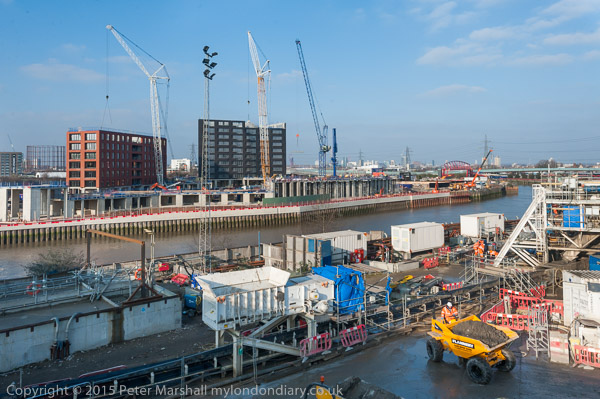
I spent an hour or so there taking pictures, then took a walk across the Lower Lea Crossing, from where I took the picture above of Bow Creek. It was a fine day for January, and decent weather for panoramas, though I would have liked rather more interesting clouds. Thanks to my recent computer problems I’ve not had the opportunity yet to process the panoramic images I made – so I’ll hopefully write about them later. Though I’m always rather loath to put a message on line “<small”>more pictures coming shortly” as I think there are still some such gaps waiting for me to fill as far back as October 2002. Really I will one day!

Next was a trip up west, to the Ritz and Mayfair, where I had expected to meet rather more members of Class War than the three who turned up for Class War visit ‘Rich London’.  It was all just a little tamer than I had hoped for.

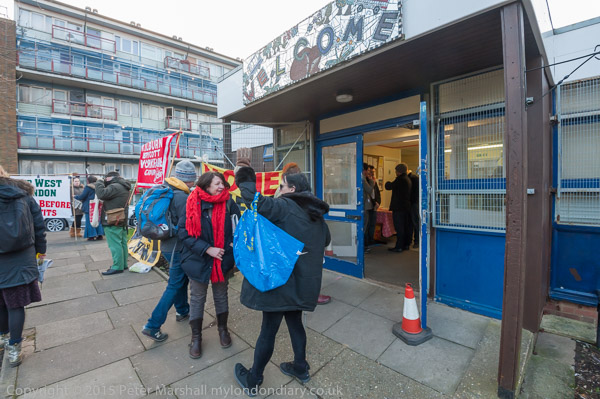
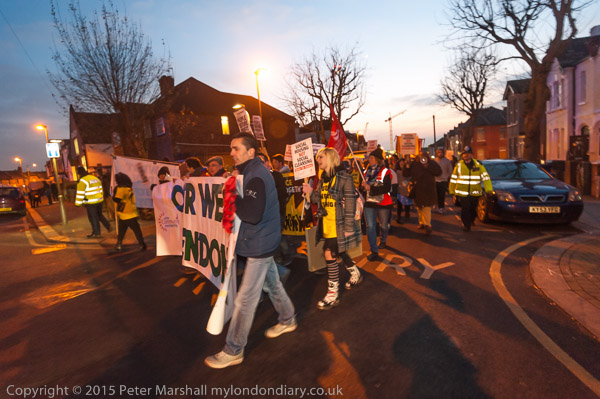
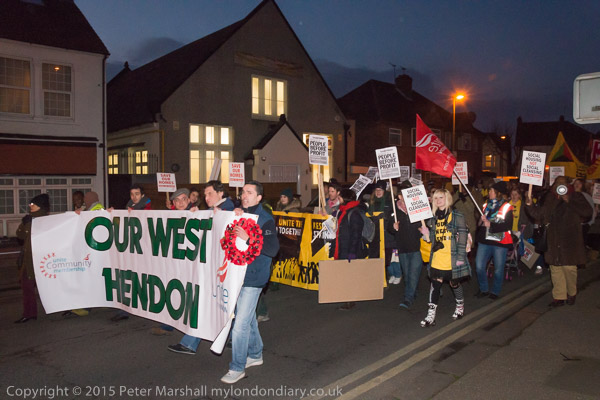
But it did make me late for what was the largest event of the day, the West Hendon march for Social Housing, in one of London’s north-west suburbs. It took just a little finding too, and had me cursing my smartphone as it showed me a black area instead of the map I’d told it to load. Paper maps have the advantage of not needing a signal. I was annoyed to have arrived just a minute or two too late for the photographs outside the community centre where the protesters had been holding a meeting, seeing them dispersing as I rounded the corner a hundred yards or more away.

Fortunately the best was yet to come, though there was around an hour of waiting around with relatively little to photograph. A few groups stood around outside the community centre talking, some with placards and banners, while others sensibly kept in the warm inside. I took a few pictures inside, had a free cup of the hot soup and talked to some of the protesters, many of whom I knew from other events. Finally it was time for the next part of the protest, the promised giant banner drop.

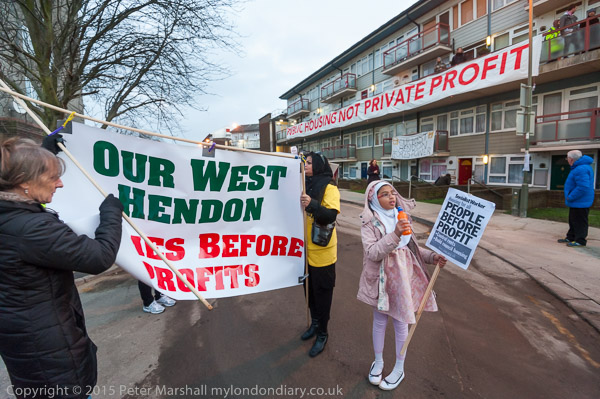
As you can read in West Hendon march for Social Housing there was then a rather long memorial event for a local war hero, the only female Sapper of WW1, who locals are hoping to commemorate in the area.  It was an interesting story, and one which I did a little more Googling on before writing my piece for My London Diary, but I wandered off shortly before the end to take a few pictures of the various posters I’d seen on some of the flats.

It was getting steadily darker and darker, and I was trying out a new toy, a Neewer CN-216 LED light, which has 12 rows of 18 LEDs (which explains the 216 in its name.)  Its a slightly chunky box, about  5.5 inches wide, 3.75″ tall and2.25″ deep with a reasonably sturdy fitting on the bottom to attach it and angle it up and down a bit on a hot shoe. Fitted with 6 AA batteries it weighs in at a smidgeon over a pound (458 grams.)

It doesn’t really produce a great deal of light, though noticeably more than the earlier and cheaper LED lights I’ve tried. Enough to make a difference when fairly close to you subject, but not really an alternative to flash at more than a few metres away, even when working at ISO 3200. When it got really dark I was working with it at 1/30th f2.8 ISO 3200.

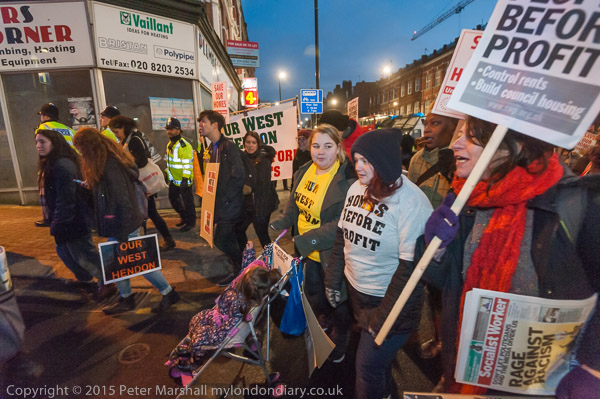
In the image above, as the march turned off from the Edgware Rd, the CN-216 provided useful fill on the closer figures, while streetlights gave reasonable overall illumination. When a little later we got to darker streets and the CN-216 became the main light source it was less useful.


D700 16mm 1/15 f4 CN-216 ISO 3200


D800 18mm (27mm equiv), 1/60 f8 ISO 3200

The two pictures above were taken within a few seconds of each other, both in a dark area with inadequate street lighting. Both have had considerable burning and dodging to partly equalise the lighting across the image. The CN-216 is a rather larger light source than the flash, but still the normal inverse square law more or less applies, doubling the distance from the light giving only a quarter of the illumination.

I’d chosen 1/60th for the flash exposure to reduce or eliminate any motion blur and the kind of double image that often results from slow shutter speeds. There is a four stop difference between the two images (two stops in aperture and the same effect as two stops in the different shutter speeds) and it’s this that makes the main difference between the two images.

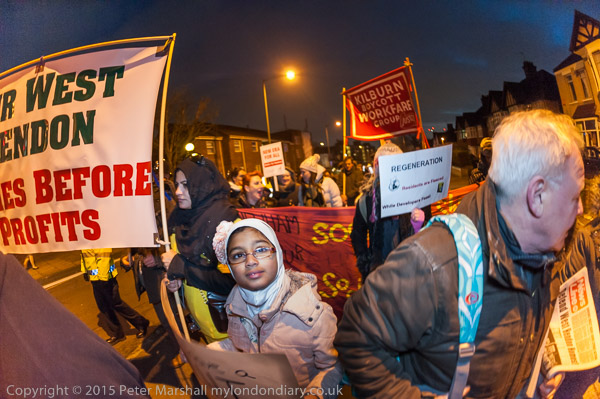
Another image taken with the aid of the CN-216, this time with the 16mm fisheye at 1/30 f2.8 close to the end of the march. Hendon seems to have some pretty dark roads. The LED light doesn’t of course cover the full 180 degree diagonal, and you can see some fall-off in the banner at upper left.  This was an advantage for the figure at the right, as he needed less burning – and was so close that with an even light spread would probably have been to far burnt out.  The girl at the centre, although a little further away was almost at the limit of the highlights.

The lens comes with a pair of diffusers, one plain the other an orange to convert the light from daylight to roughly tungsten. So far I’ve always used it with the daylight diffuser in place. Vignetting is noticeable with any wide-angle lens, but can be corrected with Lightroom, so isn’t a huge problem.

The CN-216 is just about powerful enough to be useful for this kind of work, and working with portraits at close distances you might sometimes even want to use the control wheel which dims the light rather than work as I did always on full.

Ideally I’d like a light with at least twice the output, especially since I have no really fast lenses for the Nikon. Usually the f4 16-35mm is fast enough, but rather limiting for this use. The two faster lenses I have are the 16mm f2.8 fisheye, a 20mm f2.8 and a60mm f2.8  Micro Nikkor.  The CN-216 would be more useful with the Fuji XT-1 where I have a 35mm f1.4, 18mm f2.0 and 14mm f2.8 (52mm, 27mm and 21mm equivalents) as well as a f2.8 fisheye.

And the best thing about the CN-216? The price. If I believe the specifications, the light output is much the same as that from other models costing well over £100. Without batteries it cost me a little under £30 including postage from eBay.

The link for the story and more pictures again: West Hendon march for Social Housing
Continue reading March for Social Housing

Roll Over Photoshop?

Mac users may now have a serious alternative to Photoshop as an image editor for photographers in Affinity Photo, according to a report in Creative Bloq. Available now as a free beta version, the full version is likely to cost £39.99.

Its part of an intended suite of three products, with Affinity Designer  (an alternative to Adobe Illustrator) already available at the same price getting some very good reviews. Also planned is an InDesign alternative called Affinity Publisher due for release later this year.

The programmes come from Serif, who have in the past produced some interesting products aimed at the non–professional market in similar areas. Like products from other developers that I’ve tried in the past, and Adobe’s own Elements these have lacked a few essential features and lacked the ease of of use that – once learnt – makes Photoshop so straightforward, at least for most of the things photographers really need to do.

But Serif aren’t simply trying to match Photoshop, but to outdo it, and have obviously learnt something from other software too. There is a nice promotional video and it does look good, promising greater speed and the big advantage – like Lightroom – of non-destructive editing. And “CMYK, 16-bits per channel editing, LAB colour, RAW processing, ICC colour management, and Photoshop PSD and 64-bit plug-in compatibility.”

It certainly looks promising. The only bad news is that it is Mac only, although there are plans in the longer term for a Windows version.

Lightroom Develop Primer

By now I think most of the photographers I know – or at least those who can care more about image quality than speed – have become Lightroom users. There are of course alternatives, and in the past I’ve used several of them, including Capture One and the software from Nikon and Fuji for their own cameras, as well as other independent alternatives.

For sheer speed, important to many press photographers, I’m told that nothing beats Photo Mechanic, and if I were wanting to file images from location I’d probably install this on my Ultrabook.

There are minor differences between the results from different raw conversion software, but all of them do a very acceptable job, and the differences between their renderings seem unimportant except to pixel peepers.

Lightroom appeals to me because of its workflow and versatility, and it also helps that it comes together with Photoshop on a reasonably priced subscription. Like many others I was worried about the Adobe scheme when it was introduced, but I am now converted, especially since Adobe seems to be keeping its promises and also continuing to develop both products.

For me Lightroom does have one weak link, in that it is very slow for the initial editing of the large number of images I usually take in a day’s work. The review of images within the Import dialogue works for a small number of pictures, but slows to almost a complete halt when applied to sensible numbers.

My workaround for this is FastPictureViewer Pro, software that does exactly what it promises. It reads the images from my USB 3 card reader at least as fast as I can view them on screen; after an initial load time of perhaps 10 seconds there is no waiting as I go through the pictures, pressing K for those I want to keep which it copies immediately to my ‘input’ folder.

On the web page they suggest that using Lightroom on a batch of 1000 images with a fast computer takes around 1 hr 10 minutes, while doing the initial edit with FPV and then only importing the selected images cuts this to around 20 minutes. On my system I think the time-saving is perhaps a little greater.

But although many friends have Lightroom, I don’t think many of them have really appreciated or explored what it could really do for them.   It has grown into a fairly complex programme, though basically still much simpler and more intuitive than Photoshop.

I spent a long time going through the various excellent tutorials available on the Adobe site – and a long time searching for answers to various problems in the online resources there, which I feel are not well presented. You can of course buy books telling you how to use it, and I have one, but these become out of date almost as soon as published as a new and improved version appears. Mine had some useful tips for Lightroom 2, but five years or so on, Lightroom is now at version 5, with 6 surely not long away.  But there were some good tips, particularly about workflow which still apply.

Thanks to PetaPixel for alerting me to the video 10 Tips for Optimizing Your Photos with Lightroom: A Primer on Basic Techniques, a lengthy presentation by photography instructor Tim Grey.

And it is lengthy, and I would have preferred a much more business-like presentation which would have cut the length by at least an hour, but it does give a good introduction to the basics of working with an image in the Develop module at the heart of the software. As someone who started at the beginning with version 1 (then somewhat of a disappointment compared to the software Adobe bought out) there wasn’t a great deal that was new to me, and perhaps Gray’s approach may be better for those coming across the programme for the first time. But there were a few little things that I learnt. Though what seemed like ten minutes to tell us it was a good idea to check the ‘Remove chromatic aberration’ box seemed excessive. And is there any reason ever to leave that box unchecked?

Of course, we all work slightly differently as photographers, and there was some advice that wouldn’t work for me. Perhaps because I often have to work rapidly, unlike him I often have a need to adjust the exposure slider, and I have a more aggressive approach to luminance noise reduction than him. But he does make the effect of some of the many sliders in the develop module clear, and in particular things like the difference between ‘saturation‘ and ‘vibrance‘. Though I was sorry when talking about that luminance module he failed to mention at all the functions of the contrast and detail sliders.

Perhaps more significant was the lack of any discussion about sharpening (unless I went to sleep at some point?) Other people tell me that Fuji X-Trans files render better with a 100% detail setting in sharpening. I think a similar high detail setting in the luminance noise dialogue also helps.

If you watch the video, use the link supplied by PetaPixel to the B&H site for whom the video was made, and make it full screen so you can see fairly clearly the quite detailed settings on the right of the Lightroom screen.

I’ve never been to B&H, but have often referred to its on-line catalogue for information and did once buy a camera from them, a long time ago. It arrived quickly and well packed with all the documentation in order, and at some saving to me because of the dollar/pound rate at the time, and because US prices for the Konica Hexar were rather lower. In the UK it was overpriced by the importer and was very hard to find in the shops, and what was perhaps the truly iconic ‘street’ camera was a rare beast indeed here.

Looking Back on 2014 – Part1

I don’t usually go in for reviews of the year, but I got a message a few days ago asking if I wouldn’t mind sending a selection of my favourites from the pictures I’d taken in 2014 for use on a web site slide show, and I agreed to do so.

So last night I sat down and went through my work. Until some time this year I did actually keep every picture I took – except for those obvious errors, like the many I take by accident when one camera bumps on top of the shutter release of a second, or those when I grab a camera and hit the shutter release by mistake, or those that were clearly out of focus or ten stops over or under exposed…. But this was getting to be far too much as the times got busier, I got more trigger-happy and file sizes increased to the ridiculous when I used the D800E full frame. 32Mp is great for those pictures you really need to print large, but for sending to agencies is overkill. So usually I use the D800E as a DX camera, which gives much more sensible 16Mb files. But for some purposes I need the full 32Mb and then go on to produce a 16 bit tiff file. Each pixel then needs 6 bytes, ending with 192Mb, although lossless compression can reduce this somewhat.

But dealing with large numbers of large files was slowing me down too much, as well as eating up hard disk after hard disk, and finally in October I turned over to a policy of only loading the files from any set I would be happy to publish onto the computer, and where possible weeding out duplicates and near duplicate too. I still end up with more files than I want or need, but the numbers are certainly down, with perhaps typically only a quarter of what I take making it to hard disk.

I had several arguments against this kind of editing. First that I’d never done it with film, and often when I go back to old work find that I had failed to use some of the pictures I find more interesting in retrospect. Finally I decided that this was more an argument against too tight editing rather than against editing at all.

Perhaps more important was that editing was time-consuming. But as the number of exposures increased, so was importing them all. I turned over to using FastPictureViewer Pro, a piece of software that lives up to its name. I’d tried viewing and selecting pictures from the cards in my USB3 card reader in Lightroom’s import dialogue and found that although this worked for small groups of pictures, with larger groups it soon slowed to a standstill.

FastPictureViewer takes a few seconds to load, but then lets you go through them with never a hold up, pressing the ‘K’ key for those you wish to keep. It copies them to a folder I have set up on one hard disk as an ‘Input’ folder with no hold-up to the viewing process. When I’ve been through the card or cards and selected the files, Lightroom will quickly rename and copy them according to my preset to the correct folder (and make a backup on another hard disk), much faster than working from the card. Overall there is a time saving, and the only drawback is that I have to sit there selecting the files at that point, when I often want to eat dinner before working on them. But it’s a fast process and I can wait.

So far the savings in disk space and file numbers haven’t been quite as large as I had hoped, I still tend to press the ‘k’ key rather too frequently, but I’m working on it. Over the year as a whole I covered around 360 stories, with an average of around 250 images kept for each of them, making a total of around 90,000 image files on disk (next year I  hope the average will be rather smaller.) Far too many to look through individually in any sensible amount of time – even with FastPictureViewer, which says “4,000 images per hour is is realistic, with zero upfront time.” Incidentally I don’t get free copies of software, but $50 seemed reasonable for a licence to install and use on up to 3 computers, and it can do a few more things other than simply view images, without being in any way bloated.  When I get time I may well investigate it for keywording.

So I went to the lead images of the 360 stories on My London Diary, and selected my favourites mainly from these. In some cases when I saw these I remembered I’d taken other images that I might prefer and I went and looked through the story on My London Diary. I had two rules, firstly not to select more than one image from any story, and secondly to select only landscape format images, as this was for a slide show, and vertical images don’t really fit. This was a shame as some of my favourites would undoubtedly otherwise be portrait format. And the third, slightly vaguer rule, that I would only choose images from protests.

I ended up with 69 images, which seemed to be rather too many to send, though perhaps I’ll post all or most in a series of posts here. I sent off a dozen for the slide show, and received a request for another one, not on my list. Here are the first nine:


Focus E5 Mothers Party Against Eviction – East Thames Housing Assn, Stratford, London. Fri 17 Jan 2014


‘3 Cosas’ Strike Picket and Battle Bus– Senate House to Parliament Square, London. Tue 28 Jan 2014


Hungry for Justice For Fast Food Workers – Oxford St, London. Sat 15 Feb 2014


Atos National Day of Action, London. Wed 19 Feb 2014


Focus E15 Mums at City Hall – City Hall, London. Fri 21 Feb 2014


Against Worldwide Government Corruption – Trafalgar Square & Ecuadorian embassy. Sat 1 Mar 2014


Stop Hospital Killer Clause 119 – Parliament, Westminster, London. Tue 11 Mar 2014


Syrians March for International Action – Hyde Park and Downing St, London. Sat 15 Mar 2014


Fukushima Nuclear Melt-down Remembered – Hyde Park and Downing St, London. Sat 15 Mar 2014

Continue reading Looking Back on 2014 – Part1

Fuji in Hull


A recently built footbridge across the River Hull

I’d been thinking for a while that while I liked the Fuji X-T1, and in particular the viewfinder, the lenses that I had for it, the 18-50 zoom, the 14mm and the Samyang 8mm fisheye, were all rather large. Not a problem when you are going out to work seriously, but they make it a little bulky when you want a camera to take along when taking pictures isn’t your main intention.

So for those occasions, I was still picking up the Fuji X100, a nice but sometimes frustrating fixed lens camera, with a 35mm equivalent lens. One of the frustrations with using it is that it sometimes just won’t take a picture – and the only way I’ve found to persuade it to function is to turn it off and then back on, wasting a few seconds, usually long enough for people to move or lighting to change and pictures to vanish. But my real problem is that so often its view is not quite wide enough. You can get a supplementary lens that fits on the front and makes it wider, but that seems a rather clunky solution which rather negates the concept.

For some years the main camera I used and carried almost all the time was a Leica M2 with 35mm f1.4 Summilux,. and 35mm became my ‘standard’ focal length. But after around ten years I put it to one side and standardised instead on a Minolta CLE – a more compact camera with an exposure meter – and the Minolta 28mm f2.8 which became my carry everywhere camera. I found the wider lens much more generally useful, and if absolutely necessary you could crop the image a little to give the effect of a 35mm or even a 50mm.


The Ferens Art Gallery – where I had a show in 1983 – you can see many of the pictures in ‘Still Occupied

So I wanted a small lens, and one with approximately the angle of view of a 28mm on a film camera. Taken together these two requirements made the 18mm f2 an obvious choice. But two things put me off. Firstly there are quite a few reviews that knock the performance of this lens, and secondly that I didn’t want to pay the roughly £400 that my usual dealers were then asking.

I left it for a while, then thought about it again when Fuji started a cashback scheme. There is a rather better scheme now – and for around a month longer, but unfortunately it doesn’t include the 18mm.  I turned to Ebay and found that there was a fairly steady stream of secondhand 18mm Fuji lenses coming up for sale – mainly as owners were replacing them with the 10-24 zoom.  That’s a lens I’d rather like too – and will doubtless buy in time – but  that in my mind serves a quite different purpose – and another relatively large and bulky lens, if half the size and weight of its Nikon near equivalent I currently use.


Spring Bank

I bid in a few auctions, gradually increasing the maximum bid I was prepared to pay, kicking myself for missing a real bargain in the first I took part in which went for £165, and eventually getting the lens I wanted for a little under £200 including postage. It arrived just a couple of days before I was leaving for a couple of days in Hull, where I was going to attend a wedding, followed by a brief visit to Derbyshire on the way home.

I thought it likely I would be asked to take some candid pictures at the reception, and knew I would also have some time there to take pictures, but I wanted to travel reasonably light. So I put the 18mm on the X-T1, packed the other three lenses in my shoulder bag and set off for Hull.


The Deep and the River Humber

In Hull and Derbyshire I took over a thousand pictures over 4 days, though I’ve not kept all of them, including several hundred at the wedding reception, mainly in relatively dim room lighting, and the technical quality of the results from the X-T1 and 18mm surprised me. I took quite a few night images as well, all hand-held, at shutter speeds down to 1/10 s (and one at 1/5.) Of course where possible I leaned on rails or against posts to help keep the camera steady, but often there was nothing to use for support. Not every image was sharp, and I generally took several so as to pick the sharpest.


The Deep is on the point where the River Hull flows into the River Humber

You can see more of the pictures I took in Hull with the 18mm, mainly at night, in Hull at Night and some during the daytime – as well as a few from Hornsea in Hull and Hornsea. And still with the 18mm, Unstone Grange & Chesterfield. 

Although I carried around the three other lenses in my bag throughout my trip, somehow I never felt a need to use anything but that 18mm.
Continue reading Fuji in Hull