Gilles Raynaldy: Domiciles

Gilles Raynaldy: Domiciles
Ecole nat. sup. d’architecture de Paris la Villette, Paris
4-28 Nov, 2008

Domiciles by Gilles Raynaldy turned out to be one of the more pleasant and rewarding shows of the Mois. It was a simple enough idea and project, taking photographs of the interiors (mainly) of the homes of different people, mainly in France, but also some in Morocco. (The examples you can see on his web site are arranged in two projects, Parisian apartments and Moroccan interiors.)

Each residence was represented with a short text about the person or people who lived there, giving their occupation (or former occupation for the several who were retired.) There was then a short series of pictures of the interior of the house or flat, nicely taken and well-printed in colour.

The interiors reflected the personalities of the individuals concerned, but not just that, also of course their affluence and other aspects of their background, as well as the locations. These varied from tiny flats in Paris through mansions in the south and some rather more rudimentary housing abroad.

It was very nicely done and rather fascinating in a kind of voyeuristic way. It reminded me of the glimpses inside houses that one gets walking down the street in the early evening, when people have put on their lights but not yet closed their blinds or curtains, often fascinating but it would be rude to stop and stare. In these pictures Raynaldy has gained access and permission to do just that.

I did wonder about the choice of these particular examples, which was not dealt with in the notes on the show but were certainly in no way a random sample or cross-section of the population. There were, for example, several photographers, a rahter small element of society.

There were apparently a hundred 30x40cm colour images on show and I think it would have been at least as effective as a book or a high quality presentation on CD or DVD (my normal screen has an almost identical size.)

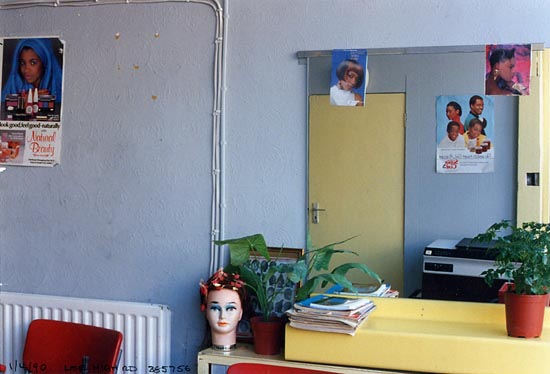
It made me think briefly of another series of domestic interiors, Bert Teunissen’s Domestic Landscapes  but these are very different, with Teunissen photographing the inhabitants in their own homes. Raynaldy’s people, who are perhaps his true subjects, remain invisible (or almost so), and the photographer roams their creation, recording their arrangement of territory and traces of their existence. It’s a project that perhaps has rather more in common with my views of shop interiors that made up a large part of the series ‘Cafe Ideal, Cool Blondes and Paradise.


Lewisham, London, ca. 1990 by Peter Marshall

Also on display in the show was a book of work by Raynaldy ‘Habitat social en Meuse‘ (also on his web site) which looked like a fine urban landscape project.

Showing in a projection area at the centre of the display were a couple of extensive slide shows by various photographers. One, on children seemed to me to have rather too many images that were largely of interest to the families concerned, mixed in with some more interesting work and some visual candyfloss. ‘Contempler et construire’ was made of sterner stuff, although not all the work appealed to me, but I was particularly interested to see the urban landscapes of Normandy as shown by Benoit Grimbert. The subject seemed rather more appropriate to his rectangular format and upright approach than the North Circular Road show I had viewed the previous day.

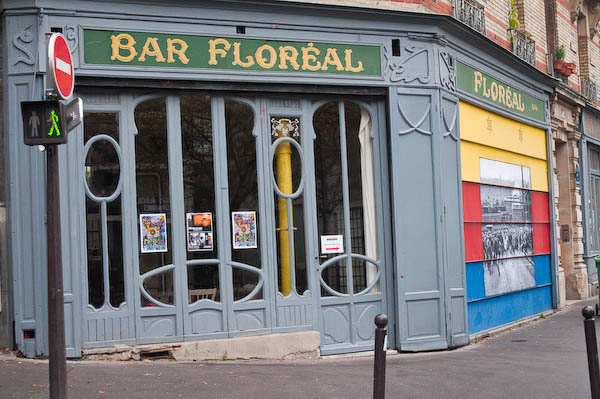
Retour en Lorraine, bar Floréal & Willy Ronis

Retour en Lorraine
bar Floréal
43, rue des Couronnes, 20e
7-30 Nov, 2008

In 1979, when workers in the steel industries of Lorraine were under threat of closure and there were strikes and violent disorder, centred around the steelworks of the basin of Longwy, Alex Jordan et André Lejarre went there to photograph the people and the dispute, producing some powerful black and white images in the ‘concerned photography’ tradition. Despite a long struggle in which their pictures played a part, as did the first free radio station, Lorraine Coeur d’acier (Heart of Steel), the industries closed.

Jordan and Lejarre went on to found  le bar Floréal photographie in 1985, a photographic centre in Belleville in the north-east of Paris (20e). It became a thriving centre for photography in the area, run by a collective of photographers, and noted for its great shows and crowded openings. The name comes from the eighth month of the revolutionary calendar and means flowering, and ran for the 30 days (3 decades) starting on April 20 or April 21.

In 2008, the ten members of the collective, including Jordan and Lejarre returned to Lorraine to photograph the same area – the others were Jean-Christophe Bardot, Bernard Baudin, Sophie Carlier, Éric Facon, Marc Gibert, Olivier Pasquiers, Caroline Pottier and Nicolas Quinette. (You can see more about the photographers with links to their work elsewhere on the Bar Floréal photographers page.)

What they found was in many ways depressing but typical, with many former skilled workers unable to find suitable work, some moving across the bored to Luxembourg to find work, ex-miners retraining to become Smurfs in an entertainment park…  As we have seen in many areas of this country, de-industrialisation isn’t easy.

This was certainly one of the more interesting shows in the Mois de la Photo, and one Linda and I would have liked to spend much more time at. I think if I lived in Paris I would end up spending an awful lot of time at this particular bar. But then I was born on the 25th (or Carpe) Floréal CLIII!

The show was also on at la Maison des métallos, a cultural centre owned by the city of Paris, not far away in the 11e. Next year there will be a book published to accompany the show as it opens in Lorraine, at first in Mont-Saint-Martin and later in Longwy itself.

At the bar Floréal, I notice a thin book about one of the great photographers of Paris (and one I wrote a long feature on a few years ago) Willy Ronis, whose finest work was all from Belleville, where he started taking pictures in 1947. Published for a show they had of his work in 1990, it described his favourite walk around the area by contact prints and illustrated with larger reproductions of some of his better images.

La Traversée de Belleville isn’t listed on their page of books, but it was truly a bargain, as when I offered the 5 euros to buy a copy, I was told that they were all damaged by damp during storage and given a copy for nothing. A few pages were slightly stuck, but with a little careful handling came apart with no damage.

It was pleasing but perhaps a little disappointing to discover that Ronis’s favourite route around the area was almost identical to mine, and that I had already walked most of it yet again a couple of days before. But we decided to fit in another walk following his footsteps if we had time before we went home. I’ll post my pictures from that walk on My London Diary in a few days.

North Circular Views: Benoît Grimbert & Me

Benoît Grimbert
A406 North Circular Road
École nationale supérieure d’architecture de Paris Malaquais
1 rue Jacques Callot, Paris
Nov 10 – Nov 29, 2008

A couple of hundred yards down a road on the Left Bank, lined with galleries and antique shops, we came to the North Circular Road.

Not of course the actual North Circular, which runs from Kew Bridge to the Woolwich Ferry through suburban London, but a Mois de la Photo show by Benoît Grimbert at l‘Ecole Nationale Supérieure d’Architecture Paris-Malaquais.

You can see a slightly extended version of the 20 pictures on show there on his  web site.

Benoit Grimbert (b1969) lives in Paris but travelled to London on several occasions to take a series of pictures along the length of the A406 North Circular Road. Unlike London’s South Circular which is almost entirely conceptual, the North Circular has a physical existence – and I’ve walked along most of its accessible parts (there are some elevated motorway style sections where I think pedestrians are not encouraged and possibly prohibited.)

So I was not just looking at a show of photographs, but a set of photographs of something I also know from my own photographs, several of which could be cropped to give virtually identical views.

If I went back to take pictures of the A406, I would work with a panoramic camera (and I have taken some pictures of it with one) as more suited to the idea of flow of traffic.  Grimbert works to a square format and seems to be very much a man wedded to his tripod and spirit levelt, all restrictions that I think oppose the central concept of the work being about movement, traffic and flow. It ends up being very much a static view, one that concerns itself largely with the structures of various types which surround the road rather than the road itself or the kind of concepts which, according the text, it is concerned with.

The mismatch between technique and concept doesn’t in one sense particularly concern me. This is after all a show of photographs and it isn’t unusual (certainly in these days) for perfectly good pictures to be accompanied by a completely irrelevant sheet of academic jargon. But here I think the work was sometimes  indecisively trapped between the visual and the conceptual (and the text from the show would certainly be a candidate for Pseuds Corner, except that I think that would be a concept the French may be unable to appreciate.)

Perhaps the problem I have with his work is that I know the North Circular. The following day I came across some of his pictures of Normandy – which you can also see on his web site –  in a projection at the École nationale supérieure d’architecture de Paris La Villette. I found those more interesting than the A406, but perhaps if I was from Normandy I would have my reservations?

Actually I think not. I’ve cycled around Normandy and do know it at least slightly – and the same is true of another of the projects on his web site, Lisieux. Here the work is essentially about structures and their relationships to each other and his chosen techniques fit well with the subject and Grimbert’s intentions.

Grimbert presumably works with a medium format camera using 120 film  and the prints are clear and detailed, though not especially so. (He claims that his colour prints are “tirage manuels argentiques” but there was no sign of the lack of bleach-fixing that this appears to suggest – perhaps the French doesn’t mean what it appears to – these seemed to me to be perfectly normal colour coupler prints.)


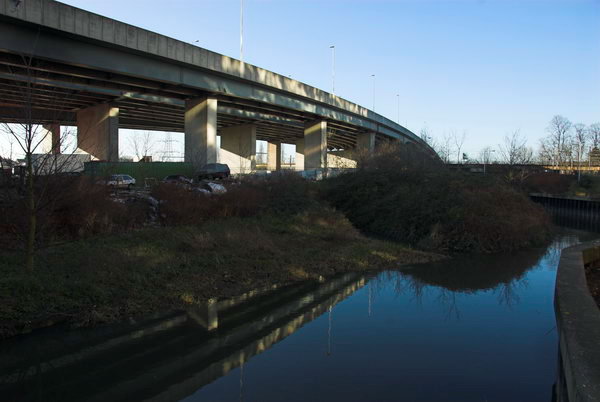
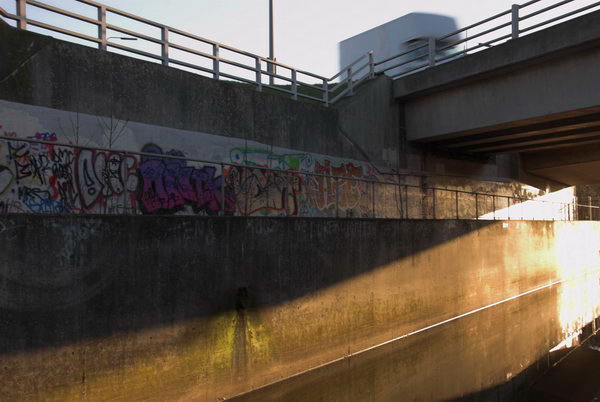
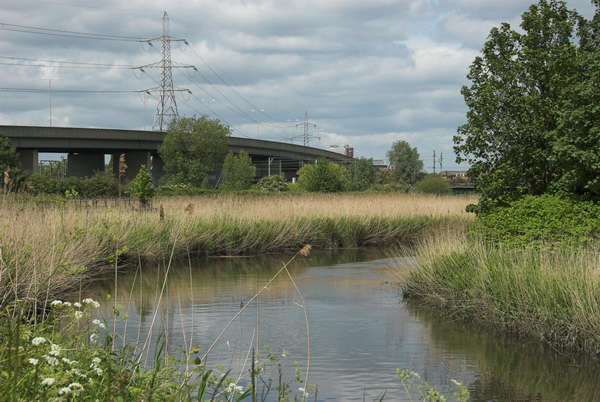
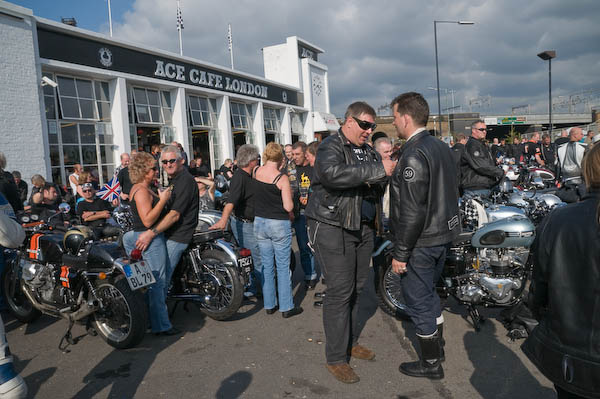
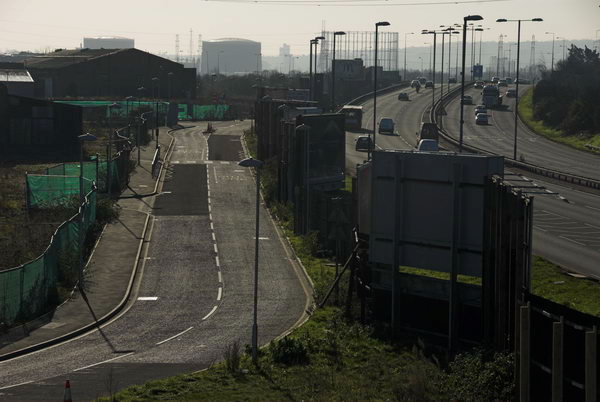
Peter Marshall Here are a few assorted digital images I’ve taken in the past couple of years on the North Circular – taken as parts of different projects. One day I’ll get around to developing and scanning the panoramic images that I also made on some of these visits!


Late evening in winter at Ilford.
There is a picture by Grimbert from almost exactly this point, but in rather different lighting.

(C) 2008, Peter Marshall
River Roding and North Circular,  Redbridge

(C) 2008, Peter Marshall
River Roding and North Circular, Barking

(C) 2008, Peter Marshall
Ace Cafe, the most famous site on the old North Circular, Stonebridge Park

(C) 2008, Peter Marshall
North Circular at Barking, looking South

Patrick Mourral: New-Age Archipelago

L’archipel by Patrick Mourral

Galerie Frédéric Moisan
72 rue mazarine 75006 paris
30 Oct – 29 Nov 2008

In rue Mazarine we came to ‘L’Archipel‘, a show of black and white and colour work by Patrick Mourral (b1976, Scotland), one of many shows in Paris that wasn’t a part of any festival. Previously shown in Strasbourg, it closed on 29 November, but I’m sure will be seen again elsewhere.

You can see a rather fast-moving and fast talking (in French) video about him and his work photographing modern-day nomads, new age travellers in Europe (we used to call them hippies.) It gets easier to understand when he talks about his work, and this téléAlsace feature does show quite a few of his pictures.

Archipel (archipelago) is the traveller’s metaphor for the level of the world they inhabit, straddling various countries along the roads to festivals, isolated areas in forests where they camp around their vans etc. They make only limited contact with the nation states over which they wander, seldom staying long in a place, sometimes doing short-term jobs or trading, usually on a cash basis.

Its a movement that got moving with the hippies in England in the ’80s and there are now thought to be more than 10,000 of them in Europe. Many, particularly in the earlier days were rat-race refugees from the middle classes who chose to live a freer if more spartan way of life, but in latter years many poor working-class inner city kids have decided that poverty and freedom on the road beats poverty and idleness in the slums.

The website of the galerie frederic moisan whose long white-painted space the show was in has some problems. You can view it in French but I had great problems in seeing things if I clicked on the ‘english‘ link, and even more if I attempted to access the English pages directly.

Mourral’s is serious work, a result of 10 years spent following and staying with the travellers, getting to know them and to be trusted by them. He presents a sympathetic but honest picture of them which is rather different from the sensationalist rubbish that often hits the press in the silly season (is that the whole year now?)

While the black and white prints on show were very impressive, Mourral’s colour work on display was ruined by over-saturated, garish colour, making it impossible for me to take seriously. This is a shame, as the images on the web, if still at times rather hyperreal, seem considerably more interesting than those in the gallery (although many are the same pictures.)

Colour ink jet is capable of producing more subtle and accurate prints (especially from digital files) than we have ever before enjoyed in photography. But it can also produce the kind of crude poster quality that does nothing for sensitive photography.

Gabriele Basilico, Vertical Moscow

Moscou Verticale
Mois de la Photo, Paris
la Cité de l’architecture et du patrimoine
23 October 2008 – 30 November 2008

One of the really major shows in the Mois de la Photo, Gabriele Basilico’s Moscou Verticale proved more difficult to find than we expected, and had us checking the information in the programme very carefully.

(C) 2008, Peter Marshall
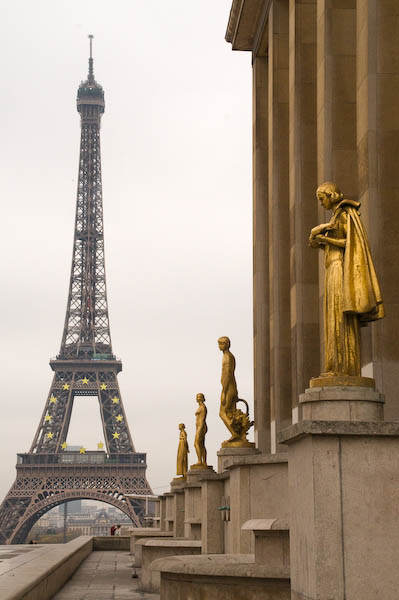
place du Trocadéro, Paris, Peter Marshall, 2008

The place du Trocadéro is really one of the bleaker areas of Paris, with the large empty square dominated by the two wings of the Palais de Chaillot, built on either side of an open terrace with its well-known view of the Eiffel Tower across the River Seine (and now thronged by young men trying to sell small models of the tower.) Built to impress for the 1937 International Exhibition it embodies every worst element of a classicized  debased modernism, and houses a rather bewildering array of museums, badly signposted in what is almost a French art-form. Even though we knew where we were going it still seemed hard to find, and we were almost put off by the notices demanding an entry fee. But although you do have to pay to visit la Cité de l’architecture et du patrimoine, this and some other exhibitions were free.

I’ve long been a fan of Gabriele Basilico (b1944, Milan)  and there were a few good examples of his work in one or two stands at Paris Photo. I own several books of his work, but I think this is the first one-person show of his that I’ve seen. Or at least it was a one-photographer show, because Basilico, wo trained as an architect before becoming a  photographer, worked on the project with architect Umberto Zanetti , photographing and photographing from the seven curiously ridiculous towers around Moscow  from the Stalinist era sometimes known as the ‘Seven Sisters‘.

These were built as showcases for the state, very much to outdo the skyscrapers of New York – and in terms of excess they certainly do. There is a story about Stalin receiving two quite different alternative plans for a building from an architect who had expected him to choose the one he preferred. But perhaps after rather too many bottles of vodka, the plans were returned with both approved by the dictator, and the architect had to build the two together on the same foundations. Looking at some of these pictures I did wonder if it was only two plans.

These are buildings so impressively bad that it becomes fascinating. You can see three of his black and white images of them on the Cohen Amador Gallery site  (you are unlikely to be fooled by the caption which tells you one is in Naples.) Like the black and white images on show, these are inkjet prints, and at least as good as those he has previously printed on silver gelatin.

But while these black and white pictures were very much what we have come to expect from Basilico, the colour work on show actually taken from the ‘Seven Sisters’ took a radically different perspective on both the buildings and the rest of the city, looking down at sometimes seriously vertigo-inducing angles and often concentrating on relatively small building details.

In part the new direction may have come from working with the architect on this project, but it may also have some connection with Basilico having worked with another of my favourite urban landscape photographers John Davies (a couple of whose pictures were also in Paris Photo.) John is one of the photographers included on the Urban Landscapes site I run with Mike Seaborne, and which links to his own extensive site.

Although I can’t find any significant pictures of this colour work by Basilico on-line (we’d be delighted to put some on Urban Landscapes) pictures at Cohen Amador from Naples (probably), Bari, Barcelona and San Francisco show this new viewpoint, as do the 2008 pictures from San Francisco at Studio La Città.

Peter Marshall


(C) 2008, Peter Marshall
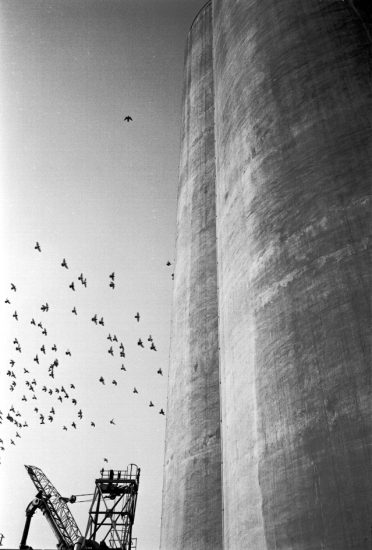
Grain Silos, Riverside Walk, East Greenwich (1982) (C) Peter Marshall I don’t often mention my own photographs of buildings (several hundred are in one of our national collections), but you can see some on the web. Perhaps the best site is London’s Industrial Heritage, but one of the first sites I wrote (and showing its age,) ‘The Buildings of London‘  has a few examples from the hundred thousand or so I took.(C) 2008, Peter Marshall
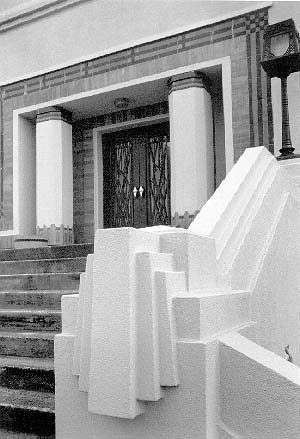
Art Deco Factory, Great West Rd, Brentford, 1980s  © Peter Marshall

Burma: Thought under Military Control


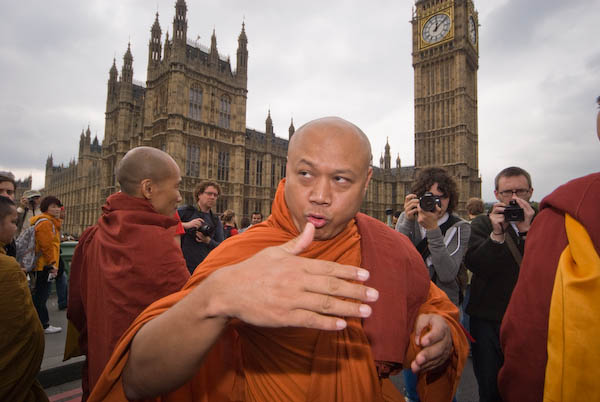
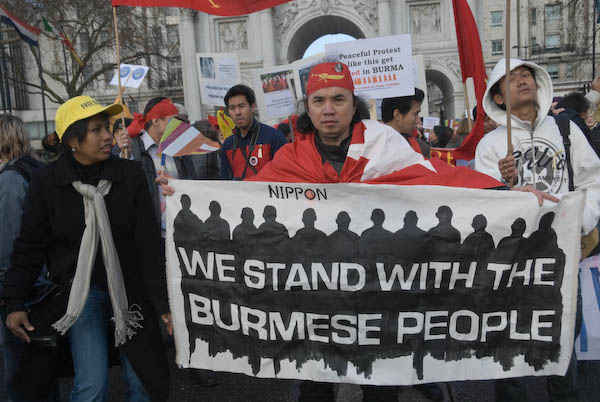
Monks protest in London during Global day of action for Burma – see My London Diary. (C) 2007, Peter Marshall

MOIS DE LA PHOTO-OFF, PARIS
Birmanie, rêves sous surveillance
(Burma, Dreams under Surveillance)
Du 10 au 23 novembre 2008 aux Vôutes

The web site Burma, dreams under surveillance gives an excellent account of this project started in 2003 by the humanitarian organisation ‘Les yeux dans le monde’ to increase our awareness of the social and political situation in Burma.

On 13 November we went to the opening of a show of the photographs taken by Manon Ott and Grégory Cohen at Les Vôutes, vaults under the roadway at les Frigos, a former industrial complex now artists homes, studios and exhibition spaces, a block east of the new building of the National Library (Bibliotheque François Mitterand) in the XIIIe.

The work is also available as a book from Editions Autrement, published in May 2008, when the work was also shown at Les Vôutes with a two-day festival.  The photographs are presented in four chapters: People’s desire, Stories of resistance, Between survival and guerilla war and The border areas, and also includes appendices containing information about the country and its culture.

Although there were some powerful images on the wall, and in the projection on the screen at the end of the cellar, the added structure of the book gives a much tighter experience.

There were a number of images among the work that to me seemed perhaps more touristic than documentary, and at times I wondered about how the work had been affected by the difficulties of working openly in Burma, impossible for me to assess.

But there were also moving stories and powerful suggestions of a pervasive military supervision of all aspects of life (the mention of Orwell’s 1984 seemed only too true.) But there was also humour – and if you don’t know about the Moustache Brothers you can find out here and also see them on YouTube.


Burma Peace walk in London,  Jan 2008 – Protests like this would be brutally repressed in Burma. (C) 2008, Peter Marshall

Wine-tasting for London Bloggers

Around 50 London Bloggers from the almost 400 members of The London Bloggers Meetup Group enjoyed a great time in the basement at Ember in Farringdon last night, tasting wines provided by wine bloggers from Germany, Italy, Spain and Portugal, invited by Robert McIntosh of the Wine Conversation blog and Thirst for Rioja,to contribute some bottles of wine and a short video for the occasion.


Robert pours a wine sample

This is a photo blog and not a wine blog, so let me start by saying something technical about the pictures before getting down to the wine. I was working with the Nikon D300, starting with a 20mm f2.8 and then moving to a Sigma 18-125mm lens. As usual I worked in P mode, but with the SB-800 flash set to work at -2/3 stop to avoid any over-exposure. The flash was in TTL/FP mode, with a minimum shtter speed of 1/60, and I set the4 ISO to 1250 so that the dim light in the bar would add a little to those areas not lit by flash. Quality at 1250 is still pretty good on the D300, but with a D700 or D3 I would probably have prefrred to work at 2500 or 3200.


Glasses waiting for the tasting as Robert talks about the wines

I had the translucent dome diffuser on the flash to give an even spread of light over the frame – almost all the pictures I took were at 18-20mm. Apertures – set by the camera – were around f8, which with this wideangle gives plenty of depth of field. I worked with the camera on autofocus, selecting a focus area on the closest face in the picture.

The flash head was generally angled so that most of the light rteaching the subject was bounced from the slightly off-white ceiling. It coloured the flash a little, but I think the white point aedjusts for this as it is the main light, and leaving the camera on auto white balance gave good results. On shots where a part of the subject was close to the camera I generally swivelled the flash head away from that direction.


Enthusiastic bloggers towards the end of the evening

Despite the use of bounce flash in most of the pictures there was still considerable light fall-off evident in the images, which is where Lightroom 2.1 came in. In most of these images I’ve done some burning in of faces, arms and hands close to the camera and a little dodging of important but more distance areas.  Using ceiling bounce, areas such as the tops of balding heads need considerable attention to bring them to a normal density. Somehow ears too can often seem too bright however you light things, and so need a little burning down too.

Of course there would be some advantages in using the flash away from the hot shoe, but this makes things far less convenient. And as I think these results show you can do surprisingly well with a flash on your hot-shoe.

Now for the wine – and it was a fine selection.

Thirst for Rioja
Robert’s own blog on the Rioja area for Spain and in particular the Bodegas Dinastia Vivanco, Bodegas Criadores de Rioja and Bodegas Carlos Serres which he represents. His  video – his first – is perhaps a little too static and information filled. The wines he brought were a white Vivanco Viura Malvasia, Rioja, 2007 which I didn’t taste and Dinastia Vivanco Rioja Crianza, 2004, a really fine oak-aged red I’d be very happy to drink again.

Winzerblog
Winzer is German for Winegrower and Thomas Lippert writes about his daily work growing grapes and making and selling wine. His video tour of the estate has some nice touches but is far too jumpy. Thomas provided Riesling Kabinett Trocken 2007, Weingut Clauer which I didn’t taste.

Bodegas Tintoralba
Javier Navarro‘s site about this cooperative winery in Higueruela, a small town near Alicante, where almost all of the 1300 inhabitants belongs to the co-op. The video has a few pictures of it near the end. But what impressed me rather more was the smooth deeply coloured Higueruela wine – probably my favourite red of the evening.

Poggio Argentiera
Gianpaolo Paglia
blogs for Poggio Argentiera, a young winery with two estates in Tuscany. As well as a video in which he talks about the area and its wines in English, you can watch another in Italian which shows you the area and the grapes, and very much makes me want to pay a visit there. The red wine, Bellamarsilia – Morellino di Scansano, was, as the web site says “perfect for every day, informal drinking, fantastic for parties, middle-of-the-week suppers at home or in a nice little eatery, or by the glass over lunch.”

Casa de las Vides
Emilio Saez Van Eerd from Casa de las Vides in Valencia, Spain sent us a video with some nice still pictures of the vineyard and winery (though I find the music over-obtrusive.) The  CVP 2007 was another fine oak-aged wine, though not my personal favourite of those tested.

Cortes de Cima
Jose Eduardo J Silva writes a very readable blog (in English) about this family owned vineyard and winery in the south of Portugal. The vineyards look a little bleak in the video, which also shows the winery. The dark red fruity Syrah 2004 did, as it said on the video, make me want to have another glass, and I did. Another good drinking wine.

Justin Roberts of the  Vinos de Jerez etc… blog persuaded Jan Pettersen at Rey Fernando de Castilla to supply their Antique Oloroso, and made a video interview with the man who made it. I’m sorry I didn’t get to taste it, but there is only so much I can drink, and I’ve never been a great fan of sherry, although one of the few perks of being a union rep some 25 years ago was that the boss used to always give me a glass if I went to see him late morning.

And I don’t often drink port, but at the end of the evening I just couldn’t resist some of Quevodo Port’s  Special Reserve Tawny. Again there is a video, by Oscar Quevedo, the youngest member of the family who have been making Port for over 100 years in Portugal above the River Douro, and one of five bloggers on their site. An 8 year old fruity wine with 19% alcohol, it did really make excellent drinking, though I was very pleased I wasn’t driving the bus or train home.

Thanks, Robert!

Belgian Architectural Photography in Paris

L’alibi documentaire, on show at the Centre Wallonie-Bruxelles opposite the Pompidou Centre in Paris until Feb 1, 2009 is a show of Belgian architectural photography and related imagery.  It has three strands, the first showing vintage architectural work, the second contemporary architectural photography and the third ‘photographic’ imagery of imaginary buildings.

Architecture is of course an area where the ability to create images of buildings that do not exist has long been important. Every project proposal needs its artists representations of how it will look, and now these are more readily (and believably) produced using computer-generated methods, which can mimic photographs to the last pixel. At least some of the images in this section of the show are more genuinely photographic, produced by merging photographic images using Photoshop or similar software, and produced solely as art.

Early work is represented by Edmond Fierlants (1819-1869), an apprentice in Paris to the pioneering Hippolyte Bayard and one of the founders of the Société française de photographie in 1854. He returned to his native Belgium in 1858, and was commissioned by the state to photograph architecture in Anvers (better known to us as Antwerp), Brussels and Louvain (Leuven.) For the last two years of his life he devoted himself to portraiture in his Brussels studio.

Of more interest to me was the work from the modernist period, particularly that of Willy Kessels (1898-1974) one of the great architectural photographers of the 1930s. The show was certainly worth a visit just to see his work. Other photographers from the 20th century were Marcel Lefrancq (1916-1974) and Gilbert de Keyser (1925-2001) whose architectural details are also interesting.


Willy Kessels: Houses. Photomontage for the Book ‘atmosphere Brussels’, 1932
Credit: Museum of Photography in Charleroi, Inv. MPC 97/83

Although the contemporary architectural photography was uniformly of a high standard, I found little to particularly inspire me. Perhaps the most interesting piece was a grid of 35 images by Marie-Francoise Plissart showing the successive stages of demolition of the Tour Martini in 2001.  Gilbert Fastenaekens‘s side walls of buildings were too bland even for my taste, and the images of Marc Wendelski too severely geometrical to really appeal – I longed to have some lines at odd angles to relieve the horizontal and vertical. I quite liked the dusk images of internally lit building by Marie-Noëlle Dailly, which had a strange lighting quality which made them seem rather less real than some of the fictive images in the third section of work.


Marie-Noëlle Dailly

The final section of invented images included some pictures that seemed more real than the actual architectural photography, but quite a few of them left me wondering why anyone had bothered to produce them. For me the work of Simon Boudvin (click on the minute artists name at top left, then select ‘already made‘) and Filip Dujardin stood out in this section, both for the actual quality of the work and the wit their work embodies. I also enjoyed the ‘Villa Malaparte’ by Martin Vierin, but this needs to be seen projected – a pity it isn’t on YouTube!.

D3x – The Führer Gives his Opinion

Quite a few have remarked that the recently announced Nikon D3x appears to use the same sensor (Nikon say it isn’t identical, but differences are likely to be small) as the Sony Alpha 900, but while the Sony has a street price of around £1600, the Nikon is expected later in the month for £5,500.

There are of course considerable differences in the camera specifications, but hardly it seems enough to account for anything like that price difference.

Looking at the performance of the Sony Alpha 900,  it isn’t a camera that would greatly appeal to me. The Nikon D700 or the D3x have a lot more going for them with their better performance at high ISO.  And for those of us who take a lot of pictures, those up to 50Mb RAW files would really eat up card and disk space.

However I’m certainly not going back to an F2. The D300 is still doing pretty well.  You can see more videos on the D3x on YouTube – but most are very annoying. The best of a bad lot I’ve found so far is from What Digital Camera magazine.

But the review you really have to see is where the Führer vents his spleen when told the price of the D3x. “Makes me wonder why the hell I went digital, instad of stick to film like Stalin!

Zombies in Ramillies Street

Ghouls, zombies and the undead staggered and lunged along Ramillies Street on my previous visit, sprawling on the roadway of this small street down a short flight of steps from Oxford Street, often referred to – as Photographers’ Gallery director Brett Rogers informed us – as “Piss Alley.”


Coming down the steps into Ramillies St

But that was Halloween a couple for years ago, and tonight things in the pristine white space of the temporary home of England’s “flagship photography gallery” were a little quieter, although I was perhaps more apprehensive.


Brett Rogers welcomes us to the gallery

Rogers welcomed us to the new space –  opposite the former home of Keith Johnson Photographic, and like its predecessor on the edges of Soho, but this time at its north rather than east – and waxed enthusiastic about the possibilities it presented for a new building to replace the current temporary conversion. Dublin based architects  O’Donnell +  Tuomey then told us about their early years in London and their plans for a new building, constrained by the small footprint of the site, rising vertically around a lift and stairway, organically (or at least metaphorically) like the branches from the trunk of a mighty oak. (You can read more here – and see a computer graphic view of the new building by clicking on the thumbnail.)


John Tuomey talks about the building as Sheila O’Donnell looks on.

Their presentation was excellent, but I found the futures suggested for the gallery outlined by Rogers rather more chilling, and my doubts were heightened by the work that had been selected for the inaugural showings in this new space.

Like many of those I talked to, I felt that this was a real occasion that should have celebrated English (or British) photography, but it was one that was sadly missed.

I’m old enough to remember Picture Post and its place in lifting the spirits in an age of austerity and rationing, even though in my childhood my family were too poor to buy it. We saw copies at neighbours and friends, read it waiting for a haircut at the barbers, and sometimes people passed on issues when they had read them. Later of course I saw many of its best pictures republished in books, and got to know the work of many of its better photographers, writing features about several of them, including Thurston Hopkins, Grace Robertson, Bert Hardy and Bill Brandt.

It takes great curatorial expertise to mine this rich resource and produce such as turgid, mind-numbing show as was presented on the ground floor of the gallery. All photographers of course have their off-days but on this evidence Picture Post photographers spent most of them – or at least their off-nights – in Soho. But from the evidence we see here it would be difficult to regard Hopkins or Slim Hewitt as anything more than reasonably competent hacks.  And Tim Gidal and Kurt Hutton fare little if any better, and we can see that Ken Russell was well-advised to turn to making films.

As the major show for this major British event I would have hoped for a major show by a well-known British (or British-based) photographer – perhaps one of that long list neglected by the gallery over the years (and there were at least half a dozen of them present at the opening) or one of the great historical figures in photography in this country – such as Bill Brandt or Raymond Moore.

Instead we got Katy Grannan, a USAmerican photographer bron in 1969 who studied with Gregory Crewdson, Philip-Lorca diCorcia and Tod Papageorge at Yale (one of the more disappointing highlights mentioned by Rogers was the Deutsche Börse Photography Prize 2009, where Papageorge is a contender with his rather bland images of Central Park, shown at Michael Hoppen  in Chelsea earlier this year – but I couldn’t bring myself to review it, as the most interesing thing was that one image was shown upside down – though Taryn Simon is also on the short list for her Photographers’ Gallery Show – one of their best in recent years, but it is hardly a heavyweight list) graduating with an MFA in 1999.

Grannan had her first gallery shows in 1998, and in 2004 she showed work at Arles, exhibited in the Whitney Biennial and won the 2004 Baum Fellowship Award for Emerging American Photographers. In 2005 she got an Aperture award for emerging photographers, and theypublished her ‘Model Americans.

Grannan is a photographer whose work I’ve previously written about appreciatively in the past, but I think this show, “The Westerns” does little to enhance her reputation. Large images, empty in every sense, at times vapid, with a few little digs in various directions including an unbelievably bad Edward Weston pastiche. You can read an interesting interview on her earlier work at The Guardian by Melissa Denes.

In that earlier work, published in Model Americans in 2005, she photographed people in their homes and other locations,  she worked mainly with strangers (starting to advertise for models in local papers in 1998), coming together for the short time needed for her to arrange them (and sometimes the surroundings) as a stage set on which to photograhp them with her 4×5 camera.   The Westerns is the result of a more lengthy collaboration with three people, including two middle-aged transsexuals, and I don’t feel she has managed to sustain the same level of interest and creativity.  It might even have been a more interesting work had the three people concerned been more conventional in their life-styles; their somewhat exotic nature makes for too easy a cliche.

Grannan is a photographer for whom size matters, and most of these prints seem to me to be oversize. Her work often appeals far more strongly to me on the web or magazine page than as these large wall prints.

Of course there were a good things on show – including Vanessa Winship’s charming portraits (one of the few stars of this year’s Arles, her pictures are also on show in the Royal Festival Hall as a part of the 2008 World Press Photo.) And on the top floor in the Print Sales area, Picture Post came to the rescue with Bert Hardy‘s delightful evocation of a British summer in his Box Brownie view of two young women perched on the promenade rail at Blackpool. It was an image that stood out glowing from what largely seemed to be an ocean of fashionable mediocrity.

I’d gone to the event in an optimistic mood; I’d thought that perhaps the move to a new building represented the possibility for a new start, a new emphasis on photography. Unfortunately the auguries seem bad, and despite the new premises, the gallery seems destined to remain mired in the same old rut.


At the opening – not much depth of field on the 35mm at  f1.4!

As someone who has been a member for around 30 years I find it deeply disappointing that if you want to see photography and a vibrant photographic culture you need to look elsewhere, whether to smaller London galleries such as HOST or by taking a trip to Paris.  (see Paris and London: MEP & PG)