Best Photo Books 2008?

Photoeye Magazine invited 17 largely well-known publishers, photographers and critics to list their top ten or so photography books which came out last year. Most of the lists they got back listed the choices in no particular order, but by combining the lists, Photoeye has come up with an overall top ten, and as well as seeing all 17 lists you also look at the books and see who chose them.

Even more usefully there are links to the books so you can take a peek at them on line if you don’t already have them on your shelves – and it is hardly a surprise that you can also buy at least nearly all of them.  My own shelves are so overflowing I hardly dare add anything, and most that I do are second-hand or books sent for review. But there are one or two listed I’m thinking about – just a shame the publishers didn’t send me review copies!

The Magnum blog also lists the choices made by the two Magnum members among those asked, Martin Parr and Alex Soth. The only point in looking at them there rather than on Photoeye is that you can if you wish make comments. But there were none when I read the post.

Thousands for the Obvious

I’ve seen plenty of bad videos.  Even watched French TV. But you if you’ve a really strong stomach you can see one of the worst camera tests ever from the Gadget show on Five TV.  The Online Photographer, where I found the link, calls it “Kind of long but good fun‘” but they obviously have a very different idea of fun to me. It’s bad, bad, bad. So bad that at times it’s laughable, but also so bad I can’t force myself to watch a second time.

A male presenter with an incredibly staring eye problem and an uncomfortable twitch and a patronisingly eager female, both blessed by bad script writers, dress up in Avengers leatherware and get themselves photographed in a studio on a Nikon D700 and a Nikon F5 using the same Nikon lens (the photographer gets into the spirit of the act later with a bad black cloth cap.) He works with ISO 400 film in the F5 (it seems a bad choice to me) and sets the D700 to ISO 400 too.

Then they get prints made the size of the side of a bus and have them erected on the rather boring exterior of a modern building in the centre of Birmingham, UK, then run along (yes, they do run) and look at them. What a surprise, the digital camera gives the better print.

Better colour, more details in black, less grain, greater clarity. Digital gives the far better result. Which has been pretty obvious to all of us who actually use digital cameras for several years now.

Tilt-Shift?

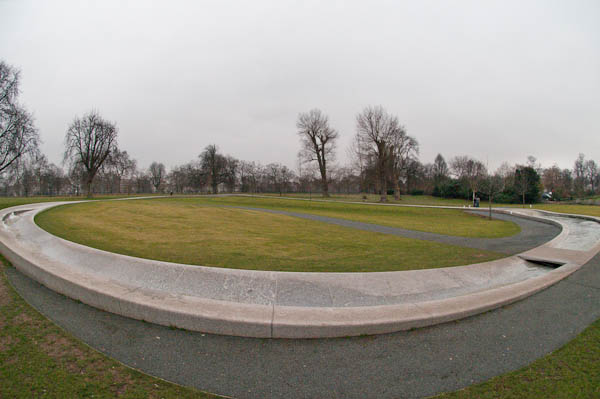
 Princess Diana fountain © 2008 Peter Marshall
Princess Diana Memorial Fountain, Hyde Park, London – more pictures

Tilt-Shift Maker  have got it all wrong. What I never wanted when I used a tilt-shift lens or the movements on a 4×5 was never to reduce the area of sharp focus, but always to get a greater apparent depth of field by tilting the plane of focus to cover the subject.


After extreme processing by Tilt-Shift Maker

So I don’t want this. What I’d like to see is that foreground area made sharp. Software that could do that would really be clever. Almost every time I go out to take pictures in winter or at night when light it low I find pictures where I can’t get the depth of field I want – and often a tilt lens could help. It isn’t often I want less depth of field – and when I do it generally isn’t just in the simple way that this program offers.

But if you are really looking for a new way to really mess up your photos and get some glowing comments on flickr, this is perhaps the way to go.

Odd moments

It takes me roughly 45 to 90 minutes to get to most places in London from home, with a train journey into Waterloo and then on by bus or tube. Over the years I’ve become pretty good at working out routes using public transport, though it can be tricky when engineering works sometimes close down half the tube at weekends, or events on the street (often those I’m photographing) disrupt bus services. The Transport for London Journey Planner is often helpful as a starting point,but can’t be relied on to suggest best routes or give an accurate estimate of journey times.

But often I want to photograph several events at different places, and these are seldom arranged at particularly convenient times. Even I can’t be in two places at one time! So it means prioritising, and perhaps leaving one event before it finishes and arriving at another late – or not at all. Other days I’ll have finished one thing and be waiting perhaps an hour or two for a second event to photograph, so what do I do in these odd moments.

Well, if there are other photographers I know about, we often go to a pub – or less often to a cafe, which can be very pleasant. But I’ve never liked sitting on my own in such places. Sometimes I’ll fit in some other photography, perhaps visiting an interesting or changing area.

I often used to try some street photography, but my current Nikon digital is rather large and clunky for this, and I’ve yet to find a good digital alternative for the Leica or Minolta CLE (no, the M8 doesn’t hack it.) Of course I could keep on shooting film, but the hundred or so rolls I’ve already go waiting for processing puts me off it. So for the moment I’ve given that up, though in good light there are compact digitals that are worth considering.

So what I often do if I’m on my own is visit galleries. Of course there are some photography shows, but I also like to visit art galleries – such as the Tate, Tate Modern, the National Gallery etc, but also sometimes the commercial galleries. It helps to be a member of The Art Fund  because this gets me free into some places and shows where I’d otherwise have to pay – and if I’ve only got a short time it seems hardly worth it, though fortunately most of London’s major galleries are free.

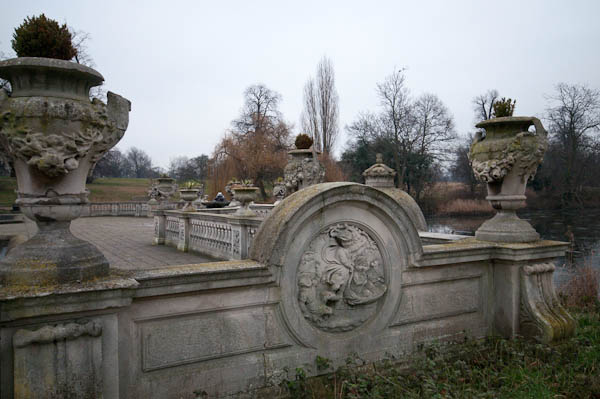
So, having taken enough pictures of the Ashura procession in rather poor light (not helped by getting the exposure wrong by mistake on some of them – my usual trouble with pressing things when I don’t mean to) I turned into Hyde Park and started by taking some pictures of one of my many favourite places in London, the Italian garden.

Hyde Park © 2009 Peter Marshall

Then I walked on in the direction of the Serpentine Gallery, walking past sign after sign pinting me towards the Princess Diana Memorial Fountain.

Princess Di Memorial Fountain © 2009 Peter Marshall

Princess Di never appealed to me and I kept away from all the popular outpouring following her death, and although I’d heard and read about the fountain I hadn’t bothered to go and see it, but since I wasn’t short of time I made the detour today.

Princess Di Memorial Fountain © 2009 Peter Marshall

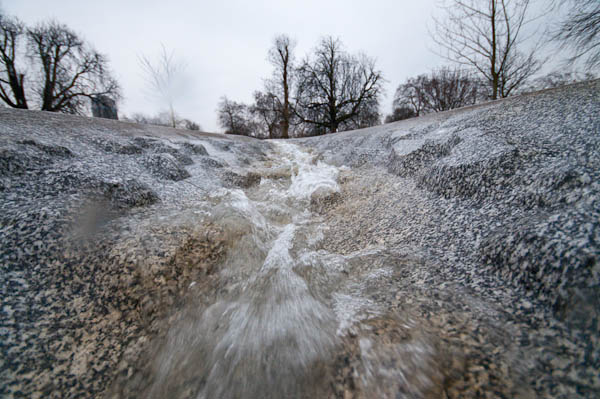
Although many people had said some fairly rude things about the memorial when it was opened, I actually rather liked it. Perhaps the failing light on a dull cold day improves it, but I liked the feeling of a mountain stream when seen close too, and the overall view too was a pleasant surprise.

The show currently at the Serpentine Gallery, Indian Highway, (until 22 Feb) was also worth a visit, and for once some of the video, particularly Amar Kanwar’s eight-screen immersive video installation, The Lightning Testimonies, was really worth watching. But most of the work was enjoyable, if some of it perhaps a little too predictable, and I found the couple of photographic pieces of limited interest.

From there a short walk and a bus took me to Jubilee Place and the Michael Hoppen Gallery, which boasted a show, Secret City, by Robert Doisneau and Jason Langer (ending 20 Jan) along with another by Nobuyoshi Araki (ending 10 Jan.) Doisneau is one of my favourite photographers (I have quite a few) but there were only a couple of images by him I would have considered buying were I a rich man, and I’ve seen better prints of both. Langer’s work just seemed rather out of place in the company.

The Araki show I also found disappointing. Few of his ‘erotic’ images rise above the interest of dead meat and pairing them with giantly enlarged flowers does nothing to help. There has long been a market for ‘respectable’ pornography to decorate bourgeois walls but Fragonard did it rather better.

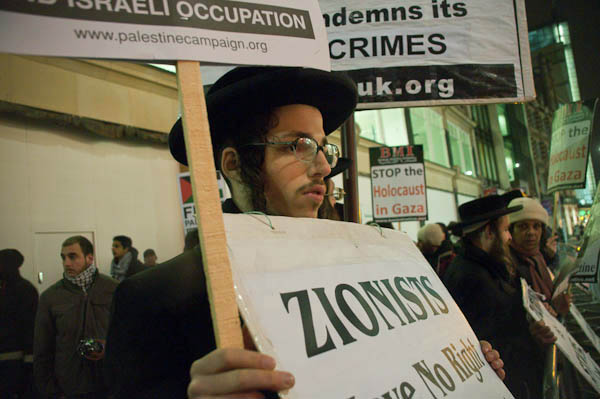
As often happens to me, by now I was running a little late and had to dash for the tube at South Kensington to take me up to my next event, the daily protest opposite the Israeli Embassy since the attack on Gaza began.

Gaza protest, Israeli Embassy © 2009 Peter Marshall

Paris Supplement

Finished at last, November’s Paris Supplement to My London Diary.

Paris (C) 2008, Peter Marshall

The trouble with being a one-man band is that when its all hands on deck there are still only two of them, but at least you can get away with murderously mixed metaphors without the restraining good sense of an editor. Though too many of those have the good sense of the average donkey coupled with a total lack of vision and an over-pernickety attitude to spelling and punctuation (and in the unlikely event she’s ever reads this, there is one lady who will immediately know I’m thinking of her – and for the record, you have absolutely no idea about punctuation despite your “corrections” to my pieces.)

Paris Photo, the world’s largest annual dealer photography fair, Le Mois de la Photo, a two-yearly festival of around a hundred shows and events, and it’s fringe, the Photo-Off with another hundred or so (and probably another hundred shows unlisted on the fringe of that fringe.)

Paris, the city and perhaps 50 km of walking around its streets searching for those shows and taking pictures. It’s all too much for one guy, even with the help of his wife (whose punctuation is always reliable and French impeccable.)

I admire those who are able to pull out their laptops or notebooks and blog or twitter away at events – at least until I read what they have written. Twitter is really such an apt name. Dawdlr is perhaps more my style, though I’ve yet to feel moved to contribute.

Anyway, my Paris Supplement 2008 is now on-line, with a dozen articles

PARIS SUPPLEMENT

Tourist Montmartre at Night
Le Paris Nord
Ceremonies du 11 novembre
Cimetiere du Pere-Lachaise
Night in the City Centre
More Shows, more walking
The Canal, Les Halles and more
Friday – More Shows
Saturday- Art & Tourism
Sunday: Marais, MEP, Seine
Buttes Chaumont / Belleville Traversée
Paris Photo Party

and over 300 photographs. In the features there are many links to the roughly 30 articles and reviews from Paris I’ve posted here on >Re:PHOTO and of course both sites have many links to external sites where you can see some of the pictures and find out more.

If you went to Paris you might find I saw some things differently, and almost certainly you will have missed some of those things I saw. Comments as always are welcome on this site, though you need to join (it’s fast, free and simple) to post.

For those who missed Paris this November (and if you are interested in photography and weren’t there, you did miss a lot) reading my thoughts and seeing my pictures (or at least the 10% or so I’ve put on line) is probably the next best thing. So if you can tear yourself away from the mince pies and steal away to your screen it might provide a little Christmas cheer.

(C) 2008, Peter Marshall

You’ll need to provide  your own champagne for that party though.

Philip Jones Griffiths & Patrick Tourneboeuf

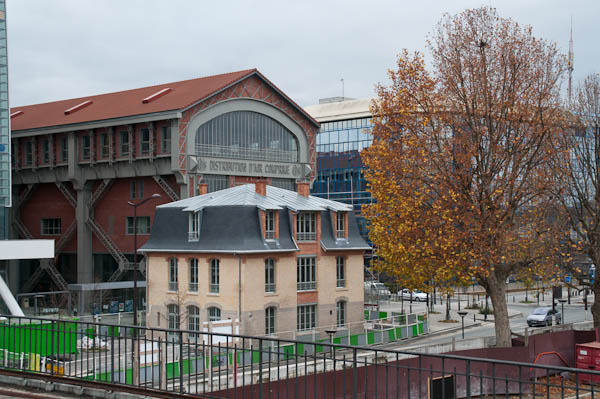
There were two exhibitions at the École nat. sup. d’architecture Paris Val-de-Seine, housed in the fine late nineteenth century factory (now listed and protected as a historic monument, and recently restored) built for the Société Urbaine d’Air Comprimé (SUDAC) and with the message in large text on its frontage: ‘Distribution d’air Comprime‘.


View from the Pont National, Peter Marshall

‘Recollections’ was a show of pictures by Philip Jones Griffiths taken in Britain from the 1950s – 1970s, with plenty of reminders of what a fine photographer he was. It appears to be showing also at the National Conservation Centre in Liverpool from 17 October 2008 to 15 March 2009, and their site has half a dozen images and some text. You can also read more and see some other pictures on the Trolley Books page about the accompanying book. The Paris show did not have the slide-show of his Vietnam images which is apparently at Liverpool, and there is also a slide-show linked at the top of the Trolley page.

This show – like the John Bulmer show I’d seen the previous day, was also a reminder of a vanished past – some gone for good, but in other ways very much for the worse. The Jones Griffiths show covers a much wider range of political and cultural events, and there is always an insistence on stating the photographer’s point of view in his work.

One image that particularly appealed to me (you can see it small and dark on the Trolley site) was taken in Downing St, outside the home of the Prime Minister. It showed four nannies with a couple of prams and a push chair who had stopped – as they did every day while taking their young charges for some air – to chat to the two policemen on duty outside the door of No 10. Now the west end of the street is walled off, and there are security gates on Whitehall, and they would need to apply several days in advance to go down the street – after passing through an airport-style security gate.

You can see many of Jones Griffith’s finest images on his Magnum pages, including in the slide show there a number that were in the show. Surprisingly, the book Recollections does not yet feature on the site.

Patrick Tourneboeuf’s giant colour pictures of spaces behind the scenes or being redeveloped in his ‘Monumental, etat des lieux’, (shown in Los Angeles as ‘The Museum Project‘) were also impressive. For once the scale of the images had a purpose, confronting us with these spaces almost on the same large scale as they actually existed, giving the feeling one could walk into these empty halls and spaces under repair. I was particularly impressed by an image of the Théâtre du Châtelet, its balconies and stalls wrapped in plastic and the workmen in hard hats at the bottom left.

It is also a project that reflects the much greater support that photography enjoys in France compared the UK.  The project began with a carte blanche commission from the French Minister of Culture in 1997 to photograph the renovation of the Pompidou Centre; other official commissions followed on from the success of his work there.

Le CentQuatre: Stephane Couturier & Alain Bernardini

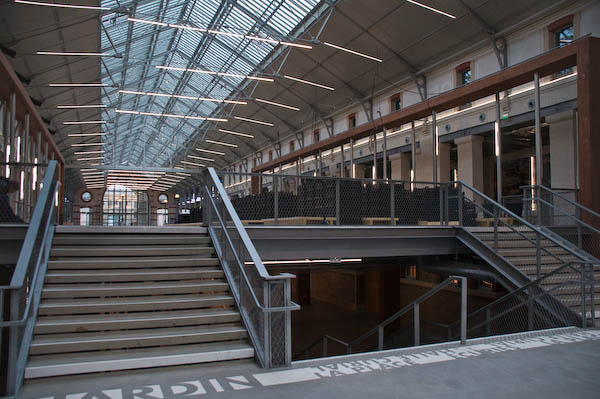
From the avenue de Flandres we walked west across the 20e to Le 104 (Centquatre), once the home of the SMPF (le service municipal des pompes funèbres.) Built in 1873 by the chuch, the premises were taken over following the law of 1905 which gave the city a monopoly on providing funeral services; this ensured that everyone, regardless of sex, religion, marital status or cause of death could receive a dignified ceremony, whereas the church had previously discriminated against various groups.

At its height, 1400 people worked there for, including trades such as seamstresses and cabinet makers, working as a team to provide a complete service, transporting bodies from home to cemetery. It had its own footbal team, and even an orchestra. In May ’68 it kept going for 15 days working as a co-operative.

The city’s monopoly was abolished in January 1993, and the SMPF soon ran down its services, closing in 1997.

Considerable redevelopment work has taken place on this 39,000 square metre site, and although it opened in October 2008, much was still unfinished, and the vast building is still largely empty space. There will be a continuing programme where around 200 artists from around the world come to work on about 30 projects each year, and three festivals to show the finished work.

When I was there a few very large prints of pictures by  Stephane Couturier who was photographer in residence during the development work – you can see  3 of his pictures on the web site.

In the terrace of the cafe (opening 2009) was a set of pictures by
Alain Bernardini (b France, 1960) Stop / Tu m’auras pas, (literally ‘You won’t have me’ but perhaps here means ‘you won’t take my photo’)  pictures of workers on the site posing for their pictures, along with some where there are no workers, perhaps because they didn’t wish to be photographed.

Global Underground

At the Galerie Blue Square in rue Debelleyme (3e) I was able to see the remarkable images from the Global Underground project by Valera and Natasha Cherkashin who I’d met earlier in the week at the Lensculture party.

They have been working together since the 1990s and using digital photography and video since 1999.  The Global Underground project began in 2005, and is intended to cover some 35 cities around the world, including Moscow, New York, Stockholm, Beijing, London, Paris, Berlin and Tokyo. The project aims to merge underground systems from 33 cities around the world into one Global Underground.

Their images make use of multiple exposures creating an almost mosaic effect both in their still images and video projection. The densely filled surfaces of their prints come to look like canvases that have been painted over and over, sometimes producing an effect that is more like an icon than a photograph.

The images from different cities reflect the different visual nature of the different underground systems. So far I’ve seen work from New York, Moscow, Stockholm, Beijing, Paris and Washington, and each is very different. New York has dark vertical columns breaking up the images of people standind on the platforms, Moscow is light and golden with oval motifs, while Beijing has a frontal fringe of Chinese faces in front of what seems more like a department store than a platform,  Paris seems more linear, while  Washington is a place of shadows. I wait to see how London will appear.

Although this isn’t the kind of photography that normall attracts me greatly it was impossible not to like this work and repsond to its intensity. For once the techniques seem to be being used to say something rather than for their own sake.

Robert McCabe & Aurelia Alcais

There were two shows organised by Galerie sit down in the rue Ste Anatase, 3e. In the Galerie itself was a Photo Mois show ‘Grece: les annees d’innocence (Greece: the years of innocence) by Robert McCabe, while neighbouring shop windows were full of ‘Les Poupees Bidons‘ by Aurelia Alcais, a rather less serious part of the Photo-Off.

McCabe’s Greece, which ends 19 Dec, is a fine show of black and white work from the 1950s. Born in Chicago in 1934, he stated as so many at an early age with a Box Brownie, and later as a teenager photographed car
accidents on the streets of New York and became interested in press photography.

He made his first visit to France and Greece in 1954, returning to Greece the following year with a Rolleiflex. His pictures from these foreign trips were exhibited at the time at Princeton University.

In 1957 came to Greece again to work for National Geographic – in colour; other assignments included being sent to the South Pole to photograph for the New York Sunday Mirror Magazine.

His pictures reflect very strongly the age in which they were made, both in terms of the scenes that he photographed and his way of seeing. It was an age of innocence both for photography and for Greece.

Aurelia Alcais‘s work certainly added a little fun to things, taking pictures of the stomachs of pregnant women decorated to make faces. Some certainly gave me a belly laugh.

Lars Tunbjork: Vinter

Lars Tunbjork: Vinter
Galerie Vu, 2 rue Jules Cousin, 4e
12 Nov 2008 – 25 January 2009

also

Lars Tunbjork: I love Boras
Centre culturel suedois, 11 rue Payenne, 3e
9 Nov 2008 – 25 January 2009

The basement  exhibition space of Galerie Vu was filled with the large colour images of one of my favourite Swedish photographers, Lars Tunbjork. His show Vinter was drawing a good audience there, and deservedly so, although I felt it lacked the kind of unity found in his earlier books such as “Home” and “Office.”

I met Lars in Poland when his work was on show at the first FotoArtFestival at Bielsko-Biala, and was very there were photographers from 25 countries showing in Poland, and I was present as ‘Great Britain’ with  ‘London’s Industrial Heritage‘)

You can see a good selection of his work on the Agence Vu web site and also on the Cohen Amador Gallery site.

Here’s a little of what I wrote about him in 2005, but didn’t publish as I am still waiting for a reply from Lars for permission to use the images concerned!

Lars Tunbjörk

Lars Tunbjörk was born in Boras, a small city in southern Sweden in 1956, in an area that was an exemplar of the Swedish ‘Folkhemmet’ (the ‘people’s home’ or welfare state envisaged by the ruling Social Democratic Party). When he was at school in 1971 at the age of 15 he went on work experience to the ‘Boras Tidning‘ newspaper and was introduced to photography. He went on to become a freelance before getting a staff job with the ‘Stockholms-Tidningen‘, a leading daily in the Swedish capital. His work there from 1981-4, distinguished by its subtlety, established him as a leading Swedish photojournalist. He also worked for Metallarbetaren, the magazine
of the Swedish Metal Workers Union, Manadsjournalen, a Swedish monthly cultural review which ceased publication in 2002, and the Scandinavian Airlines magazine Upp&Ner (Up & Down.)

It was the work published in the book ‘Country Beside Itself’ in 1993 (Swedish title: Landet Utom Sig) with text by Thomas Tidholm and Göran Greider that brought Tunbjörk’s colour photography to the attention of the photographic audience world-wide. His pictures (and you can see a good selection of his work from 1989-99 including some from this book on Zone Zero) show a strong sense of colour and design as well as a taste for the amusing, ridiculous and occasionally surreal.

The images as well as showing his personal vision, also comment on the political and social malaise felt in the country, where much of the aims of the ‘Swedish Model’ welfare state had been acheived, and the consensus that this common aim had generated was being replaced by increasing feelings of alienation, emptiness and lack of purpose, and a movement away from social idealism towards a free-market individualism.

So in Olandi, 1991, a man and a woman recline in their swim suits on almost invisible supports, oddly suspended above a large area of grass, apparently floating as if on some invisible lake or by the yellow umbrellas that seem to emerge from their heads.

Far behind them along the edge of the grass across the centre of the whole frame is a series of buildings, black roofs above offwhite wood or plaster walls, a fairytale like faux-heritage development, stressed by the fake antique black metal lamp post which rises from beside the empty grey tarmac path at left of the picture into the white sky. Even the distant trees are drained of their colour. An image flickers into my mind of bathers floating in the high density of the Dead Sea, but this dead sea is marked as clearly Swedish by the colour – the yellow umbrellas and the complemenatry blue of the woman’s costume are those of the national flag, “a blue cloth with a yellow cross”.

An interior, Oland, 1991 is a simple scene. A room is seen in a wide-angle view square on to a wall, with white ceiling with glowing fluorescent fitting, a rather vivid green floor and pale orange-yellow walls, both facing the camera and to the right. The facing wall has a blue door at right, and in the corner of the room to the right of this a red plastic chair. High towards the left of the wall a TV is fixed, and below it stands a man, dressed only in trunks, socks and sandals, heavily sun-tanned, hands down at his sides. Seen from behind he betrays no thought or gesture through his pose, and appears to be staring at the wall in front of him (again the blue and yellow of Sweden) rather than looking up at the screen. Its a strangely empty room, nothing else except the white skirting board, a white light switch and socket by the door, a picture of loneliness emphasized by the colours. On the screen in cold blue light a couple embrace, the colour contradicting their contact.

In Flemingsberg 1989, a businessman or doctor or politician in an off-white raincoat, grey trousers, black shoes, walks along an empty tarmac road beside a fence past the grounds of some institutional building (presumably a hospital), striding out, head bowed, clutching his bulging briefcase. Perhaps representing the middle-class with all the plans of the ‘Swedish Model’, looking down and not thinking about the future, oblivious to the lamp post that has fallen down apparently towards him, about to pierce his heart with the sign attached. It reads ‘Diagnosv‘(Diagnosis) 13,15,17.

Later in the afternoon we also made it to Lars’s second show in the Mois de la Photo, a much smaller show, I Love Boras, in the Centre culturel suedois in the rue Payenne in the 3e. This too was busy, but for many the main attraction was the copies of his books available for browsing rather than the few prints on the wall.

Both shows continue until 25 Jan 2009, so if you are in Paris before then, they – and the Galerie Vu show in particular are worth a visit.