Dinosaur Bones?

I’m very much a fan of A D Coleman. Like him (and I hope he will not take offence at my simplistic reduction of views which he expresses so eloquently and in detail in the essay  ‘Dinosaur Bones: the End of Photo Criticism‘*) I subscribe to such antediluvian views that photography critics should know something about photography and actually take a good look at photographs if they want to say anything of value.

Dinosaur Bones is an essay well worth reading and thinking about and indeed discussing, and again I have nothing but admiration for the fact that Coleman decided, despite previous bad experiences, to take part in four on-line discussion groups which had expressed some wish to examine his ideas.

In the two most recent posts on his blog (Forumization and Its Malcontent (1) and Forumization and Its Malcontent (2) – a series to be continued) he addresses some of his dissatisfactions at that experience, which as he states, confirmed his earlier thoughts:

“However, I do want to note that, a decade-plus later, the lessons of 1999-2000 got confirmed: (a) forums inevitably descend to the level of the lowest common denominator of their participants, and (b) forums can suck up energies more fruitfully expended elsewhere, easily turning into rabbit holes down which you disappear.”

As someone who has taken part and still lurks in several such forums (only fora if you are an ancient Roman) these are truths I hold to be self-evident. That does not mean that these forums are of no use, but rather that you need to approach them with care and retain a certain emotional distance. It seldom takes long to decide which of the participants are worth listening to and on what, and that there are discussions best ignored or where having once firmly stated your point there is little to be gained from continuing an argument with the ignorant and obtuse.

Some of those lowest common denominator participants, even those who  have played leading roles in self-aggrandising flame wars, perhaps even the person who Coleman describes as “an equal opportunity bully” and a “loose canon” are those who actually get things done outside of the forum in the real world, often acting as a catalyst for others. Their bad behaviour on-line has sometimes been a misplaced application of a real passion for the subject, an enthusiasm to communicate this to others – and in some cases a pioneering mastery of some aspects of the subject of the forum.

Certainly there are some people who are just not good forum participants, and Coleman is probably one of them. A basic qualification is the ability at times to sit on your hands and not press the reply button. But in this particular experience it would not be fair to blame him in this respect, as he had been invited or persuaded to take part in discussions on his article.

Equally there are also people who take part willing to share, sometimes in great detail, their own practices, and to give information and advice when asked. These people are a great resource and it is not that difficult if you follow a forum for some time to sort them out from the know-all muppets (though it is a distinction many people fail to make over some equipment reviewers.)

Although I share many of Coleman’s thoughts about the act of criticism and particularly of photo criticism, I come to it from a different place. I have never thought I would be able to support myself as he has by criticism, although for a period of seven years it was a significant part of my writing about photography that did supply much of my income.

I started writing about the shows I went to as a personal diary in the 1970s, more or less as soon as I had the time to pursue a serious interest in photography. I felt then as I still do now that a study of the work of others, both historic and contemporary, was essential to my own intelligent progress as a photographer.

It always begins for me with an engagement with the image, whether standing in front of it on an exhibition wall, sitting at home with a book or looking at a computer screen. Of course it doesn’t stop there, but the actual images have to be at the centre of photographic criticism.

Surprisingly, very few people who have become well-known as photography critics or review photography shows in the mass media seem comfortable with thinking about images (Coleman is of course once of the exceptions.) It doesn’t surprise me to find that Susan Sontag, the writer of possibly the most widely read book which is on every college photo course reading list, ‘On Photography’ later said – as he quotes (at greater length) “I’m not a photography critic. I don’t know how to be one.”  I read the book when it came out, and my copy was soon covered in my scribbles on her failure to know or understand our medium. It was a good TV programme, full of nice effects and half-truths but little substance.

As Coleman later says, post-modernist critics have concentrated “on a small roster of photographers and artists using photography — Jeff Wall, the Bechers and their students, Barbara Kruger, Richard Prince, Cindy Sherman, Andres Serrano, Alfredo Jaar, Laurie Simmons, Robert Mapplethorpe...” at the expense of “much wider range of significant work, past and present.” I think it is a shared lack of a real knowledge of the history of the medium that lies at the root of this. And I also think that some of those on the approved list have contributed little or nothing to photography, as I’ve at times made clear on this site.

Dinosaur Bones‘ deserves a much longer study and discussion than I’ve so far given it, and certainly deserves a careful reading by all those with an interest in photography.

In it Coleman points out he was an early adopter of digital technology, like me publishing his first web site in 1995. He has gone to such recent productions as Pepper-Spray Cop: The Lt. John Pike Saga, first in a series of Kritikomix, as well as in his satirical alter-ego The Derrière Garde‘s  Megyn Kelly’s MK-9 Pepper Spray for Kids! which frankly I wish he hadn’t. He promises a video and a podcast of Dinosaur Bones for later too which will probably be of more interest.

In 2011: That Was The Year That was, Coleman publishes an impressive review of the year, which he begins by saying that the ‘Photocritic International‘ in 2011

“had served at least 200,000 pageviews and perhaps as many as 2 million since its premiere in spring 2009. (This unclarity results from divergent reports from several different site analysis programs.) Even at the low end of that estimate, it remains the most widely read blog by any critic/historian of photography.)”

Not a bad record, but the annual figures for this >Re:PHOTO blog which I’ve just checked after reading this are significantly higher for 2011, with over 600,000 total visits and over 1.4 million page impressions.  My other main site, My London Diary, got around 800,000 page impressions and the total for all my sites (including a few small non-photographic ones) was over 3.2 million. But then I’m primarily a photographer rather than a critic, and perhaps all this shows is that photography is more popular than criticism. If so, it’s probably healthy.

At the moment I get no direct income from any of my work on my own web sites, including this, and though the occasional sale of a print or repro licence probably more than covers the actual costs it doesn’t begin to pay for my time. At the time I began writing this blog I was writing for money on a site where adverts sometimes seemed to me to dominate the pages and I deliberately set this up – as my previous web sites had been – as an advert-free space.

Lately I’ve been wondering about adding a donations button or more probably a link to a donations page to these pages, or perhaps a Flattr button or some other way to generate a little income. I’d be interested in any comments on that either here or by email. For the moment I’ll perhaps just start adding a little advert for my own work at the bottom of my posts, something like this:

________________________________________________________

My London Diary : Buildings of London : River Lea/Lee Valley : London’s Industrial Heritage

All photographs on this and my other sites, unless otherwise stated are by Peter Marshall and are available for reproduction or can be bought as prints.

To order prints or licences to use images

________________________________________________________

* the text of a lecture he first gave at the Hotshoe Gallery in London on November 8, 2011 which I unfortunately missed.

Closer To Ideal?

Eleven years ago in another place, I wrote an article ‘Digital Wishes‘ when I looked forward to what the camera of the future might be. I wanted something that was small, light, responsive and flexible (and with a decently extreme wide-angle) and had a few suggestions, including:

For a digital camera system, the obvious first step is to remove the mirror and pentaprism, replacing them by a digital viewfinder system,”

It was certainly the most contentious article I’ve ever written, and e-mail after e-mail came in and there were long and at times rather bitter arguments on an online forum I belonged to, with many posters telling me exactly why the laws of physics said that some of the things that I suggested just were not possible.

Most of them have I think been implemented now, though sometimes a little differently from how I envisaged them, and there are many more features I hadn’t thought of (or didn’t and still don’t want) in some of the newer cameras, but I’m still waiting for my perfect camera, or even one good enough to tempt me away from the heavy DSLR outfit that has been weighing down my left shoulder for years. (I had to give up on my right side thirty years back.)

Looking at the ‘first impressions’ on the web of the Sony NEX-7 announced in August it looks as if we may have the first truly usable digital viewfinder (it’s also in another Sony) for still cameras (although some others such as the Fuji X100 are close.) And although the NEX-7 seems slightly ugly it does appear to manage to get an awful lot in a rather diminutive body.

I’m not a great fan of Sony, but they do seem to have tried in the NEX-7 to produce a camera that has taken a new look at what photographers want and tried to provide it rather than produce cameras that look very much like classics but don’t really provide the features we want (and I include the Fuji FX100 in this, much as I like it.)

It’s a shame that Nikon seem to have put so much effort into a new format camera that can’t quite give the quality we need and that Fuji’s second attempt suffers from an even worse small format problem. If it really performs as well as the early views suggest, the NEX-7 might just mean we can take some strain off our shoulders, though there are one or two disappointing aspects.

One for me is the over-large file size at 24Mp, and another is the lack so far of any real wide-angle. The widest lens is a 16mm (24 mm equiv) and there are 0.75 and fisheye converters but although I’ve seen sample pictures on a Japanese site I’ve so far found no really detailed reviews, though this user review by ‘TRA’ on Amazon is encouraging.  But what I’d really like is a good zoom that gets down to perhaps 11 or 12mm at the wide end, rather than having to fiddle adding a converter for the wide pictures. I could live with having to do this for a fisheye, as that’s a little more specialised.

There are really very few occasions when I’ve felt any need for more than the 12 megapixels that my current cameras provide, though I have used some very much large files. Doubling the number of sites on a chip is unlikely to provide any real advantage and is likely to result in higher noise levels as well as larger files. I’ve a 40×30″ print from a 12Mp file (corrected somewhat from a fisheye view and actually probably only using rather less than 9 of those 12 Mp) in my ‘Secret Gardens’ show at the moment, and elsewhere there is a 2.3 metre wide image in a public exhibition which was made from a 6Mp image taken on a Nikon D100.

We are bound to read some glowing articles on the new Nikon 1 system shortly, with journalists from the major magazines being treated to trips out to Japan and lavish hospitality. Of course it won’t affect their objectivity:-)  Nor of course will Nikon’s huge advertising spend that they depend on to keep in business.  But the Nikon 1 has a sensor less than 1/3 of the area of the Sony, and that is just too big a hill to climb. So get ready with the salt for when the guys report from their expenses-paid trips. It used to sometimes annoy me when I wasn’t allowed to accept such offers when I wrote professionally, but I can see why we had a strict code of professional ethics.  It is perhaps surprising that such codes apparently don’t apply elsewhere.

The Nikon 1 will almost certainly be a good camera as compact cameras go – and probably more than a match for the recently announced Fuji X10, which has an even smaller sensor, about half the size of the Nikon 1. But it isn’t going to be batting in the same league as cameras like the NEX-7.

Speculation on Photographs

Alec Soth starts an interesting discussion with his The art of speculation on his Little Brown Mushroom blog, where he begins by quoting a series of Tweets by Erroll Morris which attempt to give a simple account of the principles of his new book Believing Is Seeing.

Perhaps the most contentious of them is the first:

1. All photographs are posed

which on an obvious level is obviously not so.  Morris makes it true by a redefinition of the word ‘posed’, as becomes clear in his discussion of the two Roger Fenton pictures of ‘The Valley of the Shadow of Death’, one with cannonballs on the path and the other without, where he writes:

Couldn’t you argue that every photograph is posed because every photograph excludes something? In every photograph something is absent. Someone has made a decision about what time-slice to expose on the emulsion, what space-slice to expose on the emulsion.

You can only argue this if you are prepared to alter the accepted definition of ‘posed’ to mean something intrinsically different to its normally understood and accepted meaning, of something that has been set up or re-ordered or arranged within the view of the camera.  Framing isn’t posing, nor is the selection of the moment, or indeed the other decisions we all make that affect the picture we produce. His is not just a silly and circular argument, but one that erodes our critical vocabulary.

The quotation comes from the third and final of his three articles on these two pictures, where his quest to establish without doubt the order in which the two pictures were made takes him both to numerous experts in photo history and interpretation of images as well as on a field trip to the Crimea.

Public domain: US Library of Congress cph 3g09217
You can download a 50 Mb file from the Library of Congress and print your own Fenton

You can read his full three part series on line starting at Which Came First, the Chicken or the Egg? (Part One) which has links to parts 2 and 3.  It was certainly a painstaking exercise, but after I’d spent a couple of minutes reading a little of part 1, all I wanted to know was if he had established the answer – and whether it agreed with my own immediate photographic intuition on first viewing the image that the cannonballs on the path were perhaps rather too nicely scattered. I posted some thoughts on the matter here in Cannon Balls to Fenton when these articles by Morris were first published in 2007.

Morris’s argument – as I say above –  seems to me to be saying that if we redefine ‘posed’ to mean made using the kind of selection and abstraction that is always  involved in making a photograph (even those ones that, to quote Leon Neal, you only got “you only got … by accidentally dropping your camera as your ate your Big Mac, firing a frame of the subject … as they passed behind you“)  then all photographs are posed.  I object to this kind of abuse of language.  Let’s find the right word and use it rather than cheapen another that has a normally accepted different and useful meaning.

 Soth discusses Morris’s second point:

2. The intentions of the photographer are not recorded in a photographic image. (You can imagine what they are, but it’s pure speculation).

It seems a rather partial truth.  Soth makes the point that our speculations about the photographers intention are essential to our experience of the work, andI think it we can also say that the photographers intentions are also integral to the production of the work. Soth discusses a well-known image by Robert Frank, of the view from a hotel window in Butte Montana. Although Frank’s intentions may not be recorded in it, had they been different then he would have made a different picture. Or no picture at all.

Frank’s intentions of course made him take not just this picture, but a large number of others, and to edit and sequence them in a particular way.  And though his intentions may not be recorded precisely in the book or any individual image, both rule out many possible interpretations. What we imagine when we read the work is certainly not “pure speculation” but an impure speculation that runs with rather than against the evidence provided.

Of course each of us sees a different picture when we look at this (or any other image) constructing it from our own interpretation of what we see and what we know about it, our previous experiences and the environment in which we come across it.  We see a different picture every time we look at it, but we are likely to have both in our individual and our shared experience certain perceptions about it which are likely to be in common.  Photography isn’t just a medium, it is also a community.

Continued in Speculation on Photographs (part 2)


Last Days of ‘London Street Photography’

This is the first of several posts I hope to write following the panel discussion I took part in on August 31 at the Museum of London, a few days before the end of the Museum’s ‘London Street Photography‘ show, which has been the most successful show in terms of audience figures ever held there. The book of the show has also sold well, and had to be reprinted to meet demand.

It’s also possible that this show will now be shown in several overseas venues, perhaps including a showing in Rio, the next city after London to host the Olympics.

I very much welcome the success of the Museum of London’s show London Street Photography 1860-2010, which along with other ‘street photography’ related events has I think helped to shift the whole perception of photography by museums and galleries in the UK. Not only the Museum of London but other institutions are thinking much more seriously about showing photography, and of showing photography outside practices in the more general art world and portraiture. We could even in the future see shows of British documentary photography or landscape at major institutions in this country, and it could, just could mark the beginning of the end to the critical coldshouldering of photography – and particularly British photography – that has prevailed here.

Although I have my doubts, not least as there are now so few curators with any real knowledge of the media in position in UK institutions – on a generous estimate a couple at most.

Mike Seaborne, who along with Anna Sparham, curated this show for the Museum (and is one of that very few) is shortly leaving the museum after a long tenure there. He was also responsible for what was arguably the last great survey related to British photography (there have been a few more partial and half-hearted attempts since,) again at the Museum of London, with the show ‘Photographers London 1839-1994’, and unsurprisingly quite a few photographers are common to both volumes. The book of that earlier show was rather larger and better produced but long out of print, although you can get a secondhand copy in fair condition for less than it cost at the time or pay another £550 or so for a “collectable” copy.

It is perhaps important to state that the current show is not a show of ‘street photography’, but “a compelling view of London street life over 150 years” and designed to give a “fascinating insight” into the museums photographic collection, with few images drawn from other sources. Its title is perhaps a little of an opportunistic grab at the zeitgeist, but ‘Photographs taken on London Streets from the Museum of London collection‘ would have been rather less compelling.

In fact the show was even more restricted than this, as the curators took the decision at the start of their work to exclude all pictures taken at organised events. Possibly this was on pragmatic grounds, simply a way to reduce the workload of looking through the huge collection, but for whatever reason it had the effect of excluding what must surely be the largest source of street photography (or photography on the streets) and certainly where most of the more interesting street photography of the last thirty or more years has taken place. It has the effect also of producing an anodyne view of the capital, removing most if not all of the evidence of dissent and social action; one of my friends described the result as “perfectly pure pabulum puree”. I certainly felt that in the work from the past fifty years the show reflected surprisingly little the great changes in population that have produced today’s vibrant multicultural city.

Contrary to the rumours put about by some (including the curators of some other exhibitions) street photography is alive and well in London and has been so for many years. The real problem has been photography and art institutions that have turned their backs on documentary photography (and particularly British documentary photography) for so many years.

It was a policy that perhaps reached its asinine depths earlier this year with the Arts Council decision to remove its support from Side Gallery, one of the very few institutions that kept the flame of documentary burning strongly in this country – and gained international recognition for its work.

The show certainly had its strengths and its weaknesses, and some of both come from the museum’s collection, which includes some real gems but also has significant weaknesses, in part because for much of the period covered by the show it lacked a curator for the medium or anyone with the knowledge of the medium to form a rounded collection. But I also felt the show was weakened by the desire of the curators to avoid showing some of the well-known works of some photographers and instead including unknown images. Certainly in some cases there was evident good reason why these works have been less often seen.

Perhaps the weakest aspect of the exhibition is a slide show of recent street photography, which I think adds little to the overall show. When I viewed it last week I was also shocked by the presentation, showing a complete lack of concern for the medium. The images were all being projected at the wrong aspect ratio, stretching out the vertical dimension and making the images look like something from a ‘Hall of Mirrors’, presumably because the screen of the computer sending the signal to the projector had been incorrectly set. They were also being projected at too low a resolution for the screen size and were ridiculously blurred to a degree that made them uncomfortable to watch. This isn’t the first time I’ve been appalled by the apparent disdain shown by the museum towards the display of photographs on-screen which is truly unprofessional.

This was also a show that very much side-steps the question of what street photography is, something I’ll return to in a later post.

According the to museum web site, the show ends on 4 Sept, and it says:

Please note that due to the popularity of this exhibition, a timed ticketing system will be in operation during weekends and school holidays.

Tickets can be collected from the Museum front desk on arrival, tickets cannot be prebooked.

On the Buses

 © 2011, Peter Marshall
Brett Jefferson Stott talking in the gallery

© 2011, Peter Marshall

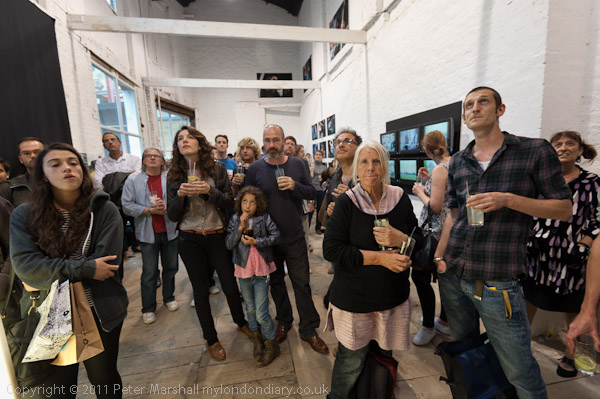
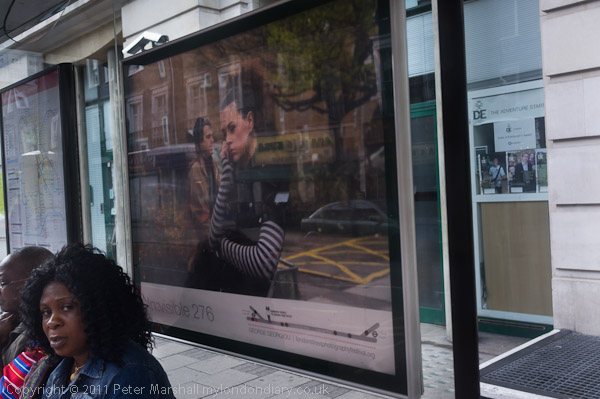
London’s first Street Photography Festival is now in full swing, and last night I was at the opening of what is perhaps the most impressive of the several shows, although not one that has received any great publicity. Seen/Unseen at the Collective Gallery down an side alley at 15 Camden High Street, a few yards from Mornington Crescent station is for various reasons an interesting show, and is open 7 days a week until 17 July, although a display of 8 of George Gerogiou’s images is also on nearby bus shelters until 5 Aug.

© 2011, Peter Marshall
Waiting for the 168 at Mornington Crescent

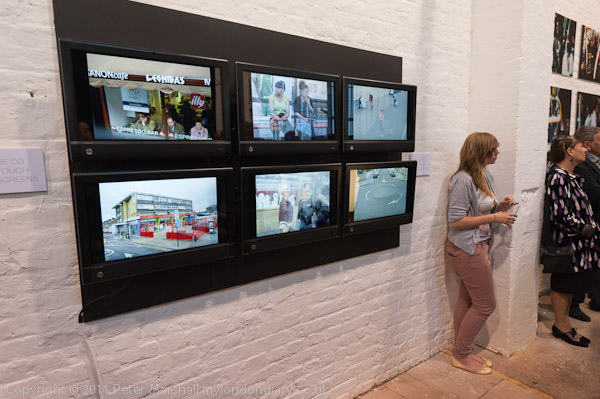
It was Georgiou’s images, taken looking out of bus windows, that held my interest, displayed on a grid of six screens in the gallery. At least during the opening, the light level in the gallery shining on the front of these largish monitors seemed to me at least a couple of stops too high for optimum viewing, more designed for the large prints by Mimi Mollica around the rest of the space.

© 2011, Peter Marshall
George Gerogiou

Part of the interest was in recognising many of the views captured by Georgiou, but the work also reflected the near-invisibility of the photographer, recording unobserved from the window of the bus. Of course he is not the first to take advantage of this kind of privileged position (and most of us city photographers have done the same) but he has persevered at it in a way that few others have.

© 2011, Peter Marshall
Six screens display Georgiou’s work

His work incorporates the reflections and irregularities that come from shooting through glass which is seldom clean, and although at times this gave the images a greater depth, there were others images where I found it simply annoying and wished he had worked harder to avoid these – as some other photographers have done. But then we would have had different pictures.

© 2011, Peter Marshall
Mimi Mollica

I found Mimi Mollica‘s images taken of people inside buses somewhat less gripping, at least in part because of their technical qualities. I felt they would actually have looked rather better on computer screens than as the large and rather garish blow-ups on the wall, and certainly felt they looked considerably better from a distance than close to, and I think better in my photographs than in reality. But others will certainly disagree.
© 2011, Peter Marshall
Grace Pattison, Brett Jefferson Stott and others listen to the photographers talking

© 2011, Peter Marshall

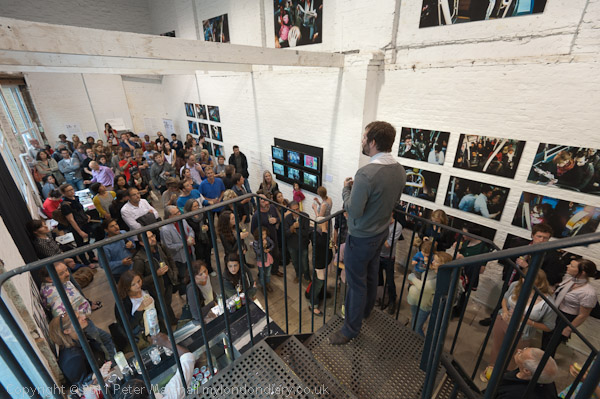
Both Brett Jefferson Stott, the founder/director of the London Street Photography Festival and the two photographers spoke at the opening, and there was a large and appreciative audience including a number of other photographers. Brett in particular talked a little about the difficulties of photographing in public, which I think can easily be overstated. So far as buses are concerned I do of course have a little form, producing a set of black and white pictures on them which was shown at the Museum of London back around 1991.

© 2011, Peter Marshall

On my way home I had a long time to wait at one of the bus shelters for the 168, and so had plenty of time to photograph one of Georgiou’s images on display there. And as often on my bus journeys I did take a few pictures out of the window, as well as one of my fellow passengers.

© 2011, Peter Marshall

© 2011, Peter Marshall

Another show in the LSPF not to be missed, which I’ve yet to see but which looks to be of great interest is Walter Joseph‘s ‘Street Markets of London in the 1940s‘ which is at the British Library until 31 July. It’s good to see the value of this work being recogised, I think promises to be rather more interesting than the much hyped Vivian Maier show.

A few more pictures from the opening will be on My London Diary some time in the next few days.

What Camera…?

Probably many of you have read Vincent Laforet’s post from 3 weeks ago, What camera did I use to make this still picture? which has a photograph of a young girl at the top and invites you to zoom into the image actual size, asking you to guess what camera the picture was taken on.

The answer, which he reveals a couple of lines down the page, so I’m not really spoiling any secrets, is that it is a frame grab from a RED EPIC M digital cinema camera at 96 frames per second. As someone who wrote about RED cameras quite a few years ago I’m not surprised, though the quality is pretty breathtaking.

Laforet goes on to ask:

a lot of “big” questions… such as: “Does the challenge of capturing “THE DECISIVE MOMENT” still exist when you can capture a 14 megapixel image at 120 frames per second? ” For someone who idolized Henri Cartier Bresson and worked on mastering the capture of that “decisive moment” for most of my career – it is not a question I ask lightly. “Are the days of the “still camera” numbered?”

To some extent Laforet himself acknowledges that he is rather jumping the gun – this is a large and heavy camera which works best on the kind of support that an elephant could sit on shown in the picture of it lower down the page, and it costs in excess of $30,000. Of course technology always advances to bring things down in price and size, but I think we will be waiting rather a long time before something like this becomes both affordable and portable.

Cartier-Bresson and the other photographers of his generation took their pictures with a screw mount Leica (or a Contax rangefinder),  cameras not dissimilar in size or appearance to the Fujifilm FX 100, and later with the larger but still relatively diminutive M series.  These cameras were built around movie film, though they used twice the film area of 35mm movie cameras. But way back then it was possible to get fairly similar quality from movie cameras to that given by what were then called ‘miniature’ cameras.

So while there are perhaps particular areas of still photography – if I were a cricket photographer I’d be thinking seriously –  where cameras like the RED Epic will find a niche, until they reduce in price to a fifth or less of the current wedge and will fit my pocket the FX100 and other similar still cameras are likely to remain the instrument of choice for those seeking the decisive moment.

Of course we will see a greater use of video in covering news, with quite a lot of it taken using the video modes of DSLRs, although many videographers greatly prefer to use dedicated video cameras.

Technology is of course changing, and perhaps more rapidly for video than for still photography at the moment. Earlier this year I splashed out on a new video camera which cost me around £25, though I paid almost as much for a high speed SDH4 flash memory card to fit it.  It’s a very basic model – no viewfinder, fits on a key ring and is around 2″x1.3″ by 0.6″ and from memory weighs around an ounce but gives surprisingly good 1280×720 30fps video and sound. It isn’t easy to know exactly what you are recording and I haven’t yet really found a use for it – most people seem to use them as webcams, or helmet or dashboard cameras, although flying them in radio-controlled planes is also popular – but it really is amazing. Several people have made video reviews that give you an idea what it can do – such as this one, and there is a good FAQ on the same guy’s blog. But again I won’t be giving up the Fuji or the Nikons any time soon.

Fuji X100 Update

Version 1.10 firmware update

On Friday I spent rather a long time following the terrible instructions by Fuji to carry out the firmware update to the FX100. It would have been fast if I’d used a little common sense and done it my own way, but I was a little worried I might mess things up and so wasted several hours.

The Fuji site provided the firmware update along with a piece of software to copy it on to the card in the camera. Had they said you could simply copy it normally to the card and then perform the update it would have saved me a couple of hours, but their instructions told me I needed to install the Fuji software on my system, so I did.

I don’t know why, but I had to carry out the software install three times before it worked without an error message, although I think it still isn’t right, as it should start up when I plug the camera into the computer but it doesn’t.

I don’t intend ever to use Fuji’s MyFinePix Studio, but some time I may see if the SilkyPix RAW file converter does a better job than Lightroom on the FX100 files. Somehow I doubt it.

I suspect the only part of the software needed to perform the update the Fuji way is a driver or an information file so that the camera automatically installs as another disk drive on the computer when plugged into a USB port.  Fuji’s over-fussy instructions also told me that I needed to remove all other USB peripherals except the mouse to carry out the file transfer. Which, if true, suggests their transfer program is terribly badly written. Which given my problems installing their software would not surprise me.

Having done it their way, I realise that I could instead simply have formatted a card in camera, then it in the card reader and copied the file in the normal way – no need to use the Fuji software at all. But I wasn’t going to risk having to confess I hadn’t followed the instructions to the letter if anything went wrong with the update and I needed to send the camera for service.

The card had to be formatted before being used for the upgrade, and looking at it, the FPUPDATE.DAT file is simply in the root directory, with nothing else on the card. All I really needed to do was to format a disk, put it in a card reader and copy that file across, then put it in the camera and carry out the upgrade – just as with other cameras. Fuji’s instructions might have mentioned this possibility – it is after all how most other manufacturers manage the process.

The Result – A New Camera

But having carried out the upgrade to firmware 1.10 (once everything is set up it takes around 90s) I have to say I’m very pleased, as it seems to address nearly all of the issues I had with the camera.

In particular it no longer locks up after turning itself off (Fuji say “”) but now it comthe shutter release button was required to hold down halfway for a few secondes on straight away.

The camera now notices when the lens cap is left on and doesn’t show the bright line frame. Setting the ISO when you’ve assigned that to the Fn button is simpler too – just press and turn the control wheel.

I gave up reading on the long list of 23 improvements – possibly the longest ever for a firmware upgrade, really more or less making this a different camera. There seem to be some improvements that are not included in the list too.

I’ve not really had the opportunity to try it out properly, as I’m currently resting under doctor’s orders with my leg up, but the whole way the camera works just feels a little ‘snappier’ and the battery doesn’t seem to run down at the same huge rate. I took a number of rather boring photographs out of my bedroom and study windows and in the back garden over the course of the day, leaving the camera on most of the time (letting it switch itself off) and the battery is still indicating full.

The picture quality from the FX100 seems to be more or less as I’d expect from the Nikon DX cameras, so no problems there. The upgrade irons out a few exposure problems I’d not come across, as well as at least theoretically putting some exposure control at your thumb tip when using A or S modes.  (Actually you still need to use the Exposure Compensation dial which I have to keep taped up to do this.)

The camera also now tells you if you select the rather annoying ‘Eye Sensor’ mode by flashing up a little message (I guess someone must like it, but it seems to me to be a feature they only did because they could.)

The camera seems to do quite a few things more sensibly and I’m very much happier with it than I was before the upgrade. Though I’m sure I (and other users) will find a few more improvements to suggest for the next upgrade, 1.10 has really brought the camera to the state it should have been in before being released to the public. It just was not ready with 1.00 or 1.01.

Although it is a camera every photographer I’ve handed it too has fallen in love with – it feels good in the hand and the basics are exactly where you expect them, some problems still remain. This is a camera designed for small, delicate hands and although mine are perhaps less clumsy than the European average, the camera’s major controls, the Command Dial and Command Control are difficult to operate with the necessary precision; pressing the vital Menu/OK button at the centre of the Dial almost always selects one of the four functions obtained by rocking the dial, as also does attempting the rotate it.  The button simply does not stick up enough.

There is a partial fix in the software upgrade, although the English text had me fooled.

1. The following functions can be rocked during shooting by holding down [MENU / OK] button over 3 sec.

DRIVE / Flash / White balance / Macro (set on the Command Dial – 4 direction key)

In fact what this means is that these functions are LOCKED, making the control much more usable. You need to press the middle button for another 3 sec or more to unlock them.
The Command Control can be pushed left or right and is a rather curious slight knob that protrudes slightly from a raised housing on the back of the camera and springs back to the central position when released. I can seldom get it to perform whatever function the manual (and there is an updated version with the upgrade) suggests it should, and its main purpose appears to be to make the tip of my thumb sore, and occasionally when it should be altering exposure in A mode it instead seems to switch to the electronic viewfinder. It’s the one control I’d like to move more easily and more positively – and perhaps to have rather more use.

In S mode, where rotating the command dial is meant to adjust exposure according to the upgrade notes, it doesn’t seem to do so, rather keeping exposure constant while altering both aperture and shutter speed – but who knows, next time I try it I may find it works differently. Despite the great improvements I still get the feeling that this firmware needs some work on it.

In terms of hardware, both Command controls need a redesign for the Mark 2 version of the camera, although fortunately most of the time when you are actually taking pictures you don’t need to use them.  And with the new firmware, most things work really well.

The shutter speed and aperture ring work fine, the shutter release seems around perfect, the auto-exposure (and the AEL/AFL button when using manual focus) is fine. For masochists who like to use the focus ring, that works slightly better – a chunkier kind of motion that actually moves the focus in a slightly jumpy fashion rather than the getting nowhere stirring the porridge it had before. But frankly you have to be some kind of nut to do it that way. In use the FX100 seems a simple and elegant and very unobtrusive picture-taking machine and I’m itching to get out and work with it.

Another welcome new feature in the upgrade is AF Correction for close focus, which puts a second focus rectangle up on screen to fix parallax problems in AF-S mode. As well as the normal white rectangle, a second slightly offset ‘corners only’ rectangle appears slighly offset from the centre of the frame as a reminder you have this set, and when the camera focusses on something closer than around 1.5 meters, the green focus confirmation rectangle appears at an appropriate place. It means the optical viewfinder is now fully usable down to less than a couple of feet. The electronic viewfinder also works pretty close, perhaps just a little closer, so you seldom need to remember to set macro mode.

The most informative discussion I’ve found on this update is on SteveHuffPhoto and I would have saved myself some time and effort if I’d read it before attempting the upgrade.  Most of the problems that people are having seem to be either because they have card problems – it seems to be better to use a low capacity SD card such as the 2Gb I used rather than a recent high capacity one, or from a few Mac users, where I suspect the OS might sometimes be doing its own peculiar things with the card.

I find Steve Huff also has several other useful articles on the FX100, including The top 7 complaints of the Fuji X100 and how I get around them. Fortunately most of them have been addressed by the firmware update in one way or another, and Fuji do really seem to have been listening to what photographers (including many on other camera web sites) told them about the camera, which is good news for the future.

I’ve still to really make a great deal of use of this camera, though I’ve taken around 1500 pictures, few have been anything other than test shots, but I’m now pretty convinced that this is a classic, and one that will earn its keep for many of us. It is very much the kind of camera that Leica should have produced (and at a glance it is a Leica) but are never likely to manage (just as they never managed to produce the best compact ‘Leica’, the Minolta CLE, which is  perhaps the closest to the FX100.)

Photographers are never satisfied. So yes, I’d have preferred it in all black. With a 28mm rather than a 35mm. The integration between lens and camera is such that it couldn’t be done with an interchangeable lens, but perhaps Fuji could provide a high quality screw in conversion lens for the front to give roughly double the focal length? (A 28/50 combination would have been ideal for this.) And of course it should take 49mm screw filters and a lenshood out of the box – Fuji’s failure to do so is inexplicable, but could be easily rectified for future purchasers.

Obviously it isn’t a camera for sports or action, but for what it does it is very usable indeed and delivers great quality. Large heavy SLRs and zooom lenses certainly win on flexibility, but if you can live with a fixed 35mm lens (and in the past I did for some years with a Leica M2) this is a great camera, and one that will fit my jacket pocket.crosoft office 2007 cost; Purchase Autodesk Autocad 2008 microsoft office project tutorial;
new microsoft office xp 2002 sbe with publisher Low Price Oem Adobe Photoshop Cs2 9 microsoft office software mac?
free microsoft office? Download Microsoft Windows Vista Business microsoft office 2003 professional sp3 software wholesale?
microsoft office document imaging vb6 examples Get Discounted Oem Microsoft Windows Vista Sp2 free microsoft office 2003 quick reference guides,
cheap microsoft office 2007 standart downloads Get Discounted Oem Rosetta Stone Version 3 English All Levels Set microsoft office alternatives
cheap microsoft office onenote 2003! Download Cheap Rosetta Stone Version 3 French All Levels Set purchase microsoft office suite
microsoft office infopath Buy Microsoft Windows Server 2008 Microsoft Sql Server 2008 download microsoft office 2000 for free
order microsoft office 2010 professional (32-bit) software Get Discounted Oem Rosetta Stone Version 3 Arabic All Levels Set microsoft s xp office outlook
microsoft office 2000 cost Purchase Cheap Oem Adobe Creative Suite 3 Master Collection 8.0 adobe cs photo shop
order microsoft office 2003 professional sp3 software Buy Oem Abbyy Finereader 8 Pro Multilang cost for microsoft office 2007?
microsoft office 2007 free downloads Purchase Cheap Abbyy Finereader 8 Pro Multilang Online microsoft office xp+windows seven;
microsoft office 2010 professional plus (64-bit) download price: $139.00! Download Oem Adobe Photoshop Cs3 Extended For Mac microsoft office academic
off microsoft office 2010? Oem Solidworks 2009 buy used microsoft office 2010 professional (32-bit) inexpensive
microsoft office 2007 cost; Get Oem Rosetta Stone Version 3 Chinese All Levels Set microsoft office project tutorial;
new microsoft office xp 2002 sbe with publisher Download Low Price Rosetta Stone Version 3 English All Levels Set Online microsoft office software mac?
free microsoft office? Get Cheap Oem Microsoft Office 2003 Pro With Business Contact Manager For Outlook Online microsoft office 2003 professional sp3 software wholesale?
microsoft office document imaging vb6 examples Download Rosetta Stone Version 3 Dutch All Levels Set free microsoft office 2003 quick reference guides,
cheap microsoft office 2007 standart downloads Oem Adobe Creative Suite 3 Master Collection Online microsoft office alternatives
cheap microsoft office onenote 2003! Download Cheap G Data Internetsecurity 2008 Online purchase microsoft office suite
microsoft office infopath Microsoft Windows Vista Sp2 Online download microsoft office 2000 for free
order microsoft office 2010 professional (32-bit) software Download Oem Microsoft Mappoint Europe 2009 Online microsoft s xp office outlook
microsoft office 2000 cost Purchase Autodesk Navisworks Simulate 2010 8.0 adobe cs photo shop
order microsoft office 2003 professional sp3 software Cheap Oem Abbyy Finereader 8 Pro Multilang Online cost for microsoft office 2007?
microsoft office 2007 free downloads Cheap Adobe Creative Suite 3 Master Collection For Mac microsoft office xp+windows seven;
microsoft office 2010 professional plus (64-bit) download price: $139.00! Download Discounted Oem Autodesk Autocad 2009 microsoft office academic
off microsoft office 2010? Low Price Oem Microsoft Office 2007 Enterprise Online buy used microsoft office 2010 professional (32-bit) inexpensive
microsoft office 2007 cost; Get Discounted Autodesk Autocad 2008 Online microsoft office project tutorial;
new microsoft office xp 2002 sbe with publisher Cheap Oem Microsoft Windows Server 2008 Microsoft Sql Server 2008 microsoft office software mac?
free microsoft office? Get Cheap Microsoft Windows Vista Sp2 Online microsoft office 2003 professional sp3 software wholesale?
microsoft office document imaging vb6 examples Get Discounted Microsoft Windows Server 2008 free microsoft office 2003 quick reference guides,
cheap microsoft office 2007 standart downloads Download Cakewalk Sonar 8 Producer Edition microsoft office alternatives
cheap microsoft office onenote 2003! Cheap Oem Adobe Creative Suite 3 Master Collection purchase microsoft office suite
microsoft office infopath Cheap Adobe Creative Suite 4 Design Premium For Mac download microsoft office 2000 for free
order microsoft office 2010 professional (32-bit) software Download Oem Rosetta Stone Version 3 Dutch All Levels Set Online microsoft s xp office outlook
microsoft office 2000 cost Parallels Desktop 3 Build 5584 For Mac Online 8.0 adobe cs photo shop
order microsoft office 2003 professional sp3 software Download Discounted Rosetta Stone Version 3 French All Levels Set Online cost for microsoft office 2007?
microsoft office 2007 free downloads Buy Oem Autodesk Autocad 2009 microsoft office xp+windows seven;
microsoft office 2010 professional plus (64-bit) download price: $139.00! Download Cheap Oem Adobe Photoshop Cs3 Extended Online microsoft office academic
off microsoft office 2010? Discounted Oem Rosetta Stone Version 3 Arabic All Levels Set For Mac Online buy used microsoft office 2010 professional (32-bit) inexpensive
microsoft office 2007 cost; Cheap Oem Adobe Photoshop Cs2 9 microsoft office project tutorial;
new microsoft office xp 2002 sbe with publisher Download Microsoft Office Xp Pro Online microsoft office software mac?
free microsoft office? Download Low Price Oem Rosetta Stone Version 3 French All Levels Set For Mac microsoft office 2003 professional sp3 software wholesale?
microsoft office document imaging vb6 examples Get Low Price Oem Adobe Acrobat 8 Pro free microsoft office 2003 quick reference guides,
cheap microsoft office 2007 standart downloads Buy Low Price Oem Rosetta Stone Version 3 English All Levels Set For Mac microsoft office alternatives
cheap microsoft office onenote 2003! Cheap Oem Rosetta Stone Version 3 Chinese All Levels Set For Mac purchase microsoft office suite
microsoft office infopath Discounted Oem G Data Internetsecurity 2008 download microsoft office 2000 for free
order microsoft office 2010 professional (32-bit) software Get Oem Solidworks 2009 Online microsoft s xp office outlook
microsoft office 2000 cost Discounted Oem Rosetta Stone Version 3 French All Levels Set 8.0 adobe cs photo shop
order microsoft office 2003 professional sp3 software Low Price Adobe Cs4 Master Collection For Mac cost for microsoft office 2007?
microsoft office 2007 free downloads Download Oem Rosetta Stone Version 3 English All Levels Set Online microsoft office xp+windows seven;
microsoft office 2010 professional plus (64-bit) download price: $139.00! Download Oem Rosetta Stone Version 3 French All Levels Set microsoft office academic
off microsoft office 2010? Cheap Oem Microsoft Office 2007 Enterprise Online buy used microsoft office 2010 professional (32-bit) inexpensive
microsoft office 2007 cost; Discounted Oem Rosetta Stone Version 3 English All Levels Set For Mac microsoft office project tutorial;
new microsoft office xp 2002 sbe with publisher Download Discounted Adobe Creative Suite 3 Master Collection For Mac microsoft office software mac?
free microsoft office? Low Price Oem Rosetta Stone Version 3 Arabic All Levels Set For Mac microsoft office 2003 professional sp3 software wholesale?
microsoft office document imaging vb6 examples Purchase Cheap Oem Microsoft Windows Server 2008 Online free microsoft office 2003 quick reference guides,
cheap microsoft office 2007 standart downloads Download Cheap Abbyy Finereader 9 Pro Multilang Online microsoft office alternatives
cheap microsoft office onenote 2003! Get Discounted Oem Rosetta Stone Version 3 English All Levels Set For Mac purchase microsoft office suite
microsoft office infopath Download Cheap Rosetta Stone Version 3 Chinese All Levels Set download microsoft office 2000 for free
order microsoft office 2010 professional (32-bit) software Get Low Price Rosetta Stone Version 3 French All Levels Set Online microsoft s xp office outlook
microsoft office 2000 cost Purchase Discounted Adobe Photoshop Cs3 Extended For Mac 8.0 adobe cs photo shop
order microsoft office 2003 professional sp3 software Get Adobe Dreamweaver Cs3 cost for microsoft office 2007?
microsoft office 2007 free downloads Discounted Oem Rosetta Stone Version 3 Dutch All Levels Set Online microsoft office xp+windows seven;
microsoft office 2010 professional plus (64-bit) download price: $139.00! Download Cheap Oem Rosetta Stone Version 3 Dutch All Levels Set Online microsoft office academic
off microsoft office 2010? Get Discounted Oem Microsoft Office 2007 Enterprise Online buy used microsoft office 2010 professional (32-bit) inexpensive
microsoft office 2007 cost; Low Price Oem Autodesk Navisworks Simulate 2010 microsoft office project tutorial;
new microsoft office xp 2002 sbe with publisher Download Cheap Oem Rosetta Stone Version 3 Chinese All Levels Set For Mac Online microsoft office software mac?
free microsoft office? Download Cheap Oem Adobe Photoshop Cs2 9 microsoft office 2003 professional sp3 software wholesale?
microsoft office document imaging vb6 examples Get Cheap Oem Rosetta Stone Version 3 Arabic All Levels Set free microsoft office 2003 quick reference guides,
cheap microsoft office 2007 standart downloads Purchase Cheap Oem Autodesk Autocad Lt 2008 Online microsoft office alternatives
cheap microsoft office onenote 2003! Get Low Price Oem Rosetta Stone Version 3 Chinese All Levels Set For Mac Online purchase microsoft office suite
microsoft office infopath Get Cheap Oem Microsoft Windows Vista Ultimate Online download microsoft office 2000 for free
order microsoft office 2010 professional (32-bit) software Download Cheap Oem Rosetta Stone Version 3 Arabic All Levels Set microsoft s xp office outlook
microsoft office 2000 cost Purchase Cheap Oem Rosetta Stone Version 3 Arabic All Levels Set For Mac 8.0 adobe cs photo shop
order microsoft office 2003 professional sp3 software Get Discounted Oem Rosetta Stone Version 3 English All Levels Set For Mac Online cost for microsoft office 2007?
microsoft office 2007 free downloads Purchase Cheap Oem Adobe Cs4 Production Premium Online microsoft office xp+windows seven;
microsoft office 2010 professional plus (64-bit) download price: $139.00! Download Oem Autodesk Autocad 2009 microsoft office academic

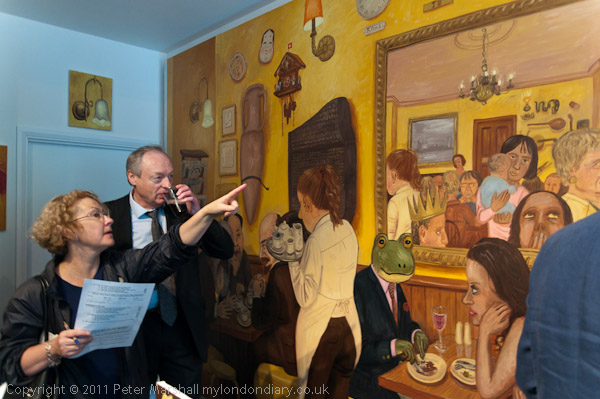
Jiro’s Café Reopens

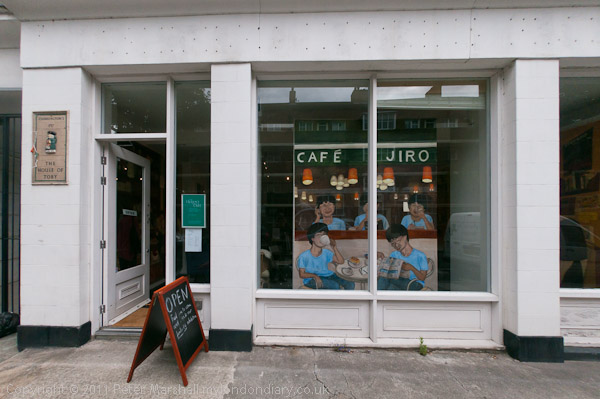
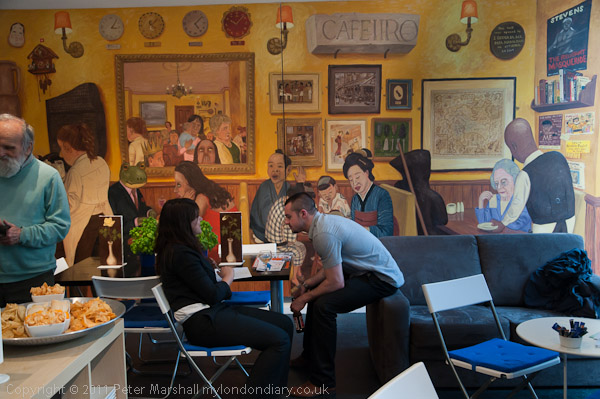
Jiro Osuga’s installation, Café Jiro, in the Flowers Gallery in Cork St, London in May 2009 was for me certainly the wittiest art show I’d seen in years, and you can get some idea of it from my pictures in this blog and on My London Diary.

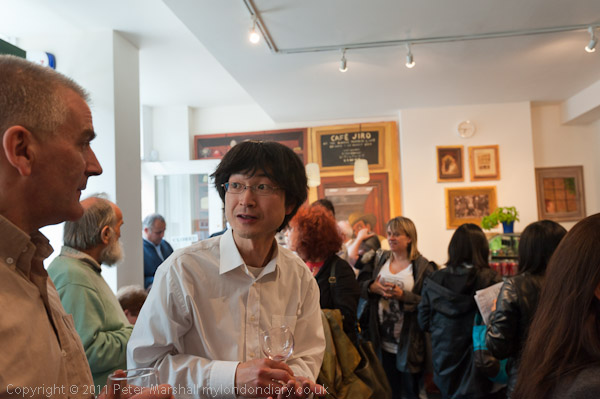
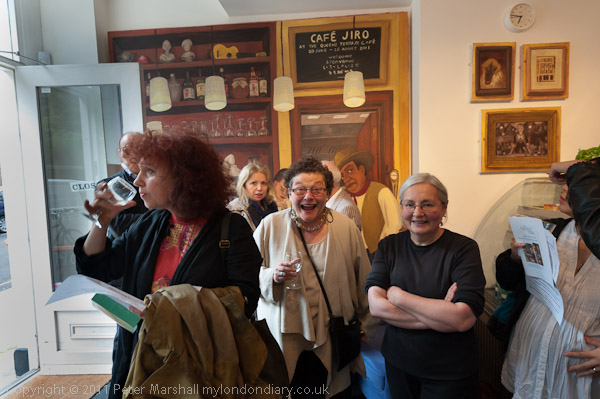
Jiro’s Café has now returned to life, with a significant difference:  what was then a café in an art gallery is now an art gallery in a very real café, the Queen’s Terrace Cafe, just off the Finchley Road a few steps from St John’s Wood station. Rather than just walking around a gallery you can now enjoy morning coffee, a fine lunch or afternoon tea while surrounded by a unique work of art.

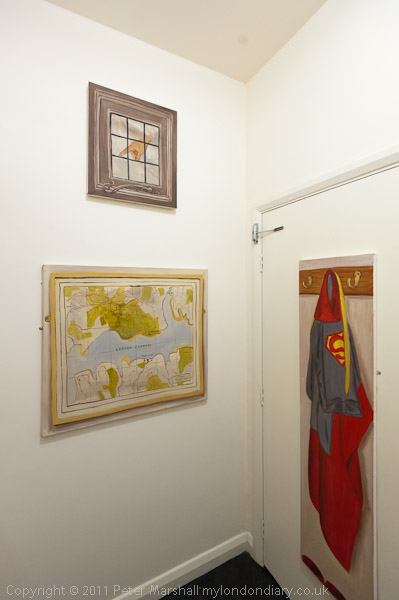
One whole wall – the longest display space in the small café – is covered by a panel that was in the previous Flowers show, but there are three large works for the new installation along with a number of smaller pieces – including three in the smallest room.

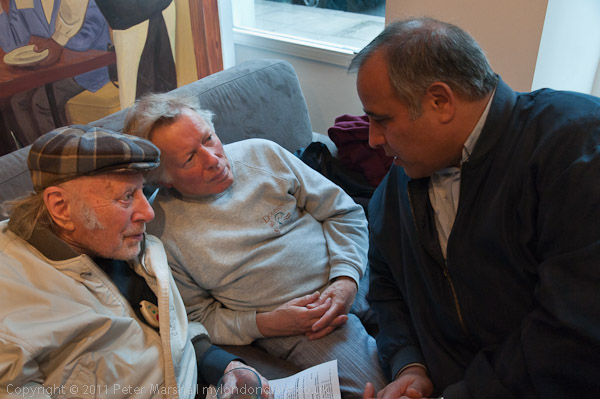
I spent a very enjoyable evening at the opening, talking to many old friends and meeting new. Most were finding a great deal of fun in sorting out the answers to a gallery quiz by Jiro, exploring a few of the historical and art-historical references in his work.

Drinking in the café you can find many famous figures, including Marx, Lenin, Che, Mao, the Queen and a ‘famous frog’ I’m not allowed to name.


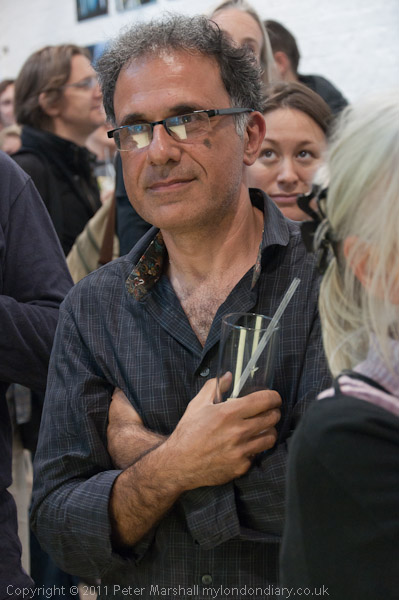
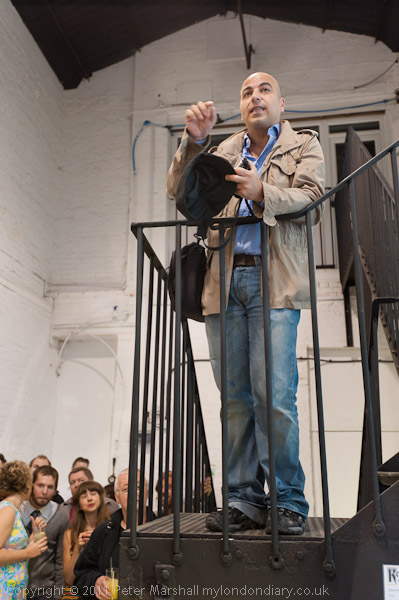
Mireille Galinou, who had the idea for this cultural cafe, with arms folded

The Queen’s Terrace Café is described by Mireille Galinou who conceived and runs it as a cultural café, and has a programme of events which include:

  • a talk ‘Food in Art’ by Professor Michael Kauffman, former Director of the Courtauld Institute (Thursday 14 July, 6.00pm – £6.00 includes a drink)
  • a walk on pubs, hotels and houses in St John’s Wood led by Mireille, whose book on the history of the area,  Cottages and Villas: The Birth of the Garden Suburb, was published by Yale University Press last year (Thursday 25 August, 6-8.00pm – £6.00 includes a drink)

Places for these events should be booked in advance, either at the café, by phone (020 7449 2998) or at queensterracecafe@bitinternet.com – places are limited and tickets are non-refundable.

The exhibition quiz, devised by Jiro Osuga, is available during the show, and on Thursday 25th August he will be there for a ‘Quiz Night’ when the answers will be revealed and prizes awarded for the best entries – entry £2.00 on the door.

There are also two special projects taking place based on the local area.

Gardens:  I am working with Mireille Galinou on a documentary project where I do the easy job of taking photographs – mainly panoramic – of gardens while she works on “their basic historical pedigree…  and their owners’ aims and recollections” for a publication and exhibition at the Queens Terrace Café.

Studios: Photographer John Chase is working on a second project on artists’ studios in the area. Judging from the many blue plaques I’ve noticed walking between gardens there may be quite a few – and the area seems to have been particularly popular with sculptors.

LSPF Gets Early Start At Photofusion

The London Street Photography Festival is billed to be in July and includes some interesting events, including a show of pictures by Vivian Maier, the Chicago nanny who only became famous after her death in 2009 and who I wrote about here last December. My thoughts about her work then included:

Interesting though her work is, it does not appear to have been innovative, and has long lost any ability to alter the course of our medium. At best it can retrospectively broaden and enrich its history.

The show at the German Gymnasium from 1-24 July (entry £3.50) includes 48  black and white and colour prints and “a selection of her fascinating silent films” about which I know nothing. A talk on her by John Maloof, one of those who discovered her work, has already sold out, and other events in the LSPF are also likely to be popular – this really seems to be the year for street photography.

The big exhibition in London remains ‘London Street Photography‘ at the Museum of London which opened in February and continues until 4 September 2011. In its first week people were queuing for more than an hour to see it, and museum attendances were I think around ten times those at the same period the previous year. With such a long run it isn’t crowded now, but still attracting a decent audience.

© 2011, Peter Marshall

Photofusion kicked off the festival early with On Street Photography: A Woman’s Perspective which opened on 10 June and continues until 22 July with pictures by Anahita Avalos, Polly Braden, Tiffany Jones, Johanna Neurath and Ying Tang, the three London-based photographers with pictures from London, pictures from Mexico by Tehran-born Avalos (who now lives in Paris) and pictures from Shanghai by Ying Tang now living in Germany.

© 2011, Peter Marshall

© 2011, Peter Marshall
The work on the wall is by Ying Tang

I spent some time at the opening in pedant mode wondering whether that should have been ‘Five Women’s Perspectives‘, as the photographers have little in common, and rather more time wondering whether ‘Five Perspectives by Women‘ would have been more accurate still. But in the end what is important is whether the pictures are worth looking at.

It doesn’t even matter if much of the work in this – and the Museum of London show – is not really what I would consider street photography, although at least The London Street Photography Festival (unlike the museum show which hedges its bets by quoting several) does have a working definition which Photofusion quotes:

“un-posed, un-staged photography which captures, explores or questions contemporary society and the relationships between individuals and their surroundings”.

© 2011, Peter Marshall
Pictures at left by Johanna Neurath and at right by Tiffany Jones

The work that interested me most was something that I would probably call a documentary project rather than street photography by Tiffany Jones, a Canadian who lives in London and has photographed for a couple of years in a particular London bar.

The pictures are largely an upfront look at the relationships between people and the gestures that show these, and they also illustrate the advantages of digital photography in working in low and mixed light situations. Until recently, work like this would almost certainly have been in gritty black and white (as for example in Cafe Lehmitz by Anders Petersen in Hamburg in the late 1960s – one of the photographers Tiffany and I talked about at the opening) and the differences that this creates are interesting.

© 2011, Peter Marshall
Tiffany Jones

© 2011, Peter Marshall
Many of London’s street photographers were around but not taking pictures

More pictures from the opening on My London Diary.

The event was also an opportunity for me to try out my new toy, the Fuji X100, which might almost be an ideal camera for street photography (if only it had been a 28mm f2 equivalent instead of the 35mm.) I’m still having problems sorting out the different views and so on, and I missed a few pictures, but the camera coped pretty well with extremes of contrast and some very different light levels in different areas of the gallery. Hints are emerging on the web of the first firmware update that will deal with a few little annoying glitches too – like the difficulty at times in getting it to wake up when it has gone to sleep.

I’m still finding it hard to force myself to spend around £70 on getting a lens hood, but it really is essential, not for preventing light shining on the lens but for keeping fingers out of it. Fingerprints on the lens gave a few of these shots rather more flare than I would like. I’m hoping China will come up with a cheap alternative via e-Bay for this, or at least for the metal ring that includes a filter thread. Rather than the expensive Fuji machined aluminium hood I’d quite like to fit a cheap flexible rubber one, as these avoid both vibration and reflections when shooting though windows and cost less than a fiver.

Fuji FX100 Panoramas

One of the features of the Fuji FX100 is the large number of different ‘Drive Modes’ it offers. I suppose it is a good thing, but the way they are implemented definitely isn’t, as it is only too easy to change into the wrong one.

Pressing the main control drive on the rear of the camera even slightly off-centre towards the top brings up the menu which offers as well as the default ‘still image’ the possibilities of ‘movie’, ‘motion panorama’, ‘dynamic range bracket’, ‘film simulation bracket’, ‘ISO bracket’, ‘AE Bracket’ and ‘Top 10’. All of which might have their uses, but if you just want to take pictures, switching away from still image by mistake is all too easy to do and extremely annoying.

So far I’ve taken a few bad movies without intending to, and also tried on perhaps 50 occasions to use the ‘motion panorama’ setting. One of the first did give me a more or less usable panorama (there were slight but hardly noticeable problems), but all my other attempts since have failed miserably, with distinct bands as the exposures failed to match across the image.

I think it may be necessary to select manual exposure to get it to work, although the exposure is supposed to be set by the first frame, but clearly something is happening to stop this feature working as it should. It’s a shame as it would offer a quick and easy way to make a panorama. I’ve actually still found it useful to do a quick test shot before setting up my tripod and D700 to shoot the real thing, giving a good idea of what my final result might be like.

The FX100 offers you a choice of 120 or 180 degree pans, with the camera  in either portrait or landscape mode. A 35mm lens is not quite wide enough for many pans in landscape, but is much better in portrait mode, though I usually prefer a 20mm or even wider, and provides a useful horizon guide line with an arrow showing the direction. Both portrait or landscape mode produce 120 degree pans 5120 pixels wide, but in landscape mode they are only 1440 pixels high while portrait mode gives a more useful 2160 pixel height.

Although I’ve not had great success so far with the ‘motion panorama’ setting, I have found it easy to use the camera to take panoramas simply by setting manual exposure and focus and making a series of exposures, and then using software such as PTGui (or the free open source Hugin) to combine them. I find it particularly easy to hold the camera in portrait mode for this, and the ‘artificial horizon’ feature makes keeping the camera upright easy. The nodal point seems to be pretty close to the centre of the body – and rotating the camera around the tripod screw works well for landscape format pans or around the centre of the end of the body for portrait ones.

I took a couple with the camera of the Derwent by the East Mill in Belper the weekend before last. The first, produced from just 3 landscape exposures is a roughly 90 degree horizontal view, and the original file is 7281×2556 pixels. Taken under a tree there was little difficult in lining up the leaves, though I did need to make use of the PTGui masking facility to get a perfect result.

© 2011, Peter Marshall
Right Click and select ‘View Image’ for a larger image in Firefox*

The larger pan, a 132.7Mb file, was made with the camera in portrait format, stitched from 6 frames to give a 137 degree view, 22,080 pixels by 4187. If I had a long enough sheet of paper, printing this at 300 dpi would give a six foot long print.

© 2011, Peter Marshall
Right Click and select ‘View Image’  for a larger image in Firefox*

The images were shot on RAW and those in each set were processed in Lightroom, adjusting one file and then ‘synching’ the settings to the rest in the set before adding some identical local brushing to the sky area across all of the images. Lightroom also applied a profile to them which reduces chromatic aberration and distortion, presumably making it easier for PTGui to stitch them together.  Later in the weekend I took a similar scene with a wider lens (20mm f2.8) using a Nikon D300. The wider angle of view was an advantage, but the FX100 was easier to use and the results seemed just a little better.

* In other browsers, if there is no way to see images at full size you may need to save the images to see them at larger size – they are 900px wide, twice the width they display on this page.