Showing in London

Yesterday I had around three hours spare in London in the afternoon, and decided to visit some of the exhibitions that I’d been meaning to take a look at, including some photography shows.

As I was in Bloomsbury, I started with ‘Cartographies of Life and Death‘,  a show  marking the bicentenary of John Snow (1813–1858) whose careful research into cholera outbreaks in London in the 1850s showed that cholera was spread by polluted water. His work making use of careful mapping of the places where the deaths occured initiated a new science of epidemiology. It was an interesting show, with some well chosen documents both from the time of Snow’s ground-breaking study – particularly a  and later disease mapping, but I found almost all of the contemporary artworks that had been specially commissioned for it disappointing in the extreme. It certainly was a show that would have been enlivened by some photography from the nineteenth century along with the rather dryer texts (though there was an amusing ballad pouring scorn on the cholera industry) and perhaps even a rather more appropraite contemporary photographic commission.

From there I walked to Soho, where the Photographers’ Gallery is just a little to the north of the site of the Broad Street pump which was the source of the outbreak. I’d decided against attending the opening of the current series of shows there on the grounds that it would only enrage me, but had decided to go in and check it – and they are on until April 7 2013. It’s best to take the lift up to the fifth floor and work your way down as there are far too many stairs in the building. By far the most interesting part of the exhibition on top floor, Perspectives on Collage, was the view out of the large window north across Oxford St into Great Titchfield St, and even that I couldn’t be bothered to photograph. There were a few mildly interesting collages both in C.K. Rajan’s Mild Terrors (1992-96) and the work of Roy Arden, and a little that was at least thought-provoking in the work of Jan Svoboda (there are at least two photographers of that name – this was the Czech artist ((1934–1990) who sought “who sought to redefine the language of photography in relation to painting and sculpture“. I remember seeing a show of his work many years ago – perhaps even at the Photographers’ Gallery – and taking a copy of a small book of  his work being given out free at the gallery. There were large piles of them because almost everyone who picked up a copy took a quick look and  put it back as not worth the price. Certainly most photographers who saw the show appeared to feel that Svoboda should have torn up his ‘The Table‘ but few if any would have suggested he should then have put the pieces on show. To be fair I thought them more interesting than most of the contemporary works. I don’t know how representative a show of collage this is, and it may reflect a dearth of work in this area.

On the floor below I found myself in a large empty space with around a dozen large empty still live images, Ill Form and Void Full, the work of Laura Letinsky.  Mostly the large prints were empty of objects, with  assemblages of objects in just a small area of the frame. The prints didn’t look particularly photographic, and when I put on my glasses they didn’t look particularly sharp, even from a fairly normal viewing distance, which I found annoying. I know I’m fussier than others in this respect, but if a large print looks unsharp I just feel it has been printed too large. Better to have made these perhaps A3. They are described as being taken with a ‘large format camera’ and frankly I’d expect more technically, although possibly the lack of absolute clarity is to enable the blending of real objects and photographs in the images.

I think her work looks better on my screen at home that it did on the wall, although perhaps rather despite myself there was an image of a simple white cup on a white table with a white wall (the image next to the text panel if you can brave the sea-sickness of the panoramic view of the exhibition, though you can’t see it well enough to appreciate it) which was a picture very much about light and illusion that intrigued me.

The lowest of the three exhibition floors was devoted to the work of Brazilian artist  Geraldo de Barros (1923-1998)  and despite some reservations it was perhaps the work on show that interested me most, though more for his early work in a modernist vogue than the collages of his final years when he returned to working with photographs, having abandoned any serious photography over 45 years before. You can read more about him, and some comments on the other shows in a Guardian piece by Sean O’Hagan.

By far the most worthwhile of the shows I saw was at the Courtauld Gallery, where  Becoming Picasso has two rooms of his work from 1901, the first containing paintings made for his Paris debut exhibition and the second the start of his Blue period, perhaps inspired – as two of the works on show clearly are – by the death of a close friend. I don’t go much for large collected blockbuster shows, but this isn’t that but a closely focused exhibition that brings together work for a specific theme. You can’t really fully appreciate these paintings on line (or in reproduction) but really have to go and stand in front of them and look at them closely as well as from a distance. Most of these images have a three-dimensional aspect to their brushwork that is important. The show runs until 26 May 2013.

Going back to photography was perhaps bound to be something of an anti-climax, but also at Somerset House, in the East Wing Gallery, is Landmark: the Fields of Photography, a landscape show curated by William A. Ewing (until 28 April 2013.) It’s a vast show, full of huge images – along with some smaller ones – in a confusing rambling series of rooms, and you really need the map supplied to ensure you see it all.

The text says it contains ‘more than 130 original works of art’ and my guess would have been that there were around twice that number of photographs, but that’s perhaps just how it felt. Although there is much interesting work on show, I think a much smaller show would have been preferable. There was too much on the wall that made me feel I’d seen pictures like that so many times before or at times to ask, ‘but is is really landscape.’ It’s like one of those big thick bricks of books of photographs (and Ewing has of course produced some) and I felt the curator needed a strict curator to keep him in check. It seems driven by an unbridled enthusiasm, a child let loose in a sweetshop with an unlimited budget.

There are too many vacuous large works – some by well-known names. Too many pictures that seem nice pages for coffee table books or colour supplements. But still much work that I liked. If you have an interest in landscape there will probably be much that interests you – just be prepared to walk through a lot of long grass too find it.

New Year

2013 has now officially started on My London Diary. Somehow I didn’t quite get around to making New Year Resolutions this year, didn’t quite get around to doing most things I meant to do, but I did more or less finish updating My London Diary for 2012 before the clock began to strike midnight on 31 December, which considering I was out taking pictures on the 27th and the 30th took a little doing.


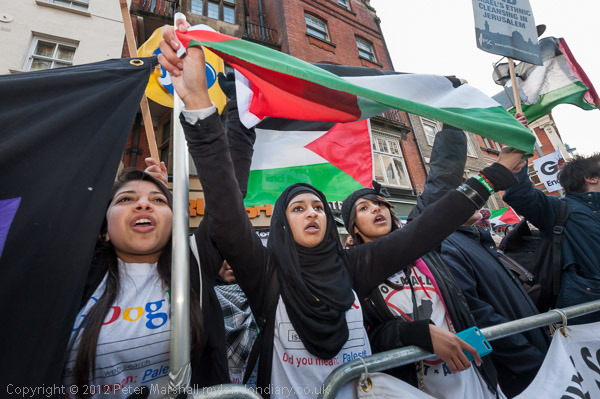
Google search t-shirts: ‘israel – Did you mean: Palestine

December 27 was, I was surprised to find, the fourth anniversary of Operation Cast Lead, the Israeli attack on Gaza which lasted around 22 or 23 days and killed at least 1400 Palestinians, mainly civilians, including many women and children. I wrote a little about photographing the event in 2012 – My Own Favourites – December, and of course you can see the pictures at Gaza – End the Siege.

I don’t often pose pictures, and I didn’t really pose the one above. I’d been photographing a small group of young women including these two, and had noticed the t-shirts with the Google logo, but couldn’t really see them well in the pictures as it was a fairly cold day and they were mainly hidden under their jackets. I sometimes feel a little embarrased about asking women if I can photograph their t-shirts, but when I asked about them, these two immediately pulled back their jackets for me to make this photograph, with one of them pulling hers out flat to show the text more clearly.

I was almost giggling too much to take the picture – and it was pretty crowded so I couldn’t move back any more, and they nicely filled the frame at 20mm (D700, 16-35mm, ISO 640 1/200 f7.1 – or rather press the button on P). I’m told that ‘I Googled Israel and got “Did you mean Palestine”‘ has been around for a very long time – and as a Facebook group since July 2010, and I had a vague recollection of having seen it before, but if it had been on a t-shirt I’d forgotten it. Perhaps its an advantage of old age forgetfulness that you can see the old freshly.

I don’t think it was the best picture I took that afternoon, though it was good to see it getting several thousand ‘shares’ on Facebook – probably more than any other picture I’ve taken. I liked several other pictures from the afternoon more, including another with these two and others, waving a Palestinian flag and shouting towards the embassy from the front of the crowd.

By then it was around an hour later and quite a bit darker, and I had changed to ISO 1250, taking this picture at 1/125 f8 and needing flash as they were in shadow from the flag. I’ve not yet taken the Nikon flash in for repair and was using a cheap Nissin unit that works a little differently. This time the 16-35 was at its widest both aperture and focal length, 16mm f4, and I’d rushed around to the front of the protest and got down on my knees to take this and several other exposures.

The Nissin Di622 is a little strange and seems to give less even coverage than the Nikon unit.  It is a dedicated Nikon iTTL flash, and is supposedly controlled by the camera when set to TTL in just the same way as the built-in flash. It has a diffuser you pull down for wide angle lenses (it claims to zoom to cover 24-105mm without) and sometimes works well, though like the Nikons it gives me problems on P setting, and is best used on S or A. The design of these units has improved a little since I bought mine and they have become more versatile (and the price has roughly doubled, but is still half that of the more or less equivalent SB700.)   But given the rate at which I go through flash units, perhaps I might buy another Nissin rather than an SB700 next time I need a flash.
Continue reading New Year

Shades of Grey

Although I’m a regular user of Surrey Libraries, I’ve yet to contribute to the statistics just announced that show Surrey borrowers to be the most avid readers of EL James’s Fifty Shades of Grey series – which apparently accounts for one in 5 loans – as a libray spokesman commented “they just can’t get enough.” Certainly I’ve noticed over recent months the ‘New Issues’ and ‘Quick choices’ troughs clustered around the front of the library are engorged, full to bursting with these titles and the many, many rip-offs, ‘Seventeen Shades of Purple‘ and the rest. It’s perhaps surprising that ’50 Shades’ was also reported to be the country’s least wanted Christmas present, so there are presumably many virgin copies lying around in homes through the country.

Although I’ve yet to open the covers of any of these titles which seem to be multiplying like rabbits – after all I’m not in any way the target audience – Shades of Grey has been on my own bookshelves – and regularly consulted – for over 20 years. And if anyone got that volume, long out of print, for Christmas they will have been entranced by Oscar Marzaroli‘s picture of Glasgow from 1956-87, published shortly before his death in 1988 (and reprinted twice the following year.) There is a very wide selection of his work on the Marzaroli Collection web site, but unfortunately the images are rather small and seem contrasty and over-sharpened (rather like some pictures I put on the web in the early days of the mid-1990s) and don’t show his work to advantage. The site does seem overdue for a re-vamp.

The book Shades of Grey, second-hand copies of which now seem to sell for £50 or more, wasn’t particularly well printed – bog-standard offset of the period, with poor separation of the darker tones and perhaps in homage to the title lacking a true black – but it does a much better job than the web site, and is a wonderful portrait of  a city and its people, complemented by a fine piece of writing ‘Where Greta Garbo Wouldn’t Have Been Alone‘ by William McIlvanney. I’d take issue with the flyleaf description which states that this, “with its subjective impressions perfectly complements the objective images from Marzaroli’s camera” only because his pictures are fortunately an equally subjective view of the city.

Paris 2012 Complete

Paris last month was something of a marathon for me, not helped by a little sickness in the last couple of days, but putting my thoughts together on this site and also on My London Diary has probably taken rather more hours of work. At last it is more or less complete:

PARIS PHOTOMONTH DIARY
Monday Blues
Sunday Afternoon
Sunday morning at the MEP
A Photo-Off Guided Tour
Saturday Morning
Paris at Night
Menilmontant
Friday Morning
More Photo-Off Openings
Thursday Afternoon
Thursday Morning
Paris Photo Wednesday pm
Wednesday Morning
Openings – Tuesday
Paris Photo – Photograph as Commodity

You can actually read all of these here on >Re:PHOTO, where there are a few pictures included in the text. On My London Diary – links above – there is a single picture at the top of the text, and then a link to one or more pages of pictures. You can also go through all the pictures I’ve put on line from Paris by starting here and following the ‘more pictures’ or ‘More pictures from Paris’ link at the bottom of each page.

So far I’ve been asked two questions about the pictures from Paris. One was about the legal position of taking pictures of people on the street in France and whether I had any problems. On this visit I had no problems, though I have very occasionally been challenged on previous visits. I work quickly and many people were not aware they were being photographed, but when they were nobody actually voiced any objection.  In some cases there were enough people to make it an image of a crowd (I was told four is a crowd in France, but wouldn’t rely on it.)  In some other pictures – like that on the Metro – I chose an angle and lighting so that the people were not really recognisable.

 © 2012, Peter Marshall

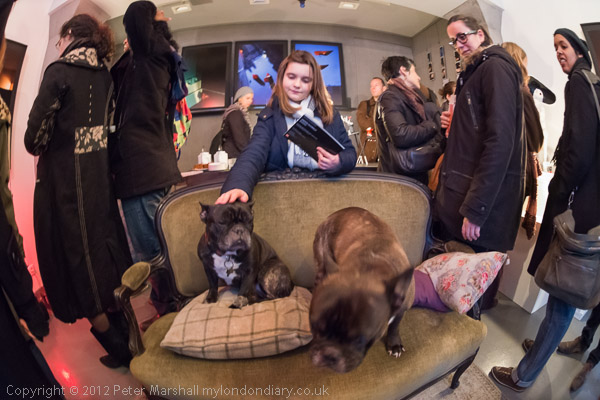
I’m not sure what my favourite picture among those that I took is, but possibly one of the dogs in the Placement libre-atelier galerie. There I was with other photographers on the tour, others were also taking photographs and no one was objecting. I did ask the before taking this picture in the same gallery, because it seemed polite to do so.

© 2012, Peter Marshall

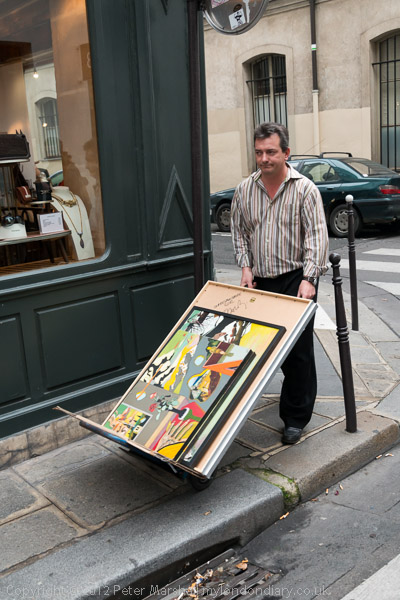
Earlier that same afternoon while walking along the street with the others on the tour Linda did say that some people seemed shocked when I rushed up to a man wheeling some paintings on a trolley and took several pictures. He didn’t look particularly pleased but he didn’t object.

© 2012, Peter Marshall

Continue reading Paris 2012 Complete

Final Hours

© 2012, Peter Marshall

Although Sunday had felt rather like the end, and my gut had put an end to all my plans, we still had most of Monday to fill before it was time to go the the Gare du Nord for the late afternoon train home.

My plans had been to go out for a good meal at one of our favourite cheapish restuarants in the 5e on Sunday night, with a few glasses of wine, then on Monday to book out of our hotel, leaving our cases to collect later, have a leisurely meander around a few of our favourite places, perhaps morning coffee in a cafe, then a little more wandering before a long and satisfying lunch, getting up from the table in time to collect our bags and walk to the station. But in my state I spent our last 24 hours in Paris eating nothing and drinking the odd sip of water – I just couldn’t stomach the thought of anything more.

© 2012, Peter Marshall

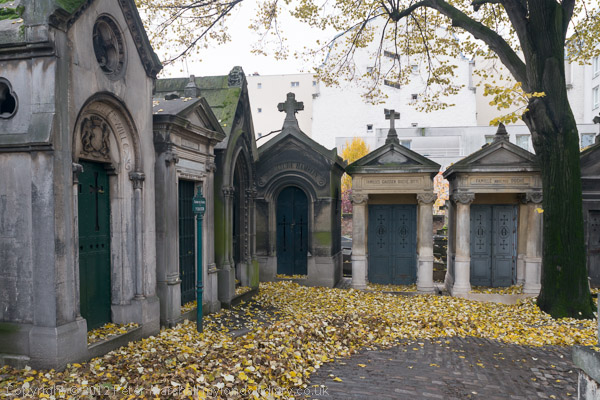
But we needed to do something to keep myself and Linda occupied, and we started with a trip to the cemetery. Montmartre cemetery isn’t really a gloomy place, though it’s pretty huge, and gives considerable employment to the gardeners who were busily blowing the leaves from one place to another. We’d actually hoped to be able to walk through it and out a gate at the north-east, but on reading the notices found that this is only open on one day a year – All Saints.

© 2012, Peter Marshall
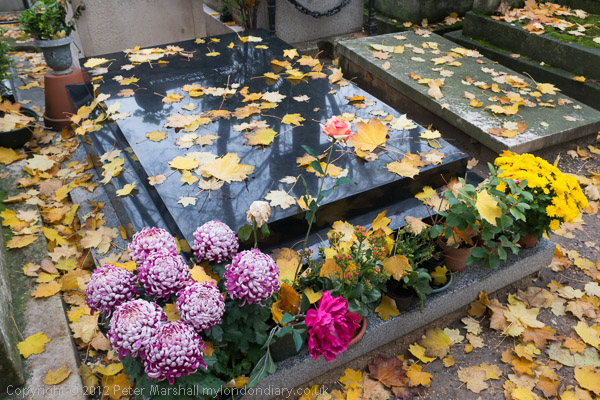
Truffaut’s grave was a simple polished black slab

So we just walked around a fairly small part of it, finding some of the graves of the famous who are buried there (even some I’d heard of) and generally enjoying the atmosphere. It must be about the best time of the year to visit, with falling leaves and colour on the trees.

© 2012, Peter Marshall
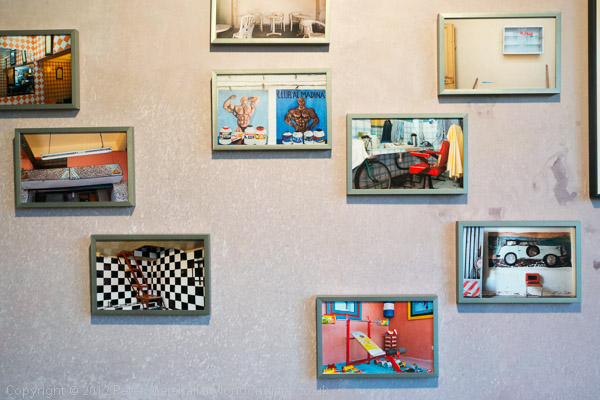
These small images at the side of the show were possibly of some of the rooms in Morocco

We then had to walk around the outside of the cemetery to revisit the Espace Central Dupon, which now held a different show, Mectoub by Scarlett Coten, portraits of young Maroccan men in their own surroundings. On her web site, she perhaps unhelpfully writes:

“« Mektoub », littéralement : c’est écrit”

– literally ‘it is written’, but it more means that whatever is referred to is predestined, already written in the book of life.  And perhaps in photographing these men in their work place or home we see them in acceptance of their fate, their destiny and their offering it to the photographer for her images.

But perhaps what is more obvious is her sense of colour, and their ease at posing for the camera. You can see the series on her web site, and what is striking both on the wall and there is the huge amount of pinks and red, dominating almost all the images. It was certainly an interesting set of portraits.

© 2012, Peter Marshall
There were a few colour images in the Yampolsky show

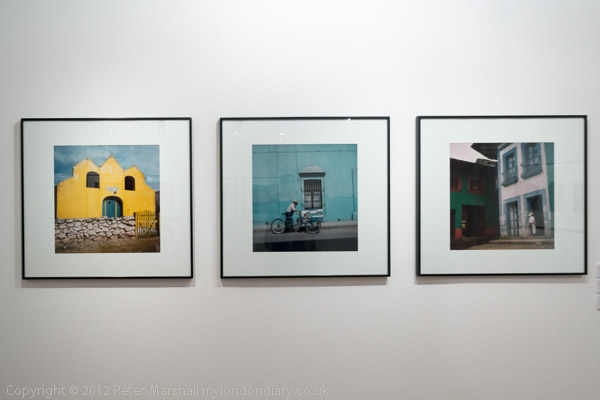
From there we hurried across Paris to the 3e, where one of the few shows open on a Monday was the work of Mariana Yampolsky (1925-2002) at the Instituto Cultural de Mexico.  Tepalcates continues there until the 29 March 2013.

Yampolsky was born in Chicago but grew up on her grandfather’s farm in rural Illinois. Her father was a sculptor and painter of Russian Jewish extraction, and her mother came from a wealthy German Jewish family. A year after she graduated from the University of Chicago in social sciences she went to Mexico City to study painting and sculpture and fell in love with the country, making it her home and becoming a Mexican citizen in 1958. In 1948 she studied photography with Lola Alvarez Bravo and Manuel Alvarez Bravo, and the more interesting work in this show clearly showed his influence on her work.

The name of the show, Tepalcates, is apparently the Spanish version of a Nahuatl word meaning a fragment or scrap of rough clay, and is used to refer to anything made from clay, particularly dishes and bowls. Perhaps the clay here is the ancient culture of Mexico which Yampolsky recorded and also the clay that was important in the vernacular architecture prominent in the work.

For me there was far too much work in the show – and too little time to look at it all before the show closed for the lunch hour. There were some images that caught my attention, and rather too many that seemed to be little more than a record, perhaps something unusual or even typical and doubtless of interest to some but perhaps not to a general audience. But perhaps I’m not the right audience, not in love with Mexican culture. I think of the little curiosities that so attracted Edward Weston when he spent time in that country – and which for me seemed simply wasted film and wasted time when he could have been producing more of the great images he made there.

Yampolsky’s work I already knew – for example on Zone Zero and here and here – had perhaps led me to expect something more interesting. The gallery was closing for lunch, and it was time to leave before I had a really good look. But perhaps if I get back to Paris before March 29 I might go back and have another look.

© 2012, Peter Marshall
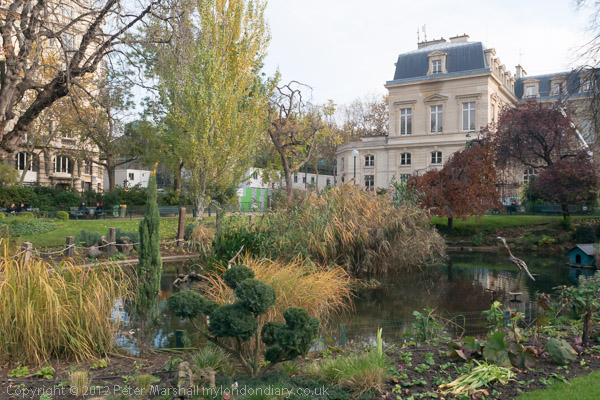
The gardens in the Square du Temple

Not that I wanted lunch. I went with Linda to a brasserie, but couldn’t face the smell or sight of food, and went to sit and read in the winter sunshine in the Square du Temple while she ate.

We did some more wandering in the afternoon, mainly by accident, and came upon the show Barcelone Annees 60, photographs by Narcis Darder Bosch (1923-2006) and Ricard Duran Bargallo (1916-1986) The PDF catalogue here has more pictures. Bosch was a succesful industrialist and a keen amatuer photographer, while Bargallo who started with an interest in cinema and painting and worked in the textile industry made photography his means of expression. While much of the work on show was very much in the amateur photography tradition, some of Bargallo’s work seemed more interesting.

© 2012, Peter Marshall
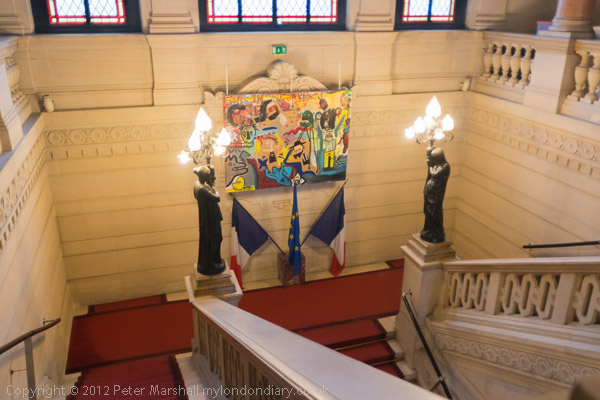
The staircase in the Mairie

Finally back at the Square du Temple we went inside the Mairie of the 3e, where another exhibition had opened that morning,  Paris Couleurs 1960 by Jean Jéhan. A young man from the country, when he had to do his national military service he was stationed in Paris, and decided that after that he wanted to be a photographer. So he bought a camera and spent most of his off-duty time travelling around Paris and taking photographs on 120 film of the people he met on the street and anything that interested him. 200 of these colour images have now been published in a book, Paris-Bohème 1960, with a preface by Charles Aznavour.

From the large selection on show at the Mairie gave an interesting view of the city, which has changed considerably since then. He was photographing more or less at the time when I first came to the city, although I didn’t photograph it at all seriously until 1973. You can get a flavour of the work from the poster and a brief article on the show.

It was time to make our way to collect our suitcases and go to the station. On the way we  bought some quiches, in case either of us felt hungry on the way home.  I hadn’t eaten for over 24 hours, and it wasn’t until I got back home around 8pm that I felt at all like food – and the quiche was delicious.

The End of Paris

© 2012, Peter Marshall

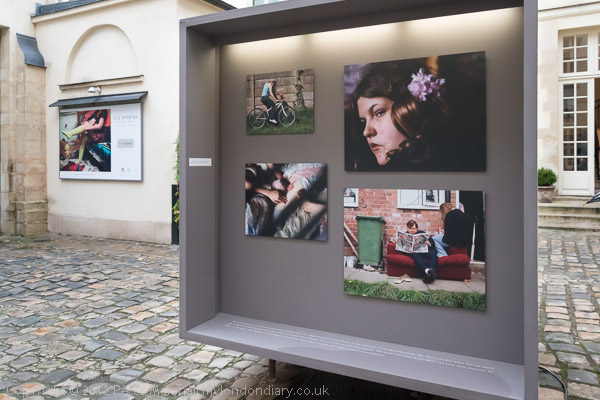
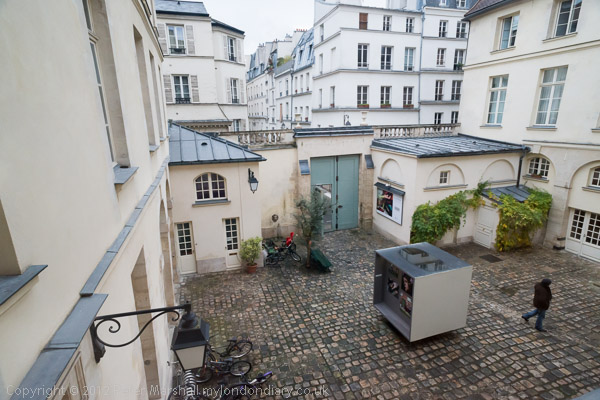
By Sunday lunchtime I was definitely beginning to feel ill, but there were still things that I wanted to see, and after a brief lunch – a mistake – we went on to the Hôtel de Sauroy in rue Charlot in the 3e,where the first thing we saw was a rather curious box in the courtyard. It seemed an odd way to treat the work of Liz Hingley, as the winner of the Prix Virginia for her work on The Jones Family, and certainly did not show it at its best.

© 2012, Peter Marshall

The first show we went inside the rather grand house to see was Thanks to Luigi Ghirri & Italian Emerging Photography. I’ve never really seen what people see in Ghirri’s work, although it’s not entirely without interest, it has never really gripped me. What people see as poetic often seems to me just sloppy thinking and technique, but the work of the six younger Italian photographers held a little more interest.

For me the most striking work were the dark images of Alessandro Imbriaco’s Static Drama, but there was also interest in Marco Barbon’s Asmara Dream, Susanna Pozzoli’s On the Block. Harlem Private View,  Ottavia Castellina‘s Here I am Again,  but I was less than enchanted by Claudia Pozzoli’s lonely mountains of metaphors and perhaps felt I had seen work similar to Margherita Cesaretti’s magic herbarium rather better done by others.

Through a neighbouring door leading to its own staircase we went up into the group show Le temps des lucioles (The time of fireflies) with work by Robert Cahen, Bogdan Konopka, Gladys, Laurent Millet, Sarah Moon, Caroline Hayeur, Machiel Botman, Didier Massard, Patrick Taberna and Salvatore Puglia.

The retelling of Hans Christian Andersen’s The Brave Tin Soldier is one of Sarah Moon’s most charming series, and it was good to see it on the wall. But for me the real star of the show – perhaps because I was not really  familiar with his work before – was Bogdan Konopka.

© 2012, Peter Marshall
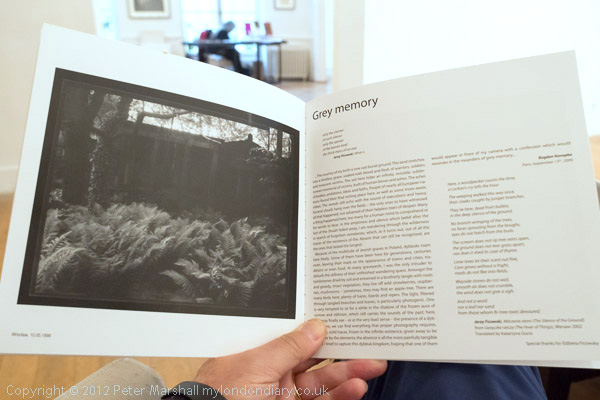
I read one of the several books by Konopka at the show

Born in Poland where he was a part of a movement known as ‘elementary photography’ which led him to use a large format camera (mainly I think 4×5″) and work with low contrast heavily printed contact prints as a reaction to the then prevalent style of working, which favoured gritty high contrast and greatly enlarged photojournalistic images. He move to France in 1989.

The images on show demonstrated his approach, small and darkly printed with very little in the highlight area, they had an unusual depth and shadow separation that prevented them from being dull or gloomy.  There were also copies of several of his books, and a comfortable sofa on which to sit and browse through them, so much that I perhaps neglected some of the other work on show which, at a fairly brief encounter failed to arouse my interest.

There is a good selection of work by Konopka on his Candace Dwan gallery page, although unfortunately the reproduction there seems a little unsharp and fails to do the work justice.

© 2012, Peter Marshall
A wall on a street in the 3e

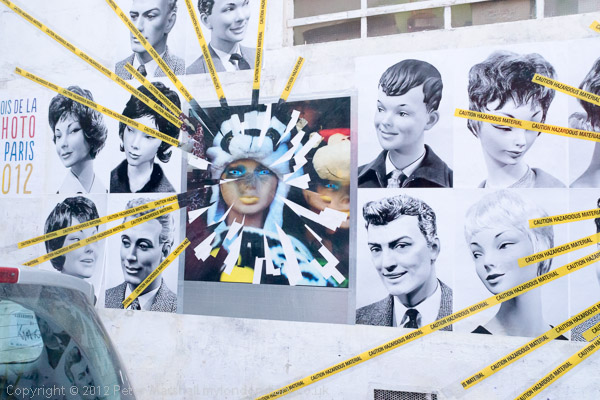
We walked rather briskly down to the Institut Suédois for a quick look at the show Different Distances, showing the work of a new generation of Swedish fashion photographers whose work has a free interpretation of fashion and is also fine art photography. Or so I think the exhibition description said, though to me it all looked rather ordinary. But by now I was really feeling quite ill, and although there were more shows I had meant to visit I had to give up and return to the hotel.
Continue reading The End of Paris

Paris – A Photo-Off Guided Tour

One of the really good things that happens during the the Mois de la Photo are the guided tours of shows in the Photo-Off fringe festival. Two years ago we went on one of the first of these and found it really interesting, so we looked at what was on offer this year.

The shows in the ‘Off’ booklet (you can download it to see) are divided into ten areas of Paris, so you can fairly easily plot your own route around them, although if you try it can be very frustrating with the various galleries having different opening days and hours and different exhibition dates. But for the organised ‘parcours guidée‘, although they can’t quite cover all the shows in each area, you can be sure not only that the galleries visited will be open, but that someone – either the photographer, curator or gallery owner – will talk about the work and you will have the chance to ask questions. Of course the talks are in French, but I’ve usually found I can ask questions and get answers in English, and with Linda I have the services of an interpreter where necessary when my O Level (Grade B, 1961 and more than half forgotten) fails, though I’m still better than her if things get photographically technical.

There are 10 ‘parcours’, and the guided tours all take place on Saturday afternoons, and there were only 4 Saturdays in November so the last took place on 1 Dec. But that still means you can only go to half of them as there are two each Saturday. I chose to go on Parcours 3 (Le Marais – Turenne) because it was going to end at the  NoFound Photo Fair which I wanted to see – and better still it included free entry.

© 2012, Peter Marshall
The courtyard opposite the Galerie Sophie Scheidecker

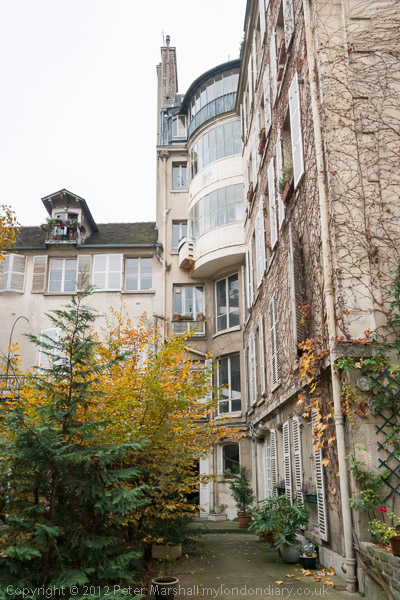
We met at Galerie Sophie Scheidecker, in a courtyard off the rue des Minimes at 2pm; the show there was Pubart, a show of advertising and publicity photography from the 1930s in the USA to recent work in France, and including quite a few interesting examples – such as one of Duffy’s images from the iconic Benson and Hedges campaign; most but not all of the work on show was photographic and included a few images I hadn’t seen before. But my main interest was in the actual venue and the other buildings surrounding the courtyard.

© 2012, Peter Marshall
Galerie Maria Lund

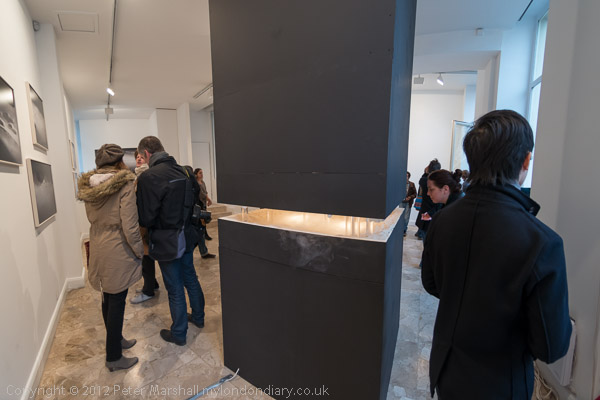
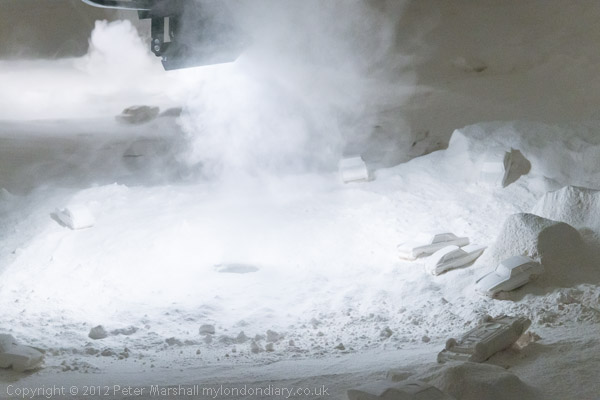
Our next stop was Galerie Maria Lund on the rue de Turenne where there was a rather curious installation by Kwang-Wha Chung, Here! I found my car with a large split box, the lower half having a modelled landscape covered with plaster dust in which were embedded small model cars. Jets of what looked like steam and seemed to be fairly random disturbed the white dust creating miniature snowstorms which revealed and covered up the cars. On the walls around were photographs taken looking into this changing scene. It didn’t seem to me to have a great deal to do with photography, although of course the photographs froze and recorded a moment in this changing artificial micro-scene.

© 2012, Peter Marshall
My own picture of those lost cars – and none are mine!

(Dés)Assemblages at Galerie ChipChop showed the work of three women photographers who in different ways produce images that are divorced from reality. Hélène Jayet combines overlapping exposures taken at different times and from a slightly different viewpoint on photographic film. Neta Dror from Israel sees the way she treats her images chemically to erase parts of them as some kind of antidote the the constant stream of news photographs flowing from her country.  Canadian Amy Friend doesn’t take her own photographs, but uses family pictures and other scenes from the early nineteenth century, staining or otherwise altering the paper and punching holes through it to let through light so that the object is given a new life. The series name ‘Dare alla Luce‘, literally Give the Light, reflects the dual meaning of the Italian which according to the gallery text also means “to give life” or rather give birth.

© 2012, Peter MarshallJérôme Tisné

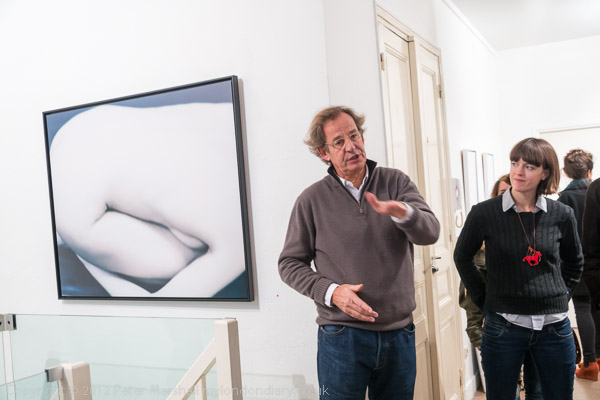
At La Galerie Pascal Gabert we saw Nus, large fairly abstract studio nude images made using north light on a 8×10 camera by Jérôme Tisné, who spoke at some length about these images. The large prints are almost all either nearly black all over or nearly white all over, using extremes of exposure – up to 20 minutes, combined with some deliberate movement of the camera and extended development of the Polaroid colour film. The dark images seemed to me to have rather more subtlety of tone and colour, while the very pale works the blue sometimes dominated. Tisné made these works as a deliberate contrast to his long and successful career in press and publicity photography, but while I found the technical aspects of interest (and I hope I got them roughly right despite my language problems) I didn’t find the works particularly interesting as images. There were echoes of classic works – such as the nudes of Edward Weston, but I didn’t feel that the images had the kind of presence of his work and felt that perhaps the technique had rather become an end in itself.

Next came Joël Denot at NeC nilsson and chiglien in the rue Vieille du Temple. His  work “concentrates on the medium’s fundamentals: colour and light” and indeed there is little else in these images with just a vague hint of the subject. The images seemed to me to be some kind of quasi-scientific inquiry into the properties of Cibachrome (Ilfochrome) or Polaroid, perhaps like the results which might (on a smaller scale) illustrate a laboratory notebook, or perhaps some kind of effort in reverse-engineering the process.  But in the main it wasn’t work I could relate to as art or as photography.

© 2012, Peter Marshall
Placement libre-atelier galerie
© 2012, Peter MarshallOur tour guide with Sandrine Maugein and her work
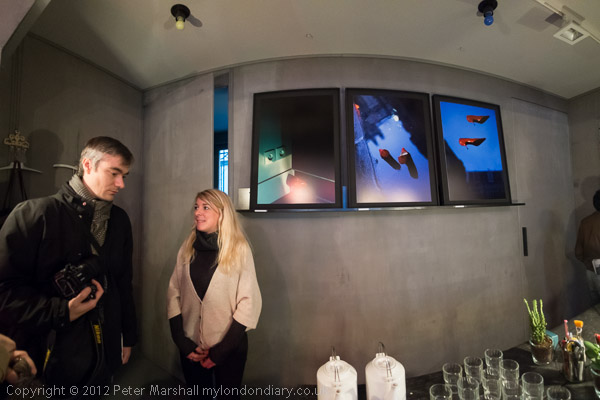
Our next stop was much more to my taste, and the glass of tea and slices of cake we were given by Sandrine Maugein were welcome icing on the photography. The Placement libre-atelier galerie had a welcoming atmosphere and the work was full of humour and insight and a strong graphic sense. Frohlein.sla femme invisible aux talons rouges” – the invisible woman in red heels – was certainly full of wit, if the message was at times certainly deliberately ambiguous. The red shoes certainly got around, and I think the statement like the pictures is full of plays on words and ideas.

Across the road Galerie LJ was like a small zoo, full of large animal sculptures, but it was the work in the basement we had come to see, Audur by Alix Marie, whose work combines performance and photography and unlike most such hybrids produces some interesting images.  Born in Paris in 1989, she studied in London at Central Saint Martins College Of Art. Audur was the result of a residency in Iceland and shows characteristic, almost picture postcard images of the country but with the artist herself intervening in the scene. I rather liked the square lighthouse with its red and white stripes and Marie standing on the stones of the beach with her head hidden by a white box with red stripes. Also on show was work from another residency in Slovenia, where she worked in a deserted building producing Les éléments du décor, using her body and simple wooden boxes and objects, with images that very much reflect her involvement in sculpture.

© 2012, Peter Marshall
In the NoFound Photo Fair

Finally we arrived at the NoFound photo fair in the large Garage Turenne, which brings together all sorts of people with a real interest in contemporary photography. Here there was far too much to write about it all, but there was certainly a great deal of interest in photography among everyone I met, even if we didn’t always share the same opinions.  Quite a lot of the work I didn’t find particularly interesting, but there was so much to see in the fairly short time I had that was just as well.

One particular set of work that stood out for me was by South African photographer Graeme Williams, whose essay ‘
Painting over the Present looks at the environments occupied by some of South Africa’s poorest people in small towns, townships and cities throughout South Africa. As he writes “although wealth and power have shifted hands since the first democratic elections in 1994, many of the benefits of these shifts have failed to filter down to grassroots level.

© 2012, Peter Marshall

Too soon it was time for us to leave as we had arranged to go out for dinner though I did take a few pictures as we made our way towards our meeting place.

Continue reading Paris – A Photo-Off Guided Tour

Paris – Saturday morning

© 2012, Peter Marshall
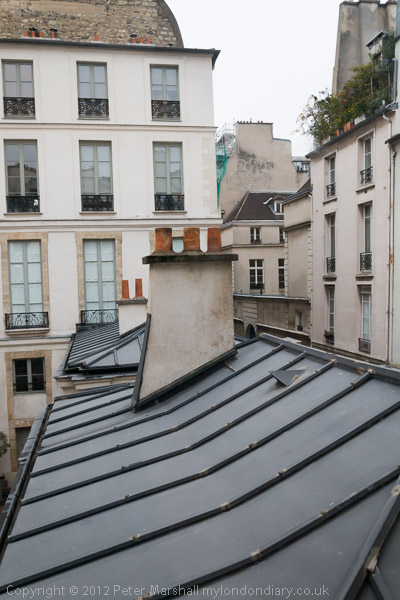
View from window of the Galerie Karsten Greve, Paris

One of shows open early (from 10am) on Saturday morning was Ilse Bing at Galerie Karsten Greve in rue Debellyme in the 3e. We had plenty of time after breakfast so decided to walk most of the way there from the edge of the 3e and on our way there we peeped through the large glass windows of a small gallery showing the work of Boris Mikhlailov; I decided it was probably not worth trying to come back to see it later when the gallery was open.

I found the Ilse Bing show a little disappointing. Not that the work was bad, but that there was really nothing that added at all to what I already knew of her work.  Born in 1899, she abandoned her studies as an architect to become a photographer in 1928. She was one of the first to buy a Leica in 1929, and according to the information at the show introduced many other photographers in Paris to the camera. Apart from a few early images from Frankfurt her work is typical of the work of modernist photographers of the era. The pictures were mainly from her time in Paris, where she came in 1930, leaving for America in 1941 after having been interned in 1940 as an enemy alien. You can see a rather more varied collection of her work on Luminous Lint, where there is also a more detailed biography.

When I first came to Paris, much of the area around here was pretty run down, but now it is stuffed with galleries and design workshops, and although we were too early for some of them, and others were closed on Saturdays, there were still plenty to look into, and too many to remember.

© 2012, Peter Marshall
Louis Stettner hanging in the small Galerie David Guiraud

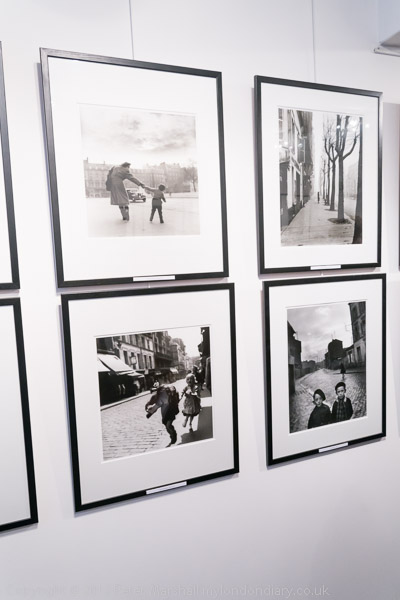
One which was closed then, but which I was able to come back to for a quick look in the afternoon was Galerie David Guiraud in the rue du Perche showing Les Chefs-d’œuvre (the Masterpieces) of Louis Stettner. Some years ago I wrote about his work and in particular the fine images he made in Paris in the immediate post-war years. Although there were a few great pictures made after his return to American (and you can see a great deal of his work on his web site), it was clear from this show that this early period remained by far his most productive. There were two pictures showing a couple of children on the street hanging next to each other; the better known perhaps gives them something of an alien quality, and I prefer the immense vitality of the other image.

© 2012, Peter Marshall
A private back street in the centre of Paris

At the end of the rue du Perche La Galerie Particulière has premises on both sides of the street. The smaller was showing work by Michael Wolf but the larger hall on the other side was devoted to the work of Todd Hido, The enchanted realm (on show until 16 Jan 2013.) Hido, born in 1968 in Kent, Ohio, drives around America, and when he sees something that takes his fancy (and mostly this seems to happen on the edges of small towns) and takes pictures of desolate rows of houses, often in fairly dramatic light and other perhaps rather clichéd subjects. Some of the pictures are perhaps more about the weather, as he often seems to find the light he likes just after a brief storm and sometimes takes his pictures through a rain-spattered windscreen. Although I actually like the work, I don’t see it as anything particularly special, and certainly not something I would spend large amounts of money on or indeed hang on my walls. But perhaps I might occasionally take a look at a book of his work.

© 2012, Peter Marshall
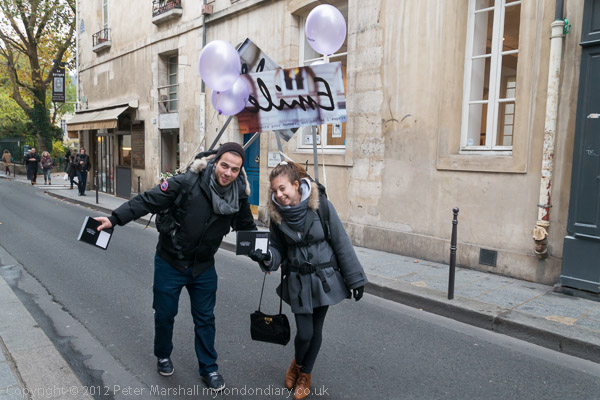
We met a couple with balloons our way to the Polka Galerie

From there we made our way east to the rue St Gilles for a show by Daido Moryami at the Polka Galerie, with large (perhaps too large) prints of 30 previously unpublished images from his stay in Paris from 1988-90. They had a kind of shock value with their lack of mid-tones and subtlety, but also a different outlook that gave them some excitement, although I think his best work is from Japan. The high-contrast look was taken even further with the giant silkscreen prints that were on display in the office building in the courtyard behind the front gallery, and I felt these were perhaps too crude, at least when seen close to. Silk screen is of course essentially high contrast – you either print ink or you don’t (although using halftone screens can produce the illusion of continuous tone) and Moriyama obviously relished the opportunity this gave him. The silk screens remain on view until 12 Jan 2013.

© 2012, Peter Marshall

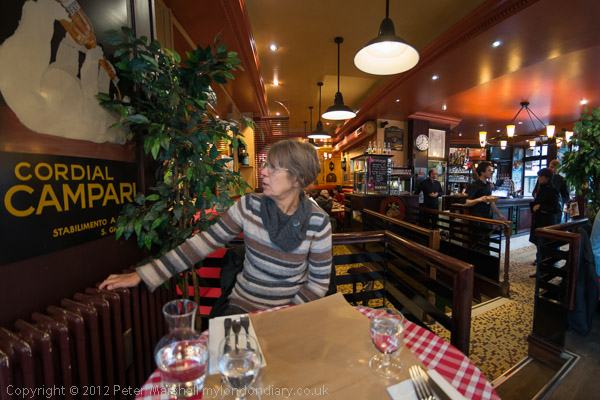
It was time for an early lunch before the tour we were joining in the afternoon, and we found a bistro on the Boulevard Beaumarchais. Linda rushed to a table beside a radiator to warm herself up.

© 2012, Peter Marshall
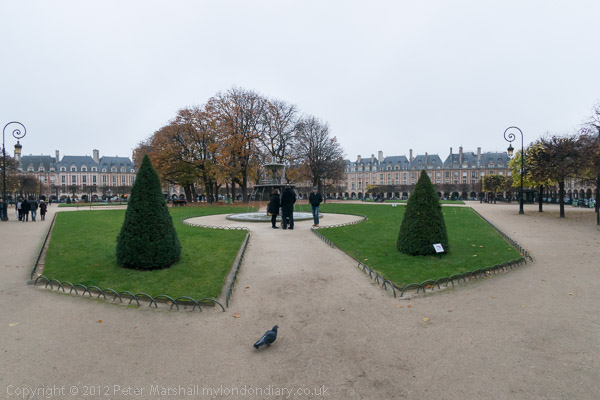
Place des Vosges
After our meal I sat in the Place des Vosges and logged on using the Paris free wifi there to read my e-mail, while Linda walked round the square. Unfortunately there still don’t seem to be many places with free wi-fi in Paris – much less then in London, and although my BT account lets me use the Fon network, there seem to be very few sites and when I found one it there appeared to be no way to log in without paying. Neither the BT or Fon websites give any help on how to use the networks abroad. But I was really too busy to spend much time on the Internet anyway.

Continue reading Paris – Saturday morning

Paris – More Photo Off openings

There were I think nine shows with “vernissages” on Thursday evening and I’d sat down the previous night and worked out a complicated route to visit half a dozen of them, finding short cuts on the complex system of routes which make up the metro system. But in the end I only made it to three.

© 2012, Peter Marshall

Thanks to my seeing so many shows in the afternoon, we got off to a late start, rushing to the station and just missing a train. Of course they are so frequent this shouldn’t had been a problem, but although the next arrived three minutes later and we got on it, it moved no further. There were announcements, but none gave any idea of how long the hold-up was likely to last, and after ten minutes we decided to jump off and walk to the first show.

© 2012, Peter Marshall
Work by 3 of the 5 photographers at Lieu37

Lieux de passage (Crossing Points) at  Lieu37 in the rue des Petites Ecuries in the 10e was a group show with 5 photographers, three of them professionals and two amateurs, photojournalist Christophe Lepetit, artist and director Frédéric Lemaitre, Grégoire Vopel, Jay Lag, and neurologist Yves Samson. It was, as the programme promised a deliberately eclectic show, and included some strange revolving triangular blocks with images on the three sides, as well as some highly enlarged i-phone images, which I felt would have looked better very much smaller, perhaps around postcard size. And although I couldn’t imagine ever hanging one of the images on a wall, I could see them selling well as cards for sending notes. The most interesting work to me was the blurred images of empty corridors and similar scenes, one of which is on the show site (image 9) but there are no details available there about it, and I seem to have lost the information I had about this set of work.

It was hard to get Linda away from the gallery and on to the appropriate metro station to take us to the next venue, Galerie Goutte de Terre on the rue Godefroy Cavaignac in the 11e, where the show was Krung Thep: la cité des anges, photographs by Pierre Raimond of street children in Bangkok (its Thai name Krung Thep means ‘city of angels’.)  The photographer was accidentally invited into the world of street children in the city and produced some powerful portraits of them. After phtoographing them for some time he was refused permission to continue his work, but the children themselves were happy to have their pictures taken but with their faces hidden, and these images were among the most striking in the show. These were images that engaged me powerfully, and was one of the more interesting shows I found in those I saw in the fringe festival.

From here it was a fairly short walk to the next opening, A stone never dreams / Une pierre ne rêve pas at Le 19 in rue Trousseau (also in the 11e.) Franz Manni, born in Italy in 1973, has worked as an anthropologist in a Paris museum since 2000 as well as as a  photographer, and perhaps because of his work has excluded people from these photographs, which look instead at structures and patterns formed in nature by human interventions. There was a strange quality to his images of patterns in water flowing over a weir or piles of materials by walls that intrigued me, though I find it hard to put into words why. These are certainly highly metaphoric images which Manni calls a way of reclaiming our dreams. In the gallery along with the pictures were some poems from the book Land of Stone by the American writer Karen Chase, in which Manni says he found the same spirit as his images, and one of which provided the title for his show:

I am a stone / a stone is good / it sits on a field / it never worries / it never dreams /

The poems in this book resulted from two years of weekly meetings with a severely withdrawn patient, in a locked ward of a large psychiatric hospital outside New York. Ben had given up speaking and social interactions and as therapy she engaged him in creating poetry. They would pass a writing pad to each other, taking turns in writing a line, engaging in a struggle for him to come out of his silence. There is perhaps something of a similar struggle evident in these pictures.

By this time the three openings had begun to take their toll (it would have seemed impolite not to have a glass or two of wine while looking at the pictures), and Linda had left me to go to a lecture and concert. I took the metro to go to the next show on my list, but when I got to the address could find nothing, not even a gallery and certainly no show. Probably I had gone to the wrong place, but I never found out.

© 2012, Peter Marshall

I took a few pictures walking the night streets, which although dark should have been possible at ISO 3200, but few if any were sharp. My problem was the 20mm not focussing correctly. Although it is an f2.8 lens it seems to have a problem in lowish light on the D800E, though I’d not really noticed before using it on the D700. On autofocus it hunts very noisily noisily and excessively for focus at times; I’d noticed this particulary when photographing pictures at Paris Photo, when it often entirely failed to focus when I put a focus point on the picture frame (which I thought should make its job easy), but was usually better on the edge of the image. So much of the time I’d given up using it on autofocus, using scale focus and expecting the depth of field to cover any inaccuracy. But at night the focus scale gets difficult to use (its not much in good light) and it’s also very easy to alter the focus without meaning to. Especially after a few drinks.

I stood on the street outside where I thought the gallery should be wondering where to go next, whether to spend longer trying to find the show or perhaps to go on to the next. It was perhaps getting a little late to go on to the next venue and I was hungry and tired and decided that this was perhaps a sign to me that I should go and eat and then rest.

Continue reading Paris – More Photo Off openings

Paris – Menilmontant

© 2012, Peter Marshall

We took the Metro for the next show, but Ménilmontant is perhaps an unusual area of Paris, a large slab without a Metro station, though they ring around its edges, perhaps connected with its hilly nature. But I was pleased to have to walk up from Gambetta to the rue de Ménilmontant, as the 20e is one of my favourite areas of the city, although I didn’t have the time to wander as much as I would like.

© 2012, Peter Marshall

It was a little hard to find the show we were looking for in the Pavillon Carré de Baudoin, though of course if you know it, then it’s impossible to miss, an impressive building, the only Palladian building in the area, built on a grand scale in several stages in the middle of the eighteenth century as a folly devoted to festivals and pleasures of the rich, and in 1770 it was given an impressive portico with four ionic columns. In the nineteenth century it became an orphanage run by the Sisters of Charity of Saint Vincent de Paul, and later they ran it as a young workers hostel and health centre. In 2003 it was bought by the City of Paris on behalf of the Mairie of the 20e who opened it as an arts centre for the community with a national and international presence in 2007.

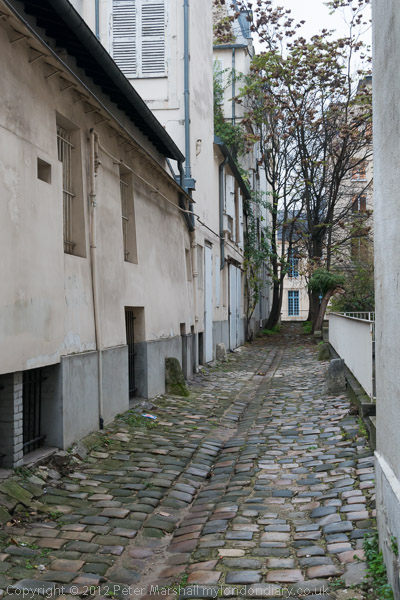
But there was only a small notice by the gate telling us about the show which we missed at first as we walked along the street trying to find number 121, and it was another couple of hundred yards down the street that we found a building with a number on it and realised we had missed our way. But before we retraced our steps we were attracted by a short and picturesque street, the Cité de l’Ermitage, and went down this cul-de-sac to have a look.

© 2012, Peter Marshall

Guillaume Herbaut‘s show in the Pavillon Carré was overwhelming. It began quietly with a room containing Les Portes de Pripiat (2010), straight-on images of the doors of abandoned homes in blocks of flats in the city 3 kilometres from Chernobyl, showing perhaps the only remaining traces of the 30,000 people who had lived there. In the darkness of the next room was a showing of images from La Zone (2009-2011), Herbaut’s much acclaimed work in the forbidden area around Chernobyl 25 years after the disaster, and up the several flights of stairs was a room with some of these same images on the wall.

© 2012, Peter Marshall
Staircase in the Pavillon Carré de Baudoin

But the final part of the show had an intensity that is difficult to describe. 7/7 is a series of essays, a total of 95 images with short captions in seven stories that deal with some of the horrors of our civilisation and in particular with the effects that these have on environments and people: Vengeance killings under medieval codes of honour in north Albania; Oswiecim – the site of the extermination camp Auschwitz; Chernobyl again with the replacement town of Slavoutich – also declared contaminated in 2001, the survivors from Nagasaki, the second city to be devasted by an atomic Bomb, two days after Hiroshima; Ciudad Juárez, Mexico in 2007, one of the centres of the drug cartels, where more than 400 women have been murdered in atrocities since 1993.

There was a powerful atmosphere in the darkened room as people moved silently from image to image around the three sides of the large space. Some of the images were harrowing, but perhaps the most difficult were those that looked, at least in most respects so ordinary, so normal and even at times so beautiful.

If you read a little French it’s worth downloading the Press dossier from the Mairie site about the show, and it has a few images, though you can see more in the portfolio on Herbaut’s web site.

The show continues until 5 January, and is one that you should make time to see if you go to Paris. Herbaut, born in 1970 was one of the founders of the collective L’œil Public and has won various awards for his work. You can also see several videos, including one on the Zone from the links on his site.

© 2012, Peter Marshall

I was still rather stunned when we came out on the street. It was a pleasant way to relax a little by taking a stroll down the Villa de l’Ermitage, often described as a haven of peace in the middle of the city, full of greenery. I’ve photographed it several times before on previous visits.

© 2012, Peter Marshall

From there we continued along some of my (and Willy Ronis‘s) favourite streets to the  Bar Floréal, not a bar but another photography collective, founded in 1985 by three photographers as a studio, gallery and lab – and over the years the three have grown into a dozen.

© 2012, Peter Marshall

Showing in the gallery there was Night and Day, the fine jazz photography of Jean-Pierre Leloir (1931-2010). You can read an obituary in The Independent, and also visit the official web site of his work. This show is on until 16 Dec 2012, and is certainly worth seeing if the subject matter – which includes some of the giants of rock as well as jazz –  is of any interest to you, as it certainly was for me.

© 2012, Peter Marshall

It was getting dark as we left, and we took a brief look for some nearby shows that were a part of the Photo-Off, but saw rather little of them – it was getting late and it was time to go and prepare for our evening visits.

Continue reading Paris – Menilmontant