Lens Culture ‘New Blog’

I’m not quite sure how Jim Casper‘s “new LensCulture blog!” differs from the old one that has been so interesting and perceptive over the last ten years.  I rather hope the changes are not too great, since I’ve enjoyed and learnt from it greatly. Here’s what the opening post says:

Now in our 10th year, we’re expanding our scope and vision at LensCulture!

We hope to delight you, often, with inspiring posts about how people are using contemporary photography around the world — in art, media, politics, commerce, propaganda and popular culture. Join us, and participate in our bold new vision to connect photographers and photography lovers via one great, dynamic platform.

Cheers, and please let us know what you think.”

Lens Culture has been a valuable resource for those interested in photography. Recent posts include Rene Burri talking about his career and talking about six of his best-known photographs and currently on the ‘newest’ page of the site you can see work by the “21 New & Emerging Photographers from Lens Culture“, most of whom are worth a look. Of course Lens Culture is not the only place where you can see such lists, but I think perhaps the most interesting, and with more truly ‘new’ photographers than some.

Of course I don’t find everything on the site of interest – it sets out to cover the whole of contemporary photography, even those parts I find rather trivial and boring!  But it’s great to have sites like this. When I started writing on the web around fifteen years ago, there was relatively little photography on the web, and what there was was largely amateur illustration or commercial advertising. Things have changed dramatically since then.

Nam June Paik


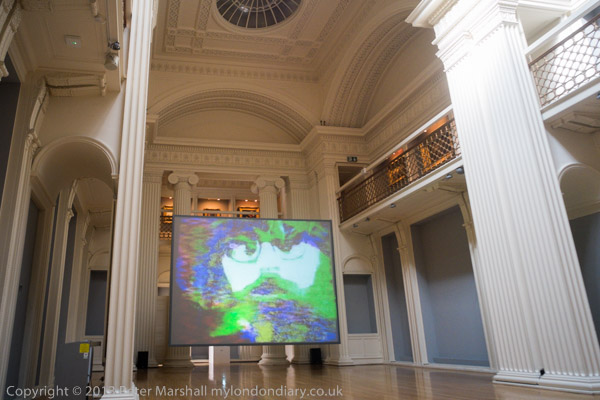
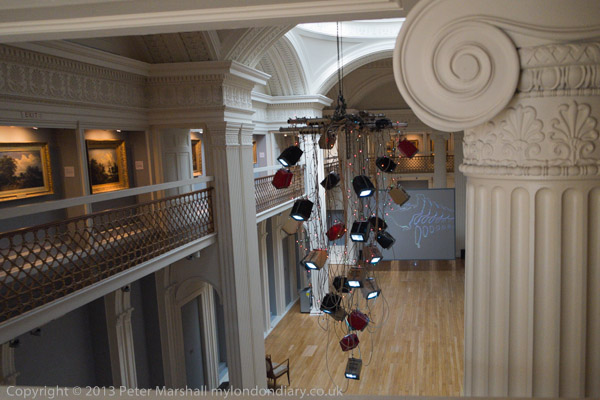
Video Chandelier No 1, 1989 and Global Groove video in the Talbot Rice Gallery

I’m generally not a great fan of video art, which seems to largely be a medium for inflicting terminal boredom on the viewer, usually saying very little at great length, sometimes taking 15 minutes to say what could have been summed up more elegantly in a single still image or perhaps a diptych or short series. But of course there are exceptions.

The Edinburgh Festival and its huge fringe isn’t a great place for the visual arts, and certainly not for photography shows. There is the Man Ray show already seen in London, and World Press Photo 2013, which doesn’t seem to be scheduled for London (though one year never seems greatly different from the last.) And the venerable International Exhibition of Photography organised by the Edinburgh Photographic Society, now in its 151st year – and I can’t help thinking the first 50 or so would still be of much greater interest.


Ginsberg (I think) in Global Groove, 1973 showing in the Talbot Rice Gallery

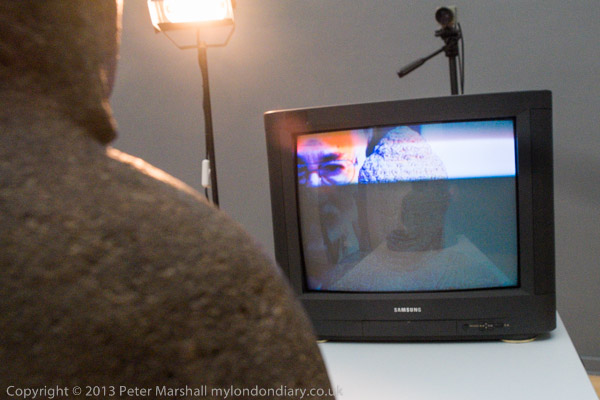
But one show that is certainly worth a at least a short detour and continues until Oct 19, 2013 is Transmitted Live: Nam June Paik Resounds, which celebrates the 50th anniversary of Paik’s first solo exhibition, Exposition of Music –Electronic Television  at Wuppertal in 1963.  He was really the guy who invented video and electronic art, and the 26 minutes of his Global Grove from 1973 demonstrates the effect his work has had since then (you can watch the first three minutes on YouTube) and still I think stretches it in ways that others have not – and he was thinking in terms of the ‘electronic super highway‘ back in the pre-internet days of the 1970s. Among his collaborators were Stockhausen, Cage and Ginsberg.


I take a close look at TV Buddha, 1974 in the Talbot Rice Gallery

The Edinburgh show doesn’t have some of the larger works you can see on a BBC web page about his Smthsonian show, but is a finely curated show which celebrated the 50th anniversary of his first solo show at Wuppertal in 1963.  His official web page, which seems to have been left unchanged after listing the tributes to his death in 2006, is also worth a visit.

The Edinburgh show will also have great appeal for connoisseurs of outdated TV and video equipment and included a largish studio area of such junk as well as that in the actual works. If we sometimes feel that the archival preservation of photographic works is a challenge, the problems surrounding his work are massive.

OMG Life But Not a Camera as we know it.

The name of the ‘OMG Life Autographer‘ is probably a pretty good sign that I am not the target audience for this device, decribed as ‘The World’s First Intelligent, Wearable Camera”, but it does look in some ways an intriguing device, though the images taken by Rankin on its web site really do less than nothing to make it appeal to me.

It seems to be a device to produce a photographic record of your day without the actual thought or effort of making photographs. It isn’t the first device that can do this, and I seem to recall artists who experimented wearing cameras set to take pictures at regular intervals way back in the days of film. And helmet cameras have really made such things commonplace. But the ‘OLA’ is at least rather less painful than ‘The Third I’ which involved New York University photography professor Wafaa Bilal having a 10Mp camera screwed into a “transdermal implant” on the back of his head and wearing it for a year (you can see some of the results on the web, and they are frankly exactly as interesting as you would expect.)

But Autographer claims to be intelligent, though it isn’t clear exactly what this intelligence entails, it does incorporate six sensors, including a PIR sensor which I think detects movement in front of the camera, as well an accelerometer which determines the wearer’s movement, and temperature, colour and compass sensors. It also keeps track of where you with GPS. But there are no clues on the web site as to how it uses any of this information to decide when to take pictures.

The images Autographer produces are 5Mp semi-fisheye, with a 136 degree angle of view, and are about as good as you would expect – this isn’t a camera for those concerned with image quality. There is an excellent  Quick Review on Digital Photography Review which has some sample images from London and gives a fairly detailed look at the device.

The image distortion is interesting, and is different from that of the two semi-fisheye lenses I own, the Nikon 10.5mm and Samyang 8mm. I removed the curvature at the edges by using the FisheyeHemi plugin in Photoshop by increasing the canvas width from 2592 pixels to 3592 (giving a rectangle on each side 500px wide in the background colour), then applying the  ‘full-frame’ version of the plugin before cropping back to an image rectangle, now around 2472 x 1936 pixels. With some noise reduction, correction of contrast and brightness and light sharpening, the images when reduced to web size –  perhaps  around 600×450 px, are just about acceptable quality. But I guess for most potential users, bad will be better, and they won’t be satisfied with the output until it’s been further freaked with Instagram.

Although usually it takes pictures without human intervention, you can tell it that you want it to be ‘active’, though apparently it waits for 10 seconds before it starts to take pictures when you’ve pressed the button. And you can stop it taking pictures by covering the lens with the bright yellow rotating lens cap. It is small, weighs around 2 ounces and is said to be stylish, which I think means black with a leather strap. Certainly you would feel less of an oddity wearing it around your neck or clipped to a jacket than wearing a helmet camera in normal situations.

Perhaps the most interesting thing on the web site is a whole page of Autography Etiquette, including advice to get the agreement of friends and family, to follow laws on photography and to respect the privacy of others. Though I suspect the most interesting images will come from people who ignore this!

Given that its 8Gb of memory can store 28,000 pictures, users are likely to have an awful lot of editing to do, and I suspect we will be inundated by masses of largely random images on Facebook, Flickr and other social media and image-sharing sites. It rather reminds me o those millions of monkeys randomly typing to produce the works of Shakespeare. One could see it as those Lomography walls taken to a logical conclusion. Of course just a few of Autographer images will have some interest but I doubt we will ever see them found from the haystack.

Frederick Sommer

I meant to write earlier about a show that closes today, though since it was showing at the US National Gallery of Art, Washington, probably few of us would have gone to see it had I posted in time. Though of course I’m sure all of my readers within easy distance of the NGA will already have seen it.

The NGA has a long history of fine big shows of photography (and another on Charles Marville coming up at the end of September 2013, followed in March 2014 by the Winogrand show from San Francisco) but A World of Bonds: Frederick Sommer’s Photography and Friendships was one of its smaller offerings, a mere “twenty-seven photographs, prints, collages, and drawings” in one room and

Frederick Sommer (1905-1999) had some interesting friends, including Edward Weston, Max Ernst, Man Ray, Charles Sheeler and Aaron Siskind and had a philosophy that very much valued the sharing of ideas, and you can see something of the influences of his friends in some of his work, and of his ideas in theirs, in particular in some  works by Weston and Siskind.

The Art Blart review perhaps best gives a flavour of the show, with some comments by a photographer who visited Sommer as well as the author’s own comments, as well as some fine reproductions of images courtesy of the NGA. For something of a different opinion you can read a review of the show in the Washington City Paper. You can also see thumbnails of 59 of his works on the NGA site, though clicking to see a larger version of any seems to return an ‘image not available’ page. To see more of his work on the web the Frederick & Frances Sommer Foundation is the obvious place to go, and although the Catalogue Raisonne is still under construction it has many of his photographs already in place.

Many years ago, it was one of Sommer’s 1943 Arizona landscapes that came as a revelation to me (was it perhaps in the 1975 show at the Victoria and Albert Museum curated by Bill Brandt with Mark Haworth-Booth, ‘The Land’ – if not it surely should have been, though it was much later that Sommer gave them some images for their collection.) It made me aware of new possibilities in the photographic print and in creating a powerful image from seemingly highly detailed nothing much spread from corner to corner across the picture. It seemed to me a work that transcended conventional ideas about subject, foreground, background in favour of the whole field of view. I didn’t rush out and buy an 8×10 (or make much if any more use of the two 4×5 cameras I owned) but I think it did change the way I felt both about composition and about printing.

Later I read in Darkroom 2 (published by Lustrum Press  in 1978) about Sommer’s printing method using a ‘contour printing pack‘ , with a fine example by Emmet Gowin, Siena, Italy, 1975 Dedicated to Frederick Sommer: The Hint That is a Garden.’ Fortunately it was a book that sold fairly well at the time and is still available (along with the first volume Darkroom) second-hand at a sensible price for anyone who wants to know more about what is now largely a historic practice.

Sommer’s other work perhaps interests me less, though when I see so much of the more recent constructed art photography in galleries and publications I do so often think Sommer did it so much better years ago.

Dead End Bum Wiping

Two articles among many that relate to the future of photojournalism and documentary photography that I’ve come across in the past couple of weeks are David Hoffman‘s Dead End Streets: Photography, Protest and Social Control  and a series of questions by Charlie Campbell to the legendary Vietnam photographer Tim Page for Time World.

Tim Page’s Wikipedia entry makes interesting reading, and most of the legends about him appear to be true. His own web site contains some interesting work and together with Horst Faas he edited REQUIEM, a book and exhibition which is a memorial to the photographers who died covering conflict in Vietnam and Indochina.

Page, born in Tunbridge Wells in 1944, left England at the age of 18 to drive overland through Europe the Middle East and Asia, running out of money in Laos. He got a job with USAID and taught himself photography, becoming a stringer for  UPI and AFP.  In the Time feature, Campbell says to him

I’ve heard you comparing a degree in photography with a degree in “bum wiping.” Any advice for budding snappers out there?

Page’s answer is typically to the point:

Don’t. Being a photojournalist now is the most fraught way of making a living. I’m no longer involved in the news, but I do other type of work. To make a living as a photographer these days is impossible. I was there the other day, and there were 100 people with cameras, video cameras and iPhones. And where are you going to sell the pictures?

Hoffman‘s essay is closely thought out and more difficult to read, looking at how the changes in media have both reduced the impact of still photographs and the ability of photographers to make a living from photographing social issues.  As he says

When I began working as a photographer a single publication fee would keep me for a week.  Now it keeps me for perhaps three hours.

Photographers now have to make several saleable images a day to make a living (I think the number is rather higher than he suggests) and no longer have time to study issues seriously and work in depth.  What perhaps he doesn’t stress enough is the influence on the nature of images that ‘saleable’ implies.

He looks briefly at the promise of democratic access of Indymedia and Demotix, two very different organisations which enable at least a limited publication of work but he says fail to allow “contributors a role in shaping the audience and the context in which the work is presented.”  While agreeing with much of his criticisms, they are surely even more true of the traditional media, with both Indymedia and Demotix allowing contributors considerably more creative freedom – the only reason I still contribute through Demotix. And, as he says “open access agencies such as these that are providing the last remaining life support for independent street photographers.” Though it’s not much of a support.

Demotix is part of Corbis, which gives some of the pictures from it a wider circulation, but in general he is correct that “neither has much of an audience.”  Work posted to my own web site or on this blog generally gets seen by perhaps five or ten times as many people as on Demotix. Some pictures from Demotix get published around the world in traditional media, and I think it has had a rather more important role for many photographers around the world who don’t have even the rather slim opportunities that remain here.

The final section of the essay is about “the forces of the state subverting and hijacking the reportage photographer with a variety of tools and techniques” and is his usual penetrating analysis of the situation, particularly as regards the police.  He also talks about the mistrust of photographers by protesters, including examples from both Climate Camp and the 2010 student protests, though surprising omitting mention of the right-wing ‘fatwas’ and violence directed at us (and I’ve been attacked at protests by people who thought I was David Hoffman, as well as others who know who I am, and been with David when we have both been subjected to threats and abuse.) But I imagine he takes that for read. It isn’t a new phenomenon for someone who was a photographer for Searchlight.

His is a piece that ends with a gloomy conclusion, and one it is difficult not to share. He writes:

Whether or not the kind of documentary photography in which I have been involved will still exist in the future is not clear…  The ecosystem that once maintained those creating socially relevant work is all but gone and it’s far from clear what, if any, new support mechanisms might take its place.  

Photojournalists are an endangered species, their numbers shrinking, and once extinct they cannot be replaced.

It’s hard in a fairly short post to give a fair summary of a long and detailed presentation such as this, and I hope not to have greatly misrepresented his opinions. It is a piece worth reading and thinking about, illustrated with some of his fine images. You can see more on his web site.


Independence Day

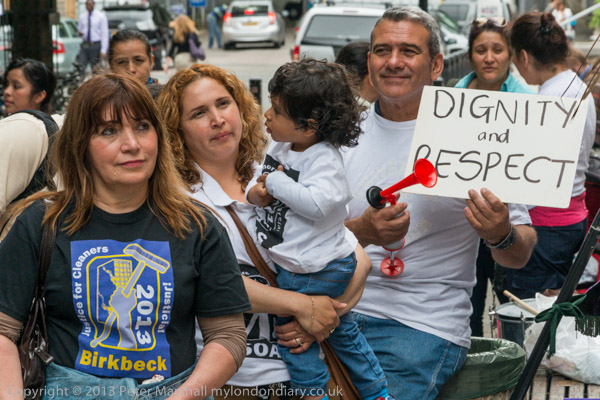
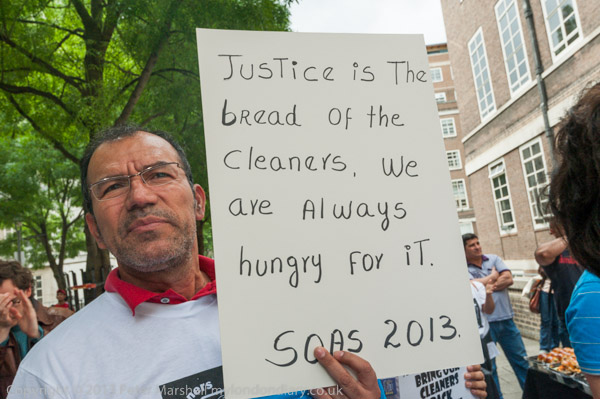
July has finally arrived for My London Diary, after some delays due to computer problems and pressure of work. I’ve already posted a couple of times about my visit to Hackney for a book launch, so the first new event in the month was SOAS Cleaners’ Independence Day at the University of London.  It was a fairly large protest for what is a relatively small institution, with a good crowd around the steps leading to the main entrance, but there wasn’t really a great deal to photograph, simply a crowd with various speakers, banners and placards.

The cleaners at SOAS get support from the students and academic and non-academic staff, with a long-running campaign for them to be directly employed by SOAS. There seems to be a very clear conflict between the principles and ethos of SOAS as an institution and the dubious employment practices involved in outsourcing work which is vital to the running of the place.

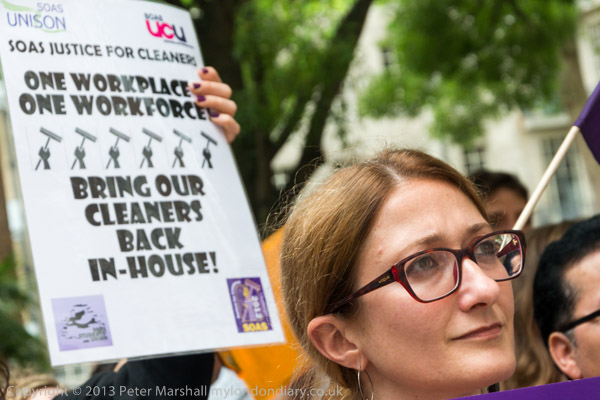
The slogan at SOAS is ‘One Workplace – One Workforce’, and the principle is that those who work there should all be treated with dignity and respect – not cheated over sick pay, pensions and holiday pay by employing them through a contractor.

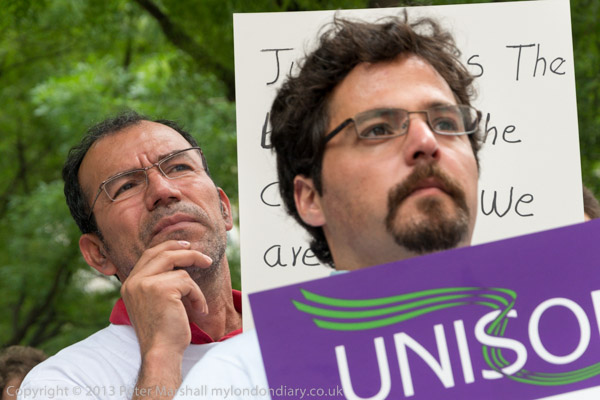
My pictures are mainly about the people taking part and their placards, and there were plenty of both to add some interest. The one above had an interesting message, but a slight difference in viewpoint presented a visually more interesting picture, but one that provided me with a dilemma. Here are the two versions of it that I produced within seconds of each other:


Right face sharp


Left face sharp

Both images were taken using an equivalent focal length of 147mm in DX mode on the D800E, and at ISO800 the exposure was 1/200 f7.1. With a long telephoto like this there was insufficient depth of field to get both faces sharp – I had to choose one or the other (though with these rather small images the difference is less obvious.) At the time I couldn’t decide which was better, so I took both. But I still can’t decide.

I could perhaps have tried increasing the ISO, giving myself a couple of stops more at ISO 3200, but even then I don’t think both could have been sharp. The image with the sharp face at left ends up probably as my choice, both because it somehow reads better from left to right going from sharp to unsharp and because the gesture with the hand makes that face more interesting. In favour of the other image, having the ‘Unison’ on the poster sharp (and more complete) is a plus.

Of course it would not be too difficult to combine the two images in Photoshop (despite a small difference in viewpoint and framing) and get both men sharp, but I think that would certainly be cheating if I did it as an afterthought. But perhaps if it was implemented in camera it would feel acceptable, but having done a quick job with a quick select, copy and paste, the result is actually less powerful without the differential focus.


Composite image to get both faces sharp – which I wouldn’t use

Focus stacking (or focus bracketing) at the moment for Nikons is so far as I’m aware limited to using specialised software with the camera tethered to a computer, and its obvious applications are for macro work. Canon DSLRs can use the cracked ‘Magic Lantern’ firmware. Getting it to work with the camera off-tripod even for relatively static subjects such as this would be tricky, and perhaps the occasions where it would be of use would not justify the effort.

You can see the rest of the pictures from the protest at SOAS Cleaners’ Independence Day.

________________________________________________________

My London Diary : Buildings of London : River Lea/Lee Valley : London’s Industrial Heritage

All photographs on this and my other sites, unless otherwise stated are by Peter Marshall and are available for reproduction or can be bought as prints.

To order prints or reproduce images

________________________________________________________

Photo Reviews

Ignacio Evangelista is a Spanish photographer with a degree in Psychology whose work you can see on the Turn On Art web site in his 2013 project After Schengen which shows some of the border crossings in the EU that were abandoned in 1995 when the Schengen treaty brough free movement of people and goods across much of the EU.  It’s a nice idea, which got him the 2013 Project Development Grant from CENTER in New Mexico, though I can’t get very excited about the large format images as they are presented on screen – perhaps they look rather better for real.

But what brought me to Turn on Art was not his photography, but a feature written by Evangelista, Are photo reviews a good investment? in which he writes about the growing number of portfolio review events for photographers and proposes “to edit a guide based on Portfolio Reviewers, such as hotels or restaurants guides, with scores marked by coloured stars and users’ comments.” (Thanks to Alan Griffiths of Luminous Lint for bringing it to my attention on Facebook.)

The feature gives a good description of what these reviews are and of the costs and possible benefits they bring to photographers.  I’ve never attended one as a photographer, but back in the days when I wrote for a slightly more popular and influential web site than >Re:PHOTO (it had perhaps six times the readership here, though of course what matters is really quality!) I was invited to attend just one as a reviewer. You can read a whole series of posts about the event and some of the better photographers that brought there work to show me, starting with Rhubarb Rhubarb: Three Canons.

We reviewers certainly had a great time, and for a few of the photographers it was an important stepping-stone in their careers, with several exhibitions and at least a couple of books coming out of the event. But I was left wondering whether I would go to such an event – and from what I’ve heard this was one of the best – as a photographer.

Back in olden times, when I was beginning my active fascination with the medium there were no such things, but I did find it very helpful to show my work to other photographers and to talk with them about it. I went to a number of photographic workshops run by photographers who I admired, quite a few just days or afternoons, but some over a long weekend, where there would be sometimes very lengthy group crits, as well as often the opportunity to talk more over meals and at the pub. Most of them were relatively cheap events compared the the costs of attending a photo review, and in those days it was normal to just come along with a set of prints in an old Ilford box (and one of the most interesting of photographers who came to see me in Birmingham brought his 10×8 prints in an old Kodak box.)

There were also more informal events where photographers got together, and for some years I met monthly with a group of friends where we would bring our latest work, hot from the darkroom, to discuss, sometimes with a bluntness that you are unlikely to find at photo reviews. Among those who used to meet was Derek Ridgers, whose blog ‘The Ponytail Pontifications‘ gives a good idea of his style, though I think he has mellowed rather over the years (or perhaps fears legal action if he put some of his views in writing.) It wasn’t always an easy ride when you brought work, fools were sometimes not suffered gladly and some people never came a second time. Occasionally other better-known photographers would be invited along to show their work and to comment on ours, and we also organised a few shows, particularly under the title of ‘Framework’.

Groups a little like this still exist, including a number that I helped to start when I was on the committee of London Independent Photography, and I still occasionally attend one, although somehow it isn’t quite like the old days, when I think we were rather more inclined to call spades spades.

What both workshops and groups had in common where that the people who took part in them were all photographers. Sometimes well-known – I learnt a lot from meeting and showing my work to people like Raymond Moore, Paul Hill, John Blakemore, Lewis Baltz, Charles Harbutt, Fay Godwin, Ralph Gibson, Leonard Freed, Martin Parr and the others over the years, and from many who never became well-known.

Photo reviews are very different. Mostly those who review are not photographers (or at least not there as photographers) but those who have become the gatekeepers of our medium, running galleries, museum departments, photography festivals and photo reviews, publishing photo books and magazines and so on. I had been invited because I was then writing a photography blog and web site which was gaining a reputation around the world  – and around a million visits a month, mainly to read the fairly long weekly articles that I wrote about photographers or aspects of photography.

Some of those people are definitely very well informed on photography (though others are better informed on book-keeping), but I think that it is the opinions of photographers which should drive the medium. Sometimes the relationship between artists and curators etc can be symbiotic, but all too often it seems merely parasitic.

After getting the invitation and about 2 months before going to Rhubarb-Rhubarb, my long-running dispute with bosses over my determination to continue to write seriously about photography had come to a head, with the termination of my contract. (I wrote just a little about the problems at the time, for example here.) So to some extent I was there as a reviewer under false pretences, although I think I worked hard and gave good value, if not necessarily always pleasing the reviewees. And although my current sites don’t have quite the same visibility (or the backing of the New York Times), they – mainly >Re:PHOTO and My London Diary – are currently getting around 400,000 hits a month, almost now up to half the level the commercial site enjoyed. One big difference is that you had to struggle through the ads to see my stuff before, and of course little of what I put on line then was my own photography.  And of course those annoying ads then did more or less provide me with a living.

But back to photo reviews. Whereas the things we used to do were about developing ourselves as photographers, photo reviews are all about developing your careers.

Of course most of those attending – certainly in my experience – are not going to have much of a career in photography.  In most cases because there work lacks interest or novelty (more important these days.)  Just because a photographer is fascinated by staring at his/her navel does not mean the world will have any great interest in him/her. Some work is probably best kept to yourself, and I wish photographic education would give students a more realistic appraisal of their work, rather than rushing to sign up bodies to fill their courses. We are simply turning out far too many people with at least a certain technical facility (not that you need a great deal these days) but with little vision.

I saw some great photography at the review. It was easy to look at, to explore and to discuss with the photographers, who were keen to listen to what people thought. Others came along with work it was hard to find anything positive in, but were full of their own importance. There were some that I hardly had time to get a word in during our session together, they were so busy telling me how good their work was. Of course I tried to give them some guidance, but it wasn’t welcome. I imagine I got some fairly negative reviews from some of my reviewees, while some of the other reviewers who had suffered the same people told me they just sat there and nodded.

I’m sure photo reviews can be good at the right time for photographers. The right time is when you have good work too show and are prepared to listen to advice. You are then likely to get your money’s worth – and you just might be offered opportunities that would otherwise not come your way. Perhaps if such things had been around when  Vivian Maier was taking pictures and she had been able to afford to take her work there she might have got the odd publication or show, though I think we would have rather less hype about her work now!

Anyway, here is a little piece of advice I published on this site immediately after my experience as a reviewer to those who intend to take their work to such things. The third is a reference to the then current refuge of the apparently untalented and perhaps may by now have been replaced by something else that would get up my critical nose:

 Three Canons for Reviewees

  1. Be still, let your work speak and your reviewer think. Say only what is necessary.
  2. When making your pictures think for yourself; when preparing to present your work, think of your audience.
  3. Erase the word memory from your memory, your statements, your discourse. Let your work be memory, if so, then no one will need to be reminded.


Fuji at Scrap Trident

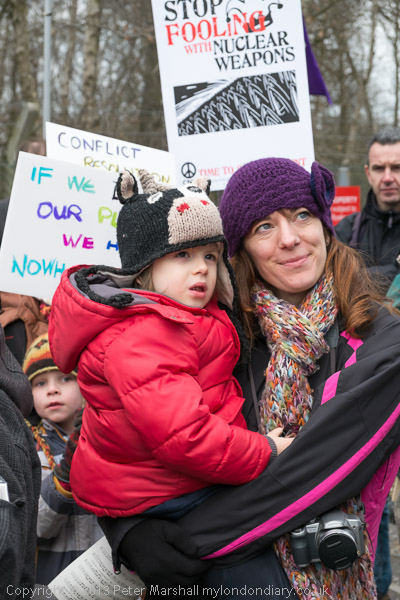
I decided to try out my new Fuji X cameras at the CND Aldermaston protest on April Fool’s Day – Nuclear Fool’s Day – Scrap Trident – for a couple of reasons. First was that I was going to cycle some of the way to the protest, and my bag full of Nikon gear is just a bit too big and heavy to be easily carried on my bike. My normal camera bag won’t fit into a pannier on the bike, and cycling more than a short distance with the strap across my chest gets difficult. I can put the gear in a back pack, but I find a pain working out of that.

The two Fuji cameras – the X Pro1 I got in a swap with a mate and the EX1 I bought together with the 16-55mm lens – fit into a much smaller (and lighter) bag, along with all the lenses I need and it will slip into a pannier for longer rides. So I hope to be able to use the Fujis when I want to cycle, and also, because of the much lighter weight, on days when I’m going to be carrying gear for a long time or distance.

I’d first tried them for real on Good Friday and had got on quite well, though there were just a few problems compared to the Nikons. I’d begun to get used to some of their oddities and problems and felt I could probably handle the Nuclear Fool’s Day – Scrap Trident event.

One big problem is lenses. I’ve two camera bodies but only one Fuji lens, the 18-55 zoom. But I do have adapters that enable me to use Leica M and Nikon lenses on the Fuji cameras, though only with manual focus and manual aperture setting – though auto exposure works in aperture priority mode. The 18-55mm is neither very long or very wide, a 27-78mm equivalent. Fuji are promising a 10-24mm f/4m and a 55-200mm f/3.5-4.8 in the relatively near future that will together cover most of the range, but until they are available it isn’t a real system.

So for the moment I’m relying on a few other lenses to fill the gaps. At the wide end is one I’ll continue to use, the Nikon 10mm f2.8 DX semi-fisheye, and another I’ll perhaps ditch, the 15mm Voigtlander, which becomes a useful 23mm equivalent – and is quite a nice lens when you want a really compact camera. And at the long end, the 90mm f2.8 Leica is a nicely fast 135mm equivalent.

For the Aldermaston protest, although I took several other lenses, I worked with two only, the Fuji 18-55 on the X Pro1 and the Voigtlander 15mm on the X-E1. It might well have been better the other way round, but the 15mm is too wide for the optical viewfinder on the X Pro1

Of the two bodies, the X-E1 is I think the better camera, with an almost decent electronic viewfinder, a slightly simpler interface and less tendency to doze off when you want to use it. The viewfinder isn’t perfect, and often only just good enough for you to know where you are pointing the camera rather than the nuances of the scene, but it responds fairly quickly and I seldom missed an image with this body.

The optical viewfinder on the X Pro1 is great, but sometimes the white line frame was very slow to appear, and I did miss some pictures. It seems to work better on electronic viewfinder, but this is rather cruder than that on the X-E1. It is possible to set the frame lines on on the optical viewfinder  for non-Fuji lenses, but doing this slows down lens changes, while the electronic viewfinder of course automatically adjusts.

The one problem I had using the electronic viewfinder on the X Pro1 was in photographing people, when I couldn’t always see their eyes clearly enough to ensure they were open and to judge their expressions. I found myself having to watch them with my other eye and use the viewfinder simply for framing – you can’t really see the image clearly enough to assess it as you would in an optical viewfinder.
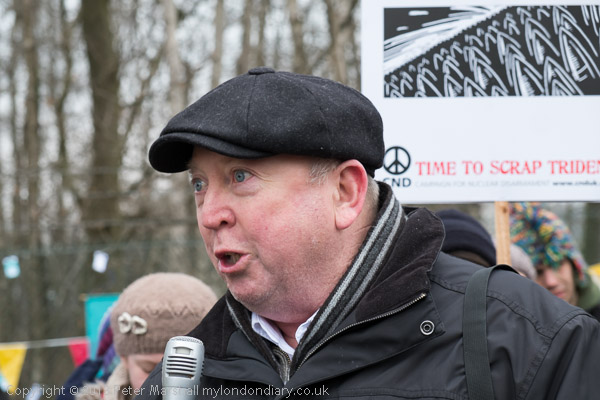

No problems with this speaker who keeps his eyes wide open, but those who blink a lot are trickier

I do have some problems with the position of some of the buttons on the camera. I constantly press the Macro button on by mistake – which slows down focussing on distant objects, and it is far too easy to move the exposure compensation dial. The Q button also is annoyingly easy to press by mistake.

The 15mm Voigtlander is small and light and virtually distortion-free

When changing to a non-Fuji lens you lose almost all of the automatic functions, though the camera will adjust the shutter speed to give correct auto-exposure. But you have to set the aperture manually, and also to focus. With wide-angles it is usually easiest simply to focus by the scale on the lens, but you can also press the main control dial and get an enlarged digital view of the centre of the frame whether using optical or digital viewfinders with the camera in manual focus mode. This is the only way to get precise focus with longer focal lengths such as the 90mm.

The Nikon 10.5mm also requires to be focussed in this manner, as the Nikon mount I have doesn’t give correct infinity focus. Perhaps a more expensive Nikon mount might do better. It is rather an annoying fault which considerably slows down use of this lens. With lenses such as this that have no aperture ring, the adapter has to have one built in, which has to be set by guess work – I focus at full aperture, then watch the change in shutter speed as I turn the ring to guess the aperture I have set.  But although I took the 10.5 Nikon along – though petite by Nikon standards it was much the heaviest lens in my bag – I didn’t find a situation where I needed it at Aldermaston.

I carefully tested all the Leica fit lenses I own with the Fuji cameras before taking pictures and you can read more about this in Hogarth and Fuji. In that piece I noticed no shutter lag with the Fuji X Pro1, but with more mobile subjects I did begin to notice the sometimes slow focussing with the Fuji lens. There still seemed to be some lag when I’d half-pressed the shutter to set focus before releasing the shutter.

Other than this and the occasional sleep mode that the X Pro1 indulges in, I had few problems. I did need to change batteries after around 300 pictures. The results technically are on the same level as I would get with the Nikons.

This wasn’t a fair comparison as I have only one Fuji lens, and had to use the Leica lenses in manual focus mode; things may change a little when the two promised Fuji zooms become available. It is also possible that Fuji can iron out some of the sulking with a firmware upgrade. It’s a shame also that lens profiles are not available for the Fuji lens in Lightroom, though I didn’t see a need for any correction for this kind of work.
Although I’d love to be able to lighten the load on my shoulder when working, the Nikons are so much better at handling fast-moving situations that I’m unlikely to stop using them for most of my work. They focus faster, are immediately responsive (with a few minor niggles,) and the optical viewfinder is still so much clearer (and of course reacts at the speed of light) than even the X-E1 digital finder. The much longer battery life is also useful.

As well as the lighter weight and smaller size, the Fuji’s do have at least one other advantage, with I think slightly better colour, particularly in those pictures I’ve taken on other occasions in artificial light. I like working with the X Pro1’s optical viewfinder, being able to see clearly outside the frame line –  something I can mimic by using the D800E in DX mode, but not quite as well. It is a great camera to work with when I have a little more time, and occasionally missing the exact moment isn’t critical.

More pictures on My London Diary: Nuclear Fool’s Day – Scrap Trident

________________________________________________________

My London Diary : Buildings of London : River Lea/Lee Valley : London’s Industrial Heritage

All photographs on this and my other sites, unless otherwise stated are by Peter Marshall and are available for reproduction or can be bought as prints.

To order prints or reproduce images

________________________________________________________
Hogarth & Fuji

A few years ago, the Leica M8 came out to generally very enthusiastic reviews, including some great write-ups from photographers who had been given the camera to use. Not long after, I had  a sudden fit of seeming affluence, and made my way on a sunny afternoon to Wey Cameras and spent the small fortune involved – and another £50 on a spare battery.  The camera felt almost like a Leica, though lacking the silky-smooth engineering of my old M2 (arguably the pinnacle of the marque) the prospect of a digital version was exciting, and the test shots I made only increased my excitement, though I could see it had some limitations compared to the Nikon I was then using, particularly as I was unable to afford new coded Leica lenses.

My exhilaration lasted up to the first time I took it out to use it in anger. I enjoyed using it with the 21mm Voigtlander (28mm equivalent) in a small animal rights event, dancing through the protesters sitting on the steps of the Royal Exchange almost like in the days of film, though it seemed considerably noisier and perhaps its automatic exposure wasn’t as accurate as some. But then I went on to another protest – and one I had actually been commissioned to cover – where there was a picket line of women in black burkhas  – and found in the Leica images they came out in various shades of brown and purple.

It wasn’t a good time. Wey Cameras went out of business a bout a week after I’d bought the camera from them, and a few days later I got the push from the job which had been making me feel reasonably off, providing well over half my income. To find I’d bought a camera that was hopeless with colour wasn’t good news.

Of course I wasn’t the only photographer who was having problems, and eventually even Leica admitted they’d got things wrong and supplied those who had bought the camera with a couple of IR cut filters free of charge, which went some way to solve the problem. But at the same time it introduced other issues, and while the camera became usable for 35mm and longer lenses (the 35mm became a standard lens, around 45mm equiv), colour remained a real pain with the wide angles I prefer. Again there was a solution from Leica, but only for their own coded lenses, and the free Cornerfix software did a good job, but added complication to the workflow.

Some people loved the camera despite this, and its poor showing by modern standards at high ISO, and it isn’t a bad camera for black and white (and a good choice for IR photography), but most of its life was spent sitting on my desk doing nothing. The resale price for the original M8 slumped to under half what I paid for it. I couldn’t afford new Leica lenses (which allow firmware correction of some of the problems) nor to get the M9 with which it might make some sense as a second body.  It’s gone to a friend with an M9, for whom it makes much more sense as a second body, while I’ve got in exchange an almost new condition Fuji X P.ro1, back from a full overhaul.

I’d been wondering for some time whether to buy a lighter smaller camera system, but couldn’t decide whether to try the Olympus OMD or Fuji. I’d more or less decided that the Fuji XE1 looked right, though only when the wide-angle zoom became available – which looks like being next year. So the X-Pro1 looked a good alternative, with perhaps the XE1 as a second body.


Chiswick Square – probably Hogarth’s nearest neighbours – and the Hogarth flyover – 15mm Voigtlander

In Chiswick I had the X-Pro1 but no Fuji lenses, so I was working with Leica M adapters with Leica and Voigtlander lenses. My old Voigtlanders are screw fitting, so there is also a screw to M adapter. Despite this, the first joy was to find the ease of changing lenses – more or less like going back to Leica or Olympus OM days – I’ve never found it quite so quick and simple with Nikon. I’d got two adapters with the camera, one an expensive Fuji version and the other a cheap Kiron – about one eigth of the price of the Fuji. I’d been warned that I might have problems with the cheap one, but I’d done a few brick wall pictures and could see no difference.


Hogarth’s House and garden – the mulberry tree was here when he moved in

Mostly I was using wide angles, so focus was seldom a problem, but where it is, the ability to zoom in digitally to focus was a great help, though it seemed going back to the dark ages to have to manually open the lens for precise focus, then stop down manually to take the picture. I think I’ll mainly work with Fuji lenses if I decide to work serious with the camera.

Automatic exposure still works fine – and it works just like it does on my other Fuji. The exposure compensation dial has a firmer detent, but it’s still possible for the heavy handed to shift in by accident (as I found) though fortunately the underexposure I set by accident on some frames made little difference to the results.

As might be expecting, working with these lenses is rather slower than using an all-automatic system, unless you make settings in advance – and with the wide angles you usually can except at short distances. Since there is no focussing, there is no noticeable shutter lag, but as with the Fuji X100, I sometime found the camera sulking after it had not been used for a while, taking a short time and some button pressing to bring it back to life.


Chiswick House gardens, close to Hogarth’s house.

Framing in the optical viewfinder is close – as good or better than with the Leica, and it can be set for any focal length, though for very wide lenses the viewfinder frame obviously can’t expand enough – and for these and lenses such as the 90mm  it’s usually better to use the electronic viewfinder. This is just a little slow to react to movement and exposure changes to be a good choice all of the time, and noticeably poorer than on the newer XE1. The X100 digital viewfinder also seems better.

My old Voigtlander 15mm, which has been dropped a few times is still a decent performer, virtually distortion free and a good 23mm equiv wide-angle, but rather susceptible to flare, and it will not take a filter for protection. Unfortunately both my 21mm Voigtlander and 28mm Minolta lenses both have some fungus that gives rise to flare, but all my other M lenses fit and work well. At first I thought I would not be able to use my old 35mm f1.4 Summilux, but although it won’t focus to infinity with the genuine Fuji adapter, there are no problems with the cheaper version.  But if I find the system fits my needs then it will make sense to buy Fuji lenses, starting with the 18-55mm. The 18mm pancake would be a nice choice when I want a more or less pocketable camera, but really it is the wide zoom that will be my most useful lens once that comes out.  There is a 14mm already, and an independent manual semi-fisheye, but my Nikon 10mm f2.8 will also fit with an adaptor. Fuji also promise a longer zoom, but until then the Leitz 90mm f2.8 will serve, and the electronic viewfinder makes that rather easier to use than peering at the tiny rectangle in the Leica viewfinder. Or for something seriously long I could always use the Nikon 70-300mm, though probably only should I become a bird watcher.


Chiswick House grounds – a public park.

The images were a pleasure to work with in Lightroom. A little vignetting on the wide angles, and no EXIF lens data so no automatic corrections. Lightroom 4.3 – the current version – doesn’t include any profiles for Fuji lenses on the X Pro1 or XE1, though perhaps they will come, along with the improved de-mosaicing of the Fuji  raw files which is in the current release candidate. I’ve not noticed any real problems with this so far, and I love the way the Fuji colour captures the winter afternoon sunlight.
Continue reading Hogarth & Fuji

Hogarth, Progress & Copyright

There is, I think, something very photographic about the work of William Hogarth, widely acknowledged as the father of visual satire for his works such as ‘Gin Lane‘ and ‘Marriage à-la-Mode‘. His paintings and the more widely disseminated etching made from them, which sold massively during his lifetime and still continue to sell almost 250 years after his death in 1764 are full of ‘decisive moments’, and rely very much on a feeling for gesture and symbol which would have made him as perceptive as a photojournalist. And as Martin Rowson says in his piece at the Tate on ‘The grandfather of satire‘, illustrated by an etching of ‘Beer Lane’, his work provides “an image of eighteenth-century London that many people probably now take at face value, almost as if it were a photograph.” The word ‘almost’ of course is important, and what Hogarth crams into a single image would take a photographic essay to explore, and the world of Hogarth is one of caricature rather than visual accuracy.

Hogarth sold and published his own work, and made a good living out of it, enough to buy a house in the country at Chiswick. Then it stood alone surrounded by fields, by the late nineteenth century it was on a pleasant village lane, and now it is more or less submerged by the Hogarth roundabout, with one of London’s more curious flyovers.  You can buy a print of Rowson’s take on this at Hogarth’s House and can see a rather unsharp version of it on Weekend Notes, which also has more about the museum which is free to visit and has two decent pubs a short walk away. But to see his paintings, visit the Soane Museum in Lincoln Fields, which you can see in the video by Ian Hislop in an article on Hogarth by The Idle Historian.

Hogarth was also important to photographers in helping to establish the principles of copyright (which was vital to his living as a print-maker), with the Engravers’ Copyright Act (also known as Hogarth’s Act) of 1735, providing the first real protection of artists copyrights, which in the course of time was extended to photographs, and is currently under severe attack from the Enterprise And Regulatory Reform Bill – with Stop43.org leading in putting forward the case for photographers.

I thought about Hogarth last week, as together with a few of my family we  small family outing to Chiswick for a meal together in a pub and then a visit to Hogarth’s House, now a small museum owned by the London Borough of Hounslow and then walked on through the grounds of Chiswick House to the station for the train home. You can see some more pictures from that outing on My London Dairy in Chiswick & Hogarth, and I’ll write a little more about them in a later post. But for the moment I’ll simply say that ‘No Nikons were used in their making.’
Continue reading Hogarth, Progress & Copyright