Croydon Blur – Does VR Help?

I usually like my own pictures to be sharp. It doesn’t worry me that something like 2/3rds of Henri Cartier-Bresson‘s greatest pictures are said to be – by modern standards – lacking in this respect, and I love some of Robert Frank’s Welsh images that are grainy and almost blurred out of existence, when he photographed coal-blacked miners in dark interiors. But mostly I’m working in at least half-decent light and there really is little reason for blur, given too a camera that can work at ISOs well beyond film.

© 2010, Peter Marshall

© 2010, Peter Marshall

© 2010, Peter Marshall
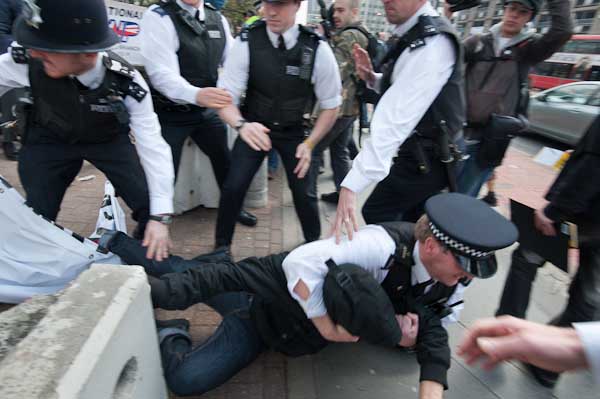
Three consecutive frames taken over around 15 s

Most of what I took at the BNP demo in Croydon is sharp, but exactly when things got a little more exciting I got a series of slightly blurred images. And I’m not entirely sure why.

I’m shooting at 1/250 f8, and with the lens at 30mm and focussed at 2 metres.  I think I was focussed on the hood of the guy being held, and that is almost sharp, though perhaps that was a bit closer. Things were happening pretty quickly at the time but I was taking my time and shooting carefully, zooming out from 35 to 30 and then 19mm. They are reasonably dramatic, but I’d have liked just a little more bite, and a few of the other frames are softer still.

One problem is obviously camera movement, and I’m obviously following the movement of the foreground figures with the camera, and thus blurring the background.

Had I known this was about to happen, I might have increased the ISO to get a higher shutter speed – I was working at ISO400 and could easily have given myself another stop or two. But I don’t think this was really the problem, as later, shooting a further incident with the same settings everything was pin sharp.

I do wonder slightly if the vibration reduction system – which was switched on – had any effect on the image. Obviously I don’t expect it help get me sharp images of moving subjects, but in picking up my movement of the camera could it actually try to counteract that and in the process make  people who are moving in a different direction less sharp?

Let’s be clear. That was a question and not an answer. I may be talking utter nonsense, but I was surprised by these images. Would I be better off leaving VR off for most of the pictures I take? Who after all needs VR for a 16-35 lens?

RED Chalk

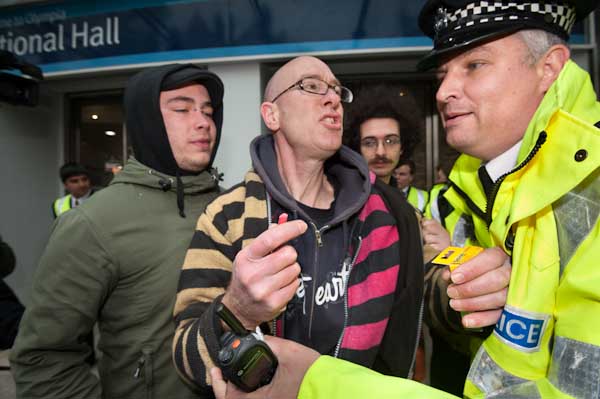
On Wednesday I saw a man arrested by police for chalking on a pavement – the charge was ‘criminal damage.’  I spent years chalking on blackboards in a teaching career without ever being charged with anything more than terminal boredom. Chalk doesn’t damage boards or stone and wipes away without trace.

© 2010, Peter Marshall

I have a small confession to make that might get me banned from some competitions. That stick of chalk he is holding didn’t actually look very red in my photograph. The way that my flash caught it made it a very pale pink, and it took a little bit of Lightroom magic to get it looking red in the picture.

The flash too was a little too bright on the officer’s jacket and especially its reflective strips, and that too took a little taming.

Almost all of my photographs get a certain amount of corrective work, but its aim is always to make the picture seem natural and to reflect how I saw the scene when I took the picture.  I don’t want people to look at one of my pictures and think that I’ve vignetted it or altered it in some way, really I don’t want them to think at all about the techniques, just to see and respond to the image.

Of course with digital images there is a certain amount of technical information embedded in them (unless you deliberately remove it.) So the EXIF data on this frame tells me I was working at ISO 640 (it was quite a dull day) that the exposure was  1/320 f6.3, the focal length 16mm and the subject distance 400mm – about 16 inches if like me you grew up in pre-decimal days. It also tells me that the flash did fire, that I was using an exposure bias of 1/3 stop and a few other things like the exact time according to my camera.

It doesn’t – so far as I can see – tell me I was shooting with the flash set at -1 stop and was probably using it in through the lens balanced flash mode. I think the camera ignores the flash exposure and sets the aperture and shutter speed on the ambient light only, but I don’t think the manual makes this clear.

Several things strike me about this, other than the evident absurdity of the alleged offence. First is that until fairly recently the fastest synchronisation speed on any of the cameras I worked with was around 1/100th second and that using fill-flash would have involved some tricky calculations that would have made it virtually impossible for pictures like this.

The second thing is that distance of 16 inches, I think from me to the hand holding the chalk. I was certainly working fairly close, but still making sure I wasn’t impeding the officer in his duty. I’m surprised it was quite that close, but things do look a little different when you are viewing the world through a 16mm lens. But had I moved back at that point, I would soon have been trying to photograph through the back of another photographer. A few seconds later, there was a ring of police and PCSO’s surrounding the man and I had to work from further back.

You can read more about the event and see the pictures in Olympia Counter Terror Expo Exposed on My London Diary.

Bow Pans

Almost the only area where I still wish I was taking film is panoramic photography. Really because it is just so simple to taken with film and a panoramic camera – just compose and press the button.  Digital is more flexible and powerful but considerably more fuss, even for the kind of simple panoramas I prefer.

The 35mm panoramic film cameras I used had lenses around 26-30mm focal length which gives a decent vertical angle of view without usually encompassing huge areas of sky. The horizontal angle of view depended on how the camera worked, but with the swing lens versions was dictated by the angle the lens swung through, typically around 120 degrees.

So to get similar results with digital I want to use a lens with a similar vertical field, so either the same range of focal length or a slightly longer length used with the camera  in portrait format.  At or around the 30mm end I find I need a set of 3 exposures to stitch (perhaps 4  if I’m shooting portrait format)  while at the wider end, 2 frames will do.

One small complication is that I mainly shoot with zoom lenses, and if you are going to stitch images it is fairly important that the lens focal length remains constant. It really is only easy to be sure of this shooting at one or other end of the lens focal length range, although I suppose it would be possible to use masking tape to hold the lens at a fixed focal length.

Most zooms also alter focal length slightly as they focus, so at least in theory you need to hold the same focus throughout the series of exposures. This isn’t usually a problem as most panoramas can be taken with the lens focussed at infinity.

It’s also easier to get good stitching if all the pictures are taken at the same exposure – and under the same lighting conditions. The British climate is fickle and rather sneaky in this respect, rather too good at brightening up a little without telling you (or the reverse.)  Of course there is often considerable variation in lighting as you swing through that 120 degrees or so, and it’s something that film, with its gradual response to excessive highlights copes with rather better than digital, which has a pretty sharp cut-off on over-exposure.

Film wasn’t of course without its problems. You could (and I did) expose it wrongly and development had its hazards too. I’ve had film returned from a pro lab absolutely blank that I know was properly exposed and made countless errors over the years when processing my own which have resulted in damaged, uneven, dense or very thin negatives. But at least out there in the field it was simple.

© 2010, Peter Marshall

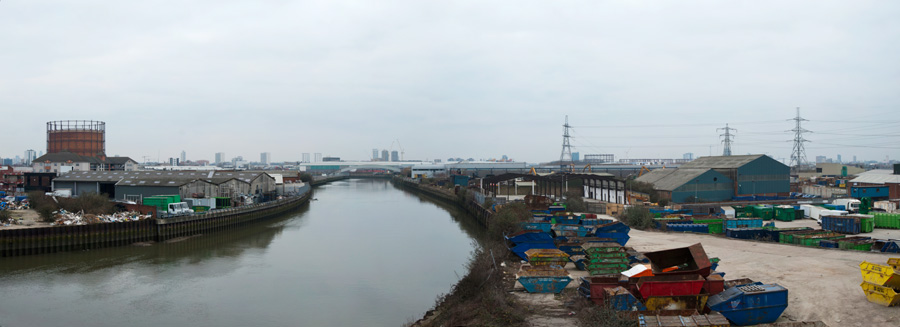
Anyway, here is a very small version of one of the results which I was reasonably pleased with. The file is actually twice the size it displays at on the blog,  and you can see it and the others at 900pixels wide on My London Diary.

The actual image I produced from PTGui, stitched from two 12Mp images (4288×2848 pixels each) is 8028×2917 pixels, an aspect ratio of 2.75:1,  and the horizontal angle of view is a little under 100 degrees.  It would print nicely at perhaps 30 inches wide if I had a sheet of suitable paper that large!

It uses a equirectangular projection which works well if – as here – the vertical angle isn’t too large, and gives a very natural effect. The image is too wide to look good in normal rectilinear perspective. One advantage of the equirectangular is that it more of less keeps the full width of the image, allowing me to retain the yellow skips at the extreme right of the image, which were for me a vital part of the composition.

Birth Matters

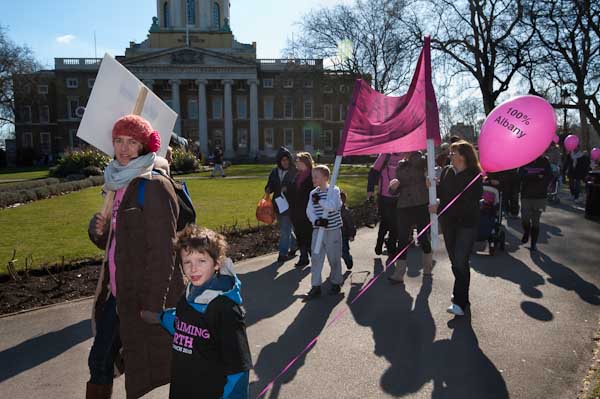
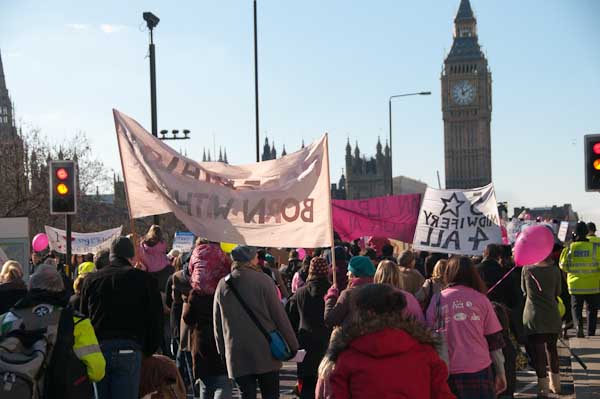
Talking to a doctor friend as I was working on the pictures that I took at the ‘Reclaiming Birth‘ march in London at the start of the week of International Women’s Day, he reminded me that one of the major aims of campaigners around this year’s events was to provide increased medical care for women while they gave birth, in order to cut down the number of women and children who die during childbirth. The call is for increasing medicalisation – and in  particular more doctors, more hospitals.

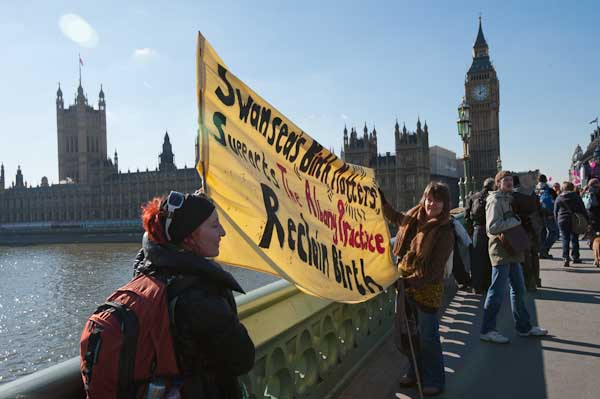
But here in the UK, the emphasis is rather different, because we have come to see the limits of the purely medical approach and campaigners are seeking to again give the women who are obviously at the centre of things a greater say in how they give birth and to centre the services provided around them, providing information, advice and support through the whole period of pregnancy, birth and baby care. Independent units such as the Albany Midwifery Practice based in Peckham, whose contract with Kings College Hospital was recently terminated, have provided models of best practice, achieving significantly better outcomes and highly satisfied mothers, many of whom were on the march, together with their children.

You can see the pictures and read more about the event  in Mums and Midwives Reclaim Birth  on My London Diary.

© 2010, Peter Marshall

Photographically the real problems were that almost everything about the march was the wrong way round. At the start of the march as people moved from Geraldine Mary Harmsworth park where they had gathered out on to the road the sun was shining strongly more or less directly into my lens as I tried to take pictures, and the same was true at the end of the march as it came up Whitehall for the rally. And when I photographed the march going over Westminster bridge with the Houses of Parliament in the background, all the marchers had their backs to me.

The sun, still low in the sky although we are approaching the Spring equinox, was a big problem. The lens hoods on wide-angle zooms are never very effective, and as usual I was doing the usual trick of trying to hold my left hand in the appropriate place to  cast a shadow on the lens. Tricky to do and impossible to avoid getting the odd frame with fingers in the top that need to be cropped out. Of course where possible I look for something in the scene that will act as a shade – perhaps a handy sign or even a placard or banner.

People walking towards you with the sun behind them will of course have their faces in shade, and you seldom have the luck to find a natural reflector that will put light into those shadows. The SB800, set to auto-fill at -2/3 or -1  stop is  a great help, though it risks over-exposure when subjects get close to the camera, and if I remember I’ll dial in a matching -2/3 stop to the ambient exposure set on the camera, which doesn’t seem to compensate itself for the extra light from the flash.

© 2010, Peter Marshall

Seeing only people’s backs as they walk towards Westminster is a harder to fix. Occasionally I ask people to turn round  or look back over their shoulders, although I don’t really like posing them at all. Sometimes people decide themselves to pose and I’ll take advantage of this – as I did with the two women with their banner from Swansea.  But I also had another idea which was to make use of the more than 140 degree horizontal coverage of the 10.5mm full-frame fisheye.

© 2010, Peter Marshall

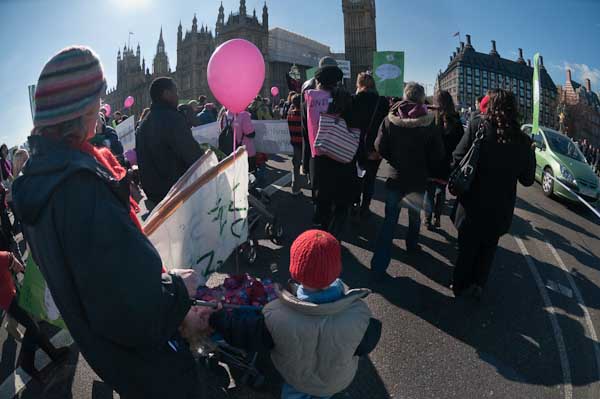
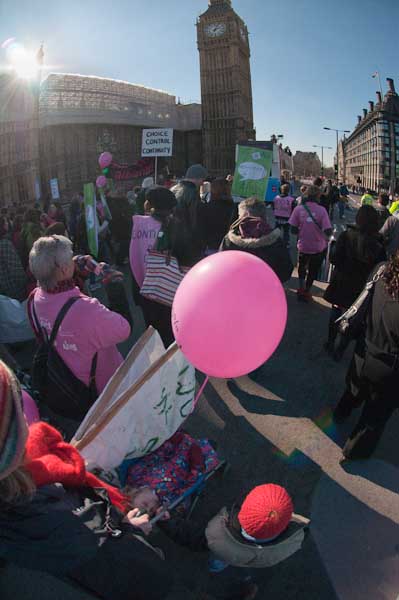
From exactly the right place above and slightly in front of someone’s head, this lens should make it possible to see their face (though from a rather odd angle ) and also the view in front of them. Although it should work in theory, in practice it is a little trickier to perform. My ideal camera position would have me floating horizontally face down in mid air above them around 2 metres or slightly more above the ground, but I couldn’t see an easy way to do this.

The approach I tried – not entirely successful – was to walk just a few inches behind the person I was trying to photograph and a few inches to one side, holding the camera up at arm’s length and slightly forward.  Since the 10.5mm is a digital format only lens, I had it on the D300 and one of the annoying small things missing from that body is an eyepiece blind. So while one hand is holding the camera to press the shutter, the other has to be on the camera back covering the eyepiece otherwise the light entering there will mess up the exposure reading and give severely underexposed results. (Had I thought a little more carefully I would have put the camera on to manual exposure, when this particular contortion would not have been needed.)

© 2010, Peter Marshall

As you can see I couldn’t quite get the camera in the place I wanted – it isn’t far enough forward to show the woman’s face, although it does just manage the child in the push chair. I’d really need to mount the camera on a monopod and use a wireless release, and getting the orientation right would be extremely tricky.

I took quite a few frames (probably resulting in a rather worried woman) using both portrait and landscape orientation and the pictures are at least a little different. As often with a lens with such a wide angle of view the sun was also a little of a problem – and in this frame it was only just outside the picture where you can see the light area.  In the vertical version it is actually in the frame, which as you can guess made processing this image near impossible – and there is an interesting piece of colour on the pavement.

© 2010, Peter Marshall

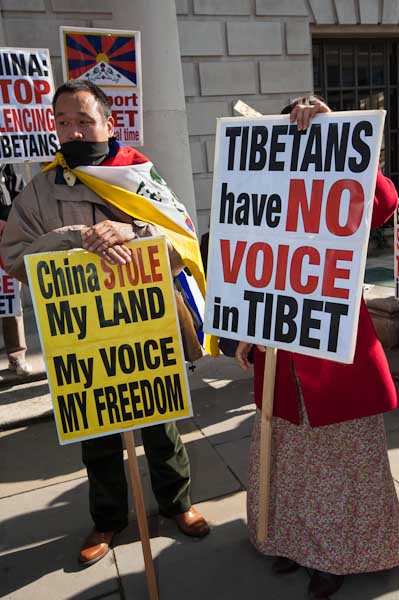
Tibet Freedom

I always enjoy photographing the annual Tibet Freedom March, although of course I would prefer it to be an event celebrating the achievement of freedom rather than bemoaning its loss. Although the spirit of Tibet is kept alive, China’s rise as to become the major world power seems to make any  attempts to put pressure on it to ease conditions in Tibet likely to be ineffectual; but perhaps China will develop as a more democratic nation as it gains in wealth.

© 2010, Peter Marshall

Coming in a generally wintry month here, the colour it brings makes a welcome change, and I think most years recently the sun has been out. Certainly this year London felt a little warmer than it has for some months as we gathered outside RIBA, opposite the Chinese embassy.

RIBA of course houses one of the largest collections of architectural photographs anywhere- between 700,000 and 1.5 million pictures – and more than 40,000 – not all photographs –  are available on-line at RIBApix. That makes it almost as large an on-line collection as My London Diary, where you can see my pictures from this year’s Tibet Freedom March!

If you are  “an up-and-coming architectural photographer” then you could consider the opportunity of putting your work on RIBApix

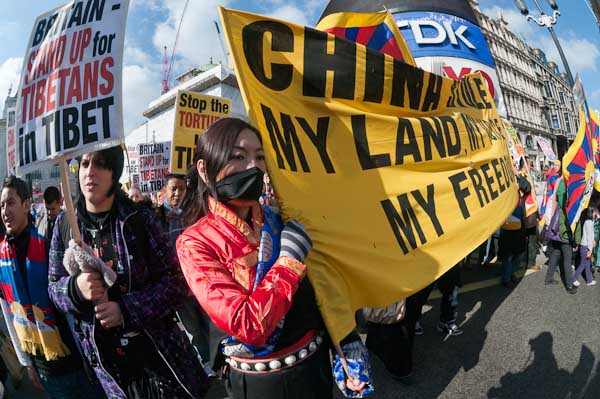
But back to Tibet and the march.  As well as being very colourful (often rather too colourful for my taste, with those strong primaries of the Tibetan flag)  the march tends to be fairly densely packed and also full of  interest. It’s also relatively slow-moving.  Taken together these things provide an ideal situation for the kind of close wide-angle work work in crowds that appeals to me.

So it was a good day to work with the 16-35mm, and I took quite a few frames at the wider end. But I could go even wider, putting the 10.5mm fisheye on the D300.

The 10.5mm is a full-frame fisheye, filling the whole sensor on the D300 and giving a diagonal field of view of 180 degrees (horizontally it is “only” a little over 140 degrees.) Its also a lens that lends itself to the use of various software tools to alter the perspective of the image. You can process the files to give a rectilinear panorama for example, though few subjects survive this treatment unscathed – rectilinear perspective seldom works above a roughly 100 degree angle of view.

So here is the march at Piccadilly Circus taken with the 10.5mm

© 2010, Peter Marshall

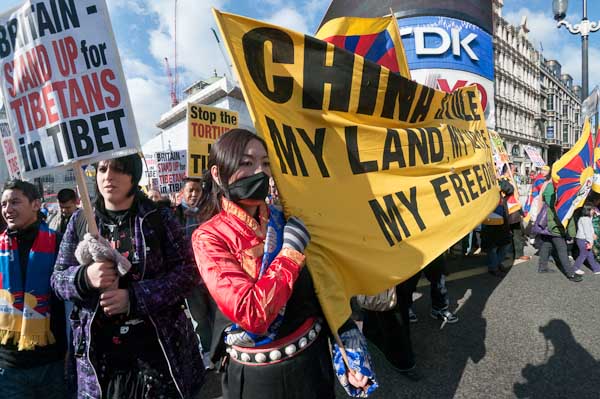
and its a picture I quite like, but a click in Photoshop applies the Image Trends IncFisheye-Hemi 2‘ filter to give a slightly different effect.

© 2010, Peter Marshall

It produces a result that I think is more ‘natural’ looking, in particular reducing the distortion of the figure at the extreme left of the picture and eliminating the curvature on the placard. Probably a little over 50% of the pictures I take with the 10.5mm look better treated to this realignment, though I’m not sure that Reuters or the World Press Photo would approve.

It hasn’t actually eliminated all curvature, and it actually looks less distorted than a rectilinear version would.  There are other alternatives to the Fisheye-Hemi plugin (some of which have the advantage of being free) but this is the one that most often works for me. It makes use of almost all the pixels in the image (losing a few in the corners) retaining the full width of the frame that I shot and almost all of the subject matter – the face that I placed at the left edge of the frame is still at the edge.

It works well in this case, particularly because I had the camera level when I took the picture, and so the lamp post and buildings at right of the frame become both straight and upright.

What is does lose is a little of the kind of outwards thrust and dynamic of the original image, where the woman in the centre really almost bursts out of the frame towards you. I was indeed very close to her when I took the picture; one of the problems of using this lens effectively is that you sometimes  have to really invade people’s personal space. In marches where they are moving forwards and you are walking backwards as you take your pictures it can be difficult to avoid collisions!

Flash at Holloway

Holloway Prison, the best-known women’s prison* in England, is not a fun place for anyone to be, either inside or outside, where it always seems somehow isolated and bleak even though it is in inner London. It’s next to a road junction which is part of a largish one-way system, and set a few yards back from the road behind some ill-kept grass and shrubs. Across the wide street of east-bound traffic is a defunct petrol station, and every time I’ve visited there has been an icy wind from the east blowing across the largely open space.

Thursday night it was cold, just a few degrees above freezing and the wind chill soon got into my bones. It’s a place with no shelter.

© 2010, Peter Marshall
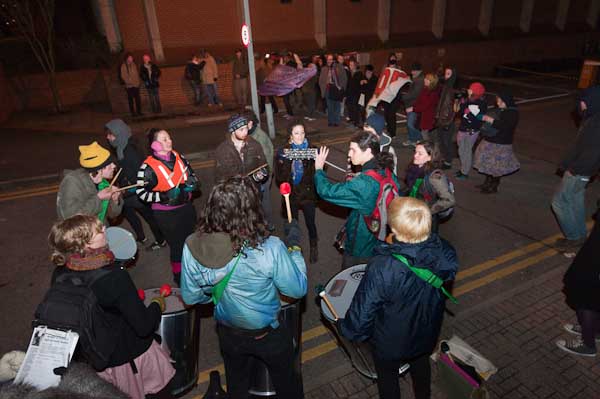
Virtually all the light for this picture came from a Nikon SB800 on camera

Outside the prison were a small group of demonstrators with banners. Inside were three women held without charge or trial (we do have a justice system in England, but it doesn’t seem to work for asylum seekers and migrants without proper documents) accused of being ring-leaders in a hunger strike still continuing three weeks later without them in the immigration detention centre (a prison in all but name, where people are routinely held without trial) at Yarl’s Wood.

By the time I left to catch a bus an hour later, the numbers had swollen to around 50 and included a samba band whose music did do a little to warm us up. But although I’d dressed for the weather I had really needed an extra layer for the steppes of Holloway.

More pictures and more about Yarl’s Wood and the hunger strikers in my piece Holloway Protest for Yarl’s Wood Women on My London Diary (also published elsewhere.)

Normal street lighting is enough to give some fill when working with flash at night if you take advantage of the high ISOs that are now perfectly usable. But the short driveway into the prison was only lit by a few low wattage bulbs which added nothing. Essentially direct flash was the only light source for photography.

This of course has its problems. It isn’t very interesting lighting being close to the lens and gives a harsh shadow because of its small size. And there is the inverse square law.

Traditionally photographers used flash brackets to take the flash further from the lens, or held the flash at arms length, but although these may make the lighting more interesting they also increase the shadow problem.

Social photographers often use weird and wonderful attachments on their flash to create a larger light source – I used to have my own favourite device made with an old translucent bottle, some aluminium foil, a couple of rubber bands and a little ingenious copying of other people’s ideas, which although it looked a touch Heath Robinson, did the job remarkably well, but these things are not too suitable for demonstrations and don’t help a lot when working a larger distances, partly because the light source still appears small, but also because they cut the light down too much.

The compromise favoured by many photojournalists was the Sto-Fen Omnibounce, a small translucent clip on diffuser, and most flash units now come with an inferior copy of this device. It actually has very little effect (a euphemistic way of saying sod all) on the light quality according to my own tests, but it does make you feel better and gives more even light with wide-angles. So I was annoyed to find that I had forgotten to put it in my camera bag. However it probably would not have made much difference to the pictures!

I do sometimes claim to have a special derogation from the inverse square law when people ask about some of my pictures, though I seldom explain this.

© 2010, Peter Marshall
Extreme differences in lighting needed a little Lightroom magic

The inverse square law if you are not familiar with it states that the light from a point source – and a camera flash is more or less that – falls off with with the square of the distance from the source. So if you imagine a picture with one person at 4 feet from the camera/flash and another at 8 feet, double the distance, the further person gets 1/4 (4=2squared) of the illumination. Its perhaps easier to think as a photographer that 2x the distance means 2 stops down and so on.

So if you expose for the close person, the distant guy is 2 stops under; and if you expose for the distant one, your near neigbour is at 2 stops over and likely to be pretty much burnt out white. It’s something that photographers like Winogrand and Friedlander used to great effect, but digital is less forgiving of overexposure than film and it is not in any case an effect that will generally endear you to editors.

You need either to get everyone at more or less the same distance from your camera, or expose very carefully to put the closest person just on the edge of burning out. If you do that, then you can burn the over-bright areas down in Lightroom (or Photoshop) and brighten the more distant dark parts. Virtually everything I took at Holloway needed something of this treatment. The results aren’t great but they are a lot better than they would otherwise have been.

While taking pictures I was asked by the reporter for a small local newspaper if I would supply them with pictures. He was apologetic when I enquired about rates and could only offer a by-line and I declined.  I think events like this are a good example of why photographers are still needed, even when everyone has a digital camera.  And if people need photographers they have to be prepared to pay for them.

* Holloway prison opened in 1852 as a mixed prison but became prison for women alone in 1902, just in time for the suffragettes.  It was demolished and completely rebuilt on the same site in the 1970s and early 80s as a rather depressive red brick block, but some reports at least on the Internet still use the pictures of the rather impressive Victorian ‘castle’ that would have been a much preferable backdrop to my pictures!

Scanning 35mm – Will a Flatbed do?

Recently I’ve gone back to scanning quite a lot of my older negatives and, as I’ve mentioned in previous posts, have been using the Epson V750, simply for its speed, rather than the Minolta Dimage Scan MultiPro.

Although the scans have been good enough for my needs at the time, I’ve always felt that for the optimum quality I would need to go to the dedicated film scanner. But I wanted to find out exactly what the difference was and so to decide when to use a film scanner.

© Peter Marshall
Brixton, 1980, taken on a Minox EL 35mm camera

I chose this negative simply because it was one I wanted to print, having spent some time searching for it in my archive.

Minolta are no longer with us, and the MultiPro scanner which was the best of its type is no longer made. The scans made with it are of similar quality to the best scanners still available, including some considerably more expensive models.

All images in this post are unretouched scans, though I’ve adjusted contrast a little to give a better match than in the actual scans – though they are still not quite the same.

Minolta Dimage Scan MultiPro

I put the negative into the universal carrier with a specially made full frame 35mm mask that ensures film flatness and set the software to 4x sampling to get every last ounce out of the negative, scanning at 4800dpi.

Then I went and had a cup of tea while the scanner got on with the job – which I think took around 15 minutes – and produced a 58Mb 16 bit grayscale TIFF file.

© Peter Marshall
a 600×400 section from the 6829×4541 scan, displayed at 2/3 size on this blog

Viewed at 1:1 on the screen (the full 6829 pixels would actually produce a picture 73 inches wide if my screen was large enough – although nominal screen resolution is 72 dpi, actual screens invariably differ from this) the image is pin sharp and shows a fine granular pattern which I think is the actual film grain. The grain is as sharp at the edges as it is at the corners, and it is a pretty impressive performance.

© Peter Marshall
An area where the white threads are more visible

Unfortunately it also shows something else, with large areas of the image being marred by fine white thread-like lines. I’ve tried to remove these by various Photoshop filters, but doing so also blurs some of the fine detail (and the grain.) Retouching using clone and healing brush tools also loses a little of the detail and is extremely difficult and tedious – and would involve several hours of work.

Minolta Dimage Scan MultiPro and Scanhancer

I’d made this first scan without the http://www.scanhancer.com/ Scanhancer which radically improves its performance in place, so the next job was obviously to try it with this.  So it was time for a coffee as I let it do its work.

The Scanhancer is a simple plastic diffuser that sits on top of the negative, and it was developed by Erik de Goederen and others on the MultiPro user group. Minolta (and some other scanner manufacturers) liked the idea so much that they incorporated the idea into later scanners.

Although most diffusing materials make a difference, the choice of the right material is crucial. But as the site says, it allows the Multipro to rival “drum scan quality by mimicking the effect of wet mounting.”

© Peter Marshall
a 600×400 section from the 6821×4568 scan MultiPro + Scanhancer

And, somewhat to my surprise it solved the problem – those white threads simply disappeared. It also slightly reduced the rather aggresive grain in the image.

Epson V750

Using the V750 with the film in the standard film holder did the scan at the same nominal resolution, 4800 in around 2 minutes – about a tenth of the time. It isn’t as sharp when viewed 1:1, and the grain is more a texture than the discrete pattern of the MultiPro scan, making some surfaces noticeably smoother. In fact it makes me begin to wonder if the ‘grain’ in the MultiPro scan is actually some kind of scanner artefact. The negative clearly isn’t flat, but the scan doesn’t show any really noticeable loss on this account. Because of the design of the holder it isn’t quite possible to scan quite the entire negative (more of a camera fault in the very slight skew of the frame on the film) but the difference is very small.

© Peter Marshall
a 600×400 section from the 6792×4419 scan, Epson V750

But although it clearly is slightly less sharp, there is more or less the same amount of detail on the scan (though differences in contrast and brightness may mean this isn’t clear)  and, as with the Scanhancer, those little white threads have simply disappeared. Flatbed scanners have more diffuse light sources than most film scanners.

© Peter Marshall
a 600×400 section from the 6792×4419 scan, Epson V750, after sharpening

A little sharpening using a tool such as the FocalBlade plugin can bring the sharpness at the maximum print size (33.3% on Photoshop gives a display on my monitor corresponding to a print at around 280 dpi, and an image size around 24×16 inches) to a similar level as the Multipro scans. At this size the main difference is actually the grain apparent on the Multipro scan, and I can get a better visual match in Photoshop by adding a little noise to the V750 scan should I want to!

It did occur to me to wonder if I could get a sharper scan direct from the V750. I tried the unsharp masking in the scanning software but decided the sharpening in Photoshop was better.

I also tried using the V750 with the same Vuescan Pro software that I use with the MultiPro (one of Vuescan’s big advantages is that it will work with almost any scanner ever made.) The scans produced were pretty similar with those from the Epson software – and using the 4x sampling didn’t seem to make any difference, except to speed. So as the Epson software did the job faster I’ll stick with that in future for this scanner.

The main problem with flatbed scanners such as the V750 is the lack of focussing. All you do is adjust the feet on the negative carrier to move it up and down slightly. I’d previously tested the carrier to arrive at the current setting of the feet, so felt fairly sure altering them wouldn’t help.

Although I couldn’t see much effect on sharpness, the curving of the film in the negative carrier did actually result in a very slight distortion of the image around the edges. It was only noticeable by comparison with the Minolta scans, but I still don’t like it.

I’m told that wet mounting does improve the performance of the scanner significantly, but have yet to try it. But there have been some reports that the Scanhancer can work a little of its magic with flat beds too, and it is a lot easier than wet mounting, so I thought it was worth a try. There was perhaps a very slight improvement in sharpness, but it was hardly significant.

Conclusions

Although there is a small difference in sharpness – particularly of the grain – when viewed at 1:1, both scanners give files entirely usable results at normal print sizes – up to perhaps 24×16 inches.

Some viewers actually prefer the look of the Epson V750 scans because they reduce the effect of film grain, giving a slightly smoother look to some surfaces.

If you are intending to print to very large sizes – perhaps A0 or larger –  then the slightly increased sharpness of the MultiPro would almost certainly be preferable. The Scanhancer is essential for removing some imperfections when scanning old negatives like these, and slightly reduces the aggressive grain.

The question that really persuaded me to carry out these tests was whether the V750 scans would pass the quality control tests imposed by Alamy. Frankly I can’t guess at the answer, but as usable files for almost any purpose they should do.
Life’s Too Short

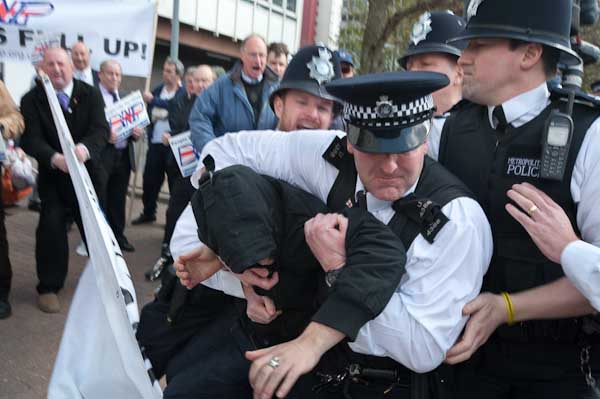
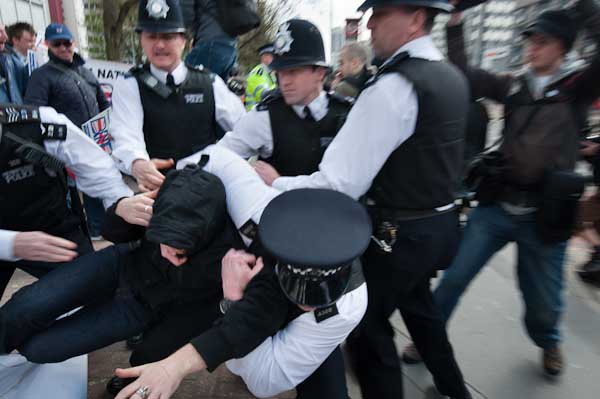
The second demonstration I photographed last Saturday was much smaller than the 1500 or so photographers in Trafalgar Square, and I could actually count the number taking part. So when I wrote in my account that “more than 150 people” were in the march from St Pancras to Piccadilly Circus there isn’t much room for argument. Of course, it’s still deliberately a little vague, both because the actual number isn’t of any interest and that it is pretty well impossible to get an exact count.

In some ways it’s much easier to cover small events – and not a great deal is likely to happen without you noticing it, whereas your view of a large event can be quite different to that of someone working on the far side away from you.

NoBorders, whose London group organised the demonstration, would like people to be allowed to move freely around the world without the kind of border controls that most states now impose. Seeing the problems that the attempts by the UK to restrict migration to this country have caused, with thousands locked up inside our immigration prisons and so many cases of injustice and inhumanity I feel they have a very strong case; whatever problems free movement might cause I think they would be less.

At the very least we should set up a humane system that recognises our historic liabilities and our obligations under international agreements and human rights declarations, and gives those seeking asylum proper access to our legal system with similar rights to our citizens. What we have are prisons run for private profit, hired thugs and fast-track procedures that deny justice. And an immigration minister who thinks it appropriate to say “The UK Border Agency vigorously opposes any appeal against deportation” rather than feeling it is the duty of the Asylum and Immigration Tribunal to come to a decision on the facts of the case.

© 2010, Peter Marshall
Sometimes you can go too wide on the 12-24mm

I was without the Sigma 24-70mm f/2.8 EX DG MACRO which has become my favourite lens, as I finally had to send it back to Sigma for repair. Something came a little loose inside a few months ago and it has clearly been getting worse.  So I was working with my old Sigma 12-24mm EX on the D700 full frame and a Nikon 18-200mm on the DX D300 (equivalent to 27-300mm.)

© 2010, Peter Marshall
But at times it’s rather fun to do so

The 12-24 is a great lens (and the current version is better still), but considerably more useful on the DX format, where it becomes an ’18-36 equivalent’. On full frame it not surprisingly gives some considerable vignetting at the wide end, and 12mm is really just too wide for any rectilinear lens. There is an unavoidable wide-angle distortion – a matter of geometry rather than lens design. On DX format it gives the same view as an 18mm on full frame which is much more usable, and also has better sharpness and less chromatic aberration because it avoids the extreme corners of the lens.  At ’18-36′ it covers the whole of the usable rectilinear wide-angle range. Should you need a wider view (and I sometimes do) the answer is a fisheye – such as the 10.5mm Nikon.

On the FX camera, the 12-24 also abandons you at the longer end, bang in the middle of the useful wide-angle range at 24mm.  This is a pain if you only have a single camera, but less so if you can simply pick up your second body. The 18-200 on the DX300 starts at a 27mm equivalent, giving you an almost seamless range of focal lengths.

This is a sort of reversal of my normal practice, where I rely on the DX300 for the wider stuff (with both the 10.5 fisheye and either the Sigma 12-24 or the smaller DX format only 10-20mm.) Then the DX700 with the 24-70mm covers the whole of the middle range (and often it is everything I need),  switching back to a cheap and light Sigma 55-200 DX lens on the D300 for any long stuff.

If Sigma made a decent full frame 50-200mm I would probably buy one; the old DX version more or less covers full frame – at least after I took a hacksaw to the lenshood – as I mentioned in an earlier post.

The closest match they have in is 70-300mm, with 3 versions available. The extra focal length does make them a little heavier and bulkier than a 50-200 would be. Having the 70-300mm f/4-5.6 DG MACRO, 70-300mm f/4-5.6 APO DG MACRO and the 70-300mm f/4-5.6 DG OS does seem a little overkill. The OS is an optically stabilised lens, but the APO offers better quality if you can hold it still, while the first mentioned is cheaper.

None of these three are in their professional EX range with “superior build and optical quality”, which does offer the large and heavy 70-200mm f/2.8 EX DG MACRO HSM II, doubtless an excellent lens but too large and heavy for me.

© 2010, Peter Marshall
’89’ was the year the Soviet bloc crumbled

More from Life is too short to be controlled.

Paris Revisited 1984 – Set 2

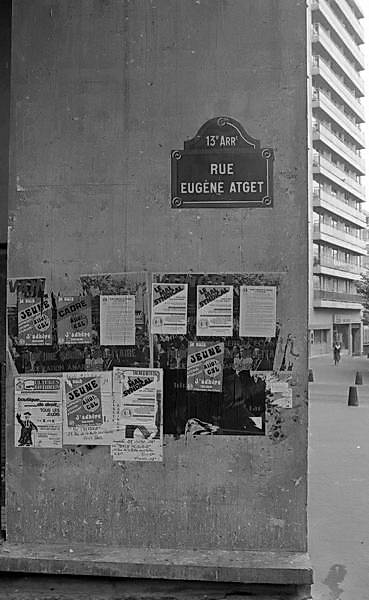
The  28 pictures that make up ‘Set 1’ of Paris Revisited included many of the favourite pictures that I took there in 1984, but there are also quite a few others that appeal to me, or that I found of particular interest for various reasons. It was good, for example, to find that Eugene Atget had a street named after him:

© 1984, Peter Marshall

though I’m fairly sure he would not have appreciated the architecture. Almost certainly the buildings that were demolished to make way for it were more to his taste – and probably among the many in the area that he photographed. This picture and the others in this post are in Paris Revisited – Set 2

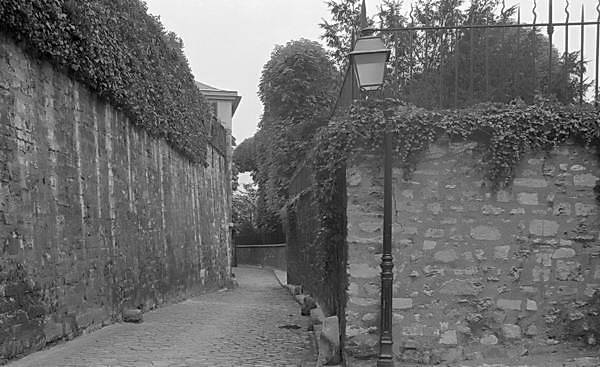
One scene that was virtually unchanged since he photographed it was in rue Berton in the  16th arrondissement, and it is one of the few pictures where I consciously copied one of his works.

© 1984, Peter Marshall

Of course there are differences. One is in the aspect ratio – his pictures are much more square than the 1.5:1 of 35mm cameras. Using the V750 scanner with the supplied film holder and Epson software which auto-detects the frame actually crops the 35mm neg to higher aspect ratio of around 1.63:1 making the difference more pronounced.

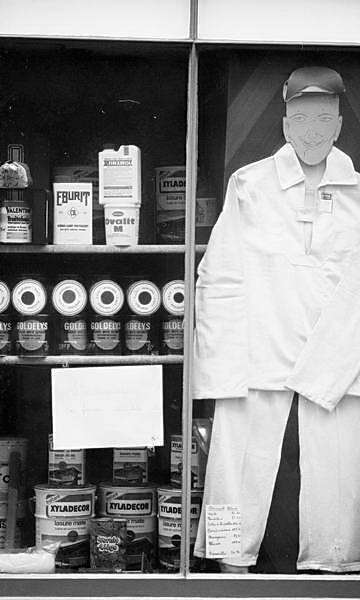
© 1984, Peter Marshall

Most of these images from Paris were taken using an Olympus OM4 camera which had come out in 1983, and using the Olympus 35mm shift lens. This gave some of the control over perspective that is available using the rising and falling front and left-right movement available in many large format cameras, but lacked the tilt and swing of some of them.  The greater depth of field on the smaller format largely made this unnecessary so far as getting sufficient depth of field was concerned if  your aim was to achieve overall sharpness in a image.

It was quite a bulky lens compared with  the non-shift 35mm lens, partly because of the mechanism allowing the lens to shift around 10mm left or right and 12mm up and down between the lens and the camera.  But it is also larger to give a wider image circle at the film plane. A normal 35mm lens has to produce a sharp image across the diagonal of the format – around 43 mm. To allow the lens to move 10mm to left or right, the PC lens needs to have an image circle of around 61mm, which also allowed a maximum rise of 12mm and fall of 13mm. You could also combine smaller amounts of sideways and up and down movement – and the lens design ensured that these kept within that image circle.

The larger image circle meant that if you didn’t use the shifts you were working in the central area of the lens, and gave the lens a really excellent performance – and it remained pretty good even a maximum shift.

As with the movements on large format cameras, perhaps the most common and certainly the most obvious use is in photographing buildings. To avoid converging verticals you need to keep the camera level and not to tilt it, but to do this from ground level without a rising front, you have to move back so that the  base of the building is at the middle of the frame. With a rising front or a shift lens you can move in closer and eliminate all or most of the foreground.

Of course now that images are digital (or scanned) you can tilt the camera and then straighten up the image in Photoshop but this does involve some extrapolation and thus loss of quality in the result and is best kept to a minimum.

But the shift lens really introduces a different dimension to photographic composition, meaning you can to some extent separate perspective from viewpoint. Although text-books draw diagrams and show example photographs I think it really is something you can only really appreciate by working with it day in and day out.

There were some downsides the the lens. Firstly it was rather expensive,  even like mine when bought second-hand. But because of the sliding mechanism it was a purely manual lens without the automatic stopping down of the iris we usually take for granted. So when using it the first thing was to stand in the place you wanted to take the picture from, then point the camera and push the lens across or up or down as required to adjust the perspective.  As usual you would do this with the lens wide open, and it would stay wide open whatever aperture you set on the aperture ring. For metering and taking the picture you then held down a small button on the lens which stopped it down to the value set by the aperture ring, and when you had set the shutter speed (or viewed that chosen by the camera on an auto setting) you kept holding that button down while making the exposure.

It soon became second nature, particularly since for some years I probably took around 90% of my pictures  with this lens. So much so that even now I sometimes find myself trying to slide the lens on my Nikon across or feeling for that button to hold down when I’m taking pictures. And I’m sometimes more than a little disappointed to find that these lenses just won’t shift!

[Nikon do make PC lenses, including the wide angle 24mm f/3.5D ED PC-E Nikkor as well as a 45mm and 85mm, none of which I’d really find suitable for general photography. Unlike the Olympus lens they only shift in one dimension – you can have  rise/fall or, by rotating the lens by 90 degrees left/right but not a combination of both. They do however have a tilt, making them more versatile for specialised use.]

Apology

Attentive readers of this blog may have noticed that my previous post, Parc de St Cloud 1984 was about the same set of pictures as an earlier post with the same title, Parc de St Cloud 1984 but at least I wrote something a little different about them second time!

USA – 8 Years of Shame

Yesterday, 11 January 2010, was 8 years since the USA set up the prison camp at Guantánamo Bay, although some of the prisoners have been held longer in various black holes around the world either by the US or on their behalf by others.  The choice of the site showed a disregard for international law, and the treatment of the detainees flouted the international conventions. You can read more about Guantánamo on Andy Worthington‘s site and book.

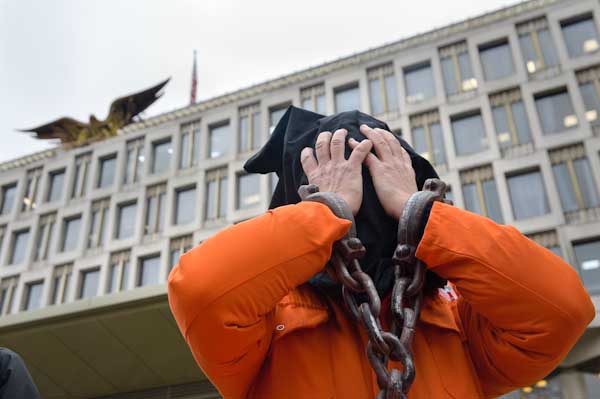
I’ve already posted pictures and text about the event on Demotix (where it made the front page), Indymedia and of course with more pictures on My London Diary  so I don’t need to recount the details here. This was the picture that Demotix put on the front page:

© 2010, Peter Marshall

Visually, the eagle is the obvious thing to include in the picture (and it would have been nice to have more of the flag too, but the lack of wind wasn’t really cooperating.)  Obviously a symbol of USAmerica – why they put it there.  But also a symbol of power and of freedom, the freedom to soar like an eagle, which the detainees don’t have. Instead of being free to spread their wings, their arms are manacled, and hands drawn back in, onto the hooded face. I liked the symmetry of the pose and I think I got the cropping just under the arms – and rather fortunately of the chain – just about right.

© 2010, Peter Marshall

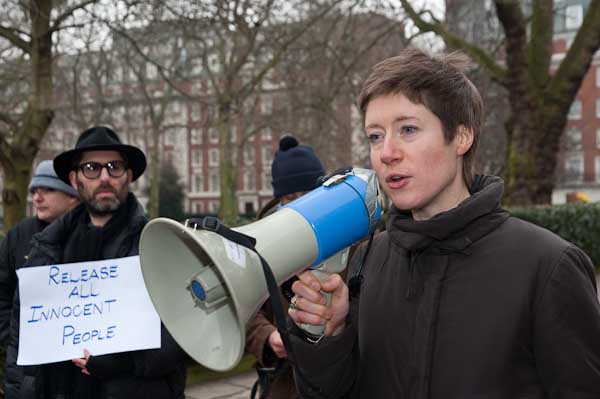
Another image I liked was of one of the speakers, Chloe Davies of Reprieve, which has provided legal defence for many of the detainees, over 50 of their clients have already been released- although over 30 are still held. I saw I could more or less line up the end of the megaphone she was holding with an appropriate message held by another of the protesters, “Release all innocent people” and it was almost as if this message was emerging from the megaphone.

I had to work very quickly, and wasn’t helped when I was trying to get in the exact right position when another person with a camera came and stood in front of me.  So it could have been improved a little.

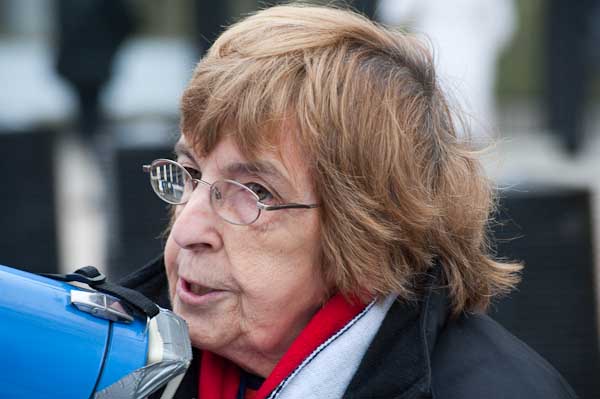
Most of these pictures were taken with the Sigma f2.8 24-70mm which continues to impress me both with its performance and its weight!  But I also took a few mainly portraits with the older lightweight 55-200mm DX format Sigma. Apart from just a little vignetting at the wider end (cropped in some images) it really does a grand job. I’m not sure  Joy Hurcombe will thank me (or Sigma) for this, but the full size original is really biting sharp and detailed, with not the slightest hint of camera shake despite being taken at 1/100s at 200mm focal length.

© 2010, Peter Marshall

Some Tech stuff

Taking the pictures wasn’t a great problem, other than that while the guys in the orange jump suits were posing there was a bit of a scrum of press and others.  And it was one of the dullest days you can imagine, though that was hardly a problem – I simply set the base ISO to 800 and the minimum shutter speed to 1/100th using auto-ISO on the D700.  I had the camera on aperture priority at f8 and the I’d chosen ISO 2000 as the maximum ISO.  So nearly all the non-flash pictures were taken at 1/100th at f8, though there we just a couple where even ISO 2000 wasn’t quite enough and they were exposed at 1/80.

Adding the SB800 flash appears to peg the ISO at the lower setting of the auto-iso limits m- in my case ISO800, while in aperture priority mode you of course set the aperture (and I left this at f8 the.). In aperture priority (or program mode) the slowest allowed shutter speed is set by custom function e1 – and I had that set to its fastest possible value, 1/60s (a shame it doesn’t let you set 1/125.)  It was used for almost all the flash pictures, with just one or two having sufficient light to use a faster speed.

In fact the easiest way to use the flash is to work in manual mode, where you set both aperture and shutter speed, but if you want to switch rapidly from working with and without flash you then need to alter the manual settings or switch to another exposure mode as you switch the flash off – and it’s all too easy to forget.

One very simple mistake – which I made to start with but immediately noticed – is not to slide the flash quite all the way into the flash shoe.  You can do this and still manage to turn the lock, and the flash will still fire, but I think on full power, usually resulting in severe overexposure.

Nikon doesn’t actually give much information about how the accessory flash units actually work with the camera in either the camera or flash manuals.  But usually it just does work.

Actually the picture above was underexposed. I’d thought that the matrix metering would compensate for the largish area of sky, but it didn’t. Added to the -2/3 stop of exposure compensation I’d dialled in on an earlier shot to avoid clipping highlights, it was really a little too far under for comfort, but a little tweaking in Lightroom restored it to reasonable health.

Bright orange jumpsuits are a bit of a challenge, and Adobe’s standard camera profile doesn’t handle them well. I made my job much easier by using the  “untwisted” profiles I wrote about a couple of months ago.