Boycott the fruits of apartheid

 © 2009 Peter Marshall.
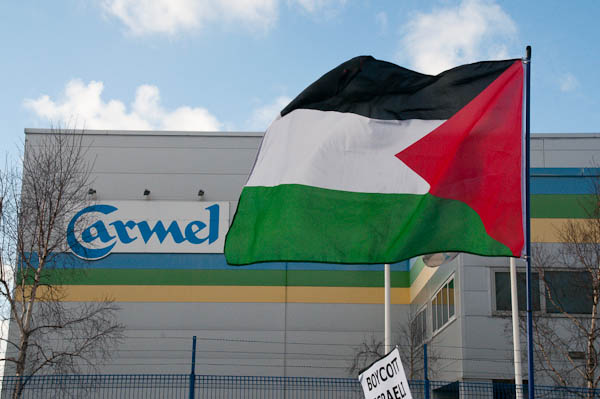
No Israeli flag now flies at Carmel Agrexco

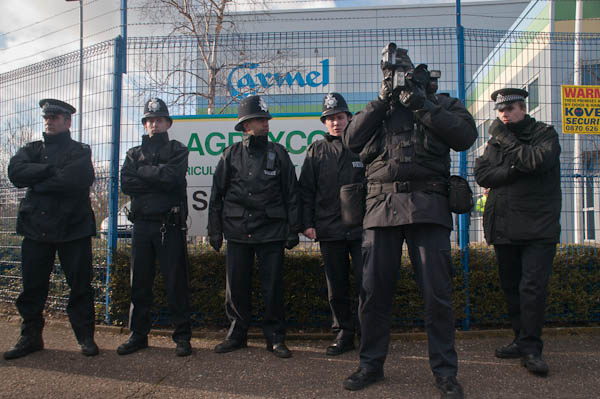
There was no sign of the Israeli flag which used to fly proudly outside the Carmel Agrexco warehouse in Hayes, Middlesex, and the Union Jack on the adjoining flagpole was tattered and skewered on its pole. When I arrived the gates were closed and guarded by around 20 police, with perhaps another 50 or more in reserve in vans parked around the industrial estate.  As well as normal police vans, these included a couple of old vans that looked like they had been rescued from the knackers yard and cheaply fitted with a notice saying Metropolitan Police in the front windscreen, so perhaps police resources were rather stretched. Later I saw even more police vans at other points around this industrial estate a couple of miles north of Heathrow.

© 2009 Peter Marshall.
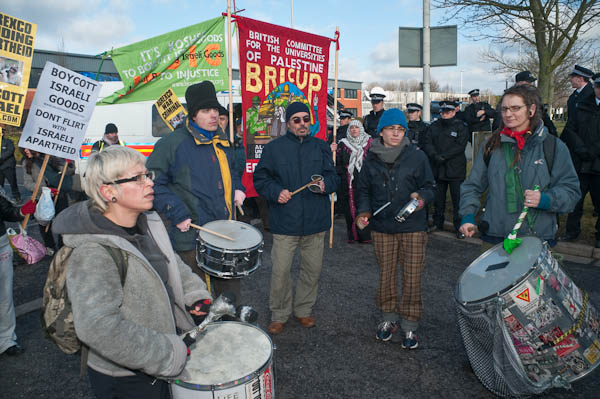
The demonstration was led around the estate by the samba band

Roughly the same number of demonstrators eventually arrived, looking considerably more cheerful than the police who appeared to be feeling the cold. Once the samba band got there the protesters went off with them for a walk around the block, attempting to visit another company on the estate involved in the export of Israeli and Palestinian flowers. Police formed a solid line across the road and refused to let the marchers past, pushing back those who tried but refusing to say why there were not allowed to continue. Eventually an Inspector introduced himself and read a statement (he afterwards confirmed this was under the Public Order Act 1986) confining the demonstration to the block containing Carmel Agrexco, and after a few arguments the marchers moved on.

© 2009 Peter Marshall.
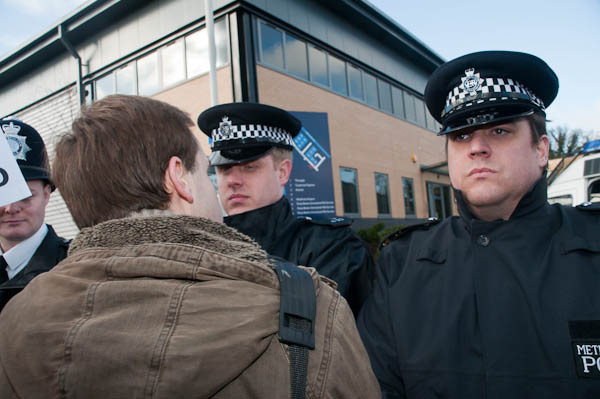
Police stop demonstrators but refuse to answer questions

At this point one man was stopped and searched, but no arrests were made. The FIT photographer was hard at work throughout the event, but generally the police were well-behaved and made an effort to engage the protesters and photographers in polite conversation throughout the roughly three hours I was there.

© 2009 Peter Marshall.
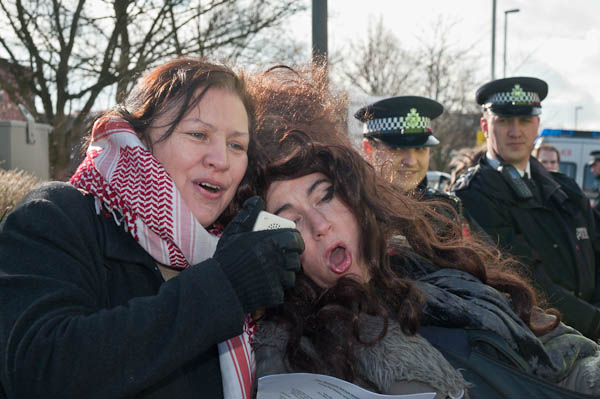
‘Amy’ and friend end their performance of The Boycott Agrexco Song

At several places the march stopped to sing songs, with ‘Amy Whitehouse’ whose wig was surely too tidy to fool anyone and another singer with a strong voice, both of whom had the advantage of knowing the tunes. The Boycott Israel Song (tune Bye Bye Love) reminded us not to buy Israeli goods including dates, Jaffa fruit, Israeli wine – and anything with a bar code starting 729. (Although some Israeli produce has this barcode, there are others, so always read read all the small print.)

A new Boycott Agrexco Song (none of us knew the tune, Jesus wants me for a Sunbeam, but then few at the demonstration will have attended Sunday School – and we didn’t sing it at mine) was more specific, reminding us of the house demolitions and checkpoints that force Gaza farmers to sell their produce dirt cheap to Israeli companies who illegally export them as Israeli produce, and of the stealing of water from Palestine to irrigate Israeli fruit. It ended on a seasonal note:

“Don’t buy your flowers from Agrexco
To give your valentine
Boycott the fruits of apartheid,
And help free Palestine”

Agrexco is Israel’s largest exporter of agricultural produce and much of it goes to EU countries including the UK. Its main UK depot is in Hayes because this is close to Heathrow – where much of the produce is flown in to this country.

© 2009 Peter Marshall.
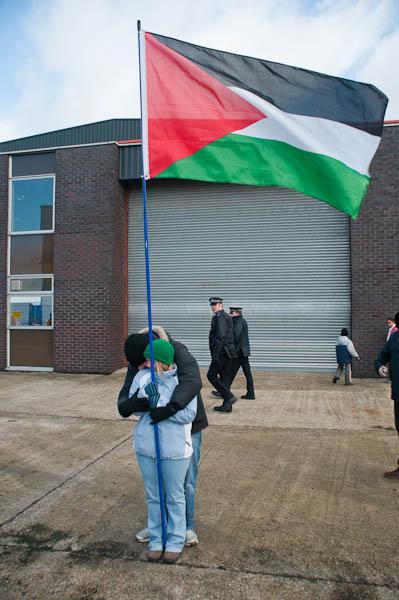
This was described as a Valentine demonstration

Movement of food by air is a considerable an unnecessary drain on the planet’s resources and contributes to global warming. So Carmel Agrexco was naturally a target for demonstrators during the Heathrow Climate cap in August 2007.  As in other protests no prosecutions resulted despite there being considerable damage reported.

© 2009 Peter Marshall
There were other photographers present – including this one.
From 16 Feb I might be arrested for taking pictures like this
.

Protesters claim that Carmel Agrexco is in violation of international law in exporting produce – mainly carnations, strawberries and cherry tomatoes – from Gaza, as well as from Israeli settlements inside the Green Line and in the West Bank.

More pictures on My London Diary.

Sri Lanka Petition and Update

Avaaz.org is asking people from all around the world to send  a message to US Secretary of State Hillary Clinton urging her to help protect civilians in Sri Lanka’s civil war. 250,000 civilians are currently trapped in the battle zone of a deadly conflict between the Sri Lankan government and the Tamil rebels.

I’ve already done so earlier today. You can join in at this address:

http://www.avaaz.org/en/sri_lanka_civilians/99.php

© 2009 Peter Marshall.
You can now see my pictures from last Saturday’s march in London on My London Diary.

Fairey or Not?

I don’t know I have a great deal to contribute to the controversy of the use of a photograph by Shepard Fairey as a basis for his Obama posters, other than to be rather clear that this is definitively not a case of plagiarism. It may well however be a matter of copyright abuse.

Frankly I think it shows a certain stupidity or at least a lack of forethought on Fairey’s part (although seeing what some other artists have got away with – Sherrie Levine and Richard Prince being prime examples – in my book appropriation is clearly an offence rather than valid art – perhaps he felt no need to bother about the legality of what he was doing.)

You can read a thorough examination of the US legal issues as would be expected by Carolyn E. Wright on her Photo Attorney blog, where she makes clear that although it is a case for the court to decide,  she would be happy to take on for the copyright owner.

As well as a very useful Checklist for Fair Use, she also links to a blog post by John Harrington on Photo Business News that looks at the question of whether the photographer, Mannie Garcia or the AP owns the copyright.  Garcia reproduces both the photograph and two posters by Fairey on his web site (and I wonder if he has Fairey’s permission to show his work and if  otherwise this constitutes fair use.)

Funnily enough, at the top of the post where you might expect the Photo Business News blog to have run either the poster or Garcia’s photograph – either could I think have been justified in the US as fair use – we instead have an ugly rectangle with the two letters ‘AP’. (Fair use is mch more restricted here in the UK, although my policy not to use images without permission is because I’d like people to ask me before using my work rather than for any legal reasons; you will need to click on links elsewhere – such as that to Garcia’s site above –  to see the photograph and poster in this case.)

In the past my own work has been used as a basis for work by various artists which has been sold or published. In at least one case I’ve received a standard licence fee for supplying a print or file for this use, but in most cases I’ve simply granted permission, knowing that the work produced will both be very different from my original both in appearance and usage.

But although it seems clear to me that a licence should have been sought in this case, Fairey’s real offence seems to me to be laziness. There are many thousands of images of Obama that have been published in print and on the web, several of which were actually identified in the press as sources for the poster before Mannie Garcia’s image was located. It’s a good photograph, but not outstanding, the kind of head shot that any of us would take and be happy to have taken at an event where a well-known figure was speaking. What for me makes it a little more than most is actually the way the flag behind frames his head, at a similar angle to the tilt of Obama’s head, something Fairey has not copied. But I actually thing there are some considerably better pictures (of other people) on Garcia’s site.

Had Fairey not chosen to have simply traced from this particular image, including its basic lines and some of its tonal structure (though in a much simplified form) but followed good practice in using a number of similar images as source material for his poster there would I think have been no claim to answer.

But he should be accused of laziness or sloppy practice and cetainly not plagiarism. The poster is quite obviously a powerful work that although based on a photographic image has created something new and quite different (and frankly considerably more iconic), not any attempt to pass off Garcia’s photograph as his own.

My final thought:

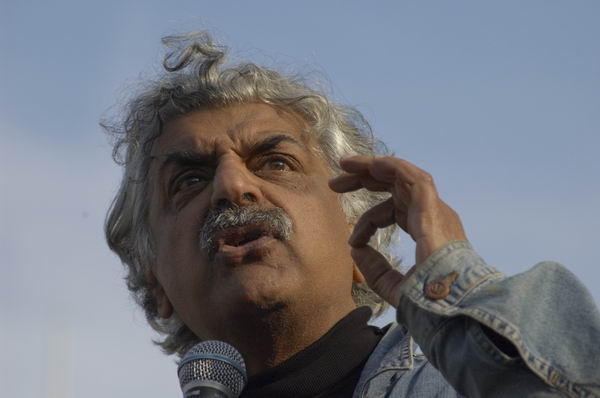
© 2005 Peter MarshallThis might make a good poster in the unlikely event that Tariq Ali were ever to become our Prime Minister!

Photography Crunch

Photographers have perhaps always complained about hard times – and they have often been harder for the best photographers, as for example a reading of Edward Weston‘s Daybooks will show. But the widely published news about rates at The Sun which I read on the Press Gazette site last week led to complaints that these were below 1993 prices. The rates for photos in The Times are even lower, with a minimum rate of £54 and a postcard size image (11-25 square inches) earning £90.

Of course back in the 90s I can remember complaining that the fee one magazine was offering for a story and pictures was actually less than they had paid me for a similar feature fifteen years earlier. And those ‘Fleet Street’ rates above are of course considerably higher than anyone can expect from the regional and local press, where conversations often end with the mention of any payment at all, and fees are generally minimal.

In one of the comments to the Press Gazette feature, Roger Maynard takes things back further still, suggesting that lineage rates, also cut, are “not much higher than the sort of lineage paid back in the sixties...”

It makes me wonder what future there is if any for the press as we know it – on wood pulp or on line. There just don’t seem to be enough peanuts going round at the moment to sustain anything really worth publishing.

Personally I’m happier to publish my work in different ways, even ones that don’t produce any direct income but which do allow me to write what I want to say and publish the pictures I want to publish – if for various reasons not always exactly how I would like. So I’ll write stories for Indymedia or NowPublic and of course here on >Re:PHOTO and My London Diary.  The audiences may be smaller, but they are certainly, dear reader, much more select, intelligent and interested.

Of course you reading this are one of a growing number who know that various blogs and web sites – including but certainly not exclusively those from the commercial media – are increasingly how we keep in touch with what is happening.  While too much of the press is at least metaphorically down in the gutter looking up the skirts of celebs – thanks to the BJP I learnt a new word for this type of photographer this week, “crotchdog.” Much to my surprise, despite the snow paralysis of the UK this week’s issue arrived on my doormat at the usual time so congratulations to them on this.


Suburban snow in Staines

But almost all other areas of photography are also feeling the pinch – even advertising and fashion. Commercial galleries around the world are hitting hard times – and according to Bloomberg, prices of some of Hiroshi Sugimoto’s seacapes currently on show the the Gagosian gallery have been reduced from $450,000 to $360,000!

According to a news item this week’s BJP (like the link above this may need a subscriber login, but in this case you can read the original press release at CIPA), one area still looking healthy is sales of digital SLRs. The  Camera and Imaging Products Association forecast a 6% increase in worldwide DSLR sales over 2008, to more than 10 million. Not only a staggering number of cameras, but even more mind-boggling the number of pictures these will produce – and what will happen to them?

What will happen in the UK at least to the prices for DSLRs is that they will rise. I’ve left thinking about buying a Nikon D700 rather too long. A few weeks ago I could have bought one for just over £1400. This week the cheapest I could find was £1625, an increase of £200. This week’s price is likely to look cheap in a few months time.

However, anything dealing in any way with financial advice coming from me should carry a prominent health warning. I ignored the professional advice a few years ago to take my savings out of unit trusts, signed up for a fixed price deal on gas when prices went sky-high last summer and more.

How Long is a Hundred Years?

I did go into my darkroom last week, but only to start a job I’ve been putting off for 18 months, filing the last films that I developed. And while I was there I also tidied up the 50 or so films still waiting to be processed whenever I get round to it. So now I know there are exactly 27 36 exposure cassettes of TCN400, 15 of Fuji colour neg, 2 120 rolls of same and most intriguingly, 2 cassettes of T-Max 100.  Much of this was shot alongside digital when I wasn’t too sure I could get what I wanted from the digital – but found I could. But I’ve not the slightest idea what can be on that T-Max, and some day soon my curiosity will force me to dev it to find out.

Of course, any b/w liquid dev I still have lurking will by now be a murky brown, so I’ll either have to find a shop that still stocks such esoteric materials or get out the recipe book and those jars of “raw chemicals” stashed in a corner of my loft next to the antique chemical balance.

All of the rest needs C41 and just one of the things that puts me off processing it is wondering whether those colour chemicals I have are still OK to use – but of course the longer I wait the less likely they are to be usable.

It’s even longer than 18 months since I made a print in the darkroom. I first ordered Piezography inks from Jon Cone in Vermont in 2000 and was immediately hooked on the quality of output I could get on matte papers such as Hahnemuhle’s German Etching. It was platinum without the hassle, though not without some problems, most of which Cone solved for me with the introduction of his “new generation” Piezotone inks in 2002 – and as a beta tester for the icc profiles I made sure they worked perfectly on my Epson 1160 printer. So well that I’ve yet to move on to his even better Neutral K7 inks, and although the inks I’m using are well past their best before dates they still seem fine. And unlike some unlucky Epson owners I’ve never had problems with these inks clogging my print heads.

I’ve also been printing glossy black and white and colour using Epson Ultrachrome K3 inks (in an Epson R2400) and Epson’s ABW (Advanced Black and White printing) using papers such Permajet Fibre Base Gloss, which really does give prints that match darkroom output – and rather better than some modern papers. The increased control from digital printing is such an advantage with ‘difficult’ prints too. But something I read today makes me think I’ll have to change my ideas on this.

What started me thinking about this was a very long post by Jon Cone on the Yahoo Piezography3000 group (you will need to sign on with a Yahoo ID to read it), in which he discusses what is meant by a 100 year print – as based on the lifetimes that inkjet manufacturers such as HP, Epson and Canon quote, using the tests by Wilhelm Imaging Research (WIR.)

As Cone makes clear, WIR figures are based on an end point of “nearly 35% fade or discoloration” while much smaller differences of around 5% are actually visible.  He suggests the 35% level was set as something achievable with chemical colour prints over reasonable periods when Wilhelm started testing – at a time when we had just realised that they deteriorated greatly.  He writes: “I think most b&w photographers would be more than willing to have thrown [the print] away long before” that level is reached.  How long before is the real thing we need to know, and frankly we don’t have the information needed to even make a reasonable guess.

The industry standard also prevents manufacturers from releasing detailed test results – they can only state a figure in years and the light level of 450Lux 8 hours per day. Because of the way that the tests are commissioned and can be reported, inks that show a truly acceptable under 5% of fading in a 100 year test end up with the same rating as those that test close to the limit – at which level a print would have long been fit only for the bin.

So the answer to that vital question for a print with a ‘100 Year’ WIR rating could be almost anything. It could be as low as 25 years or as high as 250, and that 25 year possibility worries me (though it should worry younger photographers more.)  It would obviously be a help if the actual ‘100 Year’ terminal result – whether it was 2.8 or 28% fading – was published and we could then make up our mind, but I can’t help the conclusion that the way in which WIR results are published is calculated to benefit the manufacturers rather than provide useful information to photographers.

Cone continues to say that WIR has actually now stated that its predictions can no longer be relied on for inksets that produce b/w prints by combining black and colour inks – as in Epson’s ABW and prints made using Canon and HP ink sets. He also discusses the new i*metric proposed by WIR which is in public beta and gives an explanation of why this too fails to give satisfactory predictions.

Cone has published data  from many of his own tests on his own inks. In the post (and it is worth reading in full, as well as the discussion that follows) he discusses the fading of the current Piezography inks which he states are designed to fade less than 5% (ie below the visible level) under an illumination test of approximately 150 years at 450Lux 8 hours per day.

A further post by Cone in the thread (the latest as I write, but its a thread I’ll be following with interest) looks at the problems of the archival nature of paper and states that testing by WIR ignores this. He is currently carrying out tests on Epson K3 ABW versus Piezography K7 and PiezoTone which he started using Epson Velvet Fine Art paper. Epson describes this as:

  • Acid free base to preserve fine art and photos
  • 100% cotton rag for archivability

and they publish a Permanence rating from WIR of 61 years.

This figure is perhaps confirmed by Cone’s test, because he says that it “yellowed so bad after 60 years LUX I had to scrap it.”  He is now repeating the test but using Hahnemuhle Photo Rag paper.

My Conclusions

1. If you are a photographer selling prints, you need to be very careful in what you say about archival quality or lifetime of your prints. Most current claims are incorrect because the tests they are based on are not related to visual print quality.

2. If you are producing black and white prints you need to use specialist inks (such as Cone’s) and papers to produce prints with lifetimes comparable to traditional ‘archival’ silver prints.  If like me you want to use Epson’s Ultrachrome K3 inks for colour and also to make glossy black and white prints on the same printer, then you might be advised to look at printing methods that don’t use the colour inks as well. The K3 set includes black, light black and light light black and it is possible with third party software such as Quad Tone Rip or BowHaus’s IJM/OPC to print using just these.

3. If you are a museum which wants photographs as a long term record you should be concentrating on the archival storage of digital files as the primary record rather than prints on paper. (And of course it goes without saying that you also need to be aware of the problems of long-term digital storage – and their solutions.)

4. I dislike posts with titles that ask a question and then fail to give an answer, but really there isn’t one. If you use most inks and papers that are rated at ‘100 Years’ and keep them under reasonably sensible conditions – avoiding strong sources of UV or materials that give out gases such as rubber etc, then they will probably last without noticeable fading for at least 15 years. If you chose the right inks and paper, probably ten times that.

Tamils March in London – BBC Fails Again

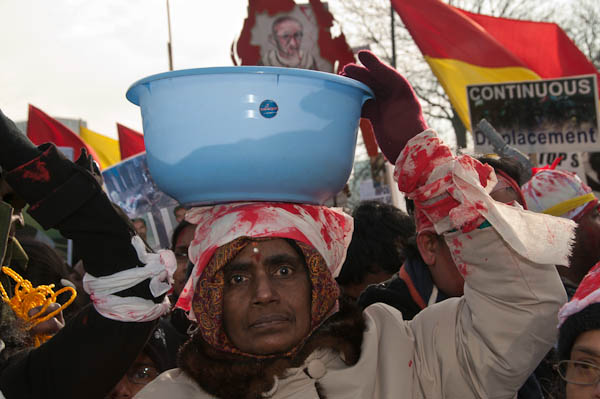
Around 100,000 Tamils marched through Westminster today to persuade our government to take action over the Sri Lankan genocide of the Tamil population, to shame our media into breaking their silence over what is happening there and to call for the establishment of a Tamil homeland, Tamil Eelam.
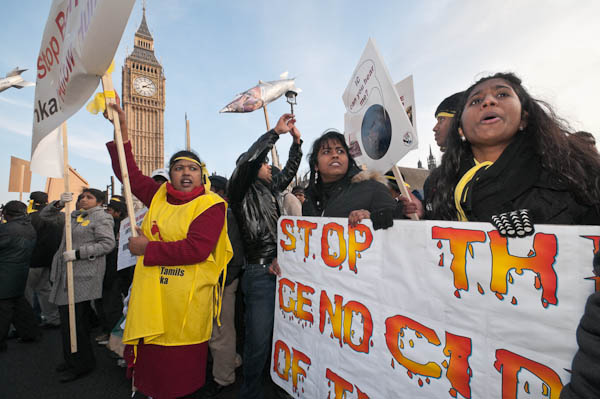
© 2009 Peter Marshall.
Marchers at the Houses of Parliament – with Big Ben

For a second time this month, I felt ashamed of the BBC. Ashamed because I grew up believing that our national broadcasting organisation was the best in the world (and in some ways it still is.)

Of course its first glaring failure this month was the kowtowing of its management to Israel when they decided not to broadcast the Gaza appeal. A second blot on the organisation came today. This evening, fresh home from this massive demonstration in London by Tamils, I turned on Radio 4 for the six o’clock News and found to my amazement that it hadn’t happened. There was not the slightest mention of it. Later I checked the BBC News web page – again nothing.

Probably the largest popular demonstration in the country since the massive anti Iraq war demo in 2003 is news. Between a third and a half of the UK’s Tamil population on the streets in Westminster is news. And certainly the genocide that is taking place in Sri Lanka, with government troops shelling areas packed with civilian refugees is news. But apparently not for the BBC.

Sri Lanka – Background

Sri Lanka is another of Britain’s colonial cockups. When Britain took over Ceylon in 1796 there were separate kingdoms, each with several thousand years of history and which had been treated separately by the Portuguese and Dutch colonists. But in 1833 the British decided to unite the Tamil and Sinhalese areas to make their administration more convenient. And when we got out of India and gave Ceylon its independence in 1948, little if any thought seemed to have been given to the division. The constitution – on a Westminster model – handed the Sinhalese a built-in majority and had no safeguards for the minority Tamils, around 30% of the population.

Most Tamils in Sri Lanka are Hindu, while nearly all the Sinhalese are Buddhist. A considerable minority – over 15% of Tamils are Christian and there are also some Tamil-speaking Muslims, who regard themselves as a separate group from the other Tamils

Within months, the government had deprived more than a million Tamils of their citizenship. These were the descendants of Tamils the British brought from India in 1834 to work their colony – and who joined Ceylon’s Tamils who had lived there for at least 2500 years. Many Tamils were also driven from their homes and replaced by Sinhalese in a deliberate policy to reduce the Tamil domination of key Tamil areas.

The government voted to make Sinhala the official language, with Tamil and English having only a secondary status in 1956, and many Tamils in government employ lost their jobs. A peaceful protest inspired by the example of Ghandi was met by riots encouraged by the government, with police, army and government taking no action to stop the killings.

The last official links with the UK were broken in 1972 when the government declared Ceylon to be a Buddhist republic, Sri Lanka, although it remained a member of the Commonwealth. The setting up of the republic further marginalised the Hindu, Christian and Muslim Tamils.

In 1983 the government took part in a massive pogrom against Tamils which was widely reported in the international media. It was the start of a series of major actions against Tamils that continue to this day, including  bombings, tortures, rape, the assasinations of human rights activists, politicians and aid workers.

The response of the Tamil people was to try and establish a Tamil state, Tamil Eelam, and a key organisation in this has been the Tamil Tigers (Liberation Tigers of Tamil Eelam or LTTE.) The LTTE carried out a number of attacks and was for some years in effective control of Tamil areas in the north of the island, setting up banks, courts, social services and other aspects of civil administration in some areas.  This infrastructure has been a major target for the Sri Lankan Army and Air Force with much being destroyed or captured.

The LTTE made headlines across the world with some of its attacks, including a suicide bomb at the country’s major Buddhist temple in 1998 in which 16 people were killed and a raid on the international airport in Colombo which destroyed several aircraft in 2001. But government restrictions on newspapers and journalists mean that they have effective control of the news and most of what happens in the Tamil areas is not reported.

There have been various attempts at peace settlements, particularly since 2000 when Norway became involved as an intermediary. Both sides accuse the other of breaking every agreement made, in particular over agreements to work towards a federal state.

The Sri Lankan Army appears to feel that at last it has the Tamil Tigers on the run and is determined to try and finish them off, whatever the cost in civilian deaths and injuries, bombing and shelling areas where they think the Tigers are hiding and where they know hundreds of thousands of civilians have taken refuge.  Civilians that manage to escape these areas have been put into camps where the world’s press and humanitarian organisations are refused access – and about which we can only presume the worst.

Saturday’s march
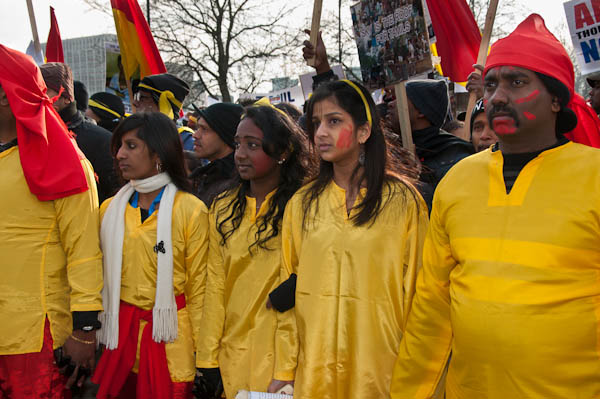
© 2009 Peter Marshall.
Demonstrators dressed in yellow and red get ready to march

But I am only reporting from Westminster, and the massive demonstration there, united in its strength of feeling and dedicated and intense in its demand for an independent Tamil homeland, Tamil Eelam, in the Tamil area of Sri Lanka. Although the chanting was loud and feelings were rightly running high against the atrocities, with street theatre acting out the attacks of the Sri Lankan army on the people and children and adults dressed in bandages and blood (or rather red dye) stained clothing, there seemed little danger of public disorder.
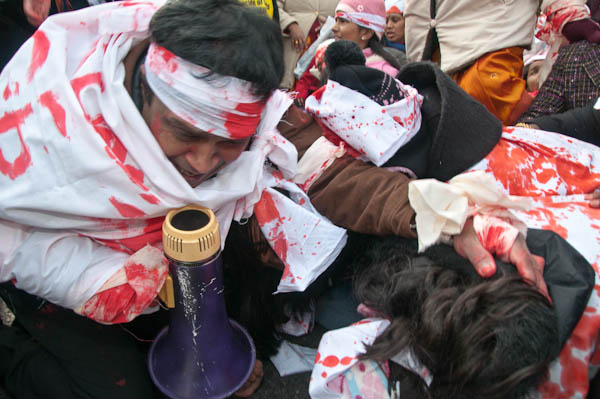
© 2009 Peter Marshall.

When I arrived around 12.40, the streets from Vauxhall station to the assembly point by the Tate Gallery were already crowded with people and I had a job to push my way through to the front of the march – although fortunately everyone was very polite and helpful (including the stewards and police – this was a march it was a delight to photograph.) It was a march that never really started, but from a little before 2pm slowly edged its way forward in small steps, and by a little after 3pm the front of the march was in Parliament Square.
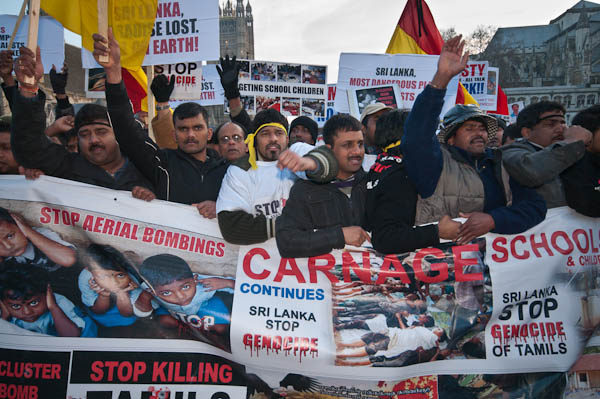
© 2009 Peter Marshall.
Marchers outside the Houses of Parliament

Although there are over 50 million Tamils in India and only 3.1 million in Sri Lanka, most of the the UK’s 200,000 or so (estimates range from 150-300,000) come from Sri Lanka as a result of the discrimination and persecution their community has suffered there at least since the 1960s.  Most of them live in London, particularly in East Ham, Walthamstow, Brent, Merton and Croydon. Among the Tamils in the UK are around 2,500 NHS doctors.

Many of the police along the route were in fireproof clothing, and stood clutching fire extinguishers with the pins removed for immediate action. They were not fearing a burning of flags or some incendiary attack on Parliament, but were ready in case some individual attempted to burn themselves to death as a protest. Fortunately they did not need to rush into action.

It was a very slow march up past Parliament, with people stopping at intervals to sit down on the road, to the considerable annoyance of the police, who at times made some pretty ineffectual attempts to speed the march up. But there were so many demonstrators they were powerless; even though the demonstrators generally law-abiding they were determined to have their day and take their time.
© 2009 Peter Marshall.
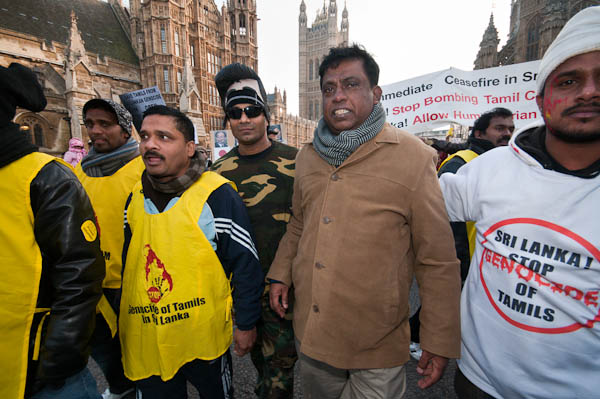
Sri Lankan MP, M K Shivaji Lingam (inn brown coat)

Among those marching was at least one Sri Lankan MP, M K Shivaji Lingam of the Tamil National Alliance (TNA), who has stated that “it will be impossible to crush or destroy the LTTE (Liberation Tigers of Tamil Eelam) militarily” and that “Hindu culture (in Sri Lanka) is at stake” threatened by the attacks by government forces that have taken over and damaged many Hindu shrines. In December he visited India and obtained the support of several Hindu groups for the Tamil cause.

© 2009 Peter Marshall.

I left around an hour later, with marchers still streaming past the Houses of Parliament, with the end of the march still coming up Millbank, and Horseferry Road just reopening to traffic. Bringing up the rear was the decorated bus or ‘tiara’ built in Karachi for Dalawar Chaudhry who owns a restaurant in Southall, which as well as its normal extensive decoration had posters calling for an end to the ethnic cleansing and highlighting the killing of politicians and human rights activists in Sri Lanka.

More pictures from the event on My London Diary shortly
Chinese New Year

London today celebrates the Chinese New Year, the Year of the Ox, but I don’t feel any great need to go and take pictures, or indeed to go and join in the celebrations.

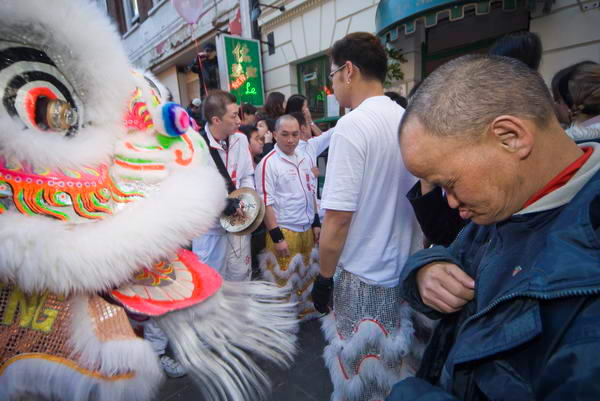
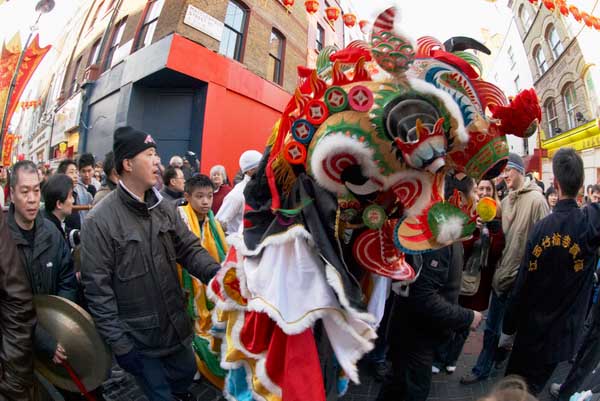
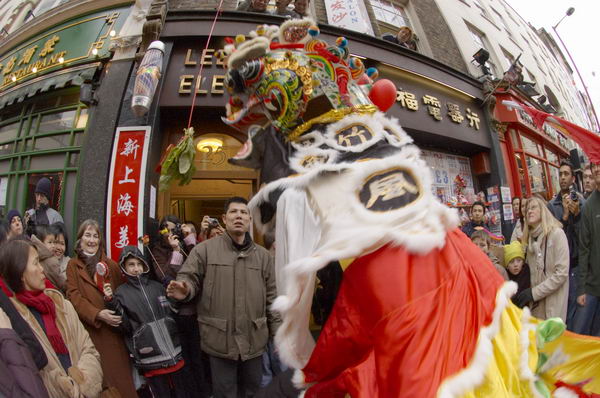
I’ve nothing against the Chinese, and I’ve been to the celebrations in London most years. The roads will be crowded for the parade and later in the day the streets of Soho’s Chinatown will be packed to the gunnels (or gunwales) with crowds trying to watch as the lion dancers and their teams of drummers visit the many shops and leap at the hanging greens above their doorways, or queue to eat in the many restaurants.

© 2008 Peter Marshall
Chinese New Year, Soho, London 2008

It’s certainly a spectacle worth seeing, but I’ve seen it before and photographed it many times and don’t feel a need to repeat the experience. Looking at the pictures from last year or earlier years

© 2006 Peter Marshall
Chinese New Year, Soho, London 2006

© 2005 Peter Marshall
Chinese New Year, Soho, London 2005

I feel I’m simply repeating myself (though of course I did take other pictures:)

© 2004 Peter Marshall
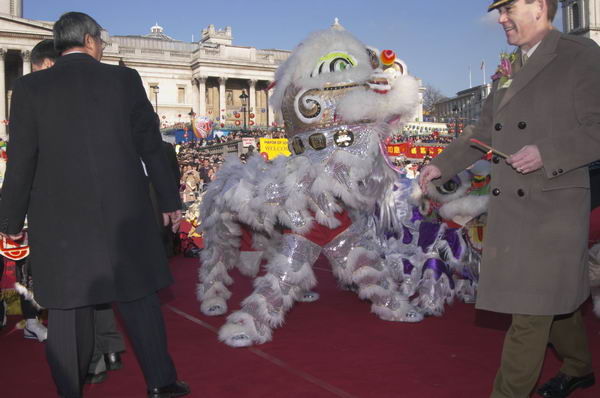
Chinese New Year, Trafalgar Square, London 2004

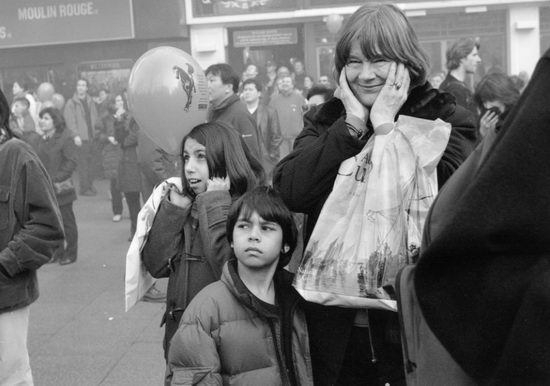
but perhaps the best are from earlier years where I shot mainly in black and white and concentrated on the people

© 2002 Peter Marshall
Firecrackers, Chinese New Year, Soho, London 2002

Of course it’s an event that brings out the Flickrati in droves (again I’ve nothing against them but don’t feel moved to join them, though I do have a free account with 97 pictures there) and where everyman and her dog has a camera and is pushing to get pictures – so, unlike some of the other events I photograph I don’t think my pictures will be missed.

And it’s actually much harder to work with amateurs than with a whole pack of pros.

Pros tend to be aware of other photographers and to “do as they would wish to be done by“, at least to some extent working together as a team and not deliberately impeding others; a certain unwritten etiquette applies (though TV crews sometimes think they are God and treat still photographers as dirt.)

© 2006 Peter Marshall
At the last second a hand appeared blocking my view

But holding a camera phone at arms length and concentrating on its small screen makes some people (mainly young and male and self-assured) completely oblivious to the presence of others as they happily walk right in front of me as I’m photographing or hold their phone right in front of my lens.

Clapton Park

This is my latest postcard, printed a couple of weeks ago to take to Hackney Wick, where the Wick Curiosity Shop was having a stall at the Hackney Wick: 2012 Community Meeting.

Clapton Park Estate, Lea Navigation © 1982 Peter Marshall

I wasn’t sure when I sent this to the printers exactly where I had taken the picture – it was after all 27 years ago.  At the time I’d only taken around 30,000 black and white photographs (and a few thousand transparencies) and could probably have told you exactly where each one was made – it was only a few years later that I started making more careful records. Occasionally I’d scribble the odd note on the contact sheets, but these were few and far between.

Looking carefully at the image, and at the pictures before and after it on the contact sheet I can work out that it shows the Clapton Park Estate, opposite Hackney Marsh.

Hackney holds some kind of world record for the 22 tower blocks it has blown up.  There were 5 blocks here (I think one is behind the others in this shot.) Two were blown up in 1993, another two in 1995 and the fifth was painted pink and converted into luxury flats.

Remember the Holocaust

© 2006 Peter Marshall
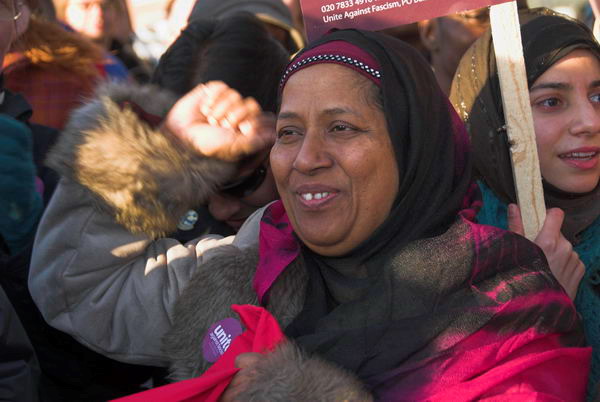
Unite against Facism – Woman in rally against the BNP at Dagenham, 2006

Today, 27th January is National Holocaust Memorial Day, which commemorates the tragic loss of life in the genocides of World War II, in Cambodia, Bosnia, Rwanda and Darfur. The date is the anniversary of the liberation of the concentration camp at Auschwitz-Birkenau.

© 2007 Peter Marshall
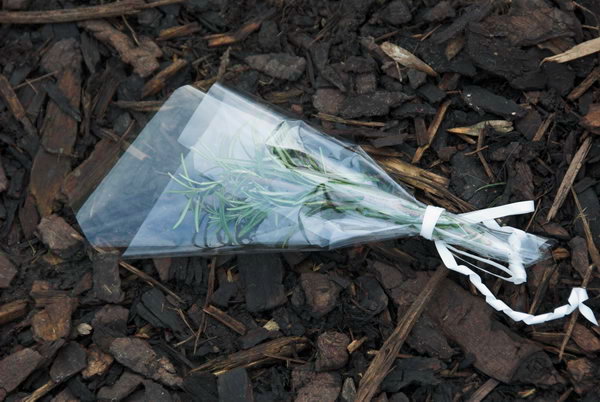
At the foot of the tree

I’m not attending any of the events that take place today, but have taken pictures related to it in the past.  One of the annual ceremonies is held at the Soviet War Memorial in Geraldine Mary Harmsworth park, next to the Imperial War Museum where a small tree was planted in memory of those who perished in the Holocaust 1939-45.

© 2007 Peter Marshall
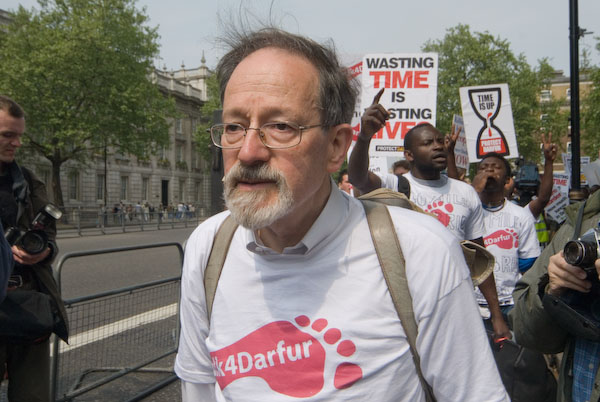
Martin Stern leads the walkers from Cambridge to Downing St

One inspiring man who I met on a number of demonstrations (and photographed) was Leon Greenman, Auschwitz Survivor 98288, born in Whitechapel, who well into his nineties took an active part in campaigning against fascism, both through educational work and through the Anti-Nazi League and Unite Against Fascism, who sadly died last year.  Another survivor was Martin Stern, taken by the Nazis in Holland at the age of five and one of only around a hundred of 15,000 children sent to Terezin to survive, who in 2007 led the Cambridge to London ‘Walk 4 Darfur’, part of the 2007 International Day of Action on Darfur.

© 2005 Peter Marshall

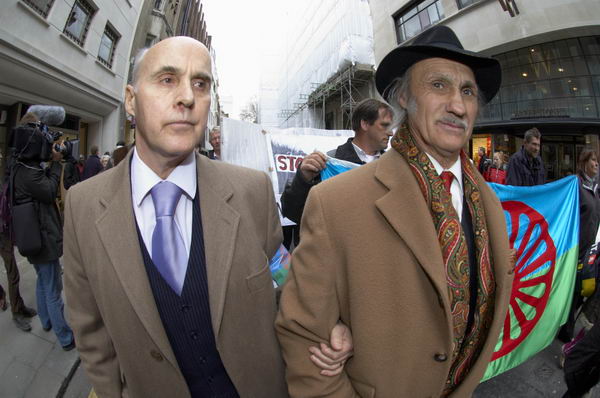
Roma were also persecuted and killed by the Nazis, and in 2004 I photographed the March Against Racism on Roma Nation Day, while a few months ago I was with them outside the Italian Embassy in a protest against ethnic cleansing taking place now in Italy.

BBC Ban on Humanitarian Appeal

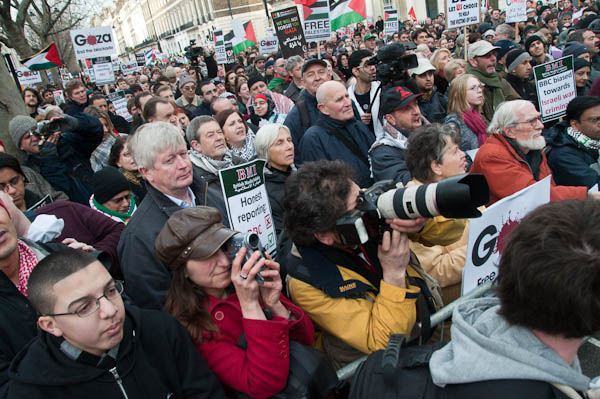
Around 10,000 people attended a demonstration at the BBC building in central London on Saturday 24 Jan, 2009, in protest against the continuing siege of Gaza and to show their contempt at the partisan decision by the BBC not to broadcast the emergency appeal for Gaza. Protesters marched from a rally there to Trafalgar Square.

© 2009 Peter Marshall.

I woke this morning to hear Tony Benn being interviewed on Radio 4 about the BBC decision not to broadcast the Disasters Emergency Committee emergency appeal for humanitarian aid for Gaza. Taken on the spurious grounds of ‘impartiality’, it is a decision that is clearly partisan, placing the Corporation firmly on the side of the government of Israel and their sick fiction that there is no humanitarian crisis there.

I was delighted to be able to congratulate him on this performance in person as he sat outside Broadcasting House. In the interview he gave the details of the DEC appeal on air (see below), and he told me he had repeated this in BBC TV News interview. He also told me that the whole Today programme studio had been on his side, against the decision taken by the BBC hierarchy.

If you missed his contribution you can hear it again on the BBC web site. He tells people they can make cheques payable to the ‘Disaster Emergency committee Gaza Crisis’ and send them to PO Box 999, London EC3A 3AA, or go to any Post Office and make a payment quoting Freepay Number 1210. You can also go to the DEC web site and make a contribution,

Later the Today programme broadcast Caroline Thomson, one of the BBC bosses attempting to justify the decision. Frankly what she said was appalling and my immediate response was to log on to my computer and send my complaint to the BBC. You can hear her on the Today site, as well as International Development Secretary Douglas Alexander who asked the BBC to think again.

© 2009 Peter Marshall.
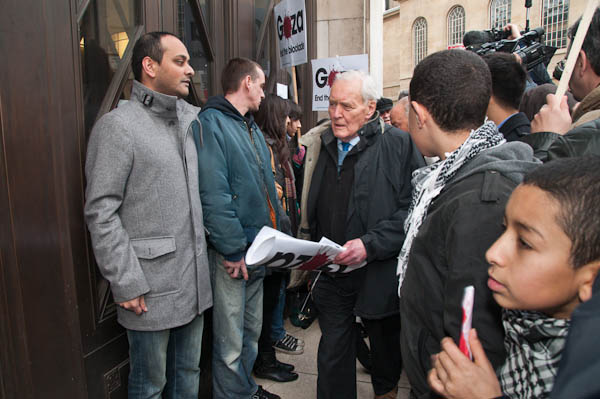
Tony Benn leads a small group into Broadcasting House to deliver a letter of protest

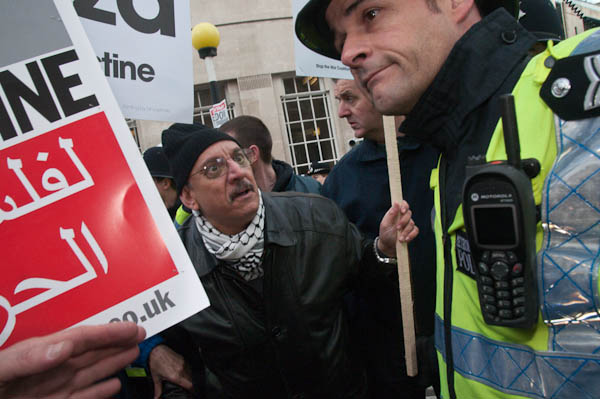
After a short press conference outside Broadcasting House, Tony Benn led others into the BBC building to deliver a letter of protest. Around 20 people entered and then a policeman stood in front of me and prevented me from following them. But they soon came out and  moved up the road to where the rally was to take place. Police pushed a number of demonstrators who wanted to continue to demonstrate outside the BBC across the road away from the building, and tempers got a little raised, but there was no real violence.

Speaker after speaker denounced the BBC decision and called on them to change their mind, and there was considerable cheering when it was announced that other broadcasters had decided to run the appeal. Benn in his speech forecast that the pressure on the BBC which was coming from all sections of the community would soon force them to change their mind.

The demonstration had been planned long before the DEC appeal became an issue, and the starting point at Broadcasting House was chosen to draw attention to the lack of honest and unbiased coverage of the Israeli attack on Gaza by the BBC. This was not  the fault of the many journalists who – in so far as the Israeli press ban had allowed – had worked as well as they could, but an institutional bias, in part resulting from the same kind of misapplication of the idea of impartiality that led them to the ridiculous decision over the DEC appeal. The demonstrations main aims, also reflected in the speeches at the rally were to call for an end to the blockade of Gaza, for a stop on arms sales to Israel and for the Israeli war criminals to be brought to justice.

The rally overran and the march proceeded to Trafalgar Square directly rather than as had originally been planned going past Downing Street, and shoes were thrown on the road outside the BBC rather than there. A few people were arrested for obstructing the police as the march reached Piccadilly Circus, and stewards halted the march, apparently demanding that those arrested should be released before they went on. But after around ten minutes the march moved on anyway to a final rally at Trafalgar Square. As this got under way I left, walking past many police vans parked around the square and in Whitehall. There had been a very strong police presence throughout.

At home I read the Press Association report of the demonstration. Ridiculously it stated there had been 400 demonstrators at the BBC, and I think this was the figure used in the BBC news I heard at 6pm. On their web site the BBC now says 2,000. The report on Sky quotes a police estimate of 5,000 – which would normally mean there were 10,000 on the march. It would seem that the PA reporter only looked at the few people on the pavement outside the BBC for what was essentially a press conference (the police wouldn’t allow demonstrators to remain there) and ignored – or didn’t notice  – the thousands across the road.

© 2009 Peter Marshall.
Police clear demonstrators away from Broadcasting House

More pictures on My London Diary