All Fools Day Disappointments

April started badly for me.  It was a day with demonstrations all over London and although I went to some and took some pictures, I find them a little disappointing.
© 2009 Peter Marshall
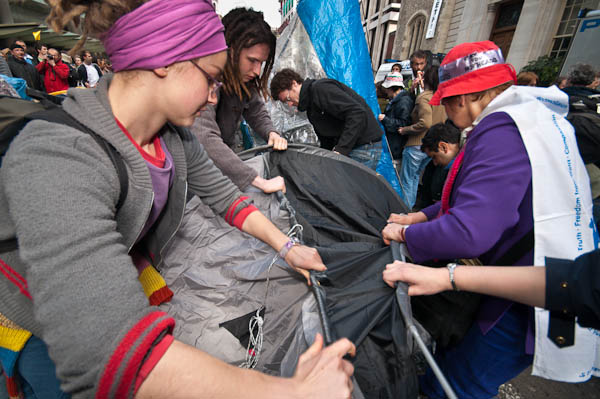
Many hands make light work of putting up tents for the Climate Camp

Not that they are particularly bad pictures. Some I would normally have been happy with. But when I look at some of the pictures other people took on the day I can see that I missed most of the action, although by the time I left Bishopsgate it seemed pretty clear to me that the police were spoiling for action.
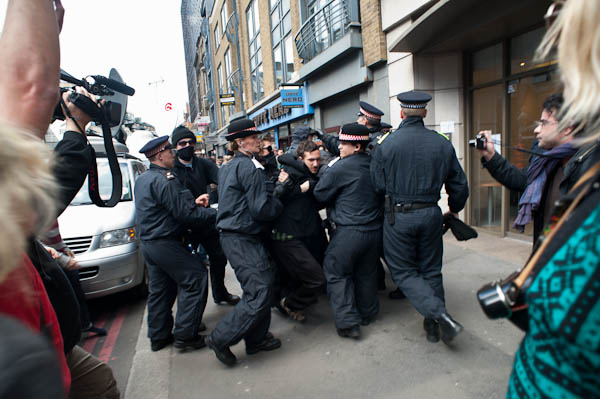
© 2009 Peter Marshall.
Police squad attack protester

Really I wasn’t equipped for it. Wednesday was a day when photographers needed hard hats and shin pads to stay with things, as well as a strong bladder and a masochistic streak. The people who got the pictures were with the demonstrators, held for hours by the police, then in the middle when the police horses charged or the riot police moved in, lashing out indiscriminately.

It was a day when I felt sickened when I watched the images and the videos – mainly not yet shown on the mainstream media. Watched the peaceful Climate Camp protesters holding up their hands and chanting “We are not a riot” as the riot police stormed in, batoning everyone on the street. There was a level of unprovoked violence by police unprecedented in this country both on Bishopsgate and around the Bank of England. One man who was there has died.

It should have been headline news on the BBC. There were cameras there and video available, but they had a different agenda, losing most of the respect I still retained for them.  They reported the death as ‘unrelated’ to the events, which appears to be simply untrue.  Some of the newspapers did a little better, but not much, even those who had reporters and photographers there.  It isn’t a great deal of use having a free press if it doesn’t do its job.

I hope there will be a full and wide-ranging enquiry into the aggressive policing, although I don’t have a great deal of confidence – under our current government they seem to be able to act with complete disregard for the rule of law. If there is an enquiry it will almost certainly be a whitewash.

I wasn’t around when things went up. Partly because I went to cover another event – the official ‘Jobs not Bombs’ march through the centre of London organised by Stop the War, CND, BMI and Palestine Solidarity, which, as expected was a worthy if not particularly exciting occasion.
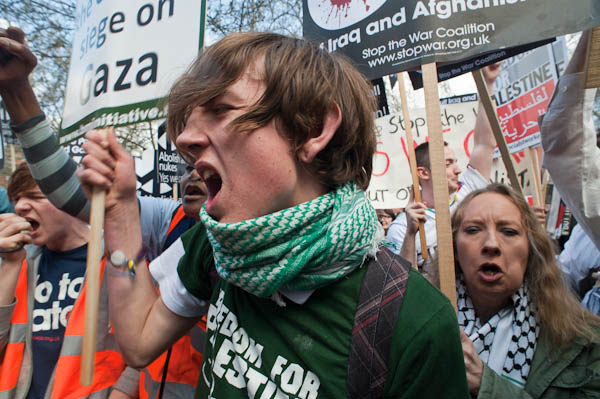
© 2009 Peter Marshall.

Then somewhere, somehow I lost my SB800 flash. It could have been stolen while I was travelling on the underground – I often forget to close my bag properly, or I may have dropped it climbing up for a better viewpoint, perhaps onto the plinth at Trafalgar Square. All I know is that I put my hand into my bag to put it back on the camera and it wasn’t there.

Otherwise I might have gone back to the City from Trafalgar Square and got a little more of the action, though more likely I would have travelled out to the Excel Centre where the Campaign against Climate Change were demonstrating with their iceberg. But without a flash, an evening demonstration didn’t seem worth going to, and I took an early night instead.

I’ve not been lucky with SB800s, which I think are a great flash unit. This was my third, and the second I’ve lost.  One was stolen from my bag. Another failed after two weeks and it took me three months to get a replacement unit – which then failed within days of the end of its guarantee and is sitting on my desk waiting for me to take it to Nikon for expensive servicing.

The SB800 is the best flash unit I’ve used – when it is working, and when powered by five 2500 millamp hour NiMnH batteries has an extremely fast re-cycle time and keeps working through a day of heavy use – more than 500 flashes. Unfortunately it has now been replaced by the SB900 which seems rather less attractive as well as more expensive.

So I’ve ordered a cheap Nikon i-TTL compatible flash – at around a fifth of the price of the SB800 – and will see how that performs. I must also get round to taking the other SB800 in for service. In the meantime I’m having to work with a Nikon SB80DX which doesn’t combine well with the latest Nikons.

Although Nikon’s flash units are great when they are working, they just don’t seem to have the robust reliability of the old workhorse units like the Vivitars I used to rely on.

I’d gone out to photograph the demonstrations, not police violence.  And so far as that went I suppose I didn’t do badly. You can see the G20 Meltdown with two of the four Horsefolk of the Apocalypse, the start of the Climate Camp on Bishopgate and the Jobs not Bombs march on My London Diary.
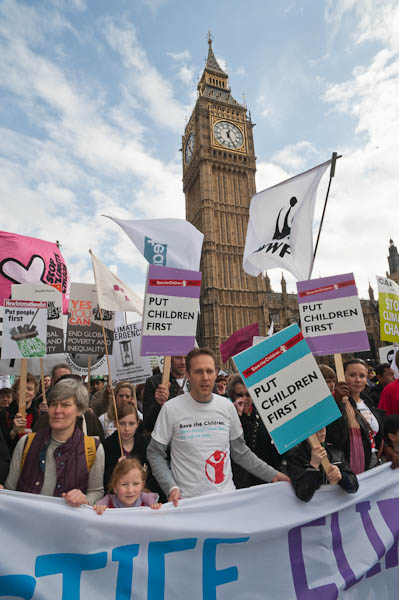
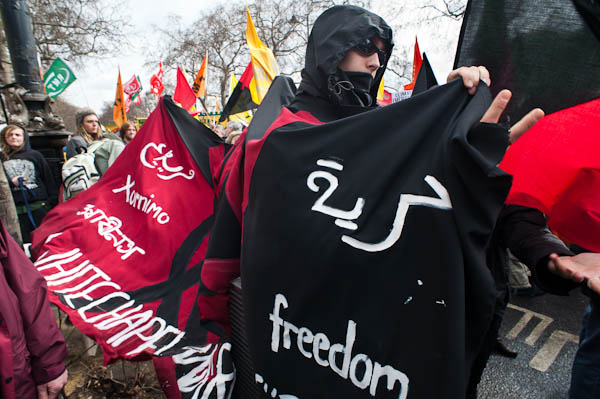
Jobs Justice Climate: Put People First

The G20 meeting in London’s docklands this Thursday brought protesters out in force on to the streets of London on Saturday, as well as prognostications of violence and doom for April 1 and 2 from the authorities and some of the gutter press. But the first major event, backed by over 150 groups and attended by around 50,000 people turned out to be entirely peaceful, if rather chaotic.

© 2009 Peter Marshall.

Police led the front of the march at a brisk walking pace, although I managed to sneak in and slow it down a little while I took pictures as it passed the Houses of Parliament, but the groups behind had problems in keeping up, with a number of large gaps developing – so the front of the march reached Hyde Park around two hours before the tail. The major hold-up was apparently caused by a police over-reaction when a few anarchists staged a sit-down.

© 2009 Peter Marshall

The march was enlivened by a little theatre or various kinds, but almost everyone was on their best behaviour except for a curious incident at Speakers Corner where the alternative end of march rally was being held. People who were there report that a mysterious figure in black dumped some tightly wrapped packages and moved quickly away. When some of the demonstrators investigated these and found them to contain catapults, they kicked them into a fenced off area away from the protest.  Before long, a police officer who seemed to know exactly what he was looking for came and found them.

© 2009 Peter Marshall
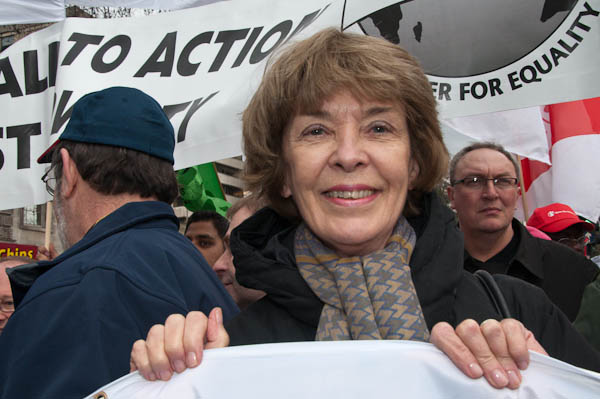
Susan George, whose books include ‘How the Other Half Dies‘ (1976)

You can see quite a few of my pictures of the event on My London Diary, though I’ve not yet had time to complete all the captions, though there is a little more about the event there.

Vintage?

I’ve written on various occasions over the years, here and elsewhere, about the cult of the vintage print.  As a photographer I find it ridiculous that people might regard the prints that I made thirty years ago more valuable than the far superior prints that I might make from those same negatives now.

We all of course get older, and some may get wiser, and certainly for many of us our ideas change, hopefully gaining in depth and insight. While those old prints we made back then simply degrade, our ideas mature and we can add to the work when we make new prints.  Valuing the older prints seldom makes sense.

Of course there may sometimes be aesthetic reasons for preferring the older work. In the immediate post-war period, Bill Brandt printed his work in an intense and moody fashion, at times because he was working for the block maker rather than the wall, knowing that a lower contrast and perhaps rather dull image was more suitable. He was working for the printed page rather than the print.

Later, as he aged, he turned to making much more contrasty prints, sometimes with very little in the mid-tone area. It was an age where the fashion was for high contrast high impact photography, particularly on the magazine page (though its arguable whether Brandt was a follower or helped to create this trend.)

Personally I loved the earlier dark and brooding versions of many of his pictures, far preferring those – for example in the first edition of his ‘Literary Britain’ to the later prints (yes, I do mean I prefer the book reproduction to the photographic prints.)  The first edition is also in most respects preferable to the later publication – though each has its merits and I have both.

But my preference is nothing to do with one being older than the other – vintage as opposed to later. It’s all about the actual quality of the work, and it is a fairly rare occasion where the early work is better. I’ve often been shocked by the poor quality of some high-priced ‘vintage prints’ on dealers stands at shows like Paris Photo – often prints made as proofs or press prints or even apparently rescued from the photographer’s rubbish bin.

Usually later prints are better prints, not least because of the availability of more sophisticated printing methods. For many photographs – and a good example would be the work of Tony Ray Jones – the ability to produce high quality scans and to print from these rather than direct from the negatives has produced superior results, not least by allowing far more precision in the dodging and burning required to get the most out of the images.

And ten years ago we were bemoaning the demise of so many classic high-quality black and white photographic papers, not least the famed Cadmium-rich Agfa Record Rapid, which after its reformulation on health and safety grounds never had quite the same appeal. But now we have papers and inks that can match or outdo virtually everything that was available in the ‘golden age’ of silver printing.

I own several Tony Ray-Jones prints.  One is something relatively rare, an exhibition print made by Ray-Jones  himself (he hated printing and wasn’t good at it, though this is an acceptable attempt), the rest are modern inkjet prints. And they are better prints despite only costing a few pounds.

It was a piece I read a week or so ago by Mike Johnston on The Online Photographer that prompted me to write again about this subject.  He finishes it with his thoughts on the subject that the should be only two things that matter about a photographic print; firstly whether it was made or approved by the photographer and secondly that it is a good print.I think I’d reduce that to one.

Our Green Government

I’m not sure that I’ll really be observing the World Wildlife Fund  ‘Earth Hour‘ tomorrow evening, although the only light I’ll need will be that from my computer screen as I frantically process the hundreds if not thousands of image files I will have made earlier in the day. Although since their web page wants you to take pictures and videos or write blog posts and tweet during the hour I guess that’s OK with them.

However I don’t think I’ll bother with that 1 hour movie of me struggling with Lightroom, even though it would have far too much action in it for the late Andy Warhol.

But it was mildly amusing to learn from Iain Dales Diary that perhaps to celebrate the event with the Government’s typical concern for Green issues that while they have asked everyone in Parliament to switch off all non-essential internal lights when they leave for the weekend and that non-essential floodlighting will be extinguished for Earth Hour itself, they also  sent round a e-mail to all staff telling them to ensure that every computer in the place is left switched on for the whole weekend.

© 2009 Peter Marshall.
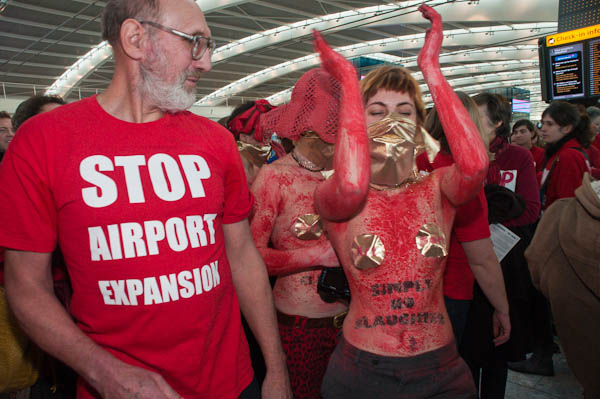
T5 Flashmob at Heathrow

It is rather like saying that Climate Change is the most important issue facing us, then announcing that they are going to build another runway at Heathrow.

Whirling Dervishes

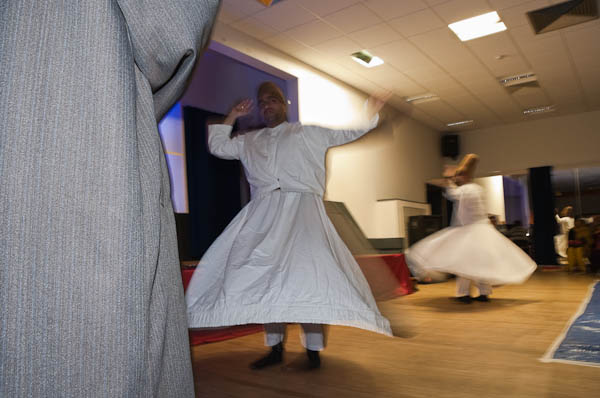
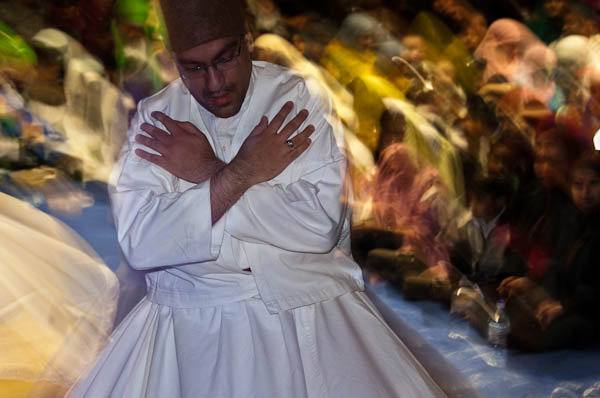
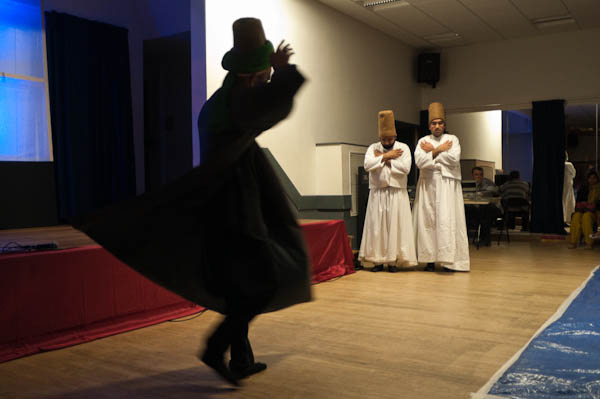
There were three of them, performing in in a dimly lit hall in a leisure centre in Tooting, at the Eid Milad-Un-Nabi celebrations of the birthday of the Prophet Muhammad organised by the Sunni Muslim Association, and I really couldn’t quite work out how to photograph them.

Working with flash seemed a good idea, since even with the D700 giving pretty good results at ISO 3200,  it was hard to get both enough depth of field and a sensible shutter speed, but even more of a problem was that the lighting in which they were performing was extremely uneven.  Using the flash, I also wanted to get some ambient exposure to avoid very dark backgrounds and also give some feeling of movement to the figures.

© 2009 Peter Marshall.

My decision in the heat of the moment was that 1/8 would probably give me enough blur and I set that as my slowest speed with flash. I set an ISO of 1250 as the18-200 zoom I was using only covered the smaller DX area and quality was more important, set the flash into TTL FP mode, the camera on P and then forgot about it, concentrating on getting pictures.

© 2009 Peter Marshall

I was also using the D300 with a 20mm wide open at f2.8 with no flash, which gave slightly underexposed results at around 1/60 ISO 1600. There were far fewer usable images from this, though I did get one with a fairly dramatic silhouette.

© 2009 Peter Marshall

You can see more pictures of the Whirling Dervishes as usual on My London Diary, where you can also read something about the deeply religious significance of their performance.  But they were only a small part of the event I photographed, and although they had particularly attracted me to the event, as usual it was the people rather than the performers that I think more interesting in the pictures that I took.

Vernal Equinox at Tower Hill

© 2009 Peter Marshall.

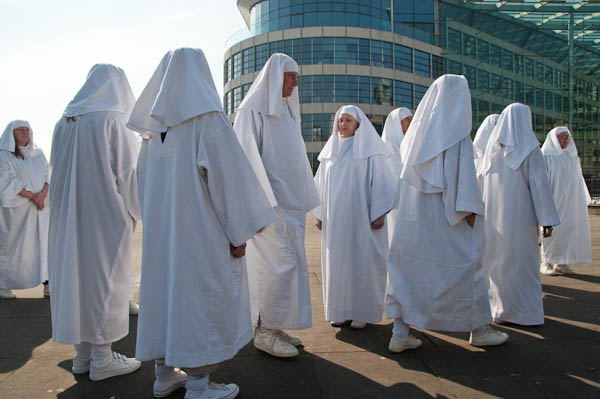
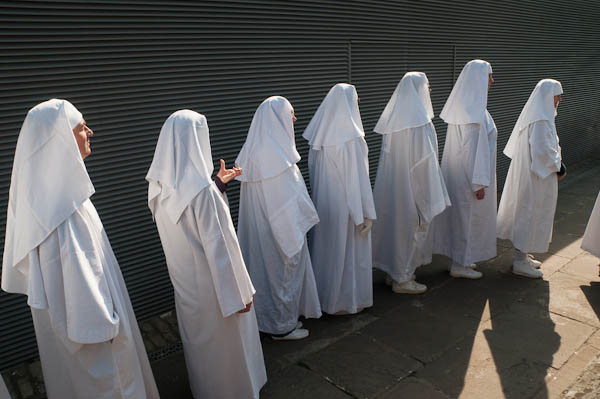
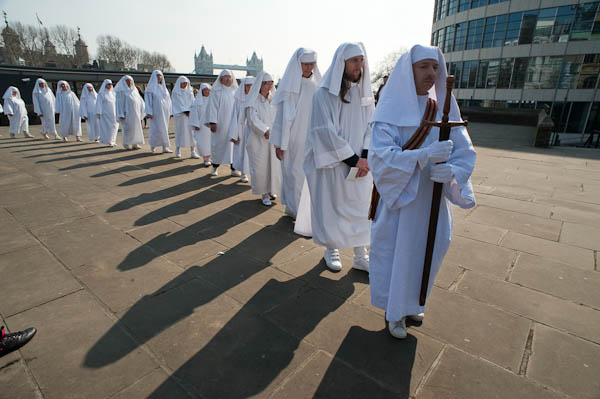
The Druid Order held their usual ceremony at Tower Hill to mark the Spring Equinox last Friday, and this year it was a warm, sunny day.  The sun made photography a little more tricky – hard at times to avoid flare, and only too easy to get the photographer’s shadow on the white robes when I didn’t want it. Fortunately the ‘Active D-lighting’ on the camera really does seem to help a bit with the excessive contrast  – surprisingly like Nikon claim it does, and shooting RAW – pretty well essential for high-contrast light – lets you open up the shadows and bring down the highlights a bit.  The camera tests do show that cameras can handle a greater contrast range when making RAW rather than jpeg files, but I think this flexibility in processing is vital. Lightroom does let you  “stretch” jpeg files a little also, but you can do more starting from a RAW file.

Although the obvious approach is to use Lightroom’s ‘Recovery’ slider to bring the highlights under control, I like to keep it to low values or indeed at zero when I can. Using large values of ‘Recovery’ seems to rather dull the highlights and you lose the kind of glow that you can get. Sometimes you can get the effect needed by simply cutting down on the ‘Exposure’ and increasing the ‘Brightness’, but often the best way seems to be to use the ‘Burn’ tool to bring down the over-bright areas.

© 2009 Peter Marshall
The ‘glow’ here can get lost if you overdo the ‘Recovery’ slider in LR

And of course on sunny days the shadows become an important part of the subject matter – if one that it is easy to forget about, even when they dominate the image. Its one of the many things you have to train yourself to see as a photographer – and which it’s only too easy to forget in the heat of the moment.

© 2009 Peter Marshall

But in the end what is more important important for me than making single images is that the pictures tell the story. And you can read them and it on My London Diary.

Prague Poet Remembered

I’ve long been a fan of Josef Sudek – and my copy of the first edition of the monograph on him published in the West in 1978, two years after his death, edited by Sonja Bullaty shows considerable signs of use.  Bullaty, a photographer who shared some of his lyrical approach, had been held in Nazi concentration camps (including Auschwitz)  before managing to escape from a death march and return to Prague as the war was ending.  There she found none of her family had survived. She became Sudek’s apprentice until she was able to leave for New York in 1947.

Sudek’s images in the book were finely printed in gravure, and have a quality that often very much echoes the originals. His work very much showed a different sensibility and an alternative photographic printmaking syntax to the bravura zone-based silver prints of American photographers such as Ansel Adams or the glossy bromides of photojournalism. Complex, sometimes brooding, and always with feeling, whether on matte silver or pigment his prints had an interest in surface and depth. It was work in a different register to the prevailing US hegemony.

Later I bought a few more books of his work, and around 1980 organised a small gallery display of Czech photography that included at least one of his prints along with these. I’ve had another gravure of one of his images hanging on my front room wall for many years. And of course I wrote about the man and his work for About Photography.

So I was pleased to see a mention on The Online Photographer  (though I think to call him “one of the fathers of 20th-century photography in the Czech nation” belittles a man who was truly one of the greats of  20th century photography full stop) directing me to a note marking the anniversary of his birth on March 17, 1896 at the Disability Studies site of Temple University.

Sudek fought in Italy in the First World War, losing his right arm, and it was this very disability that brought him into photography, as he was given a camera while convalescing from the amputation, and his disability pension allowed him to study photography. The site also links to an extensive gallery of his work and you can also see some at Iphoto Central  and Luminous Lint.

One aspect of his work that I developed a particular interest in was his use of panoramic photography – something indeed that led me to buy and use a number of panoramic cameras. The internet doesn’t lend itself too well to the  format and not many of his (or mine) appear to be on line.

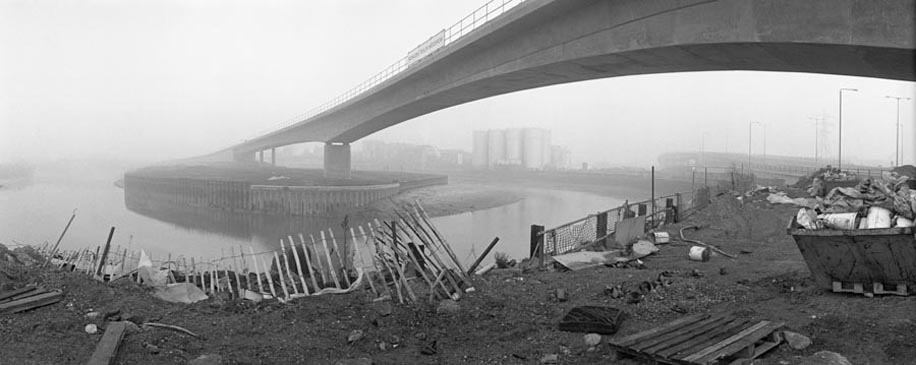
DLR at Bow Creek, © 1992 Peter Marshall
Definitely not Sudek, but one of my panoramas – some others are on the Urban Landscape web site.
Right Click in sensible browsers and select ‘View image’ to see the picture larger.

One site that has a few (it is poorly written – scroll far to the right to find images) compares some of Sudek’s Praha Panoramaticka images with 1992 images at the same locations by  Peter Sramek. Although it is sometimes interesting to see the differences time has made, Sudek’s work has a quality that sets it at a quite different level to the later work.

Invade Jersey Now!

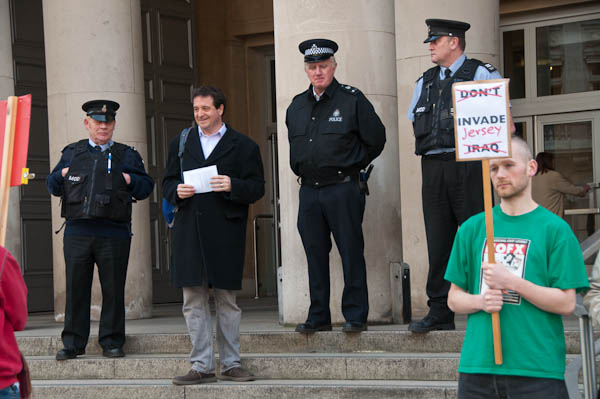
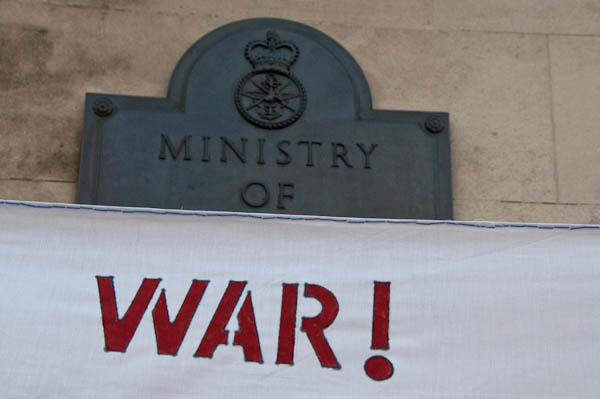
Don’t Invade Jersey Iraq  read the placards that Mark Thomas had made for his one-hour demo (sorry, this was a ‘media event‘ and not a demonstration and thus needed no SOCPA authorisation) outside the MoD. Demonstrating (or media-eventing) along with him were representatives of Jersey’s teachers, who want a British take-over of this offshore tax haven so they can get the same working conditions as UK teachers including the right to a lunch hour. But the main point of the demonstration was that, thanks to PFI, the Private Finance Initiative that is Gordon Brown’s prime dogma, most of our government buildings (and policies?) are now in the hands of private companies based off-shore in tax havens to avoid UK tax.

© 2009 Peter Marshall.
Mark with demonstrators and police on the MOD steps

You can read more about the demonstration and the six reasons that Mark gave for we should invade now

© 2009 Peter Marshall

and see more pictures on My London Diary.

End Child Poverty – 10 Years

© 2009 Peter Marshall.

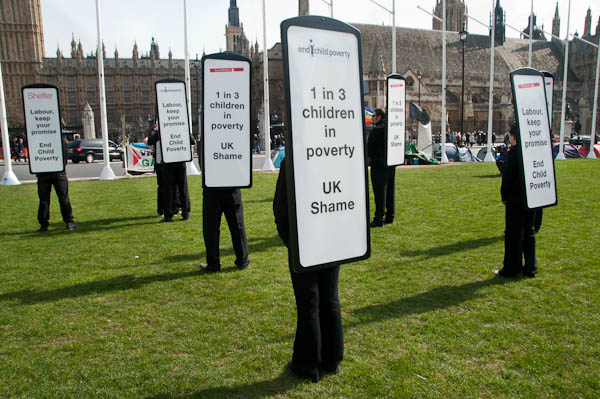
Ten years ago today the Labour Government made a promise to eradicate child poverty by 2020, and to half it by 2010. The Campaign to End Child Poverty turned up today with a birthday cake to mark the 10 years as well as a small demonstration on Parliament Square with men and women dressed in black with bill boards reminding him of the pledges and the organisations involved in the campaign, and a petition with 5000 signatures.

Urgent government action will be needed to meet the target, and it will need perhaps £3 billion pounds – which would also help to boost the economy by being spent on food, clothing and essential items to bring children out of poverty.

Taking the cake and the petition to Downing St were a small group of 10-year olds from Newham, accompanied by End Child Poverty Director Hilary Fisher, Colette Marshall (no relation) the UK Director of Save the Children and David Bull, the UK Executive Director of UNICEF. I left them in Parliament Square as I was on my way to another event.

A few more pictures on My London Diary