Police Try to Censor Protest

On Sunday Sikhs marched through London on the 25th anniversary of the storming by the Indian Army of their holiest site, the Golden Temple at Amritsar. Indira Ghandi had ordered the assault to capture or kill Sikh separatists who were in the compound at a time of year when it was also full of pilgrims.

It’s hard to be sure how many people were killed by the attack, but independent estimates suggest around 5,000, including many women and children, as well as hundreds of Indian soldiers and a relatively small number of Sikh militants.

A few months later, Mrs Ghandi’s Sikh bodyguards killed her. Following the assassination, high-ranking Indian politicians from her Congress Party incited mobs to indiscrimately attack and murder Sikhs, and thousands were massacred.  Sikhs continue to fight for a nation of their own, Khalistan, through groups such as Babbar Khalsa International, and repression against them has also continued; Sikhs allege that  “over 250,000 Sikhs have been killed by in an orchestrated genocide by the Indian government.”
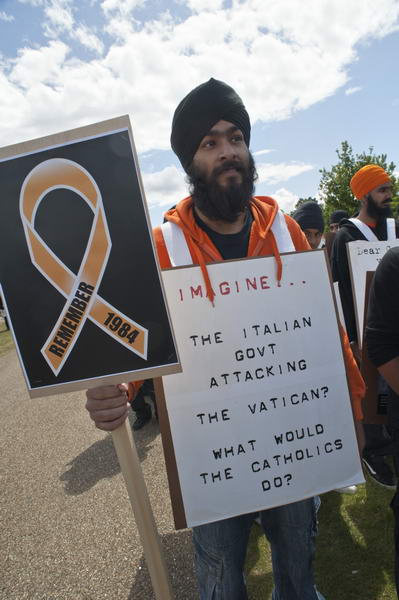
© 2009 Peter Marshall.

You can see more about the march and rally before the march on My London Diary, where there are many more pictures.

One aspect that worried me was an attempt by the police to censor the placards before the start of the march. The officer in charge, Superintendent Raj Kohli, the Met’s highest-ranking Sikh officer, objected to a number of them because of the images on them, and a woman officer said that some might cause offence, particularly because they might be seen by children.
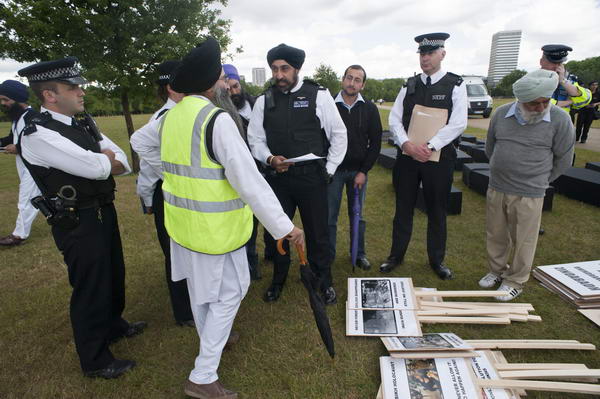
I didn’t think that the arguments the police put forward were in fact valid. Children would be unlikely to be able to interpret the images in any detail when they were being carried on placards in a demonstration, and I think they would have rather less impact on children than on adults. The placard that Kohli was most insistent about was different, showing a simple graphic of a person’s head seen in a gun sight, and the name of a prominent Indian politician who was implicated in the massacres of Sikhs.  He saw this a clearly a provocation to violence, while I would see it more as an expression of what should the persons concerned deserve.
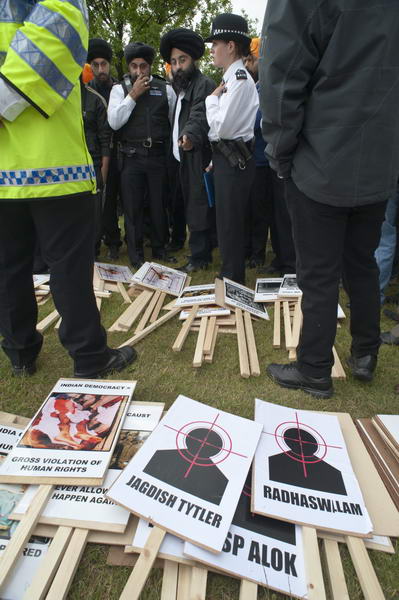
© 2009 Peter Marshall

Although some agreement seemed to have been reached between Kohli and the protesters, many if not all of the disputed placards were carried in the march and can be seen in the pictures on My London Diary.

Kohli was carrying an A4 printout of the symbol of Babbar Khalsa International, a proscribed organisation under the Terrorism Act, 2000.  This was present, along with the name Babbar, on many of the placards and banners that people carried in the march. So far as I saw the police took no action over this, perhaps because it would have involved dealing with thousands among those marching.

BKI and attempt to establish Khalistan certainly appears to have the support of a large fraction of British Sikhs, and more obviously so than when I started photographing Sikh events, perhaps around ten years ago.  It’s only aim appears to be self-determination for the Sikh nation and I can see little reason why our government should feel a need to include it on the list of banned organisations. Though of course I wouldn’t want to express any approval or support for it, as that would almost certainly be an offence.
Spanish Tastes

I don’t think the organisers of what now seems to be an annual ‘Taste of Spain‘ in Regent St have really decided quite what the event is. I only bothered to go to it as I had to get from one of may favourite pubs just to the north of Oxford Circus, where I’d met up with a few friends, to Piccadilly Circus, where I could get a bus towards Waterloo. And of course I only needed to do this because Regent St was closed to traffic for this event.  It didn’t put me in a better mood when I got to the bus stop and stood there waving wildly to the driver as my bus sailed past at some speed – there are just too many bus drivers with something against picking up passengers.

There really didn’t seem enough in the way of entertainment taking place – unless you find queueing fun. Not even a great deal of leaflets to collect and very little being given away.

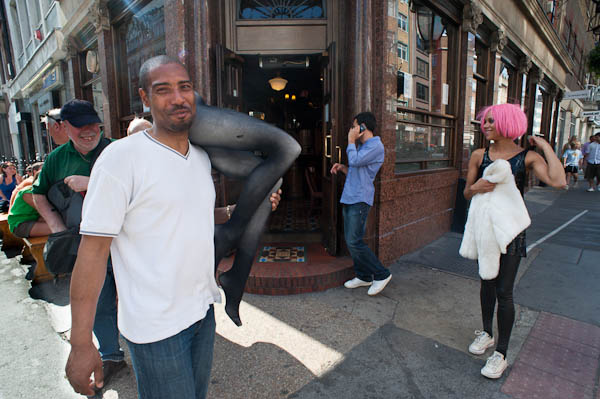
Coming out of the pub I almost bumped into a guy with some legs over his shoulder and a companion with a bright pink wig. Fortunately he stopped and posed briefly for me, as I’d been busy talking and not at all ready to take a picture.

© 2009 Peter Marshall.

Photographically things were pretty straightforward, other than the sun which was a little low and usually in exactly the wrong place – one or two shots ruined by nasty flare (a little in this picture.)  Everything here on a 20mm lens on the D700 as I couldn’t be bothered to get the other body out of my bag. Or because I really like working with just the one fixed lens when I can. A few are slightly cropped where I didn’t have time or couldn’t move in closer.

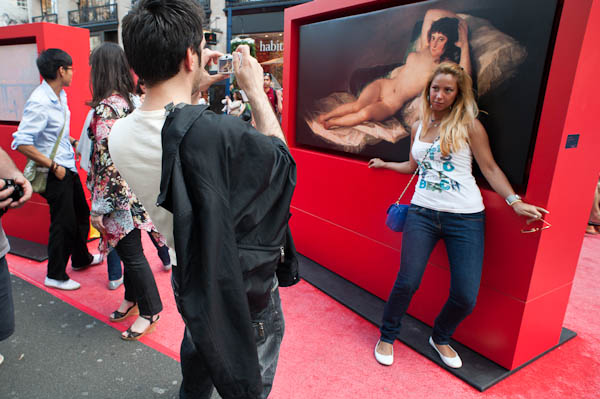
The only really interesting stand in Regent St was for Madrid, mostly taken up by reproductions of pictures from the Prado in large bright red stands. Favourite for the poseurs was Goya’s ‘La maja desnuda‘ and I took a whole series of various people in front of it. I’ve several of this scene, and o one of the things I like about it – difficult to see on this scale – is that you can clearly see the guy in it photographing his woman is framing out her body language which is what would give the picture its interest.

© 2009 Peter Marshall.

There is of course another photographer in the picture – Epson digital rangefinder on his stomach at extreme left, and being a mate of mine I’ll probably get to see his picture of the scene later. But I find I see through the viewfinder better when I hold the camera to my eye!

More pictures and ‘anthropologie’ on My London Diary. Where I also speculate about the copyright issues involved and that a prior trip to Madrid might have made Ruskin less shocked with Effie on 10th April 1846. Nowadays its rather easier to find porn on the Internet.

Hizb ut-Tahrir and Pakistan

It’s hard not to agree that America is the root cause of much of the current troubles in both Pakistan and Afghanistan, but while it may be an ‘American War’ that Pakistan is currently fighting, it is rather harder to see what the solution should be.

© 2009 Peter Marshall.

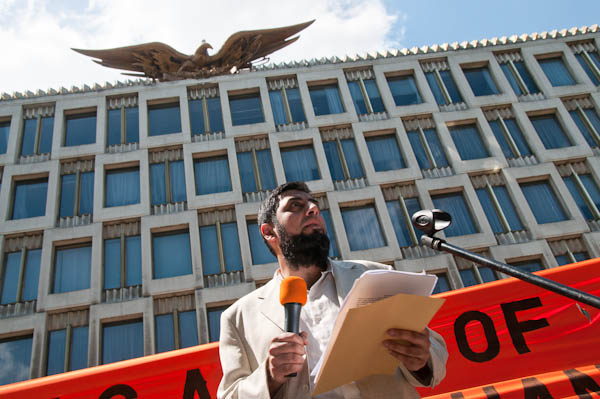
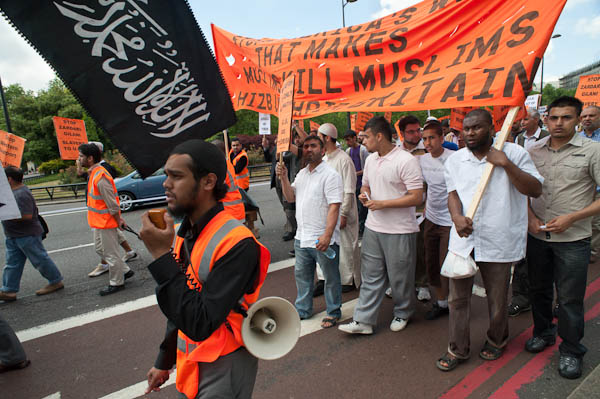
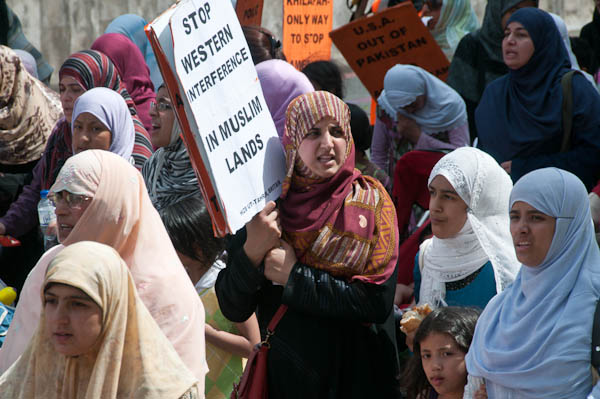
The placards say ‘Khilafah – only way to stop America and Terror’  but at the moment a Caliphate isn’t on offer from any of the sides in Pakistan, and Muslims are capable of killing Muslims without the encouragement of the USA.

© 2009 Peter Marshall.

It’s also hard to disagree with Hizb ut-Tahrir when they talk about many (if not all) Muslim regimes as corrupt. But those areas under attack by Pakistani and US forces in Pakistan and Afghanistan have seen terrible repression, particularly of women, under Taliban rule. If any of the speakers mentioned this, I missed it.

I missed too hearing what the women who made up almost half the march thought, as none were called to speak. At the two rallies they stood apart, some way from the speakers – the party insists on the segregation of sexes in public activities, insists on the covering of women’s bodies except for face and hands, forbids women ot be in private with men except immediate family, bans them from important public office and insists on their duty to obey their husbands.

© 2009 Peter Marshall

More about the march and more pictures on My London Diary.

Wedding Pictures

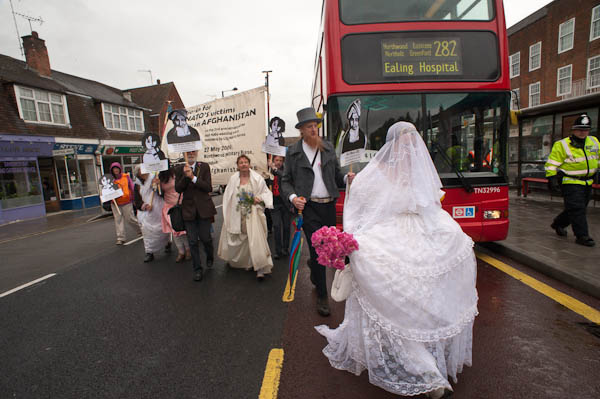
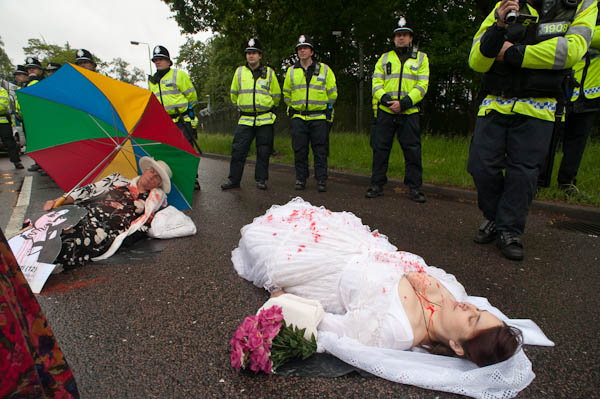
No, not a real wedding, just in case anyone is thinking I’ve flipped. Exactly two years ago, US forces attacked a wedding party in Haji Nabu, Afghanistan, killing 47 people. It was one of a number of similar incidents which have contributed to thousands of Afghan civilians being killed by US/NATO forces.

Protesters from Voices in the Wilderness UK, Justice Not Vengeance and London and Oxford Catholic Workers organised  a Die-In on the second anniversary of this massacre in wedding dress, with brides and grooms and wedding guests.

© 2009 Peter Marshall.

This was a non-violent protest against the war in Afghanistan and in sympathy with the victims of NATO aggression there, and they marched on The Permanent Joint Headquarters  in Northwood, Middlesex from which our wars, including that in Afghanistan, are run.  Police allowed the marchers to approach the area, but stopped them outside the camp around 200 metres before the main gate.

© 2009 Peter Marshall.

Here around half of the 40 or so protesters staged a die-in, lying on the road and blocking it for around 45 minutes before police eventually removed them. Six people who insisted on continuing their protest by going back onto the road after being removed were led away by police. They were held for several hours before being charged and released to appear in court at a later date.

You can see more pictures and more about the protest on My London Diary.

Wet Weather

Wednesday morning was cold and wet. The rain wasn’t particularly heavy but it was persistent. We can probably all agree there’s only room for one Martin Parr in photography, and while his ‘Bad Weather‘  was one of his most interesting books, the odd effects caused by water droplets on the lens and other hazards  are generally things to be avoided rather than emulated. Photographing in the rain was, frankly, a pain (and lying on that cold road, even on bin bags must have been pretty uncomfortable.)

Both the Nikon D300 and D700 I was using stand up pretty well to rain and the real problems I have are with lenses. Mainly I was shooting with a 20mm f2.8 on the D700, and as always with a UV filter on the front. I worked with a microfibre cloth in my left hand, keeping the front of the lens covered except while actually taking pictures, and wiping the filter obsessively, but still there were plenty of shots spoiled by raindrops on the filter. I don’t own a lens hood for this lens – with a 20mm lens hoods offer little protection either from sun or rain. A carefully placed hand is considerably more effective against the sun (and yes I do often have to crop the odd finger out of pictures)  but doesn’t work for rain.

On the D300 I was using my Nikon 18-200, but this is truly a fair weather lens. Even a hint of damp in the air tends to deposit on inner lens surfaces, having got dragged in by the pump action of the zoom. Mostly this stayed under my coat, and the longer lens hood (it’s a 27mm equivalent at its widest) although a pathetic piece of design that falls off regularly, does help a little to keep the rain out during use.

A Day Off?

What do photographers do on their days off?  Usually take pictures, at least while sober, and sometimes when not.  For most of us, photography isn’t just a skill or a job (or even a profession) but an obsession.

© 2009 Peter Marshall.

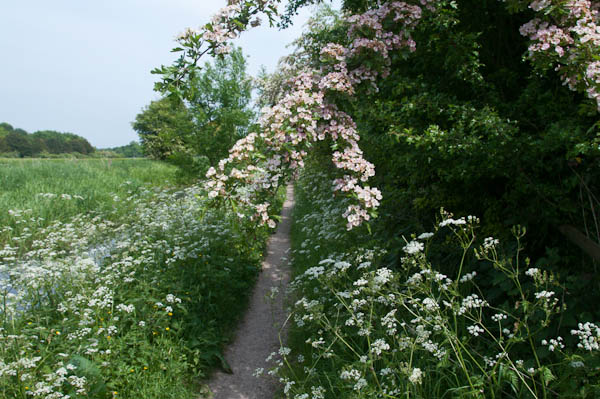
Last Monday was a Bank holiday, and rather than go an photograph London taking its Bank Holiday in different ways I went with my wife and two sons (both in their 30s) for a walk in the country. Fortunately I didn’t take the full kit, just the Nikon D300 with a couple of lenses, because it turned out to be about twice as far as I’d expected, around 18 miles.

Fortunately it was mainly along canals, and so pretty flat. And quite pretty and mainly very quiet – not quite my sort of thing at all! Probably there are far too many pictures taken along canals and as there was a canal festival going on there were lots of prettified canal boats (and for a short stretch some excruciating country music – the wrong country – over a noisy loudspeaker system.)

I was reminded of something I wrote a few years ago, about Eric de Maré, though largely because I’d then omitted to mention his great interest in canals. What I mainly wrote about was his Penguin “Photography” written in the 1950s on which a whole generation cut its photographic teeth, and a better introduction to the subject than many – here’s an edited version of what I wrote then:

A historical introduction, was followed by a chapter on photography as a creative medium, then one on composition and then five pages of quotations about photography. Only after that did it get down to a basic and readable coverage of the technical side of black and white photography.

A strong point was its use of many fine examples of the medium in its two picture sections, which included well-known works by great figures of the medium, including Werner Bischof, Bill Brandt, Julia Margaret Cameron, Henri Cartier-Bresson, Peter H Emerson, Bert Hardy, Hill & Adamson, Man Ray, Edward Weston, Clarence White and many more. The few nudes included (the only images of naked bodies allowed in our house apart from a few anthropological images in ancient back-copies of National Geographic) undoubtedly were a major part of the book’s attraction for me as a young teenager.

There is a nice short feature on de Maré on the English Heritage site, although the only canal image included is more an image of a structure than a typical canal picture.

Incidentally if you are thinking about buying his canal book, the 1987 paperback edition is readily available second-hand at under a fiver, despite some vendors describing it as “hard to find” and offering it at around 20 times the price. His “Photography” can be found for less than a quid, and most of his other books are also available cheaply, not because they are bad, but because they were popular. Some are illustrated by his generally excellent drawings rather than photographs.

You can see some of my photographs from Monday’s route march on My London Diary. A couple appear in a roughly 2: 1 panoramic format, and were taken with this in mind using the Sigma 10-20mm (15-30mm equivalent on the D300.)  I find 10mm is often too extreme using the full image rectangle, but gives a decent panoramic.

© 2009 Peter Marshall.

The D700 (and D3) can record RAW images either for the full sensor or for the ‘FX’ cut down frame area – and with Nikon lenses at least you can get the camera to automatically switch between these as appropriate for the lens in use – or choose manually.

I actually rather like shooting with the FX format 18-200mm on this body, when you get a brightline frame in the centre of the viewfinder image, making taking pictures much more like using a rangefinder – so much better for cropping and also for action where being able to see what is just outside the image in the viewfinder is a real plus.  At around 6Mp, the cut down frames are a little short of pixels, but it’s still plenty for most purposes.

But for me it would be useful for Nikon to add a panoramic option too, that could be switched on to show in the viewfinder (and of course crop the RAW image too.)  Nikon’s 14-24mm and Sigma’s 12-24mm would be ideal candidates to use with this.  Of course there is some advantage to not cropping at the point of taking – but rather just thinking panoramic – in that the normal format image gives considerable scope for the equivalent of a rising or falling front when cropping to a panoramic format.

Yemen?

I was pretty ignorant about Yemen. Until last Saturday I’m not sure I would have pointed it out absolutely correctly on a globe, though I knew it was somewhere in Arabia.  In my younger years, Aden featured regularly on the news, mainly as somewhere where British soldiers were shot at. Aden was the centre of something called a protectorate, which I think meant that while we had colonized the city itself, we’d been happy to support a whole hotchpotch of local rulers in the area around it, so long as they mostly played ball with us.

After it got independence in 1967, South Yemen became a socialist republic, receiving support and in particular arms for Russia. North Yemen was an Arab Kingdom (once under Turkish rule)   and later a republic, and the two countries soon decided in principle on merging to form a single state of Yemen, though it wasn’t until 1990 that this finally happened.

Four years later, may of those in the south were fed up with the union – they  didn’t seem to be getting  much out of it while people from the north were getting jobs and taking over land in the south.  Southerners rose up and began a civil war in 1994, aiming to leave the union and were soon defeated.

© 2009 Peter Marshall

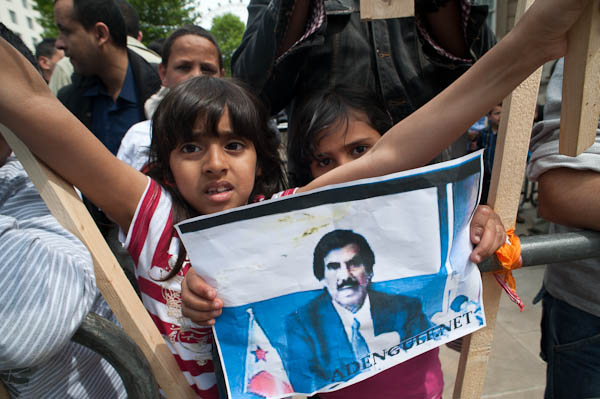
Why I needed a crash course in the history of the Yemen was because there were around a hundred supporters of South Yemen demonstrating opposite Downing Street on Saturday afternoon. Most of their placards were in Arabic, and they didn’t have a press release- or at least not in English. Perhaps the event was meant more for the Aden TV crew who were there than a British audience.

More about the event, the history of the Yemen, some rather gloomy prognostications and some pictures on My London Diary. It’s not enough for me to take pictures, I need to try and put the events I photograph into some kind of political perspective.

Reverend Billy

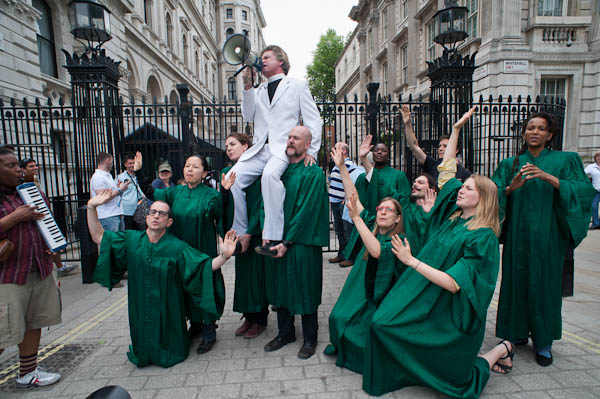
Reverend Billy and his choir from the New York-based Church of Life After Shopping are currently on a British tour, and on Saturday they were doing a little tour of some of the sights of London.

© 2009 Peter Marshall

I came across them at Downing Street where I was photographing protesters from South Yemen on the other side of Whitehall, and saw a group of people in green robes singing and dancing on the pavement in front of Downing St.

When I first started walking around London you could take a stroll down Downing St whenever you liked.  Philip Jones-Griffiths took a nice picture (halfway down the page) there of nannies taking their charges for a walk and stopping to chat with the two policemen on duty outside the famous door of number 10, oblivious of the fact that those prams could have contained enough high explosive to blast Harold Wilson (or whoever was then our Prime Minister) to kingdom come.

Today the west end of the street is completely blocked, and there are tall iron gates at the Whitehall end. You are only allowed in if your name is on the list (or if you are a photographer, usually with a press card) and then go through an airport style security arch and at times also a quick pad-down search, and any bags are pretty throuroughly checked. Probably there are twenty times as many police on duty – and many are carrying rather nasty looking automatic weapons.  Photographers then have to walk to a pen across the road from the door, and are likely to be told off if they try to photograph as they walk to it, or if they point a camera in any other direction than across the road.

Outside the tall gates, tourists are allowed to peer and photograph – though from so far away it’s hardly worth the effort. But nobody is allowed to demonstrate there, and the police are generally pretty hot on enforcing the ban.

But they just didn’t know what to do with the Rev Billy and his choir, who had been performing for several minutes before an officer came and challenged him.  And then Billy had a clear advantage – he’s argued with police on numerous occasions and the officer concerned clearly had no idea at all what to do when preached at and told he had a shopping problem.

The choir continued to dance for several minutes while the unfortunate officer got exactly nowhere, then the whole group danced off down Whitehall to their next stopping point in Parliament Square, and I left them to photograph another event.

More pictures on My London Diary.

March for Jobs

My first destination on Saturday was Highbury and Islington, and I took the precaution of consulting the Transport for London web site to find whether the Victoria Line was working, and it told me it was fine. So I got off the fast(er) train to Waterloo at Clapham Junction (You can’t really call it a fast service when Southwest Trains have increased the timetabled time to get there by 5 minutes over those when I first started travelling from here in the 1970s  – to avoid any fines for running late.

One of the many things that has completely disillusioned me about New Labour was its failure to take control of the railways when we voted it back into power in 1997. Privatisation had so obviously failed that there was no sensible alternative but reverting to a nationalised system – and with the chance to set it up on a much improved basis. But instead they made it worse. Now we have trains that close their doors half a minute before the timetabled time – if they want to run a train at 9.58.5 they should call it the 9.58.5 service, not the 9.59.  We have services that take 35 minutes to Waterloo rather than 29 0r 30 minutes. And we have fares that have increased considerably more than inflation. That’s the legacy of privatisation.

There are of course a few improvements. The trains are quieter and smother running. They are non-smoking throughout. What’s really annoying is that they actually have greater acceleration and higher maximum speeds – so really we should be seeing services that are faster rather than slower. Occasionally when engineering works re-route mainline services by our route we get speeds that show what modern trains can do on our route, cutting times from the now normal 35 to around 20 minutes.

I only have to wait 5 minutes for the even slower service that stops at Vauxhall, and walk briskly down to the Underground, where I find no service. It wasn’t TfL’s fault, as a passenger has jumped in front of a train at Stockwell. But given modern communications I think we could have expected to be told this before getting off the train at Vauxhall.

The fastest way to proceed is to go back into Vauxhall station (its claim to fame is that it provided the Russian word for station) and get on the next service to Waterloo, arriving there around 15 minutes later than if I’d stayed on my original train.

Fortunately the parts of the underground I need are working, though as usual at weekends several lines are suffering from closure. It’s a slightly slower journey than usual from having to change at Piccadilly Circus, and the Victoria Line, still running from Victoria only, has some large gaps and it’s around ten minutes before my train arrives.

Logistics  – working out how to be at places at the right time – is very important in the kind of photography I do, often covering several events in different parts of London over a day.  Fortunately, although the March to Defend Jobs, Services and Education was timed for 11.00, this was the time to start gathering, and the  march doesn’t actually get started until around 11.40, so despite the travel problems I actually arrive well in time.

As a photographer in London, you need to allow plenty of time for snarl ups and other problems. Driving is frankly pretty hopeless for getting around quickly, not least because of parking problems. The most reliable way to travel is a bike, either motor or leg-powered, and for longer distances you need to rely on underground or overground trains. One of my most useful photo accessories is a folding bike, which can be taken on trains at any time, but it gets in the way when covering demonstrations and marches.

For this march, which goes from Highbury Fields to Archway, I do rather wish I had brought the Brompton, as it’s a bit further than I remembered. But I know it would get in the way later in the day.

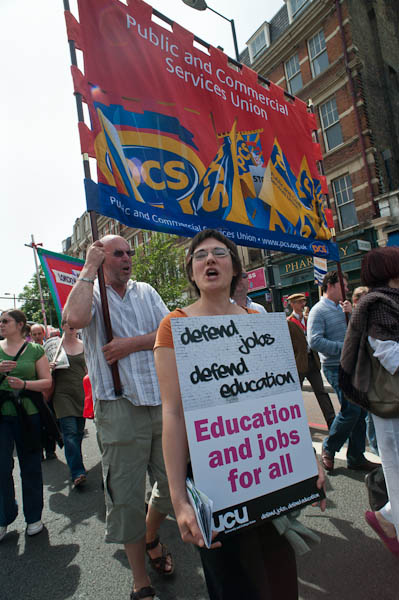
It’s hard to photograph events such as this. There just isn’t a great deal of visual interest, and it involved no real celebrities.  The trade union banners are colourful, but essentially two-dimensional.  It’s really hard work to get much out of it, but there are a few pictures I’m pleased with.

© 2009 Peter Marshall.

This was my favourite, taken with the 20mm f2.8 Nikon lens on the full-frame D700 from a low angle and including a placard that says what the event is about as well as one of the more colourful union banners from the PCS.  The expressions of the two main figures , shouting a slogan, also helps, and there are a number of strong lines all in the same direction – just off of vertical that give it a strong dynamic feel. Working at ISO 400 gave an exposure of 1/640 at f10,  freezing the movement at giving depth of field that extends from the hand close to camera in the bottom centre to the top of the banner and the buildings in the background.

In the old days, I would have been shooting at a pre-set aperture and using ‘zone focus’ to give me a  good idea of the depth of field I would get. Nowadays I’m increasingly relying on ‘Auto-area AF’ which claims to distinguish people from background, along with continous servo autofocus – the C setting. Exposure was also automatic, using matrix mode, and its coped well with the bright area of sky. Usually – as in this case – I’m impressed by what modern auto systems can do. I could have done it as well manually, but not in the fraction of a second I had to take this picture.

I left before the rally had finished – by then it was running considerably late – and again was thankful I’d come by public transport, as I could just walk the short distance to Archway tube rather than having to go back to the starting point.

Many more pictures on My London Diary.

Can Anyone Apply for an NUJ Card who has a Camera ?

Oh no, Commander Broadhurst, no, no, NO, NO!

© 2009 Peter Marshall.

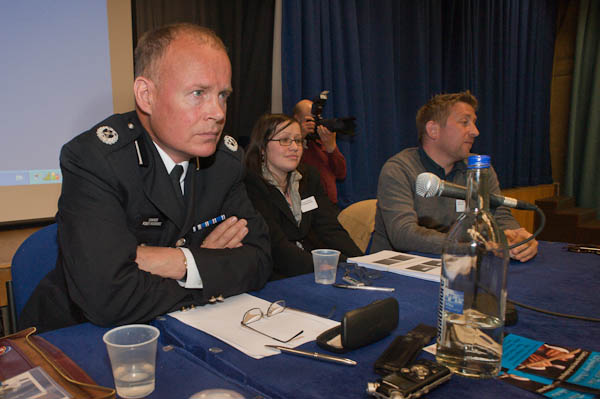
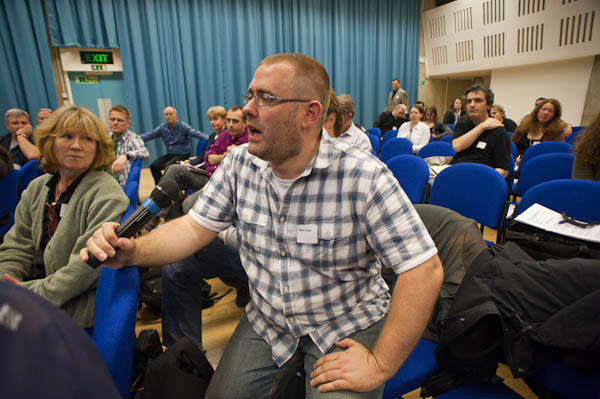
Some advice for any high-ranking police officer. If you come to a conference of 200 press photographers, don’t say things like “I don’t know whether, or what vetting system there is for holding an NUJ card, can anybody apply for an NUJ card who has a camera?” And it isn’t really sensible to talk about a  “phalanx of cameras” getting in the way of police either or make too much of expressing support for the actions of front line officers to people who have been assaulted by them. When someone gets up and describes how an officer in riot gear shouted at him “I don’t care if you’re press” and then broke the arm holding up a press card with a baton blow, or how another photographer wearing a protective helmet was hit so badly that he suffered from concussion for two days, that isn’t helpful.

The card we use is not an NUJ card, but a UK Press Card, issued by the NUJ and other bodies on behalf of the UK Press Card Authority and states “The Association of Chief Police Officers of England, Wales and Northern Ireland and the Association of Chief Police Officers in Scotland recognise the holder of this card as a bone fide newsgatherer.” But apparently neither the man in charge of public order for the Metropolitan Police nor the officers on the front line do.

It isn’t easy to get a press card from the NUJ – you have to provide evidence that you work in public places and so have a need for the card, and that 50% or more of your income comes from journalism for NUJ membership.

Two hundred of us there all tried to tell him – and he had to abandon his presentation to the NUJ ‘Photography Matters‘ conference at that point and sit and listen and try to respond to complaint after complaint about police behaviour.

© 2009 Peter Marshall
Press photographers were told to leave or be put in the cells…

Notable among these was the use of the Public Order Act to compel a group of around 20 press photographers to leave the Royal Exchange area on May 2.  An officer came up to them as they were standing behind a police cordon, and addressing them starting with the words “Ladies and Gentlemen of the press…” informed them that unless they left the area for half an hour they would spend the rest of the day in a police cell. Why? Because the police were about to set police dogs loose on the demonstrators.

This wasn’t the only session of the conference, and others,  if less important were more informative or entertaining. Penny Tweedie presented a retrospective view of her career, starting from when the NUJ stopped her getting a staff job in Fleet Street because she was a woman and couldn’t possibly cope with being the only photographer present on a night shift if anything stressful happened. You can read a little more about the other sessions that I was able to attend on My London Diary, where there are also more pictures from the day. All were taken with a 20mm lens (one is severely cropped) as when I put my hand in the bag for a longer lens I found it wasn’t there. It was an early start for me and in my rush to get the train I’d not packed it. It’s a nice lens, but some shots would be easier with something a little longer.

© 2009 Peter Marshall.

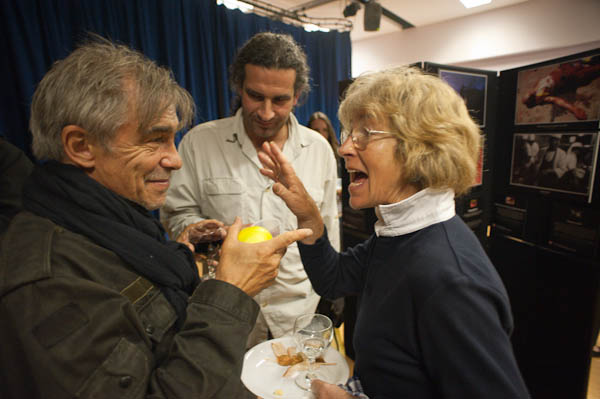
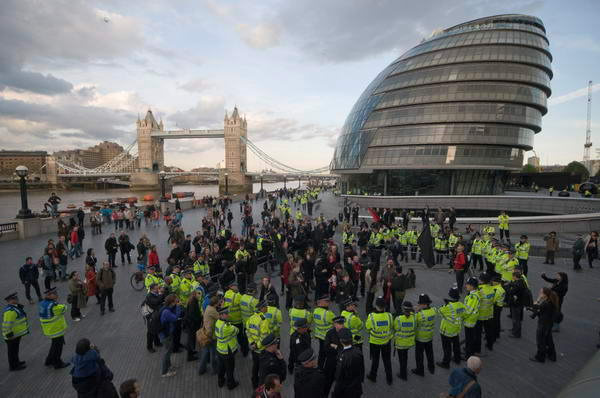
During the lunch break we all had an opportunity to look at the 2009 Photography Matters exhibition, with 50 pictures from 35 photographers – and I was very pleased that two of my pictures made the show, including a rather nice picture made with the 12mm Sigma (on the D300 – so 18mm equivalent) of a ring of police around a few demonstrators at City Hall on the night the London mayoral election was announced.

© 2008 Peter Marshall

I took this picture with a policeman pushing my shoulder, telling me I had to leave the area. It was hard to see any particular reason for this, but I knew there was no point in arguing – and that to do so could lead to my arrest. Fortunately I managed to hang on long enough to change the lens and get the image.

The Woman with the Red Balloon

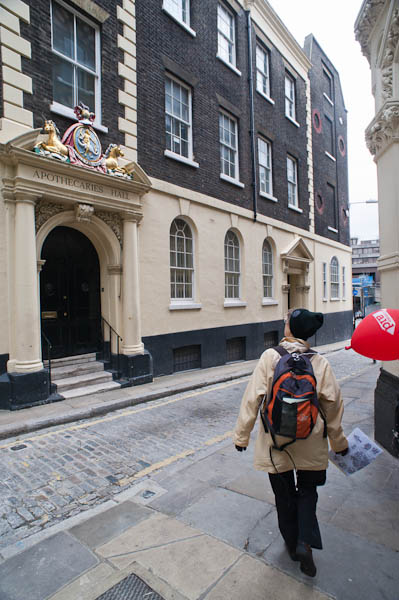
There were actually hundreds of them. Women, children and even men with red balloons, but I’d elected to follow just one of them on her walk around the city (continuing a choice I made over 45 years ago, but this isn’t the place to discuss the events of the sixties.)

© 2009 Peter Marshall.
The woman with the red balloon takes the wrong turning

Of course I photographed some of the others, but a story sometimes needs a structure, and here was a hackneyed photojournalistic approach which fitted in with one small part of my familial duties.

© 2009 Peter Marshall.
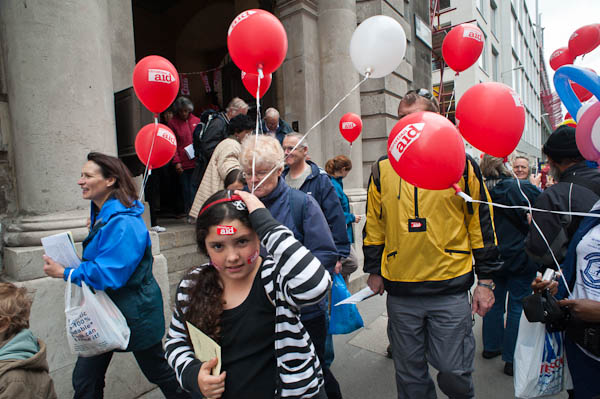
Some of the other walkers

This six-mile trek from church to church (mainly Wren to Wren) around the City of London – with a diversion via the City of Southwark – came at the end of Christian Aid Week, and was their  ‘Circle the City,’ a fund-raising sponsored stroll, fuelled by tea, coffee, lemon squash, biscuits, home-made cakes and a desire to support the work of the majority world projects that Christian Aid supports, helping people to help themselves out of destitution and give them hope.

© 2009 Peter Marshall.
Walkers relax in Wren’s St Anne and St Agnes,  at the end of the six mile walk