(Un)Limited Edition – Happy Christmas


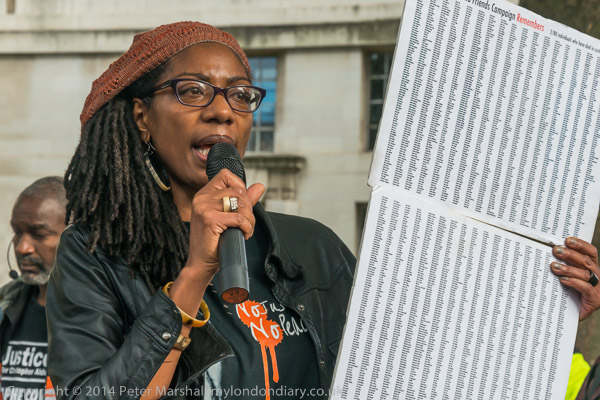
Not a Christmas image – but the one I chose for my Christmas card. Candlelit vigil for Michael Brown, US Embassy, London. Nov 26, 2014

Those who know me will know that I abhor the idea of limited editions of photographs. It’s something that to me goes against the whole grain of our democratic medium, one that has reproducibility at its very heart.

When I made a few screen-prints, these were truly limited editions, starting with a pile of perhaps fifty blank sheets of paper. Usually rather  fewer as quality paper isn’t cheap and I was never rich. The first screen image went on every sheet, often just a background colour, but as the print was built up over a series of up to a dozen printings, registration errors and other printing faults reduced the number of usable sheets. At most I had two screens, although one was quite large and might have a couple of the images on it, but by the time I made the final printing, some of the earlier images had been scrubbed off, and there was no way I could print more without making a whole new set of screen images from the set of negatives.   These truly were limited editions, and the finished prints more or less identical. Those that were not were scrap.

There are a handful of negatives from which in the darkroom days I made more than a dozen or so prints. But I never went into the darkroom and made more than a handful at a time, and even those were never quite the same, as each involved an individual performance of the dodging and burning and other tweaks that led to a fine print.  The only real way to print a proper edition would have been to have made a corrected copy negative and print from that.  Which of course a few people did with processes such as dye transfer. When we moved to digital printing, making editions became easy, but of course any limit was purely artificial. Digital files don’t wear out.

Limited editions are simply a marketing device and my opposition to them is one reason my work isn’t available from a gallery, though you can buy images direct. Some of those images I have sold as numbered but unlimited ‘editions’ which I think more accurately reflects photographic practice. The numbers involved have so far largely been single figures.

But I have produced a few ‘limited editions’, but only as Christmas cards, and this year’s has been printed and sent out in an ‘edition’ of 24 roughly postcard size pigment inkjet prints on Epson Watercoloour Radiant White to photographer friends, (other people get cards from one of our favoured charities) with another ‘edition’ of 50 as commercially printed glossy postcards.  Some of those postcards remain, and if any UK readers would like a copy and e-mail me – my e-mail address is on this page  – I will send my postal address for you to send a stamped addressed envelope to. Alternatively you can download the postcard file and print your own copy – for personal use only.

Continue reading (Un)Limited Edition – Happy Christmas

Fluorescent Orange

One of the many reasons I wish President Obama would live up to his promises and close Guantanamo Bay is that I hate trying to photograph those bright, often fluorescent, orange jump suits which have become such a part of the protest vocabularly. Of course its a very minor reason compared to the torture and human rights abuse, but one that gives me a certain amount of personal grief rather than engaging my conscience and my empathy for the suffering of others.

Bright reds and oranges have long been a particular problem for photographers, and it was certainly something I came across in the days of film – but then almost all colours were a problem with film, at least if you had any concern for accurate reproduction. Which is something many photographers don’t suffer from, and why so many long for the days of Kodachrome or wax long if not eloquent about the warmth of Agfa, or even pine for the garish purples of Orwo.  And why so many Fuji X users are excited about the new firmware that adds ‘Classic Chrome’  to the various distortions you can – if so inclined – give your colour images.

Personally I moved from chromes to negative film in the mid 1980s in the search for more natural colour, switched to Fuji when I experienced the cleaner look its colour negative films and paper gave compared to the yellow box. And realised immediately the great leap forward with Nikon’s digital files when I started using the D100, something that I think led to me soon virtually abandoning black and white (though there were other reasons too.)

But though I generally love digital colour, or at least Nikon’s version of it (and Fuji X is usually great too) there are still a few problems. Artificial light, often far removed from a continuous spectrum has its own problems, and just occasionally in natural light there are conditions where I can’t really get entirely satisfactory colour results. And there are bright oranges.

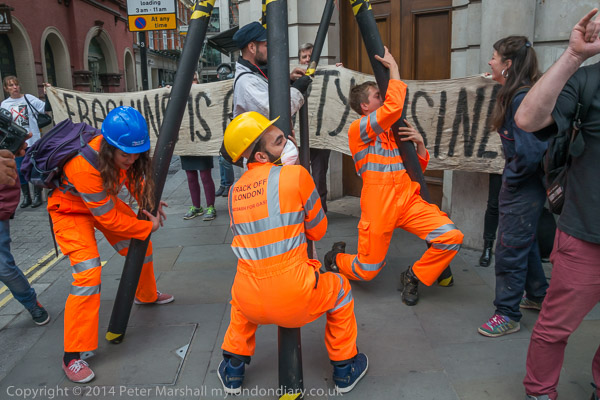
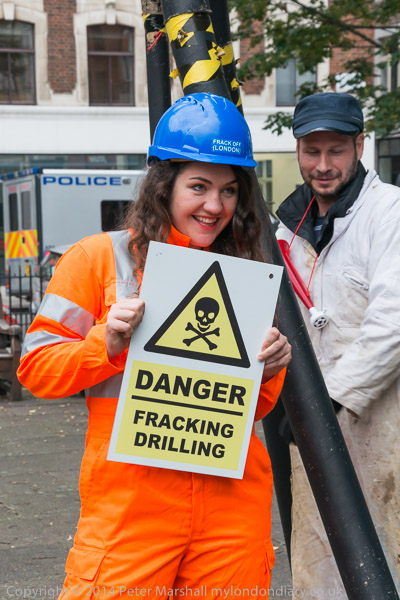
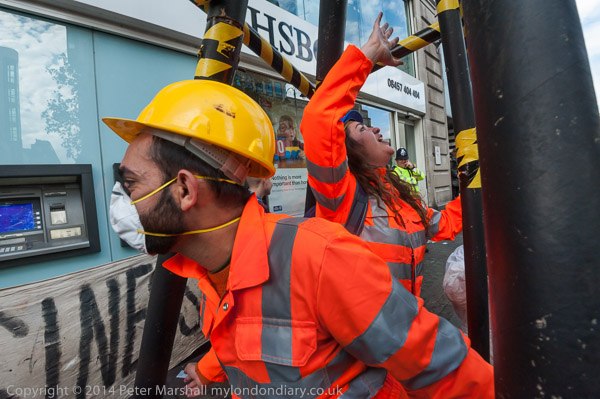
So while I expect problems at protests for the release of Shaker Aamer, a Londoner still held in Guantanamo to the shame of both US and UK governments, I didn’t expect to have to deal with the same problem when I went along to y Frack Off London’d Global Frackdown event. But I arrived to find their fracking rig workers in bright orange suits.

The files on My London Diary were processed rapidly in Lightroom before uploading them for possible publication, and I didn’t have time to think about the orange suits. I’ve done another rather quick edit (with some slightly careless burning in) which gives a rather better result to the suit, though still not entirely to my satisfaction. Apart from darkening and lightening some areas, the main change is a switch from the Adobe Standard profile I normally use to ‘Camera Portrait’ for this image made on the D800E with the 18-105mm.

For images made using the D700, I have a wider choice of profiles available in Lightroom. Changing from ‘Adobe Standard’ to ‘Camera Neutral dcpTool untwist’ with just some minor adjustments to contrast and exposure – but no burning in – gives a better result, and corrects the slight hue shift in the original oranges.

I’m sure it would be possible to get a similar profile for the D800E, but I haven’t bothered to do so yet. For almost all pictures the ‘Adobe Standard’ is fine.

You can read about the protest and see more images from it at Global Frackdown at HSBC.


PS

Since writing this I did a quick web search and found a link to some useful D800/D800E profiles.

Continue reading Fluorescent Orange

Umbrella Revolution

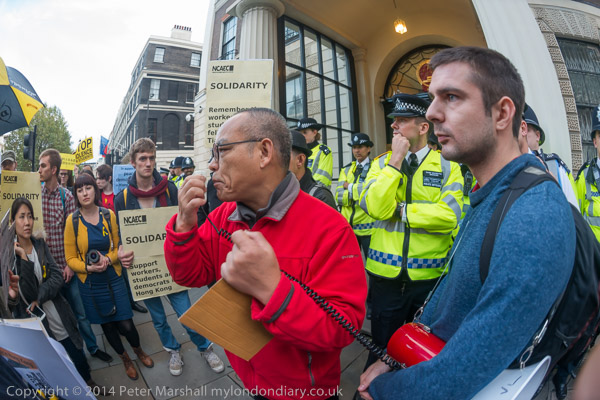
No, I didn’t get to Hong Kong, but like so many protests around the world, it also came to London, with a little help from the National Campaign against Fees and Cuts, who organised the protest at the Chinese Embassy on 10th October.

It was the last of four stories I covered that day (and I found time to do a few urban panoramas too – which you can see with the other stories on My London Diary) and in some respects the most interesting. But it was probably well after midnight by the time I had finished uploading the earlier stories and was working on the post processing of the final event. Which is perhaps why one of the pictures I uploaded was just a little strange:

As is probably obvious, this suffers from a rather nasty case of extreme distortion, though perhaps that makes the yellow and black umbrella stand out even more.Here’s the image that I intended to post:


D700, 16mm fisheye, ISO 800, 1/80 f5.6

It still looks a little distorted, and the verticals are converging, though that isn’t necessarily a bad thing.

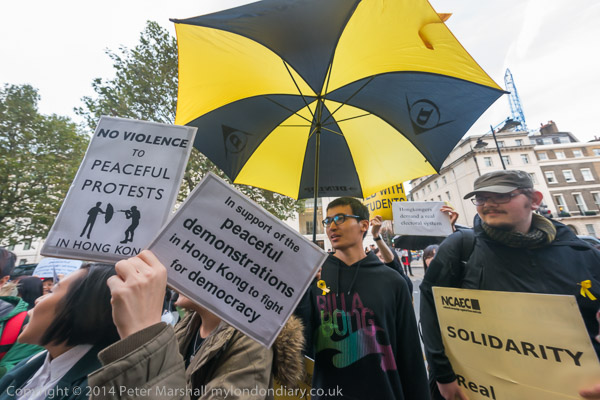
I’d made the original picture from which both these were derived using the Nikon 16mm fisheye, chosen mainly because I was in a very crowded situation on the pavement in front of the Chinese embassy and unable to move any further back from the subject.  I’d wanted both the umbrella and the messages on the poster, with the ‘No Violence to Peaceful Protests in Hong Kong’ at the left- with another umbrella and, at the right  the word ‘Solidarity‘. The text on placards is very important when photographing protests (something I learnt rapidly from the first editor I took my pictures to), and something you always need to be aware of in all images, as legible text always alters the way that we see images.

I usually process the images from the 16mm using either the Fisheye-Hemi plugin, PtGui or occasionally Photoshop’s ‘Adaptive Wide Angle’ filter.  The first two are rather simpler to use and more or less automatically convert from fisheye to a cylindrical perspective, straightening the verticals and reducing the curvature of objects at the edges of the frame. Fisheye-Hemi has just 3 options, depending on the type of fisheye lens you have used (circular, full frame or partial), while PtGui gives greater flexibility.  Photoshop’s own filter enables you to straighten any of the lines curved by the lens, but to do a great deal of work usually involves losing a lot of the image, and I usually end up getting some very funny curves indeed and deleting the results.

Somehow I have used Fisheye-Hemi twice on the top image, not a good idea. While the edges oft he placards and the crane at right are more or less straight in the lower picture, they have become curved in the opposite sense to the original in the upper image in a kind of extreme pin-cushion distortion.

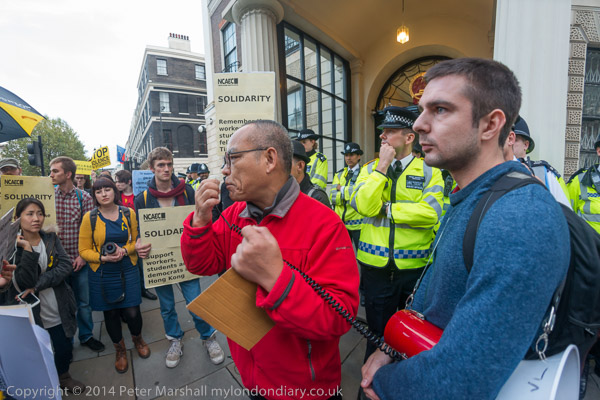
Another pair of images perhaps gives a clearer view of what Fisheye-hemi does:


D700, 16mm fisheye, ISO800, 1/60 f5

The protesters were crowded around the doorway of the Chinese embassy – much to the annoyance of the police, who like to keep protests to the opposite side of the road. I am very close to the speaker and the man at right who I could reach out and touch. In the upper images there is very clear curvature close to the edges, particularly  noticeable in the pillar of the doorway at the extreme right of the image, but also in the other building in the background and in the woman at the left of the frame.

Fisheye-Hemi has more or less straightened the verticals of the architecture and made that woman look fairly normal. You can also see that the centre points of all four sides show identical subject matter – at left the word ‘Solidarity’, at top centre the top of the pillar, at right a police officer’s ear and at bottom centre the lower edge of that red jumper (I’ve cropped the lower image very marginally to remove a little distraction, which is why there is very slight less of that officer’s face.)

There is also a little part of the image missing at the corners, something you need to be aware of when taking pictures, but it isn’t really a great deal. Because you keep those four edge centres the viewfinder image remains a pretty goo way to frame the image.


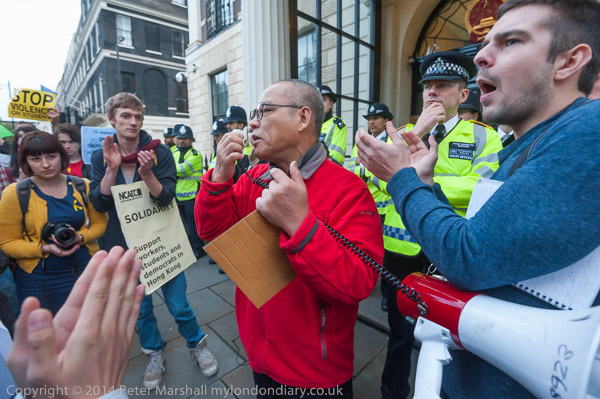
D700, 16mm fisheye, ISO 2500, 1/160 f5

Here’s another image taken a few minutes later when people were applauding.  I’m pretty sure my shoulders were touching those of the guy whose hands appear at the left of the image.


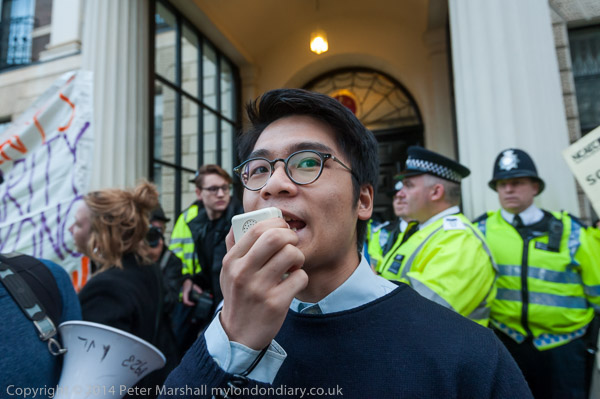
D700, 16-35mm at 22mm ISO 2500 1/160 f5

Here’s another picture of a different speaker taken from more or less the same position but with a different lens. It’s an ultra-wide view, with the 16-35mm at 22mm, which gives a good idea of how close I really was to the speakers – and I couldn’t move back because of the crowd.


D800E, Nikon 18-105mm DX, 62mm (93mm equiv) ISO 1000, 1/60 f7.1

Later I moved a little to the side and was able to work with a longer lens. I could even work from a distance where I could use a more normal ‘portrait’ focal length, in this case 93mm equivalent using the 18 – 105mm.  By this time the light was getting low and I was needing flash to brighten up the ambient.

More pictures from the event at Solidarity with the Umbrella Revolution.
Continue reading Umbrella Revolution

Darkness and Rain

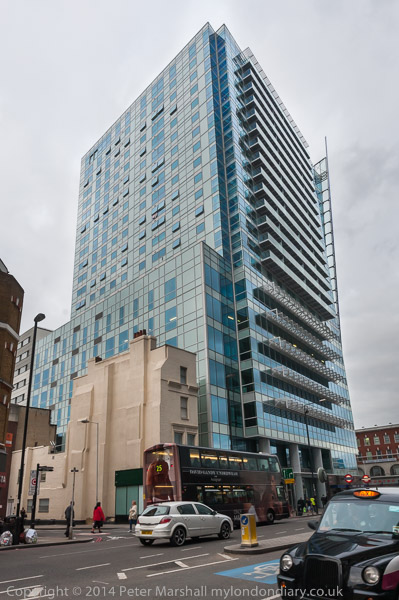
October I seemed to spend a long time struggling to make pictures in darkness and rain, particularly at several of what turned out to be a weekly fixture covering the Poor Doors protests outside the hugely expensive One Commercial Street flats in Whitechapel High St at Aldgate, just on the edge of the City of London.


It wasn’t really quite dark when I took this- and other pictures in Poor Doors Musical Protest

One solution (of sorts) to darkness is to use flash, and I’ve kind of got used to that, even if things go infuriatingly wrong at times. But using flash in rain is a problem, as all the raindrops glow in the flash, particularly those closer to the camera (as the light falls off with the square of the distance.) My flash units aren’t waterproof either, and using them in wet conditions without some kind of protection can lead to expensive repairs – and even the possibility of getting 400 volts when you least expect it.


A week later it was darker and raining rather more – Class War Poor Doors Week 12

Flash is often infuriating in any case, and there are some very good web sites about using it which suggest various creative set-ups, none of which are particularly appropriate to the kind of work that I do. For that you need quick and dirty flash, but there are a few things to bear in mind which can improve matters. I suspect I’ve mentioned all this before, but here goes with my 10 flash tips.

  1. Use high ISO to avoid blackness around the close bits your flash can light up. Mostly at night with flash I work at ISO1600 or ISO3200.
  2. If your flash has a diffuser built in, use it for wide-angles unless you want ‘creative’ vignetting. For longer lenses you can use it for close subjects. The little built-in white plastic bounce reflector helps too – but only at fairly short range, when you can then angle the flash head up at 45 degrees.
  3. Work with your camera in manual mode and your flash in auto TTL mode (assuming you can – it works with my SB800s)
  4.  Usually a shutter speed of 1/30 or 1/60 will do fine. Mostly I also work with my rather slow lenses more or less wide open too. Aim to get an exposure without flash that is perhaps 2-4 stops under.
  5. Try to underexpose with the flash too, but only by around 1 stop. If you give correct exposure you will get pictures that don’t look as if they were taken at night. If I’m working without flash I generally need to underexpose by 1-2 stops
  6. Most night scenes – at least in cities – will contain lots of light sources which seriously muck up your camera’s metering. Best work in manual and check the results, adjust as needed, then leave alone until you move into a differently lit area.
  7. When possible make use of the uneven light spread your flash will give by angling the flash head away from the closer parts of the subject.
  8. Sometimes it pays to use your left hand as a flag to shade parts of the subject.
  9. Work in RAW, as you are going to need considerable post-processing for best results.
  10. Never let people see your flash pictures until you’ve sorted them out in post-processing!


We did have one dry week, but then it rained again – another Wet night at Poor Doors

Nikon also have some kind of random fault generator, that will result in the occasional image being hopelessly over-exposed. It might help to make sure flash and hotshoe contacts are clean and that you have pushed the flash right on and locked it in position.  But you will still get the odd random white-out (or at least I do) and the occasional random non-flash image with burnt out highlights. Its just to keep you on your toes.

Of course there are some faults for which only the photographer is to blame. Like taking a second picture before the flash has had time to recycle, which I manage frequently. Or forgetting that any exposure compensation for flash set on the camera adds on to that set on an external flash unit…

And while flash actually built into the camera may sometimes be a good idea, it’s largely a marketing point. Of the five lenses that I normally use on the Nikons it actually only works sensibly with one of them (and the one I uses least)  the 20mm f2.8; with all the other lenses except the fisheye get a large shadow in the lower part of the frame from the lens. For the 16mm fisheye it’s also generally useless as it only illuminates a central oval in the frame.

I always thought that, as the SB800 manual says the flash diffuser is needed to provide proper illumination for 14mm and 17mm lenses, this meant that there was no way the flash would give a wide enough coverage with the 16mm fisheye. So I’d never tried it before these occasions. To my surprise it actually works quite well, and is slightly better still if you also use the bounce card. Used out of doors, recycling times will be around the maximum – and NiMH rechargeable batteries the only sensible choice. When I remember, adding the optional 5th battery really helps, bringing the recharge time down to under 3 seconds, almost as fast as the best external power supplies.

Having fitted an external flash into the hot-shoe, it becomes possible to only slightly raise the built-in flash. Just a little, so it is difficult to notice, but it is still enough to mess up flash exposures completely. So much so that I keep it permanently taped down, only for emergency use.


Uncorrected Fisheye and flash

But flash and rain is still a problem. As an alternative to flash I have a couple of cheap LED light sources, the more powerful with 9 rows of 16 LEDs, a total of 144 LEDs. It makes quite a good torch for looking underneath furniture, but as a light source for taking pictures it is far too weedy. There are more expensive units around, but I’ve yet to try them, though I have at times ‘borrowed’ the light from the larger units wielded by professional videographers.

But in the end I’ve often found myself trying to work just with available light, and wishing that I had lenses for the Nikons like some of those I used to use, particularly the 35mm f1.4 Summilux. Neither the 16-35mm f4 nor the 18-105mm f3.5-f5.6 is much of a lens in low light, and most of the time I find myself using the 16mm f2.8 fisheye, or, if I’ve remembered to put it in my camera bag, the 20mm f2.8. I’ve had most success with the 16mm (not least because I’ve almost always got it with me) but I’d still like a really fast wide lens for use on dirty nights. The only real choice I can see is the Nikon 20mm f1.8G AF-S but its a little on the expensive side.

October 2014

October 2014 I think probably set several records for ‘My London Diary. At a month and 11 days it’s probably the most I’ve been late in updating a month after it has ended, and the reason for that, at least in part is the record number of sets of photographs – almost reaching 50.  Not all of protests, but it is the increasing storm of protest that is making me so busy, and seems unlikely to slacken for a while, as increasingly anger over the effects of government policies rises. Not that it is just the current government – the problems related to housing and the increasing gulf between rich and poor, the failure to subject the police to proper governance etc reflect the failures and priorities of previous governments – at least back to Thatcher – and an increasing dysfunction of democracy itself.

The protests also reflect increasing tensions around the world – Kobane, Hong Kong, Iran, Palestine  – and major global issues including climate change.  I’m pleased that I’ve also found a little time – often in the gaps between a couple of protests on the same day – to continue occasionally with some of my other photographic interests.

October 2014

Wet night at Poor Doors
Biofuel picket Green Investment Bank Birthday


Kobane – Unite against Isis Drawing
Fair Fares Petition
Democracy Camp Saturday


EDL Visit Democracy Camp
Acid Attacks on Women in Iran


United Friends & Families March
Democracy Camp a Week Old


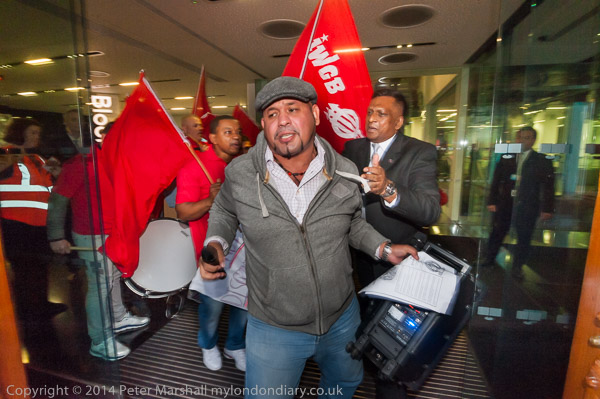
Cleaners protest at Bloomberg
Palestine – another HP protest
Musical Poor Doors


Democracy Camp – Poet Arrested
Canary Wharf & Westminster Tube
End UK shame over Shaker Aamer
DPAC High Court Vigil for ILF
Candlelit vigil for Justice for Ricky Reel
Democracy Camp Fenced Out
Staines march for flood victim Zane
Poor Doors Saturday Night Special
Procession of the Blessed Sacrament
Britain Needs A Pay Rise
Democracy Camp takes the Square
Democracy Camp starts with rally
Spoof shock U-turn by Boris on Housing
Ban on Family visits to Palestinian Prisoners
Art Not Oil Rembrandt Against Shell


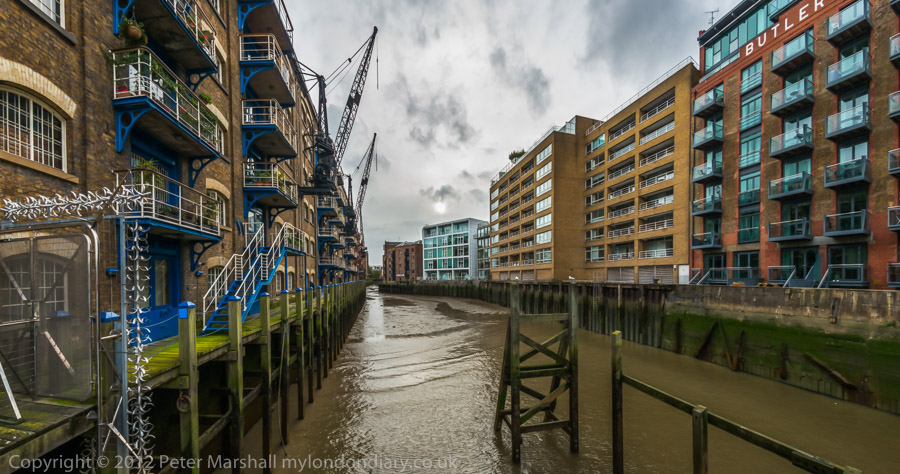
Bermondsey Thames Panoramas
CPOs for Southwark Councillors
Class War Poor Doors Week 12
London Transport Museum Arms Protest
Thorpe Walk
Support the Defenders of Kobane
#NoTTIP – Hands off our democracy
#NoTTIP – Banner Drop
Global Frackdown at HSBC


Solidarity with the Umbrella Revolution
Palestine protest at Hewlett Packard
City Panoramas
Free Ghoncheh Ghavami – SOAS action
Solidarity for Care UK Strikers
Deptford to Greenwich
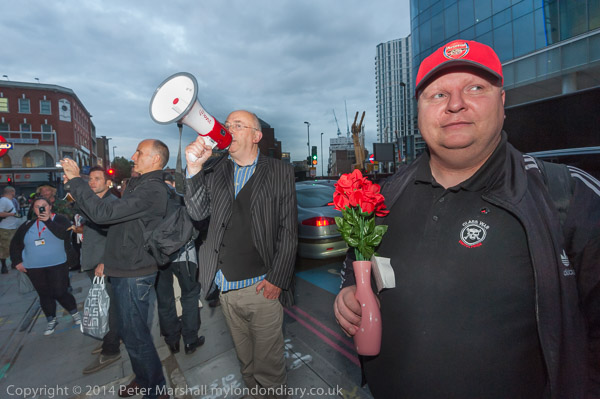
Poor Doors Musical Protest
Unstone Grange & Chesterfield
Hull and Hornsea
Hull at Night


Class War Poor Doors Week 10

Altogether I think there are over 1900 of my pictures on-line from October. Now to get to work on November

Fuji in Hull


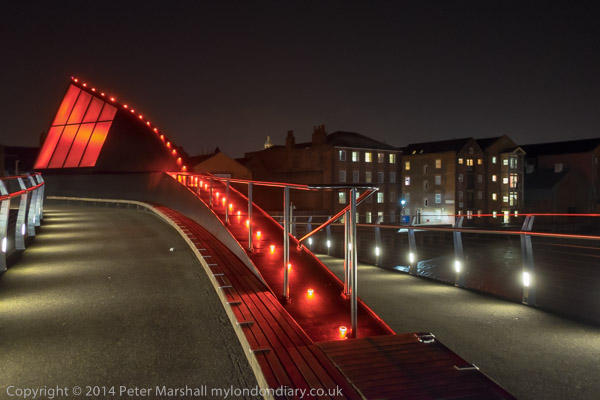
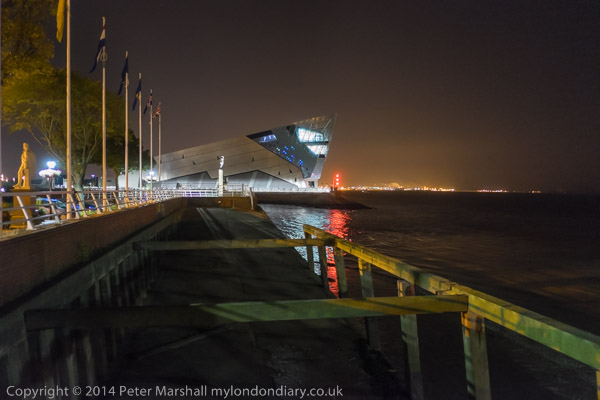
A recently built footbridge across the River Hull

I’d been thinking for a while that while I liked the Fuji X-T1, and in particular the viewfinder, the lenses that I had for it, the 18-50 zoom, the 14mm and the Samyang 8mm fisheye, were all rather large. Not a problem when you are going out to work seriously, but they make it a little bulky when you want a camera to take along when taking pictures isn’t your main intention.

So for those occasions, I was still picking up the Fuji X100, a nice but sometimes frustrating fixed lens camera, with a 35mm equivalent lens. One of the frustrations with using it is that it sometimes just won’t take a picture – and the only way I’ve found to persuade it to function is to turn it off and then back on, wasting a few seconds, usually long enough for people to move or lighting to change and pictures to vanish. But my real problem is that so often its view is not quite wide enough. You can get a supplementary lens that fits on the front and makes it wider, but that seems a rather clunky solution which rather negates the concept.

For some years the main camera I used and carried almost all the time was a Leica M2 with 35mm f1.4 Summilux,. and 35mm became my ‘standard’ focal length. But after around ten years I put it to one side and standardised instead on a Minolta CLE – a more compact camera with an exposure meter – and the Minolta 28mm f2.8 which became my carry everywhere camera. I found the wider lens much more generally useful, and if absolutely necessary you could crop the image a little to give the effect of a 35mm or even a 50mm.


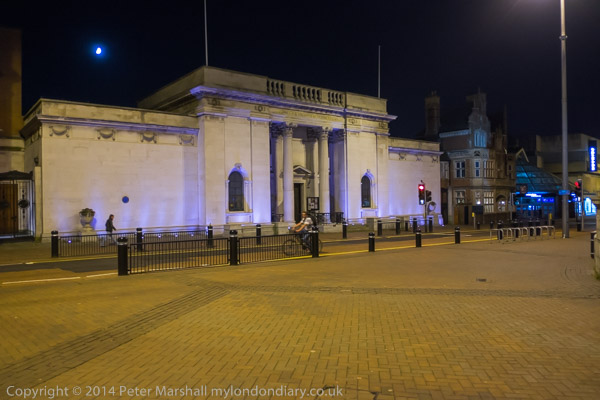
The Ferens Art Gallery – where I had a show in 1983 – you can see many of the pictures in ‘Still Occupied

So I wanted a small lens, and one with approximately the angle of view of a 28mm on a film camera. Taken together these two requirements made the 18mm f2 an obvious choice. But two things put me off. Firstly there are quite a few reviews that knock the performance of this lens, and secondly that I didn’t want to pay the roughly £400 that my usual dealers were then asking.

I left it for a while, then thought about it again when Fuji started a cashback scheme. There is a rather better scheme now – and for around a month longer, but unfortunately it doesn’t include the 18mm.  I turned to Ebay and found that there was a fairly steady stream of secondhand 18mm Fuji lenses coming up for sale – mainly as owners were replacing them with the 10-24 zoom.  That’s a lens I’d rather like too – and will doubtless buy in time – but  that in my mind serves a quite different purpose – and another relatively large and bulky lens, if half the size and weight of its Nikon near equivalent I currently use.


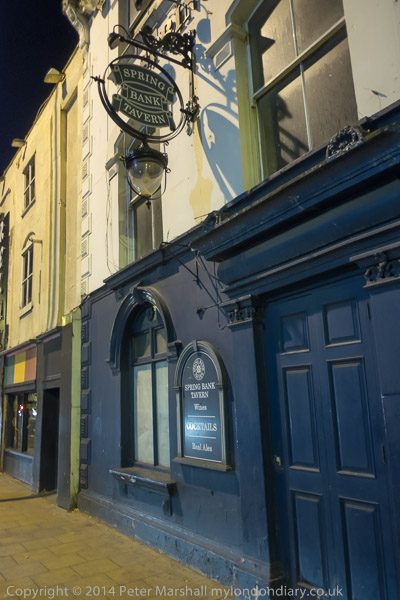
Spring Bank

I bid in a few auctions, gradually increasing the maximum bid I was prepared to pay, kicking myself for missing a real bargain in the first I took part in which went for £165, and eventually getting the lens I wanted for a little under £200 including postage. It arrived just a couple of days before I was leaving for a couple of days in Hull, where I was going to attend a wedding, followed by a brief visit to Derbyshire on the way home.

I thought it likely I would be asked to take some candid pictures at the reception, and knew I would also have some time there to take pictures, but I wanted to travel reasonably light. So I put the 18mm on the X-T1, packed the other three lenses in my shoulder bag and set off for Hull.


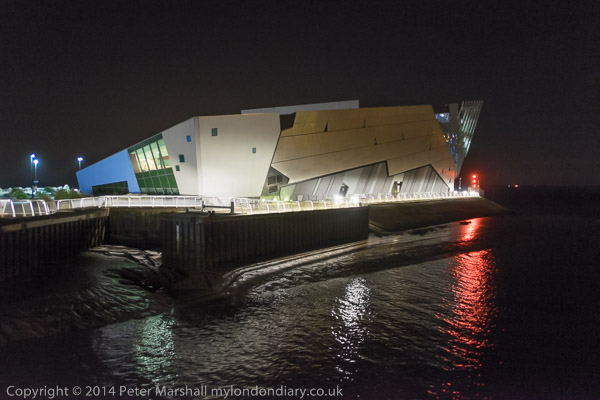
The Deep and the River Humber

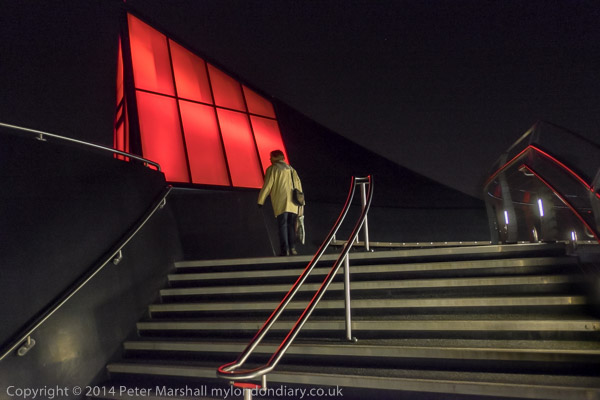
In Hull and Derbyshire I took over a thousand pictures over 4 days, though I’ve not kept all of them, including several hundred at the wedding reception, mainly in relatively dim room lighting, and the technical quality of the results from the X-T1 and 18mm surprised me. I took quite a few night images as well, all hand-held, at shutter speeds down to 1/10 s (and one at 1/5.) Of course where possible I leaned on rails or against posts to help keep the camera steady, but often there was nothing to use for support. Not every image was sharp, and I generally took several so as to pick the sharpest.


The Deep is on the point where the River Hull flows into the River Humber

You can see more of the pictures I took in Hull with the 18mm, mainly at night, in Hull at Night and some during the daytime – as well as a few from Hornsea in Hull and Hornsea. And still with the 18mm, Unstone Grange & Chesterfield. 

Although I carried around the three other lenses in my bag throughout my trip, somehow I never felt a need to use anything but that 18mm.
Continue reading Fuji in Hull

More Vases


Outside One Commercial St, Aldgate, London. Wed 1 Oct 2014

I’m very aware at the moment that my life is out of sync, with just too many things happening for me to keep up or get on with so many things that I want to do. Its some months since I’ve found the time to scan any more of my old work from the 1980s, and on My London Diary I’m still working with putting stories from the end of October on line.

Here on >Re:PHOTO I‘m event further behind in commenting on my work, only today moving to the start of October, though there are still quite a few September stories I’ve not commented on. Those I post about here are either those that raise some kind of photographic issue, either personal or wider, or sometimes those I particularly like the pictures that I took. Like everyone else, I have good days and bad days, but plenty of so-so days too, days when the pictures I turn in are hopefully professional enough, but where I’ve failed to come up with any interesting idea or just haven’t had any luck. The bad days are often the easiest to write about, when I can share my really stupid mistakes with you guys.

There is seldom any real connection between what is happening and whether I have a good or a bad day, and I’ve often taken some of my better pictures at events which I might have arrived at and thought I was wasting my time. Photography is mainly in the mind, and if too much is happening I tend to jump in and snap, snap, snap, reacting with little thought, anxious not to miss anything. (You can see it on my contact sheets from the days of film, though digital does increase the actual number of images for various reasons.) When seeing pictures is harder, you need to think more.


One Commercial Street has its main frontage on Whitechapel High Street

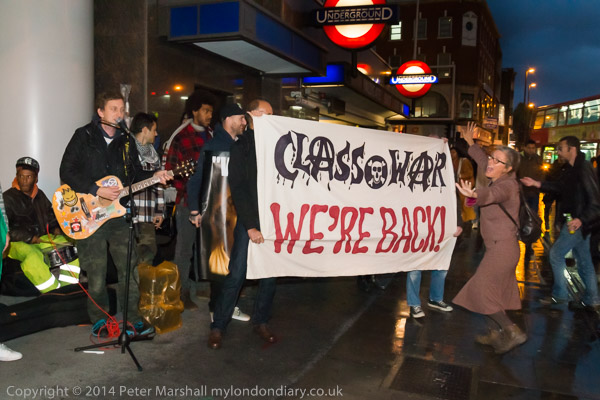
One particular series that has contributed to my recent overload has of course been ‘Poor Doors’, with its regular weekly protests (and an odd extra too.) Since they started in July I think I’ve photographed at 19 of the 21 Class War protests there – and a couple by them elsewhere that I might otherwise not have gone to.

Part of the reason for going to so many is that I think they are raising an important issue and have helped to force it into general consciousness; the separate doors for rich and poor are an index of the increasing social segregation we are seeing as the gap between rich and poor in our society increases. I’ve long opined that the true driving forces of society are cultural rather than economic – important though economic forces are, they arise from culture. with a culture that legitimises the exploitation of labour producing wealth and poverty. Its perhaps this that made me become a photographer rather than a politician.

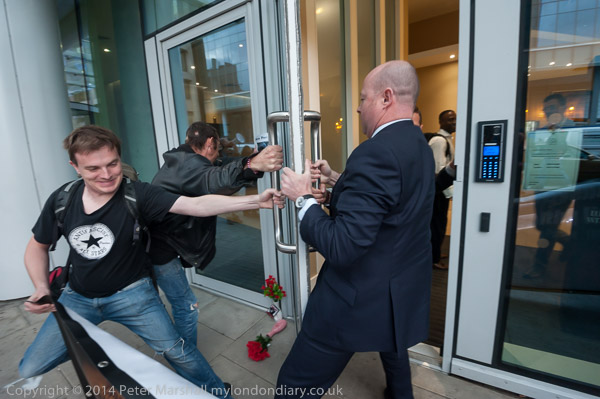
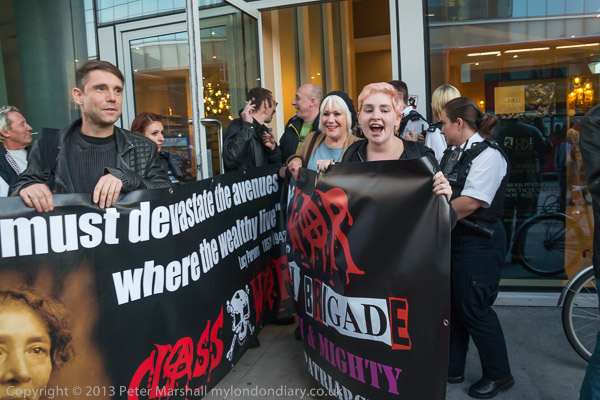
And October started with another ‘Poor Doors’ protest – the 10th for those who were counting, and my eighth weekly visit to take photographs at these similar protests, making it hard to try and photograph in a different way. Inevitably some things are pretty much the same every week, though there are also changes. So this week, after an incident involving protesters entering the building and a vase getting broken, there were now police in position half an hour before the protesters arrived and stood by the rich door with their banner. There were of course the usual struggles over the doors, though only when the police had moved a few yards away for some reason.

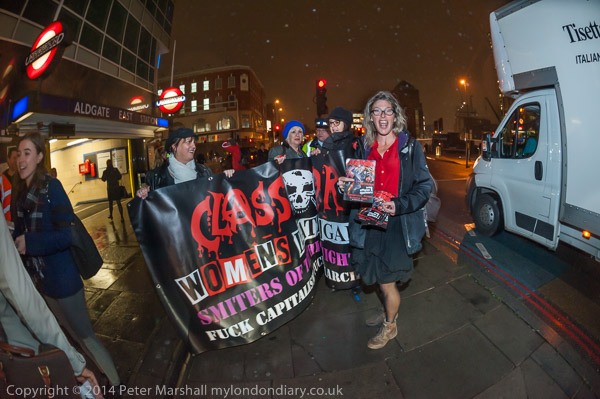
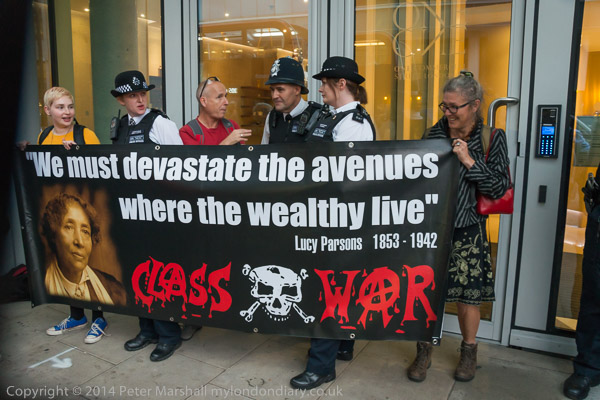
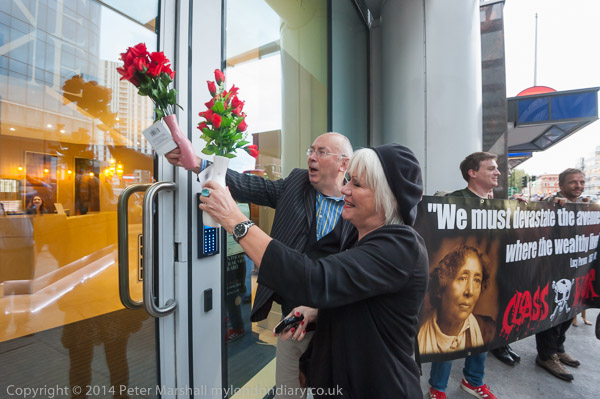
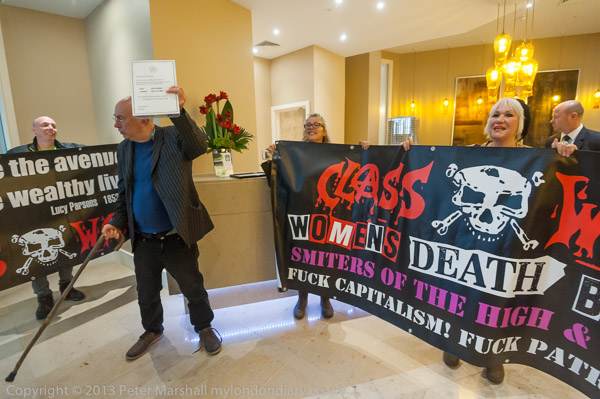
As the ‘Lucy Parsons’ banner and even more the ‘Class War Womens Death Brigade’ banner suggest, Class War’s rhetoric should not be taken literally. They raise serious issues, but in a way that is meant to provoke, and though the humour like the banners may be black they do not incite violence or suicide bombing. When they head for Mayfair next week their most dangerous weapons will be their thoughts and voices.

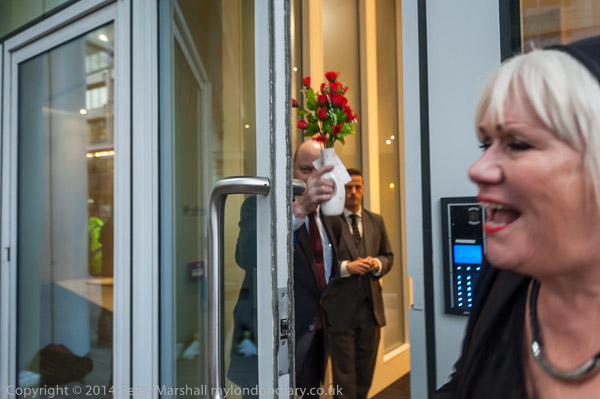
Breaking the vase the previous week had cost Ian Bone £70, but not his sense of humour, and Class War arrived with two replacement vases, by the look of them from a Pound Shop, and offered them to the staff inside the building – who ignored the offer.  Later, when the building manager was closing the door having let a resident in or out, Jane Nicoll thrust a vase in his face and, startled, he grabbed it in a reflex action.

I wasn’t in the right place and wasn’t quite quick enough to catch the moment  – though I managed one frame a second or so later as the he still holds it in front of his face and Jane is exultant. By this time the light was low, I was working at ISO3200 with the 16-35mm wide open at f4, and the focus is on the door frame, perhaps around 4 ft away.  Jane is considerably closer than the near limit of focus, and the building manager slightly beyond the far limit of depth of field. To get them both sharp would probably have required f16 – and a truly astronomical ISO. I was pleased to have got what I did.

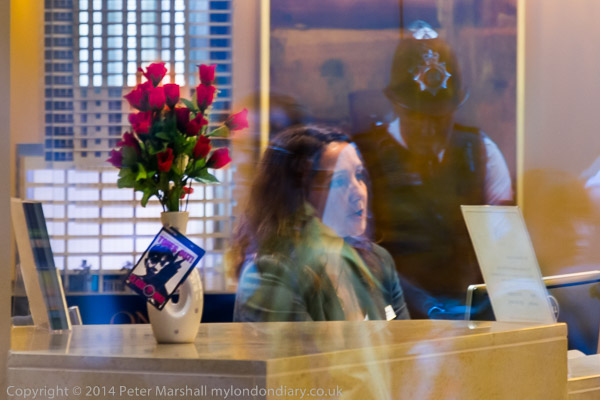
Later I was able to take a picture of it where it had been places, still complete with its Class War label on the Concierge disk occupying the same place that the broken vase had taken. But police had rushed back to surround the door and I wasn’t able to get close to the window, so had to work through it – with all sorts of reflections.  Handheld at 1/20s f5.6 ISO1500 with the 18-105mm at 157mm equiv, a fairly ridiculous exposure. I’m not sure if I had the lens stabilisation turned on or not. On the web site I’ve used a different image, taken at around the same focal length but with a lens without IS, the 70-300mm at f4.5, 1/40s which is rather cleaner looking – as you can see in Class War Poor Doors Week 10.
Continue reading More Vases

Ultrawide or Panoramic?

Yesterday I met up with an old friend – both of us are getting quite old, though Mike Seaborne is rather younger than me – and we had a drink before going on a short gallery crawl. But in the pub we talked a little about our current work, and I took along a copy of my last book, Rotherhithe & Surrey Docks, which he had not yet seen.

Both Mike and I take panoramic photographs – and you can see quite a few of his on his web site. Although I like Mike’s work, and admire his panoramas, we have some basic differences in how we work although often we photograph the same subject matter. So one set of pictures on his site is from Swanscombe, which I photographed back in the 1980s, and then in the 1990s and early 2000s returned and made panoramic images. Both of us have photographed extensively elsewhere around the Thames Estuary too, although the work on his web site is not panoramic, although it was made by stitching together a pair of images.

There are I think two things that qualify a photograph as panoramic. One is the format, which has to be significantly more elongated than the standard 1.5:1 of the 35mm frame. Many cameras now also allow you to take 16:9 images (1.78:1) which to me doesn’t quite cut it as panoramic – just ‘widescreen’. As a working definition I’ve arbitrarily decided that panoramic format starts at around 2:1, and currently I mainly actually work at 1.9:1.

The swing lens cameras that I worked with on film generally had an aspect ratio of around 2.4:1 and I chose these when I first bought a specialised camera largely because I thought that this was the optimum format for panoramic images. Mike thinks differently and likes to work with images around 3:1, though has produced at least one 360 degree panoramic which was (from memory) around 9:1, about 18 feet long and 2 foot tall.

Of course there are panoramic images that don’t really have an aspect ratio,  particularly 360 degree spherical images, which you can only see through an on-screen viewing window. Useful for house agents, but not – so far as I’m concerned – for any serious photography.

But a large aspect ratio doesn’t make a photograph a panorama – it makes it panoramic format.For me the other necessary element of a panorama is a wide angle of view. It has to be a very wide angle, and although I liked using my Hasselblad X-Pan with its normal 45 mm lens, I never felt it was producing panoramas. It was only when I added the 30mm lens that I felt the images were truly panoramic. The 30mm gives a horizontal angle of view of around 94 degrees, which is at about the useful working limit of rectilinear perspective – at greater angles the distortion usually becomes unacceptable. A horizontal angle of view of greater than 90 degrees is often taken as the minimum for a true panorama. Swing lens cameras -such as the Widelux and Horizon models I used, generally gave an angle of view of around 120-130 degrees.

The images I’m making now usually have a horizontal angle of view a little greater than this, at around 146 degrees, but they also have a larger vertical angle of view than those from swing lens cameras, and if uncropped have an aspect ration similar to that of a normal 35mm frame rather than anything more panoramic.  The vertical angle of view of a swing lens camera is limited, because a wider vertical view would lead to distortion and unsharpness due to the different film to lens distances away from the middle of the image. The cameras use a curved film (I almost wrote a curved film plane – but of course the film forms a part of a cylinder, with the lens at the centre of the cylinder. Along the centre line of the image there is a constant film to lens centre distance, but as you go up or down from the centre that distance increases, giving greater magnification and also becoming out of focus.

You can avoid these effects by using a fisheye lens – but of course that produces a ‘fisheye’ image. In the pre-digital age there was little you could do but learn to love them, but I seldom did. But thanks to the work of Prof Dr Helmut Dersch and his ‘Panorama Tools‘ and the many free or commercial products that developed from his mathematical insights we can now do almost what we like with them.

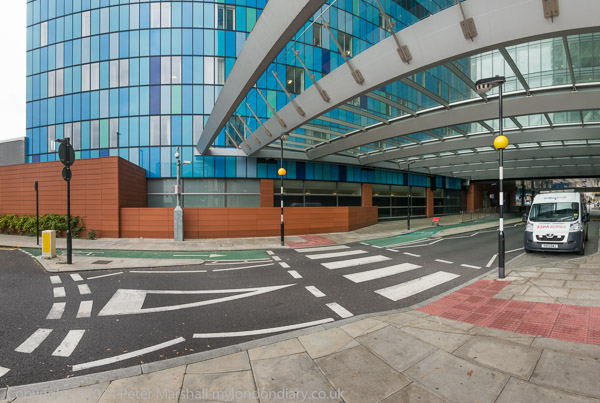
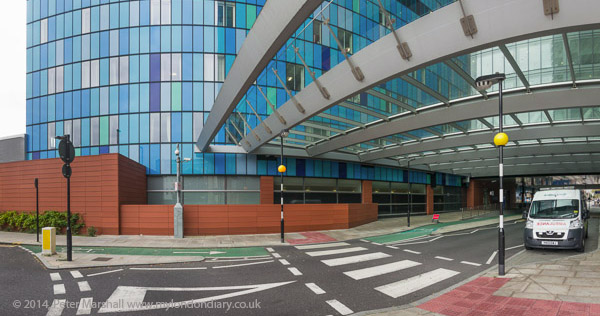
In By the Royal London you can see a number of images, some stitched and others converted from a single fisheye original. I’d gone to Whitechapel to photograph an event, but had time before it got going to take a short walk and to retake an image I’d made as a multi-image panorama around 18 months ago. of the new hospital building. One of several attempts is the top image above, shown in its ‘full-frame’ version.

And this is my ‘panoramic crop’ version of that same image. In taking the picture I had to carefully set the left and right boundaries of the frame, and ensure that the camera was level.  In the viewfinder I could see the top and bottom centre of the top image, but not precisely where the four corners would be – and there are different ways of processing the image that would give different results, although I’ve generally standardise on the particular method used here. And as you can see, when cropping to the 1.9:1 format I had considerable choice of where to place the frame – the equivalent when taking an image in the old days on a view camera with a rising/falling front. I think the crop improves the image, but in this case I rather like the uncropped  image too – and I think despite that ration is still is panoramic, though less contentiously I’d simply call it ultrawide. But really the name doesn’t matter.

For this picture I possibly wanted more of the top of the building and the roof, and tried to get this by stitching a series of images taken in vertical format with a 16mm lens. I hadn’t however taken my tripod with me to lean on and stitching the images proved a little tricky.  You can see one attempt on My London Diary, along with around 15 other pictures I took in the area, all shown converted to give straight verticals, but otherwise uncropped. Most aren’t among my best pictures, but most would be improved by a crop to 1.9:1 format.  But if I wanted to use the 3:1 ratio that Mike prefers I would have to work differently.
Continue reading Ultrawide or Panoramic?

Class War and Poor Doors

As I write this post at the end of November, Class War has just suspended its series of protests about separate doors for the rich and poor residents of One Commercial St.  They have in the last week declared a ‘truce’ as the new owners of the  building have expressed a desire to resolve the situation, with a meeting of the interested parties which hopefully will result in all residents being able to enter on the main street, rather than those on the ‘poor’ side having to go down the side alley.

People often tell me that it isn’t worth protesting, that protests never acheive anything, but that simply isn’t true. Of course not all protests are successful, but many do make a difference. If it had not been for the protests over a ‘third runway’ at Heathrow, we would now be fighting against plans for a fourth runway and Terminal 6 or 7; if it hadn’t been for the protests of UK Uncut, tax avoidance would not have become an issue. Protests seldom manage to wave a magic wand, but they often do effect changes in the ways that issues are seen and debated, cultural changes that alter  the course of events.

One Commercial St isn’t in itself that important. One block of many similar blocks springing up across the UK, and of course particularly in London. An exemplar of the trend towards social segregation which is accompanying the increasing financial gulf between rich and poor in this (and many other) countries. Class War’s stand here is one of principle rather than about the particular, and whatever the final outcome in this building, it has put the issue firmly on the political and media agenda.

Housing has become a major issue, and it has largely done so not because of the obvious and often desperate problems many face, not through the dedicated lobbying of charities and the research of academics, certainly not by the largely spineless approach of Her Majesty’s opposition (who through some Labour dominated councils are very much a part of the problem) but because of the work of grass roots activists such as Class War, Focus E15, New Era and others.

At first these kind of activities are only reported in social media and by alternative news media. Posts on Facebook and Twitter, articles in blogs and on campaigning web sites. Gradually they begin to surface in more major media outlets. I’m not a great fan of Russell Brand, but I was pleased to see a few weeks after the events in these pictures to meet John Rogers (who I met some years back when we both featured in the London International Documentary Festival)  filming at a later Poor Doors protest for Russell Brand’s Trews Reports (which have also recently covered  Focus E15 and New Era.   If you have any interest at all in London you will find some fascinating videos on his YouTube page – I particularly recommend his full length documentary The London Perambulator, a full-length documentary film.)

Back to September 24th, and Class War Occupy Rich Door, a night that marked a hotting up in the battle between protesters and the Redrow staff of the building over the rich door. Before there had been tussles with the protesters attempting to  hold the door open  when residents entered or left during the protests, but this week something different happened.

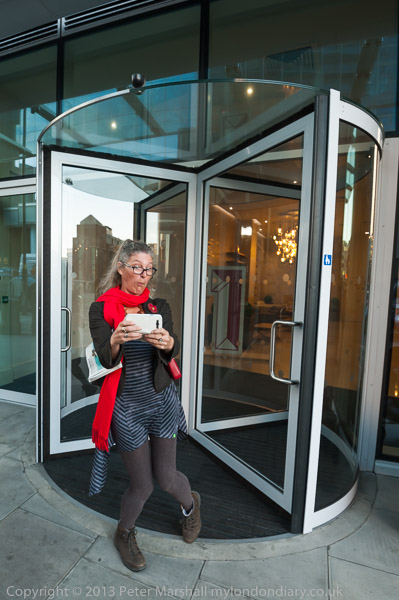
Perhaps it was the presence of Marina Pepper, Class War’s candidate to stand against Iain Duncan Smith in his Chingford Constituency, at the protests for the first time and posing above in the always locked revolving door that led the building manager to simply walk away when a protest put his foot in the door to hold it open. But whatever the reason, the open door seemed an invitation to walk inside, and the protesters, after a few moments shock at seeing it made so easy, simply walked in and made themselves at home.

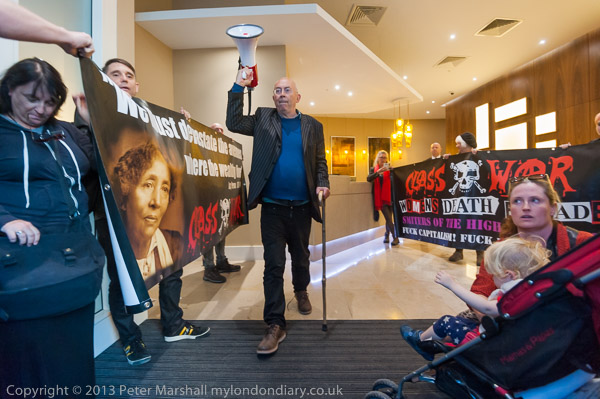
The building manager called the police, but for the moment the protesters were in the foyer and Ian Bone is holding up a framed notice from the desk with details of the 24 hour phone lines to the Concierge in the building – and comparing that with the broken entry system on the poor door in the dimly lit alley. In front of him is the walking stick he now relies on, and behind him on the desk a vase of flowers. As often, while speaking, he was flourishing his stick, sometimes rather wildly.

At some point in the next few minutes, walking stick and vase connected, either by accident or design, and that vase crashed to the floor and shattered. The noise startled me, and it seemed to startle Bone too.

It took eleven minutes for the police to arrive, and they came in and one chatted with the protesters while another went with the building manager into his office. Soon more police arrived, and after I’d gone outside to photograph them at the rich door, prevented me going back inside again. Eventually the police got the building manager to tell the protesters to leave and then the police threatened to arrest them for aggravated trespass if they didn’t go, and after being inside for 20 minutes they left in a jubilant mood.

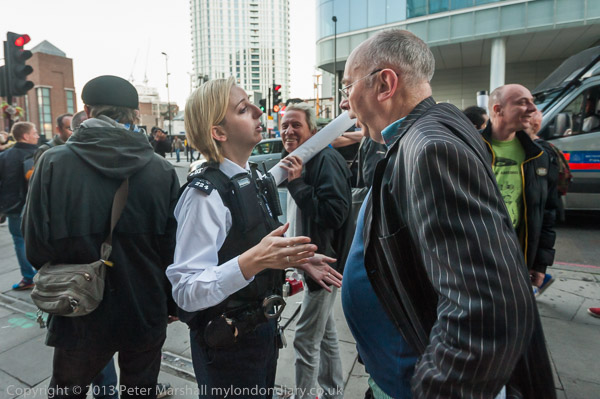
The protest then continued as usual on the pavement outside, with one rather odd incident when a man began to shout loudly that no one was prepared to answer his question, which he had apparently asked some of those holding one of the banners. He continued to shout this loudly for some minutes, while refusing to tell everyone who was asking him what his question was. Police tried to get him stop shouting and leave, but without success, and he ended up arguing with a small group of protesters. It was only at the following week’s protest that I talked to them and found that he felt that people should be protesting about rights for men.

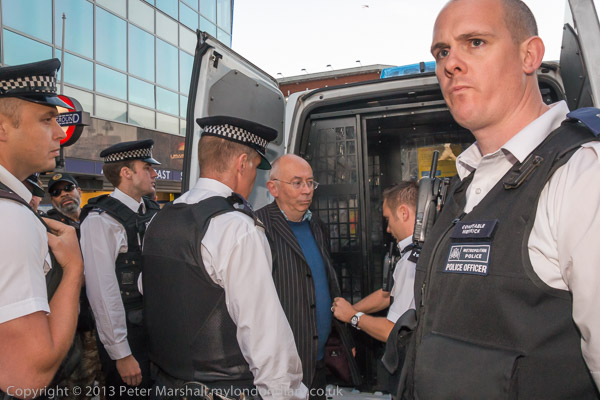
His intervention prolonged the protest for a few minutes, during which more police arrived including a van. As Ian Bone turned to leave, a police officer stood in his path, and soon he was surrounded by others and after a short argument he was told he was going to be arrested for breaking the vase and taken to be searched by the back of the police van before being driven away. The following week he said the vase had cost him seventy quid.

Photographically the light inside the building was a little on the low side, and I had some problems with depth of field and blurring due to subject movement, even working at ISO 2000 and a little above, with typical exposures around 1/80 f4.  In the few minutes I was able to move freely in and out of the building I didn’t always have time or remember to change the settings to cope with the very different lighting. In situations like this, where I’m conscious that at any moment I could be asked to leave, I tend to take too many pictures and not think enough about them.

I wasn’t asked by the building manager to stop photographing, though had I been I would probably have told him that I thought it was in the public interest and continued.  But I do tend not to use flash, as that does remind security people that I am taking pictures, and I didn’t do so. The pictures were almost certainly better for it.

At the end of the protest, when Bone was being stopped and arrested, it was beginning to get dark. But it wasn’t too dark – the image above at ISO2000 was taken at 1/60 f9. I needed to stop down for the depth of field even at 18mm (27mm equiv) on the 18-105mm. The main problem as always in such situations was getting to the right place, with both so many other protesters and also the police getting in my way. My thanks to Constable Merrick on the right of the picture for not interfering with me or trying to stop me getting a picture – too often police officers seem to think it part of their job to prevent photographers working.

More at Class War Occupy Rich Door.
Continue reading Class War and Poor Doors

Druids and Viewpoint

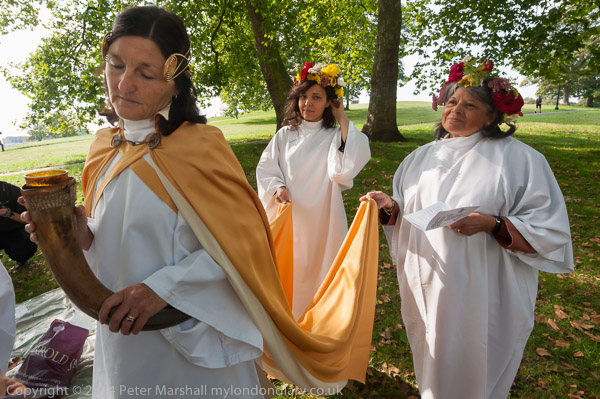
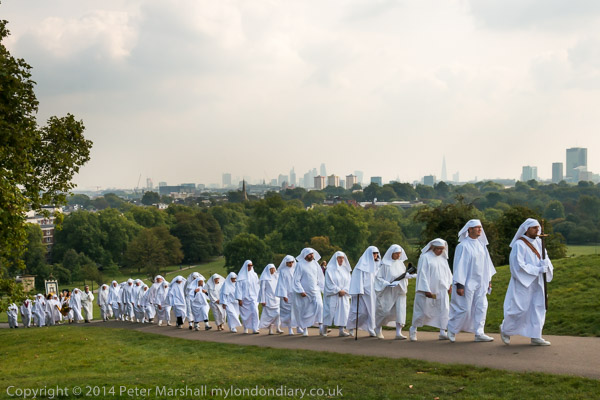
Twice a year I get an invitation from The Druid Order through the post inviting me to their Equinox celebrations, and although I’ve now seen them a number of times both at Tower Hill in Spring and on Primrose Hill in Autumn, I still like to go. Its an interesting spectacle to watch and still presents a challenge to photograph, even more of a challenge to try and produce different photographs of. I’m not sure I succeeded in that second aspect this time.


D700, 16-35mm at 16mm, f9 1/320 ISO 640

Primrose Hill is certainly the more spectacular of the two locations, with the green grass a better surface and the distant view of London. Tower Hill has its historical associations, but the Tower is a little distant and the closer buildings uninspiring. In some past years they used to process some distance through city streets which had some visual possibilities, lessened now as they emerge from the church hall next door.

I also have my suspicions that the ancient druid rites may well have been very different to these rather dry and solemn occasions. Probably a much more bloody and drunken orgy than these carefully scripted routines following the book. But the ceremonies doubtless satisfy those who take part in them and surely encapsulate some truths about the relationship between us and the planet we live on that are essential to the future of the species. We have to respect the earth, not desecrate it, and to be aware of our relationships with nature.

D700, 16-35mm at 16mm, f9 1/320 ISO 640

This is one of the very few occasions on which I screw anything into the tripod socket on any of my cameras. I hate tripods. I’ve never found one that really suited me – either too heavy to carry any distance or too flimsy and short to be of much use. If I could afford an assistant to carry the tripod (and much more usefully in London, the umbrella) I might think differently, but probably not. Tripods get in the way and slow you down. I’d rather lose the imperceptible scintilla of sharpness in the odd image than use one. Most of my images are at least sharp enough.

D800E, 18-105 at 25mm (37mm equiv)  f14 1/800 ISO 800

I had to use one when I photographed the multiple image panoramas for the ‘Secret Gardens of St John’s Wood’ as it was essential to get the lens nodal point in virtually the same place for all of the exposures. Though I messed up the only ones I screwed the camera in place for, and generally worked just by resting my hand supporting the lens at the correct place on the tripod plate. I used one – a solid Manfrotto – for some of my film panoramics too, particularly with the expensive Widelux which had no viewfinder or spirit level, but soon abandoned it with relief once I was working with the cheap Horizon that came with both.

But for this occasion, what I took to Primrose Hill was a monopod. It’s relatively light but still won’t fit into my camera bag, which is a pain. I put it across the top of the contents and close the cover and it stays there until I open the bag to get something out and forget it’s there, and then it isn’t any more. Fortunately I’ve yet to drop it anywhere completely unretrievable.

Also in my camera bag is a long cable release, an electronic thing that fits into the fancy socket on the front left of the camera. I did experiment with a cable-less release, with a little box in the hotshoe plugged into the same socket and another with an aerial in my hand, but it seemed more fuss for this job.

The monopod screws into the tripod socket on the base of the camera, or rather it should, but I have a strap that screws in there, with its socket that I always forget and screw the monopod into instead. What I should do is unscrew the strap – and then use the quick release built into the strap to remove it from the camera – before screwing in the monopod.

In use it makes no difference, but when you come to remove the monopod, it comes off the camera with the strap, leaving the camera hanging from the other end of the strap only, and it takes a mole wrench to separate the monopod from the other end of the strap. Unless your assistant carries a mole wrench (if you have either) your only recourse is to screw the monopod back in and keep working with one attached to you camera. Which I did.
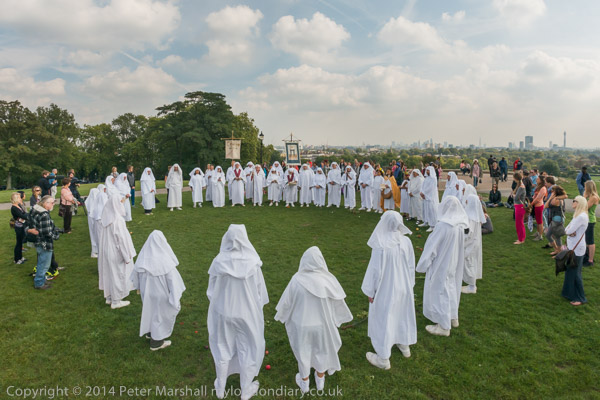

D800E 16mm fisheye, f16 1/1000 ISO 800

The purpose of this is to photograph the circle from a high viewpoint, particularly with the fisheye 16mm lens. But holding the camera high above your head you can’t see through the viewfinder. Live view puts the image on the rear screen, but it’s almost invisible from below with the sky reflected in the glass. The Nikons have a ‘virtual horizon’ feature which is a little more visible and I sometimes try to use, looking for a green line. But it still isn’t easy to see

It really is a problem trying to keep the camera level – and necessary unless you want a curved horizon. What I mean to take with me but always forget is a plumb line which ought to solve that problem. Until I do so I will just have to rely on guess work and taking quite a few exposures in the hope that some will be ok.

It isn’t too easy either to keep the camera pointing in exactly the correct direction, working very close to the circle even with the very wide angle of the fisheye.

Of course there are high-tech solutions to the problem. With the Fuji cameras I have an app that lets me control the camera and see the viewfinder image on my phone, which I might try another time. But I think I would need a cradle of some sort to fix the phone onto the monopod or to grow a third hand (or that assistant again.)  Perhaps better still would be a drone, though I’m unsure how well that would go down with the druids, especially were I to fly over the druids, and it adds another level of complexity. It would probably need to be used at a greater height, and I think the kind of view I’m getting from monopod level is probably the most interesting.
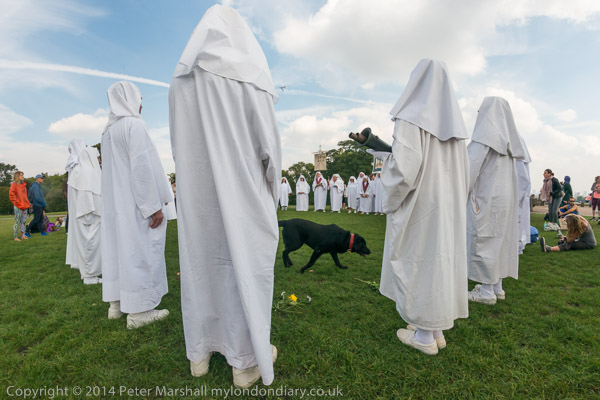

D800E 16mm fisheye, f16 1/1000 ISO 800

But perhaps I’ve already done enough on these druid ceremonies, and if I wanted to take the work further should look at it in some very different way. Though that – like the drone – is probably something I’ll leave to others.
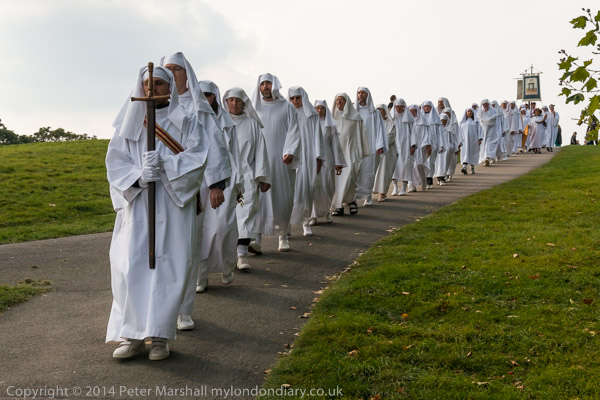

D800E 18-105 at 42mm (63mm equiv) f13 1/640 ISO800
There are more pictures on My London Diary, in Druids on Primrose Hill and as usual the images, apart from the one on the ‘month’ page with the text are posted there in more or less the order in which they were taken, and are my attempt as usual to try and tell the story mainly through images, though some words of explanation are necessary to go with them. There are a few captions, but there just aren’t enough hours in the day for me to do this as well as I would like.  As you may appreciate it  is now less than a month to the winter solstice and I’m only now on this blog writing about the equinox.

I’ve included exposure details, though they don’t have a great deal of meaning. All were probably taken on P setting and with -0.3 stops exposure compensation. All on pattern metering, with probably all on autofocus. Generally the camera does it at least as well as I could, though I occasionally make changes when time allows.
Continue reading Druids and Viewpoint