Terry King (1938-2015)

I was shocked last night to hear that an old friend of mine, well known to many photographers in the UK and around the world with an interest in alternative processes, had died yesterday afternoon of a heart attack.


Terry King reads one of his poems at his 70th birthday party

I wrote a post here in August 2008, Terry King at 70, which went into some of my personal involvement with him, and I won’t repeat those stories here. Terry was one of the first in the UK to kick-start interest in the potential of many historic processes with his lectures and workshops, and founded the international APIS (Alternative Processes International Symposium) meetings as well as paying an important role in keeping the Historical Group of the RPS going over the years when closure seemed inevitable.

When I first met him, I found his work using colour transparency film beautifully romantic, and a number of these images were later transformed into the fine gum bichromate images which gained his FRPS. His work and his approach were quite different to my more classical approach, but we shared many views about photography, not least about the dead end of academic theory that was beginning to blight photography – and particularly photographic education – at the time.

Terry’s was always a no-nonsense approach, seeking to cut through mystification. He read the historical accounts as well as the more recent publications, revelling in such details as the ‘raspberry syrup process’ and names like Mungo Ponton, with his magnificent beard,  the Scottish grandfather of the gum bichromate. And his sometimes chemically illiterate hands-on investigations of alternative methods led him to develop new and interesting variants on old processes such as the chrysotype rex and cyanotype rex. The latter provided a way of relieving what we both considered the great weakness of they cyanotype process, that the prints were always blue.

Terry’s company was always stimulating, and his Hands On Pictures web site is an good reflection of his character if a rather messy piece of web design.  One of the links on it is to his 2009 Blurb book, Beware of the Oxymoron, which the preview allows you to view in full with fine images matched by his sonnets and other poems.

My own photographic interests diverged fairly completely from Terry’s in the 1990s, and I saw him relatively infrequently after that time, but it was always a pleasure to meet him – as I last did in September last year, when he had a fine show of his work at the new studios he had just moved to in Kingston. And I have many happy memories of our outings together, sometimes with an 8×10″ camera lent to Terry by a photographer who lived down the road from me. It had it’s first outing with us at the bottom of my garden, photographing (badly) Sweeps Ditch with a lens that didn’t quite cover the format. Later I took pictures with it in Richmond, and helped Terry make some good exposures of the stones at Avebury. At the time I wrote one or two articles for Amateur Photographer about some of our outings along with other photographers to places like Bedlams Bottom. Perhaps one day I’ll dust off those memories and republish them.


Terry King with red umbrella at Pewsey, 1980
Continue reading Terry King (1938-2015)

In the Family Way

Most parents photograph their children. Or at least those of us fortunate enough to live at least reasonably comfortably and with our families do. Almost certainly now the great majority of those pictures will be taken on mobile phones, and many will be shared through social media. Some parents will share them privately, while others, either by accident or design will make them visible to the world. I’ve occasionally come across some which I would rather not have seen – usually on aesthetic grounds – on my Facebook feed, but usually I just hit the space bar to scroll down to the next post.

Occasionally I’ve told Facebook I don’t want to see any more posts like this (usually of cats or food) but it seems to have no real effect. A few people who only seem to post that kind of content I’ve blocked or unfriended, and some posts I’ve reported as spam.  If I saw anything that was clearly illegal I’d certainly report it to Facebook, but so far I haven’t had to do so.

Today on Facebook I read two different posts about people who have received an avalanche of negative comments after making photographic projects photographing their own children and publishing these images, prompting me to write this post, and I’ll mention both later.

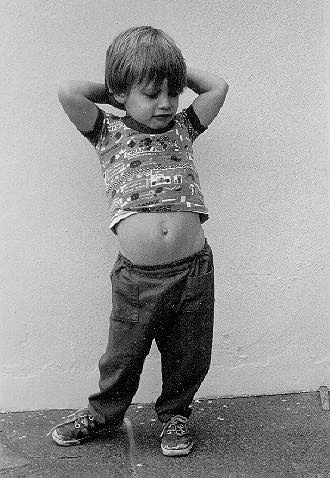
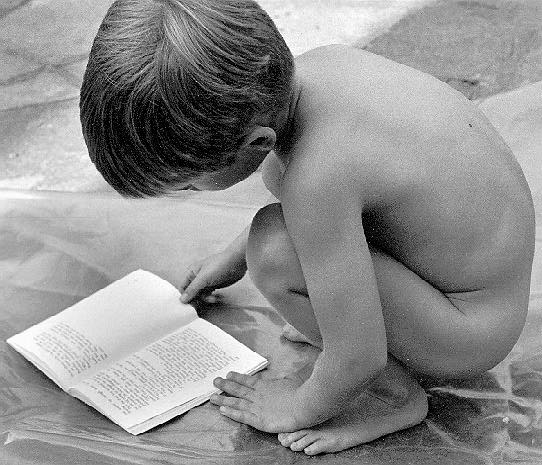
Firstly I was reminded that the first web site that used my own pictures was a small site with the title ‘Family Pictures‘, with images of my own two boys and some of their friends. I chose the images carefully as those which I felt would have an appeal outside my own family.  I was also careful to remove a few more revealing images of the children playing with friends in paddling pools and elsewhere on hot summer days that cause amusement in family circles but might have transgressed the ISP’s guidance on nudity.

By the time when these black and white images went live on the web in 1995, those two boys were in their late teens, and they helped me hand code the html for a rather basic web site and upload it to an ISP that was offering small amounts of free web space.

I updated the images a few months later to reduce image size, as some of the originals were around 100Kb and very slow to load on a dial-up connection, and got the whole site showing 16 jpeg images (and thumbnails of them) with 17 pages of html down to under 1Mb.

I transferred it to my own web space a few years later, and made a few changes to the code, removing the pre-loading of images we had thought up, which had appeared to speed up the site when going though the images in order. A full stop on each page of the site was actually the next image in the sequence resized down to a 1 or 2 pixel square. As modems got faster, such tricks became redundant, and just complicated matters. But visually the site is as it was almost 20 years ago – still the same scans, rather poor by modern standards and worsened by jpeg artifacts. You can still see all 16 images online.

Personally I find the pictures taken by photographer Wyatt Neumann during a trip with his 2-year-old daughter a charming record of childhood innocence and the relationship between father and daughter. What I find disturbing is the kind of comments that some have made about them – and also I dislike the way these images are introduced on the Upworthy site, alhtough the video is rather better than you might expect.  You can read the photographer’s own introduction to the work, which he has exhibited and published as I Feel Sorry For Your Children, on his own web site.  Those people who look at this work and see “sexual victimization and violence,” I feel sorry for their children too, and like Neumann would say “I choose life.”

Another photographer whose work has aroused similar controversy is Sally Mann, and in a long article in the New York Times, Sally Mann’s Exposure, she writes in great detail about the problems caused by such controversy, and the actions of some desperately sick people, one in particular that she goes into detail about. I’ve written before about my great admiration for Mann’s work, and a little about the misguided criticism of her for it, but had not realised the full extent of the persecution she and her family have had to suffer. It’s a moving article, and one that only strengthens my regard for her, and for the need to keep up the struggle for freedom of expression and the kind of positive family and societal values that underlie the work of these photographers and others.


Continue reading In the Family Way

I’d love to love Fuji, but


Fuji X-T1, 18mm (27mm eq)

Around Easter I’ve taken some time off from my normal work and have spent a lot of time using the Fuji X-Pro1 and Fuji X-T1 cameras, mainly with the 10-24mm zoom on the XT1 and the 18-55mm zoom on the X-Pro1, but also working with my favourite 18mm and the 35mm Fuji lenses. At times I carried around some others, but didn’t find the need to use them.

It’s taking me a long time to get used to some of the idiosyncracies of the Fuji cameras, probably much longer than if I just used one of them. If I had to pick one it would be the X-T1, largely for its far superior electronic viewfinder. Though I do like the optical viewfinder of the X-Pro1, I’ve often found myself switching to the electronic alternative, as the zoom lens blocks a significant part of the optical view. It works rather better with the smaller 18mm and 35mm primes, where only a small part of the view is blocked.

If these – and others in this focal length range – would satisfy all my photographic needs, I’d prefer the X-Pro1, but I like to have both a wider and a narrower view.  With the 18-55mm, by the time the long end is reached, the viewfinder image with the optical viewfinder is just too small for my liking, making the electronic view a preferable option, and with the fine 14mm f2.8 too much of the image is hidden where the lens obtrudes into the optical viewfinder.

The X-Pro1 is a fine but very limited tool which does appeal to me as it feels a simpler camera to operate than the X-T1, but for me the flexibility of the latter is vital. For so many lenses it works better. Even with that 18mm, seeing the bottom right corner in the viewfinder is much better. And now I’m used to it, and don’t waste time searching throught the menus for it, I very much like having a dial on the camera top putting ISO at my fingertips. Being able to walk from dark interior to bright sun without having to fiddle with menus is great.

I find switching from using a camera with a direct vision optical viewfinder to an electronic viewfinder can be confusing. Using mainly DSLRs and the X-T1 it’s just too easy to get into the habit of thinking if the image is sharp in the viewfinder it will be in focus on the sensor – and I have made many, many exposures that prove it just ain’t so. The occasional arty blur might be of interest, but to find you’ve taken 50 in error because you forgot to change back from manual focus can be annoying. With the 18-55mm at its wide end, depth of field may be your friend and cover your stupidity, but it doesn’t work at 55mm.

Of course it should be obvious that you are still on manual focus – no little green rectangle confirming focus – but in the heat of the moment it can be so easy to forget this. And if you are not photographing in the heat of the moment, perhaps you should ask yourself why you are bothering to take pictures at all.

I think now that I have finally figured out most of my problems with Fuji colour in Lightroom.  I’ve been using the X-Pro1 on and off for a couple of years and have always been surprised at how many people enthuse over Fuji’s colour rendition. Even though I think I’ve now discovered how to deal with it, I still often prefer Nikon colour.

The best result I’ve got with Lightroom come from changing the ‘Camera Calibration‘ from the normal ‘Adobe Standard‘ to the Fuji ‘Camera Pro Neg Std‘. It seems to give better colour than the camera Provia/Standard that I normally use for in-camera jpegs and the viewfinder/screen image (it seems wrong to use a different setting for camera and Lightroom, though the camera setting doesn’t affect the RAW file, but working this way seems to give me a better match between what I see in camera and the developed files.)

Setting up a development preset that applies this and uses Auto-tone produces images that need little adjustment – similar in that respect to my Nikon files, while with Adobe Standard they were a problem to deal with. Though there still seems to be an undesirable propensity for pink in Fuji’s auto white balance to correct. Lightroom’s Auto-tone perhaps works even more reliably than with the Nikon files, though this may be a reflection on the less challenging situations I’ve used the Fujis in.

I have a small issue over file sizes. Fuji’s similar quality to Nikon comes from files with a roughly similar number of pixels, but while the RAW files from the D700 average out at around 11Mb, the Fuji RAW files are roughly two or three times that size. The 16GB cards I now mainly use in camera get filled up rather fast, particularly on the X-T1, and I’ll probably buy larger ones; transfer times to the computer and into Lightroom are noticeably longer, and my external storage is filling up at a faster rate. Nikon’s compression with no real life noticeable quality loss is very useful.

Fuji battery life is a problem, even using mostly the optical finder on the X-Pro1. Nikon batteries hardly ever need changing during a day’s work. I carry spare batteries, but hardly ever need to use them, and have to remember to swap them over occasionally or the spare loses its charge over months. Working with the two Fuji cameras, at the moment I have a total of five batteries. Just enough to see me through a day of fairly light work, but I really need at least one more. Expense isn’t a problem, with replacement batteries being fairly cheap, but it’s a nuisance having to carry and to change them.

Overall I’m feeling rather frustrated with the Fujis. With the Nikons I can turn them on when I get the cameras out of the bag, and turn them on when I pack up. Between those times – often hours apart – every time I put my camera to my eye and press the shutter release, the camera takes a picture, almost every time in focus and with hardly any perceptible hesitation.

With both Fujis, things are rather different. Unless you are going to be taking pictures every few seconds, it’s quicker to switch the camera off, then turn it on when you want to use it again, waiting the roughly two seconds start up time, otherwise you can be pushing the button and swearing for even longer until the camera wakes up.

Focus, even with the improvements from firmware updates, still takes a noticeable time, but its the time taken to persuade the camera into life that is for me the real killer.

For some photography with wide-angle lenses in fast-moving situations you can of course do what we always used to do, turn off autofocus and rely on depth of field, using ‘zone focussing’. Once it’s up and running the X-Pro1 with the 18mm does the Leica thing rather better than the Leica M8 I used to use, and about as well as the real thing.

X-Pro1: 18mm, 18-55mm (27mm eq)

I have had some issues with framing using the 18-55mm with the optical finder of the X-Pro1, though these may well be down to me rather than the system. Certainly I seem to chop off the tops of people’s heads rather more than when working with the similar frame inside the view with the 18-105mm DX on the D800. And using the Fuji combination yesterday, at times the bright line frame was fading away as I was working, which was not good news. I fear an expensive repair may soon be needed.

So, much though I like the Fuji cameras, and much though I prefer to take them with me when I go out for a long walk or some relaxed occasion, they won’t be replacing the Nikons for much of my more intensive work. Perhaps I might just try working with a hybrid kit, with the X-T1 and 10-24mm replacing my ageing D700 and the superb but heavyweight Nikon 16-35mm. Perhaps. I’ll certainly give it a try before getting around to buying a D750.
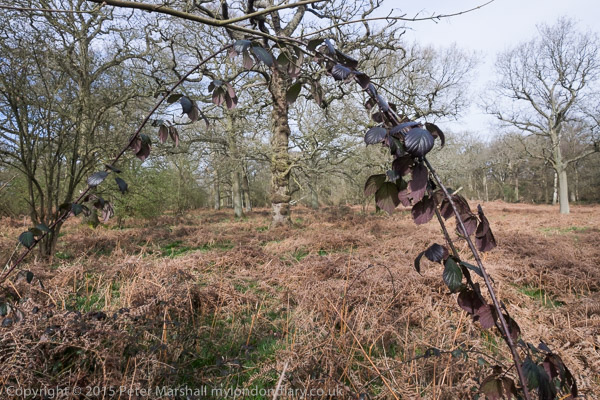

Fuji X-T1, 10-24mm at 15mm (22mm eq)

For some photographs, that couple of seconds wait isn’t a problem, nor the slight pause you get between the shutter press and exposure. Some people wouldn’t even notice it, but when you are used to a camera without appreciable delay it annoys. Catching the moment is often vital in photography; catching the moment a little after just won’t do.

While in this post I’ve concentrated on some of the negative aspects, particularly for certain types of work, there are also some very positive aspects of the Fuji. Working in quiet environments, the quiet (or truly silent in electronic mode on the XT1) shutter is a great advantage, both to me as a photographer and in preventing annoyance to those you are photographing, and fast lenses such as the 35mm f1.4 combined with good high ISO performance are great in low light on the X-T1. I’ve often found myself while working wishing I had this camera in my hands instead of a rather clunky Nikon with a slowish zoom. The 23mm f1.4 is more expensive, and I’ve not yet bought one, but I’m tempted by this and the weather resistant 18-135mm …

Continue reading I’d love to love Fuji, but

March 2015 complete

I fell asleep around midnight last night trying to finish putting my work from March on to My London Diary, waking with a start to find a black screen in front of me, and when I moved the mouse to rouse the monitor from its dreams, found myself facing a blank page where I’d almost completed the coding. In my daze it seemed something of a calamity.

Fortunately hitting Ctrl+Z to undo my last action – presumbably hitting the space bar with the page selected as I collapsed on the keys – restored my work, although had I been thinking clearly I would have realised that only the few keystrokes I had made since the last saved version would in any case have been lost. But it was certainly time to give up and go to bed. And finish the work the following morning, which I now have. I think there are 40 stories from March, though not all have a great deal of content, and a couple are just pictures from my occasional days off.

But I’m also aware of the many events I’ve been aware of but been unable to cover, invitations I’ve had to refuse because I have to be at another place. We are indeed living in interesting times, and it is something of a curse.

Mar 2015

Another Country Walk
Cross Bones Open Day
Murdoch on Trial – Guilty as charged


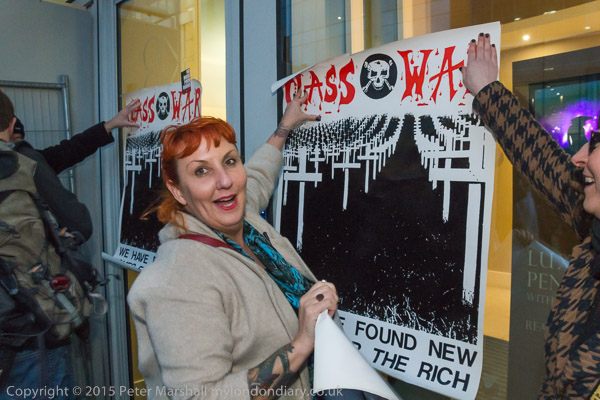
Jon Bigger Class War South Croydon
RMT protest Ticket Office Closures


Sweets Way at Annington Homes


Quiet Night at Poor Doors
Occupy Rupert Murdoch
Around Tower Bridge
Arrest Warrant for Rupert Murdoch
John Lewis customers support Living Wage


Stand Up to Racism Rally
Britain First Protests anti-Racist March
Stand Up to Racism March
Great British Tax Robbery
Bermondsey Walk


Poor Doors blocks Rich Door
Unite protest against Benefit Sanctions
Dolce & Gabbana Boycott
Debt Resistance UK #Blockupy solidarity
Free Shaker Aamer vigils continue
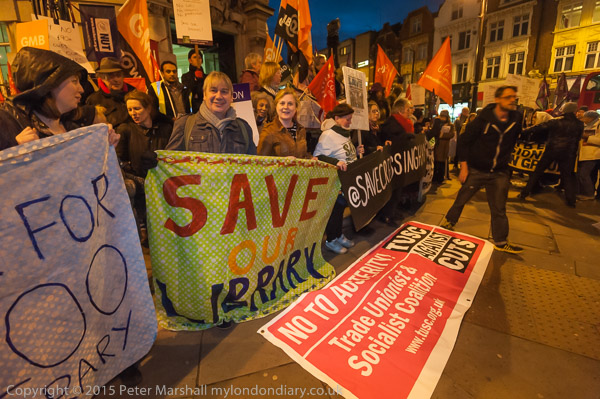
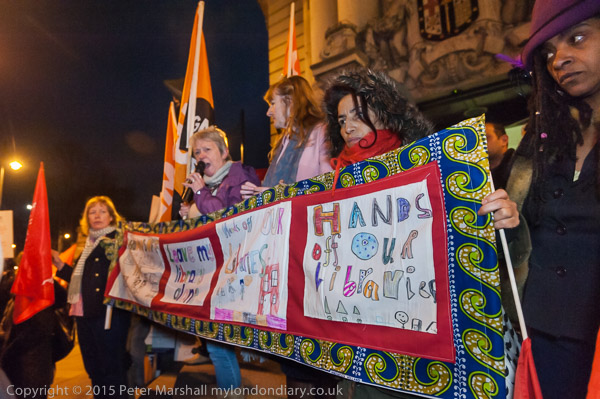
Savage cuts to Adult Education budget
Stratford to Hackney Wick
Class War go to Aylesbury Estate
Class War celebrate Election Launch
Class War Chingford Election Launch
Free the Hares boys protest at G4S


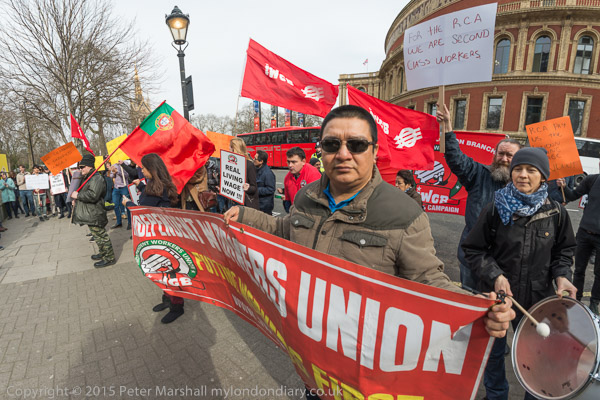
Poverty pay at the Royal College of Art
Save Our Lions – ban Canned Hunting
Let Ife Stay in the UK!
Police seize Class War banner
Viking longship invades Tate steps
Climate Change Rally


Time to Act on Climate Change
Poor Doors Zero Police
Aylesbury Estate Occupiers Move
Homeless Persons Matter
Mexican President told Stop the Killing
Shut Down Yarls Wood


Maximus – Same Circus, Different Clowns

As always there are many more pictures from most of these events on My London Diary if you follow the links, and in some cases some fairly lengthy stories.

Continue reading March 2015 complete

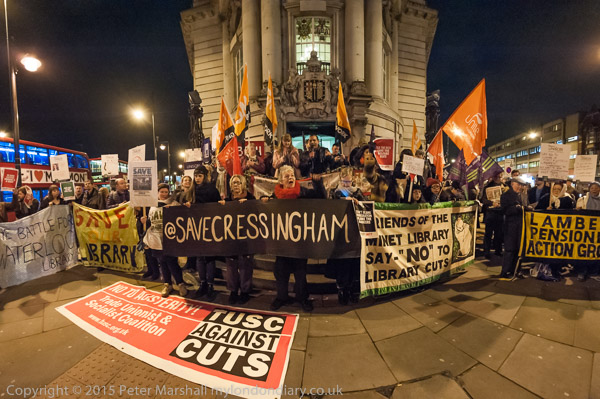
Lambeth Night

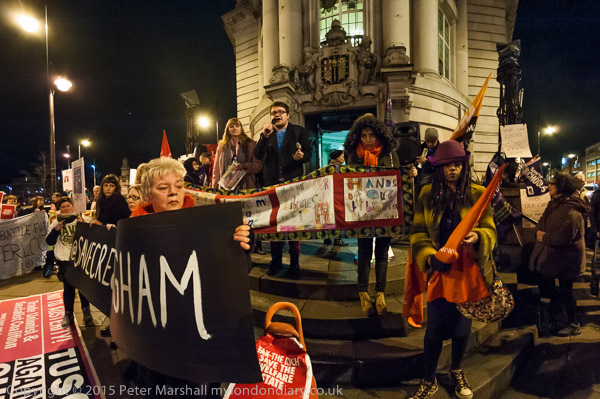
Covering the protesters outside Lambeth Town Hall on the evening that the borough council was voting on £90m cuts in local services provided some intensive testing for my Neewer 216 LED lighting panel and also for my flash technique. The Newwer perhaps did rather better.

The steps into the council offices on the corner of Acre Lane in Brixton should be a relatively well-lit area at night, on the junction of two major inner city roads, but it seemed surprisingly dark, and there were certainly some very gloomy areas in the crowd, both at the council policies and also in terms of luminance.
I started out working with the Neewer unit with both the D700 and D800E, holding the unit in my left hand and directing it appropriately. I’d decided to work with the orange 3200K filter, hoping it would work better with the ambient street lighting, and with that absorbing around a stop of light I was able to work at ISO3200 and shutter speeds around 1/30s with an aperture of f4 (the 16-35mm wide open.)

It was that slow shutter speed that caused most of my problems, with many images having the people blurred. But enough managed to catch them withoug subject movement for it to work well, at least until I wanted to photograph anything more than three or four metres away. Even then with some images, the extra light in the foreground was useful.

Working at f4, even with a wide angle, depth of field can be fairly limited, especially when working at close quarters, which is of course sometimes a good thing. But its better when you have enough light for this to be a choice rather than an imposition.

With the D800E and the 18-105mm lens I soon switched to using flash, particularly for the speakers, who were a little far away for the LED light, and where animated gestures would have otherwise been a blur.

I’m not sure why, but it was the flash images that gave me the most exposure problems; some days I just don’t seem to be able to get the flash to do what I want, and many were considerably underexposed. When you get it right, the Nikon flash system can work wonders, but there seem to be quite a few quirks that can easily fool the occasional user like me.  Lightroom was able to save the day on most of them.
Towards the end of the event I switched to the 16mm fisheye on the D700 to photograph some wider views. Although the Neewer only gives even illumination over a fairly narrow angle, with fall-off becoming fairly noticeable at any focal length less than 35mm, it was still useful, enabling me to light the darkest parts of the 146 degree horizontal angle of view. There were some fairly wide variations in lighting across the whole of that scene, and angling the light into some of them gave me a usable result.

With many of these images, consderable post-processing was needed in Lightroom. The images needed rather more overall luminance noise reduction than my standard setting, along with quite a lot of dodging and burning to even out the lighting. Different light temperatures in different areas also got some attention. I can’t say that the colour is perfect, but technically – thanks to Nikon with some help from Lightroom I find the results impressive. Certainly nothing like this would have ever been possible with film. You can judge for yourself at Lambeth against £90m cuts.
Continue reading Lambeth Night

Staines Easter


Swan Upper and Easter ‘Dawn’ Service by the Thames at Staines
Sunrise was supposedly at 6.29am in Staines where I live this morning, although the sun didn’t manage to show its face until a brief break in the clouds close to 9am. However it felt rather early when I got out of bed and onto my bike to cycle unsteadily through the empty streets (one stuttering motocycle, a paperboy on his bike and a single car on the main road) to the riverside car park where a small group of local Christians were assembling an hour late for a dawn service.


aster ‘Dawn’ Service by the Thames at Staines

Christ is Risen!” rang out over the open space (we got it in Greek too, though that was a week early) and around 20 voices responded “He is risen indeed!” and the service continued with hymn, songs, prayers and testimony , before most of those present continued their fellowship over a shared breakfast at the local Baptist church, which I was sorry to have to miss.


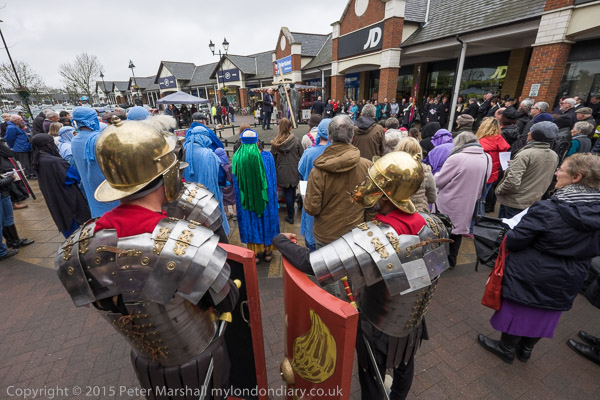
Roman Soldiers from ‘The Staines Passion’ at the Good Friday service
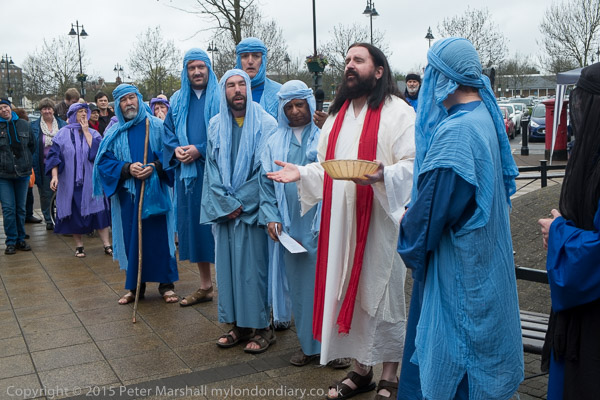
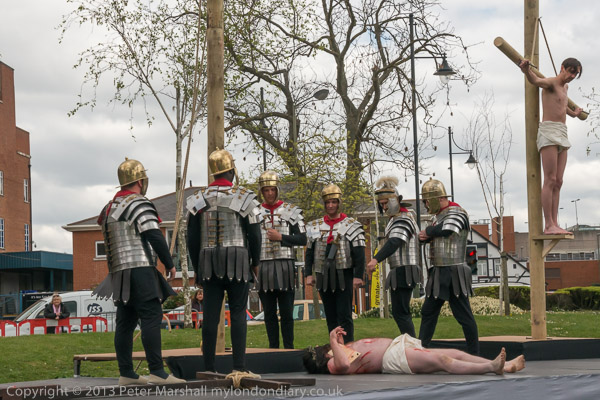
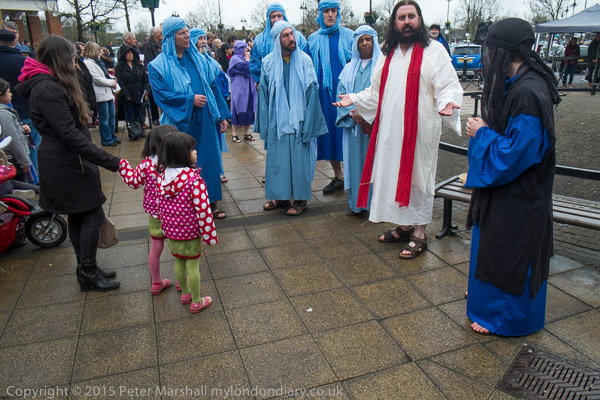
Easter is becoming more visible in Staines, with a procession through the town to a service in the local shopping centre on Good Friday, handing out free hot cross buns with a message on the serviettes, and two large open-air performances of ‘The Staines Passion’, a dramatised recreation of the Gospel stories on Holy Saturday, which this year I missed, though I did photograph it last year. Many of the cast were at the Good Friday procession, some in costume, and they performed a short version of the Last Supper and the arrest of Jesus as a trailer for the main event.


Jesus and the disciples from ‘The Staines Passion’ performing the Last Supper
Back home it was time for more hot cross buns (I prefer them cold and with a bitter touch of good marmalade) and Easter Eggs. And perhaps later a good walk after I’ve recovered from that early rising.


A scene from the 2014 performance of ‘The Staines Passion

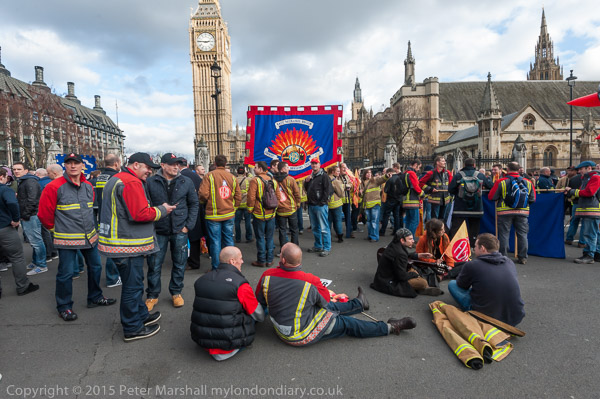
Firefighters on Strike


D700, 16-35mm, 16mm

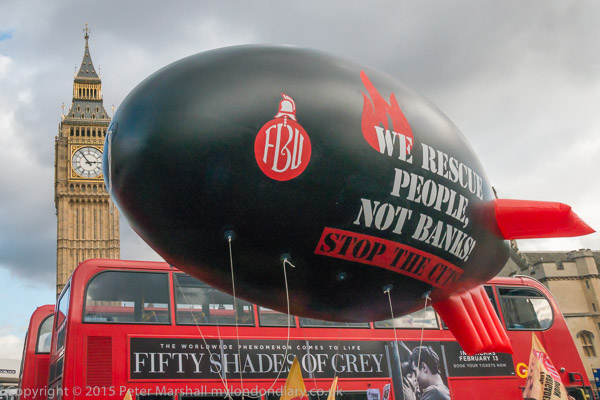
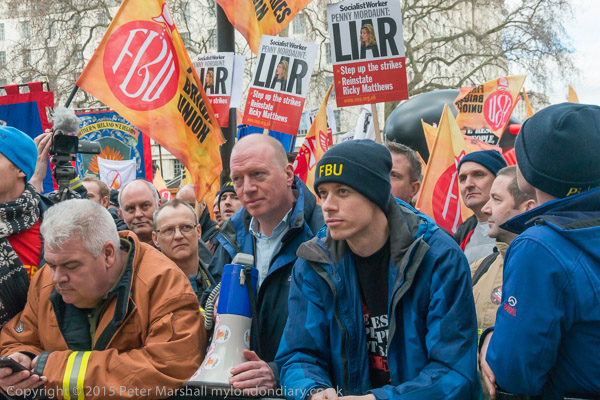
Although I’d known that the Fire Brigades Union were on strike and having a conference in Methodist Central Hall, just a couple of hundred yards from Parliament, I hadn’t come to Westminster to photograph them, but another protest taking place nearby. So it was something of a bonus to come across them sitting and standing in the roadway in front of Parliament. Apart from anything else it made it easier to cross the road!

I’ve long felt that Parliament Square should be improved, and one of the major improvements would be to take away the traffic, at least from the roads on two sides of the square, between it and Parliament and Westminster Abbey.  It just isn’t a good idea to have one of London’s major squares as a traffic island.

But the firefighters obviously have good reason to be upset, with promises clearly made to them having been broken, and I wasn’t surprised that they came to show their anger. Nor that police were treating their protest in an unusually relaxed fashion – they share a common bond with their fellow emergency workers and also many of them feel they too have been shafted by the government. And certainly it would be unwise to tangle with the firefighters, who are undoubtedly fitter and tougher than the average police officer.

It was too and almost perfect winter day for photography, with great light and good clouds, with a literal grey cloud over Parliament as well as a metaphorical one in front of it. I’ve always liked open shadows in my images in both black and white and now in colour, and the combination of Nikon sensors  and lenses with Lightroom 5 perhaps sometimes tempts me to take this to extremes.  The 16-35mm, here used at 16mm, f10 with a shutter speed of 1/400 at ISO 640 is a very sharp lens. Every slate on the roof at right is clearly defined and at 100% on screen the 4256 x 2832 pixel original processed with my standard noise removal and sharpening defaults seems noise free.

I’d arrived at a point where the protesters were uncertain about their next move, had missed the excitement of the marching on to the road and occupying the space. The grey of the roadway is a great background on which the individuals sit or stand, setting off their colours, which are perhaps just a little more saturated than real, the yellows, browns and reds of the jackets, warm colours that cluminate in the flames of the banner, set against a blue background and the blues of the working jeans.


D800E, 18-105mm DX, 24mm (36mm eq)

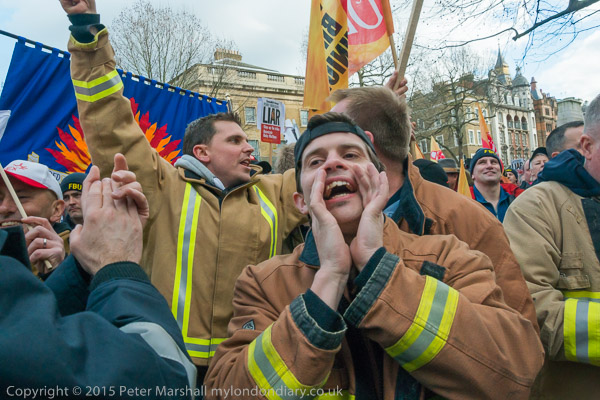
I took more pictures – you can see some of them in Striking Firefighters block traffic – and then photographed them as they made their way up Parliament St to Whitehall, stopping outside Downing St.

Things were rather crowded and chaotic there, and it was difficult to make pictures as both firefighters and other photographers filled any empty space.


D700, 16-35mm, 16mm

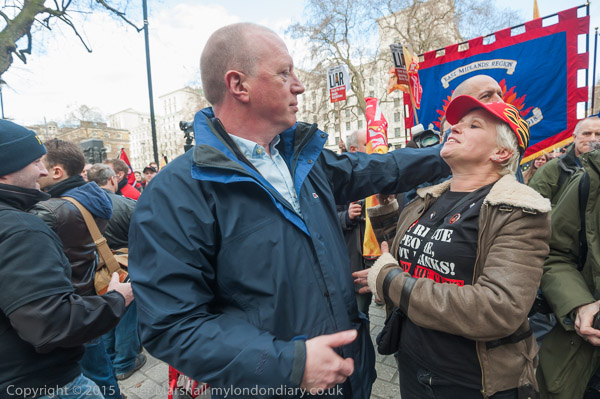
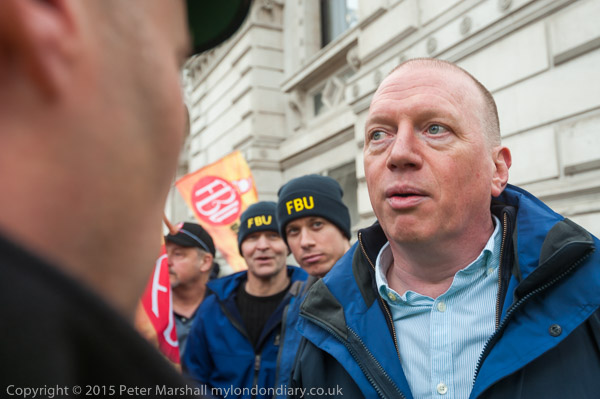
At Downing St I kept my eye on FBU leader Matt Wrack when he came to the gates, wondering what he would do next. As he moved around I tried to keep in a position where I could see his face, while also taking pictures of the firefighters who were crowding around him and shouting towards Downing St.


D800, 18mm (27mm eq)

When a police officer pushed his way through the crowd to speak with Wrack, I was at his side. Perhaps ideally I would have been a little further back, but I was wedged firmly in place, hardly able to move an inch in any direction, though just managing to have enough space in front of me to work with the 16-35mm.


D700, 35mm

I took what I thought was a rather nice series of photographs of the encounter, although all seen from that single viewpoint. It was as Wrack commented a surprisingly polite encounter with the officer asking what the firefighters wanted to do, taking down Wrack’s mobile number and then going away to see if he could arrange for someone from Downing St to come out and meet with the firefighters as requested.

By this time I was worried about missing the event I had actually come to Westminster to cover, and though I was in an interesting position I decided to leave. It wasn’t easy to make my way out through the dense crowd, but they were good-natured enough to squeeze out of my way.


D800E, 32mm (48mm equiv)

When I got as far as the gate leading into Downing St, a few yards down the road, I decided to go through it. I didn’t want to actually go inside as nothing seemed likely to happen there, and it involves and airport-style security check (those without a Press card have to apply days in advance and bring a passport) and I avoid it unless I really have to, but going just a little way down it did allow me to photograph the crowd from ‘inside’.

Had I stayed there any length of time, I think the police would have ordered me out, but I was able to take a few pictures and then move away without problems.

Striking Firefighters block traffic

Continue reading Firefighters on Strike

To the Tower!

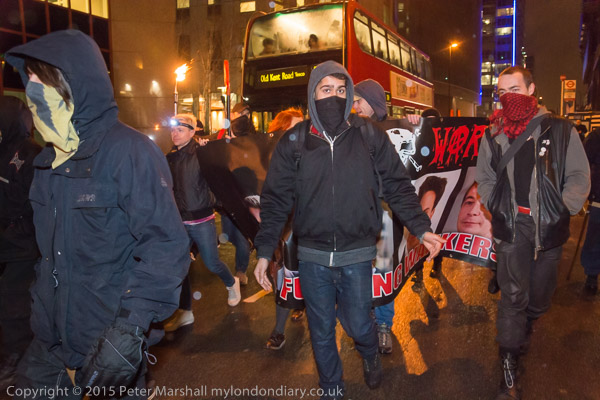
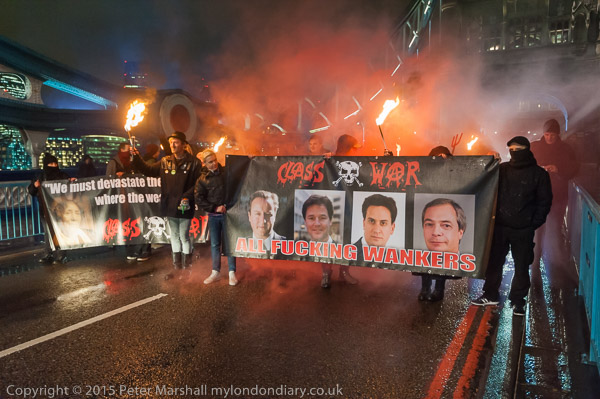
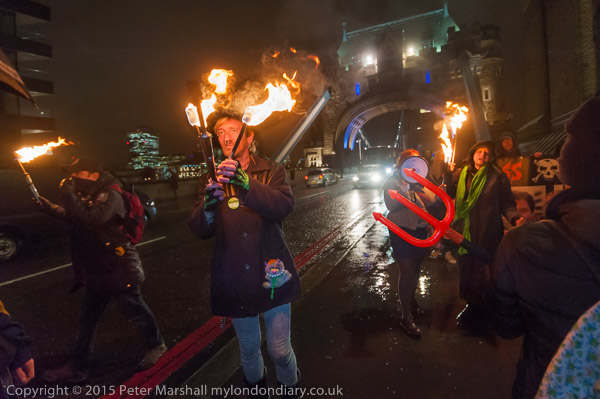
I think the image above captures something of the atmosphere of the march by Class War from ‘Poor Doors’ at ‘One Commercial St’ in Aldgate to the building site at ‘One Tower Bridge’, which as its name suggests is next to London’s trademark structure. It was an interesting event in several ways, and you can read more about it and see more pictures at Poor Doors to Rich Gardens on My London Diary.

The Exif data also makes interesting reading, at least for photographers, and here is a summary, copied with minor editing from viewing a larger copy of the image in FastPictureViewer Pro:

1/60s, f/4.5, ISO 3,200, -2.3Ev
Mode: A, Meter: Matrix, Flash, Auto WB
Focal: 18mm, 19/02/2015 18:46:20, Adobe RGB (1998)
15.4MP (4,800×3,200) NIKON D800E, 18.0-105.0 mm f/3.5-5.6, (C)2015,Peter Marshall

You can see that I was working in aperture priority mode, which surprises me slightly, as more often at night with moving subjects like this I use shutter priority, setting a shutter speed that will let me control the blur from ambient light, or more often still, manual, so I can chose both aperture and shutter.

The DX lens at 18mm has a maximum aperture of f3.5, so I had chosen to stop down by almost a stop, probably to get a little more depth of field. My focus was on the central figure, perhaps around 2.5 metres away, which would render anything from around 1.5 to 8m sharp at f4.5, while at f3.5 this would only have been from 1.7 to around 5.5m.  Or perhaps I just felt that most lenses do get noticeably better if stopped down one stop (or usually better still two.)

With the camera on A setting (aperture priority) the camera selects the shutter speed, and it seems to do so on the basis of the ISO and the +/- Ev setting when I test. So ISO3200 and -2.3EV should I think mean it was actually using ISO 640, but the actual results are very different from those at that setting.  But I give up trying to work these things out, just set things up and alter the exposure compensation until things seem to work. At night you always need a stop or two compensation or the camera will make it look like daylight.

Of course using flash I could have stopped down more. The SB800 I was using is a reasonably powerful unit, and had I left the camera on P, Nikon would have had me using it at a rather ridiculous f10, and the picture would have been a dismal failure with little or nothing visible behind the front trio.

It’s also a picture that needed considerable post-processing. The figure at left was rather close to the flash and needed rather a lot of burning in. The other two close figures also needed some, and parts of the subject further away needed to little brightening.  Almost all flash images need some help in this way to get closer to how the scene actually appeared.

Another problem in using any light source at night is colour temperature. Flash is daylight balanced, and the ambient light seldom if ever is. In some pictures the difference isn’t important, but in others it becomes very noticeable. Occasionally it’s an interesting effect, but more often a distraction – and one that can be overcome with a little post-processing.

Flash also produces an unnatural effect in this image with a number of translucent white spots of varied sizes – for example between the skull and the W on the banner at the right of the picture. These are reflections of the flash from out of focus rain drops. It isn’t really something that was a part of the scene, but an artifact of the way that the image was produced, and although the WPP or Reuters might not agree, I’d have no compunction about removing any of them if I felt they obtruded on the image that I saw when I made the exposure. But fortunately I don’t feel they do in this case, they are just one of the happy accidents of the medium that I embrace.

I chose the second image here partly because I thought it would be nice to have one of Tower Bridge.

It shows Class War blocking the bridge with flaming torches and with two banners including the ‘Political Leaders‘ which on a later occasion the police seized. Again, here’s the Exif data:

1/50s, f/4, ISO 3,200, -0.7Ev
Mode: M, Meter: Matrix, No Flash, Auto WB
Focal: 29mm, 19/02/2015 19:09:53, Adobe RGB (1998)
12.1MP (4,256×2,832) NIKON D700, 16.0-35.0 mm f/4.0, (C)2014 Peter Marshall

The 16-35mm is pretty usable wide open, and there was no reason to stop down. Although this was taken without flash, I was using additional lighting, otherwise the banners and the faces in shadow were rather dim.  Although I’m really a little out of range for the Neewer CN-216 with its 216 LEDs, it has done just enough.

It isn’t the sharpest image I’ve ever taken, but just sharp enough, with just slight problems caused by subject movement at 1/50s.

You can find the CN-216 (sold as Neewer, NanGuang and other brand names) on Ebay for £25-30 (or you can pay more) and it has a smaller and some larger brothers. I’ve tried a CN-160 which is nicely small (it fits in my jacket pockets) but the extra power of the larger CN-216 seems just worth having. The CN-304 probably gives a little more light still, which would be useful, but is significantly larger and heavier. (They also make yet larger and yet heavier versions branded EPHOTO which might be worth investigating for studio use.)

The CN-216 seems very useful used at ISO 3200 within 2-3 metres of your subject, and with the diffuser in  place gives reasonably even lighting for a 35mm lens. Fall-off is noticeable with real wide-angles, but that isn’t always a bad thing, and like lens vignetting can usually be compensated for in post-processing if necessary.

Light output is controllable by a dial, which is also the on-off switch. I’d prefer it to have a separate on-off switch as, having to rotate it to full power for almost every use is annoying. The switch is also rather easily knocked on while in your camera bag and will then run down the 6 AA batteries – though supposedly they last for two hours. I now tape down the switch in transit, moving the tape to an adjacent part of the body while the unit is in use.

You can fit the unit into a hot shoe, or simply hand hold it, which gives more control over the lighting. The hot-shoe mount is a little flimsy and only allows up-down adjustment, but I find it handy to park the unit on top of the camera.  The light comes with two filter sheets that slide over the top, one a clear diffuser to give 5600K daylight and the other amber giving 3200K. Probably the amber is more useful in terms of colour balance, but it does absorb a little light.

I’m unconvinced the diffusers give a greatly more even spread of light. The clear diffuser cuts down the light by around 2/3 stop and the amber by around another stop, so it might well be better to use the unit without either.

All of the pictures in Poor Doors to Rich Gardens were taken either with flash or with the CN-216, though in some the flaming torches were often themselves a significant light source. Getting detail in the flames and in the subject can also be rather tricky!
Continue reading To the Tower!

Greek thoughts

Let Greece Breathe! was a fairly busy event, with quite a few  photographers and videographers and fairly crowded, making it difficult to get exactly in the places I would like to have been.

Video and still photography have very different requirements, and sometimes this can be a problem. Video generally works best for most things when the camera is static for fairly long periods, at least much of the time, preferably on a tripod. In contrast, being in the same place for long as a still photographer is generally a bad thing, leading to too much repetition in your images. Even for simple things like photographing a speaker, its usually good to be able to vary the background. Composition is I think generally far more important in still images than in video.


At this event it was difficult for still photographers to move around without getting in the sight lines of a couple of video crews from foreign TV; it would have been easier had they set up closer to the tape separating the audience from the speaker. Though I tried hard not to get in the way I think that Greek TV viewers will have got the occasional view of my slightly bald patch on their screens.


To keep out of the way of the TV cameras I spent rather too much time close to one of the two speakers on stands at the front of the audience, and it was loud enough to probably damage my hearing and certainly to give me a headache – after a while I simply had to move away.

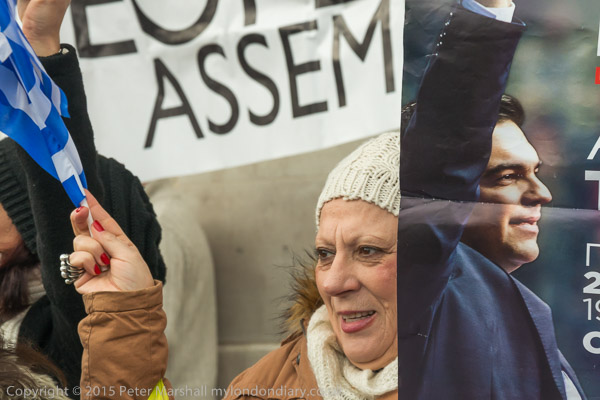
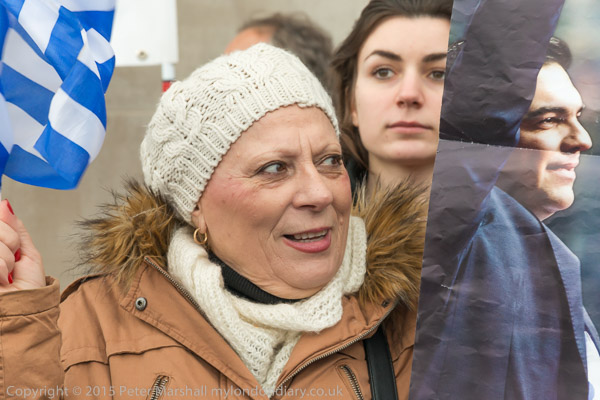
One of the things I try to do is to find an idea and then to pursue it until I’m happy that I have captured it (or sometimes simply have to give up.) One of the things that I noticed at this event was a Syriza poster of Alexis Tsipras with his head at roughly life size, and I tired to use this in pictures with the heads of real people, three of which you can see above.


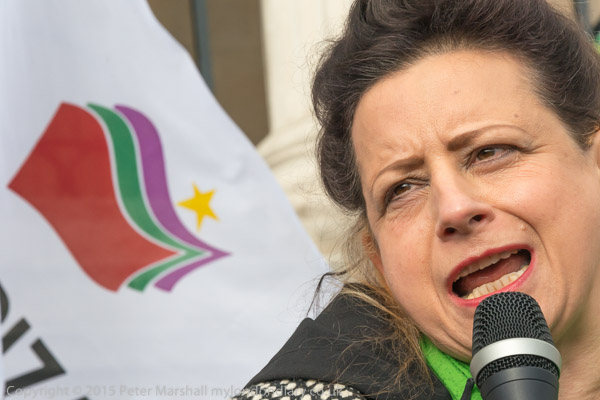
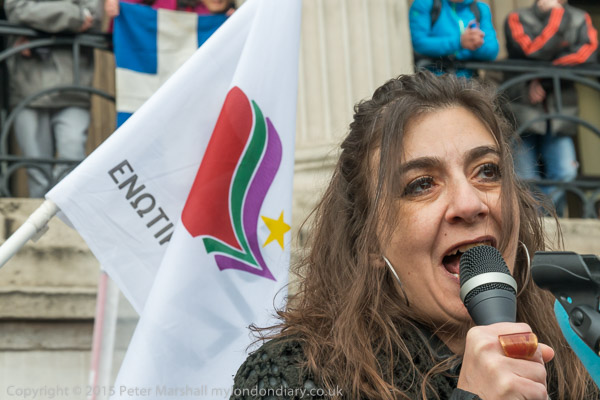
Another little series of images was of the various speakers with the Syriza symbol on a flag behind them. This was made a little tricker as the flag was being waved around, and flags are in any case often something of a challenge as they get blown around – or simply droop when you need them to fly. Add to that the need to catch the speakers in interesting or dramatic expression or gesture – and with their eyes open and you have a challenge.

There are a few more of these and some variations in Let Greece Breathe!

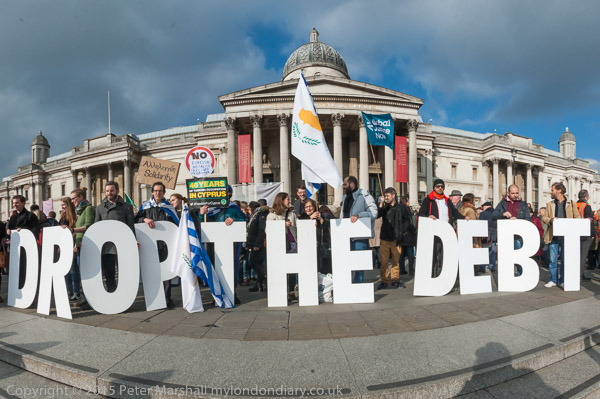
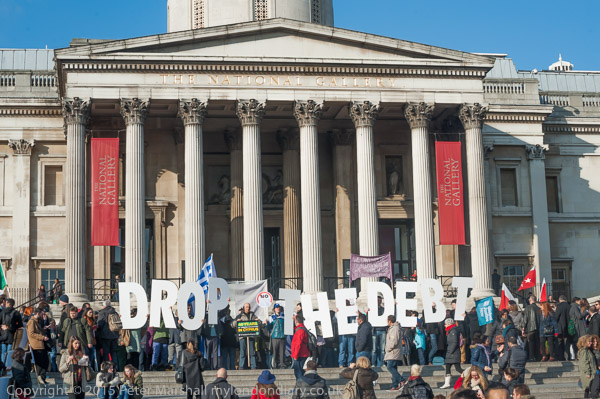
A different challenge was posed by a line of people on the steps leading down into the square from the North Terrace where the rally was held. If you approached too close it was difficult to get the whole message, while if you moved back, someone was almost certain to get between you and the message.

Often in situations like this the 16mm fisheye with its 146 degree horizontal angle of view solves the problem of getting close but getting everything in the view. But in this case I didn’t find it entirely satisfactory. Although the verticals are straight (thanks to the FIshEye Hemi plugin) I find the curvature of both the step at the bottom and the roofline a little distirbing. It is possible to remove these but only at the expense of some rather curious heights of the people across the central row who would get considerably taller towards the edges.

I tried with the 16-35mm, both from a fairly central position and also form one side of the othere, but was even less happy with the results and none of my attempts appear on line (though a long line of photographers was busily taken them from there.) But later I did go some way futher down into the square, far enough back to take a picture at the wide end of the full-frame 70-300mm. There are a lot of people in front of the message, but they appear less imporant from a distance. Possibly going even further away, particularly if I could have got a little height from climbing on to the plinth of Nelson’s column, would have given a better view, but the people put down their letters and dispersed before I had time to try it.

Continue reading Greek thoughts

Funny Valentine

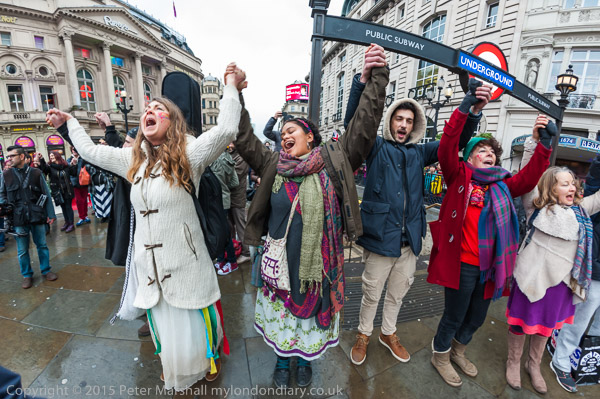
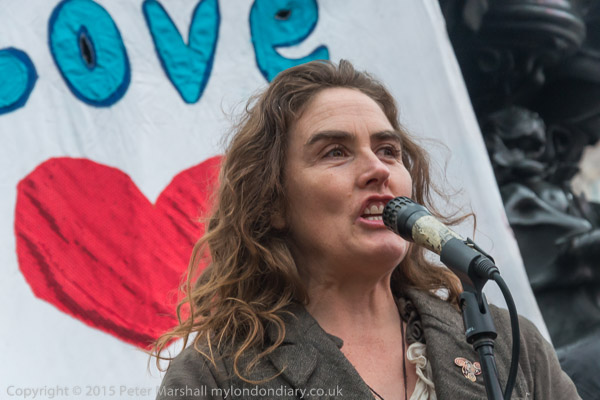
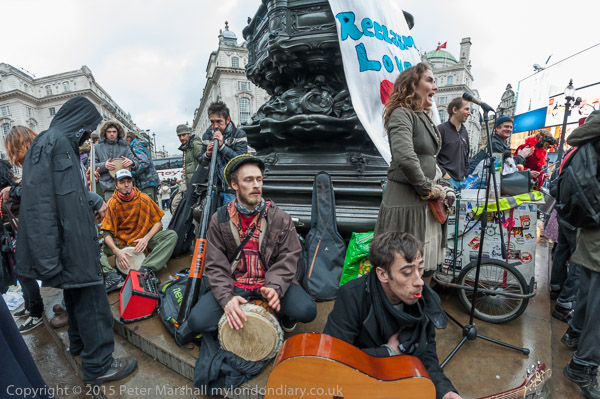
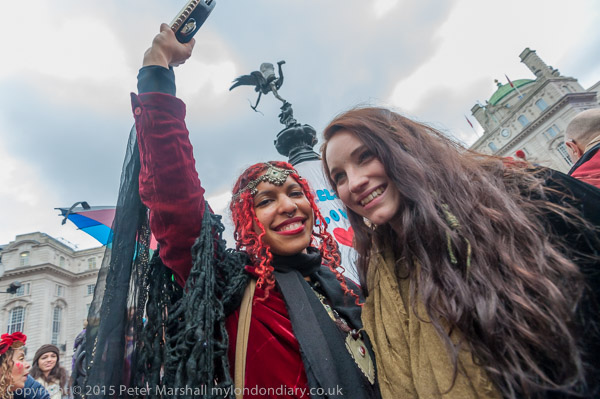
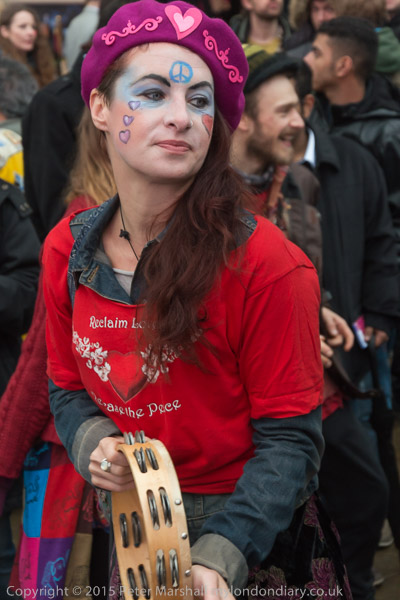
One annual event I always enjoy as well as photograph is the annual free Reclaim Love Valentine Party around the statue of Eros (well it isn’t really Eros) in Piccadilly Circus. Irish (or Irish/Indian) poet and love activist Venus CúMara (“nomadic lone wolf, poet, musician, songwriter, and storyteller“) began these events back in the early years of this Millennium and they have taken place every year since both here and elsewhere around the world.


Venus CúMara

I missed the first Reclaim Love event, which was in Trafalgar Square, as I spent Valentine’s Day in Paris in 2004, but was there for the first party at Eros in 2005, and have photographed the events every year since, including the one year that Venus was unable to attend and was organised by her friends. And it’s an event I have the t-shirt for, as in the early years they were given away free. One of my sons also has a pink one I gave him which he sometimes wears, with its winged heart on the chest and the message ‘May All The Beings In All The Worlds Be Happy And At Peace‘ on the back. I have a rather more tasteful pale blue version, though it is seldom seen in public.

Every year is different, although they follow the same basic pattern, with samba and dancing, people dressed up and in the middle of the afternoon everyone linking hands in a giant circle to chant the mantra above. Everyone except a few photographers like me, who run about dementedly trying to photograph the event. And while I may have a certain sceptism about the “Massive Healing Reclaim Love Meditation Circle beaming Love and Happiness and our Vision for world peace out into the cosmos” it’s always an impressive event.

With all the commercial promotion of Valentine’s Day it would be hard to miss – though the party is on the nearest Saturday rather than the day itself. And the party is a reaction to that commercialisation, a celebration of love rather than money. Venus, when asked where she is from has said her place of origin is Love, and the Reclaim Lovemovement aims at restoring the true and infinite meaning of Love as a force for inner and outer change.”

This year was ‘Reclaim Love 13‘, though as the 2007 event was billed as Reclaim Love IV, I think it is only the 12th. The party is also an ‘unofficial’ event, and though Venus and friends certainly do some planning and reminding people to come and take part there is a great deal of spontaneity about the event, people coming and doing what they want to do. Some of those who take part know and some have come a long way across the country, but others come across it by accident, with tourists and shoppers joining in.

The police and security in the West End generally ignore it, or take a look to see what is happening and then go away -though obviously they keep an eye on it through CCTV – the party is after all more or less on top of London’s nerve centre for surveillance, the London main CCTV control room. They have intervened when people have climbed right up to Eros – it isn’t the most robust of sculptures, and there was a little trouble one year when the circle took place a short distance away in a ‘sacred circle’ of trees in Green Park – such things are not allowed in Royal Parks.

This year the weather was not too kind, and it was dull with the odd spot of rain in the air as people gathered for the party. I’d started working at ISO 800, but soon had to put that up to ISO 1600 and by the time I left, shortly after the big meditation circle around Piccadilly Circus I was needing ISO3200 to stop the action. Night was falling a little faster than normal with some large dark clouds, and when the rain began to fall I decided it was time for me to go.

I was a little disappointed with the pictures. Perhaps it wasn’t quite such a lively event as some earlier years – and poor weather has an effect on everbody, partygoers and photographers alike. I think it’s still a reasonable picture of an interesting event in the London calendar, certainly rather more interesting than many if not all that make either the tabloids or the Tatler. You can see my results from this year at Venus CuMara Reclaim Love 13 at Eros, as well as those from previous years (sometimes you will have to scroll down on the linked page to find the pictures.):

2005:  O-i-L, One in Love, Reclaim Love
2006:  One in Love, Reclaim Love
2007:  Reclaim Love IV
2008:  Reclaim Love
2009:  Reclaim Love
2010:  Reclaim Love
2011:  Reclaim Love
2012:  Reclaim Love
2013:  Reclaim Love
2014:  Reclaim Love

Continue reading Funny Valentine