The Line

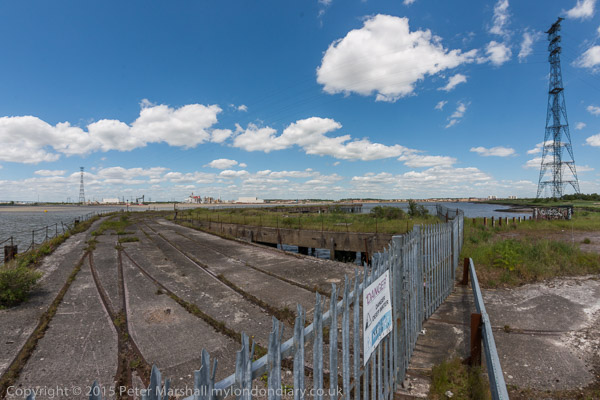
I’ve written before about ‘The Line’. Back in February 2014, when the idea was part of a crowd-funding project I wrote Marking the Meridian – The Line, which looked at my own work on the Meridian in the 1990s and my unsuccessful bid to get a walk established as a Millennium project, which failed even to be short-listed. It was a fairly obvious proposal and others had similar ideas, and a few of these did get some kind of local support, with more markers appearing along the line.

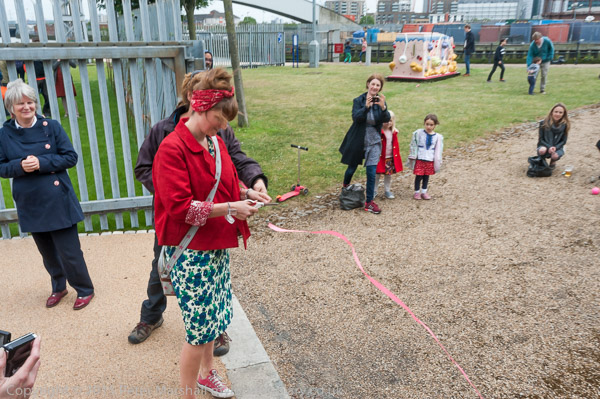
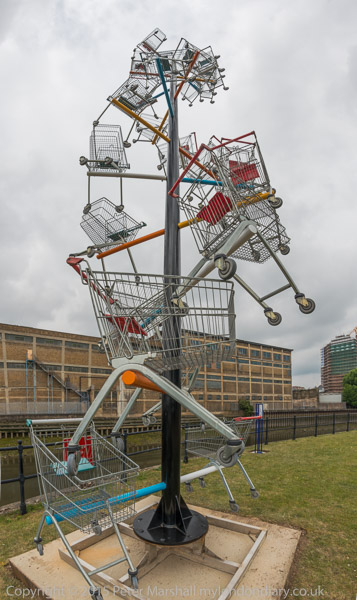
The Line was finally opened in May 2015, though on a rather smaller scale than the up to 30 sculptures in the original plan, and I was at Cody Dock on 23 May to witness the ribbon being cut and to photograph a couple of the sculptures.  It was a busy day for me and I didn’t have time to walk the whole of the line, but you can see more at Cody Dock Opening for ‘The Line’.

I still haven’t found an occasion to walk the whole of The Line – though you can’t actually walk it all but need to take the ‘dangleway’ across the Thames from North Greenwich to Royal Victoria Dock, and then the DLR to Star Lane.

The web site is rather confusing, and I’ve yet to find the link which is supposed to give a print version which might be rather easier to understand. There are as yet two sculptures I’ve failed to locate, and the House Mill at Three Mills which is supposedly open daily from 11am-4pm was closed on the day I tried.  But the walk – or the bits you can walk – is perhaps more interesting than some of the sculptures.

Some of it was there before the line – including I think all of the works at North Greenwich – and I’ve visited and photographed them on previous occasions. The cable car across the river should be one of London’s major tourist attractions, but is thankfully still uncrowded, and doesn’t cost a huge amount – with a reduction for travel card holders. It’s worth deviating at the Royal Victoria Dock to cross the high level bridge – and you can then walk back along the other side. The walk by Bow Creek from Cody Dock has its fascinations – and to my mind the most fitting of sculptures.

I’m not quite sure how The Line is meant to go at Twelvetrees Crescent, but I like the path over the Bow Locks, although not the detour needed to access it, with a building site probably illegally blocking the path from the Tunnel Northern Approach. Three Mills is always worth a visit too.

There are actually more sculptures, both found and official along or close to The Line but not a part of it. I expect someone will provide a suitably annotated and illustrated walk before long, though I’ve yet to see one.

See The Line – Sculpture Trail for some more pictures.

Continue reading The Line

Ultrawide images

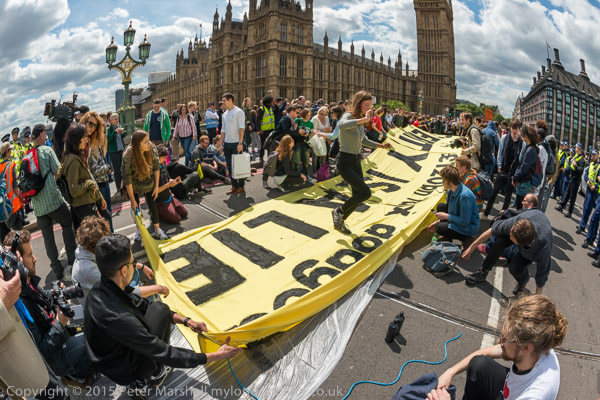
I don’t often use images taken with a fisheye lens without a partial ‘de-fishing’, but this is one case where I think it works. You can see some curvature in the image, but it isn’t excessive and I think helps draw the eye in towards the centre of the image.

Had that clock tower been further off centre its curve would have been more disturbing, and the same is true for the lamp post at the left.  The clouds wrap around rather nicely and even the people close to the edge seem rather less distorted than is often the case. When I took it I was probably thinking that the figure a bottom left would move more into the corner and I would perhaps lose all or most of the two photographers cut off by the edge, as well as most of the empty space behind the white t-shirt at the right.

Most people who haven’t used fish-eye lenses think of rectilinear perspective as being somehow natural. It’s how we ‘see’ things, constructing images in our mind in which lines we know to be straight are straight. But it doesn’t work with making images with a very wide angle of view. The image above shows the result using the ‘distortion’ slider in Lightroom at 100%.

It crops the image a little at both left and right edges, and while it does straighten the lines, it makes their divergence much more apparent. That Canon lens at the left has roughly doubled in length and the head at bottom right is a rather more curious shape. What you can’t see in this small reproduction is the softness towards the corners where there just are not enough pixels to be stretched out like this. To be usable this image would need fairly drastic cropping.

If you must have a rectilinear view, stick to a rectilinear lens and avoid really extreme focal lengths. I have a 12-24mm full-frame Sigma lens, and anything below around 16mm I find seldom makes a usable image. It’s a better lens on DX, where the full zoom range can be used. A 16mm rectilinear image on full frame has a horizontal view of around 97 degrees, while the 16mm Nikon fisheye gives around half as much again, roughly 146 degrees.

The best we can do is to keep some straight lines straight, though we can also at the same time improve on the way that rectilinear perspective renders shapes across the frame, stretching them as they get away from the centre of the image.

The image above is the result of using the Fisheye-Hemi plugin for Photoshop, which is my normal ‘de-fishing’ tool. There are other things out there that do the same job, but the plugin is the most convenient I’ve found. It retains the image across the full width and height at the centre of the sides while losing some at the four corners, producing what I think is called a cylindrical perspective, like the rotating lens panoramic cameras I’ve also used.

As you can see, it also shows up the diverging verticals that result from my pointing the camera slightly down when making the image.  But it does avoid the stretching at the corners and the softness which made the conversion to rectilinear a problem.

However I find that divergence annoying – and I didn’t see it in my viewfinder when I made the image. So I’d probably want to use Lightroom to remove at least most of this. Doing so means cropping the image (there is still a small amount of divergence, but not enough to be a nuisance.

It’s a usable alternative to the top image, but I still prefer that; the figure standing on the middle of the banner is a little more prominent, and for me at least seems more to be floating, almost as if she is being tossed up by those holding the banner.

I don’t know what Reuters and those other upholders of the unaltered image would think of all this. Would images whose perspective had been altered in the ways shown here still be accepted for World Press Photo? And I don’t greatly care.  The uppermost image is what I saw in the viewfinder when I made the picture, but I think the bottom image is also a perfectly good record of the scene and my view of it. Probably a truer record of what I saw out of my left eye when I had the viewfinder pressed to the right.

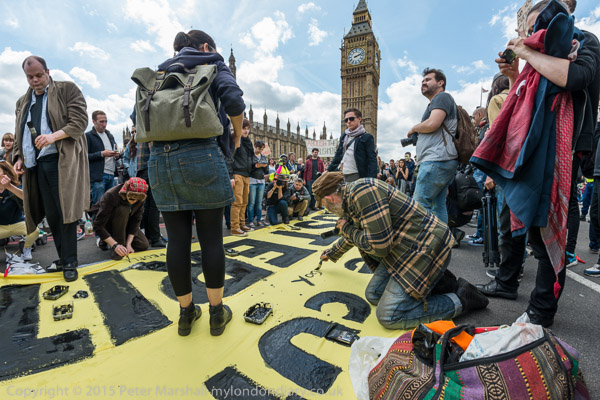
The protest was to point out to Parliament that collecting taxes which are being avoided would bring in enough money to make cuts in public services unnecessary. You can see more pictures from it, including others taken with the 16mm Nikon fisheye as well as the 16-35mm rectilinear zoom and longer lenses at UK Uncut Art Protest.

Barbican

Without doubt the greatest opportunity for the planning of London in the last century came from the destruction of large areas of the city during the war, and one of the areas where the results are most obvious is the Barbican.  It provided an opportunity to develop new approaches with pedestrian walkways high above the city streets separated from their traffic, and put homes back into the city.

It wasn’t an entirely successful experiment, although the recent demolition of parts of the ‘highwalk’ is I think a great loss for the city (and doubtless huge profits for the developers) and while many have found the Barbican an exciting place to live prices now for its over 2,000 properties and those on the adjoining and perhaps rather nicer Golden Lane Estate are pretty astronomical.

For non-residents, finding the way around the Barbican has always presented something of a challenge, with yellow lines needed to guide people to the Barbican Arts centre from the surrounding Underground stations. Inside the Arts centre too, I’ve always found the layout totally confusing, though over the years I’ve learnt easy routes to find my way to the places I’ve used, including the main art gallery and the Library, in which I’ve organised and taken part in several group shows over the years.

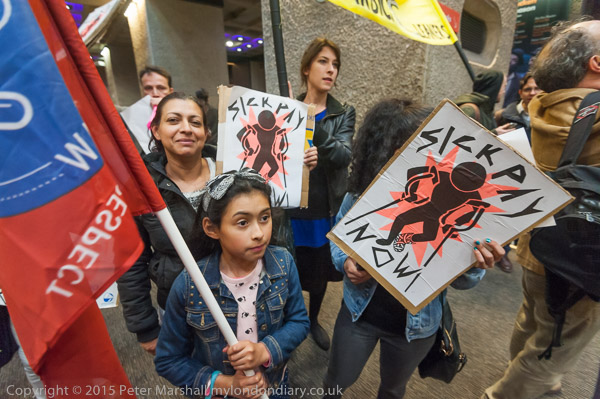
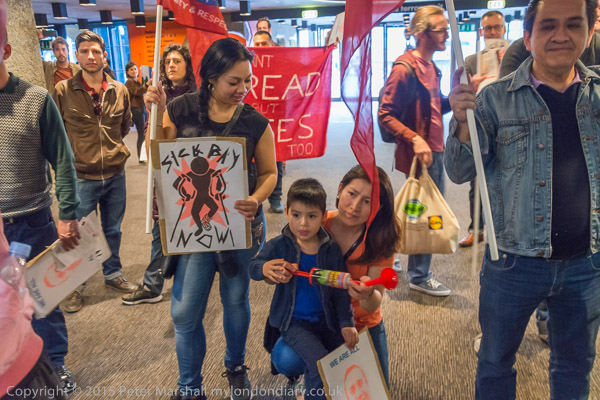
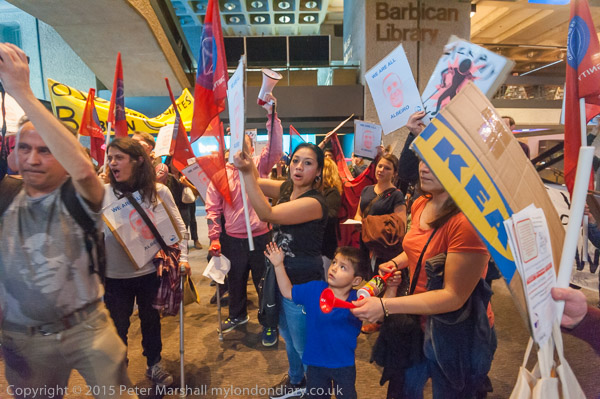
But on May 16th I had no problems in finding my way, simply having to follow the crowd of cleaners and supporters as the United Voices of the World rushed in to hold a protest inside the building.

The UVW are a grass roots union that is standing up for the rights of some of London’s lowest paid and worst treated workers, particularly cleaners who are employed by contracting firms to clean inside London’s many prestige buildings, including the Barbican Arts Centre, owned by the City of London.

The only reason for outsourcing services like cleaning is to cut costs, and the only way that the outsourcing companies cut costs compared to direct employment is by employing workers on conditions that would be unacceptable to companies and organisations that are concerned about their public profile.

The Barbican Arts Centre would feel it had to pay at least the London living Wage, provide proper pension arrangements, sick pay and holiday pay, as well as managing its employees properly, providing proper equipment and materials to do the job and not imposing excessive workloads. I’ve never worked for them, but I imagine that they aim to be a responsible and highly respectable employer.

The cleaners complain that the contracting companies treat them like dirt. Low pay, bullying management, impossible demands, and the statutory minimum conditions. Workers come into work sick because they cannot afford to take time off with only statutory sick pay. And of course an attempt to prevent union organisation and protests. As my summary reported:

Cleaners at the Barbican Centre employed by MITIE have been threatend with sacking if they protest for a living wage and proper sick pay. They say a disabled worker has been assaulted by a manager and that he was accused of terrorism for posting a video of himself at work.

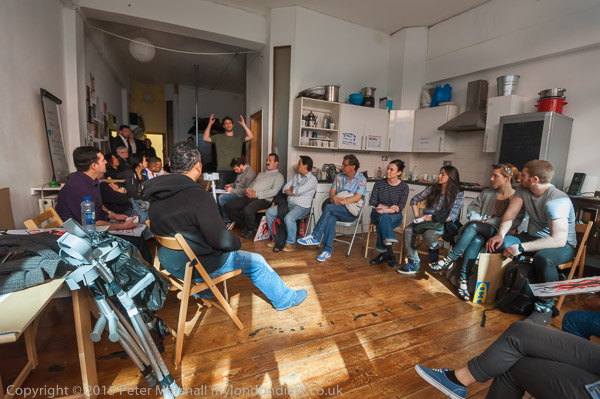
This protest was unannounced, and the cleaners and supporters met up well away from the Barbican. I met with most of them at a union meeting beforehand. UVW is a small and entirely voluntary movement with no paid officials, and as well as negotiations and protests at workplaces also provides representation and support for its members at tribunals and disciplinary hearings, and classes in English, as many of its members are from Latin America or Spain.

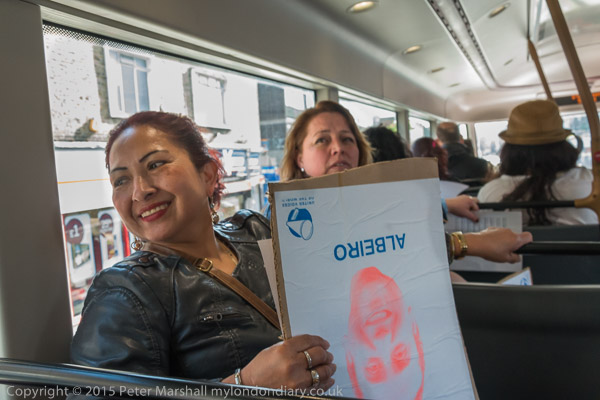
I travelled with them on the bus, then walked with them to a rendezvous with other supporters before they marched quietly to the Barbican, regrouping on a corner close to the main entrance, which they then rushed through at a suitable moment, with me following a short distance behind the leaders, making their way noisily through the building to a suitable area for the protest.

As usual with such incursions, I’m careful to avoid confrontation with security, who made some attempt to stop the first few people who entered, but then had simply to stand back and watch as the rest streamed in following them.  Theoretically I would stop taking pictures and leave if requested by a suitably authorised person, unless I felt there was an overwhelming public interest in the events being recorded, when I would attempt to do so. I would have felt so in this case, but it’s better not to have to make such a decision.

Photographically the main problem in taking pictures was the light. Rather the lack of it, and its unevenness.  The centre always reminds me of a cave, and it has lots of fairly small lights in a very large space.

I didn’t want to use flash. Partly because I didn’t want to attract attention to myself, and experience tells me that security are far more likely to tell you to stop taking pictures if you use flash, but also because it’s difficult when working close to avoid huge differences in lighting between people very close and those a few feet further away. But the light was pretty low in some areas, and when people were moving a lot there was really little alternative. But I think the picture I liked best was taken without, working at ISO 3200.

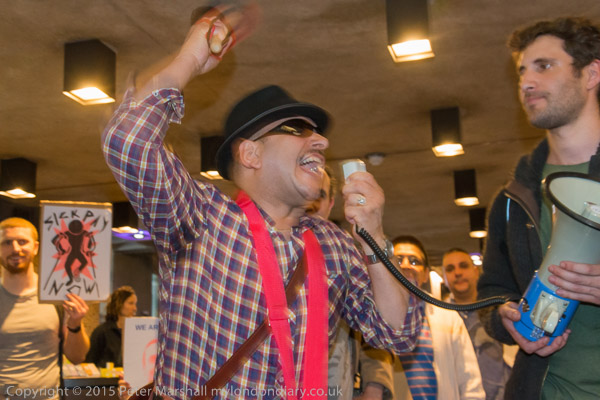
I was also working at ISO 3200 with flash, but with the aperture a couple of stops down (and sometimes about a stop faster shutter speed too) trying to retain a more even result with some exposure from the ambient light. As a consequence there is some double-imaging on these frames, which often but not always enhances the image – it adds a feeling of movement and immediacy to the speaker above.

Colour temperature is also sometimes an issue. Later the protesters moved to an area with both artificial light and large windows letting in some daylight. Using flash might have helped in the lower image, but unfortunately the D700 which I was using seems now to be very unreliable with flash and I’ve been avoiding using it. All the flash pictures I’ve made for some time have been with the D800E.

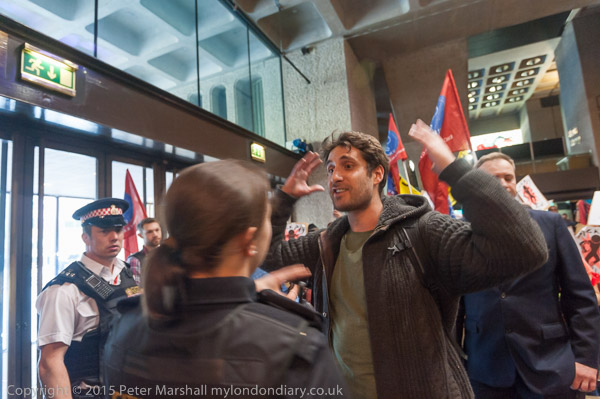
Shortly after the protesters left the building and continued to protest, marching around a little of the Barbican estate and then continuing outside the main entrance, which enabled me to take some pictures including the Barbican signage, including one of Albeiro, the cleaner being victimised and UVW general secretary Petros Elia, the man with his hands up in the image above.

Many more pictures and more about the protest at Cleaners invade Barbican Centre.

Continue reading Barbican

June 2015 Summary


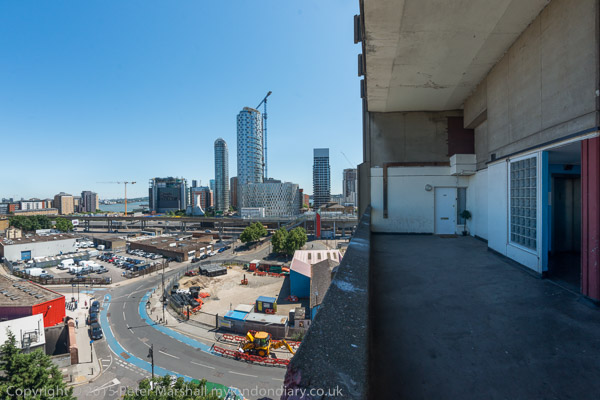
View from Robin Hood Gardens

I’m still trying to take things easy, but with no great success, but I did manage to get out a few times in June to continue my work away from protests, making panoramas at Barking, Swanscombe and Robin Hood Gardens. Most of these don’t immediately look like panoramas, as the images are presented in the same 3:2 format that I use for the rest of my work, but they do have a very wide – over 140 degree – angle of view.  It does show that sometimes we have clear blue skies, but usually they have been more interesting.

Jun 2015

Robin Hood Gardens
DPAC’s ILF Closing Ceremony
Staines Day
Victims & Survivors call for Justice


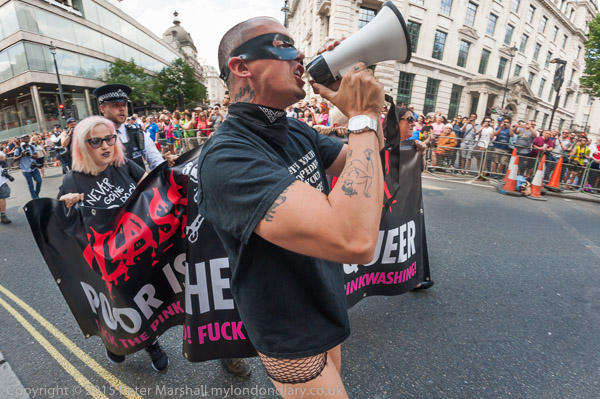
Class War protest ‘corporate pinkwashing’


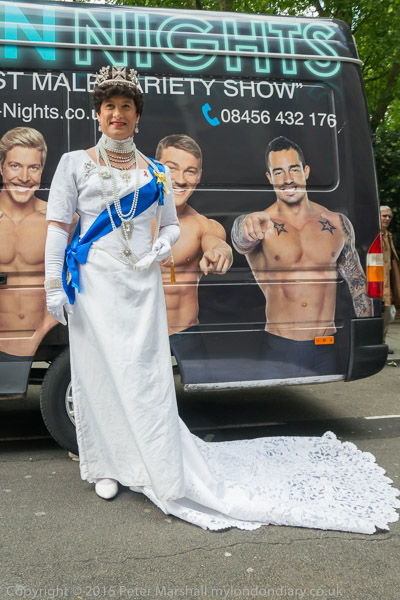
Pride Parade
UN Day for Victims of Torture
National Gallery Strike Day 41
Government threaten Mental Health sufferers


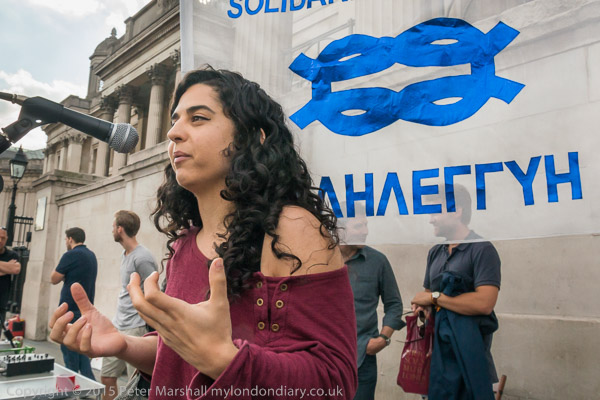
Change Europe, Solidarity with Greece
Greece protesters join Pride Flagbearers
Class War in Whitehall
Class War at the Savoy
Class War and End Austerity Now
End Austerity Now at Bank
‘3 Cosas’ at Royal College of Music
Climate Coalition Rally
Climate Coalition Mass Lobby
Support Saudi blogger Raif Badawi
New MPs Stand with Shaker
Magna Carta justice for Shaker Aamer
Close Yarls Wood, End Detention!
Cleaners International Justice Day
Voice for Justice UK Magna Carta Protest
Truth & Justice Magna Carta Day Protest
Staines celebrates Magna Carta


Police threaten Runnymede Magna Carta festival
Day Of Action For Candy Udwin
Dorney Walk


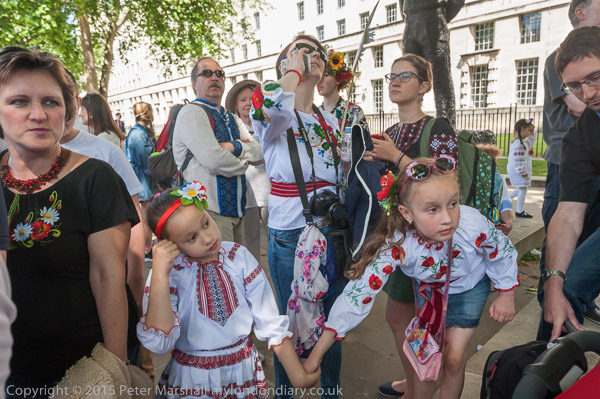
Ukrainian Vyshyvanka Embroidery march
Sikh freedom rally for Khalistan
Sikhs march for justice and freedom


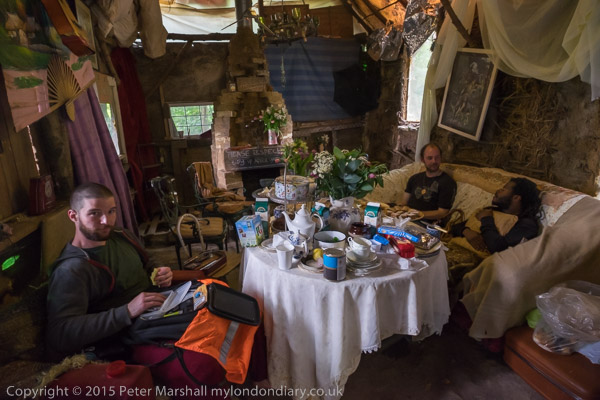
Swanscombe
Barking Creek
The Line – Sculpture Trail
G4S AGM Torture Protest
‘Mock the Opera’ protest at Kensington cuts
Virgin Health hide behind NHS Logo
Stop Closure of Aboriginal Communities

June Stats

 I don’t look at the stats for my web sites every month, but this is the first month that I’ve noticed an average of over 10,000 page views per day for >Re:PHOTO, which now accounts for 64% of traffic to my web sites. Next largest is My London Diary, which can be reached on at least 3 URLs, mylondondiary.co.uk, mylondondiary.uk and mylondondiary.com with a total for all three of 18%.
Most of the rest is for smaller sites with my work and a few which also have work by other photographers including the Urban Landscapes site.

 >Re:PHOTO blog
Visits in June 2015:         138,835
Page views June 2015:    324,731
Average views per day:     10,824

Continue reading June 2015 Summary

CLASS WAR: Rich Door, Poor Door

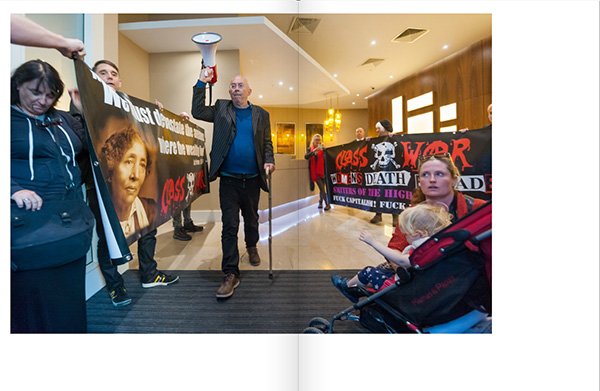
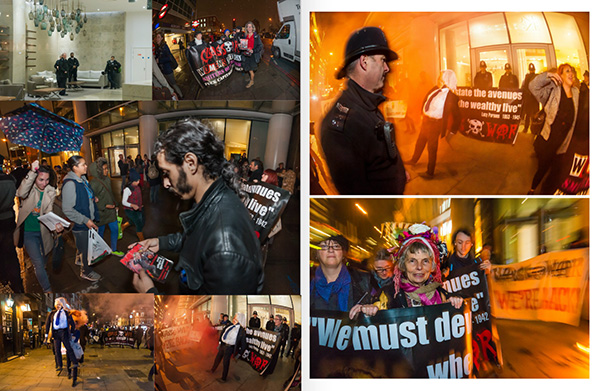
CLASS WAR – Rich Door, Poor Door is a relatively cheap 48 page magazine style publication of my coverage of the protests by Class War at One Commercial St, a large block on the corner of Commercial St and Whitechapel High Street in Tower Hamlets on the eastern edge of the City of London.

The building ‘One Commercial St’ is a tall block which includes shops, a hotel, an entrance to Aldgate East Underground station, parking and expensive flats as well as other flats which are social housing. While the occupiers of the expensive flats enter through a large, well lit lobby with a manned concierge desk and comfortable seating through a door on the main road, social housing tenants have a separate entrance some way down a narrow alley.

When I first visited it, this alley was strewn with rubbish and dog mess, with a strong smell of stale urine, and was virtually unlit, the kind of alley that drunks stumble down to relieve themselves after the pubs have closed. The ‘poor door’ had a card entry system, but for some weeks it was broken and the door left unlocked. It led onto a long narrow corridor, empty except for some post boxes for the residents.

The building manager told us that the social housing was completely physically separated from the privately owned flats, though we soon realised this was a lie. There are links between to two areas both at ground floor level and on at least one of the upper floors which both sets of flats occupy. Inside the building, when I later was taken around by a resident, the corridors and lifts were very similar, with identical signage. We went in the ‘rich door’ and came out after the tour through the ‘poor door’, having during the tour seen two locked doors between the two sides as well as walking through at ground level between them.

Having separate doors for rich and poor living in the same building is something many find unacceptable, and the protests by Class War served to publicise this ‘social apartheid’ and to put the issue on the national agenda, one of a number of direct action campaigns that have brought housing issues increased public attention. Some of those other campaigns supported Class War, with visits by supporters of Focus E15 and New Era, and Class War also supported others including the Aylesbury Estate Occupiers, with supporters also joining other housing campaigns.

During the roughly nine months covered by this magazine, from July 30, 2014 to May 1, 2015, Class War were also running a campaign to stand candidates in the May General Election. Eventually there were Class War candidates in seven seats, three in the Greater London area. Their first policy pledge was for a 50% mansion tax. Although I covered several events connected with their election campaign, including the manifesto launch at the gates of Buckingham Palace, I’ve not included these in the magazine, which includes pictures from 29 of the 31 protests at One Commercial St.

Several of the candidates were prominent in the protests, and one of the more controversial actions by the police was the seizing of their ‘political leaders’ banner which had been produced for the 2010 General Election and displayed at many events over the years without problems. A case for displaying a similar set of posters also produced in 2010 was thrown out of court for restricting freedom of expression.  Class War responded with an updated version of the banner for 2015, which so far police have failed to seize.

Police made at least five arrests at the protests which are shown in the magazine. One case has still to come to court and another was dismissed when it did so, with the court clearly suggesting that the police were trying to restrict legitimate political protest. One other case still pending also seems to have been clearly politically motivated and will I hope be thrown out by the court if not dropped beforehand.

You can read the story of the campaign in the regular posts and pictures from it on My London Diary. In the magazine I’ve included the text from just the first of these which sets the scene along with a chronological selection of over 200 images from the protests. There are just a couple of very short comments and on the final page some biographical material.

Getting over 200 images into 48 US letter size pages involved many compromises. There are a couple of images which have a double page spread and about 45 that are roughly half page size (about 8 x 5.5 inches.) The rest are crammed in at up to 8 pictures a page with little or no white space. I wanted to keep the price down so that I could offer this publication for a fiver.

For the same reason, I chose Blurb’s cheapest paper, which they say gives magazine quality reproduction. This is not the quality of a quality magazine – they call it Economy magazine. The reproduction lacks punch, with no real black, but even the smaller images are detailed and readable.

I’ve made over half the book viewable on the preview at Blurb. If you make the preview full-screen (button at bottom right of preview) you will get a rather better view than the actual magazine – much better, brighter and more accurate colour. But I’d like people to buy the magazine, though I make only a very small margin on it, as it would be good to get copies out there and perhaps seen by more people than would look at it on screen. You can of course already look at the pictures on My London Diary (I think there may be one or two where I’ve chosen slightly different images for the magazine.)

I’ve also decided not to make this publicly available as a PDF or e-book, unlike almost all of my other books. The cost of the ‘hard copy’ – actually a rather floppy soft-cover – is more or less the same.

The magazine CLASS WAR – Rich Door, Poor Door is for sale through Blurb, where it costs £6.00 plus carriage (I haven’t checked but probably an arm and a leg.)  As with my other publications, UK readers can save by ordering direct from me – contact me here to check it is still in stock and arrange payment by cheque, bank transfer or PayPal. I can currently supply copies at £6 including UK postage. I think all my other books are also in stock here.

And for people I meet it’s a fiver if I’ve got a copy on me. The price of a pint in some London pubs these days.

Continue reading CLASS WAR: Rich Door, Poor Door

Hiroshima: 70 Years

On the 360 Cities World Panorama site you can see an incredible 360 degree panorama of the city of Hiroshima, taken around 260m from the hypocenter less than two months after the city and much of its population was destroyed by the atomic bomb on August 6, 1945, seventy years ago. The series of pictures was taken by former army engineer Shigeo Hayashi, a Japanese photographer who had worked since 1943 for the magazine ‘FRONT’ and was one of two photographers (and an assistant) chosen by the Japan Film Corporation  to document the aftermath of the bombs on Hiroshima and Nagasaki for the Special Committee for the Investigation of A-bomb Damage organized by the Scientific Research Council of Japan (under the Ministry of Education).

In his comments on the image Hayashi states:

On October 1, 1945, I stood at the hypocenter of the Hiroshima atomic bombing and made a slow revolution. In that instant I had a difficulty grasping that this city had been felled by a single explosion. Nothing in my experience had prepared me to conceive of that magnitude of destructive force.

There is also a second panorama by Hayashi taken a little further from the hypocentre.

Other panoramic images on the site include photographs of Hiroshima again in October 1945 by Harbert F. Austin Jr, and the following month by H. J. Peterson.

You can see more of Hayashi’s images – now in the Hiroshima Peace Memorial Museum in their Shigeo Hayashi Photo Exhibition online.

I’ve written on various occasions about the photographs of Hiroshima following the dropping of the bomb and also about the annual commemoration in London which I’ll attend today. There are several posts on this site, including Hiroshima 65 Years On
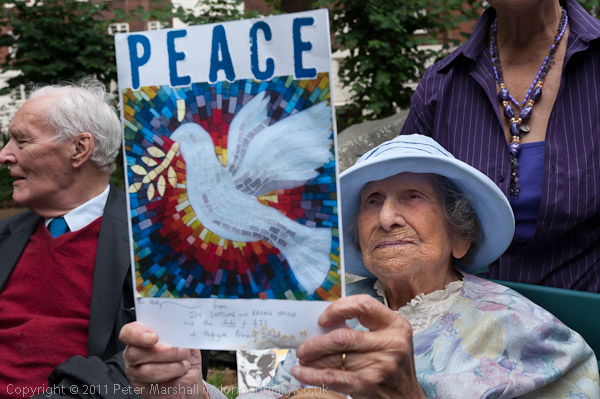
and Hiroshima Day, which included the picture at the top of this post, of the remarkable peace campaigner the late Hetty Bower, 105 when the picture was taken in 2011.
Continue reading Hiroshima: 70 Years

Camera Woes


Possibly the final image from my Nikon D800E – 25/07/2015 13:44:49

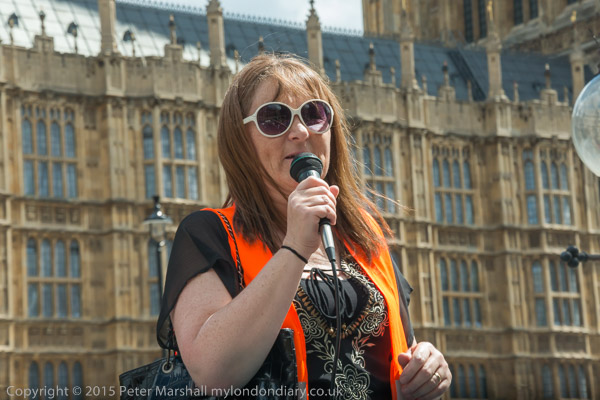
It was Saturday afternoon and I was in Old Palace Yard, opposite the Houses of Parliament photographing a woman speaking on a small platform in front of a small crowd. I’d taken a fairly wide view with the 16-35mm on the Nikon D700 and then raised the D800E and took a tigher image framing her speaking in front of the Houses of Parliament using the 18-105mm. Then I zoomed in and took a second frame, or tried to, wanting a tighter head shot, but it didn’t sound right. There was no clunk of the mirror. I tried again and it still wasn’t working. All I could get was a small bright area at the top of the frame.

I took off the lens and looked inside the camera. The lever at the side for the lens moved normally when I pressed the release, but the mirror didn’t budge at all, and looked slightly askew. Something was seriously wrong.

For the rest of the day I worked with a single camera, the D700, changing lenses rather more frequently than usual – and missing a few chances while doing so. Working with two cameras does really make a huge difference.

Back home I checked the camera again, and then began to think about what to do.  Was this a sign it was time to switch to mirrorless? Unfortunately my recent experiences in using the Fuji X-T1 haven’t been entirely positive. Though the results are fine, it had let me down at critical points, simply refusing to turn on for a few vital seconds. And though the electronic viewfinder is good, even better than an optical viewfinder in dim light, in bright conditions it can’t compete. It lets you see the framing of the images, but not to really study the scene in the kind of detail provided with an optical viewfinder. The ability to zoom in on the focus area is great, but not much use when you need to work fast.

So I ruled out that possibility, except perhaps as a short-term measure while the D800E was in for repair. It seemed likely that it would require a major overhaul, and as well as the mirror there were a few other parts that needed replacement, but I could put up for a while with working with the D700 with the 18-105mm, 16mm fisheye and 70-300mm while using the Fuji with its impressive 10-24mm (15-36mm equiv.)

I bought the D800E as soon as it became available here in 2012, so it was now three years old, and the shutter according to the press release “has been tested to withstand approximately 200,000 cycles.” Three years later, mine was now a little over that, and I began to wonder if it would be worth repairing. What would the cost of repair be and how would that compare with the second-hand value of the camera?

I did a quick search on the web. One dealer was offering a D800 in almost new condition with a shutter count of only 12,000 for £1150.  All those I could see on sale, even on Ebay claimed to be in at least excellent condition and hardly used, even at a little under a thousand.

I’d been intending to replace my D700 later this year. It has a shutter count of around 400,000 and a few minor issues and is clearly living on borrowed time. Some other photographers laugh at its cosmetic condition – loose rubber bits, embedded yellow paint and scratches, but it still delivers. It can’t last for ever and I’ve been expecting to have to give it a decent burial at any time for quite a while. Cameras aren’t made to last like they were, and photographers probably don’t want them too, as we are still in a time where technology is improving, if more slowly than in the previous decade.

I can’t remember (or be bothered to look back in my accounts) the exact cost of the D800E, but I think it was around £2,400.  In those three years I’ve spent nothing on repairs on it and the cost for using it works out at just slightly over 1p per exposure, which doesn’t seem a huge amount to pay. I’ll get an estimate for repair sometime, but won’t be too upset if it turns out to be uneconomic.

Things have very much changed since the old days. The Leica M2 that I bought second-hand in 1977 – when it was around 20 years old – is still in silky-smooth working order, though a couple of repairs over the years have doubled the price I paid. It’s second-hand value now is about the total that I’ve paid, not as people often say a good investment, but still excellent value. Cameras then were equipment, but now they are largely consumables, replacing not just the camera but most of the costs that used to be born by film.  And the film I used to use in that Leica (or rather a slightly improved version of it) now costs around 11p per exposure.

I’ve solved my immediate problems by buying a new Nikon D810. It cost a little more than those second-hand D800 bodies, but there are a few minor improvements that made me feel the extra was worthwhile. If I do get the D800E repaired I’ll have a camera in reserve for when the D700 gives out, and if not it may still be possible to use it with the mirror locked up for copy work in live view mode. But for the moment it’s a large, expensive and useless paperweight on my desk (useless because the desk is always so covered with junk there is no room for papers.)

I only got it last Wednesday and so far I’ve only taken it out on three days, but I’m getting to like it. The biggest difference I’ve noticed is in the noise from a redesigned mirror mechanism and damping. Possibly the sound isn’t much quieter, but it is at a lower pitch, less crisp and far less intrusive. I showed it to a couple of photographers this Saturday, holding the camera up a foot or so in front of me and pressing the shutter, somewhere in the middle of Parliament Square. With the noise of traffic going around the square it was hard to hear it.

Gandhi and Civil Disobedience

I’ve always felt that London wasted Parliament Square. A world heritage site because of the buildings that surround it – notably the Houses of Parliament, Westminster Abbey, Middlesex Guildhall (now the Supreme Court), the actual square is a large traffic island, with a large area poorly maintained grass and some rather crass temporary flagpoles brought out for state occasions. It has an odd assortment of statues, some rather good, others outstandingly poor.

Over recent years their have been some improvements for public access, which no longer demands a death-defying dash between traffic, with light-controlled crossings at two of its four corners, though the seats which tempted the unwary tourists have now disappeared, presumably because of Westminster Council’s vendetta against homeless rough sleepers.

Perhaps the reason for its curious state is below the surface, where I suspect it houses some secret underground bunker, linked by the mysterious underground passages we know exist between various above-ground government buildings in the area. But it certainly always feels like a missed opportunity to me. If nothing else most if not all of its area should be closed to normal traffic.

But something which I think any seat of government should have in its view is a suitable forum for public dissent, where protesters can make their views felt. Ever since the late Brian Haw took up residence on the pavement opposite the Houses of Parliament back in 2001, Parliament, the GLA, Westminster Council and the police have been doing their worst to stop such things happening or to severely limit them. Perhaps there is a case for some limits, but not for trying to set them so that protest becomes severely inhibited.

Occupy Democracy have carried out a series of protests intended to keep the square as a place for democratic discussion and protest, and I’ve photographed a few of these, though missing the main battles with police and GLA security guards (laughably called ‘Heritage Wardens’) over squares of blue tarpaulin the protesters were sitting (and sometimes sleeping) on, which led to the square being renamed by activists as ‘Tarpaulin Square’.

Recently a court has ruled that it is not a crime to have such tarpaulins in the square, dismissing the case against four people arrested, and leading to a second prosecution being dropped. As often, the police, egged on in this case by over-keen private security, have over-interpreted the law to make it mean what they wanted it to mean.

The court decision was hardly surprising. When Occupy Democracy came to the square last October it was clear to me reading the enforcement notices that the police were exceeding the law, and I told them so, to get the response that they would leave it to the courts to decide. It seemed to be a blatant disregard of the law by those who are paid to enforce it.

Occupy Gandhi – stop fossil fuel criminals on May 4, defied both the ban on tarpaulins and on tents in Parliament Square, though I imagine the protesters will argue in court that the tent was only symbolic and that they had no intention of using it to sleep in.

On this occasion police and GLA Security ignored the blue tarpaulins (except for asking one draped on the statue of Gandhi to be removed), and it was only after a tent had been erected in a deliberate act of civil disobedience that police first warned the protesters and later surrounded it and arrested those inside. You can read more about what happened in My London Diary.

Photographically the event once more proved the value of the 16mm fisheye, with several of the strongest images I made being take with it. It’s a lens that needs some care in use, usually at its best when absolutely upright, and the virtual level markers in the D800E viewfinder proved extremely useful.

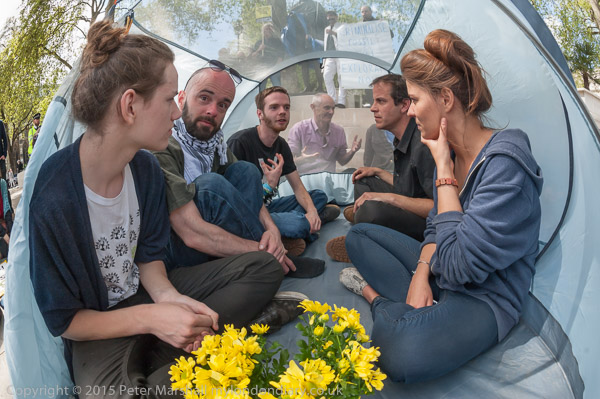
The top image on this post is an example where no perspective correction was needed, and the curvature at the edges adds to the image, producing something of a tunnel effect. I liked the near-symmetry of the scene, and the framing through the fabric at the rear of the tent of Donnachadh McCarthy who was leading the protest (he quickly jumped inside the tent as the police arrived to make arrests.)

To make Donnachadh clearer I increased the local clarity and contrast in Lightroom, adjusting the exposure slightly too. The yellow of the flowers is a nice contrast to the blues of the clothing and tent, and the pink shirt also helps Donnachadh stand out. In some other frames I also managed to include the statue of Gandhi, but his head got cut off in this one (at top centre) and it would have been nice to have a little more of the flowers. Sometimes even a fisheye isn’t quite wide enough!
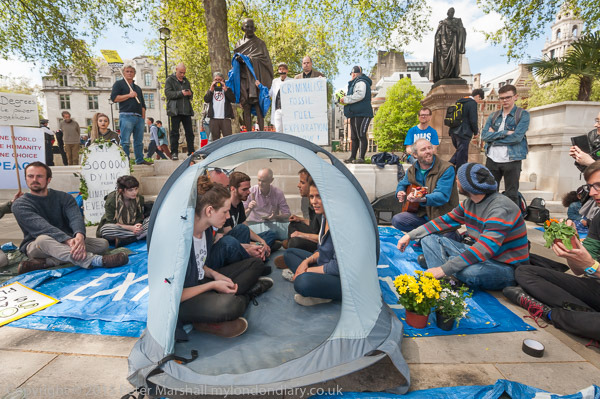
Theoretically I could have moved back a little, but practically that wasn’t possible. I’d quickly moved into position as I saw people going into the tent and worked with the 16-35mm on the D700, then moved away, coming back after the flowers had been put in the tent. After taking a frame with the 16-35mm I changed it for the 16mm fisheye and made a series of five exposures. The people inside the tent were having an animated conversation, and several of those five seemed interesting, but it was when Donnachadh briefly raised his hands that I had the picture I wanted.
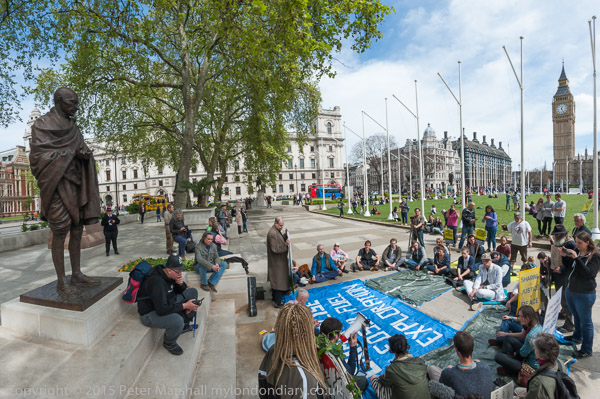
The 16mm fisheye was also the ideal lens to take an overall view of the event, enabling me to work from a close viewpoint and get in both the statue of Gandhi and at the other edge, Big Ben. The horizontal angle of view is around 140 degrees, too wide for a rectilinear lens – which would render both Gandhi and the clock tower as extremely fat. Again I was using the 16mm on the D700, keeping the D800E for the DX format 18-105mm which gives a decent-size file at the 1.5x crop. The D700 lacks the viewfinder level indicators, which accounts for the curved horizon. Correction from fisheye to cylindrical perspective was essential to avoid a curved Big Ben, Gandhi and flag poles.
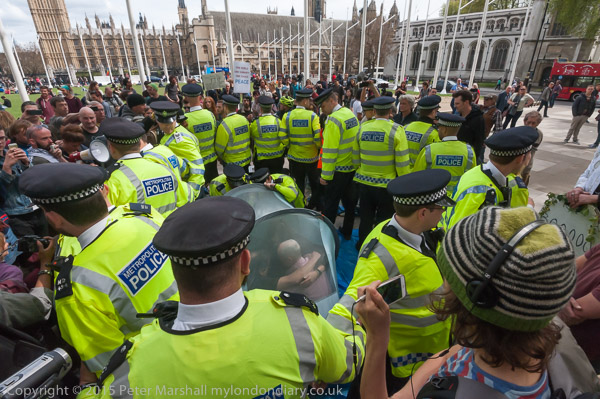
For the surrounding of the tent and the arrests it was fortunate that this took place next to the raised area with the Gandhi statue, giving me a good viewpoint, though the police did rather get in the way, as too did some of the protesters, many of whom were also taking pictures and sometimes holding up phones in front of me. Working with the D700 I did rather wish it had a hinged screen on the back like the Fuji X-T1, so much better when you do have to work with the camera held above your head. For some reason Nikon think this isn’t appropriate in their professional cameras, but I’d find it very useful. As well as the overall views with the 16-35mm, I was also able to take pictures over the shoulders or between the heads of police of the people inside the tent.

Later I went down to ground level and was able to work between the legs of the police surrounding the tent, leaving as Donnachadh was taken away by the police. He struggled as they led him away, then went limp, and was carried by the police to a van at the side of the square.
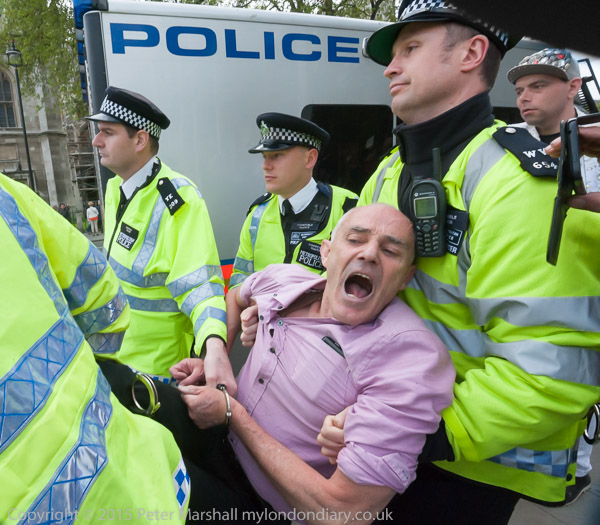
Another inexplicable failure by Nikon is with lens hoods, and in any close situation the lens hood on the 16-35mm will either be knocked completely off (I’ve lost half a dozen that way) or, perhaps even worse, get knocked askew.

This gives vignetting at top left and bottom right corners of the image at wider focal lengths, and is clearly visible in the viewfinder with the lens at 20mm or wider. Unfortunately when things get a little exciting and I’m working flat out I usually fail to notice it unless there is important subject matter in either of those two corners, and I end up with a lot of pictures with dark areas across them. Usually I crop the images to remove them, but often this means losing important subject matter.

The problem is I think a combination of the low profile of the filter mount on the lens with the flimsy flexibility of the Nikon HB-23 lens hood and could probably be more or less solved with a thicker moulding on the hood.

Usually I crop to the normal 1.5:1 format, but in this image I decided to simply cut off the left part of the frame, mainly occupied by more of the police hi-viz jacket. You can see the out of focus lens hood at top right, it’s visual impact removed slightly in Lightroom by desaturating it and the blue fringe it naturally has.

More pictures and an account of the event at:
Occupy Gandhi – stop fossil fuel criminals

Continue reading Gandhi and Civil Disobedience
Baltimore to Brixton


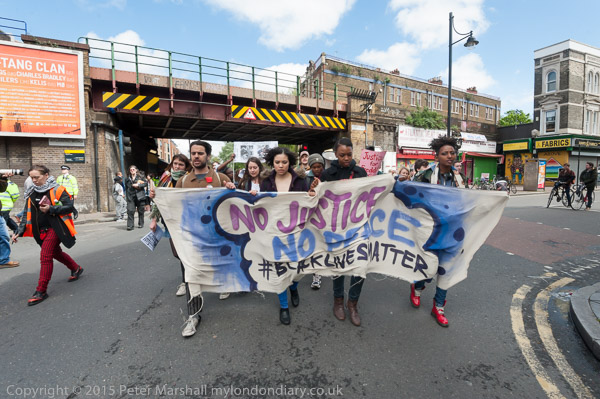
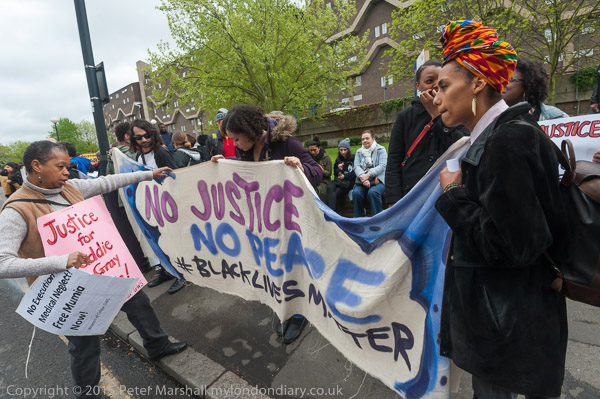
No Justice, No Peace – #BlackLivesMatter banner heads the march: Baltimore to Brixton – Black Lives Matter!
I was back in Brixton on Sunday May 2, for a march protesting after the killing of Freddie Gray in Baltimore and police attacks on his funeral. There had been huge protests in Baltimore, and others in solidarity in other cities across the USA, and this event in Brixton had been called by London Black Revs and other groups including the International People’s Democratic Uhuru Movement and Reclaim Brixton. There was also support from a number of other groups and I’d anticipated a rather larger event than it turned out.

Unfortunately there seems to be a divide between the more mainstream groups and the grass roots movements when it comes to protesting over black issues, and while many on the left are rightly appalled at the events, they fail to turn out at grass-roots organised protests such as this. There have also been internal problems in one of the organising groups which won’t have helped. But it would be good to see the left united on black issues in particular.

I arrived more or less on the dot for the protest, to find only a couple of police officers present in the area, and absolutely no-one at the address given, a property next to a street corner on Coldharbour Lane. I got out my phone and checked. Yes, I was in the right place at the right time. I walked a little way down the road and back again, meeting one woman I know who was also searching for the protest. We walked back to the meeting point and found now three students also looking for the protest.

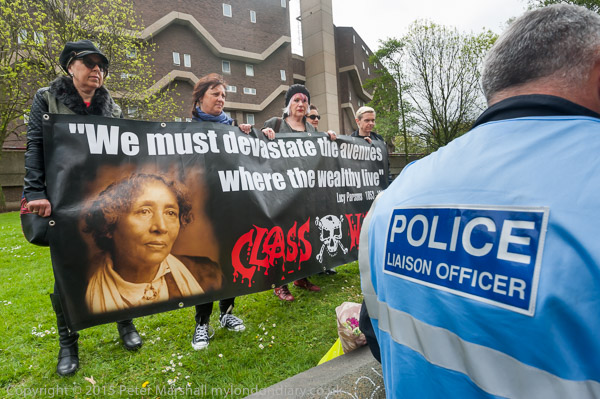
Slowly people arrived in ones and twos, and half an hour later a small crowd had arrived, icnluding a group from Class War with the Lucy Parsons banner. Still there was nothing happening, just people standing around and talking.


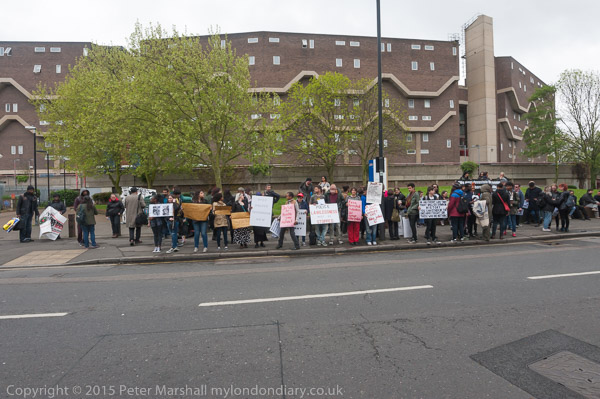
Some agency editors seem to prefer pictures like this.Not me

After a little more than an hour, someone organised people to stand with their banners alongside the curb. The view from the opposite side of the road was rather distant, and I always find such things boring. A thin narrow strip of protesters, the placards and banners too distant to read, and almost half the picture empty foreground. Exactly how not to photograph a protest, though if I were to send it with other images to the main agency that handles my pictures, its odds-on that some idiot editor would displace the image I’d selected as the lead image for the story with it.

I moved in closer, at some risk from the traffic which was still coming along the road at times fairly densely, and tried to find something a little more dynamic. If there are banners and placards I want them to be legible, and I like a little animation. I didn’t quite manage what I was looking for, but there were several such as the above which were certainly better.

Finally around 75 minutes after I arrived, the march set off, not along the road as I’d expected, but through the centre of that long block behind the people in the view from across the road, going into the Moorlands Estate through the gap in the centre of Southwyck House.

The fairly narrow path here made photographing a little tricky, and I don’t think I did as well as I might; in the centre of the estate the march stopped briefly a little short of where I’d anticipated and climbed on a small raised area, and I had to jump down and rush back, perhaps missing the best of the action there.

The march then came out in front of the Guinness Trust Estate, where tenants and leaseholders are fighting against eviction, and I assumed it would stop at least briefly there in support, again I was wrong-footed (and disappointed) when it turned away and marched on.

It made its way back past our starting point and under the railway bridge into the centre of Brixton (top image), going on to Windrush Square for a rally. Then it was time for more marching, up on the Brixton Road through the centre of Brixton – still fairly bustling even on a Sunday afternoon.

Again there was a small disappointment for me in that they marched past Brixton Police Station with its memorial tree to the victims of police killings without pause – given the nature of the event and the several speeches that had stressed the similar problems the black community has faced with police here it seemed to me an obvious target for protest – and the line of police outside showed they had come to the same conclusion.

The march went on to Loughborough Rd, marching through the centre of that estate and then returning down Coldharbour Lane – past the start point again and turning down to Number Six on Somerleyton Rd, a short life former kitchen given over to the community on a temporary basis.

The march was to continue from there after an interval there for rest and refreshment, but I’d had enough of walking around – we had already covered around 3 miles and left to catch a bus to Westminster, where I called in briefly at the Occupy Festival of Democracy before making my way home.

More on the march and rally at Baltimore to Brixton – Black Lives Matter!

Continue reading Baltimore to Brixton

Go Jeremy Go


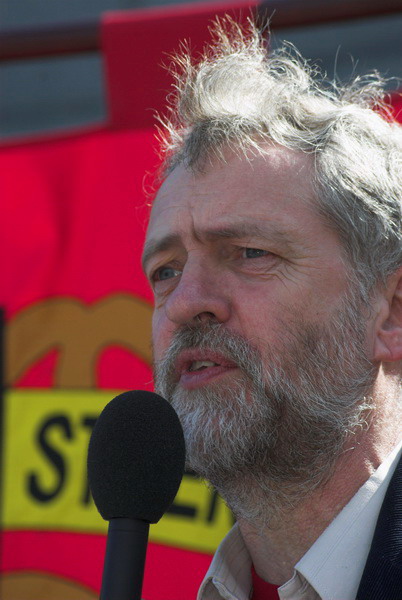
Jeremy Corbyn, 2006

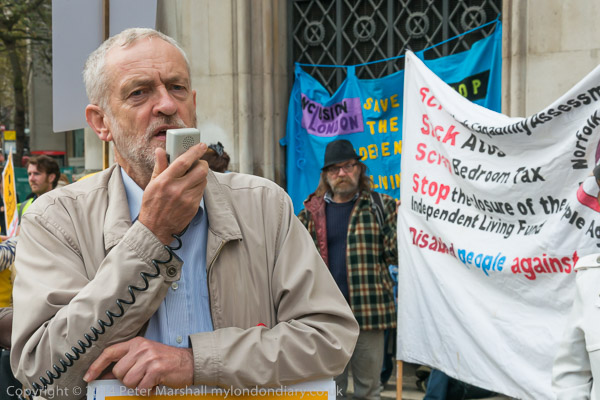
I’ve long ago lost count of the number of occasions on which I’ve photographed Jeremy Corbyn, and listened to him speaking. He’s an unusually good speaker, logical and clear, and even though I’m concentrating on his gestures and expressions I can usually also follow what he is saying. And often, though not always, I find myself agreeing.

If you have been relying on the mass media for your opinion of him, you will think of him as being some kind of left-wing extremist, but I think you would be mistaken. Jeremy is a liberal, perhaps a left-leaning liberal, but one who most of my left-wing friends decry as a woolly liberal. Islington man is nothing like radical enough for them, lacking the support for the deep structural and economic changes they feel are needed to move the country towards true equality and justice.


Jeremy Corbyn, 2014

I’m not a member of the Labour Party. I was as a student, but they threw us all out and I’ve never quite felt it worth going back to since. I do belong to two trade unions and am an active member of one, the NUJ, at least occasionally attending branch meetings and making my views heard. Until recently I used to vote Labour, solidly Labour, but I haven’t done so in recent elections. So I’m precisely one of those voters the Labour party needs to win back, though perhaps not a typical one, and my constituency is in any case one of the safest Tory seats in the country.

The only one of the four candidates I can envision doing so is Jeremy. Partly it’s because of his policies and those speeches, but mainly I think because he really isn’t a politician. He’s far too honest and sticks up for his principles; conviction rather than convenience. He’s a man I would trust to leave holding my bike and know it would still be there when I came back and not sold or left unguarded. And I would trust him with our NHS knowing it wouldn’t get privatised while he was busily assuring everyone it was safe in his hands.


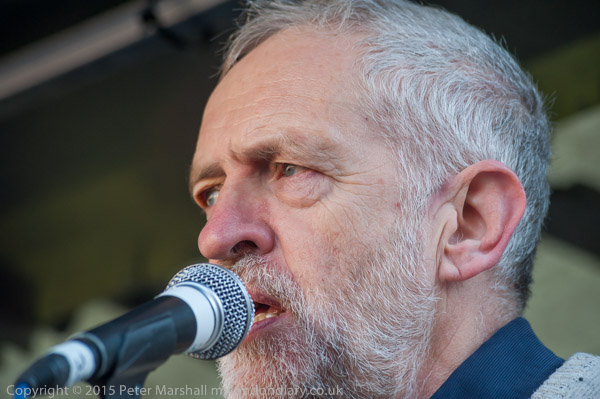
Jeremy Corbyn, 2010

Photographically Jeremy can present a problem. A while back I got an e-mail from a young photographer I know asking how I managed to photograph him with his eyes open. He does have a tendency (and I suffer from it too) to close his eyes when speaking in public, and I think is more sensitive than most to bright light. Often you simply have to keep your eye fixed for the moment when his eyes open and react immediately before they close again. That one click zooming in preview mode is vital (its the top of the top ten Nikon customisations in SLR Lounge if you are a Nikon user and don’t know what I’m talking about) so you immediately know if you were fast enough.

Another reason I warm to Jeremy is that clearly he doesn’t take a great deal of thought about how he looks. Most politicians you feel spend rather too long looking at themselves in mirrors, and employing people to improve their ‘image’.  I rather prefer the more natural look to the highly manicured.


Jeremy Corbyn, 2015

The pictures of him that I’ve put in this piece are more or less random images from over the years from My London Diary. I used the search feature on that site (top right of page) and typed in ‘Corbyn’, finding 128 items and then clicked on the first few of them. Most of those 128 pages will include pictures of Jeremy, though I have taken just a few of his brother Piers Corbyn. But those here are really a fairly random selection of the pictures I’ve taken of him over the years.

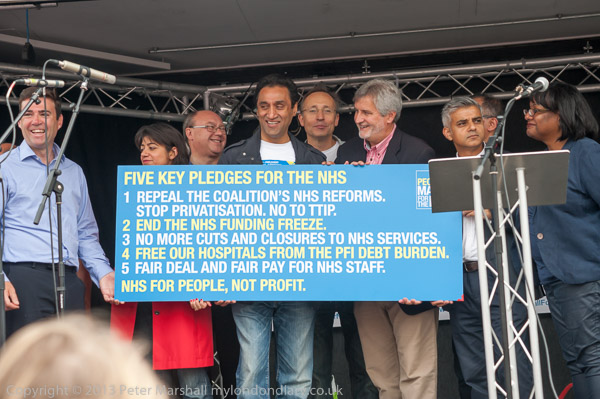
I’ve also a few times photographed Andy Burnham, at the extreme left in the above picture, who would I suppose be my second choice, though I suspect he wouldn’t deliver a Labour party I’d ever vote for. He came I felt somewhat reluctantly onto the stage where other MPs were surrounding a doctor holding the ‘Five Key Pledges for the NHS‘ at the rally ending the People’s March from Jarrow for NHS in 2014.

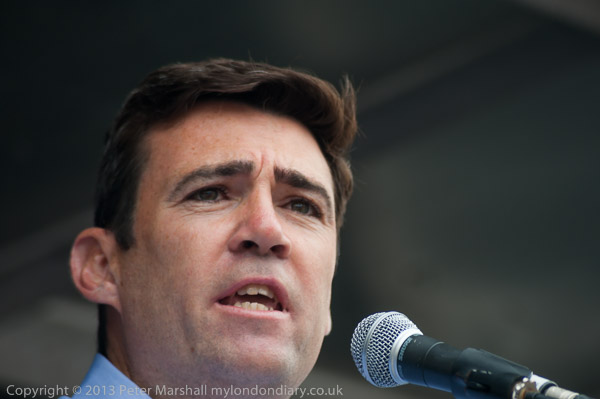
As I took the picture with him standing a little to one side I couldn’t help wondering whether if the support he was expressing as Shadow Secretary of State for Health would be quite as whole-hearted if he got the real job of being in charge of the NHS. It isn’t a good picture – those microphones were in the way, but I took quite a few more of him at the event both with other protesters and speaking.

I won’t be voting in the election, but will be interested in the result, which the opinion polls seem to indicate will be closer than anyone expected. It would be good to see a future for Labour as a real opposition to the Tories rather than a Blairite Tory-lite.

Continue reading Go Jeremy Go