November 2015

I’ve managed to complete ‘My London Diary‘ for November while I can still remember – more or less- what happened, and after only a week of December.  Having almost two weeks off due largely to minor illness helped, and the 11 or so days when I didn’t touch a camera is probably something of a record for me – certainly since I spent over three weeks in hospital back in 2003.

It’s unfortunately a part of growing old that minor issues take longer to resolve and I took the opportunity to have something of a rest. And although I’ve got back to work I’m still taking things a little easier, only going to one event where I might have taken in two or three. Although there are 16 links below, they come from only 11 events, around a third of the number of some recent months.

Also taking up some of my time last month was the work on producing my latest book, Dartford to Gravesend – still available in time for Christmas either from Blurb, or for UK addresses, direct from me.

Nov 2015

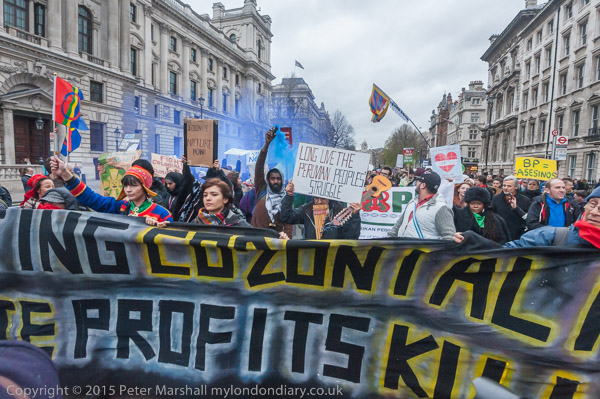
Global Frontlines lead Climate March
March for Climate Action Starts
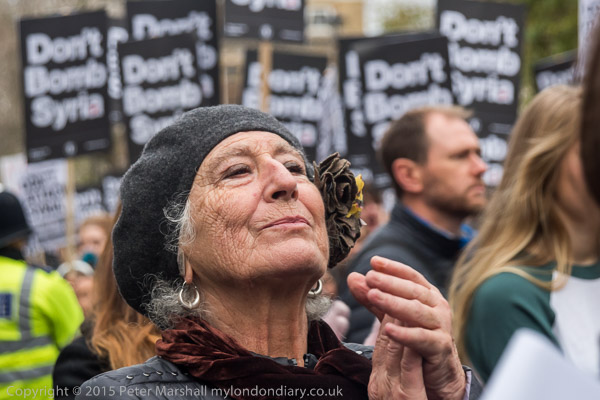
Don’t Bomb Syria Blocks Whitehall
Speakers at Don’t Bomb Syria


Don’t Bomb Syria


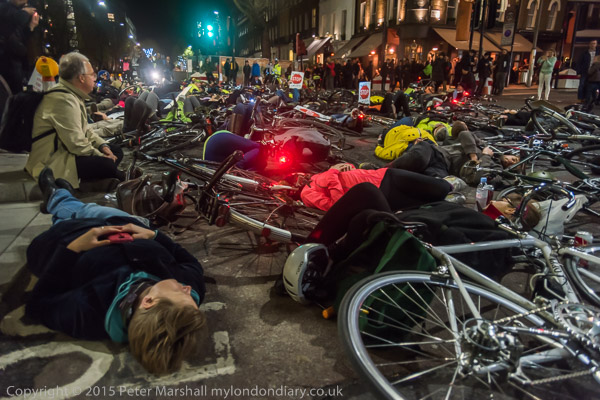
Stop Killing Cyclists Die-in


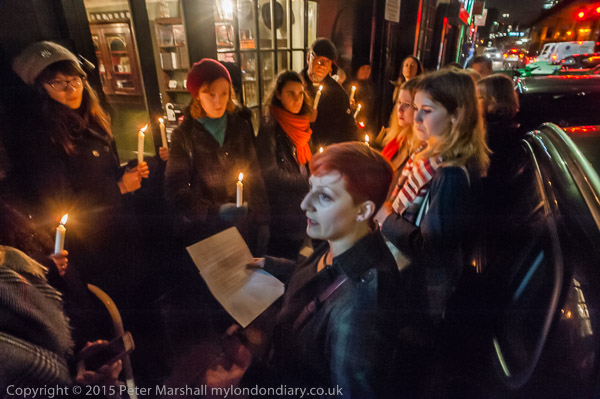
Ripper ‘Museum’ Candlelit Vigil
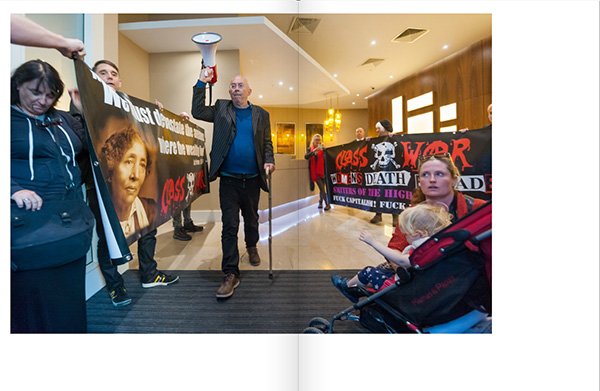
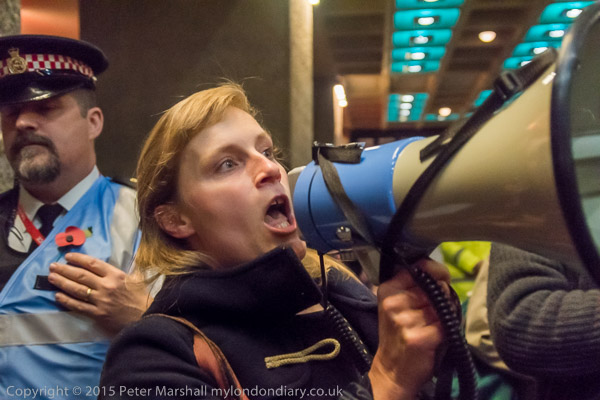
Class War at Osborne & Little
Osborne’s Nightmare Cuts


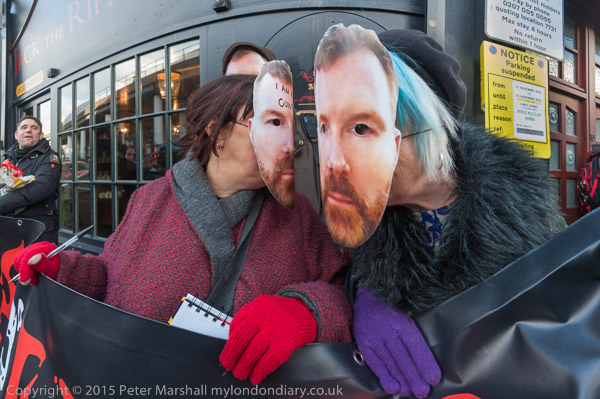
Class War at the Ripper ‘Museum’
Kingston Christmas


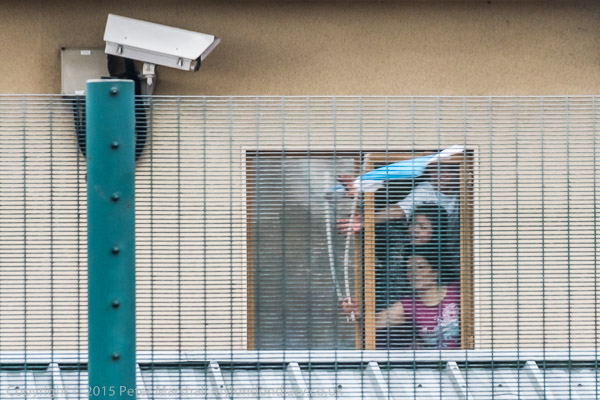
MfJ ‘Set Her Free’ protest at Yarl’s Wood
MFJ Meet Outside Yarl’s Wood


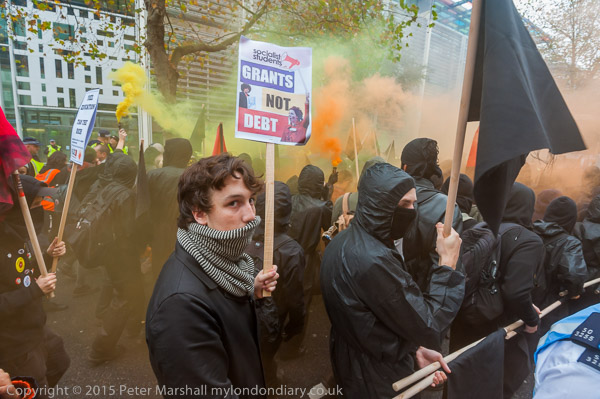
Students at Home Office and BIS
‘Welcome Home Shaker’ celebration
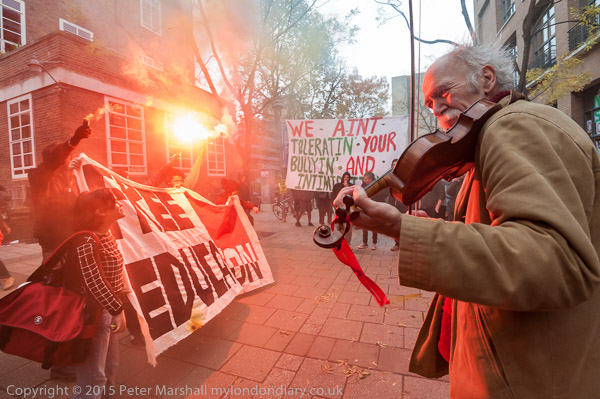
Free Education – No Barriers, Borders or Business

Continue reading November 2015

Protest Works – at least sometimes

Often people tell me there is no point in protests. They never change things. And of course they are wrong, although of course they don’t always succeed, even when they enjoy massive backing – as our involvement in the Iraq invasion and yesterday’s vote to bomb Syria show.

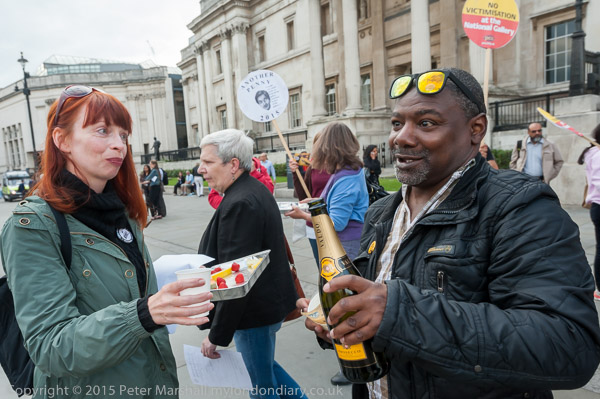
Two of the protests I covered in the last few days of July have since then resulted in at least a part successful resolution, achieving outcomes that certainly would not have happened without the protest. Both of them were protests about workplace issues, and both involved the unfair dismissal of people for normal trade union activities, and as well as opposing victimisation the protests also resulted in at least some progress on the issues over which they had been taking action. I don’t know the fine detail of the settlements reached, but I do know in both cases protest – and in the case of the PCS at the National Gallery, 100 days of strike – achieved gains which would otherwise not have happened.

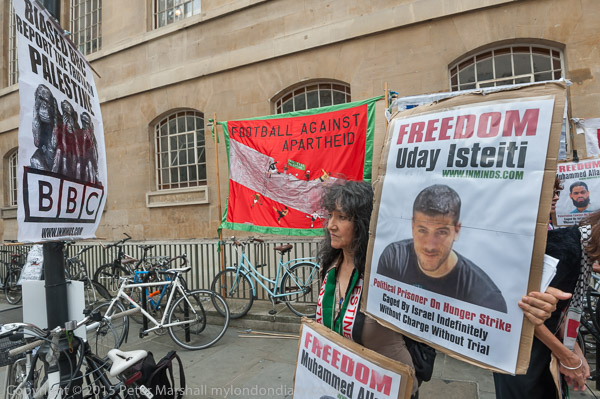
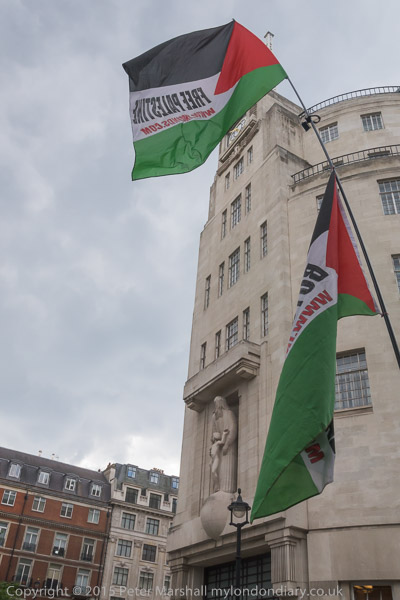
The third protest was about Palestine, and in particular about the failure of the BBC to report with the even-handedness it proclaims. Here there has been perhaps little progress, although more has come out – even from within the organisation – confirming its pro-Israel bias, and I think there has been a slight shift, with more attention being paid to the work of some of the BBC’s correspondents in Israel and Palestine rather than the prejudices of those in the studios and back rooms.

The strength of the BBC has always been in the reports of its foreign correspondents, who include some of the best journalists around. Its often at its best in the World Service rather than here in Britain. I remain a firm supporter of the BBC in spite of realising that we have to go elsewhere in search of what is happening in the UK and sensible unbiased opinion on politics in this country. It’s a real shame that it can’t reflect a more independent view here – and particularly in Westminster rather than so often following the promptings of our billionaire-directed press.

First up was a protest by National Gallery staff outside the leaving party for director Nicholas Penny in Trafalgar Square. I was shocked to find that many of the gallery staff had not even been invited, and they held their own little party outside, against the plans for privatisation and de-skilling that the departing director had signed off, despite giving his opinion that he didn’t feel they were appropriate.

The plans are all a part of the current government’s policy to sell off everything. Partly its a matter of reducing government debts, partly of putting fat profits into the hands of their mates (and themselves) in the private sector. Outsourcing cuts costs by employing less skilled staff on lower wages and inferior conditions and the only thing it ever improves is the bank balances of the out-sourcing company’s shareholders.

Photographically the only problem was in making something of fairly meagre subject matter. The light was fine, there were no problems of access, people were mainly happy to be photographed (though a few a little camera-shy) and there were few other photographers present.

The following day at the BBC there were more posters and banners, but I arrived rather late, and was short of time before the protesters left – and some had done so already.

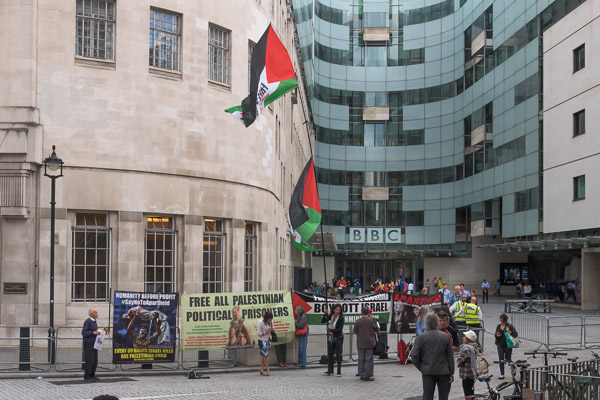
Although the old Broadcasting House is an iconic building and protesters can protest close to it, the entrance to the newer block which identifies it as the BBC is set well back in a private yard, which security keep protesters – or at least organised protests such as this – outside.  It’s a little hard to really visually link the protesters with the BBC. And although I recognise the frontage of Broadcasting House, I’m not sure how many will.

Even using a fairly long lens to compress distances, it’s hard to really link the protesters with their banners on the fence in front to that BBC above the entrance.

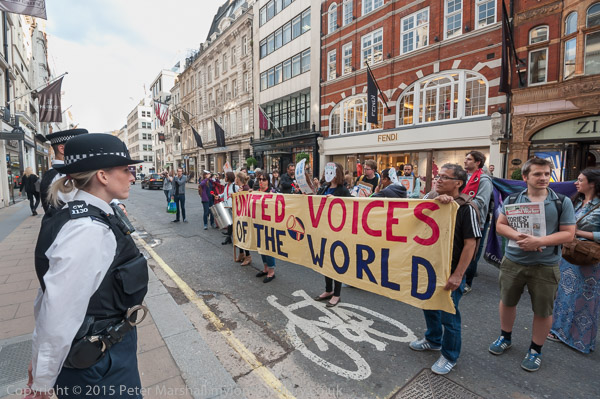
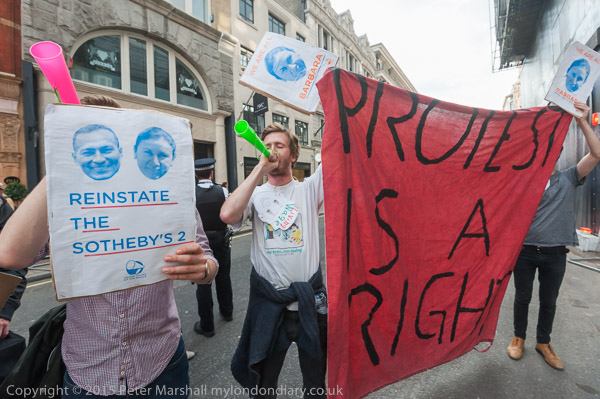
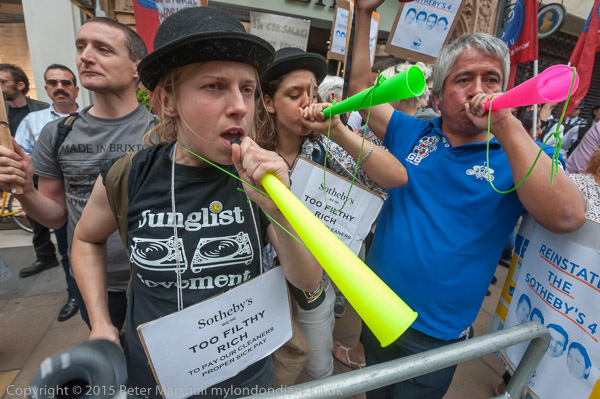
From Broadcasting House it is only a short walk to Oxford Circus where United Voices of the World were meeting to march to Sotheby’s for the start of the protest over the  ‘Sotheby’s 2′, Percy and Barbara, sacked for taking part in a protest outside their workplace for better conditions of employment – sick pay, holidays and pensions.

Previous protests had already let to the reinstatement of two sacked workers, and the last one a couple of weeks earlier had been met by a large and heavy-handed police response, trying to restrict the movement of the protest around the streets.  This time their were few police and they simply stood in a line along the pavement in front of the doorway.

It was curiously low-keyed, but perhaps showed that some officers at least had learnt from the previous  occasion, and this protest cause much less disruption of the area than the previous one. These are protesters who are prepared to make a lot of noise to make sure their protest is noticed, but not people out to cause any serious damage. But none of us likes being pushed around by police, and tempers sometimes flare on both sides if officers try aggressive tactics.

Protest‘, as one of the banners stated, ‘Is A right‘, and the police often claim that they facilitate it, though at times they seem more concerned with its restriction. But on this occasion things went smoothly. It wasn’t boring to photograph, though there were none of the scenes which are likely to make it news in the eyes of the media.

And that’s perhaps something of a dilemma for photographers who cover protests. We know that protests without violence are unlikely to make the news and that our chances of having pictures bought are relatively low.  I happen to think that the victimisation of low-waged workers by a prestigious high-profile employer like Sotheby’s who are making huge profits merits a place in the news. It is a scandal that should not happen in a civilised society.

But the wealthy owners and well-paid editors who control our news regard it as without interest – unless perhaps a ‘celebrity’ takes part or they can condemn those who lack power in our society.

It took another protest or two, but in the end Sotheby’s and the UVW came to some kind of agreement, though I don’t know the details. But here as in a number of other cases, they have managed to protect members and improve conditions by action.
Continue reading Protest Works – at least sometimes

Dartford to Gravesend now available

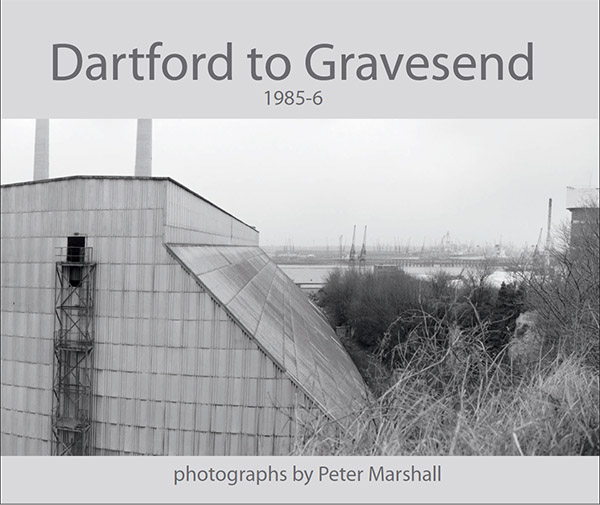
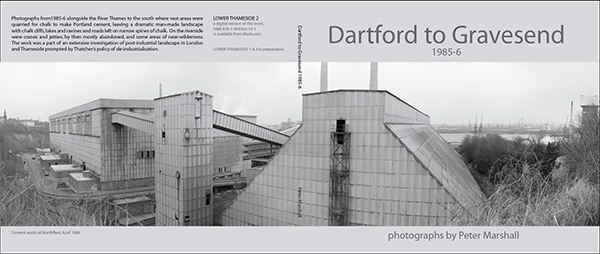
One of the advantages of the hard-copy of my latest book, Dartford to Gravesend is that you get to see the cover properly. Not my greatest design, but it is a panorama that wraps around front, spine and back of the book and begins to make more sense.

You get almost all of the image in the PDF version, but Blurb chooses to put the front cover at the start of the file, and the back cover only comes after another 80 pages, and the small vertical text and sliver of the image on the spine is missing completely.

It would do the ‘perfect’ binding of the book no good at all to flatten it out to view the entire panorama, but you can get a good impression of it. Perhaps I would have been better to have included the image across a double page spread inside the book, but getting images to work perfectly across the gutter is something of a black art, as I discovered when I produced The Secret Gardens of St Johns Wood and Thamesgate Panoramas, both of which required a couple of proofs and subsequent adjustments to get them more or less correct.

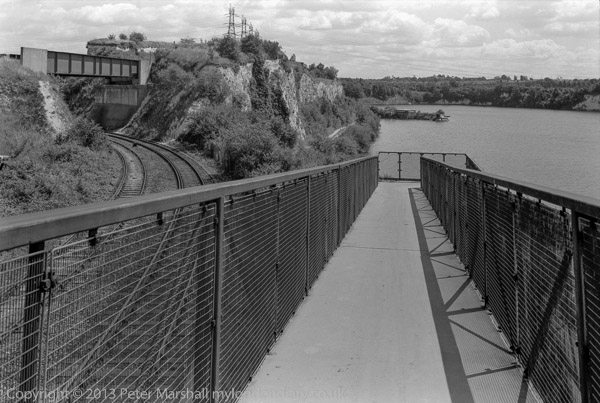
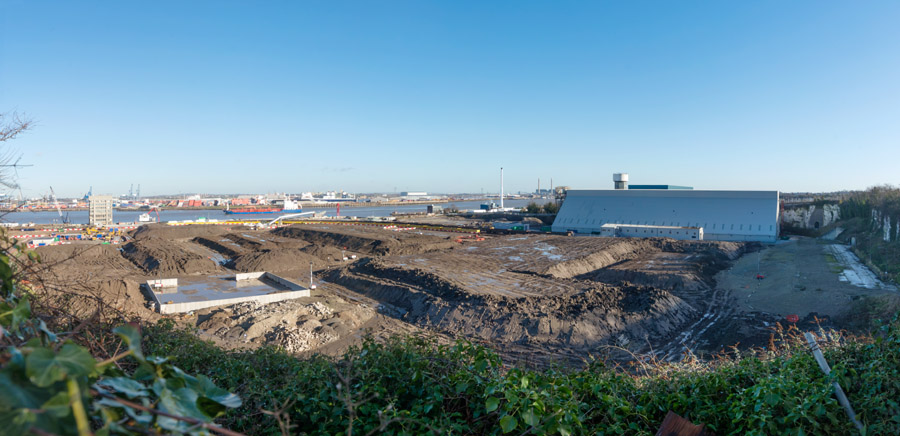
I produced the panorama back in April 1986 as four separate images taken on an Olympus OM1 camera using the 35mm Olympus f2.8 shift lens, leaning out over a wall near the top of Lawn Rd. When I returned to that same spot on New Year’s Day 2013 I made a panorama from almost the same position.

What had been the largest cement works in Europe had disappeared, leaving just a muddy hole. Then as in 1986, taking pictures was a little difficult because of the vegetation along the edge of the quarry making it hard to get a clear view.

Today I received a few print copies of the new book, and it was exciting to open them and see how good a job the printer had made of them. I was very pleasantly surprised with the quality, very close to that of the original scans and the PDF.

While my current stocks last, print copies are available direct from me (see details of how to order here) to addresses in the UK at £27.00,  while the PDF remains available (as well as the printed book) on Blurb, where the PDF is £4.99 and the print version £29.99 plus exorbitant postage. You can read more about the book and see some of the pictures in an earlier post on this site. The price will have to go up slightly when present stocks run out.

The first batch of my ‘economy magazine’ on the Poor Doors protests has sold out, but I now have a new batch but the price including UK postage from me is now £7.00. You can read more about the magazine and the protests on this blog.

Continue reading Dartford to Gravesend now available

Winnersh Triangle

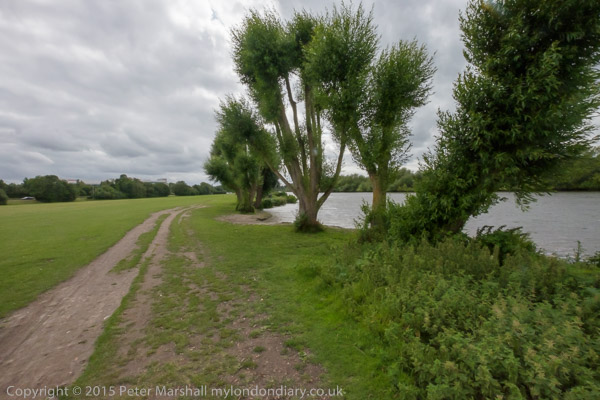
I’ve never needed to alight from the Reading train at Winnersh Triangle before. When the station – just a few hundred yards down the line from the existing station at Winnersh was added the media was full of stories about strange disappearances in the Bermuda Triangle, and Winnersh Triangle did seem to be a halt where a few left the train but nobody ever got on. And on July 27th we added to that number, the three of us leaving the train there, along with just one other passenger. I don’t know if she returned, but we didn’t.

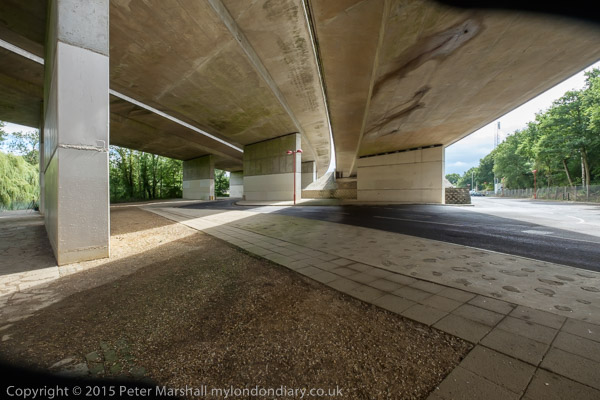
Winnersh Triangle is a business estate on a very vaguely triangular area of land between the A329 Reading Road, the A329(M), a mile or so of feeder motorway to the M4 which begins here, and Winnersh Meadows, a smallish country park. Much of it is in the flood plain of the River Loddon which runs around its west and north sides and regularly floods. Viaducts carry the railway and the lead-up to the motorway across the river.

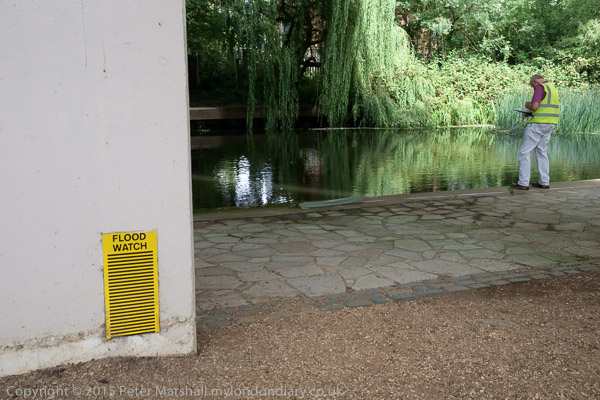
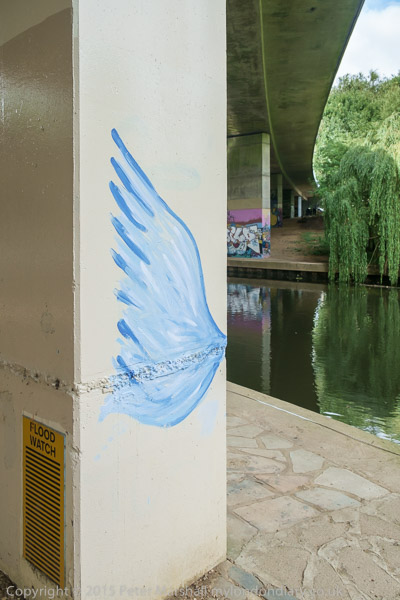
Having something of a penchant for tacky Ballardian developments I would probably have spent some time photographing in Winnersh Triangle itself – and doubtless attracting the attention of its security staff, but my two companions were of a more rural mind, and we set off through the older ribbon of suburbia along the Reading Road to Loddon Bridge before taking a footpath along by the river. Although there had been a little rain recently and we came across a man from the council checking the river – and he was keen to tell us about it. From the sign we could have been walking in a foot or two of water at the wrong time of year.

But very soon we were in green rather than concrete country, even if it was more country park than real country, though later stretches of our walk towards the Thames were in surprisingly remote areas despite being not far from the suburbs of Earley and various suburban villages around. There were a few curiosities on the route we took, including The Museum of Berkshire Aviation and a few miles on a rather deep ford across one of the streams of the Loddon, the Old River.

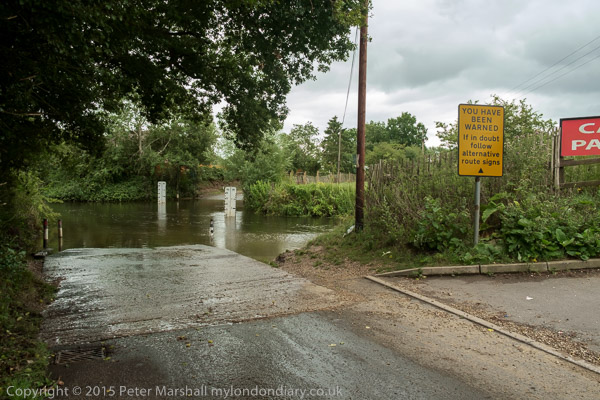
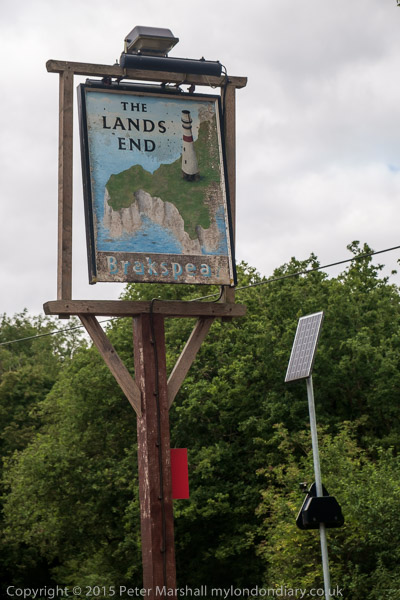
The depth gauge on that day was only reading just under 2 foot, but it goes up to 6 foot. Fortunately for those on foot there is a narrow footbridge a hundred yards or so upstream, and anyone stranded on the west side can take refuge in the Land’s End pub.  The beer was welcome, though at West End prices, with no competition from Wetherspoons here.

We walked on to the Thames, turning left to sit and eat our sandwiches by the river. There were no other walkers on the path on our side of the river – which comes to a dead end where we had joined it – but we could see a steady stream on the Thames Path along the opposite bank – where we had ourselves walked a few years ago.

The path took us to Sonning, past the home of Uri Geller who has I think since moved out, leaving another poor piece of sculpture on the river bank without planning permission to the disgust of the locals. Sonning is a posh village, for those with expensive tastes (or lack of taste) and includes what must be one of the churches with the richest supporters in the land. But we were made welcome as we looked around and presented with a glossy advert-stuffed church magazine. In Anglo-Saxon times there was a cathedral here, and a Bishops Palace until the sixteenth century.

From the churchyard we took the path to join the Thames Path for the few miles into Reading and the train home. It had been a pleasant walk but rather tiring on my old legs.  More pictures at Loddon & Thames.

All of the pictures were taken on two Fuji cameras, the Fuji X-T1 and the Fuji X-E1, with the 10-24mm and 18-55mm zooms respectively.  Weighing in at around half the Nikon equivalents they were rather easier to carry the dozen or so miles I walked. I had a couple of other lenses too, the 8mm fisheye and the 90mm Leitz Elmar, but don’t think I used either – certainly all the images on My London Diary were taken with the two zooms. Again these lenses don’t add a great deal of weight.

The two lenses are a great pair, with the overlap between the two ranges maening rather less need to switch cameras. Just occasionally that 55mm seems a little short and perhaps the 18-135mm would be better. I’m still thinking about it.

Even the four spare batteries don’t add up to a lot (and I think I used all of them.) But battery life is a big problem with all ‘mirrorless’ cameras, even though I work with the EVF on the X-T1 only switching on when I bring the camera to my eye it doesn’t seem to help much.

Many photographers rave about Fuji colours, but I prefer the Nikon version.With the Fujis  on Provia/Standard setting the colours – particularly the greens – are too intense and always need some adjustment in Lightroom. My best results come from working in RAW and importing into Lightroom with a Pro Neg Standard preset setting.

The X-T1 had also developed a strange pink cast, seeing the world through rose-coloured glasses, which takes some correcting. I found that there is a setting on the camera which allows you to mess up the auto white balance, and somehow this had been changed, although setting it back to zero doesn’t entirely solve the problem, but does make the images more neutral. This change in colour appeared to have happened at the time of the latest firmware update – and I hadn’t made any deliberate changes. But I’ve not heard of others having similar issues.

Continue reading Winnersh Triangle

Doves & Fuji Disappoint

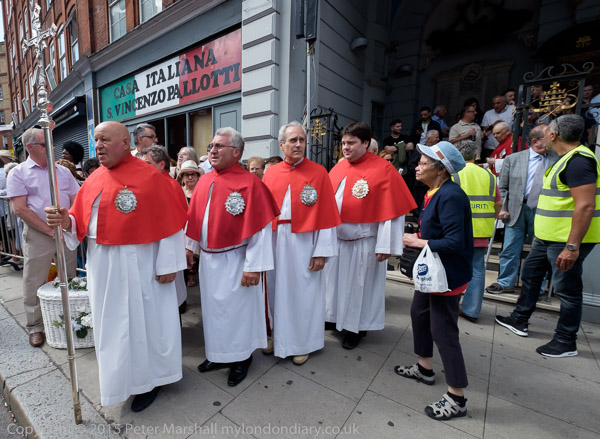
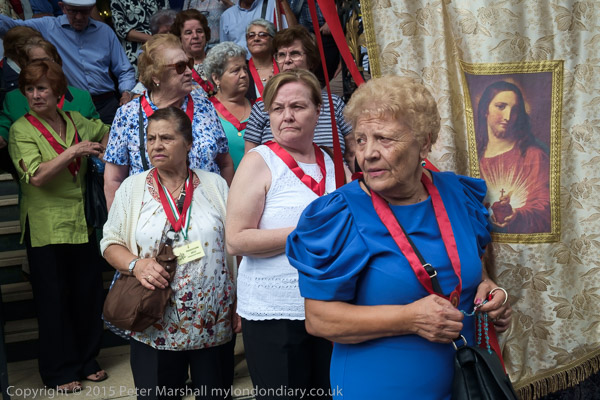
I can’t remember when I first photographed the annual Italian Church festival in London, one of our older traditions, dating back to when the community around the church in Clerkenwell was given special permission to hold a procession around their parish in 1883. Then a Roman Catholic procession was politically still very sensitive.

The Popery Act of 1698 had tightened the very strict limitations on Catholics, putting a bounty 0f £100 on Catholic priests and providing for the  “perpetuall Imprisonment” at the discretion of the King of priests taking Mass or anyone found to have been educating youths as Catholics. When the Papists Act of 1778 attempted to reduce this official discrimination London saw its worst riots ever with around 50,000 people taking part in angry marches to Parliament, with ‘King Mob’ attacking the homes of wealthy Catholics, embassies of Catholic countries and prisons – both Newgate and the Clink were largely  destroyed – and other targets in and around the city.

It was riot on a scale that makes our current protests look small beer indeed – with just the occasional window being broken, the occasional and possibly sacrificial police vehicle torched and where cereal being thrown at a shop window makes vicious headlines. After around 5 days of mob rule the army were brought in, shooting and killing almost 300. Around 450 people were arrested and later around 30 of them were tried and executed.

The legal discrimination against Catholics (and Protestant dissenters) was reduced by Acts in the 1820s but was only finally removed by the Religious Disabilities Act of 1846. But of course we continue to celebrate ‘Bonfire Night’ on November 5th, though perhaps few of us now remember it as an anti-Catholic event dating from 1605, and by  Act of Parliament until 1859.

It was one of my photographer friends whose father was Italian who first told me about the procession of Our Lady of Mount Carmel and I arranged to meet him there perhaps around 20 years ago, and I’ve met him again there most years since then, taking pictures and sharing a few tumblers of Italian wine in the Sangra.


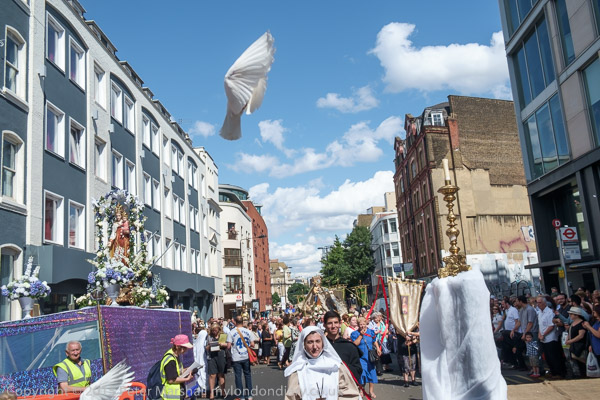
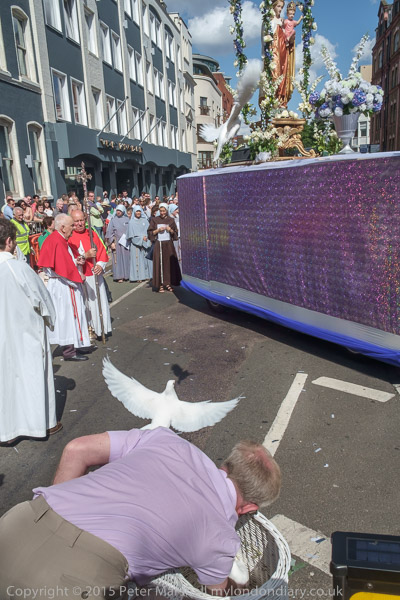
A rather bad picture of the release of the doves

One of the highlights of the event has always been the release of doves, and it’s something I make a point of trying to photograph. It changes a little from year to year and in most recent years I’ve been lucky in getting one decent image of it.

This year I had taken with me two Fuji cameras, the X-E1 and the X-T1, and most of the time I had the Fuji 10-24mm zoom on the X-T1 and the 18-55mm zoom on the X-T1. There were two releases of three doves, and I’d got in a good position for the first one and was waiting with the X-T1, and I set the shutter to continuous high-speed mode – 8 frames a second. As the lid to the first basket was raised, I raised the camera to my eye in readiness and the electronic viewfinder remained blank.  I just had time to grab the X-E1 and raise it to my eye and get a single image as the birds flew away. But they doves were not co-operating – one was flying low and mainly out of frame, a second was nicely in frame but performing a pancake impression, while the third had soared way up and behind me by the time I pressed the shutter.


My second attempt was slightly better

I saw a second basket and knew I had another chance later. So I checked the X-T1 again and found that the battery had run out – you get little or no warning. I changed the battery for a fresh one – I’d carefully taken 5 spare batteries with me and had checked before going out that all were fully charged . I tested the high-speed continuous mode with a short burst. Everything was fine. But as the dove man got ready to raise the lid of the basket, I put the camera to my eye and … Nothing. The viewfinder was blank. I tried the usual way to unblock the Fuji sulk, switching the camera off, then on. It still didn’t respond. Fortunately the doves were on a go-slow. They were sitting happily in the basket and having a good time, refusing to leave. I had time to lift the X-E1, adjust the zoom to 18mm and make a picture as the doves were persuaded to leave. You can see all three of them in the image – one still in the basket and two in flight (and a small black shadow dove as a minor bonus.) It certainly wasn’t the best picture I’ve made of the release, but at least I had a picture.

I don’t know why the X-T1 let me down that second time, but it illustrates well the frustration I have with what is in other respects a fine camera – with some really great lenses. It’s the same with other Fuji cameras too, though today for once the X-E1 performed without similar hiccoughs. I keep hoping that Fuji will sort out the problems in the next firmware update, but I suspect they are too basic.

Continue reading Doves & Fuji Disappoint

Dartford to Gravesend

I’ve not been taking many photographs recently, partly because of minor health issues, but also because I’ve been working almost day and night to get another Blurb book finished. I started working on the book ‘Dartford to Gravesend‘ well over a year ago, but it has been slow going, and doing a little bit here and a little there doesn’t really work.

For those who live away from south-east England I should perhaps explain that Dartford and Gravesend are both towns on the south bank of the River Thames, with Dartford just outside the Greater London area and Gravesend a few miles to the east, on the riverside facing London’s port at Tilbury.

My first visit to the area was actually to catch the ferry across to Tilbury in 1981, when a group I was part of had been invited to set up a project there – which never happened. It was 4 years later I returned to the area to take photographs, mainly as a part of a wider project on Britain’s disappearing industries as prime minister Thatcher decided to shift us away from manufacturing. But it was also – as I wrote in South of the Thames in January 2014 – prompted by two books, South East England, Thameside and the Weald, by Roy Millward and Adrian Robinson (1971), which contained a section ‘The cement industry of Lower Thameside’, and the rather more fanciful and poetic ‘Pilgrimage of the Thames’ by writer and illustrator Donald Maxwell (1932) who had begun his own journey up-river at Gravesend. It’s a more satisfactory starting point than the Thames Path which dared not venture beyond the Thames Barrier at Charlton.

Maxwell’s description of the area, written originally for the Church Times and illustrated with his sketches piqued my imagination:
Could our fathers visit Northfleet, Swanscombe and Greenhithe once again, they would simply not recognise them. Modernism has gone mad. Agriculture has fled. The reign of Christ and His saints is over – so he would reason – and Moloch, horrid king, besmeared with blood, reigns in his stead.

He continues in not dissimilar vein, calling it “a Hell that is Dantesque in its picturesqueness and Miltonian in its grandeur” and a page or two later comments “One Day , when the cement industry has left this valley … this district will be called the Switzerland of England, and weekend châlets, each with its aeroplane-landing on the cliff, will look down once again upon green shores and tree-embowered banks.”

After reading this, who could have resisted visiting the area? Back in 1985, the cement industry was still going, but had been rationalised into one giant plant at Northfleet (though that was only working at around a quarter of capacity) and there were yet no chalets.

Now – since 2008 – the cement industry has gone, the chalk worked out. Still no ‘aeroplane-landings’ or ‘châlets’, but there is a vast shopping centre in one disused quarry, a new town slowly appearing in its neighbouring canyons, the high-speed rail between London and Paris cutting through its centre before diving under the Thames and the threat of a vast TV and film them park. Maxwell would still recognise the reign of Moloch.

Of course I’ve been back to the area and taken more pictures since 1985-6 and those in this book. I revisited some parts in the 1990s, and again in the 2000s, with some images in the book Thamesgate Panoramas and in the exhibition Estuary at the Museum of London in Docklands. There are some more recent images on My London Diary, particularly earlier this year from Swanscombe.

As with some previous books, this one is published as a PDF on Blurb. This allows a good image quality (if you own a decent screen) at a price which is fair both for viewers and me at £4.99 – rather than the high cost of on-demand printing which makes a hard copy around £30. On top of that, Blurb uses a high-cost delivery which makes single copies ridiculously expensive. As usual I’ve ordered a small supply for UK customers which will shortly be available to UK customers for £28 including p/p. I’ll post again about these when they are in stock.

I’m also currently working on two further books of pictures from along the south bank of the Thames – and will perhaps later produce some on the Essex bank too. I’ve called this series ‘Thameside’ and although the first to be published, this is Thameside 2. Probably the next to appear – Thameside 1 – will look at the area from Woolwich to Dartford.

Continue reading Dartford to Gravesend

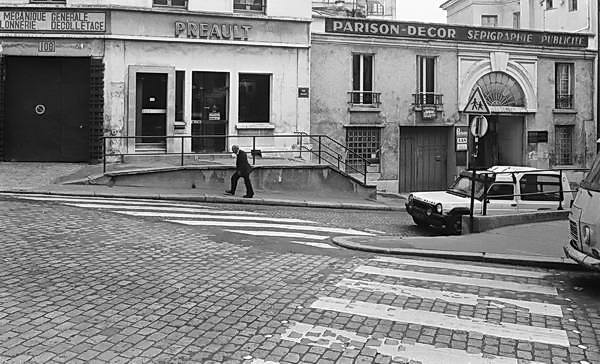
Paris

I’ve often been in Paris in November – like many involved in photography visiting the city around the time of Paris Photo, the largest of the annual shows of the photography art market – and I knew that many people I knew would be in the city when I heard the news of the terrible killings there on Friday.

I’d heard the news late, having been busy working on a new book and not keeping up with the news and was on my way to bed when my wife told me about it. She phoned her brother who lives just outside the city with his wife first thing on Saturday to check they were OK. They were; though he had been at a bar on one of the streets where one of the attacks took place most of Friday afternoon, he had left for home several hours before the shootings.

It was a relief too to turn on Facebook and see updates from many of my friends in Paris assuring us all of their safety. Of course it is still a great tragedy but it is good to know that those that you know are safe, though as I write only around 30 of the 129 confirmed dead (with another hundred or so in hospital with various injuries) have been named and there could still be shocks.

Although most reports have said that the attacks occurred away from the tourist areas, there were in the areas of Paris I know best, and where I have often stayed and photographed on my visits there, particularly around the Canal St Martin where the attacks on Le Petit Cambodge, Le Carillon, La Casa Nostra and the Bataclan theatre took place.

One of the pictures hanging above my living room mantelpiece shows a corner of Rue Bichat, though the shootings there took place a couple of blocks south where it meets Rue Alibert. It’s a street I’ve walked down many times and the same picture is also on the front page one of my more neglected web sites,  Paris Photos. Although it has quite a few of my pictures from Paris, particularly my pictures from 1973 and 1984, there are many more I should add.

My thoughts – like so many others around the world – are with Paris and those who have been killed or are suffering and their grieving relations and friends.

October 2015

What? Its only November 11th and I’m posting that I’ve finished the whole of October for My London Diary? Yes, thanks to having been a little indisposed for a few days I’ve almost got up to date. So here it is. I’m more or less feeling OK now thanks. Perhaps get back to normal work tomorrow…

October was an interesting month for me. I almost got to be a witness in a trial relating to events I photographed earlier in the year, and it could just have been a trial that set an important precedent in restricting our civil rights. But fortunately it came up in a court that had more sense than to entertain the police nonsense – and was settled without any defence evidence being heard.

Perhaps too things are quietening down a little and I’m also trying hard to cut out some of the less essential things I cover. Certainly there are fewer stories than for some time.

Continue reading October 2015

Sotheby’s Party Protest


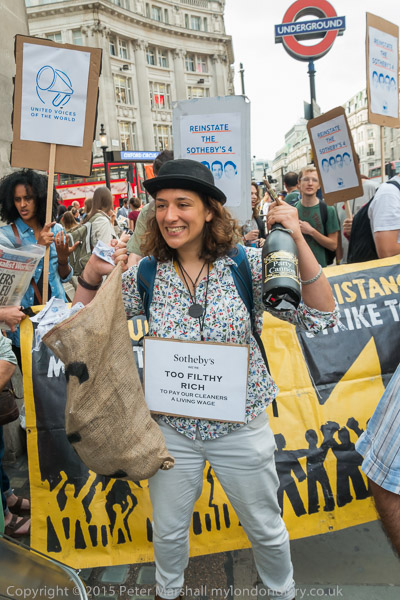
A sack full of money and an equally fake bottle of champagne for a party-themed protest

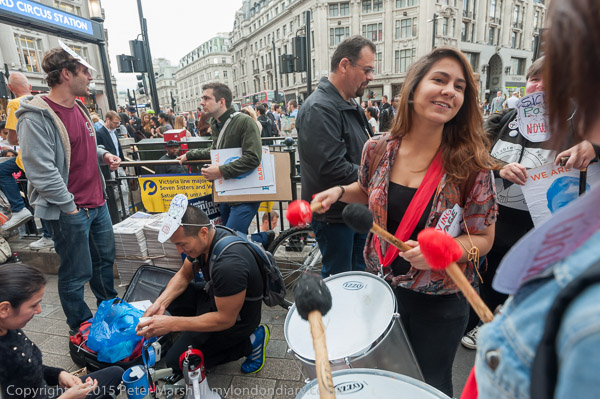
United Voices of the World went back to Sotheby’s intending to have a ‘protest party’ outside while Sotheby’s staff were having their staff party before their summer break inside the building. But the police were not in party mode at all, smarting from being given something of a run-around by the UVW at the previous protest.

Of course the union were there for a serious purpose, calling for the re-instatement of four cleaners who had been sacked for protesting outside their workplace calling for proper sick pay, holiday and pension arrangements.  The UVW want the Sotheby’s 4 to be re-instated.

The cleaners are not actually employed by Sotheby’s – so would not in any case have been inside at the staff party. They are employed by a contractor, Servest, but Sotheby’s had refused to let them come into work in the building, effectively sacking them.

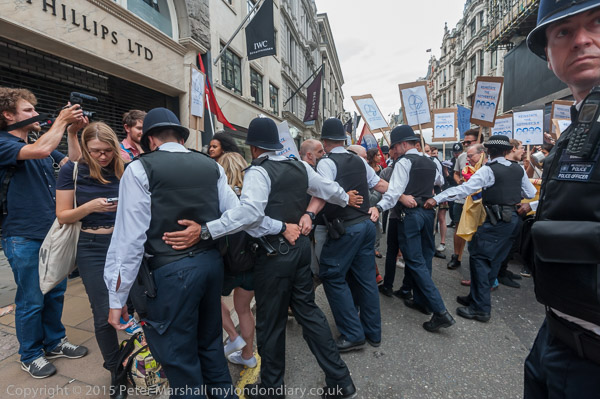
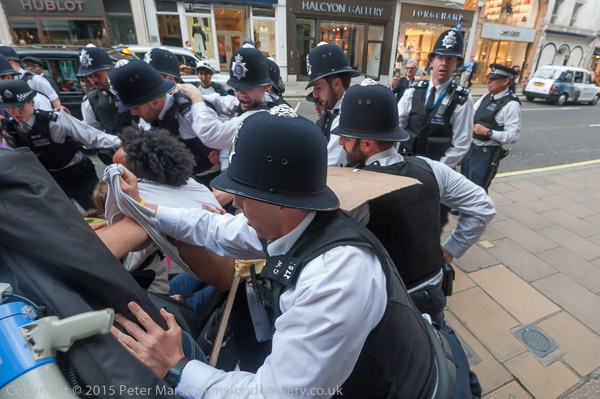
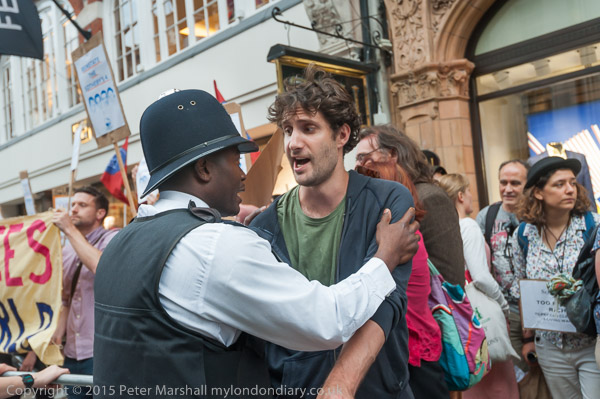
Had the police behaved sensibly there would have been a noisy but essentially good-natured protest outside the closed frontage of Sotheby’s, causing relatively little disruption to traffic in the area. But the police came determined to turn it into a battle and to show the protesters who was boss.  As the protesters came up to Sotheby’s they formed a block across the road, closing it to traffic for far longer than was necessary, eventually pushing the protesters off the road onto the opposite side of the street.

Later they attempted to stop the protesters from marching around the block, and again there was a lot of pushing and shoving by police, but the protesters walked around them and went around the block, letting off a couple of red smoke flares as they did so. When they arrived back at Sotheby’s police again pushed them off the road and behind the barriers which had been set up to contain the protest.

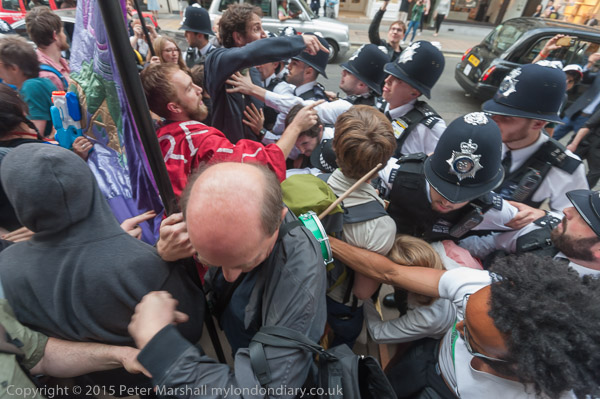
The atmosphere, which had started as good-natured was beginning to turn sour. People don’t like being pushed around by police, and when police again tried to stop them leaving the pen for a second walk around the block things got very heated. The protesters seemed to be pushing their way through when more police joined in, leaving the barriers behind unguarded.

People began unhooking them and moving out onto the street and it took a lot more pushing and manhandling of protesters by police to get them back. The police had really lost control, but the protesters weren’t really out to cause trouble – most just wanted an effective and peaceful protest and people just wandered around on the street shouting slogans.

Eventually police reinforcements arrived and brought the situation under control. It looked for a while as if they intended to arrest some of the protesters, but they thought better of it – and it was perhaps hard to know what the charges might be. Eventually UVW General Secretary Petros Elia spoke to one of the officers, telling him that they wanted to bring the protest to an end, and he went to see the officer in charge and the protesters were allowed to march away.

I made my way home, thinking that an essentially peaceful protest had been policed with unnecessary force, and had cost the public several thousand pounds more than had been needed – all because of a little police dented pride.

Photographing such events I need to keep a certain distance and objectivity, which can often be difficult. I also try hard to avoid getting in the way of the police in the discharge of their duty.  Often police don’t want to be photographed and can be unnecessarily obstructive – and I was asked to move back on a couple of occasions during this protest when I felt it was entirely unnecessary – and also got pushed out of the way rather roughly. Annoyingly police often ask photographers and protesters to move ‘for your own safety’ when its clear we are in no way at risk.

More at Reinstate the Sotheby’s 4.

Continue reading Sotheby’s Party Protest

Immigrants not Criminals


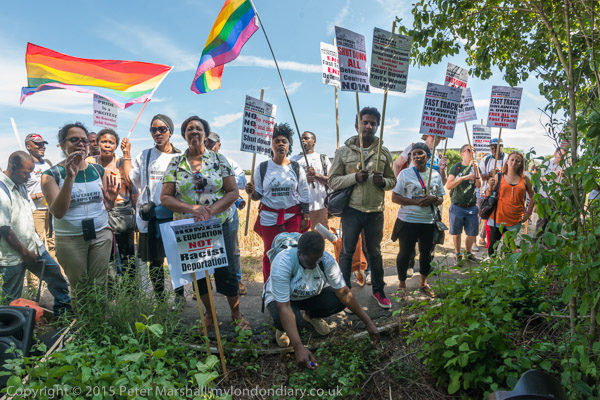
I photographed the protesters from inside the hedge in front of them using the 16mm fisheye

For years our right-wing press (and almost all the UK press is right-wing, owned by a handful of billionaires) have poured hate on immigrants, and successive governments have striven to outdo each other in repressive measures to stop people coming to settle and work in the UK. Unless of course they are extremely wealthy – its only for the rich that we really have freedom of movement around the world any more.

Words such as immigrant, asylum seeker and refugee have become terms of abuse in our racist press – and even in the reporting of more respectable organisations such as the BBC.

There has been an excessive obsession with numbers, and with terms such as ‘flood’ and ‘storm’ and even people who should know better talk and write about ‘illegal immigrants’ when there is no such thing; people may break the law but they are not illegal, as banners on these protests say – No One is Illegal.
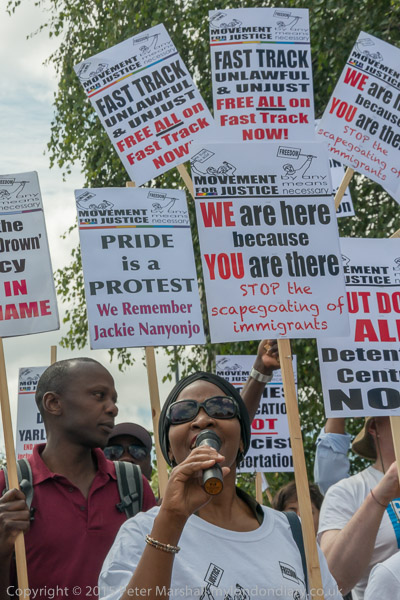
Scare stories are run about huge population increases and the ‘fact’ that the UK is overcrowded. It isn’t, although some parts of London certainly are with tourists, who the government is trying to encourage. There is pressure on services such as schools in some areas – largely because of a failure to direct resources where they are needed in a timely way and the deliberate sabotage of local authority planning with the introduction of ‘free’ schools and academies. The severe housing problem has little or nothing to do with immigrants, but is a long-term problem which has been exacerbated by ‘right to buy’, the end of rent controls and the introduction of housing benefit to subsidise landlords, a failure to implement much-needed land reforms and other government policies. The decimation of our manufacturing industry and the move to a service economy with a proliferation of dead-end low-paid work isn’t a result of migration but deliberate government policies… Immigrants are a simply a convenient scapegoat, without the means to counter their scapegoating.

Except that is through movements such as the Movement for Justice, which continues to fight for them and their rights and occasionally the courts which when people manage to get their cases heard also stand for human rights and the rule of law. That they should have to do so against the Home Office is ridiculous and shameful.
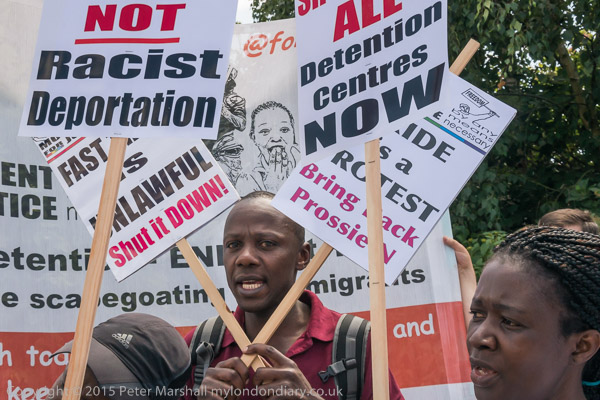
Migrants come here for various reasons, many as some of the placards at the detention prisons at Harmonsdworth & Colnbrook (Now renamed Heathrow Immigration Removal Centre) state ‘We are here because you are there.’ To Britain in particular because of the colonial legacy that built up our great cities – London, Bristol, Liverpool, Glasgow and the rest – and which continues though many international corporations based in London to exploit the labour, raw materials and consumer markets of our former Empire. Asylum seekers come because of wars and conflicts which arise from our invasion of Iraq, our earlier meddling with the politics and boundaries of the Middle East for oil, in Africa for its mineral resources and India for cotton, silk, and other textiles, tea and other goods (not forgetting opium.) And of course there was the trade in slaves, for which Britain perhaps too readily claims kudos for its abolition while refusing to fully acknowledge its involvement.

There is a remarkable inhumanity in sending those arriving to seek asylum, often traumatised by war, beatings, torture or rape, to detention centres. Even more inhumane to try and deport them back to the situations that forced them to flee by ‘fast track’ procedures deliberately designed to give them little chance to prove their suffering. The courts agreed, but still people remain at risk. Our Border Agency and immigration system – and the politicians that direct it – are inherently and institutionally racist and while some staff may work with good intentions (and sometimes are able to force sensible decisions) they do so within an overtly racist framework.

Normally in courts people are innocent until they are proven guilty, but for immigration the reverse applies – their stories are disbelieved and they have to prove they are true. It shouldn’t be like this. People should not be held for long and indefinite periods locked away from friends, and certainly should not be subjected to the rape, sexual abuse and mental torture that goes on in places such as Yarls Wood, private prisons staffed by overworked, underpaid and under-trained security staff.

The protests at Harmondsworth which houses male migrants have been going on for years – I first photographed there back in April 2006. More recently they have been a little overshadowed by MfJ protests at the women’s prison Yarl’s Wood, near Bedford, and by the revelations from inside there with undercover footage shown on TV. With a high profile demonstration due at Yarl’s Wood a few weeks later, there was less promotion of this protest and the numbers were a little lower than at some previous events.

Harmondsworth and Colnbrook prisons are next to each other, set back a hundred yards or so from the Bath Rd (A4) close to the east end of the Colnbrook bypass. A roadway goes down between their high fences to a BT site behind. Since the start of this year the protesters have been stopped from going down this private road and confined to an area in front of the Harmondsworth administration block near the front of the site. It’s hidden from the main road, though there is now in any case relatively little traffic along the A4, with most using the M4. The protests here are not visible to anyone but the prison staff and a few visitors to the prison.

Previously we would see some of the prisoners (our government thinks it makes it sound better to call them detainees) coming to the window and waving, holding up signs and welcoming the the protesters. Now they can’t see the protesters, but they can certainly hear the protest, and outside we can often hear them shouting back. Detainees are allowed mobile phones, and the protesters ring those inside and they can speak to the protest over them, though a mobile on speaker-phone held to a megaphone isn’t always too clear.

Among the protesters are those who have previously been held inside these and other immigration prisons, who also speak against the cruel and racist treatment inside them, the failures to provide proper medical services and the difficulties in trying to put together the case they should not have to make to prove their suffering against a culture of disbelief. While our justice system normally requires people to be proved guilty, under our asylum system they have to prove themselves innocent to avoid being returned to where they fled from oppression. But as the centre’s new name makes clear, this is not about justice, but about removing immigrants.
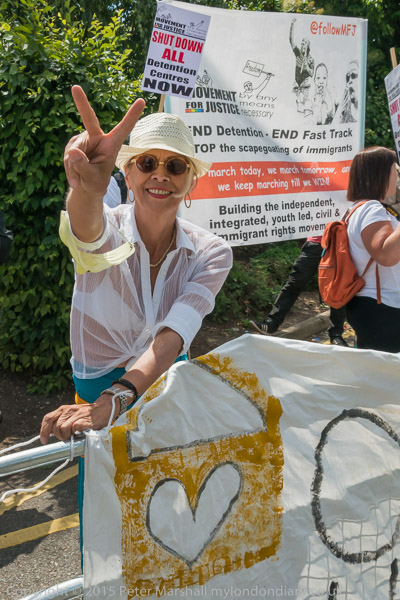
The protest pen gets fairly crowded, and the security staff and police won’t let me photograph from in front of it, though I do so as a matter of principle for a short while until forced to move inside. Telling police that it is a part of their job to facilitate the work of the press (and showing them the police guidance on this) doesn’t get you very far.
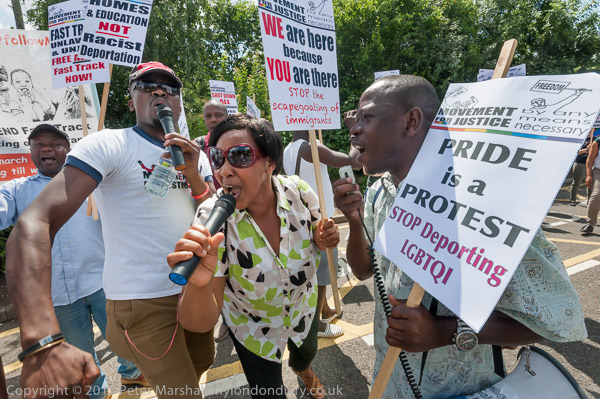
So I find myself working with very wide lenses – the wide end of the 16-35mm and the 16mm fisheye- in the middle of the protesters or sometimes leaning back over the barriers, hoping that being linked together they will not topple. I like working close, particularly with the fisheye, which brings a lot of interaction with the people I’m photographing, but it would be good to have the choice of a slightly longer view. The light’s good and I can use a reasonable shutter speed, needed even with a wide angle when the subjects are close and going across the field of view. It’s good not to use a very fast speed, and to sometimes get a little blurring as people wave their arms and fists, but mostly I’m working in the range 1/250-1/500. Again because I’m often very close I need to stop down for depth of field, and most the pictures are at f8 to f16. I don’t think much about shutter speeds and apertures when working, but set an ISO that gives me roughly what I want – in good light ISO640 or ISO800. Actually in terms of quality working with the D750 and D800E there is relatively little to be gained by any slower speeds, though I do use them for some landscape images.
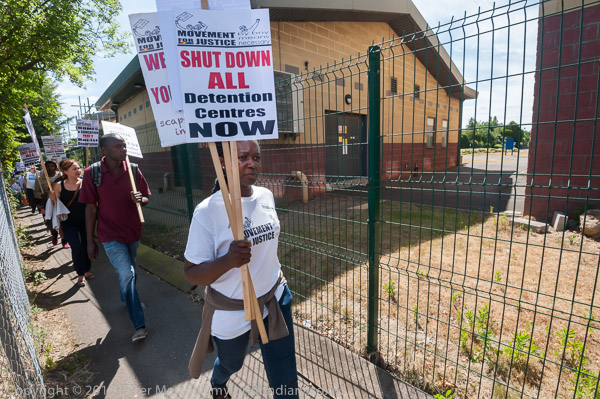
These are noisy protests so that those inside can hear, with drums and horns, but they are also protests with a lot of dancing and walking around in circles in the limited space available. As the protest was reaching its end, it marched out of the entrance onto the Bath Rd and then down a public footpath on the east edge of the Colnbrook prison, stopping in a field beside one of the blocks near the rear of the site. A large hedge and a tall fence behind it stopped us seeing any of the prisoners inside, but they were close enough to be clearly heard, and to join in with the shouting of slogans such as ‘Detention centre – Close them Down!’ with those outside. Police kept the protesters on the path by the hedge, and again the fisheye enabled me to work from inside the hedge looking towards the line of protesters along the edge of the field.
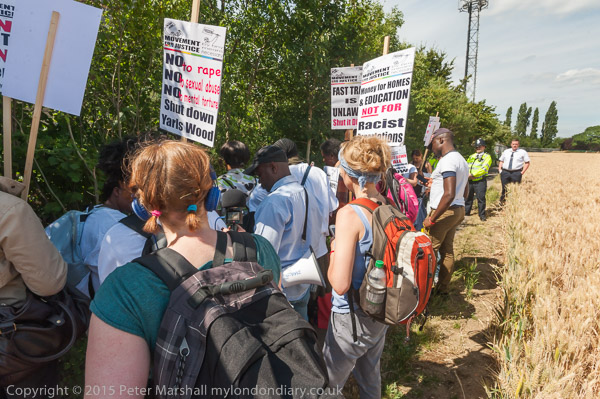
More pictures from the event on My London Diary at Surround Harmondsworth
Continue reading Immigrants not Criminals