PIP Fightback

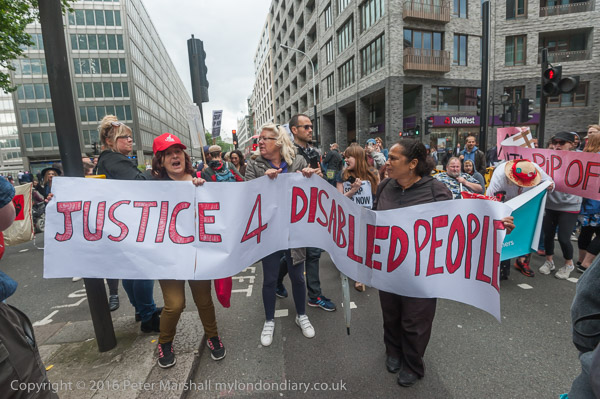
One group who are hoping the Theresa May will lose her election gamble must surely be disabled people, who were singled out by Tories, at first under the coalition government, for special treatment, ‘welfare reforms’ that were designed to cut costs and have resulted in the deaths of a considerable number. Ministers, particularly Iain Duncan Smith, mistakenly saw them as an easy target who because of their disability would be limited in their efforts to fight back.

It isn’t entirely fair to blame the Tories, who were partly just ratcheting up the screw that had already been set up by New Labour with their introduction of inappropriate tests designed largely to cut costs by denying benefits, administered in a tick-box fashion by inadequately trained operatives working for unscrupulous companies who were given financial incentives to fail claimants – and not penalised for the fact that around 70% – more than two out of three – of those who appealed had their appeals upheld.

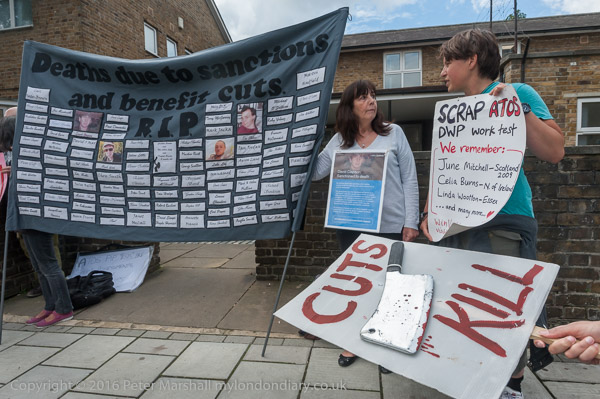
So many of those who were found to be fit for work died shortly afterwards that the DWP decided it wouldn’t keep details. Others have died even more directly because of losing their benefits. One of the banners at this and other protests, held below by the sister of David Clapson, a diabetic ex-soldier who starved to death after losing his benefits, lists around a hundred people whose deaths were due to sanctions and benefit cuts, but these are only the tip of an iceberg, with many going unrecorded.

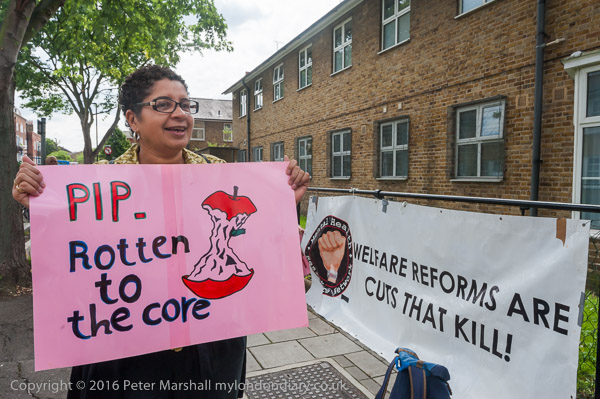
‘Cuts Kill’ say some of the placards – including one with a cleaver being held by a woman in a wheelchair.  I didn’t pose this picture, but took advantage when she lowered it during the protest at the Vauxhall PIP consultation Centre in Vauxhall, one of the centres where ATOS carry out sham Personal Independence Payments ‘assessments’ on behalf of the DWP.

Later I joined with a larger group of protesters in Westminster who were protesting against the Personal Independence Payments. The organisers of the protest, DPAC (Disabled People Against Cuts), MHRN (Mental Health Resistance Network) and WinVisible ((Women With Visible and Invisible Disabilities) say that the day of protest against PIP was organised because:

The evidence shows that even more genuine claimants are having their lives blighted in an exercise whereby their benefits are removed for months on end, in many cases leading to a serious deterioration in the health conditions and Mental Health issues, and in a growing number of cases, premature deaths.

Disabled people have led the fight against the Tory government – because for many of them it is quite simply a matter of life or death. Some have seen many of their friends already die because of these policies, and others being unable to continue the independent and productive lives that benefits had allowed them.

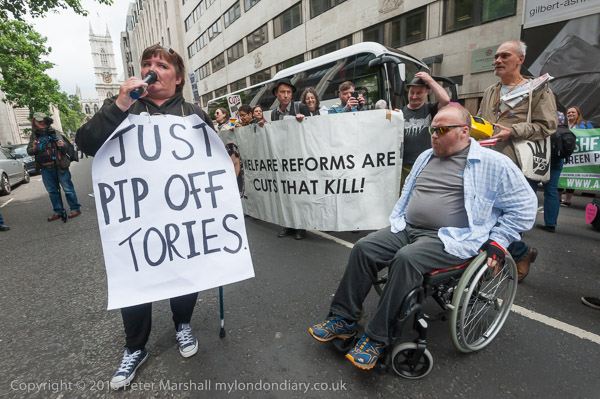
At this protest they held a rally on the pavement outside outside the Victoria St offices of Capita PLC, before briefly blocking the road, one of the main routes in Westminster and then marched to the offices of the DWP for a second rally and finally continuing to Parliament for a short stop on the roadway in front, and finishing by going to College Green, where the broadcast media gather to interview politicians.

This was roped off with police to keep the public at bay, but disabled protesters are made of sterner stuff and made their way onto the green, just a few yards from the TV crews, almost all of whom studiously ignored them, though I think their banners and chanting may have appeared in the background of some interviews.  But with the exception of a few foreign news crews, protests in the UK are generally not reported.

Disabled PIP Fightback blocks Westminster
PIP Fightback at Vauxhall

______________________________________________________

There are no adverts on this site and it receives no sponsorship, and I like to keep it that way. But it does take a considerable amount of my time and thought, and if you enjoy reading it, a small donation – perhaps the cost of a beer – would be appreciated.

My London Diary : Buildings of London : River Lea/Lee Valley : London’s Industrial Heritage

All photographs on this and my other sites, unless otherwise stated, are taken by and copyright of Peter Marshall, and are available for reproduction or can be bought as prints.

To order prints or reproduce images

________________________________________________________

Todd Webb

Todd Web (1905-2000) was one of those photographers i’ve known about for a long time, and have admired pictures by, but never got to really find out more about him and his work. I was reminded about him a few days ago in a feature about his New York photographs on the Lens blog.

There are plenty of places you can read about his life story, and he certainly lived through interesting times and was certainly one of the better photographers inspired by the work of people like Edward Weston and those others who turned away from pictorialism to a sharp and detailed modernistic approach in the 1920s and 30s. He very much moved in the circles of those better known than he was, from being in the same Detroit camera club as Harry Callaghan when he first became seriously involved in photography in 1938, and completed a ten-day workshop with Ansel Adams in 1940 before serving as a US Navy photographer in World War II.

After war service he moved to New York at the start of 1946 to be a professional photographer, sharing an address with Callaghan. He became friends with the aging Alfred Stieglitz and his partner Georgia O’Keefe, who introduced him to other leading names in photography at the time, including Beaumont and Nancy Newhall. Webb got a part-time job at the Museum of the City of New York, documenting their collection one day a week, and Beaumont, then head of the photography department at MoMA, persuaded the MCNY to put on a show of Webb’s personal work in 1947.

Now, 70 years later, Webb has another show there, A City Seen from April 20 – September 4, 2017, as well as one at the Curator Gallery in NY’s Chelsea. The MCNY show is said to be the first major gallery show of his work since his 1947 show there.

Just as he was becoming well known as a photographer in New York, working for Fortune magazine where Walker Evans was Staff Photographer (Webb said he tried hard to make  his work not too much like that of Evans), and for Roy Stryker at Standard Oil, Webb left for Paris, where he got married to an American woman and lived for the next four years, producing some of his best photographs. Moving back to New York, he got Guggenheim fellowships in both 1955 and 1956 to photograph along the trails taken by the US pioneers traveling west. In the 1960s he moved to Santa Fe, and made a number of pictures of Georgia O’Keefe, published as Georgia O’Keeffe: The Artist’s Landscape.

In the 1970s he lived with his wife for some years in Provence, and for a briefer period in Bath, England, finally moving to Maine, where he lived and worked until his death in 2000. Webb was driven by his love of photography and apparently spent his time pursuing images rather than promoting his career, and his work – as you can see from the links below, deserves to be better known.

Todd Webb – ICP has a good selection of his work on-line.
Todd Webb Archive – work from New York, Paris and O’Keefe.
Gothamist has an informative interview with the curator of his NY show at the Curator Gallery April 20-May 20 2017.
Fortune Magazine  has a good feature about his two current shows in NY.

Hull Photos: 6/4/17-12/4/17

A picture is added daily to ‘A View of Hull’, my Hull photos web site at http://www.hullphotos.co.uk/ and I also post them with these comments on Facebook.

6th April 2017
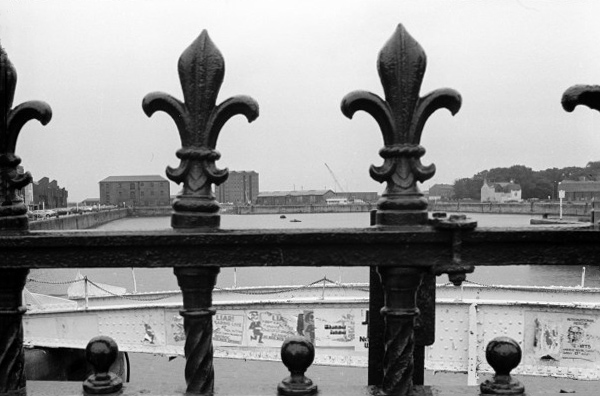

32m65: Princes Dock from Monument Bridge, 1982 – City Centre

The railings are still their, though now rather more smartly painted, but the dock bridge seen through them has gone. Many of the buildings around the dock are still there, along Princes Dock St, the rather dumpy warehouses on Castle St, their considerably more elegant counterparts at Railway Dock. The dockside sheds are long gone, and the white building near the right edge, The Earl De Gray pub, is under threat of demolition. Built as the Junction Dock Tavern in the 18th century (some say as early as 1720, other sources place it later) , and altered considerably in Victorian times it was Grade II listed in 1994.

The Earl de Grey was known to sailors around the world, serving their needs when they hit port for perhaps 180 years, described as “a seedy dive populated by drunken sailors and women of the night” and latterly by transvestites it closed around 2000. Four years later after an expensive face lift it opened again, but not for long, closing again the following year.

Earl de Grey and Ripon (later Marquis of Ripon) was installed Lord High Steward of Hull in 1863. He was a Liberal politician who was even born in Downing St (his father was PM at the time) and became one of Hulls two MPs in 1852 but both Hull MPs were unseated the following year because of widespread corruption in their election (though not by them.) He was then elected as MP for Huddersfield. Later he served for four years as Viceroy of India, and introduced a progressive bill in Parliament calling for great rights for native Indians – which Parliament rejected. He later became Leader of the House of Lords.

High Steward of Kingston upon Hull is a ceremonial title which Hull City Council has given occasionally to prominent people with some association to Hull since the sixteenth century. In the old days it included gifts of ale, and so the renaming of the pub was appropriate. Though the office was abolished in 1974, for some deranged reason it was revived in 2013 and awarded to Peter Mandelson of all people. His only qualification for the post appears to be that his grandfather Herbert Morrison had previously held it.

The pub used to be noted as the home of two very voluble parrots, Cha Cha and Ringo, noted for their mimicry of the drinkers. And in 1985, when some of these came back and robbed the takings, they stabbed Cha Cha to death in case the bird might reveal their identity. Cha Cha was buried under Castle St and Ringo, heart-broken by the loss of his mate, never uttered another word. When the pub was made over and re-opened in 2004, the two of them were replaced by a single plastic macaw, not quite the same. Though it probably wasn’t why it failed.

There were plans to pull it down and build another hideous hotel (which seems to be fast becoming a Hull speciality) but apparently now the Highways Agency would like to disrupt the city even more – Castle Street has already swallowed up too much of Hull’s heritage, smashing its way through the Old Town (there is a petition against this.)

But what is most noticeable about the picture is what isn’t there. Much of Prince’s Dock was soon to be covered by the Princes Quay shopping centre on stilts, which opened in 1991

7th April 2017

It is hard to relate this riverside warehouse, at 11 High St (or ‘Little High St’) just south of Blaides Staithe and north of Drypool Bridge, exactly to the structural boundaries shown on old maps, but I think it was the Phoenix Warehouse of Spear, Houfe & Co. Ltd. There is some lettering on the building but it is difficult to make out much of it and there seem to have been at least two names written over each other in some places. One of these at the lower left could be ‘Phoenix’ and at top right it is more clearly ‘E & Co Ltd’. There are a few distinct letters but not enough to make any sense of, and my photograph isn’t quite as clear as it might be. The plate on the side is for W & T SPEAR Co Ltd, a company that owned a number of warehouses and commercial buildings in Hull.

The building was probably Victorian, possibly earlier, and was in poor condition; it was demolished not long after I took this picture. Had it remained standing a few more years it would have been listed, and if it were beside the Thames in London would doubtless have been converted into luxury flats. In Hull, the site remains empty over 30 years later and has only been used since demolition for car parking.
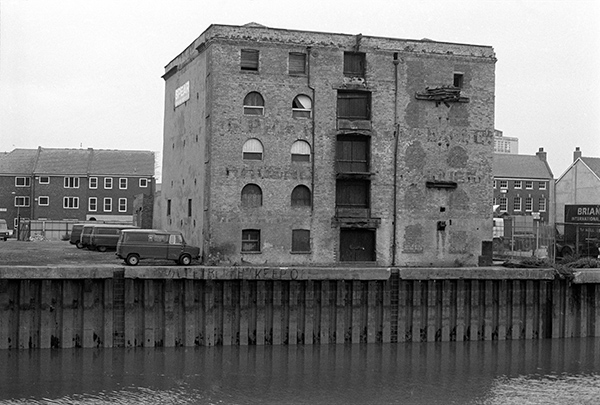

32n25: Derelict Phoenix Warehouse, Spear, Houfe & Co. Ltd., High St, 1982 – River Hull

8th April 2017

The view of the east bank of the River Hull looking upstream from Drypool Bridge with a number of boats in various states of disrepair moored. The largest is the Kenfig, a grab hopper dredger built in 1954 (possibly by Richard Dunston at Hessle) for Port Talbot and renamed Hedon Sand in 1984. It was one of the dredgers used to clear the passage into Humber Dock for the Marina, and was later scrapped at New Holland. Kenfig is a Welsh village near Bridgend on the Bristol Channel notorious for the number of wrecks around it, on the Scarweather and Nash sands, Tuskar rock and Sker point.

Unfortunately the rather elegant six-story brick industrial building has been demolished though the lower structure beyond it is still there, a part of the Gamebore cartrdige site.
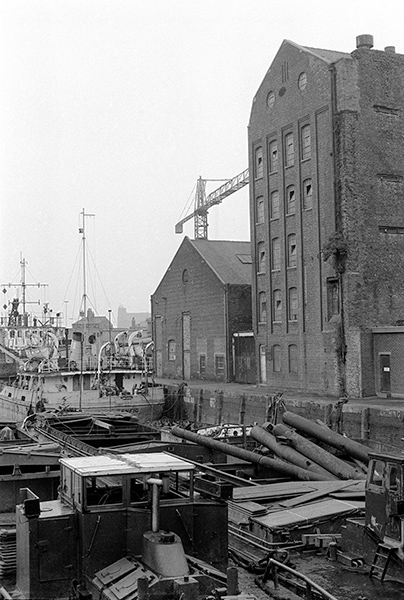

32n26 – View upstream from Drypool Bridge, East bank of River Hull, 1982 – River Hull

9th April 2017

Victoria Dock had closed in 1970, a dozen years before I took this picture, and was largely empty, with occasional signs of its previous use – a few buildings, railway lines and yards. It was hard to know where I was when I took this, although my map showed many railway lines going through the timber yards, some had clearly been out of use for some some years before the docks closed.

The large shed at left is identified by the number 4, but I am unable to identify the exact location of this image taken on my way through the dock to the Hedon Road and back into town. I think it may have been near Earle’s Road, but perhaps someone seeing this will be able to correct me.
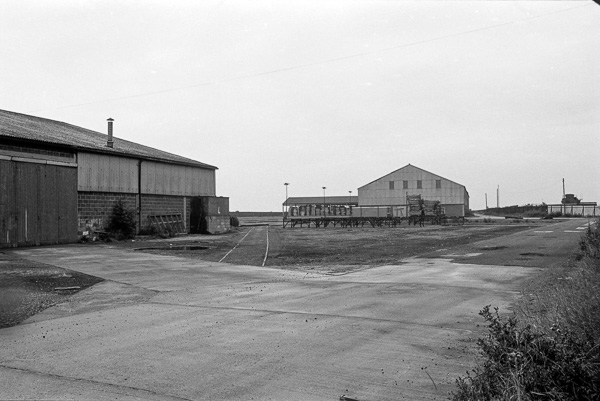

32n32: Victoria Dock, 1982 – Docks

10th April 2017

I am not sure, thirty five years after I took the picture, whether these surprisingly anonymous buildings were inside or just outside Victoria Dock, possibly on the Hedon Rd. I took them on my way out from the dock to walk to the city centre and catch my bus. The next exposure I made was I think on the Hedon Rd. Again I’d welcome information from anyone who recognises the location.

As a photographer, I carefully composed the image with its interlocking shapes and the various rectangles in differing planes across the frame. But if I took any note of the location, it is long lost.
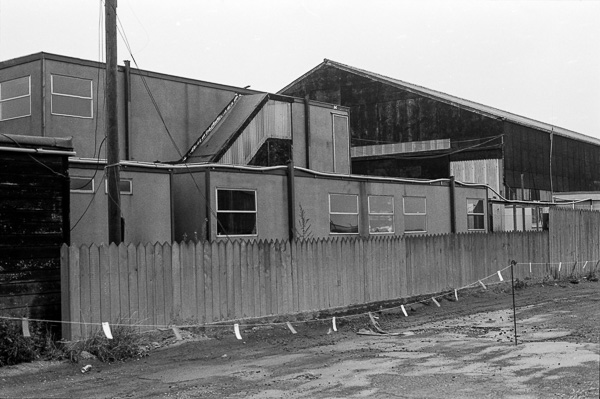

32n33: Victoria Dock or Hedon Rd area, 1982 – Docks

11th April 2017

I photographed this boarded up shop on the corner of Church St at its junction with Great Union St, and expected it to be gone next time I walked past. Surprisingly both it the cafe which adjoined it under the same roof on the left are still there, though now a single business with a new frontage and re-roofed. The neighbouring three storey building which was to its right and is shown in another picture I too is also still standing, and they all look in rather better condition than in 1982.

In 2008 the hairdressers and cafe were both ‘Sue’s Drypool Feast Cafe’ but it is now the ‘Take a Break Cafe’, with much the same advertising. I kept meaning to have breakfast there during my recent stay in Hull, just a few hundred yards away, as it was highly recommended by some, but I just didn’t feel up to a hearty English breakfast the mornings I was there. Perhaps next time.
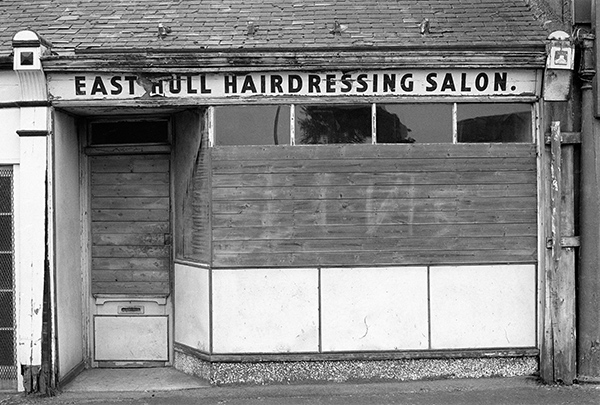

32n36: East Hull Hairdressing Salon, Church St, 1982 – East Hull

12th April 2017

The public footpath along the bank of the Humber used to lead across the dock gates of the Alexandra Dock, giving views into the dock. In 2012 this footpath was diverted as a part of the Green Port development away from the Humber to take a much longer route around the outside of the dock to enable the easier movement of wind turbines from the new Siemens facility to the rigs that take them out to offshore locations, which are too large to enter the dock but moor on the Humber bank.

It’s a shame that a better solution could not be found – perhaps with some short lengths of roofed concrete tunnels to keep the path by the riverside. The path is a part of the Trans-Pennine trail and the alternative – with artworks and orientation boards – seems something of an insult to real walkers. There is a viewpoint provided, but along much of the route views are obstructed by earth banks, parked lorries and an unnecessarily fine mesh fence.

The tug Trawlerman was built in Hull by Humber Ironworks & Shipbuilding in 1963. In 1986 she was renamed Argo Cape and in 2006 became Alsadiq 4. Her last known owner was the Dubai company Iktra Shipping & Sea Transport and she was registered in the small island state of Comoros in the Mozambique Channel, but may have been scrapped as no details are available of her current location.

In the background you can see the distinctive building of Hull Jail, immediately across the Hedon Road from the dock.
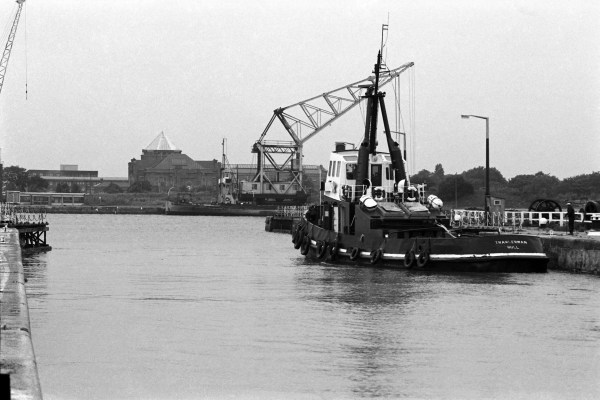

32n41: Hull Tug Trawlerman in Alexandra Dock entrance lock, 1982 – Docks


You can see the new pictures added each day at Hull Photos, and I post them with the short comments above on Facebook.
Comments and corrections to captions are welcome here or on Facebook.
Continue reading Hull Photos: 6/4/17-12/4/17
Police Station Occupied

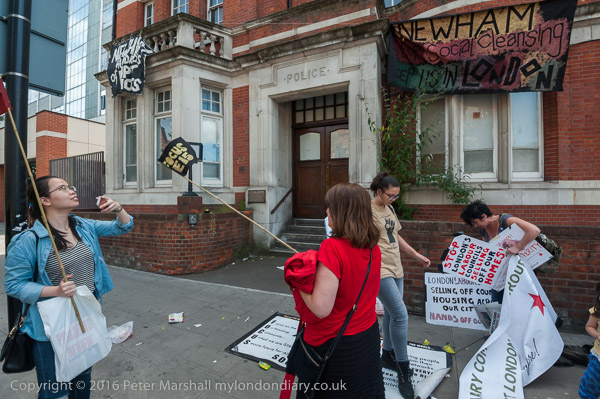
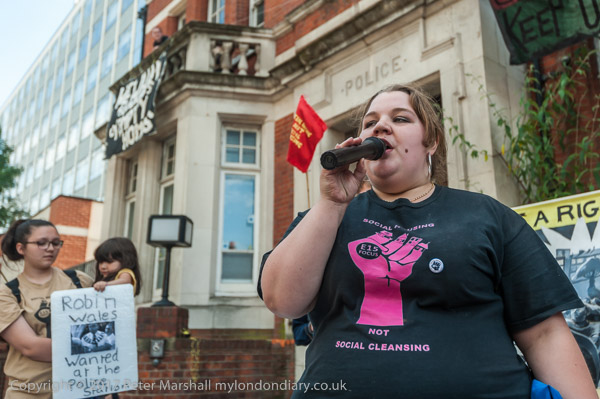
Sometimes I look at the pictures long after an event and realise with a start that I forgot or failed to see what would have been an obvious picture, and in this case, when Focus E15 briefly occupied a police station, it was a good, clear image using the sign above the door which read ‘POLICE’. It is visible in a number of pictures, but clearly I hadn’t managed to take one that really made good use of it.

Of course it may not have been that I hadn’t wanted to or even tried. Sometimes I can see possibilities, but they don’t happen spontaneously – and it goes completely against my principles to set things up. Looking through the 45 or so images on-line in Focus E15 Occupy Police Station it seemed fairly clear that I was aware of the sign and I wondered why I hadn’t managed to make better use of it.

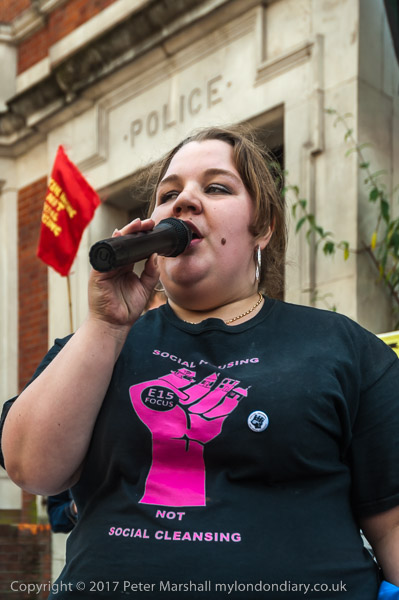
So I went back to my backup of the day’s work on my NAS, a Drobo 5N that sits to my right, and went through the pictures for the day – around 330 of them. So many have that sign in them that it was clear I was trying hard to include it, but didn’t manage to do so well enough to for  those pictures to make the web page. People just didn’t stand and set up things in the right place. Perhaps the best attempt was the image above, though it might be better had I taken it in portrait format – like this:

but I can see why I chose not to use this, as it definitely isn’t a flattering angle for Jasmin Stone. And while I don’t set out to flatter I try to present people well.

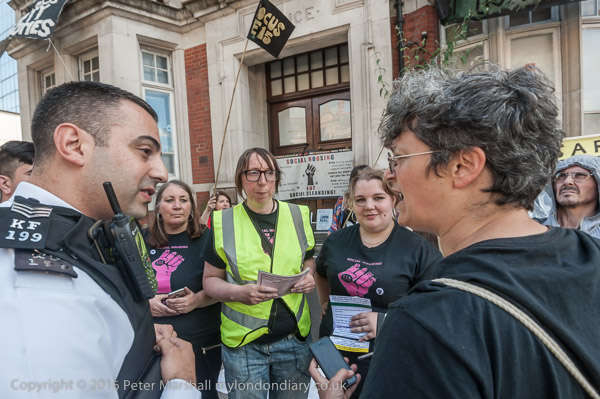
I can also see other images in the set that are on-line that I’ve framed to get that word in, notably where a police officer comes to talk with the protesters:

but at the critical moment, where the expression on the officer’s face and those of the protesters are at their most interesting, one of the protesters waves a Focus E15 flag in front of that word.  I can almost feel myself shouting ‘CUT!’ and saying ‘OK, lets run that scene again, and this time can we keep the effing flag to the left of the doorway’, but this isn’t a film set, and I’m not a director.

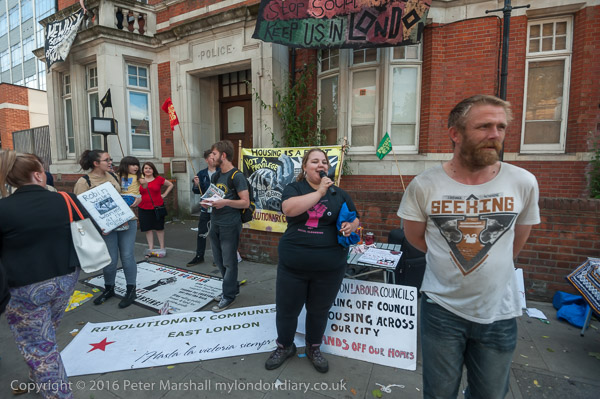
It is there in my favourite frame from the set, but rather in the background, but I’m fairly sure that would be why I was standing where I was to photograph Jasmin speaking. It was slightly tricky to take pictures, as it was a busy road and the pavement isn’t particularly wide, and there was a steady stream of people walking past as the annual Newham show was taking place in the park down the road.

Of course this wasn’t the only thing to photograph. This was the pavement outside and the occupation was taking place up above, not quite inside the building, but on the balconies.  Here’s just one picture of that, with one of the ‘occupiers’ holding up a ‘selfie stick’ which E15 produced so that people could pose with Robin Wales, the feudal Labour Mayor of Newham who features in their posters as ‘Robin the Poor’ and who had to apologise for his arrogant and rude behaviour to Focus E15 at a previous ‘Mayor’s Newham Show’ – not a previous Mayor’s show, but a previous show – the Labour Party machine in Newham, essentially a one-party state – runs the voting to ensure that no-one but Robin from the party can stand as mayor.

I’ve written a longer than usual article about the afternoon and Focus E15’s campaign at  Focus E15 Occupy Police Station where you can view my selection of pictures from the afternoon.
Continue reading Police Station Occupied

Black Lives Matter

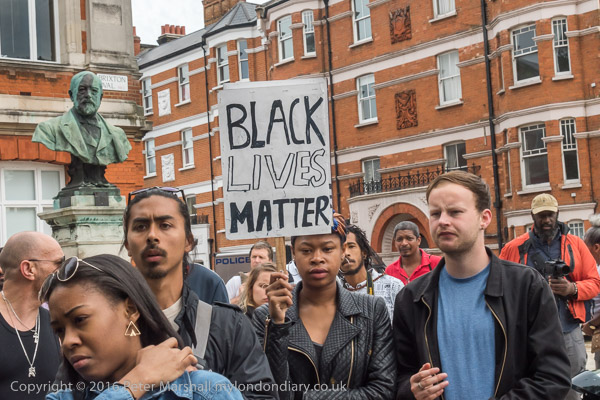
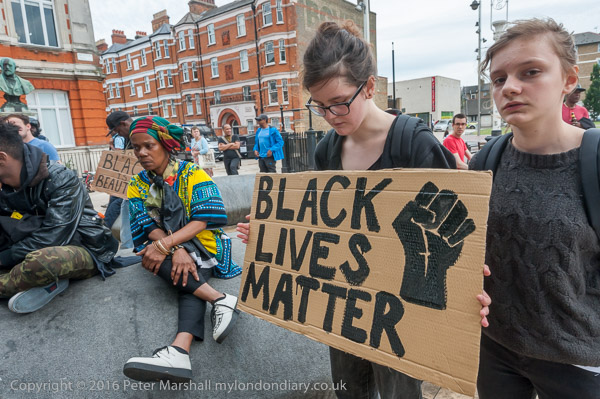
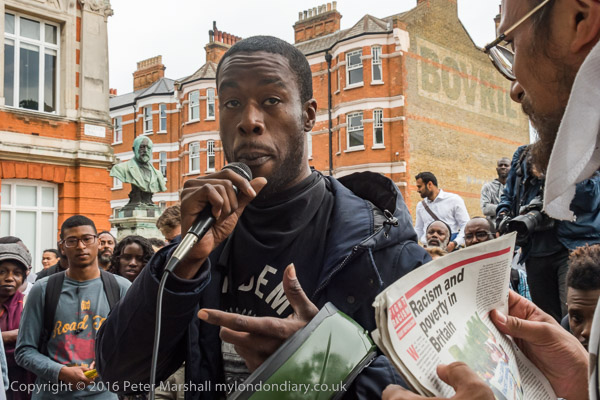
Sir Henry Tate, looking down on a part of the crowd in Windrush Square, Brixton was a sugar manufacturer who made a fortune out of refining and selling cane sugar here in the UK. Although his business had no connection with the slave trade, which had ended in the British colonies around 1840, a few years after the 1833 Slavery Abolition Act and Tate only began in the sugar business in 1859, his was clearly a colonial business, making its profits from the sugar grown by freed slaves and their descendants in the colonies, notably Barbados.

Tate was a great philanthropist, giving generously to colleges and hospitals and endowing south London with four free libraries, at Streatham, Balham, South Lambeth, and Brixton and treated his own employees well, building a dance hall and bar for them opposite the Silvertown factory. And of course in 1897 he gave his art collection to the nation, paying most of the cost for a gallery to house on Millbank – which has officially borne his name since 1932.
Although the sugar he made the profits on came from workers in the Empire, I’m not aware that any of Tate’s philanthropy extended to them, but he did provide the library outside which the protest I was photographing took place, and the gardens, now known as Windrush Square in which we were standing were given to the public by Tate’s wife after his death, in keeping with his wishes.

Many of those who came from the Caribbean to Britain in the post-war period, starting with those on board the Empire Windrush in 1948, found work in and around Brixton after the first arrivals were housed temporarily in the no longer needed deep shelter on Clapham Common. And for some, that Tate Library was their university and the gardens outside a popular meeting place. It was renamed Windrush Square as a part of the 50th anniversary of the arrival of the ship, but a few years later was the subject of a savage makeover by Lambeth Council (whose offices are opposite) designed largely with the objective of making it an unpleasant and windswept place to discourage any gatherings there.

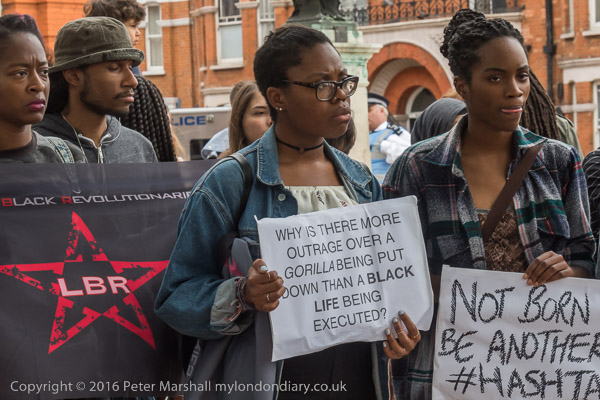
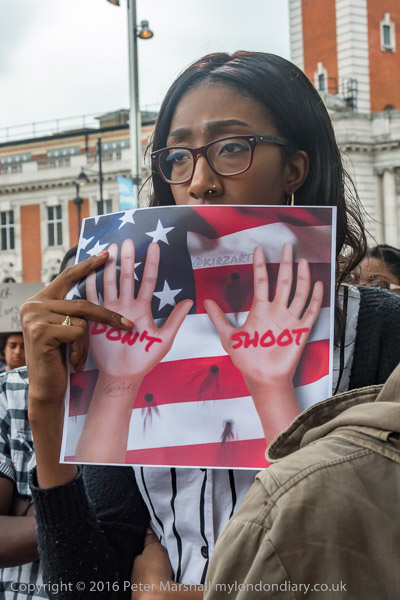
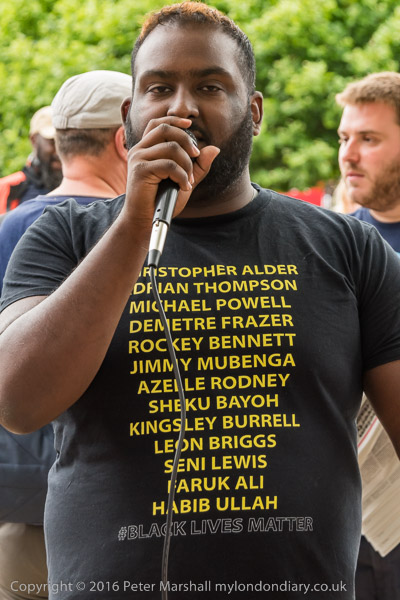
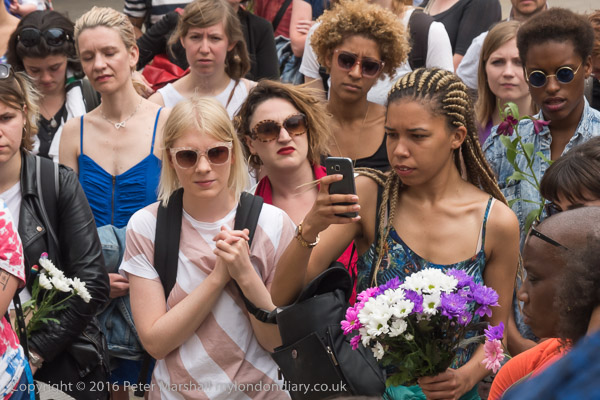
Despite this it remains a centre for the community, and several hundred gathered there for a rally and march in Memory of Alton Sterling, shot several times at close range while held on the ground by two white police in Baton Rouge, and Philando Castile, killed by a Mexican-American police officer in St Paul, Minnesota, two of the latest black victims of police violence, and to show solidarity with those murdered by police brutality, both in the US and here in the UK.

Police, here and in the USA, don’t just kill black people, but the victims of police killings are certainly disproportionately black, and Brixton has history of such events, including the deaths of Ricky Bishop, Sean Rigg and Olaseni Lewis. The situation is clearly even worse in the USA than here largely because all police carry guns, but at the annual commemoration of the lives of those killed in custody in London a list of several thousand who have died in suspicious circumstances is carried at the front of the procession down Whitehall.

One poster in particular – I think from a US source – had a message worth quoting in full:

“Yes, ALL Lives Matter. But we’re focused on the Black Ones right now OK? – Because it is very apparent that our judicial system doesn’t know that. Plus if you can see why we’re exclaiming #BLACKLIVESMATTER you are part of the problem.”

Speaker after speaker, all I think black, though there were a significant number of white supporters in the crowd – mainly at the back, wanted to have their say, and the rally went on much longer than had been planned.  So long that I was unable to stay for the march, which later I was told went to Brixton Police Station, where several young black men have died over the years in suspicious circumstances, blocking the road and bringing traffic on the busy road through Brixton to a stop for several hours.


Brixton stands with Black victims
Continue reading Black Lives Matter

More Brexit

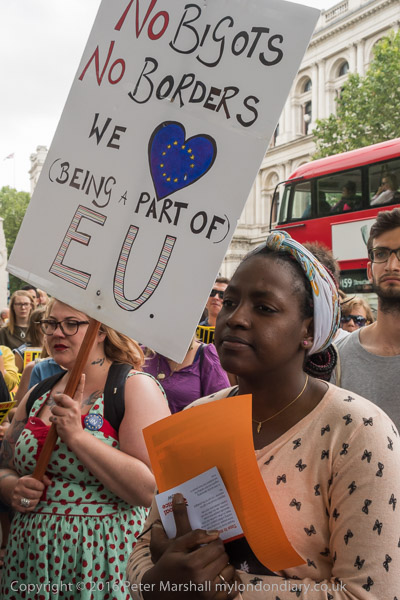
It remains difficult to see anything positive coming out of our vote to leave Europe, and it seems to have brought out a number of the worst sides of parts of the British public, with an increase in racist attacks and bullying. Another Europe is Possible hosted a rally opposite Downing St against this climate of fear and hatred after the Brexit vote, calling for an end to scapegoating of migrants and Islamophobia.

Its long seemed irrational to me to allow the free movement of capital but to restrict the movement of people; if the market is a good enough mechanism for one it should be for all, though perhaps we might be better with a certain amount of planning and intervention in both. But certainly we don’t need the kind of draconian measures that the UK currently takes against migrants in general and refugees and asylum seekers in particular. The contribution that migration has made both economically, in maintaining essential services and in broadening our culture during my lifetime has been enormous and a genuinely free press would welcome and praise it – and politicians would then not be able to stir up the kind or racist and xenophobic responses that were behind many of the votes to leave Europe.

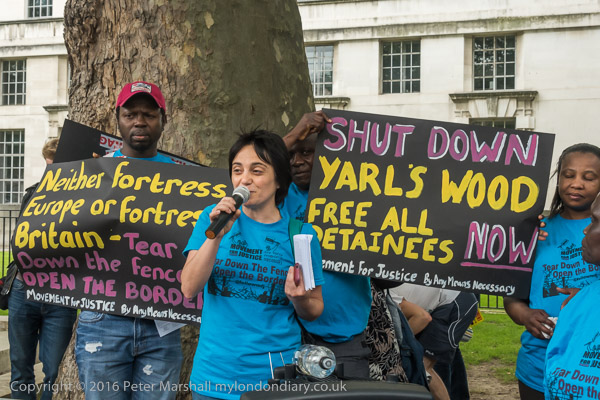
I arrived as Anna from Movement for Justice was speaking about the terrible injustice and maltreatment of asylum seekers in our detention prisons such as Yarls Wood, and photographed her framed by MfJ posters; a still image doesn’t tell us what anyone was saying, but the posters make MfJ’s arguments clear.

Of course we can’t ignore the Brexit vote, close though it was, but it is still worth fighting for the kind of Brexit it is going to be, keeping up the pressure on Theresa May (and her possible successors) not to throw out the baby with the bathwater as they currently seem determined to do.

Another of the speakers as Syrian activist Muzna Al-Naib, urging the UK to take action over the atrocities of the Assad regime and to offer real support to the Syrian people and to offer refuge to more than the small handful of Syrian refugees that have already managed to come to the UK –  largely despite the efforts of our government.  Her’s was a message that called for love and for unity of peoples and again a banner on the barrier she was speaking behind seemed appropriate.

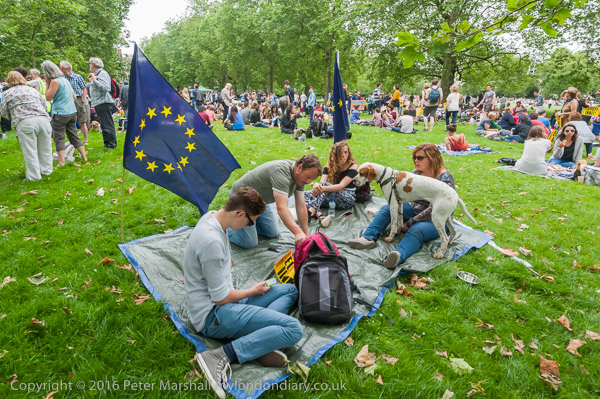
The Europe, Free Movement and Migrants protest ended with many of those present leaving to go to the Green Park Brexit Picnic,  and while many marched there, I took the tube. The picnic had been advertised as an opportunity for people to come together and debate the future under Brexit, though the great majority of those attending were obviously still feeling upset and cheated over the result of the vote obtained by an essentially dishonest campaign.

Those at the picnic were splitting up in to small groups to debate various aspects of the future as I arrived , some very small like that above, which seemed to me to be seceding into a small island of Europe in the sea of grass, and others considerably larger, circles with perhaps 20 or 30 or 40 people, and they were getting down to some sensible, organised and at times fairly heated discussions.

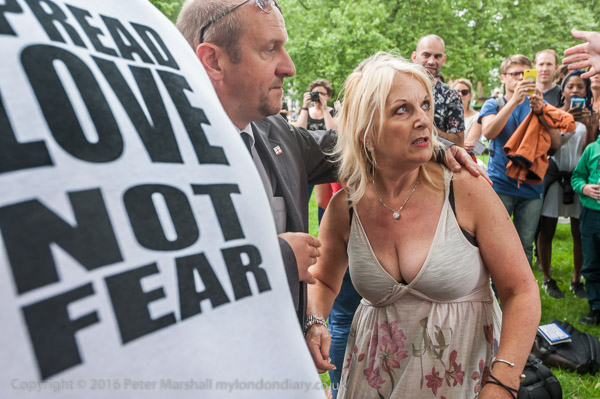
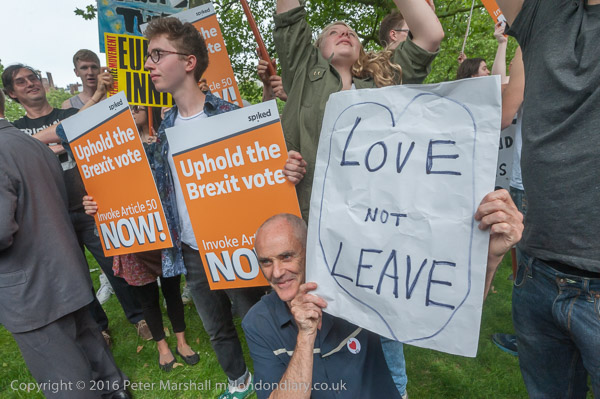
One group stood out, Brexit supporters who had come to counter the protest with their own ‘picnic for democracy’ organised by Spiked magazine calling for ‘Article 50’ to be invoked ‘NOW!’ They stood out in several ways, not least the number of empty cans and wine bottles and it was clearly in that respect a rather better party than the rest. I started to photograph them and got sworn at and threatened by one or two people who recognised me from right-wing protests I had photographed, but then they found a new outlet for aggression as the march from Downing St arrived with posters against Brexit and were joined by people wearing t-shirts with the message ‘Spread Love Not Fear’ and calling for ‘Hugs for Immigrants’ rather than hate.

There was some angry name-calling and posturing, but people from both groups came across and tried to calm things down, and stopped what had seemed an inevitable fight from developing.  The shouting had attracted the TV crews covering the event, and there was then a little largely good-natured jostling to get greater coverage from the cameras.

Having taken my pictures, I moved a few yards away and sat down to eat my own rather late sandwich lunch, after which as things seemed to have calmed down I decided to leave to cover another event.

Continue reading More Brexit

Garden Bridge & Progress

Unless you are a Labour Party member, you probably haven’t heard of Progress. It describes itself as an independent organisation of Labour party members which “aims to promote a radical and progressive politics”. It’s essentially a ‘New Labour‘ pressure group within the party, though it has tried to hide its Blairite identity in recent years by calling itself ‘Labour’s new mainstream‘, something which fools few.


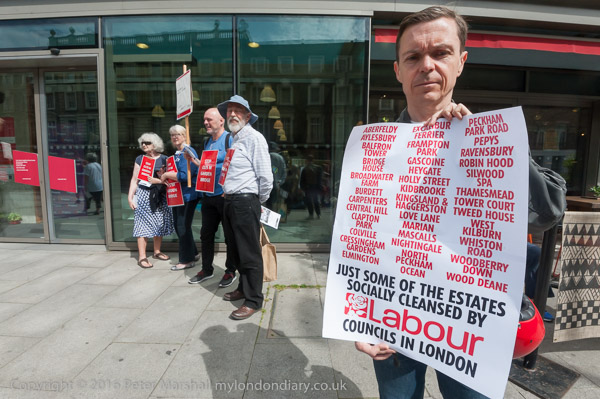
A protester holds up a list of Council Estates that Labour councils are socially cleansing

Though its right-wing views are at odds with the huge majority of the party membership, thanks to considerable funding largely by Lord Sainsbury, and some deft political maneuvering – its supporters are largely careerist politicians – it exercises considerable control over the party machinery, which has so far enabled it to resist efforts to get it proscribed, despite clearly being a party within the party, and it has managed to get many of its members selected as Parliamentary candidates, often to the considerable rage of local party members. So far unsuccessful in its attempts to get rid of Jeremy Corbyn as Labour Leader we are likely to see yet more dirty tricks by Progress MPs and at every party conference.


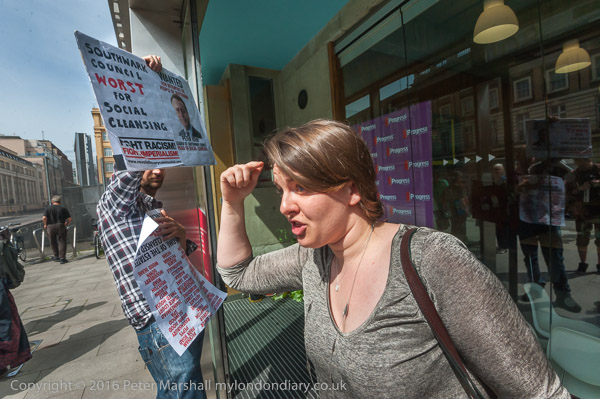
A woman comes out to shout at protesters and lie to them they are disrupting a youth health meeting

Most London Labour councils are dominated by members or supporters of Progress, and are pursuing policies which in areas such as housing which are completely at odds with the traditional values of the party, working with developers to sell of public assets and drive the less well off out of London.


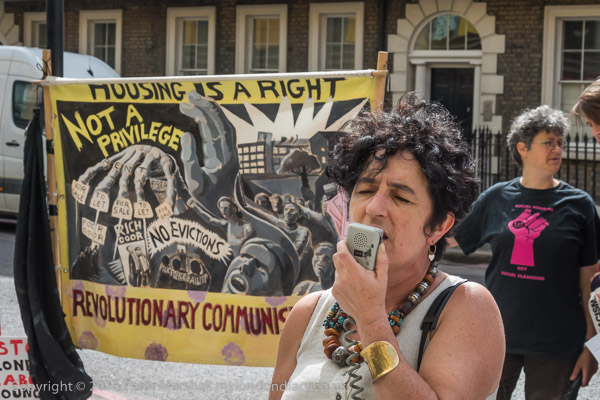
The Revolutionary Communist Group say ‘Housing is a right – Not a privilege’

Though their may be few brown envelopes changing hands, many Labour (or Progress) councilors are ending up with lucrative jobs, getting trips abroad and lavish lunches and dinners for playing their part in the evicting of social housing tenants, the demolition of their estates and their rebuilding as expensive flats, many simply to be sold as investment opportunities for wealthy foreign investors. Some get sold ‘off plan’ before they are built, being sold again before completion, and then perhaps again a few years later, but often never having been lived in – or perhaps visited a week or two a year for a trip to London.

In one not atypical example, 1700 social housing units were replaced by only 70 in the redevelopment, the former tenants and leaseholders being dispersed onto the fringes of London or further afield, many home owners getting only a fraction of the true market value of their properties, and tenants being forced into private renting with little security of tenure and much higher (and rising) rents.

Progress supports these policies, though hiding its intentions behind higher sounding ideals, the actual policies are all about realising asset values. But look at what has happened, for example to the Heygate Estate at the Elephant, what is happening to the Aylesbury Estate to the south, what Lambeth plan for Central Hill and at other estates around London and the pattern is clear.


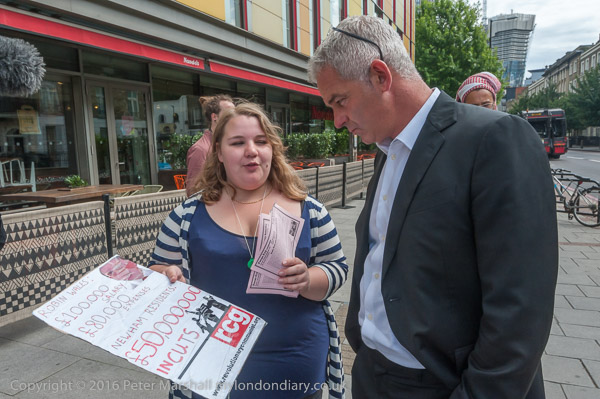
Jasmin Stone of Focus E15 talks with a man attending the meeting

Local councils are having a tough time of it with central government cuts, and are looking at estates like these as a way to solve financial problems rather than with any real concern about the people who currently live on them, or the many thousands on their housing waiting lists.

Their feeling about these people is summed up by one Labour Mayor who told protesters ‘If you can’t afford to live in London you can’t live in London‘ and at market rents relatively few can afford it. We need council housing and other social housing in London at prices that ordinary workers, including those on minimum wage, can afford. And one of the jobs of London’s local councils is to ensure it is provided in London, not indulge in social cleansing.


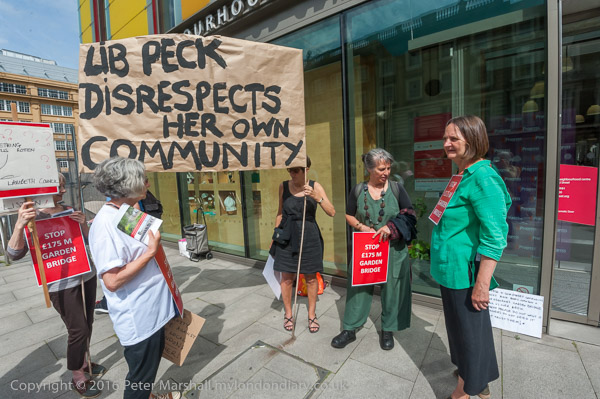
Local residents say Lambeth Council Leader Liz Peck disrespects the views of Lambeth residents

As well as housing protesters, the Momentum conference was also picket by local campaigners against one of London’s craziest plans, the Garden Bridge, a bridge neither necessary nor useful and a huge private project that would require considerable public investment for little public good. Recently there has been a damning report by Dame Margaret Hodge on the financial aspects of the plan, identifying a huge gap in funding which should be its death knell. But the protesters were more concerned that Lambeth Council were backing the scheme, and giving money towards it despite the opposition of Lambeth residents.

Housing Protest at ‘Progress’ conference
Garden Bridge ‘Progress’ protest

Continue reading Garden Bridge & Progress

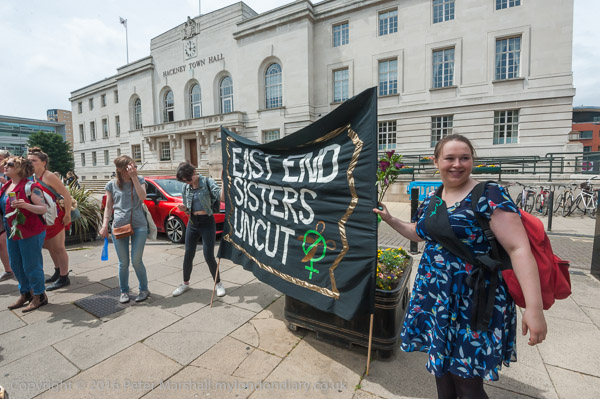
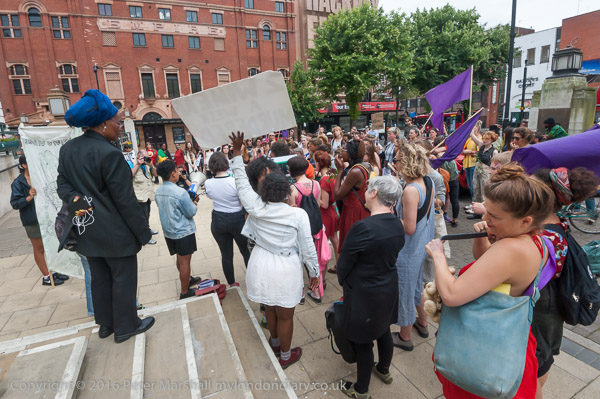
Hackney Women against D V


It was the first event of East End Sisters Uncut and a protest against domestic violence and the failure of Hackney Council to take the problem seriously – 60% of women who desperately need a refuge are turned away as there is no room for them.

I didn’t know any of the women who were there are the start and felt just a little awkward photographing at a women-only event, though I don’t think I really needed to be. But I like to blend in and photograph form inside the protest, and it just felt a little uncomfortable. Though I think it was entirely within my naturally very shy mind. People sometimes laugh when I admit I find it very hard to take photographs, but it’s true. And some days, some events, I never quite manage to overcome that shyness. There is always an initial barrier I have to overcome, and there have even been a few rare occasions on bad days when I’ve turned around and walked away rather than take pictures.

Once the protest really started things were easier, though I did have some arguments with the two women who sere security guards on the steps of Hackney Town Hall. These look and feel to me like a public place, but they were being policed officiously as private property, and although they were not in use and empty they insisted I move off from them. Hackney hire out parts of the town hall for weddings and they use the steps for wedding photographs, but there was no wedding there at the time- and I would have kept out of the way had one emerged.

I argued a bit, and took a few pictures before moving off them, but perhaps I should have stuck up more for my rights. But the protesters had moved off them when they were told they had to, and though I was annoyed, it was more important to photograph the protest rather than make my own protest.

And of course I wanted to get in closer to the people who were taking part in the protest and take their pictures. It’s always good to get images from different viewpoints, and I like ot keep my eyes open for places where I can look down on events, but the really good pictures usually come from getting down and getting close.

Although the steps were fine so far as I was concerned, increasingly I do have problems with climbing up on anything less solid. Where I used to climb on top of all sorts of street furniture to photograph from a higher viewpoint, I now have to chose more carefully, looking for places that are really solid and where I have something firm to hang on to. Stand on a wall or a box without support and I begin to shake uncontrollably, getting blurry images and in danger of falling. I think I’ve always had slight problems with balance, but in recent years it has got far worse.

It didn’t look as if much was likely to happen, everything was very quiet and ordered and there seemed to be a number of speeches coming, and I decided I could leave to go to other events that day.

This was something of a mistake, as not long after I left things rather kicked off. The protest took to the steps I’d been ordered off earlier, and set of flares and protested noisily before going off to occupy a flat nearby in their protest against the failure of Hackney Council to take seriously the need to provide refuges for women who have to leave homes because of domestic violence. They set up a flat as a refuge and kept it going for several weeks before they were evicted.

I should have talked to some of those organising the protest and found out what was happening, but the event was running rather later than I’d hoped and I was keen to be elsewhere. I should learn, as too often I try to do too much.
Continue reading Hackney Women against D V

Whatever happened to Chilcot?

When things go badly wrong in the UK, we get a public inquiry. Usually these are simply ways to shunt the problem into the long grass. Inquests into suspicious deaths are often used in the same way – sometimes taking many years to get to a decision, by which time it is often too late to take any sensible action.

These inquires are often scrupulously conducted and provide a great deal of highly lucrative employment for solicitors, barristers and the whole legal system. Chilcot too 7 years to tell us what we already knew – that Tony Blair had deliberately mislead both Parliament and the nation.

But if your crime is large enough, you can get away with it, at least most of the time. The bankers emerged largely unscathed after their dubious actions cost many billions and are now richer than ever, and Tony Blair has kept out of jail despite his crimes having emerged.

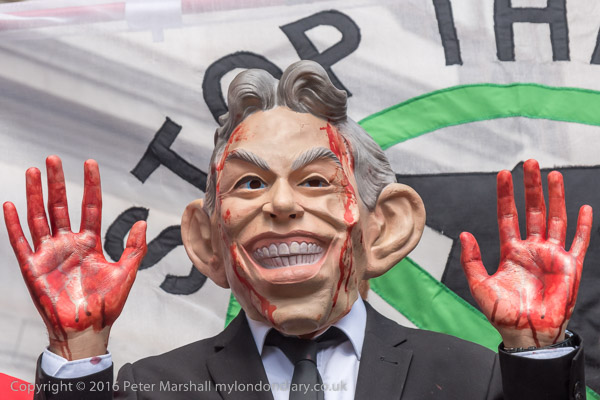
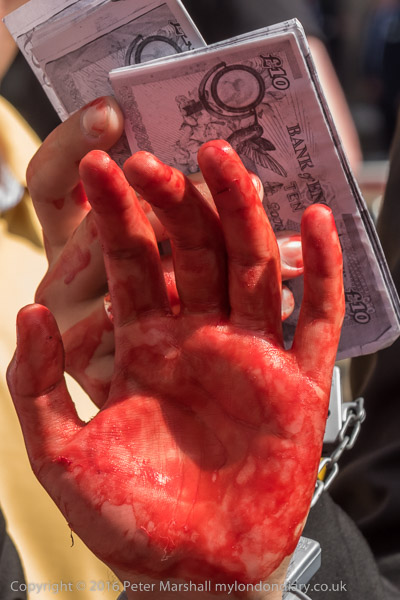
The top picture, with Blair holding up bloodstained hands in front of a ‘Stop the War ‘ banner is perhaps too obvious, and the image immediately above this, with the bloodstained hand of President Bush handing over bundles of Tenners is rather on the crude side – and needs explanation in a caption as to whose hands these are.

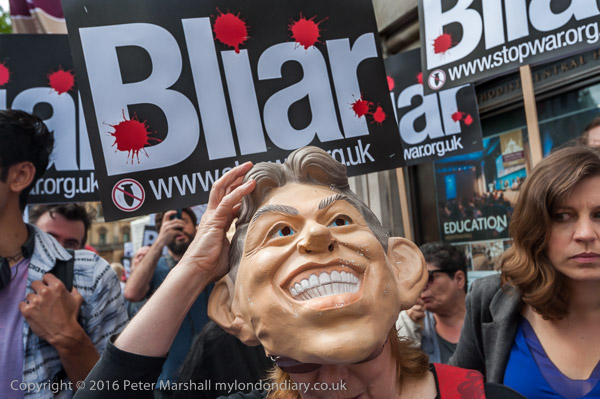
I rather prefer the third Blair image here, which shows him below the posters with the simple text ‘Bliar’ and its bloody bullet holes.

Wikipedia summarises the Chilcot report as saying:

Saddam Hussein did not pose an urgent threat to British interests, that intelligence regarding weapons of mass destruction was presented with unwarranted certainty, that peaceful alternatives to war had not been exhausted, that the United Kingdom and United States had undermined the authority of the United Nations Security Council, that the process of identifying the legal basis was “far from satisfactory”, and that a war in 2003 was unnecessary.

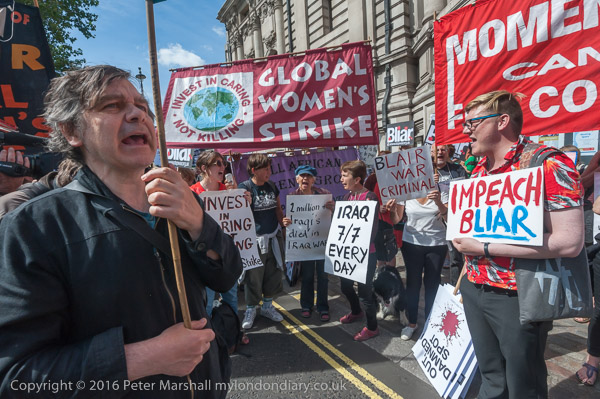
But more interesting still for me are the pictures of protesters – the man shouting at the left of this image, and, at the opposite side a guy in a rather improbable shirt holding the clear message ‘Impeach Bliar’.  Of course it hasn’t happened and is extremely unlikely for political reasons, despite the fact – as the poster held by one of the Global Women’s Strike protesters points out, 2 million Iraqis died as a result of his and Bush’s actions.

I like too the dynamism of the woman in black headscarf and top holding up the Iraqi flag as she shouts out  “Blair lied , Millions Died”.

You can see more of my pictures from the protest at Blair lied, Millions Died – Chilcot.

Inquiries such as this do sometimes come up with the more or less the right result, but if so, always too little and too late. No action has been taken as a result of Chilcot, which considerably pulled its punches in the way it dealt with many of the issues.

The British public, and Labour voters in particular, had already made up their mind about Blair. We knew he had lied and led the country to take part in a war that was a mistake for our country and a disaster for Iraq. It was a failure that played an important part in Labour’s failure to win the 2010 and still the 2015 elections, and one that only a complete break by the party as a whole from his ‘New Labour’ project can overcome in the foreseeable future.

Continue reading Whatever happened to Chilcot?

Awesome!

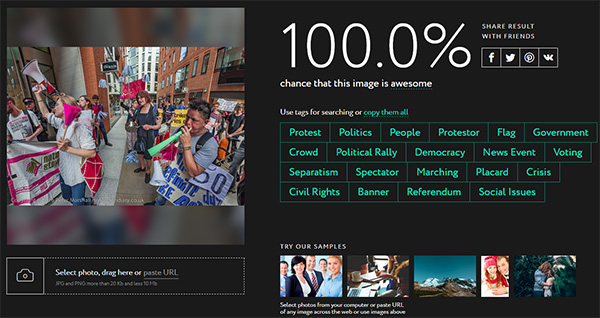
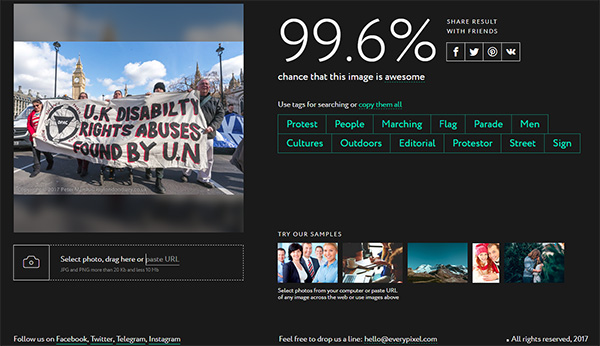
There is, according to the Everypixel Aesthetics Test, a 99.6% chance that my picture uploaded to their test page below is awesome:

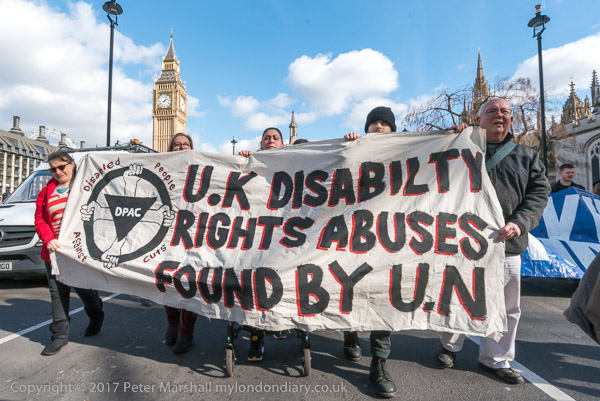
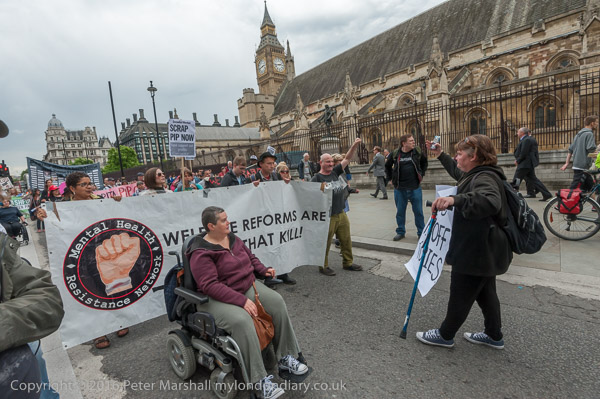
Well, actually it isn’t, just a rather ordinary image, typical of many that I take. Publishable? Yes, and fairly nicely done, but certainly not awesome. Here it is rather larger so you can judge for yourself:

It’s clear, leaves no doubt about what it is – spells out in the banner who the group is carrying it and why they are protesting.  And they are obviously marching down a street in London as I caerfully took it with ‘Big Ben’ in the background. You can see too that it is part of a larger demonstration as there is another banner to the right. Clearly the people are actually walking along a road – except for one in the middle – and you see the wheels of her wheelchair.  It’s competent, even precise (if rather hurriedly processed)  but awesome? No.

I tried out the 14 images currently on the front page of my website My London Diary, on the test page, and the results were interesting, with this image getting the highest score, though there were others that ran it close.  And one that I rather like that only scored around 25%.

Clearly the algorithm used to set the scores needs some more work, and I doubt it will ever be able to spot the awesome, though it might well be able to weed out the truly hopeless. And when I hear some picture editors get sent 50,000 images a day that could certainly be useful.  There is a disclaimer on the page, which admits it isn’t really – despite the name – makeing aesthetic judgements at all. It states:

Surprised by the result? This service doesn’t measure the coolness or beauty of a person or any object in a photo. It cares only about technical parts like brightness, contrast, noise and so on. Service doesn’t dedicate for historical photos, illustrations or 3D visualizations.

What is surprising – and perhaps even at the currrent basic level useful is the ability to generate keywords from the visual content. This is perhaps a fairly simple image, and some of the others I tried were a little more impressive, but here is the algorithm-generated list for the image above:

Protest, People, Marching, Flag, Parade, Men, Cultures, Outdoors, Editorial, Protestor, Street, Sign,

It isn’t 100% accurate – but then neither are my own hand-crafted keywords for images, particularly since time constraints often mean I’ll synchronise a list across a whole set of images, and only fine-tune them for individual images if I have time later.  Obviously this list doesn’t have any of the more specific keywords I’d find essential, but only because the agency I place most pictures with doesn’t make sensible use of captions for searching its image library.

Writing good captions is essential – and the old rules still hold, though so many images on the web and on many sites selling images are full of images are lacking. But captions for photographs to go in an online library are not the same as captions that will be used when an image is printed in a newspaper, magazine or book.

One of the old and good rules about captions in printed material is not to state the obvious. But to be computer searchable image captions need to include the obvious as they will generally be read without the image when searches are conducted. And while you may send a batch of images and feel you don’t need to mention some piece of information on every one, you have to remember that searchers – machine and human – are often going to see just a single one of them.

The 5 W’s remain essential:

  • What
  • Who
  • Where
  • When
  • Why

and sometimes there is a How worth adding.

Something like Everypixel or an enhanced version of it, taken together with software that could parse captions to generate keywords from them could make assigning keywords unnecessary. Actually computing power is now such that there is no reason not to search captions and give them greater significance in searches. After all, any editor likely to want to use that picture above would be looking for a generic ‘Protest’  but would be interested in a protest about ‘disability rights’ or the UN and UK disagrement or the organisation named on the banner or some other specific. And those would be in the caption but are not in Everypixel keywords.

Going further down the Everypixel web page we find that they actually – despite the disclaimer above – make the claim that their ‘Heartless algorithm‘ has  ‘learned to see the beauty of shoots in the same way as you do‘ because it has been trained using Artificial Intelligence techniques on a sample of images provided for them by ‘designers, editors and experienced stock photographers‘.  My short test on the site suggests to me that there is still a very long way to go.

I rather hope it does work, as they suggest it might be used for ‘intelligent image curation‘, giving high-scoring images a higer ranking in search results, and I think I would generally benefit from this. I’m often apalled at the poor quality images used by the press when I know that much better and more appropriate images by myself and others are available if only those resonsible for finding images had done a better search.

But I’m just a little worried about it being used to weed out low-scoring images. I suspect it would eliminate all of the most creative and unusual pictures along with the rubbish. It does give some scores in the 20% range to some of my favourite images.

But I’m pleased to say that sometimes I agree with the software!

Continue reading Awesome!