Disabled protest Tory hate

One of the problems of the Conservative Party has long been a failure to understand how most people live. Of course there are poor people who vote Tory, and people in the party who have come from working class backgrounds, but their policies are largely made by people who have never known (or long forgotten) what it is like to live in poverty. And those few who started poor often seem to blame those who remain poor, feeling they worked their way out of it so why can’t everyone else?
Austerity was always the wrong policy and it hasn’t worked, but it has led to a great deal of suffering and misery, punishing the poor for crimes of the rich and the failures of successive governments to regulate the activities of the wealthy, allowing huge levels of tax avoidance and encouraging scams such as ‘buy to let’ and the use of housing as an investment vehicle, particularly for foreigners, which, along with a concerted attack on social housing are at the root of our ‘housing crisis’. We don’t really have a housing crisis – there are enough homes to go round, but many are empty part or all of the time and beyond the means of those who need them, while private landlords benefit from high rents made possible only by heavy housing subsidies – and low pay for workers means companies are subsidised by ‘in-work’ benefits while CEOs and other higher management get silly money.
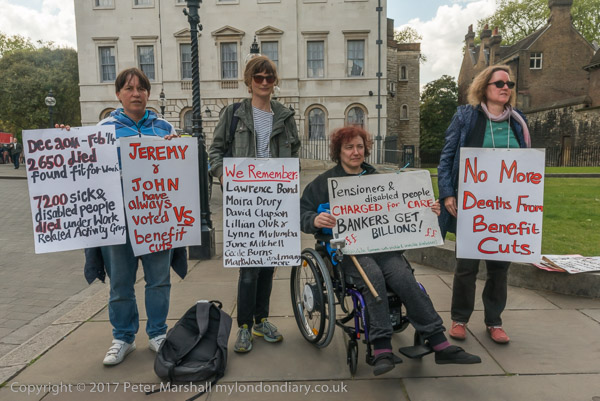
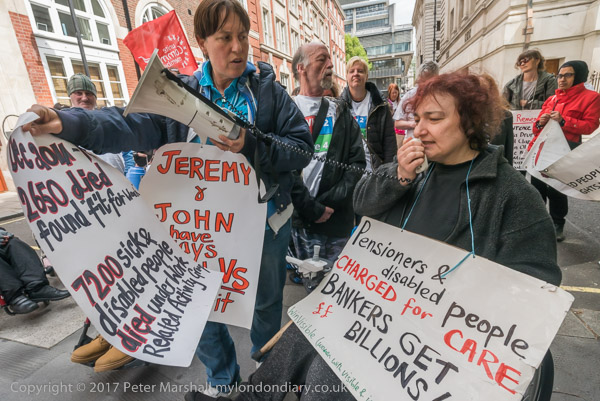
A recent study published by the BMJ concludes that austerity has led to an increase in death rates and suggests that this has led to 120,000 additional deaths since 2010 due to cuts in public expenditure on healthcare and social care. The study’s lead author was quoted in The Independent as saying “It is now very clear that austerity does not promote growth or reduce deficits – it is bad economics, but good class politics. This study shows it is also a public health disaster. It is not an exaggeration to call it economic murder.” Though those who get their news from the BBC will probably have missed the story.
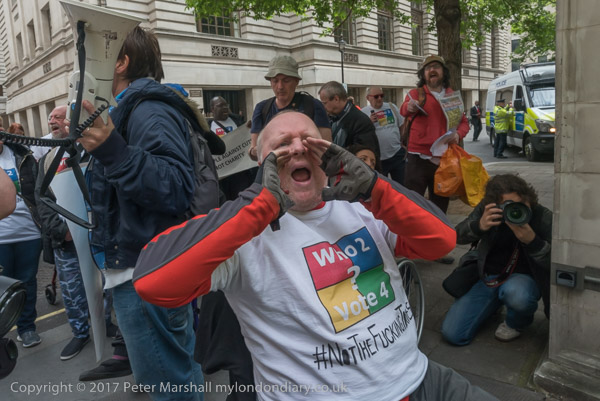
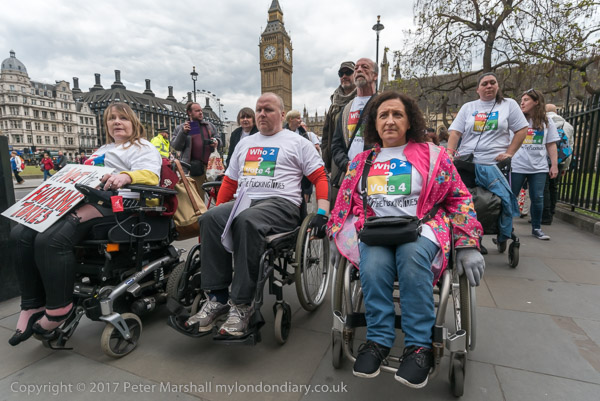
The Tories seem to have a special hatred reserved for the disabled. They seem to see them simply as a drag on the economy, taking high levels of benefits without any return to society (though paradoxically they have cut much of the support which did previously enable many to make a positive contribution.) They appear to have thought the disabled would be an easy target and would just go away and die quietly. But although far too many have died, campaigning groups such as DPAC (Disabled People Against Cuts) and MHRN (Mental Health Resistance Network) have been some of the most active protesters against their policies. And on this protest they reflected back a little of the Tory hate with t-shirts that read ‘Who 2 vote 4? Not the f**king Tories’.

In part this comes from desperation, and from clearly seeing that the cuts are life-threatening. But it is also helped by considerable public sympathy – at least once the public are told what is happening. The police find disabled people difficult to deal with, partly out of a genuine sympathy, but also because they realise how badly they might look in the press attacking the disabled – which is one reason why its important that I and other journalists cover their actions. There are also practical difficulties for them in making arrests, needing specially adapted vehicles for those protesters in wheelchairs or on mobility scooters – and police stations also may lack disabled facilities.
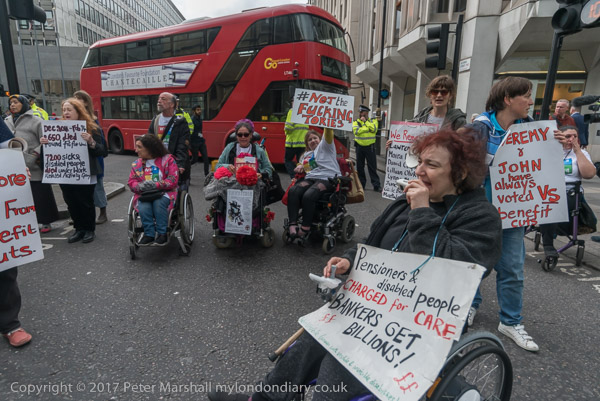
Not all disabled people are in wheelchairs, and not all disabilities are visible. One of the groups present at many of these protests is Winvisible, women with visible and invisible disabilities, and of course there are men too. But wheelchairs and scooters have proved very useful in protests, especially for blocking roads, and after protesting outside Parliament on the last day of its sitting before the General Election and then going on to protest outside the Tory HQ nearby, the protest finished by bringing traffic to a halt on busy Victoria St, leaving the road only after final warnings of arrest from the police. Stopping traffic in London, though an annoyance to those blocked, is one of few reliable ways to get any protest noticed.

More at: DPAC against Tory Hate
Continue reading Disabled protest Tory hate
October 2017

My pictures from last month – October 2017 –  are now on My London Diary.  Links to the stories are below along with a few of my favourite images  from the month.
My London Diary

Oct 2017

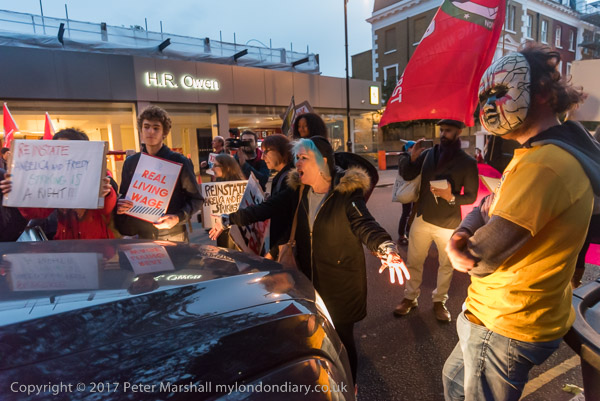
Halloween protest for living wage at HR Owen
Pregnant Then Screwed March of the Mummies
UFFC annual remembrance procession
March for a Safe Uxbridge Road


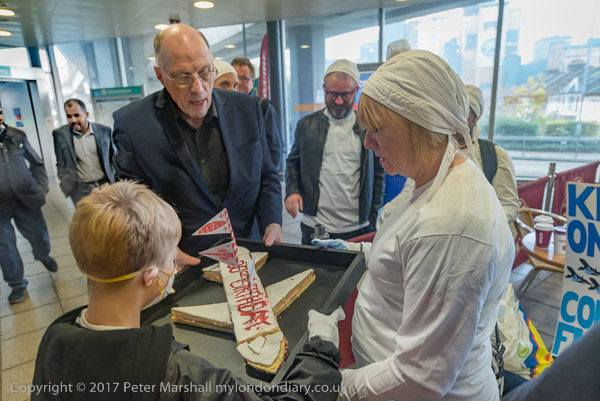
30th Birthday cake for London City Airport
Grenfell protest celebrates Russian Revolution
Guardians of the Forest – COP23
Safe Passage for the Children of Calais
Stop Robbing the Homeless
Class War levitate the Daily Mail
Class War levitate Kensington Town Hall


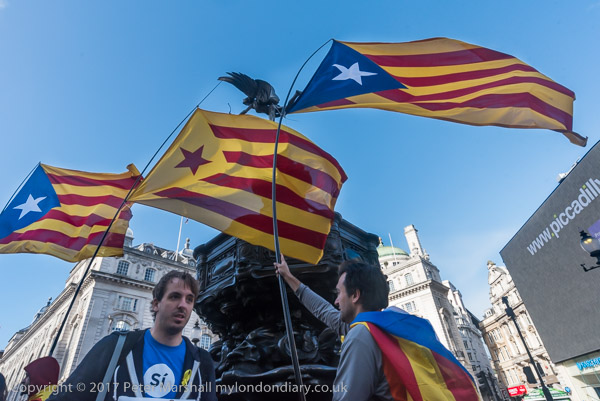
March in Solidarity with Catalonia
Floral tributes still on Westminster Bridge
Stay in Europe
BHP AGM Solidarity Demonstration
Zimbabwe vigil celebrates 15 years


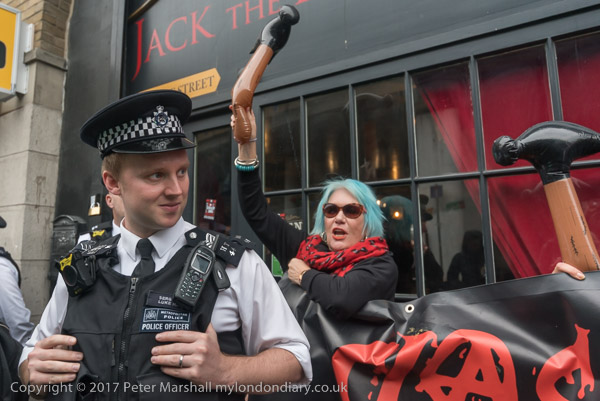
Class War return to Ripper “Museum”
Little Social don’t break the cultural boycott


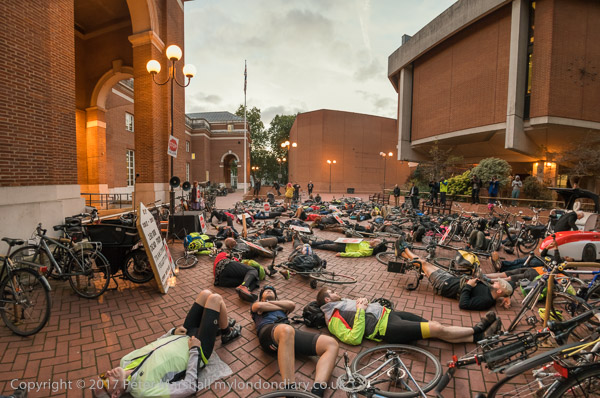
Cyclists Kensington Vigil & Die In
Prime Minister, Please Sentence
Roadblocks against Air Pollution
Stand Up To Racism and the FLA
Football Lads Alliance March
Football Lads Alliance Rally
Silent Vigil for Elephants and Rhinos
Stop Killing Londoners with traffic fumes

London Images

Continue reading October 2017

May Day, May Day

As always, May Day was a busy day in London. For once May Day was actually a Bank Holiday (I suppose it happens on average every 7 years) but this didn’t seem to make much difference to the numbers for the May Day March and other events. When I worked as a full time teacher, around 5 years out of seven I had classes to teach on May Day. Now I always work on May Day, but as well as taking pictures I’m also celebrating International Workers’ Day.

It’s a day when I don’t need to get up too early, as the May Day march only begins to gather at noon:

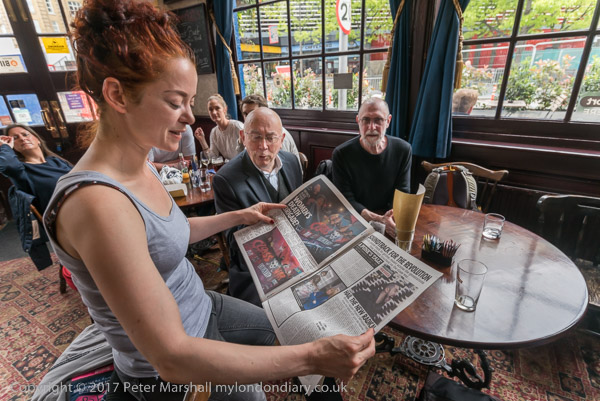
Class War didn’t actually go on the march, but they had come to Clerkenwell Green to sell copies of their newly launched newspaper – and quite a few people were keen to buy a copy.

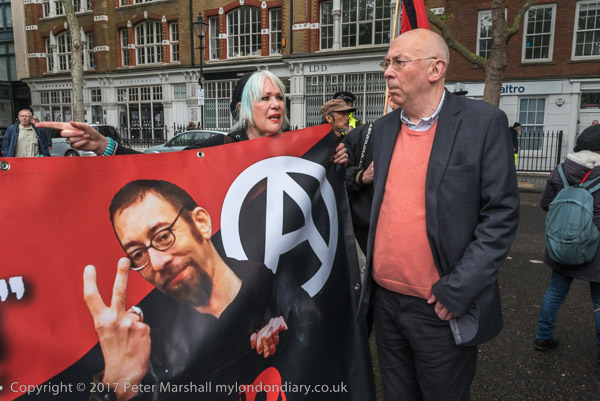
They had a new banner too, celebrating Simon Chapman who died earlier this year in his early 40s. He never really recovered from being arrested and imprisoned in Greece where he was fitted up by police who switched his rucsac for one containing petrol bombs in anti-capitalist protest in Thessaloniki, in 2003. Held in terrible conditions in prison he took part in a lengthy hunger strike which had a permanent affect on his health, and eventually due to international protests he and the other ‘Thessaloniki Seven‘  hunger strikers were released and sent home. The Greek government knew the police evidence would not stand international scrutiny they could not afford to create martyrs, though the UK Labour government refused to take any action to protect its citizens. He continued to campaign and protest after his return to the UK – and returned to Greece for a further trial  with three of the seven in 2010, when all of the original charges were thrown out after being completely discredited by  the defence evidence but he and four others were found guilty of the offence of ‘minor defiance of authority’ with Simon getting a suspended six month sentence.

By the time the march was ready to depart the area was pretty crowded, and as the march left, Class War made their way to The Crown Tavern, a pub with an interesting history, where Lenin and Stalin are said to have first met in 1905, and serving some fine local beers.

May Day March Gathers

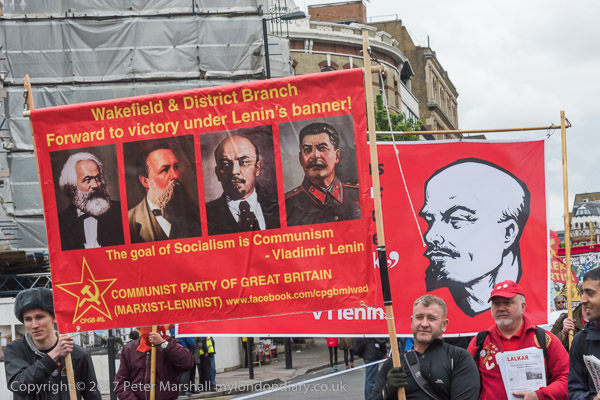
Stalin and Lenin were of course on the march today, along with Marx, Mao and others including Abdullah Öcalan, the Kurdish leader still languishing in a Turkish island jail; as always there were many from London’s migrant communities taking part. But the best banners are still some from branches of UK trade unions and it is quite a sight to see them, along with all the others, marching along the CLerkenwell Road, and I tried to photograph most of them without walking too far from the start.

May Day March

As the last of the marchers passed me I turned and made my way towards The Crown. If it was good enough for Lenin and Stalin it was good enough for me to have a pint there too. I’d intended to leave after a short break and take the tube to go to Trafalgar Square for the rally there, and some of Class War in the pub were also intending to do the same. Somehow it took us rather a long time to leave, and the tube system is designed to make the journey from Farringdon to Charing Cross difficult.

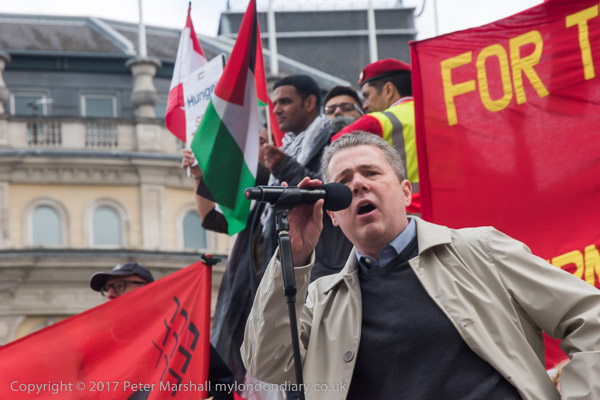
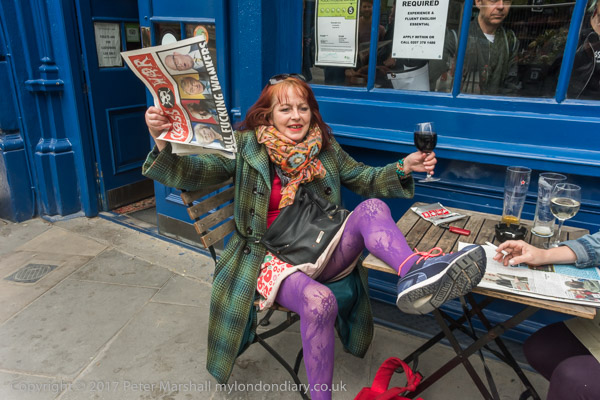
I think most of the rally was over when we reached the square as John McDonnell was coming to the end of his speech, but I was pleased to be able to photograph Mark Serwotka, who can speak about the NHS form some considerable experience following his heart transplant. I took a few pictures, including some of John McDonnell as well as of Class War with the third edition of their election banner, ‘All F**king Wankers’ featuring Theresa May, Jeremy Corbyn and some Liberal Democrat and UKIP guy. The police seized one of the earlier versions as evidence – and then lost it; I hope Class War claimed compensation.

May Day Rally

Once the mainly rather boring official rally had finished on the plinth at Trafalgar Square people carried on the celebrations in their own way, but soon I had to leave as the May Day F**k Parade was scheduled to start shortly a few minutes away in Leake St, London’s ‘graffiti central’ in the wide pedestrian underneath Waterloo station.

It really was dark in there, much darker than my pictures suggest. Several photographers came up to ask my advice about taking pictures there as it felt rather edgy, but I told them not to worry too much – and if they were worried to ask. There were quite a few people there that I knew (and more that knew me) and the main problem I had was simply the lack of light. I used flash for a few action pictures of people playing games, but it really didn’t capture the atmosphere there. Except for the flash pictures, the others were taken at ISO 6400 with the lens fully open, quite a few at 1/30s. Unfortunately I hadn’t though to take my LED light, which would have been useful in the darker corners.

May Day F**k Parade Meets

I was please when we left the tunnel and started on a walk around London, though by now I was getting rather tired. There were a few flares set off and the march was accompanied by a large group of police, but wasn’t causing any great problems. As it was a Bank Holiday there was little traffic actually in central London.

On Waterloo Bridge I was standing next to a group of police when one of the protesters set off a flare. An officer shouted to the others ‘Let’s grab him’ and they rushed into the crowd, surrounded him and made the arrest. It was a deliberately provocative act, and looked for a while as if they had started a riot, but most of the protesters were there to enjoy themselves, not to start trouble. It was a parade, not an insurrection, and the police action seemed excessive.

The parade continued, going through Covent Garden and making its way to Leicester Square, going to a recent squat in Soho (though we only knew that later.) But as it made its way out of the square I decided I’d had enough and headed for home.

May Day F**k Parade

Continue reading May Day, May Day

Class War Paper Launch

Way back, soon after Ian Bone moved to London, Class War began to produce a newspaper or magazine, an irregular tabloid size publication, which became notorious for some of its covers, several of which have more recently appeared as posters, such as ‘We have found new homes for the rich’, showing a huge cemetery of crosses. In its early days it was produced in an obscure tower block in North Kensington where Bone was living, which has more recently headlined the news, Grenfell Tower.

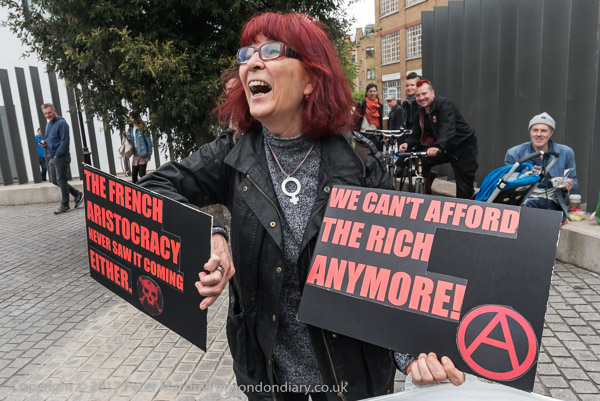
When Class War decided to produce a new issue of the newspaper, I was asked if they could use some of my pictures from their events, and I was pleased to let them do so. It was perhaps more serious than the earlier issues, with some substantial articles about Class, Housing, the Women’s Death Brigade etc, as well as some hilarious horoscopes and features on Duncan Disorderly and Potent Whisper.

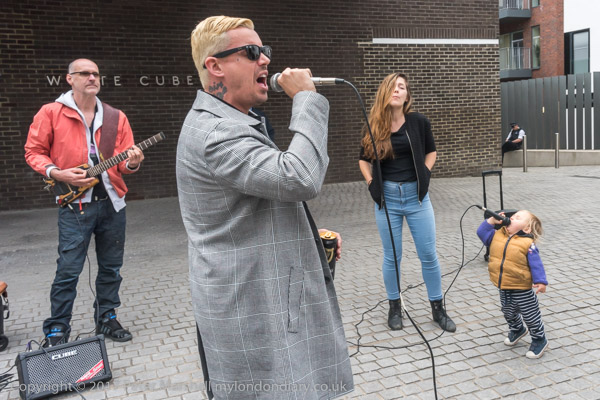
The protest outside the White Cube Gallery had been planned earlier as a protest against gentrification, following on from earlier protests there  in December 2015 –  Class War at Gilbert & George ‘Banners’ and January: Class War Footy at White Cube. As with many Class War events, in started in a nearby pub, where copies of the newly printed newspaper were read.

Eventually people walked down the street to the yard in front of the gallery:

And people posed for a group photograph with copies,

before playing a little football, something which isn’t usually allowed on the yard, empty space in a crowded inner city with astronomical land prices, seen by Class War as akin to burning £50 notes under the noses of the working class population of the area, still present in the Peabody and council flats despite the increasing hipster invasion.

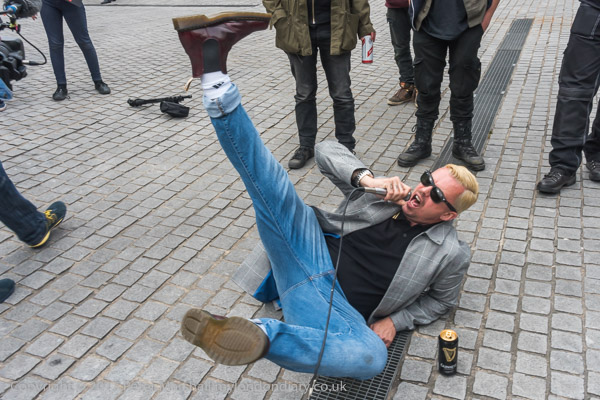
But the real treats of the afternoon were at a higher cultural level, though not appreciated by the gallery staff hiding behind police and security with the gallery locked for the afternoon. First Potent Whisper performed his latest spoken word piece on the housing crisis, Estate of War, followed up by speeches by Simon Elmer from Archtiects for Social Housing (ASH), Ian Bone and another well-known anarchist, Martin Wright, then songs from ‘one-man anarcho-folk-punk-hiphop phenomenon’ Cosmo, more from Potent Whisper and then a truly incredible new improvised performance from Adam Clifford and his guitarist (unfortunately not recorded for YouTube), after which Jane Nicholl performed her introduction to   Adam’s performance of ‘The Finest F**king Family in the Land‘.

Adam ended his performance in his usual style:

and the event was still continuing with other musical performances when I had to leave.  It had been, as I wrote at the time, a legendary performance, rather eclipsing anything the White Cube has had to offer at their site, and I felt privileged to have witnessed it.

Class War at White Cube

Continue reading Class War Paper Launch

Hull Photos: 13/10/17 – 19/10/17

Another weekly digest of the pictures I’m putting up every day on my Hull Photos web site where you can see a new picture every day. I also post them on my Facebook page, along with the short texts shown here, which are not yet included on the web site.

Comments and corrections are welcome either here or on Facebook, and will help me to get the finished texts which will eventually go on Hull Photos. Hull photos is divided into a number of sections, and the picture captions end with the name of the section that image has been placed in. Clicking any of the images will take you to it in that section of the site where you may find related images.

12th October 2017

A young man smiles as I take a picture of him sitting on his horse-drawn cart on Bridlington Avenue in front of the works of Rose Downs and Thompson Ltd.

I’ve written earlier about Rose Downs and Thompson Ltd, iron-founders and manufacturers of oil mill and hydraulic machinery, and their pioneering work in the UK building their listed 1900 factory extension (not in this picture) and the bridge on Cleveland St using the Hennebique ‘ferro-concrete’ system.


85-5i-21: Rag and Bone man, Bridlington Av, 1985 – Beverley Rd

13th October 2017

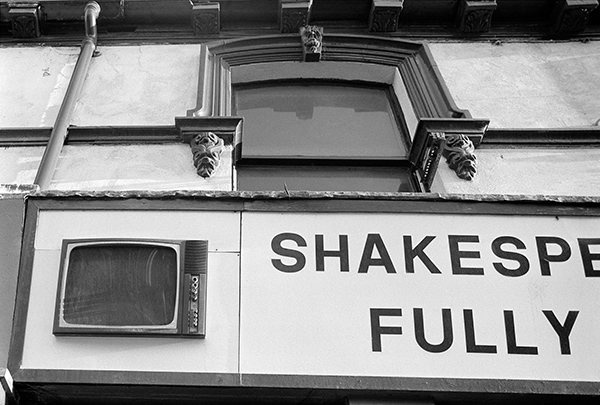
Shakespeare TV and Electronics was the place to go to buy a reconditioned TV, or for repairs, and they advertised their shop at 177 Springbank with the front of a TV on the fascia board.

This and the adjoining shop had some fancy decoration around their first floor windows, though a redundant strip of angle iron didn’t add to the effect. The shop is now a multicultral food store.


85-5i-41: Shakespeare TV and Electronics, Springbank, 1985 – Springbank

14th October 2017

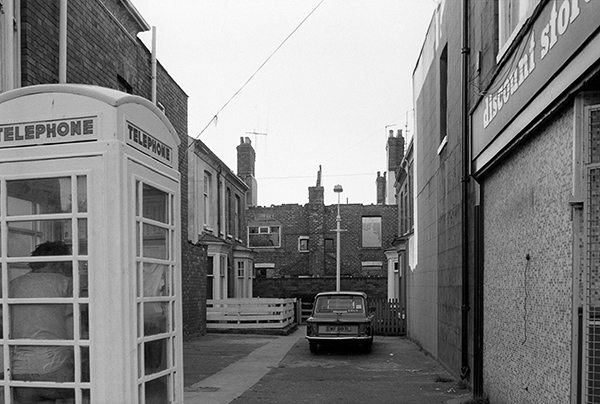
Myrtle Villas, off Springbank roughly opposite Stanley St, was surely one of Hull’s shortest terraces, with only two houses on each side. But it did have its own Hull telephone box.

The houses across the end were being demolished when I took this picture, and the terrace now looks less enclosed and leads to further properties. The discount store on the right is now ‘Grab A Bargain’ and on the left is ‘Urban Trendz’. There is still a phone box, though I might have to wait a long time to see anyone using it, while back in the 1980s queues were not unusual.


85-5i-42: Myrtle Villas, Springbank, 1985 – Springbank

15th October 2017

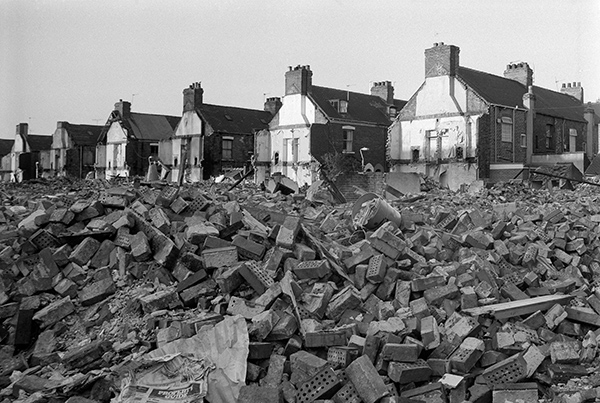
Demolition was happening on a large scale in the area between Springbank and Beverley Rd and I took seven pictures. This image is unusual in that the demolition has cut through a long stretch of tightly packed houses and has left what appears to be a massive pile of bricks – and at bottom left a pile of old newspapers with the ‘Property Guide’ at the top.


85-5i-46: Demolition, Springbank area, 1985 – Springbank

16th October 2017

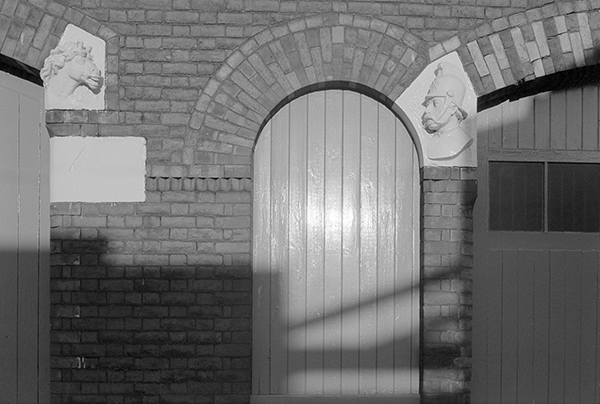
The decoration on the side of a former fire-station in Hall St now has a Hull Heritage Blue plaque stating it to have been the home of the Hull Volunteer Fire Brigade. There two wider doorways, slightly differing in size, one perhaps for the fire engine, and the other for the hroses that would have pulled it. That on the left is decorated with three horses heads and the other with images of three fire captains in their helmets, one at each side of the arch and the third on the keystone. The right hand arch also has a decorative pattern in the brickwork of the arch and small windows across the doors.

I made two exposures on this occasion, one showing the whole of the right hand gate and two of the horses heads on the left, and the second moving in closer to show just one of the horses and a man apparently looking up slightly towards it.

There was no plaque when I took my pictures, but it looked as if the building had been recently painted with the decorative figures picked out in white, slightly carelessly as there is some paint on the brickwork around. It looks as if the paintwork was a pale colour when I took these pictures, perhaps cream; later they were painted maroon and in 2008 repainted a dark blue.


85-5i-54: Hull Volunteer Fire Brigade building, Hall St, 1985 – Springbank

17th October 2017

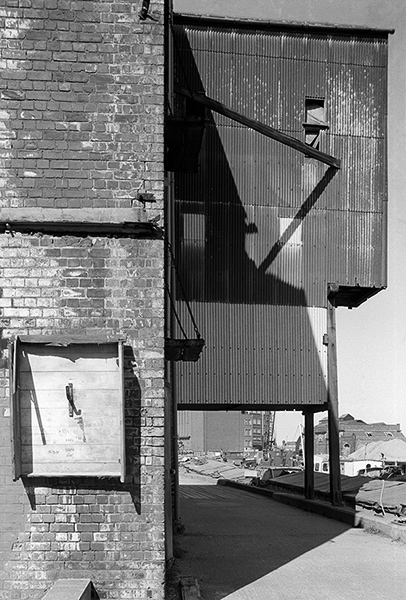
The empty open box on the wall has a hook which probably once held a lifebelt and a cast-iron covered structure projects out over the riverside pathway and overhangs the river above a covered barge. The river seems full of vessels, but the only easily identifiable one is the barge Poem 21.

In the background across the river is Clarence Mill and the former Trinity House buoy shed. On the large heaps of sand at the wharf at right is the tiny figure of a man with a shovel, apparently facing an immense task.

The picture is taken from the end of Bishop Lane Staith and the Grade II listed building here is Ellerman’s Building, 38b High St, converted into flats in 2000. Out of site on the west side of the building is a stone with ‘G G M 1655’ which was retained from a former building on the site when this warehouse was rebuilt around 1800.


85-5j-21: Riverside path and loading bay, Old Harbour, 1985 – River Hull

18th October 2017

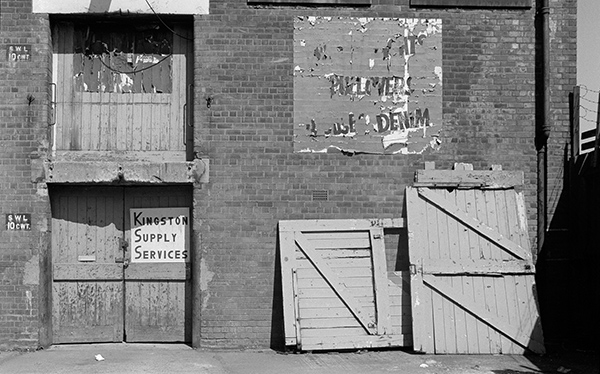
Kingston Supply Services was on Lime St on part of the site which is now a 24 hour car park next to L A Hall Roofing Contractors and Merchants. The building was demolished around 2010. The peeling sign once offered – among other indecipherable things – Pullovers, Blouses and Denim.

Some years earlier there had been a board a few yards down the street for Hull Ships Stores and this building may have been a part of this.


85-5j-31: Kingston Supply Services, Lime St, 1985 – River Hull

19th October 2017

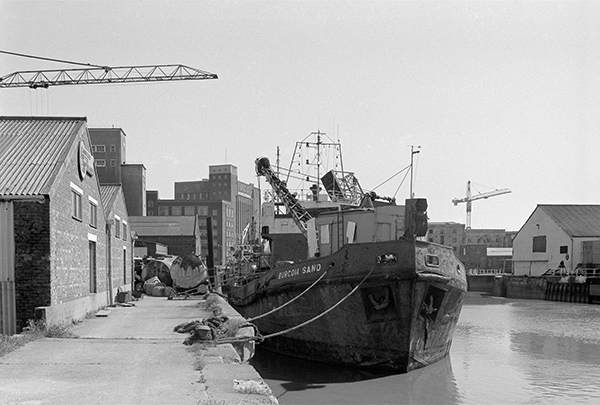
At left are the buildings of Associated Tyre Specialists, still present with a frontage to Great Union St, now occupied by Adams Fast Food Supplies. Beyond them the buildings of Clarence Mill; those on this side of Drypool Bridge still standing and occupied by Shotwell, with the larger complex behind with ‘Clarence Flour Mills’ on its side sadly (and insanely) destroyed. The tanks and other objects blocking the riverside path are in front of the Union Dry Dock and at the right of the picture is the entrance to another dry dock, with a large shed of the Yorkshire Dry Dock Company to its right, between it and the former Queen’s dock entrance.

Burcom Sand, named after a sandbank in the Humber estuary between Grimsby and Sunk Island was a grab hopper dredger built in 1954 by Cook, Welton & Gemmell at Beverley which worked extensively for the British Transport Docks Board around the Hull docks in the 1960s and 70s. Later, like the Kenfig I also photographed here, she was owned by Dave Cook of Hull and used for jobs like removing old jetties. She was apparently fixed at the bow to piles at low tide with a wire hawser and pulled them up and out as she rose with the tide. She was broken up across the Humber at New Holland in March 1994.


85-5j-33: Burcom Sand moored above Drypool Bridge, 1985 – River Hull


You can see the new pictures added each day at Hull Photos, and I post them with the short comments above on Facebook.

Comments and corrections to captions are welcome here or on Facebook.
Continue reading Hull Photos: 13/10/17 – 19/10/17

A Walk in the Park

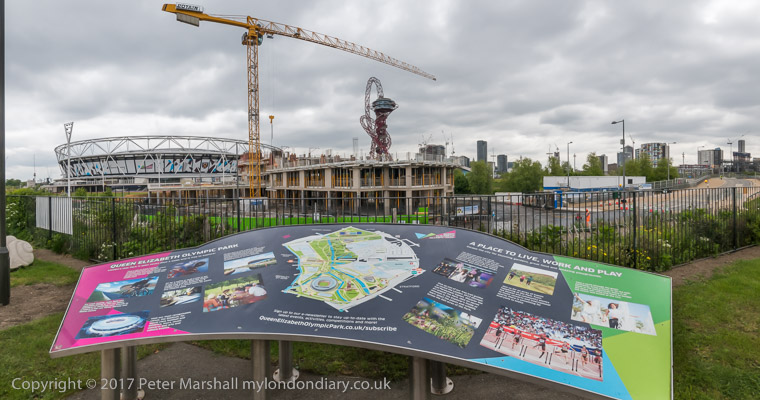
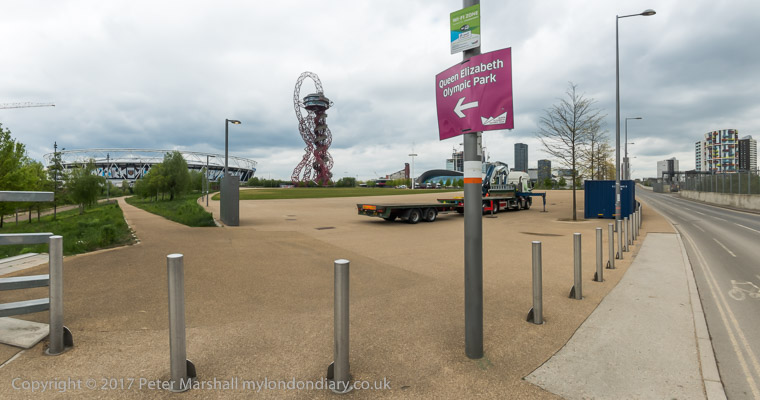
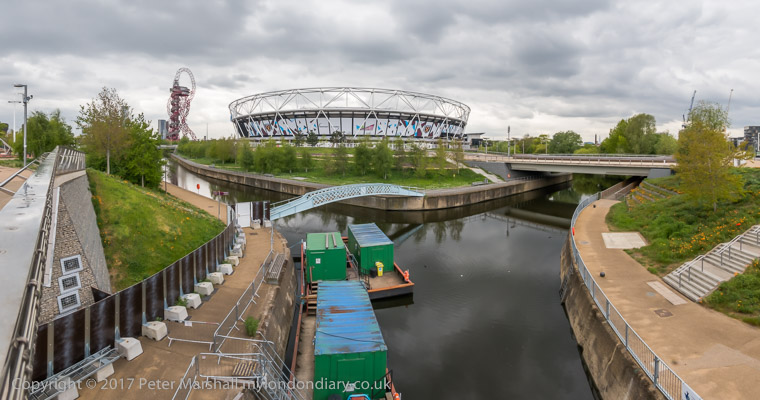
What do you do if you come to London to photograph an event that finishes around 11am and then want to photograph another that doesn’t start until 3pm? On International Worker’s Memorial Day (April 28th) I decided to go for a walk in the park. The former Olympic Park, now called the QEII Park.

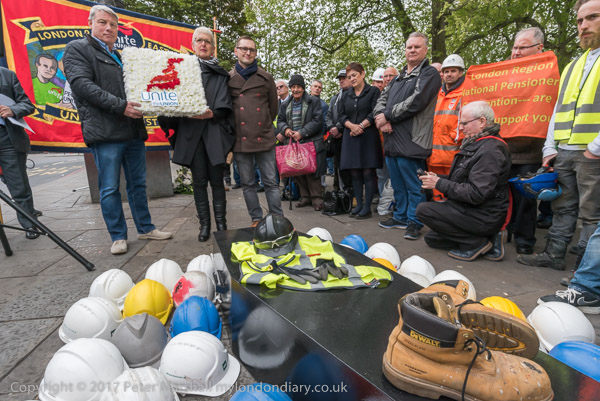
The International Worker’s Memorial Day commemoration in London is one I try to go to every year, though I don’t think it’s a particularly good event to photograph, either financially or artistically. Safety at work is an important issue, and I used at one time to be a safety officer at my workplace. People often joke about health and safety, but we have seen legislation that has made all workplaces safer, though some right-wing politicians want to sweep it away as ‘red tape’, and this and the previous government have sadly greatly weakened the enforcement of regulations. Of course sometimes regulations get misinterpreted and used as a pretext for things that clearly were not intended, but much more often they are flouted because companies know they can get away with it.

It wasn’t my first visit to the park – I’d gone shortly after it was reopened to the public, and made another short visit more recently on my way to a protest in Stratford, and the weather wasn’t ideal for making the kind of wide panoramic images I intended. With such a wide expanse of sky in many of the pictures its often useful to have some interesting clouds in a blue sky; sunlight tends to brighten the mood as well as increase the light levels, but it’s best to have plenty of cloud both to get rid of huge expanses of empty blue sky and also to reduce the local contrast with shadow areas being illuminated from the clouds.

It wasn’t too bad. Although there wasn’t – until I was getting ready to leave – even the smallest patch of blue sky for those sailor’s trousers at least the clouds had some definition – and there was not the problem of avoiding getting the sun in picture, which can be tricky on sunny days with a roughly 145 degree angle of view. And though we mainly see blue skies as a nice even blue, film or sensor is very sensitive to the increase in illumination.

I’d hoped that almost 5 years after the Olympics the park might have matured, and was rather disappointed. It doesn’t really look like it will become much of a park in my lifetime, if ever. And while it was good to find that they are still intending to replace Carpenters Lock, it does seem to be taking rather a long time.

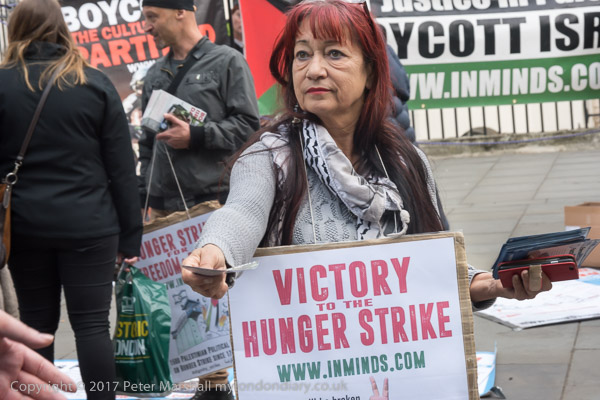
It was my first visit to the northern extremes of the site, and I also made use of the new foot bridge across the Lea Navigation to make my way to Hackney Wick station to catch a train back to Stratford and then the tube into central London to photograph a vigil in solidarity with the over 1500 Palestinian prisoners in Israeli jails taking part in a hunger strike.

Palestinian Prisoners Hunger Strike vigil
Olympic Park Update
International Workers’s Memorial Day

Continue reading A Walk in the Park

When Buddha Looks Away

When Buddha Looks Away is a set of powerful photographs of Rohingya refugees in Bangladesh from Drik Images, the leading photo agency in South Asia, set up in response to the stereotyped portrayals of our world by the western media, a platform for media practitioners in the global south.

“These photographs, powerful as they are, show the visible pain. The torment, the insecurity, the fear, the burning inside, the sense of eternal loss, remain undocumented. “

LSE sprayed with chalk

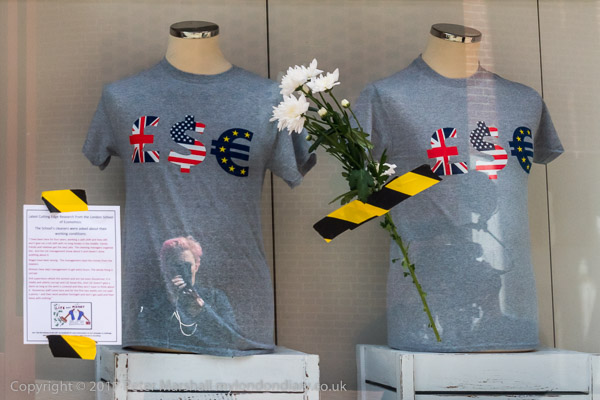
The t-shirt for sale in the university shop at the LSE, pointed out to me by Lisa McKenzie, then an academic working at the LSE and who can be seen photographing the shop window, seemed to be a rather too accurate reflection of the current priorities of the institution, with its message ‘£$€‘ , though perhaps these days it should also somehow include ¥ and .

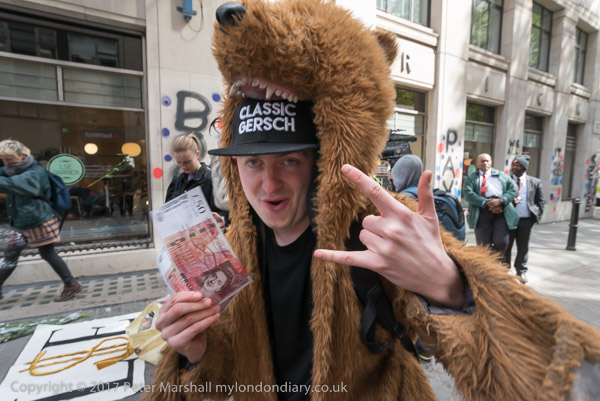
I was at the LSE for a protest by students and workers in the ‘Life Not Money’ campaign  who were calling on the LSE to change from what they say is thirty years of growing neglect, cruelty and outright corporate greed towards workers and staff at the school to something beautiful and life affirming. In particular the contrasted the high salary of the director – said to be around £500,000 a year  – with that of the lowest paid workers such as the cleaners who are paid less than the London Living Wage and have unpaid breaks and are bullied and treated as second-class citizens.

While the cleaners’ trade union, the UVW, has been taking action with a series of demonstrations and strikes, Life Not Money have decided a more effective method is to use more colorful direct action with the deliberate intention to get some of their supporters arrested. It’s an approach that does seem to have worked in other disputes.

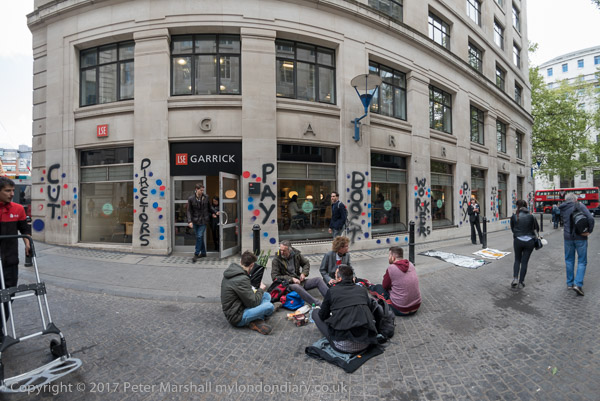
I was a little aggrieved that after having been invited to photograph the event I was left photographing what was an action intended to divert the LSE security while the actual direct action of writing and drawing on the wall of one of the university buildings in nearby Houghton St actually took place. Perhaps this was just an oversight, but by the time I got there, the writing was already on the wall:

‘Cut Directors Pay Boost Workers Pay We All Know it Makes Sense’

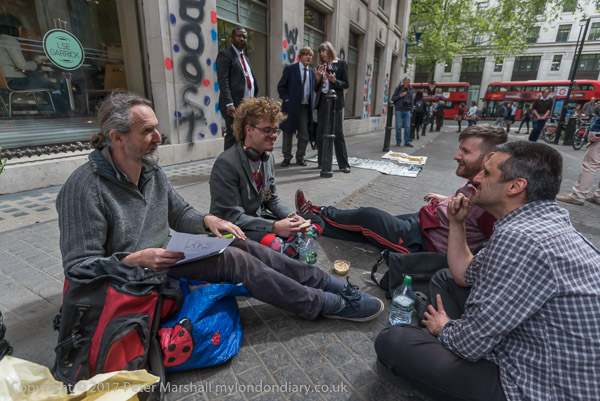
and those who had done it were sitting quietly having a party and waiting patiently to be arrested.

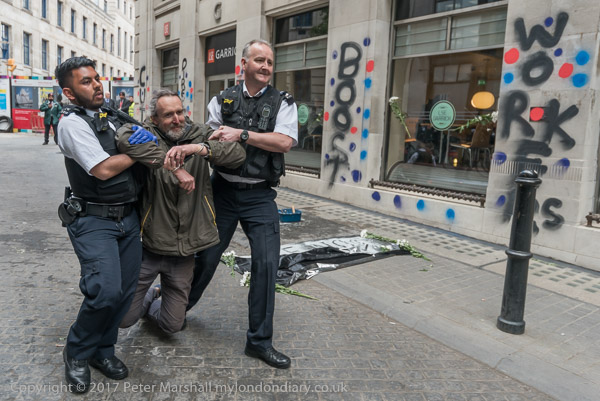
It wasn’t real paint that had been used, but spray chalk, and there was no actual damage to the wall, just to the image of the LSE and the pride of its security team who had failed to stop it.  The protesters had even brought along damp sponges and offered to remove the writing but security and police were not prepared to allow them to do so.  It’s hard to see that writing on a wall with chalk that can easily be removed with a damp cloth could be seen by a court as ‘criminal damage’ – which the LSE alleged and police arrested the writer for.

Increasingly arrest and a period of often up to 18 hours in police custody – they like to release people in the early hours of the morning when little or no public transport is running – is being used as a minor punishment by police for offences where there would be little chance of securing an actual conviction, and where often no charges are made. And in some cases police release people on bail with conditions intended to prevent further protests, such as banning them from the area where they were arrested, often for several months, though this appears to be unenforceable. And property, sometimes including clothing, may be taken as ‘evidence’ for cases that stand little or no chance of coming to court – and is sometimes lost by police.  It seems to be a little procedural bullying which has no basis in law, and for which some have managed to receive compensation.

In this case the police didn’t seem unduly worried about the apparent crime, and they kept the four perpetrators waiting for over an hour before they arrived to arrest them – and I’d almost given up waiting and gone to catch my train home.

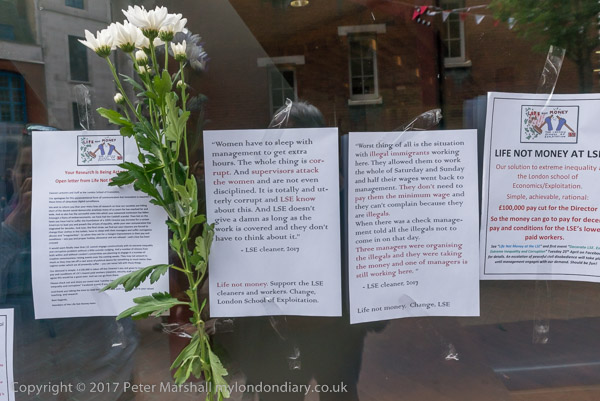
Among the allegations from cleaners employed by Noonan for the LSE on the posters that students posted:

“Women have to sleep with management to get extra hours. The whole thing is corrupt. And supervisors attack the women and are not even disciplined … LSE know about this. And LSE doesn’t give a damn so long as the work is covered and they don’t have to think about it.”

“Worst thing of all is the situation with illegal immigrants working here … half their wages went back to management. They don’t have to pay them the minimum wage and they can’t complain because they are illegals. When there was a check management told all the illegals not to come in on that day.”

These are the crimes that police should be investigating, not protesters chalking on walls.

More at: LSE decorated against inequality & corruption

Continue reading LSE sprayed with chalk

Remember Paris

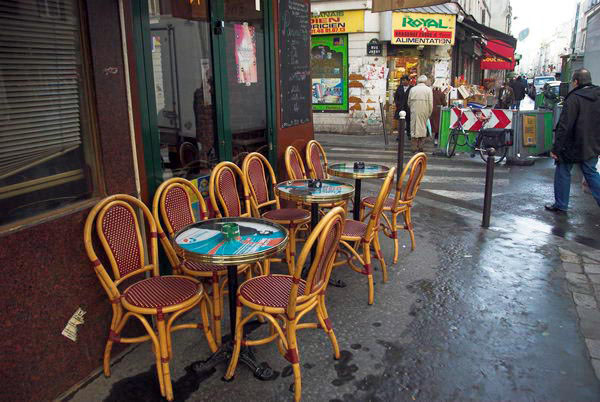
I’m not exactly sure why I’ve stopped going to Paris Photo. The last time I was there was five years ago in 2012; I’ve not even visited the city since, though I used to go there fairly often outside of Paris Photo. It is only a short journey on the Eurostar, and a comfortable one, so much better than air travel, and although there is still something of a hassle to go through customs and security, there is rather less wasted time.

Though I loved going to Paris, and there was always something interesting to see in Paris Photo, there was also an awful lot of walking around the show, and a great deal of what seemed to me worthless photography, mainly printed huge and with truly stratospheric price tags. Much of it appearing in the same galleries year after year (though sometimes they were different pictures that looked the same.) And even the work that was truly worth seeing was often still on show the following year and again the next time.

Although at first I went three years running, I soon decided every other year was enough, and chose those years when there was also a great deal of photography on offer outside of Paris Photo, with seemingly the whole city given over to le Mois de la Photo and le Mois de la Photo-OFF. But for 2017, the artistic director of le Mois de la photo, François Hébel decided to rename it le Mois de la photo du Grand Paris and to hold it in April rather than November – and the fringe also took place then.

April would have been a better month to go to Paris, likely to have better weather and certain to have more daylight, but I wasn’t organised enough to make it this year. It would be great to go, particularly for the Photo-OFF, which is a far more inclusive event. At Paris Photo if you are not a wealthy collector or a well-known photographer or curator you are something of an outsider and a second-class citizen, and a few of the dealers certainly it too clear. While at the various openings and events of the Photo-OFF, photographers (and others) are welcome, though my largely forgotten schoolboy French does sometimes make communication difficult. At Paris Photo the language is money, ruled by the dollar in American English.

I’ve sometimes made a small effort to brush up my French, but largely rely on the services of Linda to go to events outside of Paris Photo, though one year I did go on my own, and found it just a little difficult at times. And on my last visit in 2012, she came with me to all of the six openings I attended and was also invaluable on the one parcours guidée we managed ot fit in, which took us to eight venues of the Photo-OFF, at most of which there were talks by the photographer or gallery owner about the work. She also came with me to almost half of the other shows I saw that week – I think the total was over 80, but still had some time off to go to other things without me. There would have been a few more but for a nasty stomach upset towards the end of our stay which rather curtailed my activities.

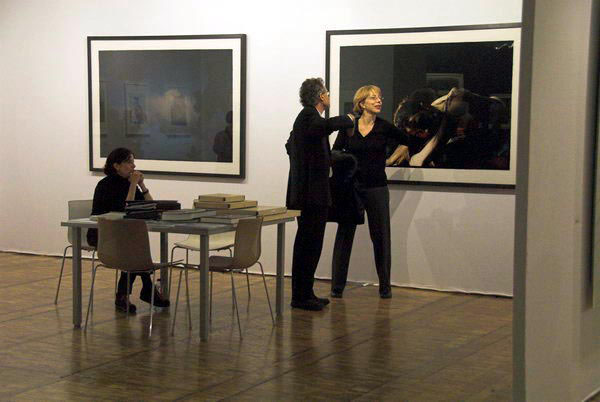
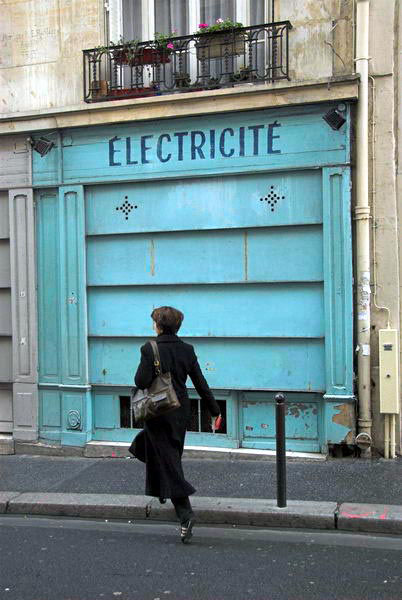
You can read more about that trip – and see some of the pictures I took in our six days there – on My London Diary. The pictures on this post are from my 2006 trip to Paris Photo and you can see more on my Paris Photos site.

But don’t worry if you, like me, don’t make it to Paris Photo this year. You can see the best of it on-line at various sites, including LensCulture, which has Your Guide to Paris Photo and links to more about it.

Continue reading Remember Paris

Hull Photos: 6/10/17 – 12/10/17

Another week of pictures added to my Hull Photos site – one per pay throughout Hull’s year as 2017 UK City of Culture. You can follow these daily on Facebook – and of course on the Hull Photos site, though the comments do not appear there – I hope to get comments and corrections to them before adding them. Your comments are welcome here or on Facebook.

6th October 2017

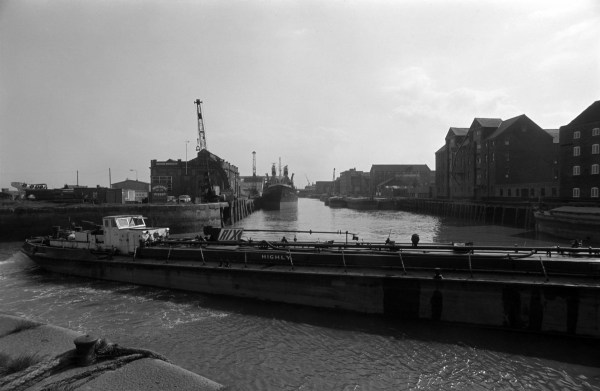
Rix tanker Beldale H, here backing further into the Drypool Basin entrance swinging area. Small tankers such as this transferred oil for large vessels in the King George V dock or other ports along the Humber Estuary or through Goole.

Beldale H, a 300 ton estuary and inland waterway barge was built by Harkers in Knottingley in 1959 and was later renamed Rix Osprey. Rix is a family firm begun by Captain Robert Rix; born on a farm in Norfolk in 1841, he ran away to sea when he was 10, later becoming a captain and setting up a shipbuilding company on the Tees in Newcastle in 1873. Ten years later he moved with his wife and seven children to Hull, where he continued to work for the firm until the day before his death in 1925. The firm developed to have wide interests in trade of lamp oil from Russia and later oil for tractors, heating etc, as well as shipping timber in and caravans out of Hull, agricultural distribution, haulage and more. As well as the Rix Petroleum site with a wharf on the River Hull and storage across Wincolmlee, from 1977 to 2012 they also owned Hepworth Shipyard Ltd at Paull a few miles down the Humber north bank.

The best-known member of the family, Brian Rix (1924-2016) noted for having trouble keeping his trousers up on stage, but also a notable campaigner on learning disability both before and after entering the House of Lords was a grandson of Robert Rix. Knighted for services to charity in 1986 he became a life peer in 1992.


85-5h-35: Beldale H at Drypool entrance swinging area, 1985 – River Hull

5th October 2017

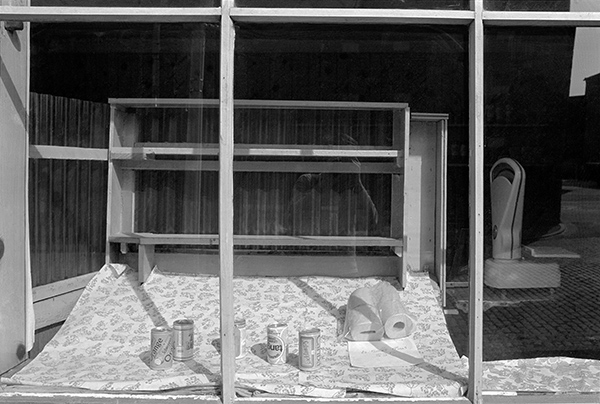
By 1985, this shop had abandoned its earlier Royal Wedding window display I had photographed in 1981 and was back to basics – 4 toilet rolls for 52 p and cans of soft drinks.


85-5h-41: Shop window display, Church St, 1985 – East Hull

7th October 2017

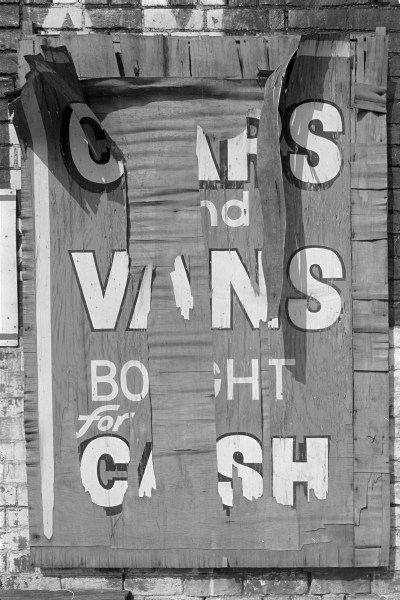
Somewhere on – or just off – the Holderness Rd was a used car dealer with this peeling message on a window.


85-5h-53: Cars and Vans Bought for Cash, Holderness Rd, 1985 – East Hull

8th October 2017

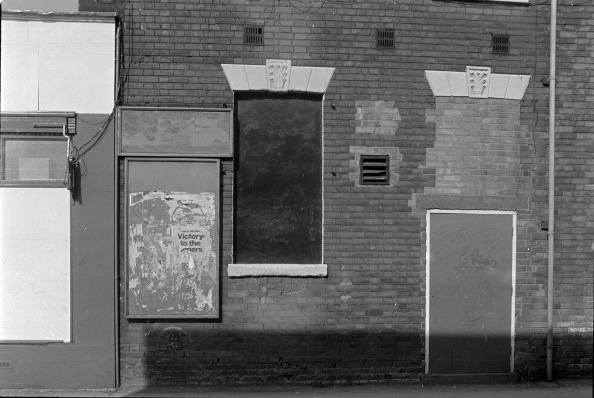
Just a few yards down a street leading off from Holderness Rd was an unusual display of rectangles – empty notices, blocked windows and doors, some bricked up and ventilation. And just one message: “Victory to the miners”. Their strike had ended in defeat two months earlier


85-5h-54: Victory to the miners, Holderness Rd, 1985 – East Hull

9th October 2017

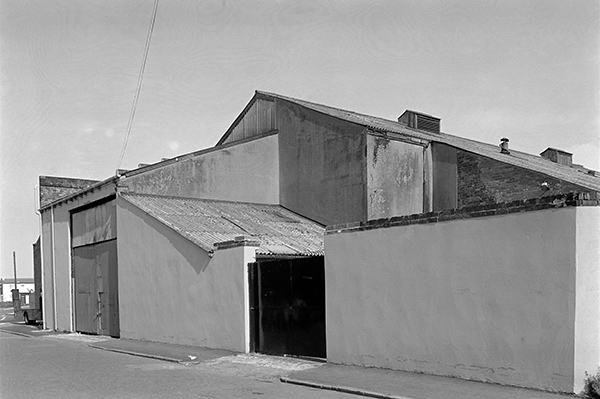
This rather unusual complex of interlocking buildings were on Church St, on the south side of the road just to the west of end of the road at the junction with Naylor’s Row/Marvel St and Strawberry St.

The site is just to the west of Paling Joiners, roughly opposite East St and I think the larger building at the back of the picture is possibly still there, perhaps with some alteration (or replaced by a similar building), though the rest has gone, and a thick hedge obscures the view.

The white building in the distance is the Kingston Arms, though rather closer to me just out of picture is The Blacksmith’s Arms, now closed and put up for auction last year as “a fantastic development opportunity.”


85-5h-55: Industrial site, Holderness Rd area, 1985 – East Hull

10th October 2017

Hull had many windmills in earlier years and around 30 are listed within the city boundary on Wikipedia, though most were demolished before the start of the 20th century. This mill appears twice on the list there and is, so far as I’m aware, the only one that remains in Hull, as The Mill public house on Holderness Rd, opposite East Park. There are of course quite a few in the surrounding area, including one at Skidby, said to be the last working mill in East Yorkshire.

This mill was restored in the late 20th century and is a Grade II listed building, as too is the public house, The Mill, adjoining it. It now has a cap and sails.

The mill had been disused for many years. A 1928 photograph shows it in a similar condition to my picture with a large advert for the Hull Daily Mail painted on it and a board for the business premises of W Lockwood in front of it. It could be the same board as was there when I took my picture but the name had change and now ended in OWEN with telephone number 783516. The remains of several advertising messages are dimly visible, one perhaps for a brand of Stout, and in front of the image are a number of blank headstones in what was presumably the yard of an monumental mason.


85-5h-64: Windmill, Holderness Rd – East Hull

11th October 2017

Carr St, off Scott St, was demolished to provide further parking for the Maizecor mill on Wincolmlee, although a downturn in business probably meant it was never needed. The building at right is the Scott Street Methodist Chapel of 1804, from around 1910 the printing works of Mason & Jackson Ltd, and at the centre of the image, along what had once been Marsh St were the buildings of the Sculcoates Relief Office.

The story of this chapel and the failure of attempts to get it listed in the 1990s are told by Paul Gibson and the buildings were all demolished in 2001. The extended lorry park this provided was always more or less empty when I went past.


85-5i-14: Carr St, 1985 – River Hull

12th October 2017

A young man smiles as I take a picture of him sitting on his horse-drawn cart on Bridlington Avenue in front of the works of Rose Downs and Thompson Ltd.

I’ve written earlier about Rose Downs and Thompson Ltd, iron-founders and manufacturers of oil mill and hydraulic machinery, and their pioneering work in the UK building their listed 1900 factory extension (not in this picture) and the bridge on Cleveland St using the Hennebique ‘ferro-concrete’ system.


85-5i-21: Rag and Bone man, Bridlington Ave, 1985 – Beverley Rd


You can see the new pictures added each day at Hull Photos, and I post them with the short comments above on Facebook.

Comments and corrections to captions are welcome here or on Facebook.
Continue reading Hull Photos: 6/10/17 – 12/10/17