International Women’s Day

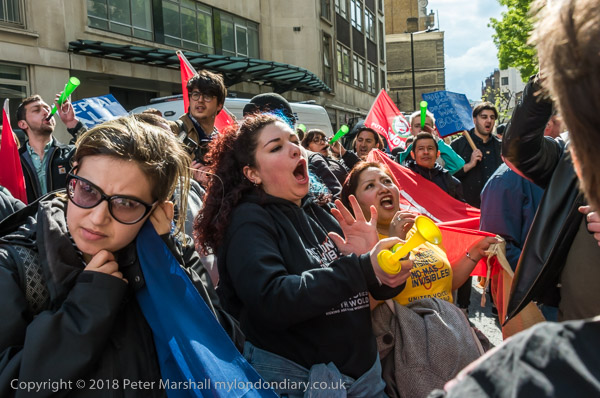
International Women’s Day was a busy time for protests in London, though I think none of them got in the news, where there seems to be a consensus that only middle class women’s issues matter on that day.

International Women’s Day began in New York in 1909, when the Socialist Party of America organised a National Women’s Day there on Feb 28th, and the following year it was adopted as an international celebration by the 1910 International Socialist Woman’s Conference.

In 1914 the date became standardised as March 8th, and in London the Suffragettes marched, with Sylvia Pankhurst being arrested on her way to speak at the rally in Trafalgar Square. And on March 8th 1914 in Russia (for them it was still Feb 23rd) it was the actions by women in cities including Petrograd and St Petersbury that began the Russian Revolution against the Czar – and a week later he abdicated and women were given the vote by the provisional government.

It was only the the 1970s, that the UN took up the day, and in 1977 it was adopted as the UN Day for women’s rights and world peace. Though we seem to have rather given up on world peace.
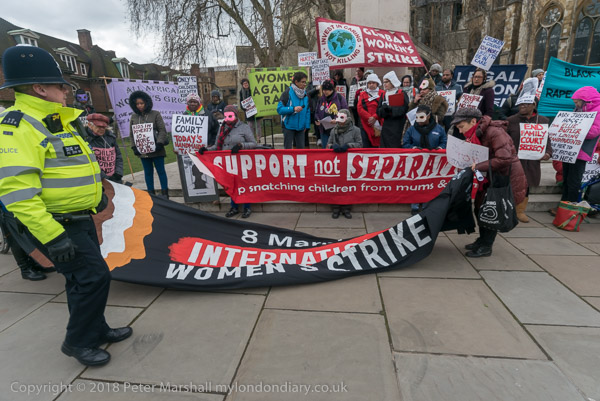
My Day began in Parliament Square, where Global Women’s Strike were staging a mock trial of the Family Courts. They say the courts fail families and remove children for adoption unnecessarily, mistaking poverty for neglect and failing to give support to victims of domestic abuse, and disabled mothers as required by the 1989 Children Act, and the Care Act 2014 . In Spain almost half of children needing taking into care are placed with kinship carers – mainly grandparents – while the figure for the UK is only 9%, less than one fifth as many.
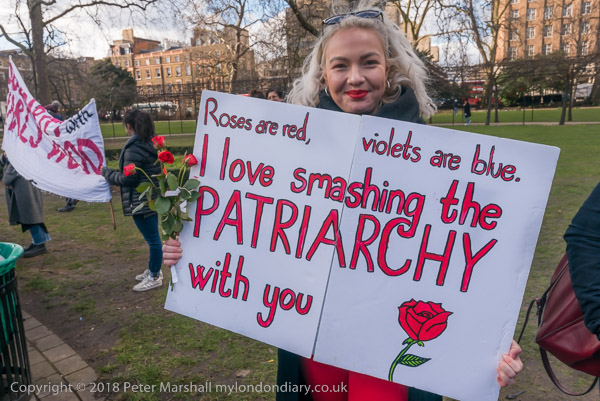
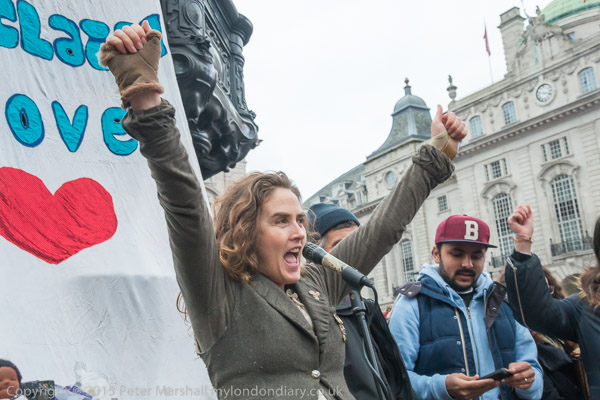
Next I went to Russell Square where women were taking part in the London Women’s Strike, refusing to do work either paid or unpaid, including housework and domestic work. There were speeches and singing and various events both in Russell Square and elsewhere in London supporting protests concerning women, three of which I attended.
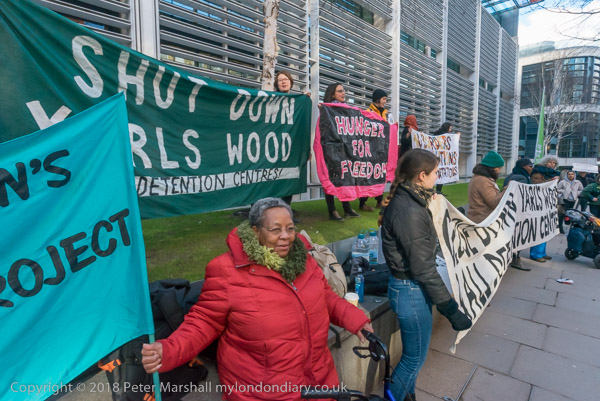
The first was at the Home Office, where protesters had come to show solidarity with the women detained in Yarl’s Wood, some of whom were on the 15th day of a hunger strike and general strike against their imprisonment and the conditions and treatment by the detention centre staff and the Home Office. The Home Office has so far responded to their demand for proper treatment by issuing public denials that the action is taking place and sending letters to the women taking part threatening them with accelerated detention.
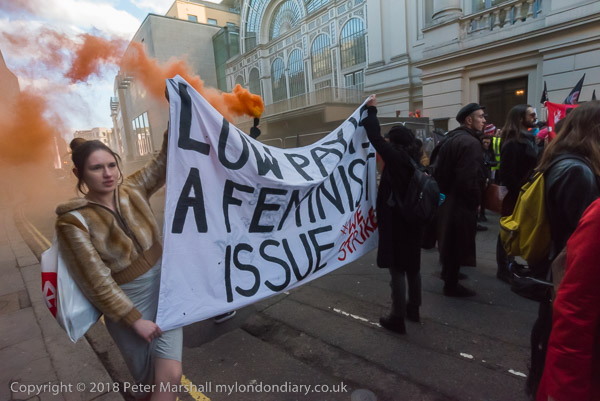
Next I met the CAIWU at Covent Garden, where a largish crowd from the London Women’s Strike had come to support the cleaners, mainly women, at the Royal Opera House, where several CAIWU members are bing victimised by contractor Kier for taking part in successful union action to get a living wage there.The larger crowd made the protest more impressive, but it took a whole series of almost daily actions there for some weeks to get justice.
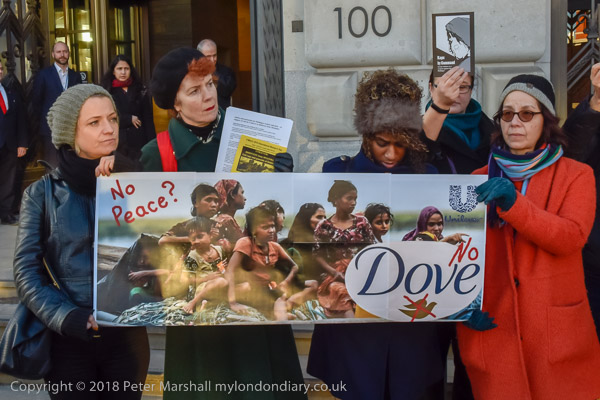
My final event for the day was at Unilever House and was again with Global Women’s Strike who are calling for Unilever to end their $667 million investment in Myanmar where the military government are committing systematic rape and other torture with total impunity as part of their genocide against the Rohingya people. Posters showed their actions in marked contrast to the image and advertising of Unilever’s Dove products, which claims that “UNILEVER aims to improve safety for women and girls in the communities where they operate.

Although some of the women were going on to further events for the day, by the end of this I was exhausted and decided it was time to go home.

More at:

Family Courts put on Trial
London Women’s Strike
Solidarity with Yarl’s Wood
Reinstate the Royal Opera House 6
Unilever & Myanmar’s Rohingya genocide
US Embassy

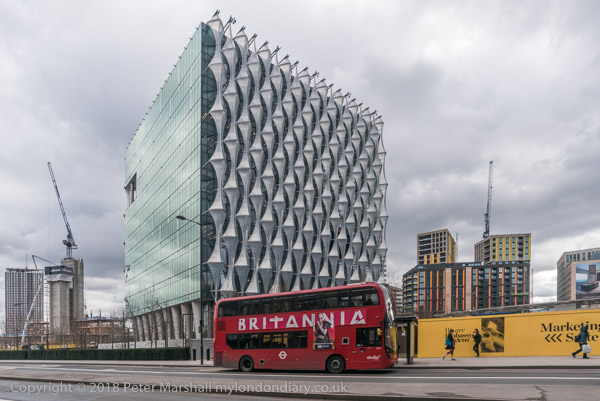
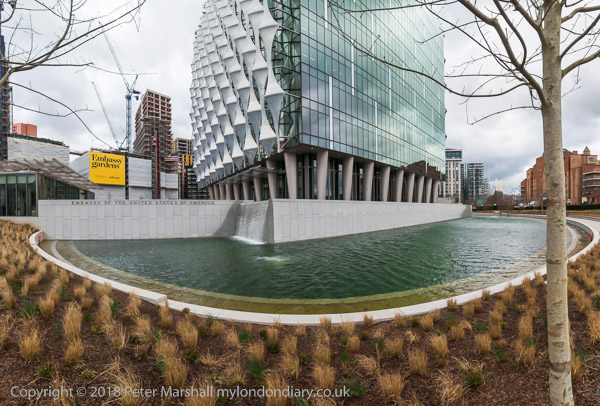
I made another visit to the new US Embassy in Nine Elms, and the picture above I think gives a good example of the strengths and some weaknesses of the wide-angle panoramic format. This image would be impossible with a rectilinear lens, as the horizontal angle of view is around 147 degrees.  My maths is a bit rusty but I think on full frame that would need a 5.3mm focal length (and have just checked this with an on-line calculator.)

The widest full-frame rectilinear lens I’ve ever used is a 12mm, which gives a measly 113 degrees, and stretched out objects at its edges to an often ridiculous extent. Even the 16mm of the 16-35mm (currently in a broken state on my desk) with it’s 97 degrees had to be used with extreme care. I sometimes miss the extra width now with my 18-35mm, (90 degrees) but it is a lot easier to use.

Looking at the edges of the image above, buildings and plants, including the slender tree trunk have retained their natural shape and size, even right into the corners of the image.

Holding the camera absolutely level enables the horizon to be kept straight, but has the disadvantage that it is always exactly across the centre of the image, often where you want it, but with a whole series of images it can become rather monotonous. This is one reason I often crop from the 1.5:1 format in which I make these images to 1.9 or 2.0:1. A second reason concerns horizontal lines away from the image centre.

Although the image is corrected to make vertical lines straight, other lines away from the horizon become increasingly curve. While this does not often show in a sky area, it can create unnatural-looking curves in the foreground. Cropping some of this can often remove the most glaring effects.

The ‘moat’ creates an almost perfect subject for the treatment, being curved. The lens perspective enhances that curvature, appearing to wrap it more around the building than is truly the case. It could be seen as a problem, but it does improve the picture.

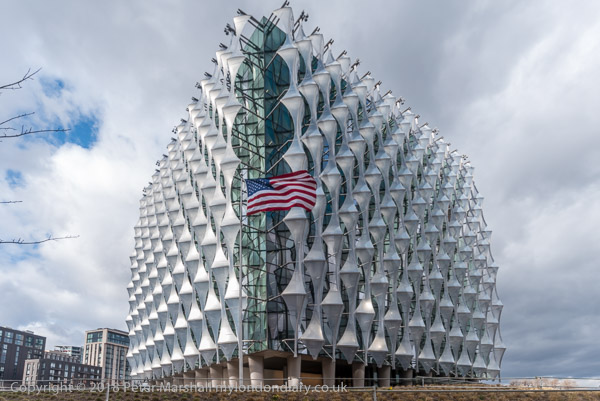
Where things are less happy is with the building itself, which is basically a cube with some added decoration on three sides (only one of which is visible from this viewpoint.) To me this picture clearly makes the corner shown look less than the 90 degrees it actually is.

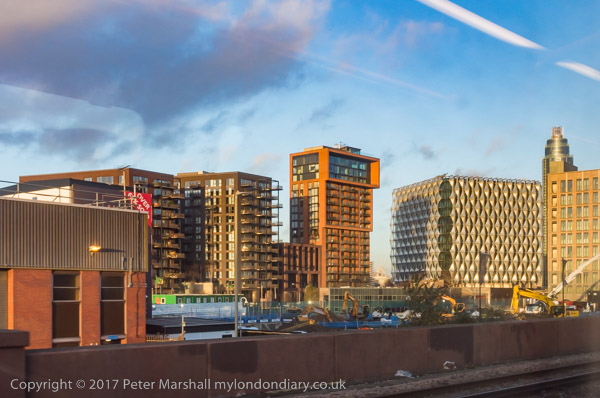
Even with a rectilinear lens, working close to the embassy doesn’t really show it as a cube – this picture is with the 18-35mm at 18mm. From the other side of the road it perhaps looks rather more the shape it really is – as the picture below shows.

But for various reasons I feel it is a building better viewed from a distance – as I do most days when I’m travelling up to London. Though since the trains on this route no longer have windows that open it is hard to avoid reflections and the view is seen through often scratched and dirty glazing.

More pictures around the embassy at Embassy Quarter.

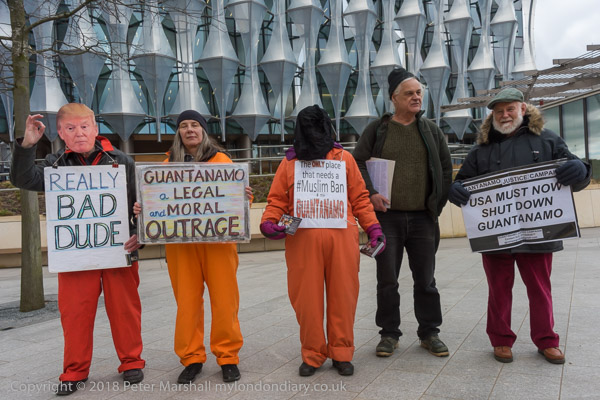
The protest I had gone there to photograph was the regular monthly Shut Guantánamo protest by the London Guantánamo Campaign, which have been taking place outside London’s US Embassy since 2007. This was there first protest at the new location, which some had problems with finding and only arrived after I had to leave. They intend to continue these monthly protests until all of the 41 still held there have been released and the illegal prison camp closed down.

Shut Guantanamo at new US Embassy

______________________________________________________

There are no adverts on this site and it receives no sponsorship, and I like to keep it that way. But it does take a considerable amount of my time and thought, and if you enjoy reading it, a small donation – perhaps the cost of a beer – would be appreciated.

My London Diary : London Photos : Hull : River Lea/Lee Valley : London’s Industrial Heritage

All photographs on this and my other sites, unless otherwise stated, are taken by and copyright of Peter Marshall, and are available for reproduction or can be bought as prints.

To order prints or reproduce images

________________________________________________________

May 2018 pictures

May was another busy month, despite my intentions to take things easier and a rather painful right leg which did make me decide to miss a few events. Going away for one weekend  and attempting to celebrate my birthday also had little effect on the amount of work. I did manage several walks with myself and family which are included here; though relaxing in some ways they often take more time in researching what I have photographed – the late May Bank Holiday stroll from Falconwood to North Woolwich being a good example.
May 2018

Woolwich wander


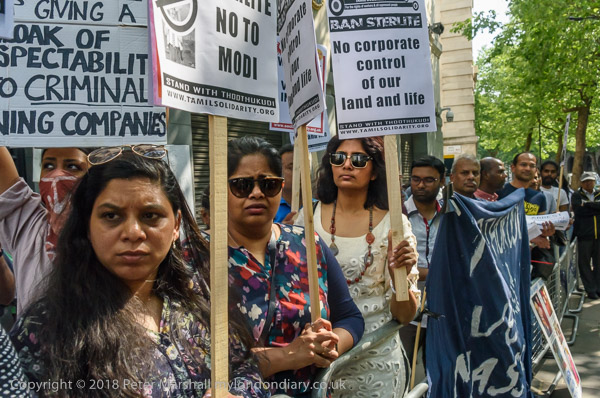
India complicit in Thoothukudi killings
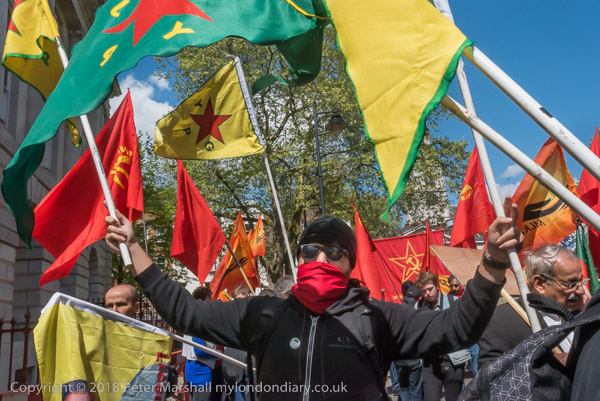
March Against Turkish Occupation of Afrin
Youth Peace Walk by Korean-based cult
‘Be the Change’ Knife and Gun Crime
Windlesham Walk
Universal Credit rally & march


Universal Credit protest at Tate Modern
Stop Charter Flight to Pakistan
DPAC protest GTR rail discrimination


Solidarity with Gaza – end support for Israel
Barclays Stop Funding Climate Chaos
Zionists defend Israeli shootings


Israeli massacre of protesters
Erdogan, Time To Go
Grenfell Parliamentary Debate Rally
BNP say release Khaleda Zia
Manchester walk
Manchester marks the 1948 Nabka
Rochdale Canal
Capital Ring Greenford to South Kenton


Windrush Immigration Act protest
Windrush rally against Theresa May
Anti-Abortion March for Life
Women protest anti-abortion march
Croydon march for May Day
Lambeth Housing Tell Us the Truth
CAIWU Mayday Mayhem at Royal Opera
Precarious Workers – King’s College


Precarious Workers – Ministry of Justice
May Day Rally
May Day March on the Strand
Against Deportation Charter Flights
Lyme Disease epidemic


London May Day March meets

London Images

______________________________________________________

There are no adverts on this site and it receives no sponsorship, and I like to keep it that way. But it does take a considerable amount of my time and thought, and if you enjoy reading it, a small donation – perhaps the cost of a beer – would be appreciated.

My London Diary : London Photos : Hull : River Lea/Lee Valley : London’s Industrial Heritage

All photographs on this and my other sites, unless otherwise stated, are taken by and copyright of Peter Marshall, and are available for reproduction or can be bought as prints.

To order prints or reproduce images

________________________________________________________

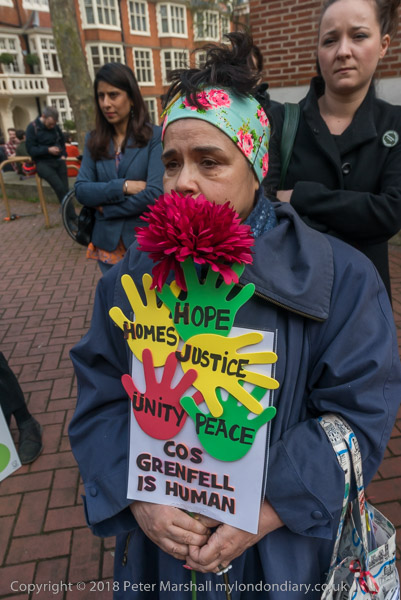
Grenfell – One Year On

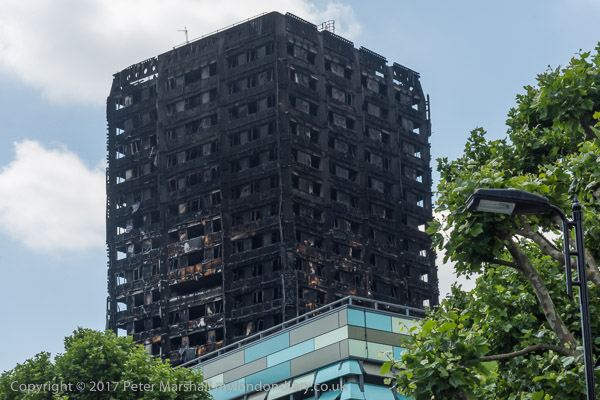
A year ago, Grenfell Tower was still burning, and I woke up to hear the news on the radio. I didn’t know the block, though I’d walked through the area on various occasions. Often very different to now as I made my way to or from Latimer Rd station on my way to or from carnival.

I  lay in bed listening to the terrible news of people trapped, burning to death, some phoning to say goodbye to relatives and friends knowing there was little or no hope of rescue. Thinking of those too who had managed to make their way out, finding their way to the stairs through thick smoke and making their way down the stairs, floor by floor.  Many years before I’d walked down eleven flights from my room, but fortunately it was for a false alarm.

Once I got up I went to my computer and started looking things up about Grenfell. One of the first things I came to was the blog by some of the residents, the Grenfell Action Group. The post KCTMO – Playing with fire! which stated as inevitable that the fire would happen at some time was only the latest in a series of posts raising the residents concerns about fire safety in the black.

There are many other posts on the Grenfell Action Group’s blog worth reading, and which expose the cavalier attitude of the Royal Borough of Kensington & Chelsea’s council – councillors and officers – to those in the housing it owns as well as the council’s TMO to which it delegated management. There is also an excellent recent long interview with Eddie Daffarn from the group published by Channel 4 News last month.

One of the first serious reports on the fire and its physical causes was ‘The Truth about Grenfell Tower: A Report by Architects for Social Housing‘, also available as a PDF, published just five weeks after the fire – and much of what it contains came from a public meeting they organised only 8 days after it, and recorded in edited version in the film ‘The Truth About Grenfell Tower’ which is also on the ASH page.

The official response has of course been much slower, with hearings only recently getting under way and dragging on for many months. Many see the deliberately slow pace of this and other public inquiries as being a deliberate tactic to allow the guilty to escape judgement, and it seems unlikely to unearth much that isn’t already known. Mainly it – and other major inquiries – allow the parties involved to spend huge amounts employing barristers whose task is often more to obfuscate than elucidate. And of course earn large fees in the process.

Probably the least useful document to emerge about Grenfell is the recent publication by the London Review of Books,’The Tower‘ by author Andrew O’Hagan. In ‘O’Hagan And His Ivory Tower‘ the Grenfell Action Group publish a letter of complaint to the LRB by one of the local residents interviewed by O’Hagan who was appalled to see how her input, and that of others, was misrepresented, and how inaccurate much of the essay was.

The LRB also produced a film, ‘Grenfell: The End of an Experiment?‘ by Andrew Wilks, which is considerably better, although still at times attempting to cast the council as the victims rather than the perpetrators. But at least we see some of the evidence, and not just the author’s recasting of it and can make our own conclusions.

Also well worth reading is the long and detailed refutation of O’Hagan’s essay by Simon ELmer of ASH, ‘The Tower: Rewriting Grenfell‘.

Grenfell of course isn’t just about Grenfell and those who died and the survivors who are still suffering – and will continue to feel its effects for the rest of their lives. Grenfell is a symbol of a much wider malaise in our society, and the attitudes of the wealthy towards the poor. It’s perhaps a curious and largely unnoticed coincidence that the first issues of the anarchist magazine Class War were actually produced in Grenfell Tower, Ian Bone’s first London home.

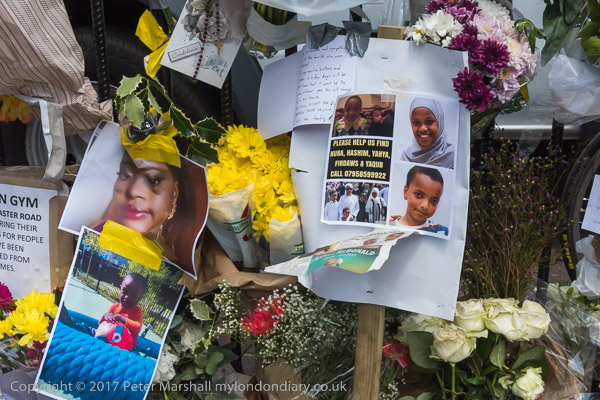
Tonight I’ll be on the silent march marking the anniversary – one of a programme of events. There are also marches taking place in other cities.

______________________________________________________

There are no adverts on this site and it receives no sponsorship, and I like to keep it that way. But it does take a considerable amount of my time and thought, and if you enjoy reading it, a small donation – perhaps the cost of a beer – would be appreciated.

My London Diary : London Photos : Hull : River Lea/Lee Valley : London’s Industrial Heritage

All photographs on this and my other sites, unless otherwise stated, are taken by and copyright of Peter Marshall, and are available for reproduction or can be bought as prints.

To order prints or reproduce images

________________________________________________________

Horsing around London

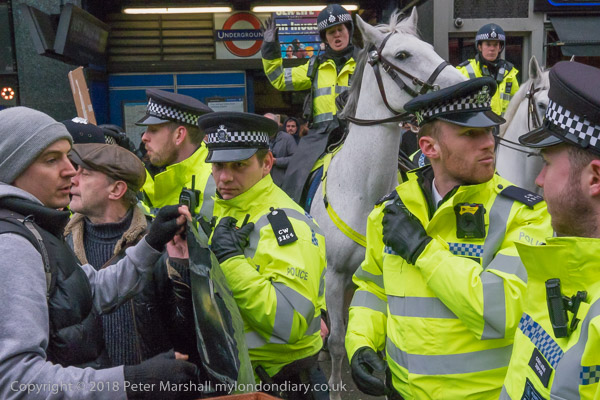
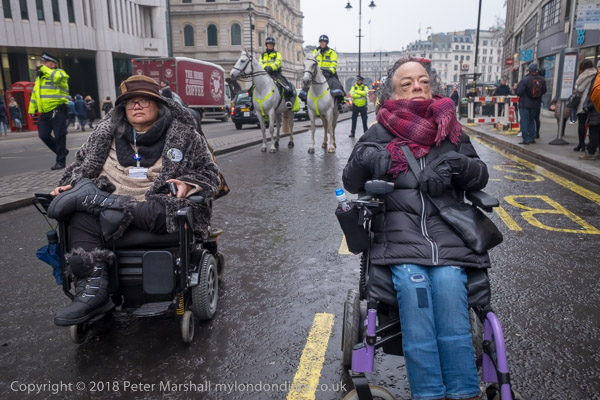
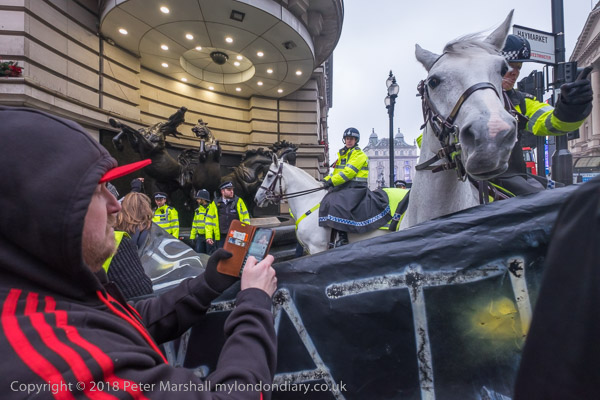
I don’t like police horses. It’s perhaps something that goes back to 1968 and those student demos I took part in, at at least one of which horses were deliberately ridden into crowds unable to move out of their way. But even though I’m sure that both the Met’s horses and riders are highly trained, every time I see them in action at protests there are times when the horses are clearly out of control. One in particular at this protest was proving my point, its rider spending most of her time shouting at everyone to get out of the way as it pranced and kicked out randomly.

Of course, it’s partly this lack of control that makes them effective, particularly in confined spaces and crowds, where large, heavy animals with only partly controlled movements are extremely frightening. If a vehicle with similar properties were to be built, it would quite rightly be banned. There is a place for horses, and they certainly can look impressive on ceremonial occasions, but they are a far too blunt and unpredictable force for crowd control.

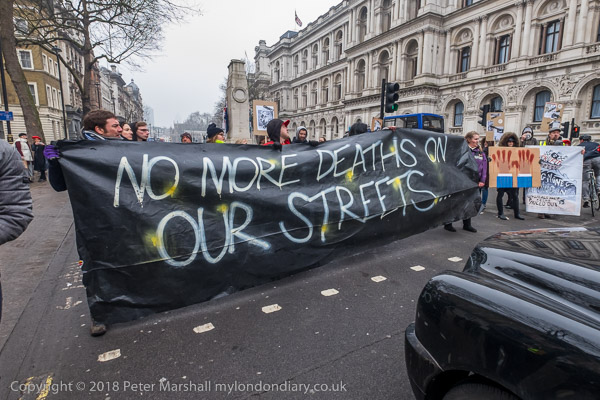
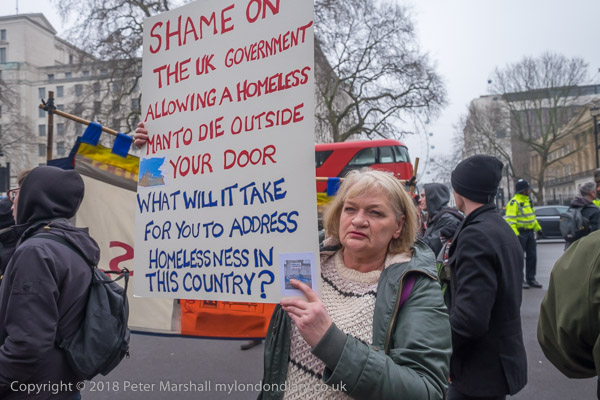
March With The Homeless was an event by grass-roots groups which work on the streets with the homeless, providing them with food and shelter, filling the gaps that have become much more gaping in our society, thanks to successive governments failures to deal with problems. In my lifetime we have moved from a society where we cared for everyone and homelessness was rare to one where there are beggars on the streets and people sleeping all over our major cities.

When I was young, there were a few tramps. Some would knock at our door – a small semi on an outer London street – and ask for water, and my mother would give them a cup of tea and talk to them. They tramped to find seasonal work. We seldom had pennies to spare, but I think she would find a few for them. But it was only when in my twenties that I went to Paris that I first saw beggars – and at first I didn’t realise what they were – and people living on the city streets.

People squat unused commercial buildings – there are many around London – and set them up as unofficial community centres, offering free food (often scavenged or donated) and a roof, as well as friendship. They sometimes have problems with police, though officers often see they are providing a vital service and saving lives, police orders come to protect property and the officers enforce them. Owners get court orders and bailiffs come to evict, often helped by police even when legally their role should be to see that the bailiffs keep to the law.

The protest was a relatively small one, and taking place towards the end of the evening rush hour. It was unlikely to lead to any great public disorder, and would have gone ahead rather more smoothly with no police presence at all. The horses – and rather more on foot than was needed – were I think there in case the protesters had decided they wanted to march down the Mall to protest outside Buckingham Palace – as they had at a previous protest.
In fact they had other plans, though they were not letting the police know, wanting to go through Covent Garden and parts of the West End to finish at the squatted Sofia House on Great Portland St. There were a number of confrontations as police tried to get them to go a different way at several road junctions, though it was hard to see why, other than to try to show they were in charge, before the march finally came to a halt at the top of Haymarket, where the police horses were joined by others in the sculpture on the corner and the road was blocked by police and demonstrators.

There were some lengthy discussions between police and the march leaders, with the police insisting the march go down Haymarket, but the protesters intending to go forwards to Piccadilly Circus. I think eventually the officer in charge realised the futility of the police action, which was merely increasing the disruption caused by the march, and an agreement was reached with the march going on towards its destination. But by this time I was tired and hungry and went home.

More at  No More Deaths On Our Streets.

______________________________________________________

There are no adverts on this site and it receives no sponsorship, and I like to keep it that way. But it does take a considerable amount of my time and thought, and if you enjoy reading it, a small donation – perhaps the cost of a beer – would be appreciated.

My London Diary : London Photos : Hull : River Lea/Lee Valley : London’s Industrial Heritage

All photographs on this and my other sites, unless otherwise stated, are taken by and copyright of Peter Marshall, and are available for reproduction or can be bought as prints.

To order prints or reproduce images

________________________________________________________

Snowy HE protest

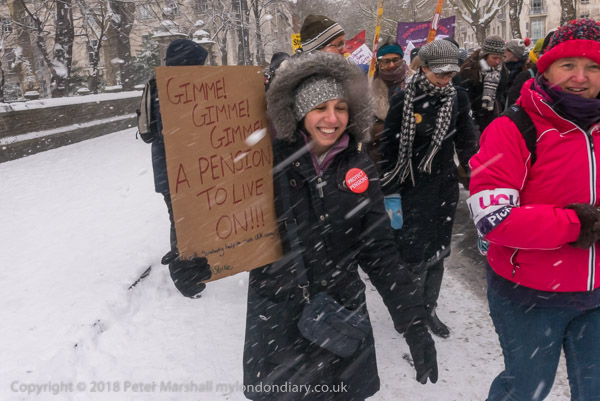
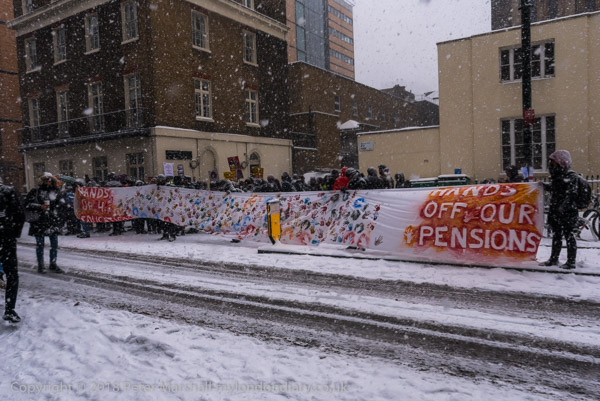
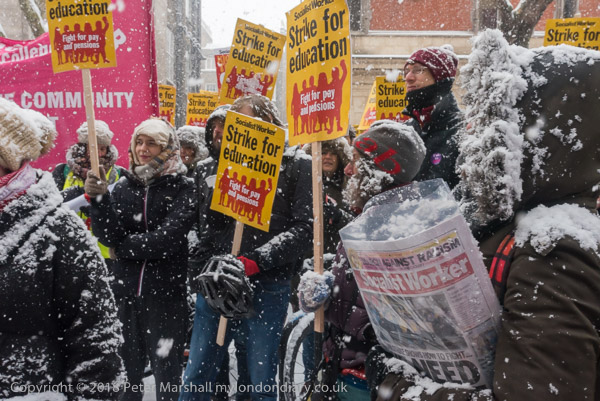
London felt more like Moscow, or rather how I imagine Moscow as I’ve never been there, as I made my way from the bus stop to Malet St. There was a wind that made it hard to walk and drove the snow into my face, and I’d slipped and almost fallen, just “catching myself and my camera bag before either hit the couple of inches of snow on the ground in Byng Place”. By the time I was in Torrington Place it was hard to see the crowd standing there with a large banner, having to wipe my glasses and my camera lens and trying to take pictures. It slackened off slightly and between squalls I managed to get one picture that wasn’t ruined. I always hope that I’ll get a nice arty result from rain and snow on the lens, but somehow it never seems to happen, and in any case I don’t think Alamy would like it.
One book on ‘Bad Weather‘ is probably enough for the whole of photographic history, and it remains in my opinion one of Martin Parr’s better titles. I even paid money for it, though my first edition seems to have gone missing. Being unsigned might make it something of a rarity!

Once I was in the crowd they afforded some shelter from the weather and things were a little easier and I could make the occasional picture without snow on the lens. And even some in which people’s eyes weren’t covered by snowflakes. Fortunately the snow didn’t keep on for too long, though there were some short and heavy showers as the march made its way towards Westminster.

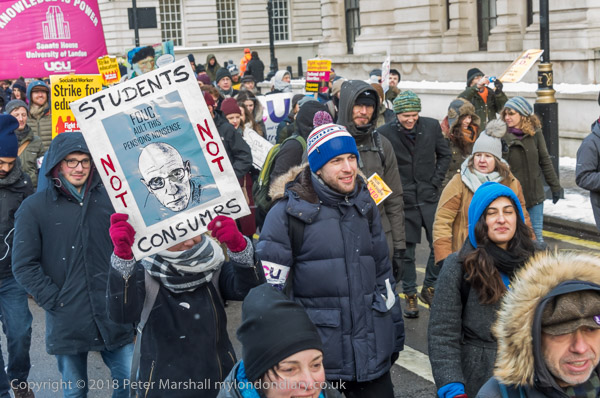
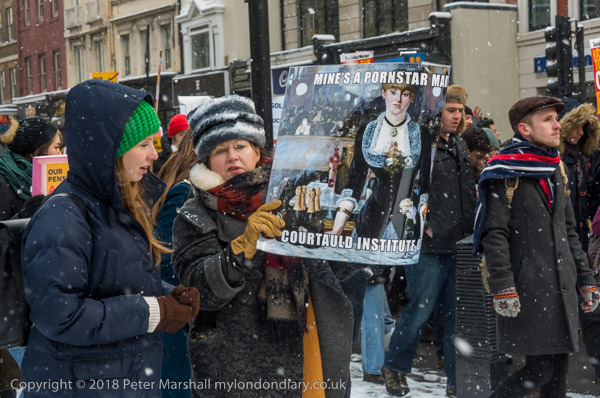
This was a protest by the UCU, lecturers in higher education, with support from their students, and some of the placards reflected this. They wanted proper talks with their employers about pensions and pay, particularly as the universities had announced their intention to steal much of their pension funds. And they were joined by some FE staff from the London area who were on the first day of a two-day strike over their pay and conditions.

If you’ve ever tried walking backwards on snow or ice, you may appreciate the problem I faced on photographing the marchers, where most of the time you are walking backwards at the same speed as they walk while taking pictures. Usually the main hazards of this are lamp posts and kerbs, but snow does add a dimension. Fortunately once we got out of Russell Square and were onto busier roads (they would have been busier but for the marches) most of the snow there was now slush and rather less slippery.

It wasn’t a particularly long march, I think about two and a half miles, and I walked the whole way, though there were some long sections where I took no pictures when the snow came on again. I’d dressed well for the weather – with long-sleeved thermal vest and longjohns over my normal underwear, a cashmere scarf, thick socks and a woolly hat, as well as my usual wind and waterproof winter jacket, but I still got cold. Better gloves would have helped – but photographers need to be able to use their fingers. I had a pair of thin silk gloves under a thicker wool pair, which still allow be to operate the camera controls, but I think I need to research for a better solution.

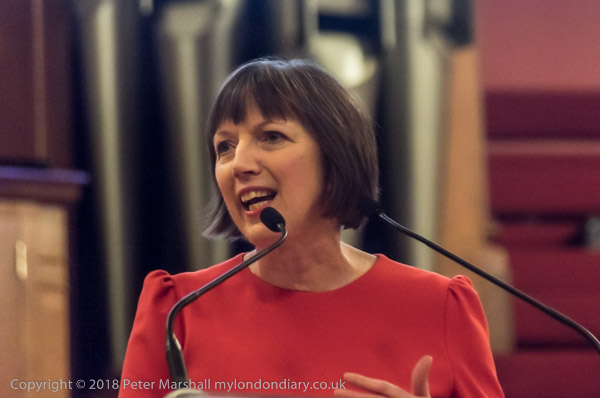
I don’t usually cover indoor rallies, but went into Methodist Central Hall with the first of the marchers largely to sit in the warm. I spent around an hour or so in there, and took pictures of the speakers, who included some well-known trade unionists and Labour politicians, so the time wasn’t wasted, though the light wasn’t too good and I could have got a little closer. But I got nice and warm by the time I had to leave to cover another protest outside a short distance away.

HE and FE march for pensions and jobs
HE & FE rally for pensions and jobs
______________________________________________________

There are no adverts on this site and it receives no sponsorship, and I like to keep it that way. But it does take a considerable amount of my time and thought, and if you enjoy reading it, a small donation – perhaps the cost of a beer – would be appreciated.

My London Diary : London Photos : Hull : River Lea/Lee Valley : London’s Industrial Heritage

All photographs on this and my other sites, unless otherwise stated, are taken by and copyright of Peter Marshall, and are available for reproduction or can be bought as prints.

To order prints or reproduce images

________________________________________________________

D Day and more

Perhaps because the media have been so preoccupied with the anniversaries of the First World War there was little publicity this year about the anniversary of D-Day, June 6th 1944. Which perhaps explains why I’m only writing about it a day late, having seen some posts about it on Facebook late last night.

Although we now know much more about the iconic images taken by Robert Capa – and the myths that have grown up around them and are still being stated as fact, even by some who are perfectly aware of the investigation by A D Coleman and his team, a three year study concluded around a year ago, when I last wrote about it. I suppose they are following Capa’s example; his most famous dictum was ‘If you’re pictures aren’t good enough, you’re not close enough‘ but perhaps the attitude that most shaped his life was to never let the facts get in the way of a good story, though to be fair the story that he wrote was intended more as a Hollywood treatment than real autobiography.

I don’t mean by this in any way to belittle Capa as a photographer. The investigation is one that I think paints others in a worse light than him, though he certainly went along with the deception. Nor do I in any way minimise the shock of landing on that Normandy beach; for the military who went as a team to do a job they had trained to do it will have been far less horrific than for a lone individual, and I doubt if many of us would have handled the situation there any better. If anything I admire him more for his courage in realising that he had to return as soon as he could and get on with doing the job.

I’ve fortunately never been under fire from an enemy army. The nearest I’ve come is having milk bottles thrown at me from six floors up on a council estate, beer cans and bricks thrown from far right groups and a firework rocket aimed horizontally at me early one Sunday morning by kids in Bermondsey that missed by inches. And a paintball which splatted on my chest from the black bloc, probably like other missiles aimed at nearby police. I’ve been spat at, threatened, cursed, pushed and punched by the right, assaulted by police… But generally I’ve chosen to avoid violent situations, and I know I would never be a good war photographer. So Capa and the others who have chosen that course deserve and get my respect.

I hadn’t meant to do more than briefly mention D-Day and Capa, but as so often I got a little carried away. On being reminded of the anniversary I took another look (as I do fairly often) at Photocritic International. A D Coleman’s latest post there has the rather uninformative title Spring Fever: Ends and Odds 2018 and is, as always, worth reading, with a typically acute analysis of the case of Naruto, a crested macaque who picked up David Slater’s camera and took a few pictures with it. Coleman explains and comments on the decision by the Federal Appeal Court that copyright law covers the actions and creations of humans, and only humans, as well as on the concept of animals having names.

The post also contains Coleman’s incisive comments on two other matters, one of which is also – like the names of animals – related to ideas of ‘identity’ and brings in Alfred Korzybski’s argument that we should beware of all variants of the verb to be, which is perhaps rather relevant to some current debates, and a second more specific to photography, and in particular the devaluation of photojournalism, something some previous guest posts on Photocritic International have explored. It’s perhaps ironic that while some photographs now sell for undreamed of amounts in the art market, the rates for photojournalism are actual cash terms are lower than they were 30 or 40 years ago, despite huge inflation. Or if not ironic at least pretty desperate for those trying to make a living.

Reclaim Love 15

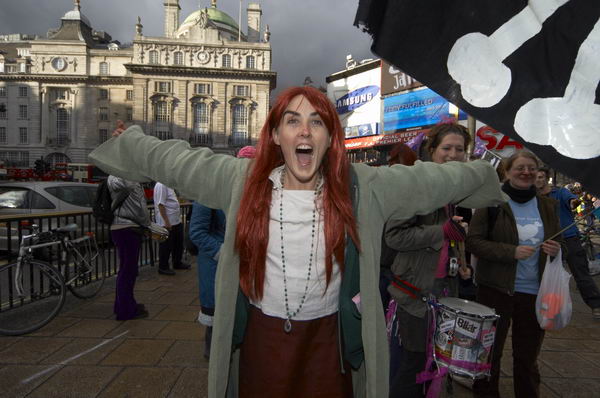
It was back in 2005 that I first met Venus CuMara, the founder of London’s Reclaim Love Pavement Party celebrated at Piccadilly Circus, a free and joyous event which she organised for 14 years. I didn’t go to the first of them, not hearing about it until after the event, but since then it has become a permanent date in My London Diary, though I think there has been the occasional year I’ve been out of London at the time.

Back in 2008 I wrote:

‘”We are O-I-L
We are Operation Infinite Love because we are…
One In Love”

says the web site, and OIL sets out to reclaim St Valentines Day from its commercial appropriation in the very temple of consumerism that is Piccadilly Circus, dominated by a giant wall of advertising neon. Appropriate too because at the centre is a statue of Eros.

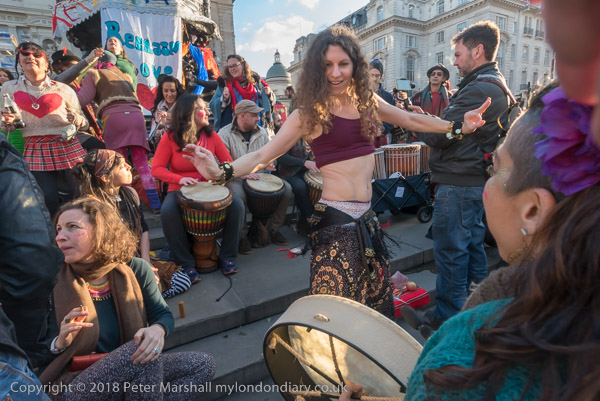
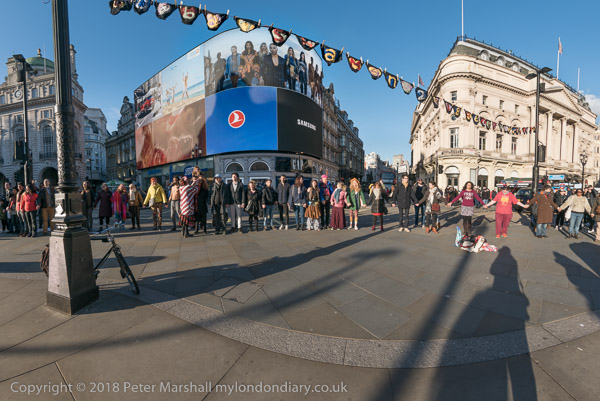
Venus says “Love is the most important resource on this planet and that without love we are nothing.” The event culminated in the formation of a large circle when everyone present joins hands around the area, and there was lots of music, including that finest of street bands, the samba of Rhythms of Resistance, along with other musicians and sound system, as well as free food, free T-shirts and a great atmosphere.’

This year there was still much of the same atmosphere, people getting together and celebrating life, but there was a little sadness this year, as Venus could not be there, as she was in Indonesia and being treated for cancer, and the event was missing her huge energy and enthusiasm.

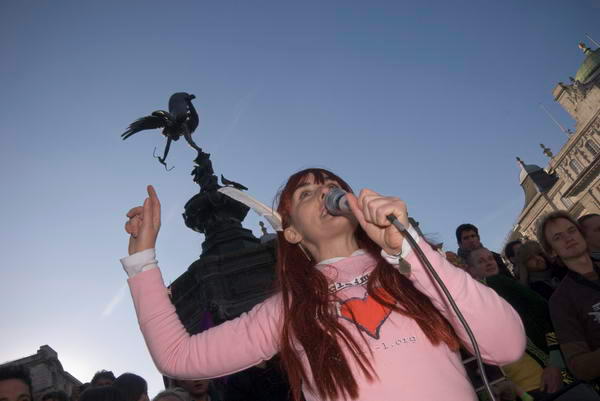
And people still joined hands in what Venus called a “Massive Healing Reclaim Love Meditation Circle beaming Love and Happiness and our Vision for world peace out into the cosmos” around Eros, repeating  the mantra as in previous years, “May All The Beings In All The Worlds Be Happy And At Peace”, and we all thought of Venus, seen below in one of many pictures I took of her at the 2015 event.

Back in 2016, when I was unwell and unable to attend, I wrote a post on this site the links to my coverage of the event in earlier years, . If you want to see more pictures from the earlier years this is a good place to start.

Pictures from this year: 15th Reclaim Love Valentine Party

______________________________________________________

There are no adverts on this site and it receives no sponsorship, and I like to keep it that way. But it does take a considerable amount of my time and thought, and if you enjoy reading it, a small donation – perhaps the cost of a beer – would be appreciated.

My London Diary : London Photos : Hull : River Lea/Lee Valley : London’s Industrial Heritage

All photographs on this and my other sites, unless otherwise stated, are taken by and copyright of Peter Marshall, and are available for reproduction or can be bought as prints.

To order prints or reproduce images

________________________________________________________

Lambeth’s Fake Library

Lambeth Council have a problem with their libraries. Put simply they cost money to run but don’t generate any income. You might think that a Labour council would understand the idea of public service, would recognise the value of libraries to the community, but apparently not.

As someone who grew up in poverty I know from personal experience the value of a library, which opened a whole world to me. We did have a few books at home, I think most had come as presents or from jumble sales or passed down from relatives, but the weekly walk to the library with my siblings was an important part of our week. I was fortunate that only half a mile away there was a good library, part of a early 20th century civic centre, with swimming baths, library (and a later children’s library) and council offices. It’s perhaps a sign of the times that the site is now a shopping centre.

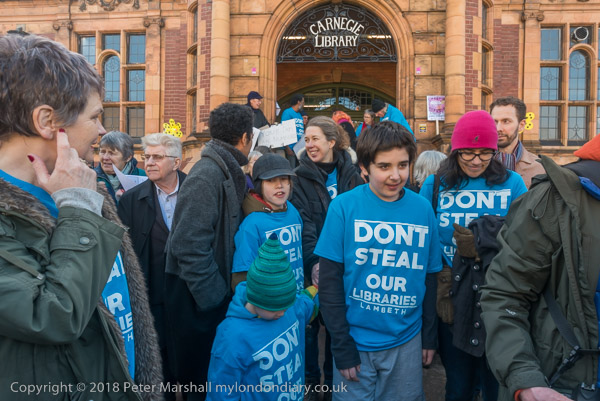
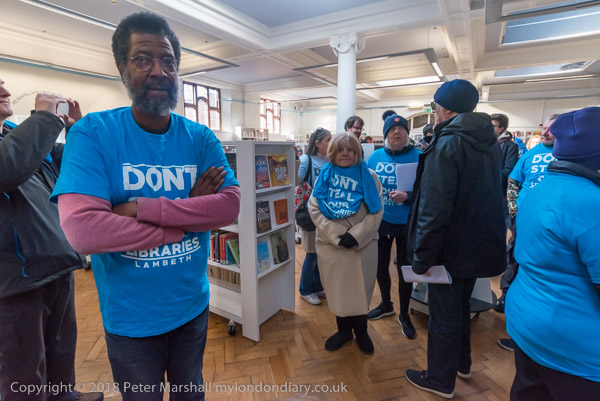
Lambeth Labour are turning the Carnegie Library in Herne Hill into a gym, which will serve the few in the community willing to pay for its services. The main room, where there are now some books and which we were allowed into, will no longer be a library but will be a hall for hire, although with very limited facilities.

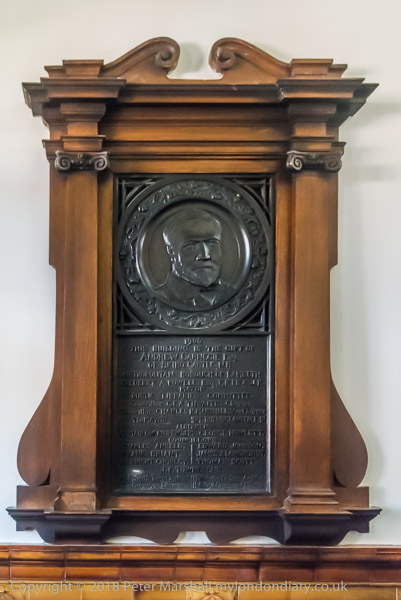
Andrew Carnegie was born in Scotland, where his family struggled to make a living and emigrated to the USA when he was 13. Times were tough there too, and he started work there in a cotton mill in Pittsburg, working 12 hour days 6 days a week for the equivalent (allowing for 170 years of inflation) of around 38p an hour. A few years later he became a messenger boy for the Ohio Telegraph Company in Pittsburgh, impressing people there with his hard work and skill. While there, Wikipedia states:

Carnegie’s education and passion for reading was given a great boost by Colonel James Anderson, who opened his personal library of 400 volumes to working boys each Saturday night.[21] Carnegie was a consistent borrower and a “self-made man” in both his economic development and his intellectual and cultural development. He was so grateful to Colonel Anderson for the use of his library that he “resolved, if ever wealth came to me, [to see to it] that other poor boys might receive opportunities similar to those for which we were indebted to the noble man”.

It was a promise he made good on, after having made a small fortune in railways and following this a very large one in building up the US steel industry, selling his huge share in this to J P Morgan in 1901 for around $230 million, and devoted the rest of his life until his death in 1919 to philanthropy. By the time of his death he had given away around 90% of his wealth – a total of around $350 million, and the residue was given away in his will.

Carnegie was clearly a remarkable man, but Carnegie Steel was a ruthless organisation responsible for one of the bloodiest anti-union fights in history, the 1892 Homestead Strike, when his business partner (Carnegie was away in Scotland) ordered in Pinkerton Agents to protect the strikebreakers who had been brought in to keep the mills rolling. Ten men were killed and hundreds injured and the strike beaten, with the workers replaced by non-union immigrants.

It’s perhaps particularly appropriate to mention now that Carnegie Steel’s huge success owed a great deal to secret lobby of the US Congress by Carnegie to get favourable US trade tariffs for the steel industry, and that, according to Wikipedia Carnegie’s success was due to his convenient relationship with the railroad industries, which not only relied on steel for track, but were also making money from steel transport. The steel and railroad barons worked closely to negotiate prices instead of free market competition determinations.” Not for nothing did he and the others become known as “robber barons.”

Carnegie had already begun his philanthropy in 1879, building swimming-baths in his home town of Dunfermline and the first Carnegie Library there in 1880. Many educational establishments benefited from his wealth and he funded around 3,000 free public libraries throughout the United States, Britain, Canada and other English-speaking countries for a total of around $60 million. Carnegie provided the buildings and fittings, but the local authorities had to provide the land and agree to provide the money to maintain and operate them.

Its a promise that councils in Lambeth more or less kept, though the maintenance has often been skimped, from when the Grade II listed library was opened in 1906 until its closure in 2016 when it reneged on this commitment.

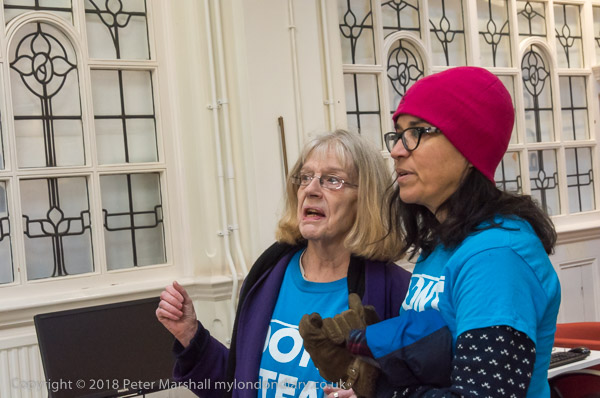
The closure for the building to be converted into a gym run by a private company led to a community occupation and a number of protests. We were there in February for a partial re-opening, of what the library campaigners described as a ‘fake library’, offering a very limited service on a temporary basis. They say it is being done a few months before May’s local elections in an attempt to defuse the closure issue politically.

Among those taking part in the protest were Unison safety inspectors. The library managers who were staffing the library for the opening attempted to prevent them from making an inspection, but they went ahead, and after we had been inside for 15 minutes called on everyone to leave as they declared the premises unsafe, with building work and gas cylinders obstructing the fire exit, unsafe temporary toilet facilities, unsafe heating and a lack of disabled access. They are advising union members to refuse to work there.

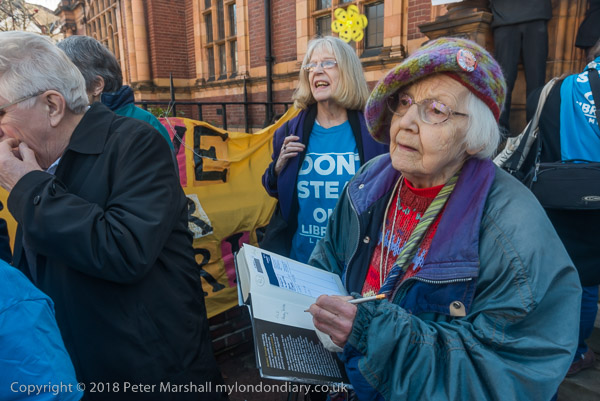
We left and the protest continued with speeches on the steps outside. One woman had brought out a book from the library, pointing out that there were no security measures in place to stop members of the public from stealing books.

More pictures: Lambeth Council opens fake Carnegie library

________________________________________________________

There are no adverts on this site and it receives no sponsorship, and I like to keep it that way. But it does take a considerable amount of my time and thought, and if you enjoy reading it, a small donation – perhaps the cost of a beer – would be appreciated.

My London Diary : London Photos : Hull : River Lea/Lee Valley : London’s Industrial Heritage

All photographs on this and my other sites, unless otherwise stated, are taken by and copyright of Peter Marshall, and are available for reproduction or can be bought as prints.

To order prints or reproduce images

________________________________________________________

Grenfell & Ladbroke Grove

As the survivors and friends and family of those who died in the Grenfell tower disaster recently finished giving their testimonies to the public inquiry, it is perhaps appropriate to point out that this is part of a longer history of contempt and neglect of the North Kensington community by the local council and national bodies.

Back in the 1960s, the Westway was built  as the A40(M) through the area, an elevated section of the A40 and a part of the London Motorway Box or ‘Ringway 1’ scheme which was to provide  motorway standard roads  (it lost motorway status in 2000 when taken over by the GLA)  across the city and involved demolition on a massive scale. Such was the devastation and public outcry caused when construction started that the massively costly scheme was abandoned in 1973 and the Westway, along with the nearby West Cross Route also in North Kensington along with the East Cross Route from Hackney Wick down to the Blackwall tunnel and on to Kidbrooke completed.  The ‘Homes before Roads‘ campaign persuaded the Labour Party to re-examine its transport policy, and the project was cancelled in favour of traffic management and investment in public transport when they took control of the GLC.

It was no accident that the completed routes were driven through some of London’s most deprived areas, particularly in North Kensignton, areas where opposition was expected to be weaker and the needs of the local communities judged to be of less importance.  But community in North Kensington turned out to be stronger and better organised than anyone had expected, and at the completion of the road the devastated area beneath and around it was given in 1971 to the North Kensington Amenity Trust (now renamed the Westway Development Trust), to be reclaimed and developed this land for local community use.

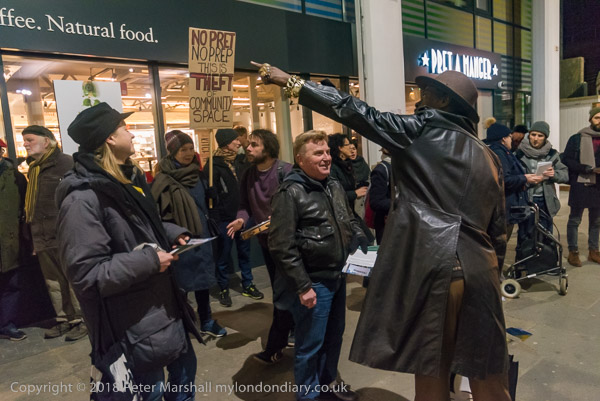
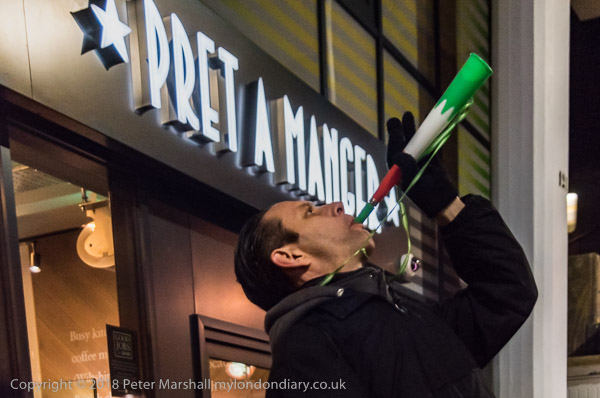
In recent years many locals see the Westway Trust as having become largely a commercial enterprise with close links to Kensington & Chelsea Council (RBKC).  Westway23 is a local action group set up to represent the interests of the community in those 23 acres dedicated to community use. On Feb 9th they protested on Ladbroke Grove outside the newly opened  Pret-a-Manger, on the ground floor of the site of the £6k per term  Notting Hill Prep School LTD (NHPS) in what had been the “Westway Information Centre, a building left in trust to the surrounding community and central to life in North Kensington.”

This abuse of public assets  was by “the Council, then under the leadership of Nick Paget-Brown, and Rock Feilding Mellen” who “were pursuing an asset-sweating strategy which prioritised the commercial value of public land, casting such issues as residents’ consent, public access, and public amenities as minor concerns.”

When the concil’s leadership after Grenfell was replaced by Elizabeth Campbell and Kim Taylor-Smith, they promised there would be change and they were listening to the people, and Westway23 called on them to reconsider the plans, and point out that the 23 acres which the Trust was set up and entrusted to protect for the community is now 80% used by commercial interests.

They state:

“Reducing the land available to the community in order to facilitate the expansion of a £6k per term prep school is, in our view, a misuse of the land; and the use of council funding to pay for building development works is a misuse of public funds. The School’s decision to sublet part of their lease to corporate interests – that not only do not enhance, but actively threaten, the mix of independent and community led activities on the 23 acres – demonstrate a worrying level of ignorance from the School about the interests of the local community. ”

Further they say that  RBKC has broken its planning guidance by letting another chain into North Kensington, rather than an independent business.

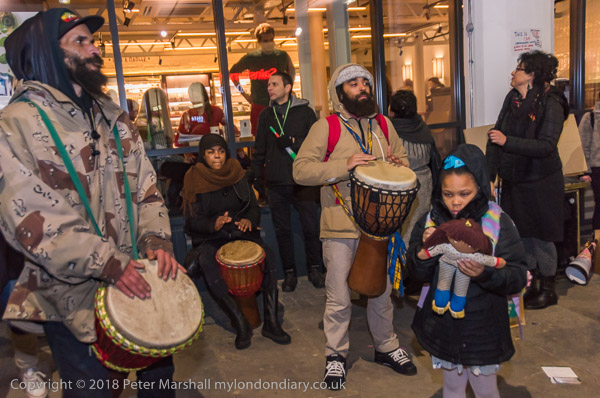
The protest started slowly  but soon developed, particularly with the arrival of some African drummers and was still going strong when I had to leave, intending to keep up the noisy picket until the shop closed. So far RBKC still seem oblivious to the complaints of the local community, either about this or on other local issues.

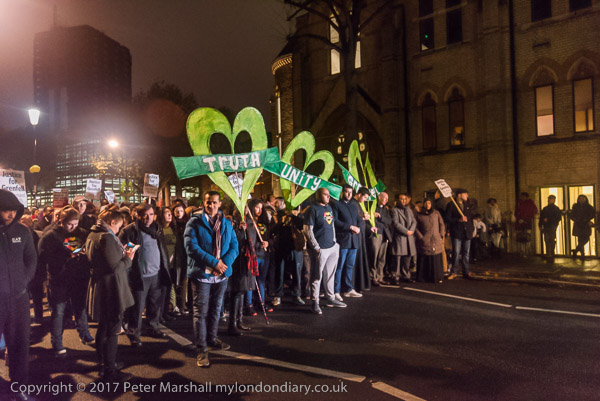
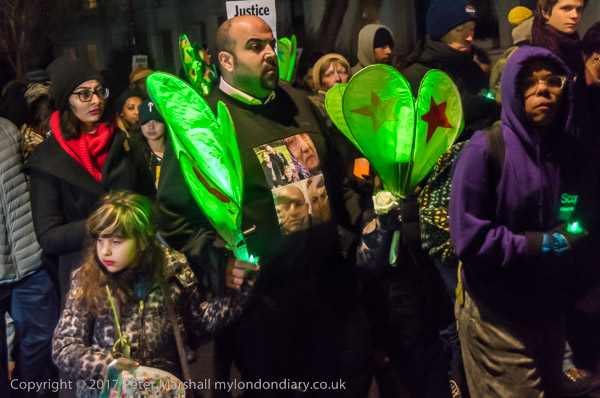
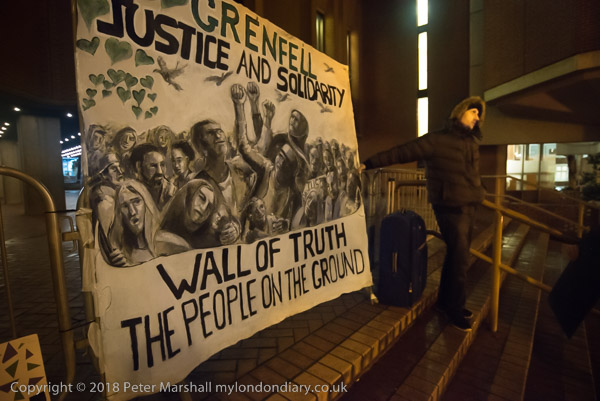
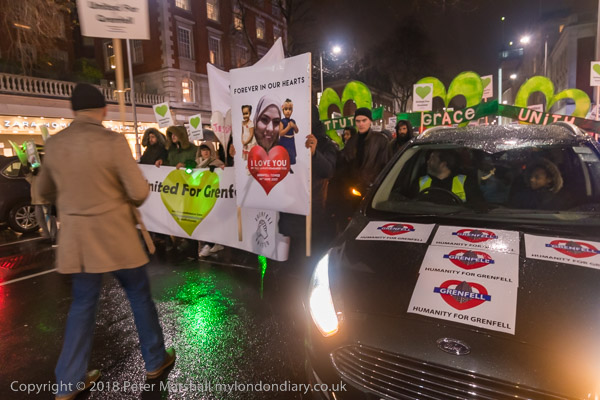
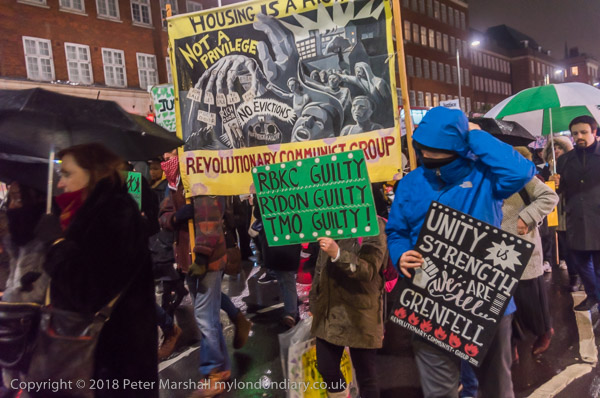
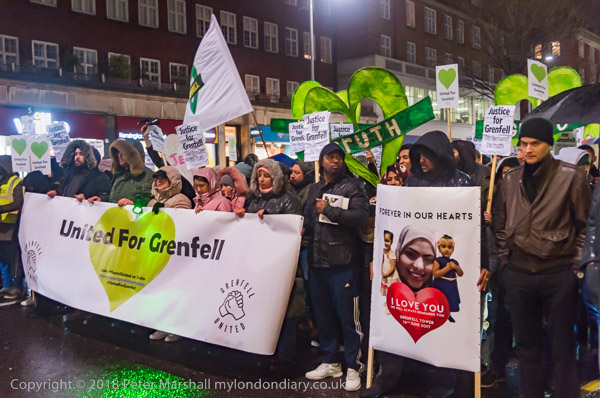
A few days later I was back again in Kensington, this time outside Kensington Town Hall, where the 8th monthly silent march for Grenfell Tower was going to begin, the organisers having decided to move it there to make in much more visible in the borough. It began its march down Kensington High Street in pouring rain and by the time it turned north into a more dimly lit street I was soaked and my cameras were also getting rather wet.

I was cold and miserable. When one of my cameras actually stopped working I stopped working too. The street was dark and there would be few opportunities to take pictures before we reached its destination close to Grenfell and Latimer Road station, almost a mile and a half away. I abandoned the march, and made my way the 500 metres to Kensington Olympia station for a train.

I fished my ticket out of my trouser pocket, and put it into the barrier gate, which took it in but then nothing happened. The ticket, which had got slightly damp from the rain had stuck inside, blocking the mechanism. Fortunately there was – as there is always supposed to be – a man in uniform by the gates and I went and told him what had happened. He came over and got out his key to open the machine – only to find it would not fit as it had got bent. He could let me through but I needed the ticket to complete my journey. He had to walk over the footbridge to the opposite platform, borrow a key from another employee, come back and could then open the machine to return my ticket. By which time my train had come and left. Fortunately it’s a fairly frequent service, but I was still almost half an hour late getting home.  And by the time I got there my cameras had dried off and were working again.

More pictures at:
Ladbroke Grove Pret-a-Manger land theft
Grenfell Remembered – 8 Months On

There are no adverts on this site and it receives no sponsorship, and I like to keep it that way. But it does take a considerable amount of my time and thought, and if you enjoy reading it, a small donation – perhaps the cost of a beer – would be appreciated.

My London Diary : London Photos : Hull : River Lea/Lee Valley : London’s Industrial Heritage

All photographs on this and my other sites, unless otherwise stated, are taken by and copyright of Peter Marshall, and are available for reproduction or can be bought as prints.

To order prints or reproduce images

________________________________________________________