Marcus Bleasdale – Rape of a Nation

Marcus Bleasdale‘s The Rape of a Nation on Burn is a powerful set of 25 images from the “deadliest war in the world today” taking place in the Democratic Republic of Congo (DRC) where 5.4 million people have died since 1998.  Many of the 45,000 who die each month do so from readily preventable causes due to the complete collapse of the economy and any systems of health care.

As well as the strength of the images, I was also impressed by the presentation, with an interface that really works, and where for once it makes sense to click the “full screen” icon – which gave me excellent quality sharp 1560×1050 pixel images (though the size will presumably depend on your screen.)  I was able to view the pictures at my own speed with captions appearing over a small strip at the bottom of the image on mouseover and a left-click changing to the next picture, and everything worked smoothly.

This is also a site that attracts some interesting comments on the work – and where the photographer himself replies. Well worth reading, and in his replies he does provide some links to sites which supply some powerful insight into the political and economic forces behind the war which was an aspect I thought lacking in the text when I first looked at these pictures on Burn.

Critical Mass

Critical Mass is not just for cyclists.

© 2004 Peter Marshall
Ten Years of Critical Mass – Cyclists show their strength in London. April 2004

Critical Mass is a program about exposure and community” says Photolucida, an arts non-profit based in Portland, Oregon, USA which runs this competitive programme. It’s a fairly simple and not too expensive way to try to get your work seen by a lot of people in the world of photography.

The initial stage costs $75 and gets your 10 submitted images seen by a group of around 20-25 jurors, many connected with Photolucida and Portland which makes a selection of the top 175 from each year’s crop.

These finalists then pay another $200 and their work gets sent to a fairly impressive list of 200 jurors, mainly from the USA, but with a sprinkling from around the world. These jurors get a CD-ROM containing the pictures and “a hard-copy thumbnail image index of all the artists with contact information.”

These jurors then select their top 50 photographers, who get the opportunity to have their work in a Critical Mass Top 50 show at Photographic Center Northwest in Seattle, USA, and Photolucida will publish monographs for 2 or more photographers from among the top-scoring finalists. Their work is also shown on the Critical Mass pages on the Photolucida web site – and you can now see the 2009 Top 50 there, as well as those from the previous five years.

All entrants get copies of that year’s monographs – though they may take a couple of years to come out – as well as a CD containing all of the submitted work.

If you are thinking of entering you have a few months to get your entry ready, as registration for Critical Mass takes place in late summer. $75 isn’t a great deal of money and you are going to get two or three decent photo books in return. The publicity for the top 50 must be worth the extra $200, and the chance of publication. So if you think the world is ready for your work it is certainly worth thinking about.

© 2006 Peter Marshall
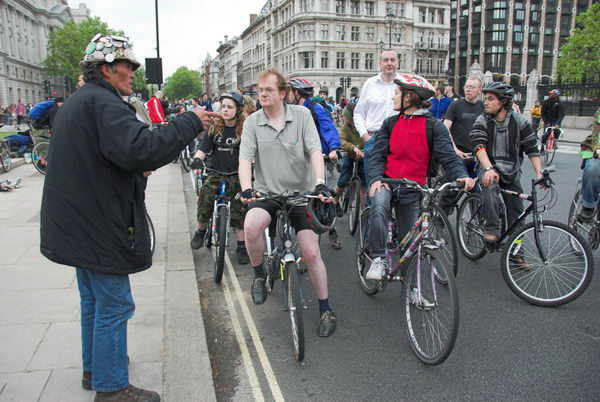
May 2006: Brian Haw lectures Critical Mass cyclists, asking where they were on Tuesday morning.

Meanwhile, back in London, Critical Mass continues to happen on the last Friday evening of every month

New Documentary- Jon Lowenstein

Thanks to DVAphoto for Worth a Look: Jon Lowenstein in Haiti which as well as pointing to the pictures also raises some points about them. It mentions Jon’s comment about one image:

Haitian National Police gather a group of ‘looters’ or ‘salvagers’ and confront them. In some of these instances the looters are shot, but in many cases they are let go, especially when Western media are present.

The presence of the media clearly does have an influence on events and surely there can be few photographers who cover them who haven’t realised this. We’ve all watched how demonstrators react to a TV crew, becoming noisier and more active for the camera, and it happens if to a lesser extent for still photographers, however discrete we try to be.  But in Haiti things are more extreme and many people have very little to lose and no way to exist or for their families to exist except by taking advantage of whatever they find. ‘Looting’ certainly isn’t a term I’m happy with in this situation.

You can see the set of images on the NOOR web site and also on Lowenstein’s own site, although I couldn’t get the captions to display there, and they help to understand more about these images. But there are a number of other projects also worth a look; in general I find his black and white work considerably stronger than the colour.

Lowenstein is a fine example of what some call the new documentary photography, and not surprisingly he put in an appearance on Verve Photo, Geoffrey Hiller’s site devoted to “The New Breed of Documentary Photographers” and well worth browsing through when  you have time to spare – as it will certainly detain you for some time.

Also on NOOR you can view Jan Grarup‘s fine colour images from Haiti – he arrived there 4 days after the quake and provides some vivid images of life there.

Copying, Co-incidence or Cliché?

I’ve written on this site before about allegations of plagiarism in Copycat Images? which included an example from my own work which I know to be simply a coincidence, but a couple of posts on PDNPulse  send me back to the subject.

Copycat or Not? posted Feb 16 looked at the similarity between landscape images by David Burdeny, a Vancouver-based photographer and earlier work by photographers Sze Tsung Leong and Elger Esser. Leong and his New York gallery owner, Yossi Milo have objected and got their lawyer on the case.

I’m very unsure about this on several grounds. Perhaps most importantly that one of the basics of copyright is that it is not concerned with ideas but with their execution, which I think are, in the examples given on PDNPulse, significantly different (and generally I prefer Burdeny’s; he does seem to be a rather better photographer – which just could be why Leong and Milo are so worried!)

This is a feeling that is reinforced by the follow-up post,  Copycat or Not, Part II: A Case of Nothing New Under the Sun? where – at least at the small scale we see it on the web, Leong’s four pictures seem to me rather like any tourist snaps (though doubtless on the gallery wall they are considerably larger) while some of Burdeneys have a little more presence.

Both photographers work with large format, but to me that doesn’t in itself make their work any more interesting. And, as one of the comments on PDN points out, both have similar backgrounds, having trained in architecture, so perhaps similarities in their work are not surprising.

But frankly I don’t find either of their work of particular interest, and when Burdeny is reported by PDN as saying that “the similarities arose because he happened to shoot from some of the same tourist spots” I think it is only too true – and about both their work. I’ve almost certainly got images in my archive rather similar to the two pairs of images of Paris included in the posts, though I doubt if I’d ever want to show either of them, even on the web. There are images you take just because you are there with a camera, and images you take because you have something to say, and on the evidence neither of these guys have grasped this. One of the comments on the second feature points out that you can find very similar pictures to these on a popular stock web site.

Burdeney also provides a number of other examples of pairs of very similar works, in some of which I think there is a far clearer case of copying involved, while others are simply coincidental.

Whether the actual concept of the show involves copying is also not entirely clear, and in a kind of vague way there would seem little doubt that the Vancouver gallery has tried to produce something in a similar vein to the Milo gallery show. But it would be hard for anyone to claim a copyright on a show of large format somewhat boring images of well known tourist sites around the world – there is far too much prior art. What neither piece tells us is how many works each photographer had in their exhibit and how many of those were of the same places. A pair of photographs is used to suggest a great similarity, but to me fails to do so, as it only includes two pictures from Burdeny’s exhibit which are not particularly similar to those from Leong’s. It does show that both galleries framed the work in white frames and – surprise, surprise – both hung them in straight lines on a white wall. But the two photographers print to different formats and Leongs prints have white borders while Burdeny’s fill the frames. The images seem evidence of a different presentation rather than a copycat show.

Another comment points out the similarity of the two artist’s statements, but my problem here is that neither seems to show much originality. However each does includes the identical phrase “each image offers a finely grained density of visual information, rendered in the broad range of tonality made possible by“and while the content is pretty much a cliché of any show of large format work, it seems likely that this exact expression may well have originated with Leong or Yossi Milo. But although I’ve not been able to locate a prior source there may well be one.

I find it hard to see that Leong has a case so far as the photographs are concerned. Most of the commenters agree with me, although Leong does have his champions, one of whom writes “his work is not merely about landscape, but has greater conceptual goals. His locations, and the use of very precise form and dimensions, are done with great thought, reason and research.” In which case I have to say he has fooled me completely – or perhaps his conceptual goals have little to do with the actual photographs?

It’s also worth looking at the set of pictures, Sacred and Secular on Burdeny’s own website, where you will find that the contested images are probably the least interesting among those shown.  Comparing this to the ‘Horizons‘ series on the Yossi Milo site you see a very different show. The case I think is closed.

Chatsworth Lion

More on my own example:

© 1984, Peter Marshall

taken by me in 1984 and click on this link to see  Fay Godwin’s taken completely independently three years later. More tightly cropped to a square format but otherwise pretty well identical.

In fact my own picture was a copy, of this image:

© 1980, Peter Marshall

which I made in 1980 in a way that is perhaps even a little closer to Fay’s picture, taken like hers later in the year so the ferns have grown. And if Edwin Smith or any other photographer walked past there a few years earlier than both of us I’m sure he would have taken a very similar picture.

I’m fairly sure that when I took the lion again in 1984 I remembered my earlier photograph and was trying to improve on it (though I don’t think I did – the earlier image is perhaps clearer as a few small images in the interior of the building weaken the later image. I also prefer it to Fay’s as the addition of the male head at the left is I think significant, but others may well prefer hers.) But quite often I have looked at pictures taken elsewhere when I’ve visited the same area after a longer gap of time and have been surprised to see almost identical images.

There are some places where there really is little choice of the best viewpoint.
World Press Photo

I can’t understand why so many blogs publish a small selection of the winning images from World Press Photo and don’t write anything about the images they use. Just what is the point, when at the click of a mouse you can go and see the whole of the work of the winners? Online at World Press Photo.

I’ve only had a quick glance through the whole lot of them – there are quite a few – and don’t really want to say anything about them yet, other than an overall impression, which is that I think they show that 2010 was a disappointing year for photography. Of course there are exceptions – and the set of pictures by Eugene Richards is one.

Of course, as two well-regarded photographers were saying to me today, World Press Photo is very much a lottery (and one went on to suggest perhaps even more so because the judging is held in Amsterdam, and at the end of a day looking at far too many pictures the judges may well indulge in recreational activities that could well cloud their judgement.)

Among the outstanding work there do seem to me to be some rather pedestrian images, and while in recent years there have been some surprisingly interesting pictures or sets in some of the generally more tedious categories such as sport, arts and entertainment and nature, this trend seems to have reversed somewhat. Perhaps too the portraits fail to excite me this time.

I’m not a great believer in contests and competitions. I seldom enter them and am unconvinced they generally improve the general standard of photography not least because I suspect the best work very seldom wins. Partly because selection is often a matter of political trading between the various judges (as we occasionally hear when judges spill the beans after the event) but also because at least in some competitions the judges often include people in whose judgement I have little or no faith.  Not purely out of prejudice, though probably I’ve plenty of that, but because of the visual quality of magazines they edit or exhibitions they have curated etc.

Certainly the most interesting comment on last year’s World Press Photo was UNCONCERNED BUT NOT INDIFFERENT by Adam Broomberg and Oliver Chanarin who were among the judges. I first read this in Foto8, but it seems no longer to be available on their site but can be downloaded from the authors’ Chopped Liver web site – listed under Information / Selected Articles. Worth reading after you’ve looked at the pictures.

2010 Deutsche Börse Photography Prize

This evening I went to the opening of the showing fo the four photographers short-listed for this year’s Deutsche Börse Prize at the Photographer’s Gallery in London and was disappointed. Although in previous years I’ve usually disagreed with the decision of the judges in making the award, I think this year is the first in which I’ve found little or nothing among the work displayed really worth looking at.

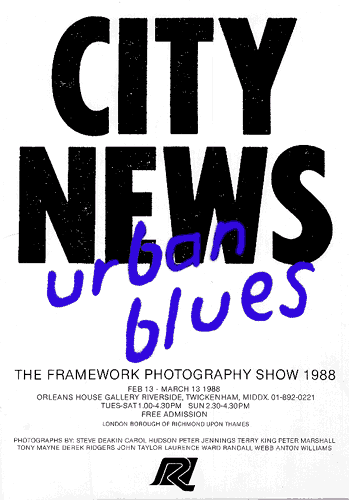
I’m particularly disappointed because one of those short-listed was a photographer who I knew years ago in the 1980s and whose work I then admired. Back then I was involved with a small group of photographers who called themselves Framework and met monthly to look at each other’s current work, and occasionally organised group shows. The core of the group apart from myself was Terry King, who did most of the organising, and others involved included Carol Hudson, Derek Ridgers and Jim Barron. (You can read more about this group in an old and outdated but never finished web site.) We had our first exhibition as Framework in 1986 and the last in 1992, and the full list of those who showed with us included some well-known names in UK photography, including Jo Spence.

© 1988 Peter Marshall

One of the photographers who brought her work to several of our meetings in Kew was Anna Fox, and I was greatly impressed by her pictures of office workers in London, later published as ‘Workstations‘ (1988). When she came to Framework she had I think just finished her degree studies at Farnham, where she is now Professor of Photography at University for the Creative Arts. I think she was also the only photographer we invited to show with Framework who declined to do so!

So I went to the gallery tonight rather rooting for Anna (though we’ve not kept in touch) but found myself rather disappointed by what I saw on the wall. You can see quite a lot of it on her web site. The series I found most interesting was her 1999 miniature bookwork ‘My Mother’s Cupboards‘, but it was simply too small and in a way too limited. The selection from ‘Back to the Village‘ was also rather disappointing, and in general I felt that what we were seeing in the gallery was too many little bits and nothing really substantial. And looking through her web site, I still find the work from her early projects – particularly ‘Workstations’ – rather more exciting than anything she has since produced. You can read about her work ( and the other three) in The Telegraph.

I can’t even bring myself to write anything about the actual work by Sophie Ristelhueber which is on the ground floor of the gallery. Other than that the prints are quite large. But on my last visit to Paris I saw shows by twenty or more French photographers who I find of more interest, and I find it hard to see why her work made it here. There is a gallery of her work from her Jeu de Paume show on The Guardian web site which I find rather better than looking at the gallery wall, but still fails to convince me the hype is really more than hype. And I’m not sure why the Photographers Gallery should be showing the work of someone who saysNowadays I am not even a photographer because I am a conceptual artist.’

Zoe Leonard is a photographer whose work I’ve known for a long time and probably first saw in the American photography magazines, perhaps Modern Photo. I’ve always thought of her as a pretty good photographer, but nothing really special, and the work on show confirms this.  Analogue 1998-2007, on show at the gallery, isn’t a bad piece of work, but I think there is very little to distinguish it above the work of the many other photographers who have also photographed “tacky shop windows, quaint signage and mundane commercial products“. I can’t really say anything against it. There are quite a few images I’d have been happy to take myself when I worked extensively with similar subject matter in London twenty years ago. But I didn’t take them on square format and print the film borders.

Duncan Wylie’s work on the Maze prison after closure I’ve always found rather boring, and this show did nothing to change my mind. The article in The Telegraph is considerably more interesting – and the smaller selection of images helps greatly in this.

But the prize winner in this show must surely be the original producer of the scrapbook which fills one wall, I think Wylie’s uncle, although it was published by Wylie and Timothy Prus. The selection of spreads on the Steidl page is misleading, because the major interest lies not in the photographs but in drawings and the text of the articles, from magazines and newspapers – and also a typed ‘recipe’ for the troubles.

It’s these articles and  (and that the wine ran out almost before the opening started) that stick in my memory and created the greatest impact –  not the photographs, and that seems to be a fairly damning indictment of what was meant to be a photography show.

Wonderland

Yesterday I was out taking pictures and I met a photographer I know, Brian David Stevens, who a couple of weeks ago at the photographers protest in Trafalgar Square had come and asked me if I thought he should buy a Leica M8, knowing that I owned one.

Well of course I told him not to be silly, and if he really wanted a digital Leica to start saving for the M9. So I wasn’t at all surprised to see him with a new M8 around his neck, and he is very pleased with it, and you can see some of his early results from it already in the last four posts on his Drifting Camera blog. Of course it’s no coincidence that the best work with the new camera – from the event we were both at, the London Arbaeen Procession, is in black and white, where the problems of using the M8 as a colour camera don’t arise. You can see a few of my pictures already on Demotix, but I’ll post again about it here later

But he also told me about a couple of books he thought I’d like, and later posted the details to me on Facebook. One of them was Wonderland, and today – another co-incidence – James Pomerantz published a lengthy illustrated Conversation With Jason Eskenazi who is the photographer concerned. On Eskenazi’s own web site the only pictures from the book appear to be thumbnail-size page spreads. You can see a dozen of the images from his book on NPR and also read about it and listen to a short program from the link on that page. The title does come from Lewis Carroll if you were wondering. As well as writing the Alice books and his day job in maths he was also a photographer, some of whose work has aroused controversy.

You can order the book direct from Eskenazi’s site, although orders sent now will not be processed until he comes back from his travels around the beginning of March. It’s a book that I think is worth getting.

Giacomo Brunelli at Photofusion

© 2010, Peter Marshall

I was very pleased to meet with Giacomo Brunelli again at the opening of his show ‘The Animals’ at Photofusion in Brixton this evening. The show continues until 26 March 2010, and if you are in London it is one you should not miss.

© 2010, Peter Marshall

© 2010, Peter Marshall

There are few photographers who have produced such an individual and intense vision as this, one which reflects a peculiar and single-minded devotion it its subject. Frankly I find most animal pictures boring and would run a mile to avoid any ‘Wildlife Photographer of the Year’ exhibition (and frankly who gives a toss whether that wolf was wild tame or even stuffed.) But these small dark and glowing images are something else completely, a different and highly personal way of seeing the world.

© 2010, Peter Marshall

I first saw this work when Brunelli brought it to Rhubarb-Rhubarb in Birmingham in 2007 and was knocked out then. These are small but dramatic images, printed by the photographer himself (in his bathroom when his wife lets him take it over for the purpose), with dark edges and rounded corners and just so different from anything else.

© 2010, Peter Marshall

I wrote about it on this blog then and included a couple of examples, so I won’t repeat myself. It still has that same freshness and impact. Don’t miss it.

Magic Realism

I first came across the work of Stephen Ferry (he describes it as ‘Non-Fiction Photography‘) when I was sent a copy of his 1999 book ‘I Am Rich Potosi’ to review (as usual, my review is no longer on line.) I found it to be not just striking images but also a fascinating story of a city which was once the fabulously wealthy centre of the Spanish empire which ran on the vast quantities of silver from this ‘Rich Mountain.’ The pictures present the remarkable story of the present day Quechua miners and their culture. I wrote a lengthy review, looking in detail at some of the images, and was surprised and gratified to get a very appreciative and detailed response from the photographer.

You can also see work from this book as well as his other projects on Ferry’s own web site, which unfortunately is another of those that opens in a new browser window that fills your screen (and on my screen that means is twice the area it needs to be to show the work.)

More recently Ferry went on a trip to the area of  Colombia where Gabriel García Márquez grew up and inspired the ‘magic realism’ of novels such as ‘One Hundred Years of Solitude‘ and ‘Chronicle of a Death Foretold‘. Márquez has described himself as just a journalist, reporting the events of the world that he knew in what most people think of as fantasies. And in the pictures that Ferry brought back from the fictional ‘Macondo‘ (and the real town of Sucre, Sucre in which he spent three weeks) at times support this thesis, as you can see in the presentation on ‘Lens.’

Don’t miss the other work on Ferry’s site either, particularly The Sinister Hand on the Civil War in Colombia. On a slightly lighter note you can also see pictures of Cholita wrestling featuring Aymara women petticoats in Marisol Khali.

Right Up My Street but

Unfortunately I’m more than unlikely to be in Milwaukee in the next couple of months (I’m not sure they’d let me in to the USA, and with the current fuss over “security” I think all those of us who need to travel with syringes are likely to have a hard time of it.)   But for those that are, the show Street Seen: The Psychological Gesture in AmericanPhotography, 1940–1959, which features the work of Lisette Model, Louis Faurer, Ted Croner, Saul Leiter, William Klein, and Robert Frank, continues at the Milwaukee Art Museum until April 25, 2010.

You can read a little more about the show (including that it also has work by Robert Capa, Henri Cartier-Bresson, Walker Evans, W. Eugene Smith, Helen Levitt and Weegee, among others) and that it claims to be the first major examination of street photography of the 1940s and ‘50s in nearly 20 years on Art Knowledge News.

While its hard to disagree with the statement that the six featured photographers “embraced photography as an ‘act of living‘”, it is perhaps harder to accept the opposition between this and telling a story, particularly with the work of photographers such as Cartier-Bresson and particularly Smith in mind who did pretty well at both.  But like many shows it sounds as if it would be good to view whatever caveats you might have about some of the curatorial texts.

There is a short review of the catalogue on the NY Times and a little more about the show here.