Photo-Forum

Photographers who live in and around London who missed last night’s Photo-Forum should be kicking themselves. Apart from Ray Tang’s excellent brownies there was great photography from Antonio Zazueta Olmos and Kieran Doherty, making this perhaps the best evening yet. If you did miss it you can follow the links to their web sites where you will find most of the pictures that the two showed, but it just isn’t the same as seeing them projected on a large screen and hearing the photographers talk about them.

You can of course get something a little more personal on blogs, and both photographers write – if not too frequently – about their work online, with Olmos on photomexican (though the last post was in 2008)  and Doherty‘s started under his name in February this year.

Olmos impressed with his obvious love of photography, and in particular the  black and white work which inspired him to buy a camera by Bruce Davidson, Robert Frank and others.  And although he showed some fine colour work including set of pictures of Nicaraguan refugees he made it clear that black and white remains his first love. Some of his best pictures were produced travelling with just a single camera and lens (Leica M6 and 35mm)  although at times he took a deliberate decision to slow down his work by using a Mamiya C330 twin-lens camera. He found that people loved to be photographed by this camera and the different approach it entails, bowing towards your subject as you take the picture with the camera held firmly against your stomach.

Olmos also passed on a great bit of advice he himself received, that if you find yourself surrounded by photographers when taking pictures, you are almost certainly in the wrong place.

In recent years most of his work for the Observer has been portraiture, and although he now usually has to shoot for the paper in digital colour he still prefers black and white film, and showed us a powerful and varied portfolio of these images.

Doherty worked for many years for Reuters, and although he praised the freedom they usually allowed him, there was still obviously a great pressure to come up with the kind of pictures they wanted, and he obviously did a great job at doing so. His work showed a great willingness to experiment, having new ideas and trying them out.  But eventually he found he wanted more freedom and at a time when the recession was really hitting and all of us were finding things pretty tough (and he’d just taken out a large mortgage) decided to go freelance.

The most impressive of his work for me was a continuing project on Wooton Bassett, shot in black and white.  He is also shooting weddings, but not in the old formal way, but very much in a photojournalistic mode.

At every Photo-Forum there is a raffle, with the cash collected providing food in the pub after the event, and the prizes are usually prints donated by the photographers who give the talks.  And last night I was lucky and one of my tickets was drawn out of the hat. So I’m now the proud possessor of a print by Kieran Doherty.

Photo-Forum happens every second Thursday of the month, 6 – 8pm downstairs in the Jacobs Pro Lounge at 74 New Oxford Street London WC1A 1EU.

Peter Sekaer Overhyped

Peter Sekaer (1901-50) was a Dane who went to New York in 1918, setting up a business producing posters for shop window displays. In 1929 he joined the National Art Students League to study painting meeting Ben Shahn, who probably got him interested in photography and also introduced him to Walker Evans. In 1933 he studied photography with Berenice Abbott at the New School for Social Reasearch and assisted for Walker Evans who was photographing artworks at the Museum of Modern Art.

Sekaer also went with Evans on his Resettlement Administration/Farm Security Administration (FSA) trip to the South, taking some pictures of similar subjects as they travelled around together. From 1936 to 1942 he worked for various US government agencies including the Rural Electrification Administration (REA), the United States Housing Authority (USHA) and the Office of Indian Affairs, working briefly for the Office of War Information (OWI) in 1941.

In 1945 he gave up working for the government agencies (and the American Red Cross) to freelance, moving to New York in 1947 where he did magazine and commercial work. A heart attack killed him in 1950, aged only 49.

Solo shows of his work took place at the Witkin Gallery, New York in 1980, in Copenhagen in 1990 and at Howard Greenberg Gallery in 1999. Books were published alongside the latter two shows. Currently the High Museum of Art in Atlanta, USA, which recently acquired 70 vintage prints of his work has a show ‘Signs of Life, Photographs by Peter Seaker, which continues until Jan 9, 2011 and there is also an accompanying book.

Searching for pictures under Sekaer’s name at the Library of Congress produces surprising few results; a set of images of an FSA trailer camp at the Vultee Aircraft Plant in Nashville Tenesse, taken in May 1941 for the OWI, and two earlier images, only one of which is on line.  The trailer camp pictures are undistinguished, a fairly dreary record of the site. The other picture shown, of mothers and children at the doorway of a brick home in a former slum area for the USHA, is a little more interesting but also rather routine.

The Library of Congress does include many fine photographs from the less well-known government agencies for which Sekaer mainly worked, taken by other better-known photographers – for example Arthur Rothstein. There are also some very run of the mill unattributed images. But unless I’ve missed something Sekaer appears to have produced little or nothing of worth for these agencies.

You get a rather more positive impression of him as a photographer by searching at the Addison Gallery of American Art which produces 17 results, one of which shows a page from a scrapbook containing 725 small prints by him (27 or 28 on the page shown appear to be contact prints including several frames of some subjects.) Not all of the other 16 pictures are on-line.

There are some nice touches visible in some of those which are. A young woman is posed behind a restaurant window in Charleston which has a cup of tea and a fish painted on it; the collar of her dress appears as a heart. But looking at most of them I can’t help thinking of rather stronger images of similar scenes by Walker Evans, Helen Levitt and others.

Sekaer’s ‘artist’ pages at the Howard Greenberg Gallery which include 25 images concentrates even more on those that make him seem heavily under the spell of Walker Evans. But frankly they just are nothing like as good. He isn’t a bad photographer, but just rather ordinary when compared with Evans  – as most of us would be. But there are two or three images that perhaps show something rather more personal, all including people. Images 19 – Lousiville, 1938, with two women and a child with an upturned tricycle and 21 – Untitled, 1938, with and old woman wrapped in a shawl on her front step, for me stand out above the rest.

Sekaer was obviously a proficient photographer, and doubtless his work adds something to our knowledge of the era he photographed, and the book may well be of interest. It’s good to see publications and shows of some of the minor figures of photography – and there were very many of them – whose contribution to photography is more in their collective input than in individual work. There are hundreds if not thousands more like him, and it would be good to see more of them recognised for what they are. But don’t let’s make them out to be overlooked geniuses.

You can read more about Sekaer and the High Museum show in a feature in the New York Times. Apparerently 53 or the works in the museum were acquired from the Howard Greenberg Gallery, and the piece quotes Greenburg as saying that had he lived to promote his work  “he would have had a great reputation.” Earlier the writer  seems to suggest that Walker Evans is better known because he “lived into his 70s and promoted himself as an artist as well as a documentarian.”

I have news for Eve M. Kahn – and also Mr Greenburg (though I think he already knows it but also knows his business.) Walker Evans is better known because he was an incomparably better photographer.

Perpignan Winners

Lens has a nice feature on the top award winners at this year’s Perpignan Festival, with some interesting photography from Frédéric Sautereau winner of The Visa d’or – Daily Press for his work for French newspaper La Croix, VII photographer Stephanie Sinclair, winner of the Visa d’or Feature award for work for National Geographic & The New York Times Magazine and Damon Winter of the New York Times, winner of the Visa d’or News award.

It was indeed a very good year for photographers associated with the New York Times, although Lens would probably have run a similar feature even if their paper had not been involved.

So far as I can see in the awards page, none of the three winners or the other six nominated photographers is British or has any connection with any UK newspaper or magazine.

There are some fine British photojournalists, but we perhaps lack the kind of photographic culture that incubates great photography; few newspapers or magazines that publish more than individual images or encourage thoughtful photographic endeavour. So perhaps the lack of British names  on the list isn’t too surprising.

In Ray’s Footsteps

© 2010, Peter Marshall
Wigton

I’ve been away for a few days having a short holiday with family and friends and away too from computers, staying at a house in the middle of Cumbria away from wireless hotspots. Of course I could have connected from many of the places we visited, but I rather enjoy having a few days away from the Internet now and then.

© 2010, Peter Marshall
Between Allonby and Maryport

My first photographic mentor was Raymond Moore (1920–1987) who I came to know through a series of photographic workshops with him and Paul Hill at Paul’s ‘Photographers Place’ in Derbyshire. Shortly after I met him, he retired from formal teaching in the Midlands in 1978 to live and photograph on the Solway Firth, where he produced some of his finest work, some of which can be seen in his ‘Every So Often’ published in 1983.

© 2010, Peter Marshall
Silloth

It’s hard for me not to think of the Cumbrian coast as ‘Ray Moore Country’ and although I wasn’t expecting to see large ‘Welcome’ signs proclaming this as I was driven to the coast, it was perhaps strange not to see any mention of him and his work in the many tourist leaflets and several information centres we visited during the week. Perhaps his work is very much at odds with how the Cumbrian Tourist Board want to promote the area, but in a hundred years or so they may erect a blue plaque on those houses in Silloth or next to that washing line in Allonby to match that on the nearby inn commemorating the stay there of Charles Dickens and Wilkie Collins. Dickens did praise the local shrimps (doubtless then less radio-active) though he found some of the other local towns which also celebrate his visits less pleasing, but so far as I’m aware the area failed to inspire him creatively.

© 2010, Peter Marshall
Allonby

I don’t know what Ray thought of the shrimps or the kippers, but he created a considerable body of work in the area on both sides of the Solway Firth, finding inspiration in the light and openness of these liminal areas, and in particular of their changing weather. In that respect the bright and sunny days we enjoyed for most of our week there while the rest of the country was experiencing heavy rainstorms was perhaps disappointing, though in other ways I was very glad of it.

© 2010, Peter Marshall
Maryport

It was the first time I’d actually visited the area and I  hadn’t gone there to “do a Ray Moore” but to have a holiday, but there were times, as in some of these images, where I nodded a little to the memory of that great man, certainly one of the finest British photographers of the last century.

Meatyard

If you’ve not yet come across the rather curious world of Ralph Eugene Meatyard, (1925-72), also known as ‘Eyeglasses of Kentucky’ you could do worse than start with the selection of his pictures on the ASX Facebook page.

Meatyard became a licenced optician after Navy service, and bought a camera to photograph his newly-born son in 1950. In 1954 he studied with Van Deren Coke, and later with Minor White and Henry Holmes Smith.

Although included in several prestigious shows, he remained an amateur photographer, opening his own business as an optician in Lexington, Kentucky in 1967. A monograph of his work was published in 1970, the same year he discovered he had terminal cancer.

Meatyard never just took a photograph. His work was always carefully planned and executed, with his children and friends acting some surreal charade for the camera. The pictures are full of menace and foreboding. People wear masks or blur their faces by moving their heads during exposure,  emerge out of bushes or other unexpected places. Even the bushes sometimes seem to move. Meatyard creates a world in his pictures, that sometimes touches on our everyday, but always has some surprise up its sleeve.

More of his pictures at George Eastman House and on Google images, and a more detailed biography on Wikipedia.

Voja Mitrovic

Printers are seldom celebrated and it was good to read a two part piece, Voja Mitrovic, Printer to the Greats by photographer Peter Turnley, himself once a printer. Mitrovic, born in 1937,  has printed the work of many great photographers, including Henri Cartier-Bresson and  Josef Koudelka . He arrived in Paris from Yugoslavia in 1964,  and worked from 1966 until his retirement at the start of 1997 at the world-renowned Paris photographic laboratory Picto created by Pierre Gassmann in 1950.

Turnley worked closely with Mitrovic, both as a printer (and he reveals it was only with his help that Turnley got a job as a printer at Picto) and when Mitrovic printed his photography, and his closeness to the printer makes this a compelling article.

As he points out, although we may not know Mitrovic’s name, we have all seen many of his prints, both in many exhibitions but for so many books. In the feature there is an incredible list of the photographers he has printed for.

Many photographers prefer to print their own work, and I’ll write about this more in another post. But for many others the collaboration with a skilled printer has been a vital if seldom acknowledged part of the success.

Gangland

João Pina’s photo essay Gangland – Rio de Janeiro’s Urban Violence, shown in Bite! magazine is a remarkable document, showing the lives of the drug dealers and gang leaders and the police units, working in some of the most dangerous places imaginable and making fine black and white images that tell the story in a remarkably powerful manner. He shows us both sides of a war on the streets in which everyone is a victim and “it is nearly impossible to escape the violence.”

Some of these pictures I found extremely moving though they are not exactly pleasant viewing, and I think it is essential to turn on the captions before you view – though it is a shame they obscure a little of the bottom of the image.  I think by default they are off, which I think is the wrong decision for a documentary site; viewing them without captions tends to aestheticise them and turn  the viewer into more of a voyeur.   I think it is a shame too that the larger set of these images on the photographers own web site – with some more other great work – presents them entirely without captions, although they are prefaced by his statement about the work.  Although it is only too obvious what some of the images are about, others are frankly impenetrable without some added context.

João Pina (b Lison, Portugal, 1980) started working as a photographer in 1998, and first went to Latin America in 2002; in 2003 he joined the Portuguese collective Kameraphoto, and from 2004-2005 studied on the Photojournalism and Documentary Photography program at the International Center of Photography (ICP)  in New York, USA. Since 2007 he has been based in Buenos Aires, Argentina.  His work has been published in newpapers and magazines around the world. He worked together with writer Rui Daniel Galiza on his  first book, Por Teu Livre Pensamento, (2007) about the people, including two of the photographer’s grandparents who were  arrested, tortured and imprisoned by the long-running Portuguese fascist regime which only came to an end in 1974.

Hiroshima 65 Years On

At 8.15 am Hiroshima time on 6 August 1945 the bomb called “Little Boy” was released from the B29 named “Enola Gay” after the pilot’s mother and around 45 seconds later its 60 kilograms  of uranium-235 detonated around 1900 ft above the city.

© 2009 Peter Marshall
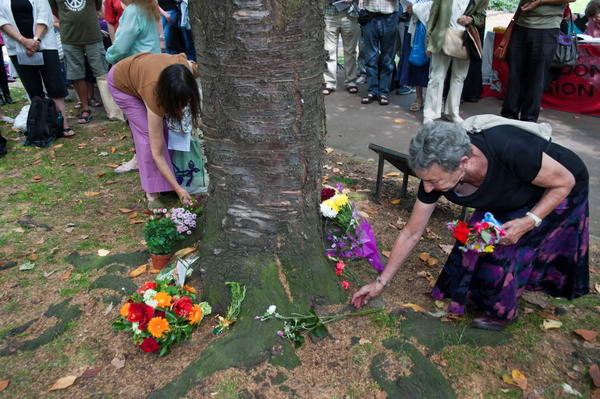
Flowers are laid at the cherry tree commemorating Hiroshima in Tavistock Square, 6 Aug 2009

Several years recently I’ve attended the annual memorial event at Tavistock Square in central London, but this year I didn’t make it.  You can see a report on last year’s event on My London Diary.  I hope to get to the exhibition ‘After the Bomb Dropped: How Hiroshima and Nagasaki Suffered’ which is now showing at the Friends Meeting House on Euston Road until August 12.

I don’t know which photographs the show will contain. The only photographer known to have photographed in Hiroshima on the day the bomb dropped was Yoshito Matsushige (1913-2005) a 32 year-old photographer for the Chugoku Newspaper in 1945, and you can read his testimony in English online. He was eating breakfast without his shirt on at his home, 2.7 km away from the centre of the blast when them bomb exploded. He saw “the world around me turned bright white.” Then came the blast, which felt like hundreds of needles stabbing into his bare torso, blowing holes in the wall and ceiling, filling the room with dust.

Matsushige pulled his camera and clothes from a mound of dust and went out on the streets. War-time shortages meant he had only two rolls of 120 film for his camera. He soon came on victims, school kids with terrible burn blisters, but though he picked up his camera he couldn’t bear to press the shutter. It took him 20 minutes to get courage to take one shot, then he moved to take a second. He walked all around the central area where the damage was at its worst, finding many terrible scenes, including a bus full of 15-20 naked dead bodies, people whose clothes had been stripped away by the blast that killed them, but was unable to bring himself to take the picture. As a newspaper photographer he also knew that pictures showing corpses could not at that time be published.

In all he managed to force himself to take just a handful of images, seven in all, of which only five came out, so stunned was he by the horror of the scenes he saw. He found himself unable to photograph the screaming and suffering victims face on; he could only make himself photograph them from the back, and even then it was hard to know that he was unable to help them. He reports that there were other photographers in Hiroshima that day, both at his newspaper and army photographers, but none of them were able to take pictures. He is the only photographer known to have photographed Hiroshima that day.

Three days later on August 9 a second bomb was dropped on Nagasaki. Yosuke Yamahata was sent by the Japanese Army News and Information Bureau to photograph the city as soon as the news came through, but transport was so badly disrupted that he was unable to reach it until the following day. He published a book of his pictures, Nagasaki Journey, in 1996 (the review by David L. Jacobs looks more generally at pictures of the dead), and you can also see his pictures and read his testimony at the Exploratorium site.

The More Unfundable The Better…

So this is the setting for the question of digital verses film.  The real question faced by a photographer or journalist today is not of course the type of film that is inside their camera, although that matters. The real question is what’s inside their head. That has always been the question and will always be the question.

The quotation above is by Danny Lyon and comes from his 2007 article The End of the Age of Photography on his Bleak Beauty web site. I’ve read it before, and possibly even mentioned it elsewhere in the past, but was pleased to be reminded about it by James Pomerantz on his ‘A Photo Student‘ blog.  You may find it easier to read there than at the original location, especially if you reduce the width of your browser to get a sensible line length.

It’s an interesting piece not just for what it says but also because of who it was written by, and is basically about integrity. While I’d certainly argue and suggest that the conclusion he comes to could equally apply to someone who decided to shoot digital and print ink jet, fundamentally I’d agree with him that the most important thing is not to sell your soul to the devil, but to do

something that you believe in, and not something you think people want to hear.”

You may or may not as he suggests end up financially able to profit from it in your latter years (and of course as he says you may not live long enough) but money isn’t everything.  And I find it hard to disagree with his general principle:

The more unfundable the project is, the better.

Funeral For Photojournalism?

One of the earliest pieces I wrote for About.com soon after I became the photography guide in 1999 was entitled ‘The Death of Photojournalism‘ and included a potted history of the genre along with some thoughts about the future. My pessimism then was occasioned by attending a show of the work of Brian Harris, “one of the UK’s best and most prolific photojournalists” who had worked his way up from starting at 16 as a messenger boy in Fleet Street eventually becoming a staff photographer on The Times and then in 1986 became the first photographer for a new daily, The Independent, which promised “to reject the typical newspaper contrived pictures and photocalls and to publish honest and powerful photojournalism.

At the start of 1999, Harris had written about his concern for photography in UK newspapers, with an increasing trend to use agency pictures and freelances rather than employing photographers. Within two weeks of this being published in the British Journal of Photography, the Independent acknowledged it had abandoned its radical policy by removing Harris’s own staff job.  As you can see from his web site this hasn’t prevented him from continuing to produce some fine stories, and there are still some great photographers working for the newspapers. The web has at least provided an opportunity for the papers such as The Guardian to feature slide shows of their work, where previously only a single image might have made the paper.

Another piece of sad evidence in my 1999 piece was the demise of the print version of Reportage magazine, started by Colin Jacobson to showcase fine photojournalism, mostly publishing work that magazines and newspapers had failed to show much interest in.

Here again the story since is not entirely gloom, with an even more successful magazine and gallery taking up the baton in Foto8, with Jacobson himself making contributions on line in his far too occasional MOG’s (Miserable Old Git) blog .

Back in 1999 too, I was able to point out that recently Tom Picton had written in Red Pepper:

‘Twenty years ago Philip Jones Griffiths, a Magnum photographer, said: ‘There are no great issues which are treated seriously by picture journalism today… the whole idea is to trivialise everything to make it as colourful as possible in order to get the advertising. Now you say to an editor: “I’m going to Bangkok,” and all he says is &Could you bring me back some temple bells?”‘

I went on to say that the decisive shift now was to digital and that

“If photojournalists are going to survive they need to come to terms with the new technology and use it not only to make and deliver their work, but also to publicise it. At the moment few working professionals seem to have fully grasped this challenge – but more on this in a week or two.”

And indeed a week or two later, in August 1999 I published a further piece with the title ‘Photojournalism live and well?’ looking at the possibilities for photojournalism on the web. I started off again on a rather gloomy note and by the end of the first page was writing:

Because its on the web people expect it to be free. The editors don’t work for nothing. The printer wouldn’t print the paper for free, but somehow photographers are expected to live on zero. If photojournalism is to stay healthy it needs a sound financial base. At the moment the web is not too successful in providing this.

Too true, and it still isn’t. And although I went on from there to look at some successful examples of photographers showing work on the web and web magazines, I couldn’t really advance on that.

I was reminded of these articles by reading an post on the EPUK web site today by Neil Burgess, previously  head of Network Photographers, Magnum Photos in New York and Magnum London, and  twice Chairman of World Press Photo who now run his own picture agency, NB Pictures.

Burgess says that people have been talking about the death of photojournalism for 30 years, and despite his former optimism, he now thinks it time to take the corpse off from the life support system and declare it dead.

It’s hard in particular to argue when he says:

I believe we owe it to our children to tell them that the profession of ‘photojournalist’ no longer exists. There are thousands of the poor bastards, creating massive debt for themselves hoping to graduate and get a job which no-one is prepared to pay for anymore.

I’m perhaps not quite as despondent at Burgess. Even in the ‘Golden Age’ there was work of merit and interest produced without corporate backing – and Eugene Smith‘s Pittsburgh project (only really completed years after his death) and of course Philip Jones Griffiths’s incredibly powerful ‘Vietnam Inc‘. In more recent years too, there have been many significant bodies of work that have been produced largely or wholly unfunded, with photographers scraping a living by odd jobs, weddings, teaching and other non-photographic work, or by having partners who have believed in and supported them.

If you get too despondent (and I sometimes do, particularly when I look at my own falling receipts)  it’s worth looking at sites like Verve Photo, subtitled ‘The New Breed of Documentary Photographers‘, looking at some of the work and reading about the photographers and their projects.

Perhaps it’s harder to really kill photojournalism than even such an experienced figure as Burgess suggests. Few if any of us really do it for the money, though I’m sure we are right to resist being screwed by guys in comfy jobs. But perhaps photojournalism shouldn’t be called a profession but an obsession.