Stanley Greene

Although I’d undoubtedly seen photographs by Stanley Greene before then, it was only early in 2004 that I really became aware of him as a photographer, and my immediate reaction was to sit down and write an essay of over 2000 words, ‘Stanley Greene: Witness to the World‘, which I published on the web site I was writing for shortly after.

It is no longer available, but it is perhaps no great loss, being more a telling of the major phases of his life and work to that point than offering any real insight into his photography, and is really too long to include in a post here. Like much of what I wrote then it was cannibalised from the available information from a number of sources on the web and some in print, and I have no complaint that parts of it have in turn been recycled by other web sites (though often rather more lazily well on the wrong side of the borderline between research and plagiarism.)

Here at any rate is how I began the story of his life (with a reference to links removed):

Beginning

Harlem

Stanley Greene was born in Harlem, New York in 1949. His father, also Stanley Greene, had been a part of the ‘Harlem Renaissance‘ of the 1930s, an actor and an activist, who was blacklisted as a communist in the 1950s. He kept in the business only through minor roles in movies, his name not listed in the credits. Although his father encouraged the young Stanley to think of a career in acting, he decided he wanted to become a painter. His parents gave him a camera when he was 10 and he used the camera to photograph material for his painting.

Gene Smith

The teenage Greene also became politically active, joining the Black Panthers and taking part in the anti-Vietnam movement, refusing to serve there. In 1971 he met the famous photojournalist W Eugene (Gene) Smith, who encouraged him and offered him space in his studio. Smith advised him to study photography at the School of Visual Arts in New York to get a grasp of the technical side of the medium, and later to go to the San Francisco Art Institute where the focus was on aesthetics.

California and New York

In California, Greene photographed the music scene, sending pictures of new punk and rock bands to the music magazines. In the mid 70s he helped to found the Camera Works Gallery in San Francisco, and it was while curating a show for this that he made his first visit to Paris in 1976. Dissatisfied with his life in California, he moved back to New York in the early 1980s, taking a job with Newsday, one of the larger regional newspapers in the USA. He hated it, being constantly sent to cover such minor events as delicatessen openings.

Paris Fashion

Eventually, in 1986, he was fed up enough to decide more or less on a whim to go back and live in Paris, where he had met a group of photographers who styled themselves ‘poets of photography’. Greene became a fashion photographer. Despite his success and easy lifestyle – including a taste for heroin – he was not content, haunted by the ghost of Gene Smith and the nagging of his example and his advice to photographers “You have to give something back.”

I was reminded of this by a set of Greene’s early pictures, (Never Quiet) on the Western Front, published by Lensculture,  none of which I’ve seen before, which set me off on revisiting much of his work around the web. As well as photographs there are also a number of articles about his work and interviews, and I thought again about the piece I had written in 2004 when I read in Stanley Greene’s Redemption and Revenge published by Lens in 2010 the photographer’s comment to the question of why he had brought out an autobiographical work:

I wanted to set the record straight. I kept hearing people say, “Chechnya was when you really started to be a photographer.” And that’s not true. I was shooting back at the Berlin Wall, but nobody knew about it.

And I thought, well those who read my piece a few years earlier certainly did – and knew too that you were a photographer before the Berlin Wall. And given that we were looking at around a million page views a month there were probably quite a few who had read at least the first few paragraphs even if they didn’t all struggle to the end of page 4.

So far I’ve only got halfway through the 25 minute interview with him in 2013 on Italian Vogue – though I’ll watch the rest later today, as he makes some interesting points. Including his observation “When you shoot film you really have time to think“.  I don’t entirely agree with this, and perhaps he also weakens his own point by going on to say he seldom ‘chimps’ when working on digital. I try to remember to take a test picture at the start of each event I photograph to check things are working properly, but seldom look at the pictures again until I’m sitting on the train on my way home. Digital does give you the choice of  being able to work differently – and in a way that I think as he does – divorces you from the situation, but you don’t have to take it.

There is a shorter interview with Green on PhotoRaw in which he also talks about digital and the attraction of film to him as well as about “Brains, guts, humanity” and the problems of being a photographer nowadays. It’s perhaps an interview that would have been better with just audio, or accompanied by a few stills, as I find the image of the photographer gets rather annoying after a minute or too.

You can of course view very many fine stories by him on Noor, the agency he was one of the founder members in 2007, one of several agencies that seem to be continuing the Magnum tradition rather better than Magnum.
Can You Help?

Having just read A D Coleman’s latest post (the ninth) in his series on Capa and the fictional account of the ‘ missing pictures’  from Omaha Beach on D-Day still being told by TIME, Magnum and the ICP – which includes the discovery of another video from TIME made in 2009 including another ‘faked’ image, I  went to my e-mail to read a post from the Coleman, who asks if any readers of >Re:PHOTO can help to solve some of the mysteries of what actually happened to Capa’s film from the landing.

Here are Coleman’s four questions as he wrote them – please comment or email either to me or to Photocritic International if you can help.

1. Have any of them experienced, or heard from others working back then or since, a case of emulsion melt due to brief exposure to high heat in a drying cabinet or other situation? Any mention of such problems in the photo periodicals of the time?

2. Does anyone know, or know of, the mysterious teenage “darkroom lad” Dennis Banks, a/k/a/ Dennis Sanders?

3. Does anyone know, or know of, the London-based LIFE contract photographer Hans Wild*, who was present when the film was developed? Are there any interviews with him in which he discusses that event? Did anyone who knew him ever hear him talk about it?

4. According to Morris, he had 5 darkroom staffers present that night. If we take Wild and Banks/Sanders as two, that leaves three more who would have witnessed the consequences of the development and (if it happened) the emulsion melt. Does anyone know any of these people?

The video that has now been found on TIME was made in 2009 and includes in the middle of a strip of Capa’s pictures from D-Day one that is not by him. You can watch it better on Vimeo.

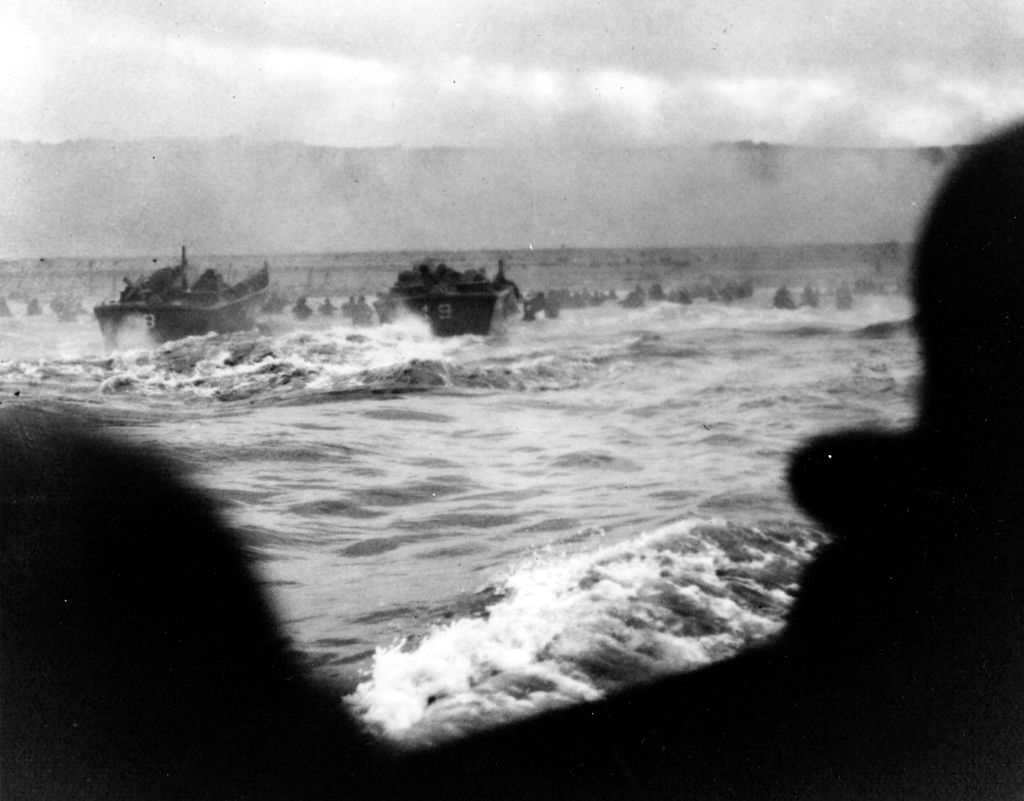
1024px-Omaha_Beach_First_Wave
Image from Wikipedia, obtained by them from PD-Archives Normandie – not by Capa

It is a picture from the U.S. Coast Guard Collection in the U.S. National Archives taken at Omaha beach – you can see it better on Wikipedia in a differently cropped version and a somewhat cruder version on the US Naval History & Heritage site. There are also some other images there from Omaha beach. The photographer is not named.

The real question I ask is why anyone should want to insert this image (and insert it rather crudely) into a video about Capa. An honest video might also have made clear that the picture of men on a packed boat (at 0m50s) although taken by Capa was not from Normandy but from Dorset, and shows US soldiers being ferried to the larger ships that would take them across the Channel.

It would perhaps be churlish to object that the pictures of Capa in uniform were not taken on D-Day, and we would not expect him to have taken these themselves, but I don’t recognise the image of a ship from above (at 1m21s) as one of his, and rather than the overprint ‘TIME’ it should perhaps have had one to indicate its source.  There are two pictures showing LCT 305 that are also probably from US Naval photographers at around 1m30s, then the picture that was re-used in the strip of Capa’s pictures. If you have more information about these it would also be of interest.

Cynthia Young, a curator at the International Photography Center in New York, annexes all these images into the Capa myth with her statement “So Capa was shooting with his camera for all of this.” But he wasn’t. He made four exposures from the landing craft before getting pushed into the water, then another eight on the beach, mainly holding his camera above his head and shooting ‘blind’ as the bullets passed over him. You can see these and others taken before and after June 6th on Magnum. Unlike the troops he could stay where he was  flat on the sand in shallow water. I’m not sure how quickly after returning with his film Capa went back to the beaches, but one of the pictures on the Magnum page taken when he returned claims also to have been made on June 6th.

Young states that a soldier was assigned to take Capa’s films back, but that these films he took were lost, and the only ones that survived were those that were not picked up. THis is a part of the myth I’ve not heard before, and I think one that does not fit the analysis in Coleman’s series of articles. It’s while she is telling the myth about the emulsion melting off the film in the ‘drying rack‘ (whatever that is) that a slightly blurred crop of the mystery image above is explicitly presented as being by Capa.   It’s a poor attempt at a forgery, being rather crudely pasted into the image strip, and not quite matching the look of the other images. As well as Cynthia Young, the blame for the misrepresentation must fall on Craig Duff who produced and edited the video, and thanks photo editor Mark Rykoff for his assistance with the images. Presumably Rykoff made clear to Duff that some of the images were not by Capa?

Does all this matter? Like Coleman I think it does. Photographs such as these are not just illustrations, but a witness statements. They say ‘I was there and this is what I saw’ and depend crucially on the integrity of the photographer – and on that of the others involved in bringing the image to public view. It matters for the same reasons that Reuters has a strict code on altering images – and fires photographers it finds to have breached it.

I think it’s also important in honouring the memory of photographers like Capa – who later died photographing another war – that we remember and value them for what they actually did, the truth about their lives and not fictions (a polite word for lies.) Finding out the true story of Capa on Omaha beach doesn’t lessen my admiration for what he did manage to do there – if anything it increase it by making me more aware of the problems that he faced. A friend I was talking with yesterday – and a former US Army photographer told me that in army training they were told that the average life of of photographer in a combat situation was twelve seconds.

____________________________________________________

* A search on Getty images brings up 3,181 pictures apparently taken by Hans Wild, who had a very long career as the first claims to have been taken on 01 Jan 1900 (but from the subject matter clearly were not) and the latest on 21 Jul 2009. The earliest appear to date from the 1930s.  Looking through the images I wonder if Hans Wild was not really a person at all, but a kind of wild card name, perhaps used for images taken by people who for contractual reasons were not named or whose names for some reason were not known. But I would like to be proved wrong!


More on Capa – Fraud

I’d not watched the Time video Behind the Photo in which LIFE picture editor John G. Morris talks through what happened when Capa’s 4 cassettes of 35mm film arrived at the offices in London’s Dean Street. Parts of A D Coleman‘s series of posts were based on the ‘ruined negatives’ that are displayed in that video as Morris talks.

I’d not looked at the ‘ruined negatives (stills of which which were reproduced in Coleman’s articles) closely, but photographer Rob McElroy did, and he noticed something very strange. What are presented as contact prints from the ruined negatives are clearly identical to the good negatives except that the image area has been whited out and the frame numbers removed. Simply a rather poor piece of Photoshop. Given that they have identical scratches and marks there can be no doubt that this is a crude forgery, and represents a clear attempt to deceive the viewer. You can read McElroy’s guest post on Photocritic International and the images in it are absolutely convincing.

On the video itself Morris actually gives a very clear description of the films, despite sticking to the fiction about them melting in the drying cabinet, when he says he “held up the rolls one at a time, and there was nothing on the first three rolls, but on the fourth roll there were 11 frames that had images…

There was ‘nothing’ on the first three rolls. In other words they were just clear film. Greatly underexposed. Nothing to melt, nothing to be lost in the drying cabinet. Capa had underexposed the film that he took before the actual landing so badly that nothing was recorded. The contact prints from the actual negatives would have been black and not white. And of course the totally blank films were thrown away.

When Capa stood on the landing craft watching the soldiers making their way to the beach that there was enough light to record on the film, and when he was on the beach. Those were the frames that could be printed – and the only frames that he took of the actual landing.

In Part 8 of his series, Coleman accuses Adrian Kelterborn of Magnum Photos, in collusion with Cynthia Young of the International Center of Photography and Mia Tramz of TIME of deliberately concocting a fraud in “blatant violation of professional ethics in the field of photojournalism, as articulated in the Code of Ethics of the National Press Photographers Association (NPPA)” and he posts a copy of his letter of complaint to Sean D. Elliott of the NPPA’s Ethics Committee  urging an investigation of the matter. And as he says, surely John Morris must have seen and approved the final version of the video and thus share responsibility for the deception.

Island History

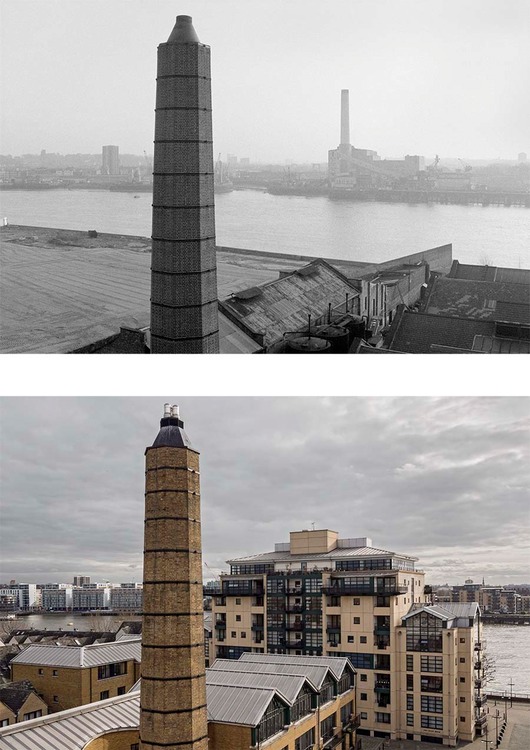
On Tuesday evening I went to the opening of Isle Of Dogs Then & Now: Photographs By Mike Seaborne, which is showing at George Green’s School Café Vert, a venue for various community and youth organisations, open to the public at times. But it is rather easier for most to see Mike’s work elsewhere, particularly in the ‘Then and Now‘ section of Mike’s 80sIslandPhotos web site.


Mike Seaborne talks about his work on the Isle of Dogs in the 1980s at Café Vert

In 1983-6 Mike undertook an extensive photographic project on the Isle of Dogs in East London to document the area prior to its redevelopment, in conjunction with the Island History Trust. In 2013, a Heritage Lottery Fund grant enabled him put approximately 1500 of his black and white photographs into Tower Hamlets Local History Library and Archives where the albums can be viewed by the public. But you can also see them on his 80sIslandPhotos web site, where they are covered by a Creative Commons license that allows them to be copied and used for non-commercial purposes provided they are correctly credited (Copyright © Mike Seaborne) and are not altered or cropped. So here is one of the pairs of images in the show at Café Vert,


View south from the Plate House belfry, Burrell’s Wharf.                             Copyright© Mike Seaborne

In the show his black and white images from 1983-6 were paired with colour images taken from the same place over the past year or so. For some it was easy to know exactly where he had taken the earlier photograph – the belfry was still there, and the chimney of the former colour works has been retained, although it is the only thing in the recent photograph that remains – even the river walls have been rebuilt since then. The power station across the river on Deptford Creek is long gone – and you can see the chimney in mid-air as it was dynamited in one of Mike’s pictures.

Mike’s photographs of the area form an important record, not just because of the quality of the work but also because of the information that is attached to them, both by him and also by others, and part of the reason for making them available on-line is to enable others to come forward with more information about the people and places in them.

You can also see more of Mike’s work from this and other places on his main web site, and also on the Urban Landscapes website that we set up around 12 years ago and co-curate.

Although I took quite a few pictures on the Isle of Dogs around the same time as Mike in the 1980s – some of which are in my book City to Blackwall 1977-84  (preview here) – my work there just a small part of a much larger project on post-industrial London and not dedicated to a particular area. His is a much more in-depth study than mine and one that involved considerable interaction with the local community. It was only a few years later that I got to know him, when I joined a group of photographers he set up, London Documentary Photographers, to document the changing city, though by then I had seen some of his work – both of us had four pictures in the 1988 BJP Annual, two of his from the Isle of Dogs.

At the opening I talked briefly with Mike about the problems of re-photographic projects such as his, particularly in areas like the Isle of Dogs which have undergone almost complete redevelopment. I’d had a few hours spare and had walked through the Island on my way to the show, taking a few panoramas. Much of the way I was walking along streets and paths I’d walked on back in the 1980s, and little remained. I think I would find it tricky to exactly pinpoint the locations of many of the pictures I made back then, or the exact direction in which my camera was pointing.

Later I began to take more careful notes about locations, and as well as street names the contact sheets from much of my later work also contain grid references, although these only locate to a 100 meter square. Life would be much easier now with GPS and the ability to automatically record the image location into metadata.

Capa Under Fire

I’ve never believed the story about Robert Capa‘s D-Day films being ruined by a darkroom technician, but though I’ve certainly expressed my doubts in discussions I can’t find anywhere where I’ve published them clearly in print or on the web.

I don’t believe it because I’ve tried hard to melt film, and it isn’t easy, and when you do so the results don’t look anything like those familiar D-Day images. Back when I was teaching art students, some of them worked hard to distress films in various ways, and found modern emulsions surprisingly resilient. They couldn’t get results like Capa’s using a film dryer or a hair dryer on full heat and ended up using more extreme means – ovens, matches and gas burners – and the results were rather different.

I didn’t believe it also because of the conflicting stories that have come out, but I kept quiet about it. I hadn’t done the research that would be necessary to write what I felt in my bones, though I tried to express a certain degree of scepticism when I wrote about it back in 1999 (and rather more in my lectures on which this was based:)

Both Capa and Rodger covered the D-Day landing in Normandy. Rodger strode ashore at Arromanche and found little happening, while Capa hit Omaha Beach where all hell was breaking loose. He shot three rolls of film on his two Contaxes, during the approach and wading ashore from the landing craft and then while lying flat on the wet sand while bullets raced over his head. Capa’s most quoted remark about photography is ‘If your pictures aren’t good enough, you aren’t close enough’, but here he was closer than he intended. He realised his duty as a photographer was to get the pictures back and rushed himself and his film back on to a landing craft and from there to England.

Only 8 of the 106 frames were fit for use. Apparently the Life darkroom technician was so excited by what he saw that he allowed the film to overheat while drying it, ruining most of the film. Life at first put out a story that the pictures had been ruined by sea water, then, after telling Capa what had really happened, ran the pictures with a caption that enraged Capa, saying he had not focused properly in the heat of the action. Of course this and a certain amount of camera shake would have been pretty excusable in the circumstances. The faults that are present in the existing pictures give them a graphic quality which would have been lacking in properly processed work.

What I was implying in the section emphasized above, though being careful not to be explicit, was that to me these pictures looked just as if they were out of focus and suffering from camera shake and that we needed no other explanation for what we can see.

But while I only implied and failed to research in any detail, J Ross Baughman recently made his views quite clear in two guest posts on Photocritic International, Robert Capa’s Troubles on Omaha Beach (1) and (2).

A D Coleman himself has followed this up with his usual dogged forensic attention to detail with a series of posts Alternate History: Robert Capa on D-Day, currently up to part 7, in which he comes to the conclusion about the ruin in drying “I no longer believe a word of it. I’m embarrassed that I did for so long, and amazed that it’s gone unchallenged for seven decades.”

But he also concludes “But it no longer matters, because whatever caused the complete loss of three of Capa’s rolls of 36-exposure 35mm film and 2/3 of the fourth roll, none of that film — according to the photographer’s own caption notes and the data encoded in the remaining negatives themselves — contained any further images of the landing at Omaha Beach.”

It seems pretty clear that Capa only made 11 exposures on Omaha beach (not the 8 which were said to have survived when I wrote) although the best of those negatives has since gone missing. Another was apparently too poor technically to print. Coleman suggests pretty convincingly that the other exposures on the film were made by Capa before the landing craft reached the beach and were drastically overexposed (as shown on the stills from a recent video.)

Coleman’s account is not quite as clear as it might be in part 4, as his mind has been changed by an exchange with photographer Mike Doukas. The frames shown on the contact sheet appear to be the final ten from a commercially loaded 36 exposure cassette, ending as usual at frame 38 (with 37 the missing negative.) They start with 5 exposures made from the landing craft as troops wade ashore  and end with the final picture Capa took on the beach.

The other films lost or ruined appear not to have been taken on Omaha beach but – according to Capa’s own notes, to have been taken earlier during boarding and the journey across the channel.

It is hard to know what to make of Capa’s claims – discussed by Coleman in part 5 – to have taken more films (or indeed about anything else in his life – Capa was nothing if not a great story teller, and good stories are always at least a little more than the truth), but Coleman’s dismissal of this seems convincing. But he is surely too harsh on Capa in the conclusion that by only taking 11 pictures and then running to get away from the beach that “On this crucial occasion, the opportunity of a lifetime, he failed himself, his picture editor, his publisher, his public, and history itself.”  It is perhaps a conclusion that reflects Coleman’s own anger at having been taken in for so long by the improbable story.

It was arguably a surprising failure not to have reloaded the camera immediately before the craft hit the beach so as to have a full 36 exposures at his disposal, but perhaps there was not enough warning that it was about to happen. But flat on the beach under withering fire he would have known that he only had a few frames left, and probably felt that loading another film would have been too much of a risk to his life. To get a couple of good images, pictures that became icons for whatever reason –  and to keep alive to take them back to England seems to me a success.

You need to read the whole story, starting with  Robert Capa on D-Day which Coleman published on June 10th.

One mystery I think remains. The young lad in the darkroom was long thought to have been the 18 year old Larry Burrows, but later LIFE‘s London picture editor John Morris who was in charge later made clear that he had not been involved, laying blame on the youngest of the darkroom staff,  15-year-old lab assistant Dennis Banks (although according to Capa biographer Richard Whelan, his name was Dennis Sanders.)  15 in 1944, if still alive he would be 85 now, and in any case there must still be many people alive who would have known him, and doubtless he would have told some his story. If he – or anyone who knew him – is reading this we would all like to hear from you, so please get in touch. Or was he simply a fictional character?

Rochester Views

I’ve finally worked out how to get TIME Lightbox to almost work on my computer, running the latest Firefox. It has always been a frustrating experience before and the only way I’d found to see all the pictures was to manually alter the address line in the browser. But now I’ve realised you can actually go on to the next image by simply waiting for the black rectangle to appear along with the ‘timer thingy’ and then pressing the ‘F5’ key to reload.

It still isn’t perfect in that to see the pictures in the full window (they call it full screen) you have to do it individually for each image, as the reload reverts to normal view. Or perhaps that is how it’s supposed to work?

I suspect my problems come from my computer refusing to accept some advertising or tracking stuff TIME want to load on me. I do have a few things set up like ‘DoNOTTrackMe‘ which blocks four trackers on the page.   Although I post a lot of material on the web I value my privacy and can’t really understand people who use Facebook but don’t look at their privacy settings. And I use and would recommend FB Purity and the advice in How to stop Facebook snooping on your web browsing activity and other similar articles.

Actually it is best to look at the work on the photographers’ own site, where there is also some text about the project. The pictures were made in 2012-3.

Back to Rochester, long the home of the yellow box which fed so many cameras, and as well as Kodak, also Bausch and Lomb and Xerox. Kodak no longer make film, and some of the pictures by Alex Webb here were shot on the last few rolls of the Kodachrome that was so symbiotic to his photographic style. But now the film can only be processed – with slightly unusual ‘distressed’ results as black and white. There are also some typically bold colour images by Alex (which I presume were made on digital), to my taste rather stronger than the more poetic pictures by his wife, Rebecca Norris Webb, still working with (no longer Kodak) film.

The book is published by Radius Books who advise “As both previous RADIUS books with these artists have sold out quickly – this is sure to be a collector’s item.” I could ask why if they think this to be the case they did not produce a larger print run. But then perhaps they did!

Although the US release date is give as June 30, it appears to be available in the UK now. ISBN-10: 1934435767 ISBN-13: 978-1934435762 and

As well as the standard edition, signed copies are available for an extra $5, as well as a limited edition with a couple of signed digital C-types thrown in for an extra $1440. I’m not greatly attracted by signed books – though I do have a few, mainly from having attended book launches or having bought directly from the photographer.  But though I’d never pay a great deal more for a signed copy, I think the idea of marketing them at a small premium – so long as most or all of it goes to the photographers – is a good one. Although given the deliberately small print runs of many new photographic books, there really is little reason why every copy should not be a signed copy.

Rochester of course still has a special place in photography, George Eastman House, the world’s oldest museum dedicated to photography which opened in 1949. It was also one of the first institutions to put a large collection of its photographic works on-line in 1998, and although the original site was decommissioned in 2006 it remains available for ‘historic and research purposes’.  The replacement site is perhaps easier to search, and quite a lot of the older work is on Flickr

Singing about Vanessa

Great to see a fine article by Sean O’Hagan, Vanessa Winship: the great, unsung chronicler of the world’s outsiders in The Guardian.  I’ve been telling people for quite a while about her photography  – back in 2008 I wrote in a piece about not going to Arles that – judging from the previews,

the outstanding pictures were by Vanessa Winship, whose work has deservedly done well in several competitions in recent years (and her ‘Albanian Landscapes‘ was screened at Arles in 2003)

and not long after, looking at a photo diary about the festival I also noted that so far “only Vanessa Winship’s exhibition seems worth more than a cursory glance.”

There are quite a few more mentions of her over the years on this site, particularly Sweet Nothings – Vanessa Winship (2009) and (2013) which are perhaps still worth reading. This piece seems to be the 14th time I’ve written about her here and I think I had mentioned her when I wrote elsewhere. Also worth reading is Michael Grieve’s review of ‘she dances on Jackson’ in 1000 Words, which I also linked to in an earlier post.

So I can only echo the sentiment under the headline of O’Hagan’s Guardian blog:

“From Mississippi to the Black Sea, Winship’s poetic, masterful photographs show how hard it is for people to belong … so why don’t British galleries acknowledge her as this large Madrid retrospective does? She deserves it”

Though I’m afraid the explanation is unfortunately rather simple. She is a real photographer, and there is no major British gallery with a real interest in photography.

Glenna Gordon & #bringbackourgirls

The New York Times Lens blog has a follow-up to its story about the abuse of images by Ami Vitale which were used to publicise the kidnapping of the Nigerian schoolgirls by Boko Haram which I wrote about earlier (Image Abuse.)

In Bringing the Nigerian Schoolgirls Into View, James Estrin writes about the work by Glenna Gordon who having photographed the demonstrations over the kidnapping in Nigeria decided she needed to do something more personal about the missing girls, and made the difficult journey to meet with some of their relatives and friends. In the Lens blog, and on her own web site you can see pictures of some of the clothing, notebooks and other items that belonged to them, along with some short descriptions of them and their hopes in life and some pictures that their families allowed her to share with the world.

It is also worth looking at the other work on Gordon’s web site, which as well as the 16 pictures on the Lens feature includes a longer series, ‘the hunters who want to #bringbackourgirls’, vigilantes keen to take on Boko Haram, said to be better armed than the Nigerian Army, with bow and arrows and hunting rifles.

There is of course much more to look at on her web site, including a lovely series on Nigerian weddings, as well as a powerful set taken in King George Home for the Elderly in Freetown, Sierra Leone.

Barts Tries Censorship

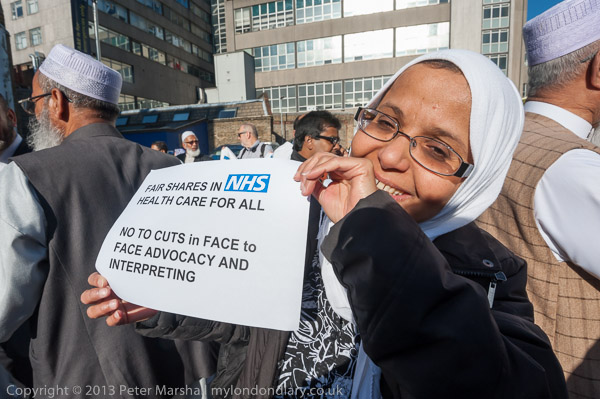
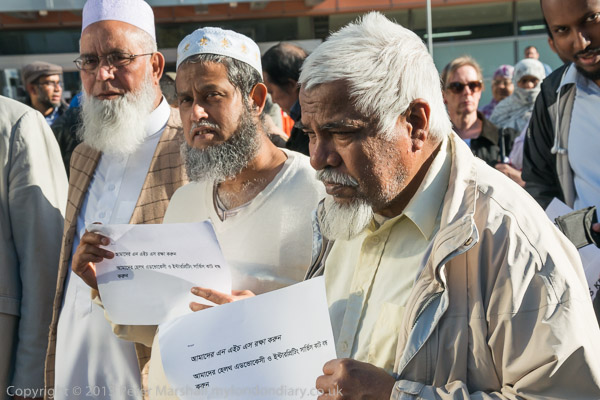
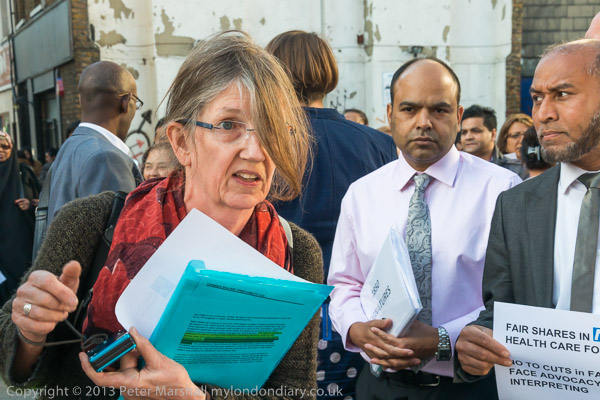
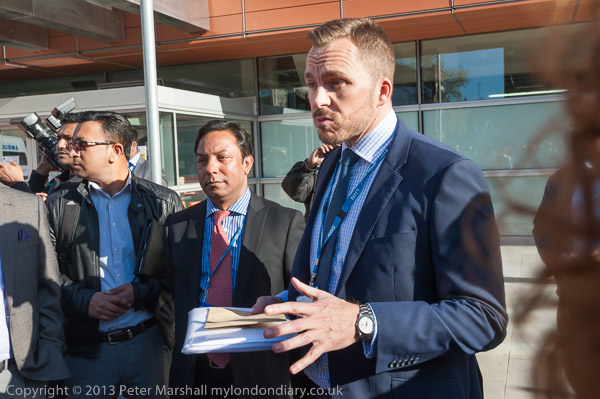
I never take kindly to being told I can’t take photographs anywhere.  I was at the protest outside the Royal Whitechapel Hospital in Whitechapel in a crowd of around a hundred people, probably at least half of whom were using their phones or compact cameras when a security man came up to me and asked “Excuse me, Sir, are you from the press?”

It’s a question that always makes me remember a film showing one of the greatest pioneers of photojournalism, ‘Eisie’, Alfred Eisenstaedt (1898-1995) working on the streets of New York, photographing kids at play, who when asked whether he was a professional replied that no, he was just an amateur*.  And of course he was a great amateur in the original sense of the word, a lover of photography. And so too am I. And given the current level of fees the press are willing to pay we are all getting to be amateurs in every sense now.

So it’s always something of a judgement call what to reply to such questions. And there are a few events where I wear my press card visibly, around my neck, but rather more where I keep it in my pocket. Everyone has a right to photograph and I don’t usually want to claim any special privileges.

But it was a polite question, and he showed me his ID card, and when I told him I was a freelance journalist he told me I could not photograph as this was land owned by the Barts Hospital NHS Trust.

I had several problems with that. Firstly it was clear that he was not attempting to stop others around me from taking pictures, so this seemed clearly to be an attack on the freedom of the press to report events, and an attempt at censorship. Secondly, the NHS trust is a public body, paid for out of my taxes as a member of the public and I feel that gives me some rights. But overriding everything was the legitimate public interest in what was happening.

So I made it clear that I intended to continue taking pictures and did so, and the security didn’t bother me any more. It seemed a particularly inept attempt to control media coverage of the event, and one that was aimed at me alone. Among the others recording the event were a couple of professional videographers who were not approached. Or perhaps they just gave up after they found I told them they had to be joking.


Local GP Dr Anna Livingstone,

It wasn’t a hugely photogenic event as you can see at Barts cuts Health Advocacy & Interpreting but over an issue which is of great importance to the local community as well as arising out of wider issues over the future of the NHS across the country. It wasn’t the first time I’d photographed in the grounds of the hospital either, and there had been some rather strange responses from security last October at the protest  Scrap Royal London NHS PFI Debt
when police had to persuade them to let the protest happen in the roadway leading to the hospital after it was clear the numbers were creating a severe problem on the Whitechapel Road.


Mark Cubbon, Executive Director of Delivery came to receive the petition

You can see more of the hugely expensive new building, both on the outside and some views from the staff canteen area in Whitechapel – Hospital Views.

* I don’t think the film I used to play to classes about ‘Eisie’ is available on-line, and although some of his best work is on the LIFE site, this seems to be a site which really fails to celebrate the photographers and it is difficult to look at more than odd pieces of work by him. But on YouTube you can watch in four parts a BBC programme Alfred Eisenstaedt Master Photographer from 1983 where he says the same thing at the end of part 3.

Continue reading Barts Tries Censorship

Purple Pictures

I’ve deliberately refrained from any comment in public (or at least I think so) on this year’s Deutsche Börse Photography Prize 2014 at the London Photographers’ Gallery. Let’s just say I found none of the short-listed photographers of great interest.

But if you don’t know who won, and want to, this page will tell you. In case you were wondering, “At the project’s heart are the points of failure of documentary photography” though I still see plenty of good documentary photography that excites and informs me considerably more than this work; (one example that comes immediately to mind is Robin Hammond’s ‘Your Wounds Will Be Named Silence’ shown at Arles in 2013 but there are many, many more.)

But had I been one of the judges faced with the four short-listed bodies of work, I think I would been hard put to make an award. But I doubt if “none of the above” was one of the options available to them.

But good luck to the fortunate winner – who is at least this year a photographer, unlike some previous recipients. Perhaps the fame and money will give him the time and space to produce something of more interest. And to buy some new film.