Paris – Sunday

Sunday I woke up not feeling at my best after a big meal the previous evening, but after a bit of breakfast felt a little better. Sunday mornings in Paris both Linda and I go separately to worship, she at the Protestant temple near the Louvre for the 10.30am service while I make my way to the Maison Européenne de la Photographie (MEP) in the rue de Fourcy in time for its 11am opening. Normally we then meet up for lunch.
© 2012, Peter Marshall
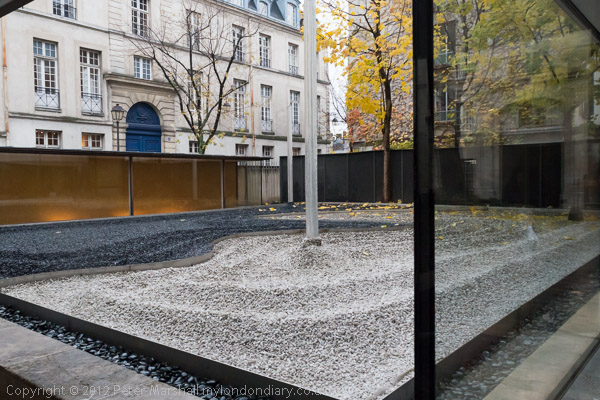
The garden in front of the Maison Européenne de la Photographie (MEP)

Linda had already been to see the main exhibition at the MEP on the free opening they have on Wednesday evenings – when I was at Photo Paris. Photography in France, 1950-2000 was a large show which reflected both the changes in the medium and in society over the period and also the views of its two creators, Gilles Mora and Alain Sayag, who feel that photography is now past its peak, with the disappearance of much print journalism and the switch online to video.
© 2012, Peter Marshall
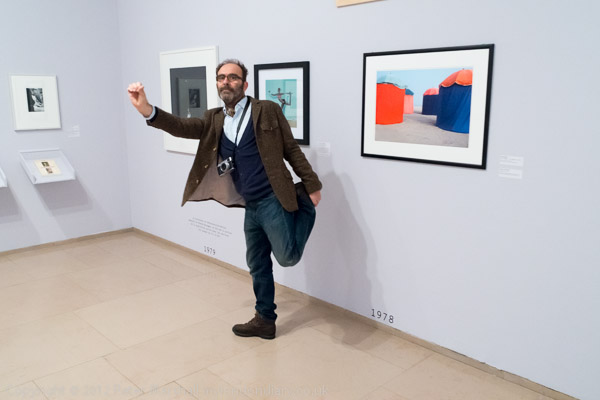
I take advantage of a man posing in front of a picture for his friend

The show certainly seemed to me to catalogue a downhill journey, with the show being dominated by the work from the early years, with some memorable images. Perhaps Iziz was the star of the show, but he had firm support from Willy Ronis, Cartier-Bresson, Doisneau, Brassai and more, with some fine fashion work by Frank Horvat and William Klein, as well as a rather irrelevant image by Robert Frank, a Swiss-born photographer who became American – although of course the publication of his book Les Amercains in Paris was a major event in photographic history in France as elsewhere across the world.

There were a number of books including this on show in glass cases – and this reflected the intentions of the curators to show photography in a wider context than simply images, and the show included examples of photography used in magazine spreads and adverts, as well as a grid of images of the best pictures by an amateur photographer packed with the usual cliches – sunsets, snow, sun on the mountains and sunsets – and one that almost manages to make a decent image of two hens. Perhaps the weakest aspect as an exhibition was in the display of books – looking at their covers isn’t a great experience, and perhaps some short video displays would have been useful.

But even in these heady early days there are signs of the fatal viruses that worked themselves out in the lower floors of the show dealing with the later decades. This was a history of a medium subverted first by the easy nudes and chemical abstractions and later by the philosophical and the chic, meaningless art and the market for such decorations. The show demonstrates both the strengths of French photography and its weaknesses.

What seems most dated from this early period was the work of the ‘radical artists’ who now don’t appear at all radical, while the ‘reclamé’ or publicity images have aged much better and made a real contribution to the show. It would perhaps have been better to have had a show of this nature curated by outsiders to French culture who might have spared us some of the more banal images of the famous French – and personally I could have done without pictures of our royal occasion.

As the years progressed there was still some fine photography, though it sometimes became hard to find for the dross (my notes have a rather stronger term.) Most of the better work came from the photojournalists, and the rest of photography – with some notable exceptions such as DATAR seemed to have lost the plot. Even those whose work I admire were often represented here by rather poor examples of their work.

This was a show intended to provoke discussion, and it will probably be very successful at doing so; it continues until 13 Jan 2013.
© 2012, Peter Marshall

As usual there were several other shows at the MEP, the most interesting of which for me was Susan Paulsen‘s intimate view made over 10 years of  Wilmot, Arkansas, a small southern town which is a part of her family history and where some of her relatives still live.

I very much enjoyed looking at her pictures – finely made Epson Ultrachrome inkjet prints. They are very much seen from the perspective of her family, living in this town of 700 inhabitants, a town (at least for its white inhabitants) that used to be a place of “fine things, fine manners, fine ways.. a place where everybody spoke perfect English.” Changes came “in the 1960s; due to mechanisation many blacks were moving from the farms into town” and Paulsen records “I am proud of Uncle William and Big John for fighting … zoning restrictions” against setting up trailers (mobile homes) on the grounds that “trailers represent fairness to the very poor.”

The images chosen for the MEP web site show two portraits of black people in the nine images, giving a rather different view to the show as a whole. Although I went around enjoying the pictures, by the end I was also thinking it was a bit like comfort food and nostalgia and I longed for something with a little more edge.

You can see some of Paulsen’s older black and white work older b/w work  here.

There were a couple of other shows down in the basement, neither of which interested me greatly. One featured the self-portraiture of teenager Sarah N. who, according the curator writing on the MEP web site “has produced a staggering body of photographic work” and the other by Jean-Luc Tartarin, undoubtedly a talented photographer – he was only 20 when he won the Prix Niepce in 1971, the youngest photographer to do so, and who now teaches photography at l’École Supérieure d’Art de Metz Métropole. You can see some of his work on line at Galerie Jean Greset and see him talking at one of his shows on YouTube. But the work for all its technical proficiency didn’t have anything to say to me.

You can take a very quick walk around all these shows in a 1 minute 26 second video by Molly Benn on Le Journal de la Photographie. She also covered other events in the Paris Month of Photography, notably on the evening of November 8th, which was the peak evening for openings in Paris this month – the Photo-Off brochure lists 25 of them, but there were also 5 others. She got on her bike and tried to take in all 30, but was defeated by the long climb up the rue de Belleville and abandoned her ride after only 19, but still an acheivement that makes my own attempts seem rather tame.

Of course I like to spend enough time at each venue to see the work properly, and also like to have a glass (or sometimes two) or wine, so even had I brought my bicycle (certainly the fastest way to get around the city) I could not have managed to come close to her record.
Continue reading Paris – Sunday

American Photographs

I’ve long been a fan of Walker Evans, and in particular his 1938 book ‘American Photographs’ and there is a well-thumbed copy of the 50th anniversary edition published by the Museum of Modern Art (who published the first edition) in 1988. That edition “with new duotone plates from the original prints” aimed to recreate the design and typography of the original “as precisely as possible”, and was I think rather an improvement on the original in terms of the quality of the printed images.

25 years on, we have the “75th anniversary edition of American Photographs, reissued by the Museum of Modern Art in an edition that recaptures, for the first time since its original release, what might be called the book’s radical purity.” I’m not sure that it differs in this respect from the edition I have .

The original was printed in 5000 copies, with an elegant cloth binding (Evans called it ‘Bible cloth’) and with various small touches that are no longer possibly in a reasonably priced edition. Printing technology has of course changed completely from the 1930s letterpress, also used for the second and rather different edition of 1962.

You can read more about the book and see 18 of the 87 images from the book (the MoMA show the original accompanied had 100 pictures) in a piece on the TIME LightBox by Ben Cosgrove.  Many of the best-known images by Evans were taken when he was working for the FSA, and you can see them on the Library of Congress web site, including the two albums of prints made when working with James Agee on another book, Let Us Now Praise Famous Men.  Many of his images on the LoC site now seem to be very poorly scanned from ‘intermediary roll film’ reproductions, but there are still over 40 decent high res scans available from the original negatives, so you can try making your own prints of his images.

Hipsters Stunned…

Or to give it the full title Hipsters stunned as vintage cameras fail to make them professional photographers on Hayibo made me laugh a little, because it contains some rather astute observations on several things that annoy me.

Like the guys who routinely convert their colour digital images of protests before posting them on the web, presumably because they think that this somehow make them more authentically ‘documentary’.  Or even those who think that using film somehow makes them better photographers. On one digital printing forum the other day there was a guy who posted (or rather boasted) about how he was going to take all his pictures on film and set up a wet darkroom to print them onto photographic paper because that would somehow make them real photographs rather than the digital crap the rest of us make.

I’ve nothing against black and white. I spent years mainly taking black and white images, using Tri-X, FP4 and the rest. Got good enough at printing to be asked by other photographers on various occasions if I would print their stuff. Took loads of colour film too.

If you want to work in black and white  – and just occasionally I think there are good reasons to do so – you need to learn to think in black and white. Not enough to own a camera that will convert your images to black and white or even a great Photoshop plugin which will do it even better. There are photographers who do it well, and some of them will be rich enough to afford Leica’s  M Monochrom digital camera.  (Of course their M8 (I made the mistake of buying one) is actually a decent monochrome digital, just had problems with colour. But the M Monochrom looks great for those who want to work in black and white and have around £6,000 to spare.  I’d love one.

There really was nothing special about film. I’m currently spending several hours a day scanning it and cursing it for its many faults. Too many frames that have bits of fogging from loading in bright light, or where I tried to squeeze in another exposure on the end of the roll. Scratches from dirty cameras or cassettes or careless handling by darkroom technicians (myself included.) Some have even suffered damage from abrasion while inside ‘archival’ storage sheets. Dust, dust, dust, both embedded during the drying or picked up later and held by powerful static electrical forces. Not to mention those that have had coffee, beer, wine, spit and various other liquids spattered across them in later life. Most of my negatives were at least properly washed, unlike some trade processed material, though I’m told that a small residue of chemicals can actually help to preserve them. Perhaps they also would help protect them from the insects who have made some of my files their homes over the years, who I’m sure like their gelatin additive-free.

Of course I exaggerate – if only slightly. But for working in black and white, digital has many advantages, and for working in colour, one over-riding one. Colour is simply so much better. Film gave you colours from the manufacturer’s tin rather than the real world.  Of course colour differs between different camera manufacturers and can be altered in processing, but the overall colour quality from both the Nikon and Fuji cameras I use is superb. There are still a few tricky areas, for example in the handling of bright oranges and reds. For some of the Guantanamo protests where those taking place wear bright orange jump suits I sometimes find I need to change to a different camera profile, but for normal subjects everything works fine.

And as for the printing, a good scan with the Minolta Dimage Scan Multi Pro (fitted with a diffuser) gives a better result than my Apo-Rodagon or other expensive enlarging lenses, and printing with the Epson R2400 allows me to work in Photoshop with a subtlety that was simply unattainable in the darkroom. It’s a bonus that the prints are likely to last longer too.

Center Awards

I learn from PDN Online that the not-for-profit public service organization, CENTER, founded in 1994 in Santa Fe, New Mexico, has recently announced its 2012 winners of its various prizes. Center’s tag-line is ‘Exposing Great Photography’ and says that it “honors, supports, and provides opportunities to gifted and committed photographers” through its programme.

Both in the judging panel and in the awards there is a certain British interest, with the top award (and a $10,000 prize) in the Project competition going to English/Swedish documentary photographer and member of VII Anastasia Taylor-Lind for her fine project  ‘The National Womb’ on the Nagorno Kabakh’s government birth encouragement programme.

The web site shows work by various photographers who won awards in the five different competitions run by CENTER, and there is plenty of other interesting work. A second fine set of work in the Project competition was Pablo Martínez‘s ‘The Line’, but work from the other competitions – Project Launch,  Curator’s Choice, Editor’s Choice, and Gallerist’s Choice is also worth looking at, although rather varied, and including some that had me thinking that perhaps it just doesn’t come over on the web. And genuinely there are some things that don’t work at small scale on a screen.

On the site you can also see work by the winner of the biennial Santa Fe prize, entry to which is by nomination from “approximately 100 industry leaders including representatives from National Geographic, TIME magazine, Art Institute of Chicago” and also carries a $10,000 prize. You need to go to her own web site to see more of her work as the couple of images on the CENTER site really give very little idea of it.

The New York Photo League

I’ve long been a fan of the work which came out of the New York Photo League. Founded in 1936 it became the basis of a tremendous energy in photography in America in the 1940s and beyond, and was a key influence on the kind of photography that for me is central to the medium. I wrote my first article about it in 2001, when there was really very little available about it on the web, and it was a piece that got a wide readership and many responses, including from several of the photographers who had been involved (a couple actually asked me for advice.) Later I wrote more about the league and a number of those who had taken an active part in it.

In the eleven years since then, I’ve been pleased to see articles and features about some of those then less well known photographers appearing, and more of their work available on the web and through galleries. Some in particular had previously been busy promoting their work, in particular the  Stephen Daiter Gallery in Chicago, who had published Anne Wilkes Tucker’s book ‘This Was The Photo League’ earlier in 2001 with photographs by Morris Engel, Walter Rosenblum, Morris Huberland, Sid Grossman, Sol Libsohn and Dan Weiner.  Years earlier in 1979 I’d read Tucker’s article on the Photo League in ‘Modern Photography’ magazine,  probably the first time I was aware of it’s importance in photography.

Here’s a short section of the roughly 3000 word essay I published in 2001:

The major figure in keeping the activities running over the years was Sid Grossman, described as an organisational genius, as well as a fine photographer, but many others, including Walter Rosenblum (president for many years), Dan Weiner and Sol Libsohn played vital roles. Paul Strand was always on hand for advice and also taught and lectured (Rosenblum describes a class by him in his essay mentioned earlier). Aaron Siskind led the Harlem project for four years, and there were many others. All those involved in the League’s programs gave their time without charge.

Most of those who belonged to the Photo League, at least before the late 1940s, were working class New Yorkers, from the lower east side, from Brooklyn and from the Bronx. Most were in their teens and twenties when they joined; many were the sons and daughters of first generation immigrants living in these working class areas, and they were predominantly of Jewish origin. Few were professional photographers, most were working in low paid jobs

The LEAGUE set up in a second floor loft – the former FPL premises in East Twenty-first Street. This small base became exhibition hall, meeting room, darkroom and school for the members.

They were attracted in particular by the low cost (the teaching staff were not paid) and high standard of the photographic tuition on offer. The League school, directed by Sid Grossman, offered courses in the techniques, history, aesthetics and practice of photography. As well as Grossman, a gifted teacher, and Libsohn who together ran the documentary class, there were also courses and guest appearances by many well-known photographers. Teaching in the photography classes was very much based on practice, with the students being sent out to record life in the various communities of Manhattan, taking photographs that were then criticised – at times extremely forcefully – and discussed in class.

The Photo League School was at the time, as Hal Greenwood noted in 1947, the’ only non-commercial photo school in America’, and in the years it was open, trained over 1500 photographers. It used a ‘ progressive educational method: the student learns by doing’ which was unusual for its time and aimed ‘ to help the student ‘discover the world; to develop a personal, philosophic, and visual perception which would load to an individual direction in photography’. It’s success can be seen in the work of those who passed through it, and also by the later adoption of similar methods by many courses in photography in our schools of art. Unfortunately few of them did it anything like as well.

What prompted me to recall this was a feature Redeeming a Life in Photography in today’s Lens blog with Sid Grossman’s widow, Miriam Grossman, now 85 (Sid died of a heart attack in 1955, when she was only 28) in which she talks of having waited since his death “for some kind of redemption, , and it never came.” As writer David Gonzalez comments, it has now, with the show ‘The Radical Camera‘ which has been showing at the Jewish Museum in New York and closes this Sunday. The Museum of the City of New York has 77 images by Grossman on-line  (open one of them as a larger image and you can then go through them all as a slide show.)

Last week the Lens blog had another feature, A Liberating League on the women of the Photo League, which includes an interview with another photographer I wrote about some years back, Rebecca Lepkoff, as well as two women I didn’t mention, Vivian Cherry and Sonia Handelman Meyer, all now in their nineties.

Cruel & Unusual

Regular readers will know that I’ve often mentioned Pete Brook’s Prison Photography blog on these pages, as well as his posts on ‘Wired’s ‘Raw File‘ blog. He’s someone who has often raised interesting issues, both photographic and political, and the forthcoming show Cruel and Unusual at Noorderlicht which he is curating together with Hester Keijser which runs from Feb 18 to April 1, 2012 looks to continue in that vein.

I’ve just been looking through an preview copy of the catalogue, which has just gone to the printers. Designed as a newspaper, 4000 copies are being printed in newsprint, and it will be available free at the gallery, and with a small handling & shipping charge through the Noorderlicht webshop shortly. Worth getting in fast when it goes on line as copies should go quickly.

And here I should declare a small interest, as one page of the publication is given over to (free and by invitation only) adverts for photography blogs, and its an honour for >Re:PHOTO to be listed there with many that I admire.

Thanks to Peggy Sue Amison, Artistic director at the Sirius Arts Centre in Cobh, Co. Cork for posting a link on Facebook to a couple of good and well-illustrated preview features on Elizabeth Avedon’s blog (and I think the answer to the question you may be asking is yes) CRUEL AND UNUSUAL: Prison Photography Exhibition Part I  and Part 2.

[Observant readers will notice that this post only went on line after my second post on the show, Cruel & Unusual 2.  It was written two days earlier but somehow I clicked ‘Save’ rather than ‘Publish’! as I hurried out to take some pictures.]

Bikes Alive & Nikon Flash

© 2012, Peter Marshall

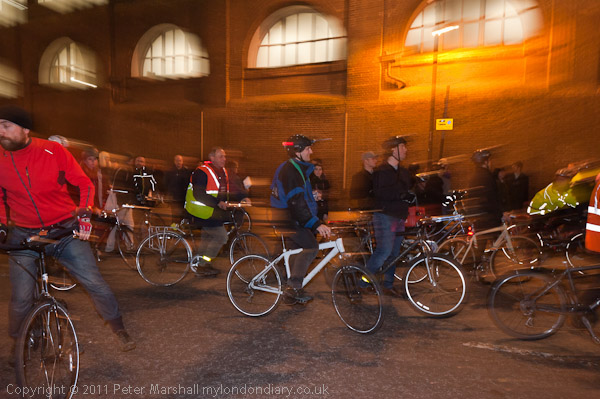
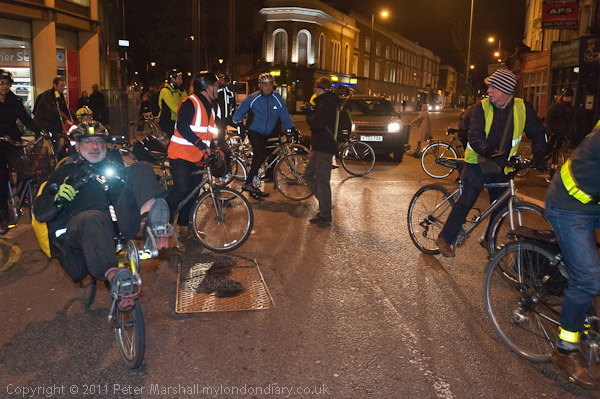
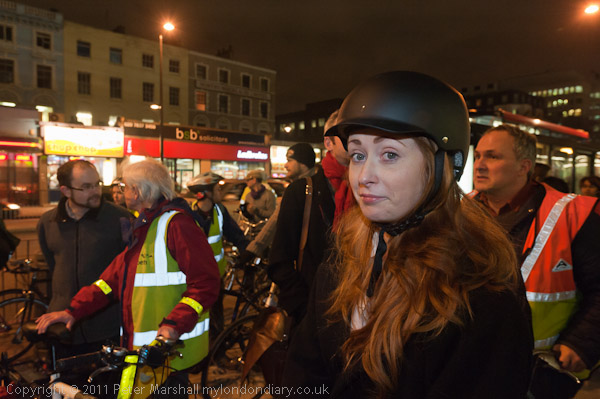
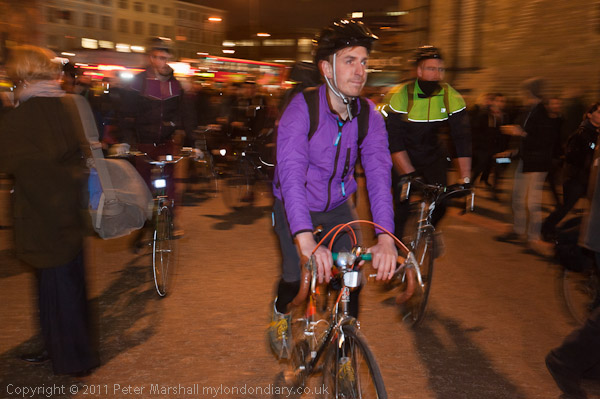
Or perhaps I should have called this things I should have remembered on Monday night with Nikon flash. Some of the results weren’t bad, but I could have done a lot better, and found myself much of the time pressing the shutter release with nothing happening, because the camera was failing to focus, and I couldn’t work out why the focus assist illuminator wasn’t working. Two minutes and a quick check of the manual when I got home and I was kicking myself.

© 2012, Peter Marshall

I’d set Custom setting a9 AF-assist illuminator to ON, but had forgotten that this only works when the focus mode is set to S (single-servo autofocus) AND you are either focussing on the central focus point or using Auto-Area AF.

Without the illuminator, focus with the 16-35mm in low light is pretty tricky as I found, and I have the camera set (CS a2) only to take pictures when in focus. So I spent a lot of time pushing the release and nothing happening.

The other slight problem was that I had taken a picture at the start of the evening using Aperture priority, and although I had changed the working aperture back to f4 (wide open) I had forgotten to change the exposure mode back to S. Which means that the camera was adjusting the shutter speed to some quite long values to get correct exposure (or rather the selected -1 stop exposure) from whatever ambient light there was.

© 2012, Peter Marshall

Generally it works better to set Shutter Priority, selecting the slowest speed that is suitable given the subject and ambient lighting. When you move into a darker area the flash to ambient ratio will change, giving a darker background, while the closer areas lit by the flash will stay more or less the same.

© 2012, Peter Marshall

You can read about the protest and see more pictures in Bikes Alive – End Killing Of Cyclists on My London Diary.
________________________________________________________

My London Diary : Buildings of London : River Lea/Lee Valley : London’s Industrial Heritage

All photographs on this and my other sites, unless otherwise stated are by Peter Marshall and are available for reproduction or can be bought as prints.

To order prints or licence to reproduce images

________________________________________________________

Odd Images

There are often pictures that I take that don’t fit into the stories on My London Diary. Nothing really odd about them (that might be more interesting.) Sometimes I tag them on at the end of a story, but that hardly makes sense, and almost certainly means that I won’t ever be able to find them again.

Here are three I took kind of on my way home on October 31. I’d decided to take a little look around the West End to see if anyone was out celebrating Halloween on the streets, but at around 7pm wasn’t surprised not to find anyone. But as I went around, both walking and from the bus I took a few pictures. Here’s one of a shop getting into the spirit of the evening.

© 2011, Peter Marshall

Its a place where during the day you will see guys standing in front dressed in union jacks and tourists posing with them for photos as well as going in and buying tourist stuff.  Probably not the kind of thing I would normally take a picture of, but standing there I wondered if it might serve as a statement not about what night it was, but about the state of the UK economy.

I was really hanging around until I could use my ‘Super Off Peak’ rail ticket after 7pm, and it was time to get on a bus to the station. (‘Super Off Peak’ was a super wheeze thought up by the rail companies to make loads of money, by keeping the Super Off Peak only slightly more than the previous excessive Off Peak fares and then putting time restrictions on them so you have to buy an more expensive Off Peak ticket to travel out of London between 4pm and 7pm.)

I couldn’t resist taking a couple of pictures on the way from the top deck of the bus. The first was in Trafalgar Square, where a bus gives quite a good view of our National Gallery, but what really attracted me was the red man hovering in front of its dome.

© 2011, Peter Marshall

The bus wasn’t stopped long at the lights and controlling the reflections in the window is always a problem, especially if you want some of them, as I did. I wondered for just a few seconds about whether to Photoshop out those bits at top right, but decided it was against my principles, although perhaps I might just make them a little less obvious…

The way to avoid reflections completely when working from buses (or through windows of any type you can approach closely) is to use a rubber lens hood, though it might be hard to find one except in a 49mm filter size. Back in the days of film, using an Olympus OM camera this wasn’t a problem, as almost all of the fairly wide range of lenses I owned took 49mm filters – the odd one out was 52mm.  This lets you form a light seal even at a bit of a slight angle to the window, without pressing the solid bit of the lens against the window – which would pick up nasty vibes from the bus. Without it I’m left using my  dark coat sleeve to do the best I can.

The other problem is dirty windows. It adds another aspect to choosing where to sit on a bus, assuming you have a choice. Fortunately you only need a fairly small patch of cleanish glass to work through. But some buses don’t have one.

I was on a nearly empty bus as we went over Waterloo Bridge, and as I’ve photographed the National Theatre at night quite a few times both from the bus and from the bridge, I moved over to a seat on the other side.  Nothing very special about this picture that I can think of, other than some slightly unusual lighting.

© 2011, Peter Marshall

August Comes Late

August has at last arrived on My London Diary, although I’m still considering adding some of my pictures from Berlin in July. But there are now two new events on the site.

Every August 6 I like to reflect on an event that took place a few weeks after I was born, the first atomic bomb exploding over the Japanese city of Hiroshima. To many at the time it seemed pointless, as Japan had already lost the war and the only option remaining was some kind of surrender. Many thought it went ahead only because of the kind of inertia of the project (rather as the invasion of Iraq had an inevitability about it months before Parliament here took the vote which, largely thanks to the deliberate misleading by Tony Blair and his fellows in crime, sanctioned it.)  But I think we now realise that Hiroshima and Nagasaki were the opening salvo of the cold war, bombs on Japan that were actually directed towards the USSR.

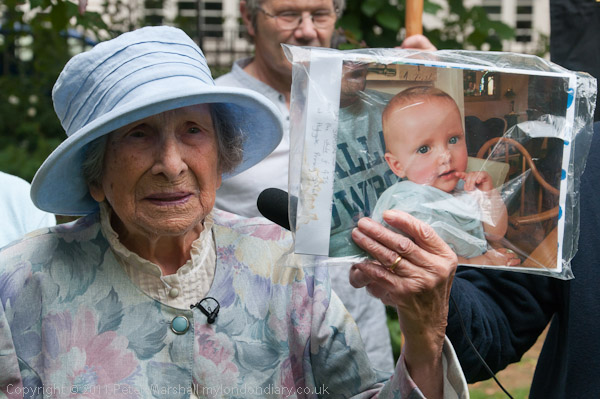
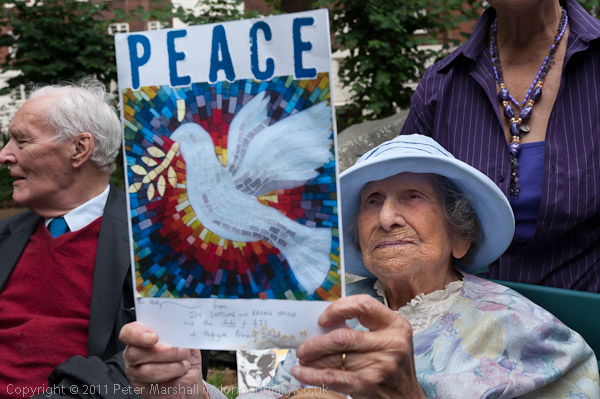
As an event, the annual commemoration close to the Hiroshima cherry tree in Tavistock Square isn’t the most exciting, and while I go to many events to photograph them, this is one that I photograph because I am there. This year however it had a star,  the 105 year-old Hetty Bower, who arrived with a camera crew in tow, and captured the hearts of the audience as she told us how as a young girl of nine in 1914 the sight of men returning from France minus an arm or a leg had convinced her of the futility of war and made her a life-long pacifist.

© 2011, Peter Marshall

Photographically the only problem was avoiding that camera crew, making a video of her life story while getting to the kind of distance I like to work at. Perhaps rather more pictures than usual were taken towards the longer end of the 28-105mm.  There was a clear cue for a picture when Hetty held up a picture of her grandson, one the following Tuesday, but it was wrapped in highly reflective cellophane and the reflections killed some of the best pictures. Later, when the formal part of the event had ended I tried to photograph her sitting and talking with another veteran (if young by her standards) Tony Benn, but I couldn’t find an appropriate angle, they were too far from each other and facing more or less in the wrong direction. Perhaps I could have posed them, but that isn’t the way I work.

I think my best picture came when she showed me a large Peace card given to her when she visited a primary school. At first I was too close, looking at the signatures she showed me inside it, with greetings from the children and staff, but as I moved back a little she closed it up and held it up for me.

© 2011, Peter Marshall

The other part of the event I’ve always wanted to get a good picture of but never quite managed is the laying of flowers around the cherry tree planted years ago in memory of the victims of Hiroshima.  It’s hard because people come spontaneously and from all directions, and of course turn to face they tree when they place their flowers.  Its also a moment when I feel a photographer is rather in the way.

© 2011, Peter Marshall

This was perhaps my best attempt, and the video cameraman at left perhaps doesn’t really add to it.  I thought I might have another good picture a few seconds later, when another woman came to add her flowers, but as she lent down to do so my picture became rather dominated by her low-cut dress billowing out to display considerably more than was appropriate for the occasion.

Westminster Council Should Be Ashamed

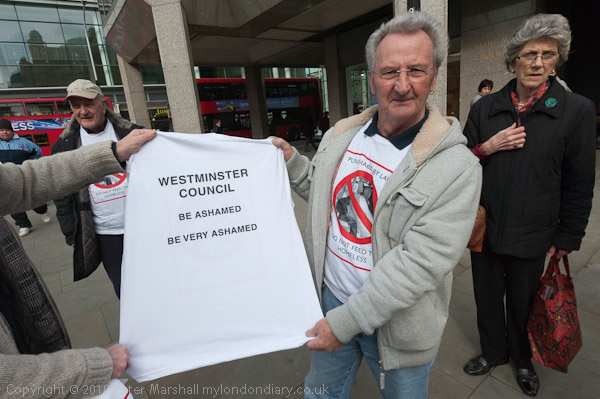
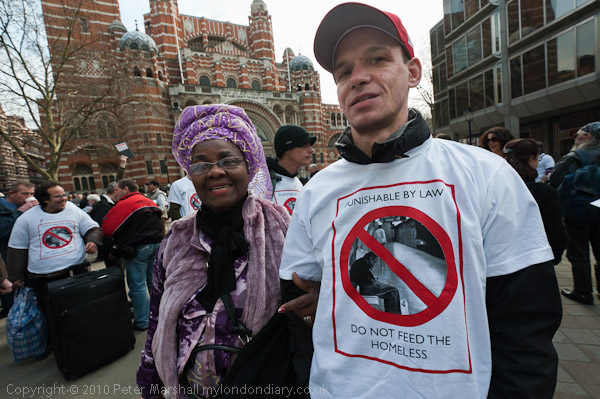
I was appalled when I heard that Westminster Council were proposing to make it an offence to offer food to the homeless, and even more so when I found that they also want to fine those sleeping on the street in their borough up to £500. Of course if people had £500 they would not be choosing to sleep on the street.

When I heard that a protest was being organised against the proposal I was keen to photograph it and try and get as much publicity as possible for the opposition to the by-law.

© 2011, Peter Marshall

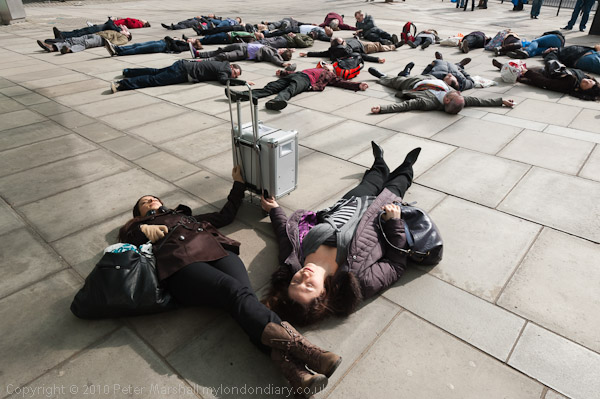
The afternoon started with what was advertised as a Flashmob, but rather to my surprise people turned up early and stood around chatting, waiting for it to happen. Which it duly did at the specified time, with people getting horizontal on the pavement as Radiohead’s ‘Just’ started and keeping flat on the ground until the song ended.

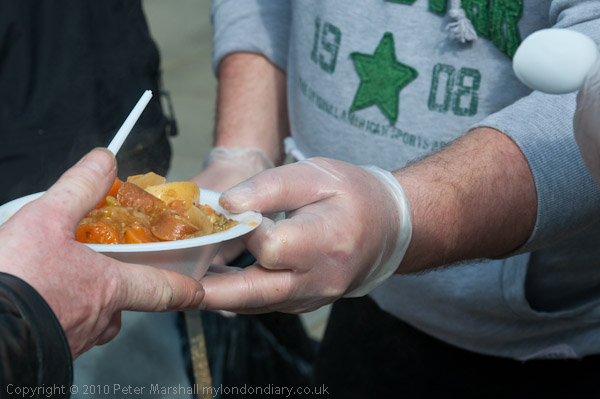
Then we all went back to Westminster Cathedral plaza, where a number of people had been sleeping rough – and some were woken by the music as tables were set up and food to give away loaded onto them.

© 2011, Peter Marshall

Usually at public events I photograph those taking part without thinking at all about their privacy – they have chosen to be there and act in public, but this was perhaps rather different. I decided that I did not want to take pictures – or at least not identifiable pictures – of those who were sleeping rough without being reasonably sure that they were comfortable with being photographed and having their pictures used.

© 2011, Peter Marshall

The free food was available to anyone who wanted it – I’d eaten on my way to the event so all I had was a couple of crisps, but those eating included some of those who hand it out at various ‘soup kitchens’ and other events around Westminster as well as passing tourists and the homeless.

But I think the pictures I took were more powerful because of that decision, which made me concentrate on how to communicate rather more than usual. And I did photograph those people who were clearly happy to have their pictures taken.

© 2011, Peter Marshall

Later I looked at work by another photographer from the same party, which was very different to mine, concentrating on the homeless people who came to it. I’m sure that he took his pictures with respect for the dignity of those he photographed and with their permission, but I still felt a little uneasy about the work. It seemed somehow to stigmatize them rather than draw attention to the issues and record the event as I had tried to do.

You can see my report and more pictures at Don’t Make Compassion Criminal on My London Diary.