Burma – 60 but Not Free

Last Friday was the 60th anniversary of Burmese Independence. Most of us have probably forgotten that Burma was a British colony, or that the events of the Second World War led to its gaining independence.

Although the Burmese nation may be independent, its people are not free. As the brutal repression of peaceful protests by monks showed, Burma is ruled by a ruthless military regime.

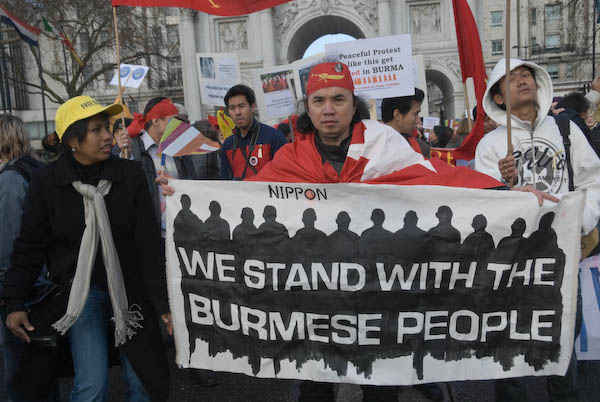
There were few celebrations in Burma, where the streets of the capital were filled with riot police to prevent any popular demonstrations. On Saturday, led by Buddhist monks, around 200 people, including many Burmese living in the UK, marched through London. They wanted to keep the problems of Burma – and the killing of thousands of monks – in the public consciousness.


Marble Arch, 6 Jan 2008

Few reporters and photographers turned up; other stories have now pushed Burma out of the news. You can see my pictures of the silent march and the rally in Trafalgar Square on My London Diary.

Creative Commons? Photographers – just say no.

Two blogs I read fairly regularly are Dan Heller‘s Photo Business blog and PDNPulse from Photo District News (PDN), and there are related recent posts on the two of them.

When last I looked there were three features on Dan Heller’s site dealing with the problems of Creative Commons Licences for photographs, but by the time you read this, there may well be more! The first in the series was posted on Jan 3, 2008, and you’ll find the others on the left sidebar.

If you are someone who puts images on the web – especially on photo-sharing sites such as Flickr, I suggest you take a careful read.

Creative Commons Licence come in 6 varieties on the UK Creative Commons site, with a slightly different presentation on the US site – which covers over 40 countries – including England and Scotland and various languages.

As Heller points out, because of the vast number of images contributed to sites such as Flickr, Creative Commons (CC) licences actually are the dominant form of photographic licencing, at least numerically. Flickr does give you the choice of ‘None’ as well as the six CC licences – and it is the one I choose for all of my pictures there – but I think most Flickr users go for one of the CC licences.

Heller certainly makes a lot of interesting points and should give all photographers something to think about. Some of the arguments he makes depends on US copyright law – rather different to the UK and other countries that followed the Berne convention as it retains a copyright registration system (although unregistered images are still copyright.) Registration enables the copyright holder to claim punitive damages rather than more normal usage fees. The US also has a rather different and generally looser interpretation of ‘fair use.’

As Heller also points out, many people see the CC licences as an alternative to copyright, but in fact they are not, but are simply licences for the use of work that do not actually affect your copyright.

I decided a year or so back that CC licences didn’t make sense for me, although I have an fairly liberal policy of granting no-cost use of my work to funds-free non-commercial organisations – with a few exceptions. For me copyright is first an issue of control over the use of my work, and secondly a strong sense of not wanting to get ripped off by guys who can afford to pay. And yes, it would be nice to make a living!

Heller comes to the conclusion that CC licences have no part in the world of photography, by which I understand he means the commercial use of photography. They simply don’t give the end-user of the picture the protection. He sees this as good news for professional photographers, as it increases the need for commercial users of photographs to get images from agencies and photographers who can be trusted to provide less risky licences for their images.

PDNPulse today links to a Washington Post article (it may require you to fill in a free subscription form) which gives some interesting examples of images used without permission, as well as some of the rather feeble excuses that companies give for their actions.

No Love Lost: Michael Grieve

Jim Casper at Lens Culture has been busy lately, and I’m finding it hard to keep up with him. One fairly recent photo-essay on the site is ‘No Love Lost‘ by Michael Grieve, a visual project made in “sexual environments” – around “pornography, prostitution and stripping” in contemporary Britain.

Grieve describes his work as a “lyrical documentary metaphor in a
factual world about real fictional encounters
” which is a phrase I find some difficulty with (as I do too with environments being sexual.) But he certainly conveys a feeling of spiritual emptiness in these images, some of which are more peripheral to the actual encounters than others.

His pictures are of a world with which I have little in common, though many years ago as a student I did live in a multi-occupied house where two of the other occupants were prostitutes who entertained clients on the premises. One was a very motherly woman, quite unlike anything in Greive’s pictures, with whom I sometimes shared a sociable cuppa in the afternoon (though I’m not really a tea drinker) while the other would have more readily fitted into his work, with a kind of vacancy like that of his ‘Mistress Storm.’ (All of the pictures I mention are on the Lens Culture site,)

There is a peculiar sadness about ‘La Chambre swingers’ club, Sheffield’, a rather ordinary looking corner shop except for the covered windows and red-lit name (curiously also present inverted in the image.) Above the door the sign says “YOU TOO CAN HAVE FUN”, but in the sequence on Lens Culture is followed by one of the most depressing scenes imaginable, with a sickly green light, a filthy ceiling with straggling wiring and an off-white plastic fitting that somehow makes me think of a skull above three men in black masks. A second image from the same place, largely back views of several men in a rather dimly lit room with what appears to be a gloomily painted obscene mural is perhaps even less enticing.

Perhaps the most striking image comes from a porn shoot in Peterborough, and at its centre are three feet, two of a woman wearing nothing but a gold chain around her left ankle and red nail varnish, forms an incredible conjunction with a man’s foot coming down from the top centre of the image, the shape between them and the contact having a sensuous quality lacking in the other pictures.


Click for a larger image on Lens Culture

The woman, cropped to more or less a pair of legs, is posed with these open but her left toes squash against the back of her right leg just above her heel, her hand delicately hides the meeting of her legs, her little finger pointing delicately up. Another male leg comes in a the back of the others from the left, and on the right is a second woman, her knees towards the top centre of the image, feet tucked back underneath, the frame cropping her just above the waist. It is a picture of incredible geometry, a kind of ‘Edward Weston meets pornography.’

If you actually come to these pictures in search of pornography you will I think be disappointed, although there is one simple image of a naked woman looking at the camera who I do find rather attractive. Another which appeals in quite a different way is the last in the sequence, ‘Break in porn shoot, London, UK, 2003′, which appears to be a rather impossible to unwrap reflection in which a naked couple lie entwined with a touching tenderness.

I also find a certain curious appeal in some of the captions. ‘View from brothel, Slough‘, the roofs of some very ordinary suburban houses, seen through one of those front doors with a half-circle of window in a kind of sun-ray pattern of 5 panes. Like the view from many suburban halls out through the closed front door, but the glass is red.

Slough is just down the road from where I live, but impossible to think of without Betjeman’s “Come friendly bombs and fall on Slough!” (perhaps the red is their incendiary fires?) and John Bunyan’s “slough of despond” that hampered his pilgrim Christian’s progress. Despond is perhaps rather appropriate for ‘No Love Lost‘, an interesting body of work that reflects on one of the sadder aspects of modern life.

Grieve was born in Newcastle, England in 1966, and after a BA in Film, Video and Photographic Arts at the Polytechnic of Central London, he gained an MA in Photographic Studies at the University of Westminster in 1997. Based in London, he worked for two years as a photographer for the Independent newspaper before freelancing as a portrait and feature photographer for various magazines. His work is now distributed by Agence Vu.

No Love Lost is his first book project, and according to ‘Vu‘ will be published soon. He is working on a second project, ‘In Passing’, on motorway and airport hotels.
A Ramble in Olmstead Parks

When Frederick Law Olmsted (1822-1903) visited England as a journalist in 1850, he was greatly impressed by Birkenhead Park, the first publicly funded British park, designed by Joseph Paxton, who had been made head gardener at Chatsworth when only 23 in 1826, and is probably best-known as the architect of the great Crystal Palace.

This park marked the start of a movement to create public parks, and Olmstead was its great pioneer in the USA, working with English architect Calvert Vaux. Their first design was for a competition to build a Central Park in New York, which they won and started work on in 1858, and thus it celebrates its 150th anniversary this year.

They went on to design parks in virtually every city in the country, setting up the first landscape architecture firm, which continued to operate after his death in 1903, and designed more than 350 academic campuses as well as parks.  Olmstead set down detailed principles of design which underlie the apparently natural vistas of all his creations.

As a part the celebration of 150 years of Central Park, The Metropolitan Museum of Art in New York is putting on a show of images by Lee Friedlander, one of my favourite photographers and a key figure in medium in the second half of the 20th century, taken in this and Olmstead’s many other parks across America.

Friedlander started shooting in Central Park in the mid-1980’s, and in 1988 gained a commission from the Canadian Center for Architecture in Montreal (where Olmstead’s Mount Royal Park opened in 1876) to photograph in other Olmstead parks. He worked on this over the next six years, but continued to photograph the parks for around 20 years in all.

The exhibition continues until May 11, and you can read more about it in a feature in the New York Times, which also has a set of 10 pictures on line. They include images in square, 3:2 and panoramic formats, from an interesting period in the photographer’s work.  Although the museum promises to have more information on its web site, currently there is little more than the title and dates and a press release. The show will have around 40 pictures, many never previously exhibited, and is accompanied by a book, Lee Friedlander Photographs: Frederick Law Olmstead Landscapes, with 89 images and an introduction by Friedlander.

Herbert Keppler

I never knew or met Herbert Keppler, (Burt to his friends) who died on Friday aged 82, but his work did affect my life. Born in 1925 he had a long career in writing about photography, and was editor and publisher of Modern Photography which was an important magazine for photographers in the UK as well as America. It was his love and knowledge of photography that led to that magazine publishing portfolios and features of many important photographers, both historical and contemporary, in the 1970s and 80s, including some finely printed examples, at least one of which still hangs in a frame on one of my walls.

Keppler also set up what was probably the first real test laboratory for camera and lenses to back up Modern’s reviews, which were so much more comprehensive and technically authoritative than any others, particularly than those we could read in the UK, where lab testing generally meant poking the lens out of the window and photographing a ship across the Thames.

Keppler was a man with high standards, and he set up a program for vetting mail order ads for Pop Photo, which led to the magazine turning away over $2 million in advertising, according to the obituary by Mason Resnick on the Adorama site.

Later, after 37 years at ‘Modern’ (he joined as Associate Editor when it started in 1950) he was persuaded to move to the more popular ‘Popular Photography’, where he put in another 20 years service, continuing to work more or less until his death. Many of us deeply regretted when ‘Modern’ was bought and closed down by ‘Pop Photo’ , but at least Keppler ensured that its technical content aspired to the standards set by that title, as well as continuing to promote high standards in mail order.

As you would expect, there is an extensive obituary on the Pop Photo site, with more material promised later.

Hanging Out in Brasilia

When I got back to ECCO after helping to hang my show, I was told I had an hour to spare before lunch, and I decided to take a short walk. ECCO is in the SCN or Northern Commercial Sector on the edge of the central axis of the city (Eixo Monumental) around which all of the major public and commercial buildings are grouped.

Brasilia is Car City. Planned almost entirely around the idea of movement by car, with streets seen simply as routes. The guide books say it is too large to walk, which isn’t true. They say people don’t walk, ditto. Few people may stroll for pleasure as I was doing, but many were hurrying from A to B, usually taking the most direct route, often in the absence of paved routes cutting a path through grassed wastes, exposing the deep red soil as a violent gash in the city fabric.

I wish I’d had more time to explore and photograph. It was hot to walk in the sun (and I’d forgotten I’d need a hat, so my forehead was peeling a few days later) and it seemed very odd to be celebrating Christmas in mid-Summer weather. Though they have that all the year round in Brasilia.

I took a few pictures around the outside of two large shopping centres, and a few around the offices and waste areas between, then returned to the gallery.

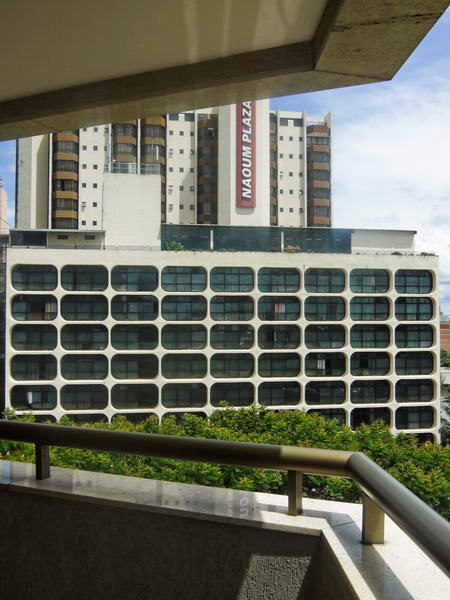
Later, on the way to lunch, we stopped at a large and empty building in the SCS and while Karla was trying to sort things out I took some pictures from its balcony. One shows the Bank of Brazil and the other is looking roughly north, with a row of ministries at the right hand side. On the full size image there are roughly 20 people visible, either walking or standing around under the trees.


There are almost 20 people walking, standing under the trees and waiting for a bus.

I’ve chosen these images partly to be different to those I’ve already put on line on the pages of my pictures from Brasilia.

Hanging in Brasilia

I certainly wasn’t the right kind of person for my hotel in Brasilia last month. I never even got to see the sauna, gym and swimming pool, there just wasn’t time, and I really made very little use of the two balconies my suite was provided with – one on the bedroom and the other on the living room, nor did I get time to even sit in all the chairs or watch the two TVs.


From the living room balcony


From the bedroom balcony

Other than the bed and bathroom (or rather shower room) about the only other facility I got to use was breakfast. Included in the room price, if bought separately it would have cost about what I normally think of paying for a hotel room. It was a buffet and I made the most of it, eating fully if not particularly well, although the scrambled eggs were good.

After a leisurely breakfast I walked back to my room and got a phone call to be in the foyer in ten minutes where I’d be picked up to go and help hang the show. Two guys arrived in a car and we left for the Espaco Cultural Renato Russo.

Brasilia is both simple and confusing. The afternoon I’d arrived I had been taken to see where my show was to be hung, but had no idea of where it was in the city. The normal rule seems to be that to get anywhere you start by driving in exactly the opposite direction. But by now I was beginning to the hang of things, and was not at all surprised when we drove past the Espaco and some way on before turning back and through the superquadra (neighbourhood block) to park at the back of it. Neither of my companions spoke or understood more than the odd word of English, but I watched as they brought out a large brown-paper parcel and started to unwrap it.

These were my prints, made at the best lab in Brazil, in Sao Paulo, and they were superb. A perfect match for the files I had viewed on my screen over 5,000 miles away (just slightly larger than my widescreen monitor) before e-mailing them for printing.

Which shows that colour management can really work. A monitor with a good profile and an Adobe RGB file should translate through a properly profiled printer to a close to perfect result, but it so seldom seems to. It isn’t long since I phoned one well-known lab to ask about profiles and how to send my files to be told “we don’t take much notice of that sort of thing.” My work went elsewhere.

I had six panels in a rough hexagon on which to organise the 24 prints. The panels did have two sides, but because of their position not all could sensibly be used on both. My show was in two parts; six prints on the Manor Gardens allotments, and the rest. There was also a panel of text.

I decided it would work well with most of the work inside the hexagon, but it needed a couple of prints on the outside in the main passageway as well as the text to draw people’s attention to the show. That left me with an almost perfect fit. Two panels with 3 prints each for the Manor Gardens work, which was a nicely loose spacing, then the remaining 16 prints on the other 4 inside panels in a fairly tight single row or 4 to a panel. These were in chronological order, with the two most recent works saved for the outside panel.


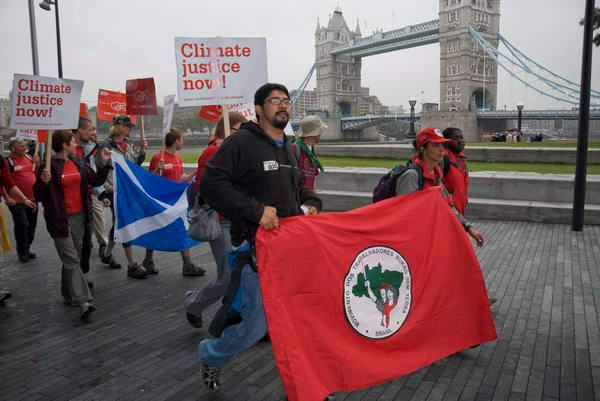
Brazilians lead on the last mile of a 1000 mile ‘Cut the Carbon’ march in the UK

I’d actually chosen these works specially to illustrate the international nature of the work. Although both were taken in London, one showed Brazilians leading a Christian Aid ‘Cut the Carbon’ march, and the other was from a protest against logging in the Tasmanian forest.

Having explained (with much gesture) how I wanted the work hung I got out of the way, looking at the other shows on in the centre – including some interesting black and white student work, as well as the show by Susana Dobal, and colourful pictures from India by Gisa Müller, before sitting down on the steps leading to the main street to make some last minute corrections to my lecture for the evening.

Before I had finished the show was hung and we were in the car heading back to ECCO, where I was to meet festival director Karla Osorio and lunch with her and the British ambassador.

More of my pictures from Brasilia.

Susana Dobal: Minding Language

One of the things I like to say is that if your work isn’t personal it isn’t worth doing. However my navel – and probably yours – is not of a great deal of interest to the rest of the world (I don’t even have any diamonds in mine, and generally prefer to keep it out of sight.) Our work also has to have something to say to other people, in some way reflecting our ideas, the issues that concern us. It has to be about something.

In photography we share a more or less common visual language across cultures. I can look at and respond (and have written about) work from China or Mexico or Mali or Albania, and although I may perhaps miss some of the more local cultural references, feel that I can appreciate (and criticise) the work.

But once we enter the Tower of Babel and bring written (or spoken) language into our work things can become more difficult. I probably am not the right person to review the work of Susan Dobal, whose Alem-Mar (Beyond the Sea) was showing at the Espaco Cultural Renato Russo in Brasilia last month, though I spent some time looking at it and thinking about it while my own work was being hung in the adjoining space. Dobal teaches photography at the University of Brasilia and has a PhD in the history of art from the City University of New York (2003) ws as as a masters in phtoography from New York University. She is one of four members of the Brazilian photo group ‘Ladrões of Alma‘ (The soul-stealers) along with Rinaldo Morelli, Usha Velasco and Marcelo Feijó.
For Dobal’s images of Portugal have added text in Portuguese. A woman totally in black, including a black hood, perhaps a religious or a widow in mourning, stands with her back to us on a stone floor in front of the massive warm orange pillars and arched doorway of a cathedral or something similar. She is small, seen from a middle distance, just right of the centre of the image.


From ‘
Alem-Mar’, (C) Susana Dobal (image Foto Arte2007)

It was an interesting image with some nice use of colour and a contrast between the light and warmth and power of the strong erect verticals and the deep sinister blackness of the crow-like figure.

But there was more to it. As if projected onto the floor was a short text in Portuguese, intended to contrast and illuminate the work. I think it says

sob sol escaldante
passeia a dor secular e ambulante”

which appears to mean

under the burning sun
strolls a pain secular and walking

Either I am missing something in my translation, or the text seems to add little or nothing to my reading of the image.

This was disappointing, as her earlier work on Zone Zero uses text in a far more interesting manner. In World, the images are largely of trees in urban settings shot in the ‘Superquadras‘ of Brasilia, but are combined with captions giving snippets of world news. These contrast with the seeming calm and isolation of these residential building blocks of the city, in which, if present, people are shown as isolated individuals.


From ‘Alem-Mar’, (C) Susana Dobal
(My apologies for the shadow at the top due to gallery lighting – and for generally poor reproduction.)

There were two pictures that attracted me very much as images in ‘Alem Mar’, Solar de Mateus I and II – presumably taken in the grounds of the famous Portuguese ‘stately home’ or manor house which is open to the public. One was of a many-trunked tree in a garden with some purple flowers, words added on its trunks and branches, in a very organic fashion. Again I’m not sure what they add to a picture that again shows Dobal as an excellent colorist.

A final image that caught my imagination is also on the Foto Arte site:

and here it was the flow of the text and the flow or the girl’s hair. Barroco means weird or freaky (or baroque) but my dictionary doesn’t include ‘alumbramento‘, although it sounds like some musical term and is certainly the title of a song.

2008 To Do List

I’m not a great believer in New Year resolutions, which tend to get broken in the first week or two anyway. But it’s often useful to make lists so here’s a quick one, some of which I hope will be of some interest to others. I’ll start with the one that has always been by aim.

1. Make better pictures
Pictures that matter more to me, that say what I think is worth saying. Thirty years ago I decided to take the pictures I wanted to take rather than try and make a living from photography. It led to years of hard graft teaching and doing photography in the gaps, low earnings, and not a great deal of recognition. Of course I don’t regret it. And it’s great to find other people who understand and care too, whether they write to me about my work on the web or see my work in the occasional show – such as that at Foto Arte 2007 in Brasilia, on until Jan 20.

2. get out more and take more pictures.
I got off to a good start on this one, at the New Year Parade in Westminster (which is why this blog appears on Jan 2.) More pictures from this on My London Diary. Events force you to get off your backside or you miss them. What is harder to keep doing are the longer-term projects, where its always too easy to look out of the window and decide the weather isn’t quite right, or find other reasons not to work on them today. Experience of course tells me that the best pictures often come in bad weather and the time is never perfect.

3. check my camera settings more often when taking pictures
So yesterday I decide one picture needs -1.33 stop, and find half an hour later that I’ve shot another hundred or so that didn’t want it at the same setting… Or that the whole set of pictures I shot in one very dark street all show unwanted motion blur because I didn’t increase the ISO… It’s so easy to get absorbed in the visual side of image-making and forget the technical (though many more photographs are failures for the opposite reason – technically perfect nothings.)

4. always check for dirt on the lens
Check and keep checking. Become paranoid about it. One of the best set of pictures I almost took in 2007 was ruined by a little bit of greasy dirt. It had been a huge rush and I hadn’t had time for my normal careful checks as I packed my camera bag.

5. edit my work more stringently
I’m writing this as Lightroom churns out 244 jpegs from the 800 or so pictures I took yesterday. I need to work that down into a much more sensible number for the web and libraries etc.

6. sort out a proper back-up system
After I lost a couple of days work when I first started using digital I’ve been careful to always make sure the first thing I do is to make TWO copies of every file I shoot as soon as I get back to base. But in the longer term that doesn’t really address the needs, as the volume of data is too large, and the media used have limited lifetimes.

For the longer term I need to sort out a carefully edited core of work for extended storage in some form or other. Or rather at least two forms, one preferably off-site.

7. make proper to-do lists
My preferred format for these at the moment is backs of envelopes. That may be ok for developing Government policies, but this is far more serious! I could do it on computer, (and I’ve tried it in the past) but I think it will work best as a large list on the wall of my work room.

8. really sort out my old ‘street photography’
‘Street’ is more a way of thinking and working, and I think most of what I do is street, though there are some purists who have some very funny ideas about it. But it would be nice to put some of my old work, scattered through perhaps 25 years of negatives, together.

9. publish, at least on the Internet, my Docklands work from the 1980s
Pictures of the empty and abandoned docks before the redevelopment really got going that I’ve hardly shown or printed for 20 years. This is stuff that people thought I was mad to bother with then, but I think will be of interest now.

10. get back to scanning my old work which is on deteriorating film negatives
Much of my older work can now only be printed by scanning, restoration work on the scans and then digital output. Film that has been processed and stored under ideal conditions has a decent life-time, but in the real world things are different for many of us.

11. rewrite as many as possible of my features and put them back on line
Few of the several thousand articles I wrote from 1999-2007 are still available on line. For legal and financial reasons I can’t simply republish them, but I would like to write about some of the same photographers and themes again. The problem is finding some way to generate an income that would make devoting the time to this possible.

12. make more money by selling photographs
I wish I knew how!

So my best wishes for a happy and successful 2008 for us all,

Peter

Nick Ut – Now and Then

If you haven’t yet read it, take a look at Nick Ut: Double Negative, an interesting article in a paper I seldom read, the Daily Telegraph. Nick Ut is the guy who took the iconic Vietnam image of a nine-year-old girl running along the road towards him, screaming, naked because she had torn off her napalm covered burning clothes, strips of burnt skin hanging from her shoulders. It was a picture that changed the attitudes of many towards the war, and won Ut a Pulitzer prize.

As John Preston says, he took the shot, but then saved Kim Phuc’s life, cleaning off the napalm, wrapping her in a jacket and driving her to hospital. The two are still in contact, still friends – almost family – 35 years later.

Last year, he took another picture that made the news worldwide, catching Paris Hilton crying in a car after she had been told she would serve her jail sentence. Ut was one of a pack of several hundred photographers outside her house, and with his camera on high speed, just happened to get one ‘lucky’ shot in which her face is clear – and clearly crying.

It isn’t a good picture. It’s about an event of infinitesimal significance to anyone except the one spoilt woman in the car, but it made front pages and TV news around the world. It makes me sick that so many photographers are wasting so much time on such trivia – and that it is more or less all that pays. Ut says he doesn’t mind, was “grateful to have the work.” To me it is just a total waste of time and talent.